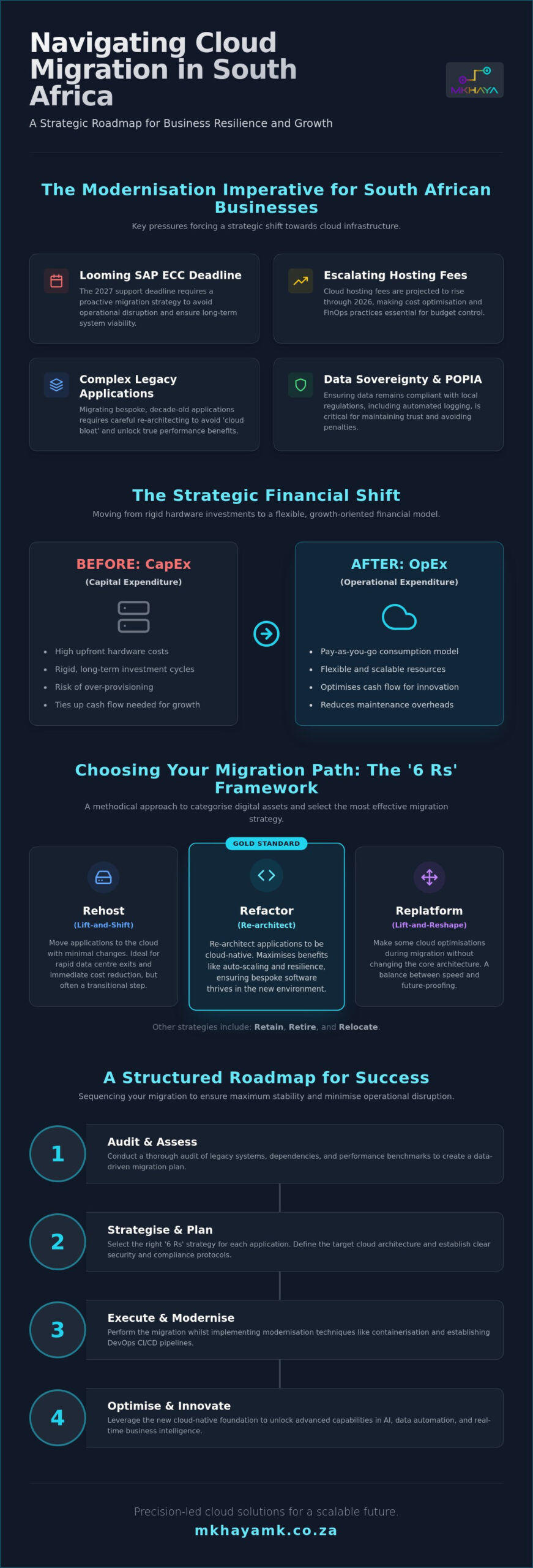
With the SAP ECC support deadline looming in 2027 and cloud hosting fees projected to rise throughout 2026, is your business infrastructure built for long-term resilience or merely for survival? Many South African organisations find themselves caught between the desire for agility and the heavy weight of high upfront hardware costs. You’re likely concerned about the complexity of migrating bespoke legacy applications whilst ensuring your data remains compliant with the latest POPIA automated log requirements. We understand that this transition feels like a high-stakes evolution rather than a simple IT project.
Choosing the right cloud migration services south africa provides a path to turn these challenges into a competitive advantage. This strategic guide explores how to seamlessly transition your business infrastructure to the cloud whilst optimising costs and ensuring absolute data sovereignty. We will explore the shift towards hybrid cloud models, the necessity of FinOps to manage escalating hosting costs, and the precise engineering required to modernise your software for a scalable future. By aligning your digital transformation with local regulatory shifts, you can build a stable, secure foundation that grows alongside your ambitions.
Key Takeaways
Understand the strategic shift from high upfront hardware costs to flexible operational models that optimise cash flow and support sustainable growth.
Select the most effective strategy for your business by exploring the ‘6 Rs’ framework, ensuring your choice of cloud migration services south africa aligns with your technical goals.
Master the nuances of POPIA compliance and data sovereignty to maintain trust and meet evolving regulatory requirements in the local landscape.
Follow a structured roadmap for auditing legacy systems and sequencing your migration to ensure maximum stability whilst minimising operational disruption.
Leverage your new cloud-native foundation to unlock advanced capabilities in AI and data automation for enhanced real-time intelligence.
What are Cloud Migration Services in the South African Business Context?
Cloud migration is the strategic process of relocating your digital assets, databases, and core applications into a virtualised environment. In South Africa, this isn’t merely a technical shift; it represents a fundamental pillar of digital transformation. Rather than viewing it as a simple file transfer, forward-thinking firms see it as an opportunity to refine their software architecture and build a more agile business foundation. Using professional cloud migration services south africa allows local enterprises to move away from the restrictive cycle of purchasing and maintaining physical hardware.
The transition from capital expenditure (CapEx) to operational expenditure (OpEx) is particularly vital for local firms managing fluctuating market conditions. By moving away from heavy upfront hardware investments, businesses can allocate resources more precisely toward growth and innovation. This bespoke approach ensures that your migration plan respects the unique requirements of the local market, including specific regulatory hurdles and infrastructure constraints.
To better understand the practicalities of this transition, watch this helpful overview:
Selecting the correct framework is the most critical step in your digital journey. While some providers offer a one-size-fits-all approach, effective cloud migration services south africa rely on the ‘6 Rs’ framework to categorise digital assets based on their future value. These strategies include Rehosting, Replatforming, Refactoring, Retiring, Retaining, and Relocating. This methodical approach ensures that resources aren’t wasted on obsolete systems whilst prioritising the applications that drive your revenue.
Rehosting, often called ‘Lift-and-Shift’, serves as the fastest route to the cloud. It involves moving your existing applications and data to a cloud environment without making significant changes to the underlying code. This path is ideal for businesses needing to exit a data centre quickly or those looking to reduce immediate hardware costs. However, it’s often a transitional phase rather than a final destination. Recent research on cloud adoption highlights that South African firms often struggle to see long-term ROI if they rely solely on rehosting without eventually modernising their stack.
For businesses with unique requirements, Refactoring stands as the gold standard. This involves re-architecting your applications to be cloud-native, allowing them to take full advantage of cloud features like auto-scaling and high availability. At Mkhaya MK, we leverage our software engineering expertise to ensure that your bespoke applications don’t just survive the move but thrive in their new environment. This precision-led approach protects the integrity of your logic whilst preparing it for a scalable future.
Modernising Legacy Applications
Moving a decade-old bespoke application directly into the cloud often results in ‘cloud bloat’, where performance stays stagnant while costs rise. True modernisation involves containerisation and microservices. This allows your software to scale individual components independently, making the system more resilient. We focus on maintaining application integrity through precise engineering, ensuring that your users experience a seamless transition without losing the familiarity of their existing UI/UX. If you’re looking for a partner to guide this technical evolution, exploring our cloud solutions can help define the most efficient path forward.
The Role of DevOps in Migration
DevOps is the engine of a successful move. By automating deployment cycles, we eliminate the risks associated with manual configuration and human error. Implementing Continuous Integration and Continuous Deployment (CI/CD) means your infrastructure evolves alongside your business needs. Managed DevOps services provide the long-term stability required to manage complex cloud environments, allowing your internal teams to focus on innovation rather than maintenance. This creates a rhythmic momentum where software updates are frequent, reliable, and invisible to the end-user.
Navigating South African Cloud Challenges and Regulations
South Africa’s regulatory environment demands a methodical approach to data management. When you engage with cloud migration services south africa, compliance isn’t just a tick-box exercise; it’s a commitment to your customers’ privacy. The Protection of Personal Information Act (POPIA) has evolved, and as of 2026, the Information Regulator requires organisations to provide automated logs of data deletion. This ensures that personal information is only retained as long as necessary, a task that becomes significantly more manageable within a well-engineered cloud environment.
Data sovereignty remains a top priority for local enterprises, especially those in the financial and public sectors. Ensuring your business data stays within South African borders is no longer a hurdle, thanks to the established presence of global hyperscale regions in Johannesburg and Cape Town. These local data centres provide the low-latency connectivity required for high-performance applications whilst satisfying legal requirements for data residency. This proximity reduces the risks associated with international data transfers and ensures your operations remain stable regardless of global connectivity fluctuations.
Currency volatility and rising global demand for AI infrastructure often lead to unpredictable hosting fees. South African firms must account for these variables to avoid the common pitfall of “cloud bill shock.” By partnering with local experts who understand the nuances of the South African economy, you can build a more resilient financial model for your IT operations. This involves balancing the need for global innovation with the practicalities of local cost management.
Security and Compliance in a Virtual Environment
Adopting a zero-trust architecture during your migration phase ensures that every access request is fully authenticated and authorised. This approach treats all traffic as potentially hostile, regardless of whether it originates inside or outside your network. Effective identity and access management (IAM) protocols allow you to control exactly who interacts with sensitive corporate data. Regular auditing and automated reporting become your primary tools for demonstrating compliance to South African regulators, providing a transparent and reliable record of your data handling practices.
Cost Optimisation Strategies
Meticulous resource monitoring is the only way to prevent “cloud sprawl,” where unused or over-provisioned resources inflate your monthly bill. Leveraging local expertise helps you select the most cost-effective service tiers tailored to your specific traffic patterns. For a deeper look at managing your expenses, read our guide on Cloud Cost Optimisation in South Africa. This proactive financial management ensures your scalable infrastructure remains a strategic asset rather than a growing liability.
A Step-by-Step Roadmap for Successful Migration
A successful digital evolution relies on a methodical sequence of events rather than a single leap. When searching for cloud migration services south africa, it’s essential to find a partner that values precision over speed. Our roadmap is designed to protect your operational continuity whilst modernising your core systems. It begins with a deep understanding of your current environment and ends with a refined, high-performance cloud ecosystem.
Strategic Planning follows the initial audit, where we map out the migration sequence. We prioritise systems based on their business criticality to ensure that your most vital services are handled with the highest level of care. This planning phase acts as a blueprint, preventing the common pitfalls of overlapping dependencies and resource bottlenecks that often plague unplanned moves.
Phase 1: The Technical Audit
The journey starts with a comprehensive assessment of your current infrastructure. We don’t just look at servers; we assess the complex web of software dependencies that keep your business running. This phase includes:
Identifying ‘low-hanging fruit’, which are applications that offer high value with low migration complexity.
Mapping interdependencies between custom applications and their respective databases.
Assessing the readiness of legacy code for a cloud-native environment.
For more complex phases where your internal team might be stretched, we often recommend staff augmentation to provide the specialised engineering capacity required for high-intensity migrations. This ensures that your daily operations never suffer while your infrastructure evolves under the guidance of experts.
Phase 2: Execution and Cutover
Once the blueprint is finalised, we move into Execution and Cutover. We always implement a pilot migration to test our assumptions in a controlled environment. This allows us to refine data synchronisation strategies, ensuring zero data loss during the final move. The ‘cutover’ window is managed with surgical precision to keep business disruptions to an absolute minimum, often occurring during low-traffic periods to protect the user experience.
The final stage of Optimisation is where the true value of the cloud is realised. We don’t just leave you with a working system; we fine-tune the environment to ensure your resource consumption matches your actual needs. This reduces waste and ensures your scalable infrastructure remains as lean and efficient as possible. If you are ready to begin your technical audit, contact our engineering team today to discuss your roadmap.
Beyond Migration: Leveraging AI and Custom Cloud Solutions
Completing your move is just the beginning of a larger journey toward operational excellence. While many providers treat the cutover as the end of the engagement, the most successful firms view it as the vital foundation for future innovation. By selecting comprehensive cloud migration services south africa, you create the high-performance environment necessary to deploy advanced AI and data automation. This infrastructure allows your business to process vast amounts of information in real-time, turning raw data into actionable business intelligence that drives decision-making.
Modern cloud-native applications don’t just store data; they facilitate sophisticated, automated workflows that scale with your ambitions. We specialise in customising these environments to support complex, industry-specific platforms that require high levels of precision. Whether you’re running an integrated ERP solution or a high-volume Loan Management System, your cloud environment should be precision-engineered to match your unique operational rhythm. This level of customisation ensures that your technology supports your business goals rather than forcing you to adapt to rigid software constraints.
Building AI-Ready Infrastructure
Preparing for machine learning requires more than just basic storage. It involves constructing structured data lakes within the cloud that allow models to access high-quality information without latency. Once this foundation is stable, cloud-based Robotic Process Automation (RPA) can be used to automate routine business tasks, freeing your team for more strategic, creative work. For a deeper look at how these technologies are reshaping the local market, see our guide on AI Automation Solutions in South Africa.
Why Mkhaya MK is the Strategic Choice
Choosing Mkhaya MK means partnering with a team that values your long-term success as much as you do. Our national footprint across South Africa allows us to understand the specific challenges of local enterprise resilience, from energy constraints to regulatory shifts. We don’t just provide cloud migration services south africa; we offer a supportive partnership rooted in software excellence and methodical execution. We invite you to consult with us on a bespoke digital transformation strategy that turns your vision into a stable, scalable reality. Together, we can build a future that’s both technologically advanced and grounded in practical business results.
Building Your Scalable Future in the Cloud
Transitioning your infrastructure is a strategic evolution that requires more than just technical execution; it demands a visionary approach to software integrity and regulatory resilience. By choosing specialised cloud migration services south africa, you ensure that your bespoke legacy systems are refactored for modern performance whilst maintaining strict POPIA compliance. This methodical shift doesn’t just reduce operational costs; it creates the stable, AI-ready foundation your business needs to thrive in a competitive landscape.
We’ve explored how a structured roadmap and the right migration framework can turn complex technical challenges into long-term assets. Mkhaya MK provides the national support and consulting expertise required to navigate this journey with quiet confidence. Our focus remains on your mutual success, ensuring that every step of your digital transformation is precise and purposeful. It’s time to scale your business with Mkhaya MK’s Cloud Solutions and embrace a partnership built on reliability. Your future in the cloud is bright, and we’re ready to help you build it.
Frequently Asked Questions
What are the primary benefits of cloud migration for South African businesses?
Cloud adoption allows South African businesses to move from heavy capital expenditure to a flexible operational model. This shift provides immediate access to scalable infrastructure that grows with your business needs. Additionally, migrating protects your operations from local infrastructure instability, ensuring your data remains accessible and secure regardless of power or connectivity challenges at your physical premises.
How long does a typical cloud migration project take to complete?
The timeline for a migration project depends on the complexity of your digital estate and the volume of data involved. A small-scale migration might take several weeks, whereas a full-scale enterprise transition involving bespoke applications can span several months. We focus on a methodical approach that prioritises stability, ensuring each phase is thoroughly tested before proceeding to the next stage of the roadmap.
Is my data secure in the cloud according to POPIA regulations?
Data remains secure and compliant with POPIA regulations when you utilise cloud migration services south africa that prioritise local data residency. By hosting your data in South African hyperscale regions, you satisfy legal requirements for sovereignty whilst benefiting from global security standards. We implement zero-trust architectures and automated deletion logs to ensure your compliance remains robust and transparent to regulators.
What is the difference between a ‘lift-and-shift’ and a ‘refactoring’ strategy?
Lift-and-shift, or rehosting, involves moving your existing software to the cloud without changing its code, which is ideal for a rapid exit from physical hardware. Refactoring is a more sophisticated strategy where we re-architect applications to be cloud-native. This gold-standard approach ensures your custom software takes full advantage of cloud features like auto-scaling, leading to better long-term performance and lower operational costs.
How can we avoid downtime during the migration process?
Minimising downtime is achieved through phased execution and rigorous pilot testing in controlled environments. We synchronise data in the background and only perform the final cutover during low-traffic windows to protect your business continuity. This precision-led strategy ensures that your users experience a seamless transition without any significant disruption to their daily workflows or access to critical services.
What are the hidden costs of cloud migration that I should plan for?
Planning for hidden costs involves looking beyond the monthly hosting fee to account for data egress charges and initial resource over-provisioning. You should also consider the investment required for staff training and the potential for “cloud sprawl” if resources aren’t actively monitored. Using professional cloud migration services south africa helps you identify these variables early, allowing for a more accurate and predictable financial model.
Can my custom-built legacy software be moved to the cloud?
Bespoke legacy applications can certainly be moved to the cloud through a process of containerisation and software re-engineering. We specialise in refactoring these systems to ensure they remain functional and performant in a virtualised environment. This allows you to retain the unique logic of your custom software whilst gaining the scalability and security benefits of modern cloud infrastructure.
Do I need to hire new staff to manage our cloud infrastructure?
You don’t necessarily need to hire new full-time employees to manage your new environment. Many organisations choose to use managed DevOps services or staff augmentation to fill specific skill gaps during and after the transition. This approach provides access to expert engineering talent without the long-term overhead of permanent hires, allowing your existing team to focus on their core business objectives.
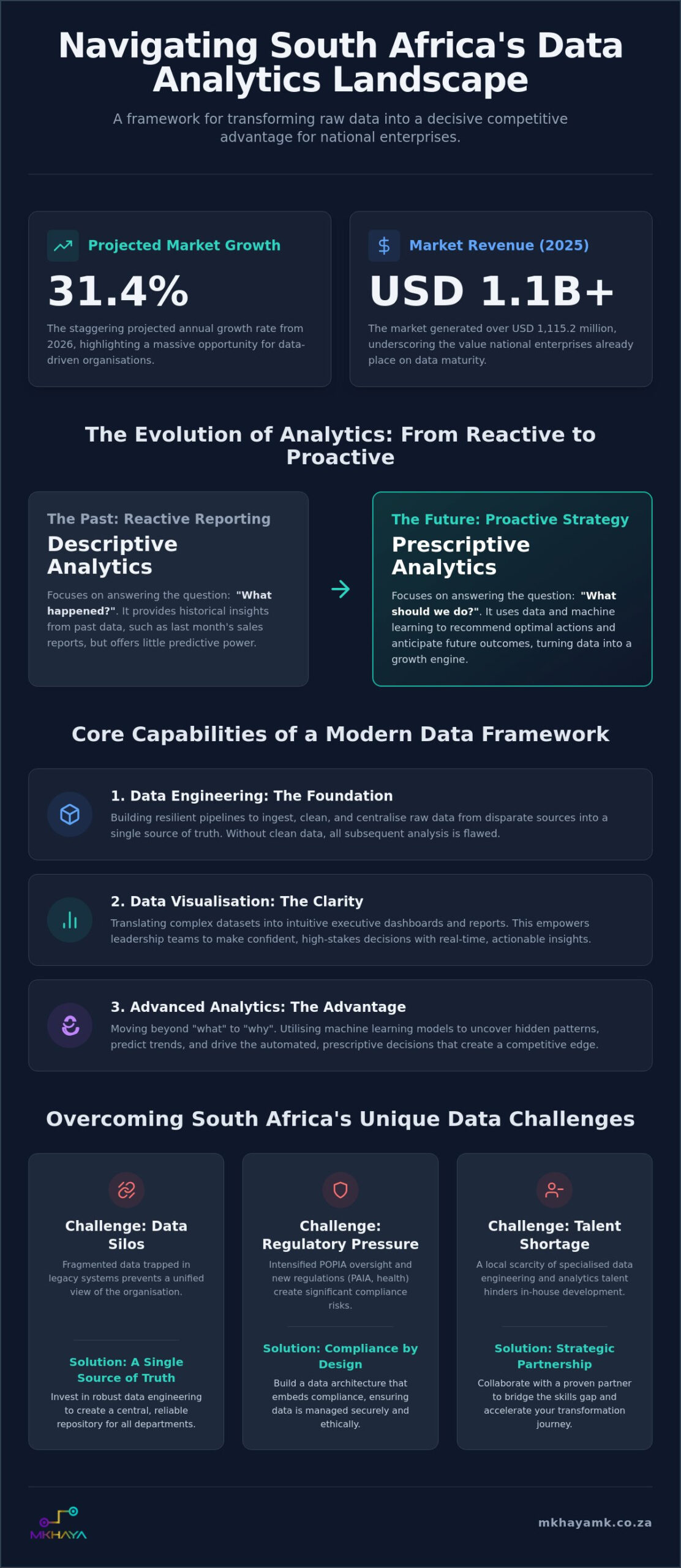
With the South African data analytics market projected to grow at a staggering 31.4% annually from 2026, the gap between businesses that guess and those that know has never been wider. You’ve likely felt the frustration of fragmented data silos trapped within legacy systems or the pressure of the 30 June PAIA annual report deadline. Finding reliable data analytics services south africa shouldn’t feel like a gamble on unproven ROI. It’s understandable to feel cautious when internal specialised engineering talent is scarce and the regulatory landscape, especially with the new health information regulations that took effect in March, is shifting beneath your feet.
We’re here to help you turn that uncertainty into a decisive competitive advantage. This guide provides a clear, executive framework to move your organisation from basic reporting to automated decision-making and predictive modelling. We’ll explore how to establish a single source of truth that satisfies the Information Regulator’s intensified POPIA oversight whilst positioning your business for long-term stability. You’ll learn how to bridge the local skills gap and select a partner that aligns your technical architecture with your most ambitious digital transformation goals.
Shift your perspective from reactive reporting to prescriptive analytics to turn raw data into a proactive engine for business growth and digital transformation.
Learn to evaluate data analytics services south africa based on their commitment to transparency and their ability to translate complex technical stacks into clear business outcomes.
Establish a single source of truth by investing in robust data engineering and intuitive visualisations that empower your executive team with real-time, actionable insights.
Overcome the local specialised talent shortage and ensure POPIA compliance by adopting a flexible, methodical approach to scaling your technical capabilities.
Discover the Mkhaya MK “Consulting to Execution” methodology, designed to bridge the gap between initial strategy and long-term technological stability.
The landscape of data in South Africa has shifted dramatically. It’s no longer just about looking at last month’s sales figures. Modern Data analysis has transitioned from a passive reporting function into a core engine that drives every strategic move. In 2026, the most successful national enterprises treat their data as a living asset rather than a dusty archive. This evolution is central to why data analytics services south africa are now considered the bedrock of any serious digital transformation journey.
We’ve moved past the era of descriptive analytics, which merely told us what happened. Today, the focus is on prescriptive analytics; the science of determining what we should do next to achieve a specific outcome. This shift allows businesses to anticipate market fluctuations and supply chain disruptions before they impact the bottom line. It’s a move from reactive firefighting to proactive, methodical growth that builds a stable foundation for future innovation.
To better understand the practical side of this evolution, watch this helpful video:
Why National Enterprises are Prioritising Data in 2026
Operational efficiency is the primary driver. With the South African data analytics market having generated USD 1,115.2 million in revenue in 2025 and projected to grow at a CAGR of 31.4% through 2033, national enterprises recognise that data maturity is no longer optional. Real-time data allows for immediate cost reduction by identifying waste in logistics or production. It isn’t just about saving money, though. Data-driven insights provide the necessary roadmap for scaling technology platforms securely. By understanding local consumer behaviour through granular data, businesses can personalise experiences in a way that feels authentic rather than automated. This precision is what allows local firms to hold their own against global competitors.
The Intersection of Data Analytics and Custom Software
Many organisations find that off-the-shelf tools simply can’t handle the unique logic of their operations. This is where the integration of analytics into custom software development becomes vital. When your data architecture is built into the very fabric of your applications, you create a seamless flow of information. This bespoke approach ensures long-term organisational stability. It prevents the common pitfall of having powerful software that remains “blind” to the insights hidden within its own databases. By choosing data analytics services south africa that understand this intersection, you ensure your technology and your strategy move in perfect lockstep. We believe in a methodical execution that values transparency over flashy claims, ensuring your data informs every line of code we write.
A robust framework acts as the nervous system of your organisation. It doesn’t just store information; it organises it into a coherent narrative that supports long-term stability. To get the most from data analytics services south africa, your framework must excel in four critical areas that bridge the gap between raw information and strategic action.
Data Engineering: This is your foundation. It involves building resilient pipelines that ingest, clean, and move raw data from disparate sources into a central repository. Without clean data, even the most advanced AI will produce flawed results.
Data Visualisation: Raw numbers rarely inspire action. By transforming complex datasets into intuitive executive dashboards, you give your leadership team the clarity needed to make high-stakes decisions with quiet confidence.
Advanced Analytics: This moves beyond what happened to why it happened. Machine learning models identify hidden patterns and predict future trends, allowing you to stay ahead of market shifts.
Data Governance: This ensures your data remains high-quality, secure, and compliant. It’s the set of rules that keeps your organisation aligned with national standards whilst maintaining the integrity of your insights.
Leveraging AI and Data Automation
Static reporting is a relic of the past. Modern AI automation solutions turn your data into a proactive force. By implementing Robotic Process Automation (RPA), you can automate the tedious tasks of data cleaning and organisation, freeing your team for higher-level strategy. Whilst many businesses rely on standard tools, the real competitive edge in 2026 comes from custom-built predictive engines that reflect your unique business logic and operational goals.
Cloud-Native Data Solutions
Scalability is non-negotiable for data-intensive applications. Utilising managed cloud services ensures that your storage capacity grows alongside your business without the need for massive upfront hardware investments. This approach provides the high availability and performance required for real-time analytics. Integrating DevOps practices into your data workflow allows for the rapid deployment of new features, ensuring your analytics capabilities are always evolving. If you’re looking to refine your technical architecture, exploring our approach to digital transformation can help you identify the most effective path forward for your specific needs.
Selecting data analytics services south africa requires moving beyond a simple checklist of technical certifications. Whilst platform designations provide a baseline, they rarely account for the nuance of your specific operational logic. A true partner acts as a visionary guide, bridging the gap between raw data and your most ambitious business goals. You should look for a partner that projects “quiet confidence”; a persona that values transparency and methodical execution over flashy, unverified claims. This reliability is what transforms a service provider into a stable anchor for your technological evolution.
It’s essential to find a balance between strategic consulting and technical execution. A partner that only offers high-level advice leaves you with a roadmap but no vehicle. Conversely, a purely technical firm might build a powerful engine that doesn’t align with your commercial objectives. We believe the most successful engagements follow a structured process that moves from a broad vision to a concrete, step-by-step path forward, ensuring every technical milestone delivers a practical business benefit.
Technical Expertise vs. Business Alignment
Your partner must speak the language of ROI. If a team focuses solely on Python or SQL without discussing how those tools drive digital transformation, the alignment is missing. Designing effective data models is a collaborative relationship; it requires deep dives into your unique workflows to ensure the architecture supports your long-term journey. As your organisation grows, you may need to scale your capabilities through staff augmentation, ensuring you have the right talent at the right time without the overhead of permanent hiring or the delays of a traditional recruitment cycle.
The Custom Advantage: Bespoke vs. Template Solutions
Template-based dashboards often carry hidden costs. Whilst they appear cheaper initially, they frequently fail to capture the complexity of South African industries, leading to “blind spots” in your reporting. Custom-built solutions offer the precision needed for high-stakes decision-making. By investing in a bespoke architecture, you ensure your data remains a valuable asset rather than becoming a legacy burden that hinders future agility. Our commitment to integrity and transparency ensures that every custom build is designed for stability and precision, providing a single source of truth that you can rely on for years to come.
South African executives face a unique set of hurdles that global counterparts might overlook. Whilst the strategic value of data analytics services south africa is clear, the practical implementation often hits a wall when confronted with the national shortage of specialised engineering talent. It’s one thing to envision a data-driven future; it’s another to find the senior analysts, who now command average salaries of R656,497, to build it. Beyond the talent war, the regulatory environment has become significantly more rigorous, requiring a partner that understands the local legal fabric as well as the code.
Scaling Teams with Staff Augmentation
When internal recruitment stalls, IT staff augmentation provides a flexible bridge to success. This model grants you immediate access to scarce data specialist skills without the long-term overhead of permanent hiring or the delays of traditional recruitment. Whether you need on-site professionals in Cape Town or remote engineers to scale a national project, extending your team allows for the methodical execution of project-specific transformations. It’s a visionary way to bypass the local skills shortage, ensuring your digital transformation doesn’t lose momentum due to empty seats in your tech department.
Data Security and Compliance as a Competitive Edge
Compliance isn’t just a legal box to tick; it’s a way to build trust with a sophisticated consumer base. In March 2026, the Information Regulator shifted to a proactive oversight model, moving beyond reactive complaints to targeted assessments in high-risk sectors. This makes navigating POPIA complexities during data migration more critical than ever. Additionally, the new health information regulations that came into force on 6 March 2026 require immediate attention from insurers and medical schemes. Implementing robust encryption and access controls within your data lake ensures integrity, especially when integrating legacy ERP solutions with modern analytics.
Resilient infrastructure is the final piece of the puzzle. Your data architecture must withstand local connectivity challenges and power fluctuations to ensure high availability for decision-makers. By building a stable, hybrid-cloud environment, you protect your “single source of truth” from external disruptions. If you’re ready to secure your data future and bridge the talent gap, contact us today for a transparent discussion on how our professionals can support your journey.
We act as the stable anchor in your technological evolution. Unlike standalone BI tools that often offer surface-level charts without context; our approach treats data as a critical component of end-to-end digital transformation. By choosing our data analytics services south africa, you’re opting for a partner that values methodical refinement over flashy, short-term claims. We bridge the gap between initial strategy and long-term stability by integrating your data architecture directly with your ERP solutions and bespoke software environments.
Our “Consulting to Execution” methodology ensures that every insight we uncover is backed by the technical capability to implement it. This synergy prevents the common frustration of having a roadmap without a vehicle. We don’t just tell you what the data says; we build the automated systems that act on those findings. It’s a collaborative relationship built on transparency and mutual success, ensuring your data assets become more valuable with each passing year. This commitment to your personal journey is what defines our “quiet confidence” in a noisy market.
A Step-by-Step Path to Data Maturity
Achieving true business intelligence requires a structured progression. We guide you through three distinct phases to ensure your investment delivers measurable results and satisfies the Information Regulator’s evolving requirements:
Phase 1: Discovery and Audit – We begin by identifying your most valuable data sources and uncovering the fragmented silos that hinder your progress. This phase ensures your strategy is rooted in the reality of your current operations.
Phase 2: Foundation Building – We establish secure, cloud-based data warehouses that serve as your single source of truth. This architecture is designed to be scalable and resilient, providing a stable base for all future custom development.
Phase 3: Insights and Automation – Once the foundation is stable, we deploy intuitive executive dashboards and AI-driven workflows. This turns your static information into a proactive engine for automated decision-making.
Ready to Transform Your Data into a Strategic Asset?
The journey from raw numbers to visionary business intelligence is one of the most significant steps an organisation can take. It requires a forward-looking mindset that embraces agile, modern technology whilst remaining rooted in traditional values of integrity and commitment. By choosing data analytics services south africa that prioritise your specific business logic, you ensure that your digital transformation is both ambitious and practical. We’re ready to act as your stable guide in this rapidly changing landscape. Start your journey with us today and discover the power of a partnership that’s deeply invested in your long-term success.
The shift towards prescriptive analytics and automated decision-making is no longer a luxury for South African enterprises. It’s the foundational architecture for long-term stability. By integrating these insights into your custom software and ERP systems, you create a single source of truth that empowers your leadership team. Navigating the complexities of POPIA whilst managing the national skills shortage requires a partner who understands the local landscape as deeply as the technical code.
Choosing the right data analytics services south africa is about more than just technology; it’s about finding a visionary guide for your end-to-end digital transformation. With our national reach and proven track record in AI and custom software engineering, we act as a stable anchor for your technological evolution. We’re committed to your personal journey, ensuring that every data point leads to a practical business outcome and measurable growth.
What are the main benefits of using data analytics services in South Africa?
The primary benefit is turning fragmented data into a proactive business engine that drives digital transformation. By leveraging data analytics services south africa, organisations can automate decision-making processes and gain a competitive edge through predictive modelling. This shift allows you to anticipate market changes rather than simply reacting to them, ensuring your business remains a stable anchor in a changing landscape.
How does POPIA affect data analytics implementation for local businesses?
POPIA requires strict data governance and security protocols throughout the entire analytics lifecycle. Since the Information Regulator shifted to proactive oversight in March 2026, businesses must ensure that data migration and storage are fully compliant. This involves implementing robust encryption and access controls to protect personal information whilst maintaining the integrity of your insights and satisfying the latest regulatory assessments.
Should we build an internal data team or outsource to a South African partner?
Outsourcing to a local partner is often more efficient due to the national shortage of specialised data engineering talent. Whilst internal teams offer deep company knowledge, a partner provides a broader perspective and access to senior expertise that is difficult to recruit. This approach reduces the overhead of permanent hiring and allows for more agile scaling of your technical capabilities through a collaborative relationship.
What is the difference between Business Intelligence (BI) and Data Analytics?
Business Intelligence focuses on descriptive reporting of past events, whereas data analytics involves prescriptive and predictive modelling for the future. BI tells you what happened in your last quarter. Analytics uses machine learning to identify patterns that suggest what you should do next to optimise your results. It’s the difference between looking in the rear-view mirror and having a visionary guide for the road ahead.
How much does it cost to implement a custom data analytics solution?
The investment for a custom solution depends entirely on the complexity of your data silos and the specific business logic required. We focus on a methodical execution that ensures long-term stability and a clear path to ROI. Rather than providing a generic price, we believe in a thorough discovery phase to define a precise scope that aligns perfectly with your strategic goals and digital journey.
Can data analytics be integrated with our existing ERP or Loan Management systems?
Yes, modern analytics frameworks are designed to integrate seamlessly with existing ERP or Loan Management systems. Custom engineering allows us to build the necessary pipelines to move and clean data from these legacy platforms. This integration ensures that your analytics engine has access to all relevant information, creating a single source of truth for your entire organisation.
What is the average timeline for a digital transformation project involving data?
Timelines vary based on the maturity of your existing data infrastructure and the scale of the transformation. A typical project moves through structured phases of discovery, foundation building, and final deployment of insights. This deliberate pace ensures that each milestone is fully articulated and reliable before moving to the next stage, reinforcing our image as a detail-oriented and reliable partner.
How does staff augmentation help with data analytics backlogs?
Staff augmentation provides immediate access to scarce specialists to help you clear technical debt and accelerate your data analytics services south africa projects. It allows you to scale your team nationally with remote or on-site professionals without the delays of traditional recruitment. This flexibility is essential for overcoming project-specific backlogs and maintaining momentum in a competitive, high-end technological landscape.
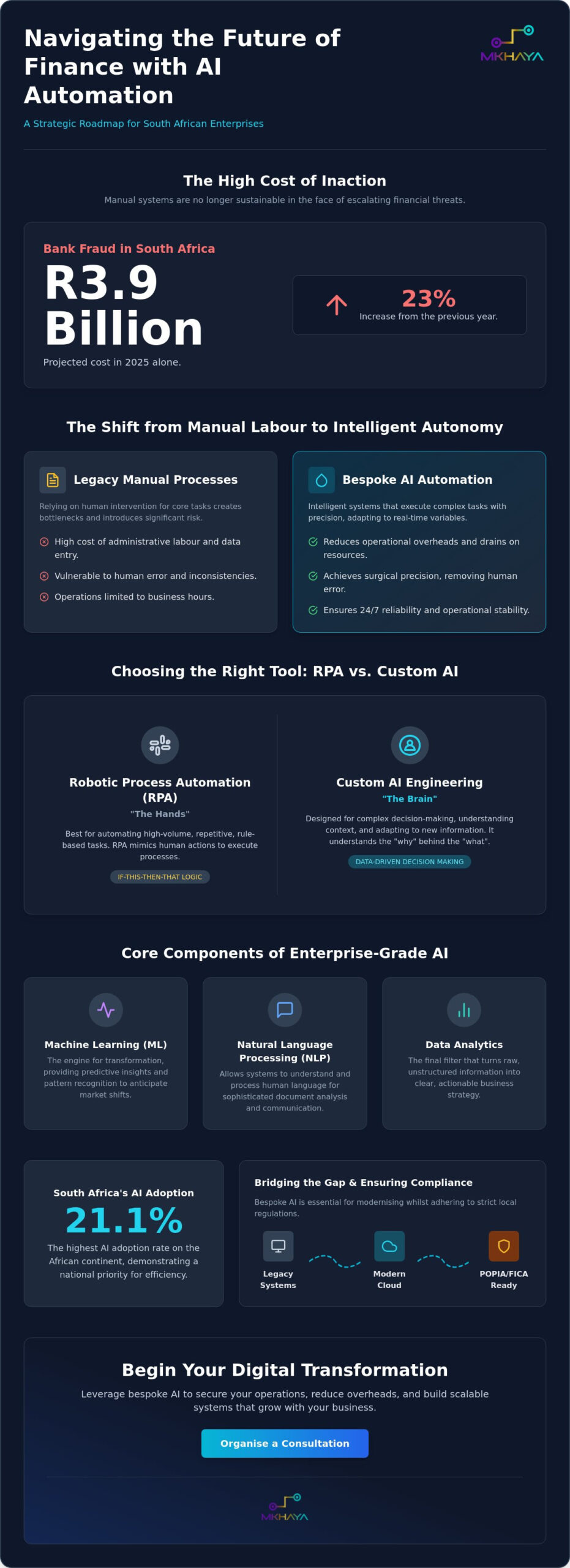
With bank fraud in South Africa costing R3.9 billion in 2025, a 23% increase from the previous year, the financial risk of relying on manual legacy systems is no longer sustainable. You’re likely finding that manual data entry errors in your financial processes are more than just a nuisance; they’re a drain on your resources. Adopting bespoke AI automation solutions south africa isn’t just about following a trend. It’s about securing your operations against rising costs and the intensified POPIA compliance monitoring expected throughout the 2026/2027 financial year.
We understand that the prospect of integrating modern intelligence with older ERP or loan management systems feels like a daunting task. It’s a challenge shared by many enterprises striving to balance stability with the need for rapid growth. This guide provides a strategic roadmap to help you leverage bespoke AI to bridge that gap. You’ll discover how to reduce operational overheads and build scalable systems that grow alongside your business. We’ll look at the shift toward agentic AI and how to maintain POPIA compliance whilst modernising your core operations. Precise execution for a more efficient future.
Key Takeaways
Distinguish between basic task automation and intelligent decision-making to identify the most impactful opportunities for your digital transformation.
Compare the “hands” of robotic process automation with the “brain” of custom AI engineering to ensure your technology stack supports long-term strategic goals.
Utilise a practical checklist to assess your data readiness and secure your operations against evolving POPIA and FICA regulatory requirements.
Discover how bespoke AI automation solutions south africa can bridge the gap between legacy ERP systems and modern, scalable cloud architectures.
Understand the benefits of flexible engagement models, such as staff augmentation, to build a stable and high-end automation platform with precision.
Defining AI Automation Solutions in the South African Business Landscape
AI automation represents a sophisticated synthesis of Artificial Intelligence (AI) and advanced process logic. It moves beyond the basic “if-this-then-that” rules of traditional computing to create systems capable of executing complex, multi-layered tasks. For many enterprises, the true value of AI automation solutions south africa lies in the shift from simple task repetition to intelligent, data-driven decision-making. While basic automation handles the “what,” AI understands the “why,” allowing your business to adapt to variables in real-time without constant manual oversight.
To better understand this concept, watch this helpful video:
Many organisations initially attempt to solve bottlenecks with “off-the-shelf” bots. These generic tools often fail because they don’t account for the specific complexities of the South African enterprise landscape, such as integrating with bespoke legacy systems or meeting local regulatory standards. True digital transformation requires a more refined approach that builds intelligence directly into your core business logic rather than layering a fragile script over existing problems.
The Shift from Manual to Autonomous Operations
The rising cost of manual administrative labour is putting immense pressure on national margins. Relying on human staff for repetitive data entry or document verification isn’t just expensive; it’s a bottleneck that prevents your best people from focusing on high-value strategy. Automation provides a stable anchor in this volatile technological environment. There is a clear transition point where spreadsheets and basic digital tools no longer suffice. When your operational volume outpaces your team’s ability to maintain precision, it’s time to move toward autonomous systems that offer long-term stability and reliability.
Why National Enterprises are Prioritising AI in 2026
In 2026, the drive for operational efficiency is no longer optional for those competing in global markets. With South Africa maintaining the highest AI adoption rate on the continent at 21.1%, firms are prioritising AI and data automation to achieve 24/7 reliability in both customer-facing and back-office processes. This adoption is characterised by a sense of “quiet confidence.” It’s technology that works tirelessly behind the scenes, ensuring that loan approvals, procurement cycles, and facility management tasks are completed with surgical precision. By removing the friction of human error, businesses can project an image of seamless, modern capability to their clients and partners.
The Core Components of Enterprise-Grade AI Automation
Building a robust digital architecture requires more than just installing new software. It involves a methodical assembly of specialised technologies that work in harmony. Machine Learning (ML) serves as the primary engine for this transformation, providing the predictive insights and pattern recognition necessary to anticipate market shifts. When these components are integrated into custom software development, they transform static applications into dynamic assets that learn and adapt. This integrated approach ensures that your AI automation solutions south africa are built on a foundation of intelligence rather than rigid, easily broken rules.
Natural Language Processing (NLP) adds another layer of sophistication by allowing systems to understand and process human language with remarkable accuracy. This isn’t just about simple text recognition. It’s about sophisticated document analysis and communication that feels natural and professional. Data Analytics then acts as the final filter, turning raw, unstructured information into a clear, actionable strategy. By synthesising these elements, businesses can move from reactive troubleshooting to a proactive stance of steady, forward-looking ambition.
Data Orchestration and Predictive Insights
The first step in any successful automation journey is organising the chaos of unstructured data. AI excels at cleaning and categorising information that would otherwise take human teams weeks to process. Predictive analytics then uses this organised data to forecast market trends and customer behaviour with surgical precision. This aligns perfectly with our philosophy of methodical execution. Research from Stellenbosch Business School highlights how AI for public service delivery is already reshaping how large-scale organisations manage complex data sets to improve efficiency. If you’re looking to refine your own internal processes, exploring our AI and data automation services is a logical first step toward long-term stability.
Intelligent Communication Layers
Modern communication layers have evolved far beyond the basic chatbots of the past. Today’s context-aware AI assistants can manage complex enquiry routing and automate document validation without losing the “quiet confidence” your brand requires. NLP allows these systems to verify identities, check compliance documents, and respond to nuanced client queries whilst maintaining a polished brand voice. This level of automation doesn’t replace the human touch; it protects it. By handling the repetitive administrative burden, your team is free to focus on the high-level relationship building that truly drives growth.
Predictive Engines: ML models that identify bottlenecks before they impact your bottom line.
Linguistic Bridges: NLP tools that parse complex legal and financial documents in seconds.
Strategic Dashboards: Real-time analytics that provide a clear view of operational health.
Strategic Comparison: Robotic Process Automation (RPA) vs. Custom AI Engineering
Choosing the right path for your digital journey requires a clear understanding of the distinction between mechanical repetition and cognitive intelligence. Robotic Process Automation (RPA) acts as the “hands” of your operation. It’s designed to handle high-volume, rule-based tasks by mimicking human interactions with software. In contrast, Custom AI Engineering serves as the “brain.” It involves building bespoke intelligence directly into your core systems to handle nuanced decision-making. Whilst RPA offers rapid implementation, AI automation solutions south africa that leverage custom engineering provide the long-term scalability needed for a truly agile enterprise.
The transition from simple bots to AI-driven business automation usually happens when rule-based logic can no longer account for the variables in your workflow. RPA is excellent for quick wins and immediate cost reduction, but its ROI can plateau as processes become more complex. Custom AI engineering requires a more deliberate initial investment, yet it delivers a superior ROI by evolving alongside your business. It allows you to own your automation IP, creating a stable anchor that isn’t dependent on third-party subscription tiers or limited integration capabilities.
When to Choose RPA for Immediate Efficiency
RPA is your best ally for high-volume, low-complexity tasks where the rules never change. If your team is bogged down by manual data migration or repetitive invoicing, these bots can provide instant relief. They’re the “quick wins” that prove the value of automation to stakeholders early in the process. For a deeper look at how to identify these opportunities, our Business Process Automation guide offers a comprehensive breakdown of the 2026 landscape. It’s a practical starting point for organisations looking to build momentum without overhauling their entire architecture immediately.
The Power of Bespoke AI for Complex Decisioning
When your operations involve unique logic or sensitive data, custom engineering is the only way to ensure precision. This is particularly evident in sectors like finance, where loan management requires sophisticated risk assessment that goes beyond simple checkboxes. Bespoke AI solutions adapt to the specific nuances of the South African market, such as local credit behaviours or specific regulatory reporting formats. By building your own “brain,” you ensure that your automated decisions are as reliable and stable as those made by your most experienced senior staff. This methodical approach to construction ensures that your technology remains a high-end asset for years to come.
Overcoming Implementation Hurdles: POPIA, Integration, and Data Readiness
The primary concern for any executive today is the security and ethical handling of sensitive information. With the Information Regulator of South Africa intensifying compliance monitoring for the 2026/2027 financial year, the question isn’t just whether the technology works, but whether it’s safe. Deploying AI automation solutions south africa requires a proactive approach to the Protection of Personal Information Act (POPIA). This involves more than just ticking boxes. It’s about building a foundation of trust where every automated decision is transparent and every data point is protected with surgical precision.
Navigating POPIA in the Age of AI
Modern AI models must adhere to the principles of data minimisation and purpose specification. This means your systems should only process the specific information required for a task, rather than holding vast, unnecessary data sets. Utilising secure cloud solutions for data hosting within South Africa is a critical step in ensuring compliance with the March 2026 regulations regarding health and personal information. We prioritises transparency in every build, ensuring that your automated workflows aren’t just efficient, but fully aligned with the latest national legal requirements.
Bridging the Gap with Legacy Systems
Many South African enterprises struggle with integrating modern intelligence into older software architectures, such as aging ERP or facility management systems. The technical solution lies in using robust APIs to create a seamless bridge between the old and the new. This allows for operational continuity whilst you upgrade your core technology. Engaging in digital transformation consulting helps map this journey, identifying exactly where AI can add the most value without disrupting existing workflows. It’s about refinement rather than replacement, ensuring your business remains stable whilst it evolves.
Before you begin your implementation, use this checklist to assess your data readiness:
Data Audit: Identify all existing data silos and assess the quality of the information held within them.
Purpose Specification: Clearly define why each AI model needs access to specific data sets.
Security Protocols: Ensure robust encryption is in place for data both at rest and in transit.
Human Oversight: Establish a “Human-in-the-loop” model where high-stakes decisions are reviewed by your team to ensure ethical accuracy.
Maintaining a high level of integrity in your automation strategy protects your brand’s reputation. By keeping humans in the loop for complex decisioning, you combine the speed of machine logic with the nuanced judgement of your experienced staff. This collaborative approach ensures that your autonomous systems act as a reliable partner to your workforce. If you’re ready to secure your operations against future regulatory shifts, speak to our experts about your integration journey today.
The Mkhaya MK Approach: Custom-Built Automation for National Scale
We view technology as a long-term commitment rather than a temporary fix. As a visionary guide in the digital space, our focus is on building stable, high-end automation platforms that serve as a reliable anchor for your enterprise. Our proprietary products aren’t static tools; they’re evolving ecosystems. By infusing intelligence into our ERP solutions, we allow businesses to automate complex procurement cycles and financial reporting with surgical precision. Similarly, our Learner Management Systems utilise advanced logic to personalise professional development, ensuring your AI automation solutions south africa deliver measurable results at a national scale.
Every engagement follows a rhythmic sense of momentum. We move from high-level strategic concepts to methodical execution, ensuring that the value remains clear to both technical and non-technical stakeholders. Whether you require a specific project delivery or a more integrated collaborative model, our goal is to bridge the gap between your current legacy operations and a future of modern scalability. This approach replaces flashy claims with a persona of quiet confidence, where the technology works tirelessly behind the scenes to support your growth.
A Partnership Rooted in Reliability
Our relationship with you is fundamentally client-centric. We recognise that AI should serve the personal journey of your business, adapting to your unique culture and operational needs. To facilitate this, we offer a staff augmentation model that allows you to bring specialised AI expertise in-house quickly. This provides the flexibility to scale your team without the long-term overheads of traditional hiring. It’s a supportive partnership designed for mutual success, ensuring that your journey toward automation is grounded in transparency and integrity.
Your Roadmap to AI Maturity
Achieving a state of autonomous efficiency requires a deliberate and thorough progression. We’ve refined this journey into four distinct stages to ensure long-term stability:
Audit: We begin with a precise evaluation of your current data readiness and legacy bottlenecks.
Design: Our team crafts a bespoke architectural blueprint that aligns with your strategic goals.
Engineer: We build and integrate your custom intelligence layers using polished, industry-appropriate code.
Optimise: Continuous refinement ensures your systems remain agile as market conditions shift.
This roadmap is designed for those with a forward-looking ambition to lead their sector. By choosing a path of methodical construction, you ensure that your digital transformation is both stable and sophisticated. We invite you to take the first step toward a more efficient future. Book a strategic consultation with our team to explore how custom automation can redefine your operational potential.
Securing Your Competitive Advantage Through Intelligent Automation
The transition from manual processes to autonomous operations is more than a technical upgrade. It’s a strategic commitment to long-term stability. By choosing bespoke AI automation solutions south africa, you ensure that your business logic remains precise and compliant with the latest POPIA regulations. We’ve explored how custom engineering acts as the “brain” of your enterprise, allowing you to bridge the gap between legacy systems and modern scalability without disrupting your daily momentum.
Success in this landscape requires a partner with end-to-end digital transformation expertise and a national reach. Whether you’re refining specialised proprietary systems for loans and facilities or seeking to reduce operational overheads, the path forward is one of methodical execution. It’s time to move beyond basic digital tools and embrace a future built on quiet confidence and mutual success. Begin your digital transformation journey with a bespoke AI strategy from Mkhaya MK. We’re ready to build a more resilient future alongside you.
Frequently Asked Questions
What are AI automation solutions and how do they differ from standard software?
AI automation solutions go beyond standard software by incorporating machine learning to adapt and make decisions rather than just following fixed rules. While standard software requires manual input for every variation, AI learns from data to handle complex tasks like document analysis or predictive forecasting. This creates a dynamic system that evolves with your business logic. It’s the difference between a tool that follows instructions and a partner that understands patterns.
How long does it typically take to implement an AI automation solution in South Africa?
Implementation timelines vary depending on complexity, but a phased rollout often takes between three to six months. We begin with a deliberate audit and design phase to ensure the architecture is stable before moving into engineering. This methodical approach ensures that the final platform is reliable and fully integrated with your existing workflows. It prevents the operational friction often associated with rushed, off-the-shelf deployments that fail to account for local nuances.
Will AI automation replace my existing staff or enhance their capabilities?
AI automation is designed to augment your team by removing the burden of repetitive, manual administrative tasks. By handling high-volume data entry or initial document verification, it frees your staff to focus on high-value strategy and client relationship building. It acts as a tireless partner that enhances human precision rather than a replacement for professional judgement. This collaborative relationship ensures your team remains agile and motivated whilst the technology handles the heavy lifting.
How does POPIA compliance affect the use of AI for customer data analysis?
POPIA requires strict adherence to data minimisation and purpose specification when using AI for analysis. You must ensure that your AI models only process information essential for the defined task and that data is stored securely, ideally within South African borders. Maintaining transparency in automated decision-making is also a key requirement for the 2026/2027 regulatory cycle. Refined data handling ensures your automation remains a stable and ethical asset for your brand.
Can AI automation be integrated with my current legacy ERP system?
Yes, integrating AI automation solutions south africa with legacy ERP systems is achievable through the use of robust APIs and custom middleware. This bridge allows modern intelligence to communicate with older architectures, ensuring you don’t have to replace your entire infrastructure to gain the benefits of automation. It’s about refined construction that maintains operational continuity whilst upgrading your core capabilities. This approach protects your previous investments while preparing you for future scalability.
What is the expected ROI for business process automation in the first year?
ROI typically manifests through reductions in operational overheads and improved accuracy in financial processes. While specific figures depend on the scale of deployment, businesses often see a return through the elimination of manual errors and faster turnaround times for core services. The long-term value lies in a scalable system that supports growth without a linear increase in labour costs. It’s a strategic investment that builds a foundation for sustainable, long-term profitability.
What industries in South Africa benefit most from AI-driven data automation?
Financial services, healthcare, and logistics are amongst the sectors seeing the most immediate benefits. In finance, AI streamlines loan management and fraud detection, whilst in logistics, it optimises supply chain logic and procurement. Any industry dealing with high-volume data and intensive compliance requirements like FICA or POPIA will find these solutions essential. These tools provide the precision and reliability needed to maintain a competitive edge in a rapidly changing technological landscape.
How do I determine if my organisation is ready for custom AI engineering?
Readiness is determined by the maturity of your data and the complexity of your current bottlenecks. If your team is overwhelmed by rule-based tasks that standard software cannot solve, you’re likely ready for a custom build. We recommend a strategic consultation to audit your current systems and identify where bespoke intelligence can provide the most stable anchor for your digital future. This visionary yet practical evaluation ensures your automation journey begins on solid ground.
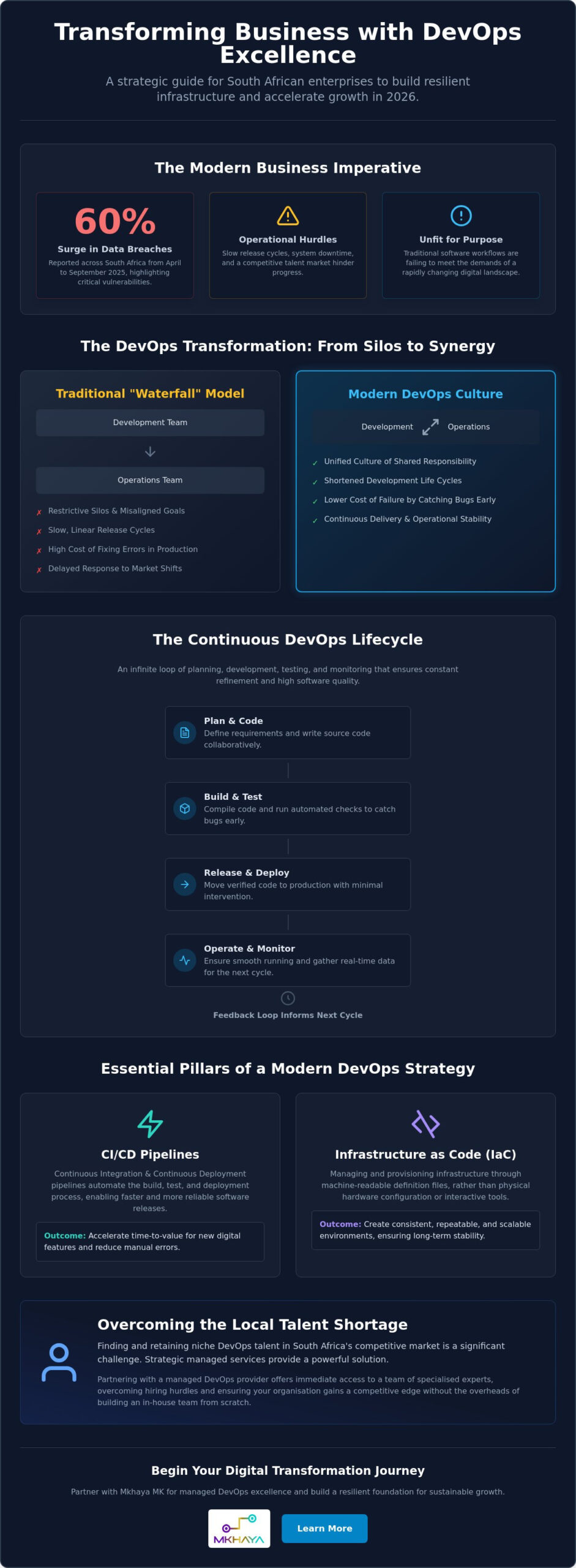
With a 60% surge in reported data breaches across the country between April and September 2025, many local enterprises are realising that their traditional software workflows are no longer fit for purpose. You likely feel the daily pressure of slow release cycles and the persistent worry of system downtime, all whilst struggling to find and retain niche talent in a competitive market. It’s a common challenge in our current environment, but choosing the right DevOps services south africa can transform these operational hurdles into a distinct competitive advantage for your organisation.
We believe that your business deserves a stable anchor in this rapidly changing technological landscape. This guide explores how modern DevOps strategies, including AI-powered automation and robust DevSecOps, help you build a more resilient cloud infrastructure for 2026. We will examine the latest regulatory shifts under POPIA and provide a clear, strategic path for your digital transformation journey. By the end of this article, you will have a practical framework to lead your business toward sustainable growth, faster time-to-market, and reduced operational costs.
Key Takeaways
Learn how shifting from siloed IT to a collaborative culture significantly shortens your systems development life cycles.
Discover practical methods to lower the cost of failure by catching bugs earlier and accelerating your time-to-value for new digital features.
Identify the essential technical pillars, such as CI/CD pipelines and Infrastructure as Code, that define high-performing DevOps services south africa.
Gain insights into overcoming the local talent shortage through strategic managed services that provide immediate access to niche expertise.
Understand how integrating DevOps from the start of your digital transformation journey ensures long-term stability and operational resilience.
What are DevOps Services and Why are They Essential for South African Businesses?
In the fast-paced South African business environment, the traditional wall between software developers and IT operations teams is finally crumbling. This barrier often led to delayed releases, misaligned goals, and frequent system errors. By choosing professional DevOps services south africa, your organisation can replace these restrictive silos with a unified culture of shared responsibility. At its heart, What is DevOps represents the intentional integration of development and operations teams to significantly shorten the systems development life cycle whilst maintaining high software quality.
To gain a clearer perspective on how these principles function in practice, watch this helpful video:
DevOps is a methodology that prioritises continuous delivery and operational stability. It isn’t just about the technical tools your team uses; it’s about how your people work together to deliver consistent value to your customers. In South Africa’s rapidly evolving digital economy, this collaborative approach has become essential for staying relevant and resilient.
The Evolution of Software Delivery in the Local Market
For years, many SA firms relied on the “Waterfall” model, where each phase of a project had to finish completely before the next began. This linear method often meant that by the time software was ready for the public, market demands had already shifted. The transition toward Agile helped teams move faster, but DevOps completes the journey by ensuring that deployment is as reliable as the development itself. Local businesses are now using these strategies to compete with international digital-first brands that have set high global expectations for speed. This modern approach is particularly vital in supporting custom software development south africa, where precision and rapid iteration are non-negotiable for long-term success.
Breaking Down the DevOps Lifecycle
The DevOps process is best understood as a continuous loop rather than a linear track with a fixed end point. It moves through several distinct stages that feed into one another:
Plan and Code: Defining business requirements and writing the source code in a collaborative environment.
Build and Test: Compiling the code and running automated quality checks to catch bugs early.
Release and Deploy: Moving the verified code into the production environment with minimal manual intervention.
Operate and Monitor: Ensuring the software runs smoothly and gathering real-time data to inform the next cycle.
The ultimate goal of modern DevOps services south africa is to achieve “continuous everything”—continuous integration, continuous testing, and continuous deployment. This loop ensures that feedback from the “operate” stage immediately informs the next “plan” stage. It creates a rhythm of constant refinement that keeps your infrastructure stable and your software modern without the stress of traditional “big bang” launches.
The Business Value of Implementing DevOps Excellence
Every minute your software is down, you lose more than just revenue; you lose customer trust. Investing in professional DevOps services south africa isn’t just a technical upgrade; it’s a strategic move that protects your bottom line. When your development and operations teams work in harmony, you create a stable foundation for growth. This alignment ensures that every digital feature you release adds genuine value to your users without the risk of system instability.
One of the most immediate benefits of this approach is the drastic reduction in the cost of failure. When you catch a bug during the initial coding phase, it costs a fraction of what it would to fix that same error once it reaches production. Industry leaders at Red Hat emphasise The Business Value of Implementing DevOps as a primary driver for aligning IT goals with broader business outcomes. By integrating automated testing into your daily workflow, you catch errors early and often, ensuring a smoother journey from concept to customer.
Beyond the financial savings, automation acts as a powerful engine for innovation. It removes the burden of manual labour from repetitive tasks like server provisioning or code deployment. This shift frees up your high-value engineers to focus on what they do best: building creative solutions that set your brand apart. If you’re looking to refine your current systems, exploring digital transformation options can help identify where automation will have the most immediate impact on your efficiency.
Accelerating Market Agility
In a competitive local market, speed is a currency. Faster release cycles allow your business to respond to market shifts in real-time, ensuring you aren’t left behind by more agile competitors. We often see South African corporate projects stall due to “deployment pain”—the fear and friction associated with manual updates. Modern DevOps services south africa eliminate this hurdle, creating a predictable and stress-free path to production. This agility is a core component of a successful cloud application development south africa strategy, where the goal is to deliver value to the user as quickly as possible.
Enhancing Security through DevSecOps
Security can no longer be an afterthought or a final “gate” at the end of a project. With increasing local cyber threats and strict regulatory requirements like POPIA, security must be “shifted left” directly into the development phase. DevSecOps integrates automated security audits and compliance checks into your delivery pipeline. This means your software is born secure, rather than being patched later. It allows your team to maintain a rapid pace of delivery whilst ensuring that every release remains compliant and resilient against modern vulnerabilities.
Key Components of a Modern DevOps Strategy
The heartbeat of this modern approach is the Continuous Integration and Continuous Deployment (CI/CD) pipeline. This automated workflow ensures that every code change is built, tested, and prepared for release without manual intervention. Alongside this, a microservices architecture allows you to break down large, monolithic applications into smaller, independent components. This means you can scale specific parts of your system, such as a payment gateway or a search function, without needing to redeploy your entire platform. It’s about precision and the ability to move fast without breaking things.
To maintain this momentum, automated testing suites must be integrated at every stage. These tests act as a constant safety net, catching regressions and performance issues before they ever reach your users. When combined with centralised logging and real-time monitoring, your team gains total visibility into the health of your systems. Instead of waiting for a customer to report a bug, your monitoring tools alert you to potential issues, allowing for proactive resolution that keeps your services running smoothly.
Automation: The Core of the DevOps Engine
Manual hand-offs are the primary cause of delays and errors in traditional IT projects. Every time a developer has to wait for an operations engineer to provision a server or run a script, your time-to-market slows down. Automation removes these bottlenecks by handling everything from unit testing to server configuration. This level of efficiency is particularly vital when you’re planning a move to the cloud. By automating your deployment processes, you simplify the complexities of cloud migration, ensuring your transition is as seamless and cost-effective as possible.
Infrastructure as Code and Containerisation
Infrastructure as Code (IaC) is a transformative practice where you manage and provision your servers through code rather than manual configuration. This approach prevents “environment drift”, where your development, staging, and production environments slowly become different over time, leading to unexpected failures. We use containers, like Docker, and orchestration tools, like Kubernetes, to package your applications with everything they need to run. This ensures that your software behaves exactly the same way regardless of where it’s deployed. These technologies are the foundation of scalable cloud solutions, providing the flexibility to grow your infrastructure alongside your business needs.
Navigating the Challenges of DevOps Adoption in 2026
It’s not just about the technical tools you choose; it’s about the people using them. Silos between developers and operations teams create friction that no software platform can fix on its own. Without a strategic vision, businesses often fall into the trap of “tool sprawl”, where they pay for dozens of disconnected platforms that fail to deliver a cohesive result. The greatest hurdle to DevOps is often human behaviour rather than technical complexity. Success requires a commitment to transparency and a shared sense of ownership across every level of your organisation. Understanding how to structure this transition is precisely why many local leaders turn to a specialist in digital transformation consulting south africa to build a clear, structured roadmap before committing to new tooling.
Addressing the Skills Gap with Staff Augmentation
Recruiting the right talent in a competitive market is both slow and expensive. Choosing managed DevOps services south africa through staff augmentation provides you with immediate access to expert engineers who integrate directly into your existing workflow. This approach allows you to extend your team with specialists who understand the nuances of local infrastructure and regulatory requirements. At Mkhaya MK, we manage the placement of these skilled professionals to bridge your technical gaps, ensuring your projects stay on track whilst your internal team grows their capabilities naturally.
Achieving Cloud Cost Optimisation
A common fear amongst South African firms is “cloud bill shock”, where unmanaged resources lead to spiralling monthly costs. DevOps practices mitigate this risk through automated scaling and better resource management. By ensuring your infrastructure only uses the resources it needs at any given moment, you can significantly reduce unnecessary spend. Implementing these efficiencies is a core part of our approach to cloud cost optimisation south africa, helping you maintain a high-performance environment without exceeding your budget. If you’re ready to bridge your talent gap and streamline your operations, explore our Staff Augmentation services to find the expertise your business needs today.
Partnering with Mkhaya MK for Managed DevOps Excellence
Choosing a partner for your digital evolution is a significant decision that impacts your organisation’s long-term stability. At Mkhaya MK, we don’t just provide technical tools; we build a supportive partnership focused on your mutual success. Our approach to DevOps services south africa is fundamentally client-centric, ensuring that every automation we build and every pipeline we refine serves your unique business goals. We believe that true success comes from a collaborative relationship where we act as a stable anchor for your team whilst navigating the complexities of modern IT.
Our digital transformation consulting isn’t a separate phase of your project. We integrate DevOps principles from day one, ensuring that your infrastructure is built for scale and resilience from the very start. This proactive alignment prevents the technical debt that often plagues rapid growth. By combining these strategies with our deep software engineering capabilities, we ensure that your applications are not only well-coded but also perfectly optimised for the environments they inhabit. We value transparency and methodical execution, offering long-term service agreements that guarantee ongoing optimisation as your business evolves.
Tailored DevOps Consulting and Execution
Every business is at a different stage of its journey. We begin by assessing your current maturity level to design a bespoke roadmap that addresses your specific bottlenecks. Our focus remains on delivering measurable business outcomes, such as reduced downtime and faster release cycles, rather than just chasing technical metrics. As a local partner, we understand the specific nuances of the South African business landscape, from regulatory compliance to the unique challenges of our national infrastructure. This local context allows us to provide solutions that are both visionary and practical, ensuring your digital transformation is grounded in reality.
Ready to Accelerate Your Digital Journey?
The transition from fragmented, siloed IT to a streamlined DevOps engine is a journey of refinement and construction. By moving away from manual processes and embracing continuous delivery, you position your organisation for sustainable growth in 2026 and beyond. We invite you to discuss your specific infrastructure challenges with us and discover how a customised approach to DevOps services south africa can drive your operational efficiency. Our team is ready to guide you through each step of the process with quiet confidence and a commitment to your long-term success. Contact Mkhaya MK today to organise a DevOps assessment and take the first step toward a more resilient digital future.
Secure Your Digital Advantage for 2026
The transition from siloed IT workflows to a unified DevOps engine isn’t just a technical upgrade; it’s a strategic commitment to your organisation’s resilience. By prioritising continuous delivery and automated security, you ensure your business remains agile enough to respond to the evolving local market. Professional DevOps services south africa allow your team to focus on high-value innovation whilst we maintain the stability and precision of your underlying systems.
We’re here to act as a stable anchor for your digital journey. Our team provides end-to-end digital transformation expertise and flexible staff augmentation for rapid scaling, grounded in specialised South African market knowledge. It’s time to replace operational friction with a streamlined, engineered path to success. Partner with Mkhaya MK for Expert DevOps Services. We look forward to building a more resilient future alongside you.
Frequently Asked Questions
What are the main benefits of DevOps services for my South African business?
Professional DevOps services south africa accelerate your time-to-market whilst significantly improving the reliability of your digital products. By integrating development and operations, your organisation can reduce the friction of manual hand-offs and catch software bugs much earlier in the cycle. This leads to a more resilient infrastructure and a better experience for your customers, who benefit from faster feature updates and less system downtime.
How much do DevOps services cost in South Africa?
The investment required for DevOps depends on the complexity of your current infrastructure and the specific maturity level you aim to reach. Most organisations choose between managed service agreements or staff augmentation models to gain access to niche expertise without the high costs of permanent hiring. We recommend a thorough strategic assessment to define a project scope that aligns with your specific budget and operational goals.
Can DevOps be implemented in a small or medium-sized enterprise?
Yes, SMEs can successfully adopt DevOps by focusing on modular, high-impact automations rather than attempting a total overhaul at once. Starting with a single CI/CD pipeline or automated testing suite allows smaller teams to see immediate efficiency gains without requiring a massive initial investment. This approach provides a stable foundation that allows your technology to grow alongside your business.
What is the difference between DevOps and traditional IT operations?
Traditional IT operations often rely on isolated silos where developers and operations teams work independently, which can lead to misaligned goals and delayed releases. DevOps replaces this with a culture of shared responsibility and continuous feedback. It moves away from manual, high-risk “big bang” updates toward a steady rhythm of automated, frequent, and low-risk deployments that ensure long-term stability.
How long does it take to see results from a DevOps transformation?
Initial technical improvements, such as faster build times and more frequent deployments, are often visible within the first three to six months. Whilst a complete cultural shift amongst your staff takes longer, the immediate reduction in “deployment pain” provides a quick boost to team morale and productivity. The speed of your results depends on your organisation’s commitment to adopting new collaborative behaviours.
Is DevOps only for companies using cloud infrastructure?
DevOps principles are effective across on-premise, hybrid, and cloud environments. Whilst cloud platforms offer the most flexibility for automated scaling, the core practices of version control and continuous integration are vital for managing any modern IT environment. Many DevOps services south africa are specifically designed to help businesses bridge the gap between their legacy on-site hardware and modern cloud solutions.
What role does automation play in a successful DevOps strategy?
Automation acts as the core engine of DevOps by removing the repetitive manual tasks that frequently cause human error and project delays. It ensures that your environments are consistent and that every piece of code is rigorously tested before it reaches your users. By automating your infrastructure provisioning, you create a predictable and repeatable process that protects your system’s uptime and integrity.
How can I find a reliable DevOps partner in South Africa?
A reliable partner should demonstrate deep expertise in digital transformation consulting south africa and a clear understanding of the local regulatory landscape, including POPIA compliance. Look for an organisation that values transparency and offers flexible engagement models, such as staff augmentation, to meet your specific needs. The right partner acts as a visionary guide, focusing on measurable business outcomes rather than just technical metrics.
With 3.0% of all digital transactions in South Africa flagged as suspected fraud in 2025, our local financial sector faces a digital onslaught unlike any other on the continent. You’ve likely seen the reports from SABRIC showing gross losses from digital banking fraud reaching R1.888 billion, a staggering 74% year-over-year increase. It’s clear that relying on legacy systems for real-time clearing is no longer enough to protect your customers or your bottom line. Integrating bespoke AI for fraud detection in financial services South Africa has become a necessity for institutions that want to outpace sophisticated syndicates whilst maintaining a seamless user experience.
We understand the frustration of balancing rigorous security with the need to reduce false positives that alienate genuine clients. This case study discovers how South African institutions are leveraging custom AI and data automation to secure digital transactions and ensure compliant data processing under POPIA. You’ll learn how a strategic shift toward scalable, locally-tuned infrastructure can transform fraud prevention from a reactive cost centre into a proactive pillar of stability. We’ll examine the move from generic global models to precision-engineered solutions that handle the unique behavioural nuances of our domestic market.
Key Takeaways
Understand how adaptive machine learning models outpace rigid, rule-based systems to identify sophisticated local fraud patterns in real-time.
Evaluate the strategic advantages of building bespoke AI for fraud detection in financial services South Africa to ensure solutions are tailored to your specific transaction behaviours.
Master the architectural essentials of a fraud prevention engine, focusing on data aggregation and the engineering of unique local features.
Explore how specialised staff augmentation provides the expertise needed to bridge the technical skills gap and maintain digital resilience.
Discover a clear path toward reducing fraud losses and ensuring POPIA compliance without compromising the customer experience during high-volume clearing.
AI for fraud detection in financial services South Africa involves deploying machine learning algorithms that scrutinise millions of data points to identify and block fraudulent activities in real-time. In the broader context of Financial technology (FinTech), these systems act as the primary line of defence against a rising tide of sophisticated local threats. South African institutions currently navigate a complex environment where card-not-present fraud, identity theft, and the creation of synthetic identities are becoming increasingly common. With suspected digital fraud rates hitting 3.0% in 2025, the highest in Africa, the pressure to automate has never been greater.
The urgency for these systems is driven by what industry leaders call the “triple-zero” paradigm. Modern banking customers expect zero time for transactions, zero risk to their assets, and zero cost for the service. To meet these expectations whilst managing the high-volume requirements of real-time clearing, automated intervention is the only viable path. The South African Reserve Bank (SARB) and the Financial Sector Conduct Authority (FSCA) have set high security expectations. Specifically, the 2025 Joint Standard on Cybersecurity and Cyber Resilience makes robust AI integration a regulatory priority for any institution handling public funds.
The Shift from Reactive to Proactive Security
Traditional “if-then” rules are rigid; they only catch what has happened before. When fraud syndicates evolve their tactics, these legacy systems fail because they cannot adapt to new patterns without manual updates. The cost of remaining reactive is high. Beyond the R1.888 billion in gross losses reported by SABRIC, institutions face severe brand reputation damage that can take years to repair. Proactive AI detection marks the shift from merely stopping known threats to predicting unknown anomalies before they impact the customer.
Local Regulatory Compliance: POPIA and Beyond
Implementing AI requires a delicate balance between data-heavy training and strict adherence to the Protection of Personal Information Act (POPIA). Financial institutions must ensure that the data used to train models is handled with absolute integrity. This has led to the rise of “Explainable AI” (XAI). This approach allows banks to provide clear reasoning for why a transaction was flagged, which is essential for regulatory reporting and customer transparency. Leveraging expert digital transformation services helps organisations align their technical infrastructure with these complex compliance mandates whilst maintaining operational agility.
How AI-Driven Detection Surpasses Traditional Systems
Traditional fraud prevention relies on rigid, rule-based logic that operates on “if-then” scenarios. For example, a system might be programmed to flag any transaction over R10,000 or any purchase made outside of a user’s home province. Whilst these rules provided a basic safety net in the past, they’re often too blunt for modern requirements. They result in high rates of false positives, where genuine customers find their accounts frozen during legitimate activities. In contrast, AI for fraud detection in financial services South Africa utilises fluid, adaptive models that learn from every interaction, allowing for a far more nuanced understanding of what constitutes a threat.
These advanced systems typically employ a hybrid approach, combining supervised and unsupervised learning to create a multi-layered defence. Supervised learning acts like an experienced investigator who has studied thousands of past fraud cases. By training on historical data, these models recognise specific markers associated with known crimes, such as stolen card patterns or phishing signatures. However, because fraud syndicates constantly pivot, relying solely on history isn’t enough. This is where unsupervised learning becomes vital. These algorithms identify outliers in transaction behaviour that have never been seen before, flagging suspicious account-to-account transfers in real-time clearing environments without needing a prior “template” of the crime.
Supervised vs Unsupervised Machine Learning
The choice between these methods depends on the specific threat. Supervised ML is excellent for high-confidence detection of recurring patterns, such as identity theft attempts during loan applications. Unsupervised ML excels at spotting “zero-day” fraud, particularly amongst the high-velocity transactions seen in digital banking. Modern engines also incorporate deep learning to analyse unstructured data, such as customer support transcripts or login metadata, to detect subtle signs of account takeover. Navigating the challenges of AI in fraud detection requires this balanced, sophisticated architecture to ensure no stone is left unturned.
Reducing False Positives: The Customer Experience Factor
Precision is the ultimate goal for any financial institution. AI distinguishes between a traveller using their card in a new city and a fraudster attempting a remote transaction by analysing hundreds of variables, from device biometrics to the time of day. This precision reduces “friction,” ensuring that genuine transactions succeed on the first attempt. When you lower the number of blocked legitimate payments, you directly improve customer loyalty and retention. If you’re ready to move beyond rigid rules, exploring bespoke AI and data automation solutions can help you build a system that protects your revenue whilst respecting your customers’ time.
Implementing Bespoke AI Frameworks: A Practical Comparison
When choosing a framework for AI for fraud detection in financial services South Africa, the “buy versus build” debate is often the first hurdle for stakeholders. Off-the-shelf SaaS tools offer a quick start, but they frequently lack the granular control needed for our local market. Bespoke solutions, built on a foundation of custom software engineering, provide the flexibility to adapt to unique South African transaction patterns whilst ensuring total data sovereignty. This is particularly relevant given the strict requirements of POPIA; keeping sensitive financial data within local borders isn’t just a preference, it’s a regulatory necessity for many organisations today.
Off-the-Shelf vs Bespoke AI Solutions
Generic fraud models are often trained on European or North American datasets. These models frequently struggle with the nuances of the South African “informal economy” where transaction behaviours may appear irregular to a global algorithm but are perfectly normal locally. When you choose a bespoke framework for AI for fraud detection in financial services South Africa, you gain the ability to customise detection logic to these specific domestic realities. Beyond customisation, the long-term ROI of owning your intellectual property (IP) is substantial. You aren’t just renting a service; you’re building a proprietary asset that grows in value as it learns from your specific data pool. Local support also means your partner understands the immediate context of a new fraud wave hitting Cape Town or Johannesburg, allowing for faster model retraining. For a broader strategic perspective on reducing operational overheads through intelligent automation, the AI automation solutions South Africa executive guide for 2026 provides a comprehensive roadmap for enterprises navigating these decisions.
Real-Time Data Processing and Cloud Infrastructure
The shift toward Real-Time Clearing (RTC) in South Africa has changed the technical requirements for fraud prevention. It’s no longer acceptable to flag a transaction after the money has left the account. Your AI must process data with sub-second latency to block fraudulent transfers before they are finalised. Achieving this level of performance requires more than just a smart algorithm; it demands a robust backend. Leveraging managed cloud services allows your infrastructure to scale instantly during massive data spikes, such as month-end salary runs or Black Friday sales. By integrating these AI models into your existing ERP and banking cores through microservices, you create a seamless flow of information that supports both security and speed. This architectural precision ensures that your digital resilience remains stable even as transaction volumes grow, preventing legacy system bottlenecks from frustrating your genuine customers.
Case Study: Architecting an AI-Powered Fraud Prevention Engine
Building a resilient system for AI for fraud detection in financial services South Africa requires a structured, methodical approach that moves beyond simple software installation. It’s about creating a living architecture that evolves alongside the tactics of local syndicates. A successful implementation follows five critical steps to ensure the engine is both accurate and scalable within the South African banking context.
Step 1: Data Aggregation — We begin by centralising siloed data from across the institution, breaking down the walls between credit card history, personal loan applications, and savings account metadata.
Step 2: Feature Engineering — Our team identifies local variables that predict fraud, such as unusual high-value EFT patterns during public holidays or branch-specific anomalies that global models often overlook.
Step 3: Model Training and Testing — We refine the engine’s accuracy by using historical South African fraud data, ensuring the system recognises the specific signatures of regional threats.
Step 4: Deployment and Monitoring — The model is transitioned into the live transaction stream where it begins continuous learning in a real-world environment.
Step 5: Feedback Loops — Human analyst insights are integrated back into the model; this ensures that “grey area” cases are correctly categorised to improve future performance.
Phase 1: Discovery and Data Strategy
Auditing existing data quality is the first hurdle in any strategic build. We look for “dark data,” such as failed login attempts or specific device metadata, which often contains hidden patterns of account takeover behaviour. During this phase, we set clear KPIs that balance aggressive fraud detection rates with acceptable false positive thresholds to protect the customer experience. Following the structured Mkhaya MK process ensures that this discovery phase is thorough and sets a stable foundation for the technical work that follows.
Phase 2: Building the Neural Network
A successful build requires a balanced team of data scientists and specialised software engineers working in tandem. We place a heavy emphasis on “Adversarial AI,” where we train the system by simulating sophisticated fraud attacks based on known local syndicate behaviours. This stress-testing ensures the neural network is prepared for the unexpected. Predictive analytics can identify the precursor signs of an account takeover and stop the fraud before the final transaction is even initiated. This proactive stance is what separates modern digital banking from legacy reactive security measures.
If you’re ready to secure your infrastructure against evolving threats, our team provides the AI and data automation expertise needed to build a precision-engineered fraud engine.
Partnering for Digital Resilience: The Mkhaya MK Approach
Effective implementation of AI for fraud detection in financial services South Africa requires a partner who balances visionary strategy with practical, boots-on-the-ground execution. At Mkhaya MK, we position ourselves as more than just a service provider; we act as a steady anchor for institutions navigating the rapid shifts in the technological landscape. Our approach focuses on mutual success, ensuring that every custom algorithm or neural network we build serves a clear business outcome. We move from high-level conceptualisation to methodical deployment, creating a sense of momentum that leads your institution toward a more secure digital future.
One of the most significant hurdles in our local market is the scarcity of specialised talent. We address this directly through staff augmentation, providing the high-end expertise your projects require without the delays of traditional recruitment. This model allows you to scale your technical capabilities instantly, bringing in data scientists and engineers who understand the unique nuances of the South African financial sector. Security shouldn’t exist in a vacuum. By integrating these advanced AI models with your broader ERP solutions, we create a holistic security environment where fraud detection data informs every facet of your business operations.
Extending Your Internal Tech Team
We believe in the power of collaborative growth. When we provide specialised talent for your machine learning projects, our focus remains on long-term stability and reliability. Whether through on-site or remote engagement, our experts work alongside your staff to ensure a seamless knowledge transfer. This ensures that your internal team possesses the skills and confidence to manage and refine the AI for fraud detection in financial services South Africa once the initial deployment is complete. It’s a supportive partnership designed to build your internal resilience rather than creating a cycle of dependency.
The Future of AI in South African Finance
As we look toward 2027, the horizon of fraud prevention continues to expand. We anticipate a significant shift toward biometric integration and blockchain-based verification systems that offer even greater layers of protection. Digital transformation isn’t a destination with a fixed end point; it’s a continuous journey of refinement and construction. Staying ahead of sophisticated syndicates requires an agile mindset and a commitment to constant evolution. If you’re ready to define your path forward, we invite you to consult with Mkhaya MK on your AI roadmap and secure your position as a leader in digital banking.
Securing Your Financial Future Through Precise Innovation
Building a resilient defence against modern fraud syndicates is no longer just a technical requirement; it’s a strategic pillar for long-term stability. You’ve seen how shifting from rigid rules to adaptive machine learning allows for real-time protection whilst respecting the customer experience. By choosing bespoke AI for fraud detection in financial services South Africa, your institution gains a system that understands the nuances of our local informal economy and the high-velocity demands of real-time clearing. This transition ensures that your security infrastructure remains as agile and forward-thinking as the clients you serve.
The journey toward digital resilience is one we’re ready to walk with you. Whether you need end-to-end custom software engineering, specialised expertise through our national staff augmentation service, or advanced AI and data automation, we provide the methodical execution your vision requires. It’s time to transform your security from a reactive cost centre into a proactive engine of growth and trust. Partner with Mkhaya MK for your AI and Digital Transformation journey and let’s build a secure, stable future for your institution together.
Frequently Asked Questions
How does AI detect fraud in real-time for South African banks?
AI systems analyse millions of data points instantly by comparing current transaction behaviour against both historical patterns and emerging anomalies. In the South African banking sector, this capability is essential for Real-Time Clearing (RTC), as it allows the engine to flag and block suspicious EFTs or card-not-present transactions before the funds leave the account. This immediate intervention prevents losses that legacy systems would only identify hours after the event.
Can AI fraud detection help with POPIA compliance?
Yes, modern AI frameworks are designed with privacy-by-design principles that align with the Protection of Personal Information Act (POPIA). By utilising “Explainable AI” (XAI), financial institutions can generate clear audit trails that justify why a transaction was flagged whilst ensuring that personal data is processed securely and for a specific purpose. This transparency is vital for meeting the security expectations set by the FSCA and SARB.
What is the difference between rules-based and AI fraud detection?
Rules-based systems rely on static “if-then” logic that only catches known threats, often leading to high rates of false positives. AI for fraud detection in financial services South Africa is adaptive; it uses machine learning to learn from every interaction and identify unknown anomalies. This fluid approach allows the system to evolve alongside local syndicates, catching sophisticated tactics that fixed rules would simply overlook.
Is bespoke AI fraud software better than off-the-shelf solutions for SA businesses?
Bespoke solutions offer a significant advantage because they are trained on domestic datasets that reflect South African transaction behaviours and the nuances of our informal economy. Generic off-the-shelf tools often struggle with these local patterns, leading to unnecessary friction for genuine customers. A custom-built engine also ensures total data sovereignty, keeping sensitive financial information within local borders as required by many regulatory frameworks.
How long does it take to implement an AI fraud detection system?
A typical implementation follows a phased journey that usually spans several months. This timeline includes an initial discovery and data strategy phase, followed by data aggregation, feature engineering, and rigorous model testing. We focus on a methodical execution to ensure the system is stable and reliable before it begins monitoring live transaction streams, ensuring a smooth transition for your internal teams.
What data is required to train an AI fraud detection model?
Training requires a robust pool of historical transaction records, customer metadata, and documented fraud signatures from previous incidents. We also look for “dark data,” such as failed login attempts and device biometrics, to provide the context needed for detecting account takeovers. The more diverse and locally relevant the data, the more precise the AI for fraud detection in financial services South Africa becomes at predicting future threats.
How do you reduce false positives in AI-driven fraud prevention?
False positives are reduced by refining the model to distinguish between legitimate behavioural shifts, such as a customer travelling, and actual fraudulent intent. By scrutinising hundreds of variables simultaneously, the AI gains a precise understanding of the user’s typical behaviour. This cause-and-effect relationship ensures that you lower the “friction” for genuine clients whilst maintaining a high-security threshold for suspicious activities.
Do I need a dedicated data science team to run AI fraud detection?
You don’t need to hire a permanent, full-scale team before you begin your journey. Many institutions use bespoke AI automation solutions in South Africa to bring in specialised experts who build the initial architecture and deploy the models. This collaborative approach ensures a thorough knowledge transfer, allowing your existing IT staff to gain the skills needed to manage and maintain the AI engine post-deployment with confidence.