

With the SAP ECC support deadline looming in 2027 and cloud hosting fees projected to rise throughout 2026, is your business infrastructure built for long-term resilience or merely for survival? Many South African organisations find themselves caught between the desire for agility and the heavy weight of high upfront hardware costs. You’re likely concerned about the complexity of migrating bespoke legacy applications whilst ensuring your data remains compliant with the latest POPIA automated log requirements. We understand that this transition feels like a high-stakes evolution rather than a simple IT project.
Choosing the right cloud migration services south africa provides a path to turn these challenges into a competitive advantage. This strategic guide explores how to seamlessly transition your business infrastructure to the cloud whilst optimising costs and ensuring absolute data sovereignty. We will explore the shift towards hybrid cloud models, the necessity of FinOps to manage escalating hosting costs, and the precise engineering required to modernise your software for a scalable future. By aligning your digital transformation with local regulatory shifts, you can build a stable, secure foundation that grows alongside your ambitions.
Key Takeaways
- Understand the strategic shift from high upfront hardware costs to flexible operational models that optimise cash flow and support sustainable growth.
- Select the most effective strategy for your business by exploring the ‘6 Rs’ framework, ensuring your choice of cloud migration services south africa aligns with your technical goals.
- Master the nuances of POPIA compliance and data sovereignty to maintain trust and meet evolving regulatory requirements in the local landscape.
- Follow a structured roadmap for auditing legacy systems and sequencing your migration to ensure maximum stability whilst minimising operational disruption.
- Leverage your new cloud-native foundation to unlock advanced capabilities in AI and data automation for enhanced real-time intelligence.
What are Cloud Migration Services in the South African Business Context?
Cloud migration is the strategic process of relocating your digital assets, databases, and core applications into a virtualised environment. In South Africa, this isn’t merely a technical shift; it represents a fundamental pillar of digital transformation. Rather than viewing it as a simple file transfer, forward-thinking firms see it as an opportunity to refine their software architecture and build a more agile business foundation. Using professional cloud migration services south africa allows local enterprises to move away from the restrictive cycle of purchasing and maintaining physical hardware.
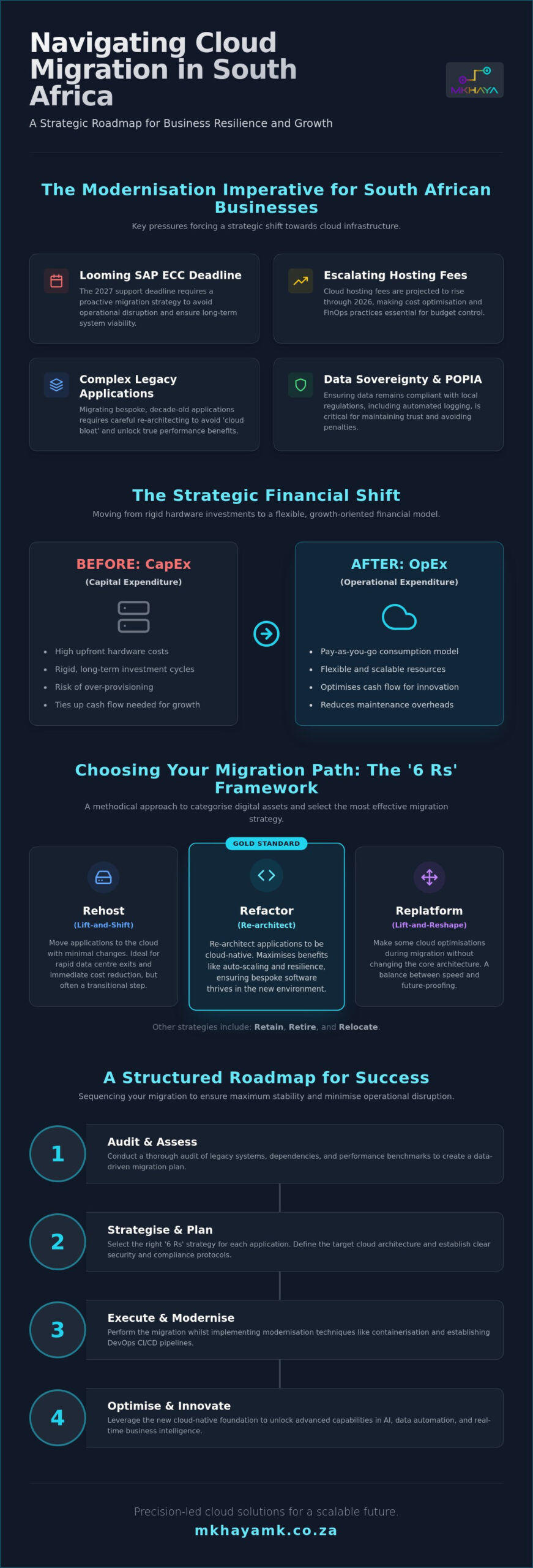
The transition from capital expenditure (CapEx) to operational expenditure (OpEx) is particularly vital for local firms managing fluctuating market conditions. By moving away from heavy upfront hardware investments, businesses can allocate resources more precisely toward growth and innovation. This bespoke approach ensures that your migration plan respects the unique requirements of the local market, including specific regulatory hurdles and infrastructure constraints.
To better understand the practicalities of this transition, watch this helpful overview:
Selecting the correct framework is the most critical step in your digital journey. While some providers offer a one-size-fits-all approach, effective cloud migration services south africa rely on the ‘6 Rs’ framework to categorise digital assets based on their future value. These strategies include Rehosting, Replatforming, Refactoring, Retiring, Retaining, and Relocating. This methodical approach ensures that resources aren’t wasted on obsolete systems whilst prioritising the applications that drive your revenue.
Rehosting, often called ‘Lift-and-Shift’, serves as the fastest route to the cloud. It involves moving your existing applications and data to a cloud environment without making significant changes to the underlying code. This path is ideal for businesses needing to exit a data centre quickly or those looking to reduce immediate hardware costs. However, it’s often a transitional phase rather than a final destination. Recent research on cloud adoption highlights that South African firms often struggle to see long-term ROI if they rely solely on rehosting without eventually modernising their stack.
For businesses with unique requirements, Refactoring stands as the gold standard. This involves re-architecting your applications to be cloud-native, allowing them to take full advantage of cloud features like auto-scaling and high availability. At Mkhaya MK, we leverage our software engineering expertise to ensure that your bespoke applications don’t just survive the move but thrive in their new environment. This precision-led approach protects the integrity of your logic whilst preparing it for a scalable future.
Modernising Legacy Applications
Moving a decade-old bespoke application directly into the cloud often results in ‘cloud bloat’, where performance stays stagnant while costs rise. True modernisation involves containerisation and microservices. This allows your software to scale individual components independently, making the system more resilient. We focus on maintaining application integrity through precise engineering, ensuring that your users experience a seamless transition without losing the familiarity of their existing UI/UX. If you’re looking for a partner to guide this technical evolution, exploring our cloud solutions can help define the most efficient path forward.
The Role of DevOps in Migration
DevOps is the engine of a successful move. By automating deployment cycles, we eliminate the risks associated with manual configuration and human error. Implementing Continuous Integration and Continuous Deployment (CI/CD) means your infrastructure evolves alongside your business needs. Managed DevOps services provide the long-term stability required to manage complex cloud environments, allowing your internal teams to focus on innovation rather than maintenance. This creates a rhythmic momentum where software updates are frequent, reliable, and invisible to the end-user.
Navigating South African Cloud Challenges and Regulations
South Africa’s regulatory environment demands a methodical approach to data management. When you engage with cloud migration services south africa, compliance isn’t just a tick-box exercise; it’s a commitment to your customers’ privacy. The Protection of Personal Information Act (POPIA) has evolved, and as of 2026, the Information Regulator requires organisations to provide automated logs of data deletion. This ensures that personal information is only retained as long as necessary, a task that becomes significantly more manageable within a well-engineered cloud environment.
Data sovereignty remains a top priority for local enterprises, especially those in the financial and public sectors. Ensuring your business data stays within South African borders is no longer a hurdle, thanks to the established presence of global hyperscale regions in Johannesburg and Cape Town. These local data centres provide the low-latency connectivity required for high-performance applications whilst satisfying legal requirements for data residency. This proximity reduces the risks associated with international data transfers and ensures your operations remain stable regardless of global connectivity fluctuations.
Currency volatility and rising global demand for AI infrastructure often lead to unpredictable hosting fees. South African firms must account for these variables to avoid the common pitfall of “cloud bill shock.” By partnering with local experts who understand the nuances of the South African economy, you can build a more resilient financial model for your IT operations. This involves balancing the need for global innovation with the practicalities of local cost management.
Security and Compliance in a Virtual Environment
Adopting a zero-trust architecture during your migration phase ensures that every access request is fully authenticated and authorised. This approach treats all traffic as potentially hostile, regardless of whether it originates inside or outside your network. Effective identity and access management (IAM) protocols allow you to control exactly who interacts with sensitive corporate data. Regular auditing and automated reporting become your primary tools for demonstrating compliance to South African regulators, providing a transparent and reliable record of your data handling practices.
Cost Optimisation Strategies
Meticulous resource monitoring is the only way to prevent “cloud sprawl,” where unused or over-provisioned resources inflate your monthly bill. Leveraging local expertise helps you select the most cost-effective service tiers tailored to your specific traffic patterns. For a deeper look at managing your expenses, read our guide on Cloud Cost Optimisation in South Africa. This proactive financial management ensures your scalable infrastructure remains a strategic asset rather than a growing liability.
A Step-by-Step Roadmap for Successful Migration
A successful digital evolution relies on a methodical sequence of events rather than a single leap. When searching for cloud migration services south africa, it’s essential to find a partner that values precision over speed. Our roadmap is designed to protect your operational continuity whilst modernising your core systems. It begins with a deep understanding of your current environment and ends with a refined, high-performance cloud ecosystem.
Strategic Planning follows the initial audit, where we map out the migration sequence. We prioritise systems based on their business criticality to ensure that your most vital services are handled with the highest level of care. This planning phase acts as a blueprint, preventing the common pitfalls of overlapping dependencies and resource bottlenecks that often plague unplanned moves.
Phase 1: The Technical Audit
The journey starts with a comprehensive assessment of your current infrastructure. We don’t just look at servers; we assess the complex web of software dependencies that keep your business running. This phase includes:
- Identifying ‘low-hanging fruit’, which are applications that offer high value with low migration complexity.
- Mapping interdependencies between custom applications and their respective databases.
- Assessing the readiness of legacy code for a cloud-native environment.
For more complex phases where your internal team might be stretched, we often recommend staff augmentation to provide the specialised engineering capacity required for high-intensity migrations. This ensures that your daily operations never suffer while your infrastructure evolves under the guidance of experts.
Phase 2: Execution and Cutover
Once the blueprint is finalised, we move into Execution and Cutover. We always implement a pilot migration to test our assumptions in a controlled environment. This allows us to refine data synchronisation strategies, ensuring zero data loss during the final move. The ‘cutover’ window is managed with surgical precision to keep business disruptions to an absolute minimum, often occurring during low-traffic periods to protect the user experience.
The final stage of Optimisation is where the true value of the cloud is realised. We don’t just leave you with a working system; we fine-tune the environment to ensure your resource consumption matches your actual needs. This reduces waste and ensures your scalable infrastructure remains as lean and efficient as possible. If you are ready to begin your technical audit, contact our engineering team today to discuss your roadmap.
Beyond Migration: Leveraging AI and Custom Cloud Solutions
Completing your move is just the beginning of a larger journey toward operational excellence. While many providers treat the cutover as the end of the engagement, the most successful firms view it as the vital foundation for future innovation. By selecting comprehensive cloud migration services south africa, you create the high-performance environment necessary to deploy advanced AI and data automation. This infrastructure allows your business to process vast amounts of information in real-time, turning raw data into actionable business intelligence that drives decision-making.
Modern cloud-native applications don’t just store data; they facilitate sophisticated, automated workflows that scale with your ambitions. We specialise in customising these environments to support complex, industry-specific platforms that require high levels of precision. Whether you’re running an integrated ERP solution or a high-volume Loan Management System, your cloud environment should be precision-engineered to match your unique operational rhythm. This level of customisation ensures that your technology supports your business goals rather than forcing you to adapt to rigid software constraints.
Building AI-Ready Infrastructure
Preparing for machine learning requires more than just basic storage. It involves constructing structured data lakes within the cloud that allow models to access high-quality information without latency. Once this foundation is stable, cloud-based Robotic Process Automation (RPA) can be used to automate routine business tasks, freeing your team for more strategic, creative work. For a deeper look at how these technologies are reshaping the local market, see our guide on AI Automation Solutions in South Africa.
Why Mkhaya MK is the Strategic Choice
Choosing Mkhaya MK means partnering with a team that values your long-term success as much as you do. Our national footprint across South Africa allows us to understand the specific challenges of local enterprise resilience, from energy constraints to regulatory shifts. We don’t just provide cloud migration services south africa; we offer a supportive partnership rooted in software excellence and methodical execution. We invite you to consult with us on a bespoke digital transformation strategy that turns your vision into a stable, scalable reality. Together, we can build a future that’s both technologically advanced and grounded in practical business results.
Building Your Scalable Future in the Cloud
Transitioning your infrastructure is a strategic evolution that requires more than just technical execution; it demands a visionary approach to software integrity and regulatory resilience. By choosing specialised cloud migration services south africa, you ensure that your bespoke legacy systems are refactored for modern performance whilst maintaining strict POPIA compliance. This methodical shift doesn’t just reduce operational costs; it creates the stable, AI-ready foundation your business needs to thrive in a competitive landscape.
We’ve explored how a structured roadmap and the right migration framework can turn complex technical challenges into long-term assets. Mkhaya MK provides the national support and consulting expertise required to navigate this journey with quiet confidence. Our focus remains on your mutual success, ensuring that every step of your digital transformation is precise and purposeful. It’s time to scale your business with Mkhaya MK’s Cloud Solutions and embrace a partnership built on reliability. Your future in the cloud is bright, and we’re ready to help you build it.
Frequently Asked Questions
What are the primary benefits of cloud migration for South African businesses?
Cloud adoption allows South African businesses to move from heavy capital expenditure to a flexible operational model. This shift provides immediate access to scalable infrastructure that grows with your business needs. Additionally, migrating protects your operations from local infrastructure instability, ensuring your data remains accessible and secure regardless of power or connectivity challenges at your physical premises.
How long does a typical cloud migration project take to complete?
The timeline for a migration project depends on the complexity of your digital estate and the volume of data involved. A small-scale migration might take several weeks, whereas a full-scale enterprise transition involving bespoke applications can span several months. We focus on a methodical approach that prioritises stability, ensuring each phase is thoroughly tested before proceeding to the next stage of the roadmap.
Is my data secure in the cloud according to POPIA regulations?
Data remains secure and compliant with POPIA regulations when you utilise cloud migration services south africa that prioritise local data residency. By hosting your data in South African hyperscale regions, you satisfy legal requirements for sovereignty whilst benefiting from global security standards. We implement zero-trust architectures and automated deletion logs to ensure your compliance remains robust and transparent to regulators.
What is the difference between a ‘lift-and-shift’ and a ‘refactoring’ strategy?
Lift-and-shift, or rehosting, involves moving your existing software to the cloud without changing its code, which is ideal for a rapid exit from physical hardware. Refactoring is a more sophisticated strategy where we re-architect applications to be cloud-native. This gold-standard approach ensures your custom software takes full advantage of cloud features like auto-scaling, leading to better long-term performance and lower operational costs.
How can we avoid downtime during the migration process?
Minimising downtime is achieved through phased execution and rigorous pilot testing in controlled environments. We synchronise data in the background and only perform the final cutover during low-traffic windows to protect your business continuity. This precision-led strategy ensures that your users experience a seamless transition without any significant disruption to their daily workflows or access to critical services.
What are the hidden costs of cloud migration that I should plan for?
Planning for hidden costs involves looking beyond the monthly hosting fee to account for data egress charges and initial resource over-provisioning. You should also consider the investment required for staff training and the potential for “cloud sprawl” if resources aren’t actively monitored. Using professional cloud migration services south africa helps you identify these variables early, allowing for a more accurate and predictable financial model.
Can my custom-built legacy software be moved to the cloud?
Bespoke legacy applications can certainly be moved to the cloud through a process of containerisation and software re-engineering. We specialise in refactoring these systems to ensure they remain functional and performant in a virtualised environment. This allows you to retain the unique logic of your custom software whilst gaining the scalability and security benefits of modern cloud infrastructure.
Do I need to hire new staff to manage our cloud infrastructure?
You don’t necessarily need to hire new full-time employees to manage your new environment. Many organisations choose to use managed DevOps services or staff augmentation to fill specific skill gaps during and after the transition. This approach provides access to expert engineering talent without the long-term overhead of permanent hires, allowing your existing team to focus on their core business objectives.