

By the start of 2026, the South African business process management market has already surpassed a valuation of $78 million, signalling a massive shift in how local organisations operate. You’ve likely felt the weight of manual, repetitive tasks draining your team’s energy and stalling your growth. It’s frustrating to watch operational overheads climb while your ability to scale remains tethered to your headcount. We understand that you want to move beyond these bottlenecks to build a more resilient, agile business.
This comprehensive guide shows you exactly how to master business process automation south africa to reclaim that lost time and drive genuine efficiency. We’ll provide a clear roadmap for your digital transformation, moving from high-level strategic concepts to the specific execution of automated workflows. You’ll discover how to refine your operations, reduce human error in data-heavy tasks, and create a stable foundation for increased productivity. Let’s explore how to turn these technological capabilities into practical, long-term success for your enterprise.
Key Takeaways
- Understand why South African organisations are prioritising digital workflows in 2026 to maintain a competitive edge and ensure long-term stability.
- Master the “High Volume, High Value” matrix to accurately identify which manual tasks will deliver the greatest return on investment when digitised.
- Follow a structured 5-step roadmap to implement business process automation south africa, ensuring a seamless transition from strategic consulting to technical execution.
- Learn practical strategies for navigating common implementation hurdles, such as managing legacy technical debt and addressing staff concerns about digital shifts.
- Discover how custom AI and ERP solutions can augment your team’s potential, transforming repetitive burdens into streamlined, precision-engineered outcomes.
What is Business Process Automation (BPA) in the South African Context?
At its core, What is Business Process Automation (BPA) involves the strategic use of technology to execute recurring, multi-step tasks that traditionally rely on manual effort. In our local market, business process automation south africa has evolved from a luxury for large corporations into a fundamental requirement for any enterprise seeking long-term stability. As of 2026, the movement toward digital workflows is driven by a need to augment human potential rather than replace it.
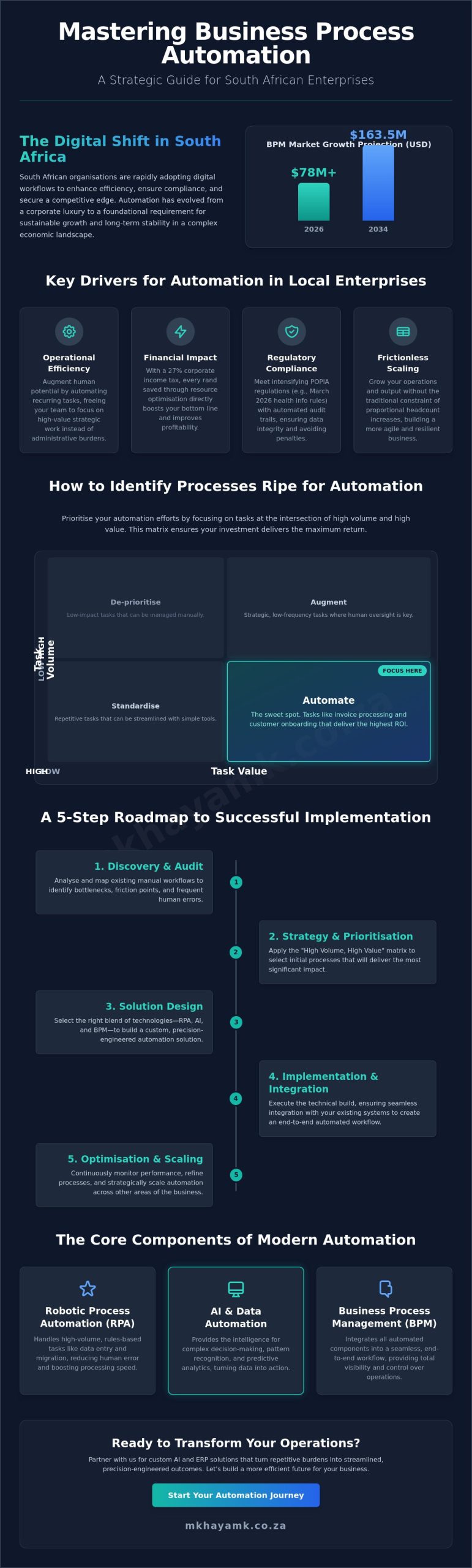
South African leaders are increasingly prioritising these systems to navigate a complex economic environment. With the local BPM market projected to reach USD 163.5 Million by 2034, the focus has shifted from simple digitisation toward building intelligent, interconnected ecosystems. This transition ensures that your organisation remains competitive on a global stage whilst maintaining the agility needed for local success.
To better understand this concept, watch this helpful video:
The Core Components of Modern Automation
Building a robust automation framework requires a blend of specialised tools. Robotic Process Automation (RPA) handles the repetitive, high-volume data entry that often leads to human error. For broader oversight, AI and data automation provides the intelligence needed for pattern recognition and complex decision-making. When these are integrated through Business Process Management (BPM) principles, the result is a seamless end-to-end workflow that provides total visibility into your operations.
Why Automation Matters for Local Enterprises
Operational efficiency is the primary driver for business process automation south africa in the current fiscal year. With corporate income tax rates at 27%, every rand saved through resource optimisation directly impacts your bottom line. Additionally, the Information Regulator’s intensification of POPIA enforcement, including the new March 2026 regulations regarding health information, makes automated audit trails essential for compliance. This digital transformation allows you to scale your operations without the friction of proportional headcount increases, ensuring your business remains a stable anchor in a changing landscape.
How to Identify Processes Ripe for Automation
Selecting the right starting point is the most critical decision in your digital transformation journey. Not every manual task deserves automation; some simply need better management. We recommend using a “High Volume, High Value” matrix to prioritise your efforts. High-volume tasks are those performed dozens of times daily, whilst high-value tasks are those where errors or delays significantly impact your bottom line. By focusing on the intersection of these two factors, you ensure that your investment in business process automation south africa yields the highest possible return.
Before you write a single line of code, you must conduct a thorough audit of your current manual workflows. This phase isn’t about looking for technology; it’s about understanding the current friction. Identifying bottlenecks where work piles up or where data entry leads to frequent errors provides the clarity needed for a successful rollout. This methodical approach is one of the essential steps to take when automating your operations, as it prevents the digitisation of inherently broken processes.
Success depends on having clear, measurable Key Performance Indicators (KPIs). Whether it’s reducing the time to process a loan application or eliminating data entry errors in procurement, these metrics provide the evidence of success that stakeholders require. This focus on precision ensures that your automation strategy remains a stable anchor for long-term growth. If you’re unsure where to begin your audit, exploring our digital transformation services can help clarify your path forward.
Criteria for Automation Suitability
A process is generally a strong candidate for automation if it meets three specific criteria. First, look for a repetitive nature where tasks are performed daily or weekly by multiple staff members. Second, the process should follow rule-based logic; it needs a clear “if-this-then-that” structure that doesn’t require subjective judgement. Finally, seek out workflows with a low exception rate. Automation thrives when the path is predictable and doesn’t require constant human intervention to fix edge cases.
Common Use Cases in South African Business
We see several sectors leading the way with specialised automation solutions. Many organisations are currently:
- Automating procurement and supplier management using precision platforms like Optimate to control costs and improve transparency.
- Streamlining financial services and credit applications through integrated loan management systems that speed up decision-making.
- Modernising HR and compliance training through learner management systems that track progress automatically.
A 5-Step Guide to Implementing Business Process Automation
Implementing business process automation south africa requires a deliberate shift from visionary thinking to technical precision. A methodical approach ensures that your digital transformation isn’t just a temporary fix but a stable foundation for long-term growth. By following a structured roadmap, you can transition smoothly from strategic consulting to technical execution, ensuring every rand spent contributes to a measurable return on investment.
Step 1: Process Mapping and Discovery
Documenting every step of your current manual process is the only way to uncover hidden inefficiencies. During this discovery phase, we engage deeply with stakeholders to identify the specific “pain points” that slow down your daily operations. This isn’t just about recording what happens; it’s about defining the desired future state of your workflow. Clear documentation prevents the common mistake of automating a flawed process, ensuring your new system is built for speed and accuracy from day one.
Step 2: Choosing the Right Technology Stack
Choosing between custom software engineering and off-the-shelf ERP solutions depends entirely on your specific organisational goals. Many South African enterprises find that cloud-based solutions offer the best balance of accessibility and scale, allowing teams to collaborate across provinces without friction. You should also consider how AI and data automation can add predictive layers to your workflows, turning simple task execution into intelligent process orchestration that anticipates business needs.
Step 3: Development, Integration, and Training
Building your solution relies on agile software engineering principles to maintain momentum and flexibility. This stage involves integrating new automation tools with your existing legacy systems to ensure data continuity across the business. Success here isn’t just technical; it’s human. Conducting comprehensive staff training is essential to facilitate a smooth transition, as it helps your team understand how these new tools will augment their potential and reduce their administrative burdens.
Step 4: Rigorous Quality Assurance
Testing is a non-negotiable step in the South African market, where data accuracy and regulatory compliance are paramount. We subject every automated workflow to rigorous quality assurance to ensure it handles edge cases and high volumes without failure. This phase identifies any potential friction points before they reach your clients, reinforcing your reputation for reliability and precision.
Step 5: Deployment and Iterative UX Refinement
Overcoming Implementation Challenges and Objections
Transitioning to business process automation south africa is rarely a linear path. Whilst the benefits of efficiency and growth are clear, organisations often face internal resistance and technical hurdles that can stall momentum. We believe that acknowledging these challenges early is the first step toward building a resilient, future-proof enterprise. By treating automation as a collaborative journey rather than a technical imposition, you create a culture that values precision and long-term stability.
Change Management and the Human Element
The most common concern we encounter is the fear that automation will replace human talent. We reframe this entirely; automation is designed to liberate your staff from the drudgery of manual, repetitive tasks. By removing the administrative burden, your team can focus on the creative and strategic work that truly drives value. To bridge technical gaps during this transition, many leaders utilise staff augmentation to bring in specialised expertise whilst their internal teams upskill. This “human-in-the-loop” approach ensures that your digital transformation remains grounded in your organisation’s unique culture and values.
Managing Technical Complexity
Legacy systems often present a significant barrier to modern workflows. Technical debt in the South African context is the accumulated cost of choosing expedited, patchwork digital fixes over a precision-engineered architecture, which eventually hinders an organisation’s ability to innovate. Overcoming this requires a focus on interoperability, ensuring that your new automated systems can communicate seamlessly with older infrastructures. As your business grows nationally, your architecture must be capable of scaling without a proportional increase in technical friction.
Security is another non-negotiable factor in the current regulatory environment. Maintaining business process automation south africa requires a commitment to security that evolves alongside local legislation. With the Information Regulator’s intensification of POPIA enforcement, particularly the March 2026 regulations concerning health data, your automated systems must be designed with privacy at their core. Beyond the initial rollout, the journey continues through iterative refinement to ensure your organisation remains a stable anchor in a rapidly changing technological landscape. If you’re ready to address these hurdles with a reliable partner, contact our team to begin your methodical transformation journey.
Partnering for Success: Custom Automation with Mkhaya MK
Achieving excellence in business process automation south africa requires more than just a software vendor; it demands a visionary guide. We position ourselves as a stable anchor for your organisation, offering a blend of professional confidence and supportive partnership. Our focus remains squarely on the collaborative relationship we build with you, ensuring that every digital stride we take together is purposeful and aligned with your long-term ambitions. Whether you require sophisticated AI and data automation or comprehensive ERP solutions, our goal is to build a foundation for mutual success.
The Mkhaya MK process is defined by methodical execution and transparency. We move from high-level strategic concepts to specific service offerings with a deliberate pace, ensuring that each stage of your journey is fully articulated before we move forward. This structured progression creates a sense of momentum, leading your organisation from a broad vision toward a concrete, high-performing reality. We value the personal journey of our clients, acting as an authoritative expert that stays deeply invested in every outcome.
Why Bespoke Solutions Outperform Generic Tools
Generic, off-the-shelf tools often fail to account for the specific operational nuances that make your South African enterprise unique. By tailoring software to your exact requirements, we eliminate the friction of trying to fit your workflows into a rigid, pre-built box. This customisation ensures precision and long-term stability, allowing your technology to evolve as your business grows. Crucially, bespoke development ensures your organisation maintains full ownership of its technology intellectual property, protecting your competitive advantage. For deeper strategic insights into this approach, we recommend exploring our custom software development guide for the 2026 market.
Start Your Transformation Journey Today
Initiating an automation project today offers immediate benefits that ripple through your entire organisation. You’ll see a reduction in manual errors, a boost in staff morale as repetitive tasks vanish, and the ability to scale without the traditional overheads. With the local BPM market expected to reach $163.5 million by 2034, the time to build your digital resilience is now. We invite you to assess your automation readiness and discover how our precision-engineered workflows can drive your growth. Take the first step toward operational excellence and partner with Mkhaya MK for your automation needs to secure your place in South Africa’s digital future.
Leading with Operational Excellence in 2026
Shaping a resilient organisation starts with a single, purposeful step toward modernisation. We’ve explored how a methodical approach to business process automation south africa transforms manual bottlenecks into streamlined engines for growth. By identifying high-value workflows and navigating implementation hurdles with transparency, you create a stable foundation that empowers your team to focus on high-level strategy. This evolution isn’t just about technology; it’s about securing your business’s role as a stable anchor in an increasingly competitive market.
Our end-to-end digital transformation expertise ensures that your journey is handled with precision and care. Whether you’re leveraging specialised proprietary systems like Optimate and MkhayaMove or building custom software, our national coverage provides the support you need to scale with confidence. To maximise the value of your automated workflows, pairing them with robust business intelligence solutions in South Africa ensures your real-time data drives smarter strategic decisions. We’re deeply invested in your personal journey and the mutual success of our partnership. Begin your digital transformation with Mkhaya MK today and turn your vision of operational excellence into a concrete reality. We look forward to building this future alongside you.
Frequently Asked Questions
How much does business process automation cost in South Africa?
Costs vary significantly based on the scope of your project and the complexity of the workflows involved. Since every organisation has unique requirements, a custom assessment is the best way to determine the investment needed for your specific goals. Factors such as the number of integrations and the level of AI required will influence the final outcome of your digital transformation.
Can automation integrate with my existing legacy software systems?
Yes, modern automation solutions are designed to integrate seamlessly with legacy software systems through custom APIs and specialised middleware. This ensures data continuity and protects your existing investments whilst you modernise your operations. It’s a critical part of a stable strategy that avoids the need for a complete and costly system overhaul.
What is the difference between RPA and AI-driven automation?
RPA handles repetitive, rule-based tasks whilst AI-driven automation manages unstructured data and complex decision-making. RPA is excellent for simple data entry, but AI allows for intelligent systems that can interpret emails or autonomously personalise customer experiences. Combining both provides a more robust framework for business process automation south africa in a modern enterprise.
How long does it typically take to implement a BPA project?
A typical implementation can range from a few weeks for simple tasks to several months for complex, enterprise-wide systems. The timeline depends on the thoroughness of the initial mapping phase and the depth of the technical integration required. We follow a structured, rhythmic progression to ensure each milestone is met with precision and transparency.
Will business process automation lead to job losses in my company?
Automation is designed to augment human potential by removing administrative burdens, not to replace your team’s value. By automating repetitive tasks, your staff can focus on high-value strategic work that drives genuine growth. We often suggest using staff augmentation to help manage the transition and upskill your existing workforce during the implementation journey.
What are the most common processes to automate in a South African enterprise?
South African businesses frequently automate procurement, financial decision-making, and compliance reporting to maintain a competitive edge. These high-volume areas, alongside learner management and loan applications, offer the most immediate returns on investment. This focus ensures that business process automation south africa remains a practical tool for increasing both local and national productivity.
Is cloud-based automation secure for sensitive financial data?
Cloud-based automation is highly secure when built with modern encryption and strict POPIA compliance standards. In fact, professional cloud environments often provide better security and data redundancy than traditional on-premise servers. This is essential for protecting sensitive financial data and maintaining an automated audit trail that meets the latest regulatory requirements.
How do I measure the ROI of my automation investment?
You measure ROI by tracking specific KPIs like reduced processing times, lower error rates, and overall resource optimisation. By comparing these metrics against your pre-automation audit, you can clearly see the impact on your operational overheads. This data-driven approach confirms the long-term stability of your investment and provides the clarity needed for future scaling. Complementing this with dedicated business intelligence solutions in South Africa gives you the real-time dashboards and analytics needed to monitor these KPIs continuously and make informed decisions at every stage of your growth. For organisations ready to move beyond historical reporting, implementing predictive analytics solutions in South Africa transforms those KPIs into forward-looking forecasts that drive proactive, data-informed decision-making.