

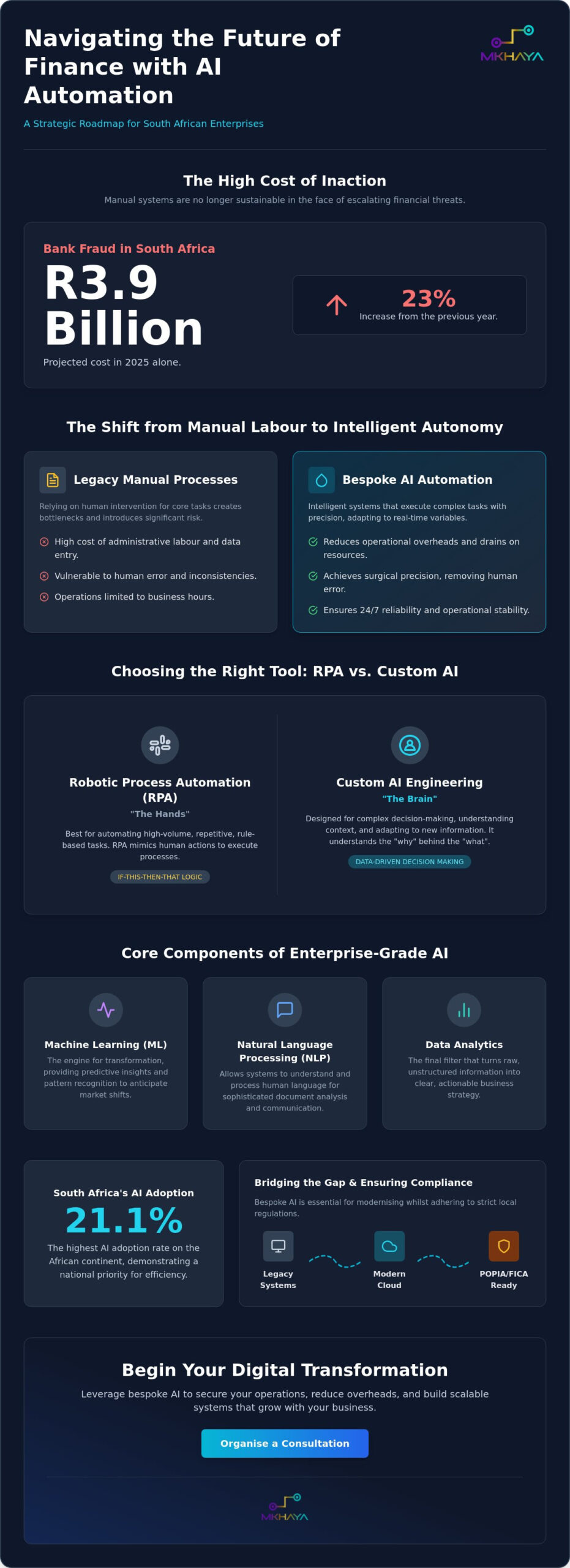
With bank fraud in South Africa costing R3.9 billion in 2025, a 23% increase from the previous year, the financial risk of relying on manual legacy systems is no longer sustainable. You’re likely finding that manual data entry errors in your financial processes are more than just a nuisance; they’re a drain on your resources. Adopting bespoke AI automation solutions south africa isn’t just about following a trend. It’s about securing your operations against rising costs and the intensified POPIA compliance monitoring expected throughout the 2026/2027 financial year.
We understand that the prospect of integrating modern intelligence with older ERP or loan management systems feels like a daunting task. It’s a challenge shared by many enterprises striving to balance stability with the need for rapid growth. This guide provides a strategic roadmap to help you leverage bespoke AI to bridge that gap. You’ll discover how to reduce operational overheads and build scalable systems that grow alongside your business. We’ll look at the shift toward agentic AI and how to maintain POPIA compliance whilst modernising your core operations. Precise execution for a more efficient future.
Key Takeaways
- Distinguish between basic task automation and intelligent decision-making to identify the most impactful opportunities for your digital transformation.
- Compare the “hands” of robotic process automation with the “brain” of custom AI engineering to ensure your technology stack supports long-term strategic goals.
- Utilise a practical checklist to assess your data readiness and secure your operations against evolving POPIA and FICA regulatory requirements.
- Discover how bespoke AI automation solutions south africa can bridge the gap between legacy ERP systems and modern, scalable cloud architectures.
- Understand the benefits of flexible engagement models, such as staff augmentation, to build a stable and high-end automation platform with precision.
Defining AI Automation Solutions in the South African Business Landscape
AI automation represents a sophisticated synthesis of Artificial Intelligence (AI) and advanced process logic. It moves beyond the basic “if-this-then-that” rules of traditional computing to create systems capable of executing complex, multi-layered tasks. For many enterprises, the true value of AI automation solutions south africa lies in the shift from simple task repetition to intelligent, data-driven decision-making. While basic automation handles the “what,” AI understands the “why,” allowing your business to adapt to variables in real-time without constant manual oversight.
To better understand this concept, watch this helpful video:
Many organisations initially attempt to solve bottlenecks with “off-the-shelf” bots. These generic tools often fail because they don’t account for the specific complexities of the South African enterprise landscape, such as integrating with bespoke legacy systems or meeting local regulatory standards. True digital transformation requires a more refined approach that builds intelligence directly into your core business logic rather than layering a fragile script over existing problems.
The Shift from Manual to Autonomous Operations
The rising cost of manual administrative labour is putting immense pressure on national margins. Relying on human staff for repetitive data entry or document verification isn’t just expensive; it’s a bottleneck that prevents your best people from focusing on high-value strategy. Automation provides a stable anchor in this volatile technological environment. There is a clear transition point where spreadsheets and basic digital tools no longer suffice. When your operational volume outpaces your team’s ability to maintain precision, it’s time to move toward autonomous systems that offer long-term stability and reliability.
Why National Enterprises are Prioritising AI in 2026
In 2026, the drive for operational efficiency is no longer optional for those competing in global markets. With South Africa maintaining the highest AI adoption rate on the continent at 21.1%, firms are prioritising AI and data automation to achieve 24/7 reliability in both customer-facing and back-office processes. This adoption is characterised by a sense of “quiet confidence.” It’s technology that works tirelessly behind the scenes, ensuring that loan approvals, procurement cycles, and facility management tasks are completed with surgical precision. By removing the friction of human error, businesses can project an image of seamless, modern capability to their clients and partners.
The Core Components of Enterprise-Grade AI Automation
Building a robust digital architecture requires more than just installing new software. It involves a methodical assembly of specialised technologies that work in harmony. Machine Learning (ML) serves as the primary engine for this transformation, providing the predictive insights and pattern recognition necessary to anticipate market shifts. When these components are integrated into custom software development, they transform static applications into dynamic assets that learn and adapt. This integrated approach ensures that your AI automation solutions south africa are built on a foundation of intelligence rather than rigid, easily broken rules.
Natural Language Processing (NLP) adds another layer of sophistication by allowing systems to understand and process human language with remarkable accuracy. This isn’t just about simple text recognition. It’s about sophisticated document analysis and communication that feels natural and professional. Data Analytics then acts as the final filter, turning raw, unstructured information into a clear, actionable strategy. By synthesising these elements, businesses can move from reactive troubleshooting to a proactive stance of steady, forward-looking ambition.
Data Orchestration and Predictive Insights
The first step in any successful automation journey is organising the chaos of unstructured data. AI excels at cleaning and categorising information that would otherwise take human teams weeks to process. Predictive analytics then uses this organised data to forecast market trends and customer behaviour with surgical precision. This aligns perfectly with our philosophy of methodical execution. Research from Stellenbosch Business School highlights how AI for public service delivery is already reshaping how large-scale organisations manage complex data sets to improve efficiency. If you’re looking to refine your own internal processes, exploring our AI and data automation services is a logical first step toward long-term stability.
Intelligent Communication Layers
Modern communication layers have evolved far beyond the basic chatbots of the past. Today’s context-aware AI assistants can manage complex enquiry routing and automate document validation without losing the “quiet confidence” your brand requires. NLP allows these systems to verify identities, check compliance documents, and respond to nuanced client queries whilst maintaining a polished brand voice. This level of automation doesn’t replace the human touch; it protects it. By handling the repetitive administrative burden, your team is free to focus on the high-level relationship building that truly drives growth.
- Predictive Engines: ML models that identify bottlenecks before they impact your bottom line.
- Linguistic Bridges: NLP tools that parse complex legal and financial documents in seconds.
- Strategic Dashboards: Real-time analytics that provide a clear view of operational health.
Strategic Comparison: Robotic Process Automation (RPA) vs. Custom AI Engineering
Choosing the right path for your digital journey requires a clear understanding of the distinction between mechanical repetition and cognitive intelligence. Robotic Process Automation (RPA) acts as the “hands” of your operation. It’s designed to handle high-volume, rule-based tasks by mimicking human interactions with software. In contrast, Custom AI Engineering serves as the “brain.” It involves building bespoke intelligence directly into your core systems to handle nuanced decision-making. Whilst RPA offers rapid implementation, AI automation solutions south africa that leverage custom engineering provide the long-term scalability needed for a truly agile enterprise.
The transition from simple bots to AI-driven business automation usually happens when rule-based logic can no longer account for the variables in your workflow. RPA is excellent for quick wins and immediate cost reduction, but its ROI can plateau as processes become more complex. Custom AI engineering requires a more deliberate initial investment, yet it delivers a superior ROI by evolving alongside your business. It allows you to own your automation IP, creating a stable anchor that isn’t dependent on third-party subscription tiers or limited integration capabilities.
When to Choose RPA for Immediate Efficiency
RPA is your best ally for high-volume, low-complexity tasks where the rules never change. If your team is bogged down by manual data migration or repetitive invoicing, these bots can provide instant relief. They’re the “quick wins” that prove the value of automation to stakeholders early in the process. For a deeper look at how to identify these opportunities, our Business Process Automation guide offers a comprehensive breakdown of the 2026 landscape. It’s a practical starting point for organisations looking to build momentum without overhauling their entire architecture immediately.
The Power of Bespoke AI for Complex Decisioning
When your operations involve unique logic or sensitive data, custom engineering is the only way to ensure precision. This is particularly evident in sectors like finance, where loan management requires sophisticated risk assessment that goes beyond simple checkboxes. Bespoke AI solutions adapt to the specific nuances of the South African market, such as local credit behaviours or specific regulatory reporting formats. By building your own “brain,” you ensure that your automated decisions are as reliable and stable as those made by your most experienced senior staff. This methodical approach to construction ensures that your technology remains a high-end asset for years to come.
Overcoming Implementation Hurdles: POPIA, Integration, and Data Readiness
The primary concern for any executive today is the security and ethical handling of sensitive information. With the Information Regulator of South Africa intensifying compliance monitoring for the 2026/2027 financial year, the question isn’t just whether the technology works, but whether it’s safe. Deploying AI automation solutions south africa requires a proactive approach to the Protection of Personal Information Act (POPIA). This involves more than just ticking boxes. It’s about building a foundation of trust where every automated decision is transparent and every data point is protected with surgical precision.
Navigating POPIA in the Age of AI
Modern AI models must adhere to the principles of data minimisation and purpose specification. This means your systems should only process the specific information required for a task, rather than holding vast, unnecessary data sets. Utilising secure cloud solutions for data hosting within South Africa is a critical step in ensuring compliance with the March 2026 regulations regarding health and personal information. We prioritises transparency in every build, ensuring that your automated workflows aren’t just efficient, but fully aligned with the latest national legal requirements.
Bridging the Gap with Legacy Systems
Many South African enterprises struggle with integrating modern intelligence into older software architectures, such as aging ERP or facility management systems. The technical solution lies in using robust APIs to create a seamless bridge between the old and the new. This allows for operational continuity whilst you upgrade your core technology. Engaging in digital transformation consulting helps map this journey, identifying exactly where AI can add the most value without disrupting existing workflows. It’s about refinement rather than replacement, ensuring your business remains stable whilst it evolves.
Before you begin your implementation, use this checklist to assess your data readiness:
- Data Audit: Identify all existing data silos and assess the quality of the information held within them.
- Purpose Specification: Clearly define why each AI model needs access to specific data sets.
- Security Protocols: Ensure robust encryption is in place for data both at rest and in transit.
- Human Oversight: Establish a “Human-in-the-loop” model where high-stakes decisions are reviewed by your team to ensure ethical accuracy.
Maintaining a high level of integrity in your automation strategy protects your brand’s reputation. By keeping humans in the loop for complex decisioning, you combine the speed of machine logic with the nuanced judgement of your experienced staff. This collaborative approach ensures that your autonomous systems act as a reliable partner to your workforce. If you’re ready to secure your operations against future regulatory shifts, speak to our experts about your integration journey today.
The Mkhaya MK Approach: Custom-Built Automation for National Scale
We view technology as a long-term commitment rather than a temporary fix. As a visionary guide in the digital space, our focus is on building stable, high-end automation platforms that serve as a reliable anchor for your enterprise. Our proprietary products aren’t static tools; they’re evolving ecosystems. By infusing intelligence into our ERP solutions, we allow businesses to automate complex procurement cycles and financial reporting with surgical precision. Similarly, our Learner Management Systems utilise advanced logic to personalise professional development, ensuring your AI automation solutions south africa deliver measurable results at a national scale.
Every engagement follows a rhythmic sense of momentum. We move from high-level strategic concepts to methodical execution, ensuring that the value remains clear to both technical and non-technical stakeholders. Whether you require a specific project delivery or a more integrated collaborative model, our goal is to bridge the gap between your current legacy operations and a future of modern scalability. This approach replaces flashy claims with a persona of quiet confidence, where the technology works tirelessly behind the scenes to support your growth.
A Partnership Rooted in Reliability
Our relationship with you is fundamentally client-centric. We recognise that AI should serve the personal journey of your business, adapting to your unique culture and operational needs. To facilitate this, we offer a staff augmentation model that allows you to bring specialised AI expertise in-house quickly. This provides the flexibility to scale your team without the long-term overheads of traditional hiring. It’s a supportive partnership designed for mutual success, ensuring that your journey toward automation is grounded in transparency and integrity.
Your Roadmap to AI Maturity
Achieving a state of autonomous efficiency requires a deliberate and thorough progression. We’ve refined this journey into four distinct stages to ensure long-term stability:
- Audit: We begin with a precise evaluation of your current data readiness and legacy bottlenecks.
- Design: Our team crafts a bespoke architectural blueprint that aligns with your strategic goals.
- Engineer: We build and integrate your custom intelligence layers using polished, industry-appropriate code.
- Optimise: Continuous refinement ensures your systems remain agile as market conditions shift.
This roadmap is designed for those with a forward-looking ambition to lead their sector. By choosing a path of methodical construction, you ensure that your digital transformation is both stable and sophisticated. We invite you to take the first step toward a more efficient future. Book a strategic consultation with our team to explore how custom automation can redefine your operational potential.
Securing Your Competitive Advantage Through Intelligent Automation
The transition from manual processes to autonomous operations is more than a technical upgrade. It’s a strategic commitment to long-term stability. By choosing bespoke AI automation solutions south africa, you ensure that your business logic remains precise and compliant with the latest POPIA regulations. We’ve explored how custom engineering acts as the “brain” of your enterprise, allowing you to bridge the gap between legacy systems and modern scalability without disrupting your daily momentum.
Success in this landscape requires a partner with end-to-end digital transformation expertise and a national reach. Whether you’re refining specialised proprietary systems for loans and facilities or seeking to reduce operational overheads, the path forward is one of methodical execution. It’s time to move beyond basic digital tools and embrace a future built on quiet confidence and mutual success. Begin your digital transformation journey with a bespoke AI strategy from Mkhaya MK. We’re ready to build a more resilient future alongside you.
Frequently Asked Questions
What are AI automation solutions and how do they differ from standard software?
AI automation solutions go beyond standard software by incorporating machine learning to adapt and make decisions rather than just following fixed rules. While standard software requires manual input for every variation, AI learns from data to handle complex tasks like document analysis or predictive forecasting. This creates a dynamic system that evolves with your business logic. It’s the difference between a tool that follows instructions and a partner that understands patterns.
How long does it typically take to implement an AI automation solution in South Africa?
Implementation timelines vary depending on complexity, but a phased rollout often takes between three to six months. We begin with a deliberate audit and design phase to ensure the architecture is stable before moving into engineering. This methodical approach ensures that the final platform is reliable and fully integrated with your existing workflows. It prevents the operational friction often associated with rushed, off-the-shelf deployments that fail to account for local nuances.
Will AI automation replace my existing staff or enhance their capabilities?
AI automation is designed to augment your team by removing the burden of repetitive, manual administrative tasks. By handling high-volume data entry or initial document verification, it frees your staff to focus on high-value strategy and client relationship building. It acts as a tireless partner that enhances human precision rather than a replacement for professional judgement. This collaborative relationship ensures your team remains agile and motivated whilst the technology handles the heavy lifting.
How does POPIA compliance affect the use of AI for customer data analysis?
POPIA requires strict adherence to data minimisation and purpose specification when using AI for analysis. You must ensure that your AI models only process information essential for the defined task and that data is stored securely, ideally within South African borders. Maintaining transparency in automated decision-making is also a key requirement for the 2026/2027 regulatory cycle. Refined data handling ensures your automation remains a stable and ethical asset for your brand.
Can AI automation be integrated with my current legacy ERP system?
Yes, integrating AI automation solutions south africa with legacy ERP systems is achievable through the use of robust APIs and custom middleware. This bridge allows modern intelligence to communicate with older architectures, ensuring you don’t have to replace your entire infrastructure to gain the benefits of automation. It’s about refined construction that maintains operational continuity whilst upgrading your core capabilities. This approach protects your previous investments while preparing you for future scalability.
What is the expected ROI for business process automation in the first year?
ROI typically manifests through reductions in operational overheads and improved accuracy in financial processes. While specific figures depend on the scale of deployment, businesses often see a return through the elimination of manual errors and faster turnaround times for core services. The long-term value lies in a scalable system that supports growth without a linear increase in labour costs. It’s a strategic investment that builds a foundation for sustainable, long-term profitability.
What industries in South Africa benefit most from AI-driven data automation?
Financial services, healthcare, and logistics are amongst the sectors seeing the most immediate benefits. In finance, AI streamlines loan management and fraud detection, whilst in logistics, it optimises supply chain logic and procurement. Any industry dealing with high-volume data and intensive compliance requirements like FICA or POPIA will find these solutions essential. These tools provide the precision and reliability needed to maintain a competitive edge in a rapidly changing technological landscape.
How do I determine if my organisation is ready for custom AI engineering?
Readiness is determined by the maturity of your data and the complexity of your current bottlenecks. If your team is overwhelmed by rule-based tasks that standard software cannot solve, you’re likely ready for a custom build. We recommend a strategic consultation to audit your current systems and identify where bespoke intelligence can provide the most stable anchor for your digital future. This visionary yet practical evaluation ensures your automation journey begins on solid ground.