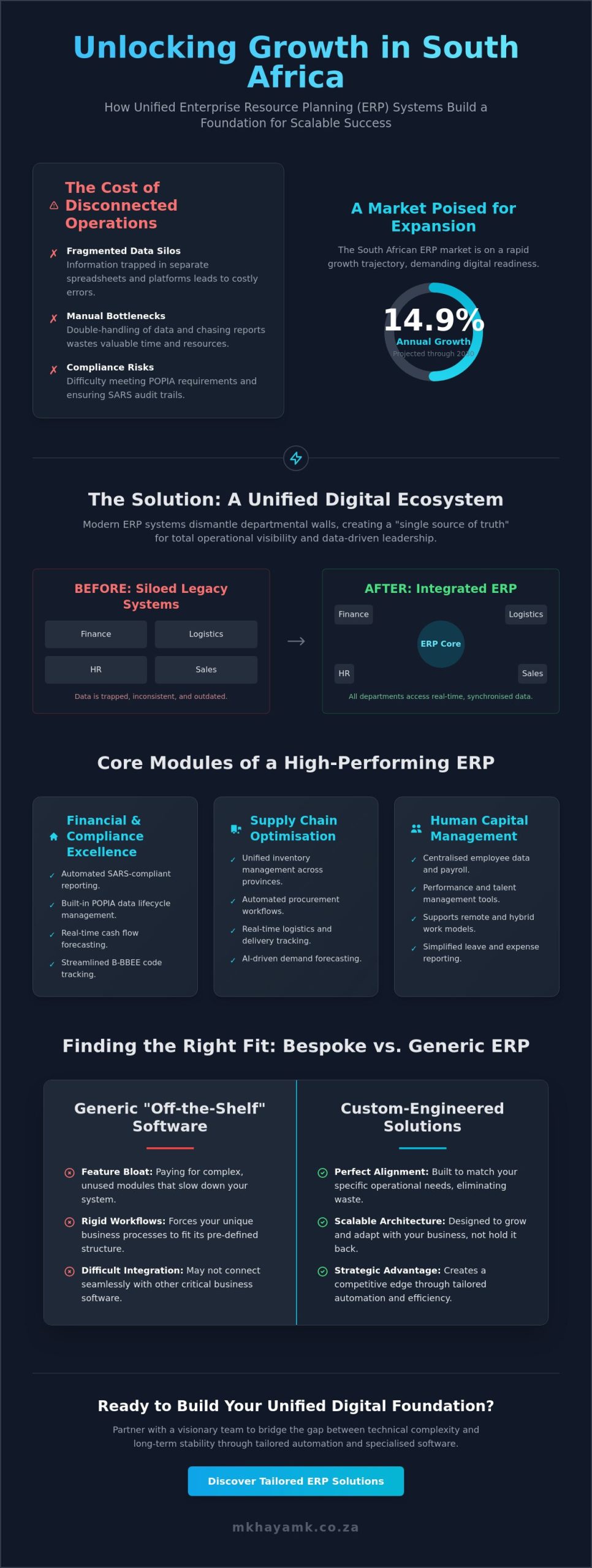
What if the primary barrier to your company’s growth isn’t market demand, but the invisible friction of fragmented data and manual bottlenecks? In an economy where the South African ERP market is projected to expand by 14.9% annually through 2030, staying competitive requires more than just hard work. It demands a unified digital foundation. Selecting the right ERP solutions South Africa offers is about more than software; it’s about building a reliable architecture that integrates every department into a single, cohesive engine.
You likely recognise the frustration of chasing real-time reports across disparate platforms or the anxiety of ensuring your data deletion logs meet the latest POPIA requirements. We understand that these operational hurdles can stifle even the most ambitious enterprises. This guide explores how modern ERP systems transform these challenges into strategic advantages by automating workflows and securing local compliance. We will examine the shift toward cloud-first adoption, the impact of AI-driven insights, and the practical steps to achieving long-term stability in an evolving technological landscape.
Key Takeaways
Understand how transitioning from siloed legacy systems to a unified digital ecosystem creates a robust foundation for scalable business growth.
Identify the core modules, such as automated financial management and supply chain optimisation, that define high-performing ERP solutions South Africa requires.
Learn to distinguish between feature-heavy generic software and custom-engineered solutions that eliminate “feature bloat” to align with your specific operational needs.
Discover a structured implementation strategy that ensures safe data migration and seamless workflow mapping while maintaining business continuity.
Explore how a visionary partnership can bridge the gap between technical complexity and long-term stability through tailored automation and specialised software products.
What are ERP Solutions and Why Do South African Enterprises Need Them?
At its core, an Enterprise Resource Planning (ERP) system acts as the central nervous system of an organisation. Understanding What are ERP Solutions involves seeing beyond simple software; it’s about a unified ecosystem where every department, from finance to logistics, shares a common data language. For years, businesses operated within silos where information stayed trapped in separate spreadsheets or disconnected accounting packages. This fragmentation often led to double-handling of data and costly miscommunications. Modern ERP solutions south africa provide a bridge, consolidating these disparate threads into a single, integrated digital platform that empowers leaders with total visibility.
To better understand how these systems function within a local context, watch this helpful case study:
Beyond efficiency, these platforms serve as a critical anchor for compliance. As of June 2026, the Information Regulator has placed a sharp focus on automated logs of data deletion to ensure adherence to POPIA. A robust ERP system doesn’t just store data; it manages the entire lifecycle of information. This includes role-based access and audit trails that are essential for navigating the complex South African regulatory landscape. By centralising these processes, companies reduce the risk of manual oversight and build a foundation of trust with their clients.
The Evolution of Business Management Software
The journey of business management has shifted dramatically. What began as basic ledger software has matured into comprehensive suites that support the dynamic needs of today’s workforce. With the rise of remote and hybrid work models across the country, the reliance on on-premise servers has faded. Managed cloud infrastructure now ensures that a team in Cape Town and a warehouse in Johannesburg remain perfectly synchronised. This evolution allows for a level of agility that was previously impossible, turning software from a back-office tool into a driver of digital transformation.
Why National Scalability Requires Integrated Data
The Essential Modules of a High-Performing ERP System
A high-performing ERP system functions as a modular framework designed to scale alongside your ambitions. Whilst weighing the advantages and disadvantages of ERP, it becomes clear that the value lies in how these modules communicate. Choosing the right ERP solutions South Africa provides means selecting a suite that addresses both global standards and local nuances. By integrating financial management, supply chain logistics, and human capital into a single interface, you eliminate the friction that slows down decision-making and business growth.
Financial and Compliance Excellence
South African businesses face a specific regulatory environment, including the standard 27% corporate income tax rate and evolving B-BBEE codes. An effective ERP automates SARS-compliant reporting and financial auditing, ensuring that your team spends less time on manual entries and more on strategy. Automated cash flow forecasting provides the stability needed to navigate market shifts, whilst direct integration with local banking gateways ensures that transactions remain seamless and secure. This level of precision is vital for maintaining long-term stability in a fluctuating economy.
Operational and Supply Chain Optimisation
For resource-heavy industries, real-time asset tracking is a necessity rather than a luxury. Implementing a specialised facility management system within your ERP framework allows for precise resource allocation and maintenance scheduling. Similarly, the Optimate Procurement Platform streamlines supplier relationships by optimising inventory levels and reducing waste. These tools ensure that your national distribution remains efficient, even when faced with local logistical challenges. Integrated logistics modules provide the visibility required to manage complex supply chains with quiet confidence.
Data-Driven Decision Making
The true power of modern ERP solutions South Africa relies on lies in their ability to turn raw data into actionable intelligence. By leveraging AI & Data Automation, executive dashboards provide a 360-degree view of the organisation. Predictive analytics allow you to forecast demand and future-proof your growth by identifying trends before they impact the bottom line. This shift from reactive reporting to proactive insight is what defines a visionary enterprise. If you’re unsure which modules match your current growth phase, exploring our ERP solutions can help clarify your path forward.
Bespoke vs Generic: Finding the Best ERP Software for Local Requirements
Choosing between a global template and a custom-engineered system is a pivotal moment for any enterprise. Whilst large global brands offer a sense of familiarity, they often introduce “feature bloat”—a collection of complex tools and workflows that your team might never use, yet you still pay to maintain. When you explore the variety of ERP solutions south africa offers, it’s essential to ask whether the software will adapt to your business, or if you’ll be forced to adapt your business to the software. Bespoke custom software development ensures that your unique business logic is baked into the code rather than bolted on as an afterthought, providing a foundation that feels natural to your operations.
The Limitations of One-Size-Fits-All Systems
Forcing local processes into rigid global templates often creates significant operational friction. These generic systems are typically built for international markets, meaning they may lack the inherent flexibility required for South African business nuances. This misalignment often leads to manual workarounds, defeating the purpose of an integrated system. The hidden costs of trying to customise a rigid generic system can quickly spiral, as you’re essentially paying to rewrite the foundation of the product. Beyond the backend, user adoption often suffers when the interface feels clunky or irrelevant. Investing in high-quality UI/UX design services ensures that the system feels intuitive, encouraging your staff to engage with the platform rather than work around it. For businesses extending their digital ecosystem to mobile users, partnering with a specialised mobile app design company south africa can further bridge the gap between complex business requirements and the real-world needs of your users.
The Power of Specialised Proprietary Products
Sometimes, the best path forward isn’t a generic ERP or a completely blank slate, but a specialised proprietary product designed for your industry. For financial providers, a dedicated loan management system offers deep functionality that a generic ERP simply can’t match without extensive, expensive modifications. Similarly, a robust facility management system provides the granular asset tracking and maintenance scheduling required for resource-heavy sectors. These specialised tools can integrate seamlessly with your wider digital ecosystem, including a learner management system to track corporate skills development. This modular approach provides the stability of a proven product with the precision of a bespoke build, ensuring that every niche department is supported by tools that actually understand their daily challenges.
Executing a Seamless ERP Implementation Strategy
Implementing ERP solutions south africa requires a disciplined, methodical approach to ensure the transition enhances rather than disrupts your daily operations. A successful rollout isn’t a single event; it’s a journey that follows a logical, five-phase progression. This structured path allows for transparency and methodical execution, building trust amongst stakeholders whilst securing the long-term stability of the new system. By moving from a broad vision toward concrete execution, we ensure that every department is aligned and ready for the shift.
Phase 1: Discovery and Assessment. We begin by mapping your current workflows and identifying operational gaps. This ensures the solution addresses real-world friction points rather than theoretical ones.
Phase 2: Data Migration and Integration. Safely moving legacy data to the new system is a delicate process. We prioritise data integrity to ensure your historical insights remain intact and accessible.
Phase 3: Customisation and Configuration. Here, we align the software with your specific business rules. This phase turns a standard platform into a precision tool for your enterprise.
Phase 4: User Acceptance Testing (UAT). We verify that the system meets every operational need. Your team tests the logic in a controlled environment before the full rollout.
Phase 5: Training and Go-Live. Empowering your staff is the final step. We transition to the new platform with a clear support structure in place to handle the initial switch.
Overcoming Implementation Hurdles
Change management is often the most overlooked aspect of a rollout. Reducing staff resistance requires transparent communication and a clear explanation of the practical benefits. People need to feel supported as they learn new behaviours. From a technical standpoint, Cloud Application Services & DevOps play a vital role in maintaining high system availability. This infrastructure ensures that your migration doesn’t compromise data security or residency; it’s a critical factor for maintaining POPIA compliance during the move.
Ensuring Long-Term System Health
A successful go-live is just the beginning of the journey. Maintaining system health requires ongoing managed cloud services and proactive support. As your cloud footprint grows, implementing a deliberate approach to cloud cost optimisation south africa businesses rely on can prevent idle resources from silently eroding your technology budget. If your internal team lacks specific technical expertise, staff augmentation can fill those gaps during the critical early months. Regular software engineering updates are also essential to keep your system secure and performing at its peak. This continuous refinement ensures that your digital foundation remains a stable anchor as your business grows. Ready to start your transition? Explore our methodical implementation process to see how we guide your business toward operational excellence.
Partnering for Growth: Mkhaya MK’s Comprehensive ERP and Automation Portfolio
Mkhaya MK positions itself as a visionary partner invested in your personal journey toward operational excellence. We don’t just provide software; we build the digital architecture that supports your long-term stability. By merging custom software development with specialised ERP solutions south africa, we create a synergy that generic vendors cannot replicate. This approach ensures that every line of code serves a specific business outcome, turning technology from a cost centre into a strategic asset. We value transparency and methodical execution, acting as a stable anchor as you navigate the complexities of digital growth.
Our methodology integrates AI & data automation directly into the core ERP framework. This integration allows for predictive insights and automated workflows that free your team from repetitive manual tasks. When technical gaps arise during a complex rollout, our staff augmentation services extend your internal capabilities, providing the expert hands needed for project success. It’s a holistic ecosystem designed for mutual success and steady, forward-looking ambition, ensuring that your business remains agile in a shifting market.
Our Specialised Product Ecosystem
To achieve national scalability, businesses require tools that understand the specific demands of their sector. Our Optimate Procurement Platform streamlines supplier management, whilst MkhayaMove provides the precision needed for complex logistics. For financial providers, our loan management system offers a robust platform for managing credit lifecycles with quiet confidence. Meanwhile, our facility management system ensures that physical assets are utilised to their full potential. These proprietary products aren’t isolated tools; they are essential components of a broader digital transformation strategy that scales alongside your enterprise.
Your Journey to Digital Maturity
Our collaborative process begins with strategic consulting and moves through to methodical execution. This journey isn’t about high-pressure urgency; it’s about a deliberate pace that ensures each milestone is fully articulated and achieved. We believe in building a relationship where your success is the primary metric of our own. This commitment to integrity and precision allows us to guide you from a broad vision toward a concrete, high-end digital reality. We invite you to explore our resources to learn more about modernising your tech stack. If you’re ready to refine your operations and embrace a proactive, data-driven future, contact us today to begin our partnership.
Building a Future-Ready Enterprise
Transitioning to a unified digital ecosystem is a strategic necessity for national scalability, whilst selecting the right ERP solutions south africa provides allows you to replace operational friction with data-driven precision. We’ve explored how a modular approach helps your business grow without the burden of feature bloat, ensuring that local compliance remains a core pillar of your architecture. This journey requires a partner that understands both global standards and the specific nuances of our local market.
Mkhaya MK is a privately held South African technology firm and an end-to-end digital transformation expert. Our specialised proprietary systems, including the Optimate Procurement Platform and MkhayaMove, provide the precision needed to solve unique logistical and procurement challenges. We’re dedicated to your long-term stability and mutual success, acting as a visionary guide through every phase of your growth. Discover our ERP solutions and start your digital transformation journey today. Let’s build a more efficient, resilient future together.
Frequently Asked Questions
What is the average timeline for an ERP implementation in South Africa?
Implementation timelines typically range from six to twelve months, depending on the complexity of your business logic and data migration needs. Smaller projects or modular rollouts can sometimes be completed in three to six months. We prioritise a methodical progression through discovery and testing to ensure the system is stable before go-live, avoiding the risks associated with rushed deployments that could disrupt your operations.
Can a custom ERP solution integrate with my existing accounting software?
Yes, custom ERP systems are designed to bridge the gap between your new digital ecosystem and legacy accounting tools. We use robust integration protocols to ensure that financial data flows seamlessly between platforms without manual entry. This connectivity preserves your historical financial records whilst providing the enhanced operational visibility that modern ERP solutions South Africa requires to remain competitive and agile in a changing market.
How does an ERP system help with POPIA compliance?
Modern systems automate the lifecycle of personal information by implementing role-based access controls and detailed audit trails. As of 2026, the Information Regulator focuses on automated logs of data deletion, which our systems handle natively. By centralising data, you eliminate the risk of unsecured personal information sitting in disconnected spreadsheets, ensuring your business meets every legal requirement under the Act with quiet confidence.
Is a cloud-based ERP better than an on-premise system for local businesses?
Cloud-based systems are generally superior for South African enterprises due to their resilience against local infrastructure challenges like load shedding. Whilst on-premise servers require expensive backup power and physical security, cloud infrastructure offers high availability and remote accessibility. This ensures your team can continue working from any location with an internet connection, providing a stable anchor for business continuity during power outages or connectivity issues.
What are the main differences between bespoke ERP and SAP or Sage?
The main difference lies in the balance between flexibility and “feature bloat”. Global brands like SAP or Sage offer massive, rigid templates that often include complex tools your team will never use. A bespoke solution is custom-engineered to match your exact business logic. This eliminates unnecessary complexity and ensures the user interface is intuitive, leading to higher adoption rates and a more refined operational flow for your staff.
How do I know if my business is ready for an ERP upgrade?
What is the role of AI in modern ERP solutions?
AI serves as a catalyst for predictive analytics and task automation within the core framework. In the current market, AI-driven ERP solutions South Africa employs use machine learning to forecast demand and automate repetitive financial entries. This shift allows executives to move from reactive decision-making to a proactive stance, where future trends are identified before they impact the bottom line, ensuring long-term stability and precision.
How does Mkhaya MK support businesses after the ERP system goes live?
We remain deeply invested in your journey through ongoing managed cloud services and regular software engineering updates. Our support doesn’t end at go-live; we provide staff augmentation to fill technical gaps and ensure your team feels confident using the new system. This collaborative relationship ensures long-term stability and allows us to refine the platform as your business evolves and scales nationally, creating an atmosphere of mutual success.
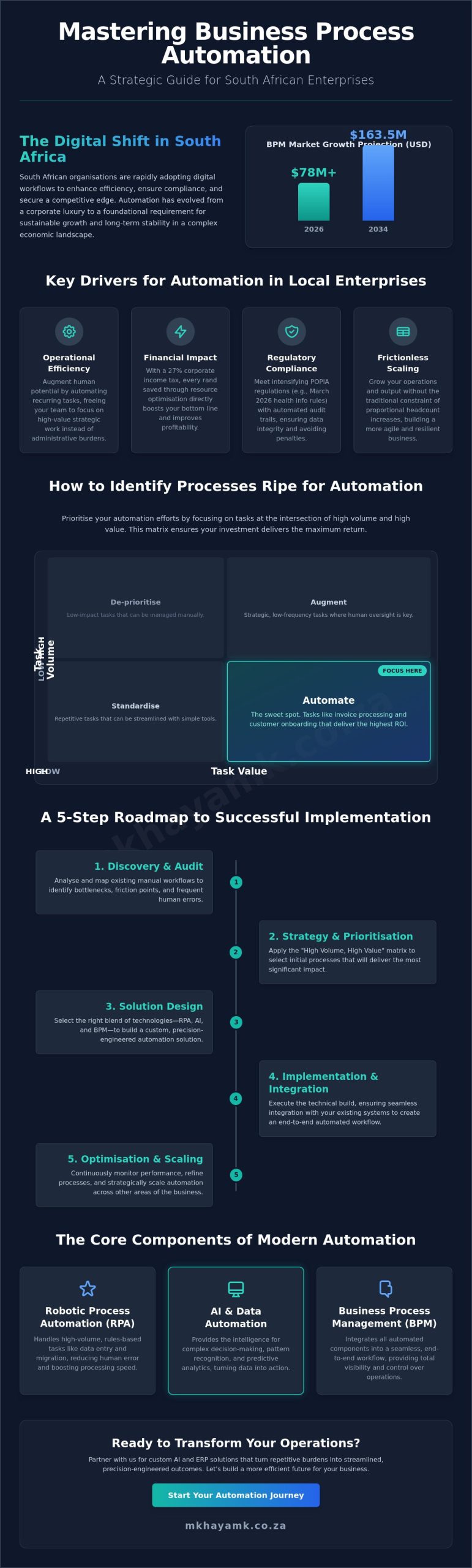
By the start of 2026, the South African business process management market has already surpassed a valuation of $78 million, signalling a massive shift in how local organisations operate. You’ve likely felt the weight of manual, repetitive tasks draining your team’s energy and stalling your growth. It’s frustrating to watch operational overheads climb while your ability to scale remains tethered to your headcount. We understand that you want to move beyond these bottlenecks to build a more resilient, agile business.
This comprehensive guide shows you exactly how to master business process automation south africa to reclaim that lost time and drive genuine efficiency. We’ll provide a clear roadmap for your digital transformation, moving from high-level strategic concepts to the specific execution of automated workflows. You’ll discover how to refine your operations, reduce human error in data-heavy tasks, and create a stable foundation for increased productivity. Let’s explore how to turn these technological capabilities into practical, long-term success for your enterprise.
Key Takeaways
Understand why South African organisations are prioritising digital workflows in 2026 to maintain a competitive edge and ensure long-term stability.
Master the “High Volume, High Value” matrix to accurately identify which manual tasks will deliver the greatest return on investment when digitised.
Follow a structured 5-step roadmap to implement business process automation south africa, ensuring a seamless transition from strategic consulting to technical execution.
Learn practical strategies for navigating common implementation hurdles, such as managing legacy technical debt and addressing staff concerns about digital shifts.
Discover how custom AI and ERP solutions can augment your team’s potential, transforming repetitive burdens into streamlined, precision-engineered outcomes.
What is Business Process Automation (BPA) in the South African Context?
At its core, What is Business Process Automation (BPA) involves the strategic use of technology to execute recurring, multi-step tasks that traditionally rely on manual effort. In our local market, business process automation south africa has evolved from a luxury for large corporations into a fundamental requirement for any enterprise seeking long-term stability. As of 2026, the movement toward digital workflows is driven by a need to augment human potential rather than replace it.
South African leaders are increasingly prioritising these systems to navigate a complex economic environment. With the local BPM market projected to reach USD 163.5 Million by 2034, the focus has shifted from simple digitisation toward building intelligent, interconnected ecosystems. This transition ensures that your organisation remains competitive on a global stage whilst maintaining the agility needed for local success.
To better understand this concept, watch this helpful video:
The Core Components of Modern Automation
Building a robust automation framework requires a blend of specialised tools. Robotic Process Automation (RPA) handles the repetitive, high-volume data entry that often leads to human error. For broader oversight, AI and data automation provides the intelligence needed for pattern recognition and complex decision-making. When these are integrated through Business Process Management (BPM) principles, the result is a seamless end-to-end workflow that provides total visibility into your operations.
Why Automation Matters for Local Enterprises
Operational efficiency is the primary driver for business process automation south africa in the current fiscal year. With corporate income tax rates at 27%, every rand saved through resource optimisation directly impacts your bottom line. Additionally, the Information Regulator’s intensification of POPIA enforcement, including the new March 2026 regulations regarding health information, makes automated audit trails essential for compliance. This digital transformation allows you to scale your operations without the friction of proportional headcount increases, ensuring your business remains a stable anchor in a changing landscape.
How to Identify Processes Ripe for Automation
Selecting the right starting point is the most critical decision in your digital transformation journey. Not every manual task deserves automation; some simply need better management. We recommend using a “High Volume, High Value” matrix to prioritise your efforts. High-volume tasks are those performed dozens of times daily, whilst high-value tasks are those where errors or delays significantly impact your bottom line. By focusing on the intersection of these two factors, you ensure that your investment in business process automation south africa yields the highest possible return.
Before you write a single line of code, you must conduct a thorough audit of your current manual workflows. This phase isn’t about looking for technology; it’s about understanding the current friction. Identifying bottlenecks where work piles up or where data entry leads to frequent errors provides the clarity needed for a successful rollout. This methodical approach is one of the essential steps to take when automating your operations, as it prevents the digitisation of inherently broken processes.
Success depends on having clear, measurable Key Performance Indicators (KPIs). Whether it’s reducing the time to process a loan application or eliminating data entry errors in procurement, these metrics provide the evidence of success that stakeholders require. This focus on precision ensures that your automation strategy remains a stable anchor for long-term growth. If you’re unsure where to begin your audit, exploring our digital transformation services can help clarify your path forward.
Criteria for Automation Suitability
A process is generally a strong candidate for automation if it meets three specific criteria. First, look for a repetitive nature where tasks are performed daily or weekly by multiple staff members. Second, the process should follow rule-based logic; it needs a clear “if-this-then-that” structure that doesn’t require subjective judgement. Finally, seek out workflows with a low exception rate. Automation thrives when the path is predictable and doesn’t require constant human intervention to fix edge cases.
Common Use Cases in South African Business
We see several sectors leading the way with specialised automation solutions. Many organisations are currently:
Automating procurement and supplier management using precision platforms like Optimate to control costs and improve transparency.
Streamlining financial services and credit applications through integrated loan management systems that speed up decision-making.
Modernising HR and compliance training through learner management systems that track progress automatically.
A 5-Step Guide to Implementing Business Process Automation
Implementing business process automation south africa requires a deliberate shift from visionary thinking to technical precision. A methodical approach ensures that your digital transformation isn’t just a temporary fix but a stable foundation for long-term growth. By following a structured roadmap, you can transition smoothly from strategic consulting to technical execution, ensuring every rand spent contributes to a measurable return on investment.
Step 1: Process Mapping and Discovery
Documenting every step of your current manual process is the only way to uncover hidden inefficiencies. During this discovery phase, we engage deeply with stakeholders to identify the specific “pain points” that slow down your daily operations. This isn’t just about recording what happens; it’s about defining the desired future state of your workflow. Clear documentation prevents the common mistake of automating a flawed process, ensuring your new system is built for speed and accuracy from day one.
Step 2: Choosing the Right Technology Stack
Choosing between custom software engineering and off-the-shelf ERP solutions depends entirely on your specific organisational goals. Many South African enterprises find that cloud-based solutions offer the best balance of accessibility and scale, allowing teams to collaborate across provinces without friction. You should also consider how AI and data automation can add predictive layers to your workflows, turning simple task execution into intelligent process orchestration that anticipates business needs.
Step 3: Development, Integration, and Training
Building your solution relies on agile software engineering principles to maintain momentum and flexibility. This stage involves integrating new automation tools with your existing legacy systems to ensure data continuity across the business. Success here isn’t just technical; it’s human. Conducting comprehensive staff training is essential to facilitate a smooth transition, as it helps your team understand how these new tools will augment their potential and reduce their administrative burdens.
Step 4: Rigorous Quality Assurance
Testing is a non-negotiable step in the South African market, where data accuracy and regulatory compliance are paramount. We subject every automated workflow to rigorous quality assurance to ensure it handles edge cases and high volumes without failure. This phase identifies any potential friction points before they reach your clients, reinforcing your reputation for reliability and precision.
Step 5: Deployment and Iterative UX Refinement
Overcoming Implementation Challenges and Objections
Transitioning to business process automation south africa is rarely a linear path. Whilst the benefits of efficiency and growth are clear, organisations often face internal resistance and technical hurdles that can stall momentum. We believe that acknowledging these challenges early is the first step toward building a resilient, future-proof enterprise. By treating automation as a collaborative journey rather than a technical imposition, you create a culture that values precision and long-term stability.
Change Management and the Human Element
The most common concern we encounter is the fear that automation will replace human talent. We reframe this entirely; automation is designed to liberate your staff from the drudgery of manual, repetitive tasks. By removing the administrative burden, your team can focus on the creative and strategic work that truly drives value. To bridge technical gaps during this transition, many leaders utilise staff augmentation to bring in specialised expertise whilst their internal teams upskill. This “human-in-the-loop” approach ensures that your digital transformation remains grounded in your organisation’s unique culture and values.
Managing Technical Complexity
Legacy systems often present a significant barrier to modern workflows. Technical debt in the South African context is the accumulated cost of choosing expedited, patchwork digital fixes over a precision-engineered architecture, which eventually hinders an organisation’s ability to innovate. Overcoming this requires a focus on interoperability, ensuring that your new automated systems can communicate seamlessly with older infrastructures. As your business grows nationally, your architecture must be capable of scaling without a proportional increase in technical friction.
Security is another non-negotiable factor in the current regulatory environment. Maintaining business process automation south africa requires a commitment to security that evolves alongside local legislation. With the Information Regulator’s intensification of POPIA enforcement, particularly the March 2026 regulations concerning health data, your automated systems must be designed with privacy at their core. Beyond the initial rollout, the journey continues through iterative refinement to ensure your organisation remains a stable anchor in a rapidly changing technological landscape. If you’re ready to address these hurdles with a reliable partner, contact our team to begin your methodical transformation journey.
Partnering for Success: Custom Automation with Mkhaya MK
Achieving excellence in business process automation south africa requires more than just a software vendor; it demands a visionary guide. We position ourselves as a stable anchor for your organisation, offering a blend of professional confidence and supportive partnership. Our focus remains squarely on the collaborative relationship we build with you, ensuring that every digital stride we take together is purposeful and aligned with your long-term ambitions. Whether you require sophisticated AI and data automation or comprehensive ERP solutions, our goal is to build a foundation for mutual success.
The Mkhaya MK process is defined by methodical execution and transparency. We move from high-level strategic concepts to specific service offerings with a deliberate pace, ensuring that each stage of your journey is fully articulated before we move forward. This structured progression creates a sense of momentum, leading your organisation from a broad vision toward a concrete, high-performing reality. We value the personal journey of our clients, acting as an authoritative expert that stays deeply invested in every outcome.
Why Bespoke Solutions Outperform Generic Tools
Generic, off-the-shelf tools often fail to account for the specific operational nuances that make your South African enterprise unique. By tailoring software to your exact requirements, we eliminate the friction of trying to fit your workflows into a rigid, pre-built box. This customisation ensures precision and long-term stability, allowing your technology to evolve as your business grows. Crucially, bespoke development ensures your organisation maintains full ownership of its technology intellectual property, protecting your competitive advantage. For deeper strategic insights into this approach, we recommend exploring our custom software development guide for the 2026 market.
Start Your Transformation Journey Today
Initiating an automation project today offers immediate benefits that ripple through your entire organisation. You’ll see a reduction in manual errors, a boost in staff morale as repetitive tasks vanish, and the ability to scale without the traditional overheads. With the local BPM market expected to reach $163.5 million by 2034, the time to build your digital resilience is now. We invite you to assess your automation readiness and discover how our precision-engineered workflows can drive your growth. Take the first step toward operational excellence and partner with Mkhaya MK for your automation needs to secure your place in South Africa’s digital future.
Leading with Operational Excellence in 2026
Shaping a resilient organisation starts with a single, purposeful step toward modernisation. We’ve explored how a methodical approach to business process automation south africa transforms manual bottlenecks into streamlined engines for growth. By identifying high-value workflows and navigating implementation hurdles with transparency, you create a stable foundation that empowers your team to focus on high-level strategy. This evolution isn’t just about technology; it’s about securing your business’s role as a stable anchor in an increasingly competitive market.
Our end-to-end digital transformation expertise ensures that your journey is handled with precision and care. Whether you’re leveraging specialised proprietary systems like Optimate and MkhayaMove or building custom software, our national coverage provides the support you need to scale with confidence. To maximise the value of your automated workflows, pairing them with robust business intelligence solutions in South Africa ensures your real-time data drives smarter strategic decisions. We’re deeply invested in your personal journey and the mutual success of our partnership. Begin your digital transformation with Mkhaya MK today and turn your vision of operational excellence into a concrete reality. We look forward to building this future alongside you.
Frequently Asked Questions
How much does business process automation cost in South Africa?
Costs vary significantly based on the scope of your project and the complexity of the workflows involved. Since every organisation has unique requirements, a custom assessment is the best way to determine the investment needed for your specific goals. Factors such as the number of integrations and the level of AI required will influence the final outcome of your digital transformation.
Can automation integrate with my existing legacy software systems?
Yes, modern automation solutions are designed to integrate seamlessly with legacy software systems through custom APIs and specialised middleware. This ensures data continuity and protects your existing investments whilst you modernise your operations. It’s a critical part of a stable strategy that avoids the need for a complete and costly system overhaul.
What is the difference between RPA and AI-driven automation?
RPA handles repetitive, rule-based tasks whilst AI-driven automation manages unstructured data and complex decision-making. RPA is excellent for simple data entry, but AI allows for intelligent systems that can interpret emails or autonomously personalise customer experiences. Combining both provides a more robust framework for business process automation south africa in a modern enterprise.
How long does it typically take to implement a BPA project?
A typical implementation can range from a few weeks for simple tasks to several months for complex, enterprise-wide systems. The timeline depends on the thoroughness of the initial mapping phase and the depth of the technical integration required. We follow a structured, rhythmic progression to ensure each milestone is met with precision and transparency.
Will business process automation lead to job losses in my company?
Automation is designed to augment human potential by removing administrative burdens, not to replace your team’s value. By automating repetitive tasks, your staff can focus on high-value strategic work that drives genuine growth. We often suggest using staff augmentation to help manage the transition and upskill your existing workforce during the implementation journey.
What are the most common processes to automate in a South African enterprise?
South African businesses frequently automate procurement, financial decision-making, and compliance reporting to maintain a competitive edge. These high-volume areas, alongside learner management and loan applications, offer the most immediate returns on investment. This focus ensures that business process automation south africa remains a practical tool for increasing both local and national productivity.
Is cloud-based automation secure for sensitive financial data?
Cloud-based automation is highly secure when built with modern encryption and strict POPIA compliance standards. In fact, professional cloud environments often provide better security and data redundancy than traditional on-premise servers. This is essential for protecting sensitive financial data and maintaining an automated audit trail that meets the latest regulatory requirements.
How do I measure the ROI of my automation investment?
You measure ROI by tracking specific KPIs like reduced processing times, lower error rates, and overall resource optimisation. By comparing these metrics against your pre-automation audit, you can clearly see the impact on your operational overheads. This data-driven approach confirms the long-term stability of your investment and provides the clarity needed for future scaling. Complementing this with dedicated business intelligence solutions in South Africa gives you the real-time dashboards and analytics needed to monitor these KPIs continuously and make informed decisions at every stage of your growth. For organisations ready to move beyond historical reporting, implementing predictive analytics solutions in South Africa transforms those KPIs into forward-looking forecasts that drive proactive, data-informed decision-making.