

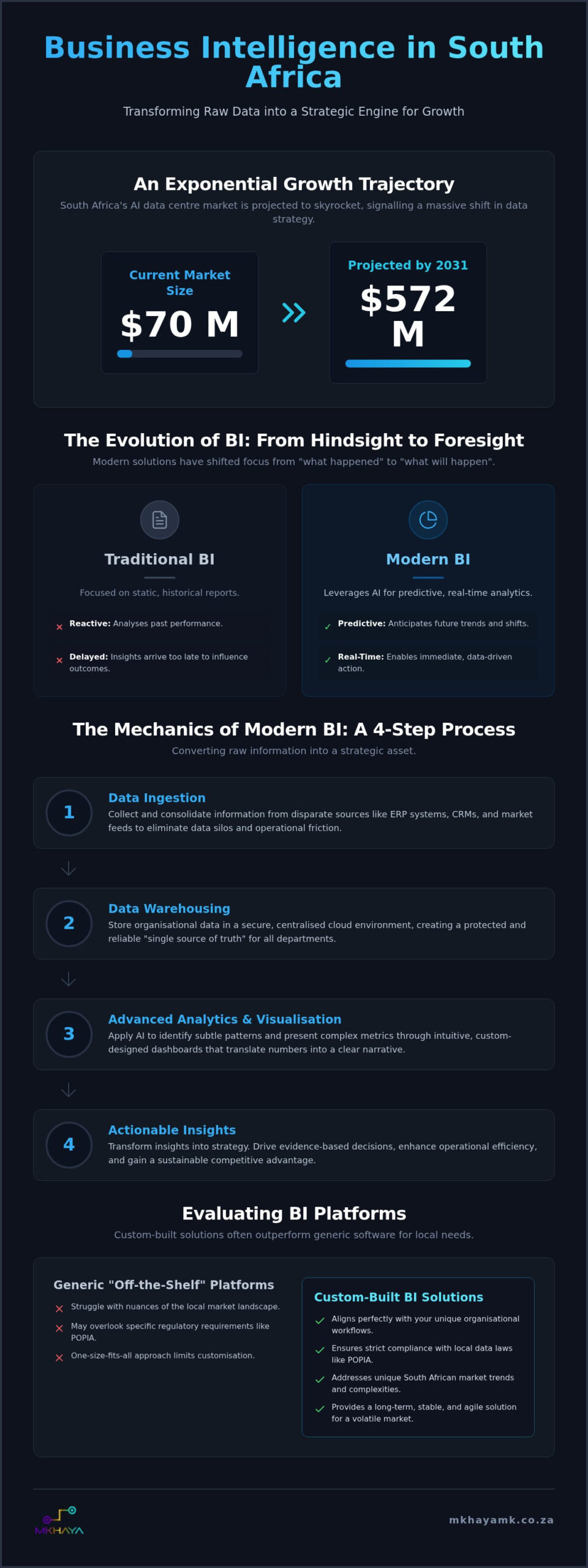
Did you know that South Africa’s AI data centre market is projected to surge from USD 70 million to over USD 572 million by 2031? This massive infrastructure investment from global giants signals a fundamental shift in how local organisations must handle their information to remain relevant. You’ve likely felt the frustration of manual reporting errors leading to costly delays, or perhaps you’re finding it difficult to maintain POPIA compliance whilst trying to analyse complex customer behaviour. It’s a common challenge in a market that’s moving faster than ever before.
We understand that you want your data to work for you, not against you. This guide explores how to implement modern business intelligence solutions south africa to transform fragmented figures into a strategic competitive advantage. We’ll preview the path to establishing a centralised “single source of truth” and moving beyond basic reporting into predictive analytics that help you stay ahead of market shifts. By the end of this article, you’ll have a clear roadmap for improving operational efficiency through automation and custom software integration tailored for the 2026 landscape.
Key Takeaways
- Understand how modern business intelligence solutions south africa transform raw data into a strategic engine for growth and national competitiveness.
- Learn how to consolidate information from ERP and CRM systems into a secure, centralised cloud environment to establish a reliable “single source of truth”.
- Evaluate why custom-built BI platforms often outperform generic software by aligning perfectly with your unique organisational workflows and local market needs.
- Follow a practical implementation roadmap that begins with a comprehensive data audit to identify silos and define your core business objectives.
- Discover how integrating AI and automation shifts your focus from historical reporting to predictive insights that help you anticipate market shifts before they happen.
What are Business Intelligence Solutions in the South African Context?
In the South African business environment, Business intelligence (BI) isn’t just a technical term; it’s a strategic necessity. It encompasses the specific technologies and methodologies local firms use to organise and analyse business information. By transforming raw data into actionable insights, organisations can drive national competitiveness and sustainable growth. Implementing robust business intelligence solutions south africa allows leaders to move away from guesswork and toward evidence-based decisions that reflect the reality of their operations.
By 2026, the lines between data analysis and automation have blurred significantly. BI is now inseparable from AI & Data Automation and machine learning. This synergy enables models to identify patterns that human analysts might miss, providing a foundation for modern digital transformation across all sectors. Whether you’re in retail, manufacturing, or financial services, these tools ensure that every department operates on a foundation of verified, high-quality intelligence.
To better understand how these solutions function as a service, watch this helpful overview:
The Evolution of BI: From Reporting to Prediction
Traditional BI models were largely reactive, focusing on “what happened” through static, historical reports. Whilst these provided a necessary record, they often arrived too late to influence immediate outcomes. Modern solutions have shifted the focus toward “what will happen” by leveraging predictive analytics. In a fast-paced national economy, the ability to process real-time data means you can anticipate supply chain disruptions or shifts in consumer demand before they impact your bottom line. It’s about moving from hindsight to foresight.
Why South African Enterprises Need Localised BI
Generic, global tools often struggle with the nuances of our local landscape. South African enterprises require solutions that navigate the complexities of our specific regulatory environment, particularly regarding data sovereignty. Maintaining strict compliance with the Protection of Personal Information Act (POPIA) is non-negotiable whilst analysing customer behaviour. Localised business intelligence solutions south africa ensure that your data stays secure and compliant while addressing unique market trends that global models might overlook. This local focus helps you stay agile and builds long-term stability in a volatile market.
The Mechanics of Modern BI: Turning Data into Strategy
Understanding the mechanics of business intelligence solutions south africa requires looking under the bonnet of your organisation’s data engine. It’s not merely about the final chart; it’s about the sophisticated pipeline that converts raw facts into strategic fuel. This process begins with data ingestion, where information is collected from disparate sources like your ERP system, CRM, and external market feeds. By consolidating these streams, you eliminate the silos that often lead to conflicting reports and operational friction.
Once ingested, this information moves into data warehousing. This involves storing your assets in a secure, centralised cloud environment where they remain accessible but protected. Modern visualisation then steps in to present complex metrics through intuitive, custom-designed dashboards. These dashboards don’t just look good; they translate abstract numbers into a narrative that drives action. Advanced analytics then apply AI to identify subtle patterns that human eyes might overlook, offering a depth of insight that was previously unattainable.
The Role of AI and Automation in BI
Integrating AI automation solutions South Africa directly into your BI pipeline significantly enhances data accuracy by reducing the risk of human error. Automation handles the heavy lifting of the ETL (Extract, Transform, Load) process, ensuring that data is cleaned and formatted without constant manual intervention. Automated Insights serve as the essential catalyst for 2026 efficiency by delivering immediate, data-driven clarity that requires no manual interpretation. This allows your team to focus on high-level strategy rather than repetitive data preparation.
Ensuring Data Quality and Governance
The “garbage in, garbage out” principle remains a fundamental truth; if your underlying data is flawed, your insights will be too. Implementing effective business intelligence solutions south africa requires a commitment to data integrity from the start. Maintaining high standards involves adhering to the King IV Report guidelines for data governance, ensuring transparency and accountability at every level. Robust security is equally vital. By utilising professional cloud migration services, you can ensure your infrastructure meets modern safety standards whilst remaining scalable. If you’re ready to refine your data architecture, our team is here to help you begin your digital transformation journey.
Evaluating BI Platforms: Custom vs Off-the-Shelf
Selecting the right platform is a pivotal decision that dictates your organisation’s long-term operational agility. When exploring business intelligence solutions south africa, you’ll generally choose between off-the-shelf software and bespoke, custom-built platforms. Off-the-shelf tools often entice with rapid deployment and lower entry costs. However, they can fall short when it comes to the specific local nuances of the South African market. Whilst these products are powerful, they are designed for a global average, which might not align with your unique internal workflows or specific reporting requirements.
Cost considerations extend far beyond the initial purchase price. For instance, as of 2026, Microsoft Power BI Pro is priced at approximately $14 per user per month, whilst Premium Per User (PPU) costs around $24. For a large organisation, these recurring fees quickly escalate. In contrast, custom-built BI platforms require a higher initial investment but offer superior long-term scalability without the burden of per-user licensing. A typical departmental BI project in the local market might range from R160,000 to R400,000, yet the value of a system that integrates seamlessly with your existing ERP solutions often provides a much higher return on investment over time.
When to Choose Custom Software Engineering
Bespoke engineering is the ideal path when you need to address niche industry requirements that standard tools simply ignore. By opting for custom software development South Africa, you maintain full ownership of your intellectual property. This ensures your data engine is built exactly to your specifications, providing a genuine competitive edge. It’s about building a tool that fits your business, rather than forcing your business to fit a tool. This precision allows for more refined data pipelines and deeper insights that are directly relevant to your strategic goals.
The Hybrid Approach: Augmenting Existing Tools
Sometimes, the most practical path forward is a hybrid model. This involves using custom APIs to connect disparate legacy systems to a modern analytics layer, ensuring no valuable information is left behind. You can enhance standard platforms with bespoke UI/UX design to improve internal adoption and user experience. If your internal team lacks the specific expertise to manage this transition, IT staff augmentation services can provide the necessary skills on a flexible basis. This approach allows you to scale your capabilities steadily whilst maintaining the stability of your current infrastructure.
A Roadmap to Successful BI Implementation
Deploying business intelligence solutions south africa requires more than just a technical installation; it demands a structured, strategic approach that aligns your data with your long-term vision. To ensure a smooth transition and lasting value, we recommend following a methodical progression that moves from high-level concepts to concrete execution:
- Step 1: Define your core business objectives and Key Performance Indicators (KPIs) to ensure your data pipeline serves your actual strategic goals.
- Step 2: Audit your current data landscape to identify silos and gaps where information might be trapped or fractured across different departments.
- Step 3: Select the right technology stack through professional digital transformation consulting to ensure your tools are compatible with your organisational maturity.
- Step 4: Execute a phased rollout, starting with high-impact departments where quick wins can build momentum and prove the system’s value to stakeholders.
- Step 5: Foster a data-driven culture through continuous training and refinement, turning the technical implementation into a living organisational asset.
By following this roadmap, you transform a complex IT project into a reliable engine for growth. If you’re ready to start building your data strategy, our experts are available to guide your implementation journey today.
Overcoming Common Implementation Hurdles
Resistance to change amongst staff members is often the most significant barrier to success. It’s vital to communicate that these tools are designed to eliminate the drudgery of manual reporting, empowering your team to focus on more meaningful work. You’ll also need to manage the technical debt of legacy systems whilst migrating to the cloud. This requires a steady, methodical approach to ensure data integrity remains intact throughout the transition. Finally, ensuring ongoing maintenance through managed service agreements provides the long-term stability needed to keep your insights accurate as your business evolves.
Measuring the ROI of Your BI Solution
Demonstrating the value of business intelligence solutions south africa involves tracking concrete metrics that reflect your bottom line. Start by measuring the time saved through automated reporting versus manual processes; reclaiming these hours allows your managers to focus on high-level strategy. You should also identify revenue growth directly linked to data-driven insights, such as more accurate sales forecasting or optimised inventory levels. In the financial sector, BI reduces operational risk by providing instant visibility into compliance anomalies and market volatility. These measurable outcomes reinforce the brand’s image as a detail-oriented and reliable partner in your success.
Partnering for Success: BI Solutions with Mkhaya MK
Choosing the right partner for your business intelligence solutions south africa is a decision that defines your organisation’s trajectory for years to come. At Mkhaya MK, we deliver bespoke BI engines built on a foundation of world-class software engineering. We don’t believe in one-size-fits-all software; instead, we construct digital ecosystems that mirror your specific operational reality. This ensures that every data point processed is relevant to your unique strategic goals and provides a clear path toward long-term stability.
We integrate AI and automation directly into your data pipelines to ensure your insights are both predictive and proactive. By moving beyond simple historical reporting, we help you anticipate shifts in the South African market before they occur. Our national reach ensures that we understand the distinct challenges local firms face, from infrastructure constraints to complex regulatory requirements. From initial consulting to final deployment, we act as your steady, forward-looking partners in digital transformation, ensuring your technology remains an asset rather than a burden.
Our Methodology: Precision and Stability
Our client-centric approach prioritises your specific business outcomes over technical vanity metrics. We employ a methodical execution process that ensures long-term stability and effortless scalability as your data volumes grow. To achieve this, we provide access to top-tier talent through our dedicated development teams. These experts become an extension of your own organisation, working collaboratively to refine your BI engine until it performs with absolute precision. This partnership model fosters a sense of mutual success and visionary ambition, allowing you to build with confidence.
Get Started on Your Data Journey
The first step toward a more intelligent organisation is understanding where you currently stand. We invite you to book a strategic consultation to assess your data maturity and identify the most impactful areas for automation. Beyond general BI, we offer a suite of specialised products designed for specific sectors, including our robust loan management systems that provide deep analytical clarity for financial institutions. It’s time to transform your data from a passive asset into a dynamic competitive advantage. Contact Mkhaya MK today to optimise your business intelligence and secure your organisation’s future in a rapidly changing data-driven world.
Securing Your Organisation’s Future with Data-Driven Clarity
We’ve explored how the shift from historical reporting to predictive analytics is redefining the national landscape. By choosing custom-built platforms over rigid software, your business gains the agility needed to navigate local regulatory complexities whilst owning its intellectual property. Implementing robust business intelligence solutions south africa is no longer just an IT project; it’s a fundamental commitment to operational excellence and market leadership. It’s about building a foundation where every decision is backed by precise, real-time insights.
Our approach at Mkhaya MK is rooted in a persona of quiet confidence, born from a track record of methodical execution and transparency. As AI-driven automation specialists with national South African service delivery, we ensure your refined data architecture remains a stable anchor in a volatile economy. Our commitment to custom software engineering excellence means your solution is built for long-term stability, providing the precision your organisation deserves. We don’t just provide tools; we build the infrastructure that empowers your team to lead with certainty.
Begin your digital transformation with Mkhaya MK’s BI expertise and turn your organisational data into a lasting competitive advantage. We’re ready to partner with you on this journey toward a more insightful and resilient future.
Frequently Asked Questions
What is the typical cost of business intelligence solutions in South Africa?
Industry averages for BI projects vary significantly based on the scope and complexity of your data. A departmental project typically ranges between R160,000 and R400,000, whilst enterprise-wide deployments can reach several million Rand depending on the integration requirements. Monthly licensing for popular off-the-shelf tools like Power BI Pro is approximately $14 per user as of 2026. Custom engineering often requires a higher initial investment but removes these recurring per-user fees over the long term.
How does POPIA compliance affect my business intelligence strategy?
POPIA compliance requires that your data processing strategy prioritises security, transparency, and purpose-specification. Your BI architecture must ensure that personal information is handled according to legal standards, particularly when you’re analysing customer behaviour or personal data. Modern solutions incorporate automated governance features that help you maintain compliance without sacrificing the depth of your insights. This builds trust with your clients whilst protecting your organisation from significant regulatory risks.
How long does it take to implement a full BI solution?
A standard implementation usually follows a phased approach over several months to ensure stability. While basic dashboards can often be operational within a few weeks, a comprehensive integration of business intelligence solutions south africa across multiple departments takes longer. The timeline depends on the complexity of your existing data silos and the level of customisation required. Starting with high-impact areas allows you to see tangible value early in the process.
Can BI solutions integrate with my existing legacy software?
Yes, modern BI platforms are designed to bridge the gap between old and new systems. Custom APIs and middleware can extract information from legacy software, ensuring your historical data remains a valuable asset for current analysis. This integration creates a centralised “single source of truth,” allowing you to view your entire operational history alongside real-time data from modern cloud applications. It’s a vital step in modernising your infrastructure without losing historical context.
What is the difference between data analytics and business intelligence?
Business intelligence focuses on using data to drive strategic decisions and improve operational performance. Data analytics is the broader technical process of examining raw information to find patterns and trends. Think of analytics as the “how” and BI as the “so what.” BI translates technical findings into actionable narratives that executives can use to steer the organisation toward its goals.
Do I need a dedicated data scientist to run a BI platform?
You don’t necessarily need a dedicated data scientist to benefit from a modern platform. Professional business intelligence solutions south africa prioritise user-friendly visualisations and automated insights that non-technical managers can easily interpret. While complex custom modelling might benefit from a specialist, most daily strategic decisions can be managed through intuitive dashboards and automated reporting that empower your existing team.
How can AI improve my organisation’s business intelligence?
AI transforms BI from a reactive reporting tool into a predictive engine that anticipates market shifts. It identifies subtle patterns and correlations that human analysts might overlook, allowing you to anticipate customer needs or potential supply chain disruptions. This proactive approach ensures your organisation stays ahead of the curve, moving beyond simple historical reports to focus on what’s likely to happen next.
What are the most important KPIs to track for a South African business?
Key metrics often include operational efficiency, customer acquisition costs, and revenue growth per segment. In our local market, tracking supply chain agility and compliance accuracy is also vital due to regional volatility and regulatory requirements. Focusing on these specific indicators ensures your data strategy remains aligned with the practical realities of the South African economic landscape and your long-term stability.