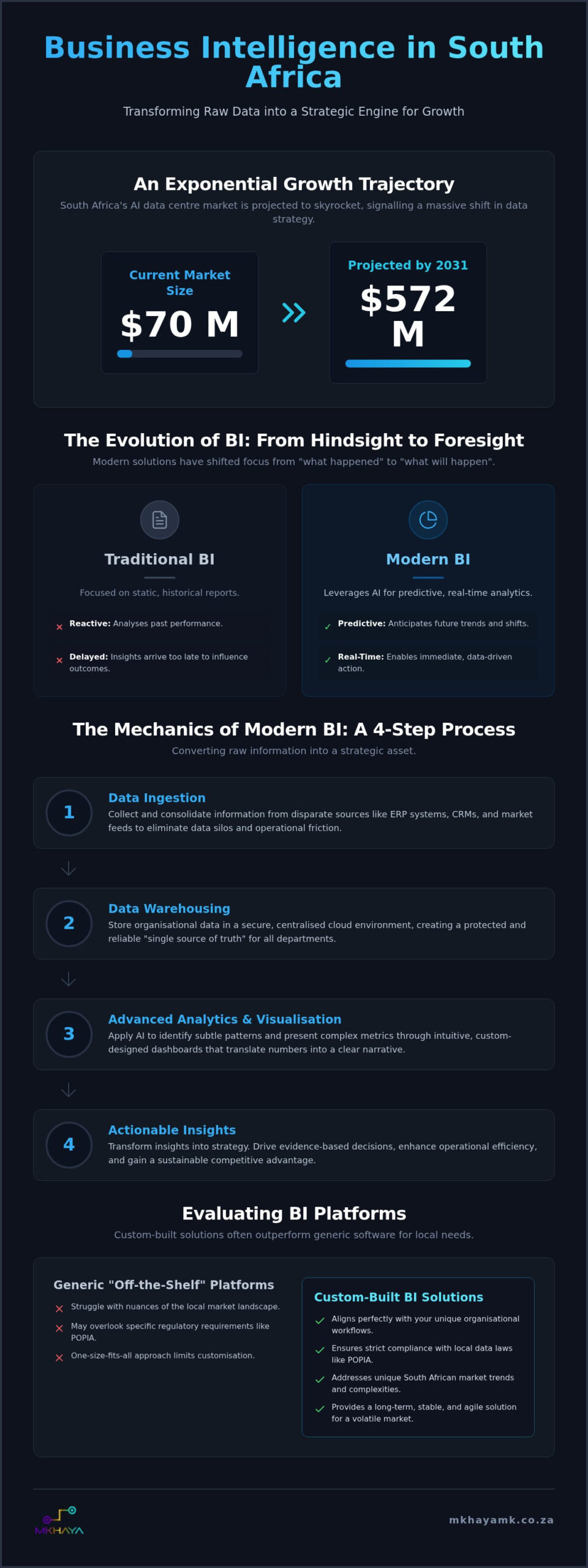
Did you know that South Africa’s AI data centre market is projected to surge from USD 70 million to over USD 572 million by 2031? This massive infrastructure investment from global giants signals a fundamental shift in how local organisations must handle their information to remain relevant. You’ve likely felt the frustration of manual reporting errors leading to costly delays, or perhaps you’re finding it difficult to maintain POPIA compliance whilst trying to analyse complex customer behaviour. It’s a common challenge in a market that’s moving faster than ever before.
We understand that you want your data to work for you, not against you. This guide explores how to implement modern business intelligence solutions south africa to transform fragmented figures into a strategic competitive advantage. We’ll preview the path to establishing a centralised “single source of truth” and moving beyond basic reporting into predictive analytics that help you stay ahead of market shifts. By the end of this article, you’ll have a clear roadmap for improving operational efficiency through automation and custom software integration tailored for the 2026 landscape.
Key Takeaways
Understand how modern business intelligence solutions south africa transform raw data into a strategic engine for growth and national competitiveness.
Learn how to consolidate information from ERP and CRM systems into a secure, centralised cloud environment to establish a reliable “single source of truth”.
Evaluate why custom-built BI platforms often outperform generic software by aligning perfectly with your unique organisational workflows and local market needs.
Follow a practical implementation roadmap that begins with a comprehensive data audit to identify silos and define your core business objectives.
Discover how integrating AI and automation shifts your focus from historical reporting to predictive insights that help you anticipate market shifts before they happen.
What are Business Intelligence Solutions in the South African Context?
In the South African business environment, Business intelligence (BI) isn’t just a technical term; it’s a strategic necessity. It encompasses the specific technologies and methodologies local firms use to organise and analyse business information. By transforming raw data into actionable insights, organisations can drive national competitiveness and sustainable growth. Implementing robust business intelligence solutions south africa allows leaders to move away from guesswork and toward evidence-based decisions that reflect the reality of their operations.
By 2026, the lines between data analysis and automation have blurred significantly. BI is now inseparable from AI & Data Automation and machine learning. This synergy enables models to identify patterns that human analysts might miss, providing a foundation for modern digital transformation across all sectors. Whether you’re in retail, manufacturing, or financial services, these tools ensure that every department operates on a foundation of verified, high-quality intelligence.
To better understand how these solutions function as a service, watch this helpful overview:
The Evolution of BI: From Reporting to Prediction
Traditional BI models were largely reactive, focusing on “what happened” through static, historical reports. Whilst these provided a necessary record, they often arrived too late to influence immediate outcomes. Modern solutions have shifted the focus toward “what will happen” by leveraging predictive analytics. In a fast-paced national economy, the ability to process real-time data means you can anticipate supply chain disruptions or shifts in consumer demand before they impact your bottom line. It’s about moving from hindsight to foresight.
Why South African Enterprises Need Localised BI
Generic, global tools often struggle with the nuances of our local landscape. South African enterprises require solutions that navigate the complexities of our specific regulatory environment, particularly regarding data sovereignty. Maintaining strict compliance with the Protection of Personal Information Act (POPIA) is non-negotiable whilst analysing customer behaviour. Localised business intelligence solutions south africa ensure that your data stays secure and compliant while addressing unique market trends that global models might overlook. This local focus helps you stay agile and builds long-term stability in a volatile market.
The Mechanics of Modern BI: Turning Data into Strategy
Understanding the mechanics of business intelligence solutions south africa requires looking under the bonnet of your organisation’s data engine. It’s not merely about the final chart; it’s about the sophisticated pipeline that converts raw facts into strategic fuel. This process begins with data ingestion, where information is collected from disparate sources like your ERP system, CRM, and external market feeds. By consolidating these streams, you eliminate the silos that often lead to conflicting reports and operational friction.
Once ingested, this information moves into data warehousing. This involves storing your assets in a secure, centralised cloud environment where they remain accessible but protected. Modern visualisation then steps in to present complex metrics through intuitive, custom-designed dashboards. These dashboards don’t just look good; they translate abstract numbers into a narrative that drives action. Advanced analytics then apply AI to identify subtle patterns that human eyes might overlook, offering a depth of insight that was previously unattainable.
The Role of AI and Automation in BI
Integrating AI automation solutions South Africa directly into your BI pipeline significantly enhances data accuracy by reducing the risk of human error. Automation handles the heavy lifting of the ETL (Extract, Transform, Load) process, ensuring that data is cleaned and formatted without constant manual intervention. Automated Insights serve as the essential catalyst for 2026 efficiency by delivering immediate, data-driven clarity that requires no manual interpretation. This allows your team to focus on high-level strategy rather than repetitive data preparation.
Ensuring Data Quality and Governance
The “garbage in, garbage out” principle remains a fundamental truth; if your underlying data is flawed, your insights will be too. Implementing effective business intelligence solutions south africa requires a commitment to data integrity from the start. Maintaining high standards involves adhering to the King IV Report guidelines for data governance, ensuring transparency and accountability at every level. Robust security is equally vital. By utilising professional cloud migration services, you can ensure your infrastructure meets modern safety standards whilst remaining scalable. If you’re ready to refine your data architecture, our team is here to help you begin your digital transformation journey.
Evaluating BI Platforms: Custom vs Off-the-Shelf
Selecting the right platform is a pivotal decision that dictates your organisation’s long-term operational agility. When exploring business intelligence solutions south africa, you’ll generally choose between off-the-shelf software and bespoke, custom-built platforms. Off-the-shelf tools often entice with rapid deployment and lower entry costs. However, they can fall short when it comes to the specific local nuances of the South African market. Whilst these products are powerful, they are designed for a global average, which might not align with your unique internal workflows or specific reporting requirements.
Cost considerations extend far beyond the initial purchase price. For instance, as of 2026, Microsoft Power BI Pro is priced at approximately $14 per user per month, whilst Premium Per User (PPU) costs around $24. For a large organisation, these recurring fees quickly escalate. In contrast, custom-built BI platforms require a higher initial investment but offer superior long-term scalability without the burden of per-user licensing. A typical departmental BI project in the local market might range from R160,000 to R400,000, yet the value of a system that integrates seamlessly with your existing ERP solutions often provides a much higher return on investment over time.
When to Choose Custom Software Engineering
Bespoke engineering is the ideal path when you need to address niche industry requirements that standard tools simply ignore. By opting for custom software development South Africa, you maintain full ownership of your intellectual property. This ensures your data engine is built exactly to your specifications, providing a genuine competitive edge. It’s about building a tool that fits your business, rather than forcing your business to fit a tool. This precision allows for more refined data pipelines and deeper insights that are directly relevant to your strategic goals.
The Hybrid Approach: Augmenting Existing Tools
Sometimes, the most practical path forward is a hybrid model. This involves using custom APIs to connect disparate legacy systems to a modern analytics layer, ensuring no valuable information is left behind. You can enhance standard platforms with bespoke UI/UX design to improve internal adoption and user experience. If your internal team lacks the specific expertise to manage this transition, IT staff augmentation services can provide the necessary skills on a flexible basis. This approach allows you to scale your capabilities steadily whilst maintaining the stability of your current infrastructure.
A Roadmap to Successful BI Implementation
Deploying business intelligence solutions south africa requires more than just a technical installation; it demands a structured, strategic approach that aligns your data with your long-term vision. To ensure a smooth transition and lasting value, we recommend following a methodical progression that moves from high-level concepts to concrete execution:
Step 1: Define your core business objectives and Key Performance Indicators (KPIs) to ensure your data pipeline serves your actual strategic goals.
Step 2: Audit your current data landscape to identify silos and gaps where information might be trapped or fractured across different departments.
Step 3: Select the right technology stack through professional digital transformation consulting to ensure your tools are compatible with your organisational maturity.
Step 4: Execute a phased rollout, starting with high-impact departments where quick wins can build momentum and prove the system’s value to stakeholders.
Step 5: Foster a data-driven culture through continuous training and refinement, turning the technical implementation into a living organisational asset.
By following this roadmap, you transform a complex IT project into a reliable engine for growth. If you’re ready to start building your data strategy, our experts are available to guide your implementation journey today.
Overcoming Common Implementation Hurdles
Resistance to change amongst staff members is often the most significant barrier to success. It’s vital to communicate that these tools are designed to eliminate the drudgery of manual reporting, empowering your team to focus on more meaningful work. You’ll also need to manage the technical debt of legacy systems whilst migrating to the cloud. This requires a steady, methodical approach to ensure data integrity remains intact throughout the transition. Finally, ensuring ongoing maintenance through managed service agreements provides the long-term stability needed to keep your insights accurate as your business evolves.
Measuring the ROI of Your BI Solution
Demonstrating the value of business intelligence solutions south africa involves tracking concrete metrics that reflect your bottom line. Start by measuring the time saved through automated reporting versus manual processes; reclaiming these hours allows your managers to focus on high-level strategy. You should also identify revenue growth directly linked to data-driven insights, such as more accurate sales forecasting or optimised inventory levels. In the financial sector, BI reduces operational risk by providing instant visibility into compliance anomalies and market volatility. These measurable outcomes reinforce the brand’s image as a detail-oriented and reliable partner in your success.
Partnering for Success: BI Solutions with Mkhaya MK
Choosing the right partner for your business intelligence solutions south africa is a decision that defines your organisation’s trajectory for years to come. At Mkhaya MK, we deliver bespoke BI engines built on a foundation of world-class software engineering. We don’t believe in one-size-fits-all software; instead, we construct digital ecosystems that mirror your specific operational reality. This ensures that every data point processed is relevant to your unique strategic goals and provides a clear path toward long-term stability.
We integrate AI and automation directly into your data pipelines to ensure your insights are both predictive and proactive. By moving beyond simple historical reporting, we help you anticipate shifts in the South African market before they occur. Our national reach ensures that we understand the distinct challenges local firms face, from infrastructure constraints to complex regulatory requirements. From initial consulting to final deployment, we act as your steady, forward-looking partners in digital transformation, ensuring your technology remains an asset rather than a burden.
Our Methodology: Precision and Stability
Our client-centric approach prioritises your specific business outcomes over technical vanity metrics. We employ a methodical execution process that ensures long-term stability and effortless scalability as your data volumes grow. To achieve this, we provide access to top-tier talent through our dedicated development teams. These experts become an extension of your own organisation, working collaboratively to refine your BI engine until it performs with absolute precision. This partnership model fosters a sense of mutual success and visionary ambition, allowing you to build with confidence.
Get Started on Your Data Journey
The first step toward a more intelligent organisation is understanding where you currently stand. We invite you to book a strategic consultation to assess your data maturity and identify the most impactful areas for automation. Beyond general BI, we offer a suite of specialised products designed for specific sectors, including our robust loan management systems that provide deep analytical clarity for financial institutions. It’s time to transform your data from a passive asset into a dynamic competitive advantage. Contact Mkhaya MK today to optimise your business intelligence and secure your organisation’s future in a rapidly changing data-driven world.
Securing Your Organisation’s Future with Data-Driven Clarity
We’ve explored how the shift from historical reporting to predictive analytics is redefining the national landscape. By choosing custom-built platforms over rigid software, your business gains the agility needed to navigate local regulatory complexities whilst owning its intellectual property. Implementing robust business intelligence solutions south africa is no longer just an IT project; it’s a fundamental commitment to operational excellence and market leadership. It’s about building a foundation where every decision is backed by precise, real-time insights.
Our approach at Mkhaya MK is rooted in a persona of quiet confidence, born from a track record of methodical execution and transparency. As AI-driven automation specialists with national South African service delivery, we ensure your refined data architecture remains a stable anchor in a volatile economy. Our commitment to custom software engineering excellence means your solution is built for long-term stability, providing the precision your organisation deserves. We don’t just provide tools; we build the infrastructure that empowers your team to lead with certainty.
What is the typical cost of business intelligence solutions in South Africa?
Industry averages for BI projects vary significantly based on the scope and complexity of your data. A departmental project typically ranges between R160,000 and R400,000, whilst enterprise-wide deployments can reach several million Rand depending on the integration requirements. Monthly licensing for popular off-the-shelf tools like Power BI Pro is approximately $14 per user as of 2026. Custom engineering often requires a higher initial investment but removes these recurring per-user fees over the long term.
How does POPIA compliance affect my business intelligence strategy?
POPIA compliance requires that your data processing strategy prioritises security, transparency, and purpose-specification. Your BI architecture must ensure that personal information is handled according to legal standards, particularly when you’re analysing customer behaviour or personal data. Modern solutions incorporate automated governance features that help you maintain compliance without sacrificing the depth of your insights. This builds trust with your clients whilst protecting your organisation from significant regulatory risks.
How long does it take to implement a full BI solution?
A standard implementation usually follows a phased approach over several months to ensure stability. While basic dashboards can often be operational within a few weeks, a comprehensive integration of business intelligence solutions south africa across multiple departments takes longer. The timeline depends on the complexity of your existing data silos and the level of customisation required. Starting with high-impact areas allows you to see tangible value early in the process.
Can BI solutions integrate with my existing legacy software?
Yes, modern BI platforms are designed to bridge the gap between old and new systems. Custom APIs and middleware can extract information from legacy software, ensuring your historical data remains a valuable asset for current analysis. This integration creates a centralised “single source of truth,” allowing you to view your entire operational history alongside real-time data from modern cloud applications. It’s a vital step in modernising your infrastructure without losing historical context.
What is the difference between data analytics and business intelligence?
Business intelligence focuses on using data to drive strategic decisions and improve operational performance. Data analytics is the broader technical process of examining raw information to find patterns and trends. Think of analytics as the “how” and BI as the “so what.” BI translates technical findings into actionable narratives that executives can use to steer the organisation toward its goals.
Do I need a dedicated data scientist to run a BI platform?
You don’t necessarily need a dedicated data scientist to benefit from a modern platform. Professional business intelligence solutions south africa prioritise user-friendly visualisations and automated insights that non-technical managers can easily interpret. While complex custom modelling might benefit from a specialist, most daily strategic decisions can be managed through intuitive dashboards and automated reporting that empower your existing team.
How can AI improve my organisation’s business intelligence?
AI transforms BI from a reactive reporting tool into a predictive engine that anticipates market shifts. It identifies subtle patterns and correlations that human analysts might overlook, allowing you to anticipate customer needs or potential supply chain disruptions. This proactive approach ensures your organisation stays ahead of the curve, moving beyond simple historical reports to focus on what’s likely to happen next.
What are the most important KPIs to track for a South African business?
Key metrics often include operational efficiency, customer acquisition costs, and revenue growth per segment. In our local market, tracking supply chain agility and compliance accuracy is also vital due to regional volatility and regulatory requirements. Focusing on these specific indicators ensures your data strategy remains aligned with the practical realities of the South African economic landscape and your long-term stability.
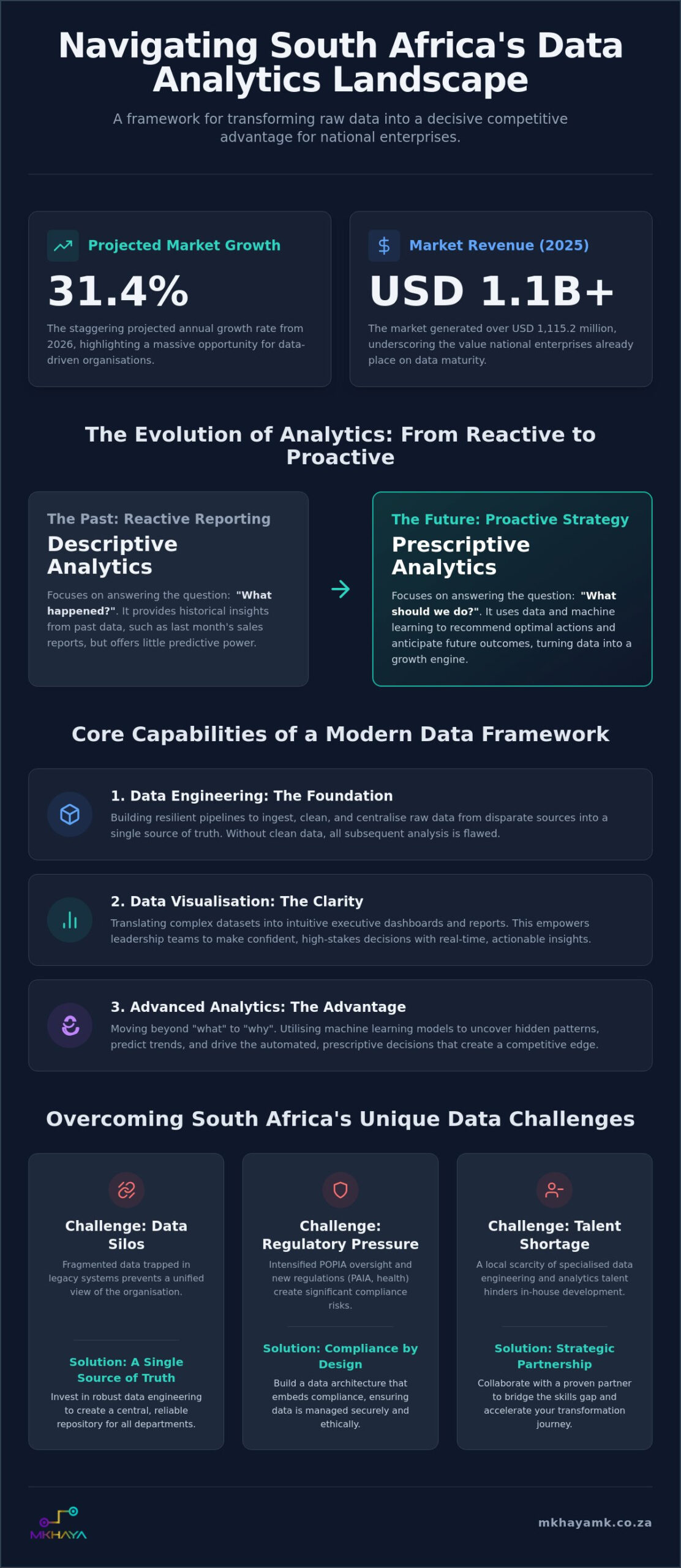
With the South African data analytics market projected to grow at a staggering 31.4% annually from 2026, the gap between businesses that guess and those that know has never been wider. You’ve likely felt the frustration of fragmented data silos trapped within legacy systems or the pressure of the 30 June PAIA annual report deadline. Finding reliable data analytics services south africa shouldn’t feel like a gamble on unproven ROI. It’s understandable to feel cautious when internal specialised engineering talent is scarce and the regulatory landscape, especially with the new health information regulations that took effect in March, is shifting beneath your feet.
We’re here to help you turn that uncertainty into a decisive competitive advantage. This guide provides a clear, executive framework to move your organisation from basic reporting to automated decision-making and predictive modelling. We’ll explore how to establish a single source of truth that satisfies the Information Regulator’s intensified POPIA oversight whilst positioning your business for long-term stability. You’ll learn how to bridge the local skills gap and select a partner that aligns your technical architecture with your most ambitious digital transformation goals.
Shift your perspective from reactive reporting to prescriptive analytics to turn raw data into a proactive engine for business growth and digital transformation.
Learn to evaluate data analytics services south africa based on their commitment to transparency and their ability to translate complex technical stacks into clear business outcomes.
Establish a single source of truth by investing in robust data engineering and intuitive visualisations that empower your executive team with real-time, actionable insights.
Overcome the local specialised talent shortage and ensure POPIA compliance by adopting a flexible, methodical approach to scaling your technical capabilities.
Discover the Mkhaya MK “Consulting to Execution” methodology, designed to bridge the gap between initial strategy and long-term technological stability.
The landscape of data in South Africa has shifted dramatically. It’s no longer just about looking at last month’s sales figures. Modern Data analysis has transitioned from a passive reporting function into a core engine that drives every strategic move. In 2026, the most successful national enterprises treat their data as a living asset rather than a dusty archive. This evolution is central to why data analytics services south africa are now considered the bedrock of any serious digital transformation journey.
We’ve moved past the era of descriptive analytics, which merely told us what happened. Today, the focus is on prescriptive analytics; the science of determining what we should do next to achieve a specific outcome. This shift allows businesses to anticipate market fluctuations and supply chain disruptions before they impact the bottom line. It’s a move from reactive firefighting to proactive, methodical growth that builds a stable foundation for future innovation.
To better understand the practical side of this evolution, watch this helpful video:
Why National Enterprises are Prioritising Data in 2026
Operational efficiency is the primary driver. With the South African data analytics market having generated USD 1,115.2 million in revenue in 2025 and projected to grow at a CAGR of 31.4% through 2033, national enterprises recognise that data maturity is no longer optional. Real-time data allows for immediate cost reduction by identifying waste in logistics or production. It isn’t just about saving money, though. Data-driven insights provide the necessary roadmap for scaling technology platforms securely. By understanding local consumer behaviour through granular data, businesses can personalise experiences in a way that feels authentic rather than automated. This precision is what allows local firms to hold their own against global competitors.
The Intersection of Data Analytics and Custom Software
Many organisations find that off-the-shelf tools simply can’t handle the unique logic of their operations. This is where the integration of analytics into custom software development becomes vital. When your data architecture is built into the very fabric of your applications, you create a seamless flow of information. This bespoke approach ensures long-term organisational stability. It prevents the common pitfall of having powerful software that remains “blind” to the insights hidden within its own databases. By choosing data analytics services south africa that understand this intersection, you ensure your technology and your strategy move in perfect lockstep. We believe in a methodical execution that values transparency over flashy claims, ensuring your data informs every line of code we write.
A robust framework acts as the nervous system of your organisation. It doesn’t just store information; it organises it into a coherent narrative that supports long-term stability. To get the most from data analytics services south africa, your framework must excel in four critical areas that bridge the gap between raw information and strategic action.
Data Engineering: This is your foundation. It involves building resilient pipelines that ingest, clean, and move raw data from disparate sources into a central repository. Without clean data, even the most advanced AI will produce flawed results.
Data Visualisation: Raw numbers rarely inspire action. By transforming complex datasets into intuitive executive dashboards, you give your leadership team the clarity needed to make high-stakes decisions with quiet confidence.
Advanced Analytics: This moves beyond what happened to why it happened. Machine learning models identify hidden patterns and predict future trends, allowing you to stay ahead of market shifts.
Data Governance: This ensures your data remains high-quality, secure, and compliant. It’s the set of rules that keeps your organisation aligned with national standards whilst maintaining the integrity of your insights.
Leveraging AI and Data Automation
Static reporting is a relic of the past. Modern AI automation solutions turn your data into a proactive force. By implementing Robotic Process Automation (RPA), you can automate the tedious tasks of data cleaning and organisation, freeing your team for higher-level strategy. Whilst many businesses rely on standard tools, the real competitive edge in 2026 comes from custom-built predictive engines that reflect your unique business logic and operational goals.
Cloud-Native Data Solutions
Scalability is non-negotiable for data-intensive applications. Utilising managed cloud services ensures that your storage capacity grows alongside your business without the need for massive upfront hardware investments. This approach provides the high availability and performance required for real-time analytics. Integrating DevOps practices into your data workflow allows for the rapid deployment of new features, ensuring your analytics capabilities are always evolving. If you’re looking to refine your technical architecture, exploring our approach to digital transformation can help you identify the most effective path forward for your specific needs.
Selecting data analytics services south africa requires moving beyond a simple checklist of technical certifications. Whilst platform designations provide a baseline, they rarely account for the nuance of your specific operational logic. A true partner acts as a visionary guide, bridging the gap between raw data and your most ambitious business goals. You should look for a partner that projects “quiet confidence”; a persona that values transparency and methodical execution over flashy, unverified claims. This reliability is what transforms a service provider into a stable anchor for your technological evolution.
It’s essential to find a balance between strategic consulting and technical execution. A partner that only offers high-level advice leaves you with a roadmap but no vehicle. Conversely, a purely technical firm might build a powerful engine that doesn’t align with your commercial objectives. We believe the most successful engagements follow a structured process that moves from a broad vision to a concrete, step-by-step path forward, ensuring every technical milestone delivers a practical business benefit.
Technical Expertise vs. Business Alignment
Your partner must speak the language of ROI. If a team focuses solely on Python or SQL without discussing how those tools drive digital transformation, the alignment is missing. Designing effective data models is a collaborative relationship; it requires deep dives into your unique workflows to ensure the architecture supports your long-term journey. As your organisation grows, you may need to scale your capabilities through staff augmentation, ensuring you have the right talent at the right time without the overhead of permanent hiring or the delays of a traditional recruitment cycle.
The Custom Advantage: Bespoke vs. Template Solutions
Template-based dashboards often carry hidden costs. Whilst they appear cheaper initially, they frequently fail to capture the complexity of South African industries, leading to “blind spots” in your reporting. Custom-built solutions offer the precision needed for high-stakes decision-making. By investing in a bespoke architecture, you ensure your data remains a valuable asset rather than becoming a legacy burden that hinders future agility. Our commitment to integrity and transparency ensures that every custom build is designed for stability and precision, providing a single source of truth that you can rely on for years to come.
South African executives face a unique set of hurdles that global counterparts might overlook. Whilst the strategic value of data analytics services south africa is clear, the practical implementation often hits a wall when confronted with the national shortage of specialised engineering talent. It’s one thing to envision a data-driven future; it’s another to find the senior analysts, who now command average salaries of R656,497, to build it. Beyond the talent war, the regulatory environment has become significantly more rigorous, requiring a partner that understands the local legal fabric as well as the code.
Scaling Teams with Staff Augmentation
When internal recruitment stalls, IT staff augmentation provides a flexible bridge to success. This model grants you immediate access to scarce data specialist skills without the long-term overhead of permanent hiring or the delays of traditional recruitment. Whether you need on-site professionals in Cape Town or remote engineers to scale a national project, extending your team allows for the methodical execution of project-specific transformations. It’s a visionary way to bypass the local skills shortage, ensuring your digital transformation doesn’t lose momentum due to empty seats in your tech department.
Data Security and Compliance as a Competitive Edge
Compliance isn’t just a legal box to tick; it’s a way to build trust with a sophisticated consumer base. In March 2026, the Information Regulator shifted to a proactive oversight model, moving beyond reactive complaints to targeted assessments in high-risk sectors. This makes navigating POPIA complexities during data migration more critical than ever. Additionally, the new health information regulations that came into force on 6 March 2026 require immediate attention from insurers and medical schemes. Implementing robust encryption and access controls within your data lake ensures integrity, especially when integrating legacy ERP solutions with modern analytics.
Resilient infrastructure is the final piece of the puzzle. Your data architecture must withstand local connectivity challenges and power fluctuations to ensure high availability for decision-makers. By building a stable, hybrid-cloud environment, you protect your “single source of truth” from external disruptions. If you’re ready to secure your data future and bridge the talent gap, contact us today for a transparent discussion on how our professionals can support your journey.
We act as the stable anchor in your technological evolution. Unlike standalone BI tools that often offer surface-level charts without context; our approach treats data as a critical component of end-to-end digital transformation. By choosing our data analytics services south africa, you’re opting for a partner that values methodical refinement over flashy, short-term claims. We bridge the gap between initial strategy and long-term stability by integrating your data architecture directly with your ERP solutions and bespoke software environments.
Our “Consulting to Execution” methodology ensures that every insight we uncover is backed by the technical capability to implement it. This synergy prevents the common frustration of having a roadmap without a vehicle. We don’t just tell you what the data says; we build the automated systems that act on those findings. It’s a collaborative relationship built on transparency and mutual success, ensuring your data assets become more valuable with each passing year. This commitment to your personal journey is what defines our “quiet confidence” in a noisy market.
A Step-by-Step Path to Data Maturity
Achieving true business intelligence requires a structured progression. We guide you through three distinct phases to ensure your investment delivers measurable results and satisfies the Information Regulator’s evolving requirements:
Phase 1: Discovery and Audit – We begin by identifying your most valuable data sources and uncovering the fragmented silos that hinder your progress. This phase ensures your strategy is rooted in the reality of your current operations.
Phase 2: Foundation Building – We establish secure, cloud-based data warehouses that serve as your single source of truth. This architecture is designed to be scalable and resilient, providing a stable base for all future custom development.
Phase 3: Insights and Automation – Once the foundation is stable, we deploy intuitive executive dashboards and AI-driven workflows. This turns your static information into a proactive engine for automated decision-making.
Ready to Transform Your Data into a Strategic Asset?
The journey from raw numbers to visionary business intelligence is one of the most significant steps an organisation can take. It requires a forward-looking mindset that embraces agile, modern technology whilst remaining rooted in traditional values of integrity and commitment. By choosing data analytics services south africa that prioritise your specific business logic, you ensure that your digital transformation is both ambitious and practical. We’re ready to act as your stable guide in this rapidly changing landscape. Start your journey with us today and discover the power of a partnership that’s deeply invested in your long-term success.
The shift towards prescriptive analytics and automated decision-making is no longer a luxury for South African enterprises. It’s the foundational architecture for long-term stability. By integrating these insights into your custom software and ERP systems, you create a single source of truth that empowers your leadership team. Navigating the complexities of POPIA whilst managing the national skills shortage requires a partner who understands the local landscape as deeply as the technical code.
Choosing the right data analytics services south africa is about more than just technology; it’s about finding a visionary guide for your end-to-end digital transformation. With our national reach and proven track record in AI and custom software engineering, we act as a stable anchor for your technological evolution. We’re committed to your personal journey, ensuring that every data point leads to a practical business outcome and measurable growth.
What are the main benefits of using data analytics services in South Africa?
The primary benefit is turning fragmented data into a proactive business engine that drives digital transformation. By leveraging data analytics services south africa, organisations can automate decision-making processes and gain a competitive edge through predictive modelling. This shift allows you to anticipate market changes rather than simply reacting to them, ensuring your business remains a stable anchor in a changing landscape.
How does POPIA affect data analytics implementation for local businesses?
POPIA requires strict data governance and security protocols throughout the entire analytics lifecycle. Since the Information Regulator shifted to proactive oversight in March 2026, businesses must ensure that data migration and storage are fully compliant. This involves implementing robust encryption and access controls to protect personal information whilst maintaining the integrity of your insights and satisfying the latest regulatory assessments.
Should we build an internal data team or outsource to a South African partner?
Outsourcing to a local partner is often more efficient due to the national shortage of specialised data engineering talent. Whilst internal teams offer deep company knowledge, a partner provides a broader perspective and access to senior expertise that is difficult to recruit. This approach reduces the overhead of permanent hiring and allows for more agile scaling of your technical capabilities through a collaborative relationship.
What is the difference between Business Intelligence (BI) and Data Analytics?
Business Intelligence focuses on descriptive reporting of past events, whereas data analytics involves prescriptive and predictive modelling for the future. BI tells you what happened in your last quarter. Analytics uses machine learning to identify patterns that suggest what you should do next to optimise your results. It’s the difference between looking in the rear-view mirror and having a visionary guide for the road ahead.
How much does it cost to implement a custom data analytics solution?
The investment for a custom solution depends entirely on the complexity of your data silos and the specific business logic required. We focus on a methodical execution that ensures long-term stability and a clear path to ROI. Rather than providing a generic price, we believe in a thorough discovery phase to define a precise scope that aligns perfectly with your strategic goals and digital journey.
Can data analytics be integrated with our existing ERP or Loan Management systems?
Yes, modern analytics frameworks are designed to integrate seamlessly with existing ERP or Loan Management systems. Custom engineering allows us to build the necessary pipelines to move and clean data from these legacy platforms. This integration ensures that your analytics engine has access to all relevant information, creating a single source of truth for your entire organisation.
What is the average timeline for a digital transformation project involving data?
Timelines vary based on the maturity of your existing data infrastructure and the scale of the transformation. A typical project moves through structured phases of discovery, foundation building, and final deployment of insights. This deliberate pace ensures that each milestone is fully articulated and reliable before moving to the next stage, reinforcing our image as a detail-oriented and reliable partner.
How does staff augmentation help with data analytics backlogs?
Staff augmentation provides immediate access to scarce specialists to help you clear technical debt and accelerate your data analytics services south africa projects. It allows you to scale your team nationally with remote or on-site professionals without the delays of traditional recruitment. This flexibility is essential for overcoming project-specific backlogs and maintaining momentum in a competitive, high-end technological landscape.
Did you know that predictive analytics captured over 40% of South Africa’s data analytics market revenue by 2024? This surge in investment shows that local businesses are hungry for foresight, yet many still find themselves trapped by fragmented data silos and the high costs of global platforms that lack local nuance. Implementing effective predictive analytics solutions south africa requires more than just high-end software; it demands a strategy that aligns with our unique operational logic and the evolving regulatory environment.
We understand that finding the right balance between sophisticated modelling and practical, cost-effective execution is a significant challenge, especially when skilled data scientists are in high demand. This article provides a clear roadmap to help you bridge that gap. You’ll discover how to transform historical records into a reliable compass for sales and risk forecasting. We will explore a strategic framework for 2026 that automates foresight, reduces operational waste, and ensures your data works as hard as you do to build a stable future.
Key Takeaways
Understand how moving from descriptive reporting to forward-looking foresight provides a distinct competitive edge in the South African corporate sector.
Identify the essential technical layers required to deploy successful predictive analytics solutions south africa, focusing on data integration and machine learning.
Learn how to quantify the financial impact of predictive models, ranging from supply chain optimisation to effective credit risk mitigation.
Discover a structured, two-phase roadmap for data readiness that ensures your infrastructure is prepared for reliable and scalable model deployment.
Explore how a collaborative approach to custom software development bridges the gap between high-level strategic consulting and technical execution.
Beyond Descriptive Reporting: The Rise of Predictive Analytics in South Africa
To better understand the core principles behind this technology, watch this helpful video:
At its heart, predictive analytics is the sophisticated intersection of historical data, statistical modelling, and machine learning. By analysing existing records, these systems identify hidden patterns that human observation might miss. The South African data analytics market, which generated USD 1,016.3 million in 2024, is proof of this growing reliance on foresight. With predictive analytics capturing over 40% of that market share, it’s clear that the ability to anticipate market shifts is becoming a standard requirement for competitive success. We see 2026 as the tipping point where data-driven decision-making becomes the primary anchor for businesses seeking to thrive amongst volatile market conditions.
The Mechanism of Foresight: How Predictive Models Work
Predictive models function by utilising data mining and pattern recognition to project future trends based on past behaviours. Whilst simple forecasting might look at seasonal sales trends, advanced modelling integrates thousands of variables to provide a more granular view of potential outcomes. These Core Components of Modern Predictive Analytics Solutions allow businesses to move beyond guesswork. Predictive analytics is a strategic tool for risk mitigation and opportunity identification that empowers leaders to act with confidence.
Why South African Businesses are Prioritising Predictive Solutions
The drive toward these solutions is fuelled by a need to navigate local economic volatility. Accurate demand and sales forecasting allow companies to reduce inventory waste and manage cash flow with higher precision. Additionally, the shift toward hyper-personalisation means that customer retention strategies are now built on individualised predictions rather than broad demographics. By integrating these capabilities into custom software development, organisations can achieve their digital transformation goals whilst maintaining a clear focus on bottom-line results. This transition ensures that South African enterprises remain agile, modern, and deeply rooted in evidence-based strategy.
Core Components of Modern Predictive Analytics Solutions
Data Engineering: The Foundation of Reliable Predictions
Quality over quantity is the primary rule for reliable predictions. Data cleansing and normalisation ensure that the model isn’t learning from “noise” or outdated records. Choosing between real-time or batch processing depends on your specific business needs. For many organisations, AI & Data Automation provides the necessary infrastructure to manage these complex pipelines efficiently. Establishing a clear Roadmap for Data Readiness is a vital step in addressing both technical hurdles and ethical considerations before full-scale deployment.
Visualising the Future: Dashboards and Reporting
Complex mathematical outputs are only valuable if they lead to action. Static charts are being replaced by interactive, “what-if” scenario planning tools. These tools allow leaders to test different strategies in a safe, virtual environment before committing resources. Our UI/UX design services play a pivotal role here, making sophisticated data accessible to non-technical executives. By integrating these predictive insights directly into existing ERP and management systems, businesses ensure that foresight becomes a natural part of the daily workflow. If you’re looking to bridge the gap between technical complexity and practical use, you might want to connect with our team to discuss your specific requirements.
Evaluating the ROI of Predictive Analytics for South African Enterprises
For a CFO or business leader, the decision to invest in predictive analytics solutions south africa isn’t merely about adopting the latest technology; it’s about the tangible impact on the bottom line. Calculating the return on investment (ROI) requires looking beyond the initial implementation costs to the long-term value created through risk mitigation and operational efficiency. In the financial services sector, for instance, even a marginal improvement in credit risk modelling can lead to significant savings by reducing default rates and refining lending criteria. This precision ensures that capital is allocated more effectively, fostering a stable environment for growth. Financial institutions looking to extend these capabilities further can explore how AI for fraud detection in financial services South Africa is being deployed to protect digital transactions and reduce losses from sophisticated syndicates.
Custom Development vs. Off-the-Shelf SaaS
When evaluating the total cost of ownership (TCO), many organisations find that global SaaS tools, whilst convenient, often lack the specific logic required for the South African market. Opting for bespoke custom software development allows you to own your intellectual property and tailor models to local nuances. This approach avoids the trap of restrictive monthly subscriptions that don’t scale with your unique needs. For a broader look at how these systems integrate with overall strategy, you might find our sibling article on Business Intelligence Solutions in South Africa: A Strategic Guide for 2026 particularly useful.
KPIs for Predictive Success
To measure the success of your predictive engines, you must track technical metrics through a business lens. Accuracy is important, but precision and recall tell you how reliable the model is in identifying specific risks or opportunities. Another critical KPI is the “time-to-insight”. If your team can’t act on a prediction within a useful timeframe, the model’s value diminishes regardless of its mathematical brilliance. ROI in predictive analytics is often found in the marginal gains of better decision-making.
Building a Roadmap for Data Readiness and Model Deployment
Moving from a strategic vision to a functional predictive engine requires a methodical, phased approach. It isn’t enough to simply possess data; you must ensure that information is accessible, accurate, and structured in a way that models can actually use. A successful deployment of predictive analytics solutions south africa follows a clear progression that balances technical precision with operational reality. By following a structured roadmap, businesses avoid the common pitfalls of fragmented implementation and ensure that their investment yields reliable foresight.
Phase 1: Data Audit and Governance. We begin by assessing the quality and accessibility of your existing records. This phase identifies gaps in your data and establishes the rules for how information is collected and stored.
Phase 2: Infrastructure Setup. Here, we determine the best environment for your needs, whether that involves on-premise servers, cloud-based platforms, or a hybrid setup that offers both security and flexibility.
Phase 3: Model Development and Training. Our team builds the custom logic required for your specific industry nuances, training algorithms on historical data to ensure they can recognise relevant patterns.
Phase 4: Integration and Scaling. The final step involves embedding the solution into your daily operations, ensuring that predictive insights flow directly into the hands of decision-makers.
POPIA Compliance and Data Security
In our local context, compliance is a foundational requirement rather than an afterthought. As of March 2026, the Information Regulator has intensified its focus on monitoring and enforcing the Protection of Personal Information Act (POPIA). This means predictive models must be designed with privacy and ethical data usage at their core. Implementing robust security protocols is essential for protecting sensitive corporate and customer information. Our cloud solutions provide the secure, encrypted environments necessary for processing large datasets whilst maintaining full regulatory alignment.
Overcoming the Skills Gap with Staff Augmentation
One of the most significant hurdles for South African enterprises is the difficulty in finding and retaining skilled data scientists to manage complex models. The market is highly competitive, and building an in-house team from scratch can be time-consuming and costly. This is where staff augmentation becomes a strategic asset. It allows you to scale your analytics capabilities rapidly by integrating expert talent into your existing workflow. This partnership ensures that your models are not only deployed successfully but also maintained and refined as your business evolves. If you’re ready to begin your journey toward data readiness, we invite you to contact our team to discuss a tailored implementation strategy.
Partnering with Mkhaya MK for Bespoke Predictive Solutions
Our expertise in custom software development ensures that every solution we deploy is built to meet the unique demands of the South African enterprise. By integrating AI, cloud services, and data automation, we facilitate an end-to-end digital transformation that prepares your organisation for the challenges of 2026 and beyond. This holistic approach provides the long-term stability and methodical execution required to thrive in a rapidly changing technological landscape. We act as a visionary yet practical guide, ensuring your journey from raw data to actionable foresight is transparent and reliable.
The Mkhaya MK Process: From Vision to Execution
Success begins with collaboration. We work closely with your internal teams to identify the high-value predictive use cases that will deliver the most significant impact on your bottom line. Whether you’re looking to refine sales forecasting or automate risk assessment, our focus remains on precision. We take pride in every line of code, ensuring that your custom models are robust and scalable. We view this partnership as part of a broader digital transformation journey, where innovation is balanced with integrity and commitment to your specific business goals.
Getting Started: Your Future-Proof Data Strategy
A consultative discovery phase is the essential first step toward a future-proof data strategy. During this stage, we assess your current infrastructure and align our technical roadmap with your long-term vision. This methodical preparation ensures that your predictive solution doesn’t just solve today’s problems but scales alongside your business as you grow. We are committed to being a stable anchor for our clients, providing the quiet confidence and expertise needed to navigate complex data environments. If you’re ready to transform your historical records into a powerful competitive advantage, contact Mkhaya MK today to discuss your predictive analytics goals.
Securing Your Competitive Edge with Data-Driven Foresight
The transition from descriptive reporting to actionable foresight is the most significant strategic shift for South African enterprises heading into 2026. By consolidating data silos and adhering to a structured implementation roadmap, your organisation can transform historical records into a reliable compass for sales and risk forecasting. Implementing predictive analytics solutions south africa isn’t just about adopting new technology; it’s about building a stable anchor for your future operations. We believe that mutual success is built on reliability and a shared vision for growth.
Mkhaya MK brings a proven track record in Custom Software Engineering and deep expertise in AI & Data Automation to every partnership. With our national reach across South Africa, we’re ready to help you navigate the complexities of model deployment and data governance. We invite you to partner with Mkhaya MK to build your predictive future and turn your data into a roadmap for sustained success. Let’s work together to create a visionary yet practical path forward. Your data has a story to tell, and we’re here to help you write the next chapter with confidence.
Frequently Asked Questions
What is the difference between business intelligence and predictive analytics?
Business intelligence focuses on historical performance to explain what happened in the past through descriptive reporting. In contrast, predictive analytics uses those same data points to project future outcomes and trends. Whilst BI helps you understand your current position, predictive modelling provides the foresight needed to anticipate market shifts and customer behaviour before they occur.
How much data do I need before I can start using predictive analytics?
There is no universal minimum, but the quality and consistency of your records are more important than the sheer volume. Generally, you need enough historical data to represent at least two or three full business cycles to identify reliable patterns. We often start with a data audit to ensure your existing information is structured correctly for model training.
Is predictive analytics only for large corporations in South Africa?
No, predictive analytics solutions south africa are increasingly accessible to medium-sized enterprises. Modern cloud infrastructure and automated pipelines have lowered the entry barriers that once limited these tools to global giants. Any business with a steady stream of digital transactions can benefit from automating foresight to reduce operational waste and improve sales forecasting.
How does POPIA affect the use of predictive analytics solutions?
POPIA requires that all personal information used in predictive models is processed lawfully and with a specific purpose. This means you must implement strict data governance and security protocols to protect customer privacy. Compliance isn’t just a legal hurdle; it’s a foundational part of building trust and ensuring your data strategy remains stable under the Information Regulator’s oversight.
Can predictive analytics integrate with my existing ERP system?
Yes, integrating predictive insights into your existing ERP system is essential for making foresight part of your daily workflow. Our custom software development approach ensures that your models communicate seamlessly with your management platforms. This connection allows your team to act on predictions immediately without switching between different software environments.
How accurate are predictive models in a volatile economy?
Predictive models are designed to account for variables and volatility, making them more reliable than traditional guesswork. Whilst no model is 100% accurate, they use automated feedback loops to refine their projections as new data enters the system. This adaptability is particularly valuable in the South African market, where economic shifts require agile and evidence-based decision-making.
What is the typical timeline for deploying a custom predictive model?
A typical timeline for deploying a custom predictive model ranges from three to six months. This period includes the initial discovery phase, data cleansing, model training, and final integration. We follow a methodical progression to ensure that each stage is fully articulated and tested before moving the solution into a live operational environment.
Do I need a team of data scientists to use these solutions?
You don’t need to hire a full internal team of specialists to see results. Many businesses use staff augmentation to access expert talent on a project basis or rely on managed services for long-term model maintenance. This collaborative approach allows you to scale your analytics capabilities rapidly without the high overhead costs of a permanent data science department.