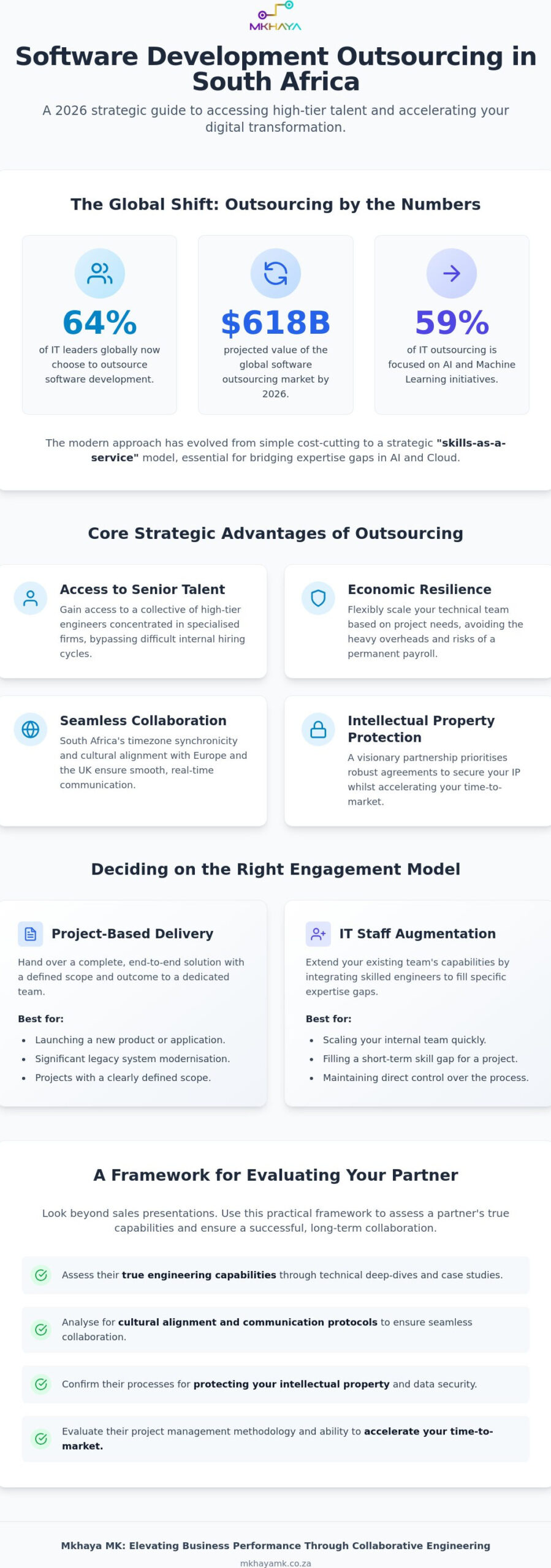
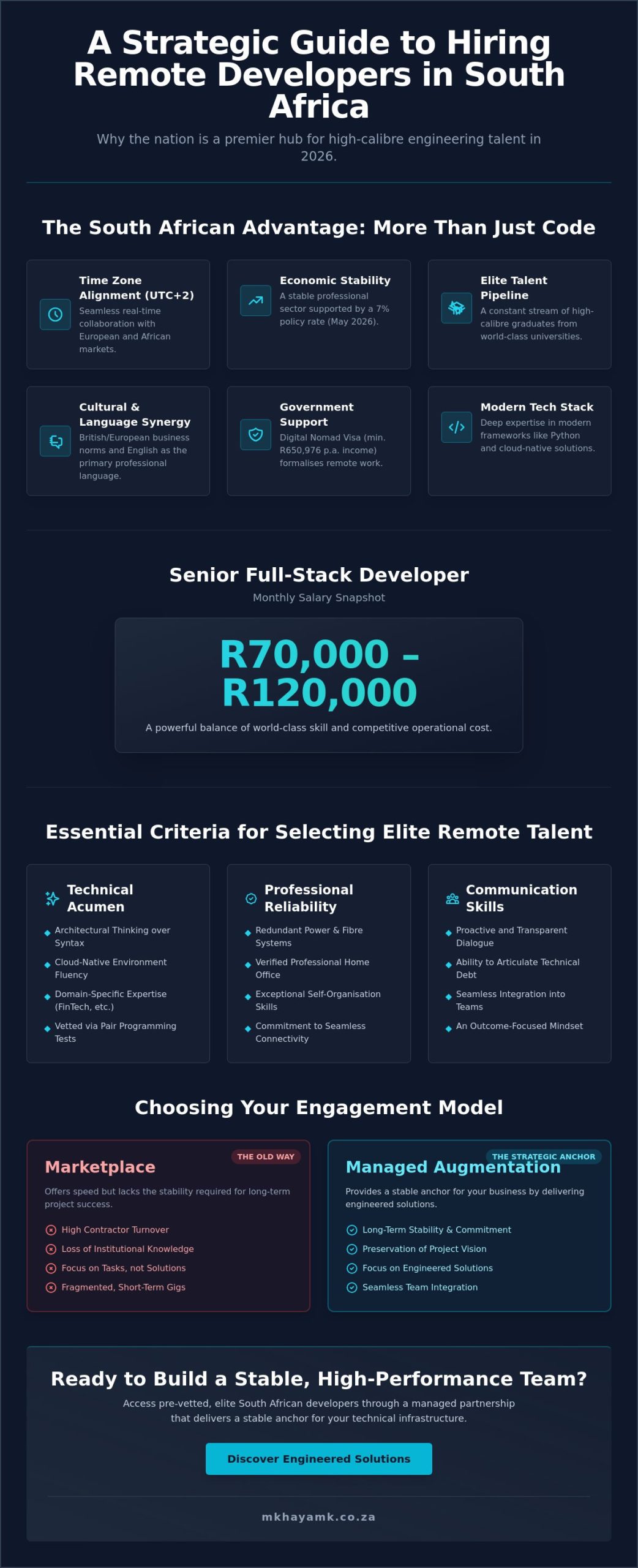
64% of IT leaders globally now choose to outsource software development, yet many still find themselves stalled by a lack of senior engineering talent for AI and Cloud initiatives. You’ve likely felt the weight of rising in-house costs and the pressure of project delays that threaten your competitive edge. When you choose to outsource software development South Africa offers, you’re making a strategic move to bridge this gap with world-class expertise and precision engineering.
We believe that a successful partnership is built on reliability and mutual success rather than just technical delivery. This 2026 guide provides the roadmap you need to navigate the South African landscape, ensuring you secure high-tier talent whilst maintaining predictable development costs. We’ll examine the latest regulatory standards, current hourly rates, and the specific steps required to accelerate your time-to-market through a collaborative, result-focused partnership that transforms your digital vision into a stable reality.
Key Takeaways
Understand the shift from tactical cost-cutting to a strategic “skills-as-a-service” model to bridge your AI and Cloud expertise gaps.
Identify the most effective engagement model for your goals, whether you need to outsource software development South Africa for a defined project or scale your team via staff augmentation.
Discover how timezone synchronicity and cultural alignment facilitate seamless real-time collaboration and ensure technical precision is maintained.
Master a practical evaluation framework to look beyond sales presentations and accurately assess a partner’s true engineering capabilities.
Learn how a visionary partnership can protect your intellectual property whilst accelerating your journey toward digital transformation.
Why South African Enterprises are Prioritising Software Development Outsourcing in 2026
The 2026 business environment has moved past the era where outsourcing was merely a tactic to trim budgets. Today, South African enterprises view it as a strategic “skills-as-a-service” model. This evolution aligns with the broader growth of Business Process Outsourcing, where the focus has shifted toward high-value ICT support and multi-disciplinary expertise. It’s about building a visionary partnership that prioritises long-term stability over short-term savings. By choosing this path, you transform technical debt into a refined asset that supports your broader commercial objectives.
Finding senior engineers has become increasingly difficult within internal hiring cycles. Many of the most skilled developers are now choosing to work within specialised firms where they can apply their expertise across diverse, high-impact projects. This concentration of talent means that when you choose to outsource software development South Africa offers, you aren’t just hiring a vendor; you’re gaining access to a collective of engineers who understand the nuances of the local market. Currently, 64% of IT leaders globally rely on this model to maintain momentum. By 2026, the global software development outsourcing market is estimated to reach $618 billion, reflecting a widespread reliance on external partners to drive innovation.
To better understand the talent landscape and the investment required for these skills, watch this helpful video:
The 2026 Tech Landscape: AI and Cloud Integration
Modern applications are no longer just collections of code. They require sophisticated AI & data automation and robust DevOps frameworks to remain functional. With 59% of IT outsourcing now focused on AI and machine learning, the cost of falling behind is immense. Outsourcing allows your business to transition from clunky legacy systems to modern, scalable cloud architectures without the friction of a complete internal restructure. This acceleration is vital for maintaining a competitive edge whilst user expectations for speed and precision are at an all-time high.
Economic Resilience Through Flexible Scaling
Building a permanent technical department involves significant long-term payroll overheads and substantial hiring risks. If a senior developer leaves, the resulting vacuum can stall progress for months. Outsourcing provides the agility to scale your team up or down based on specific project phases or market fluctuations. This flexibility ensures your internal resources remain focused on core business strategy and high-level decision-making. Whether you are implementing bespoke ERP solutions or refining a customer-facing app, a partner-led approach provides the stability and precision needed to grow without the burden of fixed technical debt.
Deciding Between Project-Based Delivery and IT Staff Augmentation
Choosing the right engagement model is a pivotal step in your digital journey. It’s a decision that balances your internal capacity with your long-term strategic goals. When you decide to outsource software development South Africa provides two primary paths: handing over a specific outcome or extending your existing team’s capabilities. Each model serves a distinct purpose in 2026, particularly as enterprises seek to integrate complex AI and Cloud architectures into their core operations. Your choice should reflect your organisational maturity and the level of direct control you wish to maintain over the daily engineering process.
When to Choose Project-Based Software Engineering
This model is designed for businesses that require a complete, end-to-end solution with a defined scope. It’s the most effective route for launching a new product or undergoing a significant legacy modernisation. By opting for project-based custom software development, you leverage a partner’s entire ecosystem, including UI/UX designers, QA testers, and DevOps specialists. This approach removes the burden of managing individual tasks, allowing you to focus on the business impact whilst your partner ensures the technical precision of the final delivery. It’s especially valuable when building cloud-native applications that require a cohesive, multidisciplinary team to succeed.
The Benefits of IT Staff Augmentation
If you already have an established internal technical department but lack specific expertise, staff augmentation is the superior choice. This model allows you to rapidly scale your capacity with remote or on-site professionals who integrate directly into your workflows. You maintain full control over the development lifecycle and daily priorities. In the current market, where 59% of outsourcing is focused on AI and machine learning, augmentation provides immediate access to niche roles like Cloud Architects or Data Engineers. You avoid the friction and cost of a traditional recruitment cycle, gaining the specific skills needed to accelerate your existing roadmap without long-term payroll commitments.
Determining which path fits your current needs is often the first step toward a successful transformation. Whether you require a visionary guide to build a system from scratch or a reliable partner to bolster your internal ranks, the right model ensures your engineering efforts remain stable and scalable. If you’re unsure which direction aligns with your 2026 objectives, discussing your roadmap with a strategic partner can provide the clarity needed to move forward with confidence.
The Strategic Advantages of Partnering with a Local South African Engineering Firm
Whilst much of the global conversation regarding technical partnerships focuses on international trade, the most profound advantages often emerge from local-to-local collaborations. Engaging a partner within your own borders removes the friction of vast time differences and misaligned business cultures. This proximity facilitates real-time collaboration and daily stand-ups where technical nuance is preserved rather than lost in translation. When you choose to outsource software development South Africa based engineering firms provide a level of synchronicity that offshore hubs simply cannot replicate. It’s a relationship built on shared market understanding and a mutual commitment to the national digital economy.
The logic is clear; a local partner is an invested stakeholder in your success. South Africa’s tech ecosystems in Johannesburg and Cape Town are mature and globally competitive, producing engineers who are trained to solve complex problems with limited resources. By keeping your engineering efforts within the country, you contribute to a sector that has already created 174,000 jobs and generated billions in revenue. This collaborative approach ensures that your digital transformation remains grounded in local realities whilst meeting world-class standards of execution.
POPIA Compliance and Data Sovereignty
Data sovereignty is a pillar of modern business stability. Local partners are inherently aligned with the Protection of Personal Information Act (POPIA), ensuring that your sensitive data never leaves the national legal jurisdiction without proper oversight. This is particularly critical for financial institutions; under Joint Standard 1 of 2024, insurers must ensure all outsourcing agreements are fully compliant by 30 November 2026. Furthermore, insurers are required to notify the Prudential Authority at least 30 days before entering into any material arrangement. A local partner understands these regulatory hurdles and provides the legal certainty needed to protect your intellectual property and code ownership.
Quality Standards and Technical Excellence
South Africa has earned a reputation for high-end engineering that rivals traditional Western hubs. Our engineering graduates from institutions like UCT and Stellenbosch are sought after globally for their precision and ability to build scalable, cloud-native applications. Choosing a local firm allows you to access this “Nearshore” quality without the communication risks associated with low-cost offshore providers. For a deeper look at how these standards are applied in practice, read our detailed analysis on Custom Software Development in South Africa: A Strategic Guide for 2026. This focus on excellence ensures that your software is not just functional, but built for long-term stability and growth.
A Framework for Evaluating Your Next Software Outsourcing Partner
Selecting a partner is a high-stakes decision that requires a methodical approach. It moves beyond surface-level sales pitches and focuses on long-term stability. When you decide to outsource software development South Africa offers, you must first define your primary objective with absolute clarity. Are you looking to build a ground-breaking new product from scratch, or do you simply need to scale an existing engineering team? This distinction is vital because the maturity required for end-to-end delivery differs significantly from the support needed for staff augmentation.
Technical depth is the next pillar of your evaluation. In 2026, buzzwords like “AI-ready” are common, but actual engineering capability is rarer. You should evaluate a partner’s ability to handle complex cloud architectures and data-driven automation. Security and IP policies must be non-negotiable. Ensure your partner provides full code ownership and adheres to the POPIA standards mentioned in previous sections. Starting with a small, phased engagement or a “pilot” project is often the wisest way to build a foundation of trust before committing to a multi-year roadmap. This approach allows you to test their communication rhythm and technical precision without immediate, large-scale risk.
Technical Vetting and Discovery
Before any code is written, a visionary partner will conduct a thorough digital transformation audit. This discovery phase identifies technical debt and aligns the proposed tech stack with your long-term goals. It’s also the stage where UI/UX design takes centre stage. A well-designed user journey is essential for project-based development success. It ensures that the final engineering effort translates into actual business value for your end-users whilst maintaining technical excellence.
Operational Alignment and Transparency
Successful partnerships thrive on clear communication protocols. You need to know exactly how the partner will integrate with your internal workflows. This involves establishing clear KPIs and structured reporting cycles that provide real-time visibility. Transparency in pricing is equally vital. Avoid partners who obscure their cost structures with hidden fees throughout the development lifecycle. A collaborative mindset ensures that both parties are working toward mutual success, treating the outsourcing arrangement as a stable extension of your own business.
Mkhaya MK: Elevating Business Performance through Collaborative Engineering
Mkhaya MK positions itself as a visionary guide rather than a mere vendor. We understand that your digital journey is unique. Our philosophy is rooted in the belief that technical precision must be paired with a supportive partnership to achieve long-term stability. When you choose to outsource software development South Africa based enterprises often seek, you require a partner who values transparency and methodical execution as much as you do. We provide high-end engineering nationally, ensuring that your business logic is preserved and refined through every stage of the development lifecycle.
Our commitment to mutual success drives our delivery of comprehensive services. We build everything from bespoke ERP solutions to complex cloud-native applications that serve as a stable anchor in a rapidly changing technological landscape. By focusing on the collaborative relationship, we ensure that our engineering efforts translate directly into measurable business outcomes. This approach allows us to project a persona of quiet confidence, where our results speak louder than flashy claims.
Our End-to-End Digital Transformation Offering
Modernising your operations requires more than just updated code; it necessitates a complete shift toward integrated cloud solutions and AI automation. We specialise in constructing platforms that fit your specific requirements, including robust loan management and learner management systems. Our approach prioritises customisation and precision, ensuring that the software we build respects your unique business rules whilst providing the scalability needed for 2026 and beyond. This end-to-end focus allows us to handle the technical complexities so you can focus on high-level strategy.
Getting Started with Mkhaya MK
We follow a highly structured process that begins with a deep discovery phase. This ensures that every engagement, whether it is a full project handover or a staff augmentation model, is rooted in a clear understanding of your goals. We facilitate a seamless transition by integrating our senior engineers into your existing workflows, maintaining the communication rhythm established in our framework. This methodical implementation ensures reliability and mitigates the risks typically associated with scaling technical teams. It’s a deliberate pace that reinforces our image as a detail-oriented and reliable partner.
The journey toward digital excellence is a personal one. We invite you to contact Mkhaya MK today to discuss your 2026 software strategy and discover how a collaborative engineering partnership can elevate your business performance.
Securing Your Digital Future through Strategic Engineering
The decision to outsource software development South Africa offers is a commitment to long-term stability and precision engineering. By shifting from tactical cost-cutting to a strategic “skills-as-a-service” model, your enterprise can bridge the AI and Cloud expertise gap with confidence. We’ve explored how a local partnership ensures POPIA compliance whilst maintaining the cultural synchronicity required for complex digital transformation. Your ambition deserves a stable, visionary partner.
Mkhaya MK stands ready to support your journey. With a national South African footprint and specialised AI and Cloud expertise, we ensure your engineering processes are both compliant and high-performing. Our methodical approach to custom software development and staff augmentation is designed to inspire trust and deliver business-focused results. We value transparency and commitment above all else.
Partner with Mkhaya MK for your next software project to accelerate your roadmap with a reliable, detail-oriented team. Let’s build a digital landscape that reflects your ambition and secures your competitive edge for years to come.
Frequently Asked Questions
Is it cheaper to outsource software development in South Africa than to hire in-house?
Outsourcing is generally more cost-effective because it eliminates the long-term overheads associated with permanent payroll, such as office space, equipment, and benefits. Whilst the hourly rates for senior talent are competitive, the true saving comes from reduced recruitment friction and the ability to scale your team down when a project phase concludes. It allows you to convert fixed costs into variable expenses that align with your actual development needs.
What is the difference between IT staff augmentation and project-based outsourcing?
Staff augmentation involves adding specific technical professionals to your existing internal team to fill skill gaps whilst you retain direct management. Project-based outsourcing is a model where you hand over a defined scope of work to a partner who manages the end-to-end delivery of the final product. Your choice depends on whether you need to bolster your current capacity or require a partner to take full responsibility for a specific technical outcome.
How do I ensure my intellectual property is protected when outsourcing?
Intellectual property is protected through robust, locally governed contracts that explicitly state your full ownership of the source code and design assets upon payment. When you choose to outsource software development South Africa based firms provide the advantage of operating within a familiar legal framework. Ensure your agreement includes comprehensive non-disclosure clauses and clear terms regarding data sovereignty to safeguard your competitive advantages from day one.
Can South African software companies handle complex AI and data automation projects?
South African engineering firms are highly capable of delivering sophisticated AI and data automation solutions due to a mature tech ecosystem and world-class university graduates. Local teams are already building complex, cloud-native applications that integrate machine learning to drive business efficiency. With 59% of global outsourcing now focused on AI, South African partners have refined their precision engineering to meet these modern technical demands whilst maintaining high standards of execution.
How long does it typically take to scale a team through staff augmentation?
Scaling a team through staff augmentation typically takes a few weeks, which is significantly faster than the months required for traditional permanent hiring. This agility allows you to respond to market fluctuations or technical challenges without delaying your roadmap. A visionary partner maintains a pipeline of vetted senior developers, ensuring that you gain access to the specific expertise you need with minimal lead time.
What are the common risks of outsourcing and how can they be mitigated?
The most common risks include communication silos, misaligned expectations, and scope creep. You can mitigate these by establishing clear KPIs, insisting on transparent reporting structures, and maintaining a regular cadence of daily stand-ups. Choosing a partner who prioritises a collaborative relationship ensures that technical nuance is never lost. Methodical discovery phases at the start of an engagement also help to align the technical roadmap with your commercial objectives.
Do I need to have a technical background to manage an outsourced development partner?
You do not need a technical background if you partner with a firm that prioritises business-focused results and clear communication. A reliable partner acts as a bridge between complex engineering and your strategic goals, providing transparent updates in a language that non-technical stakeholders understand. Your role is to define the vision and business logic, whilst the engineering team handles the precision execution and technical stability of the system.
How does POPIA compliance affect software development outsourcing in South Africa?
POPIA compliance requires that all personal data is handled with strict security and stored within compliant jurisdictions. When you outsource software development South Africa based partners are already aligned with these national privacy laws, which simplifies your regulatory burden. This is particularly vital as we approach the November 2026 deadline for financial institutions to ensure all their outsourcing arrangements meet the latest Joint Standards for data protection and sovereignty.
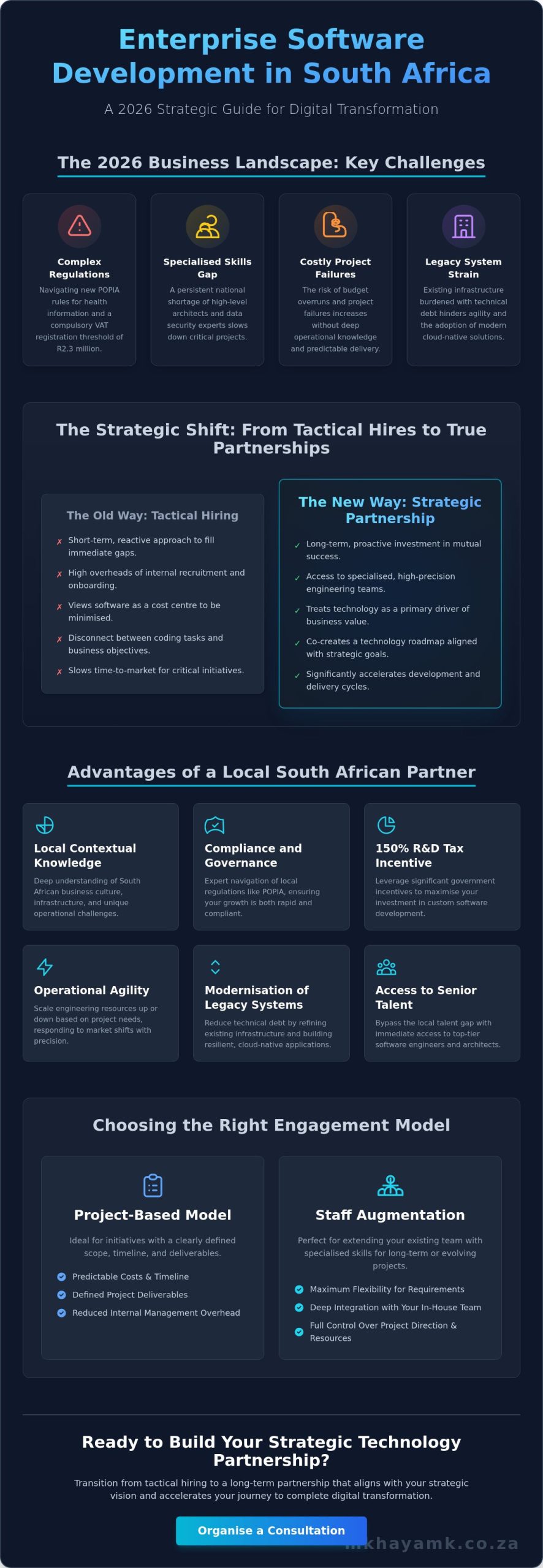
In 2026, the difference between a successful digital transformation and a costly project failure isn’t just your budget; it’s the depth of your partner’s local operational knowledge. As the compulsory VAT registration threshold sits at R2.3 million and new POPIA regulations for health information take effect, the stakes for enterprise software development south africa have never been higher. You’ve likely felt the strain of searching for high-level talent while worrying about data security and the potential for budget overruns.
We understand that you need more than just a vendor. You need a reliable partner that feels like an automated extension of your own business. This guide will show you how to navigate the current outsourcing landscape to find a team that delivers technical excellence and long-term stability. We will explore how to modernise your legacy systems, leverage the 150% R&D tax incentive, and establish predictable delivery cycles that drive your business forward with quiet confidence. By the end of this article, you’ll have a clear, step-by-step framework for choosing a partner that aligns with your strategic vision.
Key Takeaways
Learn how to transition from tactical hiring to building long-term strategic technology partnerships that align with your broader business objectives.
Identify the essential technical and architectural criteria for selecting a partner for enterprise software development south africa to ensure high-quality, scalable results.
Evaluate the benefits of project-based models versus staff augmentation to determine the most flexible engagement structure for your specific requirements.
Understand how to navigate local regulatory requirements like POPIA while building resilient cloud applications tailored to the South African infrastructure.
Discover how custom ERP solutions and proprietary systems can accelerate your journey from basic software engineering to complete digital transformation.
The Strategic Shift: Why Outsource Software Development in South Africa?
In 2026, enterprise software development south africa represents the construction of the structural backbone for our nation’s leading industries. This year, the focus has shifted from mere experimentation to full-scale digital transformation. Organisations are moving away from tactical, short-term hiring toward strategic technology partnerships that provide long-term stability and refined engineering standards. By choosing to outsource, your business avoids the immense overhead of maintaining massive internal departments whilst gaining the precision of specialised engineering teams. This approach doesn’t just save resources; it significantly accelerates your time-to-market for critical initiatives. The history of Science and technology in South Africa shows a resilient spirit of innovation that local partners carry into every project.
To better understand the current landscape of the tech workforce and the value of local expertise, watch this helpful video:
This shift marks a transition from viewing software as a cost centre to seeing it as a primary driver of value. When you move from tactical hiring to a strategic partnership, you’re investing in a relationship that prioritises mutual success. It’s about more than just clearing a backlog of tickets; it’s about co-creating a roadmap that integrates AI and cloud solutions into your core operations. This collaborative model ensures that every line of code serves a specific business objective, turning your technology stack into a competitive advantage.
Addressing the 2026 Talent Gap in South Africa
The reality of the national market in 2026 is a persistent shortage of specialised skills, particularly in high-level architecture and data security. Outsourcing provides instant access to senior software engineering expertise that might otherwise take months to recruit and onboard. Whilst offshore alternatives exist, a local partner understands the unique nuances of South African business culture and operational challenges. This proximity ensures that your tech team isn’t just a group of coders, but a collaborative extension of your business that shares your commitment to excellence. A local partner also navigates the specific complexities of the South African regulatory environment with greater ease, ensuring that your growth is both rapid and compliant.
The Business Case for Operational Agility
Selection Criteria: What Defines an Enterprise-Grade Development Partner?
Selecting a partner for enterprise software development south africa requires a gaze that penetrates deeper than surface-level testimonials or hourly rates. True enterprise-grade status is defined by a holistic approach to engineering. Architectural design, UI/UX design services, and rigorous quality assurance must intersect seamlessly. You need a partner whose portfolio reflects success in high-stakes environments like financial services or logistics. These sectors demand a level of precision and reliability that smaller firms often struggle to replicate. It’s about finding a team that understands the weight of your operational stability.
Transparency throughout the development lifecycle is non-negotiable for modern businesses. Enterprises require real-time visibility through Agile methodologies and automated DevOps pipelines. This ensures every sprint delivers tangible value whilst minimising the risk of project drift. As South Africa’s Digital Economy Master Plan outlines, the nation is rapidly positioning itself as a hub for high-tech services. This makes it vital to evaluate a partner’s ability to integrate AI and data automation into your existing workflows. If you’re looking for a team that prioritises this level of technical rigour, you can reach out to our specialists for a strategic consultation.
Security and Compliance Frameworks
Security isn’t a secondary consideration; it must be baked into the development culture. An enterprise-grade partner should adhere to international standards such as ISO 27001 or SOC2. The integration of SecOps into the engineering pipeline ensures that vulnerability assessments and encryption protocols are continuous rather than an afterthought. This methodical approach protects your data integrity whilst ensuring compliance with evolving local and international regulations. Verifying a partner’s internal data handling is essential for long-term trust.
Architecture for Scalability
Future-proofing your business requires a partner who builds for the cloud from day one. This involves a commitment to microservices and API-first development. Such structures allow for modular growth and easier integration with third-party systems. Choosing a partner with this level of foresight ensures your software remains agile and resilient as your business scales. For a deeper dive into these technical requirements, consult our enterprise software engineering services south africa reference guide.
Choosing the Right Engagement Model: Project-Based vs. Staff Augmentation
Selecting the right engagement model is a pivotal step in your journey toward technical excellence. It defines the boundaries of responsibility and the rhythm of delivery for enterprise software development south africa. A fixed-scope project model offers a defined destination with predictable costs, making it suitable for initiatives with static requirements. Conversely, monthly staff augmentation provides the fluid capacity needed for evolving roadmaps and rapid pivots. Your organisational state, whether you possess a robust internal tech team or require a full-service partner, will ultimately dictate which model offers the most significant return on investment.
We’ve found that the most successful enterprises often adopt a hybrid approach. This involves using a project-based team to handle the heavy lifting of architectural builds whilst integrating augmented staff to manage internal maintenance or niche feature sets. This blend ensures that your primary goals remain on track without neglecting the day-to-day refinements your systems require. Regardless of the model, clear Service Level Agreements (SLAs) are non-negotiable. They act as the stable anchor for your partnership, ensuring that quality, uptime, and delivery velocity meet your exact standards.
When to Choose Project-Based Development
This model is ideal for greenfield applications where the outcomes are clearly defined from the outset. By outsourcing the entire lifecycle from initial design to final deployment, you manage risk through a single point of accountability. It allows your business to focus on core operations whilst a specialised team handles the technical execution. If you’re planning a comprehensive new build, our guide on custom software development south africa provides a strategic framework for success.
The Power of IT Staff Augmentation
If your internal team is talented but overstretched, staff augmentation allows you to extend your engineering capacity almost instantly. You maintain full control over the product roadmap and internal processes whilst benefiting from the fresh perspectives of remote or on-site professionals. Mkhaya MK’s staff augmentation services are designed for this exact purpose, providing the agility to scale up for critical sprints and scale down once the objective is met. This flexibility ensures that your business remains responsive to market changes without the long-term burden of permanent headcount increases.
The South African Context: Compliance, Connectivity, and Local Expertise
Navigating the specific regulatory and infrastructural nuances of our region is where a local partner truly proves their value. For enterprise software development south africa, this means designing systems that are inherently compliant with the Protection of Personal Information Act (POPIA). It isn’t enough to simply host data locally; the very architecture of your database must reflect these legal requirements. A partner with a national presence facilitates the collaborative workshops necessary to align technical builds with your operational reality. This proximity ensures that your vision isn’t lost in translation across time zones or cultural gaps.
The ‘South African Advantage’ lies in the intersection of world-class engineering talent and a competitive national cost structure. This is a primary reason why enterprise software development south africa continues to grow as a strategic choice for firms seeking high-end engineering. Whilst internet penetration reached 79.6% by late 2025, the reality of varied connectivity speeds remains a factor for many users. Choosing a local expert ensures your platforms are built to handle these specific conditions as well as leveraging national initiatives like the R&D tax incentive. If you’re ready to align your tech stack with local excellence, contact our team today to discuss your roadmap.
Regulatory Compliance as a Feature
Compliance shouldn’t be a hurdle; it should be a built-in feature of your digital ecosystem. Local partners integrate POPIA requirements directly into the database architecture by ensuring:
Automated data handling and disposal procedures.
Strict adherence to the 2026 regulations for health-related personal information.
Optimised data residency through local cloud hosting options.
This methodical approach turns digital transformation into a path for compliant, sustainable operations. It provides an additional layer of security for sensitive information whilst maintaining the transparency your stakeholders expect.
Resilience in Software Engineering
Building for resilience means accounting for local infrastructure challenges from the first line of code. This involves developing for offline-first or low-bandwidth scenarios to ensure your enterprise platforms remain functional regardless of external conditions. Implementing robust DevOps practices further ensures high availability and rapid recovery, aligning with the government’s SA Connect goals for stable broadband access. Local expertise is the best defence against regional operational risks because it anticipates the specific environmental factors that an offshore vendor might overlook. It’s about creating a stable anchor through specialised engineering in a rapidly changing technological landscape.
Partnering for Longevity: The Mkhaya MK Approach to Digital Excellence
At Mkhaya MK, we believe that true excellence in enterprise software development south africa is found in the transition from technical execution to total digital transformation. We don’t view ourselves as a mere vendor; we act as a visionary guide for your unique business journey. Our approach is rooted in the understanding that software should be a stable anchor for your growth. By focusing on methodical execution and transparency, we ensure that every solution we construct is designed for long-term stability and precision. This philosophy allows us to move beyond simple coding to create systems that truly empower your workforce.
Our expertise is reflected in our suite of proprietary systems. We provide robust loan management systems and comprehensive ERP solutions that are customised to meet the specific needs of South African enterprises. These platforms aren’t just tools; they’re refined frameworks that organise complex operations into streamlined, efficient workflows. We also place a high priority on UI/UX design services. This focus ensures that your team finds the new tools intuitive and engaging, which is the only way to achieve the high user adoption rates necessary for a successful digital rollout.
Post-deployment, our commitment remains just as strong. We provide managed cloud solutions and continuous support to ensure your systems remain resilient and agile. This forward-looking ambition seeks to inspire trust, knowing that your technology partner is as invested in your future as you are. We value integrity and methodical execution over flashy claims, providing you with a reliable foundation in a rapidly changing technological landscape.
Beyond the Code: Strategic Consulting
Our strategic consulting services ensure that your technology roadmap aligns perfectly with your actual business revenue drivers. We help you identify opportunities where AI & data automation can optimise existing workflows and eliminate manual friction. By linking specific technical capabilities to practical business benefits, we help non-technical stakeholders see the clear value in every investment. This results-focused approach ensures that your journey toward enterprise software development south africa is both profitable and sustainable.
Your Path Forward with Mkhaya MK
Partnering with a privately held, national technology firm like Mkhaya MK offers a level of stability and commitment that is rare in a fragmented market. Our collaborative process moves you from initial concept to full-scale deployment through a rhythmic, logical progression. Each step is fully articulated and executed with the quiet confidence that comes from years of industry expertise. If you’re ready to begin your transformation, contact Mkhaya MK to discuss your specific enterprise requirements and discover how we can build your future together.
Building Your Digital Future with Confidence
The landscape of 2026 demands more than just code. It requires a strategic alliance that prioritises long-term stability and local operational expertise. By selecting an engagement model that fits your specific needs and ensuring your partner understands the nuances of POPIA compliance, you’re doing more than just launching a project. You’re constructing a resilient foundation for your organisation’s growth. High-quality enterprise software development south africa is about bridging the gap between global engineering standards and the unique challenges of our national infrastructure.
Mkhaya MK stands ready as your end-to-end digital transformation expert. With a national South African footprint and proven proprietary systems for loan and facility management, we help you move from legacy constraints to modernised excellence. We don’t just build software. We architect your digital future through methodical execution and quiet confidence. This approach ensures your technology remains a stable anchor in a rapidly changing world.
What are the main benefits to outsource software development in South Africa?
Outsourcing provides immediate access to high-level engineering talent at a competitive national cost whilst maintaining strong cultural alignment. It allows your business to scale engineering capacity rapidly without the long-term overhead of permanent headcount increases. Local partners also possess a deep understanding of the specific infrastructural challenges and tax incentives like the Section 11D R&D deduction. This ensures your project is both technically sound and financially optimised for the national environment.
How does POPIA affect enterprise software development for local companies?
POPIA requires that data protection is integrated into the software’s architecture through privacy by design principles. This involves implementing strict encryption, automated data disposal, and secure access protocols from the first line of code. For enterprise software development south africa, compliance also means ensuring that cloud hosting or third-party integrations adhere to South African data residency requirements, particularly following the 2026 regulations regarding health-related personal information.
What is the difference between staff augmentation and a dedicated development team?
Staff augmentation involves adding specific professionals to your existing internal team to boost capacity, whereas a dedicated development team operates as a self-contained unit managing the entire project lifecycle. Augmentation is ideal for maintaining direct internal control over the product roadmap. A dedicated team is better suited for complex, end-to-end builds where you want to outsource technical accountability and architectural leadership to a specialised, reliable partner.
How do you ensure code quality when working with an external software engineering partner?
Code quality is ensured through transparent DevOps pipelines, automated testing, and regular peer reviews. An enterprise-grade partner will provide real-time visibility into the development process using Agile methodologies. This ensures that every sprint meets predefined architectural standards and performance benchmarks. By establishing clear Service Level Agreements (SLAs) from the outset, you maintain a high standard of precision and long-term stability for your digital platforms.
Can an external partner help with the migration of legacy enterprise systems to the cloud?
Yes, an external partner provides the specialised expertise needed to refactor or rebuild legacy systems for cloud-native environments. This process involves moving away from monolithic architectures toward microservices, which improves scalability and resilience. A partner can help you navigate this transition methodically. They ensure your data remains secure whilst modernising your infrastructure to support advanced AI integration and real-time data automation for better business results.
What industries in South Africa benefit most from custom enterprise software?
Financial services, logistics, and healthcare sectors benefit most due to their high demand for precision, security, and complex data handling. Custom enterprise software development south africa allows these industries to automate intricate workflows that off-the-shelf solutions cannot support. Whether it’s managing loan applications or coordinating large-scale supply chains, bespoke systems provide the agility needed to compete in a rapidly changing national market whilst ensuring compliance.
How do I manage communication and project timelines with an outsourced team?
Effective management is achieved through a structured rhythm of communication, typically involving daily stand-ups and bi-weekly sprint reviews. Using collaborative project management tools ensures that all stakeholders have a clear view of progress and potential blockers. By choosing a partner with a national presence, you can also facilitate in-person workshops. This helps to build a stronger sense of partnership and ensures that project timelines remain predictable and aligned.
The most successful tech leaders in 2026 have realised that the traditional outsourcing model is no longer enough to sustain growth. When you struggle with high local recruitment costs for senior talent and the friction of remote culture, the gap between your business goals and technical execution often widens. Securing a dedicated development team south africa offers more than just a cost-effective alternative; it provides a stable, high-quality extension of your internal culture. You deserve a partner that acts as a visionary guide, ensuring your engineering capacity evolves alongside your long-term ambitions.
We understand that maintaining a reliable engineering team requires more than just technical skill. It demands a commitment to transparency and a shared sense of purpose. This guide explores how to scale your capabilities through strategic alignment, focusing on the latest 2026 regulatory landscapes like the updated POPIA health regulations and the shift towards Agentic AI. You will learn how to access senior South African talent and establish predictable monthly costs, all whilst ensuring your digital transformation remains grounded in practical, high-end results. We will walk through the specific steps to move from a broad vision to a concrete, high-performing engineering partnership.
Key Takeaways
Understand why the dedicated development team south africa model has evolved into a long-term, exclusive partnership that outpaces traditional outsourcing in 2026.
Discover how to integrate AI and data automation into your core development life cycle to drive genuine digital transformation rather than merely completing tickets.
Compare the cost and management structures of dedicated teams against staff augmentation to identify the best fit for your operational stability.
Learn the specific technical vetting and organising processes required to secure senior South African engineering talent capable of scaling with your ambitions.
Explore the benefits of an end-to-end partnership that encompasses everything from UI/UX design to cloud deployment and DevOps services.
The Evolution of Dedicated Development Teams in South Africa
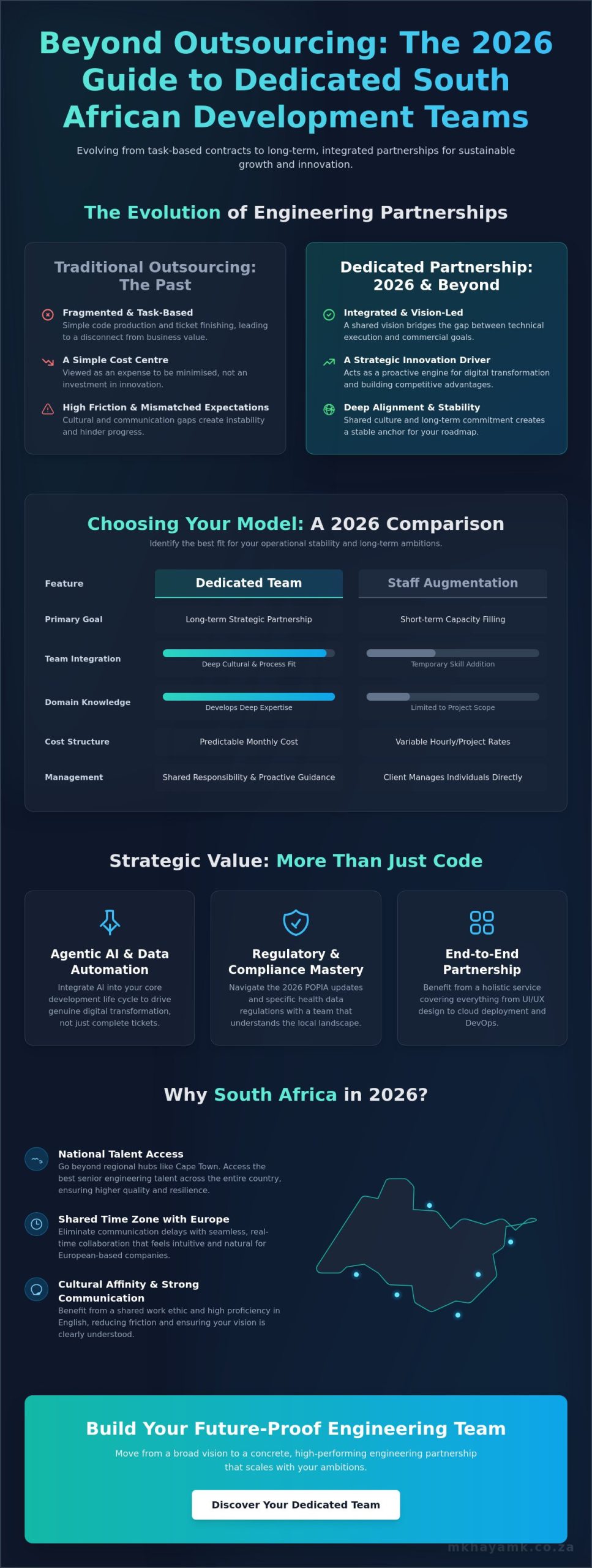
The move away from traditional “body shopping” signals a maturity in how companies view global outsourcing models. Instead of fragmented resources, leaders prioritise stability and long-term alignment. This shift ensures that technical execution isn’t just a cost centre but a driver of innovation. South Africa’s position is bolstered by a shared time zone with Europe and a cultural affinity that makes communication feel natural and intuitive. You aren’t just buying hours; you’re investing in a team that understands the nuances of your market and your user behaviour.
To better understand this concept, watch this helpful video:
What Defines a Dedicated Team in 2026?
A dedicated team is a persistent, scalable unit of senior talent exclusively committed to a single client’s business objectives and technical roadmap. These professionals don’t just work on your projects; they integrate into your daily rhythms. They use your tools, attend your stand-ups, and adopt your internal culture. This level of immersion eliminates the mismatched expectations common in high-pressure environments. It creates a stable anchor for your digital transformation. Because they focus on one product roadmap, they develop deep domain knowledge that a generalist freelancer could never match.
Why National Talent Access Beats Regional Hubs
Limiting your search for a dedicated development team south africa to specific cities like Cape Town or Johannesburg is a strategy of the past. High-speed digital infrastructure and reliable energy microgrids now enable seamless national collaboration. By accessing the full spectrum of South African expertise, you ensure your team is built on the best possible talent, regardless of their physical coordinates. This approach provides greater resilience. If one region faces local infrastructure challenges, your operations remain steady because your talent pool is diversified across the country. It’s a modern, agile way to scale that prioritises senior-level skill over postcodes, ensuring your software engineering efforts are never throttled by local talent shortages.
Strategic Value: Beyond Code to Digital Transformation
True digital transformation happens when technical capacity aligns perfectly with business intelligence. It’s a shift from simply maintaining systems to actively building competitive advantages. A dedicated development team south africa acts as the engine for this evolution, moving beyond the “ticket-finishing” mindset of traditional outsourcing. As South Africa’s digital economy continues to mature, local engineering teams have become adept at delivering end-to-end solutions that encompass strategy, architecture, and long-term maintenance. They don’t just write code; they build the infrastructure that allows your business to pivot and scale in a volatile market.
One of the most significant advantages of this partnership is the inherent understanding of the local regulatory landscape. For instance, with the Information Regulator’s increased enforcement of POPIA in 2026 and the specific health-related data regulations introduced in March 2026, having a team that is already compliant is vital. They ensure that every line of code and every data pipeline respects the latest legal frameworks, protecting your business from the risks of downtime or successful phishing attacks, which 70% of businesses expect to face this year.
Integrating AI and Data Automation
The tech landscape in 2026 is defined by the shift towards Agentic AI, where autonomous systems execute complex workflows with minimal intervention. By leveraging AI & data automation, a dedicated team can build proprietary models tailored to your specific business data. This isn’t about generic tools; it’s about custom-built intelligence that optimises development speed and software quality. Modern teams now use automated quality assurance and DevOps-led delivery to ensure that every deployment is stable and performant, reflecting the 25% growth in AI spending across the region.
Cloud-First Engineering for National Scale
Scaling a digital presence across the diverse network environments of South Africa requires a sophisticated approach to infrastructure. Moving beyond legacy systems through managed cloud solutions allows your applications to remain resilient even during energy challenges. Dedicated engineers focus on building cloud-native architectures that ensure high availability and low latency for your users. This DevOps-centric approach maintains a 24/7 digital presence, ensuring that your software remains a stable anchor for your customers. If you’re ready to see how these capabilities can be tailored to your roadmap, you might want to explore a strategic consultation to define your next steps.
Comparing Models: Dedicated Teams vs. Staff Augmentation
Choosing the right engagement model is a pivotal decision for any tech leader. Whilst both staff augmentation and dedicated teams offer access to high-tier talent, they serve different strategic purposes. The choice often hinges on how much management overhead you’re willing to absorb and the complexity of the digital asset you’re building. Given South Africa’s digital economy growth, the options for high-end engineering have never been more robust, but the wrong choice can lead to fragmented workflows and misaligned goals.
The most common objection we hear is: “Why not just hire individual contractors?” On the surface, individual contractors might seem cost-effective. However, the hidden “coordination tax” is high. You become the project manager, the scrum master, and the cultural glue. A dedicated development team south africa, by contrast, operates as a self-contained, high-performance unit. They bring their own established communication patterns and internal management, allowing you to focus on high-level strategy rather than daily micro-management. This model also secures your intellectual property more effectively; institutional knowledge stays within the team rather than walking out the door when a single contractor’s contract ends.
When to Choose Staff Augmentation
Staff augmentation is ideal for short-term projects where you have a specific, well-defined technical gap. It’s a tactical move for rapidly scaling during a specific launch or migration phase. If you already have a strong internal engineering culture and just need “extra hands” to hit a deadline, this is often the most efficient path. It’s about filling a temporary void with precision. For more details on this approach, see our guide on how to reduce IT costs with staff augmentation.
When the Dedicated Team Model Wins
The dedicated team model is the superior choice for continuous product development where requirements evolve over time. It’s about building a core digital asset that requires deep architectural knowledge and a consistent vision. This model creates a sense of “quiet confidence” in your tech stack because you have a persistent group of senior engineers who understand the “why” behind every architectural decision. They don’t just finish tickets; they anticipate technical debt and build for the future. This long-term stability ensures your platform remains a reliable anchor, even as your business pivots to meet new market demands. If your immediate challenge is expanding capacity under tight deadlines, our guide on how to scale your tech team quickly outlines the strategic frameworks that complement this model.
Vetting and Organising Your Dedicated Team Nationally
Building a high-performance engineering unit requires a vetting process that looks beyond a simple list of technical skills. To secure a dedicated development team south africa that truly functions as an extension of your business, you must evaluate their ability to handle digital transformation at scale. This involves assessing their strategic thinking, their grasp of complex architectures, and their commitment to methodical execution. You aren’t just looking for developers; you’re looking for partners who can translate business vision into robust technical reality.
Organising a team across national borders requires sophisticated communication protocols. Whilst remote work is the standard, the “quiet confidence” of a successful partnership comes from structured transparency. Establishing clear KPIs is essential, but these must focus on business outcomes rather than arbitrary metrics like lines of code. Success should be measured by feature velocity, system uptime, and the successful mitigation of technical debt. This ensures the team remains focused on long-term stability and value creation.
Assessing Technical and Cultural Fit
When searching amongst the national talent pool for specialists in software engineering, it’s vital to look for a proven track record in your specific sector. Whether your focus is on Finance, Logistics, or complex ERP systems, your partner should demonstrate a deep understanding of the unique challenges within those industries. Cultural fit is equally important. You need a team that shares your values of integrity and transparency, ensuring that communication remains fluid even during high-pressure delivery cycles. This shared vision for innovation is what separates a standard contractor from a visionary guide.
Onboarding and Integration Protocols
Successful integration starts with aligning the dedicated team with your internal process and methodology. This includes setting up a secure, cloud-based toolchain that enables seamless collaboration without compromising data integrity. A successful transition typically follows a structured 30-60-90 day roadmap that moves from initial environment setup and cultural immersion to full ownership of technical deliverables and strategic optimisations. This deliberate pace ensures that every team member is fully articulated in their role before the partnership scales. If you’re ready to build a team rooted in these values, you can consult with our team about your specific vetting requirements to ensure a perfect fit.
Scaling with Mkhaya MK: Your Partner in Digital Evolution
Choosing the right dedicated development team south africa is more than a procurement decision; it’s a commitment to your company’s future architecture. We’ve explored the evolution of the model and the strategic value of deep technical integration. Now, the focus shifts to execution. Mkhaya MK provides a stable anchor for businesses that need to scale without losing their cultural identity or technical standards. We don’t just supply resources; we build the engineering capacity required to sustain long-term digital evolution in an increasingly autonomous landscape.
Our end-to-end approach ensures that your product roadmap is never fragmented across different vendors. We manage the entire lifecycle, from the initial UI/UX design services that define your brand’s digital behaviour to the cloud application services & DevOps that guarantee your systems remain resilient. This continuity is vital for maintaining high-quality output and predictable costs. By aligning our technical capabilities with your specific business goals, we transform software from a line item into a strategic asset that drives measurable refinements across your organisation.
A Visionary Yet Practical Approach
We believe that professional confidence should always be paired with a supportive partnership model. This means we take the time to understand the nuances of your industry, whether you’re implementing complex ERP solutions or developing bespoke loan management systems. Our personality is one of “quiet confidence” where we value methodical execution over flashy, unsubstantiated claims. We focus on precision and long-term stability, ensuring that every deployment is a step toward your broader ambition. This practical guidance helps you stay agile and modern whilst remaining rooted in the traditional values of integrity and commitment.
Ready to Scale Your Engineering Capacity?
Finding a dedicated development team south africa that acts as a true extension of your business requires a partner that is deeply invested in your journey. We invite you to visit our about us page to learn more about our culture and the principles that guide our work. Our team is ready to discuss your specific roadmap and help you define a concrete path forward for your digital goals. Whether you need to build a new platform from the ground up or optimise an existing system, we provide the expertise and the stability you need to succeed. Let’s start a conversation about how our bespoke engineering solutions can help you scale with confidence.
Securing Your Path to Technical Excellence
Mkhaya MK stands as a privately held South African technology firm with national reach, offering the end-to-end expertise you need in AI, cloud, and custom software engineering. We focus on the precision and methodical execution required to turn your digital vision into a reliable reality. Contact Mkhaya MK to build your dedicated engineering team today and take the first step toward a scalable, resilient future. We’re here to serve as your stable anchor in a rapidly changing technological landscape.
Frequently Asked Questions
What is the difference between a dedicated development team and standard outsourcing?
A dedicated team functions as a long-term, exclusive extension of your business, whilst standard outsourcing is typically focused on short-term, project-based tasks. This model ensures that your engineers develop deep domain knowledge and align with your internal culture. It moves the relationship beyond a simple transaction toward a strategic engineering partnership that prioritises your product’s long-term stability.
How long does it typically take to assemble a dedicated team in South Africa?
Assembling a high-performing dedicated development team south africa usually takes between four to eight weeks. This timeline allows for a meticulous vetting process to ensure every senior engineer matches your technical requirements and cultural values. We focus on precision during this phase to ensure that the team is ready to hit the ground running from day one of your roadmap.
Can I manage the dedicated team directly or does the provider handle it?
You maintain full control over the team’s product roadmap, priorities, and technical direction. Whilst we handle the operational complexities like HR, infrastructure, and administrative stability, the team integrates directly into your daily workflows. This collaborative approach allows you to focus on high-level strategy while we ensure the engineering unit remains a stable, well-supported anchor for your business.
Is it possible to hire remote developers in South Africa for specific niche technologies?
South Africa possesses a diverse and mature talent pool capable of handling highly specialised technologies. Whether you require expertise in Agentic AI, complex fintech integrations, or cloud-native architecture, our national reach allows us to source specialists amongst the best talent in the country. This ensures you aren’t limited by geography when seeking the precise skills needed for your digital evolution.
How do dedicated teams handle data security and intellectual property rights?
Data security is handled with the highest level of professional rigour, ensuring full compliance with the 2026 POPIA enforcement standards. All intellectual property created by the team is legally transferred to you, giving you total ownership of your digital assets. We establish secure, cloud-based environments and strict communication protocols to protect your sensitive information throughout the partnership.
What happens if my project requirements change whilst the team is already active?
The dedicated model is built for agility, allowing the team to adapt quickly as your business goals evolve. Because the team is committed to your roadmap rather than a fixed project scope, they can pivot their focus without the friction of contract renegotiations. This flexibility ensures that your technical execution remains aligned with your shifting market demands and innovation goals.
How much does a dedicated development team in South Africa cost compared to in-house hiring?
A dedicated development team south africa offers significant cost efficiencies by eliminating the high overheads of local recruitment, office space, and employee benefits. You gain access to senior-level talent with predictable monthly costs, which simplifies your financial planning. This model provides a high-end engineering capacity that is often far more sustainable than building an equivalent in-house team from scratch. For businesses that need to expand capacity rapidly before committing to a full dedicated model, understanding how to scale your tech team quickly with a strategic framework can help bridge the gap effectively.
How do dedicated teams integrate with our existing internal DevOps processes?
Our teams are designed to be “tool-agnostic” and integrate seamlessly into your established DevOps pipelines and communication channels. They adopt your preferred methodologies, whether you use Jira, GitHub, or specific cloud deployment tools. This ensures that the transition is smooth and that there is no disruption to your existing engineering rhythms or deployment cycles.
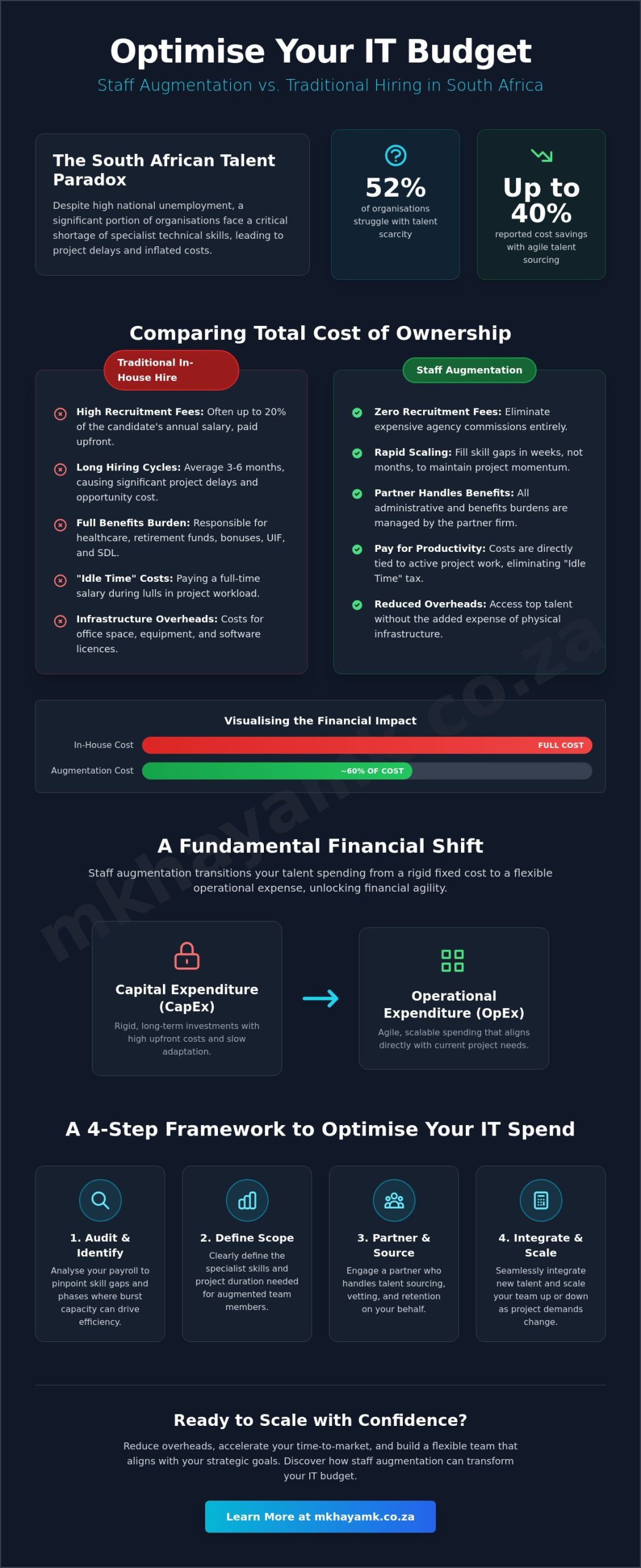
Did you know that businesses are now reporting cost savings of up to 40% simply by rethinking how they source their technical talent? In 2026, the South African market presents a unique talent paradox where 52% of organisations struggle with scarcity despite a high national unemployment rate. You’ve likely felt the budget strain of maintaining underutilised full-time staff or the frustration of long recruitment cycles that delay your most critical projects. It’s a common hurdle for growing firms, but it doesn’t have to be your permanent reality.
We believe in a more agile approach that allows you to reduce IT costs with staff augmentation whilst maintaining the highest standards of engineering excellence. This guide is designed to help you optimise your IT budget and eliminate those hidden recruitment overheads that often drain resources. We’ll walk through a strategic framework for scaling your team, from accessing specialist AI skills to building a mature, flexible partnership that ensures your business remains a stable anchor in a rapidly changing technological landscape.
Key Takeaways
Transition from rigid capital expenditure to agile operational expenditure to maintain financial flexibility in a shifting market.
Discover how to reduce IT costs with staff augmentation by eliminating traditional recruitment overheads and the recurring burden of employee benefits.
Compare the total cost of ownership between in-house hires and augmented teams to uncover the true value of specialist technical talent.
Follow a structured framework to audit your payroll and identify specific project phases where burst capacity can drive efficiency.
Optimise your management resources by partnering with experts who handle talent sourcing, vetting, and retention on your behalf.
The Financial Burden of Traditional IT Hiring in South Africa
The traditional approach to building a technical team is undergoing a fundamental shift in South Africa. For many agile firms, the permanent-first mindset has become a financial bottleneck that restricts growth. Whilst hiring full-time employees was once the standard for stability, the rising cost of talent acquisition in the national landscape has pushed many organisations toward a breaking point. This is the stage where internal recruitment costs actually exceed the project value they aim to create, leaving businesses with bloated budgets and stagnant innovation.
To navigate these challenges, visionary leaders are turning to more flexible frameworks to maintain their momentum. To understand the baseline, it’s helpful to look at what staff augmentation is: a strategic model where an organisation adds external specialists to its existing team to fill specific skill gaps. Staff augmentation is a flexible resource-scaling model that allows you to bypass the friction of traditional hiring whilst retaining full control over your project direction.
To better understand how this model reshapes your financial strategy, watch this helpful video:
Hidden Costs of the In-House Model
The true cost of a permanent employee extends far beyond the gross salary. In South Africa, statutory benefits like the Skills Development Levy (SDL) and Unemployment Insurance Fund (UIF) contributions add immediate layers of expense to every hire. Beyond these, you must account for the “Idle Time” tax. This occurs when you pay for high-level expertise during periods when project demands fluctuate or dip. When you choose to reduce IT costs with staff augmentation, you effectively eliminate these rigid overheads and the recurring expenses of office space or expensive UI/UX design tool licences. You also avoid the steep fees charged by recruitment agencies, which can often reach 20% of a candidate’s annual salary.
Opportunity Cost and Project Delays
Time is perhaps the most expensive resource in the digital economy. Local recruitment cycles for senior developers often span three to six months, creating a massive window of lost innovation. Whilst your competitors are launching new features, your team might be stuck in a holding pattern waiting for a vacancy to be filled. This delay represents a significant opportunity cost that compounds over time. By leveraging professional staff augmentation services, you close these gaps in weeks rather than months. This ensures your time-to-market remains competitive and your budget stays focused on delivery rather than the exhausting process of searching for talent in a scarce market.
Quantifying the Savings: How Staff Augmentation Trims IT Budgets
One of the most effective ways to reduce IT costs with staff augmentation is by fundamentally shifting your financial model from Capital Expenditure (CapEx) to Operational Expenditure (OpEx). In a traditional hiring scenario, you’re often locked into heavy, long-term investments that lack flexibility. By treating talent as an operational expense, you gain the ability to adjust your spend in real-time. This agility is vital for maintaining a healthy cash flow, especially when project scopes evolve or market conditions shift unexpectedly. You aren’t just paying for a person; you’re investing in a scalable resource that aligns perfectly with your current mission.
The “Benefits Burden” is another area where costs quietly accumulate. When you hire internally, the gross salary is only the starting point. You must also account for healthcare contributions, retirement funds, and performance bonuses. By partnering with a specialist firm, these financial responsibilities are handled by the partner. Many organisations find it challenging to reduce overhead costs whilst maintaining a high standard of technical output. Staff augmentation solves this by removing the need for additional infrastructure spend. There’s no requirement to purchase extra office equipment or manage additional software seats for development environments. You simply pay for the expertise you need, for as long as you need it, scaling down instantly the moment a project phase concludes.
Recruitment and Onboarding Efficiency
Internal HR departments often spend weeks, if not months, vetting technical skills for niche roles. This process consumes valuable time and resources that could be better spent on core culture-building initiatives. Mkhaya MK’s staff augmentation process eliminates this friction by providing pre-vetted teams that are ready to hit the ground running. Because the technical screening is already completed by experts, your time-to-productivity is dramatically shortened. This accelerated start ensures that your project remains on track without the typical “onboarding lag” associated with permanent hires.
Training and Upskilling Savings
The pace of technological change in 2026 is relentless. Keeping an internal team updated on the latest shifts in AI, Cloud architecture, or DevOps requires a significant training budget. Staff augmentation allows you to access ready-made experts who already possess these high-level skills. These specialists bring “best-practice” knowledge directly into your team, effectively upskling your internal staff through daily collaboration. You don’t have to fund expensive certification programmes; you simply benefit from the refined expertise the augmented staff bring to the table. If you’re looking to refine your strategy, exploring digital transformation through agile staffing can provide the edge your business needs.
Comparing Total Cost of Ownership: In-House vs. Augmented Teams
When you evaluate the 12 month cost of a Senior Developer, the sticker price of a salary is often deceptive. In South Africa, a Senior Developer with over six years of experience can command an annual salary between R700,000 and R1,200,000. However, the Total Cost of Ownership (TCO) for a permanent employee includes recruitment fees, statutory contributions, and the often overlooked “Management Overhead”. This overhead encompasses the time your leadership spends on performance reviews, career development, and administrative support. By choosing to reduce IT costs with staff augmentation, you delegate these management responsibilities to your partner, allowing your internal leaders to focus on high value strategic initiatives.
Risk mitigation is another critical factor in the TCO equation. Hiring a permanent team member involves a significant legal and financial commitment. If a project’s direction changes or a hire isn’t the right fit, the exit costs and time lost can be staggering. Augmented teams provide a financial safety net, offering the agility to swap talent or adjust team composition without the friction of traditional labour law processes. This flexibility is particularly valuable when implementing complex ERP solutions, where specific expertise might only be required for certain phases of the rollout.
The Agility Premium
It’s a common misconception that a higher hourly rate for augmented staff leads to a more expensive project. In reality, paying this “agility premium” often results in a lower total project cost. You avoid the long term “Benefits Burden” and only pay for active, productive hours. This elasticity is vital in a volatile economic environment where project scopes can shift overnight. By hiring remote developers through an augmentation model, you also reduce geographic premium pay, as you aren’t limited to the salary bubbles of major metropolitan centres.
Long-term Maintenance vs. Project Execution
Efficiency often comes down to knowing when to keep tasks in-house and when to leverage external help. Permanent staff are ideal for long term maintenance and core product knowledge. However, for intense project execution phases, augmentation is the superior financial choice. Combining this model with managed cloud services further reduces your physical infrastructure costs and licensing fees. Whilst a permanent hire represents a long-term financial commitment with significant exit costs, an augmented specialist provides a low-risk alternative that can be scaled or concluded as project requirements change.
A Step-by-Step Framework to Optimise Your IT Spend
Optimising your budget requires a methodical approach rather than a series of reactive decisions. To truly reduce IT costs with staff augmentation, you must move beyond simply filling gaps and start engineering a more lean, responsive workforce. This framework provides a clear path for finance and technical leaders to collaborate on a model that prioritises efficiency whilst maintaining high-calibre output. By following these structured phases, you ensure that every Rand spent on talent is directly linked to a measurable business outcome.
Phase 1: The Resource Audit
The first step is a thorough audit of your current IT payroll to identify redundant roles and high-cost specialist gaps. You should look for instances where you’re paying a full-time salary for a niche skill that’s only utilised during specific project phases. By mapping your project timelines to human resource requirements, you can identify “burst” capacity needs. This allows you to distinguish between “core” functions that should remain in-house to protect intellectual property and “support” or execution functions that are better suited for augmentation. This clarity prevents the financial drain of underutilised staff and ensures your internal team stays focused on your most critical revenue drivers.
Phase 2: Vetting for Cultural and Technical Fit
Technical skill is only half of the equation; cultural alignment is what ensures long-term stability. When you integrate remote specialists, they must align with your internal team’s behaviour and communication style. It’s vital to select a partner with a national footprint that conducts deep technical testing and previous project verification. Leveraging Mkhaya MK’s software engineering standards provides a layer of quality assurance that internal HR teams often struggle to replicate. This rigorous vetting process reduces the risk of project friction and ensures that augmented staff contribute to your productivity from day one.
Once your team is in place, you must integrate them into your broader digital transformation strategy. Define clear KPIs for augmented staff to ensure budget accountability and transparent reporting. It’s not enough to simply hire; you must review and adjust your talent mix quarterly to ensure it still matches your current revenue drivers. This iterative process allows you to scale your tech team quickly for innovation and scale down for maintenance without the usual friction of permanent restructuring. If you’re ready to transform your technical team into a high-performance, cost-effective engine, speak with our team today to explore a tailored staffing strategy.
Scaling with Confidence: Why Mkhaya MK is Your Strategic Partner
Choosing a partner for your technical scaling is about more than just filling seats; it’s about finding a stable anchor in a rapidly changing technological landscape. We move beyond the traditional “body shopping” approach to offer a true strategic partnership focused on shared success. By aligning our high-calibre technical talent with your specific business goals, we help you reduce IT costs with staff augmentation whilst building a foundation for long-term stability. This relationship allows you to navigate the complexities of modern engineering with a visionary guide that remains deeply invested in your personal journey and project outcomes.
Our approach ensures that your team isn’t just larger, but more capable of handling the sophisticated demands of 2026. Whether you are looking to integrate AI and data automation into your core processes or require specialist support for a legacy system migration, we provide the precision and expertise needed to succeed. We understand the national business landscape and the unique talent paradox facing South African firms. This local insight, combined with our commitment to global engineering standards, ensures that your technical capacity remains a competitive advantage rather than a financial burden.
National Expertise, Global Standards
Our rigorous vetting process is designed to identify professionals who possess both technical mastery and the behavioural traits necessary for seamless team integration. We don’t just place developers, analysts, and engineers; we manage their ongoing support and professional development to ensure they continue to deliver value. This commitment to quality has led to significant success in custom software development, where our augmented specialists have helped clients bridge the gap between complex vision and methodical execution. By maintaining these high standards, we protect your budget from the hidden costs of poor quality or high turnover.
Ready to Optimise Your IT Budget?
Engaging with us is a straightforward, transparent process designed to give you immediate control over your technical spend. We start with a deep dive into your current requirements to ensure we match you with the exact skills needed for your next milestone. Our structured process ensures that every engagement is defined by clear milestones, cost-control measures, and regular performance reviews. This rhythmic sense of momentum keeps your projects moving forward whilst providing the flexibility to adjust your talent mix as your revenue drivers evolve. If you’re ready to build a more agile, cost-effective technical engine, contact us today to discuss your staffing needs and discover how we can support your growth.
Future-Proof Your Technical Strategy
Building a resilient IT infrastructure in 2026 requires a departure from rigid, traditional hiring. We’ve explored how transitioning from capital-intensive permanent roles to an agile operational model can fundamentally transform your budget. By choosing to reduce IT costs with staff augmentation, you bypass the friction of scarce local talent and the heavy burden of statutory benefits. This strategic shift ensures your resources are focused on execution and innovation rather than the administrative overhead of recruitment. For organisations seeking even deeper integration, partnering with a dedicated development team in South Africa can provide the long-term engineering stability and cultural alignment needed to sustain growth well beyond a single project cycle.
Is staff augmentation cheaper than hiring a full-time employee?
Staff augmentation is often more cost-effective because it removes the long-term financial commitments associated with a permanent hire. You avoid statutory costs such as the Skills Development Levy (SDL) and Unemployment Insurance Fund (UIF) contributions. By paying only for active project hours, you eliminate the “Idle Time” tax found in full-time salaries. This approach allows you to reduce IT costs with staff augmentation whilst maintaining access to top-tier technical expertise.
How does staff augmentation reduce recruitment and onboarding costs?
This model shifts the burden of talent acquisition from your internal HR team to your strategic partner. We handle the entire lifecycle of sourcing, technical vetting, and behavioural screening. This reduces the time and resources spent on multiple interview rounds and expensive recruitment agency fees. Since our professionals are already pre-vetted, they integrate into your workflow with minimal onboarding lag, which accelerates your project’s productivity from day one.
Can staff augmentation help with reducing office and infrastructure overheads?
Yes, staff augmentation significantly lowers infrastructure spend by supporting remote or hybrid working models. You don’t need to provide additional office space, furniture, or high-end workstations for these specialists. Additionally, the costs of software licences and development tool seats are often managed more efficiently within the partnership. This flexibility allows you to scale your technical capacity without the need to expand your physical footprint or invest in depreciating hardware.
What is the difference between staff augmentation and traditional outsourcing?
The primary difference lies in the level of control and integration into your internal processes. Traditional outsourcing usually involves handing over an entire project to an external vendor who manages the delivery independently. Staff augmentation allows you to add specific specialists directly to your existing team. You retain full control over the project management and technical direction whilst benefiting from the external expertise required for success. Businesses that require a more permanent extension of their internal culture may also explore the benefits of a dedicated development team in South Africa as a complementary model for sustained, long-term technical delivery.
How do I ensure the quality of augmented staff remains high whilst cutting costs?
Quality is maintained through a combination of rigorous technical vetting and clear performance metrics. We employ strict engineering standards and previous project verification to ensure every professional meets high-calibre requirements. By defining specific KPIs and maintaining regular communication, you ensure that the focus remains on delivery excellence. This methodical approach ensures you reduce IT costs with staff augmentation without sacrificing the precision of your technical output.
What happens if a project ends earlier than expected with augmented staff?
One of the greatest advantages of this model is the ability to scale down as soon as a project phase concludes. Unlike permanent hires, which involve complex labour law processes and exit costs, augmented staffing is designed for elasticity. You can conclude the engagement according to your contract terms without the financial friction of traditional restructuring. This ensures your budget remains aligned with your current revenue drivers and project timelines.
Does Mkhaya MK provide remote or on-site augmented professionals?
We offer a flexible range of engagement models, including fully remote, on-site, or hybrid placements. Our national footprint allows us to support your team wherever they are located across South Africa. This choice depends entirely on your project requirements and internal culture. We work closely with you to determine the most effective setup that balances cost-control with high-performance collaboration and team cohesion.
How quickly can we scale a team with Mkhaya MK’s services?
We can typically place pre-vetted specialists within a few weeks, which is significantly faster than the three to six month window often required for permanent hiring. This agility is crucial for meeting tight deadlines and capitalising on new market opportunities. Our established talent pool allows us to respond quickly to your burst capacity needs, ensuring your project momentum remains uninterrupted whilst you manage your budget effectively. For a deeper look at the strategies involved, our guide on how to scale your tech team quickly in 2026 outlines the precise frameworks used to accelerate technical capacity without compromising quality.
What if the secret to scaling your tech team isn’t found in a larger recruitment budget, but in a more precise geographical focus? In 2026, the strategic decision to hire remote developers south africa has become a cornerstone for businesses seeking both technical depth and operational resilience. We agree that sifting through hundreds of unqualified CVs is a draining process, which is why many global firms now choose to hire remote developers south africa to access a talent pool that balances modern innovation with a reliable, problem-solving mindset.
It’s exhausting to manage high contractor turnover or struggle to assess true architectural expertise during a brief interview. This guide provides a clear path to secure and integrate top-tier talent to scale your operations with precision and reliability. We will examine current salary benchmarks, such as the R70,000 to R120,000 monthly range for senior full-stack roles, whilst outlining why the choice to hire remote developers south africa represents a stable, forward-looking anchor for your technical infrastructure.
Key Takeaways
Understand why South Africa’s software engineering hub has become a global leader for high-end remote talent in 2026.
Identify the critical selection criteria for senior developers, focusing on architectural thinking and the ability to articulate complex technical debt.
Determine whether a marketplace or managed augmentation model is best suited to your specific technical capacity and scaling requirements.
Learn how to hire remote developers south africa whilst ensuring seamless integration through standardised toolstacks and outcome-focused KPIs.
Discover how a managed partnership provides a stable anchor for your business by delivering engineered solutions rather than just a list of CVs.
The Evolving Landscape to Hire Remote Developers in South Africa
By 2026, remote staff augmentation has matured into a sophisticated model of technical partnership. In this landscape, the decision to hire remote developers south africa represents a commitment to high-calibre engineering rather than simple cost-cutting. South Africa has emerged as a premier hub because its developers don’t just execute tasks; they build scalable architectures. With the South African Reserve Bank policy rate at 7% effective from May 2026 and headline inflation at 4.0%, the economic environment supports a stable professional sector that appeals to international partners seeking long-term reliability.
The geographic advantage of UTC+2 alignment allows for real-time collaboration with European and African markets, creating a “nearshore” feel regardless of physical distance. The technology landscape in South Africa is further bolstered by the government’s Digital Nomad Visa, which requires a minimum annual income of R650,976. This regulatory support has formalised the remote work culture, making it easier for global firms to hire remote developers south africa whilst ensuring compliance with local standards. This maturity ensures that the local tech ecosystem remains focused on modern frameworks like Python and cloud-native solutions.
Why South Africa is a Premier Talent Destination
Cultural alignment is a significant factor in project success. South African business standards mirror British and European norms, prioritising transparency and direct communication. English serves as the primary professional language, ensuring that technical requirements aren’t lost in translation. The robust pipeline of graduates from world-class national universities ensures that the talent pool is constantly refreshed with engineers who understand both theoretical computer science and practical, modern application. This academic foundation produces developers who can handle the rigours of enterprise-level software development.
The Shift from Freelance to Managed Remote Teams
The era of fragmented, short-term gig work is rapidly giving way to long-term remote team extension. Businesses have learnt that whilst marketplaces offer speed, they often lack the stability required to maintain institutional knowledge. The strategic move to hire remote developers south africa through managed models allows for the preservation of software quality and long-term project vision. This shift ensures that developers aren’t just passing through; they’re committed to your roadmap, providing the steady anchor your infrastructure needs to thrive in a competitive global market.
Essential Criteria for Selecting High-Calibre Remote Talent
Selecting the right professional requires a shift from volume-based hiring to a focus on precision and long-term stability. When you choose to hire remote developers south africa, you’re looking for individuals who demonstrate architectural thinking over simple syntax knowledge. It’s about finding someone who understands how a single line of code impacts the entire system’s reliability. This high-calibre approach ensures that your software remains robust whilst your operations scale.
Reliability is a baseline requirement. The growth of South Africa’s digital economy has fostered a professional class that prioritises high-speed fibre and redundant power systems to maintain seamless connectivity. Verifying a developer’s home office setup is as essential as checking their GitHub repository. A professional’s ability to self-organise and manage their own environment is a critical trait for any remote-first team.
Technical Assessment Beyond the CV
Resumes provide a history, but they don’t always predict future performance. We recommend using pair programming and real-world problem-solving tests to evaluate a candidate’s true depth. Evaluating experience in cloud-native environments is vital for modern infrastructure. Often, specific industry expertise in sectors like Fintech or Logistics outweighs general years of experience because it reduces the learning curve for business-specific logic. If you’re looking to bypass the vetting hurdle, our staff augmentation services connect you with pre-vetted specialists who meet these exact standards.
Soft Skills for Remote Success
Communication is the primary hedge against project drift in a distributed team. To hire remote developers south africa who truly add value, you must look for a ‘no surprises’ philosophy. This involves proactive reporting and the ability to explain complex technical debt to non-technical stakeholders clearly. We value collaborative behaviour in Agile environments; it’s the mark of a professional who values transparency over flashy claims. This quiet confidence allows a developer to integrate into your existing team as a stable and reliable partner.
Marketplace vs. Managed Augmentation: Choosing Your Model
When you decide to hire remote developers in South Africa, you’ll face a fundamental choice between a self-service marketplace and a managed staff augmentation partnership. Each model serves a distinct purpose. The right choice depends entirely on your internal capacity and the long-term stability your project requires. It’s a strategic decision that affects not only your immediate output but also the long-term health of your technical infrastructure.
Choosing between these models involves looking past upfront recruitment fees to the long-term partnership value. High turnover remains a significant pain point in the remote sector, often caused by a lack of integration and support. Managed augmentation mitigates this risk by providing a layer of stability that marketplaces simply don’t offer. By investing in a managed model, you reduce the time spent on repetitive recruitment and focus your energy on achieving your core business goals.
When to Use a Talent Marketplace
Marketplaces are essentially digital talent pools. They’re excellent for sourcing specific, short-term niche skills for one-off projects where the developer doesn’t necessarily need to understand your broader business context. However, this model places the entire burden of technical vetting and management on your shoulders. If your internal HR team has the bandwidth to interview dozens of candidates and your technical leads can accurately verify architectural depth during a brief call, this DIY approach offers a broad reach. It’s best suited for companies that already have established remote management frameworks and the capacity to handle the administrative overhead of individual contractors.
The Strategic Advantage of Managed Staff Augmentation
In contrast, managed staff augmentation focuses on the collaborative relationship between the service provider and your business. This isn’t just about providing a list of CVs; it’s about providing engineered solutions. Managed services offer pre-vetted talent that has already been tested on complex internal projects. This model is ideal for scaling quickly without sacrificing quality. You gain ongoing performance management and the flexibility to adjust roles as your roadmap evolves. It provides a stable anchor, ensuring that institutional knowledge stays within your project. This approach transforms recruitment from a transactional hurdle into a steady, forward-looking ambition for mutual success.
Strategic Integration: Ensuring Remote Team Success
Successful integration is the bridge between a signed contract and a high-performing product. Many businesses focus entirely on the selection phase, yet the real work begins when the developer logs on for the first time. To hire remote developers in South Africa successfully, you must move beyond a transactional mindset. It’s about building a structured environment where external talent feels like a core part of your internal engine. This process requires a blend of professional confidence and supportive partnership to ensure that every new team member can contribute at their full potential from day one.
The First 30 Days: Onboarding for Impact
Effective onboarding should be a deliberate process designed for immediate impact. Your developer should have their development environment fully configured on day one to reduce initial frustration. Assigning a “technical buddy” provides immediate cultural context and helps them navigate the codebase without feeling isolated. Establishing a clear “definition of done” for initial tasks sets a standard for excellence from the outset. This methodical execution builds trust and sets a steady pace for the months ahead.
Maintaining Long-Term Engagement
Long-term engagement requires more than just a steady stream of tickets. Include your remote developers in high-level strategic planning sessions to foster a sense of ownership. When they see the long-term vision, they’re more likely to contribute innovative ideas that align with your business goals. Providing opportunities for professional growth and skill refinement ensures that your team stays at the cutting edge of technology. A two-way feedback loop is essential; it transforms the relationship from a simple service agreement into a genuine partnership. If you’re looking to build a team that integrates flawlessly into your existing workflows, explore our staff augmentation services to find your next strategic partner.
Elevating Your Technical Capability with Mkhaya MK
Choosing a partner to expand your technical team is a decision that defines your operational stability for years to come. At Mkhaya MK, we move beyond the traditional recruitment model. We don’t just provide a list of CVs; we provide engineered solutions. Whilst many businesses struggle to hire remote developers in South Africa through generic marketplaces, we offer a partnership rooted in precision and mutual success. Our approach ensures that every placement is backed by the same rigorous engineering standards we apply to our own internal custom software development projects.
The Mkhaya MK difference lies in our quiet confidence and methodical execution. We understand that in 2026, technical depth must be paired with an ability to navigate a rapidly changing technological landscape. Every professional we recommend has undergone a vetting process that evaluates their architectural thinking and their capacity for AI-driven automation. This end-to-end support begins with your initial consultation and continues through your ongoing digital transformation, providing a stable anchor as your business evolves.
A Partnership Focused on Your Success
Our staff augmentation services are uniquely informed by our deep expertise in custom software development and cloud application services. This dual perspective allows us to understand the practical challenges your team faces daily. By working with a partner that is deeply embedded in the South African tech ecosystem, you benefit from a talent pool that understands your pace and shares your professional values. Our clients trust us to manage their most critical technical assets because we prioritise long-term stability over short-term gains. We ensure that the integration of external talent feels like a natural expansion of your internal culture, rather than a fragmented addition.
Ready to Scale Your Team?
Scaling your technical capacity should be a structured and rewarding journey. We have refined our engagement process to ensure clarity and momentum at every stage. This rhythmic progression leads you from a broad vision toward a concrete, high-performing team. To begin your journey with a reliable partner, follow these steps:
Step 1: Consult with our experts to define your specific technical requirements and project roadmap.
Step 2: Review a curated shortlist of professionals who have been matched to your technical needs and organisational culture.
Step 3: Seamlessly integrate your new remote developers into your existing workflows and start building with precision.
We are ready to help you secure the talent you need to scale with confidence. Organise a consultation with Mkhaya MK today and discover how our managed approach to hire remote developers in South Africa can transform your technical operations.
Building Your Technical Future with Precision
The decision to hire remote developers in South Africa is more than a recruitment tactic; it’s a strategic investment in your organisation’s long-term stability. By prioritising architectural depth and managed integration over the volume-based approach of traditional marketplaces, you secure a team that is built to last. A successful partnership thrives on clear communication, shared KPIs, and a remote-first culture that values outcomes over hours logged. These foundations ensure that your external talent functions as a seamless extension of your internal vision.
As end-to-end digital transformation experts, Mkhaya MK provides national reach with deep local market insight. We specialise in custom software and AI-driven automation, applying our rigorous internal engineering standards to every placement we make. This ensures your projects are handled with the precision they deserve. We invite you to scale your technical team with Mkhaya MK’s managed talent and move beyond the friction of traditional hiring. We’re here to help you navigate the complexities of modern software development with confidence and clarity. Your path to a high-performing, reliable remote team starts with a single, well-placed step toward a better partnership.
Frequently Asked Questions
Why should I hire remote developers from South Africa specifically?
South Africa offers a unique blend of technical depth and cultural synchronicity. With English as the primary professional language and a UTC+2 time zone, collaboration feels effortless for European partners. The local market is also highly advanced; 97% of tech teams now use AI in their daily workflows to enhance productivity and deliver engineered solutions with greater precision.
How do I ensure the security of my intellectual property with remote developers?
What is the typical notice period for remote developers in South Africa?
The standard notice period in the South African tech sector is 30 days or one calendar month. Whilst some junior roles might have shorter periods, senior engineers often require this time to ensure a clean handover of complex architectural knowledge. This predictability helps you maintain project momentum and manage transitions without losing institutional knowledge.
Can South African developers work on my time zone?
Yes, South African professionals are exceptionally well-positioned to work within European and African time zones due to the minimal offset. Many businesses that hire remote developers in South Africa also find that local talent is willing to adjust their schedules for North American clients. This flexibility ensures real-time participation in daily stand-ups and critical sprint reviews.
What are the common technical stacks available in the South African remote market?
The local market is rich in modern, high-demand technical stacks. You’ll find extensive expertise in Python, JavaScript, Java, and SQL, alongside a strong focus on cloud computing platforms like AWS and Azure. This technical diversity allows you to find specialists who can integrate immediately into your existing codebase and start contributing to your roadmap.
How does staff augmentation differ from traditional outsourcing?
Staff augmentation integrates external experts directly into your internal team and workflows. Unlike traditional outsourcing, where a project is handed over to a third party to manage as a “black box,” augmented developers attend your meetings and follow your internal processes. This model ensures you retain full control over the development journey and long-term software quality.
How do I manage the performance of a remote developer I’ve never met in person?
Performance is best managed through transparent, outcome-based KPIs rather than tracking hours logged. Use collaborative tools like Jira and GitHub to maintain visibility into progress and code quality. Regular synchronisation through video calls fosters a supportive partnership and ensures the developer remains aligned with your long-term business goals and technical vision.
What happens if a remote developer isn’t a good fit for my team?
If a developer doesn’t align with your team, a managed service provider will facilitate a structured transition. This typically involves identifying the specific gap in synergy and providing a pre-vetted replacement to ensure project continuity. It’s a reliable way to hire remote developers in South Africa whilst mitigating the risks of a poor cultural or technical fit.