

What if the secret to scaling your tech team isn’t found in a larger recruitment budget, but in a more precise geographical focus? In 2026, the strategic decision to hire remote developers south africa has become a cornerstone for businesses seeking both technical depth and operational resilience. We agree that sifting through hundreds of unqualified CVs is a draining process, which is why many global firms now choose to hire remote developers south africa to access a talent pool that balances modern innovation with a reliable, problem-solving mindset.
It’s exhausting to manage high contractor turnover or struggle to assess true architectural expertise during a brief interview. This guide provides a clear path to secure and integrate top-tier talent to scale your operations with precision and reliability. We will examine current salary benchmarks, such as the R70,000 to R120,000 monthly range for senior full-stack roles, whilst outlining why the choice to hire remote developers south africa represents a stable, forward-looking anchor for your technical infrastructure.
Key Takeaways
- Understand why South Africa’s software engineering hub has become a global leader for high-end remote talent in 2026.
- Identify the critical selection criteria for senior developers, focusing on architectural thinking and the ability to articulate complex technical debt.
- Determine whether a marketplace or managed augmentation model is best suited to your specific technical capacity and scaling requirements.
- Learn how to hire remote developers south africa whilst ensuring seamless integration through standardised toolstacks and outcome-focused KPIs.
- Discover how a managed partnership provides a stable anchor for your business by delivering engineered solutions rather than just a list of CVs.
The Evolving Landscape to Hire Remote Developers in South Africa
By 2026, remote staff augmentation has matured into a sophisticated model of technical partnership. In this landscape, the decision to hire remote developers south africa represents a commitment to high-calibre engineering rather than simple cost-cutting. South Africa has emerged as a premier hub because its developers don’t just execute tasks; they build scalable architectures. With the South African Reserve Bank policy rate at 7% effective from May 2026 and headline inflation at 4.0%, the economic environment supports a stable professional sector that appeals to international partners seeking long-term reliability.
The geographic advantage of UTC+2 alignment allows for real-time collaboration with European and African markets, creating a “nearshore” feel regardless of physical distance. The technology landscape in South Africa is further bolstered by the government’s Digital Nomad Visa, which requires a minimum annual income of R650,976. This regulatory support has formalised the remote work culture, making it easier for global firms to hire remote developers south africa whilst ensuring compliance with local standards. This maturity ensures that the local tech ecosystem remains focused on modern frameworks like Python and cloud-native solutions.
Why South Africa is a Premier Talent Destination
Cultural alignment is a significant factor in project success. South African business standards mirror British and European norms, prioritising transparency and direct communication. English serves as the primary professional language, ensuring that technical requirements aren’t lost in translation. The robust pipeline of graduates from world-class national universities ensures that the talent pool is constantly refreshed with engineers who understand both theoretical computer science and practical, modern application. This academic foundation produces developers who can handle the rigours of enterprise-level software development.
The Shift from Freelance to Managed Remote Teams
The era of fragmented, short-term gig work is rapidly giving way to long-term remote team extension. Businesses have learnt that whilst marketplaces offer speed, they often lack the stability required to maintain institutional knowledge. The strategic move to hire remote developers south africa through managed models allows for the preservation of software quality and long-term project vision. This shift ensures that developers aren’t just passing through; they’re committed to your roadmap, providing the steady anchor your infrastructure needs to thrive in a competitive global market.
Essential Criteria for Selecting High-Calibre Remote Talent
Selecting the right professional requires a shift from volume-based hiring to a focus on precision and long-term stability. When you choose to hire remote developers south africa, you’re looking for individuals who demonstrate architectural thinking over simple syntax knowledge. It’s about finding someone who understands how a single line of code impacts the entire system’s reliability. This high-calibre approach ensures that your software remains robust whilst your operations scale.
Reliability is a baseline requirement. The growth of South Africa’s digital economy has fostered a professional class that prioritises high-speed fibre and redundant power systems to maintain seamless connectivity. Verifying a developer’s home office setup is as essential as checking their GitHub repository. A professional’s ability to self-organise and manage their own environment is a critical trait for any remote-first team.
Technical Assessment Beyond the CV
Resumes provide a history, but they don’t always predict future performance. We recommend using pair programming and real-world problem-solving tests to evaluate a candidate’s true depth. Evaluating experience in cloud-native environments is vital for modern infrastructure. Often, specific industry expertise in sectors like Fintech or Logistics outweighs general years of experience because it reduces the learning curve for business-specific logic. If you’re looking to bypass the vetting hurdle, our staff augmentation services connect you with pre-vetted specialists who meet these exact standards.
Soft Skills for Remote Success
Communication is the primary hedge against project drift in a distributed team. To hire remote developers south africa who truly add value, you must look for a ‘no surprises’ philosophy. This involves proactive reporting and the ability to explain complex technical debt to non-technical stakeholders clearly. We value collaborative behaviour in Agile environments; it’s the mark of a professional who values transparency over flashy claims. This quiet confidence allows a developer to integrate into your existing team as a stable and reliable partner.
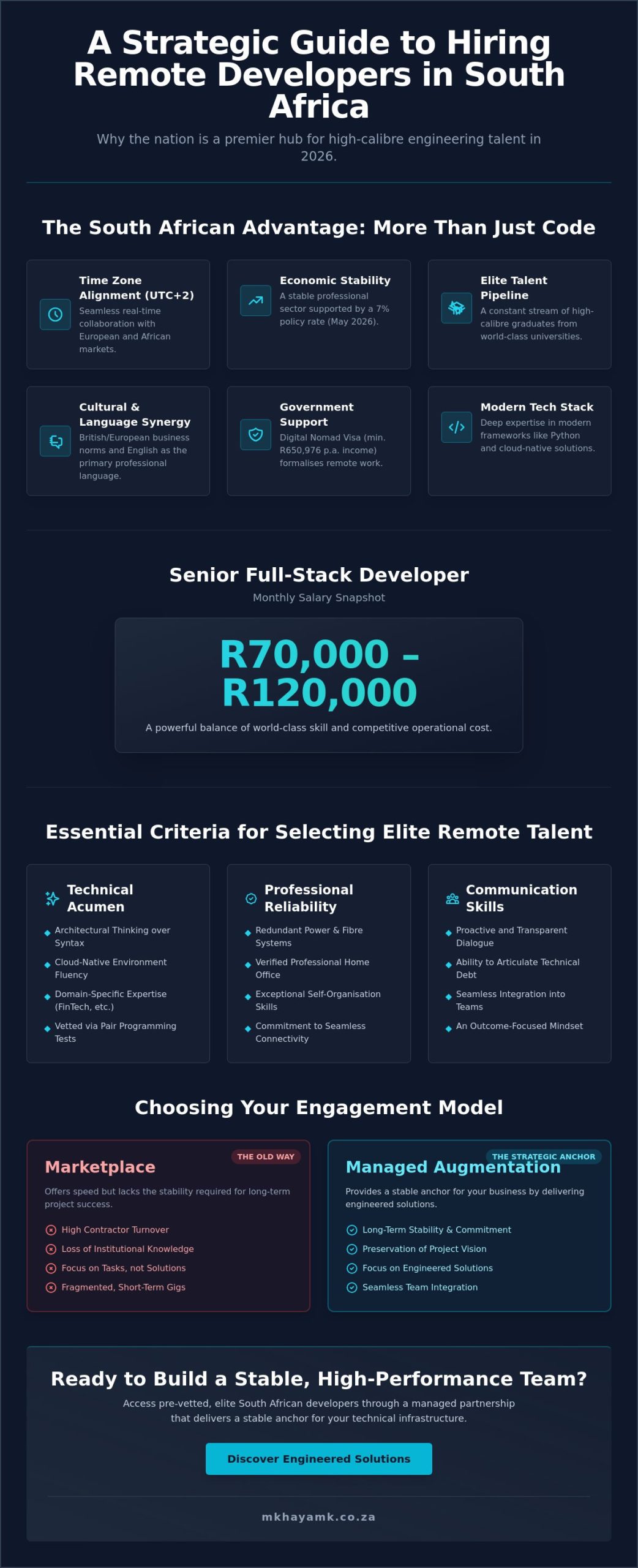
Marketplace vs. Managed Augmentation: Choosing Your Model
When you decide to hire remote developers in South Africa, you’ll face a fundamental choice between a self-service marketplace and a managed staff augmentation partnership. Each model serves a distinct purpose. The right choice depends entirely on your internal capacity and the long-term stability your project requires. It’s a strategic decision that affects not only your immediate output but also the long-term health of your technical infrastructure.
Choosing between these models involves looking past upfront recruitment fees to the long-term partnership value. High turnover remains a significant pain point in the remote sector, often caused by a lack of integration and support. Managed augmentation mitigates this risk by providing a layer of stability that marketplaces simply don’t offer. By investing in a managed model, you reduce the time spent on repetitive recruitment and focus your energy on achieving your core business goals.
When to Use a Talent Marketplace
Marketplaces are essentially digital talent pools. They’re excellent for sourcing specific, short-term niche skills for one-off projects where the developer doesn’t necessarily need to understand your broader business context. However, this model places the entire burden of technical vetting and management on your shoulders. If your internal HR team has the bandwidth to interview dozens of candidates and your technical leads can accurately verify architectural depth during a brief call, this DIY approach offers a broad reach. It’s best suited for companies that already have established remote management frameworks and the capacity to handle the administrative overhead of individual contractors.
The Strategic Advantage of Managed Staff Augmentation
In contrast, managed staff augmentation focuses on the collaborative relationship between the service provider and your business. This isn’t just about providing a list of CVs; it’s about providing engineered solutions. Managed services offer pre-vetted talent that has already been tested on complex internal projects. This model is ideal for scaling quickly without sacrificing quality. You gain ongoing performance management and the flexibility to adjust roles as your roadmap evolves. It provides a stable anchor, ensuring that institutional knowledge stays within your project. This approach transforms recruitment from a transactional hurdle into a steady, forward-looking ambition for mutual success.
Strategic Integration: Ensuring Remote Team Success
Successful integration is the bridge between a signed contract and a high-performing product. Many businesses focus entirely on the selection phase, yet the real work begins when the developer logs on for the first time. To hire remote developers in South Africa successfully, you must move beyond a transactional mindset. It’s about building a structured environment where external talent feels like a core part of your internal engine. This process requires a blend of professional confidence and supportive partnership to ensure that every new team member can contribute at their full potential from day one.
The First 30 Days: Onboarding for Impact
Effective onboarding should be a deliberate process designed for immediate impact. Your developer should have their development environment fully configured on day one to reduce initial frustration. Assigning a “technical buddy” provides immediate cultural context and helps them navigate the codebase without feeling isolated. Establishing a clear “definition of done” for initial tasks sets a standard for excellence from the outset. This methodical execution builds trust and sets a steady pace for the months ahead.
Maintaining Long-Term Engagement
Long-term engagement requires more than just a steady stream of tickets. Include your remote developers in high-level strategic planning sessions to foster a sense of ownership. When they see the long-term vision, they’re more likely to contribute innovative ideas that align with your business goals. Providing opportunities for professional growth and skill refinement ensures that your team stays at the cutting edge of technology. A two-way feedback loop is essential; it transforms the relationship from a simple service agreement into a genuine partnership. If you’re looking to build a team that integrates flawlessly into your existing workflows, explore our staff augmentation services to find your next strategic partner.
Elevating Your Technical Capability with Mkhaya MK
Choosing a partner to expand your technical team is a decision that defines your operational stability for years to come. At Mkhaya MK, we move beyond the traditional recruitment model. We don’t just provide a list of CVs; we provide engineered solutions. Whilst many businesses struggle to hire remote developers in South Africa through generic marketplaces, we offer a partnership rooted in precision and mutual success. Our approach ensures that every placement is backed by the same rigorous engineering standards we apply to our own internal custom software development projects.
The Mkhaya MK difference lies in our quiet confidence and methodical execution. We understand that in 2026, technical depth must be paired with an ability to navigate a rapidly changing technological landscape. Every professional we recommend has undergone a vetting process that evaluates their architectural thinking and their capacity for AI-driven automation. This end-to-end support begins with your initial consultation and continues through your ongoing digital transformation, providing a stable anchor as your business evolves.
A Partnership Focused on Your Success
Our staff augmentation services are uniquely informed by our deep expertise in custom software development and cloud application services. This dual perspective allows us to understand the practical challenges your team faces daily. By working with a partner that is deeply embedded in the South African tech ecosystem, you benefit from a talent pool that understands your pace and shares your professional values. Our clients trust us to manage their most critical technical assets because we prioritise long-term stability over short-term gains. We ensure that the integration of external talent feels like a natural expansion of your internal culture, rather than a fragmented addition.
Ready to Scale Your Team?
Scaling your technical capacity should be a structured and rewarding journey. We have refined our engagement process to ensure clarity and momentum at every stage. This rhythmic progression leads you from a broad vision toward a concrete, high-performing team. To begin your journey with a reliable partner, follow these steps:
- Step 1: Consult with our experts to define your specific technical requirements and project roadmap.
- Step 2: Review a curated shortlist of professionals who have been matched to your technical needs and organisational culture.
- Step 3: Seamlessly integrate your new remote developers into your existing workflows and start building with precision.
We are ready to help you secure the talent you need to scale with confidence. Organise a consultation with Mkhaya MK today and discover how our managed approach to hire remote developers in South Africa can transform your technical operations.
Building Your Technical Future with Precision
The decision to hire remote developers in South Africa is more than a recruitment tactic; it’s a strategic investment in your organisation’s long-term stability. By prioritising architectural depth and managed integration over the volume-based approach of traditional marketplaces, you secure a team that is built to last. A successful partnership thrives on clear communication, shared KPIs, and a remote-first culture that values outcomes over hours logged. These foundations ensure that your external talent functions as a seamless extension of your internal vision.
As end-to-end digital transformation experts, Mkhaya MK provides national reach with deep local market insight. We specialise in custom software and AI-driven automation, applying our rigorous internal engineering standards to every placement we make. This ensures your projects are handled with the precision they deserve. We invite you to scale your technical team with Mkhaya MK’s managed talent and move beyond the friction of traditional hiring. We’re here to help you navigate the complexities of modern software development with confidence and clarity. Your path to a high-performing, reliable remote team starts with a single, well-placed step toward a better partnership.
Frequently Asked Questions
Why should I hire remote developers from South Africa specifically?
South Africa offers a unique blend of technical depth and cultural synchronicity. With English as the primary professional language and a UTC+2 time zone, collaboration feels effortless for European partners. The local market is also highly advanced; 97% of tech teams now use AI in their daily workflows to enhance productivity and deliver engineered solutions with greater precision.
How do I ensure the security of my intellectual property with remote developers?
What is the typical notice period for remote developers in South Africa?
The standard notice period in the South African tech sector is 30 days or one calendar month. Whilst some junior roles might have shorter periods, senior engineers often require this time to ensure a clean handover of complex architectural knowledge. This predictability helps you maintain project momentum and manage transitions without losing institutional knowledge.
Can South African developers work on my time zone?
Yes, South African professionals are exceptionally well-positioned to work within European and African time zones due to the minimal offset. Many businesses that hire remote developers in South Africa also find that local talent is willing to adjust their schedules for North American clients. This flexibility ensures real-time participation in daily stand-ups and critical sprint reviews.
What are the common technical stacks available in the South African remote market?
The local market is rich in modern, high-demand technical stacks. You’ll find extensive expertise in Python, JavaScript, Java, and SQL, alongside a strong focus on cloud computing platforms like AWS and Azure. This technical diversity allows you to find specialists who can integrate immediately into your existing codebase and start contributing to your roadmap.
How does staff augmentation differ from traditional outsourcing?
Staff augmentation integrates external experts directly into your internal team and workflows. Unlike traditional outsourcing, where a project is handed over to a third party to manage as a “black box,” augmented developers attend your meetings and follow your internal processes. This model ensures you retain full control over the development journey and long-term software quality.
How do I manage the performance of a remote developer I’ve never met in person?
Performance is best managed through transparent, outcome-based KPIs rather than tracking hours logged. Use collaborative tools like Jira and GitHub to maintain visibility into progress and code quality. Regular synchronisation through video calls fosters a supportive partnership and ensures the developer remains aligned with your long-term business goals and technical vision.
What happens if a remote developer isn’t a good fit for my team?
If a developer doesn’t align with your team, a managed service provider will facilitate a structured transition. This typically involves identifying the specific gap in synergy and providing a pre-vetted replacement to ensure project continuity. It’s a reliable way to hire remote developers in South Africa whilst mitigating the risks of a poor cultural or technical fit.