

Did you know that businesses are now reporting cost savings of up to 40% simply by rethinking how they source their technical talent? In 2026, the South African market presents a unique talent paradox where 52% of organisations struggle with scarcity despite a high national unemployment rate. You’ve likely felt the budget strain of maintaining underutilised full-time staff or the frustration of long recruitment cycles that delay your most critical projects. It’s a common hurdle for growing firms, but it doesn’t have to be your permanent reality.
We believe in a more agile approach that allows you to reduce IT costs with staff augmentation whilst maintaining the highest standards of engineering excellence. This guide is designed to help you optimise your IT budget and eliminate those hidden recruitment overheads that often drain resources. We’ll walk through a strategic framework for scaling your team, from accessing specialist AI skills to building a mature, flexible partnership that ensures your business remains a stable anchor in a rapidly changing technological landscape.
Key Takeaways
- Transition from rigid capital expenditure to agile operational expenditure to maintain financial flexibility in a shifting market.
- Discover how to reduce IT costs with staff augmentation by eliminating traditional recruitment overheads and the recurring burden of employee benefits.
- Compare the total cost of ownership between in-house hires and augmented teams to uncover the true value of specialist technical talent.
- Follow a structured framework to audit your payroll and identify specific project phases where burst capacity can drive efficiency.
- Optimise your management resources by partnering with experts who handle talent sourcing, vetting, and retention on your behalf.
The Financial Burden of Traditional IT Hiring in South Africa
The traditional approach to building a technical team is undergoing a fundamental shift in South Africa. For many agile firms, the permanent-first mindset has become a financial bottleneck that restricts growth. Whilst hiring full-time employees was once the standard for stability, the rising cost of talent acquisition in the national landscape has pushed many organisations toward a breaking point. This is the stage where internal recruitment costs actually exceed the project value they aim to create, leaving businesses with bloated budgets and stagnant innovation.
To navigate these challenges, visionary leaders are turning to more flexible frameworks to maintain their momentum. To understand the baseline, it’s helpful to look at what staff augmentation is: a strategic model where an organisation adds external specialists to its existing team to fill specific skill gaps. Staff augmentation is a flexible resource-scaling model that allows you to bypass the friction of traditional hiring whilst retaining full control over your project direction.
To better understand how this model reshapes your financial strategy, watch this helpful video:
Hidden Costs of the In-House Model
The true cost of a permanent employee extends far beyond the gross salary. In South Africa, statutory benefits like the Skills Development Levy (SDL) and Unemployment Insurance Fund (UIF) contributions add immediate layers of expense to every hire. Beyond these, you must account for the “Idle Time” tax. This occurs when you pay for high-level expertise during periods when project demands fluctuate or dip. When you choose to reduce IT costs with staff augmentation, you effectively eliminate these rigid overheads and the recurring expenses of office space or expensive UI/UX design tool licences. You also avoid the steep fees charged by recruitment agencies, which can often reach 20% of a candidate’s annual salary.
Opportunity Cost and Project Delays
Time is perhaps the most expensive resource in the digital economy. Local recruitment cycles for senior developers often span three to six months, creating a massive window of lost innovation. Whilst your competitors are launching new features, your team might be stuck in a holding pattern waiting for a vacancy to be filled. This delay represents a significant opportunity cost that compounds over time. By leveraging professional staff augmentation services, you close these gaps in weeks rather than months. This ensures your time-to-market remains competitive and your budget stays focused on delivery rather than the exhausting process of searching for talent in a scarce market.
Quantifying the Savings: How Staff Augmentation Trims IT Budgets
One of the most effective ways to reduce IT costs with staff augmentation is by fundamentally shifting your financial model from Capital Expenditure (CapEx) to Operational Expenditure (OpEx). In a traditional hiring scenario, you’re often locked into heavy, long-term investments that lack flexibility. By treating talent as an operational expense, you gain the ability to adjust your spend in real-time. This agility is vital for maintaining a healthy cash flow, especially when project scopes evolve or market conditions shift unexpectedly. You aren’t just paying for a person; you’re investing in a scalable resource that aligns perfectly with your current mission.
The “Benefits Burden” is another area where costs quietly accumulate. When you hire internally, the gross salary is only the starting point. You must also account for healthcare contributions, retirement funds, and performance bonuses. By partnering with a specialist firm, these financial responsibilities are handled by the partner. Many organisations find it challenging to reduce overhead costs whilst maintaining a high standard of technical output. Staff augmentation solves this by removing the need for additional infrastructure spend. There’s no requirement to purchase extra office equipment or manage additional software seats for development environments. You simply pay for the expertise you need, for as long as you need it, scaling down instantly the moment a project phase concludes.
Recruitment and Onboarding Efficiency
Internal HR departments often spend weeks, if not months, vetting technical skills for niche roles. This process consumes valuable time and resources that could be better spent on core culture-building initiatives. Mkhaya MK’s staff augmentation process eliminates this friction by providing pre-vetted teams that are ready to hit the ground running. Because the technical screening is already completed by experts, your time-to-productivity is dramatically shortened. This accelerated start ensures that your project remains on track without the typical “onboarding lag” associated with permanent hires.
Training and Upskilling Savings
The pace of technological change in 2026 is relentless. Keeping an internal team updated on the latest shifts in AI, Cloud architecture, or DevOps requires a significant training budget. Staff augmentation allows you to access ready-made experts who already possess these high-level skills. These specialists bring “best-practice” knowledge directly into your team, effectively upskling your internal staff through daily collaboration. You don’t have to fund expensive certification programmes; you simply benefit from the refined expertise the augmented staff bring to the table. If you’re looking to refine your strategy, exploring digital transformation through agile staffing can provide the edge your business needs.
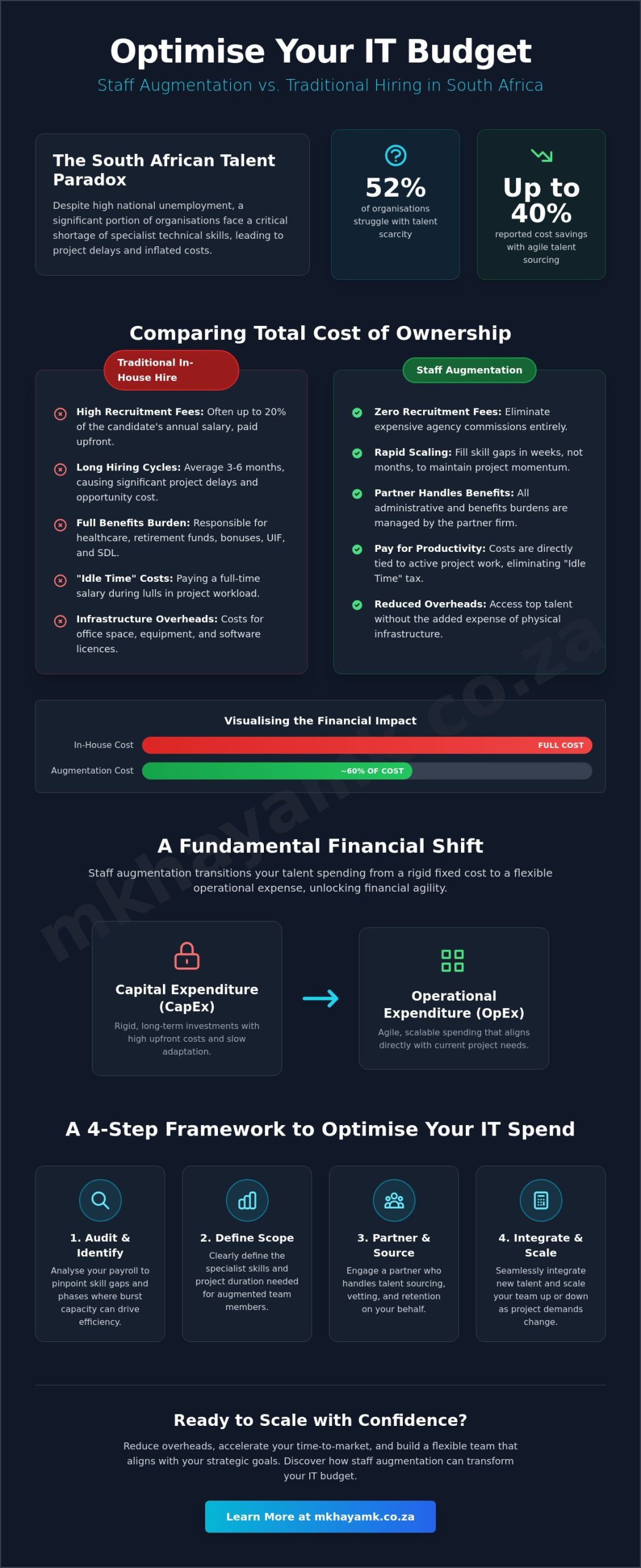
Comparing Total Cost of Ownership: In-House vs. Augmented Teams
When you evaluate the 12 month cost of a Senior Developer, the sticker price of a salary is often deceptive. In South Africa, a Senior Developer with over six years of experience can command an annual salary between R700,000 and R1,200,000. However, the Total Cost of Ownership (TCO) for a permanent employee includes recruitment fees, statutory contributions, and the often overlooked “Management Overhead”. This overhead encompasses the time your leadership spends on performance reviews, career development, and administrative support. By choosing to reduce IT costs with staff augmentation, you delegate these management responsibilities to your partner, allowing your internal leaders to focus on high value strategic initiatives.
Risk mitigation is another critical factor in the TCO equation. Hiring a permanent team member involves a significant legal and financial commitment. If a project’s direction changes or a hire isn’t the right fit, the exit costs and time lost can be staggering. Augmented teams provide a financial safety net, offering the agility to swap talent or adjust team composition without the friction of traditional labour law processes. This flexibility is particularly valuable when implementing complex ERP solutions, where specific expertise might only be required for certain phases of the rollout.
The Agility Premium
It’s a common misconception that a higher hourly rate for augmented staff leads to a more expensive project. In reality, paying this “agility premium” often results in a lower total project cost. You avoid the long term “Benefits Burden” and only pay for active, productive hours. This elasticity is vital in a volatile economic environment where project scopes can shift overnight. By hiring remote developers through an augmentation model, you also reduce geographic premium pay, as you aren’t limited to the salary bubbles of major metropolitan centres.
Long-term Maintenance vs. Project Execution
Efficiency often comes down to knowing when to keep tasks in-house and when to leverage external help. Permanent staff are ideal for long term maintenance and core product knowledge. However, for intense project execution phases, augmentation is the superior financial choice. Combining this model with managed cloud services further reduces your physical infrastructure costs and licensing fees. Whilst a permanent hire represents a long-term financial commitment with significant exit costs, an augmented specialist provides a low-risk alternative that can be scaled or concluded as project requirements change.
A Step-by-Step Framework to Optimise Your IT Spend
Optimising your budget requires a methodical approach rather than a series of reactive decisions. To truly reduce IT costs with staff augmentation, you must move beyond simply filling gaps and start engineering a more lean, responsive workforce. This framework provides a clear path for finance and technical leaders to collaborate on a model that prioritises efficiency whilst maintaining high-calibre output. By following these structured phases, you ensure that every Rand spent on talent is directly linked to a measurable business outcome.
Phase 1: The Resource Audit
The first step is a thorough audit of your current IT payroll to identify redundant roles and high-cost specialist gaps. You should look for instances where you’re paying a full-time salary for a niche skill that’s only utilised during specific project phases. By mapping your project timelines to human resource requirements, you can identify “burst” capacity needs. This allows you to distinguish between “core” functions that should remain in-house to protect intellectual property and “support” or execution functions that are better suited for augmentation. This clarity prevents the financial drain of underutilised staff and ensures your internal team stays focused on your most critical revenue drivers.
Phase 2: Vetting for Cultural and Technical Fit
Technical skill is only half of the equation; cultural alignment is what ensures long-term stability. When you integrate remote specialists, they must align with your internal team’s behaviour and communication style. It’s vital to select a partner with a national footprint that conducts deep technical testing and previous project verification. Leveraging Mkhaya MK’s software engineering standards provides a layer of quality assurance that internal HR teams often struggle to replicate. This rigorous vetting process reduces the risk of project friction and ensures that augmented staff contribute to your productivity from day one.
Once your team is in place, you must integrate them into your broader digital transformation strategy. Define clear KPIs for augmented staff to ensure budget accountability and transparent reporting. It’s not enough to simply hire; you must review and adjust your talent mix quarterly to ensure it still matches your current revenue drivers. This iterative process allows you to scale your tech team quickly for innovation and scale down for maintenance without the usual friction of permanent restructuring. If you’re ready to transform your technical team into a high-performance, cost-effective engine, speak with our team today to explore a tailored staffing strategy.
Scaling with Confidence: Why Mkhaya MK is Your Strategic Partner
Choosing a partner for your technical scaling is about more than just filling seats; it’s about finding a stable anchor in a rapidly changing technological landscape. We move beyond the traditional “body shopping” approach to offer a true strategic partnership focused on shared success. By aligning our high-calibre technical talent with your specific business goals, we help you reduce IT costs with staff augmentation whilst building a foundation for long-term stability. This relationship allows you to navigate the complexities of modern engineering with a visionary guide that remains deeply invested in your personal journey and project outcomes.
Our approach ensures that your team isn’t just larger, but more capable of handling the sophisticated demands of 2026. Whether you are looking to integrate AI and data automation into your core processes or require specialist support for a legacy system migration, we provide the precision and expertise needed to succeed. We understand the national business landscape and the unique talent paradox facing South African firms. This local insight, combined with our commitment to global engineering standards, ensures that your technical capacity remains a competitive advantage rather than a financial burden.
National Expertise, Global Standards
Our rigorous vetting process is designed to identify professionals who possess both technical mastery and the behavioural traits necessary for seamless team integration. We don’t just place developers, analysts, and engineers; we manage their ongoing support and professional development to ensure they continue to deliver value. This commitment to quality has led to significant success in custom software development, where our augmented specialists have helped clients bridge the gap between complex vision and methodical execution. By maintaining these high standards, we protect your budget from the hidden costs of poor quality or high turnover.
Ready to Optimise Your IT Budget?
Engaging with us is a straightforward, transparent process designed to give you immediate control over your technical spend. We start with a deep dive into your current requirements to ensure we match you with the exact skills needed for your next milestone. Our structured process ensures that every engagement is defined by clear milestones, cost-control measures, and regular performance reviews. This rhythmic sense of momentum keeps your projects moving forward whilst providing the flexibility to adjust your talent mix as your revenue drivers evolve. If you’re ready to build a more agile, cost-effective technical engine, contact us today to discuss your staffing needs and discover how we can support your growth.
Future-Proof Your Technical Strategy
Building a resilient IT infrastructure in 2026 requires a departure from rigid, traditional hiring. We’ve explored how transitioning from capital-intensive permanent roles to an agile operational model can fundamentally transform your budget. By choosing to reduce IT costs with staff augmentation, you bypass the friction of scarce local talent and the heavy burden of statutory benefits. This strategic shift ensures your resources are focused on execution and innovation rather than the administrative overhead of recruitment. For organisations seeking even deeper integration, partnering with a dedicated development team in South Africa can provide the long-term engineering stability and cultural alignment needed to sustain growth well beyond a single project cycle.
Scale your tech team and reduce overheads with Mkhaya MK
Frequently Asked Questions
Is staff augmentation cheaper than hiring a full-time employee?
Staff augmentation is often more cost-effective because it removes the long-term financial commitments associated with a permanent hire. You avoid statutory costs such as the Skills Development Levy (SDL) and Unemployment Insurance Fund (UIF) contributions. By paying only for active project hours, you eliminate the “Idle Time” tax found in full-time salaries. This approach allows you to reduce IT costs with staff augmentation whilst maintaining access to top-tier technical expertise.
How does staff augmentation reduce recruitment and onboarding costs?
This model shifts the burden of talent acquisition from your internal HR team to your strategic partner. We handle the entire lifecycle of sourcing, technical vetting, and behavioural screening. This reduces the time and resources spent on multiple interview rounds and expensive recruitment agency fees. Since our professionals are already pre-vetted, they integrate into your workflow with minimal onboarding lag, which accelerates your project’s productivity from day one.
Can staff augmentation help with reducing office and infrastructure overheads?
Yes, staff augmentation significantly lowers infrastructure spend by supporting remote or hybrid working models. You don’t need to provide additional office space, furniture, or high-end workstations for these specialists. Additionally, the costs of software licences and development tool seats are often managed more efficiently within the partnership. This flexibility allows you to scale your technical capacity without the need to expand your physical footprint or invest in depreciating hardware.
What is the difference between staff augmentation and traditional outsourcing?
The primary difference lies in the level of control and integration into your internal processes. Traditional outsourcing usually involves handing over an entire project to an external vendor who manages the delivery independently. Staff augmentation allows you to add specific specialists directly to your existing team. You retain full control over the project management and technical direction whilst benefiting from the external expertise required for success. Businesses that require a more permanent extension of their internal culture may also explore the benefits of a dedicated development team in South Africa as a complementary model for sustained, long-term technical delivery.
How do I ensure the quality of augmented staff remains high whilst cutting costs?
Quality is maintained through a combination of rigorous technical vetting and clear performance metrics. We employ strict engineering standards and previous project verification to ensure every professional meets high-calibre requirements. By defining specific KPIs and maintaining regular communication, you ensure that the focus remains on delivery excellence. This methodical approach ensures you reduce IT costs with staff augmentation without sacrificing the precision of your technical output.
What happens if a project ends earlier than expected with augmented staff?
One of the greatest advantages of this model is the ability to scale down as soon as a project phase concludes. Unlike permanent hires, which involve complex labour law processes and exit costs, augmented staffing is designed for elasticity. You can conclude the engagement according to your contract terms without the financial friction of traditional restructuring. This ensures your budget remains aligned with your current revenue drivers and project timelines.
Does Mkhaya MK provide remote or on-site augmented professionals?
We offer a flexible range of engagement models, including fully remote, on-site, or hybrid placements. Our national footprint allows us to support your team wherever they are located across South Africa. This choice depends entirely on your project requirements and internal culture. We work closely with you to determine the most effective setup that balances cost-control with high-performance collaboration and team cohesion.
How quickly can we scale a team with Mkhaya MK’s services?
We can typically place pre-vetted specialists within a few weeks, which is significantly faster than the three to six month window often required for permanent hiring. This agility is crucial for meeting tight deadlines and capitalising on new market opportunities. Our established talent pool allows us to respond quickly to your burst capacity needs, ensuring your project momentum remains uninterrupted whilst you manage your budget effectively. For a deeper look at the strategies involved, our guide on how to scale your tech team quickly in 2026 outlines the precise frameworks used to accelerate technical capacity without compromising quality.