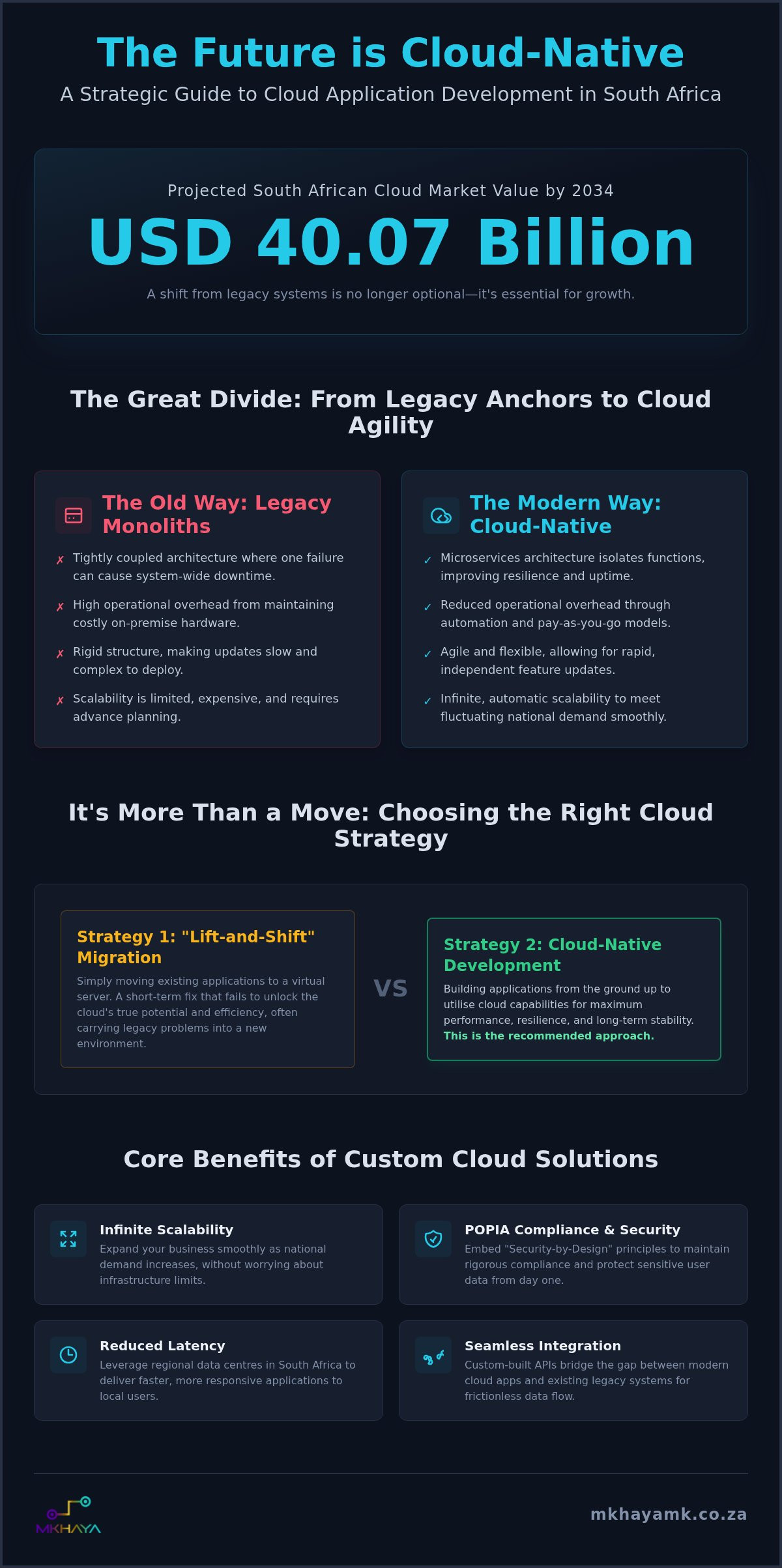
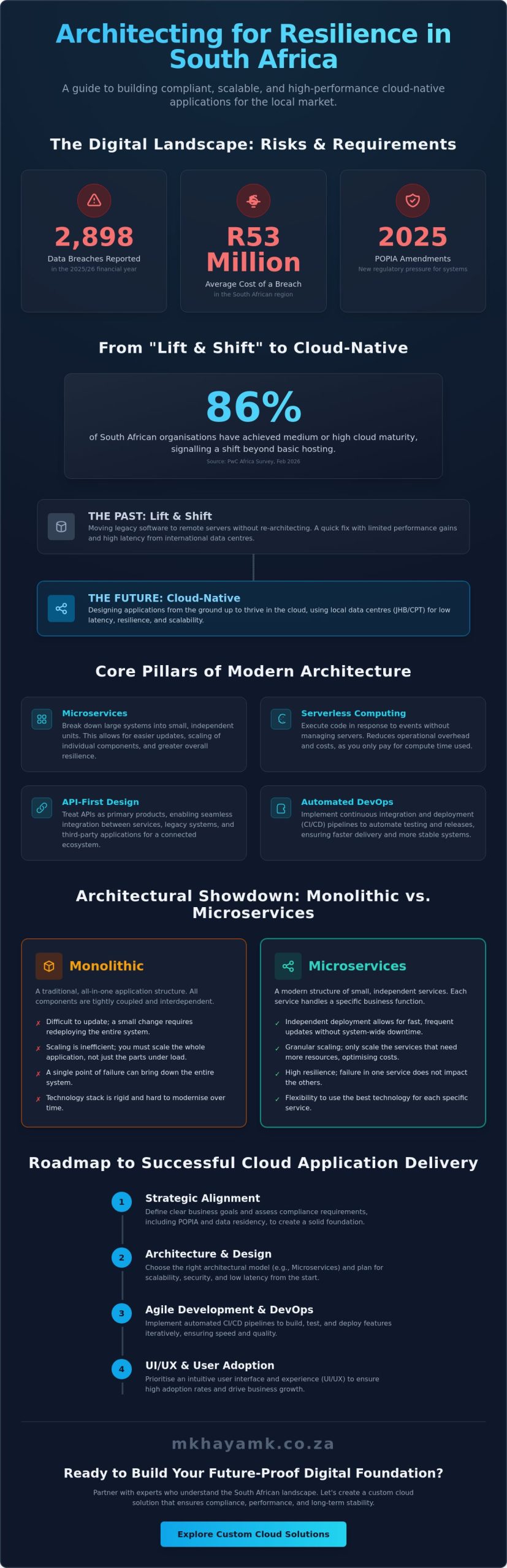
By 2034, South Africa’s cloud market is projected to reach a staggering USD 40.07 billion, yet many organisations still feel anchored by the weight of legacy systems. You’ve likely felt the mounting pressure of maintaining costly hardware whilst trying to keep pace with rapid digital shifts. Mastering cloud application development south africa requires more than just technical migration; it demands a strategy that balances modern innovation with the strict requirements of POPIA compliance and data sovereignty.
We recognise the difficulty of finding local engineering talent who can bridge the gap between global performance standards and national demand. This guide provides a clear roadmap for your cloud-native journey, showing you how to reduce operational overhead through purposeful automation. You’ll discover how to build applications that are secure, high-performing, and inherently scalable for the local landscape. From strategic engineering to long-term stability, let’s explore how to turn your cloud vision into a resilient business reality.
Key Takeaways
Distinguish between modern cloud-native engineering and traditional migrations to ensure your infrastructure is built for long-term agility.
Identify how custom-built applications offer infinite scalability, allowing your business to expand smoothly as national demand increases.
Navigate the local provider landscape to optimise cloud application development south africa by leveraging regional data centres for reduced latency.
Embed “Security-by-Design” principles into your development lifecycle to maintain rigorous POPIA compliance and protect sensitive user data.
Accelerate your digital transformation through a methodical partnership that combines custom engineering with flexible staff augmentation.
The Evolution of Cloud Application Development in South Africa
Cloud application development south africa has transitioned from a niche technical choice to a fundamental business requirement. Unlike traditional software development, which often focuses on local server environments, cloud application development is the specific process of building and deploying software designed to run within cloud-native architectures. This approach allows businesses to move beyond the constraints of physical hardware, embracing a model where performance and scale are limited only by strategic vision. It’s about building for the cloud, not just moving to it.
To better understand how these technical shifts are being supported by major global infrastructure providers in the region, watch this helpful video:
For many years, the standard approach was “lift-and-shift”, simply moving existing applications to a virtual server. Whilst this solved immediate hardware concerns, it failed to unlock the true efficiency of the cloud. Modern engineering prioritises cloud-native development, where applications are constructed from the ground up to utilise the unique capabilities of cloud platforms. This shift is particularly vital given the current state of South Africa’s digital landscape, which now supports the high-speed connectivity required for sophisticated, decentralised operations.
From Legacy Monoliths to Cloud-Native Architecture
Legacy systems often function as monoliths, where every feature is tightly coupled. If one part fails, the entire system risks downtime. Modern cloud application development south africa replaces these rigid structures with microservices. By organising business logic into small, independent services, developers can update or scale specific features without impacting the whole application. Containers, such as Docker, play a crucial role here, providing a stable environment that ensures the software runs consistently regardless of where it’s deployed.
Why Cloud-First is the Standard for South African Enterprises
The arrival of local data centres from global hyperscalers has changed the game. South African enterprises no longer need to rely on overseas servers that introduce latency. A cloud-first strategy supports the agility needed for hybrid work models, allowing teams across the country to access high-performance tools securely. This methodology is a core component of custom software development in South Africa, providing the foundation for long-term stability and growth. By building on modern infrastructure, businesses can ensure their digital tools remain resilient and adaptable to changing market demands.
Generic off-the-shelf software often forces your business into a predetermined mould. It might solve immediate problems, but it rarely accounts for the specific nuances of your internal workflows or the unique demands of the local market. Custom cloud application development south africa offers a different path. By engineering solutions tailored to your precise requirements, you gain what we call “quiet confidence.” This is the steady assurance that your digital foundation won’t buckle under pressure or limit your growth as your operations expand.
Bespoke solutions allow for seamless integration with your existing infrastructure. Whether you are using a legacy ERP system or modern data tools, custom-built APIs act as the perfect bridge, ensuring data flows without friction. This level of refinement isn’t possible with generic platforms that often rely on “one-size-fits-all” connectors. By building specifically for your ecosystem, you eliminate technical debt and create a stable anchor for long-term stability.
Operational Agility and Infinite Scalability
Traditional infrastructure requires you to predict your peak traffic months in advance. If you guess wrong, you either overpay for idle servers or suffer through site crashes during high-demand periods. Cloud-native applications solve this by scaling horizontally in real-time. When national user traffic spikes, your application automatically allocates more resources to handle the load, ensuring performance remains consistent for every user.
This agility is built on a foundation of robust Cloud Solutions. Through modern DevOps pipelines, your engineering team can deploy updates and new features without any downtime. This means your business remains agile, responding to competitor moves or regulatory changes in days rather than months. It transforms software from a static tool into a living part of your business strategy.
Cost Management through Modern Engineering
One of the most significant shifts in 2026 is the transition from Capital Expenditure (CapEx) to Operational Expenditure (OpEx). Instead of investing heavily in physical hardware that depreciates over time, you pay for exactly what you use. Custom engineering takes this a step further through serverless architecture. In a serverless model, code only executes when triggered by a specific event, which eliminates the cost of keeping servers running 24/7 when they aren’t being used.
It’s a methodical approach to efficiency that directly impacts your bottom line. For a deeper look at managing these expenses, see our guide on Cloud Cost Optimisation in South Africa: A Strategic Guide for 2026. If you are ready to move beyond the limitations of generic software, exploring a partnership with Mkhaya MK can provide the stable, forward-looking foundation your business needs.
Navigating the Local Cloud Landscape: Providers and Models
Selecting the right infrastructure is a pivotal step in the journey of cloud application development south africa. It isn’t just about where your data resides; it’s about which ecosystem best supports your specific business logic and performance requirements. With major hyperscalers now firmly rooted in the country, the choice between AWS, Azure, and Google Cloud comes down to a methodical assessment of your long-term goals and existing technical stack.
The presence of local regions, particularly the established hubs in Cape Town and Johannesburg, has fundamentally changed the user experience. By hosting your application locally, you significantly reduce latency. In the context of local data centres, latency is the time delay between a user’s action and the application’s response. For real-time applications like financial platforms or logistics trackers, every millisecond counts towards maintaining user trust and operational efficiency.
Choosing the Right Provider for Your Development Goals
Each provider offers a unique set of tools that can influence your engineering velocity. Whilst AWS is often seen as the leader in innovation and tool variety, Azure is frequently the preferred choice for organisations already embedded in the Microsoft ecosystem. Google Cloud continues to gain ground by offering specialised capabilities in AI and data analytics, making it a strong contender for data-heavy projects.
Provider
Core Strengths
Strategic Fit
AWS
Mature toolsets; extensive Cape Town region support.
High-scale consumer apps and rapid innovation.
Microsoft Azure
Deep integration with Office 365 and Windows Server.
Enterprise-grade migrations and corporate environments.
Google Cloud
Leading AI, machine learning, and data processing.
Data-heavy research and modern analytics platforms.
The Hybrid Cloud: Maintaining Data Sovereignty
Beyond the public cloud, the hybrid model offers a balanced path for businesses with strict data requirements. Some organisations must keep specific datasets on-premise due to internal policy or historical infrastructure. A hybrid approach allows you to manage data flow between your local servers and the public cloud, ensuring you benefit from cloud-native agility without compromising your existing security protocols. This setup allows for a gradual, secure transition to more modern architectures.
This methodical integration is a key pillar of Digital Transformation, providing a stable bridge between your current capabilities and future ambitions. Managed services also play a vital role in accelerating the development lifecycle. By utilising pre-configured services for databases, authentication, or messaging, your engineering team can focus on building unique business value rather than managing the underlying hardware. This shift from manual maintenance to automated management reinforces a culture of reliability and allows your team to scale with quiet confidence.
Compliance and Security: Developing for the POPIA Era
In the current regulatory environment, compliance is no longer a checkbox exercise. It is the bedrock of digital trust. For businesses engaged in cloud application development south africa, the Protection of Personal Information Act (POPIA) dictates exactly how data must be collected, stored, and processed. A common concern amongst leadership is whether data is truly safer in the cloud than on a private local server. The reality is that global hyperscalers invest billions in security infrastructure, providing a level of protection that far exceeds what most individual organisations can maintain on-premise.
According to recent industry data, 88% of organisations have increased their cloud security efforts in 2026, reflecting a national shift towards proactive protection. Security in the cloud is a shared responsibility. Whilst the provider secures the underlying hardware and data centres, the developer is responsible for securing the application layer. This involves implementing rigorous encryption for data both at rest and in transit, alongside granular access controls that ensure only authorised personnel can interact with sensitive business information.
Ensuring Data Privacy and Regulatory Compliance
Custom-engineered applications provide a distinct advantage for maintaining POPIA compliance. We can build automated workflows that handle data deletion requests or subject access reports without manual intervention, reducing the risk of human error. By leveraging local data centres in Cape Town and Johannesburg, we ensure that sensitive South African data remains on national soil, satisfying strict residency requirements. Integrating AI & Data Automation allows for intelligent, real-time monitoring of data patterns, flagging potential anomalies before they become security breaches.
Security-by-Design in Cloud Engineering
Security-by-Design is a core engineering principle where security measures are integrated into the application from the very first line of code rather than added as an afterthought. This methodical approach often involves a Zero Trust architecture, where no user or system is trusted by default, regardless of whether they are inside or outside the network perimeter. Automated testing within the DevOps cycle identifies vulnerabilities during the development phase, ensuring that every update meets the highest safety standards before it ever reaches a user.
Building a resilient digital presence requires a partner who understands the intersection of innovation and regulation. If you are ready to secure your business’s future, contact Mkhaya MK today to discuss a compliant and high-performance roadmap for your next project.
Partnering with Mkhaya MK for Scalable Cloud Innovation
Choosing a partner for cloud application development south africa is about more than just finding technical expertise; it’s about forming a relationship built on transparency and long-term stability. At Mkhaya MK, we project a persona of quiet confidence, focusing on the methodical execution of your digital vision. We act as a visionary yet practical guide, ensuring your transition to the cloud is both ambitious and rooted in technical integrity. Our role is to be a stable anchor in a rapidly changing technological landscape, helping you move from high-level strategic concepts to a concrete path forward.
Success in the cloud requires a deep understanding of the synergy between custom software engineering and managed services. We provide the end-to-end expertise needed to align your business goals with modern infrastructure, creating a resilient digital presence that scales with national demand. By focusing on your specific workflows, we refine your operations to reduce overhead and improve performance, ensuring you remain competitive in the 2026 market.
Our Methodical Engineering Process
Stability begins with a thorough discovery phase where we plan for future growth. We don’t just build software; we architect for long-term reliability. Our team prioritises strategic architecture planning to ensure your platform remains high-performing as your user base expands. Through agile development and a robust continuous integration and deployment (CI/CD) pipeline, we deliver updates with precision. This rhythmic sense of momentum ensures that every phase of the Mkhaya MK Process is fully articulated before moving to the next.
Bridging the Skills Gap with Staff Augmentation
One of the primary pains for South African businesses is the difficulty in finding local expert engineering talent to support cloud application development south africa. We solve this through flexible staff augmentation, allowing you to extend your internal tech team with specialised cloud engineers quickly. This approach isn’t just about filling gaps; it’s about adding a layer of high-end expertise to your project precisely when it’s needed most.
Our remote professionals are deeply invested in your personal journey, providing the commitment and integrity your project deserves. For a comprehensive look at how to scale your team with precision, explore our guide on Hire Dedicated Developers in South Africa: A Strategic Guide to IT Staff Augmentation (2026). By combining project-based development with skilled team extension, we provide the stability and agility required to thrive in a modern, cloud-first environment.
Securing Your Digital Future through Methodical Innovation
Refining your digital infrastructure isn’t just about adopting new tools; it’s about building a stable foundation for long-term growth. Successful cloud application development south africa hinges on a compliance-first philosophy that balances innovation with national regulations. By moving beyond generic software and embracing custom, POPIA-compliant solutions, you ensure your organisation remains agile whilst maintaining the highest security standards.
A methodical approach to engineering allows you to reduce operational overhead through automation and serverless architecture. Mkhaya MK brings end-to-end software engineering expertise to every project, acting as specialists in POPIA-compliant cloud solutions. If you need to bridge the local skills gap, our flexible staff augmentation services allow you to scale your internal team with quiet confidence.
We’re ready to act as your visionary yet practical guide in this journey. Partner with Mkhaya MK to build your next-generation cloud application and transform your technological vision into a resilient business reality. Your path to sustainable digital transformation starts here.
Frequently Asked Questions
What is the difference between cloud hosting and cloud application development?
Cloud hosting provides the virtual infrastructure and server space where your data lives, whereas cloud application development is the engineering process of building software specifically to run in those environments. Hosting is essentially the utility and maintenance of storage. Development focuses on creating custom business logic, user interfaces, and integrations. It’s the difference between renting a plot of land and architecting a bespoke building designed for your specific needs.
Is cloud application development POPIA compliant in South Africa?
Yes, cloud application development can be fully POPIA compliant when engineered with a “Security-by-Design” approach from the start. By utilising local data centres in Cape Town and Johannesburg, we ensure that sensitive personal information remains within national borders. This satisfies residency requirements whilst providing the high-speed performance required for modern business. We integrate encryption and granular access controls to protect data according to the strict standards set by South African law.
How much does it cost to develop a custom cloud application?
The cost of developing a custom cloud application depends on the complexity of your business logic, the number of required integrations, and the intended scale of the user base. A methodical discovery phase helps define these variables before any engineering begins. Whilst the initial investment might be higher than generic off-the-shelf options, the long-term reduction in operational overhead and technical debt often provides a superior return on investment for growing organisations.
How long does the cloud application development lifecycle typically take?
The development lifecycle varies based on project scope, but most enterprise-grade solutions move from discovery to deployment within three to nine months. We use an agile methodology to deliver functional modules in shorter cycles, allowing your business to see value early in the process. This iterative approach ensures that the final product remains aligned with your evolving strategic goals whilst maintaining a steady and predictable momentum throughout the project.
Can we migrate our existing legacy software to a cloud-native architecture?
Yes, you can migrate legacy software to a cloud-native architecture through a process called refactoring or re-platforming. Instead of a simple “lift-and-shift” migration, we break down monolithic systems into microservices that thrive in the cloud. This transformation allows your older systems to benefit from modern features like horizontal scaling and automated recovery, breathing new life into your existing business investments whilst improving overall system resilience and performance.
What are the best cloud providers for South African businesses in 2026?
Amazon Web Services (AWS), Microsoft Azure, and Google Cloud are the leading choices for cloud application development south africa due to their significant local infrastructure investments. AWS and Azure have established regions in the country, providing low latency for local users. Google Cloud’s Johannesburg region offers specialised AI and data tools. The best choice depends on your existing technical stack; for example, Azure is often preferred by organisations already using Microsoft enterprise tools.
Why should we choose custom development over off-the-shelf cloud software?
Custom development provides a platform built specifically for your unique workflows, whereas off-the-shelf software often requires you to change your internal processes to fit the tool. Bespoke applications offer infinite scalability and eliminate the recurring licensing fees associated with generic platforms. By owning the code, you gain long-term stability and the freedom to innovate without being restricted by the roadmap or technical limitations of a third-party software vendor.
How does Mkhaya MK ensure the security of cloud applications?
We ensure security by embedding protective measures into every layer of the engineering process through a Zero Trust architecture. This means every system interaction is verified, regardless of its origin. We utilise automated security testing within our DevOps pipelines to identify vulnerabilities before they reach production. This methodical execution, combined with rigorous encryption and compliance monitoring, provides the quiet confidence you need to manage sensitive business data securely and reliably.
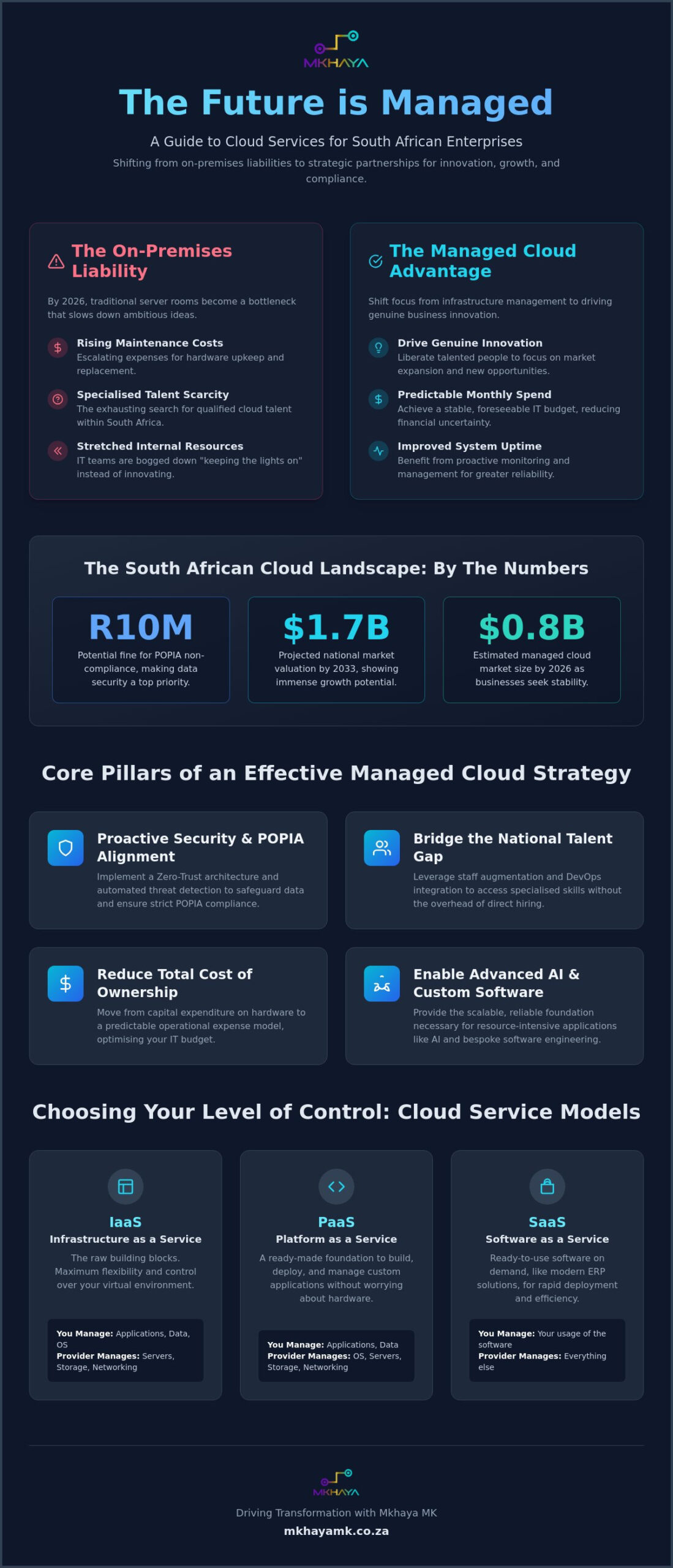
By 2026, the traditional server room isn’t just a cost centre; it’s a liability that slows down your most ambitious ideas. You’ve likely felt the pressure of rising hardware maintenance costs and the exhausting search for specialised cloud talent within our borders. It’s frustrating to watch your digital goals stall because your internal resources are stretched thin. Embracing managed cloud services south africa allows you to shift your focus from keeping the lights on to driving genuine innovation. We understand that you’re looking for more than just a vendor; you need a partner who values your long-term stability as much as you do.
This guide explores how modern cloud strategies empower South African enterprises to scale securely whilst maintaining strict POPIA compliance. With the Information Regulator now actively enforcing transborder data flow provisions and issuing fines of up to R10 million, the stakes for your digital architecture have never been higher. We’ll show you how to achieve a predictable monthly IT spend and improved system uptime through methodical execution. You’ll discover a clear roadmap for digital transformation that integrates AI and custom software, ensuring your business remains agile as the national market grows toward a projected USD 1.7 billion valuation by 2033.
Managed cloud services in South Africa represent more than just a technical handover. They’re a collaborative commitment to your business’s future. Instead of merely renting space on a server, you’re engaging in a partnership that oversees the administration, security, and optimisation of your entire digital ecosystem. This comprehensive approach to cloud management allows your leadership team to stop worrying about hardware lifecycles and start focusing on market expansion.
The trend is clear. Local enterprises are rapidly moving away from the heavy burden of on-premises servers. Maintaining physical infrastructure in our current economic climate is often inefficient and risky. By 2026, the South African managed cloud market has grown to an estimated USD 0.8 billion as businesses seek the stability that only a professional service provider can offer. This shift provides a stable anchor, allowing your organisation to remain resilient despite a volatile technological environment.
To better understand this concept, watch this helpful video:
Reliability is the cornerstone of this transition. In a landscape where the Information Regulator can issue fines of up to R10 million for POPIA non-compliance, data sovereignty is no longer optional. The SITA Cloud Framework Agreement 2.0 has already set a high standard for government departments regarding data residency. Private enterprises are following suit, choosing cloud solutions that keep sensitive information within our borders whilst ensuring seamless global connectivity.
The Shift from Maintenance to Innovation
Your IT department shouldn’t spend its days ‘keeping the lights on’. When you offload the routine tasks of patching and monitoring, you liberate your most talented people. This shift is the heart of digital transformation. It’s about building a business that’s agile enough to respond to new opportunities instantly. We see this as an aspirational journey where technology becomes an enabler of growth rather than a bottleneck.
Cloud Service Models: IaaS, PaaS, and SaaS Explained
Understanding the different layers of the cloud helps you choose the right level of control. Infrastructure as a Service (IaaS) provides the raw building blocks, giving you maximum flexibility over your virtual environment. For those focused on software engineering, Platform as a Service (PaaS) offers a refined foundation to build and deploy custom applications without managing the underlying hardware. Finally, Software as a Service (SaaS) allows for the rapid deployment of essential business tools, such as modern ERP solutions, ensuring your operations remain precise and efficient from day one.
A successful cloud strategy relies on more than just high-speed connectivity. It requires a methodical foundation built on four critical pillars. These pillars ensure that your transition to the cloud isn’t just a relocation of data, but a fundamental upgrade of your operational capability. By focusing on these core areas, enterprises can achieve the long-term stability and precision that modern markets demand. When these elements work in harmony, technology becomes a silent partner in your business success.
Proactive Security and POPIA Alignment
Security is the most vital component of any digital framework. For South African enterprises, this means implementing automated threat detection and sophisticated identity management to safeguard sensitive information. Zero-trust architecture represents the gold standard for 2026, requiring every user and device to be verified before accessing any network resource. This rigorous approach ensures that data residency requirements are met within national borders. It effectively mitigates the legal risks associated with transborder information flows, keeping your reputation secure.
DevOps and Continuous Improvement
Operational stability shouldn’t come at the expense of speed. Integrating DevOps services into your managed environment allows for faster software delivery cycles without compromising reliability. This methodology fosters a culture of collaboration between technical teams and business stakeholders. Automated testing and deployment pipelines reduce human error, ensuring that every update adds value to the end-user experience. It’s a forward-looking way to maintain an agile presence in a competitive market.
Avoiding “cloud sprawl” is essential for maintaining a predictable monthly IT spend. As noted in the SA Cloud Market Report 2025, the local market’s maturity has led to a greater emphasis on proactive resource management. Effective managed cloud services south africa provide the oversight needed to ensure resources grow only when demand dictates. This cause-and-effect logic prevents unnecessary costs whilst guaranteeing that your systems perform at their peak during critical periods.
Performance is not just about speed; it’s about consistency. A well-managed strategy utilises real-time monitoring to identify potential bottlenecks before they impact your users. This level of precision ensures that your custom applications and legacy systems operate in perfect harmony. When performance is guaranteed, your business can scale with confidence. You’ll know that your infrastructure will support your ambitions without hesitation or technical debt. If you’re ready to build a more resilient foundation, our team can help you design bespoke cloud solutions that align with your specific growth targets.
Deciding between an internal team and a managed partner is a pivotal strategic choice. Whilst an in-house team offers direct control, the Total Cost of Ownership (TCO) often exceeds initial projections. You aren’t just paying salaries; you’re funding continuous training, recruitment, and the overhead of managing complex systems. Choosing managed cloud services south africa transforms these unpredictable variables into a steady, predictable monthly operational expenditure (OpEx). This financial clarity allows for more precise budgeting and long-term planning, ensuring that your IT spend directly supports your business growth.
Investing in managed cloud services south africa isn’t just a technical decision; it’s a commitment to operational excellence. Risk mitigation is another decisive factor. When you manage infrastructure internally, the entire burden of uptime rests on your shoulders. A managed service provider shares this responsibility, offering service level agreements that guarantee reliability. This collaborative approach ensures that system maintenance happens behind the scenes, allowing your business to remain operational without constant internal intervention.
Bridging the Skills Gap Nationally
The national market is currently facing a significant hurdle: a shortage of specialised technical talent. Finding and retaining high-end cloud engineers is both difficult and expensive. By utilising staff augmentation, you gain instant access to a pool of experts who understand the nuances of modern architecture. This eliminates the “single point of failure” risk, where a single departure can leave your entire digital operation vulnerable. Instead, you benefit from a collective expertise that is always available and constantly evolving.
Hidden Costs of Self-Managed Infrastructure
Self-managed infrastructure often carries substantial hidden costs that don’t appear on a standard balance sheet. Power, cooling, and the physical security of on-site hardware require constant investment and oversight. Additionally, the cost of downtime in an unmanaged environment can be devastating, especially when disaster recovery processes are slow or untested. Transitioning to the cloud removes these physical burdens. To understand how to refine these expenses further, explore our insights on Cloud Cost Optimisation in South Africa. This strategic shift ensures that every Rand spent contributes to a more agile and resilient enterprise.
Choosing a partner for your digital journey is a high-stakes decision that requires a framework prioritising long-term compatibility over short-term savings. In the evolving landscape of 2026, a provider must offer more than just basic server management. You need a team that demonstrates deep technical expertise whilst maintaining a focus on your specific business outcomes. Evaluating a provider’s track record in digital transformation consulting is essential to ensure they can guide you through complex transitions without disrupting your daily operations.
Industry-specific experience remains a vital differentiator. Whether you operate in financial services, where the COFI Bill has introduced stringent new standards, or in the fast-paced logistics sector, your partner should understand your unique regulatory and operational hurdles. Reliable managed cloud services south africa are built on a collaborative, partnership-based engagement model. This approach ensures that the service provider acts as an extension of your own team, sharing the responsibility for your success and providing a stable anchor as you navigate new market opportunities.
Strategic Alignment and Vision
A strategic guide does more than fix problems; they anticipate your future needs. It’s important to ensure your partner understands your business trajectory for the next three to five years. This alignment allows them to suggest refinements to your architecture before bottlenecks occur. When assessing potential partners, look closely at their methodology for custom software development. A provider that understands how to build and manage applications in a cloud-native environment will offer far more value than a traditional hosting vendor.
Support and Reliability Standards
Service Level Agreements (SLAs) are the foundation of trust, but you must understand what they actually guarantee. Look for commitments that cover not just uptime, but also performance and response times. National support teams offer a distinct advantage here. They understand the local business context, including the specific connectivity and infrastructure challenges unique to our region. Ask detailed questions about their disaster recovery and business continuity planning. A partner who can demonstrate methodical execution in these areas provides the quiet confidence you need to scale. If you’re looking for a partner who values transparency and precision, we invite you to connect with our team to discuss your specific requirements.
Cloud technology shouldn’t be a passive storage space. Instead, it should serve as the high-performance engine that drives your most innovative software projects forward. At Mkhaya MK, we move beyond simple maintenance to integrate bespoke cloud solutions with our deep expertise in custom software engineering. This synergy ensures that your infrastructure isn’t just supporting your applications; it’s actively enhancing their performance. Our approach is rooted in methodical execution, providing a transparent partnership that values your long-term stability over short-term technical fixes.
Scaling proprietary systems requires a platform that can handle complex logic and high transaction volumes without hesitation. Whether you’re deploying our loan management systems or modernising your enterprise resource planning through ERP solutions, the cloud provides the necessary elasticity. We ensure that these critical tools remain responsive as your user base grows. By choosing managed cloud services south africa from a partner who understands the full software lifecycle, you avoid the friction often found between separate hosting and development vendors.
Cloud-Native Application Development
Building applications that are designed to thrive in the cloud from day one is essential for modern business agility. We focus on minimising latency for national users, ensuring that your digital services feel fast and reliable regardless of their location. This technical precision is complemented by our commitment to superior UI/UX design. When your backend infrastructure is perfectly aligned with a polished user interface, the result is a seamless digital experience that drives engagement and builds trust with your clients.
The Future of Automation in the Cloud
The next frontier of business efficiency lies in AI and data automation. We leverage robust cloud infrastructure to power robotic process automation (RPA) and AI-driven workflows that transform how you handle data. Cloud scalability is the prerequisite for AI automation solutions, as these advanced tools require significant computational power that can be adjusted in real time. This flexibility allows you to experiment with automation without the heavy upfront costs of physical hardware.
Beginning your cloud journey doesn’t have to be an overwhelming process. It starts with a clear vision and a partner who can translate that vision into a concrete technical roadmap. We invite you to move beyond the limitations of legacy systems and embrace a future built on precision and growth. Our team is ready to guide you through a strategic consultation to identify the most impactful opportunities for your business. Let’s build a foundation that doesn’t just keep up with the market, but sets the pace for others to follow.
The journey toward a cloud-native enterprise is a strategic evolution that requires more than just technical migration. It’s about securing your data in alignment with national POPIA standards and transforming unpredictable maintenance costs into a stable, value-driven OpEx model. By prioritising a security-first architecture and embracing DevOps, your business can finally move beyond the daily struggle of hardware upkeep. This transition creates the necessary space for high-end innovation, such as AI-driven automation and bespoke software development.
Choosing the right managed cloud services south africa ensures that your infrastructure becomes a reliable foundation for growth rather than a bottleneck. At Mkhaya MK, we combine our end-to-end digital transformation expertise with a methodical and transparent execution process. Our national reach and specialised technical teams are dedicated to your long-term success. We invite you to partner with Mkhaya MK for strategic managed cloud services that align with your unique business vision. Let’s work together to build a resilient, forward-looking organisation that’s ready for every opportunity 2026 has to offer.
What are managed cloud services and how do they differ from standard hosting?
Managed cloud services involve a strategic partnership where a provider oversees the administration, security, and optimisation of your cloud infrastructure. Standard hosting typically provides only the raw space or server access, leaving the maintenance and security to your internal team. By choosing a managed model, you gain a dedicated partner who ensures your environment remains stable and aligned with your business goals.
Is my data safe and POPIA compliant in a managed cloud environment?
Data safety is a primary benefit of a professionally managed environment. Providers implement a security-first architecture that includes automated threat detection and zero-trust protocols. To ensure POPIA compliance, these services maintain data residency within national borders. This methodical approach protects your organisation from the legal risks associated with unauthorised transborder data flows.
How do managed cloud services help in reducing overall IT costs?
These services reduce costs by transforming unpredictable capital expenses into a fixed monthly operating model. You’ll avoid the high costs of maintaining on-premises hardware and the difficulty of recruiting expensive, specialised cloud talent. Proactive resource management also prevents “cloud sprawl”, ensuring you don’t pay for unused capacity whilst your systems scale only as demand dictates.
Can managed cloud services support custom software and legacy applications?
Yes, modern cloud solutions are built to integrate seamlessly with both custom software and legacy systems. By utilising Platform as a Service (PaaS) models, providers can create secure environments that allow older applications to function with modern scalability. This ensures that your existing technical investments continue to provide value whilst you transition toward cloud-native architectures.
What is the role of DevOps within managed cloud solutions?
DevOps serves as the essential bridge between software development and operational stability. It introduces automated testing and deployment cycles, which significantly reduces the risk of human error during updates. This collaborative approach ensures that your custom applications are delivered faster and remain reliable, fostering a culture of continuous improvement across your technical ecosystem.
How quickly can a business migrate to a managed cloud environment?
The speed of migration depends on your architecture’s complexity, but a phased approach often produces tangible results within weeks. A reliable partner will start with a thorough audit to identify the most critical systems for transition. This methodical execution ensures that your business remains operational throughout the process, preventing downtime whilst you move toward a more agile infrastructure.
What should I look for in a managed cloud service provider in South Africa?
You should prioritise a partner with end-to-end digital transformation expertise and a transparent engagement model. It’s vital to choose a provider with national support teams that understand the local infrastructure and regulatory context. Look for a track record in your specific industry to ensure they can navigate the unique operational hurdles your business faces.
Does Mkhaya MK provide support for both public and private cloud environments?
We specialise in managing hybrid environments that leverage the strengths of both public and private cloud architectures. Our focus is on ensuring that your specific managed cloud services south africa strategy provides the stability and scalability required for your custom software and AI-driven automation projects. We act as a visionary guide, ensuring your infrastructure supports your long-term business trajectory.
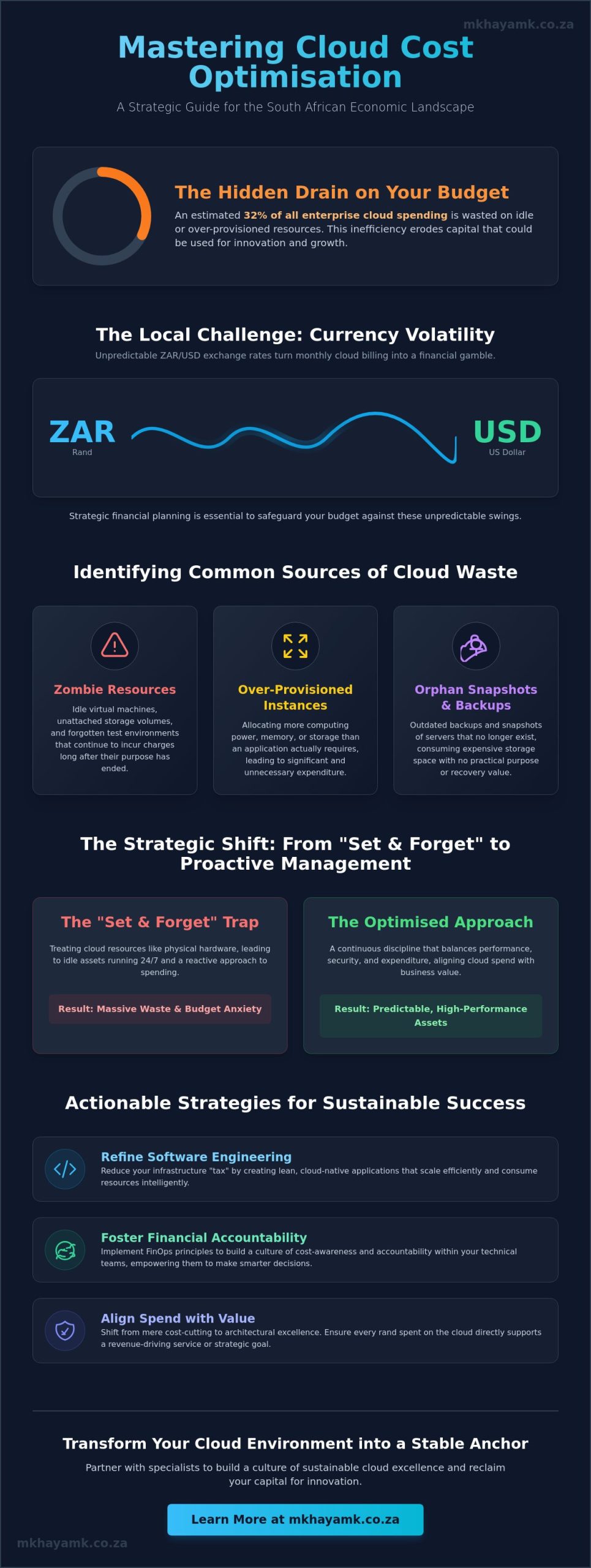
Did you know that 32% of cloud spending in the average enterprise is estimated to be wasted on idle or over-provisioned resources? In our local market, this inefficiency is often magnified by the unpredictable swing of the Rand against the US Dollar, making monthly billing feel more like a gamble than a fixed cost. Achieving effective cloud cost optimisation south africa requires more than just a cursory glance at your dashboard. It demands a strategic alignment of your technical architecture with your financial goals. We recognise the pressure of trying to scale a business whilst managing “hidden waste” that often eludes departmental visibility.
We’ve designed this guide to help you master these complexities with actionable strategies tailored for the South African economic landscape. You’ll learn how to foster a culture of cost-accountability across your engineering teams and transform your infrastructure into a predictable, high-performance asset. We’ll explore how to leverage local data centres and FinOps principles to ensure your cloud environment remains a stable anchor for your long-term success.
Key Takeaways
Move beyond the “set and forget” mentality by identifying “Zombie Resources” and right-sizing over-provisioned instances to eliminate hidden waste.
Safeguard your budget against ZAR/USD volatility with strategic financial planning for cloud cost optimization south africa in 2026.
Learn how refined software engineering practices can reduce your infrastructure “tax” by creating lean, cloud-native applications that scale efficiently.
Transition from reactive spending to proactive management by partnering with specialists to build a culture of financial accountability within your technical teams.
Understanding Cloud Cost Optimisation in the South African Context
Cloud cost optimisation isn’t a single event on a calendar. It’s a continuous discipline that balances high-performance output with security and expenditure. In many South African enterprises, the shift from traditional CAPEX models, where hardware was purchased upfront, to a variable OPEX model has created a steep learning curve. A foundational understanding of cloud computing reveals that infrastructure is essentially rental property; you pay for what you occupy. However, without a clear strategy, businesses often fall into a “set and forget” trap. This mentality treats cloud resources like physical servers, leading to massive waste as idle instances continue to run during off-peak hours in the Johannesburg or Cape Town regions.
To better understand how these costs are allocated across your organisation, watch this helpful video:
Effective cloud cost optimization south africa requires deep visibility. As companies undergo digital transformation, the complexity of their environments grows. This complexity makes it harder to see which specific departments or projects are driving spend. Without this insight, the agility promised by the cloud is often replaced by budget anxiety. We believe that transparency is the first step toward reclaiming control over your digital investments.
The Strategic Importance of Efficiency in 2026
By 2026, the South African cloud market has matured significantly. Efficiency now directly impacts the bottom line for national businesses. It’s no longer just about saving cents; it’s about reclaiming capital to fund innovation. When you refine your infrastructure, you create room for AI and data automation initiatives that drive growth. This year marks a turning point where organisations move from simply “being in the cloud” to “mastering the cloud.”
Beyond Simple Cost-Cutting
There’s a vital difference between a “cheap” cloud and an “optimised” one. Simply choosing the lowest-cost tier often leads to under-provisioning, which hurts user experience and slows down critical business processes. Achieving sustainable cloud cost optimization south africa involves a shift in perspective from mere savings to architectural excellence. True managed cloud solutions focus on alignment. We look at whether the spend matches actual revenue drivers. If a high-cost database supports your most profitable service, it’s an investment. If it supports a legacy system no one uses, it’s waste. Precision in this area ensures your business remains resilient whilst scaling.
Identifying and Eliminating Common Sources of Cloud Waste
Identifying where your money goes is the foundation of any successful strategy. In many South African organisations, the most significant drain comes from “Zombie Resources.” These are idle instances or unattached storage volumes that continue to incur charges long after their purpose has ended. Perhaps a developer spun up a testing environment for a week but forgot to decommission it, or a virtual machine was deleted whilst its associated disk remained active. These small, overlooked items accumulate, creating a heavy burden on your monthly statement. Effective cloud cost optimization south africa requires a methodical approach to hunting down these inefficiencies before they spiral.
Beyond idle resources, many firms struggle with “orphan snapshots” and outdated backup data. It’s common to find storage accounts filled with snapshots of servers that no longer exist. These backups are often kept “just in case,” yet they serve no practical purpose and only add to the monthly bill. Understanding the various cloud cost management factors is essential for any technical lead looking to tighten the belt. This includes looking at unoptimised data transfer. Egress fees, or the costs of moving data out of your cloud environment, can be surprisingly high in the Cape Town regions if you aren’t careful about how your architecture handles traffic.
The Problem of Over-Provisioned Instances
Over-provisioning occurs when you choose a larger instance type than your workload actually requires. We often see teams selecting high-spec machines to “play it safe,” resulting in servers that consistently run at less than 10% CPU utilisation. Right-sizing is the process of matching instance types and sizes to your workload performance and capacity requirements at the lowest possible cost. By analysing actual performance data, you can downsize these resources without impacting the user experience. This simple shift ensures you aren’t paying for “headroom” that you never actually use.
Managing Storage and Data Life Cycles
Storage management is about more than just deleting old files. It involves identifying unattached block storage that is still incurring costs despite not being linked to any active server. Implementing automated data life cycle policies can help by moving older, less frequently accessed data to cheaper storage tiers automatically. There are also hidden costs in keeping unnecessary logs and diagnostic data for years. If you’re finding it difficult to gain this level of visibility, our cloud solutions team can help you implement the right monitoring tools to track every cent. Refinement in this area creates a leaner, more agile environment that supports growth rather than hindering it.
Navigating Exchange Rate Volatility and Local Economic Factors
For a South African CFO, a monthly cloud bill is more than just a technical expense; it’s a reflection of the Rand’s health against the US Dollar. Whilst AWS now provides billing in South African Rand (ZAR) and Microsoft Azure offers ZAR billing through specific Cloud Solution Providers (CSPs), the underlying price structures often remain tethered to global benchmarks. This means that cloud cost optimization south africa must account for currency fluctuations that can shift your budget by 5% or 10% overnight. Managing this volatility requires a shift from passive monitoring to active financial strategy.
The decision to host in local data centres versus international regions is another critical factor. While the Cape Town and Johannesburg regions offer the low latency required for high-performance applications, they often come with a price premium. For example, data transfer out of the Africa (Cape Town) region and hourly virtual machine rates can be higher than those in US or European regions. We work with clients to evaluate whether the performance and POPIA compliance benefits of local hosting outweigh the potential savings of international regions. It’s about finding the “sweet spot” where your infrastructure supports business goals without overstretching the budget.
Hedging Against Currency Fluctuations
One of the most reliable ways to stabilise your cloud spend is through the use of Reserved Instances (RIs) and Savings Plans. These allow you to commit to a specific amount of usage for a one or three-year period in exchange for a significant discount. This commitment effectively locks in your rates, providing a much-needed buffer against ZAR/USD volatility. We also encourage the use of detailed cost allocation tags. By tagging every resource, you can track spend against a fixed ZAR budget in real-time, ensuring that departmental leaders understand the financial impact of their technical decisions. A multi-cloud approach can also offer a layer of protection, allowing you to leverage different regional pricing models as economic conditions change.
Building a Local FinOps Culture
Sustainable efficiency isn’t just about tools; it’s about people. FinOps is a cultural practice where everyone in the organisation takes ownership of their cloud usage. By organising cross-functional teams that include finance, engineering, and operations, you break down the silos that often lead to “bill shock.” We believe in empowering engineering teams with the visibility they need to see the cost impact of their architectural choices. When developers can see that a specific database configuration is costing the business thousands of Rands in waste, they are naturally inclined to build leaner, more efficient systems. This collaborative approach, often guided by a digital transformation consulting south africa specialist, ensures that your cloud environment remains a stable anchor for long-term growth.
The Link Between Software Engineering and Infrastructure Spend
Every line of code written has a financial footprint. Inefficient algorithms and bloated applications act as a silent tax on your business, requiring more compute power and memory than necessary to perform simple tasks. When we discuss cloud cost optimization south africa, we’re really discussing the elegance and efficiency of the underlying software. By investing in custom software development, you ensure that your applications are built to be cloud-native from the ground up, avoiding the “lift and shift” traps that lead to bloated monthly bills.
Refactoring legacy applications isn’t just a technical upgrade; it’s a financial rescue mission. Many older systems were designed for on-premise hardware where resources were fixed. In the cloud, these systems often fail to scale down, consuming expensive resources even during periods of zero activity. Integrating DevOps services south africa allows for the automation of cost-saving measures like auto-scaling and scheduled shut-downs. This ensures your environment only breathes when it needs to, significantly reducing the “hidden waste” mentioned in previous sections.
Architecting for Elasticity
Moving from monolithic structures to microservices allows you to scale only the specific components of your application that are under pressure. This precision prevents you from having to upgrade an entire environment just because one service is busy. Serverless architecture allows businesses to pay only for the exact execution time of their code, eliminating the cost of idle servers. This model is particularly effective for intermittent workloads where traditional “always-on” servers would be a significant drain on your ZAR budget.
Performance Tuning as a Cost-Saving Measure
Database optimisation is one of the most direct ways to lower your infrastructure spend. Poorly indexed databases force your cloud provider to use expensive, high-memory instances to maintain performance. Similarly, efficient API design reduces data transfer costs by ensuring only the necessary data packets move across the network. By integrating cost-monitoring directly into your CI/CD pipeline, your team can detect spend spikes early in the development cycle before they reach production. If you’re ready to build more efficient systems, contact our engineering experts to start your journey toward leaner infrastructure.
Partnering for Sustainable Cloud Excellence
Achieving long-term stability in the cloud requires more than just a one-off adjustment. It involves a fundamental shift in how your organisation views and manages its digital assets. Many South African firms are now turning to managed cloud solutions to gain the expert oversight needed to maintain continuous efficiency. This collaborative partnership allows your internal teams to focus on core business objectives whilst specialists handle the intricate details of resource allocation and spend tracking. A digital transformation consulting south africa partner provides the bird’s-eye view necessary to identify long-term efficiency gains that might be missed during daily operations.
At Mkhaya MK, we combine deep software engineering expertise with robust cloud management to drive a tangible ROI for our clients. We understand that your infrastructure is only as good as the code it supports. By bridging the gap between development and operations, we ensure that every architectural decision is made with financial sustainability in mind. The first step toward mastering cloud cost optimization south africa is often a comprehensive cloud audit. This process uncovers immediate savings by highlighting the “zombie resources” and over-provisioning issues we’ve discussed throughout this guide, providing a clear path toward a leaner environment.
Managed Services vs. In-House Management
Finding and retaining specialised FinOps talent in South Africa remains a significant hurdle for many growing enterprises. The demand for these skills often outstrips local supply, making in-house management a costly and complex endeavour. Staff augmentation offers a flexible alternative when you need to hire dedicated developers in South Africa, providing the specific skills required to execute an optimisation project without the overhead of a permanent hire. A strategic partnership ensures that your infrastructure scales in lockstep with your business growth, providing a stable foundation for the years ahead.
Developing a Roadmap for 2026
Success in 2026 depends on having a clear, actionable roadmap that moves from reactive fixes to proactive strategy. We recommend setting realistic targets for waste reduction over the first 90 days to build momentum and demonstrate value to your stakeholders. It’s essential that these cost-saving measures support business agility rather than hindering it. True optimisation empowers your team to innovate faster by removing the financial friction of inefficient systems. If you’re ready to take control of your monthly expenditure, contact Mkhaya MK to develop a tailored cloud cost optimization south africa strategy that aligns with your unique business goals.
Securing Your Digital Future through Strategic Efficiency
At Mkhaya MK, we bring end-to-end digital transformation expertise and a proven track record in custom software engineering and DevOps to every partnership. Our national support for enterprise-scale migrations provides the steady stability you need to scale with confidence in a changing technological landscape. Optimise your infrastructure with Mkhaya MK’s Cloud Solutions and turn your cloud environment into a predictable engine for success. We’re ready to help you build a resilient, cost-effective future that lasts.
Frequently Asked Questions
What is the first step in cloud cost optimisation for a South African business?
The first step is gaining complete visibility into your current infrastructure through a comprehensive cloud audit. You can’t manage what you can’t see. This involves identifying every active resource and tagging them by department or project. Once you have a clear map of your environment, you can begin to identify the immediate areas of waste that are inflating your monthly bills.
How much can a typical company save by implementing cloud cost optimisation?
A typical company can save approximately 32% of their cloud spend by implementing strategic cloud cost optimization south africa. This figure is based on Flexera’s 2026 report, which identifies that nearly a third of enterprise cloud expenditure is wasted on idle or over-provisioned resources. By right-sizing instances and eliminating unused storage, these savings can be realised within the first 90 days of a project.
Is it better to use Reserved Instances or Savings Plans for long-term savings?
Choosing between the two depends on your need for flexibility versus deep discounts. Reserved Instances offer higher savings for specific instance types and regions, making them ideal for stable, predictable workloads. Savings Plans provide more flexibility by applying discounts across different instance families or even serverless products. We often recommend a hybrid approach to balance stability with the ability to adapt to changing technical requirements.
How does the ZAR/USD exchange rate specifically impact my AWS or Azure bill?
The ZAR/USD exchange rate affects your bill because most cloud providers set their base pricing in US Dollars. Even if you receive a bill in South African Rand, the amount fluctuates monthly based on the currency’s performance. This volatility makes budget predictability difficult. Implementing local cloud cost optimization south africa strategies, such as locking in rates through multi-year commitments, helps mitigate this risk and ensures your costs remain stable.
Can I optimise my cloud costs without re-writing my entire software application?
You can achieve significant savings without a complete application re-write by focusing on infrastructure management. Simple actions like right-sizing over-provisioned virtual machines, deleting unattached storage, and moving old data to cheaper tiers can yield immediate results. Whilst refactoring code offers deeper long-term efficiency, these “quick wins” provide a solid foundation for cost control without requiring extensive development time or disrupting your current operations.
What are “zombie resources” and how do I find them in my environment?
“Zombie resources” are idle instances or unattached storage volumes that continue to run and incur costs long after they’re needed. You can find them by using cloud-native monitoring tools to identify servers with consistently low CPU or memory usage. Automated scripts can also scan for block storage volumes that aren’t linked to an active virtual machine. Eliminating these ghosts is one of the fastest ways to reduce unnecessary monthly expenditure.
Is there a risk that cost optimisation will affect my system performance or uptime?
There is minimal risk to performance if optimisation is handled methodically. The goal of right-sizing isn’t to starve your applications of resources, but to match capacity with actual demand. By using performance data to guide your decisions, you ensure that your systems have exactly what they need to run smoothly. Well-executed optimisation often improves uptime by creating a more organised and resilient environment that scales automatically during peak periods.
How does FinOps differ from traditional IT budgeting?
FinOps differs from traditional IT budgeting by making cloud cost management a shared, continuous responsibility across the entire organisation. Traditional budgeting is often a siloed, annual process where finance sets a limit and IT tries to stay within it. FinOps involves real-time collaboration between engineering, finance, and operations teams. This culture of accountability ensures that technical decisions are always made with a clear understanding of their financial impact.
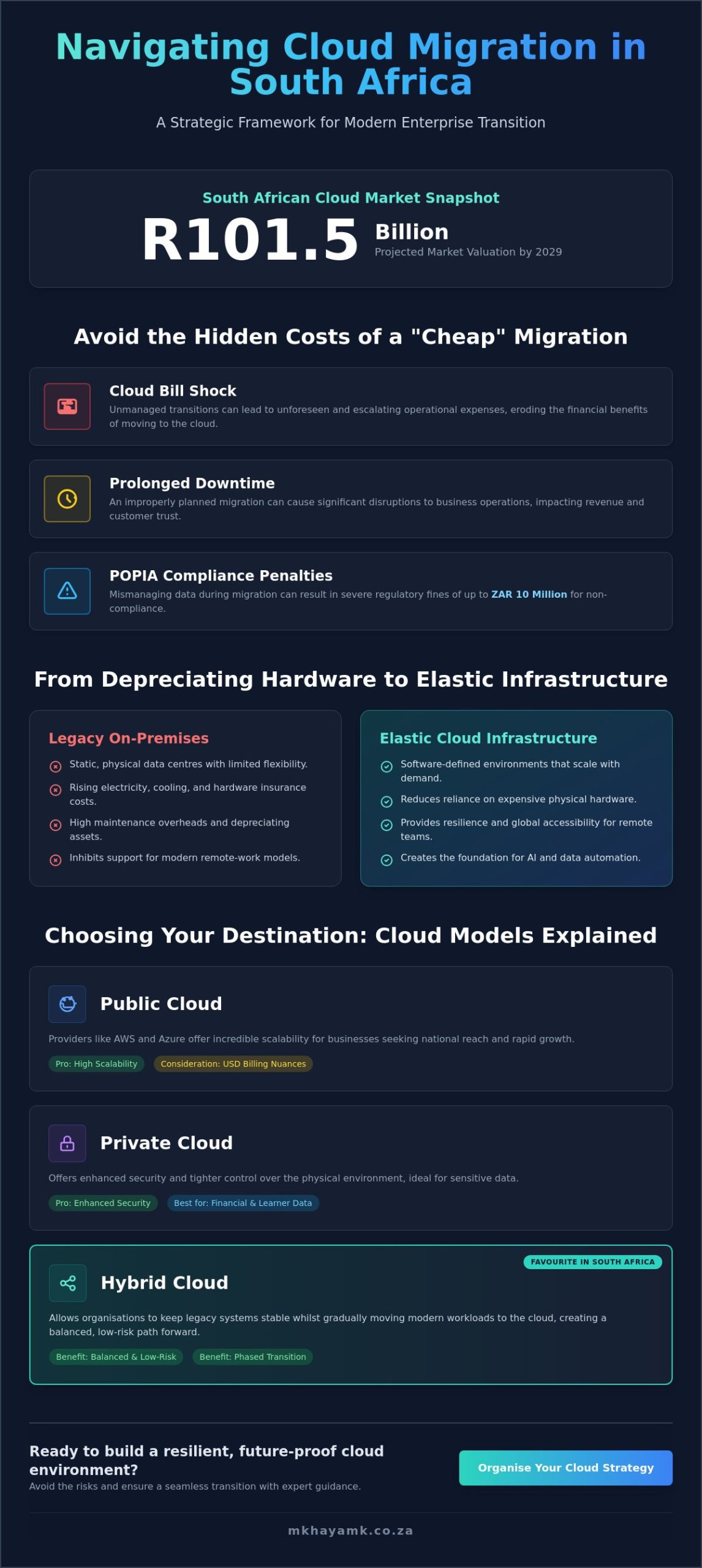
What if the biggest risk to your digital transformation isn’t the technology itself, but the hidden cost of a “cheap” migration strategy? As the local market matures toward a projected R101.5 billion valuation by 2029, many organisations find themselves caught between the promise of agility and the reality of “cloud bill shock.” You likely recognise that moving to the cloud is no longer optional, yet the fear of prolonged downtime or a ZAR 10 million POPIA penalty remains a heavy burden for leadership teams. Selecting the right cloud migration services in South Africa has become a delicate balance of technical precision and financial foresight.
We’ve designed this guide to help you master these complexities with a framework that prioritises long-term stability over quick fixes. You’ll learn how to navigate the evolving FSCA regulations, manage ZAR-based billing fluctuations, and ensure your data remains sovereign within local borders. By following this strategic roadmap, you can transition to a resilient environment that scales automatically, reduces your reliance on depreciating hardware, and ensures zero data loss during the shift.
Key Takeaways
Understand the transition from depreciating physical hardware to elastic, software-defined environments that support modern business growth.
Learn to apply the “6 Rs” framework to ensure your chosen migration strategy aligns with your specific budgetary and operational objectives.
Discover why partnering with professional cloud migration services in South Africa is essential for avoiding the security risks and hidden costs associated with unmanaged transitions.
Master a phased roadmap that prioritises discovery, rigorous governance, and full POPIA compliance to protect your organisation’s data integrity.
Explore how post-migration DevOps practices move your focus from simple maintenance to continuous innovation and accelerated software delivery.
Navigating the Cloud Migration Landscape in South Africa
Cloud migration in the modern South African enterprise is no longer just a technical tick-box exercise. It’s a strategic re-engineering of how your business functions. This shift replaces static, physical data centres with elastic, software-defined infrastructure that breathes with your operational demands. By mid-2026, the urgency to decommission legacy on-premises hardware has intensified. Rising electricity costs and the surge in global demand for AI infrastructure have made local server maintenance a financial liability rather than an asset. Transitioning to professional cloud migration services in South Africa ensures your organisation isn’t left behind as hardware depreciates and maintenance overheads climb.
To better understand this concept, watch this helpful video:
Data sovereignty remains a primary pillar of any local migration strategy. With the Protection of Personal Information Act (POPIA) fully enforceable, the Information Regulator has sharpened its focus on data breach reporting and compliance. Mismanaging this transition carries a risk of penalties up to ZAR 10 million. Adopting cloud computing through a local lens means ensuring your data stays within South African borders where necessary, whilst still benefiting from global innovation. This approach provides the quiet confidence needed to grow without the looming threat of regulatory friction.
The Drivers of Cloud Adoption Amongst Local Enterprises
The move away from physical server rooms is driven by a mix of economic necessity and technological ambition. Escalating costs for cooling systems and hardware insurance have made the “server in the basement” model obsolete. Beyond simple cost-cutting, businesses now require the resilience to support remote-work models that demand global accessibility without latency. Crucially, modern infrastructure is the prerequisite for the next wave of AI and data automation. Without an elastic cloud foundation, your business cannot effectively process the massive datasets required for predictive analytics or automated customer service workflows.
Public, Private, and Hybrid: Choosing Your Destination
Selecting the right destination depends on your specific risk profile and growth targets. Public cloud providers like AWS and Azure offer incredible scalability for businesses seeking national reach, though billing nuances like Azure’s USD requirements for new agreements require careful financial planning. For organisations handling sensitive financial records or learner data, a Private Cloud model offers enhanced security and tighter control over the physical environment. However, the Hybrid Cloud remains the favourite amongst South African firms. It allows you to keep legacy systems stable whilst gradually moving modern workloads to the cloud, creating a balanced, low-risk path forward.
Evaluating Cloud Migration Strategies: The 6 Rs Framework
Selecting the most effective cloud migration services in South Africa begins with a nuanced understanding of the “6 Rs” framework. This isn’t a one-size-fits-all journey; it’s a methodical assessment of your digital estate to determine the most stable and cost-effective path forward. A phased approach is essential to avoid operational paralysis. By categorising your applications early, you can identify which systems require total transformation and which are ready for a simpler transition. This strategic clarity is supported by local insights into Cloud and Data Storage Readiness, ensuring your choice aligns with both national policy and your specific infrastructure capabilities.
Rehosting (Lift-and-Shift) vs. Replatforming
Rehosting is often the preferred route when you face an expiring data centre lease or need a rapid exit from physical hardware. It involves moving applications to the cloud with minimal changes. Whilst fast, it doesn’t always capture the full efficiency of the cloud environment. Replatforming offers a middle ground. You make minor adjustments, such as moving a database to a managed service, to leverage cloud-native features without a full recode. For South African firms, this balance often provides the best initial ROI by reducing management overhead whilst keeping migration costs predictable and manageable.
Refactoring and Rearchitecting Custom Software
Bespoke applications built for local markets often require more than a simple move. If your software wasn’t designed for the cloud, it might struggle with scalability or high egress fees. When engaging cloud migration services in South Africa for complex environments, refactoring ensures your bespoke tools are truly cloud-ready. This process involves custom software development to modernise legacy code into microservices and containers like Docker or Kubernetes. This transformation allows your applications to scale automatically during peak usage, ensuring your digital services remain responsive regardless of the load.
Repurchasing, Retaining, and Retiring
Managed Cloud Services vs. In-House Migration
Deciding between an in-house transition and partnering with experts often comes down to a choice between perceived control and actual resilience. Many South African firms initially attempt a “Do-It-Yourself” approach to save costs, only to encounter the hidden financial traps of unmanaged cloud environments. Without the specialised expertise found in professional cloud migration services in South Africa, projects often suffer from prolonged downtime or unforeseen consumption expenses. Misconfigured security settings in an unmanaged environment can lead to catastrophic data leaks, making the initial “saving” on service fees look negligible compared to the potential POPIA penalties.
Finding local cloud architects is a significant hurdle. There is a documented shortage of certified cloud skills in the country, which leads many businesses to rely on managed service providers to bridge the gap. This partnership shifts your financial model from volatile Capital Expenditure (CapEx) on hardware to predictable Operational Expenditure (OpEx). You pay for what you use, rather than investing in physical servers that lose value the moment they’re installed. It’s a move toward long-term stability that allows your team to focus on core business goals rather than maintaining infrastructure. Utilising dedicated cloud migration services in South Africa ensures that your transition is handled with the precision required for enterprise-level success.
The Strategic Advantage of Managed Cloud Services
Staff Augmentation: A Flexible Alternative
If you prefer to keep the migration project under internal leadership but lack specific technical depth, staff augmentation offers a middle ground. You can augment your internal team with specialised cloud engineers who bring best practices directly into your existing organisation. This approach allows you to scale the team up or down based on specific project milestones, such as the initial assessment or the final go-live phase. It provides the high-end expertise required for a seamless transition whilst ensuring your internal staff retains full oversight of the digital estate.
A Step-by-Step Roadmap for Enterprise Cloud Adoption
Success in the cloud isn’t accidental. It’s the result of a structured, five-phase roadmap that transforms your digital estate from a collection of silos into a cohesive, agile environment. When you partner with professional cloud migration services in South Africa, this journey follows a logical progression that mitigates risk at every turn. This methodical approach ensures that your transition is both transparent and predictable, providing the quiet confidence needed to manage complex infrastructure changes.
Phase 1: Discovery and Assessment. Meticulously mapping your entire digital estate to understand what you own and how it functions.
Phase 2: Governance and Security. Establishing the “landing zone” with strict access controls and compliance frameworks.
Phase 3: The Pilot Migration. Validating the process by moving non-critical workloads to test performance and connectivity.
Phase 4: Full-Scale Execution. Migrating your data and applications in controlled waves to maintain operational continuity.
Phase 5: Validation and Optimisation. Post-migration checks to ensure every system meets performance benchmarks and cost targets.
Moving through these phases allows for continuous refinement. It prevents the high-pressure, all-or-nothing scenarios that often lead to technical debt or security oversights. By treating the migration as a series of controlled movements, your organisation builds internal confidence whilst ensuring that each application is placed in the most efficient environment possible. This rhythmic sense of momentum is what separates a successful adoption from a mere technical transfer.
Technical Assessment and Dependency Mapping
Automated tools are your best allies during the discovery phase. They identify exactly how your applications talk to each other, revealing hidden dependencies that could cause unexpected downtime if severed. Without this level of precision, a seemingly simple move can break critical business workflows that rely on legacy database connections. Documenting the current state isn’t just about record-keeping; it’s about creating a baseline to ensure your cloud migration services in South Africa actually deliver an environment that outperforms your legacy hardware.
Establishing the Cloud Landing Zone
Before moving a single byte, we establish a secure landing zone. This is the foundation of your new infrastructure, where we set up identity and access management (IAM) and secure network tunnels. Configuring virtual private clouds (VPCs) ensures your data remains isolated and protected according to your specific governance requirements. By implementing AI-driven security monitoring from day one, we create a resilient perimeter that evolves with the threat landscape, ensuring your move is as secure as it is efficient.
Once the foundation is set, the transition moves into active execution. This phase focuses on maintaining the integrity of your data whilst shifting workloads in a way that doesn’t disrupt your daily business operations. If you’re looking for a partner to guide you through this complex technical journey, explore our engagement process to see how we ensure a seamless and stable transition for your enterprise.
Beyond the Move: Optimising Cloud Infrastructure with Mkhaya MK
Reaching your “Go-Live” date is a momentous achievement, yet it’s merely the starting line for true digital maturity. The most successful organisations don’t view a move as a one-time event; they see it as the foundation for a continuous programme of refinement. By moving beyond the initial transfer of data, you can start to extract the full value of cloud migration services in South Africa through ongoing optimisation. This phase is where your infrastructure begins to deliver on its promise of agility, allowing your business to pivot and scale with a level of precision that was previously impossible.
Implementing DevOps services in South Africa is a critical step in this ongoing journey. It allows your technical teams to accelerate software delivery cycles, ensuring that new features and security patches reach your users faster. This shift from reactive maintenance to proactive innovation is supported by cloud-native AI and machine learning tools, which provide deep business intelligence from your newly migrated datasets. Long-term stability is then maintained through proactive managed services that anticipate issues before they disrupt your operations, ensuring your cloud environment remains a reliable anchor for your growth.
The Convergence of Cloud and Custom Software
The real power of the cloud is realised when it integrates seamlessly with your business-critical tools. Adopting a modern approach to cloud application development allows you to build more resilient, scalable software that thrives in a distributed environment. This convergence is particularly effective when you integrate cloud-native features into your ERP solutions, providing real-time data access across your entire organisation. As you look toward the future, serverless architectures offer a path to even greater efficiency, where you only pay for the exact compute time your applications consume.
Partnering for Success with Mkhaya MK
At Mkhaya MK, we provide a visionary yet practical approach to cloud solutions. We understand that your journey is unique, which is why we combine deep software engineering expertise with a methodical execution of cloud migration services in South Africa. Our goal is to be your stable partner in a rapidly changing technological landscape, helping you navigate every complexity with quiet confidence. If you’re ready to move toward a more agile and resilient future, contact us today for a comprehensive cloud readiness assessment to begin your transformation.
Building a Resilient Foundation for Your Digital Future
The transition to a cloud-native environment is a journey of refinement that replaces the constraints of physical hardware with elastic, software-defined agility. By following a structured roadmap, your organisation can navigate the complexities of POPIA and local regulatory shifts whilst maintaining quiet confidence. We’ve seen that the move itself is only the beginning. True success lies in continuous optimisation and the integration of modern DevOps services south africa enterprises are increasingly adopting to accelerate delivery and strengthen security. Choosing the right partner for cloud migration services in South Africa ensures that this transformation remains stable, predictable, and aligned with your long-term business goals.
Mkhaya MK offers end-to-end digital transformation expertise with a national footprint and deep local regulatory knowledge. We specialise in custom software and AI integration, providing the technical precision required to turn your infrastructure into a visionary asset. Our team is ready to support your personal journey toward a more agile future. You can request a Cloud Readiness Assessment from Mkhaya MK to begin your methodical transition today. We’re committed to your success and look forward to building a stable, innovative partnership together.
Frequently Asked Questions
How long does a typical enterprise cloud migration take in South Africa?
A typical enterprise migration usually spans between six and twenty-four months, depending on the volume of data and the complexity of your legacy systems. Smaller, targeted transitions can often be completed within three to six months. This timeline includes the vital discovery and testing phases mentioned earlier. By following a phased approach, we ensure that your business remains operational whilst we systematically move your workloads to a more resilient and stable environment.
Is my data safe during a cloud migration, and what about POPIA compliance?
Your data is protected through encrypted network tunnels and secure landing zones that prevent unauthorised access during the shift. Regarding POPIA compliance, we prioritise local data centres within South African borders to ensure your information remains under national jurisdiction. The Information Regulator can issue penalties of up to ZAR 10 million for non-compliance; therefore, we implement strict governance frameworks from day one to mitigate these risks and ensure full legal alignment.
What are the main differences between Public, Private, and Hybrid cloud models?
Public clouds offer massive scalability and national reach through shared infrastructure, whilst Private clouds provide a dedicated environment for highly sensitive financial or learner data. Hybrid models combine both, allowing you to keep legacy systems on-premises whilst moving modern applications to the cloud. This flexibility makes Hybrid the favourite choice for South African enterprises that need to manage legacy constraints without sacrificing the benefits of agile digital transformation.
How can I accurately estimate the monthly costs of running my business in the cloud?
Accuracy in cost estimation requires a detailed analysis of your current resource consumption and an understanding of local billing nuances. Utilising cloud migration services south africa providers offer helps you implement FinOps practices to monitor usage in real-time, preventing “cloud bill shock” by ensuring you only pay for what you effectively use. You must also account for the volatility of the South African Rand against the US Dollar when planning your monthly budget. For a deeper dive into managing these expenses, our guide on cloud cost optimisation in South Africa provides actionable strategies tailored to the local economic landscape.
Do I need to rewrite all my custom software to move it to the cloud?
You don’t necessarily need to rewrite everything, as many applications can be moved using the “Lift-and-Shift” or Replatforming methods. However, bespoke software often performs better and costs less to run when it’s refactored for a cloud-native environment. This process involves making targeted adjustments to your code to leverage microservices and auto-scaling, which ensures your custom tools remain responsive and cost-effective as your business grows and your user base expands.
What is the “Lift-and-Shift” method, and when is it appropriate?
The “Lift-and-Shift” method involves moving your applications to the cloud exactly as they are with minimal changes. It’s most appropriate when you face an urgent deadline, such as an expiring data centre lease or hardware that’s reached its end-of-life. Whilst this is the fastest way to exit physical infrastructure, we typically recommend following up with optimisation phases to ensure long-term efficiency and to prevent the unnecessary consumption of cloud resources.
How does staff augmentation help during a cloud migration project?
Staff augmentation provides you with specialised cloud engineers who integrate directly into your internal team to fill specific skill gaps. This model is particularly effective for cloud migration services south africa projects, as it allows you to maintain full control whilst benefiting from external expertise and best practices. It’s an agile solution for organisations struggling to find certified cloud architects in a competitive local market, allowing you to scale your capacity as needed.
What happens to my physical hardware once the migration is complete?
Once your migration is complete, your physical hardware is typically decommissioned to eliminate maintenance and electricity costs. You might choose to repurpose specific servers for non-critical local tasks or sell the equipment to recover some residual value. Decommissioning these assets is a key step in shifting your financial model from depreciating Capital Expenditure to a more agile and predictable Operational Expenditure model that supports long-term business stability.
With 2,898 data breaches reported to the Information Regulator during the 2025/26 financial year, the stakes for your digital infrastructure have never been higher. You’re likely aware that successful cloud application development south africa is no longer just about choosing a provider; it’s about architecting for local resilience. You’ve probably felt the frustration of high latency from international servers or the mounting pressure to align your systems with the April 2025 POPIA amendments, especially when the average cost of a single breach in our region has reached R53 million.
We understand these challenges. It’s often difficult to find local developers who truly grasp enterprise-grade DevOps whilst ensuring your data remains secure and accessible. This roadmap provides a clear path forward. You’ll discover how to build cloud-native applications that are compliant, scalable, and tailored to our unique business landscape. We’ll explore how to reduce operational overhead through automation and integrate legacy systems seamlessly, ensuring your technology serves as a stable anchor for your business’s journey into 2026 and beyond.
Key Insights
Understand the transition from basic cloud hosting to sophisticated cloud-native architectures that ensure long-term stability and performance for your enterprise.
Discover how leveraging microservices and serverless computing can reduce operational overhead whilst allowing your systems to scale effortlessly.
Master the complexities of POPIA compliance and data residency to ensure your cloud application development south africa aligns with the latest 2026 regulatory standards.
Evaluate the total cost of ownership between custom builds and SaaS solutions to determine which path provides a unique and sustainable competitive advantage.
Follow a structured delivery roadmap that prioritises strategic alignment and intuitive UI/UX design to drive high user adoption and business growth.
The Evolution of Cloud Application Development in South Africa
The journey of digital adoption in our region has reached a pivotal maturity point. According to a PwC Africa survey in February 2026, 86% of South African organisations have achieved medium or high cloud maturity. This isn’t just a statistic; it represents a fundamental shift in how local leaders perceive technology. We’ve moved past the era where being “cloud-first” was enough. Today, the focus has shifted toward being cloud-native, where applications are designed from the ground up to thrive in a distributed environment. This evolution is driven by the need for greater stability and the reality of local data residency requirements.
For many years, the standard approach was “lift and shift,” which involved moving existing legacy software to remote servers without changing its core structure. Whilst this offered a quick win for infrastructure reduction, it often failed to deliver the performance gains businesses expected. In 2026, the arrival of more robust local cloud regions in Johannesburg and Cape Town has changed the calculation. Low latency is no longer a luxury; it’s a baseline requirement for modern user experiences. Purposeful software engineering now ensures that applications are responsive and resilient, specifically tuned for the South African context.
To understand the professional landscape supporting these shifts, watch this overview of the sector’s growth:
Beyond Hosting: What Cloud-Native Development Really Means
There’s a significant difference between an application that sits “in the cloud” and one that is “built for the cloud.” True cloud application development south africa involves using microservices, containers, and serverless logic to create modular systems. This architecture allows individual components to be updated or scaled without affecting the entire platform. By leveraging the core principles of cloud computing, businesses can ensure their digital tools are not just hosted elsewhere, but are inherently flexible. This level of custom engineering is essential for supporting long-term digital transformation goals, as it prevents the technical debt often associated with rigid, monolithic systems.
The Local Landscape: Why South African Businesses are Scaling
The economic drivers for this shift are clear. Local enterprises are seeking ways to optimise costs whilst improving service delivery in an increasingly competitive market. Modern cloud applications bridge the gap between reliable legacy data and the high-end UX that today’s users demand. Whether it’s through sophisticated cloud solutions or automated workflows, the goal is always to create a more agile organisation. Cloud-native development serves as a catalyst for business agility in South Africa. By focusing on precision and long-term stability, companies can build a digital foundation that grows alongside their ambitions, rather than holding them back.
Core Pillars of Modern Cloud Application Architecture
Successful cloud application development south africa depends on moving beyond simple hosting to embrace a modular, resilient architecture. As the South Africa Cloud Computing Market continues its rapid expansion toward 2034, businesses are discovering that how an application is structured determines its long-term survival. We see four core pillars defining this new era: microservices, serverless computing, API-first design, and automated DevOps pipelines. These elements work in harmony to create systems that are not only powerful but also remarkably easy to maintain.
Microservices vs. Monolithic Builds
Microservices have become the favourite choice for high-growth South African firms because they break down large, monolithic systems into smaller, manageable units. This approach allows your development teams to organise around specific business capabilities rather than technical layers. Whilst this adds some architectural complexity, the reward is the ability to scale individual components of your application independently. This ensures you only expand the parts of the system that are under heavy load, preventing unnecessary expenditure on idle resources. It’s a precise way to build that values long-term stability over quick, rigid fixes.
Hybrid Cloud: The Strategic Middle Ground
Many enterprises aren’t ready for a total migration to the public cloud, often due to legacy requirements or specific data sensitivities. This is where hybrid cloud serves as a strategic middle ground. It allows you to keep sensitive data on-premise whilst leveraging the public cloud for intensive processing or customer-facing interfaces. Managing this balance requires purposeful engineering to ensure low-latency communication between environments. At Mkhaya MK, we often guide partners through these complexities via our digital transformation consulting, ensuring the transition is methodical and secure.
Modern builds also prioritise serverless computing, which reduces operational overhead by charging only for execution time. This efficiency is paired with an API-first design, ensuring your application integrates seamlessly with the broader digital ecosystem. We then implement DevOps and CI/CD practices to automate the journey from code to production. This creates a rhythmic momentum where updates are deployed with confidence and precision. If you’re looking to refine your current setup, exploring our cloud solutions can help you identify the most stable path forward for your business’s unique journey.
Strategic Evaluation: Custom Cloud Development vs. SaaS
The “Competitive Advantage” test is a vital tool for your roadmap: if the application handles a core process that differentiates you from competitors, you should own it. Off-the-shelf software is designed for the average user, meaning it rarely supports the nuanced workflows that make your business successful. By investing in custom builds, you ensure that your intellectual property remains yours, providing a stable foundation for growth. This approach also offers superior control over data sovereignty. Because you control the architecture, you can ensure that sensitive information is managed strictly according to POPIA requirements within our local borders, avoiding the compliance risks often associated with international SaaS providers.
When to Invest in Custom Cloud Engineering
You should consider custom builds for processes that are central to your value proposition. For instance, a generic ERP module might manage your accounting adequately, but a bespoke loan management system can be fine-tuned to your specific risk models and customer journey. Owning the code means you aren’t waiting for a third-party vendor to release a feature that your market demanded months ago. It gives you the agility to pivot and refine your services with precision. This level of customisation ensures that your software acts as a stable anchor, supporting your business as it scales through 2026.
Financial Implications of Cloud-Native Builds
The financial conversation often revolves around the shift from OPEX to CAPEX. Whilst SaaS represents a predictable monthly expense, those costs can spiral as your user base grows. Custom cloud apps eliminate per-user licensing fees over time. This makes the initial development investment a long-term asset rather than a perpetual liability. To manage the upfront costs of building these internal capabilities, many organisations utilise staff augmentation to access high-end expertise without the overhead of permanent hiring. This collaborative model allows you to build resilient systems whilst maintaining financial flexibility, ensuring your technology budget is spent on building value rather than just renting it.
Navigating Local Compliance and Performance Requirements
Building a successful digital platform in our current environment requires more than just functional code. It demands a deep commitment to regulatory integrity and technical excellence. With the Information Regulator reporting 2,898 data breaches during the 2025/26 financial year, the necessity for robust security has never been more apparent. Effective cloud application development south africa now involves integrating privacy and performance into the very fabric of your architecture. This ensures your systems remain resilient against evolving threats whilst delivering the responsive speed your users expect.
POPIA Compliance in Cloud Architectures
Compliance is no longer a checklist to be completed after development; it must be a core design principle. The April 2025 POPIA amendments simplified data subject rights but also heightened the responsibilities of information officers. To meet these standards, your application must employ rigorous encryption both at rest and in transit. We also prioritise sophisticated user consent management and automated data deletion protocols to ensure you stay aligned with the latest health information regulations of March 2026. Understanding how Mkhaya MK’s process integrates these safeguards from the first line of code can help you avoid the R53 million average cost associated with a data breach.
Performance Optimisation for the National Market
Connectivity across South Africa remains varied, which makes latency optimisation a critical focus for any local build. Whilst major providers have established data centres in Johannesburg and Cape Town, reaching users in more remote areas requires strategic engineering. We utilise several key techniques to ensure a snappy experience:
Content Delivery Networks (CDNs): Distributing content closer to the user to reduce load times significantly.
Intelligent Caching: Storing frequently accessed data locally to minimise repetitive server requests.
Adaptive Features: Balancing high-end functionality with the practical realities of local bandwidth.
By managing where your data lives within South African borders, you satisfy both residency requirements and performance needs. This methodical approach creates a stable anchor for your digital presence, ensuring your application remains accessible regardless of the user’s location. If you’re ready to build a system that is both secure and high-performing, we invite you to explore our custom software development services to see how we can partner for your long-term success.
The Roadmap to Successful Cloud Application Delivery
Moving from a strategic concept to a live digital environment requires a structured, rhythmic approach. Successful cloud application development south africa is rarely the result of chance; it’s the outcome of meticulous planning and collaborative execution. This final stage of the roadmap focuses on turning your vision into a high-performing reality whilst ensuring the system remains agile enough to adapt to future market shifts. By following a methodical path, you can minimise risk and maximise the return on your technological investment.
The Discovery Phase: Setting the Foundation
Before writing a single line of code, we focus on the discovery phase to align your cloud capabilities with business objectives. This involves identifying key stakeholders and user personas to ensure the final product solves specific, real-world problems. We work together to define a Minimum Viable Product (MVP), which allows you to deploy core functions quickly and gather essential user feedback. Mapping out integration requirements for your existing ERP or CRM systems at this stage prevents technical friction later, ensuring your new application isn’t an isolated silo but a functional part of a unified ecosystem. For organisations simultaneously planning a platform move, understanding the full scope of cloud migration services in South Africa can help you align your application development timeline with your broader infrastructure transition.
Partnering for Success: How Mkhaya MK Delivers
We believe in a persona of quiet confidence that values transparency and methodical execution over flashy claims. By leveraging our cloud solutions, you can drive significant operational efficiency and reduce the complexity of your digital estate. Our approach to software engineering is rooted in building future-proof platforms that are both resilient and scalable. We remain deeply invested in your journey, providing the technical expertise and supportive partnership needed to navigate the evolving technological landscape of 2026 with certainty and precision.
Architecting Your Digital Future with Precision
The transition toward cloud-native architecture represents a definitive shift in how local enterprises maintain their competitive edge. By prioritising resilience and purposeful design, you ensure that your systems aren’t just hosted in the cloud but are built to thrive within it. We’ve explored how navigating POPIA compliance and optimising for local latency are no longer optional hurdles but essential pillars of long-term stability. Embracing cloud application development south africa allows your business to move with agility whilst maintaining a secure, stable anchor for your data and operations.
Success in this rapidly evolving landscape requires a partner who values integrity and methodical execution. Mkhaya MK brings end-to-end digital transformation expertise and specialised proprietary products, such as Optimate and MkhayaMove, to every engagement. Our national reach and commitment to quiet confidence ensure that your project is handled with the precision it deserves. Whether you’re breaking down a monolith or building a new platform from the ground up, we’re here to guide your journey. Partner with Mkhaya MK for your next cloud project and let’s build a resilient, scalable future together.
Frequently Asked Questions
How does cloud application development differ from traditional software development?
Cloud-native development focuses on creating modular applications using microservices and containers, whilst traditional development typically results in rigid, monolithic structures. This modern approach allows individual components to be updated or scaled independently. It ensures your system remains agile and far easier to maintain as your business requirements evolve over time.
Is my data safe in the cloud under South African law (POPIA)?
Your data is secure if your architecture incorporates POPIA-by-design principles, such as encryption at rest and local data residency. Following the April 2025 POPIA amendments, it’s essential to utilise local data centres in Johannesburg or Cape Town. This ensures your cloud application development south africa remains fully compliant with national privacy standards and avoids the risks of international data transfers.
What is the average timeline for developing a custom cloud application?
A typical timeline for a Minimum Viable Product (MVP) usually ranges from three to six months, depending on the complexity of your requirements. This iterative process allows you to launch core functionality quickly. It provides a stable foundation that can be refined through subsequent development cycles based on actual user feedback and business performance.
Can I integrate my existing legacy software with a new cloud application?
Yes, you can bridge the gap between old and new systems using secure APIs or hybrid cloud architectures. This method allows your business to retain the value of legacy data whilst enjoying the enhanced performance of a modern cloud platform. It creates a rhythmic transition that protects your previous investments whilst moving your operations forward.
What are the main costs involved in cloud application development?
The primary costs include the initial software engineering, cloud infrastructure hosting fees, and ongoing maintenance. Investing in custom cloud application development south africa often proves more cost-effective over the long term. It eliminates the expensive per-user licensing fees associated with many off-the-shelf SaaS products, turning your technology into a permanent business asset.
Do I need an in-house team to manage a cloud application after launch?
Modern builds also prioritise serverless computing, which reduces operational overhead by charging only for execution time. Many organisations complement their internal teams by engaging specialist cloud migration services in South Africa to handle complex infrastructure transitions and ongoing platform management without the cost of permanent specialist hires.
What happens to my cloud application if my internet connection is unstable?
Modern applications often use “offline-first” designs or intelligent local caching to ensure users can continue their work during temporary connectivity issues. Once the connection is restored, the application synchronises any changes with the central cloud server. This ensures data integrity and a seamless experience, even in areas where local connectivity might fluctuate.
How do I choose between AWS, Azure, and Google Cloud for my South African business?
The best choice depends on your current technical ecosystem and specific business goals. Azure is often the favourite for organisations heavily invested in Microsoft tools, whilst AWS offers a vast array of services for bespoke custom engineering. Both providers have established local regions in Johannesburg and Cape Town to ensure the lowest possible latency for your South African users.