

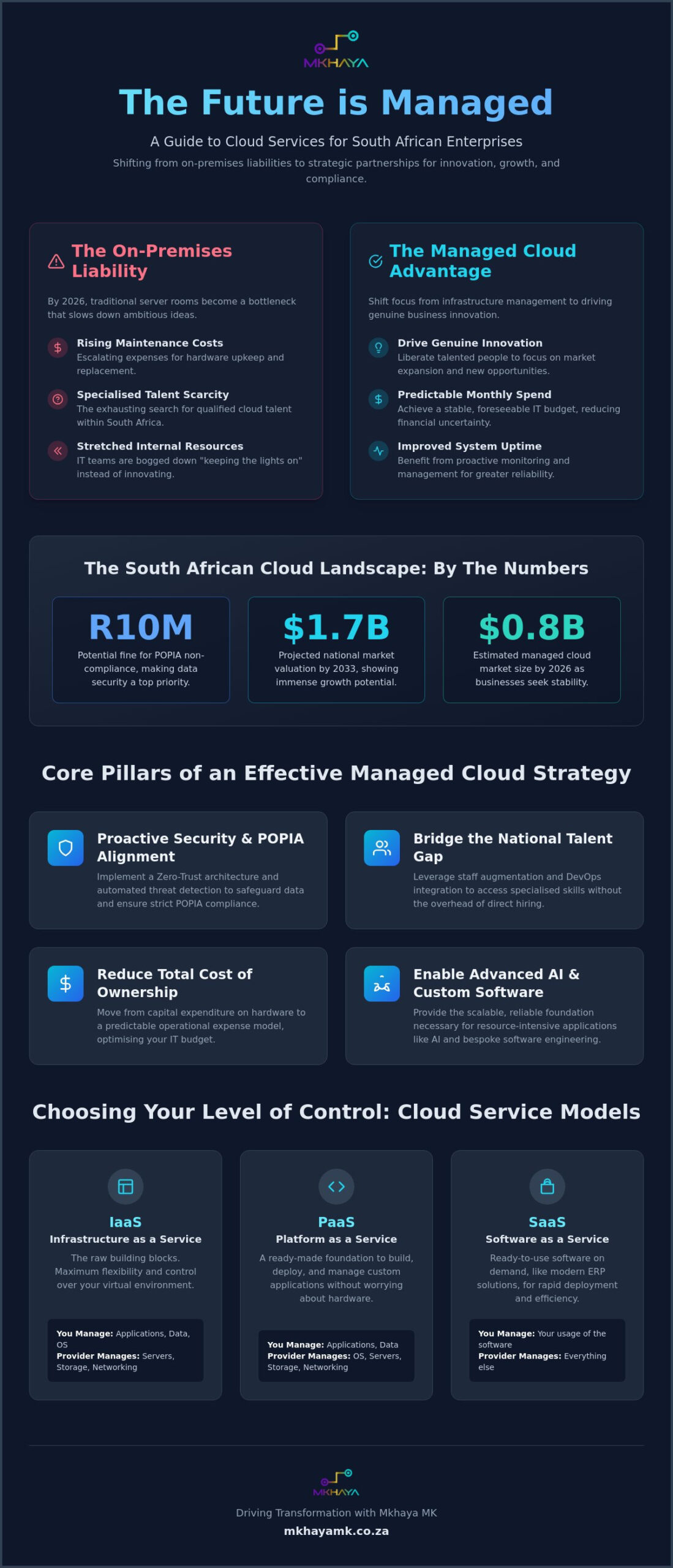
By 2026, the traditional server room isn’t just a cost centre; it’s a liability that slows down your most ambitious ideas. You’ve likely felt the pressure of rising hardware maintenance costs and the exhausting search for specialised cloud talent within our borders. It’s frustrating to watch your digital goals stall because your internal resources are stretched thin. Embracing managed cloud services south africa allows you to shift your focus from keeping the lights on to driving genuine innovation. We understand that you’re looking for more than just a vendor; you need a partner who values your long-term stability as much as you do.
This guide explores how modern cloud strategies empower South African enterprises to scale securely whilst maintaining strict POPIA compliance. With the Information Regulator now actively enforcing transborder data flow provisions and issuing fines of up to R10 million, the stakes for your digital architecture have never been higher. We’ll show you how to achieve a predictable monthly IT spend and improved system uptime through methodical execution. You’ll discover a clear roadmap for digital transformation that integrates AI and custom software, ensuring your business remains agile as the national market grows toward a projected USD 1.7 billion valuation by 2033.
Key Takeaways
- Understand why transitioning from legacy on-premises hardware to a strategic partnership is essential for scaling your enterprise in the 2026 market.
- Learn to implement a security-first architecture that ensures robust POPIA compliance whilst protecting your critical data assets.
- Discover how to bridge the national talent gap and reduce total cost of ownership by leveraging staff augmentation and DevOps integration.
- Explore how managed cloud services south africa provide the necessary foundation for advanced AI integration and custom software engineering.
- Identify the criteria for selecting a visionary partner who can align cloud infrastructure with your long-term digital transformation goals.
Understanding Managed Cloud Services in the South African Landscape
Managed cloud services in South Africa represent more than just a technical handover. They’re a collaborative commitment to your business’s future. Instead of merely renting space on a server, you’re engaging in a partnership that oversees the administration, security, and optimisation of your entire digital ecosystem. This comprehensive approach to cloud management allows your leadership team to stop worrying about hardware lifecycles and start focusing on market expansion.
The trend is clear. Local enterprises are rapidly moving away from the heavy burden of on-premises servers. Maintaining physical infrastructure in our current economic climate is often inefficient and risky. By 2026, the South African managed cloud market has grown to an estimated USD 0.8 billion as businesses seek the stability that only a professional service provider can offer. This shift provides a stable anchor, allowing your organisation to remain resilient despite a volatile technological environment.
To better understand this concept, watch this helpful video:
Reliability is the cornerstone of this transition. In a landscape where the Information Regulator can issue fines of up to R10 million for POPIA non-compliance, data sovereignty is no longer optional. The SITA Cloud Framework Agreement 2.0 has already set a high standard for government departments regarding data residency. Private enterprises are following suit, choosing cloud solutions that keep sensitive information within our borders whilst ensuring seamless global connectivity.
The Shift from Maintenance to Innovation
Your IT department shouldn’t spend its days ‘keeping the lights on’. When you offload the routine tasks of patching and monitoring, you liberate your most talented people. This shift is the heart of digital transformation. It’s about building a business that’s agile enough to respond to new opportunities instantly. We see this as an aspirational journey where technology becomes an enabler of growth rather than a bottleneck.
Cloud Service Models: IaaS, PaaS, and SaaS Explained
Understanding the different layers of the cloud helps you choose the right level of control. Infrastructure as a Service (IaaS) provides the raw building blocks, giving you maximum flexibility over your virtual environment. For those focused on software engineering, Platform as a Service (PaaS) offers a refined foundation to build and deploy custom applications without managing the underlying hardware. Finally, Software as a Service (SaaS) allows for the rapid deployment of essential business tools, such as modern ERP solutions, ensuring your operations remain precise and efficient from day one.
The Core Pillars of an Effective Managed Cloud Strategy
A successful cloud strategy relies on more than just high-speed connectivity. It requires a methodical foundation built on four critical pillars. These pillars ensure that your transition to the cloud isn’t just a relocation of data, but a fundamental upgrade of your operational capability. By focusing on these core areas, enterprises can achieve the long-term stability and precision that modern markets demand. When these elements work in harmony, technology becomes a silent partner in your business success.
Proactive Security and POPIA Alignment
Security is the most vital component of any digital framework. For South African enterprises, this means implementing automated threat detection and sophisticated identity management to safeguard sensitive information. Zero-trust architecture represents the gold standard for 2026, requiring every user and device to be verified before accessing any network resource. This rigorous approach ensures that data residency requirements are met within national borders. It effectively mitigates the legal risks associated with transborder information flows, keeping your reputation secure.
DevOps and Continuous Improvement
Operational stability shouldn’t come at the expense of speed. Integrating DevOps services into your managed environment allows for faster software delivery cycles without compromising reliability. This methodology fosters a culture of collaboration between technical teams and business stakeholders. Automated testing and deployment pipelines reduce human error, ensuring that every update adds value to the end-user experience. It’s a forward-looking way to maintain an agile presence in a competitive market.
Avoiding “cloud sprawl” is essential for maintaining a predictable monthly IT spend. As noted in the SA Cloud Market Report 2025, the local market’s maturity has led to a greater emphasis on proactive resource management. Effective managed cloud services south africa provide the oversight needed to ensure resources grow only when demand dictates. This cause-and-effect logic prevents unnecessary costs whilst guaranteeing that your systems perform at their peak during critical periods.
Performance is not just about speed; it’s about consistency. A well-managed strategy utilises real-time monitoring to identify potential bottlenecks before they impact your users. This level of precision ensures that your custom applications and legacy systems operate in perfect harmony. When performance is guaranteed, your business can scale with confidence. You’ll know that your infrastructure will support your ambitions without hesitation or technical debt. If you’re ready to build a more resilient foundation, our team can help you design bespoke cloud solutions that align with your specific growth targets.
Evaluating the Business Case: Managed Services vs In-House Management
Deciding between an internal team and a managed partner is a pivotal strategic choice. Whilst an in-house team offers direct control, the Total Cost of Ownership (TCO) often exceeds initial projections. You aren’t just paying salaries; you’re funding continuous training, recruitment, and the overhead of managing complex systems. Choosing managed cloud services south africa transforms these unpredictable variables into a steady, predictable monthly operational expenditure (OpEx). This financial clarity allows for more precise budgeting and long-term planning, ensuring that your IT spend directly supports your business growth.
Investing in managed cloud services south africa isn’t just a technical decision; it’s a commitment to operational excellence. Risk mitigation is another decisive factor. When you manage infrastructure internally, the entire burden of uptime rests on your shoulders. A managed service provider shares this responsibility, offering service level agreements that guarantee reliability. This collaborative approach ensures that system maintenance happens behind the scenes, allowing your business to remain operational without constant internal intervention.
Bridging the Skills Gap Nationally
The national market is currently facing a significant hurdle: a shortage of specialised technical talent. Finding and retaining high-end cloud engineers is both difficult and expensive. By utilising staff augmentation, you gain instant access to a pool of experts who understand the nuances of modern architecture. This eliminates the “single point of failure” risk, where a single departure can leave your entire digital operation vulnerable. Instead, you benefit from a collective expertise that is always available and constantly evolving.
Hidden Costs of Self-Managed Infrastructure
Self-managed infrastructure often carries substantial hidden costs that don’t appear on a standard balance sheet. Power, cooling, and the physical security of on-site hardware require constant investment and oversight. Additionally, the cost of downtime in an unmanaged environment can be devastating, especially when disaster recovery processes are slow or untested. Transitioning to the cloud removes these physical burdens. To understand how to refine these expenses further, explore our insights on Cloud Cost Optimisation in South Africa. This strategic shift ensures that every Rand spent contributes to a more agile and resilient enterprise.
Selecting the Right Managed Cloud Partner: A National Framework
Choosing a partner for your digital journey is a high-stakes decision that requires a framework prioritising long-term compatibility over short-term savings. In the evolving landscape of 2026, a provider must offer more than just basic server management. You need a team that demonstrates deep technical expertise whilst maintaining a focus on your specific business outcomes. Evaluating a provider’s track record in digital transformation consulting is essential to ensure they can guide you through complex transitions without disrupting your daily operations.
Industry-specific experience remains a vital differentiator. Whether you operate in financial services, where the COFI Bill has introduced stringent new standards, or in the fast-paced logistics sector, your partner should understand your unique regulatory and operational hurdles. Reliable managed cloud services south africa are built on a collaborative, partnership-based engagement model. This approach ensures that the service provider acts as an extension of your own team, sharing the responsibility for your success and providing a stable anchor as you navigate new market opportunities.
Strategic Alignment and Vision
A strategic guide does more than fix problems; they anticipate your future needs. It’s important to ensure your partner understands your business trajectory for the next three to five years. This alignment allows them to suggest refinements to your architecture before bottlenecks occur. When assessing potential partners, look closely at their methodology for custom software development. A provider that understands how to build and manage applications in a cloud-native environment will offer far more value than a traditional hosting vendor.
Support and Reliability Standards
Service Level Agreements (SLAs) are the foundation of trust, but you must understand what they actually guarantee. Look for commitments that cover not just uptime, but also performance and response times. National support teams offer a distinct advantage here. They understand the local business context, including the specific connectivity and infrastructure challenges unique to our region. Ask detailed questions about their disaster recovery and business continuity planning. A partner who can demonstrate methodical execution in these areas provides the quiet confidence you need to scale. If you’re looking for a partner who values transparency and precision, we invite you to connect with our team to discuss your specific requirements.
Beyond Hosting: Driving Transformation with Mkhaya MK
Cloud technology shouldn’t be a passive storage space. Instead, it should serve as the high-performance engine that drives your most innovative software projects forward. At Mkhaya MK, we move beyond simple maintenance to integrate bespoke cloud solutions with our deep expertise in custom software engineering. This synergy ensures that your infrastructure isn’t just supporting your applications; it’s actively enhancing their performance. Our approach is rooted in methodical execution, providing a transparent partnership that values your long-term stability over short-term technical fixes.
Scaling proprietary systems requires a platform that can handle complex logic and high transaction volumes without hesitation. Whether you’re deploying our loan management systems or modernising your enterprise resource planning through ERP solutions, the cloud provides the necessary elasticity. We ensure that these critical tools remain responsive as your user base grows. By choosing managed cloud services south africa from a partner who understands the full software lifecycle, you avoid the friction often found between separate hosting and development vendors.
Cloud-Native Application Development
Building applications that are designed to thrive in the cloud from day one is essential for modern business agility. We focus on minimising latency for national users, ensuring that your digital services feel fast and reliable regardless of their location. This technical precision is complemented by our commitment to superior UI/UX design. When your backend infrastructure is perfectly aligned with a polished user interface, the result is a seamless digital experience that drives engagement and builds trust with your clients.
The Future of Automation in the Cloud
The next frontier of business efficiency lies in AI and data automation. We leverage robust cloud infrastructure to power robotic process automation (RPA) and AI-driven workflows that transform how you handle data. Cloud scalability is the prerequisite for AI automation solutions, as these advanced tools require significant computational power that can be adjusted in real time. This flexibility allows you to experiment with automation without the heavy upfront costs of physical hardware.
Beginning your cloud journey doesn’t have to be an overwhelming process. It starts with a clear vision and a partner who can translate that vision into a concrete technical roadmap. We invite you to move beyond the limitations of legacy systems and embrace a future built on precision and growth. Our team is ready to guide you through a strategic consultation to identify the most impactful opportunities for your business. Let’s build a foundation that doesn’t just keep up with the market, but sets the pace for others to follow.
Building Your Digital Future with Confidence
The journey toward a cloud-native enterprise is a strategic evolution that requires more than just technical migration. It’s about securing your data in alignment with national POPIA standards and transforming unpredictable maintenance costs into a stable, value-driven OpEx model. By prioritising a security-first architecture and embracing DevOps, your business can finally move beyond the daily struggle of hardware upkeep. This transition creates the necessary space for high-end innovation, such as AI-driven automation and bespoke software development.
Choosing the right managed cloud services south africa ensures that your infrastructure becomes a reliable foundation for growth rather than a bottleneck. At Mkhaya MK, we combine our end-to-end digital transformation expertise with a methodical and transparent execution process. Our national reach and specialised technical teams are dedicated to your long-term success. We invite you to partner with Mkhaya MK for strategic managed cloud services that align with your unique business vision. Let’s work together to build a resilient, forward-looking organisation that’s ready for every opportunity 2026 has to offer.
Frequently Asked Questions
What are managed cloud services and how do they differ from standard hosting?
Managed cloud services involve a strategic partnership where a provider oversees the administration, security, and optimisation of your cloud infrastructure. Standard hosting typically provides only the raw space or server access, leaving the maintenance and security to your internal team. By choosing a managed model, you gain a dedicated partner who ensures your environment remains stable and aligned with your business goals.
Is my data safe and POPIA compliant in a managed cloud environment?
Data safety is a primary benefit of a professionally managed environment. Providers implement a security-first architecture that includes automated threat detection and zero-trust protocols. To ensure POPIA compliance, these services maintain data residency within national borders. This methodical approach protects your organisation from the legal risks associated with unauthorised transborder data flows.
How do managed cloud services help in reducing overall IT costs?
These services reduce costs by transforming unpredictable capital expenses into a fixed monthly operating model. You’ll avoid the high costs of maintaining on-premises hardware and the difficulty of recruiting expensive, specialised cloud talent. Proactive resource management also prevents “cloud sprawl”, ensuring you don’t pay for unused capacity whilst your systems scale only as demand dictates.
Can managed cloud services support custom software and legacy applications?
Yes, modern cloud solutions are built to integrate seamlessly with both custom software and legacy systems. By utilising Platform as a Service (PaaS) models, providers can create secure environments that allow older applications to function with modern scalability. This ensures that your existing technical investments continue to provide value whilst you transition toward cloud-native architectures.
What is the role of DevOps within managed cloud solutions?
DevOps serves as the essential bridge between software development and operational stability. It introduces automated testing and deployment cycles, which significantly reduces the risk of human error during updates. This collaborative approach ensures that your custom applications are delivered faster and remain reliable, fostering a culture of continuous improvement across your technical ecosystem.
How quickly can a business migrate to a managed cloud environment?
The speed of migration depends on your architecture’s complexity, but a phased approach often produces tangible results within weeks. A reliable partner will start with a thorough audit to identify the most critical systems for transition. This methodical execution ensures that your business remains operational throughout the process, preventing downtime whilst you move toward a more agile infrastructure.
What should I look for in a managed cloud service provider in South Africa?
You should prioritise a partner with end-to-end digital transformation expertise and a transparent engagement model. It’s vital to choose a provider with national support teams that understand the local infrastructure and regulatory context. Look for a track record in your specific industry to ensure they can navigate the unique operational hurdles your business faces.
Does Mkhaya MK provide support for both public and private cloud environments?
We specialise in managing hybrid environments that leverage the strengths of both public and private cloud architectures. Our focus is on ensuring that your specific managed cloud services south africa strategy provides the stability and scalability required for your custom software and AI-driven automation projects. We act as a visionary guide, ensuring your infrastructure supports your long-term business trajectory.