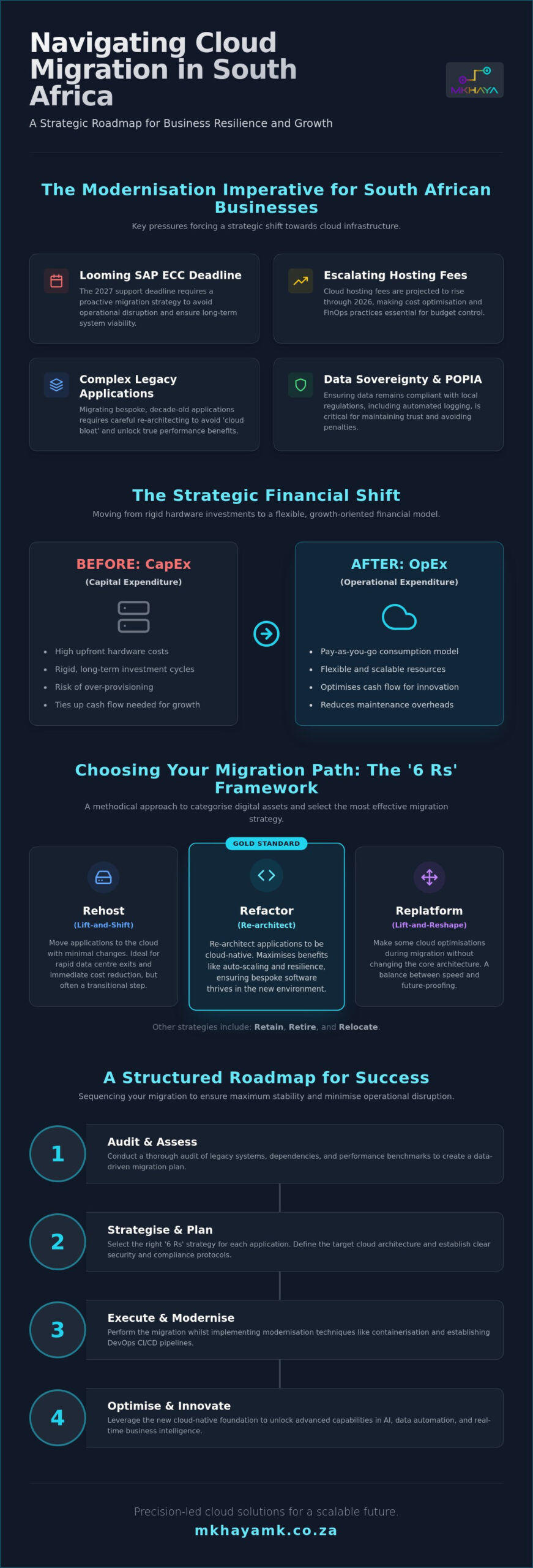
With the SAP ECC support deadline looming in 2027 and cloud hosting fees projected to rise throughout 2026, is your business infrastructure built for long-term resilience or merely for survival? Many South African organisations find themselves caught between the desire for agility and the heavy weight of high upfront hardware costs. You’re likely concerned about the complexity of migrating bespoke legacy applications whilst ensuring your data remains compliant with the latest POPIA automated log requirements. We understand that this transition feels like a high-stakes evolution rather than a simple IT project.
Choosing the right cloud migration services south africa provides a path to turn these challenges into a competitive advantage. This strategic guide explores how to seamlessly transition your business infrastructure to the cloud whilst optimising costs and ensuring absolute data sovereignty. We will explore the shift towards hybrid cloud models, the necessity of FinOps to manage escalating hosting costs, and the precise engineering required to modernise your software for a scalable future. By aligning your digital transformation with local regulatory shifts, you can build a stable, secure foundation that grows alongside your ambitions.
Key Takeaways
Understand the strategic shift from high upfront hardware costs to flexible operational models that optimise cash flow and support sustainable growth.
Select the most effective strategy for your business by exploring the ‘6 Rs’ framework, ensuring your choice of cloud migration services south africa aligns with your technical goals.
Master the nuances of POPIA compliance and data sovereignty to maintain trust and meet evolving regulatory requirements in the local landscape.
Follow a structured roadmap for auditing legacy systems and sequencing your migration to ensure maximum stability whilst minimising operational disruption.
Leverage your new cloud-native foundation to unlock advanced capabilities in AI and data automation for enhanced real-time intelligence.
What are Cloud Migration Services in the South African Business Context?
Cloud migration is the strategic process of relocating your digital assets, databases, and core applications into a virtualised environment. In South Africa, this isn’t merely a technical shift; it represents a fundamental pillar of digital transformation. Rather than viewing it as a simple file transfer, forward-thinking firms see it as an opportunity to refine their software architecture and build a more agile business foundation. Using professional cloud migration services south africa allows local enterprises to move away from the restrictive cycle of purchasing and maintaining physical hardware.
The transition from capital expenditure (CapEx) to operational expenditure (OpEx) is particularly vital for local firms managing fluctuating market conditions. By moving away from heavy upfront hardware investments, businesses can allocate resources more precisely toward growth and innovation. This bespoke approach ensures that your migration plan respects the unique requirements of the local market, including specific regulatory hurdles and infrastructure constraints.
To better understand the practicalities of this transition, watch this helpful overview:
Selecting the correct framework is the most critical step in your digital journey. While some providers offer a one-size-fits-all approach, effective cloud migration services south africa rely on the ‘6 Rs’ framework to categorise digital assets based on their future value. These strategies include Rehosting, Replatforming, Refactoring, Retiring, Retaining, and Relocating. This methodical approach ensures that resources aren’t wasted on obsolete systems whilst prioritising the applications that drive your revenue.
Rehosting, often called ‘Lift-and-Shift’, serves as the fastest route to the cloud. It involves moving your existing applications and data to a cloud environment without making significant changes to the underlying code. This path is ideal for businesses needing to exit a data centre quickly or those looking to reduce immediate hardware costs. However, it’s often a transitional phase rather than a final destination. Recent research on cloud adoption highlights that South African firms often struggle to see long-term ROI if they rely solely on rehosting without eventually modernising their stack.
For businesses with unique requirements, Refactoring stands as the gold standard. This involves re-architecting your applications to be cloud-native, allowing them to take full advantage of cloud features like auto-scaling and high availability. At Mkhaya MK, we leverage our software engineering expertise to ensure that your bespoke applications don’t just survive the move but thrive in their new environment. This precision-led approach protects the integrity of your logic whilst preparing it for a scalable future.
Modernising Legacy Applications
Moving a decade-old bespoke application directly into the cloud often results in ‘cloud bloat’, where performance stays stagnant while costs rise. True modernisation involves containerisation and microservices. This allows your software to scale individual components independently, making the system more resilient. We focus on maintaining application integrity through precise engineering, ensuring that your users experience a seamless transition without losing the familiarity of their existing UI/UX. If you’re looking for a partner to guide this technical evolution, exploring our cloud solutions can help define the most efficient path forward.
The Role of DevOps in Migration
DevOps is the engine of a successful move. By automating deployment cycles, we eliminate the risks associated with manual configuration and human error. Implementing Continuous Integration and Continuous Deployment (CI/CD) means your infrastructure evolves alongside your business needs. Managed DevOps services provide the long-term stability required to manage complex cloud environments, allowing your internal teams to focus on innovation rather than maintenance. This creates a rhythmic momentum where software updates are frequent, reliable, and invisible to the end-user.
Navigating South African Cloud Challenges and Regulations
South Africa’s regulatory environment demands a methodical approach to data management. When you engage with cloud migration services south africa, compliance isn’t just a tick-box exercise; it’s a commitment to your customers’ privacy. The Protection of Personal Information Act (POPIA) has evolved, and as of 2026, the Information Regulator requires organisations to provide automated logs of data deletion. This ensures that personal information is only retained as long as necessary, a task that becomes significantly more manageable within a well-engineered cloud environment.
Data sovereignty remains a top priority for local enterprises, especially those in the financial and public sectors. Ensuring your business data stays within South African borders is no longer a hurdle, thanks to the established presence of global hyperscale regions in Johannesburg and Cape Town. These local data centres provide the low-latency connectivity required for high-performance applications whilst satisfying legal requirements for data residency. This proximity reduces the risks associated with international data transfers and ensures your operations remain stable regardless of global connectivity fluctuations.
Currency volatility and rising global demand for AI infrastructure often lead to unpredictable hosting fees. South African firms must account for these variables to avoid the common pitfall of “cloud bill shock.” By partnering with local experts who understand the nuances of the South African economy, you can build a more resilient financial model for your IT operations. This involves balancing the need for global innovation with the practicalities of local cost management.
Security and Compliance in a Virtual Environment
Adopting a zero-trust architecture during your migration phase ensures that every access request is fully authenticated and authorised. This approach treats all traffic as potentially hostile, regardless of whether it originates inside or outside your network. Effective identity and access management (IAM) protocols allow you to control exactly who interacts with sensitive corporate data. Regular auditing and automated reporting become your primary tools for demonstrating compliance to South African regulators, providing a transparent and reliable record of your data handling practices.
Cost Optimisation Strategies
Meticulous resource monitoring is the only way to prevent “cloud sprawl,” where unused or over-provisioned resources inflate your monthly bill. Leveraging local expertise helps you select the most cost-effective service tiers tailored to your specific traffic patterns. For a deeper look at managing your expenses, read our guide on Cloud Cost Optimisation in South Africa. This proactive financial management ensures your scalable infrastructure remains a strategic asset rather than a growing liability.
A Step-by-Step Roadmap for Successful Migration
A successful digital evolution relies on a methodical sequence of events rather than a single leap. When searching for cloud migration services south africa, it’s essential to find a partner that values precision over speed. Our roadmap is designed to protect your operational continuity whilst modernising your core systems. It begins with a deep understanding of your current environment and ends with a refined, high-performance cloud ecosystem.
Strategic Planning follows the initial audit, where we map out the migration sequence. We prioritise systems based on their business criticality to ensure that your most vital services are handled with the highest level of care. This planning phase acts as a blueprint, preventing the common pitfalls of overlapping dependencies and resource bottlenecks that often plague unplanned moves.
Phase 1: The Technical Audit
The journey starts with a comprehensive assessment of your current infrastructure. We don’t just look at servers; we assess the complex web of software dependencies that keep your business running. This phase includes:
Identifying ‘low-hanging fruit’, which are applications that offer high value with low migration complexity.
Mapping interdependencies between custom applications and their respective databases.
Assessing the readiness of legacy code for a cloud-native environment.
For more complex phases where your internal team might be stretched, we often recommend staff augmentation to provide the specialised engineering capacity required for high-intensity migrations. This ensures that your daily operations never suffer while your infrastructure evolves under the guidance of experts.
Phase 2: Execution and Cutover
Once the blueprint is finalised, we move into Execution and Cutover. We always implement a pilot migration to test our assumptions in a controlled environment. This allows us to refine data synchronisation strategies, ensuring zero data loss during the final move. The ‘cutover’ window is managed with surgical precision to keep business disruptions to an absolute minimum, often occurring during low-traffic periods to protect the user experience.
The final stage of Optimisation is where the true value of the cloud is realised. We don’t just leave you with a working system; we fine-tune the environment to ensure your resource consumption matches your actual needs. This reduces waste and ensures your scalable infrastructure remains as lean and efficient as possible. If you are ready to begin your technical audit, contact our engineering team today to discuss your roadmap.
Beyond Migration: Leveraging AI and Custom Cloud Solutions
Completing your move is just the beginning of a larger journey toward operational excellence. While many providers treat the cutover as the end of the engagement, the most successful firms view it as the vital foundation for future innovation. By selecting comprehensive cloud migration services south africa, you create the high-performance environment necessary to deploy advanced AI and data automation. This infrastructure allows your business to process vast amounts of information in real-time, turning raw data into actionable business intelligence that drives decision-making.
Modern cloud-native applications don’t just store data; they facilitate sophisticated, automated workflows that scale with your ambitions. We specialise in customising these environments to support complex, industry-specific platforms that require high levels of precision. Whether you’re running an integrated ERP solution or a high-volume Loan Management System, your cloud environment should be precision-engineered to match your unique operational rhythm. This level of customisation ensures that your technology supports your business goals rather than forcing you to adapt to rigid software constraints.
Building AI-Ready Infrastructure
Preparing for machine learning requires more than just basic storage. It involves constructing structured data lakes within the cloud that allow models to access high-quality information without latency. Once this foundation is stable, cloud-based Robotic Process Automation (RPA) can be used to automate routine business tasks, freeing your team for more strategic, creative work. For a deeper look at how these technologies are reshaping the local market, see our guide on AI Automation Solutions in South Africa.
Why Mkhaya MK is the Strategic Choice
Choosing Mkhaya MK means partnering with a team that values your long-term success as much as you do. Our national footprint across South Africa allows us to understand the specific challenges of local enterprise resilience, from energy constraints to regulatory shifts. We don’t just provide cloud migration services south africa; we offer a supportive partnership rooted in software excellence and methodical execution. We invite you to consult with us on a bespoke digital transformation strategy that turns your vision into a stable, scalable reality. Together, we can build a future that’s both technologically advanced and grounded in practical business results.
Building Your Scalable Future in the Cloud
Transitioning your infrastructure is a strategic evolution that requires more than just technical execution; it demands a visionary approach to software integrity and regulatory resilience. By choosing specialised cloud migration services south africa, you ensure that your bespoke legacy systems are refactored for modern performance whilst maintaining strict POPIA compliance. This methodical shift doesn’t just reduce operational costs; it creates the stable, AI-ready foundation your business needs to thrive in a competitive landscape.
We’ve explored how a structured roadmap and the right migration framework can turn complex technical challenges into long-term assets. Mkhaya MK provides the national support and consulting expertise required to navigate this journey with quiet confidence. Our focus remains on your mutual success, ensuring that every step of your digital transformation is precise and purposeful. It’s time to scale your business with Mkhaya MK’s Cloud Solutions and embrace a partnership built on reliability. Your future in the cloud is bright, and we’re ready to help you build it.
Frequently Asked Questions
What are the primary benefits of cloud migration for South African businesses?
Cloud adoption allows South African businesses to move from heavy capital expenditure to a flexible operational model. This shift provides immediate access to scalable infrastructure that grows with your business needs. Additionally, migrating protects your operations from local infrastructure instability, ensuring your data remains accessible and secure regardless of power or connectivity challenges at your physical premises.
How long does a typical cloud migration project take to complete?
The timeline for a migration project depends on the complexity of your digital estate and the volume of data involved. A small-scale migration might take several weeks, whereas a full-scale enterprise transition involving bespoke applications can span several months. We focus on a methodical approach that prioritises stability, ensuring each phase is thoroughly tested before proceeding to the next stage of the roadmap.
Is my data secure in the cloud according to POPIA regulations?
Data remains secure and compliant with POPIA regulations when you utilise cloud migration services south africa that prioritise local data residency. By hosting your data in South African hyperscale regions, you satisfy legal requirements for sovereignty whilst benefiting from global security standards. We implement zero-trust architectures and automated deletion logs to ensure your compliance remains robust and transparent to regulators.
What is the difference between a ‘lift-and-shift’ and a ‘refactoring’ strategy?
Lift-and-shift, or rehosting, involves moving your existing software to the cloud without changing its code, which is ideal for a rapid exit from physical hardware. Refactoring is a more sophisticated strategy where we re-architect applications to be cloud-native. This gold-standard approach ensures your custom software takes full advantage of cloud features like auto-scaling, leading to better long-term performance and lower operational costs.
How can we avoid downtime during the migration process?
Minimising downtime is achieved through phased execution and rigorous pilot testing in controlled environments. We synchronise data in the background and only perform the final cutover during low-traffic windows to protect your business continuity. This precision-led strategy ensures that your users experience a seamless transition without any significant disruption to their daily workflows or access to critical services.
What are the hidden costs of cloud migration that I should plan for?
Planning for hidden costs involves looking beyond the monthly hosting fee to account for data egress charges and initial resource over-provisioning. You should also consider the investment required for staff training and the potential for “cloud sprawl” if resources aren’t actively monitored. Using professional cloud migration services south africa helps you identify these variables early, allowing for a more accurate and predictable financial model.
Can my custom-built legacy software be moved to the cloud?
Bespoke legacy applications can certainly be moved to the cloud through a process of containerisation and software re-engineering. We specialise in refactoring these systems to ensure they remain functional and performant in a virtualised environment. This allows you to retain the unique logic of your custom software whilst gaining the scalability and security benefits of modern cloud infrastructure.
Do I need to hire new staff to manage our cloud infrastructure?
You don’t necessarily need to hire new full-time employees to manage your new environment. Many organisations choose to use managed DevOps services or staff augmentation to fill specific skill gaps during and after the transition. This approach provides access to expert engineering talent without the long-term overhead of permanent hires, allowing your existing team to focus on their core business objectives.
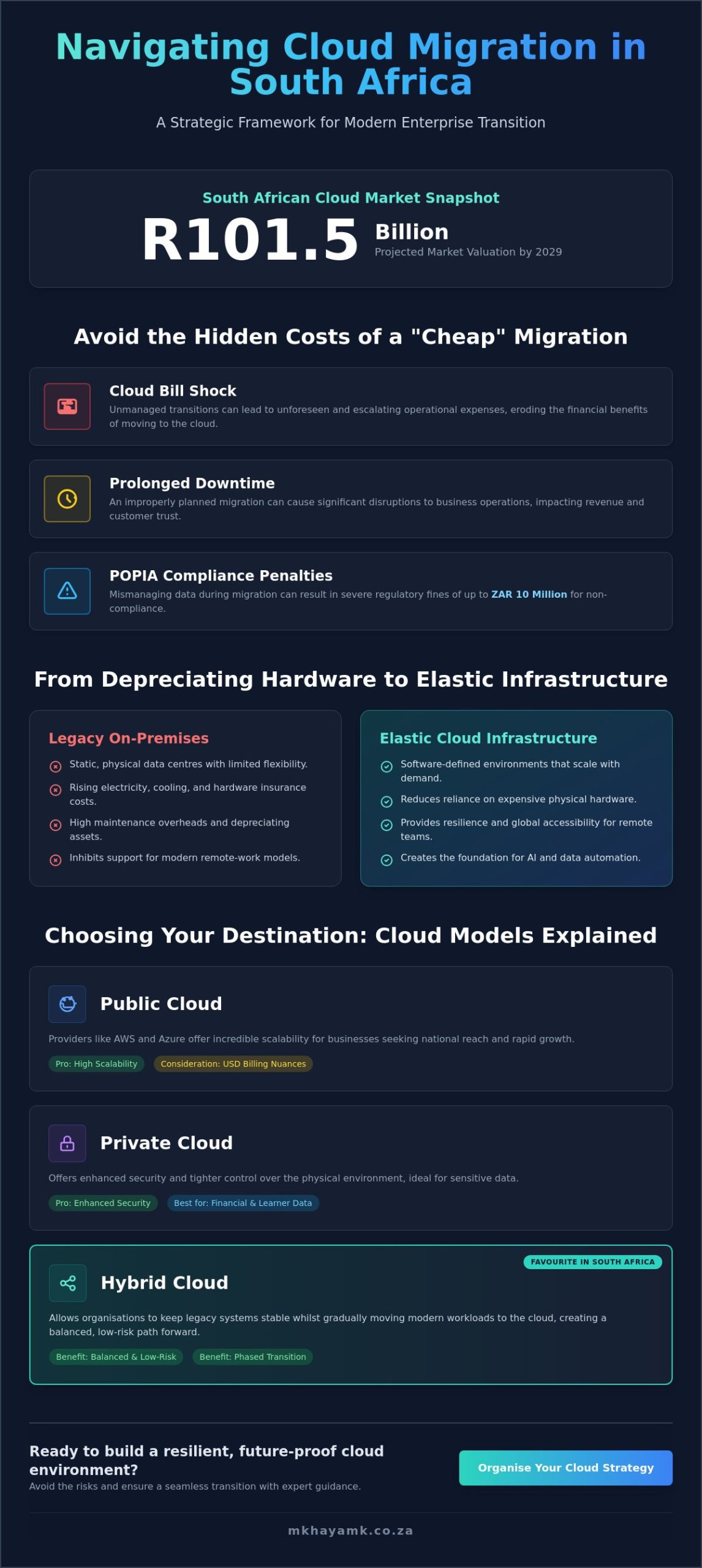
What if the biggest risk to your digital transformation isn’t the technology itself, but the hidden cost of a “cheap” migration strategy? As the local market matures toward a projected R101.5 billion valuation by 2029, many organisations find themselves caught between the promise of agility and the reality of “cloud bill shock.” You likely recognise that moving to the cloud is no longer optional, yet the fear of prolonged downtime or a ZAR 10 million POPIA penalty remains a heavy burden for leadership teams. Selecting the right cloud migration services in South Africa has become a delicate balance of technical precision and financial foresight.
We’ve designed this guide to help you master these complexities with a framework that prioritises long-term stability over quick fixes. You’ll learn how to navigate the evolving FSCA regulations, manage ZAR-based billing fluctuations, and ensure your data remains sovereign within local borders. By following this strategic roadmap, you can transition to a resilient environment that scales automatically, reduces your reliance on depreciating hardware, and ensures zero data loss during the shift.
Key Takeaways
Understand the transition from depreciating physical hardware to elastic, software-defined environments that support modern business growth.
Learn to apply the “6 Rs” framework to ensure your chosen migration strategy aligns with your specific budgetary and operational objectives.
Discover why partnering with professional cloud migration services in South Africa is essential for avoiding the security risks and hidden costs associated with unmanaged transitions.
Master a phased roadmap that prioritises discovery, rigorous governance, and full POPIA compliance to protect your organisation’s data integrity.
Explore how post-migration DevOps practices move your focus from simple maintenance to continuous innovation and accelerated software delivery.
Navigating the Cloud Migration Landscape in South Africa
Cloud migration in the modern South African enterprise is no longer just a technical tick-box exercise. It’s a strategic re-engineering of how your business functions. This shift replaces static, physical data centres with elastic, software-defined infrastructure that breathes with your operational demands. By mid-2026, the urgency to decommission legacy on-premises hardware has intensified. Rising electricity costs and the surge in global demand for AI infrastructure have made local server maintenance a financial liability rather than an asset. Transitioning to professional cloud migration services in South Africa ensures your organisation isn’t left behind as hardware depreciates and maintenance overheads climb.
To better understand this concept, watch this helpful video:
Data sovereignty remains a primary pillar of any local migration strategy. With the Protection of Personal Information Act (POPIA) fully enforceable, the Information Regulator has sharpened its focus on data breach reporting and compliance. Mismanaging this transition carries a risk of penalties up to ZAR 10 million. Adopting cloud computing through a local lens means ensuring your data stays within South African borders where necessary, whilst still benefiting from global innovation. This approach provides the quiet confidence needed to grow without the looming threat of regulatory friction.
The Drivers of Cloud Adoption Amongst Local Enterprises
The move away from physical server rooms is driven by a mix of economic necessity and technological ambition. Escalating costs for cooling systems and hardware insurance have made the “server in the basement” model obsolete. Beyond simple cost-cutting, businesses now require the resilience to support remote-work models that demand global accessibility without latency. Crucially, modern infrastructure is the prerequisite for the next wave of AI and data automation. Without an elastic cloud foundation, your business cannot effectively process the massive datasets required for predictive analytics or automated customer service workflows.
Public, Private, and Hybrid: Choosing Your Destination
Selecting the right destination depends on your specific risk profile and growth targets. Public cloud providers like AWS and Azure offer incredible scalability for businesses seeking national reach, though billing nuances like Azure’s USD requirements for new agreements require careful financial planning. For organisations handling sensitive financial records or learner data, a Private Cloud model offers enhanced security and tighter control over the physical environment. However, the Hybrid Cloud remains the favourite amongst South African firms. It allows you to keep legacy systems stable whilst gradually moving modern workloads to the cloud, creating a balanced, low-risk path forward.
Evaluating Cloud Migration Strategies: The 6 Rs Framework
Selecting the most effective cloud migration services in South Africa begins with a nuanced understanding of the “6 Rs” framework. This isn’t a one-size-fits-all journey; it’s a methodical assessment of your digital estate to determine the most stable and cost-effective path forward. A phased approach is essential to avoid operational paralysis. By categorising your applications early, you can identify which systems require total transformation and which are ready for a simpler transition. This strategic clarity is supported by local insights into Cloud and Data Storage Readiness, ensuring your choice aligns with both national policy and your specific infrastructure capabilities.
Rehosting (Lift-and-Shift) vs. Replatforming
Rehosting is often the preferred route when you face an expiring data centre lease or need a rapid exit from physical hardware. It involves moving applications to the cloud with minimal changes. Whilst fast, it doesn’t always capture the full efficiency of the cloud environment. Replatforming offers a middle ground. You make minor adjustments, such as moving a database to a managed service, to leverage cloud-native features without a full recode. For South African firms, this balance often provides the best initial ROI by reducing management overhead whilst keeping migration costs predictable and manageable.
Refactoring and Rearchitecting Custom Software
Bespoke applications built for local markets often require more than a simple move. If your software wasn’t designed for the cloud, it might struggle with scalability or high egress fees. When engaging cloud migration services in South Africa for complex environments, refactoring ensures your bespoke tools are truly cloud-ready. This process involves custom software development to modernise legacy code into microservices and containers like Docker or Kubernetes. This transformation allows your applications to scale automatically during peak usage, ensuring your digital services remain responsive regardless of the load.
Repurchasing, Retaining, and Retiring
Managed Cloud Services vs. In-House Migration
Deciding between an in-house transition and partnering with experts often comes down to a choice between perceived control and actual resilience. Many South African firms initially attempt a “Do-It-Yourself” approach to save costs, only to encounter the hidden financial traps of unmanaged cloud environments. Without the specialised expertise found in professional cloud migration services in South Africa, projects often suffer from prolonged downtime or unforeseen consumption expenses. Misconfigured security settings in an unmanaged environment can lead to catastrophic data leaks, making the initial “saving” on service fees look negligible compared to the potential POPIA penalties.
Finding local cloud architects is a significant hurdle. There is a documented shortage of certified cloud skills in the country, which leads many businesses to rely on managed service providers to bridge the gap. This partnership shifts your financial model from volatile Capital Expenditure (CapEx) on hardware to predictable Operational Expenditure (OpEx). You pay for what you use, rather than investing in physical servers that lose value the moment they’re installed. It’s a move toward long-term stability that allows your team to focus on core business goals rather than maintaining infrastructure. Utilising dedicated cloud migration services in South Africa ensures that your transition is handled with the precision required for enterprise-level success.
The Strategic Advantage of Managed Cloud Services
Staff Augmentation: A Flexible Alternative
If you prefer to keep the migration project under internal leadership but lack specific technical depth, staff augmentation offers a middle ground. You can augment your internal team with specialised cloud engineers who bring best practices directly into your existing organisation. This approach allows you to scale the team up or down based on specific project milestones, such as the initial assessment or the final go-live phase. It provides the high-end expertise required for a seamless transition whilst ensuring your internal staff retains full oversight of the digital estate.
A Step-by-Step Roadmap for Enterprise Cloud Adoption
Success in the cloud isn’t accidental. It’s the result of a structured, five-phase roadmap that transforms your digital estate from a collection of silos into a cohesive, agile environment. When you partner with professional cloud migration services in South Africa, this journey follows a logical progression that mitigates risk at every turn. This methodical approach ensures that your transition is both transparent and predictable, providing the quiet confidence needed to manage complex infrastructure changes.
Phase 1: Discovery and Assessment. Meticulously mapping your entire digital estate to understand what you own and how it functions.
Phase 2: Governance and Security. Establishing the “landing zone” with strict access controls and compliance frameworks.
Phase 3: The Pilot Migration. Validating the process by moving non-critical workloads to test performance and connectivity.
Phase 4: Full-Scale Execution. Migrating your data and applications in controlled waves to maintain operational continuity.
Phase 5: Validation and Optimisation. Post-migration checks to ensure every system meets performance benchmarks and cost targets.
Moving through these phases allows for continuous refinement. It prevents the high-pressure, all-or-nothing scenarios that often lead to technical debt or security oversights. By treating the migration as a series of controlled movements, your organisation builds internal confidence whilst ensuring that each application is placed in the most efficient environment possible. This rhythmic sense of momentum is what separates a successful adoption from a mere technical transfer.
Technical Assessment and Dependency Mapping
Automated tools are your best allies during the discovery phase. They identify exactly how your applications talk to each other, revealing hidden dependencies that could cause unexpected downtime if severed. Without this level of precision, a seemingly simple move can break critical business workflows that rely on legacy database connections. Documenting the current state isn’t just about record-keeping; it’s about creating a baseline to ensure your cloud migration services in South Africa actually deliver an environment that outperforms your legacy hardware.
Establishing the Cloud Landing Zone
Before moving a single byte, we establish a secure landing zone. This is the foundation of your new infrastructure, where we set up identity and access management (IAM) and secure network tunnels. Configuring virtual private clouds (VPCs) ensures your data remains isolated and protected according to your specific governance requirements. By implementing AI-driven security monitoring from day one, we create a resilient perimeter that evolves with the threat landscape, ensuring your move is as secure as it is efficient.
Once the foundation is set, the transition moves into active execution. This phase focuses on maintaining the integrity of your data whilst shifting workloads in a way that doesn’t disrupt your daily business operations. If you’re looking for a partner to guide you through this complex technical journey, explore our engagement process to see how we ensure a seamless and stable transition for your enterprise.
Beyond the Move: Optimising Cloud Infrastructure with Mkhaya MK
Reaching your “Go-Live” date is a momentous achievement, yet it’s merely the starting line for true digital maturity. The most successful organisations don’t view a move as a one-time event; they see it as the foundation for a continuous programme of refinement. By moving beyond the initial transfer of data, you can start to extract the full value of cloud migration services in South Africa through ongoing optimisation. This phase is where your infrastructure begins to deliver on its promise of agility, allowing your business to pivot and scale with a level of precision that was previously impossible.
Implementing DevOps services in South Africa is a critical step in this ongoing journey. It allows your technical teams to accelerate software delivery cycles, ensuring that new features and security patches reach your users faster. This shift from reactive maintenance to proactive innovation is supported by cloud-native AI and machine learning tools, which provide deep business intelligence from your newly migrated datasets. Long-term stability is then maintained through proactive managed services that anticipate issues before they disrupt your operations, ensuring your cloud environment remains a reliable anchor for your growth.
The Convergence of Cloud and Custom Software
The real power of the cloud is realised when it integrates seamlessly with your business-critical tools. Adopting a modern approach to cloud application development allows you to build more resilient, scalable software that thrives in a distributed environment. This convergence is particularly effective when you integrate cloud-native features into your ERP solutions, providing real-time data access across your entire organisation. As you look toward the future, serverless architectures offer a path to even greater efficiency, where you only pay for the exact compute time your applications consume.
Partnering for Success with Mkhaya MK
At Mkhaya MK, we provide a visionary yet practical approach to cloud solutions. We understand that your journey is unique, which is why we combine deep software engineering expertise with a methodical execution of cloud migration services in South Africa. Our goal is to be your stable partner in a rapidly changing technological landscape, helping you navigate every complexity with quiet confidence. If you’re ready to move toward a more agile and resilient future, contact us today for a comprehensive cloud readiness assessment to begin your transformation.
Building a Resilient Foundation for Your Digital Future
The transition to a cloud-native environment is a journey of refinement that replaces the constraints of physical hardware with elastic, software-defined agility. By following a structured roadmap, your organisation can navigate the complexities of POPIA and local regulatory shifts whilst maintaining quiet confidence. We’ve seen that the move itself is only the beginning. True success lies in continuous optimisation and the integration of modern DevOps services south africa enterprises are increasingly adopting to accelerate delivery and strengthen security. Choosing the right partner for cloud migration services in South Africa ensures that this transformation remains stable, predictable, and aligned with your long-term business goals.
Mkhaya MK offers end-to-end digital transformation expertise with a national footprint and deep local regulatory knowledge. We specialise in custom software and AI integration, providing the technical precision required to turn your infrastructure into a visionary asset. Our team is ready to support your personal journey toward a more agile future. You can request a Cloud Readiness Assessment from Mkhaya MK to begin your methodical transition today. We’re committed to your success and look forward to building a stable, innovative partnership together.
Frequently Asked Questions
How long does a typical enterprise cloud migration take in South Africa?
A typical enterprise migration usually spans between six and twenty-four months, depending on the volume of data and the complexity of your legacy systems. Smaller, targeted transitions can often be completed within three to six months. This timeline includes the vital discovery and testing phases mentioned earlier. By following a phased approach, we ensure that your business remains operational whilst we systematically move your workloads to a more resilient and stable environment.
Is my data safe during a cloud migration, and what about POPIA compliance?
Your data is protected through encrypted network tunnels and secure landing zones that prevent unauthorised access during the shift. Regarding POPIA compliance, we prioritise local data centres within South African borders to ensure your information remains under national jurisdiction. The Information Regulator can issue penalties of up to ZAR 10 million for non-compliance; therefore, we implement strict governance frameworks from day one to mitigate these risks and ensure full legal alignment.
What are the main differences between Public, Private, and Hybrid cloud models?
Public clouds offer massive scalability and national reach through shared infrastructure, whilst Private clouds provide a dedicated environment for highly sensitive financial or learner data. Hybrid models combine both, allowing you to keep legacy systems on-premises whilst moving modern applications to the cloud. This flexibility makes Hybrid the favourite choice for South African enterprises that need to manage legacy constraints without sacrificing the benefits of agile digital transformation.
How can I accurately estimate the monthly costs of running my business in the cloud?
Accuracy in cost estimation requires a detailed analysis of your current resource consumption and an understanding of local billing nuances. Utilising cloud migration services south africa providers offer helps you implement FinOps practices to monitor usage in real-time, preventing “cloud bill shock” by ensuring you only pay for what you effectively use. You must also account for the volatility of the South African Rand against the US Dollar when planning your monthly budget. For a deeper dive into managing these expenses, our guide on cloud cost optimisation in South Africa provides actionable strategies tailored to the local economic landscape.
Do I need to rewrite all my custom software to move it to the cloud?
You don’t necessarily need to rewrite everything, as many applications can be moved using the “Lift-and-Shift” or Replatforming methods. However, bespoke software often performs better and costs less to run when it’s refactored for a cloud-native environment. This process involves making targeted adjustments to your code to leverage microservices and auto-scaling, which ensures your custom tools remain responsive and cost-effective as your business grows and your user base expands.
What is the “Lift-and-Shift” method, and when is it appropriate?
The “Lift-and-Shift” method involves moving your applications to the cloud exactly as they are with minimal changes. It’s most appropriate when you face an urgent deadline, such as an expiring data centre lease or hardware that’s reached its end-of-life. Whilst this is the fastest way to exit physical infrastructure, we typically recommend following up with optimisation phases to ensure long-term efficiency and to prevent the unnecessary consumption of cloud resources.
How does staff augmentation help during a cloud migration project?
Staff augmentation provides you with specialised cloud engineers who integrate directly into your internal team to fill specific skill gaps. This model is particularly effective for cloud migration services south africa projects, as it allows you to maintain full control whilst benefiting from external expertise and best practices. It’s an agile solution for organisations struggling to find certified cloud architects in a competitive local market, allowing you to scale your capacity as needed.
What happens to my physical hardware once the migration is complete?
Once your migration is complete, your physical hardware is typically decommissioned to eliminate maintenance and electricity costs. You might choose to repurpose specific servers for non-critical local tasks or sell the equipment to recover some residual value. Decommissioning these assets is a key step in shifting your financial model from depreciating Capital Expenditure to a more agile and predictable Operational Expenditure model that supports long-term business stability.