ERP Solutions South Africa: The Strategic Guide to Enterprise Transformation in 2026
By 2026, the traditional approach of purchasing a boxed software package has become a primary driver of operational stagnation rather than growth. Many leaders across the country find themselves trapped in a cycle of high failure rates and fragmented data that fails to reflect the reality of their business. You likely recognise the frustration of managing departments in silos whilst trying to navigate strict POPIA compliance or the updated R2.3 million VAT registration threshold. It’s a difficult position to be in when your goal is simply to build a stable, scalable organisation.
This guide empowers you to master these complexities by identifying erp solutions south africa can utilise to bridge the gap between legacy stability and AI-driven agility. We’ll show you how to transform your operations into a unified ecosystem that automates manual tasks and eliminates human error. By the end of this article, you’ll have a clear roadmap for the construction of a future-proof digital foundation that supports cloud scaling and real-time analytics; this ensures your business remains a resilient anchor in a rapidly changing technological landscape.
Key Takeaways
- Understand why modern ERP systems function as the central nervous system of your business, evolving from basic accounting tools into comprehensive platforms for digital transformation.
- Explore how modular, cloud-native architectures for ERP solutions south africa provide the flexibility to connect core operations with custom mobile and web applications via robust APIs.
- Evaluate the strategic advantage of custom-engineered modules over generic software by analysing total cost of ownership and the impact of precision-built workflows on your bottom line.
- Learn the essential phases of a successful rollout, with a specific focus on using a dedicated Discovery Phase to uncover and resolve hidden operational bottlenecks.
- Discover how integrating AI and data automation into your enterprise foundation creates a stable, scalable environment for long-term growth and consistent POPIA compliance.
Understanding ERP Solutions in the South African Context
Successful enterprise management requires more than just efficient departments; it needs a central nervous system. Modern Enterprise Resource Planning (ERP) systems provide this vital connectivity, allowing data to flow seamlessly between finance, operations, and human resources. Historically, these tools were viewed as simple accounting packages used to balance the books. Today, they’ve evolved into the foundation for full-scale digital transformation. This evolution allows you to view your entire organisation through a single, clear lens, turning raw data into strategic insight.
Implementing effective ERP solutions south africa relies on creating a unified data source that spans national operations, from Cape Town to Johannesburg. By 2026, the focus has shifted from mere record-keeping to AI-embedded resource planning. This shift allows businesses to predict market fluctuations and automate complex decision-making processes before they become bottlenecks. It’s about moving from reactive management to proactive strategy. Reliability is the new currency, and a well-constructed ERP provides the steady ground needed for that ambition.
To better understand this concept, watch this helpful video:
The Core Pillars of a Modern ERP Ecosystem
A robust suite of ERP solutions south africa rests on several critical pillars that support long-term stability. Financial management remains at the heart, offering real-time reporting that informs strategic direction and ensures VAT compliance. Beyond the ledger, supply chain and procurement optimisation have become essential for maintaining a competitive edge. Our Optimate procurement platform demonstrates how integration reduces waste and secures vendor relationships. Additionally, human capital management now incorporates integrated learner management systems. This ensures your workforce grows alongside your technology, closing the gap between human potential and digital capability.
Why South African Businesses are Modernising Now
The drive toward modernisation isn’t just about efficiency; it’s about resilience and legal necessity. Navigating POPIA requirements and data sovereignty is no longer optional for South African firms. Modern systems ensure that personal information is handled with the precision required by law, protecting both your clients and your reputation. We’re also seeing a massive move from on-premise legacy systems to managed cloud solutions. This transition helps address the local skills gap by automating repetitive tasks. By embedding automated business logic into the software, companies reduce the burden on manual entry and lower the risk of human error. This construction of a digital foundation allows your team to focus on high-value tasks that drive growth.
The Architecture of an Intelligent ERP System
Architecture determines how well your business adapts to change. In the past, monolithic systems were the norm; they were rigid, difficult to update, and isolated from other tools. Modern ERP solutions south africa now embrace a modular, cloud-native approach. This structure allows you to select specific components that fit your unique requirements without carrying the weight of unnecessary features. By utilising APIs, these systems act as a bridge, connecting core enterprise data to custom web and mobile applications that your team actually enjoys using. This connectivity ensures that a sales representative in the field has the same real-time inventory data as the warehouse manager in Durban.
Cloud-First vs. Hybrid ERP Deployments
Choosing the right deployment model is a strategic decision that affects national scalability. Cloud-first models offer the agility needed to expand across provinces rapidly, whilst hybrid models remain a viable choice for organisations processing highly sensitive local data that requires on-premise security. This balance is often seen in large-scale initiatives like the South African Government ERP projects, where data sovereignty is paramount. To maintain these complex environments, our cloud application services leverage DevOps methodologies. This ensures constant uptime and high performance, preventing the costly disruptions that often plague legacy transitions.
Integrating AI and Robotic Process Automation (RPA)
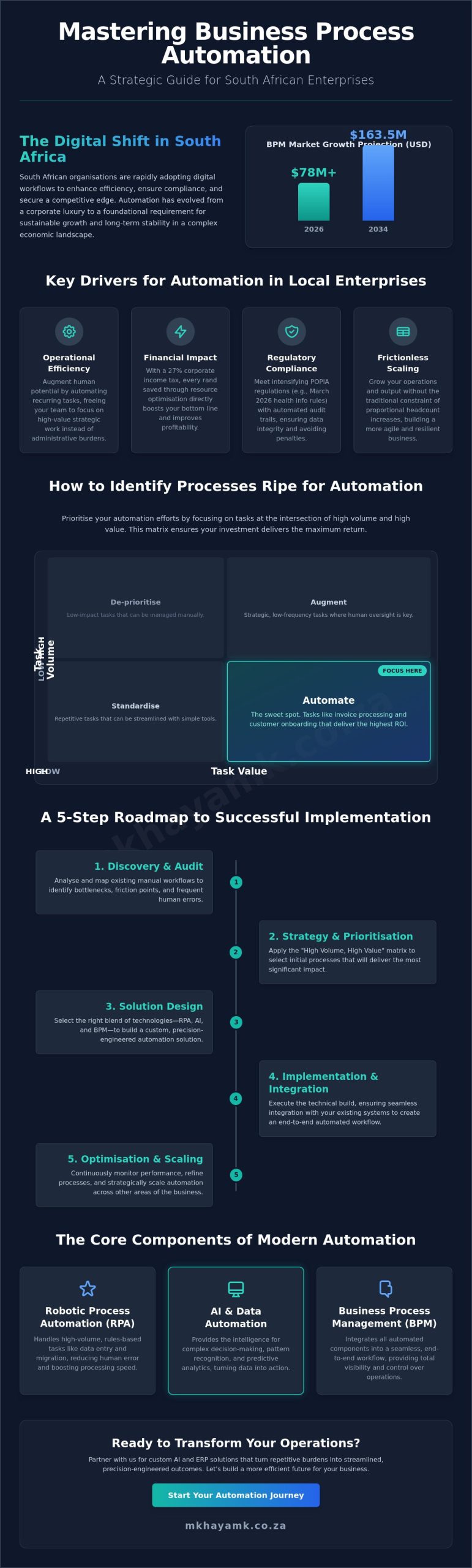
Intelligence is built through the integration of AI and data automation. By embedding RPA into your enterprise workflows, you can automate repetitive data entry and reconciliation tasks that previously consumed hours of manual labour. Mkhaya MK specialises in weaving AI & data automation into existing structures, turning static records into predictive forecasting tools. This isn’t just about speed. It’s about providing executives with real-time analytics that inform high-stakes decisions with precision. When your system can predict a stock shortage or a cash flow dip before it happens, your business gains a massive competitive advantage. This is particularly vital for South African logistics and manufacturing sectors where supply chain volatility requires instant, data-backed responses.
Adoption is the ultimate measure of success. Even the most sophisticated architecture fails if the team finds it difficult to navigate. We prioritise user-centric UI/UX design to ensure that every staff member, from the warehouse to the boardroom, can access the information they need effortlessly. If your current interface feels like a hurdle, you might consider how a refined UI/UX design service could transform your internal engagement. A stable, intuitive system doesn’t just store data; it inspires the confidence your team needs to drive the business forward.
Bespoke Customisation vs. Off-the-Shelf ERP Modules
Deciding between a pre-packaged system and a custom-built environment is a pivotal moment in your digital transformation journey. Many organisations initially gravitate towards off-the-shelf ERP solutions south africa provides because they offer a sense of immediate readiness. However, a “one size fits all” approach often leads to expensive workarounds when the software fails to align with unique local workflows. Industry reports on South Africa’s ERP market growth suggest that whilst standardisation has its place, the most resilient firms are those that prioritise flexibility to meet specific SARS and B-BBEE requirements.
The total cost of ownership (TCO) is another critical factor. Whilst off-the-shelf products might have lower initial entry points, the recurring licensing fees and per-user costs can escalate quickly as you scale. In contrast, investing in custom software engineering allows you to own the intellectual property. This shift from an expense-based model to an asset-based one provides long-term financial stability. At Mkhaya MK, we bridge this gap by tailoring existing platforms with bespoke code, ensuring your system handles niche requirements like a specialised loan management system without the bloat of unnecessary features.
When to Choose Off-the-Shelf Solutions
Pre-built modules are ideal when your requirements are strictly standardised. If your primary goal is to manage a general ledger or standard retail inventory, these systems offer rapid deployment and lower initial costs. They provide a reliable starting point for smaller enterprises that don’t yet require proprietary logic to maintain their market position. It’s a practical choice for businesses that need to get up and running quickly with proven, albeit generic, operational structures.
The Strategic Advantage of Custom ERP Engineering
True competitive edge comes from features that your rivals cannot simply buy off a shelf. Custom engineering allows you to build proprietary workflows that integrate perfectly with existing facility management systems or complex logistics chains. This approach eliminates “vendor lock-in,” giving you the freedom to evolve your ERP solutions as the South African market changes. By focusing on precision and movement, we help you construct a digital environment that isn’t just a tool, but a unique business asset that supports your specific vision for growth.
A Roadmap for Successful ERP Implementation in South Africa
Implementation is a structural evolution, not just a technical switch. Many ERP solutions south africa provides fail because they overlook the unique human and infrastructural realities of the local market. A successful journey starts with a meticulous Discovery Phase. This is where we identify the specific operational bottlenecks that hinder your progress. By understanding these friction points early, you avoid the expensive re-works that often plague generic rollouts. It’s about building a stable anchor for your future growth.
Phase 1: Strategic Alignment and Process Audit
Success requires clarity. Before writing a single line of code, we map your existing workflows to identify areas ripe for digital transformation. This involves deep consultation with stakeholders across your national departments to ensure every voice is heard. We define clear key performance indicators (KPIs) that reflect your specific business goals. This ensures the transition is purposeful and aligned with your long-term vision. It’s a methodical approach that creates a steady sense of momentum from day one.
Phase 2: Development, Integration, and Data Migration
This phase involves the technical heavy lifting of software engineering and cloud migration. Maintaining data integrity whilst moving away from legacy databases is paramount to prevent operational downtime. We prioritise UI/UX design services to ensure the platform remains intuitive for your staff. If your internal team is stretched thin, staff augmentation can provide the specialised engineering talent needed to execute this transition. This allows you to scale your technical capacity without the long-term overhead of permanent hires.
Phase 3: Training, Support, and Continuous Optimisation
Adoption is the final hurdle. We utilise a structured learner management system to ensure your staff are fully equipped to use the new tools. Post-launch, our focus shifts to continuous health checks and the iterative refinement of your automated workflows. By leveraging managed cloud services, we ensure your system remains agile and responsive to market changes. This commitment to mutual success ensures your digital foundation stays strong as your business expands.
Ready to begin your enterprise transformation with a partner you can trust? Contact our team today to schedule your initial discovery session.
Optimising Your Enterprise with Mkhaya MK
Mkhaya MK stands as a visionary partner for organisations ready to lead the next wave of digital evolution. We don’t just sell software; we construct ecosystems that bridge the gap between your current operations and your future ambitions. By integrating custom software development with advanced AI & data automation, we ensure your ERP solutions south africa are as unique as your business model. This synergy allows us to deploy proprietary tools like Optimate for procurement and MkhayaMove for logistics. These aren’t generic modules; they’re refined instruments designed to provide you with a high-end toolkit that drives both movement and long-term stability.
Our approach is rooted in the belief that technology should be an invisible enabler of your success. We invite you to explore the resources and case studies available on our website to see how these integrated systems function in real-world South African environments. Witnessing the transition from fragmented data to a unified, intelligent enterprise often provides the clarity needed to take the first step toward your own transformation.
The Mkhaya MK Difference: Engineering for South Africa
Local expertise is the cornerstone of a reliable partnership. It isn’t just about being in the same time zone; it’s about understanding the nuances of the South African regulatory environment and the specific challenges of our infrastructure. This proximity ensures faster response times and solutions that feel inherently relevant to your daily operations. Whether you require on-site support or specialised remote engineers via staff augmentation, we provide the technical depth required to maintain your competitive edge. Our commitment to integrity and methodical execution means you can trust the stability of your digital foundation as it scales across provinces.
Getting Started on Your Transformation Journey
Your path to a scalable platform begins with a simple, transparent conversation. Engaging for an initial digital transformation consultation allows us to align our expertise with your specific vision. We follow a structured process that moves from identifying your core needs to deploying a platform that supports your long-term growth. This journey is collaborative and purposeful, ensuring that every refinement we make adds tangible value to your bottom line. We’re here to act as a stable anchor whilst you navigate the complexities of modern enterprise management.
The construction of a future-proof enterprise is a significant undertaking that requires a partner invested in your personal journey. If you’re ready to move beyond generic software and build a system that truly reflects your brand’s precision, contact our team today for a bespoke assessment of your requirements.
Secure Your Future with Strategic Enterprise Transformation
Transforming your business in 2026 requires more than a standard software installation. It demands a digital foundation that acts as a central nervous system; one that integrates your financial, operational, and human capital data into a single, intelligent source of truth. We’ve explored how ERP solutions south africa can be tailored to meet local regulatory nuances whilst providing the scalability needed for national growth. By choosing custom-engineered modules over rigid, off-the-shelf packages, you ensure your technology evolves alongside your unique business logic.
Mkhaya MK is here to guide you. We specialise in custom software engineering for South African enterprises and offer a proven track record in digital transformation and AI-driven automation. Whether you need to bridge technical gaps through our flexible staff augmentation models or build a bespoke platform from the ground up, our focus remains on your long-term stability and mutual success. Let’s build a resilient digital legacy together.
Optimise your operations with Mkhaya MK’s custom ERP solutions
Frequently Asked Questions
What are the most common ERP solutions used in South Africa today?
The South African market features a robust mix of international giants and specialised local players. Common choices include SAP, Oracle NetSuite, and Microsoft Dynamics 365, alongside regional favourites like Sage and SYSPRO. Most national enterprises in 2026 prioritise cloud-first platforms that can handle specific local requirements, such as B-BBEE scorecarding and SARS tax compliance, whilst maintaining the agility to scale across different provinces.
How long does a typical ERP implementation take for a national enterprise?
A successful implementation generally spans between 6 to 18 months, depending on the complexity of your organisation. This timeline accounts for the vital Discovery Phase, data migration from legacy systems, and the customisation of modules to fit your specific workflows. Rushing this process often leads to operational friction, so we focus on a methodical progression that ensures each department is fully aligned before the final deployment.
Is it better to buy an international ERP brand or build a custom solution?
The choice depends on whether your competitive advantage lies in standardised processes or proprietary logic. International brands offer proven frameworks for general accounting, but custom-engineered solutions allow you to own your intellectual property and avoid restrictive licensing fees. Many South African firms now opt for a hybrid approach, where a core platform is enhanced with bespoke modules to handle niche operational requirements.
How does POPIA impact the choice of an ERP system in South Africa?
POPIA makes data sovereignty and lawful processing a non-negotiable legal requirement for any enterprise. Your chosen system must provide robust encryption, clear access controls, and the ability to manage personal information according to strict privacy standards. When evaluating erp solutions south africa, it’s essential to ensure the architecture supports these compliance needs natively, protecting both your customers’ data and your brand’s reputation.
Can an ERP system integrate with my existing custom-built business apps?
Integration is a core strength of modern, API-driven architectures. A well-constructed ERP functions as a central hub that connects seamlessly with your existing facility management or loan systems. This connectivity ensures that data flows freely between specialised applications and your central ledger, eliminating the silos that cause manual entry errors. It allows you to preserve the value of your current tools whilst building a more unified digital foundation.
What is the average cost of ERP software licensing vs. custom development?
Licensing models typically involve recurring per-user fees that can escalate as your workforce grows. Custom development requires an initial investment in the construction of the system, but it eliminates those ongoing subscription costs and provides you with full ownership of the software. Over a five-year period, the total cost of ownership for a custom solution is often more favourable for large-scale enterprises that require high levels of precision.
How can AI and automation be integrated into a legacy ERP system?
You don’t always need a full “rip and replace” strategy to benefit from modern technology. AI-driven automation can be integrated into legacy environments through custom API layers or robotic process automation (RPA). This allows you to introduce predictive forecasting and automated reconciliation into your existing workflows. It’s a practical way to modernise your operations whilst maintaining the stability of the core systems your team already knows.
Why do so many ERP projects fail, and how can we avoid those pitfalls?
Most failures stem from a lack of strategic alignment and poor user adoption. You can avoid these common pitfalls by conducting a thorough process audit and involving stakeholders from every department early in the journey. Success is built on transparency and a structured training programme that empowers your staff. By focusing on the human element alongside the technical build, you create a stable environment where the new system can actually thrive.