

Scaling Tech Capacity: The Strategic Guide to IT Staff Augmentation Services in 2026

Scaling Tech Capacity: The Strategic Guide to IT Staff Augmentation Services in 2026

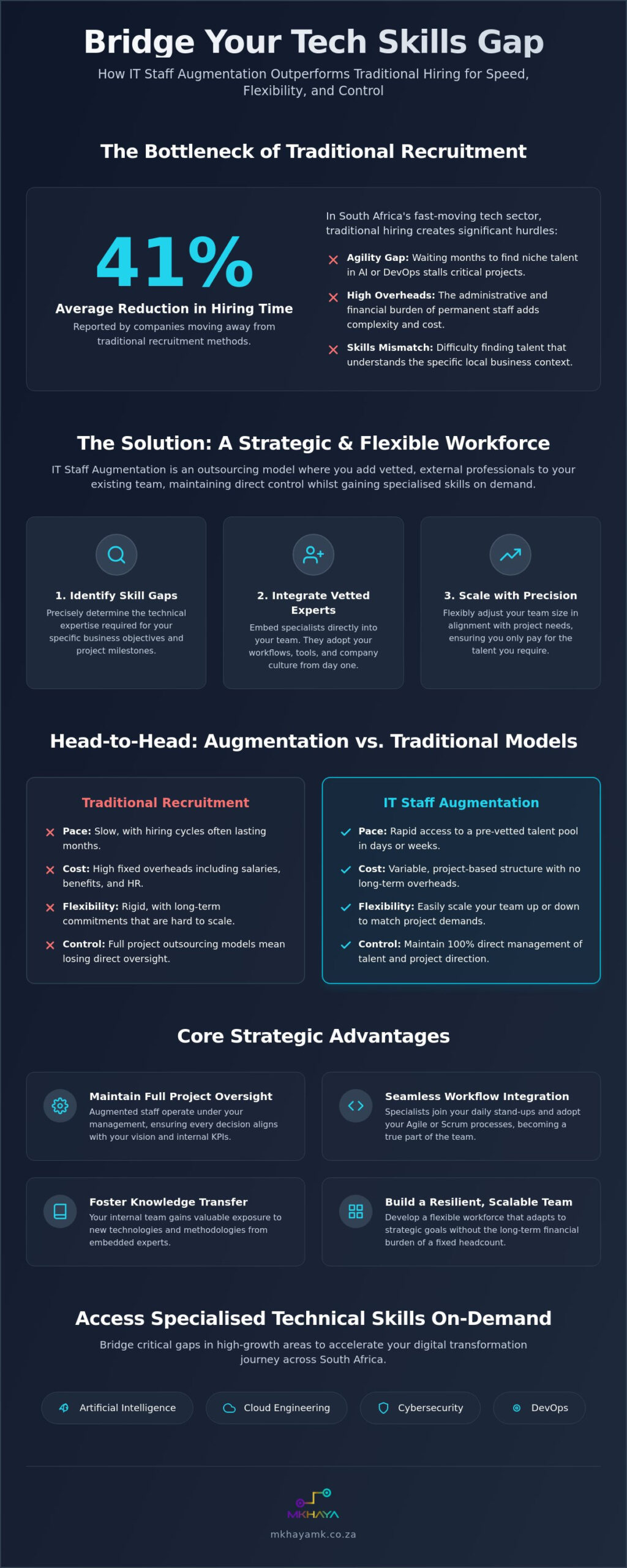
Did you know that companies report an average 41% reduction in hiring cycle times when they move away from traditional recruitment? In the fast-moving South African tech sector, waiting months to find a senior developer with niche AI or DevOps expertise isn’t just a frustration; it’s a bottleneck that stalls your digital transformation. You’ve likely felt the weight of high permanent overheads and the struggle to find talent that truly understands your local business context. By integrating high-calibre IT staff augmentation services, you can bypass these hurdles and secure the precision skills your project demands.

We understand that building a tech team requires more than just filling seats. It’s about finding a reliable partner who values your long-term stability as much as you do. This guide offers a strategic look at how to bridge technical skill gaps and accelerate growth through tailored staffing models. We’ll explore how to access specialised skills, manage flexible cost structures that align with your budget, and build a resilient tech team that scales alongside your ambitions throughout 2026.

Key Takeaways

  • Understand how IT staff augmentation services differ from traditional hiring to provide the agility needed for rapid, sustainable scaling.
  • Discover how to maintain full project oversight whilst integrating external talent directly into your existing Agile and Scrum workflows.
  • Learn to map your strategic business objectives to specialised technical roles in AI, Cloud, and Cybersecurity for more precise project outcomes.
  • Master the management techniques needed to foster a unified culture, ensuring augmented staff align perfectly with your internal KPIs and vision.
  • Explore the benefits of partnering with a provider that offers national reach and vetted expertise to support your digital transformation journey across South Africa.

Defining IT Staff Augmentation Services in the Modern Enterprise

In the 2026 South African tech landscape, agility is a survival mechanism. As digital transformation accelerates, the traditional recruitment model often feels like an anchor. This is where IT staff augmentation services come into play. This strategic outsourcing model allows you to add external talent to your existing team on a temporary basis. It differs from full-project outsourcing because you maintain direct control over the work and the individuals. Unlike permanent recruitment, it provides a flexible bridge that scales as project demands shift.

The model represents a fundamental shift toward a “flexible workforce” where stability is built through access to talent rather than just headcount. For many leaders, this approach fosters a sense of “quiet confidence”. You aren’t scrambling to fill seats; you are methodically constructing a team capable of executing a long-term vision. According to Wikipedia’s definition of staff augmentation, the primary goal is to evaluate existing staff and then determine which additional skills are required to meet specific business objectives.

The Core Mechanism of Talent Augmentation

The process begins by identifying specific skill gaps within your internal team. Instead of looking for generalists, you seek out vetted professionals with specialised expertise in areas like AI, DevOps, or custom software engineering. This model offers remarkable flexibility. You might engage a senior developer for a high-intensity three-month sprint or secure a specialist for a long-term strategic initiative. This targeted approach ensures that your team remains lean whilst possessing the exact technical depth needed to deliver results. It creates a cause-and-effect relationship where the right skill, added at the right time, leads to immediate project momentum.

Why Businesses are Moving Away from Traditional Hiring

The global war for talent has intensified, making traditional recruitment cycles increasingly unsustainable for fast-moving projects. Finding a niche developer in South Africa often takes months, creating a significant “agility gap”. The agility gap is the time lost between identifying a need and filling a seat. Beyond the time factor, the administrative burden of permanent employees, including HR, payroll, and benefits, adds layers of complexity that many modern enterprises prefer to avoid.

By choosing IT staff augmentation services, you offload these overheads to a reliable partner. This allows your leadership to focus on construction and refinement rather than administrative maintenance. It’s a practical path forward for businesses that value transparency and methodical execution. When you remove the friction of talent acquisition, you directly increase the speed and quality of your digital output.

Strategic Benefits: Why Augmentation Outperforms Traditional Outsourcing

Choosing between different outsourcing models often comes down to the level of control you wish to maintain. Full-project outsourcing requires you to hand over the entire lifecycle to an external vendor, which can sometimes lead to a disconnect in vision. In contrast, IT staff augmentation services place the external talent directly under your management. This ensures that every line of code and every architectural decision aligns with your long-term roadmap. Business leaders frequently cite the strategic advantages of IT staff augmentation when they need to scale without sacrificing the nuances of their internal culture.

This model thrives on integration. Because augmented professionals work alongside your permanent staff, they participate in your daily stand-ups and follow your specific Agile or Scrum processes. This proximity facilitates a natural knowledge transfer. Your internal team gains exposure to new methodologies and niche technologies, whilst the external specialists gain a deep understanding of your business context. It’s a symbiotic relationship that builds internal capacity over time rather than creating a dependency on an outside agency.

Maintaining Control and Cultural Alignment

One of the most significant hurdles in software engineering is maintaining consistency across a growing codebase. Augmented staff adopt your internal coding standards and documentation protocols from day one. They use your favourite project management tools and communication channels, ensuring there is no “us versus them” divide. For a deeper look at how these standards drive success, you might review our guide on custom software development in South Africa, which outlines the engineering excellence required in the local market.

Cost-Efficiency and Scalability in a Volatile Market

The financial logic of augmentation is grounded in precision. Traditional hiring involves substantial hidden costs, including recruitment fees, equipment, office space, and ongoing training. In a volatile market, these fixed overheads can become a liability. Augmentation allows you to pay for active expertise rather than idle capacity. You can “burst” your team’s capacity to meet a specific milestone, such as a major product launch, and then scale back once the objective is achieved.

This flexibility provides a predictable monthly service fee that aligns perfectly with your project budgets. It removes the stress of long-term financial commitments whilst ensuring you have the high-end talent needed to remain competitive. If you’re looking to refine your team structure, partnering with a specialist provider can help you identify the exact roles needed to move the needle without unnecessary expenditure.

Identifying the Right Technical Skills for Your Project Needs

Success in digital transformation isn’t just about adding more hands; it’s about adding the right hands. You need to map your high-level business goals to specific technical requirements. If your goal is to reduce operational friction, you might need an automation specialist. If it’s to enter a new market, a mobile developer might be the priority. High-calibre IT staff augmentation services allow you to pinpoint these exact needs without the risk of a misaligned permanent hire.

When evaluating a potential partner, look for a breadth of offering that spans various tech stacks. A partner who understands the intricacies of both legacy systems and emerging technologies can provide a more stable anchor for your growth. For long-term initiatives where you need consistent, deep-level engagement, you should consider the strategic benefits of how to hire dedicated developers in South Africa. This approach ensures that the institutional knowledge remains within your project for its entire duration.

From Software Engineering to AI and Data Automation

By 2026, the demand for engineers who can implement AI automation solutions has surpassed almost every other technical category. Data scientists and automation experts are no longer luxury additions; they’re essential for businesses looking to refine their data into actionable insights. Similarly, integrating specialists to manage cloud migration services ensures that your infrastructure remains resilient and scalable. These roles require a level of hyper-specialisation that is often difficult to source through traditional recruitment channels.

The Role of UI/UX Design and DevOps in Augmented Teams

Technical depth is only half the battle. Without a focus on the user, even the most sophisticated software can fail to gain traction. This makes UI/UX design services a critical component of any augmented team. Designers ensure that your digital products are not only functional but intuitive, which directly impacts user adoption and ROI.

To ensure these designs reach production quickly, DevOps engineers play a vital role. They automate the development pipeline, accelerating delivery cycles and preventing the bottlenecks that often plague large-scale projects. By including these supporting roles in your IT staff augmentation services strategy, you create a balanced, high-performance ecosystem capable of sustained innovation.
Scaling Tech Capacity: The Strategic Guide to IT Staff Augmentation Services in 2026

Overcoming the Integration Hurdle: Managing Augmented Teams Successfully

Successful integration of IT staff augmentation services hinges on clear expectations. From day one, establishing Key Performance Indicators (KPIs) ensures that every contributor understands their role in the broader mission. This clarity prevents the common pitfall of the “us versus them” mentality. Instead, it fosters a “one team” psychology where external specialists are viewed as vital partners in your construction process. This shared sense of purpose is what transforms a group of individuals into a high-performance unit.

A reliable partner acts as a visionary guide throughout this journey. They don’t just provide talent; they help you navigate the complexities of team dynamics and technical alignment. This supportive relationship ensures that the transition feels natural rather than forced. By focusing on mutual success, you create an atmosphere of steady, forward-looking ambition that inspires trust across the entire organisation.

Establishing Seamless Communication and Workflow Synchronisation

Daily stand-ups and sprint planning are the heart of a unified team. By including augmented staff in these rituals, you ensure that everyone stays aligned with the project’s pulse. Use collaborative platforms to centre all documentation and communication in a single, transparent location. In a national South African context, this approach bridges the gap between remote and on-site professionals. It ensures that local business contexts are respected and utilised to drive better project outcomes, regardless of where the developer is physically located.

Security, Compliance, and Intellectual Property Protection

Security is a non-negotiable pillar of modern team management. All augmented staff must strictly adhere to POPIA and international data standards to protect your sensitive information. This is especially critical when managing remote access for developers across the country. Clear contractual clauses regarding Intellectual Property (IP) ownership are essential to ensure that every line of code remains your exclusive asset. This transparency is a hallmark of a professional partnership and provides the stability you need to scale with confidence.

At Mkhaya MK, we prioritise a methodical onboarding process that handles these security and compliance layers with precision. This ensures that your new team members are ready to contribute safely and effectively from their first hour on the project. If you’re ready to scale your capacity with a partner that values integrity and methodical execution, contact our team to discuss how we can support your next milestone.

Partnering with Mkhaya MK for National IT Staff Augmentation

Mkhaya MK positions itself as a stable anchor in a rapidly shifting technological landscape. Our approach to IT staff augmentation services is built on a foundation of integrity and methodical execution. We don’t just provide resources; we offer a supportive partnership designed for mutual success. By accessing our national pool of vetted technical professionals, you gain the agility of a modern workforce backed by the reliability of a seasoned engineering firm.

Our depth of expertise is evidenced by the proprietary systems we build and maintain. We develop complex ERP solutions and loan management systems, which gives us a unique perspective on the challenges you face. This engineering heritage ensures that our augmented staff aren’t just contractors; they’re high-calibre professionals who understand the construction of robust, scalable software.

Our Rigorous Vetting and Placement Process

We believe that a perfect match requires a deep assessment of both technical capability and cultural alignment. Every developer in our network undergoes a thorough evaluation to ensure they meet our high standards for precision and reliability. This methodical process ensures that the professional we place within your team is ready to contribute to your specific project requirements from day one. We also provide ongoing management and support to our augmented professionals, ensuring they remain productive and motivated throughout their engagement.

Beyond Staffing: A Holistic Digital Transformation Approach

Staffing is rarely an isolated need. It’s usually a component of a much broader vision for growth. We integrate our IT staff augmentation services with our digital transformation consulting to ensure that every hire moves you closer to your long-term objectives. By leveraging our expertise in AI and data automation, we help you identify opportunities for refinement and construction that go beyond simple headcount.

We invite you to contact us for a comprehensive talent gap assessment. Let’s discuss how a visionary yet practical staffing strategy can accelerate your digital journey and provide the stability your business deserves in 2026.

Securing Your Path to Scalable Innovation

Navigating the complexities of the 2026 tech landscape requires more than just additional headcount; it demands a strategic alignment of talent and vision. We’ve explored how bridging the agility gap through precise skill mapping allows your organisation to remain lean whilst maintaining the technical depth needed for complex projects. By integrating specialised expertise directly into your internal workflows, you ensure that institutional knowledge stays within your business, creating a foundation for long-term stability and growth.

Choosing the right IT staff augmentation services is about finding a partner that values your journey as much as you do. With our national pool of vetted professionals and proven expertise in custom software and AI, we provide the methodical execution required to turn ambitious goals into concrete results. Our focus remains on your success, ensuring that every new team member integrates seamlessly with your internal Agile processes to drive immediate momentum.

Your next milestone is within reach. Scale your tech team with Mkhaya MK’s elite IT staff augmentation services and discover the confidence that comes from having a reliable, visionary guide by your side. We’re ready to help you build a resilient, future-ready team that scales alongside your ambitions.

Frequently Asked Questions

What is the difference between IT staff augmentation and project outsourcing?

Staff augmentation allows you to maintain direct control over the professional, whilst project outsourcing involves handing the entire lifecycle to a third party. When you use augmentation, the specialist becomes an extension of your internal team, following your specific coding standards and management style. This ensures that you retain oversight of the architectural decisions and daily progress, which is often lost in traditional project-based models.

How long does it typically take to onboard an augmented developer?

Onboarding an augmented developer typically takes significantly less time than traditional recruitment, often allowing you to fill a seat in days rather than months. Global data shows that companies report an average 41% reduction in hiring cycle times when using augmented teams. This speed helps you close the agility gap quickly, ensuring that project timelines remain on track even when unexpected skill requirements arise.

Can I choose the specific developers who will work on my project?

You have the final decision on every professional added to your team. We present a curated selection of candidates who have already passed our rigorous technical assessments, but the ultimate match is determined by your internal interviews. This consultative approach ensures that the developers you choose possess both the technical depth and the personal attributes required for your specific environment.

How do you ensure the augmented staff align with our company culture?

Alignment is achieved through a dual focus on cultural vetting during the selection process and direct integration into your daily rituals. Because augmented staff participate in your stand-ups and use your favourite project management tools, they naturally adopt your company’s work ethic and values. We prioritise professionals who demonstrate the soft skills needed to function as a unified part of your “one team” ecosystem.

Is staff augmentation suitable for short-term projects or just long-term ones?

IT staff augmentation services are designed for both short-term sprints and long-term strategic initiatives. You might need a specialist for a high-intensity three-month burst to reach a launch milestone, or a dedicated developer for a year-long digital transformation project. The model’s inherent flexibility allows you to scale capacity up or down as your project roadmap evolves, providing stability in a volatile market.

How are intellectual property and data security handled in staff augmentation?

Intellectual property (IP) and data security are managed through strict contractual clauses and adherence to local regulations like POPIA. Standard contracts include “work for hire” stipulations, ensuring that all code and documentation created by the augmented professional remain your exclusive property. We also implement robust security protocols for remote access to ensure that your sensitive data is handled with the highest level of precision.

What happens if an augmented staff member is not a good fit for our team?

If a professional isn’t a good fit, we initiate a methodical replacement process to ensure minimal disruption to your project momentum. Our commitment to your success means we take full responsibility for finding a more suitable candidate who aligns better with your technical or cultural needs. This safety net reduces the risk associated with traditional hiring and reinforces our role as a reliable, supportive partner.

Can staff augmentation help reduce our overall IT operational costs?

Yes, IT staff augmentation services help reduce operational costs by converting high fixed overheads into flexible project expenses. You avoid the hidden costs of permanent recruitment, such as training, equipment, and administrative HR burdens. This cause-and-effect relationship allows you to allocate your budget more efficiently, paying for active expertise only when it’s required to move your project forward.

How to Scale Your Tech Team Quickly: A Strategic Guide for 2026

How to Scale Your Tech Team Quickly: A Strategic Guide for 2026

What if the secret to meeting your 2026 delivery goals isn’t finding the perfect full-time hire, but rather changing how you define your team? You’ve likely felt the frustration of a recruitment cycle that drags on for months, leaving your most ambitious projects in limbo. When you need to scale tech team quickly to meet shifting demands, waiting half a year to source a single senior developer is no longer a viable option. This delay causes your delivery velocity to suffer and forces your core engineers to face the heavy burden of burnout. It’s a common struggle, yet it’s one that often prevents visionary leaders from reaching their full potential in a competitive market.

This guide reveals how to expand your technical capacity by adopting a strategic staff augmentation framework that prioritises both speed and precision. We’ll explore how to access specialised AI and DevOps skills whilst maintaining the cultural integrity and code quality your organisation depends on. From bridging immediate talent gaps to building a flexible infrastructure that adapts to peak demand, you’ll discover a methodical path to sustainable growth. We will move through the specific frameworks that allow for rapid expansion without the traditional risks associated with hypergrowth, ensuring your business remains a stable anchor in a changing landscape.

Key Takeaways

  • Identify the critical tipping point where technical debt begins to outpace feature delivery, allowing you to trigger expansion before productivity plateaus.
  • Discover how to scale tech team quickly by utilising staff augmentation models that bypass lengthy recruitment cycles whilst ensuring high standards of code quality.
  • Apply a rigorous five-step framework to align technical requirements with your organisational culture, ensuring new talent integrates seamlessly with your existing core.
  • Learn to navigate the “peak and trough” of project demand to prevent burnout and avoid the disruptive cycle of rapid hiring followed by layoffs.
  • Gain immediate access to specialised expertise in AI and DevOps through a strategic partnership that prioritises long-term stability and delivery velocity.

Recognising the Signals: When to Scale Your Tech Team Quickly

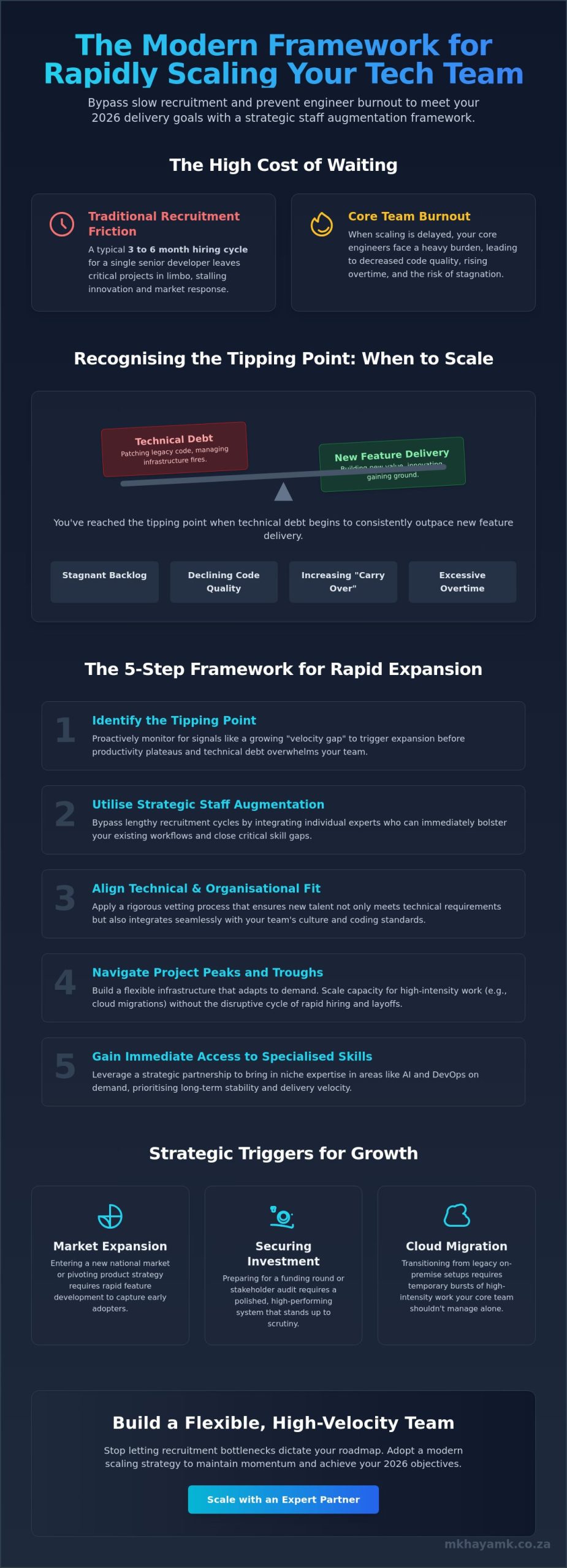
Growth is rarely a linear journey. It often arrives in waves that can overwhelm even the most disciplined engineering departments. You’ll likely notice that your product roadmap is stretching further into the future whilst the current backlog remains stagnant. This is the classic tipping point where technical debt begins to outpace feature delivery. Instead of building new value, your team spends the majority of their time patching legacy code or managing infrastructure fires. It’s a clear signal that your current capacity has reached its natural limit and requires a strategic shift to maintain momentum.

The cost of waiting is often far higher than the cost of expansion. When you fail to scale tech team quickly, you incur a heavy opportunity cost that impacts your market position. Every month a feature launch is delayed is another month your competitors have to gain ground. Beyond the financial impact, it’s vital to monitor your team’s internal health. Excessive overtime, declining code quality, and a rise in “quick fixes” that bypass standard protocols are loud indicators of burnout. If your engineers don’t have the breathing room to innovate, your entire business risks stagnation.

To better understand how these signals translate into a need for action, watch this helpful video:

The Velocity Gap: Measuring Team Output

Understanding your true output requires a close look at sprint completion rates. If the percentage of “carried over” tasks is steadily increasing, you’re facing a velocity gap. This often stems from bottlenecks in the QA and deployment pipeline where a few senior members become single points of failure. By applying technology management fundamentals, you can determine if the friction is caused by inefficient processes or a genuine lack of specialised skills. Often, the challenge isn’t just “more people,” but the need for niche expertise that your core team cannot realistically master in a tight timeframe.

Strategic Triggers for 2026 Growth

Strategic shifts often demand immediate reinforcements to succeed. If you’re entering a new national market or pivoting your product strategy, you’ll need rapid feature development to capture early adopters. Preparing for a significant funding round or a stakeholder audit also requires a polished, high-performing system that stands up to scrutiny. Many organisations find that transitioning from legacy on-premise setups to modern cloud solutions serves as the ultimate trigger. These transitions are complex and require temporary bursts of high-intensity work that your core team shouldn’t have to manage in isolation.

Evaluating Modern Scaling Models: Staff Augmentation vs Dedicated Teams

Choosing the right model to expand your technical capacity requires a balance between immediate agility and long-term stability. Whilst traditional in-house recruitment offers permanence, the typical three to six month hiring cycle is often too slow for the fast-paced demands of 2026. Many leaders now look toward hybrid models that allow them to strategies for scaling a tech team without the friction of traditional HR bottlenecks. The decision often rests on whether you need individual experts to bolster an existing workflow or a self-contained unit to own a specific outcome.

Maintaining institutional knowledge is a critical concern during periods of rapid growth. When you use external models to scale tech team quickly, you must ensure that the “brain” of your project remains within your organisation. Management overhead varies significantly between these approaches. A model that requires heavy daily supervision from your internal leads might actually slow down your progress, whereas a more autonomous structure can free up your senior architects to focus on high-level strategy. It’s about finding the specific configuration that supports your delivery velocity without diluting your core technical standards.

Staff Augmentation: The Speed Advantage

Staff augmentation serves as a primary speed-to-market tool for businesses that already have established agile processes. By integrating vetted professionals directly into your squads, you bypass the lengthy notice periods common in the South African market. This model allows you to add specific skills, such as AI or DevOps expertise, in a matter of weeks rather than months. It’s an ideal solution for closing immediate gaps in your pipeline whilst keeping full control over the development process. You can explore how staff augmentation provides the flexibility to adjust your team size based on real-time project demands.

Dedicated Development Teams for Large-Scale Projects

For complex, end-to-end deliveries, a dedicated team offers a more self-managed approach. This model works best when you have a clear product vision but lack the internal bandwidth to manage the daily minutiae of a large-scale build. These teams operate as an extension of your company, adopting your culture and coding standards whilst operating under their own project management structure. It reduces the burden on your internal leadership, allowing for a more hands-off yet highly aligned partnership. If you’re considering this path, looking into dedicated development team frameworks can help you establish the right governance from day one. We are always available for discussing your specific project needs to find the best fit for your 2026 goals.

The 5-Step Framework for Rapid Technical Expansion

  • Audit: Define clear technical requirements and cultural “must-haves” before starting your search.
  • Select: Partner with a provider that has a proven track record in the national market.
  • Connect: Establish robust communication channels using tools like Slack, Jira, or Teams.
  • Align: Implement a “Shadowing” period to sync external talent with your internal coding standards.
  • Optimise: Iterate and adjust the team size based on real-time performance metrics and project needs.

Step 1 & 2: Auditing Your Needs and Finding Partners

Before reaching out to external partners, conduct a thorough skills gap analysis. This audit helps you decide if you need comprehensive custom software development or specific staff augmentation to support your current roadmap. When vetting potential partners, prioritise those who understand the national regulatory environment and have a deep pool of senior-level talent. It’s essential to find a partner that can provide experts who hit the ground running without needing extensive hand-holding, ensuring your project timeline remains intact. If your roadmap calls for specialised engineering talent, understanding how to hire dedicated developers in South Africa through a structured IT staff augmentation model can dramatically accelerate your time to delivery.

Step 3 & 4: Onboarding and Integration

Onboarding is where many scaling efforts fail. You can leverage AI & data automation to streamline this process, setting up automated environments and access permissions before the developer even starts. The goal is to reduce the “Time to First Commit” to as little as 48 hours. Establishing clear communication protocols ensures that external talent isn’t siloed from your core team. Implementing a “Shadowing” period allows new members to observe your internal workflows in practice, fostering a “One Team” mentality that bridges the gap between in-house and augmented staff.

The final phase involves constant iteration. You should monitor real-time performance metrics to determine if your team size is optimal for your current project phase. This agile approach allows you to scale up for peak demand and scale down when requirements stabilise. Experienced technical leaders often share strategies for scaling tech teams that highlight the importance of management structure over sheer numbers. By treating expansion as a dynamic process rather than a one-time event, you create a stable foundation for long-term success.

How to Scale Your Tech Team Quickly: A Strategic Guide for 2026

Avoiding the Pitfalls of High-Speed Recruitment

As your headcount grows, you’ll also encounter what engineers call the “Communication Tax.” This is the phenomenon where the effort required to coordinate a larger group begins to eat into the time spent on actual development. If your internal systems aren’t prepared, this tax can bring your delivery velocity to a standstill. You must ensure that your operational infrastructure, including your ERP solutions, is robust enough to handle the increased administrative load of a growing workforce. Without these foundations, rapid expansion often leads to fragmented communication and missed deadlines.

The Hidden Costs of Bad Hires

A single bad hire does more than just miss targets; it can erode team morale and introduce significant technical debt. When you’re under pressure to scale, the temptation to lower your vetting standards is high. However, the cost of replacing an ill-fitted developer is often estimated at several times their annual salary when you account for recruitment fees and lost productivity. This is why reducing IT costs with staff augmentation is often a safer alternative. It allows you to leverage a partner’s rigorous vetting process, ensuring that every professional joining your project already meets high technical and cultural benchmarks. Organisations that choose to hire dedicated developers in South Africa through a proven augmentation partner benefit from pre-screened talent pools that significantly reduce this financial and operational risk.

Maintaining Quality Standards at Speed

Maintaining stability requires a disciplined adherence to software engineering best practices, especially when new members are joining the fold. Automated testing and mandatory peer reviews should be non-negotiable parts of your workflow. These checks act as a safety net against security vulnerabilities that can slip through during high-speed development. Fostering a “Culture of Documentation” is equally vital. When processes are clearly recorded, remote and augmented staff can find answers independently, reducing the burden on your senior leads. If you’re ready to expand without compromising your standards, contact our team today to discuss a tailored scaling strategy.

Strategic Partnership: Scaling with Mkhaya MK’s Expertise

Building a high-performing technical department requires more than just a list of resumes. It demands a partner who aligns with your specific operational goals whilst providing the flexibility to adapt to market shifts. At Mkhaya MK, we act as a visionary guide for organisations looking to scale tech team quickly without the typical friction of recruitment. By leveraging our established national network of vetted technical professionals, you gain immediate access to the skills you need to maintain your delivery velocity. We focus on creating a supportive partnership that prioritises your long-term success over short-term gains.

Our approach is fundamentally client-centric. We don’t just provide “extra hands”; we help you customise your expansion through our digital transformation consulting. This ensures that every new team member is supported by the right processes and tools to succeed from their first day. Whether you require a hybrid model that blends on-site presence with remote agility or full end-to-end support across UI/UX design, DevOps, and cloud migration, we provide the stability you need to grow with confidence. This cause-and-effect logic ensures that every technical addition leads directly to a business-focused result.

Why National Businesses Choose Mkhaya MK

Ready to Expand Your Technical Capacity?

If you’re feeling the pressure of a growing backlog or a lack of specialised skills, the first step is identifying your most pressing bottlenecks. We begin every partnership with a thorough consultation to ensure we’re solving the right problems with precision. You can review our portfolio of custom software development success stories to see how we’ve helped other national leaders achieve their growth targets. When you’re ready to build a high-performing team that remains a stable anchor for your business in a rapidly changing landscape, contact us to start the conversation today.

Building Your Future-Ready Engineering Department

Transitioning from a state of bottlenecked delivery to high-velocity innovation requires a fundamental shift in how you view technical capacity. By identifying the specific signals that necessitate growth and adopting flexible models like staff augmentation, you ensure that your expansion remains sustainable. We’ve explored how a methodical framework protects your organisational culture whilst allowing you to access specialised skills in AI, Cloud, and DevOps exactly when they are needed. This structured approach prevents the common pitfalls of reactive hiring and maintains the stability of your core systems.

The ability to scale tech team quickly is a strategic advantage that allows you to respond to market shifts with precision. Mkhaya MK provides a vetted national talent pool and a proven track record in digital transformation to help you navigate this journey. Whether you’re refining your custom software or migrating complex systems, our expertise provides the reliable foundation your project deserves. Partner with Mkhaya MK to scale your tech team efficiently and turn your technical roadmap into a concrete reality. We are here to support your vision and ensure your next phase of growth is both seamless and successful.

Frequently Asked Questions

How long does it typically take to scale a tech team using staff augmentation?

Scaling through staff augmentation typically takes between two and four weeks. This is a significant reduction compared to the three to six months often required for traditional permanent recruitment. By accessing a pre-vetted talent pool, you bypass the early stages of sourcing and screening. This allows your projects to move from planning to execution without the usual delays associated with the South African talent market.

Is it better to hire remote developers or on-site staff when scaling quickly?

The choice depends on your existing infrastructure, but remote or hybrid models generally allow you to scale tech team quickly by removing geographical barriers. Remote hiring expands your reach to the best national talent regardless of their physical location. Whilst on-site staff can offer immediate face-to-face collaboration, a well-structured remote workflow often provides the speed and flexibility needed for rapid expansion in a modern technical landscape.

How do we maintain code quality when adding new members to the team?

Maintaining quality requires a disciplined adherence to automated testing and mandatory peer reviews. We recommend implementing a shadowing period where new members pair with your senior developers to learn internal standards. By establishing these guardrails early, you ensure that every line of code meets your organisation’s benchmarks. Clear documentation and shared linting rules also play a vital role in keeping your codebase consistent during periods of growth.

What are the most common mistakes companies make when scaling their tech teams?

The most frequent error is “hiring for the peak,” which leads to unnecessary layoffs when demand eventually stabilises. Companies also often underestimate the “communication tax” that occurs when teams grow too large too fast. Failing to automate the onboarding process is another common pitfall. This results in new developers spending weeks on setup rather than contributing to the product roadmap, which effectively stalls your delivery velocity.

Can staff augmentation help reduce the overall cost of technical recruitment?

Staff augmentation reduces costs by eliminating recruitment fees, long-term benefit obligations, and the overhead of internal HR cycles. You only pay for the specific capacity you need during high-intensity project phases. This model also mitigates the financial risk of a bad hire, as your partner handles the vetting and replacement processes. It’s a cost-effective way to access high-level expertise without the permanent financial commitment of a full-time senior role.

How do we ensure cultural alignment with augmented staff?

Cultural alignment starts with a partner who understands your values and work ethic. We ensure that augmented professionals participate in your daily stand-ups and sprint ceremonies to foster a sense of shared ownership. This integration helps them adopt your company’s specific “language” and work patterns. By treating them as an extension of your core team rather than a separate unit, you create a unified environment that supports collective success.

What technical roles are most commonly needed during a rapid scaling phase?

Rapid scaling often requires senior full-stack developers, DevOps engineers, and AI specialists to handle complex infrastructure and automation needs. Quality Assurance analysts are also critical to ensure that speed doesn’t compromise system stability. Depending on the project, you might also require UI/UX designers to refine the user journey. Accessing these specialised skills through a partner allows you to fill specific gaps in your pipeline without lengthy training periods.

How does Mkhaya MK vet the technical professionals they provide?

We employ a rigorous multi-stage vetting process that includes deep-dive technical assessments and cultural fit interviews. Every professional in our national network is evaluated on their problem-solving abilities, coding standards, and communication skills. This methodical execution ensures that we only provide experts who can integrate seamlessly into your existing workflow. Our focus on precision and reliability means you can trust the quality of the talent we bring to your organisation.