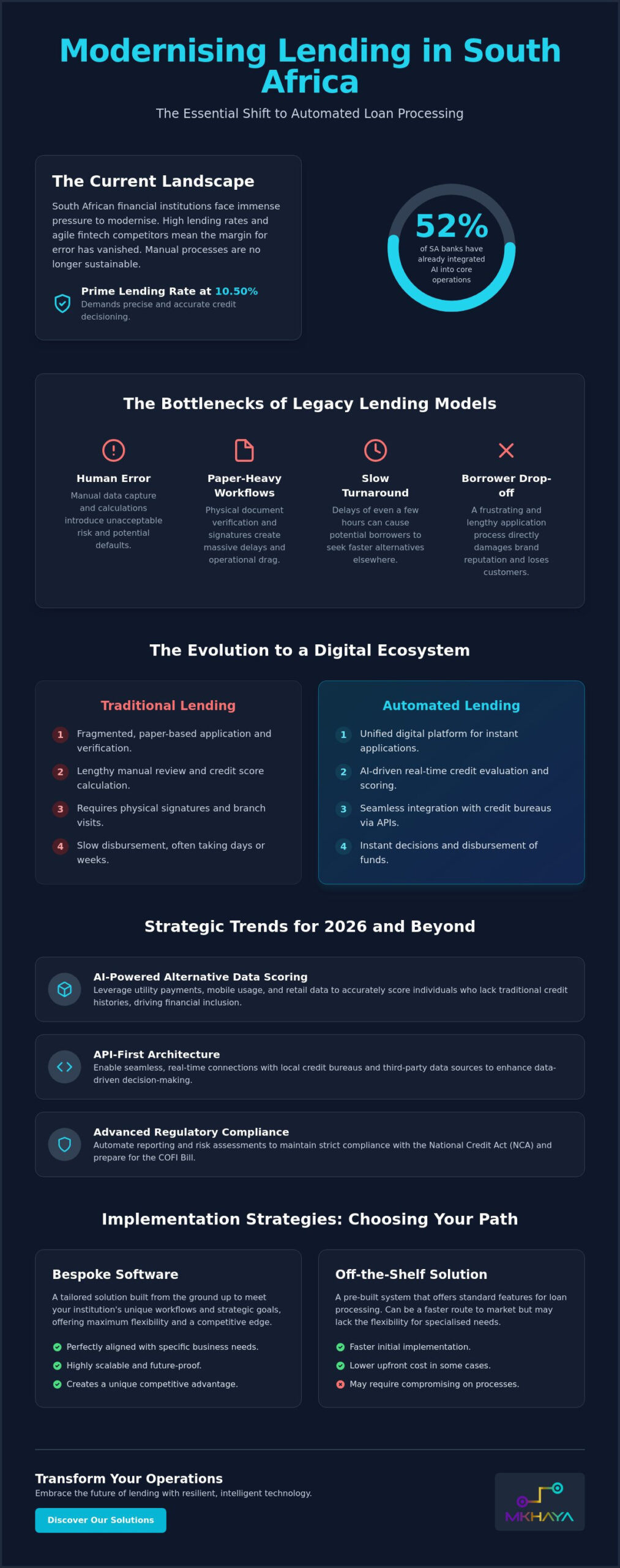
Did you know that over 52% of South African banks have already integrated AI into their core operations to stay ahead of shifting market demands? In a financial environment where the prime lending rate remains at 10.50%, the margin for error in credit decisioning has never been slimmer. Adopting a robust automated loan processing system south africa is no longer just a luxury for tech-first startups; it’s a vital step for established institutions looking to reduce manual data entry costs and eliminate the bottleneck of slow turnaround times. You probably recognise that whilst your team is dedicated, manual processes often lead to borrower drop-off and the constant worry of non-compliance with the National Credit Act.
We believe that technology should empower your team to build stronger relationships, not replace the human element of lending. This article promises to guide you through the essential steps to modernise your credit operations, ensuring your institution remains a stable anchor for your clients. You’ll discover how to leverage AI for improved risk accuracy and achieve seamless integration with local credit bureaus. We will also preview the strategic trends for 2026, including the impact of the COFI Bill and the latest FSCA positions on AI accountability, so you can lead your organisation with quiet confidence and precision.
Key Takeaways
Explore the transition from manual, paper-heavy workflows to a digital ecosystem that enables real-time credit evaluation and faster approvals.
Learn how a modern automated loan processing system south africa uses AI-driven alternative data to accurately score and serve the unbanked market.
Gain clarity on maintaining strict compliance with the National Credit Act (NCA) whilst automating complex regulatory reporting and risk assessments.
Evaluate the strategic advantages of bespoke software development versus off-the-shelf solutions for building a resilient, future-proof lending platform.
Identify how API-first architecture facilitates seamless connections with local credit bureaus to enhance data-driven decision-making.
The Evolution of Lending in South Africa: Why Automation is Non-Negotiable
An automated loan processing system south africa is far more than just a digital tool; it’s a comprehensive ecosystem designed to manage the entire lifecycle of a loan, from the first click of an application to the final disbursement of funds. It replaces fragmented, manual steps with a unified workflow that leverages data to make instant, accurate credit decisions. This evolution marks a significant departure from the traditional methods that have historically dominated Banking in South Africa, where physical paperwork and face-to-face meetings were the standard for decades.
The shift toward real-time digital lending is largely driven by the intense pressure from agile fintech startups that have entered the local market. These newcomers have raised borrower expectations, making speed and convenience the primary benchmarks for success. For traditional micro-lenders, automation isn’t just about matching that speed; it’s a strategic necessity to lower the cost-per-loan. By removing manual intervention from repetitive tasks, your institution can handle a much higher application volume whilst maintaining precision and reducing overheads.
To see how these workflows function in a real-world scenario, watch this helpful video:
The Problem with Legacy Lending Models
Manual document verification and the requirement for physical signatures create significant bottlenecks that stall growth and frustrate potential borrowers. In our mobile-first market, a delay of even a few hours can cause a borrower to seek alternatives, damaging your brand’s reputation for reliability. Beyond speed, the human error factor in data capture and credit score calculations introduces unnecessary risk. A single mistyped digit can lead to an incorrect risk profile, which might lead to non-compliance with the National Credit Act or avoidable defaults.
The Strategic Shift Toward Digital Transformation
Successful modernisation begins with a commitment to digital transformation. This foundation allows your institution to move away from rigid, branch-based operations and embrace cloud-native scalability. With a robust automated loan processing system south africa, you can extend your reach across the country without the expense of physical infrastructure. This approach prioritises a customer-centric digital experience, ensuring that your clients feel supported through every step of their financial journey whilst you maintain a stable, high-performing loan book.
Top Trends in Automated Loan Processing Systems for 2026
The lending environment in 2026 is defined by precision and inclusivity. As financial institutions move beyond basic digitisation, the focus shifts toward intelligent ecosystems that can anticipate borrower needs. A modern automated loan processing system south africa must now integrate sophisticated layers of data to remain competitive and secure whilst navigating a complex economic landscape. We see a move towards systems that don’t just process applications but actively enhance the quality of the loan book through smarter insights.
One of the most transformative trends is the use of AI-powered alternative data scoring. This technology allows lenders to evaluate individuals who lack traditional credit histories by analysing utility payments, mobile airtime usage, and even retail loyalty data. This shift is supported by insights from the South African National Treasury report, which highlights how fintech innovation can drive financial inclusion whilst managing systemic risk. By adopting these models, your institution can safely expand its reach into the unbanked sector with confidence.
Hyper-personalisation has also become a standard expectation. Instead of generic loan products, systems now offer tailored interest rates and repayment terms based on real-time spending behaviour. This level of customisation is often delivered through Lending-as-a-Service (LaaS) models, allowing non-financial retail brands to offer credit at the point of sale. To protect these digital transactions, biometric verification, such as facial recognition and liveness detection, has become the primary defence against identity fraud in the local market.
AI and Machine Learning in Credit Risk
Advanced AI & data automation helps your team identify subtle risk patterns that traditional human analysis might overlook. For first-time borrowers, psychometric testing is increasingly used to assess character and willingness to repay through interactive digital surveys. Machine learning models adapt to South African economic shifts by continuously retraining on new data sets to ensure risk profiles remain accurate during periods of volatility.
Mobile-First Borrower Journeys
With high mobile penetration, WhatsApp-integrated loan applications are no longer optional; they’re a necessity for reaching the mass market effectively. Professional UI/UX design services play a critical role here by reducing friction in mobile apps and ensuring the interface feels intuitive for all users. Self-service portals empower borrowers to manage their accounts, request settlements, or update personal details without ever needing to call a support centre. If you’re looking to refine these digital touchpoints, exploring our custom software development options can help you build a more resilient and user-friendly platform.
Navigating the South African Regulatory Landscape
Many lenders worry that moving to an automated loan processing system south africa might clash with the strict requirements of the National Credit Act (NCA). In reality, automation provides a level of consistency that manual processing simply cannot match. By removing human bias and ensuring every application follows the exact same logic, you create a more transparent and defensible lending process. This methodical approach builds trust with regulators and protects your institution from the risks of inconsistent decision-making.
The National Credit Regulator (NCR) oversees the industry to ensure fair outcomes for all consumers. To navigate these expectations, many forward-thinking institutions are aligning with South Africa’s coordinated approach to regulating FinTech. This regulatory framework ensures that digital lenders maintain high standards of accountability, especially as the Conduct of Financial Institutions (COFI) Bill consolidates multiple laws into a single, outcomes-based structure. Automation isn’t a way to bypass these rules; it’s a powerful tool to ensure you meet them every single time.
Automated Affordability Assessments
A core requirement of the NCA is the mandatory affordability assessment. A modern automated loan processing system south africa simplifies these checks by pulling real-time data directly from credit bureaus like TransUnion or Experian. This allows for the instant, accurate calculation of debt-to-income ratios, ensuring you don’t extend credit beyond a borrower’s financial capacity. Implementing a dedicated loan management system south africa ensures these complex calculations are consistent and fully documented for future regulatory reviews.
Data Privacy and Security Compliance
Handling sensitive financial data requires strict adherence to the Protection of Personal Information Act (POPIA). Automation helps you stay compliant through integrated encryption and secure data protocols that prevent unauthorised access. By utilising professional cloud solutions, your institution benefits from enterprise-grade security that protects borrower information whilst maintaining a detailed audit trail. Every decision the system generates is recorded, providing the transparency needed to explain outcomes to both the regulator and the consumer with total clarity.
Implementation Strategies: Custom vs. Off-the-Shelf Systems
Choosing how to build your automated loan processing system south africa is a pivotal decision that impacts your operational agility for years to come. You need a platform that aligns perfectly with your strategic vision rather than one that forces your team to adapt to rigid, pre-set workflows. Off-the-shelf products might offer a faster initial setup, but they frequently lack the flexibility required to navigate the unique nuances of the local credit market. An API-first architecture is essential for future-proofing your investment, as it allows your system to connect effortlessly with new data providers and digital banking services as they emerge.
The Case for Custom Software Development
Every lender possesses a unique “secret sauce” for risk assessment and customer engagement. A tailored approach through professional software engineering allows you to encode this specific business logic without any compromise. As we’ve detailed in our strategic pillar on custom software development south africa, the long-term ROI of owning your intellectual property is substantial. You aren’t simply paying for a subscription; you’re constructing a proprietary asset that provides a distinct competitive advantage and long-term stability.
Integrating with Existing ERP and Financial Systems
Integrating an automated loan processing system south africa with your existing ERP and financial systems is critical for eliminating data silos. Older organisations often struggle with information trapped in legacy databases that don’t communicate with modern tools. Our research into ERP solutions south africa demonstrates how sophisticated middleware can connect legacy infrastructure to modern automation engines. This ensures your data remains unified, providing your credit officers with a comprehensive view of borrower behaviour for higher risk accuracy.
Managing the operational risk of a digital shift requires a methodical, phased implementation. We believe in a structured rollout that allows your staff to gain confidence in the new tools whilst ensuring that borrower services remain completely uninterrupted. If your internal team is currently at capacity, staff augmentation can provide the specialised expertise needed to bridge the skills gap during the critical migration phase. This partnership model ensures your project stays on track without overwhelming your core staff or sacrificing the quality of your execution.
If you’re ready to build a platform that fits your unique lending model, get in touch with our team to discuss your requirements.
Transforming Your Operations with Mkhaya MK’s Lending Technology
Digital transformation in the credit sector requires more than just code; it requires a deep understanding of the local landscape. Mkhaya MK positions itself as a visionary partner, guiding your institution through every phase of modernisation with quiet confidence. Our engineering team provides an end-to-end service, moving from initial strategic consulting to full-scale deployment and ongoing support. This local presence ensures that your automated loan processing system south africa is built with an intimate knowledge of South African market dynamics and consumer behaviour. We don’t just provide tools; we build the foundations for your long-term success.
Our commitment to reliability means you can trust the precision of our execution. We avoid the high-pressure urgency often found in tech sales, opting instead for a supportive partnership that values transparency. By choosing a local partner, you benefit from experts who understand the nuances of the National Credit Act and the specific challenges faced by South African lenders. This allows us to construct solutions that are not only technologically advanced but also culturally and regulatory-appropriate for your specific audience.
Our Approach to Loan Management Systems
Our Loan Management System is designed to be the central nervous system of your lending operations. It streamlines the entire journey from application to recovery, ensuring that your team can focus on high-value tasks whilst the technology handles the heavy lifting of data processing. We incorporate sophisticated AI & data automation to facilitate smarter credit decisions, allowing you to identify opportunities and risks with unprecedented accuracy. If you’re ready to refine your workflows, we invite you to contact us for a strategic consultation to explore how we can tailor these tools to your specific needs.
Beyond Software: A Partnership for Success
We believe that successful digital transformation is rooted in traditional values of integrity and commitment. Our relationship with clients extends far beyond the initial software delivery; we view ourselves as a stable anchor in a rapidly changing technological landscape. This commitment to mutual success is why we offer staff augmentation services, allowing you to extend your internal capabilities with our specialised experts whenever needed. This methodical execution ensures that your transition to a modern automated loan processing system south africa is smooth, secure, and sustainable for the long term. Modernise your lending operations today and build a more resilient future for your institution.
Securing Your Competitive Edge in the 2026 Credit Market
The transition toward a digital-first lending ecosystem is a journey of precision and long-term stability. By embracing an automated loan processing system south africa, your institution can move beyond the limitations of manual data entry to achieve faster approval cycles and enhanced credit risk accuracy. We have explored how AI-driven insights and robust compliance frameworks act as foundations for growth rather than obstacles. Adopting a custom, API-first approach ensures that your operations remain agile whilst you maintain full control over your intellectual property and unique business logic.
At Mkhaya MK, we bring a national South African footprint and deep expertise in AI & Data Automation to every partnership. Our specialised Loan and Facility Management products are built to handle the complexities of the local market with quiet confidence and reliability. We are committed to your success, providing the technical depth and methodical execution needed to transform your vision into a high-performing reality. Before finalising your platform selection, reviewing our comprehensive loan management system south africa buying guide for 2026 will ensure you evaluate every critical factor with confidence. Optimise your lending operations with Mkhaya MK’s Loan Management System today. We look forward to building a smarter, more inclusive future for your organisation together.
Frequently Asked Questions
What is an automated loan processing system?
An automated loan processing system is a digital ecosystem that manages the entire loan lifecycle from the initial application through to credit evaluation and final disbursement. By replacing manual paperwork with rule-based logic and data integration, it ensures that every step of the lending journey is consistent and efficient. This technology allows your institution to scale operations without increasing overheads, providing a seamless experience for both your staff and your borrowers.
Is automated lending legal under the South African National Credit Act?
Yes, automated lending is fully legal provided the system is configured to comply with the National Credit Act (NCA) and its mandatory affordability assessments. Automation actually enhances compliance by ensuring that every applicant is evaluated against the same objective criteria. This reduces the risk of human error or bias, creating a transparent and defensible decision-making process that aligns with the expectations of the National Credit Regulator.
How much time can automation save in the loan approval process?
Automation can reduce loan approval cycles from several days to just a few minutes by eliminating manual document verification and physical signatures. By integrating an automated loan processing system south africa, your institution can provide instant feedback to applicants, which significantly reduces borrower drop-off. This speed allows your team to handle much higher application volumes whilst maintaining the precision required for accurate credit risk management.
Can automated systems handle complex business loans or just personal credit?
Modern systems are highly versatile and can handle complex business loans as effectively as personal credit products. Whilst personal loans often rely on individual credit scores, business lending modules can be configured to analyse financial statements, cash flow patterns, and company registration data. This customisation ensures that your unique business logic is applied accurately across various loan types, supporting a diverse and stable lending portfolio.
How does an automated system integrate with South African credit bureaus?
These systems integrate with South African credit bureaus through secure Application Programming Interfaces (APIs) to pull real-time data from providers like TransUnion, Experian, or XDS. This connection allows for the instant retrieval of credit reports and history, which the system then uses to calculate debt-to-income ratios and risk profiles. Such seamless integration ensures that your affordability assessments are based on the most current information available in the market.
What are the security risks of moving loan processing to the cloud?
Moving to the cloud introduces risks such as data breaches or unauthorised access, but these are effectively mitigated through enterprise-grade encryption and strict POPIA compliance protocols. Professional cloud solutions provide layers of security that often exceed what is possible with on-premise infrastructure. By maintaining detailed audit trails and secure data storage, your institution ensures that sensitive financial information remains protected whilst benefitting from the scalability of a modern digital environment.
Do I need to hire a full tech team to maintain an automated lending system?
You don’t necessarily need to hire a full internal tech team to maintain these systems. Many institutions choose to partner with experts for managed services or utilise staff augmentation to access specialised skills as needed. This approach allows you to focus on your core lending operations whilst your technology partner ensures the system remains secure, updated, and fully aligned with the latest regulatory shifts in the South African market.
How does AI improve credit scoring for borrowers with no formal credit history?
AI improves credit scoring by analysing alternative data points that traditional models often ignore, such as mobile airtime usage, utility bill payments, and retail loyalty data. This is particularly valuable for the unbanked sector where formal credit histories are absent. By using an automated loan processing system south africa equipped with machine learning, your institution can build accurate risk profiles for new borrowers, safely expanding your market reach without compromising your credit standards.
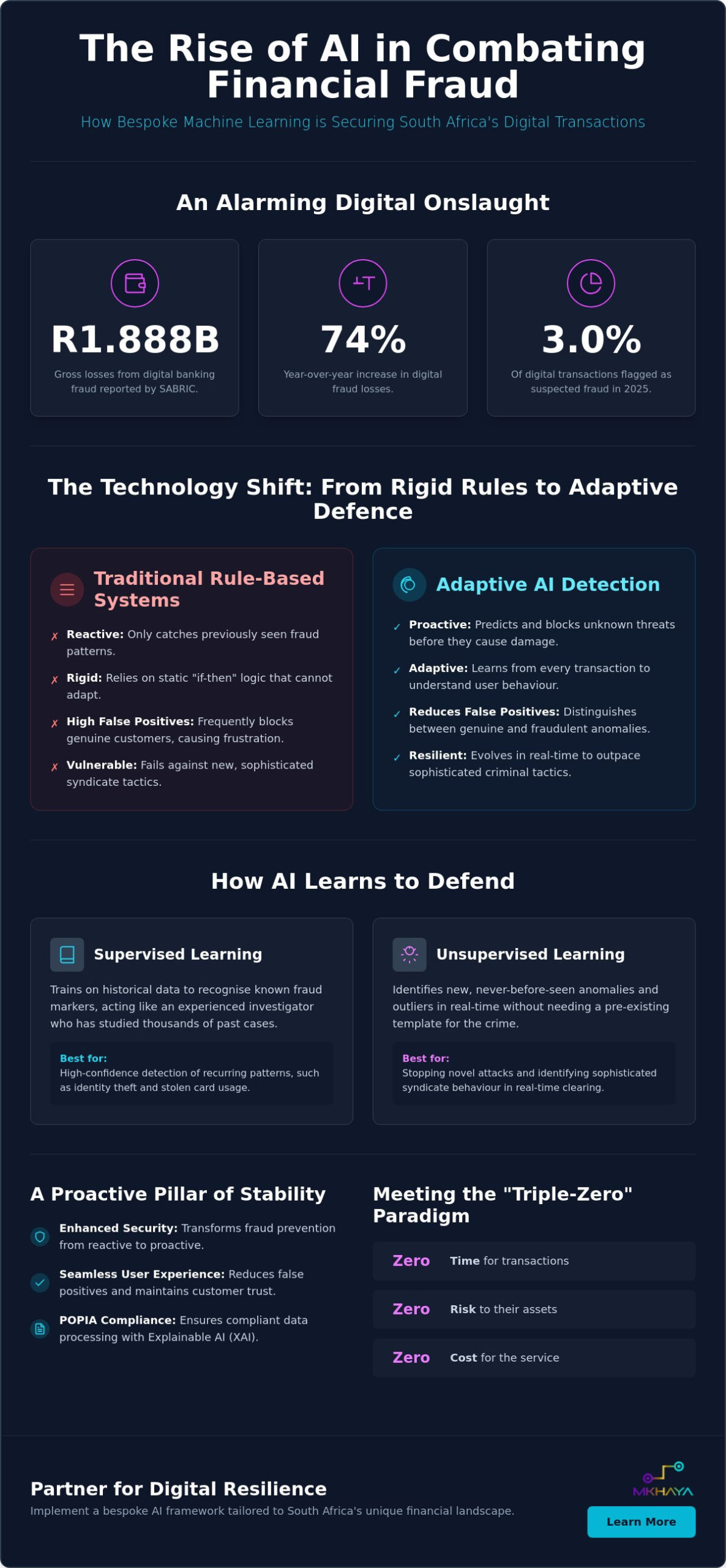
With 3.0% of all digital transactions in South Africa flagged as suspected fraud in 2025, our local financial sector faces a digital onslaught unlike any other on the continent. You’ve likely seen the reports from SABRIC showing gross losses from digital banking fraud reaching R1.888 billion, a staggering 74% year-over-year increase. It’s clear that relying on legacy systems for real-time clearing is no longer enough to protect your customers or your bottom line. Integrating bespoke AI for fraud detection in financial services South Africa has become a necessity for institutions that want to outpace sophisticated syndicates whilst maintaining a seamless user experience.
We understand the frustration of balancing rigorous security with the need to reduce false positives that alienate genuine clients. This case study discovers how South African institutions are leveraging custom AI and data automation to secure digital transactions and ensure compliant data processing under POPIA. You’ll learn how a strategic shift toward scalable, locally-tuned infrastructure can transform fraud prevention from a reactive cost centre into a proactive pillar of stability. We’ll examine the move from generic global models to precision-engineered solutions that handle the unique behavioural nuances of our domestic market.
Key Takeaways
Understand how adaptive machine learning models outpace rigid, rule-based systems to identify sophisticated local fraud patterns in real-time.
Evaluate the strategic advantages of building bespoke AI for fraud detection in financial services South Africa to ensure solutions are tailored to your specific transaction behaviours.
Master the architectural essentials of a fraud prevention engine, focusing on data aggregation and the engineering of unique local features.
Explore how specialised staff augmentation provides the expertise needed to bridge the technical skills gap and maintain digital resilience.
Discover a clear path toward reducing fraud losses and ensuring POPIA compliance without compromising the customer experience during high-volume clearing.
AI for fraud detection in financial services South Africa involves deploying machine learning algorithms that scrutinise millions of data points to identify and block fraudulent activities in real-time. In the broader context of Financial technology (FinTech), these systems act as the primary line of defence against a rising tide of sophisticated local threats. South African institutions currently navigate a complex environment where card-not-present fraud, identity theft, and the creation of synthetic identities are becoming increasingly common. With suspected digital fraud rates hitting 3.0% in 2025, the highest in Africa, the pressure to automate has never been greater.
The urgency for these systems is driven by what industry leaders call the “triple-zero” paradigm. Modern banking customers expect zero time for transactions, zero risk to their assets, and zero cost for the service. To meet these expectations whilst managing the high-volume requirements of real-time clearing, automated intervention is the only viable path. The South African Reserve Bank (SARB) and the Financial Sector Conduct Authority (FSCA) have set high security expectations. Specifically, the 2025 Joint Standard on Cybersecurity and Cyber Resilience makes robust AI integration a regulatory priority for any institution handling public funds.
The Shift from Reactive to Proactive Security
Traditional “if-then” rules are rigid; they only catch what has happened before. When fraud syndicates evolve their tactics, these legacy systems fail because they cannot adapt to new patterns without manual updates. The cost of remaining reactive is high. Beyond the R1.888 billion in gross losses reported by SABRIC, institutions face severe brand reputation damage that can take years to repair. Proactive AI detection marks the shift from merely stopping known threats to predicting unknown anomalies before they impact the customer.
Local Regulatory Compliance: POPIA and Beyond
Implementing AI requires a delicate balance between data-heavy training and strict adherence to the Protection of Personal Information Act (POPIA). Financial institutions must ensure that the data used to train models is handled with absolute integrity. This has led to the rise of “Explainable AI” (XAI). This approach allows banks to provide clear reasoning for why a transaction was flagged, which is essential for regulatory reporting and customer transparency. Leveraging expert digital transformation services helps organisations align their technical infrastructure with these complex compliance mandates whilst maintaining operational agility.
How AI-Driven Detection Surpasses Traditional Systems
Traditional fraud prevention relies on rigid, rule-based logic that operates on “if-then” scenarios. For example, a system might be programmed to flag any transaction over R10,000 or any purchase made outside of a user’s home province. Whilst these rules provided a basic safety net in the past, they’re often too blunt for modern requirements. They result in high rates of false positives, where genuine customers find their accounts frozen during legitimate activities. In contrast, AI for fraud detection in financial services South Africa utilises fluid, adaptive models that learn from every interaction, allowing for a far more nuanced understanding of what constitutes a threat.
These advanced systems typically employ a hybrid approach, combining supervised and unsupervised learning to create a multi-layered defence. Supervised learning acts like an experienced investigator who has studied thousands of past fraud cases. By training on historical data, these models recognise specific markers associated with known crimes, such as stolen card patterns or phishing signatures. However, because fraud syndicates constantly pivot, relying solely on history isn’t enough. This is where unsupervised learning becomes vital. These algorithms identify outliers in transaction behaviour that have never been seen before, flagging suspicious account-to-account transfers in real-time clearing environments without needing a prior “template” of the crime.
Supervised vs Unsupervised Machine Learning
The choice between these methods depends on the specific threat. Supervised ML is excellent for high-confidence detection of recurring patterns, such as identity theft attempts during loan applications. Unsupervised ML excels at spotting “zero-day” fraud, particularly amongst the high-velocity transactions seen in digital banking. Modern engines also incorporate deep learning to analyse unstructured data, such as customer support transcripts or login metadata, to detect subtle signs of account takeover. Navigating the challenges of AI in fraud detection requires this balanced, sophisticated architecture to ensure no stone is left unturned.
Reducing False Positives: The Customer Experience Factor
Precision is the ultimate goal for any financial institution. AI distinguishes between a traveller using their card in a new city and a fraudster attempting a remote transaction by analysing hundreds of variables, from device biometrics to the time of day. This precision reduces “friction,” ensuring that genuine transactions succeed on the first attempt. When you lower the number of blocked legitimate payments, you directly improve customer loyalty and retention. If you’re ready to move beyond rigid rules, exploring bespoke AI and data automation solutions can help you build a system that protects your revenue whilst respecting your customers’ time.
Implementing Bespoke AI Frameworks: A Practical Comparison
When choosing a framework for AI for fraud detection in financial services South Africa, the “buy versus build” debate is often the first hurdle for stakeholders. Off-the-shelf SaaS tools offer a quick start, but they frequently lack the granular control needed for our local market. Bespoke solutions, built on a foundation of custom software engineering, provide the flexibility to adapt to unique South African transaction patterns whilst ensuring total data sovereignty. This is particularly relevant given the strict requirements of POPIA; keeping sensitive financial data within local borders isn’t just a preference, it’s a regulatory necessity for many organisations today.
Off-the-Shelf vs Bespoke AI Solutions
Generic fraud models are often trained on European or North American datasets. These models frequently struggle with the nuances of the South African “informal economy” where transaction behaviours may appear irregular to a global algorithm but are perfectly normal locally. When you choose a bespoke framework for AI for fraud detection in financial services South Africa, you gain the ability to customise detection logic to these specific domestic realities. Beyond customisation, the long-term ROI of owning your intellectual property (IP) is substantial. You aren’t just renting a service; you’re building a proprietary asset that grows in value as it learns from your specific data pool. Local support also means your partner understands the immediate context of a new fraud wave hitting Cape Town or Johannesburg, allowing for faster model retraining. For a broader strategic perspective on reducing operational overheads through intelligent automation, the AI automation solutions South Africa executive guide for 2026 provides a comprehensive roadmap for enterprises navigating these decisions.
Real-Time Data Processing and Cloud Infrastructure
The shift toward Real-Time Clearing (RTC) in South Africa has changed the technical requirements for fraud prevention. It’s no longer acceptable to flag a transaction after the money has left the account. Your AI must process data with sub-second latency to block fraudulent transfers before they are finalised. Achieving this level of performance requires more than just a smart algorithm; it demands a robust backend. Leveraging managed cloud services allows your infrastructure to scale instantly during massive data spikes, such as month-end salary runs or Black Friday sales. By integrating these AI models into your existing ERP and banking cores through microservices, you create a seamless flow of information that supports both security and speed. This architectural precision ensures that your digital resilience remains stable even as transaction volumes grow, preventing legacy system bottlenecks from frustrating your genuine customers.
Case Study: Architecting an AI-Powered Fraud Prevention Engine
Building a resilient system for AI for fraud detection in financial services South Africa requires a structured, methodical approach that moves beyond simple software installation. It’s about creating a living architecture that evolves alongside the tactics of local syndicates. A successful implementation follows five critical steps to ensure the engine is both accurate and scalable within the South African banking context.
Step 1: Data Aggregation — We begin by centralising siloed data from across the institution, breaking down the walls between credit card history, personal loan applications, and savings account metadata.
Step 2: Feature Engineering — Our team identifies local variables that predict fraud, such as unusual high-value EFT patterns during public holidays or branch-specific anomalies that global models often overlook.
Step 3: Model Training and Testing — We refine the engine’s accuracy by using historical South African fraud data, ensuring the system recognises the specific signatures of regional threats.
Step 4: Deployment and Monitoring — The model is transitioned into the live transaction stream where it begins continuous learning in a real-world environment.
Step 5: Feedback Loops — Human analyst insights are integrated back into the model; this ensures that “grey area” cases are correctly categorised to improve future performance.
Phase 1: Discovery and Data Strategy
Auditing existing data quality is the first hurdle in any strategic build. We look for “dark data,” such as failed login attempts or specific device metadata, which often contains hidden patterns of account takeover behaviour. During this phase, we set clear KPIs that balance aggressive fraud detection rates with acceptable false positive thresholds to protect the customer experience. Following the structured Mkhaya MK process ensures that this discovery phase is thorough and sets a stable foundation for the technical work that follows.
Phase 2: Building the Neural Network
A successful build requires a balanced team of data scientists and specialised software engineers working in tandem. We place a heavy emphasis on “Adversarial AI,” where we train the system by simulating sophisticated fraud attacks based on known local syndicate behaviours. This stress-testing ensures the neural network is prepared for the unexpected. Predictive analytics can identify the precursor signs of an account takeover and stop the fraud before the final transaction is even initiated. This proactive stance is what separates modern digital banking from legacy reactive security measures.
If you’re ready to secure your infrastructure against evolving threats, our team provides the AI and data automation expertise needed to build a precision-engineered fraud engine.
Partnering for Digital Resilience: The Mkhaya MK Approach
Effective implementation of AI for fraud detection in financial services South Africa requires a partner who balances visionary strategy with practical, boots-on-the-ground execution. At Mkhaya MK, we position ourselves as more than just a service provider; we act as a steady anchor for institutions navigating the rapid shifts in the technological landscape. Our approach focuses on mutual success, ensuring that every custom algorithm or neural network we build serves a clear business outcome. We move from high-level conceptualisation to methodical deployment, creating a sense of momentum that leads your institution toward a more secure digital future.
One of the most significant hurdles in our local market is the scarcity of specialised talent. We address this directly through staff augmentation, providing the high-end expertise your projects require without the delays of traditional recruitment. This model allows you to scale your technical capabilities instantly, bringing in data scientists and engineers who understand the unique nuances of the South African financial sector. Security shouldn’t exist in a vacuum. By integrating these advanced AI models with your broader ERP solutions, we create a holistic security environment where fraud detection data informs every facet of your business operations.
Extending Your Internal Tech Team
We believe in the power of collaborative growth. When we provide specialised talent for your machine learning projects, our focus remains on long-term stability and reliability. Whether through on-site or remote engagement, our experts work alongside your staff to ensure a seamless knowledge transfer. This ensures that your internal team possesses the skills and confidence to manage and refine the AI for fraud detection in financial services South Africa once the initial deployment is complete. It’s a supportive partnership designed to build your internal resilience rather than creating a cycle of dependency.
The Future of AI in South African Finance
As we look toward 2027, the horizon of fraud prevention continues to expand. We anticipate a significant shift toward biometric integration and blockchain-based verification systems that offer even greater layers of protection. Digital transformation isn’t a destination with a fixed end point; it’s a continuous journey of refinement and construction. Staying ahead of sophisticated syndicates requires an agile mindset and a commitment to constant evolution. If you’re ready to define your path forward, we invite you to consult with Mkhaya MK on your AI roadmap and secure your position as a leader in digital banking.
Securing Your Financial Future Through Precise Innovation
Building a resilient defence against modern fraud syndicates is no longer just a technical requirement; it’s a strategic pillar for long-term stability. You’ve seen how shifting from rigid rules to adaptive machine learning allows for real-time protection whilst respecting the customer experience. By choosing bespoke AI for fraud detection in financial services South Africa, your institution gains a system that understands the nuances of our local informal economy and the high-velocity demands of real-time clearing. This transition ensures that your security infrastructure remains as agile and forward-thinking as the clients you serve.
The journey toward digital resilience is one we’re ready to walk with you. Whether you need end-to-end custom software engineering, specialised expertise through our national staff augmentation service, or advanced AI and data automation, we provide the methodical execution your vision requires. It’s time to transform your security from a reactive cost centre into a proactive engine of growth and trust. Partner with Mkhaya MK for your AI and Digital Transformation journey and let’s build a secure, stable future for your institution together.
Frequently Asked Questions
How does AI detect fraud in real-time for South African banks?
AI systems analyse millions of data points instantly by comparing current transaction behaviour against both historical patterns and emerging anomalies. In the South African banking sector, this capability is essential for Real-Time Clearing (RTC), as it allows the engine to flag and block suspicious EFTs or card-not-present transactions before the funds leave the account. This immediate intervention prevents losses that legacy systems would only identify hours after the event.
Can AI fraud detection help with POPIA compliance?
Yes, modern AI frameworks are designed with privacy-by-design principles that align with the Protection of Personal Information Act (POPIA). By utilising “Explainable AI” (XAI), financial institutions can generate clear audit trails that justify why a transaction was flagged whilst ensuring that personal data is processed securely and for a specific purpose. This transparency is vital for meeting the security expectations set by the FSCA and SARB.
What is the difference between rules-based and AI fraud detection?
Rules-based systems rely on static “if-then” logic that only catches known threats, often leading to high rates of false positives. AI for fraud detection in financial services South Africa is adaptive; it uses machine learning to learn from every interaction and identify unknown anomalies. This fluid approach allows the system to evolve alongside local syndicates, catching sophisticated tactics that fixed rules would simply overlook.
Is bespoke AI fraud software better than off-the-shelf solutions for SA businesses?
Bespoke solutions offer a significant advantage because they are trained on domestic datasets that reflect South African transaction behaviours and the nuances of our informal economy. Generic off-the-shelf tools often struggle with these local patterns, leading to unnecessary friction for genuine customers. A custom-built engine also ensures total data sovereignty, keeping sensitive financial information within local borders as required by many regulatory frameworks.
How long does it take to implement an AI fraud detection system?
A typical implementation follows a phased journey that usually spans several months. This timeline includes an initial discovery and data strategy phase, followed by data aggregation, feature engineering, and rigorous model testing. We focus on a methodical execution to ensure the system is stable and reliable before it begins monitoring live transaction streams, ensuring a smooth transition for your internal teams.
What data is required to train an AI fraud detection model?
Training requires a robust pool of historical transaction records, customer metadata, and documented fraud signatures from previous incidents. We also look for “dark data,” such as failed login attempts and device biometrics, to provide the context needed for detecting account takeovers. The more diverse and locally relevant the data, the more precise the AI for fraud detection in financial services South Africa becomes at predicting future threats.
How do you reduce false positives in AI-driven fraud prevention?
False positives are reduced by refining the model to distinguish between legitimate behavioural shifts, such as a customer travelling, and actual fraudulent intent. By scrutinising hundreds of variables simultaneously, the AI gains a precise understanding of the user’s typical behaviour. This cause-and-effect relationship ensures that you lower the “friction” for genuine clients whilst maintaining a high-security threshold for suspicious activities.
Do I need a dedicated data science team to run AI fraud detection?
You don’t need to hire a permanent, full-scale team before you begin your journey. Many institutions use bespoke AI automation solutions in South Africa to bring in specialised experts who build the initial architecture and deploy the models. This collaborative approach ensures a thorough knowledge transfer, allowing your existing IT staff to gain the skills needed to manage and maintain the AI engine post-deployment with confidence.
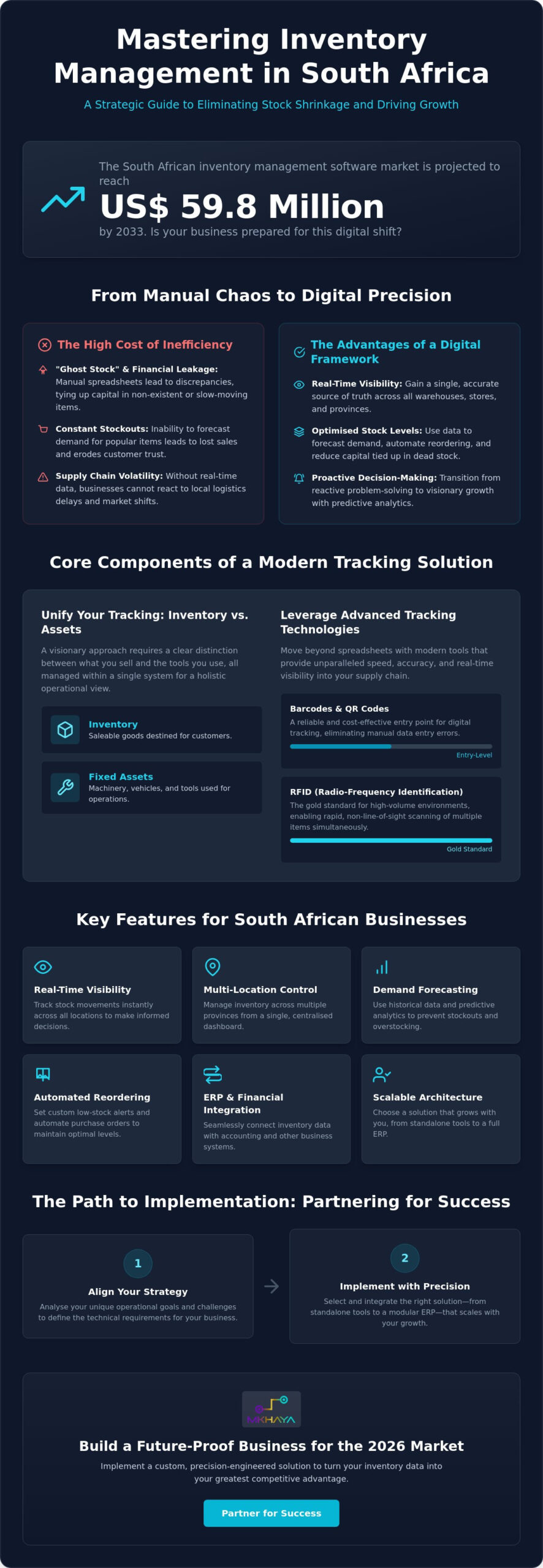
The South African inventory management software market is projected to reach US$ 59.8 million by 2033, yet many local enterprises still struggle to find the right inventory management system south africa to prevent stock shrinkage. You likely feel that traditional ways of counting boxes are failing to keep pace with a rapidly changing economy. It’s a common frustration when valuable capital is tied up in slow-moving stock while your most popular items face constant stockouts. We understand that building a reliable business requires more than just luck; it requires precision and a partner who values your long-term stability.
This guide will help you implement a robust strategy tailored to these unique local challenges. You’ll discover how to optimise your supply chain, reduce unexplained losses, and move towards a more precise, data-driven future. We’ll walk through the essential steps of achieving real-time visibility across multiple locations and automating your reordering processes. By the end of this article, you’ll have a clear roadmap for integrating these tools with your existing financial or ERP systems to ensure your business remains a stable, forward-looking anchor in the 2026 market.
Key Takeaways
Eliminate “ghost stock” and financial leakage by moving beyond manual spreadsheets to a strategic digital framework.
Gain real-time visibility by integrating advanced tracking technologies like RFID and QR codes for both saleable stock and fixed assets.
Scale with confidence by choosing between standalone tools and modular ERP systems that grow alongside your business requirements.
Optimise operations across multiple provinces using a modern inventory management system south africa designed for demand forecasting and multi-location control.
Implement a precision-engineered solution through a methodical two-step process that aligns your technical stack with your unique operational goals.
Understanding Inventory Management Systems in the South African Context
Inventory management is far more than a simple tally of items on a shelf. It’s the strategic discipline of overseeing the entire flow of goods, from the initial manufacturer to the warehouse and finally to the point of sale. In our local market, establishing a robust inventory management system south africa ensures that your operational rhythm remains steady despite external pressures. By centralising data, your business can transition from reactive firefighting to proactive, visionary growth. Precision in this area is the foundation of a reliable supply chain.
To better understand how these systems function in a real-world warehouse environment, watch this helpful video showing a local success story:
For many local enterprises, manual spreadsheets remain the default tool for tracking. However, these static records are the primary cause of “ghost stock” (items that appear in the system but don’t exist in reality) and significant financial leakage. South African businesses face unique hurdles, including supply chain volatility and frequent logistics delays. Without modern inventory management software, these bottlenecks become insurmountable. Digital transformation provides the necessary transparency to secure your stock and protect your margins in a fluctuating economy.
The High Cost of Inefficient Stock Control
Inefficiency carries a heavy price tag. Dead stock drains your cash flow and occupies valuable warehouse space that should be reserved for high-velocity items. Efficiency breeds confidence. In our competitive national market, stockouts do more than lose a single sale; they erode the customer trust you’ve worked hard to build. Integrating a comprehensive ERP solution provides the oversight needed to mitigate these risks by linking inventory data directly to your broader financial operations.
Why 2026 is the Year for Digital Migration
Cloud-based systems are now essential for multi-location South African enterprises because they provide a single source of truth accessible across provincial borders. We’re seeing a decisive shift towards data-driven decision-making in the local retail and manufacturing sectors. Investing in custom software development allows businesses to build bespoke tools that turn inventory data into a distinct competitive advantage. A tailored inventory management system south africa provides the agility needed to respond to market shifts instantly, ensuring long-term stability and precision for your brand.
Core Components of a Modern Asset Tracking Solution
A common oversight in operational planning involves treating saleable stock and operational tools as a single category. A visionary approach requires a clear distinction between inventory, which represents goods destined for customers, and assets, which include the machinery, vehicles, and tools used to deliver them. By implementing a unified inventory management system south africa, you gain a holistic view of both stock levels and fixed assets. This clarity prevents the accidental depletion of sales stock whilst ensuring that your essential equipment remains accounted for and maintained.
The modern technology stack has evolved far beyond simple spreadsheets. Barcoding and QR codes offer a reliable entry point for digital tracking, but RFID (Radio Frequency Identification) has become the gold standard for high-volume environments. These tools provide the real-time visibility necessary to manage complex supply chains. For a deeper look at the fundamentals, this inventory management guide for South African businesses highlights how local enterprises are leveraging these technologies to stay competitive. Using a robust asset tracking solution south africa ensures that your high-value equipment is monitored across national logistics routes, reducing the risk of loss during transit.
Traceability is no longer optional in sectors such as food, beverage, and electronics. Regulatory compliance requires a precise record of an item’s journey from origin to destination. A sophisticated system captures this data automatically, allowing you to respond to audits or recalls with absolute confidence. Reliability in these moments protects your brand’s reputation and ensures long-term stability.
Real-Time Visibility with RFID and IoT
IoT sensors represent the next frontier in stock control. These devices monitor the condition of sensitive inventory, such as temperature or humidity levels, during long-haul transit across South Africa. RFID technology complements this by allowing warehouse staff to scan entire pallets in seconds without needing a direct line of sight. When you integrate AI and data automation, the system can process this tracking data to predict maintenance schedules or reorder needs before a crisis occurs.
The Role of Mobile Applications in the Warehouse
Empowering your team with mobile-first software transforms the warehouse floor. Staff can perform instant stock takes and update records on the move, which significantly reduces the human error associated with manual tallying. The success of these tools depends heavily on intuitive UI/UX design. If the interface is clear and purposeful, your team is more likely to embrace the system, leading to more accurate data and smoother daily operations. If you are ready to build a more resilient operation, our team can help you customise a solution that fits your specific workflow.
Inventory Management vs. ERP: Choosing the Right Strategy
Deciding between a standalone inventory management system south africa and a full-scale Enterprise Resource Planning (ERP) platform is a pivotal moment for any growing business. While standalone tools focus purely on stock levels, an ERP integrates these figures with your financial, sales, and human resources data. This creates a single source of truth that eliminates the friction of moving data between disconnected silos. Research into inventory management practices for South African SMMEs suggests that many local businesses suffer when their systems don’t communicate effectively. By choosing an integrated path, you ensure that every sale immediately reflects in your balance sheet and procurement schedule.
A common concern is that an ERP might be too complex or overwhelming for a medium-sized operation. We believe in a modular approach where you only implement the features you need today. You can start with core inventory and finance modules, then expand as your operational footprint grows. This strategy ensures you aren’t paying for unnecessary features while maintaining a clear path toward operational excellence through a unified digital ecosystem. It’s about building a stable anchor for your business that remains agile as your needs evolve.
When to Opt for Bespoke Software Development
Off-the-shelf software often forces your business to adapt to its rigid workflows, rather than the other way around. If you find your team working around the system or struggling with a lack of local tax compliance features, it’s time to consider a custom route. Through precise software engineering, we build bespoke modules that mirror your specific warehouse layout and unique handling requirements. Custom systems offer the long-term stability of owning your intellectual property without the burden of escalating per-user licensing fees as your staff count increases. This approach allows for a solution that fits your business like a glove.
Integrating Procurement and Supplier Management
Your inventory levels shouldn’t exist in a vacuum. A truly strategic inventory management system south africa talks directly to your suppliers to ensure seamless replenishment. When stock hits a pre-defined reorder point, the system can automatically generate and send purchase orders to your preferred vendors. Using a tool like the Optimate procurement platform streamlines these external relationships by centralising supplier communication. This allows for effortless electronic comparisons, ensuring you always secure the best value for your procurement spend whilst maintaining optimal stock levels. Automation in this area reduces manual errors and frees your team to focus on higher-level strategy.
Key Features to Look For in a South African Inventory System
We also recommend prioritising automated reorder alerts. By setting specific “par levels”, your inventory management system south africa can notify you the moment stock drops below a safe threshold. This prevents out-of-stock scenarios for your best-selling items and maintains a steady rhythm of trade. Seamless integration capabilities are the final piece of the puzzle. Your inventory data should flow effortlessly into your accounting software, such as Xero or Sage, and connect with your facility management systems to create a unified operational environment.
Reporting and Analytics for Informed Decisions
Meaningful data is the fuel for strategic growth. A modern system should offer detailed reports, such as stock turnover ratios and ABC analysis, which categorises items based on their value and frequency of sale. Accessing these insights from anywhere in the country is made possible through cloud application services. Data-driven insights lead to better cash flow management by identifying exactly where your money is tied up on the shelves.
Security and Access Control
Protecting your assets requires more than just physical locks. Role-based access control is essential to prevent internal theft and ensure that only authorised personnel can make data changes. Detailed audit trails provide a clear record of every transaction, helping you identify the source of any stock discrepancies with absolute precision. We often find that digital transformation consulting is the best way to align these software security features with your internal business policies. If you’re ready to secure your supply chain, reach out to us to discuss your specific requirements.
The Path to Implementation: Partnering for Success
Implementing an inventory management system south africa is a deliberate journey that requires a steady hand and a clear roadmap. The first step involves a comprehensive audit of your existing stock-taking processes to pinpoint exact pain points, such as where manual errors most frequently occur or where shrinkage is highest. Once these gaps are identified, you must decide between bespoke custom development or a specialised tool like a loan management system or a broader ERP. This choice defines your operational foundation and should align perfectly with your long-term business goals.
Data integrity remains the most critical factor during the transition phase. You must rigorously clean your records before migration to ensure the new system starts with precise, verified figures. Moving messy or outdated data into a new environment only replicates old problems and erodes staff confidence. Training your team is equally vital; a system is only as effective as the people using it. If your internal team is stretched thin, utilising staff augmentation can provide the temporary technical expertise needed to lead a seamless transition without disrupting your daily operations.
Finally, the implementation phase moves into a cycle of monitoring and iteration. Success isn’t a one-time event but a continuous process of refinement. As your business grows, your system should scale alongside it, effortlessly adapting to new warehouse locations, diverse product lines, or changing regulatory requirements. This iterative approach ensures that your technology remains a high-performance asset rather than a legacy burden. For financial service providers looking to apply similar automation principles to their credit operations, exploring an automated loan processing system south africa can deliver comparable gains in efficiency and compliance. Lenders navigating the complexities of NCR compliance and the COFI Bill will also find that selecting the right loan management system south africa is equally critical to building a scalable, regulation-ready operation.
Why Mkhaya MK is Your Strategic Guide
We position ourselves as a visionary yet practical guide in your digital journey. Our approach values transparency and methodical execution over flashy, unsubstantiated claims, ensuring that every solution we build is rooted in your actual business needs. We bring a “quiet confidence” to every project, born from a deep understanding of the South African technological landscape and the unique challenges local businesses face. You can learn more about our commitment to integrity and mutual success on our about us page.
Next Steps: From Vision to Execution
Moving from a broad vision to concrete execution requires a dedicated partner who is invested in your personal journey. We invite you to a strategic consultation to map out your specific inventory needs and identify the most reliable path forward for your enterprise. Our solutions are built for long-term stability and scalability, acting as a stable anchor in a rapidly changing market. Visit our contact us page to begin your personalised assessment and secure your operational future.
Securing Your Operational Future
Establishing a robust inventory management system south africa is the definitive step toward long-term stability in an increasingly complex market. We’ve explored how moving beyond manual spreadsheets to digital precision protects your margins and builds lasting customer trust. By choosing a modular approach to technology, you ensure that your business remains agile, scalable, and ready for the challenges of 2026. Precision in stock control isn’t just about efficiency; it’s about building a reliable foundation for your brand’s legacy.
Our team provides end-to-end digital transformation expertise and specialised proprietary products like Optimate and MkhayaMove to support your national reach. We focus on delivering operational stability through methodical execution and transparent partnership. Partner with Mkhaya MK to build your future-proof inventory ecosystem. Together, we can transform your supply chain into a visionary asset that drives mutual success for years to come.
Frequently Asked Questions
What is the best inventory management system for a South African SME?
The best inventory management system south africa for an SME is one that offers modular scalability to grow alongside your business requirements. While off-the-shelf options exist, a system that integrates with local tax requirements and your specific logistics chain provides the greatest long-term stability. It should focus on ease of use for your warehouse team whilst providing deep analytical insights for management to make informed decisions.
How does an asset tracking solution differ from basic inventory software?
Basic inventory software tracks items intended for sale, whereas an asset tracking solution monitors the fixed equipment and tools used to run your business. A unified system allows you to manage both saleable stock and operational assets like vehicles or machinery in one place. This distinction is vital for maintaining an accurate balance sheet and ensuring your operational tools are always maintained and ready for use.
Can I integrate my inventory system with my existing accounting software?
Integration with accounting software like Xero or Sage is a standard feature of a modern inventory management system south africa. This connection ensures that every stock movement is automatically reflected in your financial records, which eliminates the need for manual data entry. It reduces the risk of human error and provides a real-time view of your business’s financial health across all provincial locations.
How much does it cost to implement a custom inventory management system in South Africa?
Implementation costs depend entirely on the scope of your requirements, the number of modules chosen, and the level of customisation needed for your workflow. We focus on building solutions that provide a clear return on investment by reducing shrinkage and improving operational efficiency. Each project is priced based on the specific technical support and features your business requires to achieve its strategic goals.
What are the benefits of using RFID for stock control in local warehouses?
RFID technology allows for the rapid scanning of entire pallets or shelves without requiring a direct line of sight to each individual barcode. This significantly reduces the time required for monthly stock takes in large warehouses, leading to lower labour costs and higher data accuracy. It’s an ideal solution for high-volume environments where speed and precision are essential for maintaining a competitive edge in the local market.
How do I prevent stock shrinkage using digital tools?
Digital tools prevent shrinkage by providing real-time visibility and detailed audit trails for every item in your facility. Automated alerts notify you of unexpected stock movements, while role-based access control ensures that only authorised staff can adjust inventory levels. These features create a culture of transparency and accountability, making it much easier to identify and address the source of any discrepancies with absolute precision.
Is cloud-based inventory software secure for my business data?
Cloud-based software is highly secure because it utilises advanced encryption and redundant data centres that are often more resilient than local servers. Your data is protected against physical hardware failure and local security breaches, ensuring that your business information remains accessible only to authorised users. Regular automated backups provide additional peace of mind, allowing you to focus on growth rather than worrying about technical maintenance.
How long does it take to migrate from manual spreadsheets to an automated system?
Migration typically takes between four weeks and three months, depending on the volume of your data and the cleanliness of your current records. A successful transition relies on a methodical approach that includes data auditing, staff training, and rigorous testing. We work closely with your team to ensure the move from manual spreadsheets to an automated system is smooth and does not disrupt your daily operations.
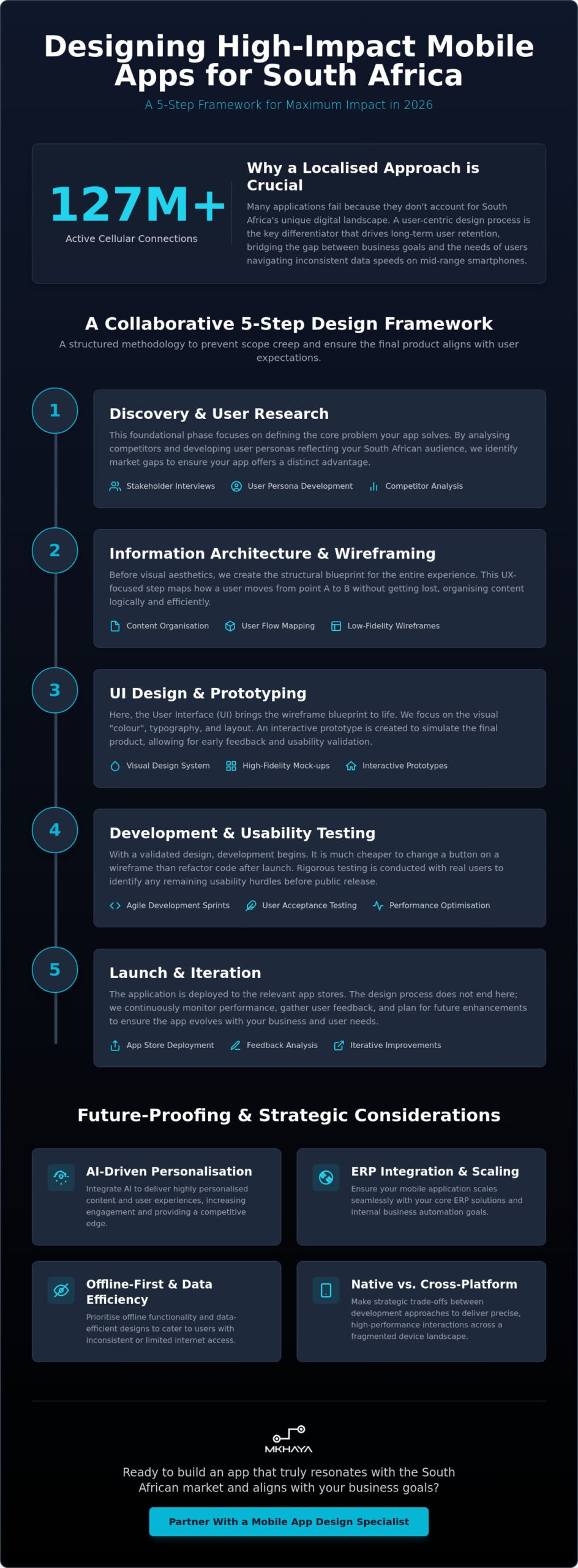
With over 127 million active cellular connections in South Africa, your audience isn’t just connected; they’re living through their mobile devices. Yet, it’s a sobering reality that many high-budget applications fail to retain users because they don’t account for the unique local landscape. You’ve likely experienced the frustration of trying to bridge the gap between complex business requirements and the actual needs of a user navigating inconsistent data speeds or a mid-range smartphone.
Partnering with a specialised mobile app design company south africa allows you to move past these obstacles with confidence and precision. This guide provides a clear roadmap to help you organise your design process for maximum impact in 2026. You’ll discover how to create an interface that feels both intuitive and valuable to your customers whilst ensuring your digital tools align perfectly with your internal business automation. We’ll explore the essential steps for building trust through POPIA-compliant design and strategies for maintaining high performance across South Africa’s diverse device ecosystem.
Key Takeaways
Understand why user experience design is the essential foundation for South African apps, serving as the key differentiator that drives long-term user retention.
Master a collaborative 5-step framework with a mobile app design company south africa to ensure your digital tools remain perfectly aligned with your strategic business goals.
Navigate local infrastructure constraints by prioritising offline-first functionality and data-efficient designs that cater to the diverse South African user base.
Evaluate the strategic trade-offs between native and cross-platform development to deliver precise, high-performance interactions across a fragmented device landscape.
Future-proof your investment by integrating AI-driven personalisation and ensuring your mobile application scales seamlessly with your core ERP solutions.
Why User Experience Design is the Foundation of South African Mobile Apps
User experience (UX) design is far more than a technical requirement; it’s the process of creating a product that provides meaningful and relevant experiences to your users. Within our local market, this discipline acts as the primary differentiator between an application that merely occupies storage and one that becomes an essential daily tool. While many competitors focus solely on creating “beautiful apps”, a professional mobile app design company south africa understands that true success lies in how a user interacts with your digital solution under real-world conditions.
Investing in robust design early in the mobile app development process reduces long-term expenses by identifying usability hurdles before a single line of code is written. It’s much cheaper to move a button on a wireframe than to refactor an entire database or fix logic errors after launch. In 2026, user experience design serves as the indispensable bridge between complex technical capability and tangible business value.
To better understand the impact of professional design on your project’s trajectory, watch this helpful video:
The Strategic Value of User-Centric Design
Aligning your app’s features with your core business objectives ensures that every swipe and tap contributes to your digital transformation goals. Professional design builds deep trust amongst South Africa’s diverse user base by acknowledging local nuances and accessibility needs. When an interface is intuitive, you’ll find a significant reduction in the need for extensive user training. This allows your team or customers to adopt the tool with minimal friction, ensuring your mobile app design company south africa delivers a product that scales with your ambition.
UI vs. UX: Understanding the Distinction
It’s easy to confuse these terms, but the difference is vital for your project’s health. User Interface (UI) focuses on the visual “colour”, typography, and layout that users see. UX, however, is the invisible journey they take. Before visual aesthetics are even considered, wireframing acts as a structural blueprint for the entire experience. It maps out how a user moves from point A to point B without getting lost. Collaborating with a UI UX design services South Africa partner ensures these two elements work in perfect harmony, resulting in a product that’s as functional as it is polished.
How to Organise Your Mobile App Design Process: A 5-Step Framework
Success in mobile app design isn’t a matter of chance; it’s the result of a highly structured, collaborative methodology. When you work with a leading mobile app design company south africa, you involve stakeholders from your business, design, and engineering teams from the very beginning. This approach effectively prevents the common pitfalls of scope creep and technical debt. Each phase of this framework is designed to produce a tangible deliverable that serves as a stable foundation for the next, ensuring the final product aligns with user expectations.
Step 1: Discovery and User Research
We start by conducting in-depth stakeholder interviews to define the specific “Job to be Done” for your application. This phase focuses on the core problem your app solves rather than just a list of features. We develop user personas that reflect the actual behaviours of your target South African audience, often referencing local academic insights regarding user-preferred app features. By analysing your competitors, we identify specific gaps in the national market, ensuring your application offers a distinct advantage.
Step 2: Information Architecture and Wireframing
Once the research is complete, we organise content and features into a logical hierarchy that minimises cognitive load for the user. Low-fidelity wireframes act as a functional blueprint, mapping out the entire journey without the distraction of visual aesthetics. We validate this flow through early-stage testing to ensure that the navigation feels natural and intuitive. If you’re ready to start this journey, following a proven engagement process ensures every decision is backed by data.
Step 3: Prototyping and Visual Design
In this stage, wireframes transform into high-fidelity designs that truly reflect your brand identity. We develop interactive prototypes that simulate the actual app experience, allowing stakeholders to interact with the product before the software engineering phase begins. This ensures the design is responsive across various screen sizes and device specifications, which is vital for the South African market. Partnering with a professional mobile app design company south africa ensures that your visual design is always balanced with technical feasibility.
Step 4: User Testing and Iteration
Before moving to development, we put the prototype in the hands of real users. This step identifies any remaining friction points and allows us to refine the interface based on actual user feedback. Iterating at this stage is far more cost-effective than making changes after the app has been built, ensuring the final product is polished and user-ready.
Step 5: Design Handoff and Specification
The final step involves preparing the design for the engineering team. We create comprehensive documentation and design specifications that include every asset, colour code, and interaction detail. This seamless handoff ensures that the vision established during the design phase is accurately translated into the final, functional software product.
Native vs. Cross-Platform: UX Design Considerations
The choice of your technology stack significantly impacts how a mobile app design company in South Africa approaches the user experience. It’s not merely a technical decision; it’s a strategic one that dictates how fluidly your users can interact with your brand. In South Africa’s mobile-first economy, where over 90% of internet users access the web via mobile devices, the performance and accessibility of your application form the bedrock of your digital reputation.
Native development, which focuses on iOS or Android individually, allows for the most precise use of device-specific gestures and animations. This path is often chosen when the highest level of performance is non-negotiable. Conversely, cross-platform frameworks like Flutter or React Native offer a faster time-to-market whilst maintaining exceptionally high design standards. Ultimately, the best choice for your project depends on your specific user behaviour and performance requirements.
When to Choose Native Design
Native design is the preferred route for projects requiring complex animations or heavy reliance on hardware features like the camera, biometric sensors, or GPS. If your application targets a user base where a platform-specific look and feel is a “favourite” requirement for adoption, native development ensures every interaction feels natural on the device. This approach is particularly effective for high-intensity enterprise tools or gaming applications where every millisecond of latency matters. By building natively, you’re investing in a stable, high-performance anchor that leverages the full power of the underlying operating system.
The Rise of Cross-Platform Efficiency
Modern frameworks have revolutionised the industry by allowing for a single design codebase that looks and feels premium on both major platforms. This efficiency allows you to balance cost-effectiveness with the need for a bespoke user experience that doesn’t feel like a compromise. Strategic custom software development South Africa involves choosing the right path that aligns with your budget and long-term scaling plans.
Cross-platform solutions are ideal for businesses that need to reach a broad audience quickly without sacrificing the visual polish expected in 2026. A skilled mobile app design company south africa can create a unified experience that adapts beautifully to different screen sizes. This ensures your brand remains consistent across the fragmented local device landscape. This collaborative approach ensures your digital tool provides immediate value whilst remaining agile enough to evolve with your business needs.
Addressing South African Challenges in Mobile App Design
South Africa presents a unique set of hurdles that require more than just a standard global design template. Varying data costs and inconsistent network connectivity mean that a “one-size-fits-all” approach often leads to high abandonment rates. A visionary mobile app design company in South Africa will prioritise these local nuances from day one. Design must account for “offline-first” functionality to ensure the app remains useful without a constant signal. Whether a user is in a remote area or a high-rise lift, the interface should remain responsive and functional.
Partnering with a dedicated mobile app design company south africa ensures that your product is built with these specific constraints in mind. When you design for the edge cases of connectivity, you create a more resilient product for every user. This methodical focus on local reality is what separates successful digital tools from those that fail to gain traction.
Optimising for Data Sensitivity
With prepaid mobile data revenue increasing by 7.7% in 2025, South Africans are acutely aware of their data consumption. We implement “light” versions of assets and icons to reduce the burden on the end-user’s wallet. Caching strategies are essential here. They ensure core information stays available whilst the user is offline, syncing only when a stable connection is found. It’s also vital to provide clear feedback. Users should know exactly when they’re about to perform a data-intensive task, such as downloading a large report. This transparency builds long-term trust and prevents “bill shock” for your customers.
Accessibility and Inclusive Design
If you’re ready to build a tool that truly resonates with the local market, reach out to our team to start your project with a partner who understands the South African landscape.
Future-Proofing Your App with AI and Strategic Scaling
AI is no longer a futuristic concept but a functional necessity for mobile applications in 2026. It enables a shift toward predictive UX, where the interface anticipates user needs before they are explicitly stated. This level of sophistication requires a mobile app design company south africa that looks beyond the surface to the underlying data structures. When your front-end experience is tightly integrated with robust ERP solutions South Africa, you create a seamless flow between customer interactions and your core business operations.
Design is a living process that demands a commitment to long-term stability and refinement. By viewing your app as a stable anchor for your business, you ensure it remains relevant even as technology shifts. Successful scaling involves more than just adding features; it requires a methodical approach to maintaining high performance whilst your user base expands. This forward-looking strategy ensures your digital tools continue to deliver value in an increasingly competitive landscape.
Integrating AI into the User Journey
Leveraging AI and data automation allows us to simplify complex user tasks through smart defaults and predictive paths. Instead of overwhelming users with endless choices, the app presents the most likely next step based on historical behaviour. This significantly reduces cognitive load and increases user retention. We also focus on conversational UI and chatbots to enhance customer support efficiency. These tools provide immediate assistance to your users, ensuring they feel supported whilst freeing up your internal resources for more complex tasks.
Scaling Through Continuous Improvement
Launching your app is simply the start of a collaborative journey. We use heatmapping and detailed analytics to identify exactly where users encounter friction after the initial release. As your requirements grow, you might need to quickly inject specialised talent into your project. Utilising staff augmentation provides the agility to scale your design team without the overhead of permanent hires. This ensures your app design evolves in lockstep with your broader digital transformation strategy.
Partnering with an expert mobile app design company south africa provides you with a visionary guide for this ongoing process. We help you interpret real-world data to make informed design adjustments that reflect changing market conditions. This methodical execution ensures that your mobile application remains a reliable, high-end tool that continues to achieve your strategic business goals; for a look at how this applies to specialised sectors, check out Build App | building management software — collection, maintenance, and tenants in one place as a benchmark for functional excellence.
Building Your Digital Legacy in the South African Market
Your journey toward a successful mobile application requires a methodical plan that balances high-end aesthetics with functional accessibility. We’ve explored how a robust 5-step framework and a deep understanding of local challenges, such as data sensitivity and connectivity, can transform your digital presence. By choosing to work with an experienced mobile app design company south africa, you aren’t just building a tool; you’re creating a stable anchor for your business’s future growth.
Mkhaya MK serves as a national leader in end-to-end digital transformation. We specialise in custom software engineering and AI automation, ensuring that your digital assets remain resilient in a rapidly changing landscape. Our focus on long-term stability and mutual success means we’re deeply invested in your personal journey. It’s time to bridge the gap between your strategic business requirements and the needs of your users. Partner with Mkhaya MK for Visionary Mobile App Design and take the first step toward a product that truly resonates with the South African audience. We’re ready to help you turn your vision into a practical, high-impact reality.
Frequently Asked Questions
How much does mobile app design cost in South Africa?
The cost of mobile app design depends on the complexity of the application, the number of custom features, and the depth of user research required. A professional design phase is a strategic investment that prioritises long-term user retention and brand alignment over a generic interface. Factors such as the integration of AI automation or complex database structures will influence the final scope of the design project.
How long does the mobile app design process typically take?
A comprehensive design process usually takes between 4 and 12 weeks to complete. This timeline includes the initial discovery phase, wireframing, and the creation of high-fidelity interactive prototypes. Smaller projects or MVPs might move through these stages faster, whilst complex enterprise tools require a more deliberate pace to ensure every user journey is thoroughly validated before development begins.
Should I design for iOS or Android first in South Africa?
In the South African market, Android typically holds the dominant share of active connections, making it a common starting point for many businesses. However, the most effective strategy often involves a cross-platform design approach that ensures a premium experience for all users regardless of their device. Your specific target demographic and their preferred device habits should ultimately guide this decision.
What is the difference between a mobile app design company and a development company?
A design company focuses on the user experience (UX) and the visual interface (UI) to ensure the app is intuitive and valuable. A development company handles the technical coding, server architecture, and logic that makes the app functional. Partnering with a full-service mobile app design company south africa ensures that your visual vision is perfectly aligned with technical feasibility from the start.
Can I use a template for my business mobile app design?
While templates offer a quick solution, they often lack the precision needed to solve specific business problems or accommodate South Africa’s unique connectivity challenges. Bespoke design allows you to build a tool that is a stable anchor for your brand, offering a level of customisation that templates cannot match. This ensures your application can scale and evolve alongside your business transformation goals.
How do I know if my current app needs a UX redesign?
High user abandonment rates, negative feedback, and difficulty in completing core tasks are the most common signs that your app needs a refresh. If your current interface feels cluttered or fails to leverage modern capabilities like AI-driven personalisation, a UX redesign can significantly improve user engagement. Regularly reviewing your app’s performance data helps identify specific friction points that hinder your strategic goals.
What are the most important UX trends in South Africa for 2026?
The most critical trends include AI-driven predictive interfaces, dark mode for battery conservation, and robust “offline-first” functionality. There is also a heightened focus on trust-centred design, driven by intensified POPIA enforcement and a need for transparent data handling. A leading mobile app design company south africa will integrate these trends to ensure your application remains modern, secure, and highly accessible.
How does mobile app design impact my overall digital transformation?
Effective design serves as the primary interface for your digital transformation, making complex backend systems accessible to your team and customers. It ensures that your investment in digital tools, such as ERP solutions or data automation, results in a tool that people actually enjoy using. By focusing on the user, you bridge the gap between technical capability and tangible business value.
According to Deloitte, only 8% of companies believe their performance management process is a good use of time. It’s a staggering figure that highlights why so many organisations feel trapped by manual spreadsheets and rigid, off-the-shelf software. When your performance appraisal management system feels like a hurdle rather than a help, it’s difficult to see the path toward genuine growth. You likely recognise the frustration of manual data entry errors and the persistent lack of real-time visibility into how your teams are actually faring.
We understand that your company culture is unique, and your tools should reflect that precision. This article explores how to transform these administrative burdens into a data-driven engine for organisational success. You’ll discover how bespoke systems can automate review cycles and provide the actionable analytics needed to secure long-term stability. We’ll look at building transparent growth paths that improve employee retention and ensure your talent feels truly seen. It’s time to move toward a more agile, modern approach that turns every evaluation into a strategic advantage.
Key Takeaways
Understand the shift from traditional annual reviews to a continuous performance appraisal management system that tracks output in real-time.
Learn why bespoke software engineering provides the flexibility needed to integrate seamlessly with your existing ERP solutions and unique company culture.
Discover how integrating AI-driven sentiment analysis can help identify employee engagement levels and mitigate burnout risks early.
Explore a strategic roadmap for implementation that focuses on defining clear KPIs and prioritising user experience for high adoption rates.
What is a Performance Appraisal Management System in 2026?
In 2026, a Performance appraisal is no longer a static document tucked away in a filing cabinet or a forgotten folder. It has evolved into a sophisticated performance appraisal management system. This digital ecosystem tracks, evaluates, and improves employee output with surgical precision. By moving away from paper-based processes and spreadsheet-heavy workflows, organisations can finally eliminate the manual data entry errors and version control issues that often plague HR departments. It’s about creating a reliable foundation for mutual success rather than just ticking a box once a year.
To better understand the pitfalls of traditional reviews and why a modern approach is necessary, watch this helpful video:
The shift from annual “event-based” reviews to continuous performance management marks a significant change in corporate strategy. Instead of a high-pressure meeting every twelve months, managers and employees engage in a steady stream of feedback. This constant dialogue ensures that individual effort aligns perfectly with national corporate objectives. When you use bespoke software engineering to build these tools, the system becomes a pillar of your digital transformation journey, adapting to your specific organisational DNA.
The Evolution of Employee Evaluation
Employee evaluation has moved far beyond simple checklists. Modern systems often use behaviourally anchored rating scales (BARS) to provide objective, qualitative data that standard metrics might miss. This is particularly vital for the remote and hybrid workforce structures that have become standard across South Africa. Digital systems bridge the gap between physical locations, ensuring every team member stays visible and supported regardless of where they log in. Real-time feedback mechanisms allow for immediate course correction, which is far more effective than discussing a mistake six months after it happened.
Core Components of a Digital Appraisal Framework
A robust digital framework relies on several key pillars to drive growth. First, goal setting through OKRs (Objectives and Key Results) allows for transparent tracking of progress against high-level business targets. Self-assessment modules and peer review capabilities then add multiple layers of perspective, creating a 360-degree view of performance. Finally, centralised documentation stores historical data securely. This allows leaders to make informed decisions based on long-term trends and data-driven insights rather than recent impressions or personal bias.
Custom vs. Off-the-Shelf: Designing the Right Architecture
Many organisations start their digital journey with off-the-shelf SaaS platforms, attracted by the promise of quick deployment. However, these solutions often lead to a “one-size-fits-none” reality. Generic tools limit growth. When your business model relies on unique hierarchies or specialised workflows, rigid software becomes a barrier to progress. You shouldn’t have to change your successful company culture to fit the limitations of a software vendor’s template.
Owning your performance data infrastructure is a strategic move toward long-term stability. Whilst subscription models seem affordable initially, the per-user licensing bloat can become a significant financial burden as your national operations expand. By investing in a custom performance appraisal management system, you ensure that your tools grow with you, not against you. This shift is a key part of The Performance Management Revolution, where businesses prioritise agility and precision over generic functionality.
The Case for Bespoke Software Engineering
Building a system from the ground up allows you to mirror your specific internal hierarchy and culture. Every organisation has its own way of rewarding excellence and identifying growth areas. Through bespoke software engineering, you can create custom modules that reflect these nuances. This approach avoids the “feature bloat” of standard tools, giving your team exactly what they need without the clutter. It’s about building a reliable partner for your HR team that feels like a natural extension of your brand.
Integration with Existing Enterprise Systems
A performance system shouldn’t exist in a vacuum. To drive real ROI, your performance data must talk to your payroll, recruitment, and learner management systems. Integrating these platforms creates a unified data source, which is essential for executive decision-making. When your ERP solutions work in harmony with a custom performance appraisal management system, you gain a holistic view of your talent landscape. If you’re finding that your current tools can’t communicate with your other business systems, it’s a clear sign you’ve outgrown the standard market offerings.
You might find it helpful to explore a custom approach if you want to see how tailored architecture can solve your specific integration challenges.
Essential Features of a High-Impact Appraisal System
Modern systems must do more than just record scores; they need to provide actionable intelligence. A high-impact performance appraisal management system acts as an early warning system for your leadership team. By incorporating AI-driven sentiment analysis, you can identify patterns in feedback that suggest employee burnout or high levels of engagement long before they manifest in turnover rates. It’s about being proactive rather than reactive, ensuring that your talent remains motivated and supported throughout their journey with your organisation.
Efficiency is built into the architecture through automated reminders and workflow triggers. These features ensure that review cycles stay on track without constant manual intervention from HR. When the system handles the scheduling and follow-ups, your team can focus on the quality of the conversations. Advanced data visualisation further enhances this by providing clear dashboards that highlight high-potential talent across different departments. This birds-eye view is crucial for succession planning and ensuring that your most promising individuals have clear, transparent growth paths.
AI and Data Automation in Performance Tracking
The integration of AI and data automation transforms how managers interact with performance data. Instead of sifting through months of notes, AI provides objective performance summaries that highlight key achievements and areas for refinement. Predictive analytics can even forecast future leadership candidates by analysing performance trajectories over time. This data-driven approach removes the guesswork from talent development, allowing you to build a stable and visionary leadership pipeline based on evidence rather than intuition.
360-Degree Feedback and Peer Recognition
Removing managerial bias is a priority for any fair evaluation process. Multi-source feedback loops allow peers and subordinates to contribute to an employee’s profile, creating a more balanced reflection of an individual’s contribution. Encouraging a culture of continuous improvement becomes easier when you include social recognition features, where colleagues can celebrate each other’s successes in real-time. To maintain trust, the system must allow for granular privacy levels for different feedback categories. Robust security protocols are non-negotiable here, as protecting sensitive employee personal information is the foundation of a reliable partnership between employer and staff.
Implementing a Performance Management Framework: A Strategic Roadmap
Launching a performance appraisal management system requires more than just a technical installation; it demands a phased, strategic approach to ensure lasting success. Phase 1 begins with defining your key performance indicators (KPIs) and broader organisational goals. This foundational step ensures that every metric tracked within the system serves a specific business purpose. Without this initial clarity, even the most advanced software fails to deliver a meaningful return on investment. It’s about building a framework that reflects your unique ambitions from the very first day.
Once your goals are established, the focus moves toward technical execution and refinement. Phase 3 involves the careful migration of data from legacy systems and rigorous pilot testing. This ensures technical reliability and data integrity before you commit to a full-scale rollout. Finally, Phase 4 centres on continuous system optimisation. By analysing feedback from the pilot phase, you can refine workflows and adjust features to better serve your teams. This methodical progression creates a sense of steady momentum, leading your organisation toward a concrete and successful digital future.
User Experience (UX) and Adoption Strategies
High adoption rates are the true measure of a system’s success. If the interface is clunky or confusing, employees will inevitably view it as an administrative burden. This is why Phase 2 of our roadmap prioritises website and UI/UX design to create an intuitive, frictionless experience. Staff should feel that the platform is a growth tool designed for their benefit, rather than a surveillance mechanism. Clear training programmes help shift this perception, fostering a culture where performance data is welcomed as a transparent path to professional development and reward.
Change Management and Organisational Buy-in
Transitioning to a digital framework requires strong executive sponsorship to secure genuine organisational buy-in. Leaders must proactively communicate the “why” behind the shift, explaining how a modern performance appraisal management system benefits the entire team through fairness and clarity. It’s vital to address common employee anxieties regarding automated evaluations early in the process. By being transparent about how data is used and how it supports individual growth, you build the trust necessary for a stable transition. This collaborative relationship between the business and its people is what turns a software tool into a pillar of corporate culture.
At Mkhaya MK, we believe that your digital tools should be as unique as your organisation’s DNA. We position ourselves as a visionary yet practical guide in your digital transformation journey, moving away from the cold, detached language often found in technical sectors. A custom-engineered performance appraisal management system isn’t just a recording tool; it’s a strategic asset built to solve the “rigid software” problem that so often stifles innovation. By choosing a bespoke approach, you’re investing in a system that adapts to your culture, rather than forcing your team to bend to the limitations of a pre-built template.
Our deep expertise in AI and cloud solutions allows us to construct future-proof platforms that grow alongside your ambitions. We focus on creating an atmosphere of steady, forward-looking ambition, ensuring that your technology remains a stable anchor even as the market shifts. As a national partner, we bring a profound understanding of the local business landscape, ensuring that your performance framework is grounded in practical, business-focused results. This local insight, combined with our polished, high-end technical execution, creates a reliable partnership rooted in integrity and commitment.
Our Collaborative Development Process
The path to a high-impact system is highly structured and follows a logical progression. We start with strategic digital transformation consulting to align your software with your high-level corporate objectives. From there, we move through methodical deployment to managed support, ensuring that your performance appraisal management system integrates seamlessly with your existing tech stack. This cause-and-effect logic ensures that every capability we build is immediately linked to a practical benefit for your HR team and executive leadership. We don’t just deliver software; we deliver a clear, step-by-step path to engagement and success.
Scaling Your Vision with Mkhaya MK
We understand that achieving operational excellence often requires more than just new software. To truly scale your vision, you might need to extend your internal capacity through our staff augmentation services. This flexible approach allows you to access specialised expertise exactly when you need it, ensuring that your roadmap for AI-driven excellence stays on track. Whether you’re refining your current review cycles or building a completely new data-driven engine for growth, we’re here to provide the precision and long-term stability your organisation deserves. It’s a supportive partnership designed to inspire trust and drive mutual success across your entire enterprise.
Building Your Engine for Organisational Growth
Transitioning to a modern performance appraisal management system is about more than just software; it’s about refining your organisational culture. By moving away from manual spreadsheets and adopting bespoke architecture, you create a foundation for long-term stability and mutual success. You’ve seen how continuous feedback and AI-driven insights can identify talent and mitigate burnout before it affects your bottom line. This strategic roadmap ensures that your digital tools mirror your unique business DNA, rather than forcing you to adapt to a generic template.
Mkhaya MK stands as your visionary partner in this journey. As end-to-end digital transformation experts and specialists in AI-driven automation, we bring a proven track record in custom enterprise software to every engagement. We value transparency and methodical execution, ensuring that your vision is built on a reliable and stable anchor. It’s time to turn your evaluation process into a sophisticated engine for growth. Partner with Mkhaya MK to build your bespoke performance system today and start your journey toward a more agile, modern future. We look forward to building this success together.
Frequently Asked Questions
What is the primary difference between performance appraisal and performance management?
Performance appraisal is a specific, formal evaluation event, whilst performance management is the ongoing, holistic process of aligning employee goals with business objectives. A performance appraisal management system integrates these two concepts by providing the tools for both formal reviews and continuous feedback loops. This ensures that development is a constant conversation rather than a stressful annual occurrence, fostering a more supportive and reliable partnership between managers and their teams.
How does a digital performance system improve employee retention?
Digital systems improve retention by providing employees with transparent growth paths and consistent recognition. Sourced data indicates that 24% of employees who receive inadequate feedback will consider looking for a new job. By using a digital platform to provide real-time visibility into achievements and skill development, you show a commitment to their personal journey. This clarity reduces frustration and builds the long-term stability needed to keep high-potential talent within your organisation.
Can a performance appraisal management system integrate with our existing payroll software?
Yes, a bespoke system can be engineered to integrate seamlessly with your existing payroll and ERP software. This connectivity allows for the automated trigger of performance-based bonuses or salary adjustments based on verified data. By creating a unified data source, you eliminate manual entry errors and ensure that rewards are distributed with precision. It’s a practical way to link individual output directly to your financial operations and reward structures.
Is it better to build a custom performance system or buy a subscription-based tool?
Building a custom system is generally better for organisations with unique cultures or complex hierarchies that rigid SaaS tools cannot accommodate. Whilst subscription tools offer quick deployment, they often lead to per-user licensing bloat and data silos. Bespoke engineering allows you to own your infrastructure and scale without restrictions. It ensures your technology remains a stable anchor that evolves as your business grows, providing a better long-term return on investment.
How do we ensure data privacy and security within a digital appraisal platform?
Data security is maintained through robust encryption protocols, multi-factor authentication, and granular access controls. Within a digital appraisal platform, you can configure exactly who sees specific feedback categories to protect sensitive personal information. This methodical approach to security ensures compliance with local regulations. By prioritising transparency in how data is handled, you build the trust necessary for employees to engage fully with the evaluation process and share honest feedback.
How often should performance reviews be conducted within a digital system?
While the traditional annual review is becoming less common, digital systems allow for a rhythm of continuous check-ins supplemented by formal quarterly sessions. This steady flow of feedback prevents surprises and allows for immediate course correction. Modern frameworks often use automated triggers to remind managers of these cycles, ensuring that development remains a priority. The goal is to move toward a more agile pace that matches the rapidly changing technological landscape of 2026.
What role does AI play in modern employee evaluations?
AI plays a transformative role by providing objective performance summaries and identifying patterns through sentiment analysis. It helps managers detect early signs of burnout or disengagement by analysing feedback trends across departments. Predictive analytics can also identify future leadership candidates based on historical growth data. This data-driven approach removes personal bias from evaluations, ensuring that talent development is based on precise, actionable insights rather than subjective impressions or recent events.
Your manual spreadsheet isn’t just a tracking tool; it’s a silent drain on your company’s productivity and a potential legal liability. Relying on fragmented data often leads to costly payroll disputes and unnecessary friction between management and staff. Choosing the right leave management system shouldn’t feel like an overwhelming technical hurdle, but rather a strategic step toward operational excellence. You’ve likely felt the weight of constant queries regarding leave balances or the difficulty of organising team capacity during peak holiday seasons.
We believe that administrative clarity is the foundation of a healthy workplace culture. This article provides a clear path to eliminate friction and ensure full BCEA compliance with a strategy tailored for South African enterprises. You’ll learn how to replace manual errors with a centralised, accurate record that supports your long-term stability. We’ll explore the essential features that reduce HR burdens and transform your leave tracking into a reliable, automated asset.
Key Takeaways
Move beyond the limitations of manual spreadsheets to eliminate data silos and formula errors that disrupt your payroll accuracy.
Ensure full compliance with the Basic Conditions of Employment Act by automating intricate calculations for annual and sick leave entitlements.
Evaluate the specific benefits of a custom leave management system compared to off-the-shelf software to find the perfect fit for your unique organisational hierarchy.
Learn how to leverage multi-level approval workflows and automated accrual engines to maintain team capacity during peak holiday seasons.
Discover the strategic value of treating leave data as a core business asset that integrates seamlessly with your existing HR infrastructure.
Beyond the Spreadsheet: Why Automated Leave Management is Essential in 2026
The era of the isolated spreadsheet is ending. Transitioning to a digital-first approach means understanding what leave management is in a modern context: a fluid, automated process for tracking and reporting absences. Modern leave management is no longer just a back-office administrative task; it’s a strategic data asset. By 2026, the standard for South African enterprises has shifted toward platforms that talk to each other. Your leave management system should integrate with your payroll and project management tools. This connectivity allows for a more holistic view of your business health. It moves the conversation from who is away today to how you can optimise your capacity for the next quarter.
To better understand how these digital tools function in practice, watch this helpful video:
The High Cost of Manual Errors
Incorrect leave accruals don’t just frustrate staff; they create genuine financial liabilities on your balance sheet. If a departing employee is paid out for incorrectly calculated days, your bottom line suffers directly. We often see the impact of “ghost leave”, where time off is taken but never officially recorded. This lack of precision leads to friction during payroll cycles and undermines trust between leadership and teams. Reliable, automated records are the only way to avoid these expensive disputes and maintain professional confidence across the organisation.
Empowering Employees through Self-Service
Automation fosters a culture of transparency and mutual respect. By utilising mobile-friendly portals, you give your team the autonomy they crave. There’s a clear psychological benefit when employees have 24/7 access to their own balances. It reduces anxiety and eliminates repetitive HR queries that drain your department’s time and energy. Through expert software engineering, these self-service workflows accelerate approval cycles. Managers can approve requests in seconds, keeping the momentum of your business steady and predictable while supporting a healthy work-life balance for everyone involved.
Core Features of an Effective Leave Management System
A high-performing leave management system acts as the digital backbone of your HR operations. It’s more than just a digital calendar; it’s a tool that aligns individual needs with corporate goals. Implementing these features is essential for your business to maintain a competitive edge. Precision starts with automated accrual engines. These systems calculate balances based on specific parameters like years of service or contract types, removing the guesswork that often plagues manual records. When your accrual engine is automated, you eliminate the risk of over-allocation and ensure every employee receives exactly what they’ve earned.
South African enterprises often operate with complex organisational hierarchies. Effective systems utilise multi-level approval workflows that mirror this reality. This ensures that the right managers are notified at the right time. Coupled with centralised team calendars, leadership can identify potential skill shortages before they impact service delivery. This is particularly vital during popular holiday periods when multiple staff members might request time off simultaneously. Efficiency is further amplified when your leave tracking talks to your wider business software. Seamless integration with existing payroll and ERP solutions ensures that financial records and resource planning remain synchronised in real-time.
Configurable Leave Types
Flexibility is vital for a modern workforce. Your system should distinguish clearly between annual, sick, family responsibility, and study leave. It must also accommodate custom fields for unique scenarios like sabbaticals or duress leave. Handling unpaid leave requires specific logic to ensure it doesn’t break the accrual cycle for other entitlements. By categorising these correctly, you maintain a clear view of why people are away, which is crucial for both compliance and resource planning.
Real-Time Reporting and Business Intelligence
Data-driven insights help HR directors spot patterns of absenteeism that might indicate employee burnout. Early intervention can prevent talent loss and improve overall morale. Audit trails provide a transparent history of every change, maintaining data integrity and accountability across the board. These reports also assist in accurate departmental budgeting by forecasting future leave payouts. If you’re looking to refine your digital infrastructure, exploring our digital transformation services can help align your technology with your growth strategy.
Navigating BCEA Compliance and South African Labour Law
Ensuring your business remains compliant with the Basic Conditions of Employment Act (BCEA) is more than a legal obligation; it’s a commitment to your team’s well-being. South African labour law provides clear frameworks for annual, sick, and family responsibility leave that require meticulous tracking. A robust leave management system acts as a safeguard, ensuring these statutory requirements are met without the need for constant manual oversight. For instance, the BCEA mandates that employees are entitled to at least 21 consecutive days of annual leave. Managing this across a diverse workforce requires a system that understands the nuances of different employment contracts and start dates, ensuring that every staff member receives their rightful entitlement.
Statutory record-keeping is another vital component of a compliant HR strategy. The BCEA requires businesses to retain employee records, including leave data, for at least three years. In a manual environment, this often leads to cluttered filing rooms and the risk of lost documentation. A digital approach provides a secure, searchable archive that satisfies legal requirements whilst keeping your office organised. By centralising these records within a leave management system, you ensure that any request from a labour inspector can be met with confidence and speed, demonstrating your commitment to transparent and lawful operations.
The 36-Month Sick Leave Cycle
One of the most complex areas of compliance is the 36-month sick leave cycle. Unlike annual leave, which typically resets every year, sick leave follows a rolling three-year period. During this time, an employee is entitled to an amount of paid sick leave equal to the number of days they would normally work during a six-week period. Tracking this manually is often the primary reason businesses fail labour audits because it’s easy to lose sight of where an individual sits within their specific cycle. A sophisticated system automatically flags when an employee enters a new cycle, preventing over-allocation and ensuring your records remain accurate and audit-ready at all times.
POPIA and Data Privacy in HR
Data privacy is equally critical in the modern workplace. With the Protection of Personal Information Act (POPIA) in full effect, how you store and process employee data is under intense scrutiny. Leave records contain sensitive personal information that must be protected with high-level encryption and strict access controls. Moving away from physical files and insecure spreadsheets through digital transformation significantly enhances your security posture. It ensures that only authorised personnel can access sensitive records, providing peace of mind for both the employer and the employee whilst maintaining a stable, high-end technological landscape.
Custom vs Off-the-Shelf: Choosing the Right Architecture
Deciding between a pre-packaged SaaS tool and a bespoke solution is a critical juncture for your business infrastructure. Off-the-shelf software provides a “quick start” that suits many smaller teams with standard requirements. However, for South African enterprises with established workflows, a custom leave management system often delivers a more precise long-term fit. This route, supported by custom software development, allows you to build a platform around your existing processes rather than forcing your staff to adopt rigid, external logic. This approach prioritises your unique business identity, ensuring that the software acts as a supportive partner in your growth journey.
Total cost of ownership (TCO) is a vital metric when choosing your architecture. Whilst SaaS may appear cheaper initially, the cumulative cost of per-user licensing over a five-year period can be substantial. Custom development involves a larger initial commitment but eliminates recurring seat fees and provides full ownership of the intellectual property. Deeper integration with legacy systems also becomes possible, ensuring that your leave data flows seamlessly into your broader operational ecosystem without the need for fragile third-party connectors. This creates a stable, high-end environment where your data remains a secure and accessible asset.
When SaaS Isn’t Enough
Industrial workforces and retail groups often struggle with “one-size-fits-all” logic. If your organisation manages complex shift patterns or unique union agreements, a generic tool will inevitably lead to administrative workarounds. These manual fixes create the very friction you are trying to eliminate. A bespoke solution adapts to your specific scaling needs, providing a stable anchor as your company expands. It ensures that your technology reflects your commitment to precision and professional excellence whilst avoiding the limitations of generic cloud subscriptions. If you are ready to move beyond generic tools, you can consult with our experts to design a system that truly reflects your business identity.
A Roadmap for Successful Implementation
A methodical transition is key to maintaining data integrity and employee trust. Following a structured path ensures that your new digital infrastructure is both reliable and well-received by your team.
Step 1: Audit existing leave policies. Review your current rules to identify any gaps in BCEA compliance or operational efficiency that the new system must address.
Step 2: Cleanse legacy data. Clean your historical records before migration to ensure your new system starts with a foundation of absolute accuracy and reliability.
Step 3: Conduct pilot testing. Launch the system within a single department first to gather practical feedback and refine the user interface before a company-wide rollout.
Strategic Implementation with Mkhaya MK: Elevating Your HR Infrastructure
Choosing a leave management system is a significant first step, but the true value of any digital tool lies in how it integrates with your broader business objectives. At Mkhaya MK, we position ourselves as more than just a service provider. We are a visionary partner that looks beyond the software to understand your entire business workflow. Our approach ensures that your technology isn’t just a functional necessity but a strategic asset that drives long-term stability. By leveraging our deep software engineering expertise, we create seamless HR integrations that eliminate fragmented data and manual workarounds. We believe that a well-designed system should reflect your unique corporate DNA, supporting your specific culture and operational requirements with precision.
Innovation is at the heart of our methodology. Through AI and data automation, we help you move from reactive tracking to proactive management. A sophisticated leave management system can do more than record absences; it can predict future staffing needs based on historical data and seasonal trends. This foresight allows leadership to make informed decisions about project timelines and resource allocation before capacity issues arise. We invite you to consult with our experts to design a bespoke solution that aligns with your vision for a more agile and modern workplace.
Integration with the Broader Digital Ecosystem
Your leave data shouldn’t exist in a vacuum. When this information feeds directly into your project management and resource allocation tools, you create a single source of truth for all employee-related data. This transparency allows project leads to see real-time availability, ensuring that deadlines remain realistic and team members aren’t over-burdened. We ensure that your entire tech stack is optimised for performance and security, providing a stable foundation that protects sensitive information whilst supporting high-end business results.
The Mkhaya MK Partnership Model
Our partnership model is built on a foundation of mutual success and professional confidence. We follow a highly structured rhythm, moving from strategic consulting to methodical execution and ongoing support. This collaborative journey ensures that each capability we build is immediately linked to a practical benefit for your organisation. We value transparency and commitment, positioning your business as a stable anchor in an ever-changing technological landscape. If you’re ready to transform your administrative processes, contact Mkhaya MK to discuss your custom software needs and take the next step toward operational excellence.
Building a Foundation for Operational Excellence
Transitioning from manual spreadsheets to a digital infrastructure is no longer a luxury; it’s a strategic necessity for any growing enterprise. By automating your processes, you eliminate the financial liabilities and payroll friction that often stem from human error. We’ve explored how a robust leave management system ensures full BCEA compliance whilst protecting sensitive data under POPIA. Whether you choose a scalable SaaS tool or a bespoke custom architecture, the goal remains the same: creating a transparent, autonomous environment for your team. This shift doesn’t just reduce administrative burdens; it empowers your workforce and secures your operational future.
Our end-to-end digital transformation expertise and national South African service coverage ensure that your transition is seamless and reliable. We specialise in bespoke ERP and management system development that aligns perfectly with your corporate DNA. It’s about more than just software; it’s about building a stable anchor for your business. Optimise your operations with Mkhaya MK’s custom software solutions. We look forward to partnering with you to create a high-end technological landscape that supports your long-term ambitions and collective success.
Frequently Asked Questions
What is the minimum leave entitlement for employees in South Africa?
Under the BCEA, employees are entitled to at least 21 consecutive days of annual leave on full pay for every 12-month cycle. Alternatively, this can be calculated as one day for every 17 days worked or one hour for every 17 hours worked. This ensures that even part-time staff receive fair and proportionate time off based on their actual contribution to the business.
How does a leave management system handle the 36-month sick leave cycle?
A robust leave management system automates the rolling 36-month cycle by tracking every sick day taken from the start of employment. It identifies the specific six-week entitlement period and automatically flags when a new cycle begins. This automation prevents the over-allocation of paid sick leave, which is a common error in manual tracking and a frequent cause of compliance failure.
Can a leave management system integrate with my current payroll software?
Yes, modern systems are designed to synchronise directly with your existing payroll and ERP solutions. This connectivity ensures that leave balances and payroll deductions remain accurate without the need for repetitive manual data entry. By creating a unified digital ecosystem, you reduce the risk of human error and ensure that your financial records always reflect the most current employee data.
Is it better to buy a ready-made leave tool or build a custom one?
The choice depends on your organisational complexity and unique business workflows. Whilst ready-made SaaS tools offer a quick start for standard needs, a custom solution provides a precise long-term fit for enterprises with complex shift patterns or specific union agreements. Custom development eliminates recurring licensing fees and ensures the platform grows alongside your company’s visionary goals.
How does POPIA affect the storage of employee leave records?
POPIA mandates that personal information, including sensitive health-related records, must be stored securely with restricted access. Your leave management system should utilise high-level encryption and robust access controls to protect this information. Maintaining these records digitally within a secure environment helps your business meet its legal privacy obligations whilst ensuring data remains accessible for statutory audits.
How can I prevent “leave clashes” where too many people are away at once?
You can prevent clashes by using centralised team calendars that provide real-time visibility of all staff absences. These systems often include automated clash detection features that notify managers if a request overlaps with too many other team members. This proactive approach ensures that your operational capacity remains stable even during popular holiday periods, maintaining your reputation for reliability.
What happens to unused leave at the end of the year under the BCEA?
The BCEA allows for annual leave to be carried over, but it generally must be taken within six months after the end of the 12-month leave cycle. Employers cannot pay out unused annual leave except upon termination of employment. An automated system tracks these expiry dates and sends reminders to staff, helping you manage leave liabilities effectively throughout the year.
How does an automated system handle family responsibility leave?
Automated systems categorise family responsibility leave as a distinct entitlement, providing three days per 12-month cycle for eligible employees. The software tracks the specific criteria for this leave, such as the birth of a child or the illness of a close relative. By separating this from annual leave, you maintain precise records and ensure full adherence to South African labour regulations.