

Your manual spreadsheet isn’t just a tracking tool; it’s a silent drain on your company’s productivity and a potential legal liability. Relying on fragmented data often leads to costly payroll disputes and unnecessary friction between management and staff. Choosing the right leave management system shouldn’t feel like an overwhelming technical hurdle, but rather a strategic step toward operational excellence. You’ve likely felt the weight of constant queries regarding leave balances or the difficulty of organising team capacity during peak holiday seasons.
We believe that administrative clarity is the foundation of a healthy workplace culture. This article provides a clear path to eliminate friction and ensure full BCEA compliance with a strategy tailored for South African enterprises. You’ll learn how to replace manual errors with a centralised, accurate record that supports your long-term stability. We’ll explore the essential features that reduce HR burdens and transform your leave tracking into a reliable, automated asset.
Key Takeaways
- Move beyond the limitations of manual spreadsheets to eliminate data silos and formula errors that disrupt your payroll accuracy.
- Ensure full compliance with the Basic Conditions of Employment Act by automating intricate calculations for annual and sick leave entitlements.
- Evaluate the specific benefits of a custom leave management system compared to off-the-shelf software to find the perfect fit for your unique organisational hierarchy.
- Learn how to leverage multi-level approval workflows and automated accrual engines to maintain team capacity during peak holiday seasons.
- Discover the strategic value of treating leave data as a core business asset that integrates seamlessly with your existing HR infrastructure.
Beyond the Spreadsheet: Why Automated Leave Management is Essential in 2026
The era of the isolated spreadsheet is ending. Transitioning to a digital-first approach means understanding what leave management is in a modern context: a fluid, automated process for tracking and reporting absences. Modern leave management is no longer just a back-office administrative task; it’s a strategic data asset. By 2026, the standard for South African enterprises has shifted toward platforms that talk to each other. Your leave management system should integrate with your payroll and project management tools. This connectivity allows for a more holistic view of your business health. It moves the conversation from who is away today to how you can optimise your capacity for the next quarter.
To better understand how these digital tools function in practice, watch this helpful video:
The High Cost of Manual Errors
Incorrect leave accruals don’t just frustrate staff; they create genuine financial liabilities on your balance sheet. If a departing employee is paid out for incorrectly calculated days, your bottom line suffers directly. We often see the impact of “ghost leave”, where time off is taken but never officially recorded. This lack of precision leads to friction during payroll cycles and undermines trust between leadership and teams. Reliable, automated records are the only way to avoid these expensive disputes and maintain professional confidence across the organisation.
Empowering Employees through Self-Service
Automation fosters a culture of transparency and mutual respect. By utilising mobile-friendly portals, you give your team the autonomy they crave. There’s a clear psychological benefit when employees have 24/7 access to their own balances. It reduces anxiety and eliminates repetitive HR queries that drain your department’s time and energy. Through expert software engineering, these self-service workflows accelerate approval cycles. Managers can approve requests in seconds, keeping the momentum of your business steady and predictable while supporting a healthy work-life balance for everyone involved.
Core Features of an Effective Leave Management System
A high-performing leave management system acts as the digital backbone of your HR operations. It’s more than just a digital calendar; it’s a tool that aligns individual needs with corporate goals. Implementing these features is essential for your business to maintain a competitive edge. Precision starts with automated accrual engines. These systems calculate balances based on specific parameters like years of service or contract types, removing the guesswork that often plagues manual records. When your accrual engine is automated, you eliminate the risk of over-allocation and ensure every employee receives exactly what they’ve earned.
South African enterprises often operate with complex organisational hierarchies. Effective systems utilise multi-level approval workflows that mirror this reality. This ensures that the right managers are notified at the right time. Coupled with centralised team calendars, leadership can identify potential skill shortages before they impact service delivery. This is particularly vital during popular holiday periods when multiple staff members might request time off simultaneously. Efficiency is further amplified when your leave tracking talks to your wider business software. Seamless integration with existing payroll and ERP solutions ensures that financial records and resource planning remain synchronised in real-time.
Configurable Leave Types
Flexibility is vital for a modern workforce. Your system should distinguish clearly between annual, sick, family responsibility, and study leave. It must also accommodate custom fields for unique scenarios like sabbaticals or duress leave. Handling unpaid leave requires specific logic to ensure it doesn’t break the accrual cycle for other entitlements. By categorising these correctly, you maintain a clear view of why people are away, which is crucial for both compliance and resource planning.
Real-Time Reporting and Business Intelligence
Data-driven insights help HR directors spot patterns of absenteeism that might indicate employee burnout. Early intervention can prevent talent loss and improve overall morale. Audit trails provide a transparent history of every change, maintaining data integrity and accountability across the board. These reports also assist in accurate departmental budgeting by forecasting future leave payouts. If you’re looking to refine your digital infrastructure, exploring our digital transformation services can help align your technology with your growth strategy.
Navigating BCEA Compliance and South African Labour Law
Ensuring your business remains compliant with the Basic Conditions of Employment Act (BCEA) is more than a legal obligation; it’s a commitment to your team’s well-being. South African labour law provides clear frameworks for annual, sick, and family responsibility leave that require meticulous tracking. A robust leave management system acts as a safeguard, ensuring these statutory requirements are met without the need for constant manual oversight. For instance, the BCEA mandates that employees are entitled to at least 21 consecutive days of annual leave. Managing this across a diverse workforce requires a system that understands the nuances of different employment contracts and start dates, ensuring that every staff member receives their rightful entitlement.
Statutory record-keeping is another vital component of a compliant HR strategy. The BCEA requires businesses to retain employee records, including leave data, for at least three years. In a manual environment, this often leads to cluttered filing rooms and the risk of lost documentation. A digital approach provides a secure, searchable archive that satisfies legal requirements whilst keeping your office organised. By centralising these records within a leave management system, you ensure that any request from a labour inspector can be met with confidence and speed, demonstrating your commitment to transparent and lawful operations.
The 36-Month Sick Leave Cycle
One of the most complex areas of compliance is the 36-month sick leave cycle. Unlike annual leave, which typically resets every year, sick leave follows a rolling three-year period. During this time, an employee is entitled to an amount of paid sick leave equal to the number of days they would normally work during a six-week period. Tracking this manually is often the primary reason businesses fail labour audits because it’s easy to lose sight of where an individual sits within their specific cycle. A sophisticated system automatically flags when an employee enters a new cycle, preventing over-allocation and ensuring your records remain accurate and audit-ready at all times.
POPIA and Data Privacy in HR
Data privacy is equally critical in the modern workplace. With the Protection of Personal Information Act (POPIA) in full effect, how you store and process employee data is under intense scrutiny. Leave records contain sensitive personal information that must be protected with high-level encryption and strict access controls. Moving away from physical files and insecure spreadsheets through digital transformation significantly enhances your security posture. It ensures that only authorised personnel can access sensitive records, providing peace of mind for both the employer and the employee whilst maintaining a stable, high-end technological landscape.
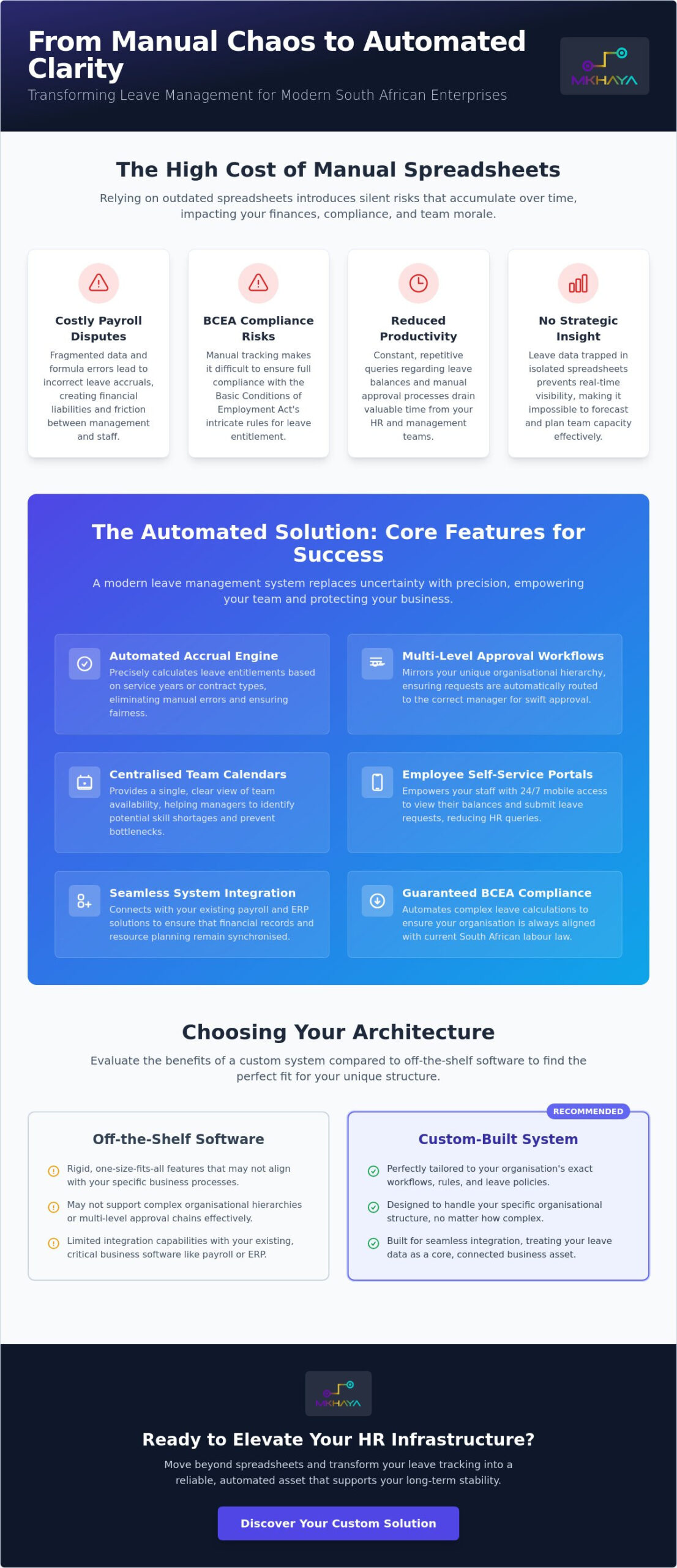
Custom vs Off-the-Shelf: Choosing the Right Architecture
Deciding between a pre-packaged SaaS tool and a bespoke solution is a critical juncture for your business infrastructure. Off-the-shelf software provides a “quick start” that suits many smaller teams with standard requirements. However, for South African enterprises with established workflows, a custom leave management system often delivers a more precise long-term fit. This route, supported by custom software development, allows you to build a platform around your existing processes rather than forcing your staff to adopt rigid, external logic. This approach prioritises your unique business identity, ensuring that the software acts as a supportive partner in your growth journey.
Total cost of ownership (TCO) is a vital metric when choosing your architecture. Whilst SaaS may appear cheaper initially, the cumulative cost of per-user licensing over a five-year period can be substantial. Custom development involves a larger initial commitment but eliminates recurring seat fees and provides full ownership of the intellectual property. Deeper integration with legacy systems also becomes possible, ensuring that your leave data flows seamlessly into your broader operational ecosystem without the need for fragile third-party connectors. This creates a stable, high-end environment where your data remains a secure and accessible asset.
When SaaS Isn’t Enough
Industrial workforces and retail groups often struggle with “one-size-fits-all” logic. If your organisation manages complex shift patterns or unique union agreements, a generic tool will inevitably lead to administrative workarounds. These manual fixes create the very friction you are trying to eliminate. A bespoke solution adapts to your specific scaling needs, providing a stable anchor as your company expands. It ensures that your technology reflects your commitment to precision and professional excellence whilst avoiding the limitations of generic cloud subscriptions. If you are ready to move beyond generic tools, you can consult with our experts to design a system that truly reflects your business identity.
A Roadmap for Successful Implementation
A methodical transition is key to maintaining data integrity and employee trust. Following a structured path ensures that your new digital infrastructure is both reliable and well-received by your team.
- Step 1: Audit existing leave policies. Review your current rules to identify any gaps in BCEA compliance or operational efficiency that the new system must address.
- Step 2: Cleanse legacy data. Clean your historical records before migration to ensure your new system starts with a foundation of absolute accuracy and reliability.
- Step 3: Conduct pilot testing. Launch the system within a single department first to gather practical feedback and refine the user interface before a company-wide rollout.
Strategic Implementation with Mkhaya MK: Elevating Your HR Infrastructure
Choosing a leave management system is a significant first step, but the true value of any digital tool lies in how it integrates with your broader business objectives. At Mkhaya MK, we position ourselves as more than just a service provider. We are a visionary partner that looks beyond the software to understand your entire business workflow. Our approach ensures that your technology isn’t just a functional necessity but a strategic asset that drives long-term stability. By leveraging our deep software engineering expertise, we create seamless HR integrations that eliminate fragmented data and manual workarounds. We believe that a well-designed system should reflect your unique corporate DNA, supporting your specific culture and operational requirements with precision.
Innovation is at the heart of our methodology. Through AI and data automation, we help you move from reactive tracking to proactive management. A sophisticated leave management system can do more than record absences; it can predict future staffing needs based on historical data and seasonal trends. This foresight allows leadership to make informed decisions about project timelines and resource allocation before capacity issues arise. We invite you to consult with our experts to design a bespoke solution that aligns with your vision for a more agile and modern workplace.
Integration with the Broader Digital Ecosystem
Your leave data shouldn’t exist in a vacuum. When this information feeds directly into your project management and resource allocation tools, you create a single source of truth for all employee-related data. This transparency allows project leads to see real-time availability, ensuring that deadlines remain realistic and team members aren’t over-burdened. We ensure that your entire tech stack is optimised for performance and security, providing a stable foundation that protects sensitive information whilst supporting high-end business results.
The Mkhaya MK Partnership Model
Our partnership model is built on a foundation of mutual success and professional confidence. We follow a highly structured rhythm, moving from strategic consulting to methodical execution and ongoing support. This collaborative journey ensures that each capability we build is immediately linked to a practical benefit for your organisation. We value transparency and commitment, positioning your business as a stable anchor in an ever-changing technological landscape. If you’re ready to transform your administrative processes, contact Mkhaya MK to discuss your custom software needs and take the next step toward operational excellence.
Building a Foundation for Operational Excellence
Transitioning from manual spreadsheets to a digital infrastructure is no longer a luxury; it’s a strategic necessity for any growing enterprise. By automating your processes, you eliminate the financial liabilities and payroll friction that often stem from human error. We’ve explored how a robust leave management system ensures full BCEA compliance whilst protecting sensitive data under POPIA. Whether you choose a scalable SaaS tool or a bespoke custom architecture, the goal remains the same: creating a transparent, autonomous environment for your team. This shift doesn’t just reduce administrative burdens; it empowers your workforce and secures your operational future.
Our end-to-end digital transformation expertise and national South African service coverage ensure that your transition is seamless and reliable. We specialise in bespoke ERP and management system development that aligns perfectly with your corporate DNA. It’s about more than just software; it’s about building a stable anchor for your business. Optimise your operations with Mkhaya MK’s custom software solutions. We look forward to partnering with you to create a high-end technological landscape that supports your long-term ambitions and collective success.
Frequently Asked Questions
What is the minimum leave entitlement for employees in South Africa?
Under the BCEA, employees are entitled to at least 21 consecutive days of annual leave on full pay for every 12-month cycle. Alternatively, this can be calculated as one day for every 17 days worked or one hour for every 17 hours worked. This ensures that even part-time staff receive fair and proportionate time off based on their actual contribution to the business.
How does a leave management system handle the 36-month sick leave cycle?
A robust leave management system automates the rolling 36-month cycle by tracking every sick day taken from the start of employment. It identifies the specific six-week entitlement period and automatically flags when a new cycle begins. This automation prevents the over-allocation of paid sick leave, which is a common error in manual tracking and a frequent cause of compliance failure.
Can a leave management system integrate with my current payroll software?
Yes, modern systems are designed to synchronise directly with your existing payroll and ERP solutions. This connectivity ensures that leave balances and payroll deductions remain accurate without the need for repetitive manual data entry. By creating a unified digital ecosystem, you reduce the risk of human error and ensure that your financial records always reflect the most current employee data.
Is it better to buy a ready-made leave tool or build a custom one?
The choice depends on your organisational complexity and unique business workflows. Whilst ready-made SaaS tools offer a quick start for standard needs, a custom solution provides a precise long-term fit for enterprises with complex shift patterns or specific union agreements. Custom development eliminates recurring licensing fees and ensures the platform grows alongside your company’s visionary goals.
How does POPIA affect the storage of employee leave records?
POPIA mandates that personal information, including sensitive health-related records, must be stored securely with restricted access. Your leave management system should utilise high-level encryption and robust access controls to protect this information. Maintaining these records digitally within a secure environment helps your business meet its legal privacy obligations whilst ensuring data remains accessible for statutory audits.
How can I prevent “leave clashes” where too many people are away at once?
You can prevent clashes by using centralised team calendars that provide real-time visibility of all staff absences. These systems often include automated clash detection features that notify managers if a request overlaps with too many other team members. This proactive approach ensures that your operational capacity remains stable even during popular holiday periods, maintaining your reputation for reliability.
What happens to unused leave at the end of the year under the BCEA?
The BCEA allows for annual leave to be carried over, but it generally must be taken within six months after the end of the 12-month leave cycle. Employers cannot pay out unused annual leave except upon termination of employment. An automated system tracks these expiry dates and sends reminders to staff, helping you manage leave liabilities effectively throughout the year.
How does an automated system handle family responsibility leave?
Automated systems categorise family responsibility leave as a distinct entitlement, providing three days per 12-month cycle for eligible employees. The software tracks the specific criteria for this leave, such as the birth of a child or the illness of a close relative. By separating this from annual leave, you maintain precise records and ensure full adherence to South African labour regulations.