Jun 1, 2026
What if the secret to scaling your tech team isn’t found in a larger recruitment budget, but in a more precise geographical focus? In 2026, the strategic decision to hire remote developers south africa has become a cornerstone for businesses seeking both technical depth and operational resilience. We agree that sifting through hundreds of unqualified CVs is a draining process, which is why many global firms now choose to hire remote developers south africa to access a talent pool that balances modern innovation with a reliable, problem-solving mindset.
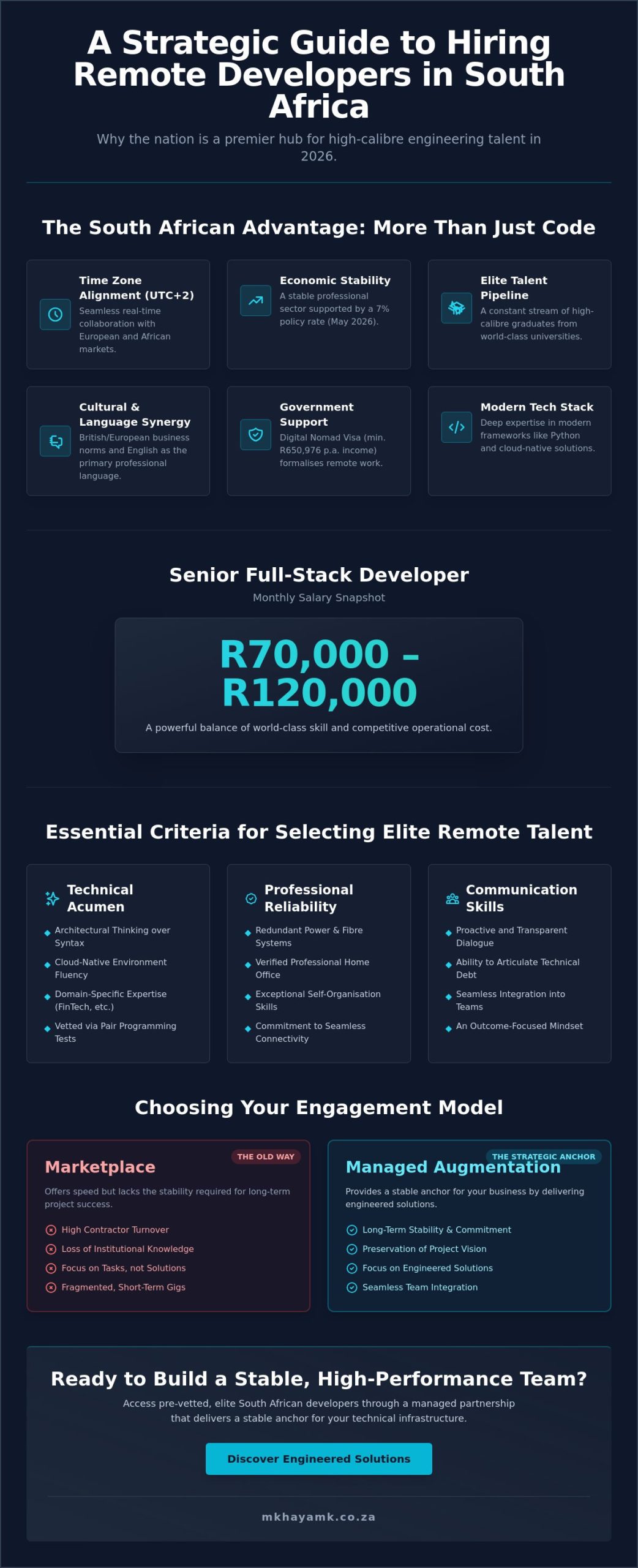
It’s exhausting to manage high contractor turnover or struggle to assess true architectural expertise during a brief interview. This guide provides a clear path to secure and integrate top-tier talent to scale your operations with precision and reliability. We will examine current salary benchmarks, such as the R70,000 to R120,000 monthly range for senior full-stack roles, whilst outlining why the choice to hire remote developers south africa represents a stable, forward-looking anchor for your technical infrastructure.
Key Takeaways
- Understand why South Africa’s software engineering hub has become a global leader for high-end remote talent in 2026.
- Identify the critical selection criteria for senior developers, focusing on architectural thinking and the ability to articulate complex technical debt.
- Determine whether a marketplace or managed augmentation model is best suited to your specific technical capacity and scaling requirements.
- Learn how to hire remote developers south africa whilst ensuring seamless integration through standardised toolstacks and outcome-focused KPIs.
- Discover how a managed partnership provides a stable anchor for your business by delivering engineered solutions rather than just a list of CVs.
The Evolving Landscape to Hire Remote Developers in South Africa
By 2026, remote staff augmentation has matured into a sophisticated model of technical partnership. In this landscape, the decision to hire remote developers south africa represents a commitment to high-calibre engineering rather than simple cost-cutting. South Africa has emerged as a premier hub because its developers don’t just execute tasks; they build scalable architectures. With the South African Reserve Bank policy rate at 7% effective from May 2026 and headline inflation at 4.0%, the economic environment supports a stable professional sector that appeals to international partners seeking long-term reliability.
The geographic advantage of UTC+2 alignment allows for real-time collaboration with European and African markets, creating a “nearshore” feel regardless of physical distance. The technology landscape in South Africa is further bolstered by the government’s Digital Nomad Visa, which requires a minimum annual income of R650,976. This regulatory support has formalised the remote work culture, making it easier for global firms to hire remote developers south africa whilst ensuring compliance with local standards. This maturity ensures that the local tech ecosystem remains focused on modern frameworks like Python and cloud-native solutions.
Why South Africa is a Premier Talent Destination
Cultural alignment is a significant factor in project success. South African business standards mirror British and European norms, prioritising transparency and direct communication. English serves as the primary professional language, ensuring that technical requirements aren’t lost in translation. The robust pipeline of graduates from world-class national universities ensures that the talent pool is constantly refreshed with engineers who understand both theoretical computer science and practical, modern application. This academic foundation produces developers who can handle the rigours of enterprise-level software development.
The Shift from Freelance to Managed Remote Teams
The era of fragmented, short-term gig work is rapidly giving way to long-term remote team extension. Businesses have learnt that whilst marketplaces offer speed, they often lack the stability required to maintain institutional knowledge. The strategic move to hire remote developers south africa through managed models allows for the preservation of software quality and long-term project vision. This shift ensures that developers aren’t just passing through; they’re committed to your roadmap, providing the steady anchor your infrastructure needs to thrive in a competitive global market.
Essential Criteria for Selecting High-Calibre Remote Talent
Selecting the right professional requires a shift from volume-based hiring to a focus on precision and long-term stability. When you choose to hire remote developers south africa, you’re looking for individuals who demonstrate architectural thinking over simple syntax knowledge. It’s about finding someone who understands how a single line of code impacts the entire system’s reliability. This high-calibre approach ensures that your software remains robust whilst your operations scale.
Reliability is a baseline requirement. The growth of South Africa’s digital economy has fostered a professional class that prioritises high-speed fibre and redundant power systems to maintain seamless connectivity. Verifying a developer’s home office setup is as essential as checking their GitHub repository. A professional’s ability to self-organise and manage their own environment is a critical trait for any remote-first team.
Technical Assessment Beyond the CV
Resumes provide a history, but they don’t always predict future performance. We recommend using pair programming and real-world problem-solving tests to evaluate a candidate’s true depth. Evaluating experience in cloud-native environments is vital for modern infrastructure. Often, specific industry expertise in sectors like Fintech or Logistics outweighs general years of experience because it reduces the learning curve for business-specific logic. If you’re looking to bypass the vetting hurdle, our staff augmentation services connect you with pre-vetted specialists who meet these exact standards.
Soft Skills for Remote Success
Communication is the primary hedge against project drift in a distributed team. To hire remote developers south africa who truly add value, you must look for a ‘no surprises’ philosophy. This involves proactive reporting and the ability to explain complex technical debt to non-technical stakeholders clearly. We value collaborative behaviour in Agile environments; it’s the mark of a professional who values transparency over flashy claims. This quiet confidence allows a developer to integrate into your existing team as a stable and reliable partner.
Marketplace vs. Managed Augmentation: Choosing Your Model
When you decide to hire remote developers in South Africa, you’ll face a fundamental choice between a self-service marketplace and a managed staff augmentation partnership. Each model serves a distinct purpose. The right choice depends entirely on your internal capacity and the long-term stability your project requires. It’s a strategic decision that affects not only your immediate output but also the long-term health of your technical infrastructure.
Choosing between these models involves looking past upfront recruitment fees to the long-term partnership value. High turnover remains a significant pain point in the remote sector, often caused by a lack of integration and support. Managed augmentation mitigates this risk by providing a layer of stability that marketplaces simply don’t offer. By investing in a managed model, you reduce the time spent on repetitive recruitment and focus your energy on achieving your core business goals.
When to Use a Talent Marketplace
Marketplaces are essentially digital talent pools. They’re excellent for sourcing specific, short-term niche skills for one-off projects where the developer doesn’t necessarily need to understand your broader business context. However, this model places the entire burden of technical vetting and management on your shoulders. If your internal HR team has the bandwidth to interview dozens of candidates and your technical leads can accurately verify architectural depth during a brief call, this DIY approach offers a broad reach. It’s best suited for companies that already have established remote management frameworks and the capacity to handle the administrative overhead of individual contractors.
The Strategic Advantage of Managed Staff Augmentation
In contrast, managed staff augmentation focuses on the collaborative relationship between the service provider and your business. This isn’t just about providing a list of CVs; it’s about providing engineered solutions. Managed services offer pre-vetted talent that has already been tested on complex internal projects. This model is ideal for scaling quickly without sacrificing quality. You gain ongoing performance management and the flexibility to adjust roles as your roadmap evolves. It provides a stable anchor, ensuring that institutional knowledge stays within your project. This approach transforms recruitment from a transactional hurdle into a steady, forward-looking ambition for mutual success.
Strategic Integration: Ensuring Remote Team Success
Successful integration is the bridge between a signed contract and a high-performing product. Many businesses focus entirely on the selection phase, yet the real work begins when the developer logs on for the first time. To hire remote developers in South Africa successfully, you must move beyond a transactional mindset. It’s about building a structured environment where external talent feels like a core part of your internal engine. This process requires a blend of professional confidence and supportive partnership to ensure that every new team member can contribute at their full potential from day one.
The First 30 Days: Onboarding for Impact
Effective onboarding should be a deliberate process designed for immediate impact. Your developer should have their development environment fully configured on day one to reduce initial frustration. Assigning a “technical buddy” provides immediate cultural context and helps them navigate the codebase without feeling isolated. Establishing a clear “definition of done” for initial tasks sets a standard for excellence from the outset. This methodical execution builds trust and sets a steady pace for the months ahead.
Maintaining Long-Term Engagement
Long-term engagement requires more than just a steady stream of tickets. Include your remote developers in high-level strategic planning sessions to foster a sense of ownership. When they see the long-term vision, they’re more likely to contribute innovative ideas that align with your business goals. Providing opportunities for professional growth and skill refinement ensures that your team stays at the cutting edge of technology. A two-way feedback loop is essential; it transforms the relationship from a simple service agreement into a genuine partnership. If you’re looking to build a team that integrates flawlessly into your existing workflows, explore our staff augmentation services to find your next strategic partner.
Elevating Your Technical Capability with Mkhaya MK
Choosing a partner to expand your technical team is a decision that defines your operational stability for years to come. At Mkhaya MK, we move beyond the traditional recruitment model. We don’t just provide a list of CVs; we provide engineered solutions. Whilst many businesses struggle to hire remote developers in South Africa through generic marketplaces, we offer a partnership rooted in precision and mutual success. Our approach ensures that every placement is backed by the same rigorous engineering standards we apply to our own internal custom software development projects.
The Mkhaya MK difference lies in our quiet confidence and methodical execution. We understand that in 2026, technical depth must be paired with an ability to navigate a rapidly changing technological landscape. Every professional we recommend has undergone a vetting process that evaluates their architectural thinking and their capacity for AI-driven automation. This end-to-end support begins with your initial consultation and continues through your ongoing digital transformation, providing a stable anchor as your business evolves.
A Partnership Focused on Your Success
Our staff augmentation services are uniquely informed by our deep expertise in custom software development and cloud application services. This dual perspective allows us to understand the practical challenges your team faces daily. By working with a partner that is deeply embedded in the South African tech ecosystem, you benefit from a talent pool that understands your pace and shares your professional values. Our clients trust us to manage their most critical technical assets because we prioritise long-term stability over short-term gains. We ensure that the integration of external talent feels like a natural expansion of your internal culture, rather than a fragmented addition.
Ready to Scale Your Team?
Scaling your technical capacity should be a structured and rewarding journey. We have refined our engagement process to ensure clarity and momentum at every stage. This rhythmic progression leads you from a broad vision toward a concrete, high-performing team. To begin your journey with a reliable partner, follow these steps:
- Step 1: Consult with our experts to define your specific technical requirements and project roadmap.
- Step 2: Review a curated shortlist of professionals who have been matched to your technical needs and organisational culture.
- Step 3: Seamlessly integrate your new remote developers into your existing workflows and start building with precision.
We are ready to help you secure the talent you need to scale with confidence. Organise a consultation with Mkhaya MK today and discover how our managed approach to hire remote developers in South Africa can transform your technical operations.
Building Your Technical Future with Precision
The decision to hire remote developers in South Africa is more than a recruitment tactic; it’s a strategic investment in your organisation’s long-term stability. By prioritising architectural depth and managed integration over the volume-based approach of traditional marketplaces, you secure a team that is built to last. A successful partnership thrives on clear communication, shared KPIs, and a remote-first culture that values outcomes over hours logged. These foundations ensure that your external talent functions as a seamless extension of your internal vision.
As end-to-end digital transformation experts, Mkhaya MK provides national reach with deep local market insight. We specialise in custom software and AI-driven automation, applying our rigorous internal engineering standards to every placement we make. This ensures your projects are handled with the precision they deserve. We invite you to scale your technical team with Mkhaya MK’s managed talent and move beyond the friction of traditional hiring. We’re here to help you navigate the complexities of modern software development with confidence and clarity. Your path to a high-performing, reliable remote team starts with a single, well-placed step toward a better partnership.
Frequently Asked Questions
Why should I hire remote developers from South Africa specifically?
South Africa offers a unique blend of technical depth and cultural synchronicity. With English as the primary professional language and a UTC+2 time zone, collaboration feels effortless for European partners. The local market is also highly advanced; 97% of tech teams now use AI in their daily workflows to enhance productivity and deliver engineered solutions with greater precision.
How do I ensure the security of my intellectual property with remote developers?
What is the typical notice period for remote developers in South Africa?
The standard notice period in the South African tech sector is 30 days or one calendar month. Whilst some junior roles might have shorter periods, senior engineers often require this time to ensure a clean handover of complex architectural knowledge. This predictability helps you maintain project momentum and manage transitions without losing institutional knowledge.
Can South African developers work on my time zone?
Yes, South African professionals are exceptionally well-positioned to work within European and African time zones due to the minimal offset. Many businesses that hire remote developers in South Africa also find that local talent is willing to adjust their schedules for North American clients. This flexibility ensures real-time participation in daily stand-ups and critical sprint reviews.
What are the common technical stacks available in the South African remote market?
The local market is rich in modern, high-demand technical stacks. You’ll find extensive expertise in Python, JavaScript, Java, and SQL, alongside a strong focus on cloud computing platforms like AWS and Azure. This technical diversity allows you to find specialists who can integrate immediately into your existing codebase and start contributing to your roadmap.
How does staff augmentation differ from traditional outsourcing?
Staff augmentation integrates external experts directly into your internal team and workflows. Unlike traditional outsourcing, where a project is handed over to a third party to manage as a “black box,” augmented developers attend your meetings and follow your internal processes. This model ensures you retain full control over the development journey and long-term software quality.
How do I manage the performance of a remote developer I’ve never met in person?
Performance is best managed through transparent, outcome-based KPIs rather than tracking hours logged. Use collaborative tools like Jira and GitHub to maintain visibility into progress and code quality. Regular synchronisation through video calls fosters a supportive partnership and ensures the developer remains aligned with your long-term business goals and technical vision.
What happens if a remote developer isn’t a good fit for my team?
If a developer doesn’t align with your team, a managed service provider will facilitate a structured transition. This typically involves identifying the specific gap in synergy and providing a pre-vetted replacement to ensure project continuity. It’s a reliable way to hire remote developers in South Africa whilst mitigating the risks of a poor cultural or technical fit.

May 31, 2026
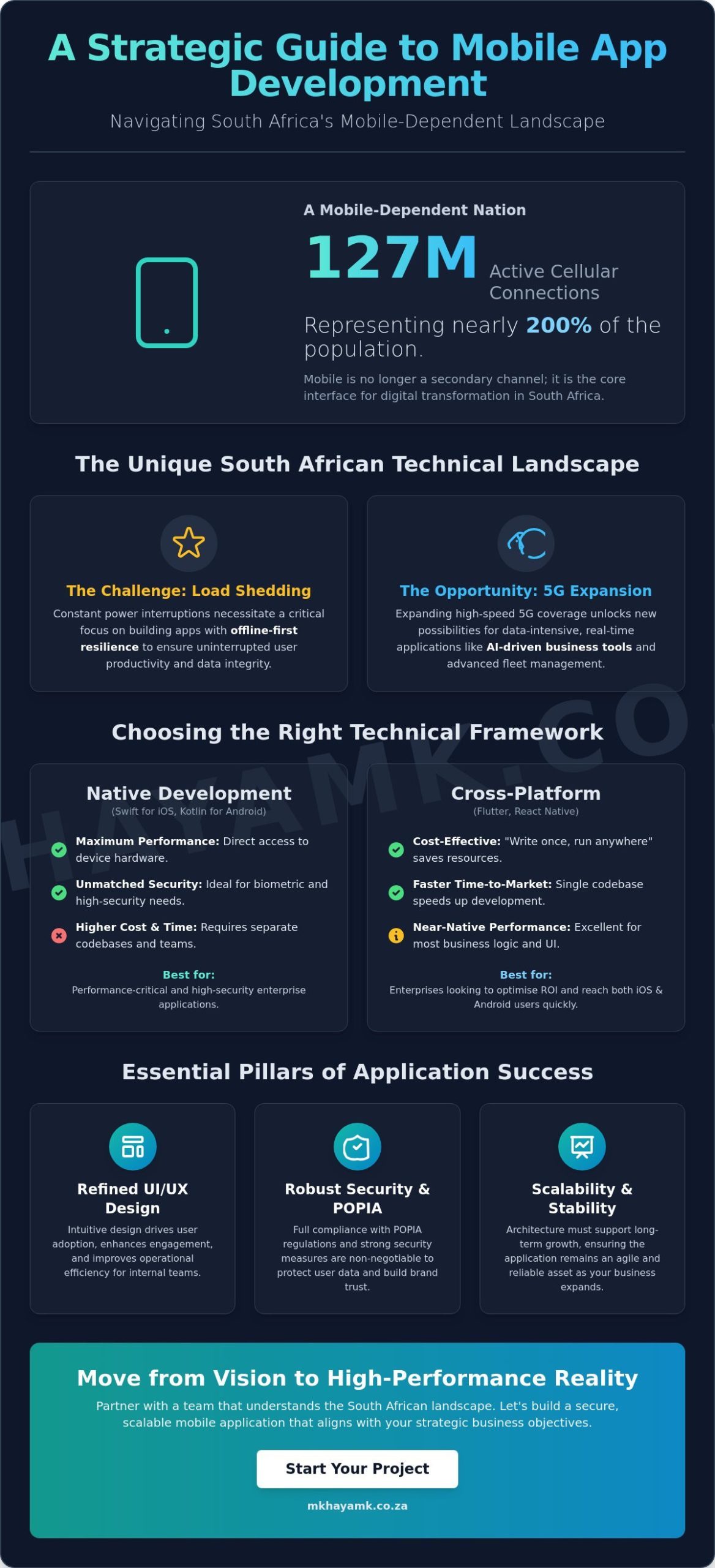
With 127 million active cellular connections representing nearly 200% of the population, South Africa isn’t just mobile-first; it’s mobile-dependent. Yet, for many local enterprises, the path to successful mobile app development south africa feels fraught with high-stakes risks. You likely recognise the frustration of searching for specialised talent or the anxiety of choosing between Native and Cross-platform stacks when the cost of a technical misstep can reach hundreds of thousands of Rands. It’s a challenging landscape where ambition must be balanced with methodical execution.
We understand that you need more than just code; you require a stable anchor in a fast-moving market where 5G coverage is expanding but load shedding still demands offline-first resilience. This guide reveals how to navigate these technical complexities to build a secure, scalable application that respects POPIA regulations and your budget. We will explore the strategic shift toward transparent development processes and how staff augmentation can bridge your internal skills gap, ensuring your project moves from a visionary concept to a high-performance reality that supports long-term growth.
Key Takeaways
- Understand why mobile applications have become the centre of digital transformation for South African enterprises aiming to connect with a mobile-dependent workforce and consumer base.
- Evaluate the cost-effectiveness and performance of different technical frameworks, specifically comparing Native builds with modern cross-platform solutions like Flutter and React Native.
- Learn how to choose the right engagement model for mobile app development south africa, whether you require an end-to-end project delivery or specialised staff augmentation to support your internal team.
- Discover the essential pillars of app success, focusing on how refined UI/UX design drives user adoption whilst robust security measures ensure full compliance with POPIA regulations.
- Explore a partnership model that prioritises long-term stability and technical support, moving beyond simple construction toward sustainable, scalable digital growth.
Navigating the Mobile-First Landscape in South Africa
As the most technologically advanced economy on the continent, our local enterprises face specific pressures. We operate in a landscape where high-speed 5G coverage is expanding, yet we must simultaneously account for the “offline-first” requirements necessitated by load shedding. Successful mobile app development south africa requires a partner who understands these local nuances. It’s about building resilient software that solves core business challenges, such as reducing manual data entry errors or providing secure, remote access to legacy ERP systems for a nationally distributed workforce.
The Strategic Importance of Mobile for Local Enterprises
Modern mobile software does more than just display information. It creates a supportive partnership between a brand and its users. By refining UI/UX design, you can enhance customer engagement through personalised experiences that feel intuitive rather than intrusive. For internal teams, mobile tools improve operational efficiency by placing sophisticated data automation directly into the hands of staff, regardless of their physical location. This connectivity is vital for maintaining momentum in a fast-paced market where responsiveness is a key competitive advantage.
Aligning App Development with Business Objectives
Precision in the early stages of a project prevents costly failures later. Before the first line of code is written, it’s essential to define clear KPIs that align with your broader commercial goals. Whether you’re building a custom Loan Management System or a new Learner Management System, the architecture must support long-term scalability and stability. A visionary mobile strategy ensures that your application doesn’t just meet today’s needs but remains an agile asset as your organisation grows. This methodical approach to construction builds brand loyalty and ensures high user retention rates through reliable, high-performance software.
Selecting a technical foundation is one of the most consequential steps in Mobile App Development South Africa. It dictates not just the initial build cost, but the long-term agility of your digital assets. As South Africa’s mobile-first economy continues to mature, the debate between Native and Cross-platform development has moved from a purely technical discussion to a core business strategy. Your choice will influence how quickly you can respond to market changes and how effectively you can scale your operations in a competitive environment.
The “write once, run anywhere” philosophy is no longer a compromise. In 2026, the South African development community has seen a massive surge in the adoption of frameworks like Flutter and React Native. These tools allow for a single codebase to power both iOS and Android platforms, which is particularly attractive for enterprises looking to optimise their return on investment. However, the decision isn’t always straightforward. It requires a visionary balance between performance requirements, available budget, and your desired timeline for deployment.
Native Development: Maximum Performance for iOS and Android
Native development involves building separate applications for iOS and Android using their respective languages, Swift and Kotlin. This approach remains the favourite choice for enterprises requiring absolute precision and maximum performance. By interacting directly with the device’s hardware, native apps offer seamless access to advanced sensors and biometric security. This level of integration is often critical for high-security environments, such as those found in our Custom Software Development projects. Whilst the user experience is generally superior, it’s vital to remember that this path requires managing two separate codebases, which can increase long-term maintenance efforts.
Cross-Platform Solutions: Optimising Time-to-Market
Cross-platform solutions have become a stable anchor for businesses that prioritise speed and cost-efficiency. Frameworks like Flutter and React Native allow for rapid prototyping, enabling you to get a high-quality product into the hands of users much faster than traditional methods. For most business-focused results, the reduction in development hours doesn’t have to mean a reduction in quality. These frameworks have reached enterprise-grade maturity, providing the stability needed for complex data automation and cloud integration. When you choose a cross-platform approach, you’re investing in a flexible architecture that simplifies future updates and ensures your application remains modern and responsive across all devices.
Strategic Engagement Models: Project-Based vs Staff Augmentation
Deciding how to structure your engagement with a technical partner is a pivotal moment that defines the trajectory of your project. Navigating mobile app development south africa often brings businesses face-to-face with a persistent challenge: the national shortage of specialised mobile engineering talent. This scarcity makes the choice between project-based outsourcing and staff augmentation more than just a budgetary decision; it’s a strategic move to secure the skills necessary for long-term success. Your choice should reflect the maturity of your internal processes and the specific phase of your product’s lifecycle.
A visionary leader understands that software is never truly “finished”. It requires constant refinement and adaptation. Whether you’re building a new platform from scratch or evolving an existing system, the engagement model you select must provide a stable anchor for your ambitions. By aligning your human resource strategy with your technical goals, you ensure that your mobile application remains a high-performance asset rather than a technical burden. This methodical approach to construction allows you to move with professional confidence in a rapidly changing market.
The Case for End-to-End Project Outsourcing
End-to-end outsourcing is the favourite choice for enterprises launching new products or Minimum Viable Products (MVPs). This model offers a fixed-scope delivery that helps you manage both budget and expectations from the outset. You gain immediate access to a full-service team, including UI/UX designers, QA testers, and DevOps engineers, without the overhead of individual hiring. This is particularly effective for defined builds where a clear beginning and end allow for a transparent, results-focused process. It ensures that your vision is translated into a polished, secure application through a single, accountable partnership.
Staff Augmentation: Scaling Your Internal Capabilities
For organisations with established agile workflows, Staff Augmentation provides the flexibility needed for ongoing product evolution. This model allows you to integrate remote or on-site professionals directly into your existing teams, bridging specific skill gaps without the long-term commitment of permanent hires. It’s a cost-effective way to maintain control over your software architecture whilst leveraging external expertise for complex tasks like AI & Data Automation. By augmenting your staff, you accelerate your development velocity and ensure your application receives the continuous maintenance required for enterprise-grade stability.
Building a high-performance application requires more than just functional code. It demands a visionary approach to architecture where every component serves a specific business outcome. In the context of mobile app development south africa, performance is often measured by how well an application survives local environmental challenges whilst maintaining a seamless user experience. A truly successful build rests on three essential pillars: intuitive design, uncompromising security, and deep system integration. When these elements are aligned, the resulting software becomes a stable anchor for your digital operations.
A significant gap in many local development projects is the failure to connect the mobile front-end with existing back-end systems. High-performance apps shouldn’t exist in a silo. They must integrate seamlessly with complex tools such as a Loan Management System or a Facility Management System. Whether you’re connecting to the Optimate Procurement Platform or a custom ERP, these integrations ensure that data flows accurately across your entire organisation. This connectivity reduces manual errors and provides the real-time transparency necessary for informed decision-making.
User-Centric Design and Engagement
UI/UX design is the favourite metric for measuring user adoption. If an interface feels clunky or confusing, users will simply abandon it. We focus on creating intuitive interfaces that reflect your brand’s unique colour and style, ensuring the visual language resonates with your specific audience. In South Africa, inclusive design is particularly important. Your app needs to be accessible to a broad national audience with varying levels of digital literacy and hardware capabilities. By using data-driven insights to refine journey maps, you can guide user behaviour toward desired actions, such as completing a procurement request or accessing a learner module.
Security, Scalability, and Integration
Security is a non-negotiable anchor, especially with the Information Regulator’s intensified monitoring of POPIA compliance in 2026. Protecting sensitive data requires implementing end-to-end encryption and multi-factor authentication (MFA) as standard features. However, security shouldn’t come at the cost of performance. Your application must be able to scale nationally without degradation, supported by a robust cloud infrastructure that ensures stability during peak usage periods. This methodical approach to construction ensures that your app remains reliable as your user base grows.
Ready to build a resilient mobile asset that truly connects with your users? Explore our UI/UX Design Services to see how we can transform your vision into an engaging digital experience.
Delivering Scalable Mobile Solutions with Mkhaya MK
At Mkhaya MK, we don’t just build apps; we architect digital futures. Our collaborative approach to custom software engineering ensures that your mobile strategy isn’t an isolated effort but a core component of your digital transformation. We bring a sense of professional confidence to every engagement, acting as a supportive partner rather than a mere vendor. This relationship is built on mutual success, where our technical expertise in mobile app development south africa serves as the foundation for your long-term growth.
National enterprises trust us because we value transparency and methodical execution over flashy, unsubstantiated claims. Our end-to-end process takes you from the initial visionary concept through to a secure, cloud-managed deployment. By leveraging our Cloud Application Services & DevOps, we ensure that your platform remains agile and responsive to the needs of a mobile-dependent population. This journey is marked by precision at every stage, from wireframing to the final integration with your existing infrastructure, providing a stable anchor for your digital ambitions.
A Visionary Guide for Your Digital Journey
Integrating sophisticated technology shouldn’t feel overwhelming. We specialise in AI & Data Automation, which allows us to enhance mobile functionality with predictive features and automated workflows that drive real business value. Our commitment to integrity means we provide honest guidance on what’s technically feasible and commercially viable, ensuring your investment is always protected. Our mobile development philosophy serves as a stable anchor that provides certainty and precision within a rapidly changing technological landscape.
We believe that true innovation is the result of methodical refinement and a deep investment in our clients’ personal journeys. Whether you’re looking to implement a complex ERP Solution or launch a custom mobile tool, we provide the technical depth required to succeed. This persona of quiet confidence allows us to focus on what matters most: delivering a high-performance application that scales with your organisation.
Starting Your Mobile Transformation
The transition from a strategic concept to a live application requires a clear, step-by-step path forward. We invite you to engage with our team for a strategic consulting session, where we can evaluate your current infrastructure for mobile readiness. This assessment identifies opportunities to streamline operations and ensures that your back-end systems are prepared for the demands of a high-traffic mobile environment. We’ll work alongside you to define a roadmap that prioritises stability, security, and user adoption. For organisations also planning to extend their digital presence beyond mobile, our custom web application development south africa project success checklist provides a structured framework to ensure your broader digital investments deliver measurable results.
Ready to build? Partner with Mkhaya MK for your next mobile project and experience a partnership rooted in reliability and forward-looking ambition.
Building Your Digital Future with Precision
The journey towards digital excellence in 2026 requires more than just technical skill; it demands a visionary partner who understands the local landscape. We’ve explored how selecting the right framework and ensuring deep system integration are vital for creating resilient, high-performance applications. By aligning your business objectives with a methodical approach to construction, you ensure that your investment drives measurable results whilst respecting the complexities of the South African market. It’s a path that leads from high-level strategy to concrete, scalable results.
Successful mobile app development south africa is built on a foundation of transparency and mutual trust. Whether you’re navigating a national digital transformation or require specialised expertise in Loan and Facility Management systems, our flexible engagement models are designed to scale with your ambitions. From end-to-end project delivery to agile staff augmentation, we provide the steady anchor your organisation needs to thrive. Explore our custom software and mobile development services today and take the first step toward a more connected future. We look forward to building something exceptional together.
Frequently Asked Questions
How much does mobile app development cost in South Africa?
The investment required for mobile software varies significantly based on the complexity of features, the chosen technical stack, and the depth of system integration. Industry professionals generally categorize costs based on whether the project is a Minimum Viable Product (MVP) or a complex enterprise solution. Factors such as custom UI/UX design, the number of platforms supported, and the necessity for backend synchronisation with existing ERP systems all influence the final budget for mobile app development south africa.
What is the difference between native and cross-platform app development?
Native development involves building separate applications for iOS and Android using Swift and Kotlin, which offers maximum performance and deep hardware integration. Cross-platform development uses a single codebase for both platforms through frameworks like Flutter or React Native. Whilst native builds are the favourite for high-performance gaming or complex utility tools, cross-platform solutions are often more cost-effective for business-focused results and faster time-to-market.
How long does it typically take to develop a custom mobile application?
Development timelines depend on the project’s scope and the clarity of initial requirements. A standard application with core features typically takes between three to six months to move from initial concept to deployment. More sophisticated enterprise platforms that require custom software engineering and extensive data automation may require a longer, methodical construction period to ensure stability and security across all user journeys.
Can I hire individual developers to join my existing team through staff augmentation?
Yes, staff augmentation is a flexible engagement model that allows you to integrate specialised mobile developers directly into your existing agile workflows. This approach is particularly effective for bridging the national skills shortage in South Africa, as it gives you immediate access to technical expertise without the long-term commitment of permanent hiring. It allows your organisation to maintain control over software architecture whilst accelerating development velocity.
How do you ensure the security of mobile applications for financial services?
Security is a stable anchor in our development process, particularly for sensitive tools like a Loan Management System. We implement end-to-end encryption, multi-factor authentication (MFA), and secure API protocols to protect data integrity. Our methodical approach ensures that all mobile app development south africa remains fully compliant with POPIA regulations, providing a secure environment for processing personal and financial information within the local regulatory context.
Do you provide ongoing support and maintenance after the app is launched?
Reliable technical support is essential for the long-term success of any digital platform. A supportive partnership includes regular security patches, performance optimisations, and updates to ensure compatibility with the latest mobile operating systems. This commitment to maintenance ensures that your application remains a high-performance asset that continues to meet user expectations and business objectives long after the initial launch phase.
What is the best way to integrate a mobile app with my existing ERP system?
The most effective integration method involves building secure, custom APIs that facilitate real-time communication between your mobile front-end and your back-end ERP or Facility Management System. This structure ensures that data flows accurately across your organisation, reducing manual entry errors and providing stakeholders with transparent, up-to-date information. Precision in these integrations is vital for maintaining operational efficiency and supporting data-driven decision-making.
How do I choose between a mobile-responsive website and a dedicated mobile app?
The choice depends on your desired user behaviour and the specific functionality your business requires. A mobile app is the superior choice if you need offline capabilities, push notifications, or access to device-specific features like biometric security and GPS. Whilst a responsive website is excellent for broad visibility and content delivery, a dedicated mobile application provides a more refined, personalised experience that drives higher engagement and long-term user retention. If you’re also evaluating whether a fully bespoke build is right for your organisation, our guide on custom application development for business versus off-the-shelf solutions can help you make a more informed strategic decision.

May 30, 2026
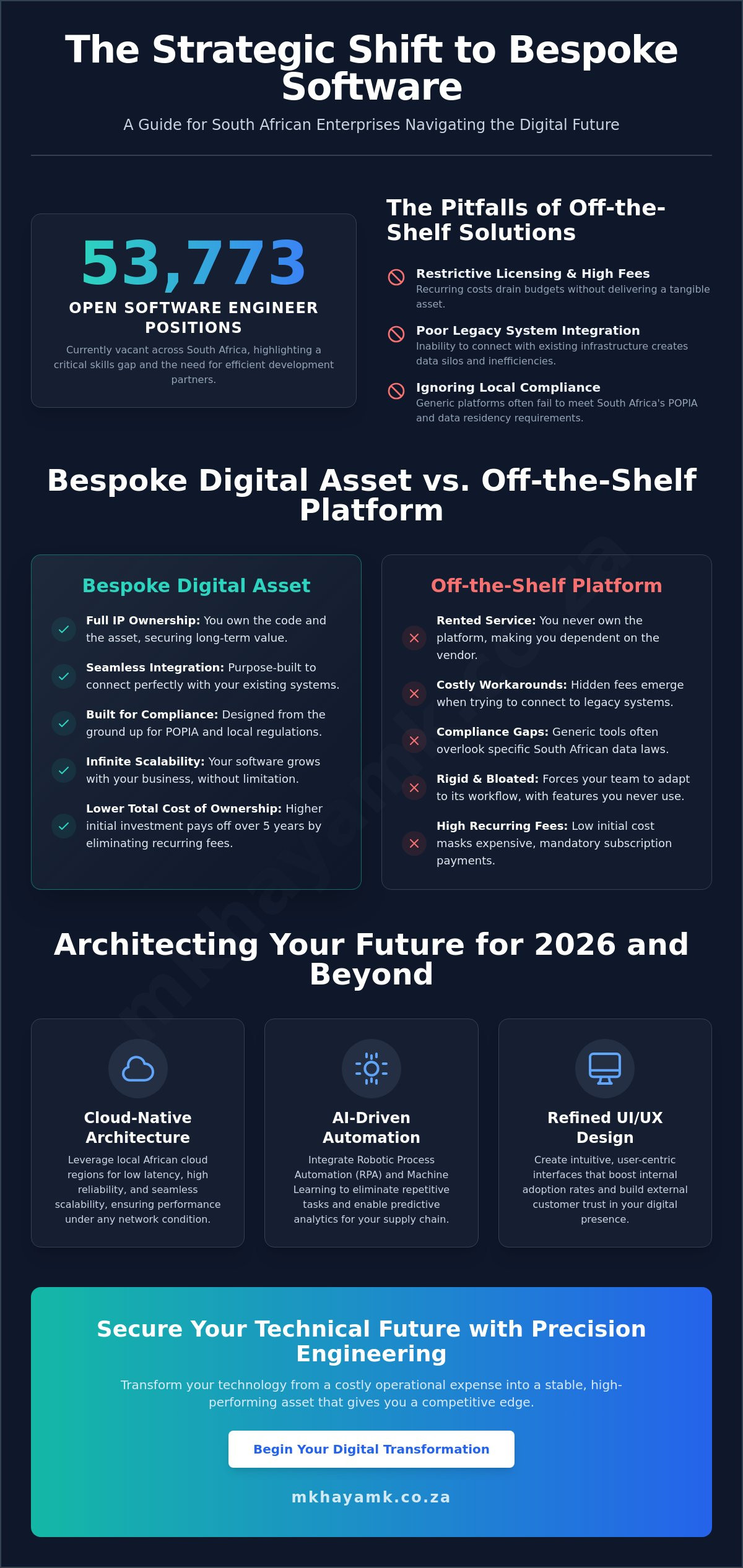
With over 53,773 open positions for software engineers currently vacant across the nation, finding the right partner for custom software development in South Africa has become a critical business priority. You’ve likely discovered that generic platforms often come with high licensing fees and a frustrating inability to integrate with your legacy systems. It’s a common challenge; many local leaders feel their growth is throttled by tools that weren’t built for their specific operational hurdles or our unique regulatory environment.
This guide demonstrates how bespoke engineering, AI-driven automation, and cloud-native architectures are transforming South African enterprises. By prioritising ownership of your intellectual property, you can move beyond the limitations of off-the-shelf products to achieve genuine operational efficiency. We’ll outline a strategic approach for 2026 that focuses on building scalable infrastructure and refined UI/UX design services. You’ll learn how a partnership rooted in precision can transform your technology from a cost centre into a stable, high-performing asset that grows with your business.
Key Takeaways
- Understand why South African enterprises are moving away from restrictive off-the-shelf licensing to regain technical control and agility.
- Discover how custom software development south africa provides full ownership of intellectual property and ensures new tech integrates perfectly with legacy systems.
- Explore the strategic benefits of cloud-native architectures and AI-driven automation for creating a scalable, future-proof digital infrastructure.
- Learn how to measure the real value of your investment by analysing the total cost of ownership over a five-year period.
- Identify how a structured lifecycle approach, including strategic consulting and staff augmentation, builds a reliable foundation for long-term success.
The Landscape of Custom Software Development in South Africa
The South African business environment is undergoing a profound transformation. As we look toward 2026, the reliance on generic, one-size-fits-all platforms is fading. Local enterprises are increasingly recognising that custom software is no longer a luxury reserved for tech giants; it’s a fundamental requirement for any organisation seeking to remain relevant. Choosing custom software development south africa allows businesses to build tools that mirror their specific workflows rather than forcing their teams to adapt to a developer’s rigid assumptions. This shift is about more than just functionality. It’s about building a digital foundation that supports national growth and long-term stability.
Unlike global markets, South African firms face unique hurdles. These include fluctuating connectivity in remote regions and the stringent enforcement of the Protection of Personal Information Act (POPIA). Bespoke engineering ensures that systems are built with these realities in mind. It offers specific data residency protocols and offline capabilities that generic software often overlooks. Perhaps most importantly, bespoke builds grant you 100% ownership of your intellectual property. You aren’t just renting a service; you’re building a proprietary asset. This shifts the dynamic from a dependency on a foreign vendor to a position of strategic autonomy.
Why Off-the-Shelf Solutions Often Fail Local Enterprises
Generic platforms frequently suffer from “feature bloat,” where you pay for a massive suite of tools your team never actually opens. This complexity often masks a lack of flexibility. Many off-the-shelf products struggle to adapt to local South African compliance or specific tax requirements, leading to manual workarounds. The hidden costs of “cheap” generic software often emerge during the integration phase. You might find yourself paying significant customisation fees just to make a standard tool talk to your legacy systems, effectively erasing any initial savings.
The Strategic Shift Toward Bespoke Digital Assets
Forward-thinking leaders now view software as a capital investment rather than a recurring operational expense. By investing in custom software development south africa, you create a stable anchor for multi-branch operations. Whether you’re managing a complex supply chain or a nationwide network of learners, your software should be a competitive advantage. Custom platforms allow for unique user experiences and proprietary logic that your competitors simply cannot replicate. This methodical approach to building digital assets ensures that your technology remains an agile partner in your business journey, capable of scaling as your ambitions grow. For enterprises operating in an increasingly mobile-first economy, this strategy extends naturally into mobile app development in South Africa, where bespoke solutions deliver the same ownership and flexibility advantages on every device your customers use.
Architecting Scalable Solutions: Cloud, AI, and Modern Engineering
Building a digital asset requires more than just writing code; it demands a blueprint that accounts for future growth. Modern custom software development South Africa has shifted towards cloud-native architectures that allow businesses to scale without the friction of physical infrastructure. By leveraging locally available African cloud regions, enterprises can achieve lower latency and higher reliability. This architectural choice is no longer optional for high-growth firms. It ensures that your application remains responsive even as your user base expands across the continent.
Resilience is particularly vital in our local context. Software must be engineered to perform gracefully under varying network conditions, ensuring that a drop in connectivity doesn’t lead to a total loss of productivity. This reliability is reinforced by a deep focus on user experience. When a platform is intuitive, internal adoption rates soar, and external customers feel a sense of trust in your digital presence. A well-designed interface acts as the bridge between complex back-end engineering and practical business results. If you are looking to refine your digital strategy, exploring professional UI/UX design services can provide the clarity needed to build a truly resilient system.
AI and Data Automation: Beyond the Buzzwords
Cloud Infrastructure and DevOps Excellence
A robust DevOps pipeline is the heartbeat of modern engineering. It enables continuous delivery, allowing for small, frequent updates that improve security and functionality without disrupting the user experience. This methodical approach ensures that your software remains a stable anchor for your operations. By automating the deployment process, your team can focus on innovation rather than troubleshooting infrastructure issues.
Managing cloud services also requires a careful balance between performance and cost-optimisation. With the Information Regulator’s active enforcement of POPIA, data sovereignty is a non-negotiable priority. Your architecture must ensure that sensitive information is processed and stored within the South African regulatory framework. This commitment to compliance protects your reputation and ensures that your digital infrastructure remains a secure, long-term asset for the business.
Bespoke vs. Off-the-Shelf: Navigating the ROI of Custom Development
Many decision-makers hesitate at the initial cost of custom software development south africa, viewing it as a steep hurdle. This perspective often misses the long-term financial reality. When you calculate the Total Cost of Ownership (TCO) over a five-year horizon, the numbers tell a different story. Off-the-shelf software might seem affordable today, but recurring per-user licensing fees and restrictive upgrade paths create a “technology tax” that grows alongside your team. Bespoke systems allow you to bypass these costs entirely, ensuring that your budget is spent on building value rather than renting access.
We often suggest a hybrid route for those seeking faster deployment without sacrificing precision. By utilising established foundations like a Loan Management System, Facility Management System, or Learner Management System, you start with a proven core that’s then tailored to your exact business logic. This method provides the stability of a mature platform with the flexibility of a bespoke build. It ensures you don’t pay for features you’ll never use while still receiving a solution that fits your operational needs like a glove. For a deeper evaluation of how to choose between these two paths, our guide on custom application development for business: bespoke vs off-the-shelf in 2026 provides a comprehensive framework for making the right strategic decision.
The ROI of Operational Efficiency
Efficiency isn’t just a buzzword; it’s a measurable reduction in the time your staff spends on manual data entry or correcting system errors. Custom integrations allow disparate systems to communicate seamlessly, which is vital for complex tasks like high-volume procurement through an Optimate Procurement Platform. Bespoke software eliminates operational drag by replacing fragmented manual workarounds with unified, automated workflows that align perfectly with your internal processes. By reducing human error in critical areas like loan processing or facility scheduling, you protect your margins and improve service delivery. Consider these primary drivers of return on investment:
- Removal of monthly per-user subscription costs
- Direct integration with existing legacy hardware and databases
- Reduced training time through intuitive, role-based interfaces
Intellectual Property and Long-Term Asset Value
Owning your software code transforms a monthly expense into a significant balance sheet asset. When you own the intellectual property, the valuation of your business increases because your core operations aren’t dependent on a third-party vendor’s roadmap. This ownership grants you the freedom to pivot. You can modify your software as South African market conditions shift or as new regulations emerge. You avoid the “vendor lock-in” trap where global SaaS platforms dictate your costs and limit your access to your own data. In the long run, custom software development south africa provides a stable, proprietary foundation that ensures your business remains agile and independent.
Successful custom software development south africa relies on a structured journey rather than a single event. It’s a process that begins long before the first line of code is written and continues well after the system goes live. This lifecycle ensures that your technical roadmap remains perfectly aligned with your business objectives, preventing the misalignment that often plagues generic solutions. By following a methodical progression, you move from a broad vision toward a concrete, high-performing asset.
The middle phases of this lifecycle focus on execution and protection. Agile engineering allows for iterative development. This provides a faster time-to-market and the flexibility to refine features based on real-world feedback. Following this, rigorous quality assurance is essential. Rigorous testing is non-negotiable. With the Information Regulator’s active enforcement of POPIA, ensuring your digital assets are secure is a fundamental requirement for maintaining stakeholder trust and operational stability.
Strategic Consulting: The Foundation of Every Build
Every successful project starts with a discovery session. These sessions are designed to identify operational bottlenecks and hidden inefficiencies before building begins. A thorough technical feasibility study and cloud migration plan ensure that your new system will integrate seamlessly with your existing infrastructure. By defining clear KPIs, such as specific targets for automation or user engagement, we create a transparent benchmark for your project’s success. This strategic alignment turns your software from a simple tool into a powerful engine for growth.
Staff Augmentation: Bridging the Skills Gap
Finding niche technical talent in the local market is a significant challenge for many South African enterprises. Staff augmentation offers a practical solution. It’s a model that allows you to scale your internal team with specialised professionals without the overhead of permanent hiring. You can choose between project-based development or hiring dedicated remote developers to maintain and scale your custom builds. This model provides access to top-tier engineering talent whilst giving you the agility to pivot as your business needs change. If you’re looking to strengthen your internal capabilities, you can partner with us for staff augmentation to access the expertise you need.
Bespoke Engineering for High-Growth Enterprises
Complex digital transformations can feel overwhelming. We organise these transitions into manageable phases, ensuring that each step delivers measurable business value. Our commitment to custom software development south africa is defined by precision and stability, whether we’re deploying a robust ERP Solution or integrating sophisticated AI & Data Automation. We’ve refined our approach through years of building specialised platforms that address specific industry pain points. These include our Loan Management System for financial services, the Facility Management System for infrastructure oversight, and the Learner Management System for educational growth. Each solution is engineered to provide the ownership of intellectual property discussed earlier, giving you total control over your proprietary logic. This same philosophy underpins our approach to mobile app development in South Africa, where we build offline-first, POPIA-compliant applications that extend your enterprise capabilities to every connected device.
Getting Started on Your Digital Journey
The path forward begins with a collaborative discovery session. This isn’t a high-pressure sales pitch; it’s a methodical exploration of your operational bottlenecks and strategic goals. We take the time to listen, ensuring that the resulting roadmap aligns with your specific KPIs. Depending on your internal capacity, you can choose from various engagement models. Some clients prefer a full project-based development cycle, whilst others utilise our Staff Augmentation services to scale their existing teams with niche technical talent. We believe in transparency and methodical execution. Every line of code we write and every architectural decision we make is aimed at creating a scalable system that grows with your business. If you’re ready to move beyond restrictive generic software and build a proprietary asset that drives efficiency, we’re here to guide you.
Organise a consultation with Mkhaya MK today to define your technical roadmap and secure your digital future.
Securing Your Technical Future with Precision
Building a proprietary digital asset is the most reliable way to ensure your organisation remains agile in a shifting economy. By prioritising custom software development south africa, you move beyond the constraints of generic licensing to create tools that truly reflect your unique business logic. We’ve seen how integrating cloud-native resilience and AI-driven automation provides the stability needed for national scaling. Whether you’re refining internal workflows or launching a new platform, a structured lifecycle ensures every technical decision supports your broader commercial goals.
Mkhaya MK is a privately held South African technology firm dedicated to this methodical approach. We specialise in delivering high-impact AI, Cloud, and ERP solutions South Africa enterprises rely on for operational excellence, whilst offering expert staff augmentation to help national enterprises bridge the technical skills gap. Our focus remains on creating a supportive partnership that values transparency and methodical execution over flashy claims. It’s time to transform your technology from a recurring cost into a stable, high-performing asset that you own entirely. Partner with Mkhaya MK for your next custom software project and let’s build something lasting together.
Frequently Asked Questions
Why should I choose custom software development over a global SaaS product?
Custom software provides full ownership of your digital assets and eliminates recurring per-user licensing fees that often inflate over time. It allows for precise alignment with local operational needs and South African regulations like POPIA. Global SaaS often lacks the flexibility to integrate with niche local systems or adapt to specific regional tax and compliance requirements that are unique to our market.
How much does custom software development cost in South Africa?
The investment required for custom software development south africa varies based on project complexity and the required technology stack. Instead of fixed prices, most projects are scoped following a detailed discovery session to ensure the budget reflects the specific business value delivered. This methodical approach ensures you invest only in the features your organisation actually needs for long-term stability and growth.
What is the typical timeline for a custom software project?
A typical project lifecycle can range from three to nine months depending on the scope and technical complexity. We utilise an agile engineering approach to deliver iterative updates, ensuring a faster time-to-market for core features. This progression allows your team to begin using essential functionality whilst the remaining components are refined and deployed in subsequent phases, maintaining a steady momentum.
How does Mkhaya MK ensure the security of our custom-built applications?
Security is integrated into our architecture through a robust DevOps pipeline and rigorous quality assurance protocols. We prioritise data sovereignty and ensure all builds comply with the latest Information Regulator enforcement of POPIA. By automating security safeguards within the cloud infrastructure, we protect your digital assets against evolving threats while maintaining high operational performance and building long-term stakeholder trust.
Can custom software integrate with our existing legacy systems?
Bespoke engineering is specifically designed to bridge the gap between modern cloud-native applications and existing legacy hardware or databases. We build custom APIs and integration layers that allow data to flow seamlessly across your entire infrastructure. This prevents the need for a total system overhaul, allowing you to modernise your operations whilst preserving the value of your previous technology investments.
What is staff augmentation, and how does it differ from traditional outsourcing?
Staff augmentation involves adding specialised professionals directly to your internal team, whereas traditional outsourcing involves handing off an entire project to an external provider. This model gives you more control over the development process and allows for better cultural alignment. It’s a strategic way to access top-tier custom software development south africa talent without the long-term overhead of permanent hiring.
Does Mkhaya MK provide ongoing support and maintenance after the launch?
We view software as a long-term asset that requires regular refinement to stay effective and secure. Our engagement models include options for ongoing support to ensure your system remains stable as market conditions change. This partnership approach means we stay invested in your journey, providing the technical expertise needed to scale your infrastructure alongside your growing business ambitions and technical requirements.
How do you handle intellectual property (IP) rights for custom builds?
You retain 100% ownership of the intellectual property for any custom build we create for your organisation. This is a fundamental benefit of bespoke development compared to renting access through generic SaaS platforms. Owning your code increases your business valuation and provides the freedom to modify or pivot your technology as your strategic goals and the South African market landscape evolve.