

What if the software meant to streamline your South African enterprise is actually the very thing holding your growth back? Many local leaders find themselves trapped by rigid, off-the-shelf platforms that force internal processes to bend to the code, rather than the other way around. When you invest in custom application development for business, you aren’t just buying a tool; you’re securing a strategic asset that you own entirely. With 68% of software projects exceeding their initial budgets, choosing the right path between bespoke builds and ready-made subscriptions is the difference between operational agility and a permanent subscription tax on your bottom line.
It’s frustrating to feel like a guest in your own digital infrastructure, especially when legacy systems won’t talk to new cloud tools. We believe your technology should be a stable anchor, not a source of friction. This article helps you evaluate, compare, and implement custom strategies that drive long-term ROI and operational efficiency. We’ll explore the 2026 shift toward AI-first architecture, compare the true costs of ownership in Rands, and map out a clear journey toward a scalable system that evolves alongside your business.
Key Takeaways
- Identify the specific operational triggers that signal when off-the-shelf software is no longer sufficient and learn how to transition to a solution that fits your unique workflows.
- Understand how custom application development for business serves as a strategic asset by removing the “subscription tax” and enabling deep, bespoke AI-driven automation.
- Compare the advantages of staff augmentation versus full project outsourcing to determine the most efficient way to bridge your internal technical talent gaps whilst maintaining momentum.
- Follow a structured 2026 development framework that prioritises stakeholder discovery and UI/UX design to ensure your new system delivers measurable operational efficiency and high user adoption.
- Explore how bespoke platforms for loan and facility management provide the stability and precision needed to scale an enterprise within the South African regulatory landscape.
Custom Application Development vs. Off-the-Shelf: The Strategic Choice
Choosing the right digital foundation is a defining moment for any modern enterprise. Most organisations start with off-the-shelf Software as a Service (SaaS) because it’s convenient; however, this convenience often comes with a hidden ceiling. Whilst a generic tool might handle basic tasks, it lacks the surgical precision required for high-stakes operations. Investing in custom application development for business allows you to build a system that mirrors your exact logic. For South African firms, owning custom software isn’t just about technical control; it’s about protecting your intellectual property in a competitive market.
The hidden costs of trying to force a generic platform to fit complex workflows often exceed the price of building from scratch. You might spend hundreds of hours on configuration, only to find that a software update breaks your customisations. High-quality custom application development for business avoids this cycle. Whilst research shows that ongoing maintenance usually costs between 15% and 25% of the initial investment annually, this is a predictable cost for an asset you own, rather than a perpetual rent for a tool you don’t.
To better understand how tailored solutions can transform your operations, watch this brief overview:
The Build vs. Buy Framework
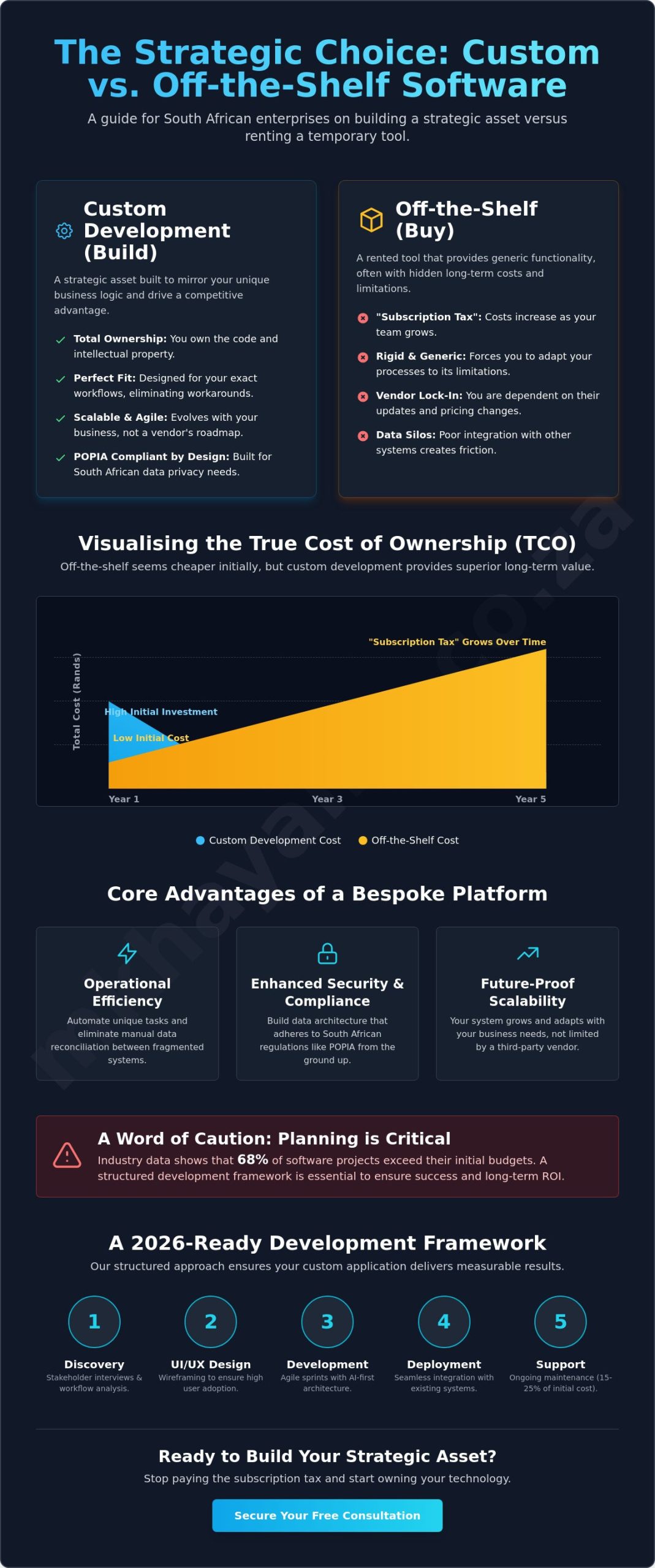
Deciding between building or buying requires a clear look at your long-term Total Cost of Ownership (TCO). A SaaS subscription might look cheaper on day one, but the subscription tax grows as you scale. You also need to consider how well a tool integrates with your existing ERP solutions. If a generic platform requires expensive, brittle middleware to talk to your core systems, the initial savings vanish. We recommend bespoke builds when your workflow is a primary source of competitive advantage. If your process is unique, your software must be too.
The Flexibility Factor in a Shifting Market
The South African business environment requires agility. External vendors often change their product roadmaps without warning, which can leave your team scrambling to adapt. Bespoke applications remove this risk by giving you total control over every feature. This independence is especially vital for POPIA compliance. Generic international tools don’t always align with South African data privacy nuances, potentially exposing you to regulatory risks. By choosing a custom path, you ensure that your data architecture is built with local compliance and your specific growth trajectory in mind.
Evaluating the Long-Term ROI of Bespoke Business Solutions
Calculating the return on investment for high-end technology requires a shift in perspective. Whilst the initial price tag of a bespoke build might seem higher than a monthly subscription, the long-term financial health of your enterprise depends on capital value rather than operational expenses. By 2026, the real value of custom application development for business lies in its ability to eliminate the “subscription tax” that grows alongside your headcount. Instead of paying more as you succeed, you own a fixed-cost asset that appreciates in utility as it becomes more deeply embedded in your unique operations.
One of the most significant ROI drivers is the elimination of fragmented data silos. When information is trapped in separate, generic tools, your team wastes hours on manual reconciliation. A bespoke system creates a single source of truth, allowing for seamless AI and data automation that standard software simply cannot replicate. By 2026, AI is no longer a secondary feature; it’s a foundational layer that identifies inefficiencies before they impact your bottom line. If you’re ready to explore how a tailored architecture could streamline your specific workflows, our team can help you map out a strategic path forward.
Efficiency Gains and Labour Cost Reduction
Bespoke solutions allow you to quantify success through recovered time. By automating repetitive data entry and reducing the “human-in-the-loop” for administrative approvals, businesses can redirect their most expensive resource; human talent; toward high-value strategy. AI-driven custom apps can predict operational bottlenecks by analysing historical workflow patterns in real-time to suggest proactive adjustments. This level of precision ensures that your labour costs remain stable even as your output increases.
Scalability: Preparing for National Expansion
Growth shouldn’t be penalised by software vendors. A major advantage of bespoke builds is the ability to scale from 100 to 10,000 users without the burden of exponential licensing fees. Leveraging robust cloud application services ensures your infrastructure remains performant across multiple provinces. This future-proof approach allows you to invest in your own feature roadmap, ensuring your technology stack remains a stable, high-performance engine for the next five years of innovation and beyond.
Bridging the Talent Gap: Staff Augmentation vs. Full Project Outsourcing
Success in custom application development for business depends as much on the people as it does on the code. Many South African enterprises face a significant hurdle: the local scarcity of senior-level technical talent. To overcome this, leaders often choose between handing over an entire project to an external partner or augmenting their existing team with specialised contractors. Both paths offer unique advantages; the right choice depends on your internal capacity and the complexity of your roadmap. We believe that technology should empower your team, not create a recruitment bottleneck that slows your momentum.
Managing the long-term health of your application requires a deliberate strategy for knowledge transfer. Whether you outsource the whole project or hire temporary experts, ensure that your partner documents every architectural decision. This transparency ensures that your internal team can maintain and scale the system long after the initial build is complete. Reliability is built on this mutual commitment to clarity and shared success. By choosing a partner who values transparency, you secure the future of your digital assets whilst keeping your internal stakeholders informed and confident.
The Project-Based Delivery Model
This model is ideal when you have well-defined requirements and need a rapid time-to-market. By opting for end-to-end software engineering services, you leverage a partner’s entire infrastructure, including their QA testers and UI/UX designers. This approach minimises the management burden on your internal staff, allowing them to focus on core business operations whilst the external team handles the heavy lifting of construction. For a deeper look at planning these initiatives, our Strategic Guide for 2026 provides a comprehensive roadmap for project success.
Staff Augmentation: Speed and Flexibility
If you already have an internal dev team but lack specific expertise or extra hands for a temporary surge, staff augmentation is the most agile solution. It allows you to scale your workforce with senior engineers who integrate directly into your existing culture and workflows. This method keeps you in the driver’s seat; you maintain full control over the daily development process and the feature roadmap. It also significantly reduces recruitment lead times and overheads, which is critical when you need to respond to market shifts before your competitors do.
Navigating the Development Lifecycle: A 2026 Framework for Success
Building a high-performance digital asset requires more than just technical skill; it demands a structured, rhythmic progression from vision to execution. Successful custom application development for business in 2026 involves a five-phase lifecycle designed to minimise risk whilst maximising operational impact. This journey begins with deep discovery and stakeholder alignment to define core KPIs, ensuring every line of code serves a commercial purpose. Following this, we move into prototyping and user-centric UI/UX design to validate the solution before full-scale construction begins.
The middle stages focus on agile development, utilising continuous integration and deployment (CI/CD) to maintain momentum. Security is never an afterthought; phase four involves rigorous testing and specific South African data compliance checks to meet POPIA standards. Finally, the lifecycle concludes with managed deployment and ongoing digital transformation consulting. This ensures your software doesn’t just launch, but evolves as a stable anchor in your technological landscape. If you’re ready to build a solution that truly fits your organisation, you can start your discovery journey with us today.
The Discovery Phase: Beyond Technical Specs
We believe in identifying the underlying business problem before selecting a technology stack. By mapping intricate user journeys, we ensure the application solves real-world pains rather than just adding another layer of complexity. This phase is about transparency and methodical execution, where we align the software’s capabilities with your long-term stability. Securing active stakeholder buy-in from the outset remains the single most accurate predictor of a project’s long-term success. This collaborative foundation prevents the “feature creep” that often leads to budget overruns in less structured projects.
DevOps and Continuous Modernisation
Modern software requires a “shift-left” approach to quality, where automated testing is integrated into the earliest stages of development. Cloud-native architecture is essential for South African enterprises, providing resilience against local infrastructure challenges and ensuring high availability. We also look at how mobile app development integrates into your broader ecosystem, allowing your workforce to remain productive whilst on the move. By adopting these DevOps principles, you ensure your application remains agile and ready for the next wave of innovation without requiring a total rebuild.
Scaling with Confidence: Why Mkhaya MK is Your Development Partner
Our expertise extends into highly specialised sectors where generic tools often fail to meet the mark. Whether we are developing a sophisticated loan management system or a robust facility management system, our focus remains on methodical execution. We organise our teams to ensure continuity and deep knowledge retention, which is vital for the ongoing health of your software. This structured rhythm of engagement creates a sense of momentum, leading your business from a broad vision toward a clear, successful path forward.
Proven Expertise in Digital Transformation
Start Your Custom Journey Today
Engaging with Mkhaya MK begins with a strategic consultation where we listen to your unique challenges and aspirations. We value transparency and integrity above all else, providing a clear roadmap for your project without the high-pressure urgency common in the tech sector. Our promise is one of technical excellence and supportive partnership, ensuring you remain in control of your digital future. Ready to build your competitive advantage? Contact our expert team to discuss how we can bring your vision to life with a bespoke solution built for the South African context.
Building Your Strategic Advantage in a Digital First Era
Owning your operational intellectual property is no longer a luxury; it’s a strategic necessity for any enterprise looking to thrive in 2026. We’ve explored how custom application development for business provides the flexibility to pivot quickly whilst avoiding the long-term trap of rigid licensing fees. By choosing a tailored approach, you ensure that your technology integrates seamlessly with your existing infrastructure and evolves alongside your team’s ambitions. This path leads to full control over your feature roadmap and a system that grows with you rather than holding you back.
Mkhaya MK stands as your dedicated partner in this journey. As end-to-end digital transformation experts with national South African service coverage, we bring technical precision and business pragmatism to every project. Our experience with specialised proprietary systems for loans and facilities ensures that your build is rooted in practical, results-driven enterprise software development in South Africa. We’re committed to your long-term stability and mutual success. Partner with Mkhaya MK for your next custom development project and take the first step toward a scalable, high-performance future. We look forward to building something exceptional together.
Frequently Asked Questions
How much does custom application development for business typically cost in 2026?
The investment required for a bespoke build depends on the complexity of your workflows and the depth of integration with existing systems. Whilst industry averages suggest allocating 15% to 25% of the initial development cost for annual maintenance, the total price is influenced by your specific feature roadmap. We focus on providing a transparent breakdown of costs that aligns with your long-term ROI rather than offering a generic, one-size-fits-all estimate.
How long does it take to build a bespoke business application?
A typical development timeline ranges from three to nine months for a production-ready enterprise system. Smaller projects or Minimum Viable Products (MVPs) can often be launched in approximately twelve weeks to gather user feedback quickly. This duration allows for a thorough discovery phase and rigorous testing, ensuring the final application is a stable anchor for your operations.
What is the difference between custom web apps and mobile applications?
Web applications are accessed through a browser and offer broad compatibility across various devices without requiring a download. Mobile applications are built specifically for iOS or Android platforms to leverage hardware features like GPS or offline storage. For most custom application development for business, a web-based approach provides the best balance of accessibility and scalability for internal teams. To ensure your web-based project stays on track from the outset, review our detailed custom web application development South Africa project success checklist covering everything from POPIA compliance to measurable ROI.
Can custom software integrate with our existing legacy ERP systems?
Yes, bespoke solutions are specifically engineered to bridge the gap between modern cloud infrastructure and legacy South African ERP systems. We utilise secure APIs and custom middleware to ensure that data flows seamlessly between your old and new platforms. This integration eliminates manual data entry and prevents the creation of fragmented information silos within your organisation.
How do we ensure our custom application is POPIA compliant?
Compliance is achieved by integrating “privacy by design” principles into the earliest stages of the development lifecycle. This involves implementing robust encryption, granular access controls, and automated data retention policies that align with South African regulations. We also prioritise hosting on local servers when necessary to meet specific data residency requirements for sensitive information.
What happens to the software once the development project is finished?
You maintain full ownership of the source code and the intellectual property once the initial build is complete. Most enterprises then transition into a managed support phase to handle routine security updates and performance optimisations. This ensures that your application remains a reliable asset that can be refined as your business strategy evolves over time.
Is staff augmentation better than hiring a full-time in-house developer?
Staff augmentation is often more efficient for projects with a defined scope as it provides immediate access to senior expertise without long-term recruitment overheads. It allows you to scale your team’s capacity during peak development periods whilst maintaining internal control. In-house hires are generally better suited for businesses that require permanent, daily maintenance of a static product over many years.
What is the most common reason custom software projects fail?
The primary predictor of failure is a lack of stakeholder alignment and poorly defined requirements at the start of the project. When the technical roadmap doesn’t match the commercial goals, scope creep often leads to budget overruns and delays. We mitigate this risk by using a structured discovery framework that ensures all parties are committed to the same core KPIs before a single line of code is written. For a practical tool to help you avoid these pitfalls, our 2026 checklist for custom web application development in South Africa provides a step-by-step guide to structuring your project for success from day one.