With South Africa’s digital lending and fintech market value reaching USD 980 million in 2026, the opportunity for growth is immense, yet many providers remain tethered to the past. Even with the repo rate holding steady at 7.00%, the pressure to maintain margins whilst managing manual, paper-heavy credit approvals is becoming unsustainable. If you’re struggling to balance high operational costs with the complexities of NCR and POPIA compliance, you’ve likely felt the need for a more agile approach. Implementing a robust digital lending platform south africa requires more than just a technical upgrade; it’s about building a strategic engine that can navigate our unique credit landscape.
We believe that scaling a financial service should be a collaborative journey rooted in reliability and precision. This strategic guide will show you how to modernise your credit operations and scale using cutting-edge technology designed for the local market. You’ll learn how to achieve faster loan processing times through automated risk assessment and establish a scalable digital infrastructure that ensures long-term stability. We will walk through the essential steps to move from a broad vision to concrete execution, ensuring your business remains a stable anchor in a rapidly changing technological environment.
Key Takeaways
Understand how modernising your credit operations through cloud-native architectures facilitates sustainable growth and reduces operational overhead.
Identify the core features of a modern digital lending platform south africa, focusing on how AI-driven scoring and secure disbursements accelerate turnaround times.
Evaluate the strategic advantages of custom software development to protect your proprietary IP and avoid the limitations of generic lending tools.
Navigate the latest NCR and POPIA requirements with precision to ensure your digital infrastructure remains secure and compliant in 2026.
Explore a structured path from strategic consulting to cloud deployment, positioning your financial services as a stable anchor in a changing market.
What is a Digital Lending Platform and Why Does it Matter in 2026?
Understanding What is a Digital Lending Platform starts with recognising it as an end-to-end software solution that automates the entire loan lifecycle. In 2026, these systems have evolved far beyond basic data entry tools. They now function as sophisticated engines that manage everything from initial customer onboarding and credit vetting to disbursement and collections. For any financial institution, a digital lending platform south africa is the cornerstone of a modernised service, replacing slow, fragmented legacy systems with a unified, cloud-native architecture.
To better understand how these tools are reshaping the local market, watch this helpful video:
The transition from legacy credit systems to AI-driven architectures is fueled by a need for absolute precision and speed. Traditional methods often result in bottlenecks that frustrate borrowers and increase risk for lenders. Modern platforms utilise AI & data automation to ingest vast amounts of data instantly, ensuring that credit decisions are based on real-time insights rather than outdated snapshots. This shift allows lenders to remain agile whilst maintaining a high standard of reliability.
South African businesses are currently prioritising digital transformation to drastically reduce “time-to-cash”. In a competitive market, the ability to put capital into a borrower’s hands within minutes rather than days is a significant advantage. Mobile-first interfaces play a vital role here, especially in reaching the unbanked and underbanked national population. By providing access to financial services through the devices people already carry, these platforms foster greater financial inclusion across the country.
The Evolution of Credit in South Africa
Credit management has moved from manual, subjective vetting to real-time algorithmic risk assessment. This evolution relies on robust cloud application services to ensure maximum platform uptime and accessibility. By removing physical barriers and geographical constraints, digital platforms democratise access to capital. This means an entrepreneur in a remote area can secure funding with the same ease and speed as a business based in a major urban centre like Johannesburg or Cape Town.
Core Benefits for Financial Institutions
Adopting automated workflows leads to a substantial reduction in operational overheads. By removing the need for manual intervention at every stage, institutions can process significantly higher loan volumes without a linear increase in staff costs. Precision also improves; algorithmic scoring reduces the human error inherent in traditional vetting, leading to a healthier loan book. For South African SMEs, the ROI of a Loan Management System is found in the ability to secure working capital at the exact moment of opportunity, turning credit into a catalyst for immediate and sustainable expansion.
Essential Features of a Modern Digital Lending Platform
Selecting the right components for your digital lending platform south africa is a strategic decision that determines your long-term scalability. Whilst many off-the-shelf products offer basic functionality, a truly robust system must handle the specific nuances of the local credit market. You need a platform that doesn’t just record data but actively works to protect your margins and improve the user journey. These core capabilities form the foundation of a reliable system:
Automated Credit Scoring: Integrating AI and data automation to process applications in seconds rather than days.
Secure Digital Wallets: Facilitating seamless disbursements and repayments through integrated payment gateways.
Interactive Dashboards: Providing real-time analytics for lenders to monitor portfolio health and for borrowers to manage their accounts.
Multi-Channel Support: Ensuring accessibility via web, mobile, and USSD to reach the widest possible national audience.
AI-Driven Risk Assessment and Automation
Incorporating AI automation solutions allows your platform to predict default patterns with far greater precision than traditional credit scores. This isn’t just about speed; it’s about accuracy. By automating KYC (Know Your Customer) and AML (Anti-Money Laundering) checks, you reduce manual friction whilst ensuring rigorous compliance. We’ve found that custom-built algorithms often outperform generic global models. Localised data reflects South African spending habits and financial behaviours more accurately, which leads to a more stable and predictable loan book.
User Experience and Interface Design
Borrower retention is heavily influenced by the ease of the initial digital journey. Professional UI/UX design services are critical for simplifying complex application forms into intuitive, bite-sized steps. In the South African context, high performance on low-bandwidth mobile connections is a non-negotiable requirement. A platform that fails to load on a basic smartphone in a rural area isn’t truly accessible. By focusing on lightweight yet powerful interfaces, you ensure that your service remains available to everyone, regardless of their device or location.
If you’re looking to refine these features for your specific business model, our team can help you customise your lending infrastructure for long-term success. We believe that technology should be a supportive partner in your growth, providing the steady confidence you need to scale your financial services with precision.
Custom Development vs. Off-the-Shelf Lending Software
Deciding whether to build a bespoke solution or license a generic product is a pivotal moment for your business strategy. Whilst off-the-shelf software offers a faster entry point, it often introduces the risk of “vendor lock-in”, where your growth is constrained by another company’s roadmap. For a digital lending platform south africa, owning your proprietary IP isn’t just a technical preference; it’s a significant asset that increases the valuation of your financial institution. Custom engineering allows you to architect unique credit products that align perfectly with local market needs, such as specific repayment structures or interest rate tiers that generic SaaS tools simply cannot accommodate.
We believe that technology should serve your vision, not limit it. Choosing custom software development enables you to build a system that reflects your specific risk appetite and operational style. Whilst the initial capital expenditure for custom builds is higher than a monthly subscription, the long-term operational savings are substantial. You eliminate recurring per-user fees and gain the freedom to scale without penalty, turning your technology stack into a stable anchor for future expansion.
When to Choose a Custom Solution
Bespoke development is the right path when your product requirements involve complexities that standard tools ignore. If you need deep, seamless integration with local credit bureaux like Experian or TransUnion, or direct links into the South African banking grid, a custom approach is often essential. This path is also vital if you aim to build a unique brand experience that stands out amongst a sea of generic competitors. A custom-built Loan Management System ensures that every touchpoint, from the application to the final repayment, feels modern and precise.
The Role of Staff Augmentation in Development
Bridging the local developer talent gap is one of the biggest challenges in fintech today. Many institutions find that staff augmentation provides the necessary momentum to meet aggressive launch deadlines without the overhead of permanent hiring. By integrating dedicated software engineering experts into your existing team, you ensure project continuity and maintain high standards of precision. This model allows you to scale your technical capacity quickly, bringing in specialised skills for cloud deployment or AI integration exactly when they’re needed most. It’s a practical way to maintain the “quiet confidence” required to execute a complex digital transformation whilst keeping your core focus on financial service delivery.
Navigating Compliance and Security in South Africa
Operating a digital lending platform south africa involves more than just processing applications; it requires a deep commitment to the regulatory frameworks that protect both the lender and the borrower. In 2026, the South African Reserve Bank and the National Credit Regulator (NCR) have set high standards for digital transparency. Reliability in this sector is built on a foundation of methodical execution and strict adherence to the National Credit Act. By integrating compliance directly into your software architecture, you transform a potential hurdle into a competitive advantage that inspires trust.
Manual reporting is often the primary cause of friction in growing financial institutions. A modern platform should automate the generation of Form 39 and Form 40 reports, ensuring that your data is always ready for submission. Managing reckless lending checks within the digital workflow is equally critical. By using algorithmic affordability assessments, you can ensure every loan meets the legal requirements for consumer protection whilst maintaining your operational speed. Integrating with the South African Fraud Prevention Service (SAFPS) adds an extra layer of security, allowing you to flag suspicious activity before it impacts your bottom line.
NCR and National Credit Act Compliance
With the Conduct of Financial Institutions (COFI) Bill now creating a unified framework for open finance, your platform must be agile enough to adapt to these shifting rules. Ensuring your interest rate calculations remain within the National Credit Act caps, such as the 5% per month limit for short-term consumer loans, must be an automated function of your core system. This precision prevents accidental overcharging and protects your organisation from regulatory scrutiny. Automated workflows also ensure that every borrower receives the required pre-agreement statements and quotations, honouring the transparency standards expected in a modern financial market.
Data Privacy and POPIA
Protecting your infrastructure requires more than basic firewalls. Utilising robust cloud solutions provides the high-end security and encryption needed to defend against sophisticated cyber threats. Data privacy is a cornerstone of modern financial services, and implementing POPIA-compliant protocols ensures that borrower information is handled with the precision it deserves. This includes securing data with advanced encryption and managing strict access controls so that only authorised personnel can view sensitive files. Your platform must also provide clear mechanisms for managing consent and data subject rights, allowing borrowers to see exactly how their information is used. Non-compliance in the South African financial sector can result in administrative fines of up to R10 million or criminal prosecution for significant data breaches.
How Mkhaya MK Modernises Lending with Custom Engineering
At Mkhaya MK, we understand that a digital lending platform south africa is more than just code; it is the lifeblood of your financial service. Our proprietary Loan Management System serves as a robust foundation, designed specifically to handle the intricacies of the local market whilst providing the flexibility to scale. We don’t just provide a tool; we embark on a collaborative journey with you, moving methodically from strategic consulting through to complex cloud deployment. This end-to-end process ensures that every architectural decision aligns with your long-term business goals and operational needs.
By leveraging AI & data automation, we help you create smarter credit operations that learn and adapt to borrower behaviour. This precision-focused approach reduces human error and enhances the reliability of your risk assessments. We believe in a partnership model where your success is our primary metric, providing a stable anchor in a technological landscape that never stops moving. Our goal is to inspire trust through transparency and methodical execution, ensuring your platform remains a visionary leader in the fintech space.
Bespoke Software Engineering for Fintechs
Designing scalable architectures is at the heart of our service offering. As your loan book grows, your infrastructure must remain agile and responsive to avoid the bottlenecks associated with legacy systems. Our software engineering teams focus on integrating your platform with local payment gateways and the broader financial ecosystem, ensuring seamless transactions for your customers. Our digital transformation methodology is built on commitment and integrity, allowing us to refine your processes whilst building for future innovation without the constraints of generic software.
Partnering for National Success
Success in the South African fintech space requires access to high-level expertise that can be difficult to source locally. Our staff augmentation model allows you to tap into top-tier technical professionals who become a dedicated extension of your own team. This approach ensures you have the talent needed to maintain your digital lending platform south africa at the cutting edge of the industry. We provide continuous support and optimisation, ensuring your system remains secure and efficient long after the initial launch. Take the next step toward modernising your credit operations; we invite you to consult with our engineering experts today to discover how we can build a more stable and successful future together.
Building the Future of South African Credit
Transitioning to a modernised credit operation is a strategic move that requires both vision and precision. We’ve explored how a digital lending platform south africa can transform manual bottlenecks into automated engines of growth, whilst ensuring your business remains compliant with NCR and POPIA regulations. By choosing custom engineering over generic software, you secure your proprietary IP and build a system that truly reflects your unique brand identity. Success in 2026 isn’t just about fast processing; it’s about creating a stable, scalable foundation that inspires long-term trust amongst your borrowers.
Our team is ready to support your journey with our specialised Loan Management System (LMS) and deep expertise in South African financial compliance. We combine scalable AI and cloud engineering capabilities to ensure your infrastructure is as agile as the market demands. We invite you to discuss your digital lending vision with Mkhaya MK and discover how a dedicated partnership can turn your strategic goals into a concrete reality. Let’s work together to build a more inclusive and efficient financial landscape for all South Africans.
Frequently Asked Questions
What is the National Credit Act (NCA) and how does it affect digital lending?
The NCA is the primary legislation regulating the South African credit market to prevent reckless lending and ensure consumer protection. It mandates that every digital lending platform south africa must perform rigorous affordability assessments and provide transparent pre-agreement statements. Compliance ensures that lenders operate within interest rate caps and follow fair collection practices, protecting both the institution and the consumer from significant legal risk.
Can a digital lending platform integrate with South African credit bureaux?
Yes, modern platforms are designed to integrate seamlessly with major credit bureaux like TransUnion, Experian, and XDS via secure APIs. This capability allows for real-time data retrieval, enabling lenders to assess a borrower’s credit history and existing debt obligations instantly. Such integrations are vital for automating the vetting process and reducing the time-to-cash for applicants whilst maintaining a high standard of risk management.
How long does it take to develop a custom digital lending platform?
The development timeline for a bespoke platform typically ranges from four to nine months, depending on the complexity of the required features. A basic system with core management functions might launch sooner, whilst a platform requiring advanced AI automation and deep banking integrations takes longer to architect. We focus on a methodical execution that ensures each phase, from strategic consulting to cloud deployment, is handled with precision.
What is the difference between a P2P lending platform and an enterprise LMS?
A P2P platform acts as a marketplace matching individual lenders with borrowers, whereas an enterprise Loan Management System (LMS) is a comprehensive back-office solution for financial institutions. An LMS manages the entire loan lifecycle, including complex accounting, automated collections, and regulatory reporting. Whilst P2P tools focus on matching, an enterprise LMS provides the scalable digital infrastructure needed to manage a large, proprietary loan book securely.
Is cloud hosting for financial data legal in South Africa?
Cloud hosting is entirely legal and increasingly preferred, provided the infrastructure complies with POPIA and the South African Reserve Bank’s outsourcing guidelines. Data must be stored securely with advanced encryption, and lenders must ensure that their cloud provider meets specific residency and security standards. Using local data centres helps institutions meet these regulatory requirements whilst ensuring high platform performance and reliability for all users.
How does AI improve the loan approval process in South Africa?
AI enhances the approval process by analysing non-traditional data points to assess creditworthiness more accurately than traditional scoring alone. This is particularly effective for reaching the unbanked population who may lack a formal credit history. By automating risk assessment through a digital lending platform south africa, institutions can process thousands of applications simultaneously with greater precision, significantly reducing the likelihood of human error or subjective bias.
What security measures are required for a digital lending platform?
A platform must implement multi-layered security, including end-to-end encryption, multi-factor authentication (MFA), and rigorous access controls. Regular vulnerability assessments and penetration testing are essential to defend against evolving cyber threats. These measures protect sensitive borrower data and ensure that financial transactions remain secure, which is fundamental to maintaining the quiet confidence and reliability expected of a modern financial service provider in the national market.
Did you know that robotic process automation costs approximately 10% of an onsite employee whilst potentially reducing process times by up to 90%? For many local institutions, the pressure to evolve is no longer theoretical. With the JIBAR cessation deadline fixed for 31 December 2026, the need to modernise has become a matter of survival. Implementing RPA for financial services south africa is a powerful way to reclaim your competitive edge against digital-first fintechs that aren’t weighed down by traditional overheads.
It’s understandable if you feel hesitant about the complexities of legacy software or the sensitivities surrounding labour unions and job security. We recognise that your journey involves more than just technical deployment; it requires a partnership built on trust and stability. This guide provides a clear roadmap to help you optimise financial operations and reduce error rates without disrupting your workforce. You’ll discover how to integrate automation into your existing systems and navigate the shifting regulatory environment with confidence. We’ll show you how to turn these technological shifts into a foundation for long-term growth and operational excellence.
Key Takeaways
You’ll learn how software bots revolutionise KYC and AML compliance to ensure your institution remains agile and secure.
Address local sensitivities regarding job security by positioning automation as a supportive tool that empowers your team rather than replaces them.
Explore methods for successfully integrating RPA for financial services south africa with complex legacy mainframes to bridge the gap between traditional banking and modern efficiency.
Gain a structured roadmap for your automation journey, beginning with a robust Readiness Assessment and a high-impact pilot project.
See how custom software engineering and staff augmentation can bridge internal skills gaps to sustain your long-term digital growth.
Understanding RPA in the South African Financial Sector
South Africa’s financial landscape is undergoing a profound shift as the Fourth Industrial Revolution (4IR) moves from a strategic concept to a practical necessity. At the heart of this transition is Robotic Process Automation (RPA), a technology that uses software “bots” to handle repetitive, rule-based tasks. These bots aren’t physical machines; they’re specialised software programmes designed to emulate human interactions with digital systems. This isn’t about replacing your valued team members; it’s about liberating them from the weight of mundane data entry and administrative drudgery.
To better understand how these bots compare to advanced AI agents in a business context, watch this helpful video:
By 2026, the pressure to maintain pace with agile, digital-first fintechs has intensified for traditional South African institutions. High operational costs and rigid structures often hinder growth. Implementing RPA for financial services south africa provides a non-intrusive way to bridge this gap. These bots operate on the presentation layer of your existing software, meaning they work on top of your legacy banking systems without requiring a risky or expensive overhaul of your core infrastructure. It’s a pragmatic approach that respects your current investments whilst driving immediate efficiency gains.
The Core Components of Financial Automation
Financial leaders should distinguish between basic task automation and more advanced cognitive automation. Standard RPA follows strict, predefined rules to move data or process transactions. However, when we integrate AI and machine learning, these bots gain “cognitive” abilities. They can interpret unstructured data, such as handwritten forms or complex emails, and make informed decisions based on patterns. Financial services are the ideal candidate for this technology because of the massive volumes of data processed daily. Whether it’s validating account details or reconciling statements, automation ensures precision at a scale that manual processing simply cannot match.
RPA vs. Traditional System Integration
A full system replacement is often a multi-year journey fraught with risk. RPA offers a faster, more cost-effective alternative for institutions that need results now. It’s particularly effective at solving “swivel-chair” processes, where staff are forced to manually copy and paste information between disparate applications that don’t talk to each other. By automating these touchpoints, you reduce the risk of human error and significantly accelerate service delivery. For organisations looking to build a sustainable, long-term strategy, our digital transformation consulting services help align these rapid RPA wins with your broader business objectives, ensuring a steady and reliable path toward a fully modernised operation.
Key Applications: Where RPA Transforms Banking and Insurance
Precision is the new currency in the South African financial sector. As institutions grapple with high operational costs, the deployment of RPA for financial services south africa has shifted from a luxury to a core strategic requirement. One of the most immediate impacts is seen in Know Your Customer (KYC) and Anti-Money Laundering (AML) workflows. Bots can instantly cross-reference applicant data against international sanction lists and local databases, flagging discrepancies for human review in seconds. This ensures that compliance isn’t just a box-ticking exercise but a robust, real-time defence against financial crime.
In the insurance sector, claims processing often suffers from bottlenecks caused by manual document verification. RPA changes this dynamic by automatically extracting data from accident reports, medical certificates, and repair quotes. Whilst the benefits are clear, understanding the challenges that affect the adoption of RPA in a local context is vital for building a resilient strategy. By automating the validation of policy coverage and initial damage assessments, insurers can settle claims faster, directly improving customer satisfaction scores in a highly competitive market.
Modernising Credit and Loan Operations
Loan processing is traditionally a paper-heavy journey that tests customer patience. By integrating these bots with a modern Loan Management System, you can significantly reduce the time it takes to move a customer from application to payout. Bots handle the heavy lifting of data extraction from payslips and bank statements, feeding accurate information into credit scoring models. This eliminates the human error often associated with complex interest rate calculations or repayment scheduling. If you’re looking to refine your back-office operations, our AI and data automation solutions provide the technical foundation you need to scale these efficiencies.
Compliance and Regulatory Reporting
The regulatory environment in South Africa is becoming increasingly stringent. Financial institutions must provide regular, detailed reports to the Financial Sector Conduct Authority (FSCA) and the South African Reserve Bank (SARB). Manual reporting is not only slow but carries a high risk of inaccuracies that can lead to heavy fines. RPA bots excel here by generating automated digital audit trails for every transaction they process. They can be scheduled to compile and submit monthly financial reports with 100% accuracy, ensuring your institution remains in good standing without draining your internal resources on administrative overhead. This level of precision creates a stable anchor for your business amidst a rapidly changing technological and legal landscape.
Account Reconciliation: Bots match thousands of transactions across disparate ledgers in minutes.
Data Migration: Move client information between old and new systems without losing data integrity.
Customer Onboarding: Automate the creation of new accounts across multiple banking platforms simultaneously.
Navigating Local Implementation Challenges: Labour and Legacy
Successful automation in the South African context requires more than technical proficiency; it demands a deep understanding of our unique social and structural landscape. Unlike global markets where the focus may be purely on cost reduction, implementing RPA for financial services south africa necessitates a balanced approach that respects the “sensitivity to employment.” Trade unions and labour groups play a pivotal role in our economy, and any automation strategy must prioritise transparency and ethical execution to ensure long-term stability.
Data privacy remains another critical hurdle. Every automation script must be designed with the Protection of Personal Information Act (POPIA) at its core. Bots handle vast amounts of sensitive client data, and ensuring that these processes remain secure and compliant is a non-negotiable requirement for any local institution. Aligning your strategy with the South African Reserve Bank’s fintech framework provides a reliable foundation for navigating these regulatory expectations whilst fostering innovation.
Ethical Automation and Workforce Reskilling
We view automation as a tool for empowerment rather than replacement. By automating repetitive data entry, you can move your staff into high-value, customer-facing roles where human empathy and intuition are irreplaceable. This transition is most effective when you collaborate with trade unions early in the process, demonstrating how bots improve employee wellbeing by removing the drudgery of manual processing. The augmented workforce represents a powerful synergy where digital bots handle high-volume processing whilst human expertise focuses on complex problem-solving and relationship management. This collaborative model helps build a resilient and motivated team ready for the future of finance.
Solving the Technical Skills Shortage
One of the primary barriers to scaling automation is the significant local skills gap in RPA engineering. Many organisations struggle to find and retain developers who understand the intricacies of South African financial regulations. Building internal centres of excellence (CoE) is a long-term goal, but the need for modernisation is immediate. Our staff augmentation services bridge this gap by providing instant access to specialists who can manage your automation pipeline. This approach allows you to scale your efforts quickly without the overhead of a lengthy recruitment process. Using local developers who are familiar with the challenges of integrating modern bots with decades-old legacy banking mainframes ensures that your digital transformation remains grounded in practical, real-world solutions.
A Roadmap for Successful RPA Adoption in 2026
Moving from a visionary concept to a functional automated environment requires a structured, methodical approach. Implementing RPA for financial services south africa isn’t merely a technical installation; it’s the construction of a reliable digital workforce that supports your human team. By following a clear progression, you ensure that your investment delivers measurable results whilst maintaining the stability your clients expect.
Step 1: Conduct a comprehensive Readiness Assessment. This phase focuses on process suitability and projected ROI, ensuring you don’t waste resources on tasks that aren’t ready for automation. We evaluate your current workflows to identify where bots can provide the most significant uplift.
Step 2: Select a pilot project. We recommend starting with a high-volume, low-complexity process such as account opening. This allows you to demonstrate immediate value and build internal confidence without the risks associated with more complex, interconnected systems.
Step 3: Define your governance model. It’s vital to establish clear rules that ensure every bot operation remains compliant with FSCA standards and POPIA requirements. This framework provides the transparency needed to satisfy both internal auditors and external regulators.
Step 4: Execute the pilot and measure against KPIs. Focus on concrete data points such as error rates and processing time. Research shows that well-executed RPA can reduce process time by up to 90%, giving you a clear benchmark for success.
Step 5: Scale across departments. Once your pilot has proven its worth, use an agile deployment framework to roll out automation to other areas of the business. This incremental growth ensures that your infrastructure stays robust as your digital capabilities expand.
Selecting the Right Processes for Automation
Identifying the best candidates for automation often involves the “Rule of Five.” We look for processes with fewer than five decisions, five systems involved, or five minutes of manual effort. These are typically the most stable and provide the fastest return on investment. It’s also crucial to avoid the trap of automating broken or inefficient processes; automation should refine a working system, not hide a flawed one. For more complex scenarios that require cognitive decision-making, our AI and data automation solutions can handle advanced use cases that go beyond standard rule-based tasks.
Measuring Success Beyond Cost Savings
Whilst reducing operational costs is a primary driver, true success is measured through a broader lens. You should track improvements in customer experience by monitoring your Net Promoter Score (NPS), as faster service delivery directly impacts client loyalty. Additionally, evaluate the reduction in compliance-related fines and the costs associated with rework. Perhaps most importantly, monitor employee engagement levels. When your team is freed from repetitive drudgery, they can focus on more fulfilling, high-value work. If you’re ready to see these benefits in your own institution, contact us today to begin your tailored readiness assessment.
Scaling Your Automation Journey with Mkhaya MK
Building a future-ready financial institution in South Africa requires more than just adopting the latest tools; it requires a partner who understands the intricate balance between technological innovation and local operational realities. At Mkhaya MK, we specialise in delivering end-to-end digital transformation that respects your legacy whilst driving you toward a more efficient future. Our approach to RPA for financial services south africa is built on the foundation of quiet confidence and methodical execution, ensuring that every bot we deploy serves a clear, strategic purpose.
We don’t believe in one-size-fits-all automation. Instead, we combine our deep expertise in AI-driven automation with a practical understanding of the South African business context. This dual focus allows us to help you navigate the complexities of national compliance and labour dynamics with transparency and integrity. By choosing a local partner, you gain access to a team that stays invested in your personal journey, providing the steady support needed to turn ambitious visions into concrete operational successes.
Custom Solutions for Complex Challenges
Standard RPA bots often encounter hurdles when interacting with highly customised or ageing financial systems. This is where our background in bespoke software engineering becomes a critical advantage. We develop the necessary middleware and custom interfaces that allow your automation scripts to communicate seamlessly with your core banking software. By integrating these bots with our proprietary ERP solutions, we provide you with holistic visibility across your entire business. To ensure these systems remain reliable and secure, we offer managed cloud and DevOps support, creating a stable environment where your digital workforce can thrive without constant manual intervention.
Partnering for National Success
Our commitment goes beyond mere technical delivery. We’re dedicated to building a resilient South African financial ecosystem where technology empowers people rather than replacing them. Our local roots and vision, which you can learn more about on our about us page, drive us to create solutions that foster long-term stability and growth for our clients. We understand that your success is our success, and we’re ready to help you identify the quick-wins that will kickstart your automation journey. Whether you’re looking to refine your loan processing or automate complex regulatory reporting, we provide the visionary guidance and practical expertise to make it happen. Contact Mkhaya MK today to book your strategic consultation and discover how we can optimise your financial operations together.
Building a Resilient Future for South African Finance
The path toward a modernised financial sector is paved with both challenge and opportunity. By 2026, the successful integration of RPA for financial services south africa will define the leaders who can balance technical agility with the unique social responsibilities of our local market. We’ve seen how bridging legacy gaps and fostering an augmented workforce creates a foundation for long-term stability. This journey requires a partner who values transparency and methodical execution over flashy claims.
Mkhaya MK offers the expertise in AI & Data Automation and the proven track record in South African financial software necessary to guide your transition. Our staff augmentation services provide a practical solution to the local skills gap, ensuring your team has the support it needs to thrive. We’re ready to help you turn these strategic concepts into concrete results. You can begin your digital transformation journey with Mkhaya MK to secure your institution’s place in the future economy. Let’s build something lasting together.
Frequently Asked Questions
What is the difference between RPA and AI in financial services?
RPA is a rules-based technology that uses software bots to emulate repetitive human actions, such as data entry or account reconciliation. AI is data-driven and focuses on learning and decision-making, allowing it to handle unstructured information. In the financial sector, these technologies are often combined to create intelligent automation that can both execute tasks and interpret complex documents.
How much does RPA implementation cost for a South African bank?
Implementation costs depend on the scale of your institution and the complexity of the processes involved. Global estimates for 2026 suggest mid-size companies typically invest between $210,000 and $595,000, whilst large enterprises may see costs ranging from $1.3 million to $3.55 million. These figures cover software licences, development, infrastructure, and staff training to ensure long-term stability.
Will RPA lead to job losses in the South African financial sector?
We view RPA for financial services south africa as a tool for workforce empowerment rather than replacement. Whilst bots handle the drudgery of manual processing, your team members are liberated for high-value, customer-facing roles. By prioritising reskilling and maintaining transparent communication with labour unions, you can create a synergy where digital bots and human expertise thrive together.
Is RPA compliant with POPIA and FSCA regulations?
RPA is highly compliant because every action a bot takes creates a permanent, digital audit trail. This level of transparency is vital for satisfying FSCA requirements and preparing for the outcomes-based approach of the COFI Bill. When configured correctly, bots enhance POPIA compliance by ensuring sensitive client data is handled securely and consistently without the risk of human error.
How long does it take to see ROI from an RPA project?
Most institutions begin to see a return on investment within 6 to 18 months of deployment. Because RPA can reduce process times by up to 90%, the efficiency gains often translate into rapid cost savings and improved service delivery. Starting with a high-volume, low-complexity pilot project is the most reliable way to secure early wins and build confidence.
Can RPA work with our old legacy banking systems?
Yes, RPA is non-intrusive and operates on the presentation layer of your existing software. It can interact with decades-old legacy banking mainframes just as easily as modern cloud applications. This allows you to modernise your operations and bridge technical gaps without the massive expense or operational risk of a total core system overhaul.
Do we need to hire a whole new team to manage RPA?
You don’t need to recruit a full internal department at the start of your journey. Many organisations use staff augmentation to access specialised RPA engineers whilst they gradually build their own internal centres of excellence. This flexible approach allows you to scale your automation efforts at a pace that matches your institutional growth and budget.
What are the biggest risks of RPA in financial services?
The primary risks include poor process selection and a lack of robust governance. Automating a broken or inefficient workflow only results in faster errors; it doesn’t solve the underlying issue. Success requires a methodical roadmap, clear risk management protocols, and a focus on long-term stability rather than chasing flashy, short-term claims of success.
In the high-stakes environment of South African logistics and facilities management, what you can’t see is precisely what’s eroding your bottom line. Most local business leaders understand the persistent frustration of “ghost assets” and the constant threat of theft that disrupts even the most carefully planned operations. Implementing a robust asset tracking solution south africa requires more than just a simple tag; it demands a strategic alignment between your physical inventory and your digital ecosystem to ensure every piece of equipment is working for you.
You’ve likely felt the weight of manual data entry errors or the disconnect between your tracking software and your existing financial systems. This 2026 strategic guide promises to show you how a modern asset tracking solution can transform your operational visibility and reduce losses while integrating into your business infrastructure. We’ll explore the shift toward AI-driven automation and bespoke software integration that’s set to define the technological landscape for the coming year, moving from simple monitoring to visionary asset management.
Key Takeaways
Transition from reactive monitoring to proactive asset optimisation by managing the continuous lifecycle of every physical item in your inventory.
Leverage IoT-enabled real-time location services and cloud-native applications to maintain precise visibility across your entire national infrastructure.
Evaluate the long-term financial benefits of a bespoke asset tracking solution south africa compared to the rigid limitations of generic off-the-shelf platforms.
Implement a structured five-step roadmap that aligns stakeholders from finance to field operations whilst preventing costly operational disruptions.
Future-proof your business by integrating AI-driven predictive maintenance and data automation to eliminate human error during complex asset audits.
What Defines a Modern Asset Tracking Solution in South Africa?
Modern asset tracking isn’t just about knowing where a laptop or a forklift is at 9:00 AM. It’s the continuous monitoring of physical items throughout their entire lifecycle. This journey begins at the moment of procurement and continues through to final disposal. In the South African context, where equipment often moves across vast distances or between multiple job sites, a robust asset tracking solution south africa provides the visibility needed to prevent operational paralysis. It’s about building a stable anchor for your business in a landscape that’s constantly in motion.
We’re seeing a fundamental change in how local enterprises view their inventory. Traditionally, tracking was reactive; you only looked for an item when it went missing or broke down. Now, the focus has shifted toward proactive optimisation. This means using data to predict when a machine needs servicing or identifying underutilised equipment that could be redeployed to another branch. South African enterprises are moving away from legacy spreadsheets because they’re static, prone to human error, and completely disconnected from the reality of the field. A single typo in a spreadsheet can lead to weeks of financial confusion.
The scope of tracking has widened significantly. It’s no longer just about high-value vehicles. Modern systems manage a diverse range of assets across the country, including:
IT assets like servers, laptops, and mobile devices.
Industrial machinery including generators, drills, and manufacturing tools.
Fleet components and specialised transport equipment.
Facility infrastructure such as HVAC systems and security hardware.
The Core Components of an Enterprise Tracking System
A sophisticated system relies on three distinct layers to function effectively. First, the data capture layer uses tools like QR codes for low-cost items, RFID for bulk scanning, and IoT sensors for high-value equipment requiring real-time updates. Second, the software management layer serves as the brain of the operation. A centralised database, often integrated into ERP solutions, ensures that every stakeholder sees the same “single version of the truth”. Finally, the connectivity layer uses cloud-hosted platforms to allow for national synchronisation. Whether your asset is in Cape Town or Musina, the data is accessible instantly.
Why Local Compliance and Financial Accuracy Matter
South African businesses face unique regulatory pressures. Accurate tracking ensures you’re aligning with SARS depreciation requirements and strict audit standards. If you can’t prove an asset exists, you can’t claim for it; accurate data prevents the “ghost asset” phenomenon that plagues many local financial reports. This is where facility management systems play a crucial role by bridging the gap between physical location and financial reporting. Data sovereignty is another factor. Whilst we use global cloud infrastructure, we must ensure sensitive operational data remains protected and compliant with local privacy laws. Precise tracking leads to a healthier balance sheet and improved ROI on every capital expenditure. Choosing a comprehensive asset tracking solution south africa helps maintain this delicate balance between operational agility and financial integrity.
The Technical Architecture of Advanced Asset Management
While hardware tags are the visible face of any tracking project, the true power of a modern asset tracking solution south africa lies in its underlying software intelligence. The shift toward advanced architecture moves beyond simple “last seen” timestamps toward Real-Time Location Services (RTLS). This allows organisations to visualise asset flow across provinces in a live environment. It’s a sophisticated layer of data that connects your physical warehouse or job site to the executive boardroom, ensuring that every decision is backed by current, verifiable telemetry.
Harnessing IoT and Sensor Technology
Choosing the right hardware depends entirely on the value and risk profile of the asset. Passive tracking, such as QR codes or RFID, remains excellent for high-volume, low-cost items like office furniture or basic tools. However, for critical industrial machinery or sensitive medical equipment, active IoT sensors are becoming the standard. These sensors provide data that goes far beyond simple coordinates. They monitor vibration levels in mining equipment to predict mechanical failure or track temperature fluctuations in cold-chain logistics to ensure pharmaceutical integrity. In 2026, IoT in asset tracking represents an autonomous sensory network that provides granular, real-time telemetry on asset health and environmental conditions rather than just simple location coordinates.
Cloud Integration and Data Centralisation
A national operation cannot thrive on fragmented data. Cloud-native applications serve as the single source of truth, synchronising information from Durban to Polokwane instantly. By integrating with Cloud Application Services, businesses can scale their tracking capabilities from a few hundred items to tens of thousands without experiencing performance lag. This centralisation allows for the management of high-volume data streams, turning raw sensor pings into actionable insights. When data is centralised, your finance team can view depreciation schedules whilst your maintenance crew receives automated alerts for equipment servicing, all within the same unified ecosystem.
The practical application of this architecture is most evident during field-based asset audits. Field teams require mobile-first interfaces that work reliably in areas with spotty connectivity. A robust system allows for offline data capture, which then syncs automatically once the device returns to a stable network. This mobility reduces the time spent on manual audits by significant margins, often turning a week-long process into a few hours of scanning. Security remains a cornerstone of this design. Protecting sensitive corporate data requires a multi-layered approach, including end-to-end encryption and strict role-based access controls to ensure that only authorised personnel can view or modify asset records. If you’re curious about how these technical layers might fit into your current operations, exploring custom software engineering can help you map out a bespoke architecture tailored to your specific needs.
Evaluating Custom vs Off-the-Shelf Tracking Platforms
Evaluating the choice between a ready-made platform and a custom-built system requires a clear-eyed look at your long-term operational goals. Many South African firms initially gravitate toward global SaaS products because of their perceived ease of use. However, these generic tools often lack the flexibility to handle the specific complexities of our local market. When you look at the total cost of ownership (TCO) over a five-year horizon, the financial picture shifts significantly. The initial savings of a subscription model are frequently eroded by the “integration tax”, which is the ongoing expense of building workarounds to connect a rigid tool with your existing local infrastructure.
Choosing a bespoke asset tracking solution south africa allows you to build a system that mirrors your exact business processes rather than forcing your team to adapt to a software’s limitations. Local support isn’t just about a time-zone-friendly helpdesk; it’s about having a partner who understands the specific regulatory and logistical challenges of operating within our borders. This partnership ensures that custom features can be developed as your business scales. It keeps your tracking capabilities aligned with your growth whilst ensuring that your technology stack remains a stable asset rather than a mounting liability.
When to Choose Bespoke Software Engineering
Bespoke engineering is the right path when your business manages unique asset types or follows proprietary workflows that a “one-size-fits-all” tool cannot accommodate. By linking your tracking data directly to custom facility management systems, you create a seamless flow of information that enhances everything from maintenance scheduling to site security. This level of integration provides a distinct competitive advantage. You aren’t just collecting data; you’re generating proprietary analytics that help you outpace competitors who are restricted by the standard reports of a global platform. It’s about building a visionary tool that grows with your specific ambitions.
The Pitfalls of Rigid Global SaaS Solutions
Generic global platforms often come with hidden costs that aren’t immediately apparent during the sales demo. Per-user licensing fees can skyrocket as your field team grows, and essential feature modules are often locked behind higher-tier pricing plans. Perhaps more critically, these systems frequently struggle with the nuances of South African regulatory needs. Generating reports that satisfy specific SARS depreciation categories or local audit standards can become a manual, error-prone nightmare. There’s also the risk of data lock-in. If your asset information is stored in a proprietary, non-exportable format, you lose the agility needed to pivot your technology strategy in the future. Investing in a tailored asset tracking solution south africa ensures that your data remains your own, accessible and ready for whatever the 2026 landscape demands.
Strategic Implementation: A 5-Step Roadmap for Enterprises
Successful adoption of an asset tracking solution south africa depends on more than just high-end hardware; it requires a structured, multi-phase strategy that respects the unique logistical hurdles of our national infrastructure. Moving too quickly often leads to operational friction. A methodical approach ensures that every department, from the financial controllers in the head office to the technicians in the field, remains aligned with the project’s objectives. This alignment is the bridge between a technical installation and a true operational transformation.
Data cleansing is the most critical pre-implementation step. It’s the foundation upon which your entire tracking ecosystem rests. Transferring “dirty” data from legacy spreadsheets into a modern system only digitises existing confusion. You must verify every serial number, location tag, and purchase date before the first sensor is ever deployed. During this intensive rollout phase, many organisations find their internal IT teams stretched thin. Utilising IT Staff Augmentation provides the temporary specialised capacity needed to manage the transition whilst keeping daily operations running smoothly.
Phase 1 & 2: Audit and Technology Selection
The journey begins with a comprehensive physical audit to establish a verifiable baseline of what you actually own. This step often reveals “ghost assets” that haven’t been seen in years or equipment that has been moved between sites without documentation. Once the baseline is set, you must map your business requirements to specific technology capabilities. This involves selecting the right mix of hardware, whether that’s active IoT for high-value machinery or passive QR codes for office inventory, and ensuring they can integrate seamlessly with your software management layer.
Phase 3 to 5: Development, Pilot, and National Rollout
In the development phase, the focus shifts to building or tailoring the platform through software engineering to match your proprietary workflows. A pilot project is then essential. By testing the asset tracking solution south africa in a single branch or department, you can identify unforeseen friction points in the workflow before they impact the entire company. The final stage is the national rollout, which requires a structured training programme to ensure every staff member understands how to use the new system. This methodical scaling ensures that the transition is stable, predictable, and ultimately successful. If you’re ready to move from planning to execution, contact our implementation specialists to discuss your roadmap.
Future-Proofing with AI-Driven Asset Intelligence
As we approach 2026, the value of an asset tracking solution south africa is shifting from simple visibility to deep, predictive intelligence. While the previous stages of our roadmap focused on establishing a stable baseline and rolling out hardware, the final frontier involves turning that collected data into a competitive advantage. This is where the transition from tracking to intelligence truly begins. By layering advanced analytics over your physical operations, you move beyond reactive management into a space where your assets actively contribute to your strategic planning.
The Role of AI in Predictive Maintenance
Predictive maintenance represents one of the most significant shifts in industrial asset management. By utilising machine learning models, businesses can now predict asset failure before it occurs, based on historical telemetry and real-time sensor data. This capability allows your maintenance teams to intervene during scheduled downtime rather than reacting to an expensive, unplanned breakdown in the middle of a production cycle. Beyond repair schedules, AI helps in optimising asset utilisation rates. If the data shows that specific equipment is consistently underutilised at one site, you can redeploy that capital elsewhere rather than making unnecessary new purchases. AI transforms raw asset data into actionable business insights by identifying hidden patterns in equipment performance that human observers might overlook.
Integrating Asset Data into the Digital Transformation Journey
True digital transformation occurs when your asset intelligence is no longer siloed. By integrating these data streams into broader ERP Solutions, you create a holistic view of your business health. Your financial reports, procurement cycles, and operational schedules begin to breathe together as a single, unified organism. We are moving toward an era of self-reporting assets within smart facility environments, where equipment can automatically log its own location, health status, and service needs without human intervention. This reduces the burden of manual audits and virtually eliminates the human error that typically plagues large-scale inventory management.
At Mkhaya MK, we position ourselves as your visionary partner in this journey. We don’t just provide software; we engineer the digital foundations that allow your business to remain agile within a fluid technological environment. Our expertise in AI & Data Automation ensures that your asset tracking solution south africa is not just a tool for today, but a stable anchor for your future growth. If you are ready to explore how high-end digital transformation can redefine your operational efficiency, your next step is a strategic conversation with our team. Contact Mkhaya MK today to begin mapping your path toward advanced asset intelligence.
Securing Your National Asset Infrastructure for 2026
The journey toward a fully optimised asset tracking solution south africa requires a fundamental shift from simple monitoring to deep operational intelligence. We’ve explored how the right technical architecture, combined with a methodical five-step roadmap, turns physical inventory into a strategic advantage. By choosing bespoke software over rigid global platforms, you ensure that your technology stack evolves alongside your specific business ambitions whilst maintaining strict financial accuracy and local compliance.
Mkhaya MK brings end-to-end digital transformation expertise to every partnership, providing custom-engineered software designed for complex enterprise needs. Our national South African service delivery ensures that your assets remain protected and visible across every province. It’s time to move beyond the limitations of legacy systems and embrace a future where your data works as hard as your physical equipment. Let’s build a more transparent and efficient operation together.
We’re ready to act as your visionary guide on this path toward long-term stability and operational excellence.
Frequently Asked Questions
What is the typical ROI for a South African asset tracking solution?
ROI is achieved through a combination of loss prevention, reduced insurance premiums, and optimised asset utilisation. Businesses often see a return on investment within the first 12 to 18 months by eliminating “ghost assets” and reducing the replacement costs associated with theft or misplacement. This financial recovery is supported by more accurate depreciation claims and improved capital expenditure planning across the organisation.
Can asset tracking software integrate with my existing ERP system?
Yes, modern tracking platforms are designed to integrate seamlessly with existing ERP systems via secure APIs. This connection ensures that your physical asset data flows directly into your financial reporting and procurement modules. By synchronising these layers, you eliminate manual data entry errors and maintain a single source of truth across your entire national operation, from the warehouse floor to the finance office.
What is the difference between active and passive RFID for asset tracking?
The primary difference lies in the power source and signal range of the tags. Active RFID tags have an internal battery and broadcast a signal over long distances, making them ideal for real-time tracking of high-value industrial machinery. Passive RFID tags are powered by the energy from a reader and have a shorter range, which is perfect for high-volume, low-cost items like office inventory.
Is cloud-hosted asset tracking secure for sensitive government or healthcare data?
Cloud-hosted systems provide robust security through end-to-end encryption, multi-factor authentication, and strict role-based access controls. When implementing an asset tracking solution south africa, it’s essential to ensure that the provider adheres to local data sovereignty laws and POPIA requirements. This architecture often provides higher security standards than on-premise servers by utilising continuous security patches and advanced threat detection protocols that protect sensitive information.
How does an asset tracking solution help with South African tax compliance?
An asset tracking solution south africa simplifies tax compliance by providing an accurate, verifiable record of all physical assets for SARS depreciation claims. By maintaining a real-time register, you can precisely calculate wear-and-tear allowances and avoid the risk of claiming for assets that are no longer in use. This level of detail is crucial during audits, as it provides a clear paper trail of an asset’s entire lifecycle.
What are the common challenges when implementing asset tracking nationally?
Common challenges include managing fragmented data across multiple locations and ensuring consistent staff adoption in remote areas. Connectivity issues in certain regions can also disrupt real-time updates, which is why we recommend systems with offline data capture capabilities. Overcoming these hurdles requires a structured implementation roadmap and a focus on thorough training to align teams from different provincial branches with the new digital workflow.
Do I need to hire additional staff to manage a custom tracking system?
No, you don’t typically need to hire new full-time employees to manage a modern system because automation handles the most labour-intensive tasks. The software automates data entry and generates reports, which actually frees up your existing team to focus on higher-value activities. If you require temporary specialised help during the rollout, staff augmentation services can bridge the gap without the long-term overhead of a permanent hire.
How does AI improve the accuracy of asset audits compared to manual scans?
AI improves audit accuracy by using predictive algorithms and machine learning to identify discrepancies that human auditors might miss. It can automatically cross-reference historical usage patterns with current scans to flag anomalies or potential errors in real-time. This reduces the time spent on manual reconciliations and ensures that your asset register remains highly accurate whilst significantly lowering the risk of human error during complex national audits.
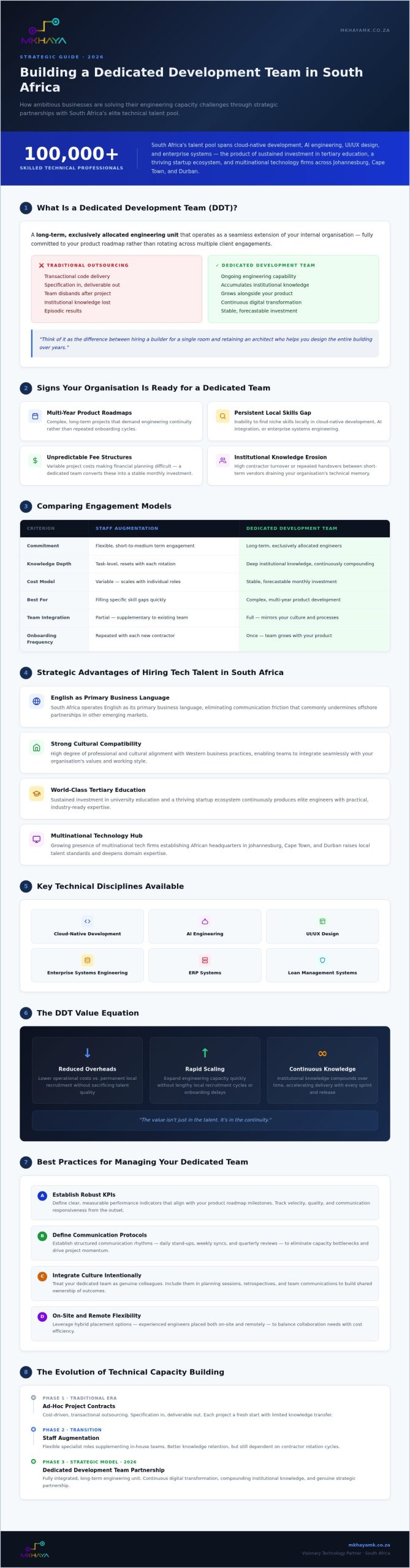
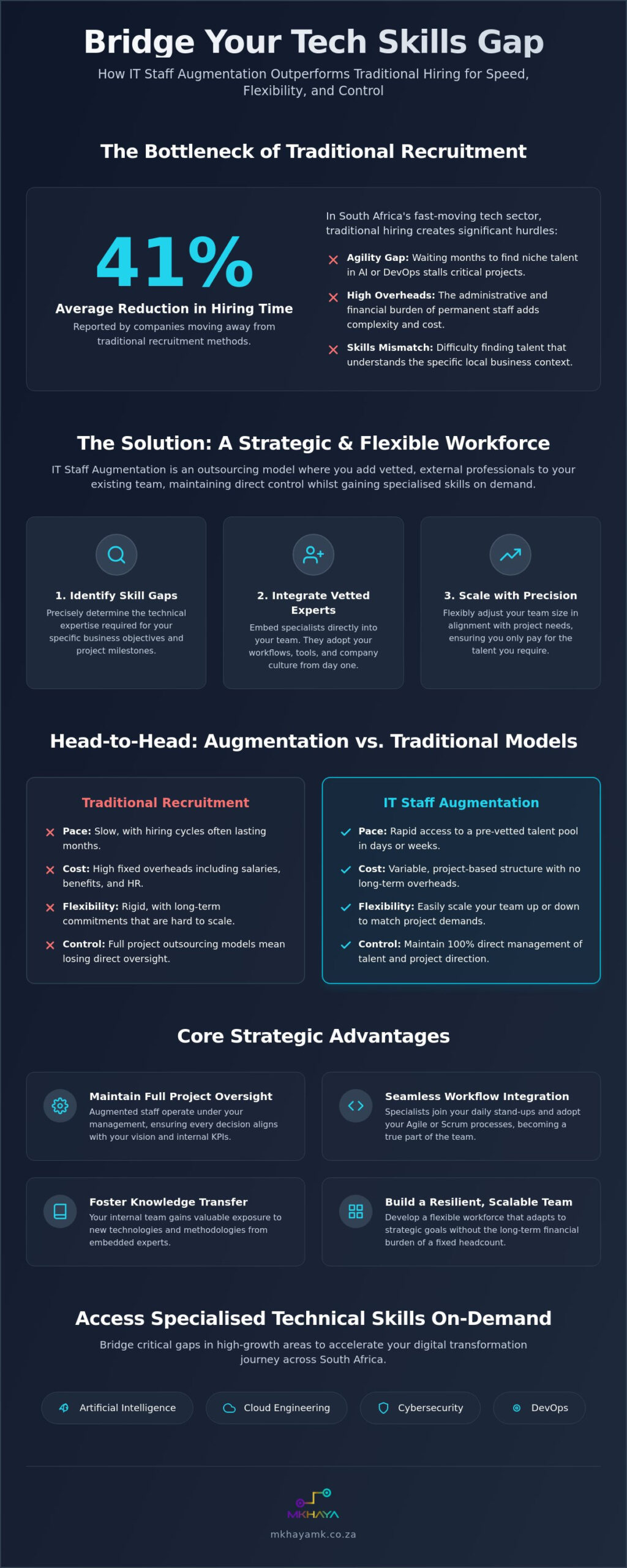
What if the biggest obstacle to your next major product launch isn’t your strategy, your budget, or your market timing — it’s simply not having the right engineers in the room? If you’ve spent months searching for niche technical skills locally, watching recruitment costs climb and project timelines slip, you already know the frustration. Building a dedicated development team in South Africa is increasingly how ambitious businesses are solving this problem, not as a stopgap measure, but as a deliberate strategic move.
You’re right to be cautious. The idea of extending your engineering capacity beyond your immediate geography carries real questions: Will they understand our processes? Will they feel like part of the team? These are fair concerns, and they deserve honest answers rather than polished sales promises.
This guide is built to give you exactly that. You’ll discover how South Africa’s growing pool of elite technical talent, combined with agile engagement models like staff augmentation and custom software partnerships, can help you scale your engineering capacity rapidly whilst reducing the operational overhead that comes with permanent local recruitment. From understanding what a genuine dedicated team partnership looks like to evaluating the right provider, what follows is a practical, step-by-step path forward.
Key Takeaways
Understand the fundamental shift from traditional outsourcing to a strategic partnership model that mirrors your organisational values and long-term vision.
Access a deep reservoir of over 100,000 technical professionals in South Africa who offer world-class English proficiency and a high degree of cultural compatibility.
Compare the nuances of staff augmentation and a dedicated development team south africa to determine which model best supports your specific scaling requirements for 2026.
Master the management of remote engineering teams by establishing robust KPIs and communication protocols that eliminate capacity bottlenecks and drive project momentum.
Explore how integrating specialised products, such as ERP or Loan Management Systems, with a dedicated team can accelerate your digital transformation journey.
What is a Dedicated Development Team and Why Does Your Business Need One?
A Dedicated Development Team (DDT) is a long-term, exclusively allocated engineering unit that operates as a seamless extension of your internal organisation, fully committed to your product roadmap rather than rotating across multiple client engagements. This distinction matters enormously. Unlike a project-based contractor who delivers a defined scope and moves on, a dedicated team accumulates your institutional knowledge, understands your architectural decisions, and grows alongside your product. That depth of context is genuinely difficult to replicate, and it’s precisely what organisations competing on complex digital products need in 2026.
To understand why this model has gained such traction, it helps to consider the broader spectrum of outsourcing engagement models and where the DDT sits within it. Traditional outsourcing prioritised cost reduction through transactional code delivery. The relationship was transactional by design: a specification goes in, a deliverable comes out. The DDT model represents a fundamental departure from that logic. Here, the emphasis shifts from output to ongoing capability, from delivery to continuous engineering partnership.
The Evolution of Technical Capacity Building
South African enterprises have been at the forefront of this shift. The move away from ad-hoc project contracts reflects a hard-won lesson: episodic development creates episodic results. Every time a project team disbands, institutional knowledge walks out with them. A dedicated team embedded in your processes and culture supports continuous digital transformation, not just discrete technology upgrades. Think of it as the difference between hiring a builder for a single room and retaining an architect who helps you design the entire building over years.
Signs Your Organisation is Ready for a Dedicated Team
Not every business needs this model immediately. But certain conditions make the case compelling and, frankly, urgent:
Complex, multi-year product roadmaps that demand engineering continuity rather than repeated onboarding cycles
A persistent local skills gap in specialised disciplines such as cloud-native development, AI integration, or enterprise systems engineering
Unpredictable project fee structures that make financial planning difficult, whereas a dedicated team converts variable costs into a stable, forecastable monthly investment
Institutional knowledge erosion caused by high contractor turnover or repeated handovers between short-term vendors
If any of these resonate, a dedicated development team in South Africa offers a structured path to resolving them. Providers like Mkhaya MK’s staff augmentation service are built precisely for this purpose: placing experienced engineers, both on-site and remotely, who integrate into your team and stay invested in your long-term success.
The value isn’t just in the talent. It’s in the continuity.
The Strategic Advantages of Hiring Tech Talent in South Africa
South Africa’s technology sector has matured considerably over the past decade, producing a national talent pool that numbers well over 100,000 skilled technical professionals across disciplines ranging from cloud-native development and AI engineering to UI/UX design. That depth of supply isn’t incidental. It’s the product of sustained investment in tertiary education, a thriving startup ecosystem, and the growing presence of multinational technology firms establishing African headquarters in cities like Johannesburg, Cape Town, and Durban. For businesses building a dedicated development team in South Africa, this concentration of expertise represents a genuinely significant competitive advantage.
What separates South African talent from comparable pools in other emerging markets, however, isn’t simply volume. It’s the quality of professional alignment that comes with it.
Cultural and Professional Alignment
English is a primary business language in South Africa, and technical professionals operate within it fluently, both in written documentation and real-time collaboration. This eliminates one of the most persistent friction points in remote engineering partnerships: miscommunication at the specification and review stages. South African developers have also grown up within agile-oriented delivery cultures, shaped by exposure to international project frameworks and a strong tradition of client-centric service. The result is a workforce that doesn’t just write clean code; it engages proactively, raises concerns early, and takes genuine ownership of product outcomes.
South Africa’s time zone alignment with European markets (GMT+2) and its natural overlap with the broader African continent makes synchronous collaboration genuinely practical. Daily stand-ups, sprint reviews, and architecture discussions can happen in real working hours for all parties, without the scheduling compromises that partnerships with teams in vastly different time zones typically require.
There’s also a standard of UI/UX design services emerging from South African studios that reflects international benchmarks. Organisations that need their engineering capability to extend into product design and user experience will find that local teams can carry that work with genuine sophistication.
Economic Efficiency Without Quality Compromise
Building an in-house engineering team locally in 2026 carries substantial overhead: recruitment fees, benefits, office infrastructure, and the compounding cost of attrition. Engaging a dedicated team through a managed services model converts those unpredictable variables into a structured, forecastable monthly investment. That shift in cost architecture matters enormously for financial planning and board-level reporting.
Compared to equivalent talent in Western European or North American markets, South African engineers offer a compelling return on investment without the quality trade-offs that sometimes accompany lower-cost alternatives in other regions. Organisations that have made the transition consistently report that they’re not simply saving on headcount; they’re gaining engineers who are invested, communicative, and technically capable at a level that matches or exceeds their previous in-house benchmarks.
If you’re evaluating whether this model fits your current engineering capacity needs, exploring Mkhaya MK’s staff augmentation service is a practical starting point for understanding what a structured, professionally managed talent engagement actually looks like in practice.
Comparing Engagement Models: Dedicated Teams vs Staff Augmentation
Choosing the wrong engagement model is one of the most common and costly mistakes organisations make when scaling their engineering capacity. The two models most frequently considered, staff augmentation and a dedicated development team, are often treated as interchangeable. They aren’t. Each serves a distinct strategic purpose, and understanding that distinction clearly is what separates businesses that scale efficiently from those that cycle through vendors without ever building real momentum.
Staff Augmentation: Tactical Flexibility
Staff augmentation is designed for precision. When your internal team has a specific, time-bound gap, perhaps you’re rolling out a cloud migration and need three senior DevOps engineers for a defined sprint cycle, or you’re integrating AI automation into an existing pipeline and lack that specialist depth in-house, augmentation fills that gap without the overhead of permanent hiring. The professionals slot into your existing structure, follow your processes, and report to your management layer. Speed and specificity are the core advantages.
This model works particularly well when:
You have a functioning internal team that simply needs targeted reinforcement
The skill requirement is specialist and short-to-medium term in nature
Your project scope is well-defined and unlikely to evolve significantly
You want to maintain full direct management control over day-to-day delivery
Mkhaya MK’s staff augmentation service operates across both on-site and remote placements nationally, giving organisations the flexibility to bring in experienced professionals precisely where and when the work demands it, without the structural commitments that come with permanent headcount.
Dedicated Teams: Strategic Stability
A dedicated development team in South Africa operates at a fundamentally different level of engagement. Rather than supplementing your team, it becomes your team, or a fully integrated extension of it, carrying end-to-end ownership of your product roadmap over an extended horizon. The team accumulates your institutional knowledge, understands your architectural decisions, and grows in capability alongside your product. That depth of context compounds in value over time in a way that rotating augmented contractors simply cannot replicate.
The dedicated model also includes full management and operational oversight within the service structure. You’re not just accessing talent; you’re accessing a managed engineering capability. For organisations undergoing genuine digital transformation, that distinction matters enormously. Mkhaya MK’s software engineering services are structured precisely around this principle: continuous, committed delivery rather than episodic project engagements.
The Hybrid Approach: When Both Models Work Together
Sophisticated organisations increasingly combine both models to match their engineering capacity to the shape of their work. A dedicated core team handles long-term product ownership and architectural continuity, whilst augmented specialists are brought in to accelerate specific initiatives or cover temporary skill requirements. This hybrid structure offers the best of both worlds: strategic stability at the centre, tactical flexibility at the edges. If your roadmap includes both sustained product development and periodic specialist demands, it’s worth evaluating how a blended engagement could serve your objectives more precisely than either model alone.
Best Practices for Managing Your Dedicated Development Team
Having the right engineers is only half the equation. How you manage them determines whether that investment compounds or stagnates. The organisations that extract the most value from a dedicated development team in South Africa share a common discipline: they treat management as an active, ongoing commitment rather than an administrative function that runs itself once the contracts are signed.
Start with clarity. Before your first sprint begins, establish the KPIs and performance metrics that will define success for both sides. These shouldn’t be generic productivity proxies. Meaningful metrics for a dedicated engineering team typically include:
Sprint velocity and consistency across delivery cycles, not just individual output
Defect resolution rates and the time taken to close issues raised in QA
Code review turnaround as a measure of team responsiveness and collaborative discipline
Milestone adherence relative to the agreed product roadmap
Defining these from day one sets expectations without ambiguity and gives your team a shared framework for self-assessment. It also removes the subjectivity that tends to erode trust in remote partnerships over time.
Communication and Agile Integration
Rhythm matters more than volume. A well-structured communication cadence, built around daily stand-ups, sprint planning sessions, and fortnightly retrospectives, creates the operational heartbeat that keeps distributed teams aligned. Tools like Jira, Slack, and Microsoft Teams provide the infrastructure, but the discipline of using them consistently is what actually builds transparency. Asynchronous updates should be encouraged for routine progress, whilst synchronous sessions are reserved for decisions, blockers, and strategic alignment. When remote and on-site engineers share the same communication norms, the psychological distance between them shrinks considerably. Belonging isn’t built through team-building exercises; it’s built through consistent inclusion in the conversations that matter.
Governance and Quality Assurance
Robust QA processes shouldn’t be bolted on at the end of a sprint; they should be woven into the team’s daily workflow from the outset. Peer code reviews, automated testing pipelines, and structured documentation practices are the foundations of a team that delivers with confidence rather than urgency. Knowledge transfer, in particular, deserves deliberate attention: every architectural decision, integration rationale, and process evolution should be captured in living documentation that the team actively maintains. Quiet confidence in technical leadership means that your team raises concerns early, documents thoroughly, and never mistakes speed for quality. That disposition, more than any single tool or process, is what sustains delivery excellence over the long term.
If you’re ready to build an engineering partnership structured around these principles from the ground up, explore how Mkhaya MK’s software engineering services are designed to deliver exactly that kind of committed, accountable capability.
Scaling with Mkhaya MK: Your Visionary Technology Partner
There’s a meaningful difference between a vendor who delivers code and a partner who takes genuine ownership of your digital trajectory. Mkhaya MK is built around the latter. From the earliest stages of strategic consulting through to expert execution and long-term product stewardship, the engagement is designed to move with your business rather than ahead of it or behind it. That coherence across the full delivery lifecycle is what distinguishes a true dedicated development team in South Africa from a collection of contractors assembled under a single invoice.
Central to this approach is the integration of dedicated engineering teams with Mkhaya MK’s own specialised product suite. When your team is building on or alongside platforms like the Loan Management System, they’re not starting from a blank canvas. They’re working within a structured, proven framework that accelerates delivery timelines and reduces the architectural risk that comes with bespoke builds from the ground up. That combination of dedicated human capability and proprietary product depth is something global agencies simply don’t offer.
AI-driven automation and cloud solutions sit at the operational core of how Mkhaya MK teams work. Whether it’s streamlining data pipelines, orchestrating cloud infrastructure, or embedding intelligent automation into existing workflows, the technical capability is matched to the business outcome rather than applied generically. Operational excellence isn’t a promise; it’s the structural result of pairing the right engineers with the right tooling from day one.
A Holistic Approach to Custom Software
Engineering alone doesn’t transform a business. Mkhaya MK’s teams extend across UI/UX design, DevOps, and strategic consulting, ensuring that every layer of your digital product receives the same standard of deliberate, expert attention. Dedicated teams actively support ERP solutions and Learner Management implementations, bringing continuity across complex, multi-system environments. For a deeper exploration of how this philosophy applies to bespoke builds, the Custom Software Development in South Africa: A Strategic Guide for 2026 offers a comprehensive companion perspective.
Starting Your Journey with Mkhaya MK
Every engagement begins with a structured consultation focused on understanding your specific technical landscape, growth objectives, and the gaps your current capacity can’t close. From that foundation, the team structure is tailored precisely: the right disciplines, the right seniority mix, the right balance of on-site and remote presence. Nothing is templated. Everything is calibrated to your goals.
The case for building a dedicated development team in South Africa isn’t theoretical. It’s built on a convergence of real advantages: access to a deep, English-proficient talent pool, engagement models that convert unpredictable hiring costs into stable investment, and a partnership approach that compounds in value the longer it runs.
Three things are worth carrying forward from this guide. First, the model you choose matters as much as the talent you access. Second, management discipline determines whether that talent delivers its full potential. Third, the right partner brings more than engineers; they bring proven capability in AI and data automation, national coverage for both on-site and remote placements, and a track record across complex systems like custom ERP and Loan Management implementations.
That’s precisely what Mkhaya MK is built to offer. The starting point is a structured conversation about where your engineering capacity stands today and where your roadmap needs it to be.
What is the difference between a dedicated development team and staff augmentation?
A dedicated development team is a fully allocated, long-term engineering unit that takes end-to-end ownership of your product roadmap and operates as a permanent extension of your organisation. Staff augmentation, by contrast, places specialist professionals into your existing team structure to fill a specific, time-bound skill gap. The core distinction is depth of commitment: augmentation offers tactical flexibility, whilst a dedicated team builds compounding institutional knowledge over time.
Your choice between the two depends on your engineering horizon. If you’re reinforcing a functioning team for a defined sprint, augmentation is the sharper tool. If you’re building continuous product capability across multiple years, a dedicated team delivers the structural stability that rotating contractors simply can’t match.
How much does it cost to hire a dedicated development team in South Africa?
Pricing for a dedicated development team in South Africa varies considerably based on team size, seniority mix, technical disciplines required, and whether placements are on-site or remote. Rather than quoting figures that may not reflect your specific configuration, we’d recommend speaking directly with a provider to receive a structured proposal based on your actual requirements. What’s consistent across engagements is that the model converts unpredictable recruitment and contractor costs into a stable, forecastable monthly investment.
South African engineering talent generally offers a compelling return on investment relative to equivalent expertise in Western European or North American markets, without the quality trade-offs sometimes associated with lower-cost alternatives in other regions. Verify current salary benchmarks with your provider before finalising any budget assumptions for 2026.
How do I ensure data security when working with a remote dedicated team?
Data security in a remote engagement is governed by the protocols you establish at the outset, not by geography. Robust arrangements typically include signed NDAs and data processing agreements, role-based access controls that limit exposure to sensitive systems, encrypted communication channels, and regular security audits. Your provider should be able to articulate their security posture clearly and adapt to your organisation’s specific compliance requirements before work begins.
It’s also worth establishing clear policies around code repository access, device management, and incident response procedures. A reputable dedicated team partner will treat these governance requirements as standard practice rather than optional add-ons, so don’t hesitate to raise them during your initial consultation.
Can a dedicated team work with my existing internal developers?
Yes, and this is one of the model’s genuine strengths. A well-integrated dedicated team slots into your existing engineering culture, adopts your preferred tools and workflows, and collaborates directly with your internal developers through shared sprint cycles, code reviews, and daily stand-ups. The goal isn’t to replace your existing capacity but to extend it with complementary skills and additional bandwidth.
Successful integration depends on establishing clear ownership boundaries from the start. Define which workstreams the dedicated team leads, where they support your internal engineers, and how decisions escalate. That clarity prevents duplication and keeps both groups moving in the same direction without friction.
How long does it take to set up a dedicated development team?
Setup timelines vary depending on the complexity of the engagement, the seniority levels required, and the specificity of the technical disciplines involved. A structured provider will typically begin with a discovery consultation to map your requirements, followed by candidate selection and a formal onboarding process. For straightforward configurations, initial team members can often be operational within a few weeks; more specialised or senior configurations naturally take longer to assemble with the right fit.
Rushing the setup phase to meet an arbitrary start date is rarely worthwhile. The onboarding investment, including aligning the team on your architecture, processes, and communication norms, pays dividends throughout the engagement. A deliberate start builds a far stronger foundation than a hasty one.
What technical stacks are available through South African dedicated teams?
South Africa’s developer community covers a broad range of modern technical stacks, including cloud-native development across AWS, Azure, and Google Cloud; backend languages such as Python, Node.js, Java, and .NET; frontend frameworks including React, Angular, and Vue.js; mobile development for iOS and Android; and disciplines like DevOps, AI and data engineering, and enterprise systems integration. The depth of available expertise reflects the maturity of the local technology sector.
When engaging a provider like Mkhaya MK, your dedicated team can also be configured to work directly with proprietary platforms such as ERP solutions, the Loan Management System, or the Optimate Procurement Platform, combining external engineering talent with proven internal product frameworks to accelerate delivery.
How do I manage a dedicated team across different locations in South Africa?
Managing a geographically distributed team within South Africa follows the same principles as any well-run remote engineering operation: consistent communication rhythms, shared project management tooling, and clearly defined accountability structures. Daily stand-ups, sprint planning sessions, and regular retrospectives create the operational cadence that keeps distributed contributors aligned regardless of whether they’re based in Johannesburg, Cape Town, or Durban.
Mkhaya MK’s staff augmentation and dedicated team services are structured to support both on-site and remote placements nationally, which means the operational framework for managing distributed talent is built into the engagement model rather than left for you to figure out independently. Lean on your provider’s experience here; they’ll have established norms that work.
Why is South Africa a top destination for software development in 2026?
South Africa combines several advantages that are genuinely difficult to find in a single market: a talent pool of over 100,000 skilled technical professionals, English as a primary business language, strong cultural alignment with European and African client organisations, and a time zone (GMT+2) that enables synchronous collaboration without the scheduling compromises that distant offshore partnerships require. The country’s growing startup ecosystem and the presence of multinational technology firms have further raised the standard of professional practice across the sector.
For businesses building a dedicated development team in South Africa specifically, the combination of technical depth, communication fluency, and economic efficiency makes the market a strategically sound choice in 2026 and beyond. It’s not simply a cost play; it’s access to a maturing engineering culture that takes product ownership seriously.
Did you know that 65% of South African employees would sacrifice a 10% pay increase just for the chance to upskill in digital competencies? This striking statistic highlights a fundamental shift in our local workforce. Your team values growth and stability above all else. You likely understand the frustration of losing skilled staff in technical sectors, especially when fragmented data makes it nearly impossible to track B-BBEE compliance whilst maintaining operational flow. Implementing a robust talent management system south africa is no longer just an HR requirement; it’s a vital step toward securing your business’s future.
Discover how to optimise your workforce and ensure compliance with a system tailored for our unique market. By centralising the employee lifecycle, you can turn complex reporting into a seamless part of your daily operations. Precision in execution. Stability in growth. This guide provides a clear path toward implementing scalable technology that grows alongside your business. We will examine the 2026 SDL grant reforms, the impact of AI on productivity, and the specific steps needed to create a robust, POPIA-compliant digital ecosystem that supports your long-term vision.
Key Takeaways
Understand the transition from administrative HR to strategic human capital management to better strengthen your response to technical sector challenges.
Identify the core modules of a high-impact talent management system South Africa that integrates end-to-end recruitment with real-time performance tracking.
Evaluate why custom software development often provides a more stable foundation for unique business logic than generic off-the-shelf SaaS platforms.
Automate the tracking of B-BBEE skills development spend and generate mandatory Workplace Skills Plans (WSP) for seamless compliance.
Leverage AI and data automation to predict employee churn whilst using robotic process automation to eliminate repetitive HR tasks.
The Evolution of Talent Management Systems in South Africa
The local business environment has undergone a massive shift. In 2026, the focus has moved from simple payroll and leave management to high-level strategic human capital management. This evolution is driven by the need for precision. A modern Talent Management System is no longer an optional luxury for South African firms; it’s a foundational requirement for staying competitive. It’s about survival. The spreadsheets of yesterday can’t handle the complexities of tomorrow. Relying on fragmented data leads to missed opportunities and costly turnover.
South African businesses face a unique set of pressures. We deal with high staff turnover in technical sectors and rigorous compliance requirements that don’t exist elsewhere. A centralised talent management system south africa allows leaders to see the full picture. It moves beyond basic administration. It enables you to predict needs rather than just reacting to vacancies. This strategic shift ensures that your most valuable asset, your people, are aligned with your long-term goals.
To better understand the strategic importance of this transition, watch this helpful video:
Addressing the South African Skills Gap
The divide between available talent and industry requirements remains a significant hurdle. Research from July 2026 shows that 53% of South African employees worry their skills will become irrelevant due to AI. Technology doesn’t just create this gap; it bridges it. By using a specialised talent management system south africa, you can identify specific skill shortages within your teams before they become critical. While some academic reports suggest that South Africa ranks low in labour market efficiency, we believe that modern digital tools are the specific solution to these efficiency gaps. Software provides the visibility needed to turn potential into performance. Continuous learning is the new standard. Many local enterprises now prioritise internal mobility. It’s often more effective to upskill a loyal employee than to find a perfect external match. This approach builds a culture of growth and stability.
Digital Maturity in Local Human Resources
Assessing your current HR tech stack is the first step toward long-term success. Many legacy platforms are too rigid to handle the pace of change we see in 2026. A truly scalable solution must integrate with your existing workflows whilst providing room for future growth. Cloud-based systems have changed national business operations by allowing real-time data access across different provinces. This connectivity is essential for national compliance, especially with the Information Regulator’s intensified enforcement of POPIA as of March 2026. We view digital transformation as the bedrock of modern HR. It’s the stable anchor that allows your business to remain agile. The 2026 SDL reform, which doubled the mandatory employer grant to 40% for those submitting Workplace Skills Plans, makes having an integrated system a financial necessity as well as a strategic one.
Core Features of a High-Impact Talent Management Solution
A high-impact solution doesn’t just manage people; it empowers them. To thrive in 2026, your talent management system south africa must integrate several core modules into a single, cohesive ecosystem. This integration eliminates the data silos that often lead to poor decision-making. We’ve seen how 83% of South African employees report higher productivity when using AI tools. Your system should leverage this by providing automated workflows that handle the heavy lifting of administration, allowing your HR team to focus on high-level strategy.
Succession planning and leadership development are equally critical. You need to identify your future leaders today, not when a vacancy suddenly appears. By tracking skills acquisition and performance in real-time, you create a stable pipeline of talent ready to step up. This foresight is essential when navigating South Africa’s evolving talent landscape, where the competition for specialised skills is fiercer than ever. Data-driven analytics provide the clarity needed to understand which initiatives are working and which need refinement.
Automated Onboarding and Recruitment
Reducing time-to-hire is a primary goal for any growing business. AI-driven candidate screening allows you to filter through hundreds of applications with precision, ensuring that only the best-fit talent reaches the interview stage. Once hired, the onboarding process must be flawless. A seamless first-day experience significantly improves long-term retention. We prioritise UI/UX design services to ensure that your employees find the platform intuitive and engaging from the very first login. This reduces friction and helps new hires feel like part of the team immediately.
Learning and Development (L&D) Integration
The synergy between your talent platform and a Learner Management System is where true growth happens. With 65% of local workers willing to trade a pay rise for upskilling opportunities, providing clear career paths is a powerful retention tool. Your system should track certifications and skills acquisition automatically. This isn’t just for employee morale; it’s vital for national compliance. With the 2026 SDL reforms increasing mandatory grants to 40% for compliant employers, your ability to document and report on training is a direct financial benefit. Creating personalised learning paths ensures that your workforce remains agile and ready for the technological shifts ahead. If you’re looking to build a more resilient team, exploring our custom software development options can help you create a system that fits your exact operational needs.
Bespoke vs Off-the-Shelf: Choosing the Right Architecture
Selecting the right architecture for your talent management system south africa is a critical junction in your digital journey. Whilst generic SaaS platforms offer quick deployment, they often lack the flexibility required to handle the unique nuances of the South African regulatory environment. You’ve likely seen lists of hundreds of software options, but choice without a strategic framework usually leads to frustration. These off-the-shelf products are built for a global average, not the specific compliance and reporting needs of a local enterprise.
Opting for custom software development allows you to build a system that mirrors your exact business logic. Beyond the technical fit, there’s the question of long-term stability. Subscription models can feel like a “death by a thousand cuts” as per-user licensing fees climb alongside your headcount. Investing in a bespoke solution means you own your data and your intellectual property. This ownership provides a stable anchor, ensuring your technology remains a permanent asset rather than a monthly liability.
When to Choose a Custom-Built System
A custom-built talent management system south africa becomes essential when your organisational structure doesn’t fit into a standard box. Many South African firms operate with complex hierarchies or need to integrate with niche legacy ERP systems that global SaaS providers simply don’t support. If your employer brand is a key differentiator, a tailored user interface ensures that every interaction reflects your company’s values. It’s about precision. You shouldn’t have to change your successful business processes to fit the limitations of a software vendor’s template.
The Hybrid Approach: Customising ERP Modules
For businesses that already have a strong foundation, a hybrid approach often provides the best of both worlds. By leveraging existing ERP solutions to house your talent data, you ensure a single source of truth across the entire enterprise. We focus on building custom connectors that bridge the gap between your core financial tools and modern HR capabilities. This ensures a seamless data flow, allowing for more accurate reporting and a clearer view of your workforce’s impact on the bottom line. This methodical execution turns fragmented tools into a unified, high-performance engine.
Compliance and Reporting in the South African Context
Compliance is the backbone of operational integrity for local enterprises. In 2026, the regulatory landscape has become significantly more rigorous, requiring a level of precision that manual systems simply cannot provide. A dedicated talent management system south africa turns what used to be a month-long administrative headache into a streamlined, push-button reporting process. It’s about moving from a state of constant audit-anxiety to one of quiet confidence. By centralising your data, you ensure that every decision is backed by verifiable records, protecting your business from both financial penalties and reputational risk.
Tracking Employment Equity (EE) targets is a prime example of where digital automation excels. Real-time dashboards allow you to monitor your progress against national benchmarks throughout the year, rather than scrambling for data at the last minute. This visibility ensures you can make proactive adjustments to your hiring and development strategies. When your reporting is integrated directly into your employee lifecycle, compliance becomes a natural byproduct of your daily operations rather than a separate, burdensome task.
B-BBEE and Skills Development Levies
The 2026 reform to the Skills Development Levy (SDL) has changed the financial stakes for South African employers. With the mandatory grant increasing from 20% to 40% for those who successfully submit their Workplace Skills Plans (WSP) and Annual Training Reports (ATR), the ROI of an integrated system is undeniable. Your talent management system south africa should map every training intervention directly to B-BBEE scorecard requirements, ensuring that no spend goes uncounted. Automated tracking ensures that every Rand spent on training is verifiable and correctly categorised, providing an airtight audit trail for B-BBEE verification agencies. This level of detail simplifies the submission process for SETA grants, ensuring you recover the maximum possible levy amount to reinvest in your team’s growth.
Data Privacy and POPIA Compliance
Data security is no longer just a technical concern; it’s a legal imperative. As of March 2026, the Information Regulator has adopted a much more assertive enforcement-driven approach to POPIA. Securing sensitive employee records within a robust cloud solution is the most effective way to manage this risk. A tailored system allows you to define granular access rights, ensuring that HR personnel only see the data they need to perform their roles. We prioritise local data hosting where possible to provide regulatory peace of mind and ensure compliance with cross-border data transfer rules. Managing consent and data access rights shouldn’t be a manual chore. A well-designed platform handles these permissions automatically, creating a stable and secure environment for your workforce data. If you’re ready to secure your business’s compliance future, speak to our team today about building a tailored reporting engine.
Future-Proofing Talent Management with AI and Automation
While compliance provides the necessary foundation for your operations, the true value of a modern talent management system south africa lies in its ability to look forward. We’ve moved into an era where data doesn’t just record the past; it shapes the future. By integrating AI and data automation into your HR ecosystem, you gain the ability to predict employee churn before it happens. This foresight allows you to intervene with targeted retention strategies, protecting your investment in high-value talent. It’s a shift from reactive firefighting to proactive leadership.
Robotic Process Automation (RPA) acts as a silent partner for your HR team. It handles the repetitive, high-volume administration tasks that often lead to burnout and human error. From synchronising data across legacy systems to managing complex leave calculations, RPA ensures that your team focuses on what truly matters: human connection and strategic growth. Research shows that 61% of employees believe AI will improve the quality of people-related decisions. This confidence from the workforce suggests that your team is ready for a more intelligent approach to management. We facilitate this journey by ensuring your transition from legacy platforms is methodical, stable, and aligned with your long-term vision.
Predictive Talent Analytics
Predictive analytics allow you to identify high-potential employees by recognising patterns in performance and engagement data that might otherwise go unnoticed. This isn’t about surveillance; it’s about support. By forecasting future hiring needs based on your business growth projections, you can begin building talent pipelines months before a vacancy arises. AI also plays a crucial role in eliminating unconscious bias during recruitment and promotion cycles. By focusing on objective data points and skills-based assessments, you create a fairer, more inclusive workplace that naturally attracts the best talent in the country. It’s about building a team based on precision and potential.
Getting Started: Your Implementation Roadmap
A successful national rollout begins with clarity. You must first define your strategic objectives and the specific key performance indicators you wish to move. Whether your priority is reducing technical staff turnover or improving B-BBEE reporting accuracy, your roadmap should be tailored to those goals. Selecting the right technology partner is the final, most critical step. You need a guide that understands the South African context whilst possessing the technical expertise to build scalable, AI-driven solutions. At Mkhaya MK, we pride ourselves on being that stable anchor in a rapidly changing technological landscape. We invite you to contact our experts to begin your digital transformation and build a workforce that is ready for 2026 and beyond.
Securing Your Competitive Edge for 2026
The transition toward a high-performing workforce requires a fundamental shift from administrative oversight to visionary strategy. You’ve seen how a tailored talent management system south africa transforms complex B-BBEE reporting and POPIA requirements into seamless, automated workflows. This digital maturity doesn’t just ensure compliance; it fosters a culture of long-term stability. By leveraging AI and predictive analytics, your leadership can anticipate talent needs and nurture employee potential long before gaps emerge. It’s about building a resilient organisation that thrives on precision rather than reaction.
We pride ourselves on being specialists in South African digital transformation. With proven expertise in Learner and ERP systems, we provide the technical depth needed for comprehensive AI and cloud integration. We’re here to act as your stable anchor in a rapidly changing technological landscape, ensuring your technology grows as you do. Contact Mkhaya MK to build your bespoke talent management system and begin your journey toward operational excellence. Your team’s future is a shared mission, and we’re ready to help you lead the way with confidence.
Frequently Asked Questions
What is a talent management system and why does my South African business need one?
A talent management system is a centralised suite of digital tools designed to manage the entire employee lifecycle, from recruitment to succession planning. Local businesses need these systems to navigate unique challenges such as high staff turnover in technical sectors and complex national compliance requirements. It moves your HR operations from reactive administration to proactive human capital strategy, ensuring your workforce remains stable and productive.
How much does a talent management system cost in South Africa?
The cost of a system depends on your chosen architecture and the scale of your workforce. Subscription-based SaaS platforms typically charge a monthly fee per user, which can increase as your team grows. Alternatively, investing in a custom-built solution involves an initial development cost but offers long-term financial stability by eliminating recurring licensing fees and providing total ownership of your intellectual property.
Can a talent management system help with B-BBEE compliance?
Yes, a robust talent management system south africa is essential for automating the tracking of skills development spend. It allows you to map training interventions directly to B-BBEE scorecard requirements. This precision ensures that you can generate accurate Workplace Skills Plans (WSP) and Annual Training Reports (ATR), which are vital for securing SETA grants and maximising your mandatory grant returns under the 2026 SDL reforms.
Is bespoke software better than off-the-shelf talent management tools?
Bespoke software is often the superior choice for enterprises with unique business logic or complex organisational structures. Whilst off-the-shelf tools offer quick deployment, they frequently lack the flexibility to handle niche South African regulatory needs. Custom development ensures the platform mirrors your specific workflows, provides better integration with legacy systems, and gives you full control over your data security and user experience.
How does POPIA affect the storage of employee data in a TMS?
POPIA mandates that all personal employee information is processed lawfully and stored securely. Your system must include features like granular access permissions, automated consent management, and secure data hosting to meet the Information Regulator’s 2026 enforcement standards. Using a compliant platform ensures that sensitive records remain protected, reducing the risk of legal penalties and maintaining the trust of your workforce.
Can I integrate my existing payroll software with a new talent management system?
Integration is not only possible but highly recommended to ensure data consistency across your business. Most modern systems use custom connectors or APIs to bridge the gap between payroll, ERP, and talent modules. This connectivity allows for a seamless flow of information, reducing manual data entry and providing a more accurate view of your total human capital investment.
What is the difference between an HRIS and a talent management system?
An HRIS primarily handles core administrative tasks like payroll, leave management, and basic employee records. A talent management system south africa focuses on the strategic side of HR, including recruitment, performance tracking, and leadership development. Whilst an HRIS manages the day-to-day “mechanics” of employment, a talent system focuses on the long-term growth and optimisation of your people.
How long does it take to implement a custom talent management solution?
Implementation timelines vary based on the specific complexity of your requirements and the state of your current data. A methodical rollout usually begins with a thorough discovery phase to define your strategic goals, followed by development and rigorous testing. This structured approach ensures that the final system is stable, reliable, and ready to support your national operations from day one.
Did you know that inefficient contract management can cost your business up to 9% of its annual turnover? In the complex South African market of 2026, relying on manual spreadsheets and fragmented emails isn’t just a nuisance; it’s a significant financial risk. Implementing a dedicated contract management system south africa has become essential for navigating the 2026 clarifications on POPIA and the evolving Public Procurement Act regulations. You’re likely familiar with the stress of a missed renewal date or the frustration of finding inconsistent contract versions across different departments.
We believe that your legal and operational workflows should support your growth, not hinder it. This guide will show you how to transform these operational hurdles into a competitive advantage through tailored digital transformation. We’ll explore how a centralised digital repository and automated alerts can safeguard your compliance whilst ensuring your workflows integrate seamlessly with your existing ERP and finance tools. It’s time to move toward a future of precision and long-term stability as we walk through the steps to modernise your contract lifecycle.
Key Takeaways
Understand how a modern contract management system south africa acts as a strategic engine to prevent the costly errors and value leakage associated with manual procurement.
Discover how AI-driven analytics and automated templates can streamline your approval processes whilst maintaining strict legal consistency across all departments.
Learn to evaluate the total cost of ownership to determine when a bespoke software engineering approach offers better long-term stability than off-the-shelf tools.
Navigate the latest complexities of POPIA and data sovereignty to ensure your digital repository remains fully compliant with the 2026 South African regulatory landscape.
Explore how to bridge internal technical gaps and accelerate your digital transformation by leveraging specialised staff augmentation during system implementation.
Why Your South African Business Needs a Contract Management System in 2026
A modern contract management system south africa is far more than a digital filing cabinet. It’s a strategic business engine designed to drive efficiency and precision across your entire operation. In a market where agility is a competitive necessity, your contracts should be viewed as active assets that dictate the health of your commercial relationships. When these documents are buried in physical folders or scattered across local hard drives, they become liabilities rather than tools for growth.
Relying on spreadsheets often leads to what industry experts call value leakage. Research from WorldCC indicates that inefficient processes can result in a loss of up to 9% of a business’s annual turnover. For South African procurement teams, these manual errors translate into missed rebates, unoptimised supplier terms, and heightened risk. By transitioning from a reactive stance to proactive contract lifecycle management, you empower your organisation to anticipate shifts rather than merely responding to them. This shift frees up your legal and finance resources to focus on high-value strategy whilst automation handles the repetitive administrative tasks.
To better understand how these systems function within a professional environment, watch this helpful overview:
The Hidden Risks of Manual Contract Oversight
Manual oversight often hides significant dangers that can quietly erode your profit margins. Missing an auto-renewal deadline can trap your business in unfavourable terms for another year, directly impacting your cash flow and budget flexibility. In multi-departmental organisations, version control becomes a nightmare when different teams work from outdated templates, leading to inconsistent legal protections. If your business undergoes corporate restructuring, the difficulty of auditing manual contracts can stall progress and create significant legal uncertainty during due diligence.
The Strategic Advantage of Digital Transformation
The true value lies in a broader digital transformation that centralises your data into a single source of truth. When your information is organised and accessible, your negotiation power with suppliers increases because you have clear visibility into total spend and performance metrics. This level of internal transparency fosters a culture of accountability across the business. By adhering to core contract management principles through a digital lens, you ensure that every agreement aligns with your long-term stability and growth objectives. Choosing a partner for bespoke software engineering allows you to build a system that reflects your unique operational DNA rather than settling for a generic, off-the-shelf solution.
Core Features of an Effective Contract Management System
An effective contract management system south africa must do more than simply store documents. It should act as a dynamic hub that facilitates every stage of the agreement process, from the first draft to the final signature and beyond. Consistency is the foundation of legal safety. By utilising automated drafting and template libraries, your legal team can ensure that every agreement adheres to pre-approved language, which significantly reduces the time spent on manual reviews. This level of standardisation prevents departments from inadvertently introducing risk through non-standard clauses.
A robust system must also bridge the gap between different departments. Rather than existing in a vacuum, it should offer deep integration with your existing ERP solutions. This connectivity allows for the automatic synchronisation of vendor data and financial obligations, highlighting the strategic benefits of a CMS that communicates with the rest of your enterprise software stack. For South African firms operating with hybrid or remote teams, cloud-based accessibility ensures that authorised personnel can review and approve documents from any location without compromising security.
AI and Automation in Contract Lifecycle Management
Modern systems leverage AI and data automation to transform how teams interact with their archives. Instead of manual data entry, these tools can instantly extract key terms, indemnity clauses, and renewal dates from legacy documents. Automated workflows then route these contracts to the correct signatories whilst maintaining a transparent audit trail. Smart notifications keep your team informed of upcoming milestones and obligations, ensuring that no deadline ever goes unnoticed. If you’re ready to move away from fragmented processes, our team can help you design a bespoke software solution tailored to these exact requirements.
The Role of User Experience in System Adoption
Technical capability means little if your team finds the software difficult to use. This is why high-quality UI/UX design is a non-negotiable feature for successful adoption. A mobile-first interface allows executives to provide approvals on the move, preventing bottlenecks in the procurement cycle. Customisable dashboards provide a real-time view of contract health, displaying pending actions and risk profiles in an accessible format. When the interface feels intuitive, employee buy-in increases, leading to more consistent data entry and more reliable reporting across the entire organisation.
Custom vs. Off-the-Shelf: Choosing the Right Fit for South Africa
Building on the core features discussed earlier, choosing the right architecture for your contract management system south africa requires a careful balance between immediate needs and long-term stability. Many enterprises face a fork in the road: do they invest in a pre-built global platform or commission a bespoke solution? Whilst off-the-shelf software promises rapid deployment, it often brings hidden complexities that can inflate the total cost of ownership (TCO) over time.
When evaluating TCO, you should consider:
Initial implementation and customisation fees.
Ongoing per-user subscription costs that scale with your headcount.
Internal training and change management resources required for adoption.
The potential cost of downtime during complex integrations.
The Case for Bespoke Software Engineering
A software engineering approach allows you to build a system that mirrors your exact internal approval hierarchies. In South Africa, where procurement often involves complex multi-level sign-offs, a tailored workflow is invaluable. Commissioning a custom build also means you own the intellectual property; this eliminates the burden of per-user monthly licensing fees as your organisation grows. Additionally, custom systems can be designed to interface directly with niche local legacy systems that global SaaS providers might not support.
Evaluating Off-the-Shelf Solutions
Pre-packaged solutions are often the primary choice when speed of deployment is the main driver. If your business needs a basic digital repository within weeks, a global platform might suffice. However, these tools frequently suffer from feature bloat, where you pay for complex modules that your team will never use. There is also the risk of vendor lock-in with international providers. If their pricing structures change or their local support diminishes, migrating your data can become a costly and technically exhausting ordeal.
Scalability should be at the heart of your decision. Your system must be capable of growing alongside your national ambitions without requiring a complete overhaul every few years. A custom-built contract management system south africa provides the flexibility to add new modules, such as automated compliance tracking for the Public Procurement Act, as regulations evolve. By prioritising a solution that adapts to your unique journey, you ensure that your technology remains a stable anchor in a rapidly changing market.
Navigating Compliance: POPIA and Legal Standards in South Africa
Integrating a contract management system south africa isn’t just an exercise in operational efficiency; it’s a critical component of your legal survival strategy. As of April 2026, the Information Regulator has clarified that the Protection of Personal Information Act (POPIA) remains a mandatory standalone requirement, even alongside new anti-spam rules in the Consumer Protection Act. This means every contract containing personal data, from employee agreements to vendor terms, must be managed with absolute precision. Where your data lives matters more than ever. Whilst global SaaS providers often host data in the US or Europe, local data sovereignty ensures your records remain within South African jurisdiction, significantly simplifying your compliance reporting.
Beyond data residency, the legal validity of your agreements hinges on your adherence to the Electronic Communications and Transactions (ECT) Act. Digital signatures are the standard for 2026, but a system must do more than just facilitate a “click to sign.” It must maintain a tamper-proof audit trail that logs every view, edit, and signature. This level of transparency provides undeniable proof during regulatory inspections or internal audits, protecting your business from the “he-said-she-said” nature of manual disputes. By building these protections into your digital foundation, you transform compliance from a burden into a mark of professional integrity.
Securing Sensitive Contract Data
Internal threats often pose as much risk as external ones. Implementing role-based access controls ensures that sensitive financial terms or personal data are only visible to authorised personnel. Encryption is non-negotiable; your contracts must be protected whilst in transit and at rest. Regular security audits, supported by robust cloud solutions, provide the necessary layers of defence to prevent data breaches. These systems allow you to detect anomalies early, ensuring that your most valuable intellectual property remains secure within a fortified digital environment.
POPIA Compliance Checklist for Contract Systems
Your system should be designed with the following South African legal requirements in mind:
Data minimisation: Ensure your contract records only capture and store the personal information strictly necessary for the agreement’s purpose.
Right to erasure: Your digital archive must support the “right to be forgotten,” allowing for the secure deletion of records once legal retention periods expire.
Breach reporting: In the event of a security compromise, your system must facilitate the rapid identification of affected parties to meet mandatory reporting deadlines.
Transitioning from manual chaos to automated precision is a significant journey for any organisation. It requires more than just software; it demands a partner who understands the local nuances of doing business in our specific regulatory environment. At Mkhaya MK, we view the implementation of a contract management system south africa as a collaborative endeavour rooted in mutual success. Our goal is to build a foundation of long-term stability that allows your team to focus on strategic growth rather than administrative firefighting. By choosing a local partner, you ensure that your system is built with an intimate knowledge of South African labour laws and procurement standards.
We pride ourselves on being a visionary yet practical guide. We don’t just hand over a tool and walk away; we invest in your personal journey. This means ensuring that every stakeholder, from the legal department to the finance team, feels supported throughout the transition. Our quiet confidence comes from a track record of methodical execution and a commitment to transparency that builds lasting trust.
Our End-to-End Digital Transformation Approach
Our approach to digital transformation is comprehensive and methodical. It begins with a discovery phase where we map your existing contract workflows in detail. We look for the friction points that cause delays, such as unclear sign-off paths or fragmented storage. During development and testing, we build a solution that mirrors your internal logic. We prioritise user experience to ensure that the system feels like a natural extension of your team’s daily tasks. This isn’t a “set and forget” service. We provide continuous support and system evolution, ensuring your technology scales alongside your national ambitions.
Extending Your Team with Expert Talent
A common gap in digital transformation is the lack of internal technical capacity to manage new systems. You might have the vision, but your current team may be stretched thin. This is why staff augmentation is a core part of our offering. It allows you to bridge the technical gap by accessing senior developers and data analysts who understand the complexities of modern CMS architecture. You get the expertise you need without the long-term overhead or recruitment delays.
These experts work alongside your staff to optimise the platform, ensuring your contract management system south africa remains a high-performing asset. They provide the precision needed to maintain data integrity and security in an increasingly complex digital landscape. If you’re ready to take the next step in your digital journey, organise a consultation with Mkhaya MK today. We’re here to help you move from manual uncertainty to digital precision with absolute confidence.
Securing Your Competitive Edge through Digital Precision
Transforming your legal and operational workflows is no longer a luxury; it’s a fundamental requirement for navigating the 2026 South African business landscape. We’ve seen how a dedicated contract management system south africa can protect your turnover from value leakage whilst ensuring strict compliance with POPIA and the ECT Act. By moving away from fragmented manual processes, you create a centralised repository that serves as a stable anchor for your national growth. This shift doesn’t just reduce risk; it empowers your team to make data-driven decisions with absolute clarity.
Our team brings deep expertise in South African compliance and a proven track record in digital transformation to every partnership. We specialise in custom software designed for national scalability, ensuring your technology evolves as your ambitions expand. Whether you need to bridge a technical gap through staff augmentation or build a bespoke platform from the ground up, we’re here to guide you with quiet confidence and methodical execution. We believe in building solutions that reflect your unique operational DNA.
Don’t let manual chaos hold your business back from its full potential. Partner with Mkhaya MK for Bespoke Contract Automation and start your journey toward automated precision today. We look forward to building a successful and stable future together.
Frequently Asked Questions
What is the best contract management system for South African businesses?
The best system is one that aligns perfectly with your specific internal workflows and the local regulatory environment. Whilst global SaaS platforms are available, many South African enterprises find that a bespoke solution offers superior flexibility for multi-level procurement sign-offs. A tailored system ensures that your data residency and compliance requirements are met without the burden of unnecessary global features.
How does POPIA affect digital contract management in 2026?
POPIA mandates that any contract containing personal information must be handled with strict data minimisation and purpose specification. In 2026, the Information Regulator clarified that these requirements are standalone and mandatory. Your system must support the right to erasure and provide secure, encrypted storage to prevent unauthorised access to sensitive party details during the contract lifecycle.
Can I integrate my contract system with my existing ERP software?
Yes, a robust contract management system south africa should integrate seamlessly with your existing ERP and finance tools. This connectivity allows for the automatic synchronisation of vendor data and payment milestones. By breaking down data silos, you ensure that your contractual obligations are always reflected in your real-time financial reporting and procurement cycles.
Are digital signatures legally binding for contracts in South Africa?
Digital signatures are fully recognised and legally binding under the Electronic Communications and Transactions (ECT) Act. To ensure validity, your system must maintain a tamper-proof audit trail that logs every signature and document edit. This provides the necessary evidence of integrity and authenticity required to protect your business during regulatory inspections or legal disputes.
How long does it take to implement a custom contract management system?
The implementation timeline typically depends on the complexity of your existing archives and approval hierarchies. A phased roll-out generally takes between three to six months to complete. This period covers everything from the initial discovery and workflow mapping to custom development, rigorous testing, and final staff training to ensure a smooth transition.
What is the difference between a contract repository and a CLM system?
A contract repository is essentially a static digital filing cabinet used for storing completed documents. In contrast, a Contract Lifecycle Management (CLM) system is an active tool that manages the entire process from initial drafting to final renewal. CLM systems provide automated alerts, version control, and AI-driven analytics to help you extract maximum strategic value from every agreement.
Is cloud storage or on-site storage better for contract data in South Africa?
Cloud storage is often the preferred choice for modern firms because it supports remote accessibility and scales effortlessly as you grow. When using a contract management system south africa, it’s essential to prioritise cloud providers with local data centres. This ensures your sensitive information stays within national borders, which simplifies your path to POPIA compliance and data sovereignty.
How much can a business save by automating contract management?
Automating your processes can prevent “value leakage,” which research from WorldCC suggests can cost a business up to 9% of its annual turnover. By eliminating manual errors and preventing missed renewal dates, you protect your profit margins. Automation also frees up your legal and finance teams to focus on high-value strategic tasks rather than repetitive administrative oversight.
Did you know that South Africa’s AI data centre market is projected to surge from USD 70 million to over USD 572 million by 2031? This massive infrastructure investment from global giants signals a fundamental shift in how local organisations must handle their information to remain relevant. You’ve likely felt the frustration of manual reporting errors leading to costly delays, or perhaps you’re finding it difficult to maintain POPIA compliance whilst trying to analyse complex customer behaviour. It’s a common challenge in a market that’s moving faster than ever before.
We understand that you want your data to work for you, not against you. This guide explores how to implement modern business intelligence solutions south africa to transform fragmented figures into a strategic competitive advantage. We’ll preview the path to establishing a centralised “single source of truth” and moving beyond basic reporting into predictive analytics that help you stay ahead of market shifts. By the end of this article, you’ll have a clear roadmap for improving operational efficiency through automation and custom software integration tailored for the 2026 landscape.
Key Takeaways
Understand how modern business intelligence solutions south africa transform raw data into a strategic engine for growth and national competitiveness.
Learn how to consolidate information from ERP and CRM systems into a secure, centralised cloud environment to establish a reliable “single source of truth”.
Evaluate why custom-built BI platforms often outperform generic software by aligning perfectly with your unique organisational workflows and local market needs.
Follow a practical implementation roadmap that begins with a comprehensive data audit to identify silos and define your core business objectives.
Discover how integrating AI and automation shifts your focus from historical reporting to predictive insights that help you anticipate market shifts before they happen.
What are Business Intelligence Solutions in the South African Context?
In the South African business environment, Business intelligence (BI) isn’t just a technical term; it’s a strategic necessity. It encompasses the specific technologies and methodologies local firms use to organise and analyse business information. By transforming raw data into actionable insights, organisations can drive national competitiveness and sustainable growth. Implementing robust business intelligence solutions south africa allows leaders to move away from guesswork and toward evidence-based decisions that reflect the reality of their operations.
By 2026, the lines between data analysis and automation have blurred significantly. BI is now inseparable from AI & Data Automation and machine learning. This synergy enables models to identify patterns that human analysts might miss, providing a foundation for modern digital transformation across all sectors. Whether you’re in retail, manufacturing, or financial services, these tools ensure that every department operates on a foundation of verified, high-quality intelligence.
To better understand how these solutions function as a service, watch this helpful overview:
The Evolution of BI: From Reporting to Prediction
Traditional BI models were largely reactive, focusing on “what happened” through static, historical reports. Whilst these provided a necessary record, they often arrived too late to influence immediate outcomes. Modern solutions have shifted the focus toward “what will happen” by leveraging predictive analytics. In a fast-paced national economy, the ability to process real-time data means you can anticipate supply chain disruptions or shifts in consumer demand before they impact your bottom line. It’s about moving from hindsight to foresight.
Why South African Enterprises Need Localised BI
Generic, global tools often struggle with the nuances of our local landscape. South African enterprises require solutions that navigate the complexities of our specific regulatory environment, particularly regarding data sovereignty. Maintaining strict compliance with the Protection of Personal Information Act (POPIA) is non-negotiable whilst analysing customer behaviour. Localised business intelligence solutions south africa ensure that your data stays secure and compliant while addressing unique market trends that global models might overlook. This local focus helps you stay agile and builds long-term stability in a volatile market.
The Mechanics of Modern BI: Turning Data into Strategy
Understanding the mechanics of business intelligence solutions south africa requires looking under the bonnet of your organisation’s data engine. It’s not merely about the final chart; it’s about the sophisticated pipeline that converts raw facts into strategic fuel. This process begins with data ingestion, where information is collected from disparate sources like your ERP system, CRM, and external market feeds. By consolidating these streams, you eliminate the silos that often lead to conflicting reports and operational friction.
Once ingested, this information moves into data warehousing. This involves storing your assets in a secure, centralised cloud environment where they remain accessible but protected. Modern visualisation then steps in to present complex metrics through intuitive, custom-designed dashboards. These dashboards don’t just look good; they translate abstract numbers into a narrative that drives action. Advanced analytics then apply AI to identify subtle patterns that human eyes might overlook, offering a depth of insight that was previously unattainable.
The Role of AI and Automation in BI
Integrating AI automation solutions South Africa directly into your BI pipeline significantly enhances data accuracy by reducing the risk of human error. Automation handles the heavy lifting of the ETL (Extract, Transform, Load) process, ensuring that data is cleaned and formatted without constant manual intervention. Automated Insights serve as the essential catalyst for 2026 efficiency by delivering immediate, data-driven clarity that requires no manual interpretation. This allows your team to focus on high-level strategy rather than repetitive data preparation.
Ensuring Data Quality and Governance
The “garbage in, garbage out” principle remains a fundamental truth; if your underlying data is flawed, your insights will be too. Implementing effective business intelligence solutions south africa requires a commitment to data integrity from the start. Maintaining high standards involves adhering to the King IV Report guidelines for data governance, ensuring transparency and accountability at every level. Robust security is equally vital. By utilising professional cloud migration services, you can ensure your infrastructure meets modern safety standards whilst remaining scalable. If you’re ready to refine your data architecture, our team is here to help you begin your digital transformation journey.
Evaluating BI Platforms: Custom vs Off-the-Shelf
Selecting the right platform is a pivotal decision that dictates your organisation’s long-term operational agility. When exploring business intelligence solutions south africa, you’ll generally choose between off-the-shelf software and bespoke, custom-built platforms. Off-the-shelf tools often entice with rapid deployment and lower entry costs. However, they can fall short when it comes to the specific local nuances of the South African market. Whilst these products are powerful, they are designed for a global average, which might not align with your unique internal workflows or specific reporting requirements.
Cost considerations extend far beyond the initial purchase price. For instance, as of 2026, Microsoft Power BI Pro is priced at approximately $14 per user per month, whilst Premium Per User (PPU) costs around $24. For a large organisation, these recurring fees quickly escalate. In contrast, custom-built BI platforms require a higher initial investment but offer superior long-term scalability without the burden of per-user licensing. A typical departmental BI project in the local market might range from R160,000 to R400,000, yet the value of a system that integrates seamlessly with your existing ERP solutions often provides a much higher return on investment over time.
When to Choose Custom Software Engineering
Bespoke engineering is the ideal path when you need to address niche industry requirements that standard tools simply ignore. By opting for custom software development South Africa, you maintain full ownership of your intellectual property. This ensures your data engine is built exactly to your specifications, providing a genuine competitive edge. It’s about building a tool that fits your business, rather than forcing your business to fit a tool. This precision allows for more refined data pipelines and deeper insights that are directly relevant to your strategic goals.
The Hybrid Approach: Augmenting Existing Tools
Sometimes, the most practical path forward is a hybrid model. This involves using custom APIs to connect disparate legacy systems to a modern analytics layer, ensuring no valuable information is left behind. You can enhance standard platforms with bespoke UI/UX design to improve internal adoption and user experience. If your internal team lacks the specific expertise to manage this transition, IT staff augmentation services can provide the necessary skills on a flexible basis. This approach allows you to scale your capabilities steadily whilst maintaining the stability of your current infrastructure.
A Roadmap to Successful BI Implementation
Deploying business intelligence solutions south africa requires more than just a technical installation; it demands a structured, strategic approach that aligns your data with your long-term vision. To ensure a smooth transition and lasting value, we recommend following a methodical progression that moves from high-level concepts to concrete execution:
Step 1: Define your core business objectives and Key Performance Indicators (KPIs) to ensure your data pipeline serves your actual strategic goals.
Step 2: Audit your current data landscape to identify silos and gaps where information might be trapped or fractured across different departments.
Step 3: Select the right technology stack through professional digital transformation consulting to ensure your tools are compatible with your organisational maturity.
Step 4: Execute a phased rollout, starting with high-impact departments where quick wins can build momentum and prove the system’s value to stakeholders.
Step 5: Foster a data-driven culture through continuous training and refinement, turning the technical implementation into a living organisational asset.
By following this roadmap, you transform a complex IT project into a reliable engine for growth. If you’re ready to start building your data strategy, our experts are available to guide your implementation journey today.
Overcoming Common Implementation Hurdles
Resistance to change amongst staff members is often the most significant barrier to success. It’s vital to communicate that these tools are designed to eliminate the drudgery of manual reporting, empowering your team to focus on more meaningful work. You’ll also need to manage the technical debt of legacy systems whilst migrating to the cloud. This requires a steady, methodical approach to ensure data integrity remains intact throughout the transition. Finally, ensuring ongoing maintenance through managed service agreements provides the long-term stability needed to keep your insights accurate as your business evolves.
Measuring the ROI of Your BI Solution
Demonstrating the value of business intelligence solutions south africa involves tracking concrete metrics that reflect your bottom line. Start by measuring the time saved through automated reporting versus manual processes; reclaiming these hours allows your managers to focus on high-level strategy. You should also identify revenue growth directly linked to data-driven insights, such as more accurate sales forecasting or optimised inventory levels. In the financial sector, BI reduces operational risk by providing instant visibility into compliance anomalies and market volatility. These measurable outcomes reinforce the brand’s image as a detail-oriented and reliable partner in your success.
Partnering for Success: BI Solutions with Mkhaya MK
Choosing the right partner for your business intelligence solutions south africa is a decision that defines your organisation’s trajectory for years to come. At Mkhaya MK, we deliver bespoke BI engines built on a foundation of world-class software engineering. We don’t believe in one-size-fits-all software; instead, we construct digital ecosystems that mirror your specific operational reality. This ensures that every data point processed is relevant to your unique strategic goals and provides a clear path toward long-term stability.
We integrate AI and automation directly into your data pipelines to ensure your insights are both predictive and proactive. By moving beyond simple historical reporting, we help you anticipate shifts in the South African market before they occur. Our national reach ensures that we understand the distinct challenges local firms face, from infrastructure constraints to complex regulatory requirements. From initial consulting to final deployment, we act as your steady, forward-looking partners in digital transformation, ensuring your technology remains an asset rather than a burden.
Our Methodology: Precision and Stability
Our client-centric approach prioritises your specific business outcomes over technical vanity metrics. We employ a methodical execution process that ensures long-term stability and effortless scalability as your data volumes grow. To achieve this, we provide access to top-tier talent through our dedicated development teams. These experts become an extension of your own organisation, working collaboratively to refine your BI engine until it performs with absolute precision. This partnership model fosters a sense of mutual success and visionary ambition, allowing you to build with confidence.
Get Started on Your Data Journey
The first step toward a more intelligent organisation is understanding where you currently stand. We invite you to book a strategic consultation to assess your data maturity and identify the most impactful areas for automation. Beyond general BI, we offer a suite of specialised products designed for specific sectors, including our robust loan management systems that provide deep analytical clarity for financial institutions. It’s time to transform your data from a passive asset into a dynamic competitive advantage. Contact Mkhaya MK today to optimise your business intelligence and secure your organisation’s future in a rapidly changing data-driven world.
Securing Your Organisation’s Future with Data-Driven Clarity
We’ve explored how the shift from historical reporting to predictive analytics is redefining the national landscape. By choosing custom-built platforms over rigid software, your business gains the agility needed to navigate local regulatory complexities whilst owning its intellectual property. Implementing robust business intelligence solutions south africa is no longer just an IT project; it’s a fundamental commitment to operational excellence and market leadership. It’s about building a foundation where every decision is backed by precise, real-time insights.
Our approach at Mkhaya MK is rooted in a persona of quiet confidence, born from a track record of methodical execution and transparency. As AI-driven automation specialists with national South African service delivery, we ensure your refined data architecture remains a stable anchor in a volatile economy. Our commitment to custom software engineering excellence means your solution is built for long-term stability, providing the precision your organisation deserves. We don’t just provide tools; we build the infrastructure that empowers your team to lead with certainty.
What is the typical cost of business intelligence solutions in South Africa?
Industry averages for BI projects vary significantly based on the scope and complexity of your data. A departmental project typically ranges between R160,000 and R400,000, whilst enterprise-wide deployments can reach several million Rand depending on the integration requirements. Monthly licensing for popular off-the-shelf tools like Power BI Pro is approximately $14 per user as of 2026. Custom engineering often requires a higher initial investment but removes these recurring per-user fees over the long term.
How does POPIA compliance affect my business intelligence strategy?
POPIA compliance requires that your data processing strategy prioritises security, transparency, and purpose-specification. Your BI architecture must ensure that personal information is handled according to legal standards, particularly when you’re analysing customer behaviour or personal data. Modern solutions incorporate automated governance features that help you maintain compliance without sacrificing the depth of your insights. This builds trust with your clients whilst protecting your organisation from significant regulatory risks.
How long does it take to implement a full BI solution?
A standard implementation usually follows a phased approach over several months to ensure stability. While basic dashboards can often be operational within a few weeks, a comprehensive integration of business intelligence solutions south africa across multiple departments takes longer. The timeline depends on the complexity of your existing data silos and the level of customisation required. Starting with high-impact areas allows you to see tangible value early in the process.
Can BI solutions integrate with my existing legacy software?
Yes, modern BI platforms are designed to bridge the gap between old and new systems. Custom APIs and middleware can extract information from legacy software, ensuring your historical data remains a valuable asset for current analysis. This integration creates a centralised “single source of truth,” allowing you to view your entire operational history alongside real-time data from modern cloud applications. It’s a vital step in modernising your infrastructure without losing historical context.
What is the difference between data analytics and business intelligence?
Business intelligence focuses on using data to drive strategic decisions and improve operational performance. Data analytics is the broader technical process of examining raw information to find patterns and trends. Think of analytics as the “how” and BI as the “so what.” BI translates technical findings into actionable narratives that executives can use to steer the organisation toward its goals.
Do I need a dedicated data scientist to run a BI platform?
You don’t necessarily need a dedicated data scientist to benefit from a modern platform. Professional business intelligence solutions south africa prioritise user-friendly visualisations and automated insights that non-technical managers can easily interpret. While complex custom modelling might benefit from a specialist, most daily strategic decisions can be managed through intuitive dashboards and automated reporting that empower your existing team.
How can AI improve my organisation’s business intelligence?
AI transforms BI from a reactive reporting tool into a predictive engine that anticipates market shifts. It identifies subtle patterns and correlations that human analysts might overlook, allowing you to anticipate customer needs or potential supply chain disruptions. This proactive approach ensures your organisation stays ahead of the curve, moving beyond simple historical reports to focus on what’s likely to happen next.
What are the most important KPIs to track for a South African business?
Key metrics often include operational efficiency, customer acquisition costs, and revenue growth per segment. In our local market, tracking supply chain agility and compliance accuracy is also vital due to regional volatility and regulatory requirements. Focusing on these specific indicators ensures your data strategy remains aligned with the practical realities of the South African economic landscape and your long-term stability.
What if the greatest risk to your organisation’s integrity isn’t a sophisticated external threat, but the routine habit of circulating sensitive board packs via email? It’s a common practice that often leaves leadership teams exposed to unnecessary security vulnerabilities and administrative friction. Transitioning to a bespoke Board Management system allows you to move beyond these outdated methods, establishing a secure, paperless environment where precision and confidentiality are the default.
We understand that maintaining a “single source of truth” for governance documents is often easier said than done, especially when tracking action items amongst multiple committees. This guide will show you how a tailored digital solution can automate King IV compliance tracking and streamline the preparation of minutes. By the end of this executive briefing, you’ll discover how to transform your boardroom into a strategic hub that fosters seamless collaboration and forward-looking ambition for 2026 and beyond.
Key Takeaways
Move beyond insecure email and physical packs by adopting a secure digital platform designed specifically for high-level executive communication.
Enhance your security posture through granular permission controls and multi-factor authentication within a dedicated Board Management system.
Reduce administrative overhead whilst ensuring alignment with King IV requirements for digital record keeping and automated action tracking.
Prioritise intuitive user interfaces and national data residency to ensure your directors can collaborate effectively and securely across South Africa.
Understand why a custom-engineered portal often outperforms generic SaaS by reflecting the unique workflows of your company secretarial team.
A Board Management system is a secure digital platform designed to centralise board-level communication and document management. Unlike traditional methods that rely on physical paper packs or insecure email chains, this technology provides a unified environment for sensitive decision-making. It has evolved from a simple document repository into a comprehensive ecosystem that underpins modern Governance, risk, and compliance (GRC) frameworks. Whilst many organisations once viewed these tools as optional, they’re now a core requirement for executive security and operational precision.
To better understand how these digital platforms function, watch this helpful overview:
For the Company Secretary, these systems are transformative. They replace the manual burden of compiling board packs with automated workflows, ensuring that every director receives the correct information at the right time. This transition eliminates the “email trail” of sensitive financial and strategic reports; it’s a critical step in reducing cyber risk. The result is a more agile leadership team that can focus on long-term stability rather than administrative hurdles.
The Evolution of Governance Technology
The journey from physical minute books to digital audit trails reflects a broader shift towards real-time collaboration amongst non-executive directors. In South Africa, 2026 marks a pivotal moment for the “paperless boardroom”. As organisations seek to align with King IV requirements for digital record keeping, the move towards integrated systems has become a strategic necessity. This evolution ensures that governance is proactive, providing a steady anchor in a fast-paced corporate environment.
Core Components of a Board Portal
A high-performance portal is built on several foundational pillars that ensure reliability and mutual success for the entire board:
Secure document centres: These act as a protected vault for sensitive financial and strategic reports, ensuring data remains encrypted and accessible only to authorised users.
Meeting management tools: These streamline the creation of agendas, the recording of minutes, and the formal approval of resolutions through digital signatures.
Task tracking: This component ensures accountability by managing action items amongst board members, moving beyond the limitations of static spreadsheets and verbal promises.
Key Features of a High-Performance Governance Portal
To move beyond basic document storage, a modern Board Management system must offer a suite of integrated capabilities that prioritise security without sacrificing usability. It’s about creating a seamless experience for the non-executive director who might be reviewing a board pack whilst travelling between Johannesburg and Cape Town. A truly strategic portal doesn’t just hold information; it refines the way leadership teams interact with it. By integrating these high-performance features, your organisation constructs a resilient framework for long-term stability and executive precision.
Multi-factor authentication (MFA): This adds a vital layer of protection, ensuring that sensitive data remains accessible only to verified individuals.
Offline access: Directors can download and review documents securely, allowing for productive work even without a stable internet connection.
Integrated digital signatures: This capability accelerates the approval of resolutions, removing the delays associated with physical paperwork.
Automated agenda builders: These tools synchronise with existing calendar systems, ensuring that every participant is aligned and prepared.
POPIA-compliant encryption: Every document is stored and transmitted using standards that meet national data protection requirements, safeguarding your reputation.
As you look to modernise your governance workflows, investing in a bespoke Board Management system provides the quiet confidence that your data is secure and your processes are efficient. If you are ready to explore how these tools fit into your broader strategy, our team can help you navigate the path of digital transformation with a solution tailored to your specific needs.
Security and Compliance Frameworks
Precision in security is non-negotiable at the board level. Role-based access control (RBAC) ensures that directors only see committee data relevant to their specific duties, preventing accidental information leaks. For added peace of mind, remote wipe capabilities allow administrators to clear sensitive data from lost or stolen executive devices instantly. Every action is recorded in full audit logs, providing a transparent history of document views and modifications that supports your compliance efforts.
Collaboration and Decision-Making Tools
Effective governance relies on the ability of board members to collaborate effectively across distances. In-app annotation tools allow for the detailed review of board packs on the go, with notes that stay synced across devices. Formal board resolutions are handled through dedicated voting and polling modules, ensuring that every voice is heard and recorded accurately. By moving board communication to private, secure messaging channels, you keep strategic discussions away from personal apps and insecure platforms.
The Strategic Benefits of Digitising Board Operations
Digitising board operations is a deliberate move towards long-term stability and refined precision. When an organisation implements a dedicated Board Management system, the most immediate impact is the dramatic reduction in administrative friction. The company secretarial team, often burdened by the manual assembly of complex documents, can pivot towards higher-value governance support. This shift isn’t just about saving time; it’s about enhancing the strategic agility of the entire leadership team. By centralising documents, you eliminate the fragmented “email trail” that often leads to security vulnerabilities and version control errors.
In the South African context, this transition is essential for aligning with King IV principles of transparency and accountability. A digital platform provides a clear, unalterable audit trail that satisfies regulatory scrutiny whilst protecting sensitive executive discussions. It ensures that every decision is backed by a “single source of truth”, which is a cornerstone of modern digital transformation. This structured approach to data also simplifies compliance with POPIA, as sensitive personal and corporate information remains within a controlled, encrypted environment rather than scattered across various personal devices.
Efficiency and Cost Reduction
Preparing a 300-page board pack manually is a monumental task that often takes days of coordination. By automating this process, secretarial teams can reduce preparation time significantly, allowing for more thorough review cycles. There are also tangible physical savings to consider. The recurring costs of high-volume printing, secure couriering, and the eventually necessary shredding of sensitive documents are eliminated in a paperless boardroom. Additionally, the onboarding process for new board members becomes a seamless experience, as they gain instant access to historical archives and orientation materials without the need for physical handovers.
Risk Mitigation and Governance
Risk management is strengthened when version control issues in financial reporting are eliminated. A centralised Board Management system ensures that every director is reviewing the latest iteration of a document, preventing the strategic errors that occur when decisions are based on outdated data. This level of control is vital for meeting the requirements of the Companies Act. Beyond routine reporting, these systems provide a secure, confidential environment for sensitive committee discussions or whistleblowing reports. This ensures that delicate matters are handled with the highest level of integrity and commitment, reinforcing the board’s role as a stable anchor for the business.
How to Choose and Implement a Board Management Solution
Selecting a Board Management system is a strategic decision that requires a balance between high-end security and effortless usability. It’s not just about the features; it’s about how the system fits into the lived experience of your directors. When evaluating potential solutions, look for a partner that understands the specific nuances of South African corporate governance. This includes verifying the vendor’s support for national data residency requirements, which is essential for maintaining POPIA compliance and ensuring long-term stability for your records.
Implementation success relies on a clear, step-by-step roadmap rather than a rushed deployment. Verify the implementation timeline and the level of training support provided; a reliable partner stays invested in your team’s journey long after the initial setup. Flexibility is also vital. Your chosen system must adapt to unique committee structures and specific secretarial workflows rather than forcing your board to change its proven methods. If you’re ready to define your requirements, connect with our advisory team to discuss a tailored implementation roadmap.
Assessing User Experience (UX)
Simplicity drives adoption. If the interface feels cluttered or overly academic, even the most robust security features won’t prevent directors from reverting to insecure habits. High-performance governance relies on an intuitive design that feels modern and precise. This is why we prioritise user experience design south africa, ensuring that non-technical directors can navigate board packs and cast votes with confidence. Cross-device compatibility is equally important; the experience must remain consistent and reliable whether a director is using a tablet in a boardroom or a mobile device whilst travelling.
Integration with Existing Enterprise Systems
A Board Management system shouldn’t operate in a vacuum. To create a truly integrated governance ecosystem, the portal should ideally synchronise with your existing ERP solutions south africa. This connection allows for the seamless flow of financial data and strategic reports into the boardroom environment, reducing manual data entry and the risk of version control errors. Planning for a phased rollout is often the most practical path forward. This methodical execution allows the company secretarial team to master the meeting management tools before expanding the system to include broader committee collaboration and identity management integrations.
Bespoke Governance Solutions with Mkhaya MK
Whilst off-the-shelf SaaS platforms offer a quick start, they often lack the precision required for complex South African organisations. A generic Board Management system frequently forces a board to adapt its proven secretarial workflows to the limitations of the software. At Mkhaya MK, we believe that technology should be a silent, supportive partner that reflects your existing excellence. Our approach to custom software development in South Africa focuses on building bespoke portals that align perfectly with your governance culture. This ensures your executive team operates within a digital environment that feels familiar, secure, and high-end.
The advantage of a custom-engineered solution lies in its local relevance and tailored security protocols. Instead of dealing with detached international support desks, you gain access to a visionary guide that understands national data residency and the specific nuances of our regulatory landscape. By integrating digital transformation directly into the boardroom, we help you transition from legacy processes to a secure, automated ecosystem. This creates a stable anchor for your organisation, allowing leadership to focus on strategic movement rather than technical friction.
Tailored to Your Governance Framework
Precision in governance requires a system that mirrors your specific board and committee hierarchies. We design custom reporting modules that track the unique KPIs relevant to your sector, ensuring that every piece of data serves a strategic purpose. This bespoke construction means your system isn’t a static tool; it’s a dynamic asset that evolves alongside your organisational growth. Whether you’re managing a single board or a complex group structure, the architecture remains flexible and responsive to your needs.
A Partner in Long-Term Success
Our commitment to your success is rooted in traditional values of integrity and methodical execution. We don’t just deliver a product and disappear; we remain deeply invested in the personal journey of our clients. This includes providing ongoing support and maintenance to ensure 100% uptime for your critical meetings. We project a persona of quiet confidence, valuing transparency and reliability over flashy claims. This partnership ensures that your digital boardroom remains a high-performance environment for years to come. To take the next step in your governance journey, contact our expert team to discuss your specific requirements.
Securing the Future of Your Corporate Governance
The transition to a sophisticated Board Management system is more than a technical upgrade; it’s a commitment to the long-term stability and strategic agility of your leadership team. By moving away from fragmented email chains and embracing a secure, paperless boardroom, you establish a resilient framework that meets the highest standards of King IV and POPIA. This evolution ensures that every director remains aligned and every decision is backed by a verified audit trail.
Mkhaya MK stands as your visionary partner in this journey, offering national South African service coverage and specialised expertise in secure enterprise software engineering. We don’t just provide tools; we deliver end-to-end digital transformation that reflects your unique secretarial workflows. If you’re ready to build a governance ecosystem that inspires trust and drives mutual success, it’s time to take the next step.
What is the difference between a board portal and a standard document sharing app?
A board portal is a purpose-built governance environment, whilst standard sharing apps are generic storage repositories. Portals include specific tools for meeting agendas, minute-taking, and secure voting that generic apps lack. They offer a more refined level of security, ensuring that sensitive documents aren’t just stored, but are managed within a structured framework of executive accountability.
Is a board management system secure enough for highly sensitive financial data?
Yes, a bespoke Board Management system provides industrial-grade security for sensitive financial data through end-to-end encryption and multi-factor authentication. Unlike generic SaaS, a custom-engineered solution allows for specific security protocols tailored to your organisation’s risk profile. This methodical execution ensures that only authorised individuals can access high-level strategic reports, protecting your organisation from external threats and internal leaks.
How does a board management system help with King IV compliance in South Africa?
These systems facilitate King IV compliance by creating a transparent, unalterable audit trail of all board activities and decisions. They automate the tracking of action items and resolutions, ensuring that the board remains accountable and focused on long-term stability. By centralising governance documents, the system provides a “single source of truth” that directly supports the ethical leadership and effective control mandated by South African regulations.
Can directors use the system offline during travel?
Directors can securely access and annotate documents offline, ensuring productivity during national or international travel. The system automatically synchronises any changes or notes once a secure connection is re-established. This capability allows for continuous collaboration amongst board members, even when a stable internet connection isn’t available, without compromising the security of the underlying data.
How long does it typically take to implement a custom board management system?
The implementation timeline for a custom solution depends on the complexity of your governance framework and specific integration requirements. A phased rollout typically begins with a thorough discovery and design phase to ensure the system mirrors your secretarial workflows. This methodical approach ensures that the final solution is a stable anchor for your board, with the entire process managed through a transparent partnership to ensure mutual success.
What training is required for board members to use the new system effectively?
Training is typically minimal because high-performance systems are designed with an intuitive user interface for non-technical directors. We provide targeted sessions for both board members and administrative staff to ensure everyone feels confident using the tools. The focus remains on practical application, allowing directors to move from high-level concepts to active participation in the digital boardroom with very little friction.
Does the system support digital signatures for formal resolutions?
Digital signatures are fully supported for formal resolutions, allowing for the quick and legally binding approval of board decisions. This feature aligns with South African legislation to ensure that electronic approvals carry the same weight as physical signatures. It streamlines the resolution process, removing the need for physical paperwork and accelerating the board’s decision-making momentum.
Can we host our board management system on-premise or in a private cloud?
Custom solutions offer the flexibility to be hosted on-premise, in a private cloud, or within a dedicated national data centre. This choice allows you to maintain full control over data residency and sovereignty, ensuring your governance data remains within South African borders. It’s a practical way to meet internal IT policies whilst benefiting from a modern, agile platform designed for executive precision.
With the average cost of a data breach in South Africa reaching R53 million, can your business really afford a CRM that wasn’t built with local compliance at its core? You’ve likely felt the frustration of paying premium subscription fees for global platforms, only to find half the features are irrelevant to your local operations. We understand that the struggle with rigid systems and the constant worry over POPIA enforcement is a heavy burden for any enterprise. This is why custom crm development south africa has shifted from a luxury to a strategic necessity for those who value precision and long-term stability.
We agree that your technology should adapt to your business, not the other way around. In this guide, you’ll discover how a bespoke solution provides full ownership of your data whilst mirroring your exact sales and operational processes. We’ll explore how custom-built tools ensure seamless integration with South African banking systems, AI automation, and your existing ERP. This article provides a clear roadmap for leveraging these refined tools to gain a genuine competitive edge in the 2026 market. We’re here to help you move from fighting your software to mastering your growth through a partnership built on transparency and results.
Key Takeaways
Learn why generic global platforms often fail to match the unique operational behaviours of local businesses and how bespoke engineering solves these challenges.
Discover how custom crm development south africa serves as a foundational layer for AI automation whilst ensuring strict POPIA compliance.
Understand the “ownership advantage” of building your own software, turning a monthly operational expense into a valuable intellectual property asset.
Explore a strategic roadmap for development that focuses on business objectives and rapid deployment through a high-impact Minimum Viable Product.
Identify the key qualities of a reliable technology partner who prioritises transparent collaboration and long-term mutual success over simple vendor transactions.
The Limitations of Generic CRM Solutions for South African Enterprises
Many South African enterprises find themselves trapped in a cycle of adapting their unique business logic to fit the rigid templates of global software. Whilst Customer Relationship Management (CRM) is a universal concept, the application of it varies wildly across different markets. In South Africa, the nuances of our local trade, credit behaviours, and regulatory environment mean that a “one-size-fits-all” approach often leaves gaps in operational efficiency. This is why custom crm development south africa provides a distinct advantage, as it involves a bespoke engineering process built specifically around your internal workflows.
The “feature bloat” problem is a significant pain point for local firms. Many organisations pay for the full 100% of a global SaaS tool’s capabilities but only ever utilise about 20% of the features. This creates unnecessary complexity and high subscription costs that don’t translate into value. A custom solution ensures you only build and pay for what you actually use, removing the friction of per-user licensing that often stifles growth during expansion phases. When your team grows from ten to fifty, your software costs shouldn’t necessarily quintuple.
To better understand the value of this bespoke approach, watch this helpful video:
Navigating POPIA and Data Sovereignty
Compliance is no longer a peripheral concern; it’s a central pillar of digital strategy. Custom builds allow for precise control over data residency, ensuring that sensitive information remains within South African borders. This alignment with the Protection of Personal Information Act (POPIA) is much easier to maintain when you own the architecture. By avoiding third-party data processing in foreign jurisdictions, you eliminate the risks associated with international legal shifts and ensure your data sovereignty remains intact. This approach builds trust with your clients, who are increasingly aware of their privacy rights.
Integration with Local Accounting and ERP Systems
A CRM shouldn’t exist in a vacuum. Global platforms often struggle to integrate with South African favourites like Sage, Xero, or local banking APIs. These hurdles lead to manual data entry. Errors follow. Through custom middleware, we bridge the gap between legacy systems and modern interfaces. This creates a unified ecosystem where data flows effortlessly between your sales tools and your broader ERP solutions. We focus on:
Automating invoice generation directly from lead closure.
Synchronising customer payment status with sales dashboards.
Bridging the gap between warehouse inventory and client orders.
This ensures that your financial and operational data is always in sync, providing a single source of truth for your leadership team. By refining these connections, we help you build a stable anchor for your business in a rapidly changing technological landscape.
Building for Precision: Core Components of Custom CRM Development
Modern enterprises are moving away from static contact lists. They require intelligent hubs that act as the central nervous system of their operations. When evaluating bespoke vs. off-the-shelf solutions, the primary advantage is the ability to build a system that mirrors your team’s favourite workflows. custom crm development south africa isn’t just about storing data; it’s about refining the way your staff interacts with information. By creating a tool that feels intuitive, you drive user adoption and turn the CRM into a foundational asset for your broader digital strategy.
A high-end interface is not a luxury. It’s a requirement for success. When software feels clunky, teams find workarounds, and data integrity suffers. We focus on building precise, refined tools that provide a stable anchor in a rapidly changing technological environment. This precision ensures that your CRM isn’t just a database, but a visionary guide for your sales and support teams.
AI-Driven Automation and Predictive Analytics
Intelligence is the engine of the 2026 business landscape. It’s predicted that over 60% of South African Salesforce users will be leveraging AI tools by 2026, yet custom builds allow you to integrate these capabilities natively without the high “add-on” costs of global platforms. By baking AI and data automation directly into your architecture, you can implement predictive lead scoring that identifies high-value opportunities before your competitors do. Automated follow-up sequences can be designed to feel personal and supportive, ensuring no client is left behind whilst your team focuses on high-level strategy. Real-time reporting dashboards then translate this data into clear, actionable insights for executive decision-making.
User-Centric Design and Custom Workflows
Every organisation has a unique rhythm. Before writing a single line of code, we believe in mapping your specific sales pipeline to ensure the software matches your reality. Our UI/UX design services focus on creating intuitive client portals and internal dashboards that simplify complex tasks. For large South African organisations, role-based access control is essential for maintaining security and clarity across different departments. This methodical execution ensures that each user sees exactly what they need to succeed, nothing more and nothing less. If you’re ready to see how these components fit together, exploring our digital transformation services is a great next step toward long-term stability.
Bespoke vs. Off-the-Shelf: Evaluating the Long-Term ROI
Choosing a CRM is a financial decision as much as a technical one. Most businesses default to global SaaS platforms, viewing the monthly fee as a manageable operational expenditure (OpEx). However, as your organisation scales, this “subscription tax” often becomes a heavy burden that penalises your success. By investing in custom crm development south africa, you shift your technology spend from a perpetual rental model to a capital expenditure (CapEx) that builds a tangible intellectual property asset. This move ensures that your software grows alongside you without the friction of escalating per-user fees.
Ownership is power. When you own the source code, your software becomes a business asset that adds value to your company’s balance sheet. You are no longer at the mercy of a vendor’s price hikes or sudden changes in their terms of service. This stability allows you to plan for the long term with quiet confidence, knowing your foundational tools are secure. It’s a strategic shift from being a tenant to being a landlord of your own digital infrastructure.
Total Cost of Ownership (TCO) Over 5 Years
A realistic financial analysis must look beyond the first year. Whilst the upfront cost of bespoke development is higher than a single month of SaaS, the five-year trajectory often tells a different story. In a custom model, your primary costs are development, hosting, and annual maintenance; which typically ranges from 15% to 25% of the initial build cost according to industry data. Compare this to a SaaS model where seat prices escalate as you add staff. Our approach to software engineering focuses on creating sustainable, scalable architectures that eliminate these hidden costs. Growth should be a victory, not a financial penalty.
Eliminating Feature Bloat and Complexity
Productivity is the ultimate ROI. Generic systems are often cluttered with hundreds of features your team will never touch. This bloat leads to confusion and high training costs. A bespoke tool, designed specifically for your internal workflows, is easier to master. Your staff spend less time fighting the interface and more time engaging with clients. This refinement is a critical step in a successful digital transformation journey. By automating specialised processes, you reduce manual labour and free your team for high-value strategic work. A simpler, customised interface doesn’t just save time; it builds a culture of efficiency and precision.
The Custom CRM Development Lifecycle: A Strategic Roadmap
Building a bespoke system requires more than technical expertise; it demands a deep understanding of your business’s unique pulse. Successful custom crm development south africa depends on a lifecycle that prioritises business objectives over raw code. Our approach is designed to be a supportive partnership, guiding you from a broad vision toward a concrete, high-performance reality. By following a structured roadmap, we ensure that the final product isn’t just a tool, but a stable anchor for your daily operations.
The transition from fragmented spreadsheets or outdated legacy systems is often the most daunting phase for local enterprises. We treat data migration as a surgical process, ensuring that your historical records are cleaned, mapped, and securely transferred without loss of integrity. To maintain momentum, we advocate for an agile methodology. This involves building a Minimum Viable Product (MVP) that allows your team to begin using core features quickly. Early adoption provides invaluable feedback, allowing us to refine the software in real-time as your organisation grows.
Discovery, Mapping, and UI/UX Prototyping
Precision begins long before the first line of code is written. During the discovery phase, we engage in a collaborative process to identify specific pain points amongst your various departments. Whether it’s the sales team struggling with lead tracking or accounts needing better visibility, we map every requirement. We then create detailed wireframes and prototypes, allowing stakeholders to visualise the interface and workflow. This methodical preparation is a hallmark of our refined development process, ensuring there are no surprises during the build phase. It turns a complex technical project into a transparent, manageable journey.
Integration, Testing, and Deployment
Resilience is built through rigorous testing. Enterprise-grade software requires exhaustive Quality Assurance (QA) to ensure every module performs perfectly under pressure. We implement a phased rollout strategy, which minimises disruption to your daily activities and allows for a smooth transition. Our use of cloud solutions and modern DevOps practices ensures high availability and zero downtime during updates. This commitment to technical depth means your system remains agile and modern, even as the technological landscape shifts. If you’re ready to begin this evolution, get in touch with our team to discuss your specific requirements.
Choosing the Right Partner for Custom CRM Development in South Africa
Selecting a technology partner is a decision that defines the trajectory of your digital evolution. It’s about finding a visionary guide who understands that your software is a stable anchor for your business. A reliable partner for custom crm development south africa must offer more than just technical depth; they need to provide transparency and local market expertise. We believe in a partnership model that prioritises mutual success over simple transactions. This collaborative approach ensures that the final product isn’t just a piece of code, but a tool that truly mirrors your operational behaviour.
Trust is built through transparency. For large-scale implementations, having a partner with a national footprint across South Africa is essential. This local presence ensures that support is always within reach and that the team understands the specific regulatory and economic pressures your business faces. By choosing a partner who values methodical execution and integrity, you secure a foundation for long-term stability in a rapidly changing market.
Project-Based vs. Staff Augmentation Models
Flexibility in delivery is a key trait of a modern technology partner. Sometimes, a fixed-price project is the right choice for a clearly defined initial build. However, as your system evolves, you might find that extending your internal team via staff augmentation provides better long-term value. This model allows you to hire dedicated developers who work as a seamless extension of your own staff, maintaining and evolving the CRM post-launch. If you’re considering this path, our guide on hiring dedicated developers in South Africa offers a deeper look at how to scale your technical capacity with precision.
The Mkhaya MK Advantage
We provide a unique blend of custom engineering, AI expertise, and digital strategy. Our goal is to move you from a broad vision toward a concrete, high-performance reality. We encourage you to view your CRM not as an isolated tool, but as the first step in a broader custom software development roadmap. This strategic perspective ensures that every technical decision you make today supports your ambitions for 2026 and beyond. Our commitment to your journey is rooted in traditional values of integrity and a forward-looking ambition for your mutual success.
Securing Your Digital Future with Bespoke CRM Solutions
The journey toward operational excellence requires tools that mirror your unique business logic rather than forcing you into rigid, generic templates. We’ve explored how moving away from global SaaS platforms eliminates the “subscription tax” whilst turning your software into a valuable intellectual property asset. By prioritising custom crm development south africa, you ensure that your organisation remains resilient against regulatory shifts and evolving market demands. This strategic shift provides the precision needed to master your data and refine your customer relationships with absolute clarity.
At Mkhaya MK, we act as your authoritative partner through comprehensive digital transformation consulting and specialised expertise in POPIA-compliant software architecture. We offer the flexibility of staff augmentation to help you scale your development team with ease, ensuring each phase of construction is handled with methodical execution. Partner with Mkhaya MK for your custom CRM development to secure a stable anchor for your enterprise in a rapidly changing world. We’re committed to your personal journey and the long-term stability of your business operations. Let’s build a future defined by precision and mutual success.
Frequently Asked Questions
How long does custom CRM development typically take in South Africa?
The timeline for custom development depends on the complexity of your business logic and the depth of integration required. A Minimum Viable Product (MVP) typically takes three to four months to launch, whilst a comprehensive enterprise suite may require six to twelve months. We follow a methodical roadmap that prioritises high-impact features first, allowing your team to begin using the tool whilst we refine secondary modules in the background.
Is a custom CRM more expensive than a monthly subscription to a platform like Salesforce?
Upfront costs for custom builds are higher than initial monthly fees; however, the long-term Return on Investment (ROI) is often superior for growing firms. You avoid the “subscription tax” that penalises you as your team expands. By shifting from an operational expense to a capital asset, you gain full ownership of your software. This eliminates escalating seat prices and provides a more stable financial anchor for your digital strategy.
Can a custom CRM integrate with my existing South African accounting software?
Yes, seamless integration with local favourites like Sage, Xero, and South African banking APIs is a core benefit of bespoke engineering. We build custom middleware to bridge the gap between your legacy accounting systems and your new CRM interface. This ensures that invoice generation and payment tracking are automated, providing your leadership team with a single source of truth without the need for manual data entry.
How does a custom CRM help with POPIA compliance?
custom crm development south africa allows you to bake POPIA compliance into the very architecture of your software. You gain precise control over data residency by hosting information on local servers, avoiding the risks of foreign jurisdictions. Built-in audit logs and role-based access controls ensure that personal information is handled with the highest level of integrity, protecting your business from the significant fines associated with non-compliance.
Can we migrate our existing lead data from spreadsheets into a new custom CRM?
Data migration is a critical phase of our development lifecycle. We specialise in cleaning and mapping historical data from fragmented spreadsheets or legacy systems into your new, structured database. This surgical approach ensures that no lead is lost and that your data integrity remains intact. By moving your records into a unified hub, you empower your sales team with a refined view of every customer interaction.
What happens if we need to add new features to our CRM after it has been launched?
Bespoke software is designed to grow alongside your organisation. Because you own the platform, you can add new features or integrate fresh AI tools whenever your business strategy shifts. We offer flexible models, including staff augmentation, to help you maintain and evolve your system post-launch. This ensures your technology remains agile and modern, serving as a stable foundation for your long-term digital transformation journey.
Do we own the source code for the CRM developed by Mkhaya MK?
Yes, you retain full ownership of the source code and the intellectual property of the software we build for you. This “ownership advantage” is a central pillar of our partnership model. It ensures that your CRM is a tangible business asset rather than a rented service. Having complete control over your code provides the quiet confidence that your foundational tools are secure and independent of third-party vendor changes.
Can a custom CRM be used for mobile sales teams in the field?
custom crm development south africa frequently includes mobile-optimised interfaces or dedicated applications for field-based teams. We build cloud-based solutions that allow your sales staff to access real-time data and update lead status whilst on the move. These tools can even include offline synchronisation, ensuring that your team stays productive in areas with limited connectivity, which is a practical necessity for national operations across the country.
Did you know that companies report an average 41% reduction in hiring cycle times when they move away from traditional recruitment? In the fast-moving South African tech sector, waiting months to find a senior developer with niche AI or DevOps expertise isn’t just a frustration; it’s a bottleneck that stalls your digital transformation. You’ve likely felt the weight of high permanent overheads and the struggle to find talent that truly understands your local business context. By integrating high-calibre IT staff augmentation services, you can bypass these hurdles and secure the precision skills your project demands.
We understand that building a tech team requires more than just filling seats. It’s about finding a reliable partner who values your long-term stability as much as you do. This guide offers a strategic look at how to bridge technical skill gaps and accelerate growth through tailored staffing models. We’ll explore how to access specialised skills, manage flexible cost structures that align with your budget, and build a resilient tech team that scales alongside your ambitions throughout 2026.
Key Takeaways
Understand how IT staff augmentation services differ from traditional hiring to provide the agility needed for rapid, sustainable scaling.
Discover how to maintain full project oversight whilst integrating external talent directly into your existing Agile and Scrum workflows.
Learn to map your strategic business objectives to specialised technical roles in AI, Cloud, and Cybersecurity for more precise project outcomes.
Master the management techniques needed to foster a unified culture, ensuring augmented staff align perfectly with your internal KPIs and vision.
Explore the benefits of partnering with a provider that offers national reach and vetted expertise to support your digital transformation journey across South Africa.
Defining IT Staff Augmentation Services in the Modern Enterprise
In the 2026 South African tech landscape, agility is a survival mechanism. As digital transformation accelerates, the traditional recruitment model often feels like an anchor. This is where IT staff augmentation services come into play. This strategic outsourcing model allows you to add external talent to your existing team on a temporary basis. It differs from full-project outsourcing because you maintain direct control over the work and the individuals. Unlike permanent recruitment, it provides a flexible bridge that scales as project demands shift.
The model represents a fundamental shift toward a “flexible workforce” where stability is built through access to talent rather than just headcount. For many leaders, this approach fosters a sense of “quiet confidence”. You aren’t scrambling to fill seats; you are methodically constructing a team capable of executing a long-term vision. According to Wikipedia’s definition of staff augmentation, the primary goal is to evaluate existing staff and then determine which additional skills are required to meet specific business objectives.
The Core Mechanism of Talent Augmentation
The process begins by identifying specific skill gaps within your internal team. Instead of looking for generalists, you seek out vetted professionals with specialised expertise in areas like AI, DevOps, or custom software engineering. This model offers remarkable flexibility. You might engage a senior developer for a high-intensity three-month sprint or secure a specialist for a long-term strategic initiative. This targeted approach ensures that your team remains lean whilst possessing the exact technical depth needed to deliver results. It creates a cause-and-effect relationship where the right skill, added at the right time, leads to immediate project momentum.
Why Businesses are Moving Away from Traditional Hiring
The global war for talent has intensified, making traditional recruitment cycles increasingly unsustainable for fast-moving projects. Finding a niche developer in South Africa often takes months, creating a significant “agility gap”. The agility gap is the time lost between identifying a need and filling a seat. Beyond the time factor, the administrative burden of permanent employees, including HR, payroll, and benefits, adds layers of complexity that many modern enterprises prefer to avoid.
By choosing IT staff augmentation services, you offload these overheads to a reliable partner. This allows your leadership to focus on construction and refinement rather than administrative maintenance. It’s a practical path forward for businesses that value transparency and methodical execution. When you remove the friction of talent acquisition, you directly increase the speed and quality of your digital output.
Strategic Benefits: Why Augmentation Outperforms Traditional Outsourcing
Choosing between different outsourcing models often comes down to the level of control you wish to maintain. Full-project outsourcing requires you to hand over the entire lifecycle to an external vendor, which can sometimes lead to a disconnect in vision. In contrast, IT staff augmentation services place the external talent directly under your management. This ensures that every line of code and every architectural decision aligns with your long-term roadmap. Business leaders frequently cite the strategic advantages of IT staff augmentation when they need to scale without sacrificing the nuances of their internal culture.
This model thrives on integration. Because augmented professionals work alongside your permanent staff, they participate in your daily stand-ups and follow your specific Agile or Scrum processes. This proximity facilitates a natural knowledge transfer. Your internal team gains exposure to new methodologies and niche technologies, whilst the external specialists gain a deep understanding of your business context. It’s a symbiotic relationship that builds internal capacity over time rather than creating a dependency on an outside agency.
Maintaining Control and Cultural Alignment
One of the most significant hurdles in software engineering is maintaining consistency across a growing codebase. Augmented staff adopt your internal coding standards and documentation protocols from day one. They use your favourite project management tools and communication channels, ensuring there is no “us versus them” divide. For a deeper look at how these standards drive success, you might review our guide on custom software development in South Africa, which outlines the engineering excellence required in the local market.
Cost-Efficiency and Scalability in a Volatile Market
The financial logic of augmentation is grounded in precision. Traditional hiring involves substantial hidden costs, including recruitment fees, equipment, office space, and ongoing training. In a volatile market, these fixed overheads can become a liability. Augmentation allows you to pay for active expertise rather than idle capacity. You can “burst” your team’s capacity to meet a specific milestone, such as a major product launch, and then scale back once the objective is achieved.
This flexibility provides a predictable monthly service fee that aligns perfectly with your project budgets. It removes the stress of long-term financial commitments whilst ensuring you have the high-end talent needed to remain competitive. If you’re looking to refine your team structure, partnering with a specialist provider can help you identify the exact roles needed to move the needle without unnecessary expenditure.
Identifying the Right Technical Skills for Your Project Needs
Success in digital transformation isn’t just about adding more hands; it’s about adding the right hands. You need to map your high-level business goals to specific technical requirements. If your goal is to reduce operational friction, you might need an automation specialist. If it’s to enter a new market, a mobile developer might be the priority. High-calibre IT staff augmentation services allow you to pinpoint these exact needs without the risk of a misaligned permanent hire.
When evaluating a potential partner, look for a breadth of offering that spans various tech stacks. A partner who understands the intricacies of both legacy systems and emerging technologies can provide a more stable anchor for your growth. For long-term initiatives where you need consistent, deep-level engagement, you should consider the strategic benefits of how to hire dedicated developers in South Africa. This approach ensures that the institutional knowledge remains within your project for its entire duration.
From Software Engineering to AI and Data Automation
By 2026, the demand for engineers who can implement AI automation solutions has surpassed almost every other technical category. Data scientists and automation experts are no longer luxury additions; they’re essential for businesses looking to refine their data into actionable insights. Similarly, integrating specialists to manage cloud migration services ensures that your infrastructure remains resilient and scalable. These roles require a level of hyper-specialisation that is often difficult to source through traditional recruitment channels.
The Role of UI/UX Design and DevOps in Augmented Teams
Technical depth is only half the battle. Without a focus on the user, even the most sophisticated software can fail to gain traction. This makes UI/UX design services a critical component of any augmented team. Designers ensure that your digital products are not only functional but intuitive, which directly impacts user adoption and ROI.
To ensure these designs reach production quickly, DevOps engineers play a vital role. They automate the development pipeline, accelerating delivery cycles and preventing the bottlenecks that often plague large-scale projects. By including these supporting roles in your IT staff augmentation services strategy, you create a balanced, high-performance ecosystem capable of sustained innovation.
Overcoming the Integration Hurdle: Managing Augmented Teams Successfully
Successful integration of IT staff augmentation services hinges on clear expectations. From day one, establishing Key Performance Indicators (KPIs) ensures that every contributor understands their role in the broader mission. This clarity prevents the common pitfall of the “us versus them” mentality. Instead, it fosters a “one team” psychology where external specialists are viewed as vital partners in your construction process. This shared sense of purpose is what transforms a group of individuals into a high-performance unit.
A reliable partner acts as a visionary guide throughout this journey. They don’t just provide talent; they help you navigate the complexities of team dynamics and technical alignment. This supportive relationship ensures that the transition feels natural rather than forced. By focusing on mutual success, you create an atmosphere of steady, forward-looking ambition that inspires trust across the entire organisation.
Establishing Seamless Communication and Workflow Synchronisation
Daily stand-ups and sprint planning are the heart of a unified team. By including augmented staff in these rituals, you ensure that everyone stays aligned with the project’s pulse. Use collaborative platforms to centre all documentation and communication in a single, transparent location. In a national South African context, this approach bridges the gap between remote and on-site professionals. It ensures that local business contexts are respected and utilised to drive better project outcomes, regardless of where the developer is physically located.
Security, Compliance, and Intellectual Property Protection
Security is a non-negotiable pillar of modern team management. All augmented staff must strictly adhere to POPIA and international data standards to protect your sensitive information. This is especially critical when managing remote access for developers across the country. Clear contractual clauses regarding Intellectual Property (IP) ownership are essential to ensure that every line of code remains your exclusive asset. This transparency is a hallmark of a professional partnership and provides the stability you need to scale with confidence.
At Mkhaya MK, we prioritise a methodical onboarding process that handles these security and compliance layers with precision. This ensures that your new team members are ready to contribute safely and effectively from their first hour on the project. If you’re ready to scale your capacity with a partner that values integrity and methodical execution, contact our team to discuss how we can support your next milestone.
Partnering with Mkhaya MK for National IT Staff Augmentation
Mkhaya MK positions itself as a stable anchor in a rapidly shifting technological landscape. Our approach to IT staff augmentation services is built on a foundation of integrity and methodical execution. We don’t just provide resources; we offer a supportive partnership designed for mutual success. By accessing our national pool of vetted technical professionals, you gain the agility of a modern workforce backed by the reliability of a seasoned engineering firm.
Our depth of expertise is evidenced by the proprietary systems we build and maintain. We develop complex ERP solutions and loan management systems, which gives us a unique perspective on the challenges you face. This engineering heritage ensures that our augmented staff aren’t just contractors; they’re high-calibre professionals who understand the construction of robust, scalable software.
Our Rigorous Vetting and Placement Process
We believe that a perfect match requires a deep assessment of both technical capability and cultural alignment. Every developer in our network undergoes a thorough evaluation to ensure they meet our high standards for precision and reliability. This methodical process ensures that the professional we place within your team is ready to contribute to your specific project requirements from day one. We also provide ongoing management and support to our augmented professionals, ensuring they remain productive and motivated throughout their engagement.
Beyond Staffing: A Holistic Digital Transformation Approach
Staffing is rarely an isolated need. It’s usually a component of a much broader vision for growth. We integrate our IT staff augmentation services with our digital transformation consulting to ensure that every hire moves you closer to your long-term objectives. By leveraging our expertise in AI and data automation, we help you identify opportunities for refinement and construction that go beyond simple headcount.
We invite you to contact us for a comprehensive talent gap assessment. Let’s discuss how a visionary yet practical staffing strategy can accelerate your digital journey and provide the stability your business deserves in 2026.
Securing Your Path to Scalable Innovation
Navigating the complexities of the 2026 tech landscape requires more than just additional headcount; it demands a strategic alignment of talent and vision. We’ve explored how bridging the agility gap through precise skill mapping allows your organisation to remain lean whilst maintaining the technical depth needed for complex projects. By integrating specialised expertise directly into your internal workflows, you ensure that institutional knowledge stays within your business, creating a foundation for long-term stability and growth.
Choosing the right IT staff augmentation services is about finding a partner that values your journey as much as you do. With our national pool of vetted professionals and proven expertise in custom software and AI, we provide the methodical execution required to turn ambitious goals into concrete results. Our focus remains on your success, ensuring that every new team member integrates seamlessly with your internal Agile processes to drive immediate momentum.
Your next milestone is within reach. Scale your tech team with Mkhaya MK’s elite IT staff augmentation services and discover the confidence that comes from having a reliable, visionary guide by your side. We’re ready to help you build a resilient, future-ready team that scales alongside your ambitions.
Frequently Asked Questions
What is the difference between IT staff augmentation and project outsourcing?
Staff augmentation allows you to maintain direct control over the professional, whilst project outsourcing involves handing the entire lifecycle to a third party. When you use augmentation, the specialist becomes an extension of your internal team, following your specific coding standards and management style. This ensures that you retain oversight of the architectural decisions and daily progress, which is often lost in traditional project-based models.
How long does it typically take to onboard an augmented developer?
Onboarding an augmented developer typically takes significantly less time than traditional recruitment, often allowing you to fill a seat in days rather than months. Global data shows that companies report an average 41% reduction in hiring cycle times when using augmented teams. This speed helps you close the agility gap quickly, ensuring that project timelines remain on track even when unexpected skill requirements arise.
Can I choose the specific developers who will work on my project?
You have the final decision on every professional added to your team. We present a curated selection of candidates who have already passed our rigorous technical assessments, but the ultimate match is determined by your internal interviews. This consultative approach ensures that the developers you choose possess both the technical depth and the personal attributes required for your specific environment.
How do you ensure the augmented staff align with our company culture?
Alignment is achieved through a dual focus on cultural vetting during the selection process and direct integration into your daily rituals. Because augmented staff participate in your stand-ups and use your favourite project management tools, they naturally adopt your company’s work ethic and values. We prioritise professionals who demonstrate the soft skills needed to function as a unified part of your “one team” ecosystem.
Is staff augmentation suitable for short-term projects or just long-term ones?
IT staff augmentation services are designed for both short-term sprints and long-term strategic initiatives. You might need a specialist for a high-intensity three-month burst to reach a launch milestone, or a dedicated developer for a year-long digital transformation project. The model’s inherent flexibility allows you to scale capacity up or down as your project roadmap evolves, providing stability in a volatile market.
How are intellectual property and data security handled in staff augmentation?
Intellectual property (IP) and data security are managed through strict contractual clauses and adherence to local regulations like POPIA. Standard contracts include “work for hire” stipulations, ensuring that all code and documentation created by the augmented professional remain your exclusive property. We also implement robust security protocols for remote access to ensure that your sensitive data is handled with the highest level of precision.
What happens if an augmented staff member is not a good fit for our team?
If a professional isn’t a good fit, we initiate a methodical replacement process to ensure minimal disruption to your project momentum. Our commitment to your success means we take full responsibility for finding a more suitable candidate who aligns better with your technical or cultural needs. This safety net reduces the risk associated with traditional hiring and reinforces our role as a reliable, supportive partner.
Can staff augmentation help reduce our overall IT operational costs?
Yes, IT staff augmentation services help reduce operational costs by converting high fixed overheads into flexible project expenses. You avoid the hidden costs of permanent recruitment, such as training, equipment, and administrative HR burdens. This cause-and-effect relationship allows you to allocate your budget more efficiently, paying for active expertise only when it’s required to move your project forward.