

What if the biggest obstacle to your next major product launch isn’t your strategy, your budget, or your market timing — it’s simply not having the right engineers in the room? If you’ve spent months searching for niche technical skills locally, watching recruitment costs climb and project timelines slip, you already know the frustration. Building a dedicated development team in South Africa is increasingly how ambitious businesses are solving this problem, not as a stopgap measure, but as a deliberate strategic move.
You’re right to be cautious. The idea of extending your engineering capacity beyond your immediate geography carries real questions: Will they understand our processes? Will they feel like part of the team? These are fair concerns, and they deserve honest answers rather than polished sales promises.
This guide is built to give you exactly that. You’ll discover how South Africa’s growing pool of elite technical talent, combined with agile engagement models like staff augmentation and custom software partnerships, can help you scale your engineering capacity rapidly whilst reducing the operational overhead that comes with permanent local recruitment. From understanding what a genuine dedicated team partnership looks like to evaluating the right provider, what follows is a practical, step-by-step path forward.
Key Takeaways
- Understand the fundamental shift from traditional outsourcing to a strategic partnership model that mirrors your organisational values and long-term vision.
- Access a deep reservoir of over 100,000 technical professionals in South Africa who offer world-class English proficiency and a high degree of cultural compatibility.
- Compare the nuances of staff augmentation and a dedicated development team south africa to determine which model best supports your specific scaling requirements for 2026.
- Master the management of remote engineering teams by establishing robust KPIs and communication protocols that eliminate capacity bottlenecks and drive project momentum.
- Explore how integrating specialised products, such as ERP or Loan Management Systems, with a dedicated team can accelerate your digital transformation journey.
What is a Dedicated Development Team and Why Does Your Business Need One?
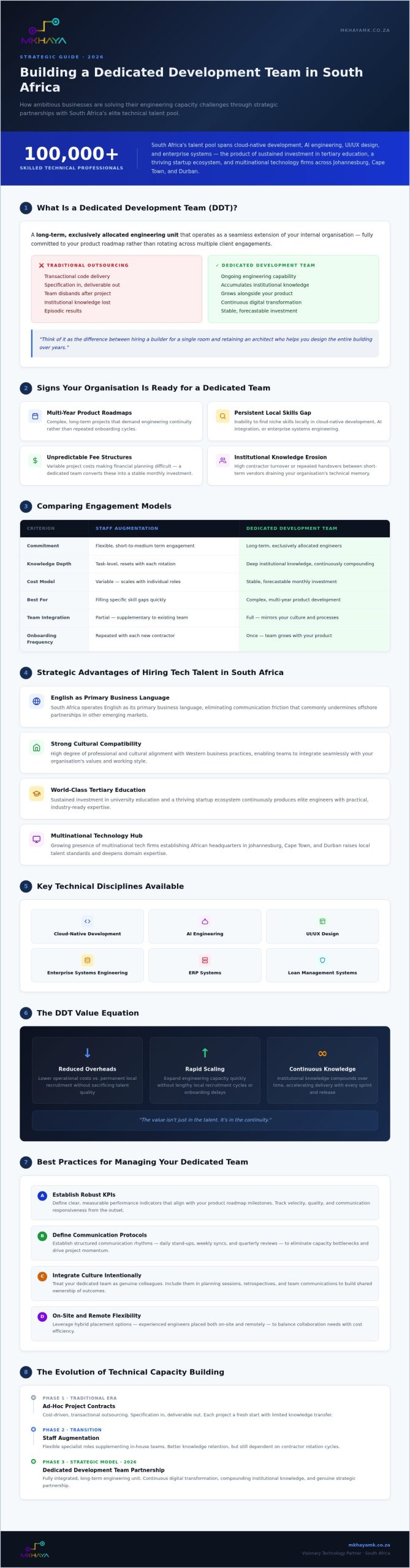
A Dedicated Development Team (DDT) is a long-term, exclusively allocated engineering unit that operates as a seamless extension of your internal organisation, fully committed to your product roadmap rather than rotating across multiple client engagements. This distinction matters enormously. Unlike a project-based contractor who delivers a defined scope and moves on, a dedicated team accumulates your institutional knowledge, understands your architectural decisions, and grows alongside your product. That depth of context is genuinely difficult to replicate, and it’s precisely what organisations competing on complex digital products need in 2026.
To understand why this model has gained such traction, it helps to consider the broader spectrum of outsourcing engagement models and where the DDT sits within it. Traditional outsourcing prioritised cost reduction through transactional code delivery. The relationship was transactional by design: a specification goes in, a deliverable comes out. The DDT model represents a fundamental departure from that logic. Here, the emphasis shifts from output to ongoing capability, from delivery to continuous engineering partnership.
The Evolution of Technical Capacity Building
South African enterprises have been at the forefront of this shift. The move away from ad-hoc project contracts reflects a hard-won lesson: episodic development creates episodic results. Every time a project team disbands, institutional knowledge walks out with them. A dedicated team embedded in your processes and culture supports continuous digital transformation, not just discrete technology upgrades. Think of it as the difference between hiring a builder for a single room and retaining an architect who helps you design the entire building over years.
Signs Your Organisation is Ready for a Dedicated Team
Not every business needs this model immediately. But certain conditions make the case compelling and, frankly, urgent:
- Complex, multi-year product roadmaps that demand engineering continuity rather than repeated onboarding cycles
- A persistent local skills gap in specialised disciplines such as cloud-native development, AI integration, or enterprise systems engineering
- Unpredictable project fee structures that make financial planning difficult, whereas a dedicated team converts variable costs into a stable, forecastable monthly investment
- Institutional knowledge erosion caused by high contractor turnover or repeated handovers between short-term vendors
If any of these resonate, a dedicated development team in South Africa offers a structured path to resolving them. Providers like Mkhaya MK’s staff augmentation service are built precisely for this purpose: placing experienced engineers, both on-site and remotely, who integrate into your team and stay invested in your long-term success.
The value isn’t just in the talent. It’s in the continuity.
The Strategic Advantages of Hiring Tech Talent in South Africa
South Africa’s technology sector has matured considerably over the past decade, producing a national talent pool that numbers well over 100,000 skilled technical professionals across disciplines ranging from cloud-native development and AI engineering to UI/UX design. That depth of supply isn’t incidental. It’s the product of sustained investment in tertiary education, a thriving startup ecosystem, and the growing presence of multinational technology firms establishing African headquarters in cities like Johannesburg, Cape Town, and Durban. For businesses building a dedicated development team in South Africa, this concentration of expertise represents a genuinely significant competitive advantage.
What separates South African talent from comparable pools in other emerging markets, however, isn’t simply volume. It’s the quality of professional alignment that comes with it.
Cultural and Professional Alignment
English is a primary business language in South Africa, and technical professionals operate within it fluently, both in written documentation and real-time collaboration. This eliminates one of the most persistent friction points in remote engineering partnerships: miscommunication at the specification and review stages. South African developers have also grown up within agile-oriented delivery cultures, shaped by exposure to international project frameworks and a strong tradition of client-centric service. The result is a workforce that doesn’t just write clean code; it engages proactively, raises concerns early, and takes genuine ownership of product outcomes.
South Africa’s time zone alignment with European markets (GMT+2) and its natural overlap with the broader African continent makes synchronous collaboration genuinely practical. Daily stand-ups, sprint reviews, and architecture discussions can happen in real working hours for all parties, without the scheduling compromises that partnerships with teams in vastly different time zones typically require.
There’s also a standard of UI/UX design services emerging from South African studios that reflects international benchmarks. Organisations that need their engineering capability to extend into product design and user experience will find that local teams can carry that work with genuine sophistication.
Economic Efficiency Without Quality Compromise
Building an in-house engineering team locally in 2026 carries substantial overhead: recruitment fees, benefits, office infrastructure, and the compounding cost of attrition. Engaging a dedicated team through a managed services model converts those unpredictable variables into a structured, forecastable monthly investment. That shift in cost architecture matters enormously for financial planning and board-level reporting.
Compared to equivalent talent in Western European or North American markets, South African engineers offer a compelling return on investment without the quality trade-offs that sometimes accompany lower-cost alternatives in other regions. Organisations that have made the transition consistently report that they’re not simply saving on headcount; they’re gaining engineers who are invested, communicative, and technically capable at a level that matches or exceeds their previous in-house benchmarks.
If you’re evaluating whether this model fits your current engineering capacity needs, exploring Mkhaya MK’s staff augmentation service is a practical starting point for understanding what a structured, professionally managed talent engagement actually looks like in practice.
Comparing Engagement Models: Dedicated Teams vs Staff Augmentation
Choosing the wrong engagement model is one of the most common and costly mistakes organisations make when scaling their engineering capacity. The two models most frequently considered, staff augmentation and a dedicated development team, are often treated as interchangeable. They aren’t. Each serves a distinct strategic purpose, and understanding that distinction clearly is what separates businesses that scale efficiently from those that cycle through vendors without ever building real momentum.
Staff Augmentation: Tactical Flexibility
Staff augmentation is designed for precision. When your internal team has a specific, time-bound gap, perhaps you’re rolling out a cloud migration and need three senior DevOps engineers for a defined sprint cycle, or you’re integrating AI automation into an existing pipeline and lack that specialist depth in-house, augmentation fills that gap without the overhead of permanent hiring. The professionals slot into your existing structure, follow your processes, and report to your management layer. Speed and specificity are the core advantages.
This model works particularly well when:
- You have a functioning internal team that simply needs targeted reinforcement
- The skill requirement is specialist and short-to-medium term in nature
- Your project scope is well-defined and unlikely to evolve significantly
- You want to maintain full direct management control over day-to-day delivery
Mkhaya MK’s staff augmentation service operates across both on-site and remote placements nationally, giving organisations the flexibility to bring in experienced professionals precisely where and when the work demands it, without the structural commitments that come with permanent headcount.
Dedicated Teams: Strategic Stability
A dedicated development team in South Africa operates at a fundamentally different level of engagement. Rather than supplementing your team, it becomes your team, or a fully integrated extension of it, carrying end-to-end ownership of your product roadmap over an extended horizon. The team accumulates your institutional knowledge, understands your architectural decisions, and grows in capability alongside your product. That depth of context compounds in value over time in a way that rotating augmented contractors simply cannot replicate.
The dedicated model also includes full management and operational oversight within the service structure. You’re not just accessing talent; you’re accessing a managed engineering capability. For organisations undergoing genuine digital transformation, that distinction matters enormously. Mkhaya MK’s software engineering services are structured precisely around this principle: continuous, committed delivery rather than episodic project engagements.
The Hybrid Approach: When Both Models Work Together
Sophisticated organisations increasingly combine both models to match their engineering capacity to the shape of their work. A dedicated core team handles long-term product ownership and architectural continuity, whilst augmented specialists are brought in to accelerate specific initiatives or cover temporary skill requirements. This hybrid structure offers the best of both worlds: strategic stability at the centre, tactical flexibility at the edges. If your roadmap includes both sustained product development and periodic specialist demands, it’s worth evaluating how a blended engagement could serve your objectives more precisely than either model alone.
Best Practices for Managing Your Dedicated Development Team
Having the right engineers is only half the equation. How you manage them determines whether that investment compounds or stagnates. The organisations that extract the most value from a dedicated development team in South Africa share a common discipline: they treat management as an active, ongoing commitment rather than an administrative function that runs itself once the contracts are signed.
Start with clarity. Before your first sprint begins, establish the KPIs and performance metrics that will define success for both sides. These shouldn’t be generic productivity proxies. Meaningful metrics for a dedicated engineering team typically include:
- Sprint velocity and consistency across delivery cycles, not just individual output
- Defect resolution rates and the time taken to close issues raised in QA
- Code review turnaround as a measure of team responsiveness and collaborative discipline
- Milestone adherence relative to the agreed product roadmap
Defining these from day one sets expectations without ambiguity and gives your team a shared framework for self-assessment. It also removes the subjectivity that tends to erode trust in remote partnerships over time.
Communication and Agile Integration
Rhythm matters more than volume. A well-structured communication cadence, built around daily stand-ups, sprint planning sessions, and fortnightly retrospectives, creates the operational heartbeat that keeps distributed teams aligned. Tools like Jira, Slack, and Microsoft Teams provide the infrastructure, but the discipline of using them consistently is what actually builds transparency. Asynchronous updates should be encouraged for routine progress, whilst synchronous sessions are reserved for decisions, blockers, and strategic alignment. When remote and on-site engineers share the same communication norms, the psychological distance between them shrinks considerably. Belonging isn’t built through team-building exercises; it’s built through consistent inclusion in the conversations that matter.
Governance and Quality Assurance
Robust QA processes shouldn’t be bolted on at the end of a sprint; they should be woven into the team’s daily workflow from the outset. Peer code reviews, automated testing pipelines, and structured documentation practices are the foundations of a team that delivers with confidence rather than urgency. Knowledge transfer, in particular, deserves deliberate attention: every architectural decision, integration rationale, and process evolution should be captured in living documentation that the team actively maintains. Quiet confidence in technical leadership means that your team raises concerns early, documents thoroughly, and never mistakes speed for quality. That disposition, more than any single tool or process, is what sustains delivery excellence over the long term.
If you’re ready to build an engineering partnership structured around these principles from the ground up, explore how Mkhaya MK’s software engineering services are designed to deliver exactly that kind of committed, accountable capability.
Scaling with Mkhaya MK: Your Visionary Technology Partner
There’s a meaningful difference between a vendor who delivers code and a partner who takes genuine ownership of your digital trajectory. Mkhaya MK is built around the latter. From the earliest stages of strategic consulting through to expert execution and long-term product stewardship, the engagement is designed to move with your business rather than ahead of it or behind it. That coherence across the full delivery lifecycle is what distinguishes a true dedicated development team in South Africa from a collection of contractors assembled under a single invoice.
Central to this approach is the integration of dedicated engineering teams with Mkhaya MK’s own specialised product suite. When your team is building on or alongside platforms like the Loan Management System, they’re not starting from a blank canvas. They’re working within a structured, proven framework that accelerates delivery timelines and reduces the architectural risk that comes with bespoke builds from the ground up. That combination of dedicated human capability and proprietary product depth is something global agencies simply don’t offer.
AI-driven automation and cloud solutions sit at the operational core of how Mkhaya MK teams work. Whether it’s streamlining data pipelines, orchestrating cloud infrastructure, or embedding intelligent automation into existing workflows, the technical capability is matched to the business outcome rather than applied generically. Operational excellence isn’t a promise; it’s the structural result of pairing the right engineers with the right tooling from day one.
A Holistic Approach to Custom Software
Engineering alone doesn’t transform a business. Mkhaya MK’s teams extend across UI/UX design, DevOps, and strategic consulting, ensuring that every layer of your digital product receives the same standard of deliberate, expert attention. Dedicated teams actively support ERP solutions and Learner Management implementations, bringing continuity across complex, multi-system environments. For a deeper exploration of how this philosophy applies to bespoke builds, the Custom Software Development in South Africa: A Strategic Guide for 2026 offers a comprehensive companion perspective.
Starting Your Journey with Mkhaya MK
Every engagement begins with a structured consultation focused on understanding your specific technical landscape, growth objectives, and the gaps your current capacity can’t close. From that foundation, the team structure is tailored precisely: the right disciplines, the right seniority mix, the right balance of on-site and remote presence. Nothing is templated. Everything is calibrated to your goals.
If you’re ready to build an engineering partnership that compounds in value over time, contact Mkhaya MK to begin building your dedicated team.
Your Next Engineering Chapter Starts Here
The case for building a dedicated development team in South Africa isn’t theoretical. It’s built on a convergence of real advantages: access to a deep, English-proficient talent pool, engagement models that convert unpredictable hiring costs into stable investment, and a partnership approach that compounds in value the longer it runs.
Three things are worth carrying forward from this guide. First, the model you choose matters as much as the talent you access. Second, management discipline determines whether that talent delivers its full potential. Third, the right partner brings more than engineers; they bring proven capability in AI and data automation, national coverage for both on-site and remote placements, and a track record across complex systems like custom ERP and Loan Management implementations.
That’s precisely what Mkhaya MK is built to offer. The starting point is a structured conversation about where your engineering capacity stands today and where your roadmap needs it to be.
Build your dedicated development team with Mkhaya MK today and take the first deliberate step towards engineering capacity that genuinely scales with your ambitions.
Frequently Asked Questions
What is the difference between a dedicated development team and staff augmentation?
A dedicated development team is a fully allocated, long-term engineering unit that takes end-to-end ownership of your product roadmap and operates as a permanent extension of your organisation. Staff augmentation, by contrast, places specialist professionals into your existing team structure to fill a specific, time-bound skill gap. The core distinction is depth of commitment: augmentation offers tactical flexibility, whilst a dedicated team builds compounding institutional knowledge over time.
Your choice between the two depends on your engineering horizon. If you’re reinforcing a functioning team for a defined sprint, augmentation is the sharper tool. If you’re building continuous product capability across multiple years, a dedicated team delivers the structural stability that rotating contractors simply can’t match.
How much does it cost to hire a dedicated development team in South Africa?
Pricing for a dedicated development team in South Africa varies considerably based on team size, seniority mix, technical disciplines required, and whether placements are on-site or remote. Rather than quoting figures that may not reflect your specific configuration, we’d recommend speaking directly with a provider to receive a structured proposal based on your actual requirements. What’s consistent across engagements is that the model converts unpredictable recruitment and contractor costs into a stable, forecastable monthly investment.
South African engineering talent generally offers a compelling return on investment relative to equivalent expertise in Western European or North American markets, without the quality trade-offs sometimes associated with lower-cost alternatives in other regions. Verify current salary benchmarks with your provider before finalising any budget assumptions for 2026.
How do I ensure data security when working with a remote dedicated team?
Data security in a remote engagement is governed by the protocols you establish at the outset, not by geography. Robust arrangements typically include signed NDAs and data processing agreements, role-based access controls that limit exposure to sensitive systems, encrypted communication channels, and regular security audits. Your provider should be able to articulate their security posture clearly and adapt to your organisation’s specific compliance requirements before work begins.
It’s also worth establishing clear policies around code repository access, device management, and incident response procedures. A reputable dedicated team partner will treat these governance requirements as standard practice rather than optional add-ons, so don’t hesitate to raise them during your initial consultation.
Can a dedicated team work with my existing internal developers?
Yes, and this is one of the model’s genuine strengths. A well-integrated dedicated team slots into your existing engineering culture, adopts your preferred tools and workflows, and collaborates directly with your internal developers through shared sprint cycles, code reviews, and daily stand-ups. The goal isn’t to replace your existing capacity but to extend it with complementary skills and additional bandwidth.
Successful integration depends on establishing clear ownership boundaries from the start. Define which workstreams the dedicated team leads, where they support your internal engineers, and how decisions escalate. That clarity prevents duplication and keeps both groups moving in the same direction without friction.
How long does it take to set up a dedicated development team?
Setup timelines vary depending on the complexity of the engagement, the seniority levels required, and the specificity of the technical disciplines involved. A structured provider will typically begin with a discovery consultation to map your requirements, followed by candidate selection and a formal onboarding process. For straightforward configurations, initial team members can often be operational within a few weeks; more specialised or senior configurations naturally take longer to assemble with the right fit.
Rushing the setup phase to meet an arbitrary start date is rarely worthwhile. The onboarding investment, including aligning the team on your architecture, processes, and communication norms, pays dividends throughout the engagement. A deliberate start builds a far stronger foundation than a hasty one.
What technical stacks are available through South African dedicated teams?
South Africa’s developer community covers a broad range of modern technical stacks, including cloud-native development across AWS, Azure, and Google Cloud; backend languages such as Python, Node.js, Java, and .NET; frontend frameworks including React, Angular, and Vue.js; mobile development for iOS and Android; and disciplines like DevOps, AI and data engineering, and enterprise systems integration. The depth of available expertise reflects the maturity of the local technology sector.
When engaging a provider like Mkhaya MK, your dedicated team can also be configured to work directly with proprietary platforms such as ERP solutions, the Loan Management System, or the Optimate Procurement Platform, combining external engineering talent with proven internal product frameworks to accelerate delivery.
How do I manage a dedicated team across different locations in South Africa?
Managing a geographically distributed team within South Africa follows the same principles as any well-run remote engineering operation: consistent communication rhythms, shared project management tooling, and clearly defined accountability structures. Daily stand-ups, sprint planning sessions, and regular retrospectives create the operational cadence that keeps distributed contributors aligned regardless of whether they’re based in Johannesburg, Cape Town, or Durban.
Mkhaya MK’s staff augmentation and dedicated team services are structured to support both on-site and remote placements nationally, which means the operational framework for managing distributed talent is built into the engagement model rather than left for you to figure out independently. Lean on your provider’s experience here; they’ll have established norms that work.
Why is South Africa a top destination for software development in 2026?
South Africa combines several advantages that are genuinely difficult to find in a single market: a talent pool of over 100,000 skilled technical professionals, English as a primary business language, strong cultural alignment with European and African client organisations, and a time zone (GMT+2) that enables synchronous collaboration without the scheduling compromises that distant offshore partnerships require. The country’s growing startup ecosystem and the presence of multinational technology firms have further raised the standard of professional practice across the sector.
For businesses building a dedicated development team in South Africa specifically, the combination of technical depth, communication fluency, and economic efficiency makes the market a strategically sound choice in 2026 and beyond. It’s not simply a cost play; it’s access to a maturing engineering culture that takes product ownership seriously.