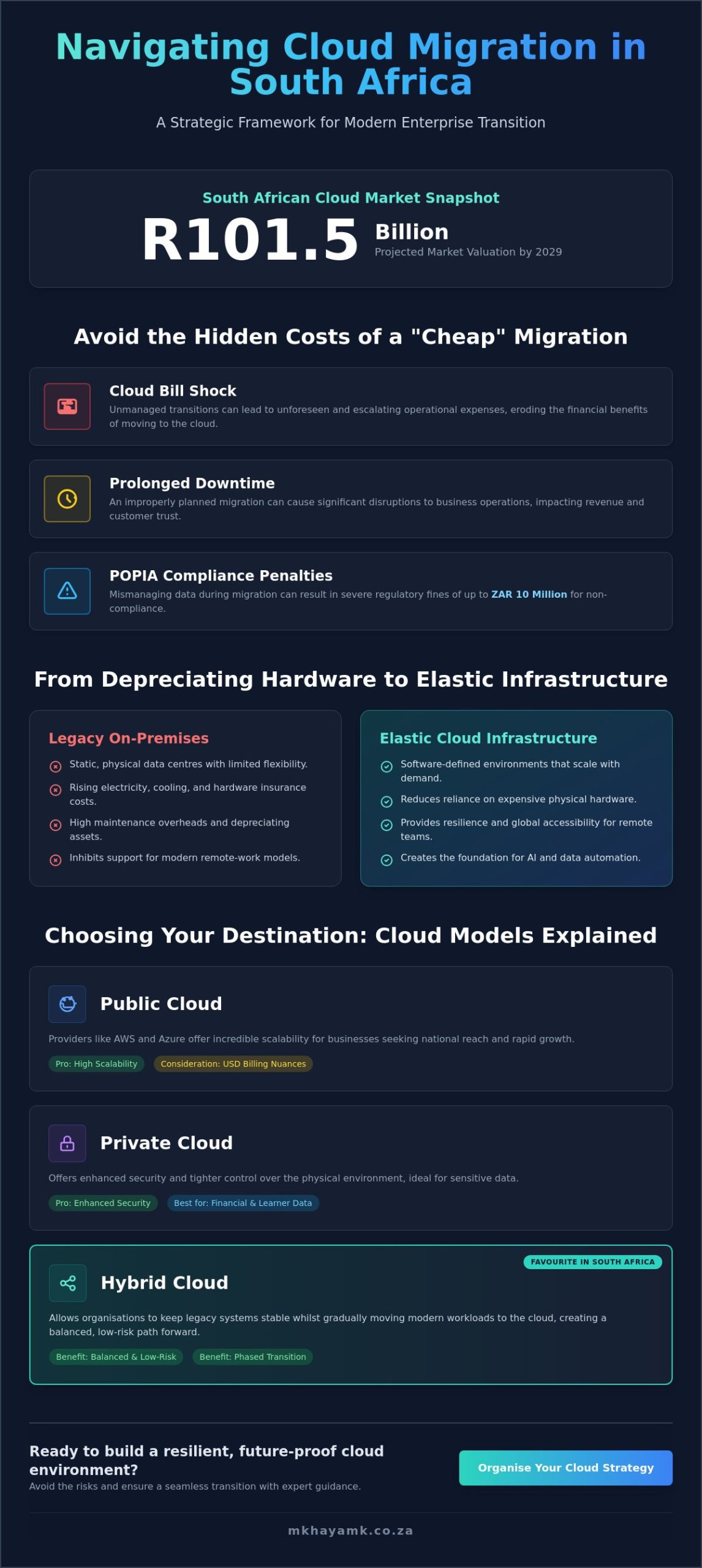
What if the biggest risk to your digital transformation isn’t the technology itself, but the hidden cost of a “cheap” migration strategy? As the local market matures toward a projected R101.5 billion valuation by 2029, many organisations find themselves caught between the promise of agility and the reality of “cloud bill shock.” You likely recognise that moving to the cloud is no longer optional, yet the fear of prolonged downtime or a ZAR 10 million POPIA penalty remains a heavy burden for leadership teams. Selecting the right cloud migration services in South Africa has become a delicate balance of technical precision and financial foresight.
We’ve designed this guide to help you master these complexities with a framework that prioritises long-term stability over quick fixes. You’ll learn how to navigate the evolving FSCA regulations, manage ZAR-based billing fluctuations, and ensure your data remains sovereign within local borders. By following this strategic roadmap, you can transition to a resilient environment that scales automatically, reduces your reliance on depreciating hardware, and ensures zero data loss during the shift.
Key Takeaways
Understand the transition from depreciating physical hardware to elastic, software-defined environments that support modern business growth.
Learn to apply the “6 Rs” framework to ensure your chosen migration strategy aligns with your specific budgetary and operational objectives.
Discover why partnering with professional cloud migration services in South Africa is essential for avoiding the security risks and hidden costs associated with unmanaged transitions.
Master a phased roadmap that prioritises discovery, rigorous governance, and full POPIA compliance to protect your organisation’s data integrity.
Explore how post-migration DevOps practices move your focus from simple maintenance to continuous innovation and accelerated software delivery.
Navigating the Cloud Migration Landscape in South Africa
Cloud migration in the modern South African enterprise is no longer just a technical tick-box exercise. It’s a strategic re-engineering of how your business functions. This shift replaces static, physical data centres with elastic, software-defined infrastructure that breathes with your operational demands. By mid-2026, the urgency to decommission legacy on-premises hardware has intensified. Rising electricity costs and the surge in global demand for AI infrastructure have made local server maintenance a financial liability rather than an asset. Transitioning to professional cloud migration services in South Africa ensures your organisation isn’t left behind as hardware depreciates and maintenance overheads climb.
To better understand this concept, watch this helpful video:
Data sovereignty remains a primary pillar of any local migration strategy. With the Protection of Personal Information Act (POPIA) fully enforceable, the Information Regulator has sharpened its focus on data breach reporting and compliance. Mismanaging this transition carries a risk of penalties up to ZAR 10 million. Adopting cloud computing through a local lens means ensuring your data stays within South African borders where necessary, whilst still benefiting from global innovation. This approach provides the quiet confidence needed to grow without the looming threat of regulatory friction.
The Drivers of Cloud Adoption Amongst Local Enterprises
The move away from physical server rooms is driven by a mix of economic necessity and technological ambition. Escalating costs for cooling systems and hardware insurance have made the “server in the basement” model obsolete. Beyond simple cost-cutting, businesses now require the resilience to support remote-work models that demand global accessibility without latency. Crucially, modern infrastructure is the prerequisite for the next wave of AI and data automation. Without an elastic cloud foundation, your business cannot effectively process the massive datasets required for predictive analytics or automated customer service workflows.
Public, Private, and Hybrid: Choosing Your Destination
Selecting the right destination depends on your specific risk profile and growth targets. Public cloud providers like AWS and Azure offer incredible scalability for businesses seeking national reach, though billing nuances like Azure’s USD requirements for new agreements require careful financial planning. For organisations handling sensitive financial records or learner data, a Private Cloud model offers enhanced security and tighter control over the physical environment. However, the Hybrid Cloud remains the favourite amongst South African firms. It allows you to keep legacy systems stable whilst gradually moving modern workloads to the cloud, creating a balanced, low-risk path forward.
Evaluating Cloud Migration Strategies: The 6 Rs Framework
Selecting the most effective cloud migration services in South Africa begins with a nuanced understanding of the “6 Rs” framework. This isn’t a one-size-fits-all journey; it’s a methodical assessment of your digital estate to determine the most stable and cost-effective path forward. A phased approach is essential to avoid operational paralysis. By categorising your applications early, you can identify which systems require total transformation and which are ready for a simpler transition. This strategic clarity is supported by local insights into Cloud and Data Storage Readiness, ensuring your choice aligns with both national policy and your specific infrastructure capabilities.
Rehosting (Lift-and-Shift) vs. Replatforming
Rehosting is often the preferred route when you face an expiring data centre lease or need a rapid exit from physical hardware. It involves moving applications to the cloud with minimal changes. Whilst fast, it doesn’t always capture the full efficiency of the cloud environment. Replatforming offers a middle ground. You make minor adjustments, such as moving a database to a managed service, to leverage cloud-native features without a full recode. For South African firms, this balance often provides the best initial ROI by reducing management overhead whilst keeping migration costs predictable and manageable.
Refactoring and Rearchitecting Custom Software
Bespoke applications built for local markets often require more than a simple move. If your software wasn’t designed for the cloud, it might struggle with scalability or high egress fees. When engaging cloud migration services in South Africa for complex environments, refactoring ensures your bespoke tools are truly cloud-ready. This process involves custom software development to modernise legacy code into microservices and containers like Docker or Kubernetes. This transformation allows your applications to scale automatically during peak usage, ensuring your digital services remain responsive regardless of the load.
Repurchasing, Retaining, and Retiring
Managed Cloud Services vs. In-House Migration
Deciding between an in-house transition and partnering with experts often comes down to a choice between perceived control and actual resilience. Many South African firms initially attempt a “Do-It-Yourself” approach to save costs, only to encounter the hidden financial traps of unmanaged cloud environments. Without the specialised expertise found in professional cloud migration services in South Africa, projects often suffer from prolonged downtime or unforeseen consumption expenses. Misconfigured security settings in an unmanaged environment can lead to catastrophic data leaks, making the initial “saving” on service fees look negligible compared to the potential POPIA penalties.
Finding local cloud architects is a significant hurdle. There is a documented shortage of certified cloud skills in the country, which leads many businesses to rely on managed service providers to bridge the gap. This partnership shifts your financial model from volatile Capital Expenditure (CapEx) on hardware to predictable Operational Expenditure (OpEx). You pay for what you use, rather than investing in physical servers that lose value the moment they’re installed. It’s a move toward long-term stability that allows your team to focus on core business goals rather than maintaining infrastructure. Utilising dedicated cloud migration services in South Africa ensures that your transition is handled with the precision required for enterprise-level success.
The Strategic Advantage of Managed Cloud Services
Staff Augmentation: A Flexible Alternative
If you prefer to keep the migration project under internal leadership but lack specific technical depth, staff augmentation offers a middle ground. You can augment your internal team with specialised cloud engineers who bring best practices directly into your existing organisation. This approach allows you to scale the team up or down based on specific project milestones, such as the initial assessment or the final go-live phase. It provides the high-end expertise required for a seamless transition whilst ensuring your internal staff retains full oversight of the digital estate.
A Step-by-Step Roadmap for Enterprise Cloud Adoption
Success in the cloud isn’t accidental. It’s the result of a structured, five-phase roadmap that transforms your digital estate from a collection of silos into a cohesive, agile environment. When you partner with professional cloud migration services in South Africa, this journey follows a logical progression that mitigates risk at every turn. This methodical approach ensures that your transition is both transparent and predictable, providing the quiet confidence needed to manage complex infrastructure changes.
Phase 1: Discovery and Assessment. Meticulously mapping your entire digital estate to understand what you own and how it functions.
Phase 2: Governance and Security. Establishing the “landing zone” with strict access controls and compliance frameworks.
Phase 3: The Pilot Migration. Validating the process by moving non-critical workloads to test performance and connectivity.
Phase 4: Full-Scale Execution. Migrating your data and applications in controlled waves to maintain operational continuity.
Phase 5: Validation and Optimisation. Post-migration checks to ensure every system meets performance benchmarks and cost targets.
Moving through these phases allows for continuous refinement. It prevents the high-pressure, all-or-nothing scenarios that often lead to technical debt or security oversights. By treating the migration as a series of controlled movements, your organisation builds internal confidence whilst ensuring that each application is placed in the most efficient environment possible. This rhythmic sense of momentum is what separates a successful adoption from a mere technical transfer.
Technical Assessment and Dependency Mapping
Automated tools are your best allies during the discovery phase. They identify exactly how your applications talk to each other, revealing hidden dependencies that could cause unexpected downtime if severed. Without this level of precision, a seemingly simple move can break critical business workflows that rely on legacy database connections. Documenting the current state isn’t just about record-keeping; it’s about creating a baseline to ensure your cloud migration services in South Africa actually deliver an environment that outperforms your legacy hardware.
Establishing the Cloud Landing Zone
Before moving a single byte, we establish a secure landing zone. This is the foundation of your new infrastructure, where we set up identity and access management (IAM) and secure network tunnels. Configuring virtual private clouds (VPCs) ensures your data remains isolated and protected according to your specific governance requirements. By implementing AI-driven security monitoring from day one, we create a resilient perimeter that evolves with the threat landscape, ensuring your move is as secure as it is efficient.
Once the foundation is set, the transition moves into active execution. This phase focuses on maintaining the integrity of your data whilst shifting workloads in a way that doesn’t disrupt your daily business operations. If you’re looking for a partner to guide you through this complex technical journey, explore our engagement process to see how we ensure a seamless and stable transition for your enterprise.
Beyond the Move: Optimising Cloud Infrastructure with Mkhaya MK
Reaching your “Go-Live” date is a momentous achievement, yet it’s merely the starting line for true digital maturity. The most successful organisations don’t view a move as a one-time event; they see it as the foundation for a continuous programme of refinement. By moving beyond the initial transfer of data, you can start to extract the full value of cloud migration services in South Africa through ongoing optimisation. This phase is where your infrastructure begins to deliver on its promise of agility, allowing your business to pivot and scale with a level of precision that was previously impossible.
Implementing DevOps services in South Africa is a critical step in this ongoing journey. It allows your technical teams to accelerate software delivery cycles, ensuring that new features and security patches reach your users faster. This shift from reactive maintenance to proactive innovation is supported by cloud-native AI and machine learning tools, which provide deep business intelligence from your newly migrated datasets. Long-term stability is then maintained through proactive managed services that anticipate issues before they disrupt your operations, ensuring your cloud environment remains a reliable anchor for your growth.
The Convergence of Cloud and Custom Software
The real power of the cloud is realised when it integrates seamlessly with your business-critical tools. Adopting a modern approach to cloud application development allows you to build more resilient, scalable software that thrives in a distributed environment. This convergence is particularly effective when you integrate cloud-native features into your ERP solutions, providing real-time data access across your entire organisation. As you look toward the future, serverless architectures offer a path to even greater efficiency, where you only pay for the exact compute time your applications consume.
Partnering for Success with Mkhaya MK
At Mkhaya MK, we provide a visionary yet practical approach to cloud solutions. We understand that your journey is unique, which is why we combine deep software engineering expertise with a methodical execution of cloud migration services in South Africa. Our goal is to be your stable partner in a rapidly changing technological landscape, helping you navigate every complexity with quiet confidence. If you’re ready to move toward a more agile and resilient future, contact us today for a comprehensive cloud readiness assessment to begin your transformation.
Building a Resilient Foundation for Your Digital Future
The transition to a cloud-native environment is a journey of refinement that replaces the constraints of physical hardware with elastic, software-defined agility. By following a structured roadmap, your organisation can navigate the complexities of POPIA and local regulatory shifts whilst maintaining quiet confidence. We’ve seen that the move itself is only the beginning. True success lies in continuous optimisation and the integration of modern DevOps services south africa enterprises are increasingly adopting to accelerate delivery and strengthen security. Choosing the right partner for cloud migration services in South Africa ensures that this transformation remains stable, predictable, and aligned with your long-term business goals.
Mkhaya MK offers end-to-end digital transformation expertise with a national footprint and deep local regulatory knowledge. We specialise in custom software and AI integration, providing the technical precision required to turn your infrastructure into a visionary asset. Our team is ready to support your personal journey toward a more agile future. You can request a Cloud Readiness Assessment from Mkhaya MK to begin your methodical transition today. We’re committed to your success and look forward to building a stable, innovative partnership together.
Frequently Asked Questions
How long does a typical enterprise cloud migration take in South Africa?
A typical enterprise migration usually spans between six and twenty-four months, depending on the volume of data and the complexity of your legacy systems. Smaller, targeted transitions can often be completed within three to six months. This timeline includes the vital discovery and testing phases mentioned earlier. By following a phased approach, we ensure that your business remains operational whilst we systematically move your workloads to a more resilient and stable environment.
Is my data safe during a cloud migration, and what about POPIA compliance?
Your data is protected through encrypted network tunnels and secure landing zones that prevent unauthorised access during the shift. Regarding POPIA compliance, we prioritise local data centres within South African borders to ensure your information remains under national jurisdiction. The Information Regulator can issue penalties of up to ZAR 10 million for non-compliance; therefore, we implement strict governance frameworks from day one to mitigate these risks and ensure full legal alignment.
What are the main differences between Public, Private, and Hybrid cloud models?
Public clouds offer massive scalability and national reach through shared infrastructure, whilst Private clouds provide a dedicated environment for highly sensitive financial or learner data. Hybrid models combine both, allowing you to keep legacy systems on-premises whilst moving modern applications to the cloud. This flexibility makes Hybrid the favourite choice for South African enterprises that need to manage legacy constraints without sacrificing the benefits of agile digital transformation.
How can I accurately estimate the monthly costs of running my business in the cloud?
Accuracy in cost estimation requires a detailed analysis of your current resource consumption and an understanding of local billing nuances. Utilising cloud migration services south africa providers offer helps you implement FinOps practices to monitor usage in real-time, preventing “cloud bill shock” by ensuring you only pay for what you effectively use. You must also account for the volatility of the South African Rand against the US Dollar when planning your monthly budget. For a deeper dive into managing these expenses, our guide on cloud cost optimisation in South Africa provides actionable strategies tailored to the local economic landscape.
Do I need to rewrite all my custom software to move it to the cloud?
You don’t necessarily need to rewrite everything, as many applications can be moved using the “Lift-and-Shift” or Replatforming methods. However, bespoke software often performs better and costs less to run when it’s refactored for a cloud-native environment. This process involves making targeted adjustments to your code to leverage microservices and auto-scaling, which ensures your custom tools remain responsive and cost-effective as your business grows and your user base expands.
What is the “Lift-and-Shift” method, and when is it appropriate?
The “Lift-and-Shift” method involves moving your applications to the cloud exactly as they are with minimal changes. It’s most appropriate when you face an urgent deadline, such as an expiring data centre lease or hardware that’s reached its end-of-life. Whilst this is the fastest way to exit physical infrastructure, we typically recommend following up with optimisation phases to ensure long-term efficiency and to prevent the unnecessary consumption of cloud resources.
How does staff augmentation help during a cloud migration project?
Staff augmentation provides you with specialised cloud engineers who integrate directly into your internal team to fill specific skill gaps. This model is particularly effective for cloud migration services south africa projects, as it allows you to maintain full control whilst benefiting from external expertise and best practices. It’s an agile solution for organisations struggling to find certified cloud architects in a competitive local market, allowing you to scale your capacity as needed.
What happens to my physical hardware once the migration is complete?
Once your migration is complete, your physical hardware is typically decommissioned to eliminate maintenance and electricity costs. You might choose to repurpose specific servers for non-critical local tasks or sell the equipment to recover some residual value. Decommissioning these assets is a key step in shifting your financial model from depreciating Capital Expenditure to a more agile and predictable Operational Expenditure model that supports long-term business stability.
The most successful tech leaders in 2026 have realised that the traditional outsourcing model is no longer enough to sustain growth. When you struggle with high local recruitment costs for senior talent and the friction of remote culture, the gap between your business goals and technical execution often widens. Securing a dedicated development team south africa offers more than just a cost-effective alternative; it provides a stable, high-quality extension of your internal culture. You deserve a partner that acts as a visionary guide, ensuring your engineering capacity evolves alongside your long-term ambitions.
We understand that maintaining a reliable engineering team requires more than just technical skill. It demands a commitment to transparency and a shared sense of purpose. This guide explores how to scale your capabilities through strategic alignment, focusing on the latest 2026 regulatory landscapes like the updated POPIA health regulations and the shift towards Agentic AI. You will learn how to access senior South African talent and establish predictable monthly costs, all whilst ensuring your digital transformation remains grounded in practical, high-end results. We will walk through the specific steps to move from a broad vision to a concrete, high-performing engineering partnership.
Key Takeaways
Understand why the dedicated development team south africa model has evolved into a long-term, exclusive partnership that outpaces traditional outsourcing in 2026.
Discover how to integrate AI and data automation into your core development life cycle to drive genuine digital transformation rather than merely completing tickets.
Compare the cost and management structures of dedicated teams against staff augmentation to identify the best fit for your operational stability.
Learn the specific technical vetting and organising processes required to secure senior South African engineering talent capable of scaling with your ambitions.
Explore the benefits of an end-to-end partnership that encompasses everything from UI/UX design to cloud deployment and DevOps services.
The Evolution of Dedicated Development Teams in South Africa
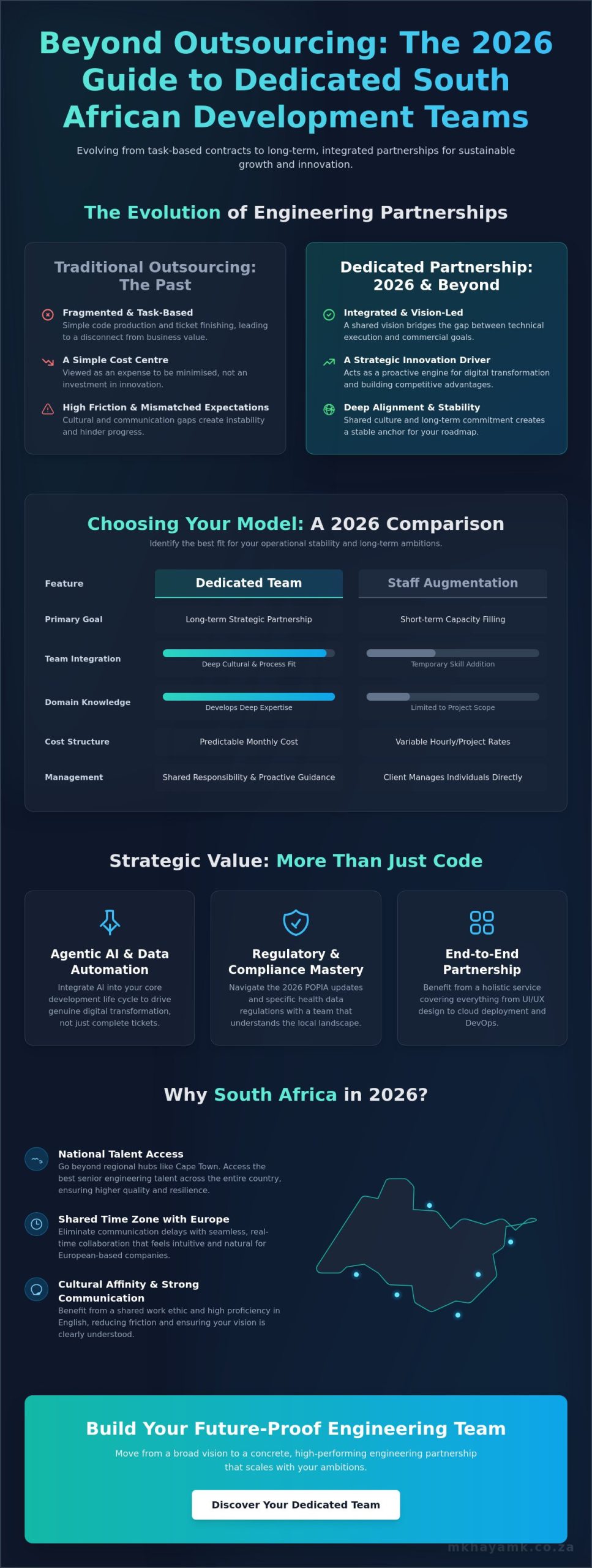
The move away from traditional “body shopping” signals a maturity in how companies view global outsourcing models. Instead of fragmented resources, leaders prioritise stability and long-term alignment. This shift ensures that technical execution isn’t just a cost centre but a driver of innovation. South Africa’s position is bolstered by a shared time zone with Europe and a cultural affinity that makes communication feel natural and intuitive. You aren’t just buying hours; you’re investing in a team that understands the nuances of your market and your user behaviour.
To better understand this concept, watch this helpful video:
What Defines a Dedicated Team in 2026?
A dedicated team is a persistent, scalable unit of senior talent exclusively committed to a single client’s business objectives and technical roadmap. These professionals don’t just work on your projects; they integrate into your daily rhythms. They use your tools, attend your stand-ups, and adopt your internal culture. This level of immersion eliminates the mismatched expectations common in high-pressure environments. It creates a stable anchor for your digital transformation. Because they focus on one product roadmap, they develop deep domain knowledge that a generalist freelancer could never match.
Why National Talent Access Beats Regional Hubs
Limiting your search for a dedicated development team south africa to specific cities like Cape Town or Johannesburg is a strategy of the past. High-speed digital infrastructure and reliable energy microgrids now enable seamless national collaboration. By accessing the full spectrum of South African expertise, you ensure your team is built on the best possible talent, regardless of their physical coordinates. This approach provides greater resilience. If one region faces local infrastructure challenges, your operations remain steady because your talent pool is diversified across the country. It’s a modern, agile way to scale that prioritises senior-level skill over postcodes, ensuring your software engineering efforts are never throttled by local talent shortages.
Strategic Value: Beyond Code to Digital Transformation
True digital transformation happens when technical capacity aligns perfectly with business intelligence. It’s a shift from simply maintaining systems to actively building competitive advantages. A dedicated development team south africa acts as the engine for this evolution, moving beyond the “ticket-finishing” mindset of traditional outsourcing. As South Africa’s digital economy continues to mature, local engineering teams have become adept at delivering end-to-end solutions that encompass strategy, architecture, and long-term maintenance. They don’t just write code; they build the infrastructure that allows your business to pivot and scale in a volatile market.
One of the most significant advantages of this partnership is the inherent understanding of the local regulatory landscape. For instance, with the Information Regulator’s increased enforcement of POPIA in 2026 and the specific health-related data regulations introduced in March 2026, having a team that is already compliant is vital. They ensure that every line of code and every data pipeline respects the latest legal frameworks, protecting your business from the risks of downtime or successful phishing attacks, which 70% of businesses expect to face this year.
Integrating AI and Data Automation
The tech landscape in 2026 is defined by the shift towards Agentic AI, where autonomous systems execute complex workflows with minimal intervention. By leveraging AI & data automation, a dedicated team can build proprietary models tailored to your specific business data. This isn’t about generic tools; it’s about custom-built intelligence that optimises development speed and software quality. Modern teams now use automated quality assurance and DevOps-led delivery to ensure that every deployment is stable and performant, reflecting the 25% growth in AI spending across the region.
Cloud-First Engineering for National Scale
Scaling a digital presence across the diverse network environments of South Africa requires a sophisticated approach to infrastructure. Moving beyond legacy systems through managed cloud solutions allows your applications to remain resilient even during energy challenges. Dedicated engineers focus on building cloud-native architectures that ensure high availability and low latency for your users. This DevOps-centric approach maintains a 24/7 digital presence, ensuring that your software remains a stable anchor for your customers. If you’re ready to see how these capabilities can be tailored to your roadmap, you might want to explore a strategic consultation to define your next steps.
Comparing Models: Dedicated Teams vs. Staff Augmentation
Choosing the right engagement model is a pivotal decision for any tech leader. Whilst both staff augmentation and dedicated teams offer access to high-tier talent, they serve different strategic purposes. The choice often hinges on how much management overhead you’re willing to absorb and the complexity of the digital asset you’re building. Given South Africa’s digital economy growth, the options for high-end engineering have never been more robust, but the wrong choice can lead to fragmented workflows and misaligned goals.
The most common objection we hear is: “Why not just hire individual contractors?” On the surface, individual contractors might seem cost-effective. However, the hidden “coordination tax” is high. You become the project manager, the scrum master, and the cultural glue. A dedicated development team south africa, by contrast, operates as a self-contained, high-performance unit. They bring their own established communication patterns and internal management, allowing you to focus on high-level strategy rather than daily micro-management. This model also secures your intellectual property more effectively; institutional knowledge stays within the team rather than walking out the door when a single contractor’s contract ends.
When to Choose Staff Augmentation
Staff augmentation is ideal for short-term projects where you have a specific, well-defined technical gap. It’s a tactical move for rapidly scaling during a specific launch or migration phase. If you already have a strong internal engineering culture and just need “extra hands” to hit a deadline, this is often the most efficient path. It’s about filling a temporary void with precision. For more details on this approach, see our guide on how to reduce IT costs with staff augmentation.
When the Dedicated Team Model Wins
The dedicated team model is the superior choice for continuous product development where requirements evolve over time. It’s about building a core digital asset that requires deep architectural knowledge and a consistent vision. This model creates a sense of “quiet confidence” in your tech stack because you have a persistent group of senior engineers who understand the “why” behind every architectural decision. They don’t just finish tickets; they anticipate technical debt and build for the future. This long-term stability ensures your platform remains a reliable anchor, even as your business pivots to meet new market demands. If your immediate challenge is expanding capacity under tight deadlines, our guide on how to scale your tech team quickly outlines the strategic frameworks that complement this model.
Vetting and Organising Your Dedicated Team Nationally
Building a high-performance engineering unit requires a vetting process that looks beyond a simple list of technical skills. To secure a dedicated development team south africa that truly functions as an extension of your business, you must evaluate their ability to handle digital transformation at scale. This involves assessing their strategic thinking, their grasp of complex architectures, and their commitment to methodical execution. You aren’t just looking for developers; you’re looking for partners who can translate business vision into robust technical reality.
Organising a team across national borders requires sophisticated communication protocols. Whilst remote work is the standard, the “quiet confidence” of a successful partnership comes from structured transparency. Establishing clear KPIs is essential, but these must focus on business outcomes rather than arbitrary metrics like lines of code. Success should be measured by feature velocity, system uptime, and the successful mitigation of technical debt. This ensures the team remains focused on long-term stability and value creation.
Assessing Technical and Cultural Fit
When searching amongst the national talent pool for specialists in software engineering, it’s vital to look for a proven track record in your specific sector. Whether your focus is on Finance, Logistics, or complex ERP systems, your partner should demonstrate a deep understanding of the unique challenges within those industries. Cultural fit is equally important. You need a team that shares your values of integrity and transparency, ensuring that communication remains fluid even during high-pressure delivery cycles. This shared vision for innovation is what separates a standard contractor from a visionary guide.
Onboarding and Integration Protocols
Successful integration starts with aligning the dedicated team with your internal process and methodology. This includes setting up a secure, cloud-based toolchain that enables seamless collaboration without compromising data integrity. A successful transition typically follows a structured 30-60-90 day roadmap that moves from initial environment setup and cultural immersion to full ownership of technical deliverables and strategic optimisations. This deliberate pace ensures that every team member is fully articulated in their role before the partnership scales. If you’re ready to build a team rooted in these values, you can consult with our team about your specific vetting requirements to ensure a perfect fit.
Scaling with Mkhaya MK: Your Partner in Digital Evolution
Choosing the right dedicated development team south africa is more than a procurement decision; it’s a commitment to your company’s future architecture. We’ve explored the evolution of the model and the strategic value of deep technical integration. Now, the focus shifts to execution. Mkhaya MK provides a stable anchor for businesses that need to scale without losing their cultural identity or technical standards. We don’t just supply resources; we build the engineering capacity required to sustain long-term digital evolution in an increasingly autonomous landscape.
Our end-to-end approach ensures that your product roadmap is never fragmented across different vendors. We manage the entire lifecycle, from the initial UI/UX design services that define your brand’s digital behaviour to the cloud application services & DevOps that guarantee your systems remain resilient. This continuity is vital for maintaining high-quality output and predictable costs. By aligning our technical capabilities with your specific business goals, we transform software from a line item into a strategic asset that drives measurable refinements across your organisation.
A Visionary Yet Practical Approach
We believe that professional confidence should always be paired with a supportive partnership model. This means we take the time to understand the nuances of your industry, whether you’re implementing complex ERP solutions or developing bespoke loan management systems. Our personality is one of “quiet confidence” where we value methodical execution over flashy, unsubstantiated claims. We focus on precision and long-term stability, ensuring that every deployment is a step toward your broader ambition. This practical guidance helps you stay agile and modern whilst remaining rooted in the traditional values of integrity and commitment.
Ready to Scale Your Engineering Capacity?
Finding a dedicated development team south africa that acts as a true extension of your business requires a partner that is deeply invested in your journey. We invite you to visit our about us page to learn more about our culture and the principles that guide our work. Our team is ready to discuss your specific roadmap and help you define a concrete path forward for your digital goals. Whether you need to build a new platform from the ground up or optimise an existing system, we provide the expertise and the stability you need to succeed. Let’s start a conversation about how our bespoke engineering solutions can help you scale with confidence.
Securing Your Path to Technical Excellence
Mkhaya MK stands as a privately held South African technology firm with national reach, offering the end-to-end expertise you need in AI, cloud, and custom software engineering. We focus on the precision and methodical execution required to turn your digital vision into a reliable reality. Contact Mkhaya MK to build your dedicated engineering team today and take the first step toward a scalable, resilient future. We’re here to serve as your stable anchor in a rapidly changing technological landscape.
Frequently Asked Questions
What is the difference between a dedicated development team and standard outsourcing?
A dedicated team functions as a long-term, exclusive extension of your business, whilst standard outsourcing is typically focused on short-term, project-based tasks. This model ensures that your engineers develop deep domain knowledge and align with your internal culture. It moves the relationship beyond a simple transaction toward a strategic engineering partnership that prioritises your product’s long-term stability.
How long does it typically take to assemble a dedicated team in South Africa?
Assembling a high-performing dedicated development team south africa usually takes between four to eight weeks. This timeline allows for a meticulous vetting process to ensure every senior engineer matches your technical requirements and cultural values. We focus on precision during this phase to ensure that the team is ready to hit the ground running from day one of your roadmap.
Can I manage the dedicated team directly or does the provider handle it?
You maintain full control over the team’s product roadmap, priorities, and technical direction. Whilst we handle the operational complexities like HR, infrastructure, and administrative stability, the team integrates directly into your daily workflows. This collaborative approach allows you to focus on high-level strategy while we ensure the engineering unit remains a stable, well-supported anchor for your business.
Is it possible to hire remote developers in South Africa for specific niche technologies?
South Africa possesses a diverse and mature talent pool capable of handling highly specialised technologies. Whether you require expertise in Agentic AI, complex fintech integrations, or cloud-native architecture, our national reach allows us to source specialists amongst the best talent in the country. This ensures you aren’t limited by geography when seeking the precise skills needed for your digital evolution.
How do dedicated teams handle data security and intellectual property rights?
Data security is handled with the highest level of professional rigour, ensuring full compliance with the 2026 POPIA enforcement standards. All intellectual property created by the team is legally transferred to you, giving you total ownership of your digital assets. We establish secure, cloud-based environments and strict communication protocols to protect your sensitive information throughout the partnership.
What happens if my project requirements change whilst the team is already active?
The dedicated model is built for agility, allowing the team to adapt quickly as your business goals evolve. Because the team is committed to your roadmap rather than a fixed project scope, they can pivot their focus without the friction of contract renegotiations. This flexibility ensures that your technical execution remains aligned with your shifting market demands and innovation goals.
How much does a dedicated development team in South Africa cost compared to in-house hiring?
A dedicated development team south africa offers significant cost efficiencies by eliminating the high overheads of local recruitment, office space, and employee benefits. You gain access to senior-level talent with predictable monthly costs, which simplifies your financial planning. This model provides a high-end engineering capacity that is often far more sustainable than building an equivalent in-house team from scratch. For businesses that need to expand capacity rapidly before committing to a full dedicated model, understanding how to scale your tech team quickly with a strategic framework can help bridge the gap effectively.
How do dedicated teams integrate with our existing internal DevOps processes?
Our teams are designed to be “tool-agnostic” and integrate seamlessly into your established DevOps pipelines and communication channels. They adopt your preferred methodologies, whether you use Jira, GitHub, or specific cloud deployment tools. This ensures that the transition is smooth and that there is no disruption to your existing engineering rhythms or deployment cycles.
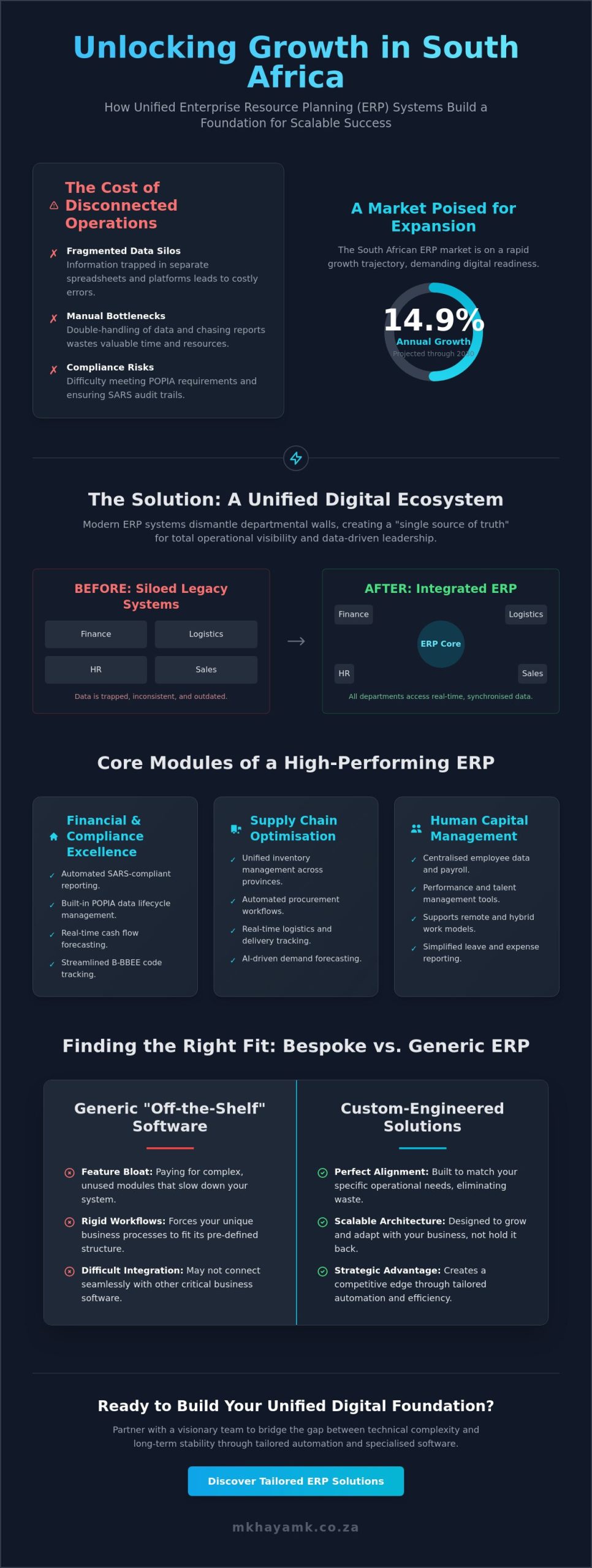
What if the primary barrier to your company’s growth isn’t market demand, but the invisible friction of fragmented data and manual bottlenecks? In an economy where the South African ERP market is projected to expand by 14.9% annually through 2030, staying competitive requires more than just hard work. It demands a unified digital foundation. Selecting the right ERP solutions South Africa offers is about more than software; it’s about building a reliable architecture that integrates every department into a single, cohesive engine.
You likely recognise the frustration of chasing real-time reports across disparate platforms or the anxiety of ensuring your data deletion logs meet the latest POPIA requirements. We understand that these operational hurdles can stifle even the most ambitious enterprises. This guide explores how modern ERP systems transform these challenges into strategic advantages by automating workflows and securing local compliance. We will examine the shift toward cloud-first adoption, the impact of AI-driven insights, and the practical steps to achieving long-term stability in an evolving technological landscape.
Key Takeaways
Understand how transitioning from siloed legacy systems to a unified digital ecosystem creates a robust foundation for scalable business growth.
Identify the core modules, such as automated financial management and supply chain optimisation, that define high-performing ERP solutions South Africa requires.
Learn to distinguish between feature-heavy generic software and custom-engineered solutions that eliminate “feature bloat” to align with your specific operational needs.
Discover a structured implementation strategy that ensures safe data migration and seamless workflow mapping while maintaining business continuity.
Explore how a visionary partnership can bridge the gap between technical complexity and long-term stability through tailored automation and specialised software products.
What are ERP Solutions and Why Do South African Enterprises Need Them?
At its core, an Enterprise Resource Planning (ERP) system acts as the central nervous system of an organisation. Understanding What are ERP Solutions involves seeing beyond simple software; it’s about a unified ecosystem where every department, from finance to logistics, shares a common data language. For years, businesses operated within silos where information stayed trapped in separate spreadsheets or disconnected accounting packages. This fragmentation often led to double-handling of data and costly miscommunications. Modern ERP solutions south africa provide a bridge, consolidating these disparate threads into a single, integrated digital platform that empowers leaders with total visibility.
To better understand how these systems function within a local context, watch this helpful case study:
Beyond efficiency, these platforms serve as a critical anchor for compliance. As of June 2026, the Information Regulator has placed a sharp focus on automated logs of data deletion to ensure adherence to POPIA. A robust ERP system doesn’t just store data; it manages the entire lifecycle of information. This includes role-based access and audit trails that are essential for navigating the complex South African regulatory landscape. By centralising these processes, companies reduce the risk of manual oversight and build a foundation of trust with their clients.
The Evolution of Business Management Software
The journey of business management has shifted dramatically. What began as basic ledger software has matured into comprehensive suites that support the dynamic needs of today’s workforce. With the rise of remote and hybrid work models across the country, the reliance on on-premise servers has faded. Managed cloud infrastructure now ensures that a team in Cape Town and a warehouse in Johannesburg remain perfectly synchronised. This evolution allows for a level of agility that was previously impossible, turning software from a back-office tool into a driver of digital transformation.
Why National Scalability Requires Integrated Data
The Essential Modules of a High-Performing ERP System
A high-performing ERP system functions as a modular framework designed to scale alongside your ambitions. Whilst weighing the advantages and disadvantages of ERP, it becomes clear that the value lies in how these modules communicate. Choosing the right ERP solutions South Africa provides means selecting a suite that addresses both global standards and local nuances. By integrating financial management, supply chain logistics, and human capital into a single interface, you eliminate the friction that slows down decision-making and business growth.
Financial and Compliance Excellence
South African businesses face a specific regulatory environment, including the standard 27% corporate income tax rate and evolving B-BBEE codes. An effective ERP automates SARS-compliant reporting and financial auditing, ensuring that your team spends less time on manual entries and more on strategy. Automated cash flow forecasting provides the stability needed to navigate market shifts, whilst direct integration with local banking gateways ensures that transactions remain seamless and secure. This level of precision is vital for maintaining long-term stability in a fluctuating economy.
Operational and Supply Chain Optimisation
For resource-heavy industries, real-time asset tracking is a necessity rather than a luxury. Implementing a specialised facility management system within your ERP framework allows for precise resource allocation and maintenance scheduling. Similarly, the Optimate Procurement Platform streamlines supplier relationships by optimising inventory levels and reducing waste. These tools ensure that your national distribution remains efficient, even when faced with local logistical challenges. Integrated logistics modules provide the visibility required to manage complex supply chains with quiet confidence.
Data-Driven Decision Making
The true power of modern ERP solutions South Africa relies on lies in their ability to turn raw data into actionable intelligence. By leveraging AI & Data Automation, executive dashboards provide a 360-degree view of the organisation. Predictive analytics allow you to forecast demand and future-proof your growth by identifying trends before they impact the bottom line. This shift from reactive reporting to proactive insight is what defines a visionary enterprise. If you’re unsure which modules match your current growth phase, exploring our ERP solutions can help clarify your path forward.
Bespoke vs Generic: Finding the Best ERP Software for Local Requirements
Choosing between a global template and a custom-engineered system is a pivotal moment for any enterprise. Whilst large global brands offer a sense of familiarity, they often introduce “feature bloat”—a collection of complex tools and workflows that your team might never use, yet you still pay to maintain. When you explore the variety of ERP solutions south africa offers, it’s essential to ask whether the software will adapt to your business, or if you’ll be forced to adapt your business to the software. Bespoke custom software development ensures that your unique business logic is baked into the code rather than bolted on as an afterthought, providing a foundation that feels natural to your operations.
The Limitations of One-Size-Fits-All Systems
Forcing local processes into rigid global templates often creates significant operational friction. These generic systems are typically built for international markets, meaning they may lack the inherent flexibility required for South African business nuances. This misalignment often leads to manual workarounds, defeating the purpose of an integrated system. The hidden costs of trying to customise a rigid generic system can quickly spiral, as you’re essentially paying to rewrite the foundation of the product. Beyond the backend, user adoption often suffers when the interface feels clunky or irrelevant. Investing in high-quality UI/UX design services ensures that the system feels intuitive, encouraging your staff to engage with the platform rather than work around it. For businesses extending their digital ecosystem to mobile users, partnering with a specialised mobile app design company south africa can further bridge the gap between complex business requirements and the real-world needs of your users.
The Power of Specialised Proprietary Products
Sometimes, the best path forward isn’t a generic ERP or a completely blank slate, but a specialised proprietary product designed for your industry. For financial providers, a dedicated loan management system offers deep functionality that a generic ERP simply can’t match without extensive, expensive modifications. Similarly, a robust facility management system provides the granular asset tracking and maintenance scheduling required for resource-heavy sectors. These specialised tools can integrate seamlessly with your wider digital ecosystem, including a learner management system to track corporate skills development. This modular approach provides the stability of a proven product with the precision of a bespoke build, ensuring that every niche department is supported by tools that actually understand their daily challenges.
Executing a Seamless ERP Implementation Strategy
Implementing ERP solutions south africa requires a disciplined, methodical approach to ensure the transition enhances rather than disrupts your daily operations. A successful rollout isn’t a single event; it’s a journey that follows a logical, five-phase progression. This structured path allows for transparency and methodical execution, building trust amongst stakeholders whilst securing the long-term stability of the new system. By moving from a broad vision toward concrete execution, we ensure that every department is aligned and ready for the shift.
Phase 1: Discovery and Assessment. We begin by mapping your current workflows and identifying operational gaps. This ensures the solution addresses real-world friction points rather than theoretical ones.
Phase 2: Data Migration and Integration. Safely moving legacy data to the new system is a delicate process. We prioritise data integrity to ensure your historical insights remain intact and accessible.
Phase 3: Customisation and Configuration. Here, we align the software with your specific business rules. This phase turns a standard platform into a precision tool for your enterprise.
Phase 4: User Acceptance Testing (UAT). We verify that the system meets every operational need. Your team tests the logic in a controlled environment before the full rollout.
Phase 5: Training and Go-Live. Empowering your staff is the final step. We transition to the new platform with a clear support structure in place to handle the initial switch.
Overcoming Implementation Hurdles
Change management is often the most overlooked aspect of a rollout. Reducing staff resistance requires transparent communication and a clear explanation of the practical benefits. People need to feel supported as they learn new behaviours. From a technical standpoint, Cloud Application Services & DevOps play a vital role in maintaining high system availability. This infrastructure ensures that your migration doesn’t compromise data security or residency; it’s a critical factor for maintaining POPIA compliance during the move.
Ensuring Long-Term System Health
A successful go-live is just the beginning of the journey. Maintaining system health requires ongoing managed cloud services and proactive support. As your cloud footprint grows, implementing a deliberate approach to cloud cost optimisation south africa businesses rely on can prevent idle resources from silently eroding your technology budget. If your internal team lacks specific technical expertise, staff augmentation can fill those gaps during the critical early months. Regular software engineering updates are also essential to keep your system secure and performing at its peak. This continuous refinement ensures that your digital foundation remains a stable anchor as your business grows. Ready to start your transition? Explore our methodical implementation process to see how we guide your business toward operational excellence.
Partnering for Growth: Mkhaya MK’s Comprehensive ERP and Automation Portfolio
Mkhaya MK positions itself as a visionary partner invested in your personal journey toward operational excellence. We don’t just provide software; we build the digital architecture that supports your long-term stability. By merging custom software development with specialised ERP solutions south africa, we create a synergy that generic vendors cannot replicate. This approach ensures that every line of code serves a specific business outcome, turning technology from a cost centre into a strategic asset. We value transparency and methodical execution, acting as a stable anchor as you navigate the complexities of digital growth.
Our methodology integrates AI & data automation directly into the core ERP framework. This integration allows for predictive insights and automated workflows that free your team from repetitive manual tasks. When technical gaps arise during a complex rollout, our staff augmentation services extend your internal capabilities, providing the expert hands needed for project success. It’s a holistic ecosystem designed for mutual success and steady, forward-looking ambition, ensuring that your business remains agile in a shifting market.
Our Specialised Product Ecosystem
To achieve national scalability, businesses require tools that understand the specific demands of their sector. Our Optimate Procurement Platform streamlines supplier management, whilst MkhayaMove provides the precision needed for complex logistics. For financial providers, our loan management system offers a robust platform for managing credit lifecycles with quiet confidence. Meanwhile, our facility management system ensures that physical assets are utilised to their full potential. These proprietary products aren’t isolated tools; they are essential components of a broader digital transformation strategy that scales alongside your enterprise.
Your Journey to Digital Maturity
Our collaborative process begins with strategic consulting and moves through to methodical execution. This journey isn’t about high-pressure urgency; it’s about a deliberate pace that ensures each milestone is fully articulated and achieved. We believe in building a relationship where your success is the primary metric of our own. This commitment to integrity and precision allows us to guide you from a broad vision toward a concrete, high-end digital reality. We invite you to explore our resources to learn more about modernising your tech stack. If you’re ready to refine your operations and embrace a proactive, data-driven future, contact us today to begin our partnership.
Building a Future-Ready Enterprise
Transitioning to a unified digital ecosystem is a strategic necessity for national scalability, whilst selecting the right ERP solutions south africa provides allows you to replace operational friction with data-driven precision. We’ve explored how a modular approach helps your business grow without the burden of feature bloat, ensuring that local compliance remains a core pillar of your architecture. This journey requires a partner that understands both global standards and the specific nuances of our local market.
Mkhaya MK is a privately held South African technology firm and an end-to-end digital transformation expert. Our specialised proprietary systems, including the Optimate Procurement Platform and MkhayaMove, provide the precision needed to solve unique logistical and procurement challenges. We’re dedicated to your long-term stability and mutual success, acting as a visionary guide through every phase of your growth. Discover our ERP solutions and start your digital transformation journey today. Let’s build a more efficient, resilient future together.
Frequently Asked Questions
What is the average timeline for an ERP implementation in South Africa?
Implementation timelines typically range from six to twelve months, depending on the complexity of your business logic and data migration needs. Smaller projects or modular rollouts can sometimes be completed in three to six months. We prioritise a methodical progression through discovery and testing to ensure the system is stable before go-live, avoiding the risks associated with rushed deployments that could disrupt your operations.
Can a custom ERP solution integrate with my existing accounting software?
Yes, custom ERP systems are designed to bridge the gap between your new digital ecosystem and legacy accounting tools. We use robust integration protocols to ensure that financial data flows seamlessly between platforms without manual entry. This connectivity preserves your historical financial records whilst providing the enhanced operational visibility that modern ERP solutions South Africa requires to remain competitive and agile in a changing market.
How does an ERP system help with POPIA compliance?
Modern systems automate the lifecycle of personal information by implementing role-based access controls and detailed audit trails. As of 2026, the Information Regulator focuses on automated logs of data deletion, which our systems handle natively. By centralising data, you eliminate the risk of unsecured personal information sitting in disconnected spreadsheets, ensuring your business meets every legal requirement under the Act with quiet confidence.
Is a cloud-based ERP better than an on-premise system for local businesses?
Cloud-based systems are generally superior for South African enterprises due to their resilience against local infrastructure challenges like load shedding. Whilst on-premise servers require expensive backup power and physical security, cloud infrastructure offers high availability and remote accessibility. This ensures your team can continue working from any location with an internet connection, providing a stable anchor for business continuity during power outages or connectivity issues.
What are the main differences between bespoke ERP and SAP or Sage?
The main difference lies in the balance between flexibility and “feature bloat”. Global brands like SAP or Sage offer massive, rigid templates that often include complex tools your team will never use. A bespoke solution is custom-engineered to match your exact business logic. This eliminates unnecessary complexity and ensures the user interface is intuitive, leading to higher adoption rates and a more refined operational flow for your staff.
How do I know if my business is ready for an ERP upgrade?
What is the role of AI in modern ERP solutions?
AI serves as a catalyst for predictive analytics and task automation within the core framework. In the current market, AI-driven ERP solutions South Africa employs use machine learning to forecast demand and automate repetitive financial entries. This shift allows executives to move from reactive decision-making to a proactive stance, where future trends are identified before they impact the bottom line, ensuring long-term stability and precision.
How does Mkhaya MK support businesses after the ERP system goes live?
We remain deeply invested in your journey through ongoing managed cloud services and regular software engineering updates. Our support doesn’t end at go-live; we provide staff augmentation to fill technical gaps and ensure your team feels confident using the new system. This collaborative relationship ensures long-term stability and allows us to refine the platform as your business evolves and scales nationally, creating an atmosphere of mutual success.
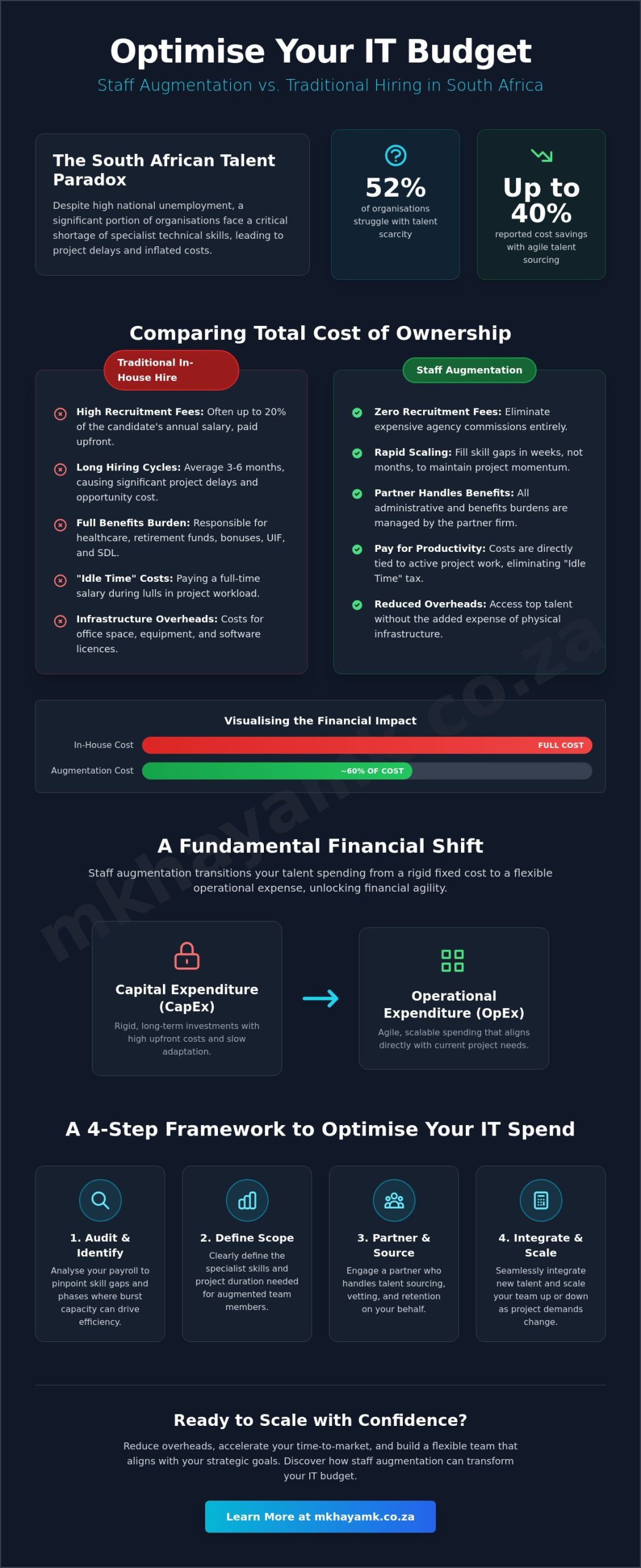
Did you know that businesses are now reporting cost savings of up to 40% simply by rethinking how they source their technical talent? In 2026, the South African market presents a unique talent paradox where 52% of organisations struggle with scarcity despite a high national unemployment rate. You’ve likely felt the budget strain of maintaining underutilised full-time staff or the frustration of long recruitment cycles that delay your most critical projects. It’s a common hurdle for growing firms, but it doesn’t have to be your permanent reality.
We believe in a more agile approach that allows you to reduce IT costs with staff augmentation whilst maintaining the highest standards of engineering excellence. This guide is designed to help you optimise your IT budget and eliminate those hidden recruitment overheads that often drain resources. We’ll walk through a strategic framework for scaling your team, from accessing specialist AI skills to building a mature, flexible partnership that ensures your business remains a stable anchor in a rapidly changing technological landscape.
Key Takeaways
Transition from rigid capital expenditure to agile operational expenditure to maintain financial flexibility in a shifting market.
Discover how to reduce IT costs with staff augmentation by eliminating traditional recruitment overheads and the recurring burden of employee benefits.
Compare the total cost of ownership between in-house hires and augmented teams to uncover the true value of specialist technical talent.
Follow a structured framework to audit your payroll and identify specific project phases where burst capacity can drive efficiency.
Optimise your management resources by partnering with experts who handle talent sourcing, vetting, and retention on your behalf.
The Financial Burden of Traditional IT Hiring in South Africa
The traditional approach to building a technical team is undergoing a fundamental shift in South Africa. For many agile firms, the permanent-first mindset has become a financial bottleneck that restricts growth. Whilst hiring full-time employees was once the standard for stability, the rising cost of talent acquisition in the national landscape has pushed many organisations toward a breaking point. This is the stage where internal recruitment costs actually exceed the project value they aim to create, leaving businesses with bloated budgets and stagnant innovation.
To navigate these challenges, visionary leaders are turning to more flexible frameworks to maintain their momentum. To understand the baseline, it’s helpful to look at what staff augmentation is: a strategic model where an organisation adds external specialists to its existing team to fill specific skill gaps. Staff augmentation is a flexible resource-scaling model that allows you to bypass the friction of traditional hiring whilst retaining full control over your project direction.
To better understand how this model reshapes your financial strategy, watch this helpful video:
Hidden Costs of the In-House Model
The true cost of a permanent employee extends far beyond the gross salary. In South Africa, statutory benefits like the Skills Development Levy (SDL) and Unemployment Insurance Fund (UIF) contributions add immediate layers of expense to every hire. Beyond these, you must account for the “Idle Time” tax. This occurs when you pay for high-level expertise during periods when project demands fluctuate or dip. When you choose to reduce IT costs with staff augmentation, you effectively eliminate these rigid overheads and the recurring expenses of office space or expensive UI/UX design tool licences. You also avoid the steep fees charged by recruitment agencies, which can often reach 20% of a candidate’s annual salary.
Opportunity Cost and Project Delays
Time is perhaps the most expensive resource in the digital economy. Local recruitment cycles for senior developers often span three to six months, creating a massive window of lost innovation. Whilst your competitors are launching new features, your team might be stuck in a holding pattern waiting for a vacancy to be filled. This delay represents a significant opportunity cost that compounds over time. By leveraging professional staff augmentation services, you close these gaps in weeks rather than months. This ensures your time-to-market remains competitive and your budget stays focused on delivery rather than the exhausting process of searching for talent in a scarce market.
Quantifying the Savings: How Staff Augmentation Trims IT Budgets
One of the most effective ways to reduce IT costs with staff augmentation is by fundamentally shifting your financial model from Capital Expenditure (CapEx) to Operational Expenditure (OpEx). In a traditional hiring scenario, you’re often locked into heavy, long-term investments that lack flexibility. By treating talent as an operational expense, you gain the ability to adjust your spend in real-time. This agility is vital for maintaining a healthy cash flow, especially when project scopes evolve or market conditions shift unexpectedly. You aren’t just paying for a person; you’re investing in a scalable resource that aligns perfectly with your current mission.
The “Benefits Burden” is another area where costs quietly accumulate. When you hire internally, the gross salary is only the starting point. You must also account for healthcare contributions, retirement funds, and performance bonuses. By partnering with a specialist firm, these financial responsibilities are handled by the partner. Many organisations find it challenging to reduce overhead costs whilst maintaining a high standard of technical output. Staff augmentation solves this by removing the need for additional infrastructure spend. There’s no requirement to purchase extra office equipment or manage additional software seats for development environments. You simply pay for the expertise you need, for as long as you need it, scaling down instantly the moment a project phase concludes.
Recruitment and Onboarding Efficiency
Internal HR departments often spend weeks, if not months, vetting technical skills for niche roles. This process consumes valuable time and resources that could be better spent on core culture-building initiatives. Mkhaya MK’s staff augmentation process eliminates this friction by providing pre-vetted teams that are ready to hit the ground running. Because the technical screening is already completed by experts, your time-to-productivity is dramatically shortened. This accelerated start ensures that your project remains on track without the typical “onboarding lag” associated with permanent hires.
Training and Upskilling Savings
The pace of technological change in 2026 is relentless. Keeping an internal team updated on the latest shifts in AI, Cloud architecture, or DevOps requires a significant training budget. Staff augmentation allows you to access ready-made experts who already possess these high-level skills. These specialists bring “best-practice” knowledge directly into your team, effectively upskling your internal staff through daily collaboration. You don’t have to fund expensive certification programmes; you simply benefit from the refined expertise the augmented staff bring to the table. If you’re looking to refine your strategy, exploring digital transformation through agile staffing can provide the edge your business needs.
Comparing Total Cost of Ownership: In-House vs. Augmented Teams
When you evaluate the 12 month cost of a Senior Developer, the sticker price of a salary is often deceptive. In South Africa, a Senior Developer with over six years of experience can command an annual salary between R700,000 and R1,200,000. However, the Total Cost of Ownership (TCO) for a permanent employee includes recruitment fees, statutory contributions, and the often overlooked “Management Overhead”. This overhead encompasses the time your leadership spends on performance reviews, career development, and administrative support. By choosing to reduce IT costs with staff augmentation, you delegate these management responsibilities to your partner, allowing your internal leaders to focus on high value strategic initiatives.
Risk mitigation is another critical factor in the TCO equation. Hiring a permanent team member involves a significant legal and financial commitment. If a project’s direction changes or a hire isn’t the right fit, the exit costs and time lost can be staggering. Augmented teams provide a financial safety net, offering the agility to swap talent or adjust team composition without the friction of traditional labour law processes. This flexibility is particularly valuable when implementing complex ERP solutions, where specific expertise might only be required for certain phases of the rollout.
The Agility Premium
It’s a common misconception that a higher hourly rate for augmented staff leads to a more expensive project. In reality, paying this “agility premium” often results in a lower total project cost. You avoid the long term “Benefits Burden” and only pay for active, productive hours. This elasticity is vital in a volatile economic environment where project scopes can shift overnight. By hiring remote developers through an augmentation model, you also reduce geographic premium pay, as you aren’t limited to the salary bubbles of major metropolitan centres.
Long-term Maintenance vs. Project Execution
Efficiency often comes down to knowing when to keep tasks in-house and when to leverage external help. Permanent staff are ideal for long term maintenance and core product knowledge. However, for intense project execution phases, augmentation is the superior financial choice. Combining this model with managed cloud services further reduces your physical infrastructure costs and licensing fees. Whilst a permanent hire represents a long-term financial commitment with significant exit costs, an augmented specialist provides a low-risk alternative that can be scaled or concluded as project requirements change.
A Step-by-Step Framework to Optimise Your IT Spend
Optimising your budget requires a methodical approach rather than a series of reactive decisions. To truly reduce IT costs with staff augmentation, you must move beyond simply filling gaps and start engineering a more lean, responsive workforce. This framework provides a clear path for finance and technical leaders to collaborate on a model that prioritises efficiency whilst maintaining high-calibre output. By following these structured phases, you ensure that every Rand spent on talent is directly linked to a measurable business outcome.
Phase 1: The Resource Audit
The first step is a thorough audit of your current IT payroll to identify redundant roles and high-cost specialist gaps. You should look for instances where you’re paying a full-time salary for a niche skill that’s only utilised during specific project phases. By mapping your project timelines to human resource requirements, you can identify “burst” capacity needs. This allows you to distinguish between “core” functions that should remain in-house to protect intellectual property and “support” or execution functions that are better suited for augmentation. This clarity prevents the financial drain of underutilised staff and ensures your internal team stays focused on your most critical revenue drivers.
Phase 2: Vetting for Cultural and Technical Fit
Technical skill is only half of the equation; cultural alignment is what ensures long-term stability. When you integrate remote specialists, they must align with your internal team’s behaviour and communication style. It’s vital to select a partner with a national footprint that conducts deep technical testing and previous project verification. Leveraging Mkhaya MK’s software engineering standards provides a layer of quality assurance that internal HR teams often struggle to replicate. This rigorous vetting process reduces the risk of project friction and ensures that augmented staff contribute to your productivity from day one.
Once your team is in place, you must integrate them into your broader digital transformation strategy. Define clear KPIs for augmented staff to ensure budget accountability and transparent reporting. It’s not enough to simply hire; you must review and adjust your talent mix quarterly to ensure it still matches your current revenue drivers. This iterative process allows you to scale your tech team quickly for innovation and scale down for maintenance without the usual friction of permanent restructuring. If you’re ready to transform your technical team into a high-performance, cost-effective engine, speak with our team today to explore a tailored staffing strategy.
Scaling with Confidence: Why Mkhaya MK is Your Strategic Partner
Choosing a partner for your technical scaling is about more than just filling seats; it’s about finding a stable anchor in a rapidly changing technological landscape. We move beyond the traditional “body shopping” approach to offer a true strategic partnership focused on shared success. By aligning our high-calibre technical talent with your specific business goals, we help you reduce IT costs with staff augmentation whilst building a foundation for long-term stability. This relationship allows you to navigate the complexities of modern engineering with a visionary guide that remains deeply invested in your personal journey and project outcomes.
Our approach ensures that your team isn’t just larger, but more capable of handling the sophisticated demands of 2026. Whether you are looking to integrate AI and data automation into your core processes or require specialist support for a legacy system migration, we provide the precision and expertise needed to succeed. We understand the national business landscape and the unique talent paradox facing South African firms. This local insight, combined with our commitment to global engineering standards, ensures that your technical capacity remains a competitive advantage rather than a financial burden.
National Expertise, Global Standards
Our rigorous vetting process is designed to identify professionals who possess both technical mastery and the behavioural traits necessary for seamless team integration. We don’t just place developers, analysts, and engineers; we manage their ongoing support and professional development to ensure they continue to deliver value. This commitment to quality has led to significant success in custom software development, where our augmented specialists have helped clients bridge the gap between complex vision and methodical execution. By maintaining these high standards, we protect your budget from the hidden costs of poor quality or high turnover.
Ready to Optimise Your IT Budget?
Engaging with us is a straightforward, transparent process designed to give you immediate control over your technical spend. We start with a deep dive into your current requirements to ensure we match you with the exact skills needed for your next milestone. Our structured process ensures that every engagement is defined by clear milestones, cost-control measures, and regular performance reviews. This rhythmic sense of momentum keeps your projects moving forward whilst providing the flexibility to adjust your talent mix as your revenue drivers evolve. If you’re ready to build a more agile, cost-effective technical engine, contact us today to discuss your staffing needs and discover how we can support your growth.
Future-Proof Your Technical Strategy
Building a resilient IT infrastructure in 2026 requires a departure from rigid, traditional hiring. We’ve explored how transitioning from capital-intensive permanent roles to an agile operational model can fundamentally transform your budget. By choosing to reduce IT costs with staff augmentation, you bypass the friction of scarce local talent and the heavy burden of statutory benefits. This strategic shift ensures your resources are focused on execution and innovation rather than the administrative overhead of recruitment. For organisations seeking even deeper integration, partnering with a dedicated development team in South Africa can provide the long-term engineering stability and cultural alignment needed to sustain growth well beyond a single project cycle.
Is staff augmentation cheaper than hiring a full-time employee?
Staff augmentation is often more cost-effective because it removes the long-term financial commitments associated with a permanent hire. You avoid statutory costs such as the Skills Development Levy (SDL) and Unemployment Insurance Fund (UIF) contributions. By paying only for active project hours, you eliminate the “Idle Time” tax found in full-time salaries. This approach allows you to reduce IT costs with staff augmentation whilst maintaining access to top-tier technical expertise.
How does staff augmentation reduce recruitment and onboarding costs?
This model shifts the burden of talent acquisition from your internal HR team to your strategic partner. We handle the entire lifecycle of sourcing, technical vetting, and behavioural screening. This reduces the time and resources spent on multiple interview rounds and expensive recruitment agency fees. Since our professionals are already pre-vetted, they integrate into your workflow with minimal onboarding lag, which accelerates your project’s productivity from day one.
Can staff augmentation help with reducing office and infrastructure overheads?
Yes, staff augmentation significantly lowers infrastructure spend by supporting remote or hybrid working models. You don’t need to provide additional office space, furniture, or high-end workstations for these specialists. Additionally, the costs of software licences and development tool seats are often managed more efficiently within the partnership. This flexibility allows you to scale your technical capacity without the need to expand your physical footprint or invest in depreciating hardware.
What is the difference between staff augmentation and traditional outsourcing?
The primary difference lies in the level of control and integration into your internal processes. Traditional outsourcing usually involves handing over an entire project to an external vendor who manages the delivery independently. Staff augmentation allows you to add specific specialists directly to your existing team. You retain full control over the project management and technical direction whilst benefiting from the external expertise required for success. Businesses that require a more permanent extension of their internal culture may also explore the benefits of a dedicated development team in South Africa as a complementary model for sustained, long-term technical delivery.
How do I ensure the quality of augmented staff remains high whilst cutting costs?
Quality is maintained through a combination of rigorous technical vetting and clear performance metrics. We employ strict engineering standards and previous project verification to ensure every professional meets high-calibre requirements. By defining specific KPIs and maintaining regular communication, you ensure that the focus remains on delivery excellence. This methodical approach ensures you reduce IT costs with staff augmentation without sacrificing the precision of your technical output.
What happens if a project ends earlier than expected with augmented staff?
One of the greatest advantages of this model is the ability to scale down as soon as a project phase concludes. Unlike permanent hires, which involve complex labour law processes and exit costs, augmented staffing is designed for elasticity. You can conclude the engagement according to your contract terms without the financial friction of traditional restructuring. This ensures your budget remains aligned with your current revenue drivers and project timelines.
Does Mkhaya MK provide remote or on-site augmented professionals?
We offer a flexible range of engagement models, including fully remote, on-site, or hybrid placements. Our national footprint allows us to support your team wherever they are located across South Africa. This choice depends entirely on your project requirements and internal culture. We work closely with you to determine the most effective setup that balances cost-control with high-performance collaboration and team cohesion.
How quickly can we scale a team with Mkhaya MK’s services?
We can typically place pre-vetted specialists within a few weeks, which is significantly faster than the three to six month window often required for permanent hiring. This agility is crucial for meeting tight deadlines and capitalising on new market opportunities. Our established talent pool allows us to respond quickly to your burst capacity needs, ensuring your project momentum remains uninterrupted whilst you manage your budget effectively. For a deeper look at the strategies involved, our guide on how to scale your tech team quickly in 2026 outlines the precise frameworks used to accelerate technical capacity without compromising quality.
What if the success of your next digital venture has almost nothing to do with the programming language your team chooses? For many local businesses, custom web application development south africa often feels like a gamble against scope creep and unpredictable costs. It’s a valid concern; the transition from a visionary concept to a functional, bespoke tool is rarely a straight line. You want a solution that fits your unique workflows without the bloat of off-the-shelf software, yet the technical jargon and shifting regulatory landscape can make the path forward feel obscured.
We understand that you’re looking for more than just code; you’re seeking a stable anchor for your business’s future. This guide provides a comprehensive checklist for 2026 to help you navigate everything from the latest POPIA enforcement measures to ensuring measurable ROI. You’ll gain a clear, step-by-step roadmap that transforms uncertainty into a structured plan for deployment. We’ll explore how to choose a reliable local partner and precisely define your requirements to ensure your final product delivers the long-term stability your organisation deserves.
Key Takeaways
Align your digital strategy with measurable KPIs to ensure your application solves core business inefficiencies from day one.
Conduct a thorough infrastructure audit to ensure your data is clean and ready for seamless integration with legacy systems.
Master the nuances of custom web application development south africa by prioritising 2026 POPIA compliance and securing full ownership of your source code.
Accelerate your time-to-market using Agile milestones and a well-defined Minimum Viable Product to deliver immediate value.
Ensure long-term stability through real-time performance monitoring and structured user feedback loops that drive continuous refinement.
Success begins long before the first line of code is written. In the context of custom web application development south africa, the most common pitfall isn’t technical; it’s a lack of strategic alignment. You must first determine whether you’re solving an internal operational bottleneck or addressing a specific friction point for your customers. A clear understanding of this primary objective ensures that every feature developed serves a practical purpose rather than becoming a costly distraction. By identifying the core problem early, you transform the project from a technical expense into a strategic asset.
Citing the foundational definition of a web application helps clarify that these tools are dynamic systems designed to perform specific tasks via a browser. Because these systems are deeply integrated into your daily business life, they must be built with a specific outcome in mind. If a generic tool cannot handle your specific workflow or lacks the necessary local integrations, the case for a bespoke build becomes clear. This initial homework is what separates high-performing digital tools from abandoned software projects.
To better understand this concept and the foundational phases of development, watch this helpful video:
Once the problem is identified, define what “better” looks like through measurable KPIs. Will you measure success by time saved on manual data entry, revenue generated through a new digital channel, or user engagement levels? Establishing these metrics early allows you to justify a realistic budget range. It’s vital to distinguish between the initial build cost and the long-term value the system generates; a bespoke build might require a higher upfront investment, but it eliminates the recurring “feature tax” of paying for SaaS tools that don’t quite fit your needs.
Defining Your Unique Value Proposition (UVP)
Your application should offer something your competitors’ tools don’t. This starts by consulting with the people who will actually use the software every day. Internal stakeholders provide the most valuable insights into daily workflows that a generic tool simply cannot accommodate. By drafting a single-sentence mission statement for the project, you create a North Star that prevents scope creep. If a proposed feature doesn’t directly support that mission, it doesn’t belong in the initial build.
Evaluating the Strategic Guide to Software
Before committing to a path, it’s wise to review the Custom Software Development in South Africa: A Strategic Guide for 2026. This resource helps you compare the long-term ROI of a custom build against the recurring costs of SaaS licensing fees. Often, the decision to go bespoke is driven by “deal-breakers” such as the need for specific local payment gateway integrations or high-security data handling that international off-the-shelf tools might lack. Identifying these requirements now ensures your custom web application development south africa remains on track and within budget.
Technical & Operational Readiness: The Infrastructure Checklist
Before a single pixel is rendered, you must prepare the environment where your application will live. Technical readiness is the engine room of successful custom web application development south africa. It begins with a rigorous audit of your current data structures. If your existing data is unorganised or fragmented, migrating it to a new platform will only amplify those inefficiencies. A thorough audit ensures your information is clean and structured, allowing you to compete and grow in the digital economy with a solid foundation.
Your new system won’t exist in a vacuum. It must communicate fluently with your legacy systems, whether that’s an existing ERP or a specialised accounting tool. Mapping these integration points early prevents costly architectural changes later in the project. You should also consider the following operational requirements:
User Access Levels: Define who will use the system and what specific permissions they require to protect sensitive data.
Mobile Responsiveness: Whilst every site should be responsive, your business case might require a more robust, dedicated mobile app development strategy for offline access.
Data Flow Mapping: Create a visual guide of how information moves from a user’s input through to your internal databases.
Cloud and Data Strategy
When planning custom web application development south africa, your choice of hosting is just as important as the code itself. You might choose local South African data centres to reduce latency and satisfy specific local governance requirements, or opt for global providers like AWS or Azure for their vast feature sets. We recommend exploring cloud solutions that offer the elasticity needed to scale as your user base expands. This ensures your infrastructure remains a stable anchor even during periods of rapid growth. If you are unsure which path fits your trajectory, you can review our methodical execution process to see how we align technology with your goals.
UI/UX Design Expectations
Vetting Your Partner: The South African Compliance Checklist
Choosing a partner for custom web application development south africa requires looking beyond technical proficiency. You need a collaborator who understands the regulatory and economic pulse of the region. As South Africa’s Digital Economy Growth continues to accelerate, the complexity of compliance and data sovereignty increases. A partner who treats your project as a shared journey toward mutual success will always outperform a simple service provider. This relationship should feel like a supportive partnership, rooted in reliability and forward-looking ambition.
Compliance with the Protection of Personal Information Act (POPIA) is a cornerstone of any 2026 project. Your developer must demonstrate a “privacy by design” approach, ensuring data protection is baked into the architecture rather than added as an afterthought. Equally critical is the matter of Intellectual Property (IP). You must confirm in writing that your organisation will own the source code upon completion. This prevents vendor lock-in and ensures your software remains a long-term asset under your total control, providing the stability your business requires to scale.
Local sector experience provides a significant advantage. A partner who has navigated the specific challenges of South African finance or logistics will anticipate hurdles before they arise. Ask about their post-launch support and maintenance structures. You need to know the exact turnaround time for critical bug fixes. A reliable partner offers clear Service Level Agreements (SLAs) that protect your operations from unexpected downtime, ensuring your digital tools remain operational whilst your business grows. For organisations operating at a larger scale, understanding the full scope of enterprise software development south africa requirements can help you set the right expectations for compliance, data security, and partnership models from the outset.
Assessing Technical Depth and Staffing
Verify the seniority of the engineers assigned to your build. Sales teams often present a polished front, but the actual construction relies on seasoned developers who understand complex system logic. Enquire about staff augmentation options if you anticipate needing to scale your team rapidly during peak development phases. Request case studies that illustrate successful digital transformation for national clients to ensure they can handle high-stakes deployments with precision.
Communication and Culture Fit
Transparency is the bedrock of trust. Ensure your partner uses modern project management tools like Jira or ClickUp, giving you real-time visibility into progress. Establish a weekly “stand-up” rhythm to maintain momentum and address blockers immediately. This cultural alignment ensures that the team understands the unique nuances of our local business environment, from B-BBEE requirements to specific market behaviours. This structured approach moves your project from a broad vision toward a concrete, successful path forward.
The Execution Roadmap: Agile Milestones Checklist
The construction phase moves forward in two-week “sprints.” Each sprint focuses on a specific set of deliverables, allowing you to see the application grow in real-time. This iterative rhythm ensures that you remain a central part of the development journey. Before any feature is considered complete, it must pass through User Acceptance Testing (UAT). This is where your internal team interacts with the software to ensure it meets the practical needs of your daily operations. A successful UAT phase provides the confidence needed to move toward deployment.
When it’s time to launch, your deployment strategy should reflect the scale of your organisation. A “Big Bang” launch might suit smaller tools, but a phased rollout is often the more stable choice for enterprise systems. This allows you to introduce the application to specific user groups first, ensuring that your infrastructure handles the load gracefully. If you’re ready to see how a structured roadmap can bring your vision to life, you can explore our bespoke engineering services to start your journey.
Managing the Development Process
Understanding the process of iterative feedback is essential for long-term success. It prevents the team from drifting away from the original business case and helps catch potential errors before they require expensive fixes. We establish clear “Definition of Done” criteria for every feature, ensuring that nothing moves to the live environment without meeting our rigorous quality standards. A dedicated Quality Assurance (QA) phase acts as a final safety net, verifying that the code is secure, performant, and reliable.
Risk Mitigation and Flexibility
Even the most methodical projects encounter variables. We maintain a live risk register to track potential delays, such as changes in third-party APIs or external hardware shortages. By building a sensible buffer into the timeline, we protect the project from the pressure of unrealistic deadlines. Every change to the original scope is documented with precision, allowing you to track budget impacts accurately and maintain total transparency throughout the build. This structured flexibility is what makes a custom web application development south africa project truly resilient.
The successful deployment of your application marks the transition from construction to refinement. In the context of custom web application development south africa, the post-launch phase is where your strategic preparation truly begins to yield measurable ROI. You’ve built a stable anchor for your business; now you must ensure it remains resilient and responsive to the real-world needs of your team and customers. This period is about transformation, moving from a completed project to a living tool that grows with your organisation.
Effective performance monitoring is your first priority. By using real-time tools to track load times and user drop-off rates, you can identify technical bottlenecks before they impact productivity. This data-driven approach allows you to make informed decisions about where to refine the user experience. Simultaneously, establishing a structured user feedback loop ensures that those using the system daily have a voice in its evolution. Prioritising feature requests based on actual user behaviour prevents the development of “vanity features” that don’t add practical value to your bottom line.
To maintain a competitive edge, consider how AI & data automation can enhance your existing workflows. Integrating intelligent automation can reduce manual data entry and provide predictive insights that were previously inaccessible. Alongside these enhancements, regular security audits are essential. Scheduling frequent penetration testing protects your organisation from evolving cyber threats and reinforces your commitment to POPIA compliance, ensuring that your user data remains secure and your business reputation stays intact whilst you scale.
Long-term Growth and Evolution
Your MVP launch provides the data necessary to plan a robust Version 2.0. As your organisation expands, you may find that your application needs to be integrated into a more comprehensive ERP solution to synchronise your operations across different departments. This level of integration ensures that your digital tools scale alongside your business ambitions. We recommend staying updated with the latest resources on South African web technology trends to ensure your custom web application development south africa project remains a modern, high-performing asset for years to come.
Finalising the Project Transition
A smooth transition requires that your internal team feels a sense of ownership over the new system. Ensure that every administrator is fully trained on the application’s backend and that all technical documentation has been meticulously handed over by your development partner. This transparency ensures you aren’t reliant on external support for basic maintenance or minor configuration changes. Finally, take the time to celebrate the launch. Recognising this achievement builds the internal buy-in and enthusiasm necessary for high user adoption, turning your new software into a celebrated success amongst your staff.
Securing Your Digital Legacy Through Methodical Execution
Transforming a complex business challenge into a high-performing digital asset requires more than just technical skill; it demands a supportive partnership rooted in reliability. Successful custom web application development south africa relies on the synergy between strategic alignment and a disciplined execution roadmap. By prioritising POPIA compliance and establishing clear Agile milestones, you move from a broad vision toward a concrete path for growth. You now have the checklist to ensure your final product delivers measurable ROI whilst maintaining the long-term stability your organisation deserves.
Mkhaya MK serves as your visionary yet practical guide through every stage of this journey. As privately held South African expertise and end-to-end digital transformation specialists, we offer a proven track record in AI, Cloud, and Custom Engineering. We are deeply invested in the personal journey of our clients and value transparency over flashy claims. We invite you to take the next step toward a stable, scalable future. Ready to build your bespoke solution? Contact Mkhaya MK today. Let’s build something exceptional together.
Frequently Asked Questions
Is custom web application development better than using a website builder?
Custom development is superior when your business requires unique workflows, complex data handling, or high scalability that template-based builders cannot support. Whilst builders are excellent for simple brochures, a bespoke build ensures your software adapts to your specific operational needs. This prevents the limitations of “feature tax” and allows for long-term stability as your organisation grows and your processes become more sophisticated.
How much does custom web application development cost in South Africa?
General industry costs for custom web application development south africa vary significantly based on the complexity and the specific technical stack required. Small custom systems typically start from a lower baseline, whilst large enterprise-level platforms can require a substantial investment. These figures depend on the number of integrations, user roles, and security requirements. We focus on delivering measurable ROI by aligning the build with your strategic business goals.
Can a web application be converted into a mobile app later?
Yes, a web application can be extended into a mobile experience through technologies like Progressive Web Apps (PWAs) or hybrid frameworks. By building a robust web-based core first, you create a stable foundation that can be wrapped for app stores later. This phased approach allows you to validate your MVP with users before investing in dedicated mobile development, ensuring your capital is used efficiently and effectively.
How long does it typically take to build a custom web application?
Most projects involving custom web application development south africa move from the initial discovery phase to a functional MVP within three to nine months. The exact duration depends on the clarity of your requirements and the complexity of the integrations involved. Using an Agile approach with two-week sprints allows you to see tangible progress throughout the journey, ensuring the final product remains on track and aligned with your vision.
What is the difference between a website and a web application?
A website primarily focuses on displaying information, whereas a web application is designed to perform specific tasks and process user data. Websites are generally static and informational; in contrast, web applications are dynamic systems that allow users to interact with databases and perform complex functions. This distinction is crucial when deciding if your business requires a simple digital presence or a bespoke, task-oriented operational tool.
What happens if our development partner goes out of business?
You protect your business by ensuring you have full ownership of the source code and all technical documentation from the start. A reliable partner will confirm these Intellectual Property (IP) rights in writing, as discussed in our compliance checklist. By maintaining access to your code repository, you ensure that your digital asset remains a stable anchor, even if you need to transition to a new support team.
How does POPIA affect the development of our web application?
The Protection of Personal Information Act (POPIA) requires that your application incorporates “privacy by design” to protect all user data processed within South Africa. This means security measures, such as encryption and access controls, must be built into the architecture from day one. Compliance isn’t just a legal hurdle; it’s a commitment to your users’ trust and the long-term integrity of your digital infrastructure and business reputation.
Can we integrate our existing Excel data into a new web application?
Yes, your existing Excel data can be cleaned, structured, and migrated into a new web application through a methodical ETL (Extract, Transform, Load) process. Moving away from fragmented spreadsheets into a centralised database reduces manual errors and improves data visibility across your team. This transition is a vital step in digital transformation, allowing your data to work harder for your business in a secure, multi-user environment. For larger organisations navigating this shift, reviewing a dedicated enterprise software development south africa outsourcing guide can provide valuable context on managing data migration, POPIA compliance, and partner selection at scale.