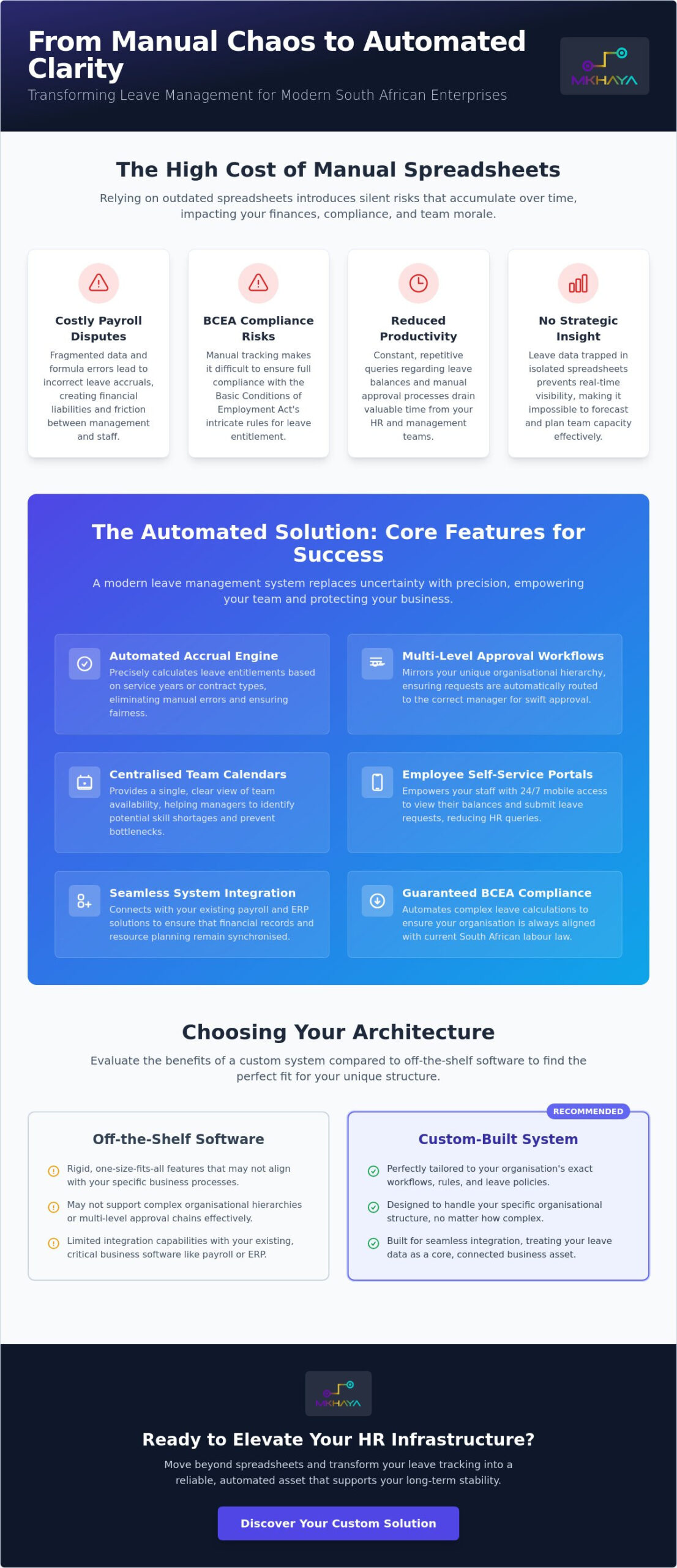
Your manual spreadsheet isn’t just a tracking tool; it’s a silent drain on your company’s productivity and a potential legal liability. Relying on fragmented data often leads to costly payroll disputes and unnecessary friction between management and staff. Choosing the right leave management system shouldn’t feel like an overwhelming technical hurdle, but rather a strategic step toward operational excellence. You’ve likely felt the weight of constant queries regarding leave balances or the difficulty of organising team capacity during peak holiday seasons.
We believe that administrative clarity is the foundation of a healthy workplace culture. This article provides a clear path to eliminate friction and ensure full BCEA compliance with a strategy tailored for South African enterprises. You’ll learn how to replace manual errors with a centralised, accurate record that supports your long-term stability. We’ll explore the essential features that reduce HR burdens and transform your leave tracking into a reliable, automated asset.
Key Takeaways
Move beyond the limitations of manual spreadsheets to eliminate data silos and formula errors that disrupt your payroll accuracy.
Ensure full compliance with the Basic Conditions of Employment Act by automating intricate calculations for annual and sick leave entitlements.
Evaluate the specific benefits of a custom leave management system compared to off-the-shelf software to find the perfect fit for your unique organisational hierarchy.
Learn how to leverage multi-level approval workflows and automated accrual engines to maintain team capacity during peak holiday seasons.
Discover the strategic value of treating leave data as a core business asset that integrates seamlessly with your existing HR infrastructure.
Beyond the Spreadsheet: Why Automated Leave Management is Essential in 2026
The era of the isolated spreadsheet is ending. Transitioning to a digital-first approach means understanding what leave management is in a modern context: a fluid, automated process for tracking and reporting absences. Modern leave management is no longer just a back-office administrative task; it’s a strategic data asset. By 2026, the standard for South African enterprises has shifted toward platforms that talk to each other. Your leave management system should integrate with your payroll and project management tools. This connectivity allows for a more holistic view of your business health. It moves the conversation from who is away today to how you can optimise your capacity for the next quarter.
To better understand how these digital tools function in practice, watch this helpful video:
The High Cost of Manual Errors
Incorrect leave accruals don’t just frustrate staff; they create genuine financial liabilities on your balance sheet. If a departing employee is paid out for incorrectly calculated days, your bottom line suffers directly. We often see the impact of “ghost leave”, where time off is taken but never officially recorded. This lack of precision leads to friction during payroll cycles and undermines trust between leadership and teams. Reliable, automated records are the only way to avoid these expensive disputes and maintain professional confidence across the organisation.
Empowering Employees through Self-Service
Automation fosters a culture of transparency and mutual respect. By utilising mobile-friendly portals, you give your team the autonomy they crave. There’s a clear psychological benefit when employees have 24/7 access to their own balances. It reduces anxiety and eliminates repetitive HR queries that drain your department’s time and energy. Through expert software engineering, these self-service workflows accelerate approval cycles. Managers can approve requests in seconds, keeping the momentum of your business steady and predictable while supporting a healthy work-life balance for everyone involved.
Core Features of an Effective Leave Management System
A high-performing leave management system acts as the digital backbone of your HR operations. It’s more than just a digital calendar; it’s a tool that aligns individual needs with corporate goals. Implementing these features is essential for your business to maintain a competitive edge. Precision starts with automated accrual engines. These systems calculate balances based on specific parameters like years of service or contract types, removing the guesswork that often plagues manual records. When your accrual engine is automated, you eliminate the risk of over-allocation and ensure every employee receives exactly what they’ve earned.
South African enterprises often operate with complex organisational hierarchies. Effective systems utilise multi-level approval workflows that mirror this reality. This ensures that the right managers are notified at the right time. Coupled with centralised team calendars, leadership can identify potential skill shortages before they impact service delivery. This is particularly vital during popular holiday periods when multiple staff members might request time off simultaneously. Efficiency is further amplified when your leave tracking talks to your wider business software. Seamless integration with existing payroll and ERP solutions ensures that financial records and resource planning remain synchronised in real-time.
Configurable Leave Types
Flexibility is vital for a modern workforce. Your system should distinguish clearly between annual, sick, family responsibility, and study leave. It must also accommodate custom fields for unique scenarios like sabbaticals or duress leave. Handling unpaid leave requires specific logic to ensure it doesn’t break the accrual cycle for other entitlements. By categorising these correctly, you maintain a clear view of why people are away, which is crucial for both compliance and resource planning.
Real-Time Reporting and Business Intelligence
Data-driven insights help HR directors spot patterns of absenteeism that might indicate employee burnout. Early intervention can prevent talent loss and improve overall morale. Audit trails provide a transparent history of every change, maintaining data integrity and accountability across the board. These reports also assist in accurate departmental budgeting by forecasting future leave payouts. If you’re looking to refine your digital infrastructure, exploring our digital transformation services can help align your technology with your growth strategy.
Navigating BCEA Compliance and South African Labour Law
Ensuring your business remains compliant with the Basic Conditions of Employment Act (BCEA) is more than a legal obligation; it’s a commitment to your team’s well-being. South African labour law provides clear frameworks for annual, sick, and family responsibility leave that require meticulous tracking. A robust leave management system acts as a safeguard, ensuring these statutory requirements are met without the need for constant manual oversight. For instance, the BCEA mandates that employees are entitled to at least 21 consecutive days of annual leave. Managing this across a diverse workforce requires a system that understands the nuances of different employment contracts and start dates, ensuring that every staff member receives their rightful entitlement.
Statutory record-keeping is another vital component of a compliant HR strategy. The BCEA requires businesses to retain employee records, including leave data, for at least three years. In a manual environment, this often leads to cluttered filing rooms and the risk of lost documentation. A digital approach provides a secure, searchable archive that satisfies legal requirements whilst keeping your office organised. By centralising these records within a leave management system, you ensure that any request from a labour inspector can be met with confidence and speed, demonstrating your commitment to transparent and lawful operations.
The 36-Month Sick Leave Cycle
One of the most complex areas of compliance is the 36-month sick leave cycle. Unlike annual leave, which typically resets every year, sick leave follows a rolling three-year period. During this time, an employee is entitled to an amount of paid sick leave equal to the number of days they would normally work during a six-week period. Tracking this manually is often the primary reason businesses fail labour audits because it’s easy to lose sight of where an individual sits within their specific cycle. A sophisticated system automatically flags when an employee enters a new cycle, preventing over-allocation and ensuring your records remain accurate and audit-ready at all times.
POPIA and Data Privacy in HR
Data privacy is equally critical in the modern workplace. With the Protection of Personal Information Act (POPIA) in full effect, how you store and process employee data is under intense scrutiny. Leave records contain sensitive personal information that must be protected with high-level encryption and strict access controls. Moving away from physical files and insecure spreadsheets through digital transformation significantly enhances your security posture. It ensures that only authorised personnel can access sensitive records, providing peace of mind for both the employer and the employee whilst maintaining a stable, high-end technological landscape.
Custom vs Off-the-Shelf: Choosing the Right Architecture
Deciding between a pre-packaged SaaS tool and a bespoke solution is a critical juncture for your business infrastructure. Off-the-shelf software provides a “quick start” that suits many smaller teams with standard requirements. However, for South African enterprises with established workflows, a custom leave management system often delivers a more precise long-term fit. This route, supported by custom software development, allows you to build a platform around your existing processes rather than forcing your staff to adopt rigid, external logic. This approach prioritises your unique business identity, ensuring that the software acts as a supportive partner in your growth journey.
Total cost of ownership (TCO) is a vital metric when choosing your architecture. Whilst SaaS may appear cheaper initially, the cumulative cost of per-user licensing over a five-year period can be substantial. Custom development involves a larger initial commitment but eliminates recurring seat fees and provides full ownership of the intellectual property. Deeper integration with legacy systems also becomes possible, ensuring that your leave data flows seamlessly into your broader operational ecosystem without the need for fragile third-party connectors. This creates a stable, high-end environment where your data remains a secure and accessible asset.
When SaaS Isn’t Enough
Industrial workforces and retail groups often struggle with “one-size-fits-all” logic. If your organisation manages complex shift patterns or unique union agreements, a generic tool will inevitably lead to administrative workarounds. These manual fixes create the very friction you are trying to eliminate. A bespoke solution adapts to your specific scaling needs, providing a stable anchor as your company expands. It ensures that your technology reflects your commitment to precision and professional excellence whilst avoiding the limitations of generic cloud subscriptions. If you are ready to move beyond generic tools, you can consult with our experts to design a system that truly reflects your business identity.
A Roadmap for Successful Implementation
A methodical transition is key to maintaining data integrity and employee trust. Following a structured path ensures that your new digital infrastructure is both reliable and well-received by your team.
Step 1: Audit existing leave policies. Review your current rules to identify any gaps in BCEA compliance or operational efficiency that the new system must address.
Step 2: Cleanse legacy data. Clean your historical records before migration to ensure your new system starts with a foundation of absolute accuracy and reliability.
Step 3: Conduct pilot testing. Launch the system within a single department first to gather practical feedback and refine the user interface before a company-wide rollout.
Strategic Implementation with Mkhaya MK: Elevating Your HR Infrastructure
Choosing a leave management system is a significant first step, but the true value of any digital tool lies in how it integrates with your broader business objectives. At Mkhaya MK, we position ourselves as more than just a service provider. We are a visionary partner that looks beyond the software to understand your entire business workflow. Our approach ensures that your technology isn’t just a functional necessity but a strategic asset that drives long-term stability. By leveraging our deep software engineering expertise, we create seamless HR integrations that eliminate fragmented data and manual workarounds. We believe that a well-designed system should reflect your unique corporate DNA, supporting your specific culture and operational requirements with precision.
Innovation is at the heart of our methodology. Through AI and data automation, we help you move from reactive tracking to proactive management. A sophisticated leave management system can do more than record absences; it can predict future staffing needs based on historical data and seasonal trends. This foresight allows leadership to make informed decisions about project timelines and resource allocation before capacity issues arise. We invite you to consult with our experts to design a bespoke solution that aligns with your vision for a more agile and modern workplace.
Integration with the Broader Digital Ecosystem
Your leave data shouldn’t exist in a vacuum. When this information feeds directly into your project management and resource allocation tools, you create a single source of truth for all employee-related data. This transparency allows project leads to see real-time availability, ensuring that deadlines remain realistic and team members aren’t over-burdened. We ensure that your entire tech stack is optimised for performance and security, providing a stable foundation that protects sensitive information whilst supporting high-end business results.
The Mkhaya MK Partnership Model
Our partnership model is built on a foundation of mutual success and professional confidence. We follow a highly structured rhythm, moving from strategic consulting to methodical execution and ongoing support. This collaborative journey ensures that each capability we build is immediately linked to a practical benefit for your organisation. We value transparency and commitment, positioning your business as a stable anchor in an ever-changing technological landscape. If you’re ready to transform your administrative processes, contact Mkhaya MK to discuss your custom software needs and take the next step toward operational excellence.
Building a Foundation for Operational Excellence
Transitioning from manual spreadsheets to a digital infrastructure is no longer a luxury; it’s a strategic necessity for any growing enterprise. By automating your processes, you eliminate the financial liabilities and payroll friction that often stem from human error. We’ve explored how a robust leave management system ensures full BCEA compliance whilst protecting sensitive data under POPIA. Whether you choose a scalable SaaS tool or a bespoke custom architecture, the goal remains the same: creating a transparent, autonomous environment for your team. This shift doesn’t just reduce administrative burdens; it empowers your workforce and secures your operational future.
Our end-to-end digital transformation expertise and national South African service coverage ensure that your transition is seamless and reliable. We specialise in bespoke ERP and management system development that aligns perfectly with your corporate DNA. It’s about more than just software; it’s about building a stable anchor for your business. Optimise your operations with Mkhaya MK’s custom software solutions. We look forward to partnering with you to create a high-end technological landscape that supports your long-term ambitions and collective success.
Frequently Asked Questions
What is the minimum leave entitlement for employees in South Africa?
Under the BCEA, employees are entitled to at least 21 consecutive days of annual leave on full pay for every 12-month cycle. Alternatively, this can be calculated as one day for every 17 days worked or one hour for every 17 hours worked. This ensures that even part-time staff receive fair and proportionate time off based on their actual contribution to the business.
How does a leave management system handle the 36-month sick leave cycle?
A robust leave management system automates the rolling 36-month cycle by tracking every sick day taken from the start of employment. It identifies the specific six-week entitlement period and automatically flags when a new cycle begins. This automation prevents the over-allocation of paid sick leave, which is a common error in manual tracking and a frequent cause of compliance failure.
Can a leave management system integrate with my current payroll software?
Yes, modern systems are designed to synchronise directly with your existing payroll and ERP solutions. This connectivity ensures that leave balances and payroll deductions remain accurate without the need for repetitive manual data entry. By creating a unified digital ecosystem, you reduce the risk of human error and ensure that your financial records always reflect the most current employee data.
Is it better to buy a ready-made leave tool or build a custom one?
The choice depends on your organisational complexity and unique business workflows. Whilst ready-made SaaS tools offer a quick start for standard needs, a custom solution provides a precise long-term fit for enterprises with complex shift patterns or specific union agreements. Custom development eliminates recurring licensing fees and ensures the platform grows alongside your company’s visionary goals.
How does POPIA affect the storage of employee leave records?
POPIA mandates that personal information, including sensitive health-related records, must be stored securely with restricted access. Your leave management system should utilise high-level encryption and robust access controls to protect this information. Maintaining these records digitally within a secure environment helps your business meet its legal privacy obligations whilst ensuring data remains accessible for statutory audits.
How can I prevent “leave clashes” where too many people are away at once?
You can prevent clashes by using centralised team calendars that provide real-time visibility of all staff absences. These systems often include automated clash detection features that notify managers if a request overlaps with too many other team members. This proactive approach ensures that your operational capacity remains stable even during popular holiday periods, maintaining your reputation for reliability.
What happens to unused leave at the end of the year under the BCEA?
The BCEA allows for annual leave to be carried over, but it generally must be taken within six months after the end of the 12-month leave cycle. Employers cannot pay out unused annual leave except upon termination of employment. An automated system tracks these expiry dates and sends reminders to staff, helping you manage leave liabilities effectively throughout the year.
How does an automated system handle family responsibility leave?
Automated systems categorise family responsibility leave as a distinct entitlement, providing three days per 12-month cycle for eligible employees. The software tracks the specific criteria for this leave, such as the birth of a child or the illness of a close relative. By separating this from annual leave, you maintain precise records and ensure full adherence to South African labour regulations.
Did you know that predictive analytics captured over 40% of South Africa’s data analytics market revenue by 2024? This surge in investment shows that local businesses are hungry for foresight, yet many still find themselves trapped by fragmented data silos and the high costs of global platforms that lack local nuance. Implementing effective predictive analytics solutions south africa requires more than just high-end software; it demands a strategy that aligns with our unique operational logic and the evolving regulatory environment.
We understand that finding the right balance between sophisticated modelling and practical, cost-effective execution is a significant challenge, especially when skilled data scientists are in high demand. This article provides a clear roadmap to help you bridge that gap. You’ll discover how to transform historical records into a reliable compass for sales and risk forecasting. We will explore a strategic framework for 2026 that automates foresight, reduces operational waste, and ensures your data works as hard as you do to build a stable future.
Key Takeaways
Understand how moving from descriptive reporting to forward-looking foresight provides a distinct competitive edge in the South African corporate sector.
Identify the essential technical layers required to deploy successful predictive analytics solutions south africa, focusing on data integration and machine learning.
Learn how to quantify the financial impact of predictive models, ranging from supply chain optimisation to effective credit risk mitigation.
Discover a structured, two-phase roadmap for data readiness that ensures your infrastructure is prepared for reliable and scalable model deployment.
Explore how a collaborative approach to custom software development bridges the gap between high-level strategic consulting and technical execution.
Beyond Descriptive Reporting: The Rise of Predictive Analytics in South Africa
To better understand the core principles behind this technology, watch this helpful video:
At its heart, predictive analytics is the sophisticated intersection of historical data, statistical modelling, and machine learning. By analysing existing records, these systems identify hidden patterns that human observation might miss. The South African data analytics market, which generated USD 1,016.3 million in 2024, is proof of this growing reliance on foresight. With predictive analytics capturing over 40% of that market share, it’s clear that the ability to anticipate market shifts is becoming a standard requirement for competitive success. We see 2026 as the tipping point where data-driven decision-making becomes the primary anchor for businesses seeking to thrive amongst volatile market conditions.
The Mechanism of Foresight: How Predictive Models Work
Predictive models function by utilising data mining and pattern recognition to project future trends based on past behaviours. Whilst simple forecasting might look at seasonal sales trends, advanced modelling integrates thousands of variables to provide a more granular view of potential outcomes. These Core Components of Modern Predictive Analytics Solutions allow businesses to move beyond guesswork. Predictive analytics is a strategic tool for risk mitigation and opportunity identification that empowers leaders to act with confidence.
Why South African Businesses are Prioritising Predictive Solutions
The drive toward these solutions is fuelled by a need to navigate local economic volatility. Accurate demand and sales forecasting allow companies to reduce inventory waste and manage cash flow with higher precision. Additionally, the shift toward hyper-personalisation means that customer retention strategies are now built on individualised predictions rather than broad demographics. By integrating these capabilities into custom software development, organisations can achieve their digital transformation goals whilst maintaining a clear focus on bottom-line results. This transition ensures that South African enterprises remain agile, modern, and deeply rooted in evidence-based strategy.
Core Components of Modern Predictive Analytics Solutions
Data Engineering: The Foundation of Reliable Predictions
Quality over quantity is the primary rule for reliable predictions. Data cleansing and normalisation ensure that the model isn’t learning from “noise” or outdated records. Choosing between real-time or batch processing depends on your specific business needs. For many organisations, AI & Data Automation provides the necessary infrastructure to manage these complex pipelines efficiently. Establishing a clear Roadmap for Data Readiness is a vital step in addressing both technical hurdles and ethical considerations before full-scale deployment.
Visualising the Future: Dashboards and Reporting
Complex mathematical outputs are only valuable if they lead to action. Static charts are being replaced by interactive, “what-if” scenario planning tools. These tools allow leaders to test different strategies in a safe, virtual environment before committing resources. Our UI/UX design services play a pivotal role here, making sophisticated data accessible to non-technical executives. By integrating these predictive insights directly into existing ERP and management systems, businesses ensure that foresight becomes a natural part of the daily workflow. If you’re looking to bridge the gap between technical complexity and practical use, you might want to connect with our team to discuss your specific requirements.
Evaluating the ROI of Predictive Analytics for South African Enterprises
For a CFO or business leader, the decision to invest in predictive analytics solutions south africa isn’t merely about adopting the latest technology; it’s about the tangible impact on the bottom line. Calculating the return on investment (ROI) requires looking beyond the initial implementation costs to the long-term value created through risk mitigation and operational efficiency. In the financial services sector, for instance, even a marginal improvement in credit risk modelling can lead to significant savings by reducing default rates and refining lending criteria. This precision ensures that capital is allocated more effectively, fostering a stable environment for growth. Financial institutions looking to extend these capabilities further can explore how AI for fraud detection in financial services South Africa is being deployed to protect digital transactions and reduce losses from sophisticated syndicates.
Custom Development vs. Off-the-Shelf SaaS
When evaluating the total cost of ownership (TCO), many organisations find that global SaaS tools, whilst convenient, often lack the specific logic required for the South African market. Opting for bespoke custom software development allows you to own your intellectual property and tailor models to local nuances. This approach avoids the trap of restrictive monthly subscriptions that don’t scale with your unique needs. For a broader look at how these systems integrate with overall strategy, you might find our sibling article on Business Intelligence Solutions in South Africa: A Strategic Guide for 2026 particularly useful.
KPIs for Predictive Success
To measure the success of your predictive engines, you must track technical metrics through a business lens. Accuracy is important, but precision and recall tell you how reliable the model is in identifying specific risks or opportunities. Another critical KPI is the “time-to-insight”. If your team can’t act on a prediction within a useful timeframe, the model’s value diminishes regardless of its mathematical brilliance. ROI in predictive analytics is often found in the marginal gains of better decision-making.
Building a Roadmap for Data Readiness and Model Deployment
Moving from a strategic vision to a functional predictive engine requires a methodical, phased approach. It isn’t enough to simply possess data; you must ensure that information is accessible, accurate, and structured in a way that models can actually use. A successful deployment of predictive analytics solutions south africa follows a clear progression that balances technical precision with operational reality. By following a structured roadmap, businesses avoid the common pitfalls of fragmented implementation and ensure that their investment yields reliable foresight.
Phase 1: Data Audit and Governance. We begin by assessing the quality and accessibility of your existing records. This phase identifies gaps in your data and establishes the rules for how information is collected and stored.
Phase 2: Infrastructure Setup. Here, we determine the best environment for your needs, whether that involves on-premise servers, cloud-based platforms, or a hybrid setup that offers both security and flexibility.
Phase 3: Model Development and Training. Our team builds the custom logic required for your specific industry nuances, training algorithms on historical data to ensure they can recognise relevant patterns.
Phase 4: Integration and Scaling. The final step involves embedding the solution into your daily operations, ensuring that predictive insights flow directly into the hands of decision-makers.
POPIA Compliance and Data Security
In our local context, compliance is a foundational requirement rather than an afterthought. As of March 2026, the Information Regulator has intensified its focus on monitoring and enforcing the Protection of Personal Information Act (POPIA). This means predictive models must be designed with privacy and ethical data usage at their core. Implementing robust security protocols is essential for protecting sensitive corporate and customer information. Our cloud solutions provide the secure, encrypted environments necessary for processing large datasets whilst maintaining full regulatory alignment.
Overcoming the Skills Gap with Staff Augmentation
One of the most significant hurdles for South African enterprises is the difficulty in finding and retaining skilled data scientists to manage complex models. The market is highly competitive, and building an in-house team from scratch can be time-consuming and costly. This is where staff augmentation becomes a strategic asset. It allows you to scale your analytics capabilities rapidly by integrating expert talent into your existing workflow. This partnership ensures that your models are not only deployed successfully but also maintained and refined as your business evolves. If you’re ready to begin your journey toward data readiness, we invite you to contact our team to discuss a tailored implementation strategy.
Partnering with Mkhaya MK for Bespoke Predictive Solutions
Our expertise in custom software development ensures that every solution we deploy is built to meet the unique demands of the South African enterprise. By integrating AI, cloud services, and data automation, we facilitate an end-to-end digital transformation that prepares your organisation for the challenges of 2026 and beyond. This holistic approach provides the long-term stability and methodical execution required to thrive in a rapidly changing technological landscape. We act as a visionary yet practical guide, ensuring your journey from raw data to actionable foresight is transparent and reliable.
The Mkhaya MK Process: From Vision to Execution
Success begins with collaboration. We work closely with your internal teams to identify the high-value predictive use cases that will deliver the most significant impact on your bottom line. Whether you’re looking to refine sales forecasting or automate risk assessment, our focus remains on precision. We take pride in every line of code, ensuring that your custom models are robust and scalable. We view this partnership as part of a broader digital transformation journey, where innovation is balanced with integrity and commitment to your specific business goals.
Getting Started: Your Future-Proof Data Strategy
A consultative discovery phase is the essential first step toward a future-proof data strategy. During this stage, we assess your current infrastructure and align our technical roadmap with your long-term vision. This methodical preparation ensures that your predictive solution doesn’t just solve today’s problems but scales alongside your business as you grow. We are committed to being a stable anchor for our clients, providing the quiet confidence and expertise needed to navigate complex data environments. If you’re ready to transform your historical records into a powerful competitive advantage, contact Mkhaya MK today to discuss your predictive analytics goals.
Securing Your Competitive Edge with Data-Driven Foresight
The transition from descriptive reporting to actionable foresight is the most significant strategic shift for South African enterprises heading into 2026. By consolidating data silos and adhering to a structured implementation roadmap, your organisation can transform historical records into a reliable compass for sales and risk forecasting. Implementing predictive analytics solutions south africa isn’t just about adopting new technology; it’s about building a stable anchor for your future operations. We believe that mutual success is built on reliability and a shared vision for growth.
Mkhaya MK brings a proven track record in Custom Software Engineering and deep expertise in AI & Data Automation to every partnership. With our national reach across South Africa, we’re ready to help you navigate the complexities of model deployment and data governance. We invite you to partner with Mkhaya MK to build your predictive future and turn your data into a roadmap for sustained success. Let’s work together to create a visionary yet practical path forward. Your data has a story to tell, and we’re here to help you write the next chapter with confidence.
Frequently Asked Questions
What is the difference between business intelligence and predictive analytics?
Business intelligence focuses on historical performance to explain what happened in the past through descriptive reporting. In contrast, predictive analytics uses those same data points to project future outcomes and trends. Whilst BI helps you understand your current position, predictive modelling provides the foresight needed to anticipate market shifts and customer behaviour before they occur.
How much data do I need before I can start using predictive analytics?
There is no universal minimum, but the quality and consistency of your records are more important than the sheer volume. Generally, you need enough historical data to represent at least two or three full business cycles to identify reliable patterns. We often start with a data audit to ensure your existing information is structured correctly for model training.
Is predictive analytics only for large corporations in South Africa?
No, predictive analytics solutions south africa are increasingly accessible to medium-sized enterprises. Modern cloud infrastructure and automated pipelines have lowered the entry barriers that once limited these tools to global giants. Any business with a steady stream of digital transactions can benefit from automating foresight to reduce operational waste and improve sales forecasting.
How does POPIA affect the use of predictive analytics solutions?
POPIA requires that all personal information used in predictive models is processed lawfully and with a specific purpose. This means you must implement strict data governance and security protocols to protect customer privacy. Compliance isn’t just a legal hurdle; it’s a foundational part of building trust and ensuring your data strategy remains stable under the Information Regulator’s oversight.
Can predictive analytics integrate with my existing ERP system?
Yes, integrating predictive insights into your existing ERP system is essential for making foresight part of your daily workflow. Our custom software development approach ensures that your models communicate seamlessly with your management platforms. This connection allows your team to act on predictions immediately without switching between different software environments.
How accurate are predictive models in a volatile economy?
Predictive models are designed to account for variables and volatility, making them more reliable than traditional guesswork. Whilst no model is 100% accurate, they use automated feedback loops to refine their projections as new data enters the system. This adaptability is particularly valuable in the South African market, where economic shifts require agile and evidence-based decision-making.
What is the typical timeline for deploying a custom predictive model?
A typical timeline for deploying a custom predictive model ranges from three to six months. This period includes the initial discovery phase, data cleansing, model training, and final integration. We follow a methodical progression to ensure that each stage is fully articulated and tested before moving the solution into a live operational environment.
Do I need a team of data scientists to use these solutions?
You don’t need to hire a full internal team of specialists to see results. Many businesses use staff augmentation to access expert talent on a project basis or rely on managed services for long-term model maintenance. This collaborative approach allows you to scale your analytics capabilities rapidly without the high overhead costs of a permanent data science department.
What if your most sensitive strategic discussions are currently sitting in an unsecured inbox, just one accidental ‘forward’ away from a reputational crisis? Many boards still rely on fragmented email chains and manual processes, yet the risk of a security leak via traditional board packs is higher than ever. To lead with confidence, you need a robust Board Management system that doesn’t just store documents but actually strengthens the integrity of your governance framework.
We understand that managing multiple committees whilst maintaining strict version control often feels like a constant uphill battle. You’ve likely felt the pressure of manual minute-taking or the urgency of meeting the SEC’s strict four-day cybersecurity disclosure rules enforced this year. This guide will show you how to modernise your corporate governance, enhance security, and streamline board operations through custom-engineered solutions. We’ll explore the transition to paperless meetings, automated compliance tracking, and the creation of a centralised repository for your most vital strategic assets.
Key Takeaways
Understand how a centralised digital hub replaces vulnerable physical packs to create a secure, real-time collaboration environment for executives.
Learn how to select a Board Management system that prioritises role-based access control and high-level security protocols for diverse committees.
Discover why bespoke architectures often outperform standard subscription portals by eliminating per-user fees and offering deeper integration.
Gain a strategic roadmap for a phased digital transition, beginning with focused pilot programmes to ensure board-wide adoption.
Explore how integrating AI and data automation can refine your governance workflows and provide more precise oversight of strategic assets.
The Evolution of Digital Governance: Why a Board Management System is Essential
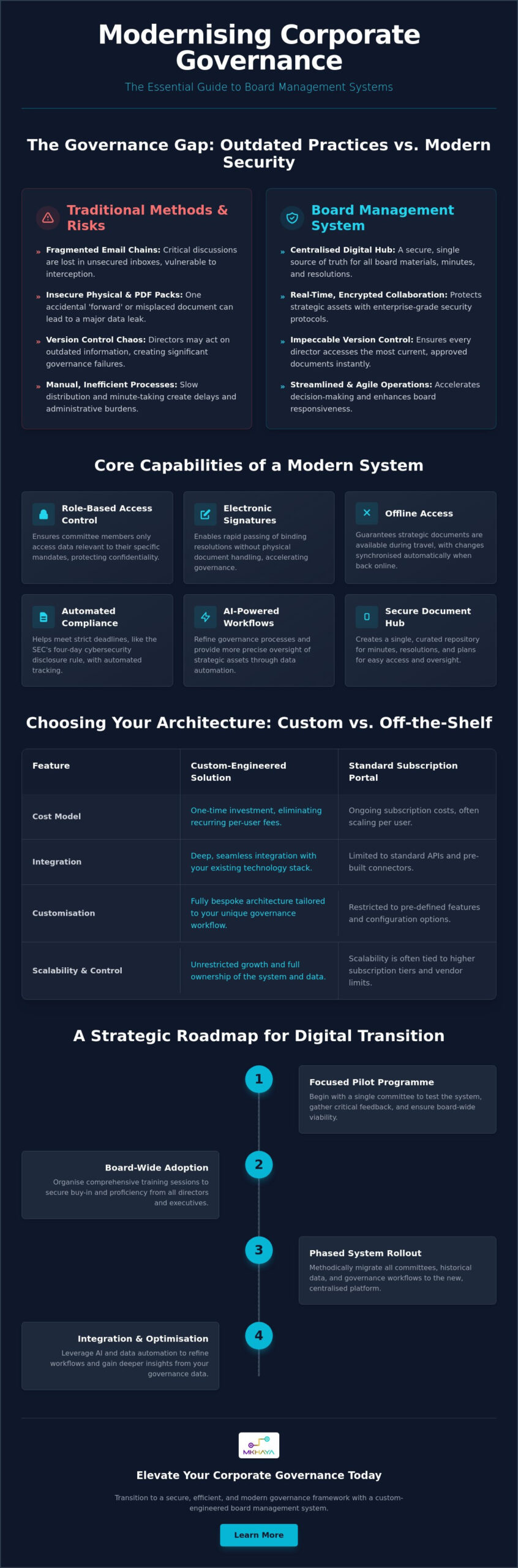
A modern Board Management system serves as a secure, centralised digital hub where directors and executives converge to steer their organisations. It represents a fundamental shift from the era of cumbersome physical board packs to a world of real-time, encrypted digital collaboration. This transition isn’t just about convenience; it’s a strategic necessity to meet the rigorous transparency and accountability standards expected in 2026. This shift eliminates the lag time associated with printing and distribution, allowing for a more agile response to market shifts.
Digital transformation at the board level directly accelerates decision-making speed. When information is accessible instantly, leadership can pivot with precision rather than waiting for the next courier delivery. To better understand how these platforms function in practice, watch this helpful overview:
Moving Beyond Risky Email and Paper Processes
Relying on standard email to circulate sensitive PDF packs creates significant security vulnerabilities. Emails are easily intercepted or accidentally forwarded, putting proprietary data at risk. Manual processes often suffer from version control issues, where directors might review outdated financial figures, leading to potential governance failures. When multiple versions of a resolution exist across different devices, the risk of approving the wrong document becomes a tangible threat to corporate integrity. We define Digital Governance as the integration of technology to uphold transparency and fiduciary duty.
By adopting a dedicated system, boards align themselves with modern corporate governance principles, ensuring that every document is protected by enterprise-grade encryption rather than sitting in an unsecured inbox. This proactive approach to security is a hallmark of a reliable partnership between technology and leadership.
The Strategic Value of Centralised Governance
A centralised system creates a “single source of truth” for minutes, resolutions, and strategic plans. This clarity is invaluable for non-executive directors who need to provide effective oversight between formal meetings. Instead of searching through archived threads, they can access a curated repository of historical data at any time, which promotes a culture of steady, forward-looking ambition.
This structured approach supports the principles of the King IV Report on Corporate Governance by fostering an ethical culture and effective leadership. Using a Board Management system helps ensure your organisation remains a stable anchor amidst rapid technological change. For businesses looking to enhance their technical infrastructure, exploring digital transformation strategies is often the first step toward long-term stability and mutual success.
Core Capabilities of a Modern Board Management System
Selecting a Board Management system requires a focus on features that empower executive decision-making rather than merely digitising paperwork. At the executive level, certain capabilities are non-negotiable for maintaining the pace of modern business. These systems act as a modern solution for smarter governance, providing a framework where complex data becomes actionable insight. Key features include:
Electronic Signatures: Enables rapid passing of binding resolutions without physical document handling.
Role-Based Access Control: Ensures committee members only access data relevant to their specific mandates.
Offline Access: Guarantees that strategic documents are available for review during travel, synchronising once back online.
This level of agility is particularly vital when responding to the SEC’s 2026 requirement to disclose material cybersecurity incidents within four business days. Precision in access is equally critical. Role-based access prevents information overlap and maintains the confidentiality required for high-stakes discussions. For directors frequently travelling across the country, the ability to work without a constant connection ensures that preparation for the next session is never interrupted.
Advanced Security and Data Sovereignty
Security is the foundation of any governance platform. A reliable system must employ AES-256 encryption and multi-factor authentication (MFA) to guard against unauthorised entry. For South African firms, data sovereignty is a primary concern under POPIA regulations. Keeping sensitive board data within local borders or ensuring it resides in jurisdictions with equivalent protection is a legal necessity. Implementing detailed audit trails adds another layer of accountability, providing a chronological record of who accessed which document and at what time. This transparency builds trust and ensures that the board remains a stable anchor for the organisation.
Automation and AI in the Boardroom
The integration of AI is transforming how boards function. Modern platforms now utilise AI for automated minute-taking and even sentiment analysis to gauge the tone of board discussions. This technology identifies key risks and emerging trends directly from the dialogue. Automating task tracking ensures that every resolution passed is assigned to management with clear deadlines. AI-driven summarisation reduces director cognitive load without sacrificing detail, allowing for more focused strategic debate. If you’re looking to refine these processes, our expertise in AI & data automation can help you build a more responsive governance framework.
Custom vs. Off-the-Shelf: Choosing the Right Architecture
Deciding on the right architecture for your Board Management system is a pivotal choice that shapes your organisation’s long-term agility. Whilst many firms gravitate toward subscription-based portals for their perceived speed of implementation, these often lack the depth required for complex governance structures. Custom systems, by contrast, offer unparalleled scalability. They allow you to build an environment that mirrors your specific organisational hierarchy rather than forcing your board to adapt to a vendor’s pre-set logic. This tailored approach ensures that the technology serves the board, not the other way around.
Recurring operational expenses can quietly erode budgets over time. Subscription models frequently rely on per-user fees, which effectively penalise larger committees or organisations that need to provide access to a wide range of stakeholders. By treating your governance platform as a long-term asset through custom development, you move away from the cycle of endless monthly payments. You invest in a foundation that you own entirely, ensuring that your strategic tools grow alongside your business without unexpected financial hurdles. This creates an atmosphere of steady, forward-looking ambition where you control your own digital destiny.
When Off-the-Shelf Portals Fall Short
Rigid workflows in standard portals often fail to align with a specific board charter, creating friction in high-stakes environments. There’s also the matter of security. Sharing a multi-tenant cloud environment with other firms can introduce risks that bespoke solutions naturally avoid. These generic tools also struggle with integration. Attempting to link a standard portal with your existing ERP solutions can be notoriously difficult, often resulting in fragmented data silos that hinder effective oversight. These limitations can turn a supposed solution into a technical burden that slows down executive action.
The Benefits of Bespoke Board Portals
Choosing a bespoke path gives you absolute ownership of the source code. This means you have complete control over the security roadmap, allowing for precision adjustments as new threats emerge. UI/UX design can be tailored to match the digital literacy of your specific board members, ensuring that the technology feels like a supportive partner rather than a barrier. These portals also allow for seamless integration with other custom software engineering projects, creating a unified digital ecosystem. A custom Board Management system becomes a stable anchor in a rapidly changing technological landscape, providing the reliability your leadership team deserves.
Implementing Your Board System: A Strategic Roadmap
Transitioning to a modern Board Management system is a strategic journey that requires methodical execution rather than a hurried rollout. A successful transition typically unfolds in distinct phases, beginning with the digitisation of core workflows and culminating in a fully integrated governance environment. We’ve found that a “white-glove” onboarding process is essential for executive teams. This high-touch approach ensures that directors feel supported as they adapt to new tools, reducing the friction often associated with technical change. It’s about building a partnership that values reliability and mutual success from day one.
Before a full-scale deployment, we recommend launching a pilot programme with a single subcommittee, such as the Audit or Risk committee. This allows your organisation to refine security protocols and user permissions in a controlled setting before the main board adopts the platform. Managing the migration of historical board records is equally vital. Ensuring that years of resolutions and minutes are correctly indexed provides the continuity required for effective long-term oversight, turning your archive into a searchable strategic asset.
Assessing Governance Workflows
The first step involves mapping your existing meeting cycle, from initial agenda preparation through to final minute approval. This process often reveals hidden bottlenecks in your current digital transformation journey. By consulting closely with the Board Secretary, you can identify specific automation triggers that will save time, such as automated reminders for action items or instant distribution of updated board packs. This level of precision ensures the system mirrors your actual behaviour rather than imposing an external logic that doesn’t fit your culture.
Ensuring High Adoption Rates
High adoption rates depend on an intuitive interface that respects the limited time of busy executives. If the system is too complex, directors will naturally revert to familiar, less secure methods. Providing dedicated support is a non-negotiable requirement, ensuring assistance is available regardless of a director’s location or time zone. Finally, setting clear policies for the decommissioning of paper-based packs creates a necessary momentum for change. This shift positions your business as a stable anchor in a rapidly changing technological landscape.
Mkhaya MK stands as a dedicated partner for organisations navigating the complexities of high-stakes digital environments. We specialise in building secure, high-end enterprise applications that protect your strategic integrity at every level. By integrating AI & data automation with established governance best practices, we create tools that do far more than merely store documents. A custom Board Management system engineered by our team acts as a sophisticated engine for oversight, ensuring that every resolution and record is handled with absolute precision. Our collaborative process is deeply client-centric, ensuring the final architecture reflects your board’s unique culture and constitutional requirements whilst fostering an environment of professional confidence.
Partnering with a national firm provides the stability and local insight necessary to navigate complex South African regulations like POPIA and the King IV Report with ease. We don’t believe in one-size-fits-all solutions; instead, we focus on a supportive partnership that prioritises your specific journey. This long-term commitment allows us to act as a stable anchor for your leadership team, offering the reliability required to manage sensitive corporate data amidst a shifting technological landscape. We work alongside you to ensure that each technical capability is immediately linked to a practical benefit, driving mutual success through methodical execution.
Bespoke Engineering for Executive Needs
We build secure portals designed to integrate seamlessly with your existing cloud solutions, ensuring a cohesive digital strategy across your entire organisation. This creates a unified ecosystem where data flows securely between departments without compromising executive confidentiality or creating technical silos. Our engineering focus remains rooted in precision, stability, and long-term partnership, ensuring your system remains robust as your organisation scales. Mkhaya MK serves as a visionary yet practical guide in the South African tech landscape, helping you navigate the complexities of modern digital governance.
Ready to Modernise Your Boardroom?
The transition from operational friction to strategic governance excellence begins with a deliberate move toward modernisation. By moving away from fragmented, risky processes, you empower your directors to focus on high-level strategy rather than administrative hurdles. We encourage you to reach out for a consultation to discuss your specific board requirements and explore how a tailored Board Management system can benefit your leadership team. Visit our contact page today for a bespoke evaluation of your governance needs and take the first step toward a more secure digital future.
Securing Your Strategic Future
Modernising your governance is a journey from operational vulnerability toward precise, data-driven leadership. Transitioning from fragmented email chains to a centralised hub eliminates security risks whilst significantly enhancing executive decision-making speed. Choosing a bespoke Board Management system ensures your technology aligns perfectly with your organisational charter, providing a stable anchor in a rapidly changing corporate landscape.
At Mkhaya MK, we bring end-to-end digital transformation expertise and specialised experience in complex ERP and Loan Management systems to every project. Our national South African presence ensures we understand the nuances of local compliance, making your platform a reliable asset for years to come. We value the collaborative relationship that drives mutual success through methodical execution and professional confidence.
What is a board management system and why is it more secure than email?
A Board Management system is a secure, centralised digital hub designed specifically for executive collaboration. Unlike standard email, which is vulnerable to interception and accidental forwarding, these systems use AES-256 encryption and multi-factor authentication to protect sensitive data. This structure ensures that your strategic discussions remain confidential and accessible only to authorised individuals, providing a level of security that traditional inboxes simply cannot match.
How does a board portal help with POPIA compliance in South Africa?
A board portal assists with POPIA compliance by ensuring that sensitive personal information is handled within a secure, audited environment. By maintaining data sovereignty and providing detailed audit trails, you can track exactly who accessed specific documents and when. This transparency is vital for meeting South African regulatory requirements and demonstrates a proactive commitment to protecting director and stakeholder data whilst maintaining organisational integrity.
Can we integrate our existing ERP or financial systems with a custom board portal?
Yes, bespoke systems are specifically designed to integrate with your existing ERP or financial systems. This connectivity allows for the real-time flow of data into board reports, creating a single source of truth for your leadership team. By linking these systems, you eliminate manual data entry and ensure that directors are always reviewing the most current financial figures during their strategic deliberations.
What features should we prioritise for directors who are not tech-savvy?
You should prioritise an intuitive UI/UX design that focuses on clarity and ease of use. Features like one-click access to board packs, simple annotation tools, and a clear, searchable document library are essential for directors who may not be tech-savvy. A clean interface reduces cognitive load and ensures that the technology feels like a supportive partner rather than a barrier to effective governance.
How long does it typically take to develop and deploy a custom board management system?
The development and deployment of a custom Board Management system typically takes several months, depending on the complexity of your specific requirements. We recommend a phased approach, starting with a discovery period to map your unique workflows, followed by a pilot programme for a single subcommittee. This methodical progression ensures a stable rollout and allows for refinement before the system is introduced to the full board.
Is it possible to use the board management system on mobile devices and tablets?
Modern board systems are fully responsive and designed for use on both mobile devices and tablets. This flexibility allows directors to review board packs and sign resolutions whilst travelling or working remotely. High-end systems also include offline access, ensuring that documents can be downloaded securely and reviewed even without a constant internet connection, with changes synchronising automatically once back online.
How do we handle voting and resolutions within a digital board system?
Voting and resolutions are managed through integrated digital modules that support secure, binding electronic signatures. Directors can cast their votes on specific items directly within the platform, with the results automatically recorded in the minutes. This process streamlines the approval of resolutions between formal meetings, ensuring that executive actions are documented accurately and remain legally compliant with your board charter.
What happens to our historical board documents during the migration process?
Your historical board documents are carefully indexed and migrated into the new centralised repository during the implementation phase. This process ensures that past minutes, resolutions, and strategic plans remain accessible for future reference and oversight. By organising your archive within the new system, you transform decades of physical or fragmented digital records into a searchable, secure strategic asset for the organisation.
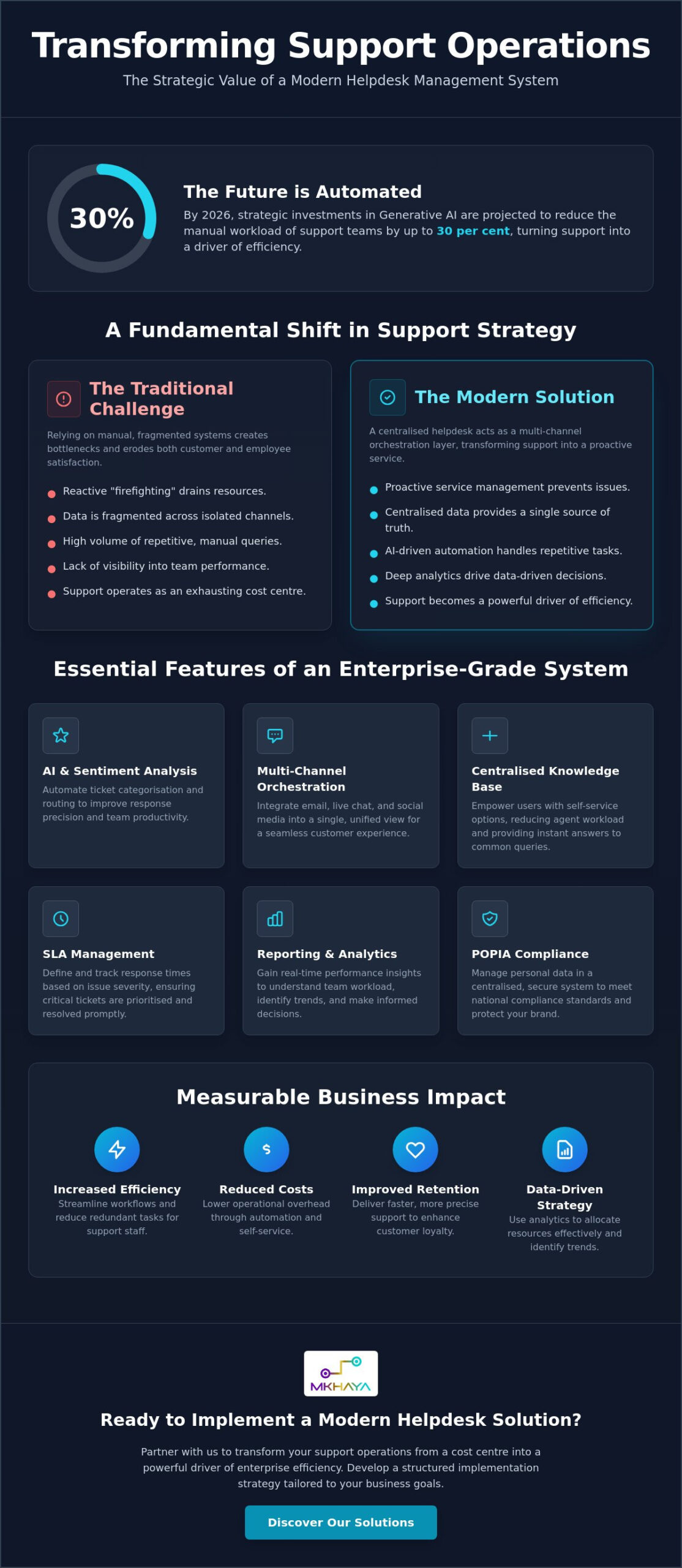
By 2026, strategic investments in Generative AI are projected to reduce the manual workload of support teams by up to 30 per cent. For many South African enterprises, the daily reality still involves managing a high volume of repetitive queries and fragmented data that feels impossible to organise. You likely recognise the frustration of losing visibility into team performance whilst customer information remains scattered across isolated channels. It’s a common challenge that often turns a vital service into an exhausting cost centre.
This guide demonstrates how a modern helpdesk management system can transform those hurdles into a streamlined driver of digital efficiency. By aligning technology with your specific business goals, you can build a support structure that offers both precision and scalability. We will examine the essential features of a helpdesk management system, the impact of recent POPIA enforcement on data handling, and the practical steps to integrate these tools into your existing workflows for measurable success.
Key Takeaways
Learn how to transition from reactive firefighting to a proactive service model by treating your support platform as a multi-channel orchestration layer.
Discover how AI-driven automation and sentiment analysis can refine ticket categorisation to improve response precision and team productivity.
Evaluate the long-term value of a helpdesk management system by comparing the total cost of ownership between custom-built and off-the-shelf solutions.
Develop a structured implementation strategy by auditing current bottlenecks and organising cross-functional teams to define precise system requirements.
Understand how strategic digital transformation converts support operations from a traditional cost centre into a powerful driver of enterprise efficiency.
What is a Helpdesk Management System and Why Does it Matter?
A modern helpdesk management system acts as more than a simple repository for customer complaints. It serves as a sophisticated orchestration layer that synchronises communications across every touchpoint your enterprise maintains. In the past, support teams often operated in a state of reactive firefighting, scrambling to address issues as they flared up. Today, the transition toward proactive service management allows businesses to identify patterns and resolve underlying problems before they escalate into systemic failures.
Relying on manual, email-based support poses a significant risk to South African business continuity. When critical data is trapped in individual inboxes, transparency vanishes and response times suffer. This fragmentation doesn’t just frustrate customers; it erodes employee morale as staff members struggle with redundant tasks and lack the tools to succeed. By centralising these interactions, you create a stable foundation for both customer retention and internal operational excellence.
To better understand how these systems function in a professional environment, watch this helpful video:
The Core Components of Modern Ticketing
Precision in support requires an intelligent structure. A robust helpdesk management system automates ticket routing and prioritisation based on urgency and agent expertise. This ensures that high-priority issues reach the right specialist instantly, reducing the “ping-pong” effect often seen in manual systems. This approach bridges the gap between external customer care and internal employee support, ensuring that your IT Service Management (ITSM) remains as agile as your client-facing departments.
Centralised knowledge bases also empower users through self-service options. This allows them to find answers to common queries without needing direct intervention, which lightens the load on your staff and builds trust through instant resolution. Multi-channel integration brings email, live chat, and social media into a single view. Your team never misses a conversation regardless of where it starts, creating a seamless experience that reflects a modern, professional brand.
Business Impact: Beyond the IT Department
The benefits of a structured support platform extend far beyond technical troubleshooting. These systems provide deep analytics that drive data-driven decision making, helping leadership understand where resources are best allocated. By increasing agent efficiency through AI and data automation, enterprises can significantly reduce operational costs whilst maintaining high service standards. This efficiency isn’t about cutting corners; it’s about refining the customer journey to ensure long-term stability.
These tools are also essential for supporting national compliance. With the Information Regulator intensifying monitoring of the Protection of Personal Information Act (POPIA) as of March 2026, having a centralised, secure way to manage personal data is no longer optional. It’s a fundamental pillar of digital transformation that protects your brand’s reputation. Implementing a reliable system provides a stable anchor in a rapidly changing technological landscape, allowing your business to move forward with quiet confidence.
Essential Features of an Enterprise-Grade System
Choosing a helpdesk management system involves more than comparing tick-box features. It requires a focus on the specific tools that allow your team to operate with precision at scale. For South African enterprises, the challenge isn’t just volume; it’s the complexity of maintaining high standards whilst resources are stretched. A truly enterprise-grade system provides the structural support needed to ensure every customer interaction is handled with professional care.
Customisable Service Level Agreement (SLA) management acts as the engine of accountability within these platforms. By defining and tracking response times based on issue severity, you ensure that critical tickets never languish in a queue. This transparency is bolstered by robust reporting dashboards that offer real-time performance monitoring. Integration with your existing ERP and CRM systems ensures that agents have a 360-degree view of the customer, linking support history directly to business outcomes.
AI and Automation: The New Standard
Robotic Process Automation (RPA) eliminates the burden of repetitive data entry, allowing your specialists to focus on high-value problem solving. AI chatbots complement this by providing immediate first-level support resolution for common queries, ensuring customers receive answers without delay. AI-driven ticketing functions as a predictive service tool that anticipates user needs based on historical data patterns. Integrating these capabilities through AI and data automation ensures your support remains agile and cost-effective.
Security and Collaboration Tools
Role-based access control (RBAC) restricts data visibility to authorised personnel only, which is essential for maintaining POPIA compliance. Beyond security, internal collaboration tools like ‘parent-child’ ticket linking enable teams to break down complex issues without losing the broader context. Internal notes allow agents to share insights privately, ensuring a seamless handover between departments. Audit trails provide a chronological record of every action taken, ensuring total regulatory transparency and long-term stability for your helpdesk management system.
The Strategic Choice: Custom-Built vs. Off-the-Shelf
When to Choose a SaaS Solution
Software-as-a-Service (SaaS) platforms are often ideal for smaller teams with standard support requirements. They allow for faster initial deployment, which is helpful if you need a basic ticketing structure in place immediately. However, users frequently encounter “feature bloat,” where they pay for complex modules that remain untouched. This creates a trade-off between immediate convenience and the long-term customisation needed to maintain a competitive edge. If your requirements are standard and your team is small, the convenience of a subscription might outweigh the need for a bespoke build.
The Power of Custom Software Engineering
When your business requirements exceed the capabilities of generic platforms, custom software engineering provides a path to long-term stability. Building a system that mirrors your exact internal processes ensures that the technology adapts to your team, not the other way around. This approach allows for seamless integration with bespoke legacy applications, creating a unified digital environment that supports sustainable growth. By investing in a tailored helpdesk management system, you eliminate recurring per-user fees and gain a proprietary asset that evolves alongside your enterprise. This level of precision ensures that your support infrastructure remains a stable anchor in a rapidly changing technological landscape.
Planning Your Helpdesk Implementation Strategy
Successful deployment of a helpdesk management system begins long before the first ticket is logged. You must first audit your current support behaviour to identify the primary bottlenecks that slow down resolution times. Are your agents manually re-entering data, or is information frequently lost between departments? By organising a cross-functional team to define system requirements, you ensure that the final solution serves the entire enterprise rather than just the IT desk. This collaborative approach builds internal buy-in and ensures the technology aligns with your broader business goals.
Developing a phased rollout plan is essential to minimise operational disruption whilst your team adapts to new workflows. Instead of a “big bang” launch, introduce the system to specific departments or regions first. This allows you to refine the configuration based on real-world usage and feedback. Establish clear key performance indicators (KPIs) such as First Response Time (FRT) and Customer Satisfaction Score (CSAT) to measure success. These metrics provide the data-driven evidence needed to justify the investment and demonstrate the system’s impact on enterprise efficiency.
Data Migration and Integration
Moving to a new platform offers a rare opportunity to purge outdated or redundant information. Cleaning legacy data before importing it prevents “garbage in, garbage out” scenarios that can undermine your new helpdesk management system. Ensuring secure API connections with existing business tools is equally vital for maintaining a unified workflow across your organisation. This technical alignment is a core component of digital transformation consulting, providing the connectivity needed for long-term scalability and precision.
User Training and Change Management
System adoption hinges entirely on the user experience. Designing an intuitive UI/UX encourages agents to embrace the new tool rather than resisting the change. Comprehensive documentation for both agents and end-users provides a stable reference point that reduces initial anxiety during the transition. Feedback loops play a critical role in continuous system refinement; your agents are on the front lines, and their insights will help you polish the platform over time. This iterative process ensures the system remains a supportive partner in your team’s daily success.
If you are ready to move beyond fragmented support and build a unified service engine, contact our team today to discuss a tailored implementation strategy for your enterprise.
Partnering with Mkhaya MK for National Tech Excellence
Mkhaya MK positions itself as a visionary yet practical guide for enterprises seeking national tech excellence. We understand that a helpdesk management system is more than a tool; it’s a fundamental pillar of your digital journey. Our team provides end-to-end digital transformation that moves from high-level strategic concepts to methodical execution. By focusing on the unique challenges faced by South African businesses, we ensure that your support infrastructure is both resilient and forward-looking. We project a persona of quiet confidence, valuing transparency and precision over flashy claims.
Our expertise in AI and data automation allows us to build smarter support structures that turn raw data into actionable business insights. This national reach ensures that your enterprise receives support tailored to the local landscape, including strict adherence to POPIA requirements and other regional standards. We act as a stable anchor in a rapidly changing technological environment, providing the reliability you need to grow without friction.
Bespoke Solutions for Complex Operations
We design custom applications that scale alongside your growth, ensuring that your infrastructure never becomes a bottleneck. By integrating helpdesk logic into broader ERP solutions, we create a unified ecosystem where support data informs procurement, finance, and operations. This connectivity allows for a 360-degree view of your business health. Our custom AI implementations go beyond simple chatbots; we build intelligent systems that reduce support overhead by predicting user needs and automating complex ticket routing. This level of precision ensures that your helpdesk management system remains a high-performing asset rather than a recurring expense.
Extending Your Team with Expert Talent
Finding the right technical skills shouldn’t be a hurdle to your progress. Through staff augmentation, we provide access to skilled developers who integrate seamlessly with your internal teams. This flexible model allows you to scale your technical capacity as needed without the long-term overhead of permanent hiring. We also provide ongoing maintenance and cloud optimisation to ensure peak performance and stability. Our goal is to act as a supportive partner, offering the guidance you need to navigate complex digital shifts. If you are ready to refine your support operations, contact Mkhaya MK to discuss your custom helpdesk strategy and discover how we can drive your digital efficiency forward.
Empowering Your Enterprise Through Strategic Support
Implementing a modern helpdesk management system is a significant step toward organisational maturity. It moves your team beyond the limitations of manual ticketing and into a space of data-driven precision. By focusing on essential features like AI-driven automation and robust SLA tracking, you ensure your support infrastructure grows as a stable anchor for your business. The choice between custom engineering and off-the-shelf tools depends on your specific business logic and long-term scalability needs.
Mkhaya MK provides the end-to-end digital transformation expertise required to build these sophisticated environments. With our national South African service coverage and specialised focus on AI and custom software engineering, we act as a reliable partner in your technical journey. We value transparency and methodical execution, ensuring that your transition into a high-efficiency support model is both seamless and sustainable.
What is the difference between a helpdesk and a service desk?
A helpdesk primarily handles tactical, end-user technical issues, whereas a service desk manages the entire lifecycle of IT services within an enterprise. While the helpdesk provides quick fixes for immediate problems, the service desk focuses on broader business goals and strategic service delivery. This distinction ensures your team isn’t just reacting to problems but is also supporting long-term operational stability.
Can a helpdesk management system integrate with our existing CRM?
Integration with your existing CRM is entirely possible through secure API connections that synchronise customer data across platforms. This connectivity allows support agents to view purchase history and previous interactions directly within the helpdesk management system. By linking these tools, you eliminate data silos and provide a more personalised, efficient service experience for every client.
How does AI improve the efficiency of a helpdesk?
AI improves efficiency by automating the categorisation and prioritisation of incoming tickets based on urgency and historical patterns. It also powers intelligent chatbots that provide immediate answers to repetitive questions without human intervention. This reduces the manual workload on your staff, allowing them to focus on high-value tasks that require human precision and complex problem-solving.
Is it better to build a custom helpdesk or buy a SaaS subscription?
Choosing between custom-built and SaaS depends on your unique business requirements and long-term growth strategy. SaaS solutions offer rapid deployment for standard workflows, but a custom helpdesk management system provides total control over your business logic. Custom builds also eliminate recurring per-user subscription fees, which often makes them a more stable financial choice as your enterprise scales.
How long does it typically take to implement a new helpdesk system?
Implementation timelines vary based on the complexity of your requirements and the volume of legacy data you need to migrate. A standard cloud-based setup might take several weeks, while a bespoke enterprise solution typically requires three to six months for full deployment. A phased rollout strategy helps manage this transition by minimising disruption to your daily operations.
How do helpdesk systems ensure data security and POPIA compliance?
These systems ensure POPIA compliance by implementing role-based access control and detailed audit trails that track every data interaction. Encryption and secure local data residency further protect sensitive personal information from unauthorised access. These measures provide the transparency and accountability required by the Information Regulator to maintain national standards of data privacy.
What are the most important KPIs to track in a helpdesk system?
The most critical metrics include First Response Time (FRT), Customer Satisfaction Score (CSAT), and the average time to resolution. Tracking these KPIs allows leadership to identify bottlenecks and measure the impact of service improvements over time. Consistent monitoring ensures your support team remains aligned with your enterprise’s broader performance targets and quality standards.
Can we use a helpdesk system for internal IT support only?
Yes, many South African enterprises use these platforms specifically for internal IT Service Management (ITSM) to support their own employees. A dedicated internal system streamlines hardware requests, software troubleshooting, and access management within the organisation. This focus on internal efficiency ensures that your staff has the technical support they need to remain productive without unnecessary delays.
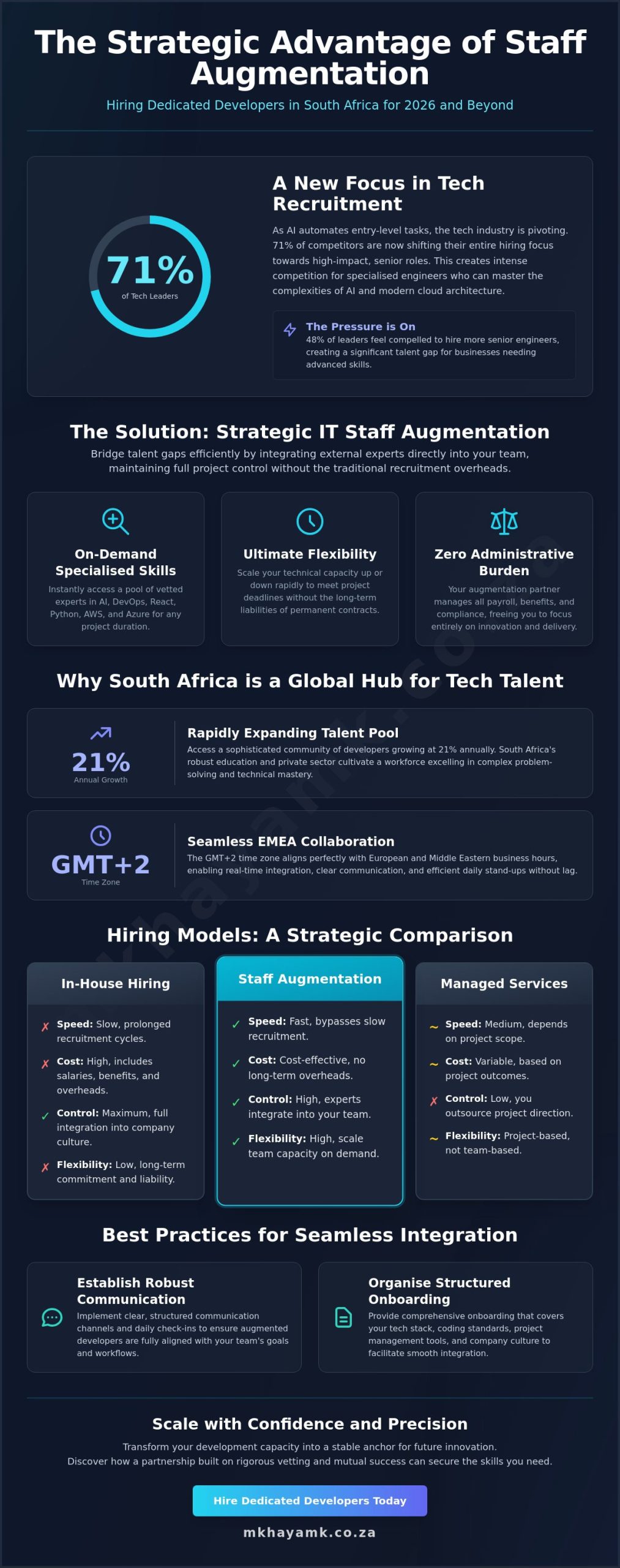
Could your business thrive if 71% of your competitors suddenly shifted their entire hiring focus toward high-impact, senior roles? As we move through 2026, tech leaders are moving away from broad recruitment to find specialised engineers who can master the complexities of AI and cloud architecture. You’ve likely felt the strain of intense local talent competition and the frustration of recruitment cycles that move far too slowly for your project deadlines. When you decide to hire dedicated developers in South Africa, you’re doing more than just filling a vacancy. You’re accessing a talent pool growing at 21% annually, offering a sophisticated blend of technical mastery and operational agility.
We recognise that scaling a technical team often feels like a difficult choice between quality and cost. This guide demonstrates how strategic staff augmentation provides a stable bridge to your digital goals. You’ll discover how to access top-tier software engineering talent, reduce your operational overheads, and integrate experts into your workflows with precision. We’ll explore flexible cost management and the specific steps to secure the AI and DevOps skills your next phase of growth requires, ensuring your organisation remains a stable anchor in a changing technological world.
Key Takeaways
Modernise your technical capacity by transitioning from rigid recruitment to on-demand staff augmentation, allowing for rapid scaling in a competitive 2026 market.
Leverage the GMT+2 time zone and exceptional engineering standards to hire dedicated developers in South Africa who integrate seamlessly with EMEA-based teams.
Determine when to utilise staff augmentation versus managed services to ensure your project receives the precise level of oversight and control required.
Establish robust communication channels and structured onboarding processes to facilitate the smooth integration of specialised talent into your existing workflows.
Discover how a partnership built on rigorous vetting and mutual success can transform your development capacity into a stable anchor for future innovation.
Understanding IT Staff Augmentation Services in the South African Context
In 2026, the traditional model of permanent recruitment is no longer the default for agile enterprises. Forward-thinking organisations are turning to Understanding IT Staff Augmentation as a sophisticated strategy to bridge talent gaps. This approach allows you to integrate external experts directly into your internal teams, maintaining full control over your project direction whilst outsourcing the complexities of recruitment and HR. When you choose to hire dedicated developers in South Africa, you’re not just filling a seat. You’re injecting high-level expertise from a community growing at 21% annually into your workflow to ensure your digital products remain competitive.
To better understand how this model functions in practice, watch this helpful video:
The Core Components of Modern Staff Augmentation
Modern augmentation focuses on immediate access to specialised skill sets such as React, Python, AWS, and Azure. You can choose between short-term engagements for specific project milestones or long-term team extensions that feel like an organic part of your company. A key benefit is that the service provider manages all administrative overheads. They handle payroll, benefits, and statutory compliance, leaving your leadership team free to focus on innovation. This creates a rhythmic momentum where your internal staff can focus on core business logic whilst augmented experts handle specialized execution.
Why South African Businesses are Choosing Augmentation in 2026
The local market is currently facing a talent paradox. Whilst the developer population is expanding, there’s a critical shortage of senior-level expertise in AI and DevOps. Since 71% of tech leaders have shifted their hiring focus to high-impact roles, the competition for these specialists is fierce. 48% of leaders now feel pressure to hire more senior engineers as AI absorbs entry-level tasks. Augmentation allows businesses to meet aggressive digital transformation deadlines by bypassing slow recruitment cycles. It offers a cost-effective way to secure senior talent without the overheads associated with full-time executive hires.
Why South Africa is a Global Hub for Dedicated Development Teams
South Africa has emerged as a cornerstone of global technical talent, offering a unique blend of high-end expertise and strategic convenience. It’s no longer just about finding lower costs; it’s about finding a partner that understands the pace of modern business. The country’s education system and robust private sector have cultivated a workforce that excels in complex problem-solving. When you decide to hire dedicated developers in South Africa, you’re engaging with a community that prioritises precision and long-term stability over quick, superficial fixes. This mindset ensures that your technical debt remains low whilst your innovation remains high.
One of the most significant advantages is the GMT+2 time zone. This alignment is perfect for EMEA collaboration, allowing for seamless, real-time integration into your daily stand-ups and sprint cycles. There’s no lag in communication, which is often the downfall of offshore projects. Coupled with high English proficiency and a business culture that mirrors Western standards, the integration process feels natural and frictionless. This cultural alignment ensures that project managers and stakeholders spend less time explaining context and more time driving results. You aren’t just hiring a remote worker; you’re gaining a teammate who shares your professional values.
Technical Excellence and Innovation
The local ecosystem is thriving, particularly in the field of custom software development. South African engineers have built a reputation for excellence in high-stakes sectors like fintech and digital lending. This isn’t accidental. It’s the result of a concentrated move towards AI-driven automation and robust data architectures. As organisations look to future-proof their operations, they find that South African teams are already well-versed in the cloud-native technologies and AI fluencies that are becoming baseline expectations in 2026. This forward-looking ambition makes the region a natural fit for businesses aiming to lead their industries.
Economic and Operational Advantages
The economic logic is compelling. Whilst the quality of work rivals that of Silicon Valley or London, the operational costs are significantly more manageable. Businesses often report savings of 50-70% compared to local hires in North America or Europe, based on current 2026 market data. This financial efficiency doesn’t come at the cost of infrastructure. South Africa boasts world-class connectivity and a legal framework that provides familiarity and protection for international contracts. It’s a stable anchor in a rapidly changing technological landscape, providing the reliability you need to scale with confidence. If you’re ready to explore these benefits for your own team, you can learn more about our engagement process to see how we can support your growth.
Strategic Comparison: Staff Augmentation vs Managed Services and In-house Hiring
Deciding how to grow your technical team requires a careful balance between immediate speed and long term stability. Building an internal team from scratch offers deep cultural alignment, yet it often comes with significant delays. In 2026, the average recruitment cycle for a senior engineer can exceed several months; a timeline that frequently clashes with urgent project milestones. Whilst permanent hires provide excellent knowledge retention, the high competition for local talent means you might spend more time recruiting than actually building software.
Managed services offer an alternative where you outsource an entire project outcome to an external partner. This model is effective for standalone products with fixed requirements. However, if you need to hire dedicated developers in South Africa to work alongside your existing staff, staff augmentation is the superior strategic choice. It allows you to maintain direct oversight of the development process whilst benefiting from external expertise. This ensures that the code quality and architectural decisions remain within your control, preventing the “black box” effect often associated with traditional outsourcing.
When to Choose Staff Augmentation
Staff augmentation is the ideal solution when you need to close specific skill gaps within an existing agile team. If your current developers are proficient in core logic but lack deep expertise in AI or cloud-native DevOps, bringing in a dedicated specialist provides an immediate boost. This model is also perfectly suited for projects with fluctuating workloads. You can scale your capacity during intensive development phases and reduce it once the project moves into maintenance. It offers the precision of a surgical strike, allowing you to add exactly the “muscle” you need without disrupting your established internal culture.
The Financial Reality: Reducing IT Costs
The primary objection to augmentation is often the perceived higher hourly rate compared to a permanent salary. However, a true cost analysis reveals that augmentation is frequently more economical. By choosing this model, you eliminate recruitment fees, training expenses, and the substantial costs of equipment and office overheads. You also avoid the long term liabilities associated with permanent contracts in South Africa’s complex labour market. This shift allows you to reduce IT costs with staff augmentation by converting fixed labour costs into variable operational expenses. It provides your business with the financial agility to pivot resources as market demands change, ensuring that every Rand spent contributes directly to technical output.
Best Practices for Integrating Augmented Developers into Your Tech Stack
Successful staff augmentation depends on more than just technical skill; it requires a deliberate strategy for integration. When you hire dedicated developers in South Africa, the goal is to create a unified team where the boundary between internal and external staff becomes invisible. This synergy doesn’t happen by accident. It’s the result of structured processes that align every new member with your internal coding standards and DevOps culture. By setting clear KPIs and performance metrics from the first day, you establish a baseline for mutual success and accountability. It’s about creating a rhythmic momentum that drives your technical roadmap forward.
Step 1: Onboarding and Cultural Alignment
Onboarding is the foundation of your partnership. Start by introducing developers to your overarching company vision and the specific project roadmap. This context allows them to make informed technical decisions that support long-term goals rather than just immediate tickets. You’ll need to provide immediate access to necessary cloud solutions and security protocols to prevent early delays. Establishing meeting cadences and reporting structures early ensures everyone is moving at the same pace. When developers understand the “why” behind the “what”, their contribution becomes significantly more impactful and purposeful.
Step 2: Technical Integration and Tooling
Technical friction can stall even the most talented engineers. Ensure your augmented staff have seamless access to version control systems like GitHub or GitLab from the outset. Integrate them into your existing Slack, Jira, or Trello workflows to maintain transparent communication. To protect your software engineering standards, establish a robust peer review process. This doesn’t just maintain code quality; it also facilitates knowledge transfer between your internal team and your augmented developers. It’s about building a collective intelligence that benefits the entire organisation, ensuring that every line of code meets your specific architectural requirements.
Step 3: Continuous Feedback and Scaling
The final phase of integration is refinement. Implement regular check-ins to identify and remove bottlenecks before they impact your timelines. You can use data from AI and automation tools to track productivity and identify areas for improvement. This data-driven approach allows you to scale the team up or down based on real-time project requirements with complete confidence. It ensures your organisation remains agile, pivoting resources as your market demands shift. If you’re ready to refine your technical capacity with precision, explore our staff augmentation services to find the right fit for your next project.
Scaling with Confidence: The Mkhaya MK Approach to Staff Augmentation
Scaling a technical team requires a partner who values your long-term stability as much as your immediate output. When you choose to hire dedicated developers in South Africa through Mkhaya MK, you’re engaging with a visionary partner in digital transformation. We move beyond the “body-shopping” model that often leaves enterprises with technical debt or misaligned goals. Our approach is built on a foundation of professional confidence and supportive partnership, ensuring that every expert we place is both a technical master and a strategic asset. We value transparency and methodical execution, providing you with the reliability needed to navigate a changing technological landscape.
Our commitment to your success is reflected in the Mkhaya MK Guarantee. This promise is built on three pillars: reliability, transparency, and a long-term investment in your journey. We don’t just provide resources; we provide a stable anchor. Our vetting process is exceptionally rigorous, going far beyond a simple checklist of coding languages to include business acumen. Our developers don’t just work on isolated features; they understand the intricate dependencies of complex enterprise environments. Whether you’re refining an ERP solution or building a custom Loan Management System, our staff brings the industry-specific knowledge required to avoid common architectural pitfalls.
More Than Just Code: A Partnership for Success
We align our staff augmentation services with your specific strategic goals to ensure that every hire contributes to your bottom line. It isn’t enough to just execute tasks; we provide developers who are ready to innovate and challenge existing processes for the better. Our national reach allows us to tap into the deepest talent pools across South Africa, ensuring we find the right fit for your unique company culture. By focusing on mutual success, we build relationships that last years, not just months. This forward-looking ambition is what sets our partnerships apart from standard, transactional outsourcing arrangements. It’s about building a collective intelligence that stays within your organisation.
Start Your Journey with Mkhaya MK
The path to a stronger, more agile team begins with a clear assessment of your current technical gaps. We invite you to initiate a consultation where we’ll analyse your requirements, project deadlines, and desired outcomes. Our methodical matching process ensures that the talent we provide isn’t just technically capable but also culturally aligned with your internal staff. This precision reduces friction and accelerates your time-to-market, allowing your business to pivot as market demands shift. When you’re ready to move forward with a partner that values integrity and commitment, contact us today to scale your technical team with precision and discover how we can help you build for the future.
Building Your Technical Future with Strategic Partnership
We’ve explored how the shift toward high-impact, senior roles in 2026 makes traditional recruitment a bottleneck for growth. By choosing to hire dedicated developers in South Africa, you secure a competitive advantage through GMT+2 alignment and world-class engineering standards. This model offers the precision to close skill gaps in AI and cloud architecture whilst maintaining the flexibility to manage costs effectively. It’s about more than just filling a gap; it’s about constructing a stable anchor for your long-term innovation.
Mkhaya MK stands as your visionary guide in this journey. Our vetted network of senior South African developers brings deep expertise in AI, Cloud, and Custom Software Development to your most ambitious projects. With a proven track record in national digital transformation projects, we ensure your team scaling is methodical and rooted in mutual success. Partner with Mkhaya MK to scale your engineering team today and turn your technical vision into a stable reality. We look forward to building a resilient future alongside your organisation.
Frequently Asked Questions
What is the difference between IT staff augmentation and project outsourcing?
Staff augmentation integrates external experts directly into your internal team under your direct management, whilst project outsourcing involves handing over an entire project to a provider for a specific outcome. Augmentation provides you with greater control over daily workflows and architectural decisions. It’s a collaborative approach that allows you to maintain oversight whilst injecting specialised talent into your existing processes.
How long does it take to hire a dedicated developer in South Africa through Mkhaya MK?
We typically match your organisation with vetted technical talent within two to four weeks. This timeline depends on the complexity of the required skill set and your specific project needs. Our methodical approach ensures we move faster than traditional recruitment cycles, which often exceed three months in the current 2026 market, allowing you to maintain project momentum without long delays.
Can I hire remote developers for short-term projects only?
You can certainly engage developers for short-term projects to address immediate technical hurdles or seasonal workload surges. Our models are built for flexibility, allowing you to scale your capacity up or down as your roadmap requires. This agility ensures you only pay for the expertise you need when you need it, converting fixed labour costs into manageable operational expenses.
How do you ensure the quality and vetting of your developers?
We employ a rigorous multi-stage vetting process that evaluates technical mastery, business acumen, and cultural alignment. Every candidate undergoes live coding assessments and architectural reviews to ensure they can handle complex enterprise systems. When you hire dedicated developers in South Africa through us, you’re accessing a network of professionals who have been tested for reliability and long-term stability.
Is staff augmentation suitable for small businesses or only large enterprises?
Staff augmentation is highly effective for organisations of all sizes. Small businesses use this model to access senior-level expertise that might be too costly for full-time local hire, whilst larger enterprises use it for rapid scaling. It provides a stable anchor for growth by allowing any business to hire dedicated developers in South Africa to meet specific technical milestones with precision.
What happens if the augmented developer is not a good fit for my team?
We prioritise a precise matching process to ensure cultural and technical alignment from the start. However, if a developer isn’t the right fit for your specific team dynamics, we initiate a replacement protocol to minimise disruption. Our focus remains on mutual success, and we act decisively to ensure your project remains on track and your team’s rhythm stays consistent.
How does Mkhaya MK handle intellectual property and data security with augmented staff?
All intellectual property created during the engagement belongs entirely to your organisation through clear legal agreements. We ensure that every developer adheres to your internal security protocols and complies with national data protection standards like POPIA. This transparency protects your digital assets and provides the peace of mind required to innovate in a secure and reliable technical environment.
Can augmented developers work on-site at our offices in South Africa?
Whilst our model is primarily designed for remote or hybrid integration to maximise efficiency, on-site arrangements can be discussed for specific requirements within South Africa. Most clients find that our GMT+2 alignment makes remote collaboration feel seamless and productive. We focus on creating a supportive partnership that adapts to your preferred way of working, whether remote or in-person.