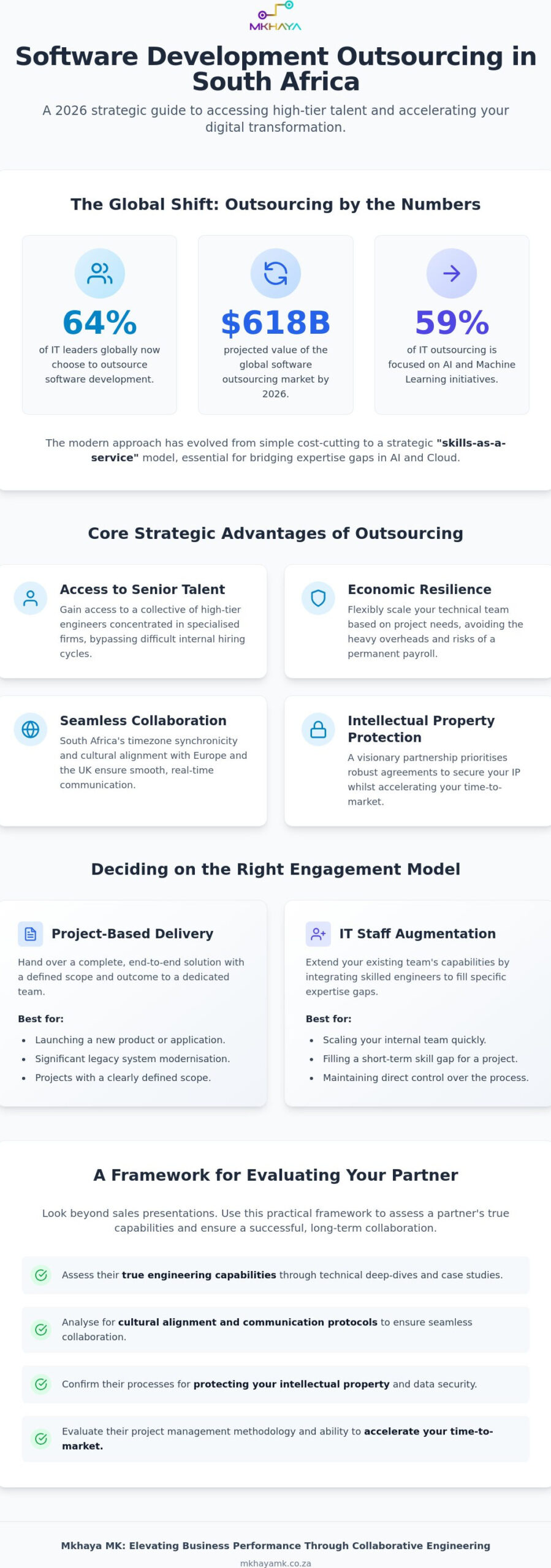
64% of IT leaders globally now choose to outsource software development, yet many still find themselves stalled by a lack of senior engineering talent for AI and Cloud initiatives. You’ve likely felt the weight of rising in-house costs and the pressure of project delays that threaten your competitive edge. When you choose to outsource software development South Africa offers, you’re making a strategic move to bridge this gap with world-class expertise and precision engineering.
We believe that a successful partnership is built on reliability and mutual success rather than just technical delivery. This 2026 guide provides the roadmap you need to navigate the South African landscape, ensuring you secure high-tier talent whilst maintaining predictable development costs. We’ll examine the latest regulatory standards, current hourly rates, and the specific steps required to accelerate your time-to-market through a collaborative, result-focused partnership that transforms your digital vision into a stable reality.
Key Takeaways
Understand the shift from tactical cost-cutting to a strategic “skills-as-a-service” model to bridge your AI and Cloud expertise gaps.
Identify the most effective engagement model for your goals, whether you need to outsource software development South Africa for a defined project or scale your team via staff augmentation.
Discover how timezone synchronicity and cultural alignment facilitate seamless real-time collaboration and ensure technical precision is maintained.
Master a practical evaluation framework to look beyond sales presentations and accurately assess a partner’s true engineering capabilities.
Learn how a visionary partnership can protect your intellectual property whilst accelerating your journey toward digital transformation.
Why South African Enterprises are Prioritising Software Development Outsourcing in 2026
The 2026 business environment has moved past the era where outsourcing was merely a tactic to trim budgets. Today, South African enterprises view it as a strategic “skills-as-a-service” model. This evolution aligns with the broader growth of Business Process Outsourcing, where the focus has shifted toward high-value ICT support and multi-disciplinary expertise. It’s about building a visionary partnership that prioritises long-term stability over short-term savings. By choosing this path, you transform technical debt into a refined asset that supports your broader commercial objectives.
Finding senior engineers has become increasingly difficult within internal hiring cycles. Many of the most skilled developers are now choosing to work within specialised firms where they can apply their expertise across diverse, high-impact projects. This concentration of talent means that when you choose to outsource software development South Africa offers, you aren’t just hiring a vendor; you’re gaining access to a collective of engineers who understand the nuances of the local market. Currently, 64% of IT leaders globally rely on this model to maintain momentum. By 2026, the global software development outsourcing market is estimated to reach $618 billion, reflecting a widespread reliance on external partners to drive innovation.
To better understand the talent landscape and the investment required for these skills, watch this helpful video:
The 2026 Tech Landscape: AI and Cloud Integration
Modern applications are no longer just collections of code. They require sophisticated AI & data automation and robust DevOps frameworks to remain functional. With 59% of IT outsourcing now focused on AI and machine learning, the cost of falling behind is immense. Outsourcing allows your business to transition from clunky legacy systems to modern, scalable cloud architectures without the friction of a complete internal restructure. This acceleration is vital for maintaining a competitive edge whilst user expectations for speed and precision are at an all-time high.
Economic Resilience Through Flexible Scaling
Building a permanent technical department involves significant long-term payroll overheads and substantial hiring risks. If a senior developer leaves, the resulting vacuum can stall progress for months. Outsourcing provides the agility to scale your team up or down based on specific project phases or market fluctuations. This flexibility ensures your internal resources remain focused on core business strategy and high-level decision-making. Whether you are implementing bespoke ERP solutions or refining a customer-facing app, a partner-led approach provides the stability and precision needed to grow without the burden of fixed technical debt.
Deciding Between Project-Based Delivery and IT Staff Augmentation
Choosing the right engagement model is a pivotal step in your digital journey. It’s a decision that balances your internal capacity with your long-term strategic goals. When you decide to outsource software development South Africa provides two primary paths: handing over a specific outcome or extending your existing team’s capabilities. Each model serves a distinct purpose in 2026, particularly as enterprises seek to integrate complex AI and Cloud architectures into their core operations. Your choice should reflect your organisational maturity and the level of direct control you wish to maintain over the daily engineering process.
When to Choose Project-Based Software Engineering
This model is designed for businesses that require a complete, end-to-end solution with a defined scope. It’s the most effective route for launching a new product or undergoing a significant legacy modernisation. By opting for project-based custom software development, you leverage a partner’s entire ecosystem, including UI/UX designers, QA testers, and DevOps specialists. This approach removes the burden of managing individual tasks, allowing you to focus on the business impact whilst your partner ensures the technical precision of the final delivery. It’s especially valuable when building cloud-native applications that require a cohesive, multidisciplinary team to succeed.
The Benefits of IT Staff Augmentation
If you already have an established internal technical department but lack specific expertise, staff augmentation is the superior choice. This model allows you to rapidly scale your capacity with remote or on-site professionals who integrate directly into your workflows. You maintain full control over the development lifecycle and daily priorities. In the current market, where 59% of outsourcing is focused on AI and machine learning, augmentation provides immediate access to niche roles like Cloud Architects or Data Engineers. You avoid the friction and cost of a traditional recruitment cycle, gaining the specific skills needed to accelerate your existing roadmap without long-term payroll commitments.
Determining which path fits your current needs is often the first step toward a successful transformation. Whether you require a visionary guide to build a system from scratch or a reliable partner to bolster your internal ranks, the right model ensures your engineering efforts remain stable and scalable. If you’re unsure which direction aligns with your 2026 objectives, discussing your roadmap with a strategic partner can provide the clarity needed to move forward with confidence.
The Strategic Advantages of Partnering with a Local South African Engineering Firm
Whilst much of the global conversation regarding technical partnerships focuses on international trade, the most profound advantages often emerge from local-to-local collaborations. Engaging a partner within your own borders removes the friction of vast time differences and misaligned business cultures. This proximity facilitates real-time collaboration and daily stand-ups where technical nuance is preserved rather than lost in translation. When you choose to outsource software development South Africa based engineering firms provide a level of synchronicity that offshore hubs simply cannot replicate. It’s a relationship built on shared market understanding and a mutual commitment to the national digital economy.
The logic is clear; a local partner is an invested stakeholder in your success. South Africa’s tech ecosystems in Johannesburg and Cape Town are mature and globally competitive, producing engineers who are trained to solve complex problems with limited resources. By keeping your engineering efforts within the country, you contribute to a sector that has already created 174,000 jobs and generated billions in revenue. This collaborative approach ensures that your digital transformation remains grounded in local realities whilst meeting world-class standards of execution.
POPIA Compliance and Data Sovereignty
Data sovereignty is a pillar of modern business stability. Local partners are inherently aligned with the Protection of Personal Information Act (POPIA), ensuring that your sensitive data never leaves the national legal jurisdiction without proper oversight. This is particularly critical for financial institutions; under Joint Standard 1 of 2024, insurers must ensure all outsourcing agreements are fully compliant by 30 November 2026. Furthermore, insurers are required to notify the Prudential Authority at least 30 days before entering into any material arrangement. A local partner understands these regulatory hurdles and provides the legal certainty needed to protect your intellectual property and code ownership.
Quality Standards and Technical Excellence
South Africa has earned a reputation for high-end engineering that rivals traditional Western hubs. Our engineering graduates from institutions like UCT and Stellenbosch are sought after globally for their precision and ability to build scalable, cloud-native applications. Choosing a local firm allows you to access this “Nearshore” quality without the communication risks associated with low-cost offshore providers. For a deeper look at how these standards are applied in practice, read our detailed analysis on Custom Software Development in South Africa: A Strategic Guide for 2026. This focus on excellence ensures that your software is not just functional, but built for long-term stability and growth.
A Framework for Evaluating Your Next Software Outsourcing Partner
Selecting a partner is a high-stakes decision that requires a methodical approach. It moves beyond surface-level sales pitches and focuses on long-term stability. When you decide to outsource software development South Africa offers, you must first define your primary objective with absolute clarity. Are you looking to build a ground-breaking new product from scratch, or do you simply need to scale an existing engineering team? This distinction is vital because the maturity required for end-to-end delivery differs significantly from the support needed for staff augmentation.
Technical depth is the next pillar of your evaluation. In 2026, buzzwords like “AI-ready” are common, but actual engineering capability is rarer. You should evaluate a partner’s ability to handle complex cloud architectures and data-driven automation. Security and IP policies must be non-negotiable. Ensure your partner provides full code ownership and adheres to the POPIA standards mentioned in previous sections. Starting with a small, phased engagement or a “pilot” project is often the wisest way to build a foundation of trust before committing to a multi-year roadmap. This approach allows you to test their communication rhythm and technical precision without immediate, large-scale risk.
Technical Vetting and Discovery
Before any code is written, a visionary partner will conduct a thorough digital transformation audit. This discovery phase identifies technical debt and aligns the proposed tech stack with your long-term goals. It’s also the stage where UI/UX design takes centre stage. A well-designed user journey is essential for project-based development success. It ensures that the final engineering effort translates into actual business value for your end-users whilst maintaining technical excellence.
Operational Alignment and Transparency
Successful partnerships thrive on clear communication protocols. You need to know exactly how the partner will integrate with your internal workflows. This involves establishing clear KPIs and structured reporting cycles that provide real-time visibility. Transparency in pricing is equally vital. Avoid partners who obscure their cost structures with hidden fees throughout the development lifecycle. A collaborative mindset ensures that both parties are working toward mutual success, treating the outsourcing arrangement as a stable extension of your own business.
Mkhaya MK: Elevating Business Performance through Collaborative Engineering
Mkhaya MK positions itself as a visionary guide rather than a mere vendor. We understand that your digital journey is unique. Our philosophy is rooted in the belief that technical precision must be paired with a supportive partnership to achieve long-term stability. When you choose to outsource software development South Africa based enterprises often seek, you require a partner who values transparency and methodical execution as much as you do. We provide high-end engineering nationally, ensuring that your business logic is preserved and refined through every stage of the development lifecycle.
Our commitment to mutual success drives our delivery of comprehensive services. We build everything from bespoke ERP solutions to complex cloud-native applications that serve as a stable anchor in a rapidly changing technological landscape. By focusing on the collaborative relationship, we ensure that our engineering efforts translate directly into measurable business outcomes. This approach allows us to project a persona of quiet confidence, where our results speak louder than flashy claims.
Our End-to-End Digital Transformation Offering
Modernising your operations requires more than just updated code; it necessitates a complete shift toward integrated cloud solutions and AI automation. We specialise in constructing platforms that fit your specific requirements, including robust loan management and learner management systems. Our approach prioritises customisation and precision, ensuring that the software we build respects your unique business rules whilst providing the scalability needed for 2026 and beyond. This end-to-end focus allows us to handle the technical complexities so you can focus on high-level strategy.
Getting Started with Mkhaya MK
We follow a highly structured process that begins with a deep discovery phase. This ensures that every engagement, whether it is a full project handover or a staff augmentation model, is rooted in a clear understanding of your goals. We facilitate a seamless transition by integrating our senior engineers into your existing workflows, maintaining the communication rhythm established in our framework. This methodical implementation ensures reliability and mitigates the risks typically associated with scaling technical teams. It’s a deliberate pace that reinforces our image as a detail-oriented and reliable partner.
The journey toward digital excellence is a personal one. We invite you to contact Mkhaya MK today to discuss your 2026 software strategy and discover how a collaborative engineering partnership can elevate your business performance.
Securing Your Digital Future through Strategic Engineering
The decision to outsource software development South Africa offers is a commitment to long-term stability and precision engineering. By shifting from tactical cost-cutting to a strategic “skills-as-a-service” model, your enterprise can bridge the AI and Cloud expertise gap with confidence. We’ve explored how a local partnership ensures POPIA compliance whilst maintaining the cultural synchronicity required for complex digital transformation. Your ambition deserves a stable, visionary partner.
Mkhaya MK stands ready to support your journey. With a national South African footprint and specialised AI and Cloud expertise, we ensure your engineering processes are both compliant and high-performing. Our methodical approach to custom software development and staff augmentation is designed to inspire trust and deliver business-focused results. We value transparency and commitment above all else.
Partner with Mkhaya MK for your next software project to accelerate your roadmap with a reliable, detail-oriented team. Let’s build a digital landscape that reflects your ambition and secures your competitive edge for years to come.
Frequently Asked Questions
Is it cheaper to outsource software development in South Africa than to hire in-house?
Outsourcing is generally more cost-effective because it eliminates the long-term overheads associated with permanent payroll, such as office space, equipment, and benefits. Whilst the hourly rates for senior talent are competitive, the true saving comes from reduced recruitment friction and the ability to scale your team down when a project phase concludes. It allows you to convert fixed costs into variable expenses that align with your actual development needs.
What is the difference between IT staff augmentation and project-based outsourcing?
Staff augmentation involves adding specific technical professionals to your existing internal team to fill skill gaps whilst you retain direct management. Project-based outsourcing is a model where you hand over a defined scope of work to a partner who manages the end-to-end delivery of the final product. Your choice depends on whether you need to bolster your current capacity or require a partner to take full responsibility for a specific technical outcome.
How do I ensure my intellectual property is protected when outsourcing?
Intellectual property is protected through robust, locally governed contracts that explicitly state your full ownership of the source code and design assets upon payment. When you choose to outsource software development South Africa based firms provide the advantage of operating within a familiar legal framework. Ensure your agreement includes comprehensive non-disclosure clauses and clear terms regarding data sovereignty to safeguard your competitive advantages from day one.
Can South African software companies handle complex AI and data automation projects?
South African engineering firms are highly capable of delivering sophisticated AI and data automation solutions due to a mature tech ecosystem and world-class university graduates. Local teams are already building complex, cloud-native applications that integrate machine learning to drive business efficiency. With 59% of global outsourcing now focused on AI, South African partners have refined their precision engineering to meet these modern technical demands whilst maintaining high standards of execution.
How long does it typically take to scale a team through staff augmentation?
Scaling a team through staff augmentation typically takes a few weeks, which is significantly faster than the months required for traditional permanent hiring. This agility allows you to respond to market fluctuations or technical challenges without delaying your roadmap. A visionary partner maintains a pipeline of vetted senior developers, ensuring that you gain access to the specific expertise you need with minimal lead time.
What are the common risks of outsourcing and how can they be mitigated?
The most common risks include communication silos, misaligned expectations, and scope creep. You can mitigate these by establishing clear KPIs, insisting on transparent reporting structures, and maintaining a regular cadence of daily stand-ups. Choosing a partner who prioritises a collaborative relationship ensures that technical nuance is never lost. Methodical discovery phases at the start of an engagement also help to align the technical roadmap with your commercial objectives.
Do I need to have a technical background to manage an outsourced development partner?
You do not need a technical background if you partner with a firm that prioritises business-focused results and clear communication. A reliable partner acts as a bridge between complex engineering and your strategic goals, providing transparent updates in a language that non-technical stakeholders understand. Your role is to define the vision and business logic, whilst the engineering team handles the precision execution and technical stability of the system.
How does POPIA compliance affect software development outsourcing in South Africa?
POPIA compliance requires that all personal data is handled with strict security and stored within compliant jurisdictions. When you outsource software development South Africa based partners are already aligned with these national privacy laws, which simplifies your regulatory burden. This is particularly vital as we approach the November 2026 deadline for financial institutions to ensure all their outsourcing arrangements meet the latest Joint Standards for data protection and sovereignty.
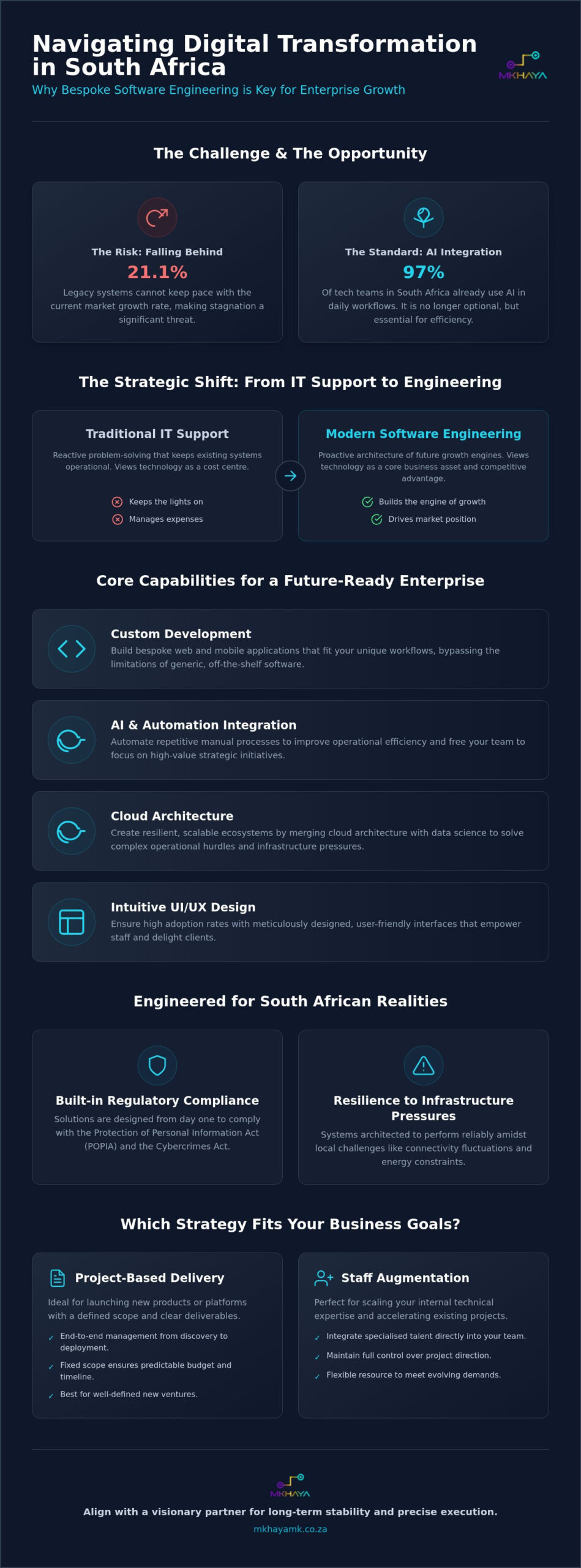
What if the greatest risk to your enterprise isn’t a competitor’s product, but the invisible weight of a legacy system that can no longer keep pace with a 21.1% market growth rate? In a territory where 97% of tech teams already use AI in their daily workflows, standing still is the fastest way to fall behind. Finding reliable software engineering services south africa enterprises can trust involves more than just hiring developers; it’s about securing a partner who understands how to bridge the gap between ageing infrastructure and future-ready automation.
You’ve likely experienced the high cost of failed software projects or the struggle to find specialised local talent amidst rising international competition. It’s a common challenge, and we agree that your digital transformation shouldn’t feel like a high-stakes gamble. This guide will show you how bespoke software engineering, cloud integration, and AI-driven automation empower South African enterprises to scale with precision. We’ll explore the strategic steps to modernise your operations, ensure compliance with the Cybercrimes Act, and build a secure platform that supports long-term stability.
Key Takeaways
Understand how modern software engineering in the local market balances high-level programming with the practicalities of South African infrastructure.
Learn to leverage software engineering services south africa enterprises use to integrate cloud-native architecture and AI automation for improved operational efficiency.
Identify whether your business goals are best served by project-based delivery for new launches or staff augmentation to scale your internal technical expertise.
Discover the importance of a structured lifecycle, from strategic discovery to intuitive UI/UX design, in building platforms that users actually want to adopt.
Align with a visionary partner to ensure long-term stability and precise execution whilst navigating the rapidly shifting technological landscape.
Defining the Landscape of Software Engineering Services in South Africa
Software engineering isn’t a simple technical task; it’s the deliberate architecture of a business’s future. In our region, high-quality software engineering services south africa providers focus on merging cloud architecture with data science to solve complex operational hurdles. It’s about building a digital foundation that doesn’t just work; it excels under pressure. This discipline moves beyond basic coding to create resilient ecosystems that support your specific commercial goals and long-term vision.
The technology landscape in South Africa is unique. We face specific infrastructure pressures, such as connectivity fluctuations and energy constraints, yet our enterprises must compete on a global stage. This requires a fundamental shift in perspective. Digital transformation isn’t a one-off purchase you can tick off a list. It’s a continuous journey of refinement and growth that requires a stable partner to guide the way whilst you navigate changing market demands.
To better understand how this profession is evolving locally, watch this insightful interview:
The Strategic Shift from IT Support to Engineering
Modern leaders don’t view software as a line-item expense. They see it as a core asset that dictates market position. Traditional IT support keeps the lights on, but engineering builds the engine of growth. By automating repetitive manual processes, bespoke systems free your team to focus on high-value strategy. Custom solutions provide a competitive edge that generic, off-the-shelf software simply can’t match. Off-the-shelf tools often force you to change your workflows to fit the software. True engineering does the opposite; it builds the software to empower your unique way of doing business.
Why National Enterprises Require Bespoke Solutions
South African businesses operate within a strict regulatory environment. Compliance with the Protection of Personal Information Act (POPIA) and the Cybercrimes Act is non-negotiable for any enterprise handling sensitive data. The software engineering services south africa requires must ensure these legal requirements are baked into the code from day one. This proactive approach supports long-term stability and protects your brand identity as you scale. National enterprises need systems that grow with them. You need the ability to adapt to a shifting economy without the risk of outgrowing your digital tools or facing the high cost of a failed migration. Custom software engineering provides that anchor.
Core Capabilities: Custom Development, Cloud, and AI Integration
Digital excellence isn’t something you can buy off a shelf. It’s a bespoke creation. When you invest in software engineering services south africa, you’re looking for a partner to build tools that fit your unique business workflows. Custom web and mobile application development allows you to bypass the limitations of generic software. It ensures that your technology supports your processes rather than forcing your team to work around rigid, third-party limitations. This precision is what allows an enterprise to move from being a participant in the market to a leader.
Success also depends on how your users interact with these tools. High adoption rates aren’t accidental; they’re the result of meticulous UI/UX design. By creating intuitive interfaces, we ensure that your staff and clients feel supported by the technology. This focus on the human element, combined with robust backend engineering, creates a stable platform for growth. If you’re curious about how these elements come together, exploring our approach to digital transformation can provide a clearer picture of the journey ahead.
Architecting for the Cloud and DevOps
High-growth enterprises can’t afford downtime or sluggish performance. Cloud-native architecture provides the high availability needed to serve users across the country reliably. By leveraging Managed Cloud and Digital Transformation, you gain an environment that scales automatically as your demand increases. We integrate DevOps practices to accelerate these delivery cycles. This methodology ensures that quality is baked into every update, allowing your business to pivot quickly without compromising system integrity. It’s a rhythmic approach to development that maintains momentum whilst protecting your core assets.
Leveraging AI-Driven Automation for Operational Efficiency
Data is the lifeblood of modern business, but raw information is often overwhelming. Integrating AI and data automation turns this complexity into a strategic advantage. For instance, in finance or logistics, Robotic Process Automation (RPA) can eliminate mundane, repetitive tasks, allowing your team to focus on higher-level strategy. This isn’t just about speed; it’s about accuracy and refinement. According to the State of the Software Developer Nation, the local demand for these intelligent systems is rising as businesses seek more sophisticated ways to manage ERP and procurement systems. We focus on linking AI directly to these core business systems, ensuring that automation delivers measurable results rather than just technical novelty.
Project-Based Delivery vs. Staff Augmentation: Which Strategy Fits?
Choosing the right engagement model is as critical as the architecture of the code itself. It’s the difference between a one-off success and a sustainable digital future. When you’re looking for software engineering services south africa, you need to decide if you want a partner to own the entire outcome or if you simply need more hands on deck. Both models offer distinct advantages. The right choice depends on your internal capacity and the complexity of your roadmap. As South Africa’s digital economy expands, the ability to pivot between these models has become a hallmark of agile, successful enterprises.
When to Opt for End-to-End Project Delivery
Project-based delivery is the preferred route when you have a clearly defined objective and need a partner to take full ownership of the result. It’s the ideal choice for building a new system from the ground up, such as a custom ERP or a proprietary loan management system. This model allows you to focus on your core business whilst we manage the entire lifecycle, from the initial UI/UX design to final deployment. By choosing Custom Software Development, you benefit from a fixed-price structure and a guaranteed outcome, ensuring that your vision is realised without the distraction of day-to-day management.
Scaling Internal Teams with Staff Augmentation
If you already have an established technical team but find yourself facing specific skill gaps or a sudden increase in workload, staff augmentation is the more strategic fit. This approach provides access to high-level professionals without the long-term overhead and complexity of permanent hiring. It’s about extending your team’s reach with remote or on-site experts who integrate into your existing culture and workflows. Our Staff Augmentation Services ensure you maintain momentum on long-term platforms whilst filling niche roles in DevOps, QA, or data science. It’s a flexible way to scale that prioritises speed and technical precision.
Evaluating cost-effectiveness requires looking beyond the initial quote. Fixed-price projects offer budget certainty for new launches. Conversely, monthly recurring professional fees for augmented staff provide the agility needed for ongoing maintenance. Regardless of the model, quality assurance and talent management remain the non-negotiables. We act as a stable anchor, ensuring that every engineer assigned to your project meets the highest standards of integrity and technical excellence. Securing the right software engineering services south africa has to offer ensures your digital platform remains secure, scalable, and ready for whatever the market demands next.
Navigating the Engineering Lifecycle: From Concept to Deployment
A successful digital platform isn’t the result of a single brilliant idea; it’s the product of a methodical, transparent journey. For many stakeholders, the world of software development feels like a “black box” where requirements go in and a product eventually comes out. We believe in a different approach. The most effective software engineering services south africa provides are those that invite the client into the process, turning technical execution into a collaborative partnership. This lifecycle ensures that every line of code serves a specific business purpose whilst maintaining the flexibility to adapt to new insights.
The Importance of Discovery and User Experience
Skipping the discovery phase is a primary cause of project bloat and eventual failure. This initial stage is where we align technology with your commercial goals, identifying potential roadblocks before they become expensive mistakes. We treat discovery as a strategic consulting session, ensuring the architecture supports your vision for the next five to ten years. Once the strategy is set, we move into UI/UX Design Services. User experience isn’t just about aesthetics; it’s about productivity. An interface that feels natural to your staff reduces training time and minimises user error, ensuring your investment pays for itself through improved operational efficiency.
Agile Methodology and Continuous Integration
We use an agile framework to maintain momentum and ensure you’re never left in the dark. By building in iterative cycles, or sprints, we provide regular progress reports and feedback loops. This prevents the “black box” effect and allows for course corrections as your market evolves. Our Engineering Process incorporates continuous integration and rigorous QA testing. We don’t just test for bugs; we test for performance, security, and reliability. This ensures that when your system goes live, it’s ready to handle the real-world demands of your users without hesitation. This phase also includes verifying compliance with local regulations like POPIA, ensuring your data remains secure from day one.
Deployment is the beginning of a new chapter, not the end of the work. Managed support ensures your platform remains a stable anchor in a changing landscape, with regular updates that keep your technology modern and secure. This long-term commitment to your success is what separates a vendor from a partner. If you’re ready to move from a vague concept to a concrete digital asset that drives revenue, contact our team to begin your discovery session and define your path to digital excellence.
Empowering South African Business with Mkhaya MK’s Engineering Expertise
Choosing Mkhaya MK means selecting a stable anchor in a rapidly shifting technological environment. We don’t just provide the software engineering services south africa businesses need to survive; we provide the strategic vision they need to lead. Our approach is rooted in transparency and methodical execution, ensuring that every project is a step toward mutual success. We see ourselves as your visionary yet practical guide, committed to your personal journey of digital transformation. This partnership ensures that your technology remains an asset rather than a burden.
Bespoke Enterprise Solutions: ERP and Loan Management
Our deep engineering capability is best evidenced by our proprietary systems. We’ve developed specialised tools to streamline complex operations, such as our Loan Management and Facility Management platforms. These aren’t generic templates. They’re high-end, custom-built solutions designed to handle the specific pressures of the local market. For those in the financial sector, our Loan Management System South Africa: The Strategic 2026 Buying Guide offers a deeper look into selecting the right technology for your portfolio. By integrating ERP Solutions into your core workflow, you optimise resources and gain a unified view of your entire enterprise.
Partnering for Long-term Digital Stability
We move beyond the traditional vendor relationship. A true partnership is built on integrity and a shared commitment to long-term stability. Whilst other providers might focus on global headcounts, we focus on the precision of our execution and the strength of our national service coverage. Whether you’re extending your team through staff augmentation or launching a new product, our goal is to ensure your digital platform remains a secure and scalable asset. We’re here to help you build something that lasts. We believe in building trust through consistent, high-quality delivery that respects your budget and your timeline. It’s about creating a foundation that can support your growth for years to come.
Securing high-level software engineering services south africa enterprises can rely on is the first step toward digital excellence. We’re ready to help you navigate this journey with confidence and clarity. Contact Mkhaya MK today to discuss your engineering requirements and let’s begin architecting your digital future.
Architecting Your Digital Legacy with Precision
The journey toward digital excellence requires more than just code; it demands a partner who understands the intricate balance between innovation and stability. We’ve explored how the high-level software engineering services south africa enterprises need are built on a foundation of strategic discovery, agile execution, and robust cloud architecture. Whether you’re modernising legacy systems or scaling your internal team through staff augmentation, the goal remains the same: creating a secure, reliable platform that drives measurable business value.
Mkhaya MK stands as a stable anchor in this evolving landscape. Our proprietary Loan and Facility Management Systems, combined with specialised AI and data automation expertise, serve as proof of our commitment to technical precision. With a proven track record in national digital transformation, we’re ready to help you navigate the complexities of modern engineering whilst ensuring your long-term success. We believe in building relationships that go beyond the typical vendor model, focusing instead on mutual growth and methodical execution.
Don’t leave your digital future to chance. Partner with Mkhaya MK for your next software engineering project and let’s build a resilient ecosystem together. We’re invested in your journey and look forward to architecting a solution that empowers your enterprise to scale with confidence.
Frequently Asked Questions
What is the difference between software development and software engineering?
Software development primarily focuses on the act of writing code to create functional tools. Software engineering is a broader, more disciplined application of engineering principles to the entire software lifecycle. It ensures that software engineering services south africa providers deliver systems that are not only functional but also scalable, maintainable, and resilient under heavy operational loads. This structured approach treats software as a core asset rather than just a technical script.
How much does custom software development cost in South Africa?
The cost of custom software varies significantly based on the project’s scope, complexity, and required integrations. Factors such as the number of user roles, the depth of data automation, and the need for cloud-native architecture all influence the final investment. Most professional firms provide a detailed discovery phase to establish a precise budget that aligns with your strategic goals. This ensures the solution remains cost-effective whilst meeting all your operational requirements.
How long does it take to build a bespoke business application?
Building a bespoke business application typically takes between three to nine months depending on the system’s intricacy. A basic Minimum Viable Product (MVP) might be ready for deployment sooner; however, enterprise-grade systems like ERP or Loan Management platforms require more time for rigorous testing and QA. We follow a methodical execution process to ensure that your timeline is realistic and your launch is stable from day one.
Can I hire a dedicated development team for a short-term project?
Yes, you can hire a dedicated team for short-term projects through flexible engagement models like staff augmentation. This allows you to scale your technical capacity quickly to meet a specific deadline or fill a niche skill gap without the long-term overhead of permanent employment. It’s an agile way to access high-level expertise whilst maintaining full control over your project’s momentum and quality without the burden of permanent hiring costs.
What technologies do software engineering firms in South Africa typically use?
Local engineering firms typically utilise a mix of modern, reliable technologies including Java, C#, Python, and JavaScript frameworks like React or Angular. Cloud-native development often centres on platforms like AWS, Microsoft Azure, or Google Cloud. These choices ensure that the software engineering services south africa enterprises receive are compatible with global standards whilst remaining robust enough to handle local infrastructure challenges and connectivity requirements.
How do you ensure the security of custom-developed software?
Security is ensured by integrating DevSecOps practices from the very first line of code. This includes end-to-end encryption, regular penetration testing, and strict adherence to local regulations like the Protection of Personal Information Act (POPIA) and the Cybercrimes Act. By baking security into the engineering lifecycle, we protect your data and ensure your platform remains a stable anchor for your business operations even as the threat landscape changes.
Is staff augmentation better than hiring permanent developers?
Staff augmentation is often better for businesses that need to scale rapidly or require specific expertise for a defined period. It avoids the lengthy recruitment cycles and administrative costs associated with permanent hiring. Permanent developers may be preferable for building long-term internal IP; however, augmentation provides the agility and precision needed to respond to a changing technological landscape without the commitment of fixed, long-term overheads.
What if the software holding your business back is actually costing you more in hidden licence fees than it would to build a proprietary asset from the ground up? Many South African leaders find themselves trapped between high international costs and platforms that simply don’t scale with national expansion. It’s a common frustration to feel that your digital tools are a constraint rather than a catalyst for growth.
We understand that you’re looking for more than just a vendor; you’re looking for a partner to help you navigate the complexities of custom software development south africa in 2026. In this guide, you’ll discover how bespoke engineering, AI-driven automation, and cloud-native solutions are transforming the local landscape. We’ll explore the shift toward delivery maturity and how owning your digital IP provides the stability needed for long-term success. By the end of this article, you’ll have a clear path toward achieving operational efficiency whilst securing a scalable platform that supports your unique business journey.
Key Takeaways
Learn why South African enterprises are moving away from restrictive international licences in favour of custom software development south africa to secure long-term digital IP.
Understand how integrating AI-driven automation and cloud-native architecture ensures your platform remains scalable and efficient in a competitive market.
Discover how a rigorous Discovery phase and Agile methodology mitigate project risks whilst ensuring your software aligns perfectly with complex business logic.
Evaluate the cost-benefit ratio of bespoke tools compared to off-the-shelf packages, focusing on long-term operational savings and enhanced productivity.
Explore how a flexible partnership model, including staff augmentation, allows you to extend your internal team’s capabilities whilst maintaining project momentum.
The Landscape of Custom Software Development in South Africa (2026)
In 2026, custom software development south africa is no longer just about building apps; it’s about engineering strategic assets that align with unique business logic. Whilst off-the-shelf solutions offer a quick start, they often fail to capture the specific nuances of the local market. Local enterprises are increasingly viewing digital transformation as a necessary evolution rather than a luxury. Within the 2026 South African digital economy, custom software development is defined as the creation of high-precision, cloud-native tools that transform operational friction into a competitive advantage.
Choosing local engineering over international SaaS allows businesses to bypass the volatility of exchange rates and rigid global frameworks. By focusing on bespoke builds, organisations ensure their technology scales alongside their national footprint. This shift represents a move toward stability and long-term resilience in a landscape where agility is the primary currency for success.
To better understand the practical side of engineering in our local context, watch this helpful video:
Addressing Local Operational Challenges
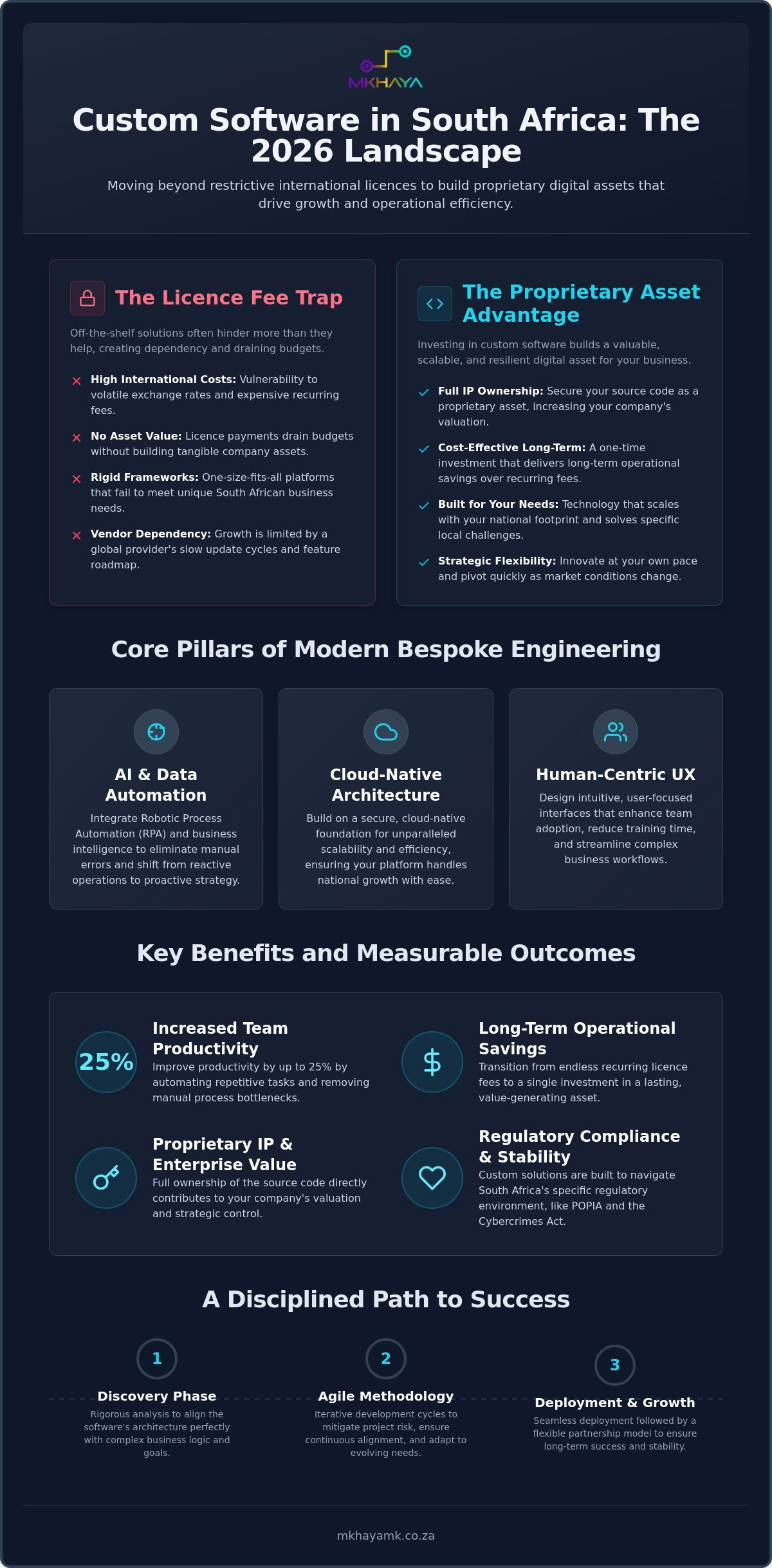
Fragmented legacy systems continue to hinder productivity for many established firms. Modern software engineering provides a bridge, integrating disparate processes into a unified, high-performing workflow. This approach is vital for navigating South Africa’s strict regulatory environment, including POPIA and the Cybercrimes Act. Industry benchmarks suggest that bespoke tools can improve team productivity by up to 25% by removing manual bottlenecks and automating repetitive tasks. Following a structured approach to The Software Development Lifecycle ensures that these solutions remain robust, compliant, and ready for future expansion from the very first day of deployment.
The Move Towards Proprietary Intellectual Property
Many businesses are waking up to the “licence fee trap” associated with international software packages. These recurring costs often drain budgets without adding to the company’s tangible asset value. By investing in software engineering, a business secures full ownership of its source code. This proprietary IP increases the overall valuation of the enterprise and provides the strategic flexibility to pivot quickly when market conditions change. Owning the platform means you aren’t waiting for a global provider to update a feature; you have the power to innovate and refine your tools at your own pace, ensuring your technology remains a stable anchor for your growth.
Core Pillars of Modern Bespoke Engineering: AI, Cloud, and UX
The technical foundation of any digital asset determines its lifespan and its ability to return value. In 2026, custom software development south africa has evolved beyond simple coding to encompass a sophisticated blend of intelligence, scalability, and human-centric design. These pillars ensure that a platform doesn’t just function; it thrives within the unique economic context of The South African Software Industry. By building on these core strengths, organisations create tools that are resilient enough to handle national growth whilst remaining agile enough to adapt to local market shifts.
AI and Data Automation Integration
Artificial intelligence is no longer a futuristic add-on; it’s a standard requirement for modern builds. Implementing AI automation solutions south africa allows businesses to move from reactive operations to proactive strategy. Robotic Process Automation (RPA) is frequently integrated within custom workflows to eliminate manual errors in data entry and processing. This precision is backed by business intelligence tools that provide real-time oversight. When your software can predict bottlenecks before they occur, your leadership team can focus on growth rather than fire-fighting.
Cloud Solutions and DevOps Excellence
Scalability across provinces requires a robust infrastructure that only cloud-native architecture can provide. Utilising cloud migration services south africa is essential for businesses looking to shed the weight of physical servers and local hardware limitations. DevOps practices further accelerate this by creating a continuous loop of refinement and deployment. This methodology ensures that security updates and new features reach users without downtime. It also keeps your organisation compliant with national data protection laws, such as POPIA, by embedding security protocols directly into the development pipeline.
Specialised Business Systems
Generic software often fails to meet the specific demands of regulated sectors. For instance, a bespoke loan management system south africa provides the exact compliance and reporting features required by local financial authorities. Similarly, custom tools for learner management and facility oversight allow organisations to organise their internal logic without compromise. Custom ERP solutions are designed to adapt to your existing business behaviour rather than forcing your staff to learn a foreign, rigid system. If you’re ready to build a system that truly fits your operations, you might consider how tailored engineering services can refine your current processes.
User experience remains the final, critical pillar. Even the most advanced AI or cloud system will fail if employees find it difficult to use. Prioritising UI/UX design ensures high adoption rates, making the transition to new technology a smooth and supportive experience for your entire team.
Strategic Benefits: Why South African Enterprises Favour Bespoke Tools
Strategic value in 2026 is measured by how well your technology serves your specific business behaviour. Whilst many leaders initially consider off-the-shelf packages for their perceived speed, they often encounter the “80/20” rule. This is where a generic platform meets 80% of your requirements but leaves the most critical 20% of your unique logic unsupported. Choosing custom software development south africa ensures that your digital tools are a 100% fit, eliminating the workarounds that typically stifle productivity.
The shift toward bespoke engineering is driven by a desire for stability and control. Instead of being a tenant on a global SaaS platform, you become the owner of a proprietary asset. This transition from recurring monthly subscription costs to capital investment in your own source code significantly enhances the long-term valuation of your enterprise. It also provides a level of agility that international software simply cannot match. When your market changes, you have the power to refine your platform instantly without waiting for a global update cycle.
Custom vs. Off-the-Shelf: A 2026 Comparison
The difference between these two paths often comes down to the quality of the partnership. Generic software users frequently find themselves stuck in international ticket systems, waiting days for a response from a remote support centre. In contrast, bespoke engineering offers direct access to local engineers who understand the South African business context. This proximity ensures that support is not just technical, but strategic. Additionally, custom builds allow for seamless integration with your existing legacy hardware and APIs, ensuring that your new system works in harmony with your current infrastructure rather than requiring a total overhaul.
Security and Data Sovereignty
Compliance with POPIA is a non-negotiable priority for any organisation handling personal data. Bespoke systems allow you to keep data strictly within South African borders, ensuring full data sovereignty. You can build custom security protocols that address the specific risks inherent to your industry, rather than relying on a one-size-fits-all security patch. There is also a distinct advantage in “security through obscurity”. Whilst generic tools are high-profile targets for global cyberattacks, a custom-built system is far less likely to be targeted by automated hacking scripts designed for mass-market software.
A key differentiator in managing project risk is the ability to extend your team’s capabilities through staff augmentation. This model allows you to maintain momentum by bringing in specialised expertise exactly when it’s needed. It bridges the gap between hiring a full-time team and outsourcing entirely, providing a flexible way to scale your software engineering efforts. By combining this flexible talent model with a custom architecture, you create a platform that is ready to support national growth and future innovation.
The Software Development Lifecycle: From Discovery to Deployment
Building a high-performing digital asset requires a methodical and transparent approach. Success in custom software development south africa depends on more than just technical skill; it relies on a structured lifecycle that prioritises clarity and partnership at every stage. By following a rhythmic momentum from strategy to execution, we ensure that the final product isn’t just a piece of software, but a stable anchor for your business operations. This process transforms abstract goals into concrete, scalable platforms that deliver a measurable return on investment.
Discovery and Business Analysis
The Discovery phase is arguably the most critical part of the entire journey. We begin with collaborative workshops designed to map out intricate user journeys and define the technical architecture. This isn’t just about planning; it’s about deep alignment between your business logic and our engineering strategy. Integrating professional UI UX design services south africa during this stage ensures that the software remains intuitive and supportive for the people who will use it daily. We establish clear KPIs before development begins, providing a shared definition of success that guides every subsequent decision.
Agile Development and Deployment
Agile methodologies keep you at the heart of the build process. By breaking the project into manageable sprints, we create frequent feedback loops that allow for refinements in real-time. This iterative approach significantly reduces project risk, as any deviations from the original vision are caught and corrected early. We utilise Continuous Integration and Deployment (CI/CD) pipelines to manage updates seamlessly, ensuring that new features are integrated without disrupting your existing workflows. Transitioning from development to a live production environment is handled with precision to avoid downtime, maintaining your operational momentum throughout the launch.
Stability is never an accident; it’s the result of rigorous Quality Assurance (QA). Every line of code undergoes thorough testing to ensure it meets enterprise-grade standards for security and performance. Even after deployment, our commitment continues through dedicated maintenance and support. Software is a living asset that must evolve alongside your business. If you’re ready to see how a structured approach can secure your digital future, you can explore our development process in more detail. This long-term perspective ensures your platform remains a reliable tool for national expansion and sustained efficiency.
Partnering for Growth: Mkhaya MK’s Integrated Development Model
Choosing a partner for custom software development south africa is a decision that shapes your organisation’s long-term stability. At Mkhaya MK, we don’t just deliver code; we build collaborative relationships designed to bridge the gap between high-level business strategy and precise technical execution. Our integrated model offers the flexibility you need to navigate a rapidly changing technological landscape whilst ensuring your digital assets remain secure and scalable. By acting as a stable anchor for your growth, we help you transform ambitious visions into practical, operational realities.
Working with a national partner means you’re collaborating with a team that truly understands the South African business context. We’re deeply invested in your personal journey and the success of your national expansion. This local expertise ensures that your technology isn’t just modern; it’s relevant to the specific challenges and opportunities within our borders. It’s about moving forward with a sense of quiet confidence, knowing that your software is built on a foundation of integrity and commitment.
Staff Augmentation: Scaling Your Team on Demand
One of the greatest challenges in 2026 is accessing niche technical expertise without the heavy overhead of permanent hiring. Our IT staff augmentation services allow you to extend your internal team seamlessly. Whether you need to hire dedicated developers south africa for a specific sprint or bring in long-term specialists, this model ensures you maintain project momentum. It’s an agile way to scale that keeps you in control of your workflows. You get the benefit of senior-level skills whilst avoiding the complexities of traditional recruitment, allowing your core team to focus on their primary objectives.
End-to-End Digital Transformation
Our approach goes beyond simple engineering to provide comprehensive digital transformation consulting south africa. We look at your entire business ecosystem to identify where automation and cloud-native tools can create the most value. For businesses in the financial sector, leveraging our proprietary Loan Management System offers a faster return on investment by providing a pre-validated framework that can be customised to your specific logic. This blend of bespoke engineering and specialised platforms ensures that your technology is always fit for purpose.
The Mkhaya MK promise is to provide a visionary yet practical guide that empowers your business to lead with confidence. We value transparency and methodical execution over flashy claims, ensuring that every step of our engagement is clearly articulated. As you look toward 2026 and beyond, we’re ready to help you build the stable, high-performing platforms your future demands. Together, we can create a technological landscape that supports your ambition and secures your legacy.
Securing Your Digital Legacy in 2026
The transition from restrictive international licences to proprietary digital assets marks a turning point for any ambitious organisation. By embracing custom software development south africa, you secure the ownership of your source code whilst ensuring your technology aligns perfectly with your business logic. We’ve explored how integrating AI-driven automation and cloud-native architecture provides the scalability required for national expansion. From the initial Discovery phase to the final deployment, a structured approach ensures that every line of code serves a strategic purpose.
Mkhaya MK brings a polished, professional team with national coverage to every project. Whether you require specialised systems for Loan, Facility, or Learner Management, our end-to-end service covers everything from UI/UX design to complex Cloud DevOps. We’re here to act as your stable anchor in a rapidly changing landscape, providing the technical precision and visionary guidance needed to succeed. Start your digital transformation journey with Mkhaya MK today and build a platform that grows with your ambition. Your path toward operational excellence is a partnership we value deeply, and we look forward to building a resilient, high-performing future together.
Frequently Asked Questions
How much does custom software development cost in South Africa?
Market benchmarks for custom software development south africa in 2026 typically start from R27,000 for specialised applications, whilst complex mobile platforms can range from R50,000 to over R1,500,000. These figures depend heavily on the specific feature set and integration requirements of your project. Ongoing application maintenance usually adds an annual expense of 15% to 20% of the initial development cost to ensure the platform remains stable and secure.
How long does it typically take to build a bespoke business application?
Building a bespoke business application generally takes between three and nine months, depending on the complexity of the requirements. A focused tool with limited integrations might reach deployment in twelve weeks, whereas an enterprise-grade system requires a longer timeline for rigorous testing. Following an Agile methodology allows for iterative releases, meaning your staff can often begin using core features whilst the rest of the platform is being constructed.
What is the difference between project-based development and staff augmentation?
Project-based development involves a defined scope where the service provider manages the entire delivery from discovery to launch. Staff augmentation allows you to extend your internal team by bringing in specialised developers to work directly under your management. This flexible model is ideal for maintaining project momentum during rapid growth phases without the long-term overhead of permanent hiring, providing access to niche technical skills on demand.
Can custom software be integrated with my existing legacy systems?
Yes, custom software is designed to integrate seamlessly with your existing legacy systems through secure APIs and custom middleware. This approach allows you to modernise your workflows without needing to replace your entire hardware infrastructure. By building bridges between old and new technology, you can protect your previous investments whilst gaining the efficiency benefits of modern, cloud-native engineering and automated data flows.
Who owns the intellectual property (IP) of the developed software?
Standard practice ensures that the client owns the full intellectual property and source code upon completion of the project. It’s vital to have a written IP assignment clause in your development agreement to confirm this ownership from the outset. Owning your digital assets increases the overall valuation of your enterprise and provides the freedom to refine your platform without being beholden to a third-party vendor’s restrictive roadmap.
Is bespoke software more secure than off-the-shelf alternatives?
Bespoke software is often more secure because it isn’t a high-profile target for automated global hacking scripts designed for mass-market tools. Custom systems allow for the construction of specific security protocols tailored to your industry’s unique risks and regulatory requirements. This “security through obscurity” is reinforced by embedding compliance with POPIA and the Cybercrimes Act directly into the software architecture during the development process.
What industries in South Africa benefit most from custom software?
Industries such as FinTech, logistics, and education benefit significantly from custom software development south africa due to their complex operational needs. For example, financial institutions require specialised loan management tools, whilst educational organisations rely on bespoke learner management systems to organise student data. Any sector where generic software fails to capture unique business logic will find a competitive advantage in building a proprietary, scalable platform.
How do I choose the right software development company in South Africa?
Choosing the right partner requires looking beyond technical skills to find “delivery maturity” and a deep understanding of the local business context. You should prioritise a company that values transparency and offers a clear, step-by-step explanation of their engagement process. Look for a visionary guide that remains invested in your personal journey and is capable of providing end-to-end support from UI/UX design to cloud-native deployment.
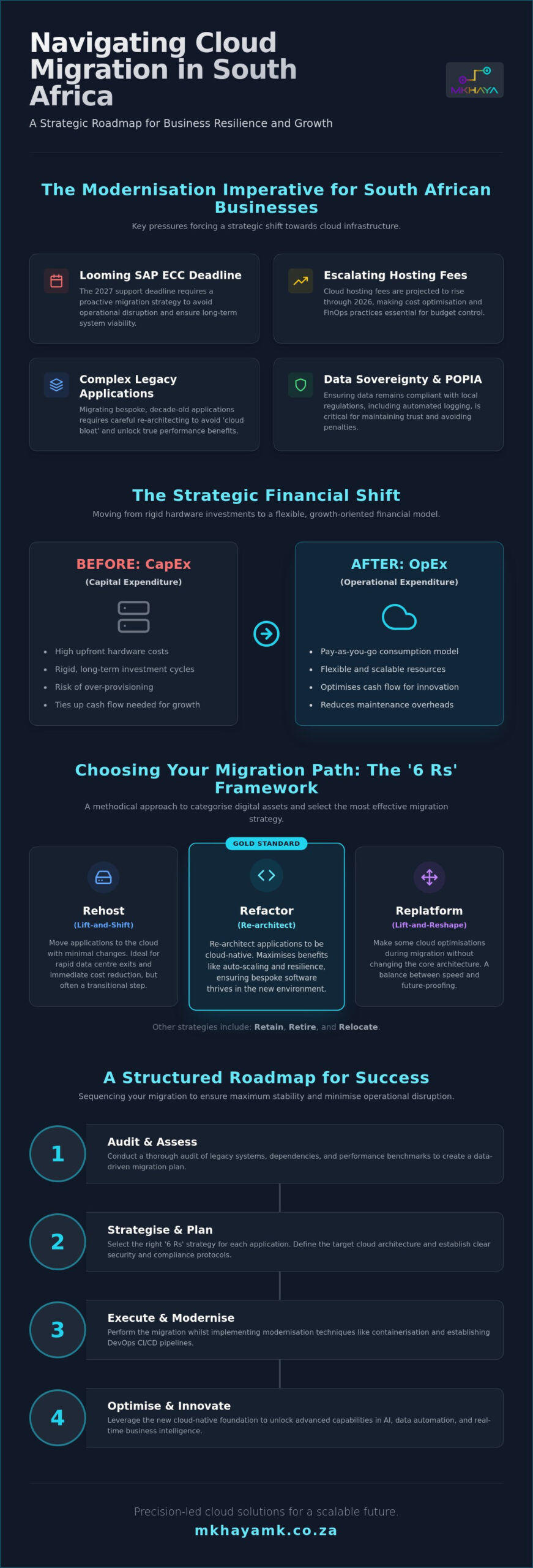
With the SAP ECC support deadline looming in 2027 and cloud hosting fees projected to rise throughout 2026, is your business infrastructure built for long-term resilience or merely for survival? Many South African organisations find themselves caught between the desire for agility and the heavy weight of high upfront hardware costs. You’re likely concerned about the complexity of migrating bespoke legacy applications whilst ensuring your data remains compliant with the latest POPIA automated log requirements. We understand that this transition feels like a high-stakes evolution rather than a simple IT project.
Choosing the right cloud migration services south africa provides a path to turn these challenges into a competitive advantage. This strategic guide explores how to seamlessly transition your business infrastructure to the cloud whilst optimising costs and ensuring absolute data sovereignty. We will explore the shift towards hybrid cloud models, the necessity of FinOps to manage escalating hosting costs, and the precise engineering required to modernise your software for a scalable future. By aligning your digital transformation with local regulatory shifts, you can build a stable, secure foundation that grows alongside your ambitions.
Key Takeaways
Understand the strategic shift from high upfront hardware costs to flexible operational models that optimise cash flow and support sustainable growth.
Select the most effective strategy for your business by exploring the ‘6 Rs’ framework, ensuring your choice of cloud migration services south africa aligns with your technical goals.
Master the nuances of POPIA compliance and data sovereignty to maintain trust and meet evolving regulatory requirements in the local landscape.
Follow a structured roadmap for auditing legacy systems and sequencing your migration to ensure maximum stability whilst minimising operational disruption.
Leverage your new cloud-native foundation to unlock advanced capabilities in AI and data automation for enhanced real-time intelligence.
What are Cloud Migration Services in the South African Business Context?
Cloud migration is the strategic process of relocating your digital assets, databases, and core applications into a virtualised environment. In South Africa, this isn’t merely a technical shift; it represents a fundamental pillar of digital transformation. Rather than viewing it as a simple file transfer, forward-thinking firms see it as an opportunity to refine their software architecture and build a more agile business foundation. Using professional cloud migration services south africa allows local enterprises to move away from the restrictive cycle of purchasing and maintaining physical hardware.
The transition from capital expenditure (CapEx) to operational expenditure (OpEx) is particularly vital for local firms managing fluctuating market conditions. By moving away from heavy upfront hardware investments, businesses can allocate resources more precisely toward growth and innovation. This bespoke approach ensures that your migration plan respects the unique requirements of the local market, including specific regulatory hurdles and infrastructure constraints.
To better understand the practicalities of this transition, watch this helpful overview:
Selecting the correct framework is the most critical step in your digital journey. While some providers offer a one-size-fits-all approach, effective cloud migration services south africa rely on the ‘6 Rs’ framework to categorise digital assets based on their future value. These strategies include Rehosting, Replatforming, Refactoring, Retiring, Retaining, and Relocating. This methodical approach ensures that resources aren’t wasted on obsolete systems whilst prioritising the applications that drive your revenue.
Rehosting, often called ‘Lift-and-Shift’, serves as the fastest route to the cloud. It involves moving your existing applications and data to a cloud environment without making significant changes to the underlying code. This path is ideal for businesses needing to exit a data centre quickly or those looking to reduce immediate hardware costs. However, it’s often a transitional phase rather than a final destination. Recent research on cloud adoption highlights that South African firms often struggle to see long-term ROI if they rely solely on rehosting without eventually modernising their stack.
For businesses with unique requirements, Refactoring stands as the gold standard. This involves re-architecting your applications to be cloud-native, allowing them to take full advantage of cloud features like auto-scaling and high availability. At Mkhaya MK, we leverage our software engineering expertise to ensure that your bespoke applications don’t just survive the move but thrive in their new environment. This precision-led approach protects the integrity of your logic whilst preparing it for a scalable future.
Modernising Legacy Applications
Moving a decade-old bespoke application directly into the cloud often results in ‘cloud bloat’, where performance stays stagnant while costs rise. True modernisation involves containerisation and microservices. This allows your software to scale individual components independently, making the system more resilient. We focus on maintaining application integrity through precise engineering, ensuring that your users experience a seamless transition without losing the familiarity of their existing UI/UX. If you’re looking for a partner to guide this technical evolution, exploring our cloud solutions can help define the most efficient path forward.
The Role of DevOps in Migration
DevOps is the engine of a successful move. By automating deployment cycles, we eliminate the risks associated with manual configuration and human error. Implementing Continuous Integration and Continuous Deployment (CI/CD) means your infrastructure evolves alongside your business needs. Managed DevOps services provide the long-term stability required to manage complex cloud environments, allowing your internal teams to focus on innovation rather than maintenance. This creates a rhythmic momentum where software updates are frequent, reliable, and invisible to the end-user.
Navigating South African Cloud Challenges and Regulations
South Africa’s regulatory environment demands a methodical approach to data management. When you engage with cloud migration services south africa, compliance isn’t just a tick-box exercise; it’s a commitment to your customers’ privacy. The Protection of Personal Information Act (POPIA) has evolved, and as of 2026, the Information Regulator requires organisations to provide automated logs of data deletion. This ensures that personal information is only retained as long as necessary, a task that becomes significantly more manageable within a well-engineered cloud environment.
Data sovereignty remains a top priority for local enterprises, especially those in the financial and public sectors. Ensuring your business data stays within South African borders is no longer a hurdle, thanks to the established presence of global hyperscale regions in Johannesburg and Cape Town. These local data centres provide the low-latency connectivity required for high-performance applications whilst satisfying legal requirements for data residency. This proximity reduces the risks associated with international data transfers and ensures your operations remain stable regardless of global connectivity fluctuations.
Currency volatility and rising global demand for AI infrastructure often lead to unpredictable hosting fees. South African firms must account for these variables to avoid the common pitfall of “cloud bill shock.” By partnering with local experts who understand the nuances of the South African economy, you can build a more resilient financial model for your IT operations. This involves balancing the need for global innovation with the practicalities of local cost management.
Security and Compliance in a Virtual Environment
Adopting a zero-trust architecture during your migration phase ensures that every access request is fully authenticated and authorised. This approach treats all traffic as potentially hostile, regardless of whether it originates inside or outside your network. Effective identity and access management (IAM) protocols allow you to control exactly who interacts with sensitive corporate data. Regular auditing and automated reporting become your primary tools for demonstrating compliance to South African regulators, providing a transparent and reliable record of your data handling practices.
Cost Optimisation Strategies
Meticulous resource monitoring is the only way to prevent “cloud sprawl,” where unused or over-provisioned resources inflate your monthly bill. Leveraging local expertise helps you select the most cost-effective service tiers tailored to your specific traffic patterns. For a deeper look at managing your expenses, read our guide on Cloud Cost Optimisation in South Africa. This proactive financial management ensures your scalable infrastructure remains a strategic asset rather than a growing liability.
A Step-by-Step Roadmap for Successful Migration
A successful digital evolution relies on a methodical sequence of events rather than a single leap. When searching for cloud migration services south africa, it’s essential to find a partner that values precision over speed. Our roadmap is designed to protect your operational continuity whilst modernising your core systems. It begins with a deep understanding of your current environment and ends with a refined, high-performance cloud ecosystem.
Strategic Planning follows the initial audit, where we map out the migration sequence. We prioritise systems based on their business criticality to ensure that your most vital services are handled with the highest level of care. This planning phase acts as a blueprint, preventing the common pitfalls of overlapping dependencies and resource bottlenecks that often plague unplanned moves.
Phase 1: The Technical Audit
The journey starts with a comprehensive assessment of your current infrastructure. We don’t just look at servers; we assess the complex web of software dependencies that keep your business running. This phase includes:
Identifying ‘low-hanging fruit’, which are applications that offer high value with low migration complexity.
Mapping interdependencies between custom applications and their respective databases.
Assessing the readiness of legacy code for a cloud-native environment.
For more complex phases where your internal team might be stretched, we often recommend staff augmentation to provide the specialised engineering capacity required for high-intensity migrations. This ensures that your daily operations never suffer while your infrastructure evolves under the guidance of experts.
Phase 2: Execution and Cutover
Once the blueprint is finalised, we move into Execution and Cutover. We always implement a pilot migration to test our assumptions in a controlled environment. This allows us to refine data synchronisation strategies, ensuring zero data loss during the final move. The ‘cutover’ window is managed with surgical precision to keep business disruptions to an absolute minimum, often occurring during low-traffic periods to protect the user experience.
The final stage of Optimisation is where the true value of the cloud is realised. We don’t just leave you with a working system; we fine-tune the environment to ensure your resource consumption matches your actual needs. This reduces waste and ensures your scalable infrastructure remains as lean and efficient as possible. If you are ready to begin your technical audit, contact our engineering team today to discuss your roadmap.
Beyond Migration: Leveraging AI and Custom Cloud Solutions
Completing your move is just the beginning of a larger journey toward operational excellence. While many providers treat the cutover as the end of the engagement, the most successful firms view it as the vital foundation for future innovation. By selecting comprehensive cloud migration services south africa, you create the high-performance environment necessary to deploy advanced AI and data automation. This infrastructure allows your business to process vast amounts of information in real-time, turning raw data into actionable business intelligence that drives decision-making.
Modern cloud-native applications don’t just store data; they facilitate sophisticated, automated workflows that scale with your ambitions. We specialise in customising these environments to support complex, industry-specific platforms that require high levels of precision. Whether you’re running an integrated ERP solution or a high-volume Loan Management System, your cloud environment should be precision-engineered to match your unique operational rhythm. This level of customisation ensures that your technology supports your business goals rather than forcing you to adapt to rigid software constraints.
Building AI-Ready Infrastructure
Preparing for machine learning requires more than just basic storage. It involves constructing structured data lakes within the cloud that allow models to access high-quality information without latency. Once this foundation is stable, cloud-based Robotic Process Automation (RPA) can be used to automate routine business tasks, freeing your team for more strategic, creative work. For a deeper look at how these technologies are reshaping the local market, see our guide on AI Automation Solutions in South Africa.
Why Mkhaya MK is the Strategic Choice
Choosing Mkhaya MK means partnering with a team that values your long-term success as much as you do. Our national footprint across South Africa allows us to understand the specific challenges of local enterprise resilience, from energy constraints to regulatory shifts. We don’t just provide cloud migration services south africa; we offer a supportive partnership rooted in software excellence and methodical execution. We invite you to consult with us on a bespoke digital transformation strategy that turns your vision into a stable, scalable reality. Together, we can build a future that’s both technologically advanced and grounded in practical business results.
Building Your Scalable Future in the Cloud
Transitioning your infrastructure is a strategic evolution that requires more than just technical execution; it demands a visionary approach to software integrity and regulatory resilience. By choosing specialised cloud migration services south africa, you ensure that your bespoke legacy systems are refactored for modern performance whilst maintaining strict POPIA compliance. This methodical shift doesn’t just reduce operational costs; it creates the stable, AI-ready foundation your business needs to thrive in a competitive landscape.
We’ve explored how a structured roadmap and the right migration framework can turn complex technical challenges into long-term assets. Mkhaya MK provides the national support and consulting expertise required to navigate this journey with quiet confidence. Our focus remains on your mutual success, ensuring that every step of your digital transformation is precise and purposeful. It’s time to scale your business with Mkhaya MK’s Cloud Solutions and embrace a partnership built on reliability. Your future in the cloud is bright, and we’re ready to help you build it.
Frequently Asked Questions
What are the primary benefits of cloud migration for South African businesses?
Cloud adoption allows South African businesses to move from heavy capital expenditure to a flexible operational model. This shift provides immediate access to scalable infrastructure that grows with your business needs. Additionally, migrating protects your operations from local infrastructure instability, ensuring your data remains accessible and secure regardless of power or connectivity challenges at your physical premises.
How long does a typical cloud migration project take to complete?
The timeline for a migration project depends on the complexity of your digital estate and the volume of data involved. A small-scale migration might take several weeks, whereas a full-scale enterprise transition involving bespoke applications can span several months. We focus on a methodical approach that prioritises stability, ensuring each phase is thoroughly tested before proceeding to the next stage of the roadmap.
Is my data secure in the cloud according to POPIA regulations?
Data remains secure and compliant with POPIA regulations when you utilise cloud migration services south africa that prioritise local data residency. By hosting your data in South African hyperscale regions, you satisfy legal requirements for sovereignty whilst benefiting from global security standards. We implement zero-trust architectures and automated deletion logs to ensure your compliance remains robust and transparent to regulators.
What is the difference between a ‘lift-and-shift’ and a ‘refactoring’ strategy?
Lift-and-shift, or rehosting, involves moving your existing software to the cloud without changing its code, which is ideal for a rapid exit from physical hardware. Refactoring is a more sophisticated strategy where we re-architect applications to be cloud-native. This gold-standard approach ensures your custom software takes full advantage of cloud features like auto-scaling, leading to better long-term performance and lower operational costs.
How can we avoid downtime during the migration process?
Minimising downtime is achieved through phased execution and rigorous pilot testing in controlled environments. We synchronise data in the background and only perform the final cutover during low-traffic windows to protect your business continuity. This precision-led strategy ensures that your users experience a seamless transition without any significant disruption to their daily workflows or access to critical services.
What are the hidden costs of cloud migration that I should plan for?
Planning for hidden costs involves looking beyond the monthly hosting fee to account for data egress charges and initial resource over-provisioning. You should also consider the investment required for staff training and the potential for “cloud sprawl” if resources aren’t actively monitored. Using professional cloud migration services south africa helps you identify these variables early, allowing for a more accurate and predictable financial model.
Can my custom-built legacy software be moved to the cloud?
Bespoke legacy applications can certainly be moved to the cloud through a process of containerisation and software re-engineering. We specialise in refactoring these systems to ensure they remain functional and performant in a virtualised environment. This allows you to retain the unique logic of your custom software whilst gaining the scalability and security benefits of modern cloud infrastructure.
Do I need to hire new staff to manage our cloud infrastructure?
You don’t necessarily need to hire new full-time employees to manage your new environment. Many organisations choose to use managed DevOps services or staff augmentation to fill specific skill gaps during and after the transition. This approach provides access to expert engineering talent without the long-term overhead of permanent hires, allowing your existing team to focus on their core business objectives.
With the South African data analytics market projected to grow at a staggering 31.4% annually from 2026, the gap between businesses that guess and those that know has never been wider. You’ve likely felt the frustration of fragmented data silos trapped within legacy systems or the pressure of the 30 June PAIA annual report deadline. Finding reliable data analytics services south africa shouldn’t feel like a gamble on unproven ROI. It’s understandable to feel cautious when internal specialised engineering talent is scarce and the regulatory landscape, especially with the new health information regulations that took effect in March, is shifting beneath your feet.
We’re here to help you turn that uncertainty into a decisive competitive advantage. This guide provides a clear, executive framework to move your organisation from basic reporting to automated decision-making and predictive modelling. We’ll explore how to establish a single source of truth that satisfies the Information Regulator’s intensified POPIA oversight whilst positioning your business for long-term stability. You’ll learn how to bridge the local skills gap and select a partner that aligns your technical architecture with your most ambitious digital transformation goals.
Shift your perspective from reactive reporting to prescriptive analytics to turn raw data into a proactive engine for business growth and digital transformation.
Learn to evaluate data analytics services south africa based on their commitment to transparency and their ability to translate complex technical stacks into clear business outcomes.
Establish a single source of truth by investing in robust data engineering and intuitive visualisations that empower your executive team with real-time, actionable insights.
Overcome the local specialised talent shortage and ensure POPIA compliance by adopting a flexible, methodical approach to scaling your technical capabilities.
Discover the Mkhaya MK “Consulting to Execution” methodology, designed to bridge the gap between initial strategy and long-term technological stability.
The landscape of data in South Africa has shifted dramatically. It’s no longer just about looking at last month’s sales figures. Modern Data analysis has transitioned from a passive reporting function into a core engine that drives every strategic move. In 2026, the most successful national enterprises treat their data as a living asset rather than a dusty archive. This evolution is central to why data analytics services south africa are now considered the bedrock of any serious digital transformation journey.
We’ve moved past the era of descriptive analytics, which merely told us what happened. Today, the focus is on prescriptive analytics; the science of determining what we should do next to achieve a specific outcome. This shift allows businesses to anticipate market fluctuations and supply chain disruptions before they impact the bottom line. It’s a move from reactive firefighting to proactive, methodical growth that builds a stable foundation for future innovation.
To better understand the practical side of this evolution, watch this helpful video:
Why National Enterprises are Prioritising Data in 2026
Operational efficiency is the primary driver. With the South African data analytics market having generated USD 1,115.2 million in revenue in 2025 and projected to grow at a CAGR of 31.4% through 2033, national enterprises recognise that data maturity is no longer optional. Real-time data allows for immediate cost reduction by identifying waste in logistics or production. It isn’t just about saving money, though. Data-driven insights provide the necessary roadmap for scaling technology platforms securely. By understanding local consumer behaviour through granular data, businesses can personalise experiences in a way that feels authentic rather than automated. This precision is what allows local firms to hold their own against global competitors.
The Intersection of Data Analytics and Custom Software
Many organisations find that off-the-shelf tools simply can’t handle the unique logic of their operations. This is where the integration of analytics into custom software development becomes vital. When your data architecture is built into the very fabric of your applications, you create a seamless flow of information. This bespoke approach ensures long-term organisational stability. It prevents the common pitfall of having powerful software that remains “blind” to the insights hidden within its own databases. By choosing data analytics services south africa that understand this intersection, you ensure your technology and your strategy move in perfect lockstep. We believe in a methodical execution that values transparency over flashy claims, ensuring your data informs every line of code we write.
A robust framework acts as the nervous system of your organisation. It doesn’t just store information; it organises it into a coherent narrative that supports long-term stability. To get the most from data analytics services south africa, your framework must excel in four critical areas that bridge the gap between raw information and strategic action.
Data Engineering: This is your foundation. It involves building resilient pipelines that ingest, clean, and move raw data from disparate sources into a central repository. Without clean data, even the most advanced AI will produce flawed results.
Data Visualisation: Raw numbers rarely inspire action. By transforming complex datasets into intuitive executive dashboards, you give your leadership team the clarity needed to make high-stakes decisions with quiet confidence.
Advanced Analytics: This moves beyond what happened to why it happened. Machine learning models identify hidden patterns and predict future trends, allowing you to stay ahead of market shifts.
Data Governance: This ensures your data remains high-quality, secure, and compliant. It’s the set of rules that keeps your organisation aligned with national standards whilst maintaining the integrity of your insights.
Leveraging AI and Data Automation
Static reporting is a relic of the past. Modern AI automation solutions turn your data into a proactive force. By implementing Robotic Process Automation (RPA), you can automate the tedious tasks of data cleaning and organisation, freeing your team for higher-level strategy. Whilst many businesses rely on standard tools, the real competitive edge in 2026 comes from custom-built predictive engines that reflect your unique business logic and operational goals.
Cloud-Native Data Solutions
Scalability is non-negotiable for data-intensive applications. Utilising managed cloud services ensures that your storage capacity grows alongside your business without the need for massive upfront hardware investments. This approach provides the high availability and performance required for real-time analytics. Integrating DevOps practices into your data workflow allows for the rapid deployment of new features, ensuring your analytics capabilities are always evolving. If you’re looking to refine your technical architecture, exploring our approach to digital transformation can help you identify the most effective path forward for your specific needs.
Selecting data analytics services south africa requires moving beyond a simple checklist of technical certifications. Whilst platform designations provide a baseline, they rarely account for the nuance of your specific operational logic. A true partner acts as a visionary guide, bridging the gap between raw data and your most ambitious business goals. You should look for a partner that projects “quiet confidence”; a persona that values transparency and methodical execution over flashy, unverified claims. This reliability is what transforms a service provider into a stable anchor for your technological evolution.
It’s essential to find a balance between strategic consulting and technical execution. A partner that only offers high-level advice leaves you with a roadmap but no vehicle. Conversely, a purely technical firm might build a powerful engine that doesn’t align with your commercial objectives. We believe the most successful engagements follow a structured process that moves from a broad vision to a concrete, step-by-step path forward, ensuring every technical milestone delivers a practical business benefit.
Technical Expertise vs. Business Alignment
Your partner must speak the language of ROI. If a team focuses solely on Python or SQL without discussing how those tools drive digital transformation, the alignment is missing. Designing effective data models is a collaborative relationship; it requires deep dives into your unique workflows to ensure the architecture supports your long-term journey. As your organisation grows, you may need to scale your capabilities through staff augmentation, ensuring you have the right talent at the right time without the overhead of permanent hiring or the delays of a traditional recruitment cycle.
The Custom Advantage: Bespoke vs. Template Solutions
Template-based dashboards often carry hidden costs. Whilst they appear cheaper initially, they frequently fail to capture the complexity of South African industries, leading to “blind spots” in your reporting. Custom-built solutions offer the precision needed for high-stakes decision-making. By investing in a bespoke architecture, you ensure your data remains a valuable asset rather than becoming a legacy burden that hinders future agility. Our commitment to integrity and transparency ensures that every custom build is designed for stability and precision, providing a single source of truth that you can rely on for years to come.
South African executives face a unique set of hurdles that global counterparts might overlook. Whilst the strategic value of data analytics services south africa is clear, the practical implementation often hits a wall when confronted with the national shortage of specialised engineering talent. It’s one thing to envision a data-driven future; it’s another to find the senior analysts, who now command average salaries of R656,497, to build it. Beyond the talent war, the regulatory environment has become significantly more rigorous, requiring a partner that understands the local legal fabric as well as the code.
Scaling Teams with Staff Augmentation
When internal recruitment stalls, IT staff augmentation provides a flexible bridge to success. This model grants you immediate access to scarce data specialist skills without the long-term overhead of permanent hiring or the delays of traditional recruitment. Whether you need on-site professionals in Cape Town or remote engineers to scale a national project, extending your team allows for the methodical execution of project-specific transformations. It’s a visionary way to bypass the local skills shortage, ensuring your digital transformation doesn’t lose momentum due to empty seats in your tech department.
Data Security and Compliance as a Competitive Edge
Compliance isn’t just a legal box to tick; it’s a way to build trust with a sophisticated consumer base. In March 2026, the Information Regulator shifted to a proactive oversight model, moving beyond reactive complaints to targeted assessments in high-risk sectors. This makes navigating POPIA complexities during data migration more critical than ever. Additionally, the new health information regulations that came into force on 6 March 2026 require immediate attention from insurers and medical schemes. Implementing robust encryption and access controls within your data lake ensures integrity, especially when integrating legacy ERP solutions with modern analytics.
Resilient infrastructure is the final piece of the puzzle. Your data architecture must withstand local connectivity challenges and power fluctuations to ensure high availability for decision-makers. By building a stable, hybrid-cloud environment, you protect your “single source of truth” from external disruptions. If you’re ready to secure your data future and bridge the talent gap, contact us today for a transparent discussion on how our professionals can support your journey.
We act as the stable anchor in your technological evolution. Unlike standalone BI tools that often offer surface-level charts without context; our approach treats data as a critical component of end-to-end digital transformation. By choosing our data analytics services south africa, you’re opting for a partner that values methodical refinement over flashy, short-term claims. We bridge the gap between initial strategy and long-term stability by integrating your data architecture directly with your ERP solutions and bespoke software environments.
Our “Consulting to Execution” methodology ensures that every insight we uncover is backed by the technical capability to implement it. This synergy prevents the common frustration of having a roadmap without a vehicle. We don’t just tell you what the data says; we build the automated systems that act on those findings. It’s a collaborative relationship built on transparency and mutual success, ensuring your data assets become more valuable with each passing year. This commitment to your personal journey is what defines our “quiet confidence” in a noisy market.
A Step-by-Step Path to Data Maturity
Achieving true business intelligence requires a structured progression. We guide you through three distinct phases to ensure your investment delivers measurable results and satisfies the Information Regulator’s evolving requirements:
Phase 1: Discovery and Audit – We begin by identifying your most valuable data sources and uncovering the fragmented silos that hinder your progress. This phase ensures your strategy is rooted in the reality of your current operations.
Phase 2: Foundation Building – We establish secure, cloud-based data warehouses that serve as your single source of truth. This architecture is designed to be scalable and resilient, providing a stable base for all future custom development.
Phase 3: Insights and Automation – Once the foundation is stable, we deploy intuitive executive dashboards and AI-driven workflows. This turns your static information into a proactive engine for automated decision-making.
Ready to Transform Your Data into a Strategic Asset?
The journey from raw numbers to visionary business intelligence is one of the most significant steps an organisation can take. It requires a forward-looking mindset that embraces agile, modern technology whilst remaining rooted in traditional values of integrity and commitment. By choosing data analytics services south africa that prioritise your specific business logic, you ensure that your digital transformation is both ambitious and practical. We’re ready to act as your stable guide in this rapidly changing landscape. Start your journey with us today and discover the power of a partnership that’s deeply invested in your long-term success.
The shift towards prescriptive analytics and automated decision-making is no longer a luxury for South African enterprises. It’s the foundational architecture for long-term stability. By integrating these insights into your custom software and ERP systems, you create a single source of truth that empowers your leadership team. Navigating the complexities of POPIA whilst managing the national skills shortage requires a partner who understands the local landscape as deeply as the technical code.
Choosing the right data analytics services south africa is about more than just technology; it’s about finding a visionary guide for your end-to-end digital transformation. With our national reach and proven track record in AI and custom software engineering, we act as a stable anchor for your technological evolution. We’re committed to your personal journey, ensuring that every data point leads to a practical business outcome and measurable growth.
What are the main benefits of using data analytics services in South Africa?
The primary benefit is turning fragmented data into a proactive business engine that drives digital transformation. By leveraging data analytics services south africa, organisations can automate decision-making processes and gain a competitive edge through predictive modelling. This shift allows you to anticipate market changes rather than simply reacting to them, ensuring your business remains a stable anchor in a changing landscape.
How does POPIA affect data analytics implementation for local businesses?
POPIA requires strict data governance and security protocols throughout the entire analytics lifecycle. Since the Information Regulator shifted to proactive oversight in March 2026, businesses must ensure that data migration and storage are fully compliant. This involves implementing robust encryption and access controls to protect personal information whilst maintaining the integrity of your insights and satisfying the latest regulatory assessments.
Should we build an internal data team or outsource to a South African partner?
Outsourcing to a local partner is often more efficient due to the national shortage of specialised data engineering talent. Whilst internal teams offer deep company knowledge, a partner provides a broader perspective and access to senior expertise that is difficult to recruit. This approach reduces the overhead of permanent hiring and allows for more agile scaling of your technical capabilities through a collaborative relationship.
What is the difference between Business Intelligence (BI) and Data Analytics?
Business Intelligence focuses on descriptive reporting of past events, whereas data analytics involves prescriptive and predictive modelling for the future. BI tells you what happened in your last quarter. Analytics uses machine learning to identify patterns that suggest what you should do next to optimise your results. It’s the difference between looking in the rear-view mirror and having a visionary guide for the road ahead.
How much does it cost to implement a custom data analytics solution?
The investment for a custom solution depends entirely on the complexity of your data silos and the specific business logic required. We focus on a methodical execution that ensures long-term stability and a clear path to ROI. Rather than providing a generic price, we believe in a thorough discovery phase to define a precise scope that aligns perfectly with your strategic goals and digital journey.
Can data analytics be integrated with our existing ERP or Loan Management systems?
Yes, modern analytics frameworks are designed to integrate seamlessly with existing ERP or Loan Management systems. Custom engineering allows us to build the necessary pipelines to move and clean data from these legacy platforms. This integration ensures that your analytics engine has access to all relevant information, creating a single source of truth for your entire organisation.
What is the average timeline for a digital transformation project involving data?
Timelines vary based on the maturity of your existing data infrastructure and the scale of the transformation. A typical project moves through structured phases of discovery, foundation building, and final deployment of insights. This deliberate pace ensures that each milestone is fully articulated and reliable before moving to the next stage, reinforcing our image as a detail-oriented and reliable partner.
How does staff augmentation help with data analytics backlogs?
Staff augmentation provides immediate access to scarce specialists to help you clear technical debt and accelerate your data analytics services south africa projects. It allows you to scale your team nationally with remote or on-site professionals without the delays of traditional recruitment. This flexibility is essential for overcoming project-specific backlogs and maintaining momentum in a competitive, high-end technological landscape.