What if the biggest obstacle to your next major product launch isn’t your strategy, your budget, or your market timing — it’s simply not having the right engineers in the room? If you’ve spent months searching for niche technical skills locally, watching recruitment costs climb and project timelines slip, you already know the frustration. Building a dedicated development team in South Africa is increasingly how ambitious businesses are solving this problem, not as a stopgap measure, but as a deliberate strategic move.
You’re right to be cautious. The idea of extending your engineering capacity beyond your immediate geography carries real questions: Will they understand our processes? Will they feel like part of the team? These are fair concerns, and they deserve honest answers rather than polished sales promises.
This guide is built to give you exactly that. You’ll discover how South Africa’s growing pool of elite technical talent, combined with agile engagement models like staff augmentation and custom software partnerships, can help you scale your engineering capacity rapidly whilst reducing the operational overhead that comes with permanent local recruitment. From understanding what a genuine dedicated team partnership looks like to evaluating the right provider, what follows is a practical, step-by-step path forward.
Key Takeaways
Understand the fundamental shift from traditional outsourcing to a strategic partnership model that mirrors your organisational values and long-term vision.
Access a deep reservoir of over 100,000 technical professionals in South Africa who offer world-class English proficiency and a high degree of cultural compatibility.
Compare the nuances of staff augmentation and a dedicated development team south africa to determine which model best supports your specific scaling requirements for 2026.
Master the management of remote engineering teams by establishing robust KPIs and communication protocols that eliminate capacity bottlenecks and drive project momentum.
Explore how integrating specialised products, such as ERP or Loan Management Systems, with a dedicated team can accelerate your digital transformation journey.
What is a Dedicated Development Team and Why Does Your Business Need One?
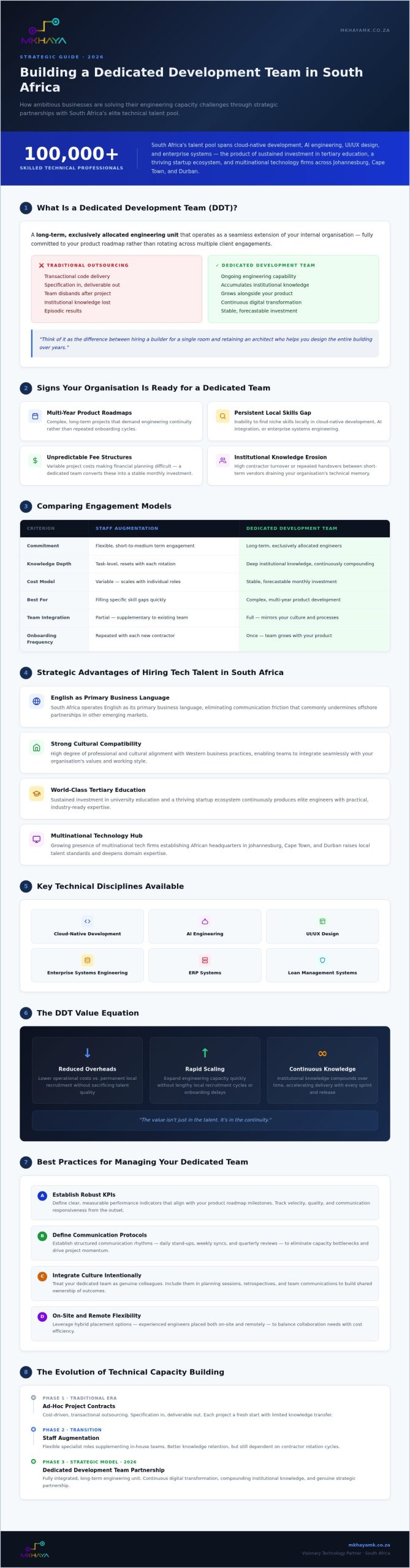
A Dedicated Development Team (DDT) is a long-term, exclusively allocated engineering unit that operates as a seamless extension of your internal organisation, fully committed to your product roadmap rather than rotating across multiple client engagements. This distinction matters enormously. Unlike a project-based contractor who delivers a defined scope and moves on, a dedicated team accumulates your institutional knowledge, understands your architectural decisions, and grows alongside your product. That depth of context is genuinely difficult to replicate, and it’s precisely what organisations competing on complex digital products need in 2026.
To understand why this model has gained such traction, it helps to consider the broader spectrum of outsourcing engagement models and where the DDT sits within it. Traditional outsourcing prioritised cost reduction through transactional code delivery. The relationship was transactional by design: a specification goes in, a deliverable comes out. The DDT model represents a fundamental departure from that logic. Here, the emphasis shifts from output to ongoing capability, from delivery to continuous engineering partnership.
The Evolution of Technical Capacity Building
South African enterprises have been at the forefront of this shift. The move away from ad-hoc project contracts reflects a hard-won lesson: episodic development creates episodic results. Every time a project team disbands, institutional knowledge walks out with them. A dedicated team embedded in your processes and culture supports continuous digital transformation, not just discrete technology upgrades. Think of it as the difference between hiring a builder for a single room and retaining an architect who helps you design the entire building over years.
Signs Your Organisation is Ready for a Dedicated Team
Not every business needs this model immediately. But certain conditions make the case compelling and, frankly, urgent:
Complex, multi-year product roadmaps that demand engineering continuity rather than repeated onboarding cycles
A persistent local skills gap in specialised disciplines such as cloud-native development, AI integration, or enterprise systems engineering
Unpredictable project fee structures that make financial planning difficult, whereas a dedicated team converts variable costs into a stable, forecastable monthly investment
Institutional knowledge erosion caused by high contractor turnover or repeated handovers between short-term vendors
If any of these resonate, a dedicated development team in South Africa offers a structured path to resolving them. Providers like Mkhaya MK’s staff augmentation service are built precisely for this purpose: placing experienced engineers, both on-site and remotely, who integrate into your team and stay invested in your long-term success.
The value isn’t just in the talent. It’s in the continuity.
The Strategic Advantages of Hiring Tech Talent in South Africa
South Africa’s technology sector has matured considerably over the past decade, producing a national talent pool that numbers well over 100,000 skilled technical professionals across disciplines ranging from cloud-native development and AI engineering to UI/UX design. That depth of supply isn’t incidental. It’s the product of sustained investment in tertiary education, a thriving startup ecosystem, and the growing presence of multinational technology firms establishing African headquarters in cities like Johannesburg, Cape Town, and Durban. For businesses building a dedicated development team in South Africa, this concentration of expertise represents a genuinely significant competitive advantage.
What separates South African talent from comparable pools in other emerging markets, however, isn’t simply volume. It’s the quality of professional alignment that comes with it.
Cultural and Professional Alignment
English is a primary business language in South Africa, and technical professionals operate within it fluently, both in written documentation and real-time collaboration. This eliminates one of the most persistent friction points in remote engineering partnerships: miscommunication at the specification and review stages. South African developers have also grown up within agile-oriented delivery cultures, shaped by exposure to international project frameworks and a strong tradition of client-centric service. The result is a workforce that doesn’t just write clean code; it engages proactively, raises concerns early, and takes genuine ownership of product outcomes.
South Africa’s time zone alignment with European markets (GMT+2) and its natural overlap with the broader African continent makes synchronous collaboration genuinely practical. Daily stand-ups, sprint reviews, and architecture discussions can happen in real working hours for all parties, without the scheduling compromises that partnerships with teams in vastly different time zones typically require.
There’s also a standard of UI/UX design services emerging from South African studios that reflects international benchmarks. Organisations that need their engineering capability to extend into product design and user experience will find that local teams can carry that work with genuine sophistication.
Economic Efficiency Without Quality Compromise
Building an in-house engineering team locally in 2026 carries substantial overhead: recruitment fees, benefits, office infrastructure, and the compounding cost of attrition. Engaging a dedicated team through a managed services model converts those unpredictable variables into a structured, forecastable monthly investment. That shift in cost architecture matters enormously for financial planning and board-level reporting.
Compared to equivalent talent in Western European or North American markets, South African engineers offer a compelling return on investment without the quality trade-offs that sometimes accompany lower-cost alternatives in other regions. Organisations that have made the transition consistently report that they’re not simply saving on headcount; they’re gaining engineers who are invested, communicative, and technically capable at a level that matches or exceeds their previous in-house benchmarks.
If you’re evaluating whether this model fits your current engineering capacity needs, exploring Mkhaya MK’s staff augmentation service is a practical starting point for understanding what a structured, professionally managed talent engagement actually looks like in practice.
Comparing Engagement Models: Dedicated Teams vs Staff Augmentation
Choosing the wrong engagement model is one of the most common and costly mistakes organisations make when scaling their engineering capacity. The two models most frequently considered, staff augmentation and a dedicated development team, are often treated as interchangeable. They aren’t. Each serves a distinct strategic purpose, and understanding that distinction clearly is what separates businesses that scale efficiently from those that cycle through vendors without ever building real momentum.
Staff Augmentation: Tactical Flexibility
Staff augmentation is designed for precision. When your internal team has a specific, time-bound gap, perhaps you’re rolling out a cloud migration and need three senior DevOps engineers for a defined sprint cycle, or you’re integrating AI automation into an existing pipeline and lack that specialist depth in-house, augmentation fills that gap without the overhead of permanent hiring. The professionals slot into your existing structure, follow your processes, and report to your management layer. Speed and specificity are the core advantages.
This model works particularly well when:
You have a functioning internal team that simply needs targeted reinforcement
The skill requirement is specialist and short-to-medium term in nature
Your project scope is well-defined and unlikely to evolve significantly
You want to maintain full direct management control over day-to-day delivery
Mkhaya MK’s staff augmentation service operates across both on-site and remote placements nationally, giving organisations the flexibility to bring in experienced professionals precisely where and when the work demands it, without the structural commitments that come with permanent headcount.
Dedicated Teams: Strategic Stability
A dedicated development team in South Africa operates at a fundamentally different level of engagement. Rather than supplementing your team, it becomes your team, or a fully integrated extension of it, carrying end-to-end ownership of your product roadmap over an extended horizon. The team accumulates your institutional knowledge, understands your architectural decisions, and grows in capability alongside your product. That depth of context compounds in value over time in a way that rotating augmented contractors simply cannot replicate.
The dedicated model also includes full management and operational oversight within the service structure. You’re not just accessing talent; you’re accessing a managed engineering capability. For organisations undergoing genuine digital transformation, that distinction matters enormously. Mkhaya MK’s software engineering services are structured precisely around this principle: continuous, committed delivery rather than episodic project engagements.
The Hybrid Approach: When Both Models Work Together
Sophisticated organisations increasingly combine both models to match their engineering capacity to the shape of their work. A dedicated core team handles long-term product ownership and architectural continuity, whilst augmented specialists are brought in to accelerate specific initiatives or cover temporary skill requirements. This hybrid structure offers the best of both worlds: strategic stability at the centre, tactical flexibility at the edges. If your roadmap includes both sustained product development and periodic specialist demands, it’s worth evaluating how a blended engagement could serve your objectives more precisely than either model alone.
Best Practices for Managing Your Dedicated Development Team
Having the right engineers is only half the equation. How you manage them determines whether that investment compounds or stagnates. The organisations that extract the most value from a dedicated development team in South Africa share a common discipline: they treat management as an active, ongoing commitment rather than an administrative function that runs itself once the contracts are signed.
Start with clarity. Before your first sprint begins, establish the KPIs and performance metrics that will define success for both sides. These shouldn’t be generic productivity proxies. Meaningful metrics for a dedicated engineering team typically include:
Sprint velocity and consistency across delivery cycles, not just individual output
Defect resolution rates and the time taken to close issues raised in QA
Code review turnaround as a measure of team responsiveness and collaborative discipline
Milestone adherence relative to the agreed product roadmap
Defining these from day one sets expectations without ambiguity and gives your team a shared framework for self-assessment. It also removes the subjectivity that tends to erode trust in remote partnerships over time.
Communication and Agile Integration
Rhythm matters more than volume. A well-structured communication cadence, built around daily stand-ups, sprint planning sessions, and fortnightly retrospectives, creates the operational heartbeat that keeps distributed teams aligned. Tools like Jira, Slack, and Microsoft Teams provide the infrastructure, but the discipline of using them consistently is what actually builds transparency. Asynchronous updates should be encouraged for routine progress, whilst synchronous sessions are reserved for decisions, blockers, and strategic alignment. When remote and on-site engineers share the same communication norms, the psychological distance between them shrinks considerably. Belonging isn’t built through team-building exercises; it’s built through consistent inclusion in the conversations that matter.
Governance and Quality Assurance
Robust QA processes shouldn’t be bolted on at the end of a sprint; they should be woven into the team’s daily workflow from the outset. Peer code reviews, automated testing pipelines, and structured documentation practices are the foundations of a team that delivers with confidence rather than urgency. Knowledge transfer, in particular, deserves deliberate attention: every architectural decision, integration rationale, and process evolution should be captured in living documentation that the team actively maintains. Quiet confidence in technical leadership means that your team raises concerns early, documents thoroughly, and never mistakes speed for quality. That disposition, more than any single tool or process, is what sustains delivery excellence over the long term.
If you’re ready to build an engineering partnership structured around these principles from the ground up, explore how Mkhaya MK’s software engineering services are designed to deliver exactly that kind of committed, accountable capability.
Scaling with Mkhaya MK: Your Visionary Technology Partner
There’s a meaningful difference between a vendor who delivers code and a partner who takes genuine ownership of your digital trajectory. Mkhaya MK is built around the latter. From the earliest stages of strategic consulting through to expert execution and long-term product stewardship, the engagement is designed to move with your business rather than ahead of it or behind it. That coherence across the full delivery lifecycle is what distinguishes a true dedicated development team in South Africa from a collection of contractors assembled under a single invoice.
Central to this approach is the integration of dedicated engineering teams with Mkhaya MK’s own specialised product suite. When your team is building on or alongside platforms like the Loan Management System, they’re not starting from a blank canvas. They’re working within a structured, proven framework that accelerates delivery timelines and reduces the architectural risk that comes with bespoke builds from the ground up. That combination of dedicated human capability and proprietary product depth is something global agencies simply don’t offer.
AI-driven automation and cloud solutions sit at the operational core of how Mkhaya MK teams work. Whether it’s streamlining data pipelines, orchestrating cloud infrastructure, or embedding intelligent automation into existing workflows, the technical capability is matched to the business outcome rather than applied generically. Operational excellence isn’t a promise; it’s the structural result of pairing the right engineers with the right tooling from day one.
A Holistic Approach to Custom Software
Engineering alone doesn’t transform a business. Mkhaya MK’s teams extend across UI/UX design, DevOps, and strategic consulting, ensuring that every layer of your digital product receives the same standard of deliberate, expert attention. Dedicated teams actively support ERP solutions and Learner Management implementations, bringing continuity across complex, multi-system environments. For a deeper exploration of how this philosophy applies to bespoke builds, the Custom Software Development in South Africa: A Strategic Guide for 2026 offers a comprehensive companion perspective.
Starting Your Journey with Mkhaya MK
Every engagement begins with a structured consultation focused on understanding your specific technical landscape, growth objectives, and the gaps your current capacity can’t close. From that foundation, the team structure is tailored precisely: the right disciplines, the right seniority mix, the right balance of on-site and remote presence. Nothing is templated. Everything is calibrated to your goals.
The case for building a dedicated development team in South Africa isn’t theoretical. It’s built on a convergence of real advantages: access to a deep, English-proficient talent pool, engagement models that convert unpredictable hiring costs into stable investment, and a partnership approach that compounds in value the longer it runs.
Three things are worth carrying forward from this guide. First, the model you choose matters as much as the talent you access. Second, management discipline determines whether that talent delivers its full potential. Third, the right partner brings more than engineers; they bring proven capability in AI and data automation, national coverage for both on-site and remote placements, and a track record across complex systems like custom ERP and Loan Management implementations.
That’s precisely what Mkhaya MK is built to offer. The starting point is a structured conversation about where your engineering capacity stands today and where your roadmap needs it to be.
What is the difference between a dedicated development team and staff augmentation?
A dedicated development team is a fully allocated, long-term engineering unit that takes end-to-end ownership of your product roadmap and operates as a permanent extension of your organisation. Staff augmentation, by contrast, places specialist professionals into your existing team structure to fill a specific, time-bound skill gap. The core distinction is depth of commitment: augmentation offers tactical flexibility, whilst a dedicated team builds compounding institutional knowledge over time.
Your choice between the two depends on your engineering horizon. If you’re reinforcing a functioning team for a defined sprint, augmentation is the sharper tool. If you’re building continuous product capability across multiple years, a dedicated team delivers the structural stability that rotating contractors simply can’t match.
How much does it cost to hire a dedicated development team in South Africa?
Pricing for a dedicated development team in South Africa varies considerably based on team size, seniority mix, technical disciplines required, and whether placements are on-site or remote. Rather than quoting figures that may not reflect your specific configuration, we’d recommend speaking directly with a provider to receive a structured proposal based on your actual requirements. What’s consistent across engagements is that the model converts unpredictable recruitment and contractor costs into a stable, forecastable monthly investment.
South African engineering talent generally offers a compelling return on investment relative to equivalent expertise in Western European or North American markets, without the quality trade-offs sometimes associated with lower-cost alternatives in other regions. Verify current salary benchmarks with your provider before finalising any budget assumptions for 2026.
How do I ensure data security when working with a remote dedicated team?
Data security in a remote engagement is governed by the protocols you establish at the outset, not by geography. Robust arrangements typically include signed NDAs and data processing agreements, role-based access controls that limit exposure to sensitive systems, encrypted communication channels, and regular security audits. Your provider should be able to articulate their security posture clearly and adapt to your organisation’s specific compliance requirements before work begins.
It’s also worth establishing clear policies around code repository access, device management, and incident response procedures. A reputable dedicated team partner will treat these governance requirements as standard practice rather than optional add-ons, so don’t hesitate to raise them during your initial consultation.
Can a dedicated team work with my existing internal developers?
Yes, and this is one of the model’s genuine strengths. A well-integrated dedicated team slots into your existing engineering culture, adopts your preferred tools and workflows, and collaborates directly with your internal developers through shared sprint cycles, code reviews, and daily stand-ups. The goal isn’t to replace your existing capacity but to extend it with complementary skills and additional bandwidth.
Successful integration depends on establishing clear ownership boundaries from the start. Define which workstreams the dedicated team leads, where they support your internal engineers, and how decisions escalate. That clarity prevents duplication and keeps both groups moving in the same direction without friction.
How long does it take to set up a dedicated development team?
Setup timelines vary depending on the complexity of the engagement, the seniority levels required, and the specificity of the technical disciplines involved. A structured provider will typically begin with a discovery consultation to map your requirements, followed by candidate selection and a formal onboarding process. For straightforward configurations, initial team members can often be operational within a few weeks; more specialised or senior configurations naturally take longer to assemble with the right fit.
Rushing the setup phase to meet an arbitrary start date is rarely worthwhile. The onboarding investment, including aligning the team on your architecture, processes, and communication norms, pays dividends throughout the engagement. A deliberate start builds a far stronger foundation than a hasty one.
What technical stacks are available through South African dedicated teams?
South Africa’s developer community covers a broad range of modern technical stacks, including cloud-native development across AWS, Azure, and Google Cloud; backend languages such as Python, Node.js, Java, and .NET; frontend frameworks including React, Angular, and Vue.js; mobile development for iOS and Android; and disciplines like DevOps, AI and data engineering, and enterprise systems integration. The depth of available expertise reflects the maturity of the local technology sector.
When engaging a provider like Mkhaya MK, your dedicated team can also be configured to work directly with proprietary platforms such as ERP solutions, the Loan Management System, or the Optimate Procurement Platform, combining external engineering talent with proven internal product frameworks to accelerate delivery.
How do I manage a dedicated team across different locations in South Africa?
Managing a geographically distributed team within South Africa follows the same principles as any well-run remote engineering operation: consistent communication rhythms, shared project management tooling, and clearly defined accountability structures. Daily stand-ups, sprint planning sessions, and regular retrospectives create the operational cadence that keeps distributed contributors aligned regardless of whether they’re based in Johannesburg, Cape Town, or Durban.
Mkhaya MK’s staff augmentation and dedicated team services are structured to support both on-site and remote placements nationally, which means the operational framework for managing distributed talent is built into the engagement model rather than left for you to figure out independently. Lean on your provider’s experience here; they’ll have established norms that work.
Why is South Africa a top destination for software development in 2026?
South Africa combines several advantages that are genuinely difficult to find in a single market: a talent pool of over 100,000 skilled technical professionals, English as a primary business language, strong cultural alignment with European and African client organisations, and a time zone (GMT+2) that enables synchronous collaboration without the scheduling compromises that distant offshore partnerships require. The country’s growing startup ecosystem and the presence of multinational technology firms have further raised the standard of professional practice across the sector.
For businesses building a dedicated development team in South Africa specifically, the combination of technical depth, communication fluency, and economic efficiency makes the market a strategically sound choice in 2026 and beyond. It’s not simply a cost play; it’s access to a maturing engineering culture that takes product ownership seriously.
64% of IT leaders globally now choose to outsource software development, yet many still find themselves stalled by a lack of senior engineering talent for AI and Cloud initiatives. You’ve likely felt the weight of rising in-house costs and the pressure of project delays that threaten your competitive edge. When you choose to outsource software development South Africa offers, you’re making a strategic move to bridge this gap with world-class expertise and precision engineering.
We believe that a successful partnership is built on reliability and mutual success rather than just technical delivery. This 2026 guide provides the roadmap you need to navigate the South African landscape, ensuring you secure high-tier talent whilst maintaining predictable development costs. We’ll examine the latest regulatory standards, current hourly rates, and the specific steps required to accelerate your time-to-market through a collaborative, result-focused partnership that transforms your digital vision into a stable reality.
Key Takeaways
Understand the shift from tactical cost-cutting to a strategic “skills-as-a-service” model to bridge your AI and Cloud expertise gaps.
Identify the most effective engagement model for your goals, whether you need to outsource software development South Africa for a defined project or scale your team via staff augmentation.
Discover how timezone synchronicity and cultural alignment facilitate seamless real-time collaboration and ensure technical precision is maintained.
Master a practical evaluation framework to look beyond sales presentations and accurately assess a partner’s true engineering capabilities.
Learn how a visionary partnership can protect your intellectual property whilst accelerating your journey toward digital transformation.
Why South African Enterprises are Prioritising Software Development Outsourcing in 2026
The 2026 business environment has moved past the era where outsourcing was merely a tactic to trim budgets. Today, South African enterprises view it as a strategic “skills-as-a-service” model. This evolution aligns with the broader growth of Business Process Outsourcing, where the focus has shifted toward high-value ICT support and multi-disciplinary expertise. It’s about building a visionary partnership that prioritises long-term stability over short-term savings. By choosing this path, you transform technical debt into a refined asset that supports your broader commercial objectives.
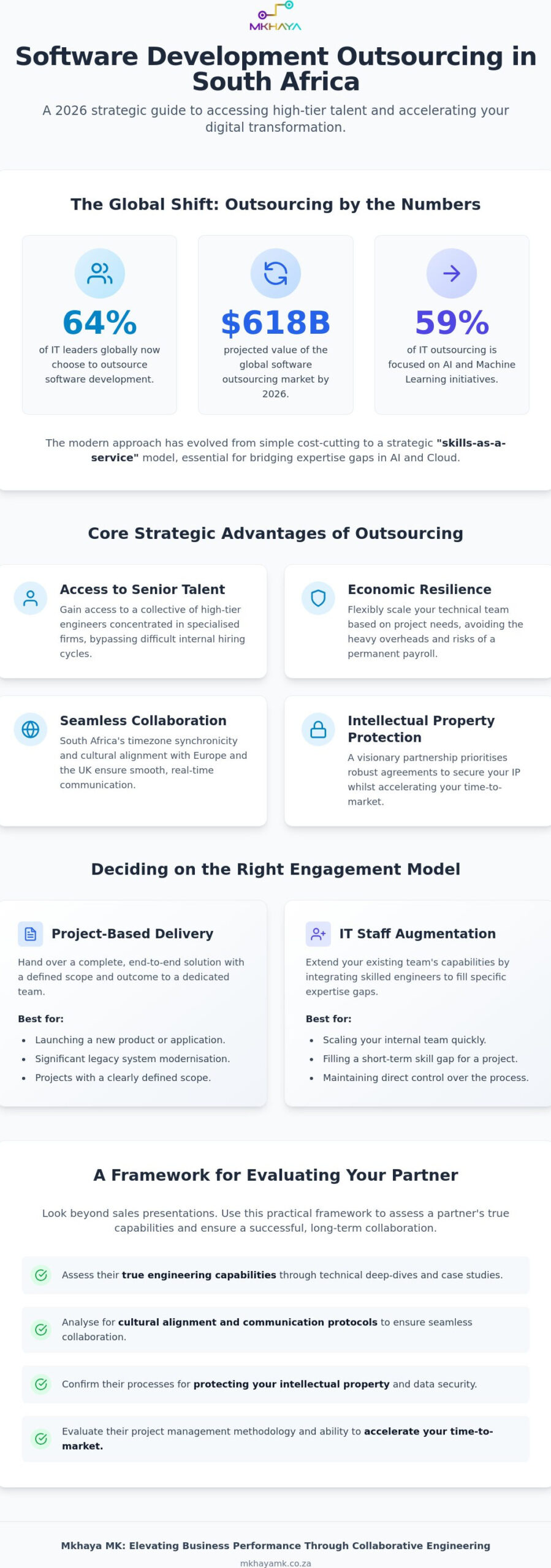
Finding senior engineers has become increasingly difficult within internal hiring cycles. Many of the most skilled developers are now choosing to work within specialised firms where they can apply their expertise across diverse, high-impact projects. This concentration of talent means that when you choose to outsource software development South Africa offers, you aren’t just hiring a vendor; you’re gaining access to a collective of engineers who understand the nuances of the local market. Currently, 64% of IT leaders globally rely on this model to maintain momentum. By 2026, the global software development outsourcing market is estimated to reach $618 billion, reflecting a widespread reliance on external partners to drive innovation.
To better understand the talent landscape and the investment required for these skills, watch this helpful video:
The 2026 Tech Landscape: AI and Cloud Integration
Modern applications are no longer just collections of code. They require sophisticated AI & data automation and robust DevOps frameworks to remain functional. With 59% of IT outsourcing now focused on AI and machine learning, the cost of falling behind is immense. Outsourcing allows your business to transition from clunky legacy systems to modern, scalable cloud architectures without the friction of a complete internal restructure. This acceleration is vital for maintaining a competitive edge whilst user expectations for speed and precision are at an all-time high.
Economic Resilience Through Flexible Scaling
Building a permanent technical department involves significant long-term payroll overheads and substantial hiring risks. If a senior developer leaves, the resulting vacuum can stall progress for months. Outsourcing provides the agility to scale your team up or down based on specific project phases or market fluctuations. This flexibility ensures your internal resources remain focused on core business strategy and high-level decision-making. Whether you are implementing bespoke ERP solutions or refining a customer-facing app, a partner-led approach provides the stability and precision needed to grow without the burden of fixed technical debt.
Deciding Between Project-Based Delivery and IT Staff Augmentation
Choosing the right engagement model is a pivotal step in your digital journey. It’s a decision that balances your internal capacity with your long-term strategic goals. When you decide to outsource software development South Africa provides two primary paths: handing over a specific outcome or extending your existing team’s capabilities. Each model serves a distinct purpose in 2026, particularly as enterprises seek to integrate complex AI and Cloud architectures into their core operations. Your choice should reflect your organisational maturity and the level of direct control you wish to maintain over the daily engineering process.
When to Choose Project-Based Software Engineering
This model is designed for businesses that require a complete, end-to-end solution with a defined scope. It’s the most effective route for launching a new product or undergoing a significant legacy modernisation. By opting for project-based custom software development, you leverage a partner’s entire ecosystem, including UI/UX designers, QA testers, and DevOps specialists. This approach removes the burden of managing individual tasks, allowing you to focus on the business impact whilst your partner ensures the technical precision of the final delivery. It’s especially valuable when building cloud-native applications that require a cohesive, multidisciplinary team to succeed.
The Benefits of IT Staff Augmentation
If you already have an established internal technical department but lack specific expertise, staff augmentation is the superior choice. This model allows you to rapidly scale your capacity with remote or on-site professionals who integrate directly into your workflows. You maintain full control over the development lifecycle and daily priorities. In the current market, where 59% of outsourcing is focused on AI and machine learning, augmentation provides immediate access to niche roles like Cloud Architects or Data Engineers. You avoid the friction and cost of a traditional recruitment cycle, gaining the specific skills needed to accelerate your existing roadmap without long-term payroll commitments.
Determining which path fits your current needs is often the first step toward a successful transformation. Whether you require a visionary guide to build a system from scratch or a reliable partner to bolster your internal ranks, the right model ensures your engineering efforts remain stable and scalable. If you’re unsure which direction aligns with your 2026 objectives, discussing your roadmap with a strategic partner can provide the clarity needed to move forward with confidence.
The Strategic Advantages of Partnering with a Local South African Engineering Firm
Whilst much of the global conversation regarding technical partnerships focuses on international trade, the most profound advantages often emerge from local-to-local collaborations. Engaging a partner within your own borders removes the friction of vast time differences and misaligned business cultures. This proximity facilitates real-time collaboration and daily stand-ups where technical nuance is preserved rather than lost in translation. When you choose to outsource software development South Africa based engineering firms provide a level of synchronicity that offshore hubs simply cannot replicate. It’s a relationship built on shared market understanding and a mutual commitment to the national digital economy.
The logic is clear; a local partner is an invested stakeholder in your success. South Africa’s tech ecosystems in Johannesburg and Cape Town are mature and globally competitive, producing engineers who are trained to solve complex problems with limited resources. By keeping your engineering efforts within the country, you contribute to a sector that has already created 174,000 jobs and generated billions in revenue. This collaborative approach ensures that your digital transformation remains grounded in local realities whilst meeting world-class standards of execution.
POPIA Compliance and Data Sovereignty
Data sovereignty is a pillar of modern business stability. Local partners are inherently aligned with the Protection of Personal Information Act (POPIA), ensuring that your sensitive data never leaves the national legal jurisdiction without proper oversight. This is particularly critical for financial institutions; under Joint Standard 1 of 2024, insurers must ensure all outsourcing agreements are fully compliant by 30 November 2026. Furthermore, insurers are required to notify the Prudential Authority at least 30 days before entering into any material arrangement. A local partner understands these regulatory hurdles and provides the legal certainty needed to protect your intellectual property and code ownership.
Quality Standards and Technical Excellence
South Africa has earned a reputation for high-end engineering that rivals traditional Western hubs. Our engineering graduates from institutions like UCT and Stellenbosch are sought after globally for their precision and ability to build scalable, cloud-native applications. Choosing a local firm allows you to access this “Nearshore” quality without the communication risks associated with low-cost offshore providers. For a deeper look at how these standards are applied in practice, read our detailed analysis on Custom Software Development in South Africa: A Strategic Guide for 2026. This focus on excellence ensures that your software is not just functional, but built for long-term stability and growth.
A Framework for Evaluating Your Next Software Outsourcing Partner
Selecting a partner is a high-stakes decision that requires a methodical approach. It moves beyond surface-level sales pitches and focuses on long-term stability. When you decide to outsource software development South Africa offers, you must first define your primary objective with absolute clarity. Are you looking to build a ground-breaking new product from scratch, or do you simply need to scale an existing engineering team? This distinction is vital because the maturity required for end-to-end delivery differs significantly from the support needed for staff augmentation.
Technical depth is the next pillar of your evaluation. In 2026, buzzwords like “AI-ready” are common, but actual engineering capability is rarer. You should evaluate a partner’s ability to handle complex cloud architectures and data-driven automation. Security and IP policies must be non-negotiable. Ensure your partner provides full code ownership and adheres to the POPIA standards mentioned in previous sections. Starting with a small, phased engagement or a “pilot” project is often the wisest way to build a foundation of trust before committing to a multi-year roadmap. This approach allows you to test their communication rhythm and technical precision without immediate, large-scale risk.
Technical Vetting and Discovery
Before any code is written, a visionary partner will conduct a thorough digital transformation audit. This discovery phase identifies technical debt and aligns the proposed tech stack with your long-term goals. It’s also the stage where UI/UX design takes centre stage. A well-designed user journey is essential for project-based development success. It ensures that the final engineering effort translates into actual business value for your end-users whilst maintaining technical excellence.
Operational Alignment and Transparency
Successful partnerships thrive on clear communication protocols. You need to know exactly how the partner will integrate with your internal workflows. This involves establishing clear KPIs and structured reporting cycles that provide real-time visibility. Transparency in pricing is equally vital. Avoid partners who obscure their cost structures with hidden fees throughout the development lifecycle. A collaborative mindset ensures that both parties are working toward mutual success, treating the outsourcing arrangement as a stable extension of your own business.
Mkhaya MK: Elevating Business Performance through Collaborative Engineering
Mkhaya MK positions itself as a visionary guide rather than a mere vendor. We understand that your digital journey is unique. Our philosophy is rooted in the belief that technical precision must be paired with a supportive partnership to achieve long-term stability. When you choose to outsource software development South Africa based enterprises often seek, you require a partner who values transparency and methodical execution as much as you do. We provide high-end engineering nationally, ensuring that your business logic is preserved and refined through every stage of the development lifecycle.
Our commitment to mutual success drives our delivery of comprehensive services. We build everything from bespoke ERP solutions to complex cloud-native applications that serve as a stable anchor in a rapidly changing technological landscape. By focusing on the collaborative relationship, we ensure that our engineering efforts translate directly into measurable business outcomes. This approach allows us to project a persona of quiet confidence, where our results speak louder than flashy claims.
Our End-to-End Digital Transformation Offering
Modernising your operations requires more than just updated code; it necessitates a complete shift toward integrated cloud solutions and AI automation. We specialise in constructing platforms that fit your specific requirements, including robust loan management and learner management systems. Our approach prioritises customisation and precision, ensuring that the software we build respects your unique business rules whilst providing the scalability needed for 2026 and beyond. This end-to-end focus allows us to handle the technical complexities so you can focus on high-level strategy.
Getting Started with Mkhaya MK
We follow a highly structured process that begins with a deep discovery phase. This ensures that every engagement, whether it is a full project handover or a staff augmentation model, is rooted in a clear understanding of your goals. We facilitate a seamless transition by integrating our senior engineers into your existing workflows, maintaining the communication rhythm established in our framework. This methodical implementation ensures reliability and mitigates the risks typically associated with scaling technical teams. It’s a deliberate pace that reinforces our image as a detail-oriented and reliable partner.
The journey toward digital excellence is a personal one. We invite you to contact Mkhaya MK today to discuss your 2026 software strategy and discover how a collaborative engineering partnership can elevate your business performance.
Securing Your Digital Future through Strategic Engineering
The decision to outsource software development South Africa offers is a commitment to long-term stability and precision engineering. By shifting from tactical cost-cutting to a strategic “skills-as-a-service” model, your enterprise can bridge the AI and Cloud expertise gap with confidence. We’ve explored how a local partnership ensures POPIA compliance whilst maintaining the cultural synchronicity required for complex digital transformation. Your ambition deserves a stable, visionary partner.
Mkhaya MK stands ready to support your journey. With a national South African footprint and specialised AI and Cloud expertise, we ensure your engineering processes are both compliant and high-performing. Our methodical approach to custom software development and staff augmentation is designed to inspire trust and deliver business-focused results. We value transparency and commitment above all else.
Partner with Mkhaya MK for your next software project to accelerate your roadmap with a reliable, detail-oriented team. Let’s build a digital landscape that reflects your ambition and secures your competitive edge for years to come.
Frequently Asked Questions
Is it cheaper to outsource software development in South Africa than to hire in-house?
Outsourcing is generally more cost-effective because it eliminates the long-term overheads associated with permanent payroll, such as office space, equipment, and benefits. Whilst the hourly rates for senior talent are competitive, the true saving comes from reduced recruitment friction and the ability to scale your team down when a project phase concludes. It allows you to convert fixed costs into variable expenses that align with your actual development needs.
What is the difference between IT staff augmentation and project-based outsourcing?
Staff augmentation involves adding specific technical professionals to your existing internal team to fill skill gaps whilst you retain direct management. Project-based outsourcing is a model where you hand over a defined scope of work to a partner who manages the end-to-end delivery of the final product. Your choice depends on whether you need to bolster your current capacity or require a partner to take full responsibility for a specific technical outcome.
How do I ensure my intellectual property is protected when outsourcing?
Intellectual property is protected through robust, locally governed contracts that explicitly state your full ownership of the source code and design assets upon payment. When you choose to outsource software development South Africa based firms provide the advantage of operating within a familiar legal framework. Ensure your agreement includes comprehensive non-disclosure clauses and clear terms regarding data sovereignty to safeguard your competitive advantages from day one.
Can South African software companies handle complex AI and data automation projects?
South African engineering firms are highly capable of delivering sophisticated AI and data automation solutions due to a mature tech ecosystem and world-class university graduates. Local teams are already building complex, cloud-native applications that integrate machine learning to drive business efficiency. With 59% of global outsourcing now focused on AI, South African partners have refined their precision engineering to meet these modern technical demands whilst maintaining high standards of execution.
How long does it typically take to scale a team through staff augmentation?
Scaling a team through staff augmentation typically takes a few weeks, which is significantly faster than the months required for traditional permanent hiring. This agility allows you to respond to market fluctuations or technical challenges without delaying your roadmap. A visionary partner maintains a pipeline of vetted senior developers, ensuring that you gain access to the specific expertise you need with minimal lead time.
What are the common risks of outsourcing and how can they be mitigated?
The most common risks include communication silos, misaligned expectations, and scope creep. You can mitigate these by establishing clear KPIs, insisting on transparent reporting structures, and maintaining a regular cadence of daily stand-ups. Choosing a partner who prioritises a collaborative relationship ensures that technical nuance is never lost. Methodical discovery phases at the start of an engagement also help to align the technical roadmap with your commercial objectives.
Do I need to have a technical background to manage an outsourced development partner?
You do not need a technical background if you partner with a firm that prioritises business-focused results and clear communication. A reliable partner acts as a bridge between complex engineering and your strategic goals, providing transparent updates in a language that non-technical stakeholders understand. Your role is to define the vision and business logic, whilst the engineering team handles the precision execution and technical stability of the system.
How does POPIA compliance affect software development outsourcing in South Africa?
POPIA compliance requires that all personal data is handled with strict security and stored within compliant jurisdictions. When you outsource software development South Africa based partners are already aligned with these national privacy laws, which simplifies your regulatory burden. This is particularly vital as we approach the November 2026 deadline for financial institutions to ensure all their outsourcing arrangements meet the latest Joint Standards for data protection and sovereignty.
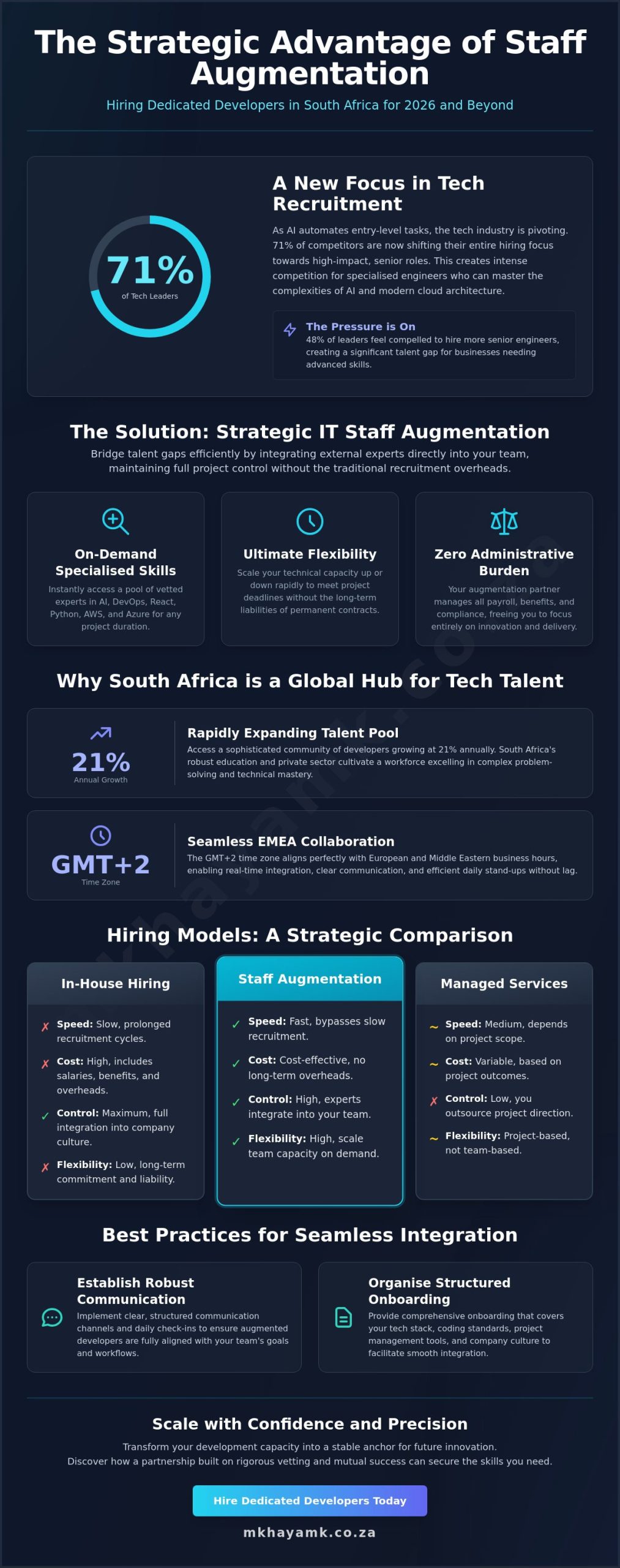
Could your business thrive if 71% of your competitors suddenly shifted their entire hiring focus toward high-impact, senior roles? As we move through 2026, tech leaders are moving away from broad recruitment to find specialised engineers who can master the complexities of AI and cloud architecture. You’ve likely felt the strain of intense local talent competition and the frustration of recruitment cycles that move far too slowly for your project deadlines. When you decide to hire dedicated developers in South Africa, you’re doing more than just filling a vacancy. You’re accessing a talent pool growing at 21% annually, offering a sophisticated blend of technical mastery and operational agility.
We recognise that scaling a technical team often feels like a difficult choice between quality and cost. This guide demonstrates how strategic staff augmentation provides a stable bridge to your digital goals. You’ll discover how to access top-tier software engineering talent, reduce your operational overheads, and integrate experts into your workflows with precision. We’ll explore flexible cost management and the specific steps to secure the AI and DevOps skills your next phase of growth requires, ensuring your organisation remains a stable anchor in a changing technological world.
Key Takeaways
Modernise your technical capacity by transitioning from rigid recruitment to on-demand staff augmentation, allowing for rapid scaling in a competitive 2026 market.
Leverage the GMT+2 time zone and exceptional engineering standards to hire dedicated developers in South Africa who integrate seamlessly with EMEA-based teams.
Determine when to utilise staff augmentation versus managed services to ensure your project receives the precise level of oversight and control required.
Establish robust communication channels and structured onboarding processes to facilitate the smooth integration of specialised talent into your existing workflows.
Discover how a partnership built on rigorous vetting and mutual success can transform your development capacity into a stable anchor for future innovation.
Understanding IT Staff Augmentation Services in the South African Context
In 2026, the traditional model of permanent recruitment is no longer the default for agile enterprises. Forward-thinking organisations are turning to Understanding IT Staff Augmentation as a sophisticated strategy to bridge talent gaps. This approach allows you to integrate external experts directly into your internal teams, maintaining full control over your project direction whilst outsourcing the complexities of recruitment and HR. When you choose to hire dedicated developers in South Africa, you’re not just filling a seat. You’re injecting high-level expertise from a community growing at 21% annually into your workflow to ensure your digital products remain competitive.
To better understand how this model functions in practice, watch this helpful video:
The Core Components of Modern Staff Augmentation
Modern augmentation focuses on immediate access to specialised skill sets such as React, Python, AWS, and Azure. You can choose between short-term engagements for specific project milestones or long-term team extensions that feel like an organic part of your company. A key benefit is that the service provider manages all administrative overheads. They handle payroll, benefits, and statutory compliance, leaving your leadership team free to focus on innovation. This creates a rhythmic momentum where your internal staff can focus on core business logic whilst augmented experts handle specialized execution.
Why South African Businesses are Choosing Augmentation in 2026
The local market is currently facing a talent paradox. Whilst the developer population is expanding, there’s a critical shortage of senior-level expertise in AI and DevOps. Since 71% of tech leaders have shifted their hiring focus to high-impact roles, the competition for these specialists is fierce. 48% of leaders now feel pressure to hire more senior engineers as AI absorbs entry-level tasks. Augmentation allows businesses to meet aggressive digital transformation deadlines by bypassing slow recruitment cycles. It offers a cost-effective way to secure senior talent without the overheads associated with full-time executive hires.
Why South Africa is a Global Hub for Dedicated Development Teams
South Africa has emerged as a cornerstone of global technical talent, offering a unique blend of high-end expertise and strategic convenience. It’s no longer just about finding lower costs; it’s about finding a partner that understands the pace of modern business. The country’s education system and robust private sector have cultivated a workforce that excels in complex problem-solving. When you decide to hire dedicated developers in South Africa, you’re engaging with a community that prioritises precision and long-term stability over quick, superficial fixes. This mindset ensures that your technical debt remains low whilst your innovation remains high.
One of the most significant advantages is the GMT+2 time zone. This alignment is perfect for EMEA collaboration, allowing for seamless, real-time integration into your daily stand-ups and sprint cycles. There’s no lag in communication, which is often the downfall of offshore projects. Coupled with high English proficiency and a business culture that mirrors Western standards, the integration process feels natural and frictionless. This cultural alignment ensures that project managers and stakeholders spend less time explaining context and more time driving results. You aren’t just hiring a remote worker; you’re gaining a teammate who shares your professional values.
Technical Excellence and Innovation
The local ecosystem is thriving, particularly in the field of custom software development. South African engineers have built a reputation for excellence in high-stakes sectors like fintech and digital lending. This isn’t accidental. It’s the result of a concentrated move towards AI-driven automation and robust data architectures. As organisations look to future-proof their operations, they find that South African teams are already well-versed in the cloud-native technologies and AI fluencies that are becoming baseline expectations in 2026. This forward-looking ambition makes the region a natural fit for businesses aiming to lead their industries.
Economic and Operational Advantages
The economic logic is compelling. Whilst the quality of work rivals that of Silicon Valley or London, the operational costs are significantly more manageable. Businesses often report savings of 50-70% compared to local hires in North America or Europe, based on current 2026 market data. This financial efficiency doesn’t come at the cost of infrastructure. South Africa boasts world-class connectivity and a legal framework that provides familiarity and protection for international contracts. It’s a stable anchor in a rapidly changing technological landscape, providing the reliability you need to scale with confidence. If you’re ready to explore these benefits for your own team, you can learn more about our engagement process to see how we can support your growth.
Strategic Comparison: Staff Augmentation vs Managed Services and In-house Hiring
Deciding how to grow your technical team requires a careful balance between immediate speed and long term stability. Building an internal team from scratch offers deep cultural alignment, yet it often comes with significant delays. In 2026, the average recruitment cycle for a senior engineer can exceed several months; a timeline that frequently clashes with urgent project milestones. Whilst permanent hires provide excellent knowledge retention, the high competition for local talent means you might spend more time recruiting than actually building software.
Managed services offer an alternative where you outsource an entire project outcome to an external partner. This model is effective for standalone products with fixed requirements. However, if you need to hire dedicated developers in South Africa to work alongside your existing staff, staff augmentation is the superior strategic choice. It allows you to maintain direct oversight of the development process whilst benefiting from external expertise. This ensures that the code quality and architectural decisions remain within your control, preventing the “black box” effect often associated with traditional outsourcing.
When to Choose Staff Augmentation
Staff augmentation is the ideal solution when you need to close specific skill gaps within an existing agile team. If your current developers are proficient in core logic but lack deep expertise in AI or cloud-native DevOps, bringing in a dedicated specialist provides an immediate boost. This model is also perfectly suited for projects with fluctuating workloads. You can scale your capacity during intensive development phases and reduce it once the project moves into maintenance. It offers the precision of a surgical strike, allowing you to add exactly the “muscle” you need without disrupting your established internal culture.
The Financial Reality: Reducing IT Costs
The primary objection to augmentation is often the perceived higher hourly rate compared to a permanent salary. However, a true cost analysis reveals that augmentation is frequently more economical. By choosing this model, you eliminate recruitment fees, training expenses, and the substantial costs of equipment and office overheads. You also avoid the long term liabilities associated with permanent contracts in South Africa’s complex labour market. This shift allows you to reduce IT costs with staff augmentation by converting fixed labour costs into variable operational expenses. It provides your business with the financial agility to pivot resources as market demands change, ensuring that every Rand spent contributes directly to technical output.
Best Practices for Integrating Augmented Developers into Your Tech Stack
Successful staff augmentation depends on more than just technical skill; it requires a deliberate strategy for integration. When you hire dedicated developers in South Africa, the goal is to create a unified team where the boundary between internal and external staff becomes invisible. This synergy doesn’t happen by accident. It’s the result of structured processes that align every new member with your internal coding standards and DevOps culture. By setting clear KPIs and performance metrics from the first day, you establish a baseline for mutual success and accountability. It’s about creating a rhythmic momentum that drives your technical roadmap forward.
Step 1: Onboarding and Cultural Alignment
Onboarding is the foundation of your partnership. Start by introducing developers to your overarching company vision and the specific project roadmap. This context allows them to make informed technical decisions that support long-term goals rather than just immediate tickets. You’ll need to provide immediate access to necessary cloud solutions and security protocols to prevent early delays. Establishing meeting cadences and reporting structures early ensures everyone is moving at the same pace. When developers understand the “why” behind the “what”, their contribution becomes significantly more impactful and purposeful.
Step 2: Technical Integration and Tooling
Technical friction can stall even the most talented engineers. Ensure your augmented staff have seamless access to version control systems like GitHub or GitLab from the outset. Integrate them into your existing Slack, Jira, or Trello workflows to maintain transparent communication. To protect your software engineering standards, establish a robust peer review process. This doesn’t just maintain code quality; it also facilitates knowledge transfer between your internal team and your augmented developers. It’s about building a collective intelligence that benefits the entire organisation, ensuring that every line of code meets your specific architectural requirements.
Step 3: Continuous Feedback and Scaling
The final phase of integration is refinement. Implement regular check-ins to identify and remove bottlenecks before they impact your timelines. You can use data from AI and automation tools to track productivity and identify areas for improvement. This data-driven approach allows you to scale the team up or down based on real-time project requirements with complete confidence. It ensures your organisation remains agile, pivoting resources as your market demands shift. If you’re ready to refine your technical capacity with precision, explore our staff augmentation services to find the right fit for your next project.
Scaling with Confidence: The Mkhaya MK Approach to Staff Augmentation
Scaling a technical team requires a partner who values your long-term stability as much as your immediate output. When you choose to hire dedicated developers in South Africa through Mkhaya MK, you’re engaging with a visionary partner in digital transformation. We move beyond the “body-shopping” model that often leaves enterprises with technical debt or misaligned goals. Our approach is built on a foundation of professional confidence and supportive partnership, ensuring that every expert we place is both a technical master and a strategic asset. We value transparency and methodical execution, providing you with the reliability needed to navigate a changing technological landscape.
Our commitment to your success is reflected in the Mkhaya MK Guarantee. This promise is built on three pillars: reliability, transparency, and a long-term investment in your journey. We don’t just provide resources; we provide a stable anchor. Our vetting process is exceptionally rigorous, going far beyond a simple checklist of coding languages to include business acumen. Our developers don’t just work on isolated features; they understand the intricate dependencies of complex enterprise environments. Whether you’re refining an ERP solution or building a custom Loan Management System, our staff brings the industry-specific knowledge required to avoid common architectural pitfalls.
More Than Just Code: A Partnership for Success
We align our staff augmentation services with your specific strategic goals to ensure that every hire contributes to your bottom line. It isn’t enough to just execute tasks; we provide developers who are ready to innovate and challenge existing processes for the better. Our national reach allows us to tap into the deepest talent pools across South Africa, ensuring we find the right fit for your unique company culture. By focusing on mutual success, we build relationships that last years, not just months. This forward-looking ambition is what sets our partnerships apart from standard, transactional outsourcing arrangements. It’s about building a collective intelligence that stays within your organisation.
Start Your Journey with Mkhaya MK
The path to a stronger, more agile team begins with a clear assessment of your current technical gaps. We invite you to initiate a consultation where we’ll analyse your requirements, project deadlines, and desired outcomes. Our methodical matching process ensures that the talent we provide isn’t just technically capable but also culturally aligned with your internal staff. This precision reduces friction and accelerates your time-to-market, allowing your business to pivot as market demands shift. When you’re ready to move forward with a partner that values integrity and commitment, contact us today to scale your technical team with precision and discover how we can help you build for the future.
Building Your Technical Future with Strategic Partnership
We’ve explored how the shift toward high-impact, senior roles in 2026 makes traditional recruitment a bottleneck for growth. By choosing to hire dedicated developers in South Africa, you secure a competitive advantage through GMT+2 alignment and world-class engineering standards. This model offers the precision to close skill gaps in AI and cloud architecture whilst maintaining the flexibility to manage costs effectively. It’s about more than just filling a gap; it’s about constructing a stable anchor for your long-term innovation.
Mkhaya MK stands as your visionary guide in this journey. Our vetted network of senior South African developers brings deep expertise in AI, Cloud, and Custom Software Development to your most ambitious projects. With a proven track record in national digital transformation projects, we ensure your team scaling is methodical and rooted in mutual success. Partner with Mkhaya MK to scale your engineering team today and turn your technical vision into a stable reality. We look forward to building a resilient future alongside your organisation.
Frequently Asked Questions
What is the difference between IT staff augmentation and project outsourcing?
Staff augmentation integrates external experts directly into your internal team under your direct management, whilst project outsourcing involves handing over an entire project to a provider for a specific outcome. Augmentation provides you with greater control over daily workflows and architectural decisions. It’s a collaborative approach that allows you to maintain oversight whilst injecting specialised talent into your existing processes.
How long does it take to hire a dedicated developer in South Africa through Mkhaya MK?
We typically match your organisation with vetted technical talent within two to four weeks. This timeline depends on the complexity of the required skill set and your specific project needs. Our methodical approach ensures we move faster than traditional recruitment cycles, which often exceed three months in the current 2026 market, allowing you to maintain project momentum without long delays.
Can I hire remote developers for short-term projects only?
You can certainly engage developers for short-term projects to address immediate technical hurdles or seasonal workload surges. Our models are built for flexibility, allowing you to scale your capacity up or down as your roadmap requires. This agility ensures you only pay for the expertise you need when you need it, converting fixed labour costs into manageable operational expenses.
How do you ensure the quality and vetting of your developers?
We employ a rigorous multi-stage vetting process that evaluates technical mastery, business acumen, and cultural alignment. Every candidate undergoes live coding assessments and architectural reviews to ensure they can handle complex enterprise systems. When you hire dedicated developers in South Africa through us, you’re accessing a network of professionals who have been tested for reliability and long-term stability.
Is staff augmentation suitable for small businesses or only large enterprises?
Staff augmentation is highly effective for organisations of all sizes. Small businesses use this model to access senior-level expertise that might be too costly for full-time local hire, whilst larger enterprises use it for rapid scaling. It provides a stable anchor for growth by allowing any business to hire dedicated developers in South Africa to meet specific technical milestones with precision.
What happens if the augmented developer is not a good fit for my team?
We prioritise a precise matching process to ensure cultural and technical alignment from the start. However, if a developer isn’t the right fit for your specific team dynamics, we initiate a replacement protocol to minimise disruption. Our focus remains on mutual success, and we act decisively to ensure your project remains on track and your team’s rhythm stays consistent.
How does Mkhaya MK handle intellectual property and data security with augmented staff?
All intellectual property created during the engagement belongs entirely to your organisation through clear legal agreements. We ensure that every developer adheres to your internal security protocols and complies with national data protection standards like POPIA. This transparency protects your digital assets and provides the peace of mind required to innovate in a secure and reliable technical environment.
Can augmented developers work on-site at our offices in South Africa?
Whilst our model is primarily designed for remote or hybrid integration to maximise efficiency, on-site arrangements can be discussed for specific requirements within South Africa. Most clients find that our GMT+2 alignment makes remote collaboration feel seamless and productive. We focus on creating a supportive partnership that adapts to your preferred way of working, whether remote or in-person.
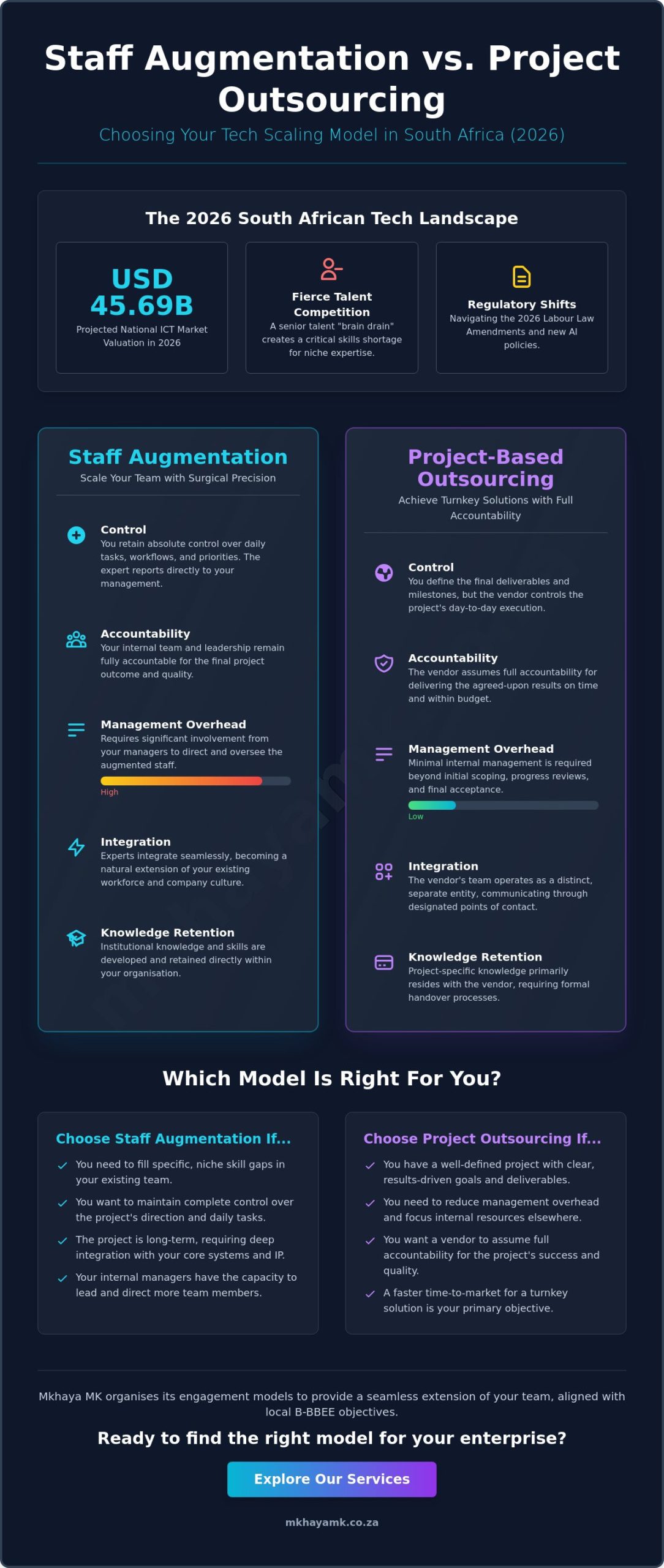
The search for high-level engineering expertise in South Africa has reached a critical turning point in 2026, where the way you scale is now as vital as the talent you find. With the national ICT market projected to reach USD 45.69 billion this year, the competition for senior developers is fiercer than ever. Deciding between staff augmentation vs project outsourcing south africa isn’t just a choice about headcount; it’s a strategic decision between operational control and delivery accountability.
You’ve likely felt the frustration of niche talent shortages or the management overhead that often shadows remote teams. It’s a common challenge to balance the need for rapid scaling against the reality of internal capacity constraints. This guide helps you discover the ideal scaling model for your South African enterprise by comparing control, cost, and delivery outcomes. We’ll examine how to secure a faster time-to-market and access elite engineering skills without the long-term commitment of a permanent headcount, ensuring your business remains agile whilst navigating the 2026 labour law amendments.
Key Takeaways
Understand how the 2026 South African talent landscape and the “brain drain” affect your ability to secure niche engineering expertise locally.
Discover how staff augmentation allows you to maintain absolute control over daily workflows whilst scaling your internal team with surgical precision.
Explore the advantages of project-based outsourcing for results-driven, turnkey solutions where the vendor assumes full accountability for delivery and quality.
Evaluate management overhead and cost structures to determine whether staff augmentation vs project outsourcing south africa best suits your operational goals.
Learn how Mkhaya MK organises its engagement models to provide a seamless extension of your team that remains aligned with local B-BBEE objectives.
The South African Tech Landscape in 2026: Why Model Choice Matters
A foundational grasp of these structures is essential for long-term stability. Before committing to a vendor, many leaders ask What is Staff Augmentation? to ensure they understand the level of control they retain. This model allows for surgical precision in team building, which is vital when navigating the 2026 Labour Law Amendment Bill and its new regulations regarding gig worker classifications. Choosing the right path ensures your infrastructure remains resilient whilst you leverage local expertise that understands the nuances of the South African market.
To better understand how these models function in a real-world setting, watch this helpful comparison:
Addressing the Local Skills Gap
The demand for specialised skills in AI integration and cloud-native architectures has never been higher. In tech hubs like Cape Town and Johannesburg, the shift toward flexible talent models is a direct response to the slow pace of traditional hiring. Businesses need access to senior engineering talent that can hit the ground running. With the South African government implementing a draft AI policy in 2026, the need for compliant, high-level expertise is paramount. These flexible models provide a way to bypass lengthy recruitment cycles and immediately address capacity constraints with precision.
Economic Pressures and IT Budgeting
Fluctuations in the Rand make offshore talent a risky financial gamble for many local enterprises. Strategic tech spend now focuses on local partnerships that ensure B-BBEE alignment and support the domestic economy. Achieving high-end digital transformation doesn’t have to mean sacrificing cost-efficiency. By choosing local expertise, businesses gain partners who understand the unique challenges of the South African market, including infrastructure stability and the latest regulatory requirements like the 2025 Joint Standard on Cybersecurity. This local focus ensures that every Rand spent contributes to both project success and national economic growth.
Understanding Staff Augmentation: Scaling with Precision
Choosing staff augmentation is akin to performing a surgical upgrade on your existing technical team. This model allows you to hand-pick specific experts who join your internal ranks to bridge a precise skill gap. Unlike other models, you retain the leadership role. You direct their daily tasks, set their priorities, and ensure they adhere to your internal culture. When evaluating staff augmentation vs project outsourcing south africa, the decision often hinges on how much day-to-day involvement your internal managers can sustain.
Integrating augmented talent into your current software engineering processes feels natural because they function as a seamless extension of your workforce. This approach is particularly effective for long-term product maintenance or the development of core intellectual property where deep, ongoing knowledge of your systems is required. It ensures that the institutional knowledge stays within your walls, even if the individual isn’t a permanent hire. It’s a model built for businesses that already have a strong internal technical vision but simply lack the hands to execute it at pace.
Key Advantages of the Augmentation Model
The primary appeal lies in direct oversight. You eliminate the “black box” effect where progress happens out of sight. Instead, you see the developer’s output in real-time. This level of transparency builds trust and allows for immediate course correction. It also offers a pathway to scale without the long-term liabilities associated with permanent employment, such as the increased severance pay requirements introduced in the 2026 Labour Law Amendment Bill. You gain the skills you need without the administrative weight of a permanent headcount.
Potential Challenges for SA Managers
The management burden is the most overlooked factor when comparing staff augmentation vs project outsourcing south africa. Many businesses underestimate the hours spent in daily stand-ups, code reviews, and performance check-ins. If your internal leads are already at maximum capacity, adding more individuals to supervise might lead to bottlenecks rather than solving them. You also carry the full weight of project outcomes. If the roadmap is flawed, the responsibility rests entirely with your team. Friction can also arise if the new talent isn’t carefully aligned with your existing team’s social dynamics, requiring a proactive approach to cultural integration.
If your team has the leadership capacity to guide high-level talent toward your vision, exploring our staff augmentation services could be the steady foundation your next phase of growth requires.
Project outsourcing represents a fundamental shift from managing people to managing results. In this model, you entrust a partner with the entire lifecycle of a project, from the initial concept to the final deployment. It’s a turnkey solution where the vendor assumes full accountability for meeting deadlines and maintaining quality standards. This shift is particularly beneficial when you’re looking to accelerate custom software development without diverting your internal team from their core responsibilities.
When comparing staff augmentation vs project outsourcing south africa, the primary differentiator is the ownership of the process. Whilst augmentation requires you to lead the daily stand-ups, outsourcing allows you to focus on the strategic “why” whilst your partner handles the technical “how”. Success in this model relies heavily on a well-defined scope and robust Service Level Agreements (SLAs) that align with South Africa’s 2025 Joint Standard on Cybersecurity. These documents ensure that both parties have a shared vision of success and a clear roadmap for delivery, providing a stable anchor in a fast-moving market.
When to Choose Project-Based Delivery
This model is the ideal choice for ambitious product launches or non-core initiatives that require a rapid turnaround. It’s especially effective when your project demands highly specialised tech stacks, such as AI and data automation, which might otherwise require months of internal training. By outsourcing the entire project, you bypass the learning curve. You gain immediate access to a team that already possesses the necessary expertise. This significantly reduces the burden on your internal IT leadership, allowing them to focus on high-level strategy rather than the minutiae of daily development tasks.
Managing the Outsourcing Relationship
A successful partnership begins long before the first line of code is written. It starts with a comprehensive Discovery Phase where your vision is translated into functional requirements and intuitive UI/UX design. This phase is crucial for eliminating the “black box” feel that sometimes plagues traditional outsourcing. By leveraging modern cloud solutions, we ensure that remote project delivery is seamless and secure, regardless of where your stakeholders are located. We maintain transparency through Agile methodologies, providing regular updates that keep you informed and in control of the project’s direction without the need for constant micromanagement.
Staff Augmentation vs Project Outsourcing: A Strategic Comparison
The fundamental difference in management overhead often dictates the success of your scaling strategy. In a staff augmentation model, your internal leads direct every daily stand-up and code review, maintaining a tight grip on the development culture. Conversely, project outsourcing shifts this burden to your partner. They manage the technical execution whilst you oversee the high-level roadmap. When weighing staff augmentation vs project outsourcing south africa, you must evaluate if your internal leadership has the capacity to mentor additional hands or if they need the freedom to focus on core business growth.
Cost structures also diverge significantly to suit different financial goals. Augmentation typically relies on monthly retainers, providing predictable operational expenses for ongoing support and long-term stability. Project-based models often utilise fixed-price fees or milestone payments. These offer budget certainty for specific deliverables, which is particularly relevant in 2026 as South African firms navigate exchange rate volatility and the need for local, B-BBEE-compliant tech spend. This financial clarity allows you to allocate resources with confidence, knowing that the price of delivery is locked in from the start.
Risk mitigation involves more than just delivery guarantees; it requires a deep understanding of local regulations. Both models must adhere to POPIA and the 2025 Joint Standard on Cybersecurity to ensure data integrity. Scalability speed is another vital factor. Augmentation allows for rapid, surgical additions to your team to meet immediate needs. Project outsourcing can ramp up an entire project squad in weeks rather than months, providing a stable anchor for large-scale initiatives that your internal team might not be equipped to handle alone.
The Decision Matrix for 2026
Choosing the right path requires an honest assessment of your project’s maturity and your budget certainty. For most South African CTOs, control remains the deciding factor. If the project involves core intellectual property or requires daily pivots based on user feedback, augmentation is usually the safer bet. However, if a project is too complex for your internal team to oversee without significant distraction, a results-driven outsourcing model provides the necessary buffer. This ensures that your primary operations don’t suffer whilst you pursue new innovations.
Hybrid Models: The Best of Both Worlds?
Many forward-thinking enterprises find that a single model isn’t enough to meet all their needs. You might use augmented talent to maintain your core learner management system whilst tasking an outsourced specialist team with building a new AI-driven automation feature. We facilitate this transition at Mkhaya MK, allowing you to move between models as your project evolves. A hybrid model is the ultimate flexibility tool for South African enterprises seeking to balance operational control with rapid innovation.
If you’re ready to define your scaling strategy, contact our team to discuss which model aligns with your 2026 objectives.
Navigating the Choice: Implementing the Right Model with Mkhaya MK
Finding the right balance in the staff augmentation vs project outsourcing south africa debate is only the first step toward operational excellence. The real value lies in how that model is integrated into your daily business life. At Mkhaya MK, we organise our staff augmentation to feel like a natural extension of your team. This ensures that the transition is smooth and that the technical expertise we provide aligns perfectly with your internal culture and objectives. We don’t just provide hands; we provide a collaborative partnership built on mutual success.
Our commitment to local talent development goes beyond simple recruitment. We prioritise B-BBEE alignment and domestic economic contribution, ensuring that your tech spend strengthens the South African ecosystem. Choosing a local partner also provides a level of infrastructure resilience that offshore alternatives cannot match. We understand the local challenges, from connectivity nuances to the importance of data sovereignty under POPIA. We build our delivery models to remain stable and reliable, providing a steady anchor in a rapidly changing technological landscape.
The Mkhaya MK process moves purposefully from an initial consultation to a steady state of delivery. This methodical execution ensures that every detail is articulated before we move forward. By linking our specific engineering capabilities to your practical business outcomes, we create a rhythmic sense of momentum. This approach leads your business from a broad vision toward a concrete path of growth and stability.
Your Roadmap to Successful Engagement
Success requires a structured approach. We recommend starting with an internal audit to identify your most pressing technical gaps and long-term project goals. Once these are clear, you can choose the model that best aligns with your management capacity. Finally, we work with you to establish clear KPIs and communication channels. This transparency ensures that every stakeholder remains informed and that the project moves forward with absolute clarity.
Why Mkhaya MK is the Preferred Partner in South Africa
We bring deep expertise across ERP solutions and custom engineering to every engagement. Our focus is never on transactional vendor relationships; we strive for long-term partnerships that grow alongside your business. We have a proven track record of delivering digital transformation for national brands, providing the visionary yet practical guidance needed to navigate 2026. By choosing Mkhaya MK, you gain a reliable partner dedicated to your personal journey and your business’s forward-looking ambition.
Building Your Technical Future with Confidence
The choice between staff augmentation vs project outsourcing south africa ultimately rests on your unique operational vision and internal capacity. Throughout this guide, we’ve explored how augmentation offers surgical control whilst project outsourcing provides results-driven accountability. Both models serve as powerful catalysts for growth when aligned with the right strategic goals and management structures. As end-to-end digital transformation experts with a national South African reach, Mkhaya MK is here to ensure your scaling journey is both precise and sustainable.
Our specialised expertise in AI, Cloud, and Custom Engineering allows us to guide you through the complexities of the 2026 tech landscape. Whether you need to bolster your internal team or deliver a turnkey solution, we provide the steady foundation your business requires to thrive. We invite you to book a consultation with Mkhaya MK to find your ideal scaling model. We look forward to partnering with you to turn your ambitious vision into a concrete, high-performing reality.
Frequently Asked Questions
What is the primary difference between staff augmentation and project outsourcing?
The primary difference lies in who manages the daily workflow and team leadership. Staff augmentation provides you with individual experts who report directly to your internal leads, whilst project outsourcing involves a partner taking full responsibility for the end-to-end delivery of a specific outcome. One offers operational control, while the other provides delivery accountability.
Which model is more cost-effective for a South African startup?
For a South African startup, the most cost-effective model depends on your internal leadership capacity. Staff augmentation often provides lower upfront costs if you already have technical leads to manage the work. However, project outsourcing offers predictable, fixed-price structures that help startups avoid the financial risks of project creep and management overhead during critical growth phases.
How does staff augmentation affect my internal company culture?
Staff augmentation introduces new talent directly into your existing team rituals and social dynamics. This can strengthen your culture by bringing in fresh perspectives and high-level expertise, provided you have a structured onboarding process. It’s essential to treat augmented staff as a true extension of your workforce to maintain a cohesive and aspirational environment.
Can I switch from staff augmentation to project outsourcing mid-way through a project?
Switching between models is entirely possible and often strategically sound as a project evolves. You might start with project outsourcing to build a core product and then transition to staff augmentation for long-term maintenance. When comparing staff augmentation vs project outsourcing south africa, many firms find that a hybrid approach offers the most long-term stability.
Who owns the Intellectual Property (IP) in a project outsourcing agreement?
In a standard project outsourcing agreement, the client typically retains full ownership of the Intellectual Property. It’s vital to ensure your contract explicitly states that all custom code, designs, and documentation belong to your enterprise upon payment. This protection is a standard part of our commitment to transparency and the mutual success of our partnerships.
How do I ensure data security when using augmented staff in South Africa?
Ensuring data security requires strict adherence to POPIA regulations and the 2025 Joint Standard on Cybersecurity. You should implement secure cloud environments and ensure all augmented staff follow your internal security protocols. Regular audits and clear data-handling policies are non-negotiable for maintaining resilience in the South African technological landscape.
What management tools are best for overseeing an outsourced development project?
Does Mkhaya MK offer support for both remote and on-site staff augmentation?
Mkhaya MK provides flexible staff augmentation services designed to fit your specific infrastructure and operational requirements. We focus on delivering a seamless experience that feels like a natural extension of your team, ensuring that our experts align with your internal workflows. Our goal is to provide the steady support and engineering expertise your business needs to thrive.