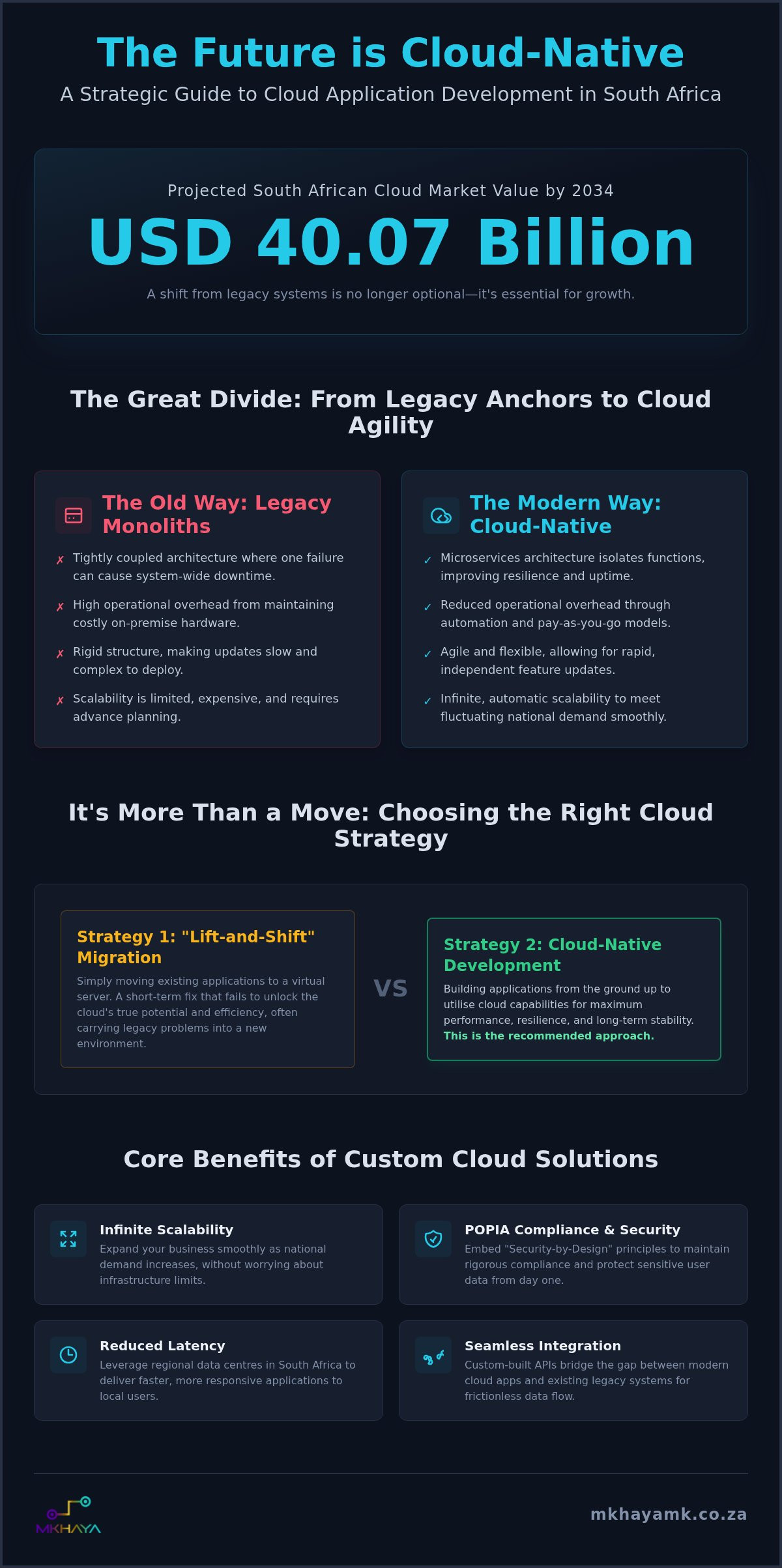
By 2034, South Africa’s cloud market is projected to reach a staggering USD 40.07 billion, yet many organisations still feel anchored by the weight of legacy systems. You’ve likely felt the mounting pressure of maintaining costly hardware whilst trying to keep pace with rapid digital shifts. Mastering cloud application development south africa requires more than just technical migration; it demands a strategy that balances modern innovation with the strict requirements of POPIA compliance and data sovereignty.
We recognise the difficulty of finding local engineering talent who can bridge the gap between global performance standards and national demand. This guide provides a clear roadmap for your cloud-native journey, showing you how to reduce operational overhead through purposeful automation. You’ll discover how to build applications that are secure, high-performing, and inherently scalable for the local landscape. From strategic engineering to long-term stability, let’s explore how to turn your cloud vision into a resilient business reality.
Key Takeaways
Distinguish between modern cloud-native engineering and traditional migrations to ensure your infrastructure is built for long-term agility.
Identify how custom-built applications offer infinite scalability, allowing your business to expand smoothly as national demand increases.
Navigate the local provider landscape to optimise cloud application development south africa by leveraging regional data centres for reduced latency.
Embed “Security-by-Design” principles into your development lifecycle to maintain rigorous POPIA compliance and protect sensitive user data.
Accelerate your digital transformation through a methodical partnership that combines custom engineering with flexible staff augmentation.
The Evolution of Cloud Application Development in South Africa
Cloud application development south africa has transitioned from a niche technical choice to a fundamental business requirement. Unlike traditional software development, which often focuses on local server environments, cloud application development is the specific process of building and deploying software designed to run within cloud-native architectures. This approach allows businesses to move beyond the constraints of physical hardware, embracing a model where performance and scale are limited only by strategic vision. It’s about building for the cloud, not just moving to it.
To better understand how these technical shifts are being supported by major global infrastructure providers in the region, watch this helpful video:
For many years, the standard approach was “lift-and-shift”, simply moving existing applications to a virtual server. Whilst this solved immediate hardware concerns, it failed to unlock the true efficiency of the cloud. Modern engineering prioritises cloud-native development, where applications are constructed from the ground up to utilise the unique capabilities of cloud platforms. This shift is particularly vital given the current state of South Africa’s digital landscape, which now supports the high-speed connectivity required for sophisticated, decentralised operations.
From Legacy Monoliths to Cloud-Native Architecture
Legacy systems often function as monoliths, where every feature is tightly coupled. If one part fails, the entire system risks downtime. Modern cloud application development south africa replaces these rigid structures with microservices. By organising business logic into small, independent services, developers can update or scale specific features without impacting the whole application. Containers, such as Docker, play a crucial role here, providing a stable environment that ensures the software runs consistently regardless of where it’s deployed.
Why Cloud-First is the Standard for South African Enterprises
The arrival of local data centres from global hyperscalers has changed the game. South African enterprises no longer need to rely on overseas servers that introduce latency. A cloud-first strategy supports the agility needed for hybrid work models, allowing teams across the country to access high-performance tools securely. This methodology is a core component of custom software development in South Africa, providing the foundation for long-term stability and growth. By building on modern infrastructure, businesses can ensure their digital tools remain resilient and adaptable to changing market demands.
Generic off-the-shelf software often forces your business into a predetermined mould. It might solve immediate problems, but it rarely accounts for the specific nuances of your internal workflows or the unique demands of the local market. Custom cloud application development south africa offers a different path. By engineering solutions tailored to your precise requirements, you gain what we call “quiet confidence.” This is the steady assurance that your digital foundation won’t buckle under pressure or limit your growth as your operations expand.
Bespoke solutions allow for seamless integration with your existing infrastructure. Whether you are using a legacy ERP system or modern data tools, custom-built APIs act as the perfect bridge, ensuring data flows without friction. This level of refinement isn’t possible with generic platforms that often rely on “one-size-fits-all” connectors. By building specifically for your ecosystem, you eliminate technical debt and create a stable anchor for long-term stability.
Operational Agility and Infinite Scalability
Traditional infrastructure requires you to predict your peak traffic months in advance. If you guess wrong, you either overpay for idle servers or suffer through site crashes during high-demand periods. Cloud-native applications solve this by scaling horizontally in real-time. When national user traffic spikes, your application automatically allocates more resources to handle the load, ensuring performance remains consistent for every user.
This agility is built on a foundation of robust Cloud Solutions. Through modern DevOps pipelines, your engineering team can deploy updates and new features without any downtime. This means your business remains agile, responding to competitor moves or regulatory changes in days rather than months. It transforms software from a static tool into a living part of your business strategy.
Cost Management through Modern Engineering
One of the most significant shifts in 2026 is the transition from Capital Expenditure (CapEx) to Operational Expenditure (OpEx). Instead of investing heavily in physical hardware that depreciates over time, you pay for exactly what you use. Custom engineering takes this a step further through serverless architecture. In a serverless model, code only executes when triggered by a specific event, which eliminates the cost of keeping servers running 24/7 when they aren’t being used.
It’s a methodical approach to efficiency that directly impacts your bottom line. For a deeper look at managing these expenses, see our guide on Cloud Cost Optimisation in South Africa: A Strategic Guide for 2026. If you are ready to move beyond the limitations of generic software, exploring a partnership with Mkhaya MK can provide the stable, forward-looking foundation your business needs.
Navigating the Local Cloud Landscape: Providers and Models
Selecting the right infrastructure is a pivotal step in the journey of cloud application development south africa. It isn’t just about where your data resides; it’s about which ecosystem best supports your specific business logic and performance requirements. With major hyperscalers now firmly rooted in the country, the choice between AWS, Azure, and Google Cloud comes down to a methodical assessment of your long-term goals and existing technical stack.
The presence of local regions, particularly the established hubs in Cape Town and Johannesburg, has fundamentally changed the user experience. By hosting your application locally, you significantly reduce latency. In the context of local data centres, latency is the time delay between a user’s action and the application’s response. For real-time applications like financial platforms or logistics trackers, every millisecond counts towards maintaining user trust and operational efficiency.
Choosing the Right Provider for Your Development Goals
Each provider offers a unique set of tools that can influence your engineering velocity. Whilst AWS is often seen as the leader in innovation and tool variety, Azure is frequently the preferred choice for organisations already embedded in the Microsoft ecosystem. Google Cloud continues to gain ground by offering specialised capabilities in AI and data analytics, making it a strong contender for data-heavy projects.
Provider
Core Strengths
Strategic Fit
AWS
Mature toolsets; extensive Cape Town region support.
High-scale consumer apps and rapid innovation.
Microsoft Azure
Deep integration with Office 365 and Windows Server.
Enterprise-grade migrations and corporate environments.
Google Cloud
Leading AI, machine learning, and data processing.
Data-heavy research and modern analytics platforms.
The Hybrid Cloud: Maintaining Data Sovereignty
Beyond the public cloud, the hybrid model offers a balanced path for businesses with strict data requirements. Some organisations must keep specific datasets on-premise due to internal policy or historical infrastructure. A hybrid approach allows you to manage data flow between your local servers and the public cloud, ensuring you benefit from cloud-native agility without compromising your existing security protocols. This setup allows for a gradual, secure transition to more modern architectures.
This methodical integration is a key pillar of Digital Transformation, providing a stable bridge between your current capabilities and future ambitions. Managed services also play a vital role in accelerating the development lifecycle. By utilising pre-configured services for databases, authentication, or messaging, your engineering team can focus on building unique business value rather than managing the underlying hardware. This shift from manual maintenance to automated management reinforces a culture of reliability and allows your team to scale with quiet confidence.
Compliance and Security: Developing for the POPIA Era
In the current regulatory environment, compliance is no longer a checkbox exercise. It is the bedrock of digital trust. For businesses engaged in cloud application development south africa, the Protection of Personal Information Act (POPIA) dictates exactly how data must be collected, stored, and processed. A common concern amongst leadership is whether data is truly safer in the cloud than on a private local server. The reality is that global hyperscalers invest billions in security infrastructure, providing a level of protection that far exceeds what most individual organisations can maintain on-premise.
According to recent industry data, 88% of organisations have increased their cloud security efforts in 2026, reflecting a national shift towards proactive protection. Security in the cloud is a shared responsibility. Whilst the provider secures the underlying hardware and data centres, the developer is responsible for securing the application layer. This involves implementing rigorous encryption for data both at rest and in transit, alongside granular access controls that ensure only authorised personnel can interact with sensitive business information.
Ensuring Data Privacy and Regulatory Compliance
Custom-engineered applications provide a distinct advantage for maintaining POPIA compliance. We can build automated workflows that handle data deletion requests or subject access reports without manual intervention, reducing the risk of human error. By leveraging local data centres in Cape Town and Johannesburg, we ensure that sensitive South African data remains on national soil, satisfying strict residency requirements. Integrating AI & Data Automation allows for intelligent, real-time monitoring of data patterns, flagging potential anomalies before they become security breaches.
Security-by-Design in Cloud Engineering
Security-by-Design is a core engineering principle where security measures are integrated into the application from the very first line of code rather than added as an afterthought. This methodical approach often involves a Zero Trust architecture, where no user or system is trusted by default, regardless of whether they are inside or outside the network perimeter. Automated testing within the DevOps cycle identifies vulnerabilities during the development phase, ensuring that every update meets the highest safety standards before it ever reaches a user.
Building a resilient digital presence requires a partner who understands the intersection of innovation and regulation. If you are ready to secure your business’s future, contact Mkhaya MK today to discuss a compliant and high-performance roadmap for your next project.
Partnering with Mkhaya MK for Scalable Cloud Innovation
Choosing a partner for cloud application development south africa is about more than just finding technical expertise; it’s about forming a relationship built on transparency and long-term stability. At Mkhaya MK, we project a persona of quiet confidence, focusing on the methodical execution of your digital vision. We act as a visionary yet practical guide, ensuring your transition to the cloud is both ambitious and rooted in technical integrity. Our role is to be a stable anchor in a rapidly changing technological landscape, helping you move from high-level strategic concepts to a concrete path forward.
Success in the cloud requires a deep understanding of the synergy between custom software engineering and managed services. We provide the end-to-end expertise needed to align your business goals with modern infrastructure, creating a resilient digital presence that scales with national demand. By focusing on your specific workflows, we refine your operations to reduce overhead and improve performance, ensuring you remain competitive in the 2026 market.
Our Methodical Engineering Process
Stability begins with a thorough discovery phase where we plan for future growth. We don’t just build software; we architect for long-term reliability. Our team prioritises strategic architecture planning to ensure your platform remains high-performing as your user base expands. Through agile development and a robust continuous integration and deployment (CI/CD) pipeline, we deliver updates with precision. This rhythmic sense of momentum ensures that every phase of the Mkhaya MK Process is fully articulated before moving to the next.
Bridging the Skills Gap with Staff Augmentation
One of the primary pains for South African businesses is the difficulty in finding local expert engineering talent to support cloud application development south africa. We solve this through flexible staff augmentation, allowing you to extend your internal tech team with specialised cloud engineers quickly. This approach isn’t just about filling gaps; it’s about adding a layer of high-end expertise to your project precisely when it’s needed most.
Our remote professionals are deeply invested in your personal journey, providing the commitment and integrity your project deserves. For a comprehensive look at how to scale your team with precision, explore our guide on Hire Dedicated Developers in South Africa: A Strategic Guide to IT Staff Augmentation (2026). By combining project-based development with skilled team extension, we provide the stability and agility required to thrive in a modern, cloud-first environment.
Securing Your Digital Future through Methodical Innovation
Refining your digital infrastructure isn’t just about adopting new tools; it’s about building a stable foundation for long-term growth. Successful cloud application development south africa hinges on a compliance-first philosophy that balances innovation with national regulations. By moving beyond generic software and embracing custom, POPIA-compliant solutions, you ensure your organisation remains agile whilst maintaining the highest security standards.
A methodical approach to engineering allows you to reduce operational overhead through automation and serverless architecture. Mkhaya MK brings end-to-end software engineering expertise to every project, acting as specialists in POPIA-compliant cloud solutions. If you need to bridge the local skills gap, our flexible staff augmentation services allow you to scale your internal team with quiet confidence.
We’re ready to act as your visionary yet practical guide in this journey. Partner with Mkhaya MK to build your next-generation cloud application and transform your technological vision into a resilient business reality. Your path to sustainable digital transformation starts here.
Frequently Asked Questions
What is the difference between cloud hosting and cloud application development?
Cloud hosting provides the virtual infrastructure and server space where your data lives, whereas cloud application development is the engineering process of building software specifically to run in those environments. Hosting is essentially the utility and maintenance of storage. Development focuses on creating custom business logic, user interfaces, and integrations. It’s the difference between renting a plot of land and architecting a bespoke building designed for your specific needs.
Is cloud application development POPIA compliant in South Africa?
Yes, cloud application development can be fully POPIA compliant when engineered with a “Security-by-Design” approach from the start. By utilising local data centres in Cape Town and Johannesburg, we ensure that sensitive personal information remains within national borders. This satisfies residency requirements whilst providing the high-speed performance required for modern business. We integrate encryption and granular access controls to protect data according to the strict standards set by South African law.
How much does it cost to develop a custom cloud application?
The cost of developing a custom cloud application depends on the complexity of your business logic, the number of required integrations, and the intended scale of the user base. A methodical discovery phase helps define these variables before any engineering begins. Whilst the initial investment might be higher than generic off-the-shelf options, the long-term reduction in operational overhead and technical debt often provides a superior return on investment for growing organisations.
How long does the cloud application development lifecycle typically take?
The development lifecycle varies based on project scope, but most enterprise-grade solutions move from discovery to deployment within three to nine months. We use an agile methodology to deliver functional modules in shorter cycles, allowing your business to see value early in the process. This iterative approach ensures that the final product remains aligned with your evolving strategic goals whilst maintaining a steady and predictable momentum throughout the project.
Can we migrate our existing legacy software to a cloud-native architecture?
Yes, you can migrate legacy software to a cloud-native architecture through a process called refactoring or re-platforming. Instead of a simple “lift-and-shift” migration, we break down monolithic systems into microservices that thrive in the cloud. This transformation allows your older systems to benefit from modern features like horizontal scaling and automated recovery, breathing new life into your existing business investments whilst improving overall system resilience and performance.
What are the best cloud providers for South African businesses in 2026?
Amazon Web Services (AWS), Microsoft Azure, and Google Cloud are the leading choices for cloud application development south africa due to their significant local infrastructure investments. AWS and Azure have established regions in the country, providing low latency for local users. Google Cloud’s Johannesburg region offers specialised AI and data tools. The best choice depends on your existing technical stack; for example, Azure is often preferred by organisations already using Microsoft enterprise tools.
Why should we choose custom development over off-the-shelf cloud software?
Custom development provides a platform built specifically for your unique workflows, whereas off-the-shelf software often requires you to change your internal processes to fit the tool. Bespoke applications offer infinite scalability and eliminate the recurring licensing fees associated with generic platforms. By owning the code, you gain long-term stability and the freedom to innovate without being restricted by the roadmap or technical limitations of a third-party software vendor.
How does Mkhaya MK ensure the security of cloud applications?
We ensure security by embedding protective measures into every layer of the engineering process through a Zero Trust architecture. This means every system interaction is verified, regardless of its origin. We utilise automated security testing within our DevOps pipelines to identify vulnerabilities before they reach production. This methodical execution, combined with rigorous encryption and compliance monitoring, provides the quiet confidence you need to manage sensitive business data securely and reliably.
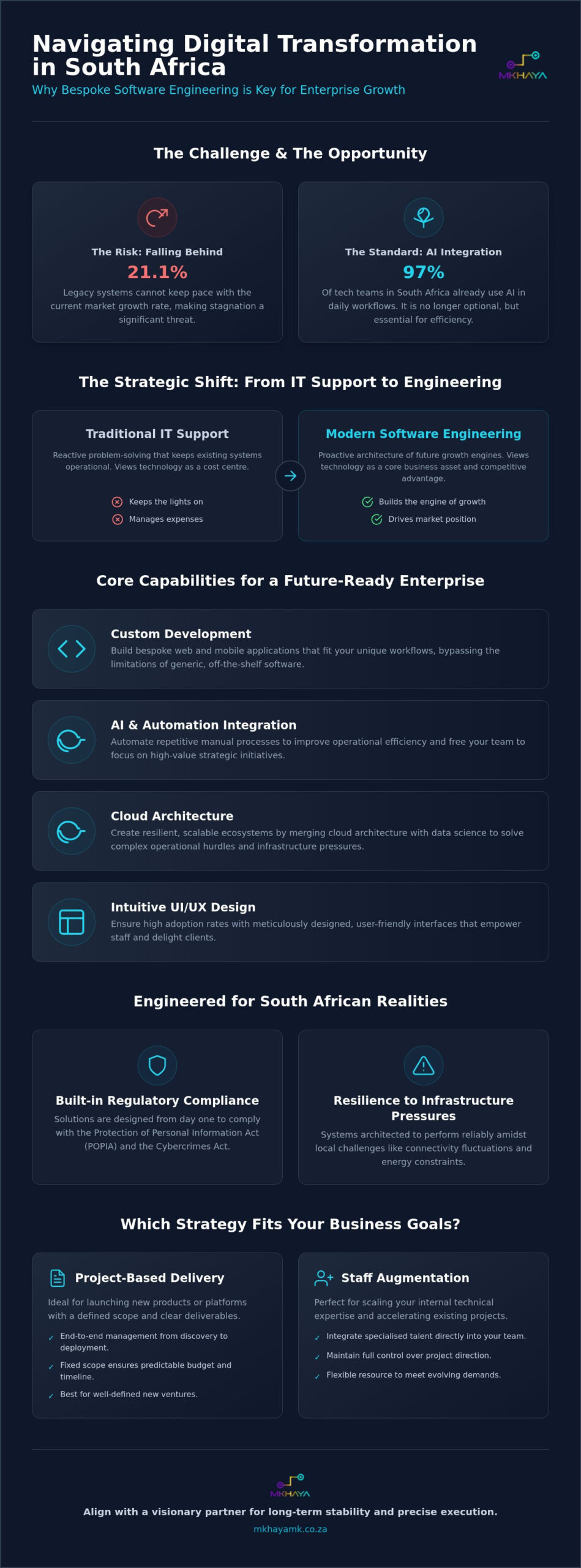
What if the greatest risk to your enterprise isn’t a competitor’s product, but the invisible weight of a legacy system that can no longer keep pace with a 21.1% market growth rate? In a territory where 97% of tech teams already use AI in their daily workflows, standing still is the fastest way to fall behind. Finding reliable software engineering services south africa enterprises can trust involves more than just hiring developers; it’s about securing a partner who understands how to bridge the gap between ageing infrastructure and future-ready automation.
You’ve likely experienced the high cost of failed software projects or the struggle to find specialised local talent amidst rising international competition. It’s a common challenge, and we agree that your digital transformation shouldn’t feel like a high-stakes gamble. This guide will show you how bespoke software engineering, cloud integration, and AI-driven automation empower South African enterprises to scale with precision. We’ll explore the strategic steps to modernise your operations, ensure compliance with the Cybercrimes Act, and build a secure platform that supports long-term stability.
Key Takeaways
Understand how modern software engineering in the local market balances high-level programming with the practicalities of South African infrastructure.
Learn to leverage software engineering services south africa enterprises use to integrate cloud-native architecture and AI automation for improved operational efficiency.
Identify whether your business goals are best served by project-based delivery for new launches or staff augmentation to scale your internal technical expertise.
Discover the importance of a structured lifecycle, from strategic discovery to intuitive UI/UX design, in building platforms that users actually want to adopt.
Align with a visionary partner to ensure long-term stability and precise execution whilst navigating the rapidly shifting technological landscape.
Defining the Landscape of Software Engineering Services in South Africa
Software engineering isn’t a simple technical task; it’s the deliberate architecture of a business’s future. In our region, high-quality software engineering services south africa providers focus on merging cloud architecture with data science to solve complex operational hurdles. It’s about building a digital foundation that doesn’t just work; it excels under pressure. This discipline moves beyond basic coding to create resilient ecosystems that support your specific commercial goals and long-term vision.
The technology landscape in South Africa is unique. We face specific infrastructure pressures, such as connectivity fluctuations and energy constraints, yet our enterprises must compete on a global stage. This requires a fundamental shift in perspective. Digital transformation isn’t a one-off purchase you can tick off a list. It’s a continuous journey of refinement and growth that requires a stable partner to guide the way whilst you navigate changing market demands.
To better understand how this profession is evolving locally, watch this insightful interview:
The Strategic Shift from IT Support to Engineering
Modern leaders don’t view software as a line-item expense. They see it as a core asset that dictates market position. Traditional IT support keeps the lights on, but engineering builds the engine of growth. By automating repetitive manual processes, bespoke systems free your team to focus on high-value strategy. Custom solutions provide a competitive edge that generic, off-the-shelf software simply can’t match. Off-the-shelf tools often force you to change your workflows to fit the software. True engineering does the opposite; it builds the software to empower your unique way of doing business.
Why National Enterprises Require Bespoke Solutions
South African businesses operate within a strict regulatory environment. Compliance with the Protection of Personal Information Act (POPIA) and the Cybercrimes Act is non-negotiable for any enterprise handling sensitive data. The software engineering services south africa requires must ensure these legal requirements are baked into the code from day one. This proactive approach supports long-term stability and protects your brand identity as you scale. National enterprises need systems that grow with them. You need the ability to adapt to a shifting economy without the risk of outgrowing your digital tools or facing the high cost of a failed migration. Custom software engineering provides that anchor.
Core Capabilities: Custom Development, Cloud, and AI Integration
Digital excellence isn’t something you can buy off a shelf. It’s a bespoke creation. When you invest in software engineering services south africa, you’re looking for a partner to build tools that fit your unique business workflows. Custom web and mobile application development allows you to bypass the limitations of generic software. It ensures that your technology supports your processes rather than forcing your team to work around rigid, third-party limitations. This precision is what allows an enterprise to move from being a participant in the market to a leader.
Success also depends on how your users interact with these tools. High adoption rates aren’t accidental; they’re the result of meticulous UI/UX design. By creating intuitive interfaces, we ensure that your staff and clients feel supported by the technology. This focus on the human element, combined with robust backend engineering, creates a stable platform for growth. If you’re curious about how these elements come together, exploring our approach to digital transformation can provide a clearer picture of the journey ahead.
Architecting for the Cloud and DevOps
High-growth enterprises can’t afford downtime or sluggish performance. Cloud-native architecture provides the high availability needed to serve users across the country reliably. By leveraging Managed Cloud and Digital Transformation, you gain an environment that scales automatically as your demand increases. We integrate DevOps practices to accelerate these delivery cycles. This methodology ensures that quality is baked into every update, allowing your business to pivot quickly without compromising system integrity. It’s a rhythmic approach to development that maintains momentum whilst protecting your core assets.
Leveraging AI-Driven Automation for Operational Efficiency
Data is the lifeblood of modern business, but raw information is often overwhelming. Integrating AI and data automation turns this complexity into a strategic advantage. For instance, in finance or logistics, Robotic Process Automation (RPA) can eliminate mundane, repetitive tasks, allowing your team to focus on higher-level strategy. This isn’t just about speed; it’s about accuracy and refinement. According to the State of the Software Developer Nation, the local demand for these intelligent systems is rising as businesses seek more sophisticated ways to manage ERP and procurement systems. We focus on linking AI directly to these core business systems, ensuring that automation delivers measurable results rather than just technical novelty.
Project-Based Delivery vs. Staff Augmentation: Which Strategy Fits?
Choosing the right engagement model is as critical as the architecture of the code itself. It’s the difference between a one-off success and a sustainable digital future. When you’re looking for software engineering services south africa, you need to decide if you want a partner to own the entire outcome or if you simply need more hands on deck. Both models offer distinct advantages. The right choice depends on your internal capacity and the complexity of your roadmap. As South Africa’s digital economy expands, the ability to pivot between these models has become a hallmark of agile, successful enterprises.
When to Opt for End-to-End Project Delivery
Project-based delivery is the preferred route when you have a clearly defined objective and need a partner to take full ownership of the result. It’s the ideal choice for building a new system from the ground up, such as a custom ERP or a proprietary loan management system. This model allows you to focus on your core business whilst we manage the entire lifecycle, from the initial UI/UX design to final deployment. By choosing Custom Software Development, you benefit from a fixed-price structure and a guaranteed outcome, ensuring that your vision is realised without the distraction of day-to-day management.
Scaling Internal Teams with Staff Augmentation
If you already have an established technical team but find yourself facing specific skill gaps or a sudden increase in workload, staff augmentation is the more strategic fit. This approach provides access to high-level professionals without the long-term overhead and complexity of permanent hiring. It’s about extending your team’s reach with remote or on-site experts who integrate into your existing culture and workflows. Our Staff Augmentation Services ensure you maintain momentum on long-term platforms whilst filling niche roles in DevOps, QA, or data science. It’s a flexible way to scale that prioritises speed and technical precision.
Evaluating cost-effectiveness requires looking beyond the initial quote. Fixed-price projects offer budget certainty for new launches. Conversely, monthly recurring professional fees for augmented staff provide the agility needed for ongoing maintenance. Regardless of the model, quality assurance and talent management remain the non-negotiables. We act as a stable anchor, ensuring that every engineer assigned to your project meets the highest standards of integrity and technical excellence. Securing the right software engineering services south africa has to offer ensures your digital platform remains secure, scalable, and ready for whatever the market demands next.
Navigating the Engineering Lifecycle: From Concept to Deployment
A successful digital platform isn’t the result of a single brilliant idea; it’s the product of a methodical, transparent journey. For many stakeholders, the world of software development feels like a “black box” where requirements go in and a product eventually comes out. We believe in a different approach. The most effective software engineering services south africa provides are those that invite the client into the process, turning technical execution into a collaborative partnership. This lifecycle ensures that every line of code serves a specific business purpose whilst maintaining the flexibility to adapt to new insights.
The Importance of Discovery and User Experience
Skipping the discovery phase is a primary cause of project bloat and eventual failure. This initial stage is where we align technology with your commercial goals, identifying potential roadblocks before they become expensive mistakes. We treat discovery as a strategic consulting session, ensuring the architecture supports your vision for the next five to ten years. Once the strategy is set, we move into UI/UX Design Services. User experience isn’t just about aesthetics; it’s about productivity. An interface that feels natural to your staff reduces training time and minimises user error, ensuring your investment pays for itself through improved operational efficiency.
Agile Methodology and Continuous Integration
We use an agile framework to maintain momentum and ensure you’re never left in the dark. By building in iterative cycles, or sprints, we provide regular progress reports and feedback loops. This prevents the “black box” effect and allows for course corrections as your market evolves. Our Engineering Process incorporates continuous integration and rigorous QA testing. We don’t just test for bugs; we test for performance, security, and reliability. This ensures that when your system goes live, it’s ready to handle the real-world demands of your users without hesitation. This phase also includes verifying compliance with local regulations like POPIA, ensuring your data remains secure from day one.
Deployment is the beginning of a new chapter, not the end of the work. Managed support ensures your platform remains a stable anchor in a changing landscape, with regular updates that keep your technology modern and secure. This long-term commitment to your success is what separates a vendor from a partner. If you’re ready to move from a vague concept to a concrete digital asset that drives revenue, contact our team to begin your discovery session and define your path to digital excellence.
Empowering South African Business with Mkhaya MK’s Engineering Expertise
Choosing Mkhaya MK means selecting a stable anchor in a rapidly shifting technological environment. We don’t just provide the software engineering services south africa businesses need to survive; we provide the strategic vision they need to lead. Our approach is rooted in transparency and methodical execution, ensuring that every project is a step toward mutual success. We see ourselves as your visionary yet practical guide, committed to your personal journey of digital transformation. This partnership ensures that your technology remains an asset rather than a burden.
Bespoke Enterprise Solutions: ERP and Loan Management
Our deep engineering capability is best evidenced by our proprietary systems. We’ve developed specialised tools to streamline complex operations, such as our Loan Management and Facility Management platforms. These aren’t generic templates. They’re high-end, custom-built solutions designed to handle the specific pressures of the local market. For those in the financial sector, our Loan Management System South Africa: The Strategic 2026 Buying Guide offers a deeper look into selecting the right technology for your portfolio. By integrating ERP Solutions into your core workflow, you optimise resources and gain a unified view of your entire enterprise.
Partnering for Long-term Digital Stability
We move beyond the traditional vendor relationship. A true partnership is built on integrity and a shared commitment to long-term stability. Whilst other providers might focus on global headcounts, we focus on the precision of our execution and the strength of our national service coverage. Whether you’re extending your team through staff augmentation or launching a new product, our goal is to ensure your digital platform remains a secure and scalable asset. We’re here to help you build something that lasts. We believe in building trust through consistent, high-quality delivery that respects your budget and your timeline. It’s about creating a foundation that can support your growth for years to come.
Securing high-level software engineering services south africa enterprises can rely on is the first step toward digital excellence. We’re ready to help you navigate this journey with confidence and clarity. Contact Mkhaya MK today to discuss your engineering requirements and let’s begin architecting your digital future.
Architecting Your Digital Legacy with Precision
The journey toward digital excellence requires more than just code; it demands a partner who understands the intricate balance between innovation and stability. We’ve explored how the high-level software engineering services south africa enterprises need are built on a foundation of strategic discovery, agile execution, and robust cloud architecture. Whether you’re modernising legacy systems or scaling your internal team through staff augmentation, the goal remains the same: creating a secure, reliable platform that drives measurable business value.
Mkhaya MK stands as a stable anchor in this evolving landscape. Our proprietary Loan and Facility Management Systems, combined with specialised AI and data automation expertise, serve as proof of our commitment to technical precision. With a proven track record in national digital transformation, we’re ready to help you navigate the complexities of modern engineering whilst ensuring your long-term success. We believe in building relationships that go beyond the typical vendor model, focusing instead on mutual growth and methodical execution.
Don’t leave your digital future to chance. Partner with Mkhaya MK for your next software engineering project and let’s build a resilient ecosystem together. We’re invested in your journey and look forward to architecting a solution that empowers your enterprise to scale with confidence.
Frequently Asked Questions
What is the difference between software development and software engineering?
Software development primarily focuses on the act of writing code to create functional tools. Software engineering is a broader, more disciplined application of engineering principles to the entire software lifecycle. It ensures that software engineering services south africa providers deliver systems that are not only functional but also scalable, maintainable, and resilient under heavy operational loads. This structured approach treats software as a core asset rather than just a technical script.
How much does custom software development cost in South Africa?
The cost of custom software varies significantly based on the project’s scope, complexity, and required integrations. Factors such as the number of user roles, the depth of data automation, and the need for cloud-native architecture all influence the final investment. Most professional firms provide a detailed discovery phase to establish a precise budget that aligns with your strategic goals. This ensures the solution remains cost-effective whilst meeting all your operational requirements.
How long does it take to build a bespoke business application?
Building a bespoke business application typically takes between three to nine months depending on the system’s intricacy. A basic Minimum Viable Product (MVP) might be ready for deployment sooner; however, enterprise-grade systems like ERP or Loan Management platforms require more time for rigorous testing and QA. We follow a methodical execution process to ensure that your timeline is realistic and your launch is stable from day one.
Can I hire a dedicated development team for a short-term project?
Yes, you can hire a dedicated team for short-term projects through flexible engagement models like staff augmentation. This allows you to scale your technical capacity quickly to meet a specific deadline or fill a niche skill gap without the long-term overhead of permanent employment. It’s an agile way to access high-level expertise whilst maintaining full control over your project’s momentum and quality without the burden of permanent hiring costs.
What technologies do software engineering firms in South Africa typically use?
Local engineering firms typically utilise a mix of modern, reliable technologies including Java, C#, Python, and JavaScript frameworks like React or Angular. Cloud-native development often centres on platforms like AWS, Microsoft Azure, or Google Cloud. These choices ensure that the software engineering services south africa enterprises receive are compatible with global standards whilst remaining robust enough to handle local infrastructure challenges and connectivity requirements.
How do you ensure the security of custom-developed software?
Security is ensured by integrating DevSecOps practices from the very first line of code. This includes end-to-end encryption, regular penetration testing, and strict adherence to local regulations like the Protection of Personal Information Act (POPIA) and the Cybercrimes Act. By baking security into the engineering lifecycle, we protect your data and ensure your platform remains a stable anchor for your business operations even as the threat landscape changes.
Is staff augmentation better than hiring permanent developers?
Staff augmentation is often better for businesses that need to scale rapidly or require specific expertise for a defined period. It avoids the lengthy recruitment cycles and administrative costs associated with permanent hiring. Permanent developers may be preferable for building long-term internal IP; however, augmentation provides the agility and precision needed to respond to a changing technological landscape without the commitment of fixed, long-term overheads.
What if the secret to scaling your tech team isn’t found in a larger recruitment budget, but in a more precise geographical focus? In 2026, the strategic decision to hire remote developers south africa has become a cornerstone for businesses seeking both technical depth and operational resilience. We agree that sifting through hundreds of unqualified CVs is a draining process, which is why many global firms now choose to hire remote developers south africa to access a talent pool that balances modern innovation with a reliable, problem-solving mindset.
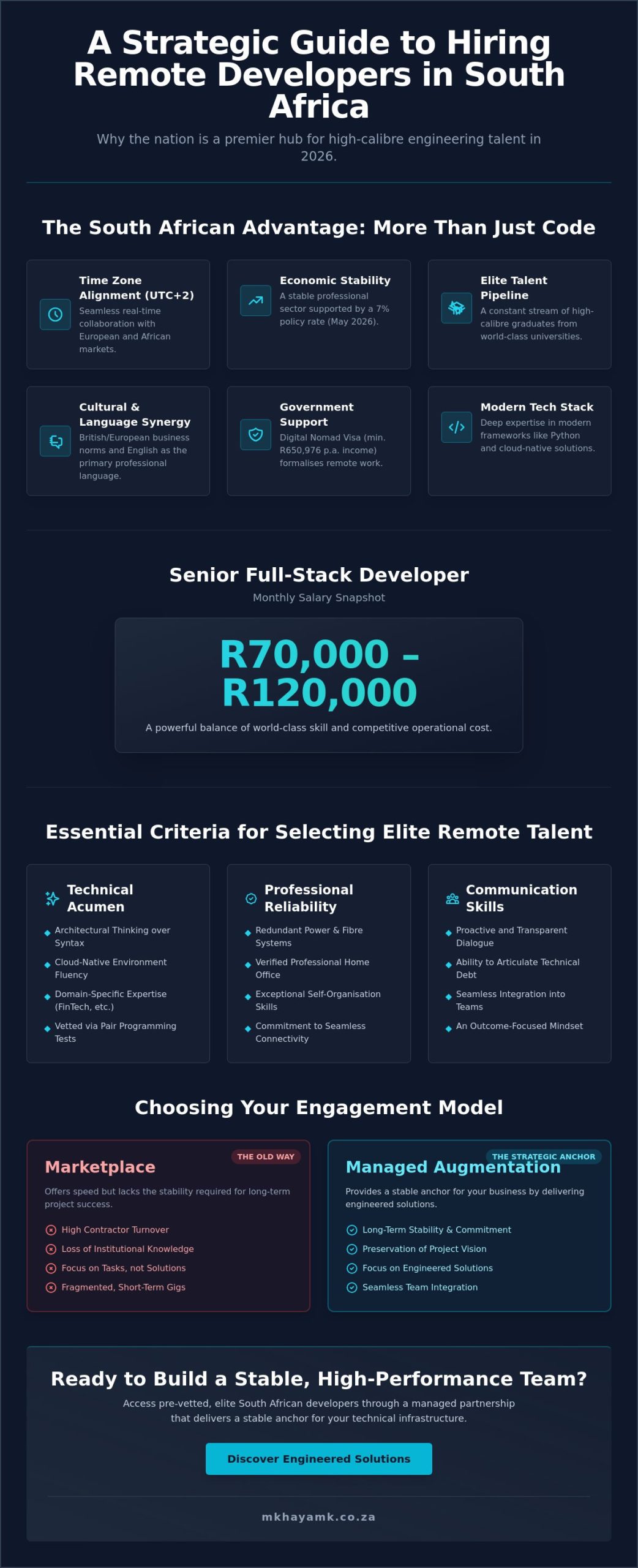
It’s exhausting to manage high contractor turnover or struggle to assess true architectural expertise during a brief interview. This guide provides a clear path to secure and integrate top-tier talent to scale your operations with precision and reliability. We will examine current salary benchmarks, such as the R70,000 to R120,000 monthly range for senior full-stack roles, whilst outlining why the choice to hire remote developers south africa represents a stable, forward-looking anchor for your technical infrastructure.
Key Takeaways
Understand why South Africa’s software engineering hub has become a global leader for high-end remote talent in 2026.
Identify the critical selection criteria for senior developers, focusing on architectural thinking and the ability to articulate complex technical debt.
Determine whether a marketplace or managed augmentation model is best suited to your specific technical capacity and scaling requirements.
Learn how to hire remote developers south africa whilst ensuring seamless integration through standardised toolstacks and outcome-focused KPIs.
Discover how a managed partnership provides a stable anchor for your business by delivering engineered solutions rather than just a list of CVs.
The Evolving Landscape to Hire Remote Developers in South Africa
By 2026, remote staff augmentation has matured into a sophisticated model of technical partnership. In this landscape, the decision to hire remote developers south africa represents a commitment to high-calibre engineering rather than simple cost-cutting. South Africa has emerged as a premier hub because its developers don’t just execute tasks; they build scalable architectures. With the South African Reserve Bank policy rate at 7% effective from May 2026 and headline inflation at 4.0%, the economic environment supports a stable professional sector that appeals to international partners seeking long-term reliability.
The geographic advantage of UTC+2 alignment allows for real-time collaboration with European and African markets, creating a “nearshore” feel regardless of physical distance. The technology landscape in South Africa is further bolstered by the government’s Digital Nomad Visa, which requires a minimum annual income of R650,976. This regulatory support has formalised the remote work culture, making it easier for global firms to hire remote developers south africa whilst ensuring compliance with local standards. This maturity ensures that the local tech ecosystem remains focused on modern frameworks like Python and cloud-native solutions.
Why South Africa is a Premier Talent Destination
Cultural alignment is a significant factor in project success. South African business standards mirror British and European norms, prioritising transparency and direct communication. English serves as the primary professional language, ensuring that technical requirements aren’t lost in translation. The robust pipeline of graduates from world-class national universities ensures that the talent pool is constantly refreshed with engineers who understand both theoretical computer science and practical, modern application. This academic foundation produces developers who can handle the rigours of enterprise-level software development.
The Shift from Freelance to Managed Remote Teams
The era of fragmented, short-term gig work is rapidly giving way to long-term remote team extension. Businesses have learnt that whilst marketplaces offer speed, they often lack the stability required to maintain institutional knowledge. The strategic move to hire remote developers south africa through managed models allows for the preservation of software quality and long-term project vision. This shift ensures that developers aren’t just passing through; they’re committed to your roadmap, providing the steady anchor your infrastructure needs to thrive in a competitive global market.
Essential Criteria for Selecting High-Calibre Remote Talent
Selecting the right professional requires a shift from volume-based hiring to a focus on precision and long-term stability. When you choose to hire remote developers south africa, you’re looking for individuals who demonstrate architectural thinking over simple syntax knowledge. It’s about finding someone who understands how a single line of code impacts the entire system’s reliability. This high-calibre approach ensures that your software remains robust whilst your operations scale.
Reliability is a baseline requirement. The growth of South Africa’s digital economy has fostered a professional class that prioritises high-speed fibre and redundant power systems to maintain seamless connectivity. Verifying a developer’s home office setup is as essential as checking their GitHub repository. A professional’s ability to self-organise and manage their own environment is a critical trait for any remote-first team.
Technical Assessment Beyond the CV
Resumes provide a history, but they don’t always predict future performance. We recommend using pair programming and real-world problem-solving tests to evaluate a candidate’s true depth. Evaluating experience in cloud-native environments is vital for modern infrastructure. Often, specific industry expertise in sectors like Fintech or Logistics outweighs general years of experience because it reduces the learning curve for business-specific logic. If you’re looking to bypass the vetting hurdle, our staff augmentation services connect you with pre-vetted specialists who meet these exact standards.
Soft Skills for Remote Success
Communication is the primary hedge against project drift in a distributed team. To hire remote developers south africa who truly add value, you must look for a ‘no surprises’ philosophy. This involves proactive reporting and the ability to explain complex technical debt to non-technical stakeholders clearly. We value collaborative behaviour in Agile environments; it’s the mark of a professional who values transparency over flashy claims. This quiet confidence allows a developer to integrate into your existing team as a stable and reliable partner.
Marketplace vs. Managed Augmentation: Choosing Your Model
When you decide to hire remote developers in South Africa, you’ll face a fundamental choice between a self-service marketplace and a managed staff augmentation partnership. Each model serves a distinct purpose. The right choice depends entirely on your internal capacity and the long-term stability your project requires. It’s a strategic decision that affects not only your immediate output but also the long-term health of your technical infrastructure.
Choosing between these models involves looking past upfront recruitment fees to the long-term partnership value. High turnover remains a significant pain point in the remote sector, often caused by a lack of integration and support. Managed augmentation mitigates this risk by providing a layer of stability that marketplaces simply don’t offer. By investing in a managed model, you reduce the time spent on repetitive recruitment and focus your energy on achieving your core business goals.
When to Use a Talent Marketplace
Marketplaces are essentially digital talent pools. They’re excellent for sourcing specific, short-term niche skills for one-off projects where the developer doesn’t necessarily need to understand your broader business context. However, this model places the entire burden of technical vetting and management on your shoulders. If your internal HR team has the bandwidth to interview dozens of candidates and your technical leads can accurately verify architectural depth during a brief call, this DIY approach offers a broad reach. It’s best suited for companies that already have established remote management frameworks and the capacity to handle the administrative overhead of individual contractors.
The Strategic Advantage of Managed Staff Augmentation
In contrast, managed staff augmentation focuses on the collaborative relationship between the service provider and your business. This isn’t just about providing a list of CVs; it’s about providing engineered solutions. Managed services offer pre-vetted talent that has already been tested on complex internal projects. This model is ideal for scaling quickly without sacrificing quality. You gain ongoing performance management and the flexibility to adjust roles as your roadmap evolves. It provides a stable anchor, ensuring that institutional knowledge stays within your project. This approach transforms recruitment from a transactional hurdle into a steady, forward-looking ambition for mutual success.
Strategic Integration: Ensuring Remote Team Success
Successful integration is the bridge between a signed contract and a high-performing product. Many businesses focus entirely on the selection phase, yet the real work begins when the developer logs on for the first time. To hire remote developers in South Africa successfully, you must move beyond a transactional mindset. It’s about building a structured environment where external talent feels like a core part of your internal engine. This process requires a blend of professional confidence and supportive partnership to ensure that every new team member can contribute at their full potential from day one.
The First 30 Days: Onboarding for Impact
Effective onboarding should be a deliberate process designed for immediate impact. Your developer should have their development environment fully configured on day one to reduce initial frustration. Assigning a “technical buddy” provides immediate cultural context and helps them navigate the codebase without feeling isolated. Establishing a clear “definition of done” for initial tasks sets a standard for excellence from the outset. This methodical execution builds trust and sets a steady pace for the months ahead.
Maintaining Long-Term Engagement
Long-term engagement requires more than just a steady stream of tickets. Include your remote developers in high-level strategic planning sessions to foster a sense of ownership. When they see the long-term vision, they’re more likely to contribute innovative ideas that align with your business goals. Providing opportunities for professional growth and skill refinement ensures that your team stays at the cutting edge of technology. A two-way feedback loop is essential; it transforms the relationship from a simple service agreement into a genuine partnership. If you’re looking to build a team that integrates flawlessly into your existing workflows, explore our staff augmentation services to find your next strategic partner.
Elevating Your Technical Capability with Mkhaya MK
Choosing a partner to expand your technical team is a decision that defines your operational stability for years to come. At Mkhaya MK, we move beyond the traditional recruitment model. We don’t just provide a list of CVs; we provide engineered solutions. Whilst many businesses struggle to hire remote developers in South Africa through generic marketplaces, we offer a partnership rooted in precision and mutual success. Our approach ensures that every placement is backed by the same rigorous engineering standards we apply to our own internal custom software development projects.
The Mkhaya MK difference lies in our quiet confidence and methodical execution. We understand that in 2026, technical depth must be paired with an ability to navigate a rapidly changing technological landscape. Every professional we recommend has undergone a vetting process that evaluates their architectural thinking and their capacity for AI-driven automation. This end-to-end support begins with your initial consultation and continues through your ongoing digital transformation, providing a stable anchor as your business evolves.
A Partnership Focused on Your Success
Our staff augmentation services are uniquely informed by our deep expertise in custom software development and cloud application services. This dual perspective allows us to understand the practical challenges your team faces daily. By working with a partner that is deeply embedded in the South African tech ecosystem, you benefit from a talent pool that understands your pace and shares your professional values. Our clients trust us to manage their most critical technical assets because we prioritise long-term stability over short-term gains. We ensure that the integration of external talent feels like a natural expansion of your internal culture, rather than a fragmented addition.
Ready to Scale Your Team?
Scaling your technical capacity should be a structured and rewarding journey. We have refined our engagement process to ensure clarity and momentum at every stage. This rhythmic progression leads you from a broad vision toward a concrete, high-performing team. To begin your journey with a reliable partner, follow these steps:
Step 1: Consult with our experts to define your specific technical requirements and project roadmap.
Step 2: Review a curated shortlist of professionals who have been matched to your technical needs and organisational culture.
Step 3: Seamlessly integrate your new remote developers into your existing workflows and start building with precision.
We are ready to help you secure the talent you need to scale with confidence. Organise a consultation with Mkhaya MK today and discover how our managed approach to hire remote developers in South Africa can transform your technical operations.
Building Your Technical Future with Precision
The decision to hire remote developers in South Africa is more than a recruitment tactic; it’s a strategic investment in your organisation’s long-term stability. By prioritising architectural depth and managed integration over the volume-based approach of traditional marketplaces, you secure a team that is built to last. A successful partnership thrives on clear communication, shared KPIs, and a remote-first culture that values outcomes over hours logged. These foundations ensure that your external talent functions as a seamless extension of your internal vision.
As end-to-end digital transformation experts, Mkhaya MK provides national reach with deep local market insight. We specialise in custom software and AI-driven automation, applying our rigorous internal engineering standards to every placement we make. This ensures your projects are handled with the precision they deserve. We invite you to scale your technical team with Mkhaya MK’s managed talent and move beyond the friction of traditional hiring. We’re here to help you navigate the complexities of modern software development with confidence and clarity. Your path to a high-performing, reliable remote team starts with a single, well-placed step toward a better partnership.
Frequently Asked Questions
Why should I hire remote developers from South Africa specifically?
South Africa offers a unique blend of technical depth and cultural synchronicity. With English as the primary professional language and a UTC+2 time zone, collaboration feels effortless for European partners. The local market is also highly advanced; 97% of tech teams now use AI in their daily workflows to enhance productivity and deliver engineered solutions with greater precision.
How do I ensure the security of my intellectual property with remote developers?
What is the typical notice period for remote developers in South Africa?
The standard notice period in the South African tech sector is 30 days or one calendar month. Whilst some junior roles might have shorter periods, senior engineers often require this time to ensure a clean handover of complex architectural knowledge. This predictability helps you maintain project momentum and manage transitions without losing institutional knowledge.
Can South African developers work on my time zone?
Yes, South African professionals are exceptionally well-positioned to work within European and African time zones due to the minimal offset. Many businesses that hire remote developers in South Africa also find that local talent is willing to adjust their schedules for North American clients. This flexibility ensures real-time participation in daily stand-ups and critical sprint reviews.
What are the common technical stacks available in the South African remote market?
The local market is rich in modern, high-demand technical stacks. You’ll find extensive expertise in Python, JavaScript, Java, and SQL, alongside a strong focus on cloud computing platforms like AWS and Azure. This technical diversity allows you to find specialists who can integrate immediately into your existing codebase and start contributing to your roadmap.
How does staff augmentation differ from traditional outsourcing?
Staff augmentation integrates external experts directly into your internal team and workflows. Unlike traditional outsourcing, where a project is handed over to a third party to manage as a “black box,” augmented developers attend your meetings and follow your internal processes. This model ensures you retain full control over the development journey and long-term software quality.
How do I manage the performance of a remote developer I’ve never met in person?
Performance is best managed through transparent, outcome-based KPIs rather than tracking hours logged. Use collaborative tools like Jira and GitHub to maintain visibility into progress and code quality. Regular synchronisation through video calls fosters a supportive partnership and ensures the developer remains aligned with your long-term business goals and technical vision.
What happens if a remote developer isn’t a good fit for my team?
If a developer doesn’t align with your team, a managed service provider will facilitate a structured transition. This typically involves identifying the specific gap in synergy and providing a pre-vetted replacement to ensure project continuity. It’s a reliable way to hire remote developers in South Africa whilst mitigating the risks of a poor cultural or technical fit.