

Cloud Application Development in South Africa: A Strategic Roadmap for 2026
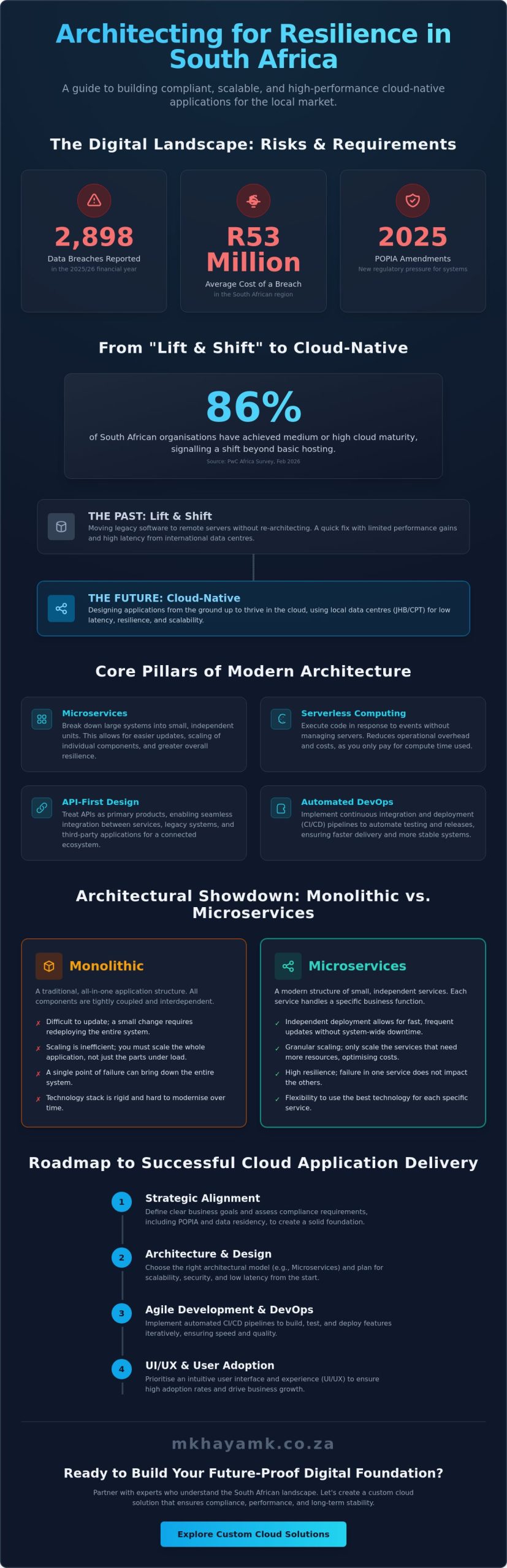
With 2,898 data breaches reported to the Information Regulator during the 2025/26 financial year, the stakes for your digital infrastructure have never been higher. You’re likely aware that successful cloud application development south africa is no longer just about choosing a provider; it’s about architecting for local resilience. You’ve probably felt the frustration of high latency from international servers or the mounting pressure to align your systems with the April 2025 POPIA amendments, especially when the average cost of a single breach in our region has reached R53 million.
We understand these challenges. It’s often difficult to find local developers who truly grasp enterprise-grade DevOps whilst ensuring your data remains secure and accessible. This roadmap provides a clear path forward. You’ll discover how to build cloud-native applications that are compliant, scalable, and tailored to our unique business landscape. We’ll explore how to reduce operational overhead through automation and integrate legacy systems seamlessly, ensuring your technology serves as a stable anchor for your business’s journey into 2026 and beyond.
Key Insights
- Understand the transition from basic cloud hosting to sophisticated cloud-native architectures that ensure long-term stability and performance for your enterprise.
- Discover how leveraging microservices and serverless computing can reduce operational overhead whilst allowing your systems to scale effortlessly.
- Master the complexities of POPIA compliance and data residency to ensure your cloud application development south africa aligns with the latest 2026 regulatory standards.
- Evaluate the total cost of ownership between custom builds and SaaS solutions to determine which path provides a unique and sustainable competitive advantage.
- Follow a structured delivery roadmap that prioritises strategic alignment and intuitive UI/UX design to drive high user adoption and business growth.
The Evolution of Cloud Application Development in South Africa
The journey of digital adoption in our region has reached a pivotal maturity point. According to a PwC Africa survey in February 2026, 86% of South African organisations have achieved medium or high cloud maturity. This isn’t just a statistic; it represents a fundamental shift in how local leaders perceive technology. We’ve moved past the era where being “cloud-first” was enough. Today, the focus has shifted toward being cloud-native, where applications are designed from the ground up to thrive in a distributed environment. This evolution is driven by the need for greater stability and the reality of local data residency requirements.
For many years, the standard approach was “lift and shift,” which involved moving existing legacy software to remote servers without changing its core structure. Whilst this offered a quick win for infrastructure reduction, it often failed to deliver the performance gains businesses expected. In 2026, the arrival of more robust local cloud regions in Johannesburg and Cape Town has changed the calculation. Low latency is no longer a luxury; it’s a baseline requirement for modern user experiences. Purposeful software engineering now ensures that applications are responsive and resilient, specifically tuned for the South African context.
To understand the professional landscape supporting these shifts, watch this overview of the sector’s growth:
Beyond Hosting: What Cloud-Native Development Really Means
There’s a significant difference between an application that sits “in the cloud” and one that is “built for the cloud.” True cloud application development south africa involves using microservices, containers, and serverless logic to create modular systems. This architecture allows individual components to be updated or scaled without affecting the entire platform. By leveraging the core principles of cloud computing, businesses can ensure their digital tools are not just hosted elsewhere, but are inherently flexible. This level of custom engineering is essential for supporting long-term digital transformation goals, as it prevents the technical debt often associated with rigid, monolithic systems.
The Local Landscape: Why South African Businesses are Scaling
The economic drivers for this shift are clear. Local enterprises are seeking ways to optimise costs whilst improving service delivery in an increasingly competitive market. Modern cloud applications bridge the gap between reliable legacy data and the high-end UX that today’s users demand. Whether it’s through sophisticated cloud solutions or automated workflows, the goal is always to create a more agile organisation. Cloud-native development serves as a catalyst for business agility in South Africa. By focusing on precision and long-term stability, companies can build a digital foundation that grows alongside their ambitions, rather than holding them back.
Core Pillars of Modern Cloud Application Architecture
Successful cloud application development south africa depends on moving beyond simple hosting to embrace a modular, resilient architecture. As the South Africa Cloud Computing Market continues its rapid expansion toward 2034, businesses are discovering that how an application is structured determines its long-term survival. We see four core pillars defining this new era: microservices, serverless computing, API-first design, and automated DevOps pipelines. These elements work in harmony to create systems that are not only powerful but also remarkably easy to maintain.
Microservices vs. Monolithic Builds
Microservices have become the favourite choice for high-growth South African firms because they break down large, monolithic systems into smaller, manageable units. This approach allows your development teams to organise around specific business capabilities rather than technical layers. Whilst this adds some architectural complexity, the reward is the ability to scale individual components of your application independently. This ensures you only expand the parts of the system that are under heavy load, preventing unnecessary expenditure on idle resources. It’s a precise way to build that values long-term stability over quick, rigid fixes.
Hybrid Cloud: The Strategic Middle Ground
Many enterprises aren’t ready for a total migration to the public cloud, often due to legacy requirements or specific data sensitivities. This is where hybrid cloud serves as a strategic middle ground. It allows you to keep sensitive data on-premise whilst leveraging the public cloud for intensive processing or customer-facing interfaces. Managing this balance requires purposeful engineering to ensure low-latency communication between environments. At Mkhaya MK, we often guide partners through these complexities via our digital transformation consulting, ensuring the transition is methodical and secure.
Modern builds also prioritise serverless computing, which reduces operational overhead by charging only for execution time. This efficiency is paired with an API-first design, ensuring your application integrates seamlessly with the broader digital ecosystem. We then implement DevOps and CI/CD practices to automate the journey from code to production. This creates a rhythmic momentum where updates are deployed with confidence and precision. If you’re looking to refine your current setup, exploring our cloud solutions can help you identify the most stable path forward for your business’s unique journey.
Strategic Evaluation: Custom Cloud Development vs. SaaS
The “Competitive Advantage” test is a vital tool for your roadmap: if the application handles a core process that differentiates you from competitors, you should own it. Off-the-shelf software is designed for the average user, meaning it rarely supports the nuanced workflows that make your business successful. By investing in custom builds, you ensure that your intellectual property remains yours, providing a stable foundation for growth. This approach also offers superior control over data sovereignty. Because you control the architecture, you can ensure that sensitive information is managed strictly according to POPIA requirements within our local borders, avoiding the compliance risks often associated with international SaaS providers.
When to Invest in Custom Cloud Engineering
You should consider custom builds for processes that are central to your value proposition. For instance, a generic ERP module might manage your accounting adequately, but a bespoke loan management system can be fine-tuned to your specific risk models and customer journey. Owning the code means you aren’t waiting for a third-party vendor to release a feature that your market demanded months ago. It gives you the agility to pivot and refine your services with precision. This level of customisation ensures that your software acts as a stable anchor, supporting your business as it scales through 2026.
Financial Implications of Cloud-Native Builds
The financial conversation often revolves around the shift from OPEX to CAPEX. Whilst SaaS represents a predictable monthly expense, those costs can spiral as your user base grows. Custom cloud apps eliminate per-user licensing fees over time. This makes the initial development investment a long-term asset rather than a perpetual liability. To manage the upfront costs of building these internal capabilities, many organisations utilise staff augmentation to access high-end expertise without the overhead of permanent hiring. This collaborative model allows you to build resilient systems whilst maintaining financial flexibility, ensuring your technology budget is spent on building value rather than just renting it.
Navigating Local Compliance and Performance Requirements
Building a successful digital platform in our current environment requires more than just functional code. It demands a deep commitment to regulatory integrity and technical excellence. With the Information Regulator reporting 2,898 data breaches during the 2025/26 financial year, the necessity for robust security has never been more apparent. Effective cloud application development south africa now involves integrating privacy and performance into the very fabric of your architecture. This ensures your systems remain resilient against evolving threats whilst delivering the responsive speed your users expect.
POPIA Compliance in Cloud Architectures
Compliance is no longer a checklist to be completed after development; it must be a core design principle. The April 2025 POPIA amendments simplified data subject rights but also heightened the responsibilities of information officers. To meet these standards, your application must employ rigorous encryption both at rest and in transit. We also prioritise sophisticated user consent management and automated data deletion protocols to ensure you stay aligned with the latest health information regulations of March 2026. Understanding how Mkhaya MK’s process integrates these safeguards from the first line of code can help you avoid the R53 million average cost associated with a data breach.
Performance Optimisation for the National Market
Connectivity across South Africa remains varied, which makes latency optimisation a critical focus for any local build. Whilst major providers have established data centres in Johannesburg and Cape Town, reaching users in more remote areas requires strategic engineering. We utilise several key techniques to ensure a snappy experience:
- Content Delivery Networks (CDNs): Distributing content closer to the user to reduce load times significantly.
- Intelligent Caching: Storing frequently accessed data locally to minimise repetitive server requests.
- Adaptive Features: Balancing high-end functionality with the practical realities of local bandwidth.
By managing where your data lives within South African borders, you satisfy both residency requirements and performance needs. This methodical approach creates a stable anchor for your digital presence, ensuring your application remains accessible regardless of the user’s location. If you’re ready to build a system that is both secure and high-performing, we invite you to explore our custom software development services to see how we can partner for your long-term success.
The Roadmap to Successful Cloud Application Delivery
Moving from a strategic concept to a live digital environment requires a structured, rhythmic approach. Successful cloud application development south africa is rarely the result of chance; it’s the outcome of meticulous planning and collaborative execution. This final stage of the roadmap focuses on turning your vision into a high-performing reality whilst ensuring the system remains agile enough to adapt to future market shifts. By following a methodical path, you can minimise risk and maximise the return on your technological investment.
The Discovery Phase: Setting the Foundation
Before writing a single line of code, we focus on the discovery phase to align your cloud capabilities with business objectives. This involves identifying key stakeholders and user personas to ensure the final product solves specific, real-world problems. We work together to define a Minimum Viable Product (MVP), which allows you to deploy core functions quickly and gather essential user feedback. Mapping out integration requirements for your existing ERP or CRM systems at this stage prevents technical friction later, ensuring your new application isn’t an isolated silo but a functional part of a unified ecosystem. For organisations simultaneously planning a platform move, understanding the full scope of cloud migration services in South Africa can help you align your application development timeline with your broader infrastructure transition.
Partnering for Success: How Mkhaya MK Delivers
We believe in a persona of quiet confidence that values transparency and methodical execution over flashy claims. By leveraging our cloud solutions, you can drive significant operational efficiency and reduce the complexity of your digital estate. Our approach to software engineering is rooted in building future-proof platforms that are both resilient and scalable. We remain deeply invested in your journey, providing the technical expertise and supportive partnership needed to navigate the evolving technological landscape of 2026 with certainty and precision.
Architecting Your Digital Future with Precision
The transition toward cloud-native architecture represents a definitive shift in how local enterprises maintain their competitive edge. By prioritising resilience and purposeful design, you ensure that your systems aren’t just hosted in the cloud but are built to thrive within it. We’ve explored how navigating POPIA compliance and optimising for local latency are no longer optional hurdles but essential pillars of long-term stability. Embracing cloud application development south africa allows your business to move with agility whilst maintaining a secure, stable anchor for your data and operations.
Success in this rapidly evolving landscape requires a partner who values integrity and methodical execution. Mkhaya MK brings end-to-end digital transformation expertise and specialised proprietary products, such as Optimate and MkhayaMove, to every engagement. Our national reach and commitment to quiet confidence ensure that your project is handled with the precision it deserves. Whether you’re breaking down a monolith or building a new platform from the ground up, we’re here to guide your journey. Partner with Mkhaya MK for your next cloud project and let’s build a resilient, scalable future together.
Frequently Asked Questions
How does cloud application development differ from traditional software development?
Cloud-native development focuses on creating modular applications using microservices and containers, whilst traditional development typically results in rigid, monolithic structures. This modern approach allows individual components to be updated or scaled independently. It ensures your system remains agile and far easier to maintain as your business requirements evolve over time.
Is my data safe in the cloud under South African law (POPIA)?
Your data is secure if your architecture incorporates POPIA-by-design principles, such as encryption at rest and local data residency. Following the April 2025 POPIA amendments, it’s essential to utilise local data centres in Johannesburg or Cape Town. This ensures your cloud application development south africa remains fully compliant with national privacy standards and avoids the risks of international data transfers.
What is the average timeline for developing a custom cloud application?
A typical timeline for a Minimum Viable Product (MVP) usually ranges from three to six months, depending on the complexity of your requirements. This iterative process allows you to launch core functionality quickly. It provides a stable foundation that can be refined through subsequent development cycles based on actual user feedback and business performance.
Can I integrate my existing legacy software with a new cloud application?
Yes, you can bridge the gap between old and new systems using secure APIs or hybrid cloud architectures. This method allows your business to retain the value of legacy data whilst enjoying the enhanced performance of a modern cloud platform. It creates a rhythmic transition that protects your previous investments whilst moving your operations forward.
What are the main costs involved in cloud application development?
The primary costs include the initial software engineering, cloud infrastructure hosting fees, and ongoing maintenance. Investing in custom cloud application development south africa often proves more cost-effective over the long term. It eliminates the expensive per-user licensing fees associated with many off-the-shelf SaaS products, turning your technology into a permanent business asset.
Do I need an in-house team to manage a cloud application after launch?
Modern builds also prioritise serverless computing, which reduces operational overhead by charging only for execution time. Many organisations complement their internal teams by engaging specialist cloud migration services in South Africa to handle complex infrastructure transitions and ongoing platform management without the cost of permanent specialist hires.
What happens to my cloud application if my internet connection is unstable?
Modern applications often use “offline-first” designs or intelligent local caching to ensure users can continue their work during temporary connectivity issues. Once the connection is restored, the application synchronises any changes with the central cloud server. This ensures data integrity and a seamless experience, even in areas where local connectivity might fluctuate.
How do I choose between AWS, Azure, and Google Cloud for my South African business?
The best choice depends on your current technical ecosystem and specific business goals. Azure is often the favourite for organisations heavily invested in Microsoft tools, whilst AWS offers a vast array of services for bespoke custom engineering. Both providers have established local regions in Johannesburg and Cape Town to ensure the lowest possible latency for your South African users.

Mobile App Development in South Africa: A Strategic Guide for 2026
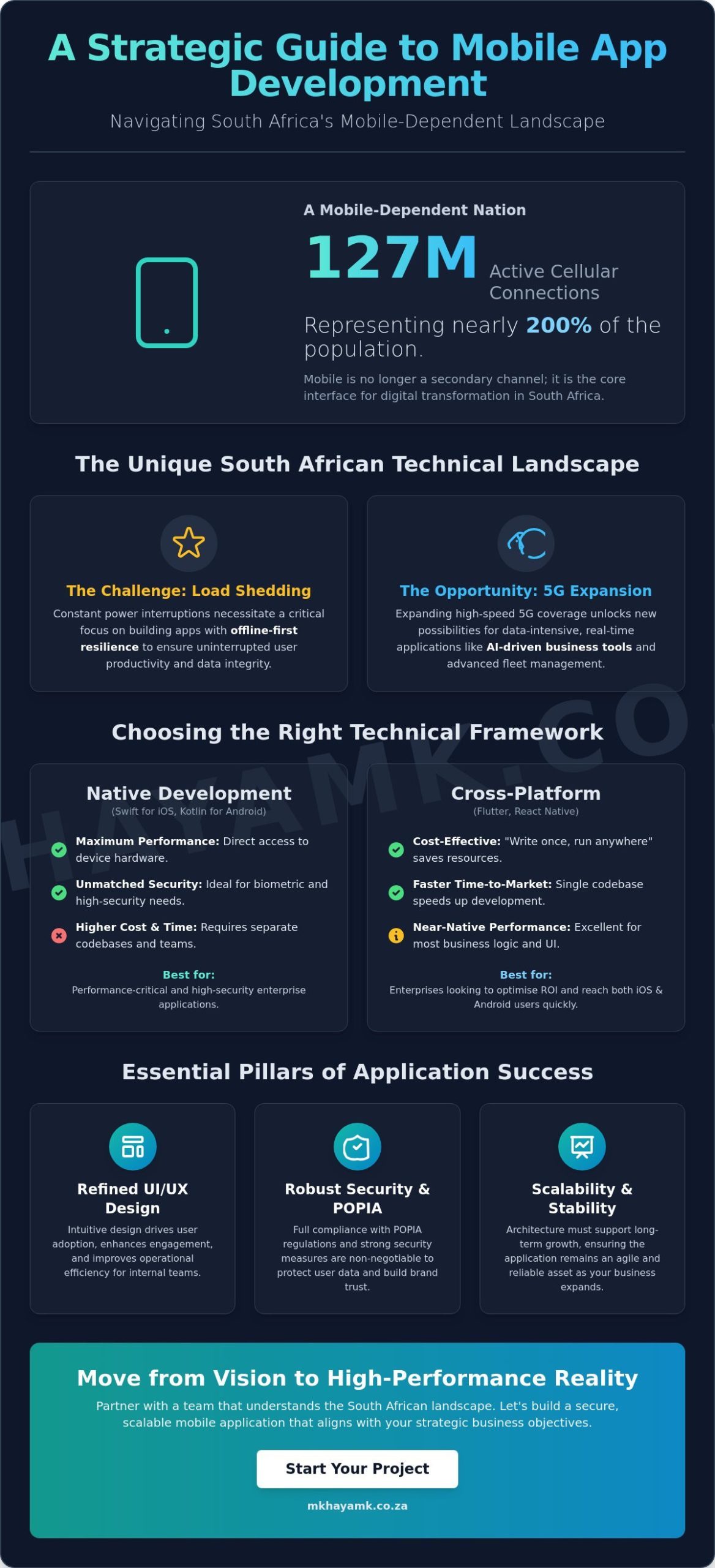
With 127 million active cellular connections representing nearly 200% of the population, South Africa isn’t just mobile-first; it’s mobile-dependent. Yet, for many local enterprises, the path to successful mobile app development south africa feels fraught with high-stakes risks. You likely recognise the frustration of searching for specialised talent or the anxiety of choosing between Native and Cross-platform stacks when the cost of a technical misstep can reach hundreds of thousands of Rands. It’s a challenging landscape where ambition must be balanced with methodical execution.
We understand that you need more than just code; you require a stable anchor in a fast-moving market where 5G coverage is expanding but load shedding still demands offline-first resilience. This guide reveals how to navigate these technical complexities to build a secure, scalable application that respects POPIA regulations and your budget. We will explore the strategic shift toward transparent development processes and how staff augmentation can bridge your internal skills gap, ensuring your project moves from a visionary concept to a high-performance reality that supports long-term growth.
Key Takeaways
- Understand why mobile applications have become the centre of digital transformation for South African enterprises aiming to connect with a mobile-dependent workforce and consumer base.
- Evaluate the cost-effectiveness and performance of different technical frameworks, specifically comparing Native builds with modern cross-platform solutions like Flutter and React Native.
- Learn how to choose the right engagement model for mobile app development south africa, whether you require an end-to-end project delivery or specialised staff augmentation to support your internal team.
- Discover the essential pillars of app success, focusing on how refined UI/UX design drives user adoption whilst robust security measures ensure full compliance with POPIA regulations.
- Explore a partnership model that prioritises long-term stability and technical support, moving beyond simple construction toward sustainable, scalable digital growth.
Navigating the Mobile-First Landscape in South Africa
As the most technologically advanced economy on the continent, our local enterprises face specific pressures. We operate in a landscape where high-speed 5G coverage is expanding, yet we must simultaneously account for the “offline-first” requirements necessitated by load shedding. Successful mobile app development south africa requires a partner who understands these local nuances. It’s about building resilient software that solves core business challenges, such as reducing manual data entry errors or providing secure, remote access to legacy ERP systems for a nationally distributed workforce.
The Strategic Importance of Mobile for Local Enterprises
Modern mobile software does more than just display information. It creates a supportive partnership between a brand and its users. By refining UI/UX design, you can enhance customer engagement through personalised experiences that feel intuitive rather than intrusive. For internal teams, mobile tools improve operational efficiency by placing sophisticated data automation directly into the hands of staff, regardless of their physical location. This connectivity is vital for maintaining momentum in a fast-paced market where responsiveness is a key competitive advantage.
Aligning App Development with Business Objectives
Precision in the early stages of a project prevents costly failures later. Before the first line of code is written, it’s essential to define clear KPIs that align with your broader commercial goals. Whether you’re building a custom Loan Management System or a new Learner Management System, the architecture must support long-term scalability and stability. A visionary mobile strategy ensures that your application doesn’t just meet today’s needs but remains an agile asset as your organisation grows. This methodical approach to construction builds brand loyalty and ensures high user retention rates through reliable, high-performance software.
Choosing the Right Framework: Native, Hybrid, or Cross-Platform?
Selecting a technical foundation is one of the most consequential steps in Mobile App Development South Africa. It dictates not just the initial build cost, but the long-term agility of your digital assets. As South Africa’s mobile-first economy continues to mature, the debate between Native and Cross-platform development has moved from a purely technical discussion to a core business strategy. Your choice will influence how quickly you can respond to market changes and how effectively you can scale your operations in a competitive environment.
The “write once, run anywhere” philosophy is no longer a compromise. In 2026, the South African development community has seen a massive surge in the adoption of frameworks like Flutter and React Native. These tools allow for a single codebase to power both iOS and Android platforms, which is particularly attractive for enterprises looking to optimise their return on investment. However, the decision isn’t always straightforward. It requires a visionary balance between performance requirements, available budget, and your desired timeline for deployment.
Native Development: Maximum Performance for iOS and Android
Native development involves building separate applications for iOS and Android using their respective languages, Swift and Kotlin. This approach remains the favourite choice for enterprises requiring absolute precision and maximum performance. By interacting directly with the device’s hardware, native apps offer seamless access to advanced sensors and biometric security. This level of integration is often critical for high-security environments, such as those found in our Custom Software Development projects. Whilst the user experience is generally superior, it’s vital to remember that this path requires managing two separate codebases, which can increase long-term maintenance efforts.
Cross-Platform Solutions: Optimising Time-to-Market
Cross-platform solutions have become a stable anchor for businesses that prioritise speed and cost-efficiency. Frameworks like Flutter and React Native allow for rapid prototyping, enabling you to get a high-quality product into the hands of users much faster than traditional methods. For most business-focused results, the reduction in development hours doesn’t have to mean a reduction in quality. These frameworks have reached enterprise-grade maturity, providing the stability needed for complex data automation and cloud integration. When you choose a cross-platform approach, you’re investing in a flexible architecture that simplifies future updates and ensures your application remains modern and responsive across all devices.
Strategic Engagement Models: Project-Based vs Staff Augmentation
Deciding how to structure your engagement with a technical partner is a pivotal moment that defines the trajectory of your project. Navigating mobile app development south africa often brings businesses face-to-face with a persistent challenge: the national shortage of specialised mobile engineering talent. This scarcity makes the choice between project-based outsourcing and staff augmentation more than just a budgetary decision; it’s a strategic move to secure the skills necessary for long-term success. Your choice should reflect the maturity of your internal processes and the specific phase of your product’s lifecycle.
A visionary leader understands that software is never truly “finished”. It requires constant refinement and adaptation. Whether you’re building a new platform from scratch or evolving an existing system, the engagement model you select must provide a stable anchor for your ambitions. By aligning your human resource strategy with your technical goals, you ensure that your mobile application remains a high-performance asset rather than a technical burden. This methodical approach to construction allows you to move with professional confidence in a rapidly changing market.
The Case for End-to-End Project Outsourcing
End-to-end outsourcing is the favourite choice for enterprises launching new products or Minimum Viable Products (MVPs). This model offers a fixed-scope delivery that helps you manage both budget and expectations from the outset. You gain immediate access to a full-service team, including UI/UX designers, QA testers, and DevOps engineers, without the overhead of individual hiring. This is particularly effective for defined builds where a clear beginning and end allow for a transparent, results-focused process. It ensures that your vision is translated into a polished, secure application through a single, accountable partnership.
Staff Augmentation: Scaling Your Internal Capabilities
For organisations with established agile workflows, Staff Augmentation provides the flexibility needed for ongoing product evolution. This model allows you to integrate remote or on-site professionals directly into your existing teams, bridging specific skill gaps without the long-term commitment of permanent hires. It’s a cost-effective way to maintain control over your software architecture whilst leveraging external expertise for complex tasks like AI & Data Automation. By augmenting your staff, you accelerate your development velocity and ensure your application receives the continuous maintenance required for enterprise-grade stability.
Key Pillars of High-Performance Mobile Applications
Building a high-performance application requires more than just functional code. It demands a visionary approach to architecture where every component serves a specific business outcome. In the context of mobile app development south africa, performance is often measured by how well an application survives local environmental challenges whilst maintaining a seamless user experience. A truly successful build rests on three essential pillars: intuitive design, uncompromising security, and deep system integration. When these elements are aligned, the resulting software becomes a stable anchor for your digital operations.
A significant gap in many local development projects is the failure to connect the mobile front-end with existing back-end systems. High-performance apps shouldn’t exist in a silo. They must integrate seamlessly with complex tools such as a Loan Management System or a Facility Management System. Whether you’re connecting to the Optimate Procurement Platform or a custom ERP, these integrations ensure that data flows accurately across your entire organisation. This connectivity reduces manual errors and provides the real-time transparency necessary for informed decision-making.
User-Centric Design and Engagement
UI/UX design is the favourite metric for measuring user adoption. If an interface feels clunky or confusing, users will simply abandon it. We focus on creating intuitive interfaces that reflect your brand’s unique colour and style, ensuring the visual language resonates with your specific audience. In South Africa, inclusive design is particularly important. Your app needs to be accessible to a broad national audience with varying levels of digital literacy and hardware capabilities. By using data-driven insights to refine journey maps, you can guide user behaviour toward desired actions, such as completing a procurement request or accessing a learner module.
Security, Scalability, and Integration
Security is a non-negotiable anchor, especially with the Information Regulator’s intensified monitoring of POPIA compliance in 2026. Protecting sensitive data requires implementing end-to-end encryption and multi-factor authentication (MFA) as standard features. However, security shouldn’t come at the cost of performance. Your application must be able to scale nationally without degradation, supported by a robust cloud infrastructure that ensures stability during peak usage periods. This methodical approach to construction ensures that your app remains reliable as your user base grows.
Ready to build a resilient mobile asset that truly connects with your users? Explore our UI/UX Design Services to see how we can transform your vision into an engaging digital experience.
Delivering Scalable Mobile Solutions with Mkhaya MK
At Mkhaya MK, we don’t just build apps; we architect digital futures. Our collaborative approach to custom software engineering ensures that your mobile strategy isn’t an isolated effort but a core component of your digital transformation. We bring a sense of professional confidence to every engagement, acting as a supportive partner rather than a mere vendor. This relationship is built on mutual success, where our technical expertise in mobile app development south africa serves as the foundation for your long-term growth.
National enterprises trust us because we value transparency and methodical execution over flashy, unsubstantiated claims. Our end-to-end process takes you from the initial visionary concept through to a secure, cloud-managed deployment. By leveraging our Cloud Application Services & DevOps, we ensure that your platform remains agile and responsive to the needs of a mobile-dependent population. This journey is marked by precision at every stage, from wireframing to the final integration with your existing infrastructure, providing a stable anchor for your digital ambitions.
A Visionary Guide for Your Digital Journey
Integrating sophisticated technology shouldn’t feel overwhelming. We specialise in AI & Data Automation, which allows us to enhance mobile functionality with predictive features and automated workflows that drive real business value. Our commitment to integrity means we provide honest guidance on what’s technically feasible and commercially viable, ensuring your investment is always protected. Our mobile development philosophy serves as a stable anchor that provides certainty and precision within a rapidly changing technological landscape.
We believe that true innovation is the result of methodical refinement and a deep investment in our clients’ personal journeys. Whether you’re looking to implement a complex ERP Solution or launch a custom mobile tool, we provide the technical depth required to succeed. This persona of quiet confidence allows us to focus on what matters most: delivering a high-performance application that scales with your organisation.
Starting Your Mobile Transformation
The transition from a strategic concept to a live application requires a clear, step-by-step path forward. We invite you to engage with our team for a strategic consulting session, where we can evaluate your current infrastructure for mobile readiness. This assessment identifies opportunities to streamline operations and ensures that your back-end systems are prepared for the demands of a high-traffic mobile environment. We’ll work alongside you to define a roadmap that prioritises stability, security, and user adoption. For organisations also planning to extend their digital presence beyond mobile, our custom web application development south africa project success checklist provides a structured framework to ensure your broader digital investments deliver measurable results.
Ready to build? Partner with Mkhaya MK for your next mobile project and experience a partnership rooted in reliability and forward-looking ambition.
Building Your Digital Future with Precision
The journey towards digital excellence in 2026 requires more than just technical skill; it demands a visionary partner who understands the local landscape. We’ve explored how selecting the right framework and ensuring deep system integration are vital for creating resilient, high-performance applications. By aligning your business objectives with a methodical approach to construction, you ensure that your investment drives measurable results whilst respecting the complexities of the South African market. It’s a path that leads from high-level strategy to concrete, scalable results.
Successful mobile app development south africa is built on a foundation of transparency and mutual trust. Whether you’re navigating a national digital transformation or require specialised expertise in Loan and Facility Management systems, our flexible engagement models are designed to scale with your ambitions. From end-to-end project delivery to agile staff augmentation, we provide the steady anchor your organisation needs to thrive. Explore our custom software and mobile development services today and take the first step toward a more connected future. We look forward to building something exceptional together.
Frequently Asked Questions
How much does mobile app development cost in South Africa?
The investment required for mobile software varies significantly based on the complexity of features, the chosen technical stack, and the depth of system integration. Industry professionals generally categorize costs based on whether the project is a Minimum Viable Product (MVP) or a complex enterprise solution. Factors such as custom UI/UX design, the number of platforms supported, and the necessity for backend synchronisation with existing ERP systems all influence the final budget for mobile app development south africa.
What is the difference between native and cross-platform app development?
Native development involves building separate applications for iOS and Android using Swift and Kotlin, which offers maximum performance and deep hardware integration. Cross-platform development uses a single codebase for both platforms through frameworks like Flutter or React Native. Whilst native builds are the favourite for high-performance gaming or complex utility tools, cross-platform solutions are often more cost-effective for business-focused results and faster time-to-market.
How long does it typically take to develop a custom mobile application?
Development timelines depend on the project’s scope and the clarity of initial requirements. A standard application with core features typically takes between three to six months to move from initial concept to deployment. More sophisticated enterprise platforms that require custom software engineering and extensive data automation may require a longer, methodical construction period to ensure stability and security across all user journeys.
Can I hire individual developers to join my existing team through staff augmentation?
Yes, staff augmentation is a flexible engagement model that allows you to integrate specialised mobile developers directly into your existing agile workflows. This approach is particularly effective for bridging the national skills shortage in South Africa, as it gives you immediate access to technical expertise without the long-term commitment of permanent hiring. It allows your organisation to maintain control over software architecture whilst accelerating development velocity.
How do you ensure the security of mobile applications for financial services?
Security is a stable anchor in our development process, particularly for sensitive tools like a Loan Management System. We implement end-to-end encryption, multi-factor authentication (MFA), and secure API protocols to protect data integrity. Our methodical approach ensures that all mobile app development south africa remains fully compliant with POPIA regulations, providing a secure environment for processing personal and financial information within the local regulatory context.
Do you provide ongoing support and maintenance after the app is launched?
Reliable technical support is essential for the long-term success of any digital platform. A supportive partnership includes regular security patches, performance optimisations, and updates to ensure compatibility with the latest mobile operating systems. This commitment to maintenance ensures that your application remains a high-performance asset that continues to meet user expectations and business objectives long after the initial launch phase.
What is the best way to integrate a mobile app with my existing ERP system?
The most effective integration method involves building secure, custom APIs that facilitate real-time communication between your mobile front-end and your back-end ERP or Facility Management System. This structure ensures that data flows accurately across your organisation, reducing manual entry errors and providing stakeholders with transparent, up-to-date information. Precision in these integrations is vital for maintaining operational efficiency and supporting data-driven decision-making.
How do I choose between a mobile-responsive website and a dedicated mobile app?
The choice depends on your desired user behaviour and the specific functionality your business requires. A mobile app is the superior choice if you need offline capabilities, push notifications, or access to device-specific features like biometric security and GPS. Whilst a responsive website is excellent for broad visibility and content delivery, a dedicated mobile application provides a more refined, personalised experience that drives higher engagement and long-term user retention. If you’re also evaluating whether a fully bespoke build is right for your organisation, our guide on custom application development for business versus off-the-shelf solutions can help you make a more informed strategic decision.