Did you know that organisations anchored to legacy systems often spend between 60 and 80 percent of their entire IT budget just to keep the lights on? It’s a heavy burden to carry, especially when that investment doesn’t even guarantee safety. You’re likely all too aware of the fragile nature of your existing code and the persistent anxiety that security vulnerabilities in old software could expose your business to a breach or a compliance nightmare under POPIA. It’s understandable to feel caught between the need for stability and the urgent requirement for modern protection.
We believe that your technology should be a foundation for growth, not a source of constant risk. In this guide, you’ll learn how to identify, mitigate, and resolve critical security gaps without triggering operational downtime. We’ll outline a strategic roadmap for phased modernisation that transforms your legacy systems from liabilities into secure, high-performing assets. By the end, you’ll have a clear path to a more resilient future where your security posture is as ambitious as your business goals.
Distinguish between simply outdated and truly legacy systems to better prioritise your risk management and security efforts.
Understand how the end-of-support lifecycle creates permanent security vulnerabilities in old software by removing essential vendor patches and technical support.
Evaluate the strategic impact of legacy risk, including the direct correlation between fragile code and the high cost of operational downtime.
Implement immediate mitigation tactics such as network segregation to isolate risks whilst planning a phased, stable modernisation.
Discover how bespoke software development provides a secure, future-proof alternative to maintaining obsolete and increasingly vulnerable technology.
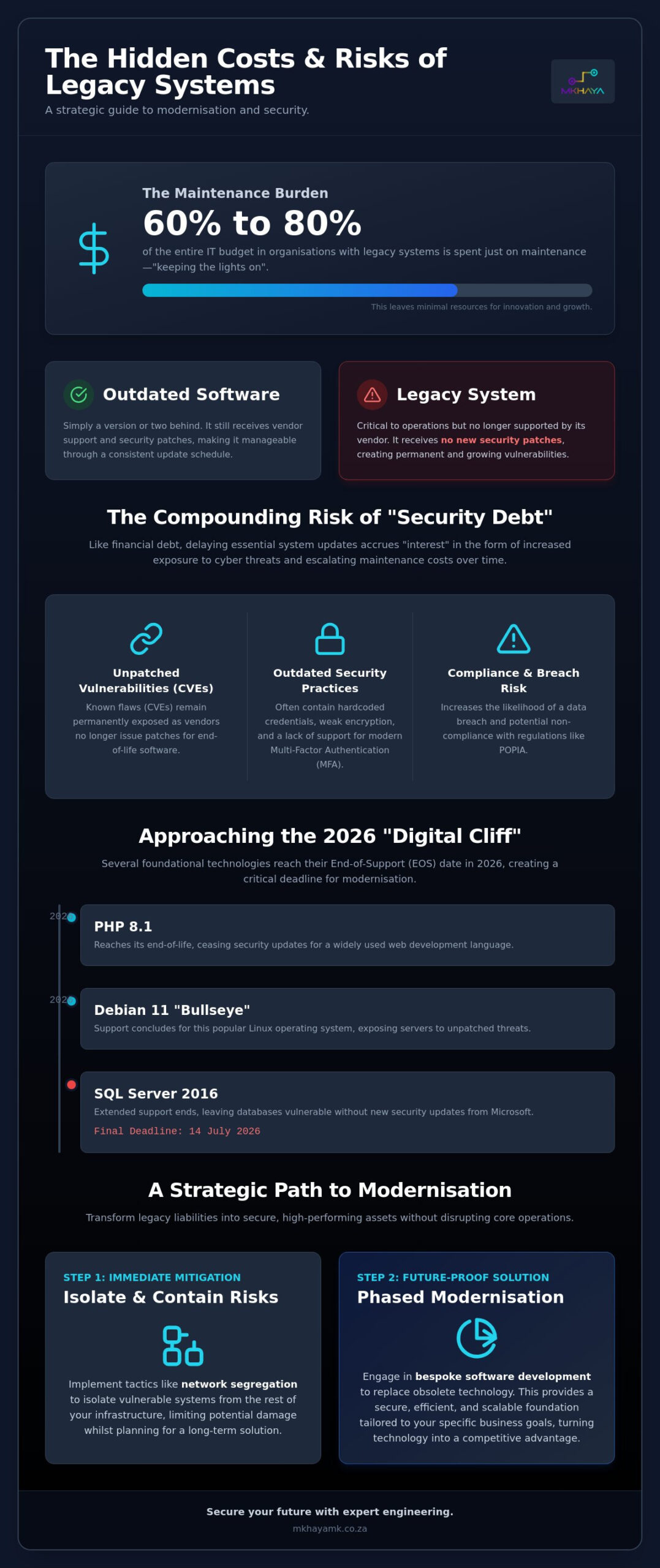
Many organisations struggle to distinguish between software that is simply outdated and systems that have become true legacy assets. Outdated software is typically a version or two behind, often manageable through a rigorous patching schedule. In contrast, What is a legacy system? It’s technology that remains critical to your daily operations but has been surpassed by modern standards and no longer receives updates. Security vulnerabilities in old software are particularly treacherous because they aren’t static; they compound over time, creating a non-linear risk profile that grows more dangerous every day it remains unaddressed.
This accumulation of risk is often described as “Security Debt.” Just like financial debt, the cost of delaying essential updates or migrations accrues interest in the form of increased exposure and higher maintenance costs. Recent data indicates that legacy-heavy organisations often spend between 60 and 80 percent of their IT budgets just on maintenance, leaving little room for innovation. When you consider that the global average cost of a data breach has reached $4.44 million, the financial argument for maintaining the status quo quickly collapses. A legacy vulnerability is a flaw in a system that no longer receives vendor support.
To better understand how hardware and software age into significant risk, watch this helpful video:
Why “If It Isn’t Broken, Don’t Fix It” Is a Dangerous Philosophy
The “if it isn’t broken” mindset is a common trap for busy leaders. Whilst a system might appear operationally stable, it often lacks the security resilience required to withstand modern cyber threats. Modern attackers specialise in silent entry; they exploit security vulnerabilities in old software to dwell within a network for months without detection. These environments usually lack the advanced telemetry and logging found in modern software engineering, making it nearly impossible to spot long-term data exfiltration until the damage is done.
Common Types of Vulnerabilities in Obsolete Systems
Obsolete systems are frequently riddled with documented CVEs (Common Vulnerabilities and Exposures) that will never be resolved because the vendor has moved on. You’ll often find hardcoded credentials, which were a common but poor practice in older development cycles, or encryption protocols that are easily cracked by modern computing power. Additionally, these systems rarely support modern Multi-Factor Authentication (MFA), leaving your most sensitive data protected by nothing more than a legacy password that’s vulnerable to simple brute-force attacks.
As we move through 2026, the timeline for several foundational technologies is reaching a critical junction. The transition from active maintenance to End-of-Life (EOL) or End-of-Support (EOS) isn’t just a change in status; it’s a fundamental shift in your risk profile. For instance, SQL Server 2016 reaches its final end-of-support milestone on 14 July 2026, whilst PHP 8.1 and Debian 11 also face their sunsets in the same year. These dates represent a “digital cliff” where vendor responsibility ends and your vulnerability begins. Microsoft highlights the significant risks posed by outdated systems, particularly as these platforms stop receiving the critical security updates necessary to thwart modern intrusion methods.
Beyond the software itself, the human element presents a growing challenge. Finding developers who are both willing and skilled enough to maintain ancient codebases is becoming increasingly difficult. Most modern talent focuses on contemporary frameworks, leaving a shrinking pool of experts who understand the nuances of legacy languages. This talent gap often forces organisations into a corner where they can’t even apply basic fixes to security vulnerabilities in old software because the original architecture is too fragile for anyone but a specialist to touch. If you’re struggling to find these niche skills, exploring staff augmentation can provide the bridge you need to maintain stability whilst planning your next move.
The Loss of Vendor Security Patches
When a vendor stops issuing patches, “Zero-Day” exploits become permanent fixtures of your environment. In a supported system, a new vulnerability is identified and patched within days. In an unsupported one, that hole remains open forever. Third-party extended support might feel like a safety net, but it’s often just a temporary sticking plaster that doesn’t address underlying architectural flaws. The financial impact is stark; emergency patching for a single incident often costs significantly more than a year of planned, proactive maintenance.
Modern Cyber Threats vs. Ancient Defences
Today’s ransomware isn’t just opportunistic; it’s sophisticated. Attackers now use AI-driven tools to scan entire networks, identifying and exploiting legacy code in mere seconds. These ancient defences simply aren’t built to communicate with modern cloud application services or advanced threat detection systems. This incompatibility creates a “security silo” where your most vulnerable assets are also the hardest to monitor. By modernising these components, you don’t just close a gap; you gain the visibility required for true operational resilience.
For many business leaders, the decision to maintain legacy systems is often framed as a cost-saving measure. However, the reality of managing security vulnerabilities in old software suggests a much more expensive outcome. There’s a direct, measurable correlation between the age of your technology stack and the probability of a successful data breach. With the global average cost of a breach sitting at $4.44 million in 2026, the perceived savings of delaying an upgrade are quickly eclipsed by the financial fallout of a single security incident. These systems aren’t just old; they’re inherently fragile, often lacking the modern architecture required to facilitate a rapid recovery after a compromise.
The operational impact extends far beyond the initial breach. Over 90 percent of mid-size and large enterprises now report that a single hour of downtime costs more than $300,000. When a legacy system fails, the recovery phase is frequently hampered by a lack of documentation and the “brittleness” of ancient code, leading to extended outages that can paralyse a business for days. This fragility also impacts your bottom line through skyrocketing insurance costs. Providers are increasingly conducting deep technical audits, and those with significant cybersecurity vulnerabilities in their legacy infrastructure often face higher premiums or outright denial of coverage.
POPIA and Regulatory Compliance in South Africa
In the South African context, the Protection of Personal Information Act (POPIA) places a clear legal obligation on organisations to secure the data they process. Relying on unpatched or obsolete systems is increasingly viewed by regulators as a failure to implement “reasonable technical and organisational measures.” If a breach occurs due to known security vulnerabilities in old software that can no longer be patched, your organisation could face significant administrative fines, legal liabilities, and mandatory public disclosures that permanently damage customer trust.
The Ripple Effect on Digital Transformation
Legacy systems act as a heavy anchor, slowing down even the most ambitious digital transformation initiatives. Every new AI tool or cloud-native application you wish to deploy requires expensive, custom-built “bridges” to talk to your old databases. This technical debt drains resources that should be spent on innovation. To understand how to navigate this transition effectively, our guide on Custom Software Development in South Africa: A Strategic Guide for 2026 provides a detailed framework for building modern, secure alternatives that support your long-term growth.
Managing security vulnerabilities in old software requires a transition from reactive firefighting to proactive engineering. The first step is always a comprehensive inventory and audit. You simply cannot protect what you do not know exists. Many organisations discover “shadow IT” or forgotten databases only after a security incident occurs. Once your landscape is clear, you can implement immediate tactical shields such as network segregation. By isolating legacy systems within their own secure zones, you prevent attackers from using them as a beachhead to move laterally through your more modern infrastructure.
Virtual patching offers another layer of protection. By using modern web application firewalls and intrusion prevention systems, you can intercept threats before they reach the vulnerable legacy code. This buys you the most precious commodity in digital transformation: time. During this transition, maintaining operational stability is paramount. This is where staff augmentation becomes a strategic asset. By bringing in specialists to manage the day-to-day stability of your older systems, your internal team is freed to focus on building the future. If you are ready to secure your infrastructure, reach out to us for a consultation on your modernisation journey.
Creating a Phased Modernisation Roadmap
A “rip and replace” strategy is often too risky for mission-critical systems. Instead, we advocate for a phased approach, starting with encapsulation. This involves wrapping your old code in modern APIs, allowing it to communicate securely with new tools without exposing its underlying flaws. When deciding what to tackle first, prioritise systems based on data sensitivity and business criticality. In many cases, custom software engineering proves safer than buying off-the-shelf products. Bespoke solutions are designed specifically for your unique security requirements, ensuring that no unnecessary features introduce new risks.
Managed Cloud Migration as a Security Cure
Moving legacy workloads to the cloud often serves as a powerful security cure. Modern cloud environments provide superior monitoring and logging capabilities that legacy on-premise servers simply cannot match. You must choose between refactoring, which involves rewriting parts of the code for better performance, or replatforming, which involves moving the application with minimal changes to a cloud-native foundation. To ensure your transition remains financially viable, consult our guide on Cloud Cost Optimisation in South Africa: A Strategic Guide for 2026. This methodical approach ensures that your move to the cloud improves your security posture without creating unexpected overheads.
Resolving the complex security vulnerabilities in old software requires more than a temporary fix; it demands a partner who understands the intricate balance between legacy stability and modern security. At Mkhaya MK, we begin by conducting deep-dive audits to uncover hidden risks within your current stack. We don’t just look for missing patches. We identify architectural weaknesses that could lead to future compromise. By combining this technical precision with a supportive partnership, we help you navigate the transition from fragile, high-maintenance code to a resilient, future-ready infrastructure.
Our approach to custom software development focuses on creating secure, scalable alternatives that don’t just replace your old systems but enhance them. We bridge the critical talent gap through our specialised staff augmentation services, providing you with experts who understand both your legacy languages and the modern frameworks required for a safe migration. This dual expertise ensures that your daily operations remain stable whilst we construct your new digital foundation.
Beyond mere replacement, we help you turn legacy liabilities into competitive advantages. By integrating AI & data automation, we unlock the value trapped in your old databases, transforming static records into actionable business intelligence. This evolution moves your organisation from a state of compliance anxiety to one of visionary growth, ensuring that your technology supports your long-term ambitions rather than hindering them.
Custom Software Engineering for Legacy Replacement
We believe that every organisation has a unique rhythm. That’s why our solutions are never off-the-shelf; they’re tailored to match your specific business workflows and security requirements. By following a rigorous software engineering process, we ensure that security-by-design is baked into every new line of code. This methodology eliminates the recurring costs of “fragile” legacy systems and replaces them with a stable anchor for your future digital initiatives.
A Partner in Your Digital Evolution
South African enterprises choose Mkhaya MK because we value integrity and methodical execution over flashy, short-term claims. We act as a visionary yet practical guide, helping you move away from the “digital cliff” of 2026 toward long-term stability. Our goal is your mutual success, providing the steady hand you need in a rapidly changing technological landscape. Contact us to audit your legacy systems today and take the first step toward a secure, modern future.
Addressing the risks of legacy technology is no longer a matter of simple maintenance; it’s a strategic necessity that protects your organisation’s reputation and financial health. We’ve explored how security vulnerabilities in old software create a digital cliff where vendor support vanishes and risks compound daily. By shifting toward a phased modernisation roadmap, you can isolate these fragile systems whilst constructing secure, scalable alternatives that support your long-term ambitions. This methodical approach ensures your business remains agile and protected against increasingly sophisticated threats.
Mkhaya MK brings deep expertise in South African enterprise environments, offering POPIA-compliant digital transformation and specialised technical staff augmentation to bridge your talent gaps. We’re committed to your mutual success, ensuring that your transition is methodical, transparent, and free from operational disruption. You don’t have to navigate this complex landscape alone. Our team is ready to serve as your visionary yet practical guide, turning yesterday’s liabilities into tomorrow’s competitive advantages. Secure your business today with Mkhaya MK’s custom software engineering and start your journey toward a more stable, secure future.
What is the biggest security risk of using old software?
The most significant danger is the total absence of security patches for newly discovered threats. When a vendor stops supporting a product, any fresh vulnerability identified by cybercriminals remains open forever. This creates a permanent, unfixable entry point that attackers can exploit using automated scanning tools to gain access to your entire network.
How does POPIA affect businesses using legacy software in South Africa?
POPIA mandates that organisations must implement “reasonable technical and organisational measures” to secure personal information. Operating with known security vulnerabilities in old software that can no longer be patched is often viewed as a failure to meet this legal duty. If a breach occurs on an obsolete system, your business could face heavy fines and significant reputational damage from the Information Regulator.
Can I make my old software secure without replacing it entirely?
You can reduce the risk through mitigation, but you cannot make obsolete code truly secure. Strategies such as network segregation or “air-gapping” help by isolating the vulnerable system from the rest of your infrastructure. Whilst these tactical shields provide a temporary safety net, they don’t resolve the underlying flaws, making a phased modernisation the only way to achieve long-term resilience.
What is the difference between end-of-life and end-of-support?
End-of-Life (EOL) usually indicates that a product has reached the end of its intended useful life and is no longer being sold or improved. End-of-Support (EOS) is the more critical milestone for your security team; it’s the specific date when the vendor ceases all technical assistance and security updates. Once a system hits its EOS date, it becomes a high-risk asset that is permanently exposed to new exploits.
Why are legacy systems more expensive to maintain than modern ones?
Maintenance costs spiral because of “technical debt” and the increasing scarcity of specialised talent. Older systems often require complex, custom-built “bridges” to communicate with modern cloud tools or AI platforms. Additionally, as the pool of developers familiar with ancient codebases shrinks, the cost of hiring specialists to keep these fragile systems running continues to rise.
How can custom software development help with legacy vulnerabilities?
Custom development enables you to build a secure-by-design replacement that is tailored to your unique business workflows. Unlike generic off-the-shelf software, bespoke engineering allows you to eliminate unnecessary features that might otherwise expand your attack surface. This approach removes the baggage of security vulnerabilities in old software whilst providing a stable, scalable foundation for your future growth.
What is virtual patching and how does it protect old software?
Virtual patching involves using external security layers, like a Web Application Firewall, to intercept and block threats before they reach the vulnerable system. It acts as a digital shield that neutralises exploits at the network level. It’s an effective short-term measure to protect your business during a transition, but it doesn’t fix the core issues within the obsolete software itself.
How do I know if my software is considered “legacy”?
Your software is likely a legacy system if it no longer receives updates, is incompatible with modern operating systems, or relies on obsolete hardware. A key indicator is the “integration hurdle”; if your team finds it nearly impossible to connect the system with new cloud applications or automation tools, the technology has transitioned from a helpful asset to a strategic liability.
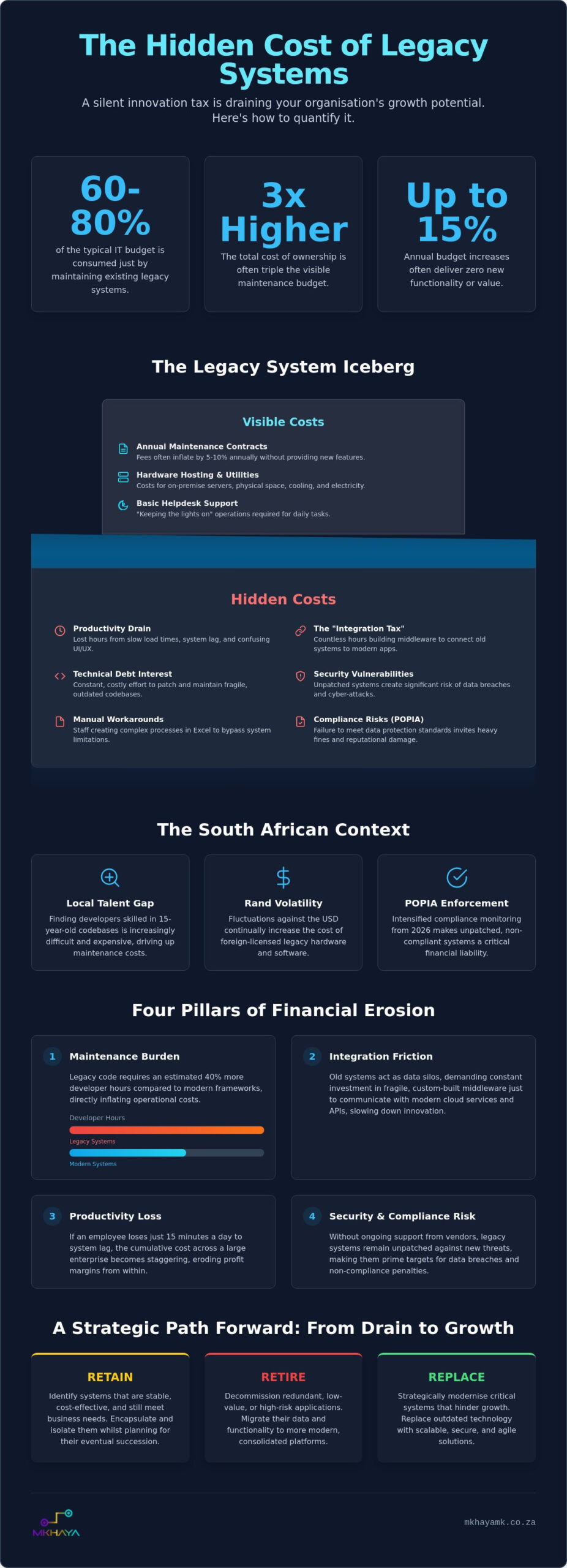
Did you know that between 60% and 80% of your current IT budget is likely being consumed by the mere act of keeping your existing systems alive? For many South African organisations, the challenge of calculating the hidden costs of legacy systems reveals a silent innovation tax that drains growth. This often results in annual budget increases of up to 15% whilst failing to deliver any new functionality. You aren’t alone in feeling that your legacy environment has become a cage, especially as the search for developers who can maintain 15-year-old codebases becomes increasingly difficult and expensive.
We understand that building a business case for change requires more than just intuition. It requires hard data. This guide provides a precise framework for identifying the invisible expenses that often make the total cost of ownership three times higher than your visible maintenance budget. We’ll show you how to quantify the risks of unpatched vulnerabilities, particularly in light of the Information Regulator’s 2026 strategy for intensive POPIA compliance monitoring. By the end of this article, you’ll have a clear financial justification for modernisation and a roadmap to accelerate your time-to-market for the digital services your customers deserve.
Recognise the “Iceberg Model” to distinguish between visible licensing fees and the deeper operational friction that erodes your annual IT budget.
Master a structured framework for calculating the hidden costs of legacy systems by quantifying the “Integration Tax” and developer hours lost to technical debt.
Explore how South African market dynamics, including Rand volatility and the local talent gap, increase the risk profile for organisations maintaining old codebases.
Identify the critical security and compliance liabilities unpatched systems create as POPIA enforcement intensifies across the country.
Evaluate the “Retain, Retire, or Replace” strategy to transform your technology portfolio from a financial drain into a platform for growth.
A software application becomes a legacy system the moment its maintenance costs begin to outpace the business value it provides. Whilst many leaders view old code as a stable foundation, it’s often a financial anchor that prevents agility. Understanding what is a legacy system involves looking beyond the date of installation. It’s about identifying where your technology has stopped being an asset and started being a liability.
Most organisations view their IT budget through the lens of an iceberg. The visible tip consists of line items like licensing and hosting, but the vast majority of the expense remains submerged. Research indicates that 60% to 80% of IT budgets are typically spent on maintaining legacy systems, leaving very little room for innovation. This reality makes calculating the hidden costs of legacy systems a vital exercise for any enterprise aiming to remain competitive in 2026.
To better understand how these expenses accumulate beneath the surface, watch this helpful video:
Many South African businesses struggle with the sunk cost fallacy, staying tethered to failing infrastructure because they’ve already invested millions in it over the years. This mindset ignores the reality that technical debt is the interest paid on sub-optimal technology choices made years ago. As the Rand fluctuates against the USD, the cost of maintaining foreign-licensed legacy hardware only grows, making the decision to hold on even more expensive.
The Visible Costs: Licensing and Basic Support
The tip of the iceberg is easy to track on a balance sheet. These costs are predictable but often include hidden escalations that erode your margins over time:
Annual Maintenance Contracts (AMCs): These fees often inflate by 5% to 10% annually without providing any new features or performance improvements.
Hardware Hosting: Legacy servers kept on-premise require physical space, cooling, and electricity; costs that are frequently rising in the local market.
Basic Helpdesk Support: This covers the “business-as-usual” operations required just to keep the lights on and the system functional for daily tasks.
The Hidden Costs: What Your Budget Sheet Misses
When calculating the hidden costs of legacy systems, you must look at the friction created within your workforce. These expenses don’t appear as specific invoices but manifest as lost time and missed opportunities. For example, staff often create complex manual workarounds in Excel just to bypass the limitations of a rigid system. This “Integration Tax” is another heavy burden, as developers must spend countless hours building middleware just to help old software communicate with modern cloud applications.
Slow load times and outdated UI/UX also lead to significant productivity drains. If an employee loses just fifteen minutes a day to system lag or confusing navigation, the cumulative cost across a large enterprise is staggering. Modern solutions like AI & Data Automation can help streamline these processes, turning what was once a manual struggle into an automated, high-value workflow.
The “Iceberg Model” introduced previously illustrates that visible costs are just the beginning. To truly succeed at calculating the hidden costs of legacy systems, we must examine the four specific pillars where financial erosion occurs. These pillars represent the constant friction that slows down your operations and drains your capital. By identifying these areas, you can begin to transform your IT budget from a survival fund into a growth engine.
First, consider the direct maintenance burden. Industry data suggests that legacy code often requires 40% more developer hours compared to modern frameworks just to maintain the same level of functionality. This efficiency gap is compounded by the “Integration Tax”. As your business adopts new tools, you’re forced to build and manage complex middleware just to keep your old software talking to the new world. Whilst you focus on these patches, the opportunity cost grows. Your competitors are launching features in weeks, whilst your team is stuck in a cycle of regression testing and manual fixes.
Maintenance and the Talent Premium
Finding specialists for obsolete languages like COBOL, Delphi, or older .NET versions has become a significant financial hurdle. As senior engineers retire, they take years of institutional knowledge with them, leaving your infrastructure fragile. Many organisations find that staff augmentation provides a vital lifeline, allowing them to maintain stability whilst they begin calculating legacy system modernisation ROI and planning their next moves. This approach ensures you aren’t held hostage by a shrinking talent pool.
Security Risks and POPIA Compliance
The security gap in unpatched legacy environments is perhaps the most dangerous pillar. These systems often lack the native security features found in modern cloud solutions, making them prime targets for data breaches. In South Africa, the financial impact is now magnified by the Information Regulator’s 2026 focus on proactive POPIA enforcement. A single breach in an unsupported environment could lead to massive regulatory penalties and irreparable brand damage. It’s no longer just an IT risk; it’s a fundamental threat to your business continuity.
If you’re concerned about how your current architecture might be impacting your bottom line, our team is here to help you audit your technical debt and find a sustainable way forward.
Operating in South Africa presents a unique set of challenges when calculating the hidden costs of legacy systems. Whilst global frameworks provide a solid foundation, they often overlook the specific economic pressures of our local market. For instance, the true total cost of ownership for an enterprise stack in Johannesburg or Cape Town is heavily influenced by the volatility of the Rand. When your core infrastructure relies on foreign-owned systems, you’re essentially importing inflation into your IT budget every time the currency fluctuates.
This financial strain is often compounded by the rise of “Shadow IT”. When employees find their official legacy tools too slow or restrictive, they frequently turn to unapproved third-party cloud applications to complete their tasks. This behaviour creates massive security holes and fragmented data silos that are difficult to manage. By investing in custom software development, South African enterprises can build bespoke tools that meet the actual needs of their workforce, bringing data back under centralised and secure control.
Exchange Rate Volatility and Licensing
As of July 2026, the ZAR/USD exchange rate sits at approximately 16.41. For a business tied to USD-based licensing fees, this creates a constant risk of budget shocks that are impossible to predict over a three-year maintenance cycle. This “vendor lock-in” forces many organisations to pay a premium just to keep the lights on. It’s a primary reason why local ERP solutions are becoming more attractive for cost stability. By moving toward modern, locally supported platforms, enterprises can stabilise their expenditure and reclaim financial sovereignty from foreign providers.
The Local Talent Scarcity
The “Brain Drain” is a significant factor in the national IT landscape. Top-tier local developers increasingly refuse to work on legacy stacks, preferring the career growth and agility offered by modern cloud environments. This creates a scarcity of niche skills for older systems, driving up the cost of hiring the few remaining experts who can navigate 20-year-old codebases. Sourcing these individuals becomes a costly exercise in recruitment and retention.
Many businesses find that hiring dedicated developers in South Africa through a strategic partner is the most viable way to maintain operations whilst planning for the future. Training junior staff on outdated technology is often a poor investment, as those skills have limited market value, leading to high turnover and wasted training budgets. Transitioning to modern frameworks isn’t just about the tech; it’s about making your organisation a place where the best local talent actually wants to work.
When you begin the process of calculating the hidden costs of legacy systems, you need a structured methodology that goes beyond your monthly invoices. Moving from vague frustration to financial clarity requires a methodical audit of your entire technical ecosystem. This framework isn’t just about identifying waste; it’s about building a robust business case for a more agile future. By following these five steps, you can uncover the true impact of technical debt on your bottom line.
Step 1: Audit Direct Spend. Compile all licensing fees, annual maintenance contracts, and physical hosting costs. Don’t forget the niche support fees often required for older versions of software.
Step 2: Quantify the Integration Tax. Track the developer hours spent building and maintaining custom middleware. If your team is spending 20% of their time just making systems talk to each other, that’s a direct tax on your progress.
Step 3: Estimate Productivity Loss. Use the “Minutes per Day” formula to see how much time staff lose to slow load speeds or manual workarounds.
Step 4: Calculate Opportunity Cost. Estimate the revenue lost whilst competitors launch new features faster than your legacy stack allows.
Step 5: Compare the “Do Nothing” Cost. Project your current maintenance trajectory over three years and compare it against a modernisation roadmap.
Quantifying Productivity and Opportunity
To measure staff downtime, use a simple formula: (Average Daily Salary / 480 minutes) x (Minutes lost to system lag per day) x (Total Staff). This provides a concrete ZAR value for the friction your employees face. You should also measure your “Time-to-Value” gap, which is the time it takes to move a new feature from concept to deployment compared to modern competitors. The Innovation Gap is the distance between current capability and market demand. When this gap becomes too wide, your business risks irrelevance.
Building the Business Case for the Board
Non-technical stakeholders often view software as a cost centre rather than a value driver. To change this perception, translate technical debt into business risk. Focus on how digital transformation acts as a revenue driver by enabling faster scaling and better customer experiences. Use your data-driven projections to justify the initial capital expenditure, showing that the cost of inaction is far higher than the cost of change. If you’re ready to see how these numbers apply to your specific environment, you can explore our modernisation process to begin your journey.
By calculating the hidden costs of legacy systems through this lens, you move the conversation from “keeping the lights on” to “powering the future”. It’s about ensuring your technology enables your ambition rather than restricting it.
Once you’ve finished calculating the hidden costs of legacy systems, the natural next step is to decide how to act. Holding onto an inefficient system because of the “sunk cost” is a trap that many South African businesses fall into. Instead, we advocate for a “Retain, Retire, or Replace” framework. This portfolio management strategy ensures that every Rand you spend on technology is aligned with your long-term enterprise growth. By categorising your systems based on their current utility, you can prioritise investments that offer the highest return whilst gradually decommissioning the anchors that hold you back.
A phased approach to modernisation is often the most reliable path for a stable transition. It allows your organisation to manage operational risk by making incremental changes rather than attempting a high-risk replacement. This method ensures business continuity whilst providing your team with the space to adapt to new workflows. Mkhaya MK acts as your visionary yet practical guide through this journey, ensuring that the process of calculating the hidden costs of legacy systems leads directly to a concrete, executable plan for digital evolution.
Choosing the Right Path: Refactor vs Re-platform
Deciding between refactoring and re-platforming depends on whether your current software structure still holds intrinsic value. A full custom rewrite is often the best choice for systems that provide a unique competitive advantage but are currently constrained by old code. You can explore our strategic guide to custom software development in South Africa to understand when this investment makes the most sense. Conversely, Cloud Migration can modernise your underlying infrastructure, providing better scalability and stability without the need for a complete code overhaul.
Leveraging AI for Legacy Evolution
One of the biggest hurdles in modernisation is the cost and complexity of data migration. However, AI & Data Automation is revolutionising this process by significantly reducing the manual effort required. We use AI to map complex legacy database schemas automatically, which identifies patterns in old data structures that human auditors might miss. This technology drastically lowers the financial burden of migration by accelerating timelines and preventing costly data entry errors.
Automated testing also plays a critical role in reducing the risk of modernisation projects. By using AI-driven testing suites, we can ensure that new systems mirror the correct behaviours of the old ones whilst eliminating the bugs that have plagued your legacy environment for years. This precision ensures a stable anchor for your business in a rapidly changing technological landscape. If you’re ready to stop the drain on your IT budget, contact Mkhaya MK to audit your systems and discover a path toward long-term stability and success.
The journey of calculating the hidden costs of legacy systems is more than a financial audit; it’s the first step toward reclaiming your organisation’s agility. By looking beneath the surface of your IT budget, you’ve identified how maintenance friction and technical debt stall your growth. You now have the framework to quantify these invisible drains and build a compelling case for change that resonates with the board. Transitioning from a legacy environment to a modern architecture ensures your business remains resilient against exchange rate shocks and talent scarcity whilst staying compliant with evolving POPIA regulations.
At Mkhaya MK, we specialise in turning these challenges into opportunities for innovation. With our proven track record in national custom software engineering and specialised AI-driven automation solutions, we provide the steady hand you need for a successful transition. Whether you’re refactoring core applications or migrating to the cloud, our end-to-end digital transformation expertise ensures your evolution is both methodical and precise. We invite you to partner with Mkhaya MK for your digital transformation journey and build a technology foundation that truly supports your long-term ambition. Let’s work together to create a stable, forward-looking anchor for your business success.
What exactly qualifies as a legacy system in 2026?
A system is classified as legacy when it no longer supports your business agility or when its maintenance costs begin to exceed the value it provides. In 2026, this definition includes any infrastructure that cannot natively integrate with AI-driven automation or lacks the flexibility for real-time data processing. It isn’t just a matter of age; it’s a matter of technical debt and the inability to adapt to modern market demands.
How much of my IT budget should be spent on maintenance versus innovation?
Whilst many South African enterprises currently spend the majority of their budget on “keeping the lights on”, a healthy strategic target is a 50/50 split. Achieving this balance requires a methodical approach to calculating the hidden costs of legacy systems to identify where capital is being drained by technical debt. Shifting these funds toward innovation allows you to build new digital services that drive revenue rather than just sustaining existing operations.
Can we modernise our legacy system without a total shutdown?
Yes, a phased modernisation approach allows you to evolve your technology without disrupting your national operations. We often utilise strategies like the “strangler pattern”, where new components are built around the old core and gradually take over its functions. This method ensures business continuity and provides a stable, low-risk path toward a modern environment.
Is cloud migration the same as legacy modernisation?
Cloud migration is a component of modernisation, but the two aren’t identical. Simply moving an outdated application to the cloud, often called “lift and shift”, provides better hosting stability but doesn’t fix underlying code inefficiencies. True modernisation involves refactoring or re-platforming your software to ensure it can actually leverage cloud-native features like auto-scaling and advanced security protocols.
How do hidden costs affect our POPIA compliance status?
Hidden costs often manifest as unpatched security vulnerabilities that legacy systems aren’t equipped to handle. Because older codebases frequently lack modern encryption and granular access controls, they make it difficult to prove that “reasonable technical measures” were taken to protect data. This increases your risk of falling foul of the Information Regulator’s 2026 strategy for intensive compliance monitoring and enforcement.
What is the “Talent Premium” and why is it a hidden cost?
The Talent Premium refers to the inflated salaries required to hire and retain developers who specialise in obsolete languages like COBOL or Delphi. As these niche skills become scarcer, the cost of maintaining your system rises significantly. It’s considered a hidden cost because it’s often categorised under general recruitment or staff retention rather than being identified as a direct consequence of maintaining legacy tech.
How long does it typically take to see ROI from system modernisation?
Most organisations begin to realise a return on investment within 12 to 18 months of initiating a phased modernisation project. This ROI is driven by a reduction in developer hours lost to technical debt and the elimination of expensive, foreign-currency licensing fees. Calculating the hidden costs of legacy systems early in the process helps you establish clear financial benchmarks to track these savings effectively.
Should we buy off-the-shelf software or build a custom solution to replace legacy tech?
The decision depends on whether the system provides a unique competitive advantage for your business. Off-the-shelf software is ideal for standard administrative processes, but custom software development is the superior choice for core operations that require precision and long-term stability. A custom solution ensures your technology is a bespoke asset that grows alongside your enterprise rather than a rigid tool that limits your ambition.
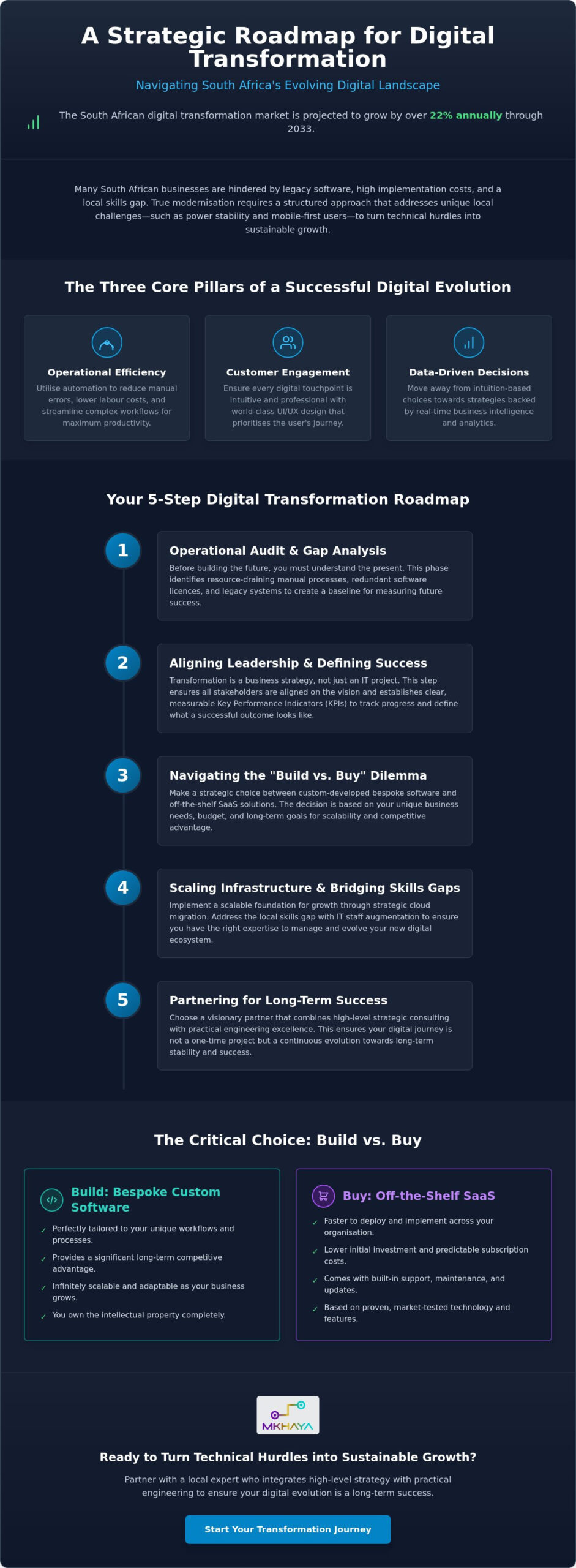
What if the very systems meant to support your business are actually the ones holding your growth hostage? With the South African digital transformation market projected to grow by over 22% annually through 2033, the pressure to evolve has never been more intense. Many local leaders find themselves trapped between legacy software that slows down operations and the high cost of failed IT implementations. If you’ve struggled to find reliable local talent or feel overwhelmed by the complexity of modernising, you aren’t alone. Partnering with the right digital transformation consulting south africa firm can turn these technical hurdles into a clear path for sustainable growth.
We understand that true modernisation isn’t about buying the newest gadget; it’s about building a stable foundation that supports your unique goals. This guide offers a practical, structured roadmap to help you navigate the transition with precision and confidence. You’ll learn how to audit your current processes, manage rising cloud costs, and implement scalable technology that actually improves efficiency. From understanding how the new R2.3 million VAT threshold affects your digital strategy to choosing the right bespoke software, we’ll walk through the essential steps to ensure your digital journey is a success.
Key Takeaways
Learn why successful digital transformation consulting south africa requires a unique balance between infrastructure resilience and mobile-first user experiences.
Discover how to conduct a thorough operational audit to identify legacy tech debt and define measurable KPIs for your modernisation journey.
Evaluate the “Build vs Buy” dilemma to decide between off-the-shelf SaaS or bespoke custom software development tailored to your specific business needs.
Explore how cloud migration and IT staff augmentation can bridge the local skills gap and provide a scalable foundation for sustainable growth.
Understand the value of a visionary partnership that integrates high-level strategic consulting with practical engineering excellence to ensure long-term stability.
What is Digital Transformation Consulting in South Africa?
At its heart, Digital transformation consulting is the strategic process of aligning modern technology with your core business objectives. It isn’t just about installing new software or moving files to a server. Instead, it involves a fundamental shift in how your organisation delivers value. In the South African context, this requires a specialised approach. Local businesses must contend with specific infrastructure challenges, such as power stability and varying connectivity speeds, whilst catering to a consumer base that is overwhelmingly mobile-first.
To better understand this concept, watch this helpful video:
The Core Pillars of a Successful Digital Evolution
Building a resilient digital foundation rests on three essential pillars. First, operational efficiency focuses on using automation to reduce manual errors and lower labour costs. Second, customer engagement ensures that every digital touchpoint feels intuitive and professional. This is achieved through world-class UI/UX design services that prioritise the user’s journey. Finally, data-driven decision making moves your leadership team away from gut-feel choices toward strategies backed by real-time business intelligence.
Why Local Expertise Matters for National Enterprises
Navigating the South African business environment requires more than just technical skill; it demands local insight. A local partner understands the intricacies of the regulatory landscape, ensuring your systems remain POPIA compliant from day one. They also help you navigate unique economic challenges, such as fluctuating exchange rates that impact software licensing costs. By choosing a partner who understands the domestic market, you ensure that your technology scales smoothly across diverse national operations without encountering regional friction or cultural misalignment.
How to Organise Your Digital Transformation Strategy: A 5-Step Roadmap
Embarking on a journey of digital transformation consulting south africa requires moving beyond vague ambitions toward a granular, actionable plan. Transformation without structure is simply expensive experimentation. By following a methodical, five-phase roadmap, you can ensure that every Rand invested produces a measurable return and supports your long-term vision. This structured approach provides the stability needed to navigate the complexities of modernising a national enterprise.
Step 1: The Operational Audit and Gap Analysis
Before you can build the future, you must understand the limitations of the present. This initial phase involves evaluating existing workflows to see exactly where manual processes are draining your resources. We often identify “shadow IT”—unauthorised software used by different departments—and redundant software licences that inflate costs without adding value. Determining which legacy systems can be modernised and which must be replaced is a critical decision. This audit creates a baseline, allowing you to measure the actual impact of your future technology investments against current inefficiencies.
Step 2: Aligning Leadership and Defining Success
Digital evolution isn’t just a technical task; it’s a cultural shift that requires total buy-in. It’s essential that the C-suite and middle management are aligned on the digital vision to prevent internal friction during implementation. We recommend creating a roadmap that delivers “quick wins” early on. These small, visible victories build organisational momentum and prove the project’s value to stakeholders. To keep your efforts focused, write a single sentence defining success for your specific business case. For instance: “Our goal is to reduce customer onboarding time by 50% through automated identity verification.”
Once the strategic foundation is set, the process moves into technical construction and continuous improvement. Phase 3 involves architecting a scalable technology stack, prioritising cloud-native solutions that offer the flexibility South African businesses need to grow. Phase 4 is the execution stage, where we use agile software engineering and iterative testing to bring the vision to life safely. Finally, Phase 5 ensures long-term stability by monitoring, measuring, and refining the digital ecosystem. This continuous feedback loop allows you to adapt to market changes whilst maintaining peak operational performance. If you’re ready to begin this journey, exploring our proven engagement methodology can help clarify the road ahead.
Navigating the Build vs Buy Dilemma in the South African Market
One of the most frequent questions we encounter in digital transformation consulting south africa is whether to invest in a ready-made platform or build a unique solution from scratch. This decision is rarely a simple “either-or” choice. Instead, it’s about finding the right balance for your specific operational needs. Many leaders worry that custom work is too expensive for a local business. However, when you consider the long-term cost of rigid licensing and the inability to adapt to local market shifts, bespoke development often proves more cost-effective over time. Hybrid models often provide the best return on investment; you might use a global accounting tool whilst building a custom layer that connects directly to your unique logistics chain.
When to Choose Off-the-Shelf ERP or Management Systems
Standard business processes that don’t provide a competitive advantage are often best served by established ERP solutions. If your requirements for payroll or basic inventory management align with industry standards, an off-the-shelf product allows for faster deployment. It’s vital to evaluate the long-term licensing costs of global platforms, which are often pegged to fluctuating foreign currencies. Always check for integration capabilities with existing South African financial tools. With the 2026 VAT registration threshold increasing to R2.3 million, ensuring your software can handle local tax compliance and SARS eFiling requirements is a non-negotiable priority for any growing enterprise.
The Strategic Advantage of Bespoke Software Engineering
Custom builds should focus on your “secret sauce”—the specific processes that make your business unique and competitive. When you invest in custom software development, you own the intellectual property rather than merely renting it. This ownership provides long-term stability and removes the risk of a third-party provider suddenly changing their terms or pricing. Bespoke applications are also designed specifically for local user behaviour. In South Africa, this means creating interfaces that function reliably despite connectivity constraints or high data costs. Whether you need a specialised loan management system or a unique procurement platform, a custom build ensures the technology fits your workflow perfectly, rather than forcing your team to adapt to a generic template.
Choosing the right path requires a partner who understands both the technical possibilities and the local economic reality. By aligning your technology choices with your long-term business goals, you create a scalable ecosystem that supports growth without unnecessary technical debt. This balanced approach ensures that your digital evolution remains agile, precise, and firmly rooted in your company’s specific needs.
Scaling Your Infrastructure: Cloud Migration and Staff Augmentation
Once you’ve defined your strategic roadmap and chosen your software path, the focus must shift to the engine room of your organisation. Scaling your infrastructure is a critical phase where theoretical plans become operational reality. In any successful digital transformation consulting south africa engagement, this step ensures that your technology can handle increased loads whilst remaining secure and cost-effective. Without a flexible, modern foundation, even the most sophisticated custom applications will struggle to deliver their full value. By modernising your back-end systems, you create a resilient environment that supports both current operations and future innovations like AI and data automation.
Foundational Cloud Migration and DevOps
Transitioning from on-premise servers to secure, scalable cloud environments is the cornerstone of modern business evolution. Utilising expert cloud migration services allows you to move away from the limitations of physical hardware toward a more agile setup. To maintain this environment, we implement DevOps services that ensure continuous integration and deployment. This approach reduces the time between a business requirement and a live technical solution. Ultimately, cloud infrastructure reduces long-term capital expenditure by shifting costs to a predictable operational model whilst increasing the agility needed to respond to sudden market changes. Once this stable foundation is in place, you can begin to layer in AI and data automation to further refine your efficiency.
Overcoming the Skills Gap with Staff Augmentation
South Africa’s technology landscape currently faces a significant shortage of specialised technical talent. This gap can often stall transformation projects just as they gain momentum. To solve this, we introduce staff augmentation as a strategic outcome of our consulting process. This model allows you to access highly skilled developers, analysts, and engineers without the heavy overhead and long lead times of permanent hiring. You can scale your internal tech team quickly to meet the intense demands of a migration or a new software launch. Crucially, this partnership ensures a steady knowledge transfer between augmented staff and your permanent employees, leaving your internal team stronger and more capable than they were before the project began.
Building a scalable infrastructure requires a blend of high-level cloud strategy and practical, hands-on engineering. If you’re ready to bridge the skills gap and modernise your technical foundation, we invite you to connect with our expert team to discuss a tailored scaling strategy for your business.
Partnering for Success: How Mkhaya MK Executes Digital Evolution
Our Comprehensive Transformation Ecosystem
Our approach encompasses every stage of the modernisation process. We move organised and seamlessly from initial digital transformation consulting to the final deployment of bespoke tools. This ecosystem includes specialised products such as our loan management platform and ERP solutions, each meticulously tailored for the national market. We don’t simply deliver a product and depart. Instead, we provide continuous support and AI-driven optimisation. This commitment ensures your technology remains agile and never falls behind in an increasingly competitive landscape.
Start Your Journey: Discovery and Engagement
Taking the first step toward modernisation shouldn’t feel overwhelming. We begin every partnership with a comprehensive discovery session designed to audit your current tech stack and identify immediate opportunities for improvement. This phase is the bedrock of our digital transformation consulting south africa service, where we listen to your pains and define what success looks like for your specific organisation. This transparent, methodical execution creates a stable anchor for the work ahead.
What can you expect during the first 90 days? Our focus remains on building organisational momentum through “quick wins” whilst architecting the foundation for larger shifts. We prioritise clear communication and knowledge transfer, ensuring your internal team feels supported throughout the transition. This structured rhythm leads you from a broad vision toward a concrete, high-performing digital reality. If you’re ready to move beyond legacy limitations, contact Mkhaya MK today to begin your digital transformation.
Building Your Resilient Digital Future
Modernising your business operations is a continuous journey that requires a blend of strategic vision and technical precision. By moving beyond simple digitisation and embracing a structured roadmap, you ensure that your technology serves your business goals rather than complicating them. Whether you’re navigating the decision between bespoke builds and off-the-shelf platforms or scaling your internal team to meet new demands, the focus must always remain on creating a stable, scalable foundation.
Expert digital transformation consulting south africa provides the clarity needed to overcome local infrastructure hurdles and the technical skills gap. Mkhaya MK offers a comprehensive ecosystem to support this evolution. Our end-to-end software engineering and cloud expertise, combined with specialised proprietary products like our Loan Management System and Facility Management System, provide a reliable path to success. We also offer agile staff augmentation to ensure your projects never lose momentum due to talent shortages. Partner with Mkhaya MK for your Digital Transformation and turn your technological vision into a concrete reality. We’re ready to walk this path with you.
Frequently Asked Questions
What is the typical timeline for a digital transformation project in South Africa?
A typical project timeline ranges from six to eighteen months depending on the complexity of your requirements. Smaller automation tasks might take a few weeks; however, a full scale digital transformation consulting south africa engagement requires a phased rollout to ensure long term stability. This allows your team to adapt to new workflows whilst technical teams refine the infrastructure in a controlled manner.
How much does digital transformation consulting cost for a mid-sized business?
The investment required is determined by the scope of your legacy debt and the complexity of the required solutions. Rather than a fixed fee, costs are usually structured around specific phases such as the initial audit or custom software development. This ensures that your budget is allocated toward high impact areas that provide the fastest return on investment for your specific business model.
Can digital transformation be done in stages, or must it be all at once?
Executing in stages is the most reliable method for local enterprises. This modular approach allows you to address high priority bottlenecks first, such as automating manual data entry, before moving to more complex cloud integrations. It minimises operational disruption and allows you to fund future phases using the savings generated by early efficiencies, creating a self sustaining cycle of growth.
Is my business too small to benefit from digital transformation consulting?
No business is too small to benefit from a strategic digital shift. Even smaller operations see significant growth by adopting AI and data automation or migrating to the cloud. Modernising early prevents the accumulation of technical debt. It makes it much easier to scale your operations and maintain a competitive edge as your customer base expands within the national market.
How do we ensure our data remains secure during a cloud migration?
Security is maintained through a combination of end to end encryption, multi factor authentication, and strict access controls. During a cloud migration, we prioritise compliance with the Protection of Personal Information Act (POPIA). This ensures that your sensitive business data and customer information remain protected against external threats throughout the entire transition, providing peace of mind for your stakeholders.
What is the difference between IT consulting and digital transformation consulting?
How do we measure the ROI of our digital transformation efforts?
ROI is measured by tracking specific Key Performance Indicators (KPIs) defined during the initial audit phase. These often include metrics such as a percentage reduction in manual processing time, lower customer acquisition costs, or increased system uptime. By comparing these figures against your pre transformation baseline, you can see the tangible impact on your bottom line and overall operational efficiency.
What happens to our legacy systems during the transformation process?
Your legacy systems are evaluated during the initial audit to determine their future viability. Some systems are retired and replaced with more efficient cloud native tools, whilst others are modernised by adding a custom software layer. This ensures that you don’t lose valuable historical data whilst moving toward a more agile, modern technical environment that supports your future ambitions.