

Did you know that between 60% and 80% of your current IT budget is likely being consumed by the mere act of keeping your existing systems alive? For many South African organisations, the challenge of calculating the hidden costs of legacy systems reveals a silent innovation tax that drains growth. This often results in annual budget increases of up to 15% whilst failing to deliver any new functionality. You aren’t alone in feeling that your legacy environment has become a cage, especially as the search for developers who can maintain 15-year-old codebases becomes increasingly difficult and expensive.
We understand that building a business case for change requires more than just intuition. It requires hard data. This guide provides a precise framework for identifying the invisible expenses that often make the total cost of ownership three times higher than your visible maintenance budget. We’ll show you how to quantify the risks of unpatched vulnerabilities, particularly in light of the Information Regulator’s 2026 strategy for intensive POPIA compliance monitoring. By the end of this article, you’ll have a clear financial justification for modernisation and a roadmap to accelerate your time-to-market for the digital services your customers deserve.
Key Takeaways
- Recognise the “Iceberg Model” to distinguish between visible licensing fees and the deeper operational friction that erodes your annual IT budget.
- Master a structured framework for calculating the hidden costs of legacy systems by quantifying the “Integration Tax” and developer hours lost to technical debt.
- Explore how South African market dynamics, including Rand volatility and the local talent gap, increase the risk profile for organisations maintaining old codebases.
- Identify the critical security and compliance liabilities unpatched systems create as POPIA enforcement intensifies across the country.
- Evaluate the “Retain, Retire, or Replace” strategy to transform your technology portfolio from a financial drain into a platform for growth.
Understanding the Legacy System Iceberg: Visible vs Hidden Costs
A software application becomes a legacy system the moment its maintenance costs begin to outpace the business value it provides. Whilst many leaders view old code as a stable foundation, it’s often a financial anchor that prevents agility. Understanding what is a legacy system involves looking beyond the date of installation. It’s about identifying where your technology has stopped being an asset and started being a liability.
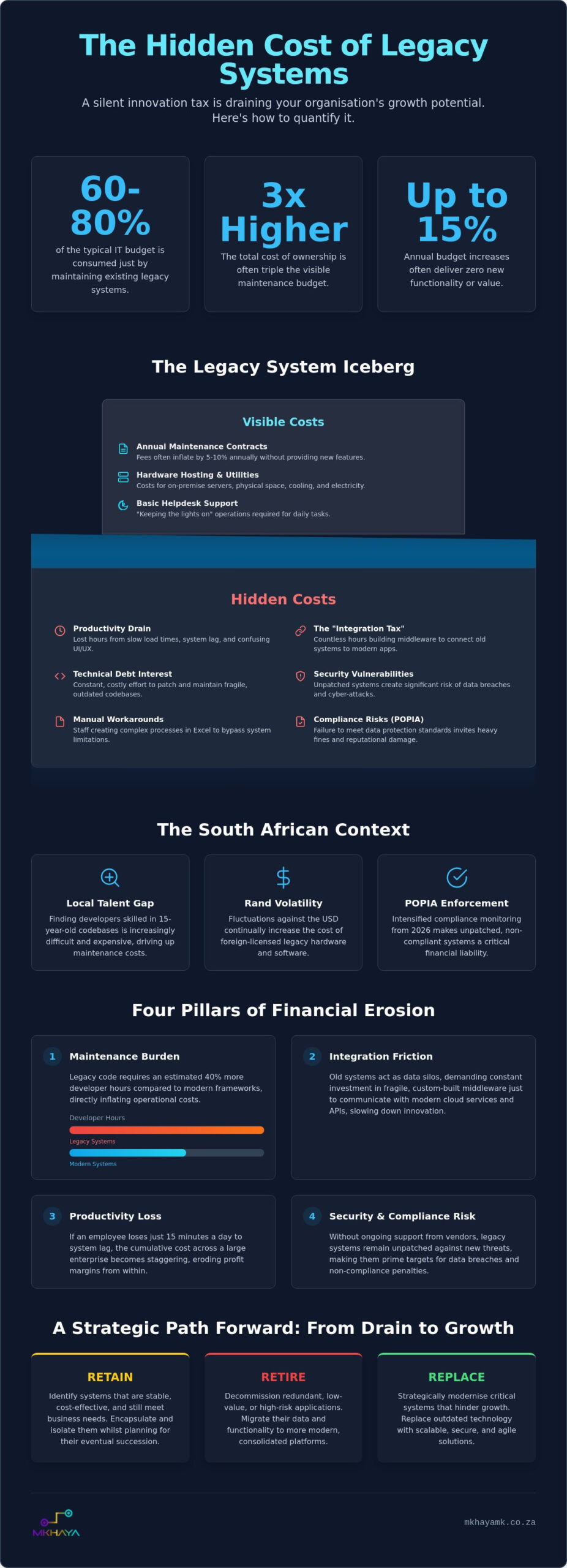
Most organisations view their IT budget through the lens of an iceberg. The visible tip consists of line items like licensing and hosting, but the vast majority of the expense remains submerged. Research indicates that 60% to 80% of IT budgets are typically spent on maintaining legacy systems, leaving very little room for innovation. This reality makes calculating the hidden costs of legacy systems a vital exercise for any enterprise aiming to remain competitive in 2026.
To better understand how these expenses accumulate beneath the surface, watch this helpful video:
Many South African businesses struggle with the sunk cost fallacy, staying tethered to failing infrastructure because they’ve already invested millions in it over the years. This mindset ignores the reality that technical debt is the interest paid on sub-optimal technology choices made years ago. As the Rand fluctuates against the USD, the cost of maintaining foreign-licensed legacy hardware only grows, making the decision to hold on even more expensive.
The Visible Costs: Licensing and Basic Support
The tip of the iceberg is easy to track on a balance sheet. These costs are predictable but often include hidden escalations that erode your margins over time:
- Annual Maintenance Contracts (AMCs): These fees often inflate by 5% to 10% annually without providing any new features or performance improvements.
- Hardware Hosting: Legacy servers kept on-premise require physical space, cooling, and electricity; costs that are frequently rising in the local market.
- Basic Helpdesk Support: This covers the “business-as-usual” operations required just to keep the lights on and the system functional for daily tasks.
The Hidden Costs: What Your Budget Sheet Misses
When calculating the hidden costs of legacy systems, you must look at the friction created within your workforce. These expenses don’t appear as specific invoices but manifest as lost time and missed opportunities. For example, staff often create complex manual workarounds in Excel just to bypass the limitations of a rigid system. This “Integration Tax” is another heavy burden, as developers must spend countless hours building middleware just to help old software communicate with modern cloud applications.
Slow load times and outdated UI/UX also lead to significant productivity drains. If an employee loses just fifteen minutes a day to system lag or confusing navigation, the cumulative cost across a large enterprise is staggering. Modern solutions like AI & Data Automation can help streamline these processes, turning what was once a manual struggle into an automated, high-value workflow.
The Four Pillars of Legacy System Financial Erosion
The “Iceberg Model” introduced previously illustrates that visible costs are just the beginning. To truly succeed at calculating the hidden costs of legacy systems, we must examine the four specific pillars where financial erosion occurs. These pillars represent the constant friction that slows down your operations and drains your capital. By identifying these areas, you can begin to transform your IT budget from a survival fund into a growth engine.
First, consider the direct maintenance burden. Industry data suggests that legacy code often requires 40% more developer hours compared to modern frameworks just to maintain the same level of functionality. This efficiency gap is compounded by the “Integration Tax”. As your business adopts new tools, you’re forced to build and manage complex middleware just to keep your old software talking to the new world. Whilst you focus on these patches, the opportunity cost grows. Your competitors are launching features in weeks, whilst your team is stuck in a cycle of regression testing and manual fixes.
Maintenance and the Talent Premium
Finding specialists for obsolete languages like COBOL, Delphi, or older .NET versions has become a significant financial hurdle. As senior engineers retire, they take years of institutional knowledge with them, leaving your infrastructure fragile. Many organisations find that staff augmentation provides a vital lifeline, allowing them to maintain stability whilst they begin calculating legacy system modernisation ROI and planning their next moves. This approach ensures you aren’t held hostage by a shrinking talent pool.
Security Risks and POPIA Compliance
The security gap in unpatched legacy environments is perhaps the most dangerous pillar. These systems often lack the native security features found in modern cloud solutions, making them prime targets for data breaches. In South Africa, the financial impact is now magnified by the Information Regulator’s 2026 focus on proactive POPIA enforcement. A single breach in an unsupported environment could lead to massive regulatory penalties and irreparable brand damage. It’s no longer just an IT risk; it’s a fundamental threat to your business continuity.
If you’re concerned about how your current architecture might be impacting your bottom line, our team is here to help you audit your technical debt and find a sustainable way forward.
The South African Context: Talent, Cloud, and Exchange Rates
Operating in South Africa presents a unique set of challenges when calculating the hidden costs of legacy systems. Whilst global frameworks provide a solid foundation, they often overlook the specific economic pressures of our local market. For instance, the true total cost of ownership for an enterprise stack in Johannesburg or Cape Town is heavily influenced by the volatility of the Rand. When your core infrastructure relies on foreign-owned systems, you’re essentially importing inflation into your IT budget every time the currency fluctuates.
This financial strain is often compounded by the rise of “Shadow IT”. When employees find their official legacy tools too slow or restrictive, they frequently turn to unapproved third-party cloud applications to complete their tasks. This behaviour creates massive security holes and fragmented data silos that are difficult to manage. By investing in custom software development, South African enterprises can build bespoke tools that meet the actual needs of their workforce, bringing data back under centralised and secure control.
Exchange Rate Volatility and Licensing
As of July 2026, the ZAR/USD exchange rate sits at approximately 16.41. For a business tied to USD-based licensing fees, this creates a constant risk of budget shocks that are impossible to predict over a three-year maintenance cycle. This “vendor lock-in” forces many organisations to pay a premium just to keep the lights on. It’s a primary reason why local ERP solutions are becoming more attractive for cost stability. By moving toward modern, locally supported platforms, enterprises can stabilise their expenditure and reclaim financial sovereignty from foreign providers.
The Local Talent Scarcity
The “Brain Drain” is a significant factor in the national IT landscape. Top-tier local developers increasingly refuse to work on legacy stacks, preferring the career growth and agility offered by modern cloud environments. This creates a scarcity of niche skills for older systems, driving up the cost of hiring the few remaining experts who can navigate 20-year-old codebases. Sourcing these individuals becomes a costly exercise in recruitment and retention.
Many businesses find that hiring dedicated developers in South Africa through a strategic partner is the most viable way to maintain operations whilst planning for the future. Training junior staff on outdated technology is often a poor investment, as those skills have limited market value, leading to high turnover and wasted training budgets. Transitioning to modern frameworks isn’t just about the tech; it’s about making your organisation a place where the best local talent actually wants to work.
Step-by-Step: How to Calculate Your Legacy ROI Framework
When you begin the process of calculating the hidden costs of legacy systems, you need a structured methodology that goes beyond your monthly invoices. Moving from vague frustration to financial clarity requires a methodical audit of your entire technical ecosystem. This framework isn’t just about identifying waste; it’s about building a robust business case for a more agile future. By following these five steps, you can uncover the true impact of technical debt on your bottom line.
- Step 1: Audit Direct Spend. Compile all licensing fees, annual maintenance contracts, and physical hosting costs. Don’t forget the niche support fees often required for older versions of software.
- Step 2: Quantify the Integration Tax. Track the developer hours spent building and maintaining custom middleware. If your team is spending 20% of their time just making systems talk to each other, that’s a direct tax on your progress.
- Step 3: Estimate Productivity Loss. Use the “Minutes per Day” formula to see how much time staff lose to slow load speeds or manual workarounds.
- Step 4: Calculate Opportunity Cost. Estimate the revenue lost whilst competitors launch new features faster than your legacy stack allows.
- Step 5: Compare the “Do Nothing” Cost. Project your current maintenance trajectory over three years and compare it against a modernisation roadmap.
Quantifying Productivity and Opportunity
To measure staff downtime, use a simple formula: (Average Daily Salary / 480 minutes) x (Minutes lost to system lag per day) x (Total Staff). This provides a concrete ZAR value for the friction your employees face. You should also measure your “Time-to-Value” gap, which is the time it takes to move a new feature from concept to deployment compared to modern competitors. The Innovation Gap is the distance between current capability and market demand. When this gap becomes too wide, your business risks irrelevance.
Building the Business Case for the Board
Non-technical stakeholders often view software as a cost centre rather than a value driver. To change this perception, translate technical debt into business risk. Focus on how digital transformation acts as a revenue driver by enabling faster scaling and better customer experiences. Use your data-driven projections to justify the initial capital expenditure, showing that the cost of inaction is far higher than the cost of change. If you’re ready to see how these numbers apply to your specific environment, you can explore our modernisation process to begin your journey.
By calculating the hidden costs of legacy systems through this lens, you move the conversation from “keeping the lights on” to “powering the future”. It’s about ensuring your technology enables your ambition rather than restricting it.
Modernisation Strategies: Moving from Sunk Cost to Strategic Value
Once you’ve finished calculating the hidden costs of legacy systems, the natural next step is to decide how to act. Holding onto an inefficient system because of the “sunk cost” is a trap that many South African businesses fall into. Instead, we advocate for a “Retain, Retire, or Replace” framework. This portfolio management strategy ensures that every Rand you spend on technology is aligned with your long-term enterprise growth. By categorising your systems based on their current utility, you can prioritise investments that offer the highest return whilst gradually decommissioning the anchors that hold you back.
A phased approach to modernisation is often the most reliable path for a stable transition. It allows your organisation to manage operational risk by making incremental changes rather than attempting a high-risk replacement. This method ensures business continuity whilst providing your team with the space to adapt to new workflows. Mkhaya MK acts as your visionary yet practical guide through this journey, ensuring that the process of calculating the hidden costs of legacy systems leads directly to a concrete, executable plan for digital evolution.
Choosing the Right Path: Refactor vs Re-platform
Deciding between refactoring and re-platforming depends on whether your current software structure still holds intrinsic value. A full custom rewrite is often the best choice for systems that provide a unique competitive advantage but are currently constrained by old code. You can explore our strategic guide to custom software development in South Africa to understand when this investment makes the most sense. Conversely, Cloud Migration can modernise your underlying infrastructure, providing better scalability and stability without the need for a complete code overhaul.
Leveraging AI for Legacy Evolution
One of the biggest hurdles in modernisation is the cost and complexity of data migration. However, AI & Data Automation is revolutionising this process by significantly reducing the manual effort required. We use AI to map complex legacy database schemas automatically, which identifies patterns in old data structures that human auditors might miss. This technology drastically lowers the financial burden of migration by accelerating timelines and preventing costly data entry errors.
Automated testing also plays a critical role in reducing the risk of modernisation projects. By using AI-driven testing suites, we can ensure that new systems mirror the correct behaviours of the old ones whilst eliminating the bugs that have plagued your legacy environment for years. This precision ensures a stable anchor for your business in a rapidly changing technological landscape. If you’re ready to stop the drain on your IT budget, contact Mkhaya MK to audit your systems and discover a path toward long-term stability and success.
Securing Your Enterprise Future through Strategic Modernisation
The journey of calculating the hidden costs of legacy systems is more than a financial audit; it’s the first step toward reclaiming your organisation’s agility. By looking beneath the surface of your IT budget, you’ve identified how maintenance friction and technical debt stall your growth. You now have the framework to quantify these invisible drains and build a compelling case for change that resonates with the board. Transitioning from a legacy environment to a modern architecture ensures your business remains resilient against exchange rate shocks and talent scarcity whilst staying compliant with evolving POPIA regulations.
At Mkhaya MK, we specialise in turning these challenges into opportunities for innovation. With our proven track record in national custom software engineering and specialised AI-driven automation solutions, we provide the steady hand you need for a successful transition. Whether you’re refactoring core applications or migrating to the cloud, our end-to-end digital transformation expertise ensures your evolution is both methodical and precise. We invite you to partner with Mkhaya MK for your digital transformation journey and build a technology foundation that truly supports your long-term ambition. Let’s work together to create a stable, forward-looking anchor for your business success.
Frequently Asked Questions
What exactly qualifies as a legacy system in 2026?
A system is classified as legacy when it no longer supports your business agility or when its maintenance costs begin to exceed the value it provides. In 2026, this definition includes any infrastructure that cannot natively integrate with AI-driven automation or lacks the flexibility for real-time data processing. It isn’t just a matter of age; it’s a matter of technical debt and the inability to adapt to modern market demands.
How much of my IT budget should be spent on maintenance versus innovation?
Whilst many South African enterprises currently spend the majority of their budget on “keeping the lights on”, a healthy strategic target is a 50/50 split. Achieving this balance requires a methodical approach to calculating the hidden costs of legacy systems to identify where capital is being drained by technical debt. Shifting these funds toward innovation allows you to build new digital services that drive revenue rather than just sustaining existing operations.
Can we modernise our legacy system without a total shutdown?
Yes, a phased modernisation approach allows you to evolve your technology without disrupting your national operations. We often utilise strategies like the “strangler pattern”, where new components are built around the old core and gradually take over its functions. This method ensures business continuity and provides a stable, low-risk path toward a modern environment.
Is cloud migration the same as legacy modernisation?
Cloud migration is a component of modernisation, but the two aren’t identical. Simply moving an outdated application to the cloud, often called “lift and shift”, provides better hosting stability but doesn’t fix underlying code inefficiencies. True modernisation involves refactoring or re-platforming your software to ensure it can actually leverage cloud-native features like auto-scaling and advanced security protocols.
How do hidden costs affect our POPIA compliance status?
Hidden costs often manifest as unpatched security vulnerabilities that legacy systems aren’t equipped to handle. Because older codebases frequently lack modern encryption and granular access controls, they make it difficult to prove that “reasonable technical measures” were taken to protect data. This increases your risk of falling foul of the Information Regulator’s 2026 strategy for intensive compliance monitoring and enforcement.
What is the “Talent Premium” and why is it a hidden cost?
The Talent Premium refers to the inflated salaries required to hire and retain developers who specialise in obsolete languages like COBOL or Delphi. As these niche skills become scarcer, the cost of maintaining your system rises significantly. It’s considered a hidden cost because it’s often categorised under general recruitment or staff retention rather than being identified as a direct consequence of maintaining legacy tech.
How long does it typically take to see ROI from system modernisation?
Most organisations begin to realise a return on investment within 12 to 18 months of initiating a phased modernisation project. This ROI is driven by a reduction in developer hours lost to technical debt and the elimination of expensive, foreign-currency licensing fees. Calculating the hidden costs of legacy systems early in the process helps you establish clear financial benchmarks to track these savings effectively.
Should we buy off-the-shelf software or build a custom solution to replace legacy tech?
The decision depends on whether the system provides a unique competitive advantage for your business. Off-the-shelf software is ideal for standard administrative processes, but custom software development is the superior choice for core operations that require precision and long-term stability. A custom solution ensures your technology is a bespoke asset that grows alongside your enterprise rather than a rigid tool that limits your ambition.