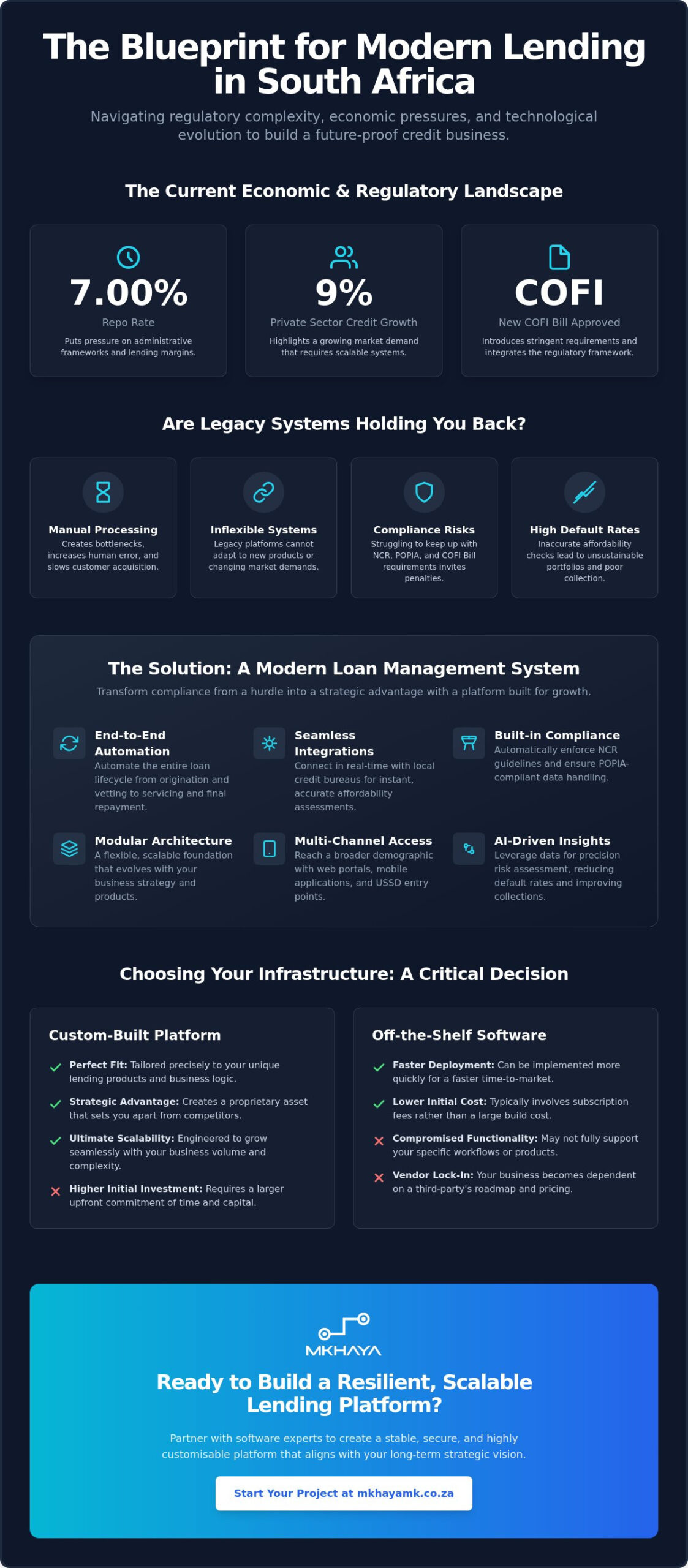
Could your current administrative framework withstand the pressure of a 7.00% repo rate whilst navigating the stringent requirements of the newly approved COFI Bill? Many lenders find themselves trapped between manual processing bottlenecks and the growing fear of NCR non-compliance penalties. You likely recognise that relying on inflexible legacy systems is no longer a viable strategy for growth in a market where private sector credit growth has reached 9%. Finding the right loan management system south africa requires more than just a digital ledger; it demands a visionary partner that transforms compliance from a hurdle into a strategic advantage.
We understand that your primary goal is to build a resilient, scalable business that balances precision with operational speed. This guide will show you exactly how to evaluate and select a platform that automates the entire loan lifecycle, integrates seamlessly with credit bureaus, and ensures POPIA-compliant data handling. We will explore the shift towards AI-driven ecosystems, helping you move away from high default rates and toward a future of improved collection rates and sustainable, long-term stability.
Understand why the shift to digital-first, agile fintech models is now mandatory for South African credit providers to remain competitive.
Identify the essential modular features of a loan management system south africa that automate the credit lifecycle from origination to final repayment.
Analyse the critical trade-offs between off-the-shelf software and custom-built infrastructure to ensure your technology supports unique lending products.
Utilise a step-by-step buyer’s checklist to audit your data readiness and define the specific logic requirements your business needs to scale.
Learn how to partner with software experts to create a stable, secure, and highly customisable platform that aligns with your long-term strategic vision.
South Africa’s financial sector is undergoing a profound transformation. Traditional banking structures, whilst stable, often lack the agility required to serve a modern, credit-hungry population. We’re seeing a decisive move toward tech-first micro-lending and fintech solutions that can navigate a repo rate of 7.00% and a prime lending rate of 10.50%. These agile providers use speed as their primary differentiator. For any credit provider, implementing a robust loan management system south africa is no longer a luxury. It’s a fundamental requirement for survival in a market where private sector credit growth rose to approximately 9% in April 2026.
This technological shift is vital for reaching the unbanked and underbanked sectors. By leveraging data-driven insights, lenders can extend credit to individuals who previously lacked a traditional financial footprint. This requires a delicate balance. Lenders must manage high-volume processing whilst maintaining a granular view of individual risk. Effective technology ensures that the entire loan servicing process, from the moment funds are disbursed to the final collection, remains transparent and efficient.
To better understand how these elements come together in a local context, watch this helpful video:
Regulatory Compliance: NCR and POPIA Requirements
Compliance isn’t just about avoiding fines; it’s about building trust. Your system should automatically enforce National Credit Regulator (NCR) guidelines. This ensures interest rates and fees remain within legal thresholds, protecting both you and the consumer. With the Cabinet’s approval of the COFI Bill in April 2026, the regulatory framework is becoming even more integrated. Managing sensitive borrower data is equally critical. You must ensure strict alignment with the Protection of Personal Information Act (POPIA). Automating statutory reports and compliance audits reduces the administrative burden, allowing your team to focus on growth.
The Move Toward Automated Loan Processing
Manual vetting is becoming a significant liability in the current economy. In a climate where GDP growth is projected at a modest 1.3%, precision in risk assessment is everything. Human error in affordability checks can lead to unsustainable default rates. Adopting an automated loan processing system south africa allows for real-time decision-making based on verified data. This speed doesn’t just lower risk; it improves customer acquisition. When a borrower receives a decision in minutes rather than days, they’re far more likely to stay with your service.
A modern loan management system is a comprehensive digital platform designed to automate the entire credit lifecycle. This process begins at the point of origination and continues through every stage until the final repayment is secured. For lenders in the current market, a loan management system south africa must serve as a dynamic engine rather than a static ledger. To achieve this, we prioritise a modular architecture. This structural flexibility allows for bespoke feature additions, ensuring that your technology evolves alongside your business strategy and shifting market demands.
Seamless integration with local credit bureaus is a non-negotiable requirement for instant, accurate vetting. These integrations allow your system to pull real-time data, ensuring that every affordability assessment remains in strict alignment with the guidelines provided by the National Credit Regulator. Accessibility is equally critical. To truly scale, your platform should offer multi-channel entry points. Borrowers expect the convenience of applying via web portals, mobile applications, or even USSD codes. This inclusive approach ensures you can reach a broader demographic across the country, regardless of their primary device.
AI-Powered Credit Scoring and Risk Assessment
Traditional scorecards often overlook the nuances of the South African consumer. By utilising machine learning, modern systems can predict default patterns based on localised market data with far greater precision. You can see how AI and data automation transform credit risk models by moving beyond basic history. Incorporating alternative data points, such as mobile airtime usage or consistent utility payments, allows you to lend confidently to those with thin credit files. This refined approach reduces your exposure whilst expanding your serviceable market. For a broader strategic perspective on deploying intelligence across your operations, the executive guide to AI automation solutions south africa provides a comprehensive roadmap for bridging modern intelligence with legacy financial systems.
Comprehensive Collections and Recovery Management
The strength of your business relies on the efficiency of your recovery process. Automating payment reminders via SMS, email, and WhatsApp is a proven method to improve recovery rates without increasing headcount. Your system must handle complex repayment structures with ease. Whether your products involve revolving credit or fixed-term loans, the underlying logic should be robust and error-free. Integrating with local payment gateways for automated debit order processing is essential for maintaining a steady cash flow. If you’re ready to enhance your operational efficiency, our team can guide you in developing a highly customised lending infrastructure that meets these specific needs.
Deciding on the foundation of your lending business is a pivotal strategic moment. You’re faced with a choice between the perceived speed of an off-the-shelf product and the enduring flexibility of a bespoke solution. Whilst a pre-packaged loan management system south africa might seem like the path of least resistance, it often forces you to compromise your unique business logic to fit a rigid template. This “one-size-fits-all” approach frequently fails to accommodate the nuanced lending products required to thrive in our local market. The South African Reserve Bank’s focus on Fintech in South Africa highlights the need for agile, forward-thinking technology that can adapt to rapid regulatory and economic shifts.
A Total Cost of Ownership (TCO) analysis often reveals that licensing fees for standard platforms can escalate quickly as you scale. In contrast, investing in your own technology allows you to build significant enterprise value. Owning your Intellectual Property (IP) means you aren’t just a tenant on someone else’s platform; you’re the architect of your own growth. This strategic advantage becomes apparent when you need to pivot your interest rate models or fee structures in response to market changes without waiting for a third-party vendor’s update cycle.
When to Choose a Custom Loan Management System
If your credit products require non-standard logic or complex workflows that don’t fit into a standard box, a bespoke solution is essential. Choosing custom software development ensures that your system is built specifically to support your operational DNA. This precision allows you to automate unique tasks that off-the-shelf systems simply cannot handle. As your business expands, a custom-built loan management system south africa grows with you, providing a stable and scalable anchor for your long-term ambitions.
The Pitfalls of Rigid Off-the-Shelf Platforms
Many lenders discover hidden costs when attempting to customise a “standard” system to meet specific South African requirements. These platforms often lack the flexibility to handle local debit order types or specific NCR reporting formats natively. This leads to “vendor lock-in,” where your digital transformation agility is stifled by the limitations of your provider’s roadmap. Rigid systems can also prevent you from innovating. If you can’t easily adjust your risk modelling or trial new lending products because the software won’t allow it, your competitors will inevitably move ahead.
Selecting the right loan management system south africa requires a methodical approach that goes beyond comparing feature lists. You’re looking for a partner that understands the nuances of the local market and the specific pressures of your operational environment. This framework ensures that your technology investment translates into long-term stability and measurable growth.
Step 1: Define your core lending products. Each product has unique logic requirements, from interest calculation methods to grace periods. Your system must handle these without manual workarounds.
Step 2: Audit your data quality. Before switching platforms, assess your current migration readiness. Clean, structured data is the foundation of a successful transition.
Step 3: Assess local support. A vendor must demonstrate a deep understanding of South African law, including the COFI Bill approved in April 2026. Support should be available in your timezone to ensure business continuity.
Step 4: Verify integrations. Ensure the platform connects seamlessly with your existing ERP or accounting tools. This creates a unified view of your financial health and reduces manual data entry.
Step 5: Review the user experience. A system is only as good as the people who use it. Evaluate the interface for both your administrators and your end-borrowers to ensure it’s intuitive.
Technical Scalability and Cloud Readiness
Lending is a 24/7 operation. Your platform should be hosted on secure managed cloud services to ensure high availability and robust disaster recovery. This infrastructure allows you to scale your processing power during peak periods without compromising performance. APIs play a crucial role here; they act as the bridges that connect your system to the broader financial ecosystem, including payment gateways and credit bureaus.
User Experience: The Front-End Competitive Edge
Friction in the application process is the primary cause of abandonment. Professional UI/UX design services focus on creating a frictionless borrower journey across all devices. Mobile-first design is particularly vital in the South African context, where many users access credit through their smartphones. Internally, intuitive dashboards allow credit officers to conduct manual reviews more efficiently, reducing the time from application to disbursement. If you’re ready to build a platform that prioritises both compliance and user satisfaction, contact our team today to begin your strategic evaluation.
Mkhaya MK stands at the intersection of technical excellence and deep local insight. We don’t just provide software; we build the digital foundations that allow your lending business to thrive in a complex economy. By choosing a loan management system south africa from our team, you’re investing in a platform that prioritises precision, security, and long-term stability. Our approach is rooted in digital transformation consulting, ensuring your technology isn’t just a tool, but a strategic asset that aligns perfectly with your commercial objectives.
Our partnership model is designed for visionary leaders who value transparency and methodical execution. We understand that the lending landscape in 2026 requires more than just a functional ledger; it demands an ecosystem that can adapt to interest rate shifts and new regulatory frameworks with ease. This commitment to continuous innovation ensures that your infrastructure remains a stable anchor, even as the technological landscape shifts around it.
Our Proven Development and Implementation Process
We’ve refined a structured execution path that moves from initial discovery to final deployment. This begins with an intensive phase of UI/UX design, where we map out frictionless borrower journeys that reduce application abandonment. Once the blueprint is finalised, our engineers construct a robust, scalable system tailored to your specific logic requirements. If your project requires a rapid turnaround to meet market demands, our staff augmentation services provide the specialised talent needed to accelerate project timelines without sacrificing quality. We don’t simply hand over the keys; our ongoing support and maintenance keep your system ahead of emerging trends.
Beyond Lending: Integrating with Enterprise Solutions
To build a truly holistic enterprise, your lending platform shouldn’t exist in a silo. We specialise in connecting your loan management system south africa with ERP solutions to create unified financial reporting and real-time visibility across your entire organisation. This integration allows for a seamless flow of data, ensuring that your executive team has the insights needed to make informed, high-stakes decisions.
For asset-backed lenders, the synergies with facility management systems allow for superior tracking and protection of collateral. By bridging the gap between lending data and physical asset management, you create a more resilient business model. This methodical approach to integration closes the loop, transforming your business into a modern, high-end digital enterprise ready for 2026 and beyond.
The evolution of the South African financial sector demands a shift from reactive management to proactive innovation. By prioritising a modular, custom-built loan management system south africa, you ensure that your operations remain resilient against regulatory shifts whilst delivering a frictionless experience to your borrowers. We’ve explored how the right infrastructure transforms compliance from a burden into a strategic advantage, allowing your business to scale with quiet confidence.
As a privately held South African technology firm with national coverage, Mkhaya MK brings specialised expertise in engineering NCR-compliant financial systems. Our focus on digital transformation ensures your technology remains a stable anchor. We’re committed to your long-term success. Through meticulous execution and a supportive partnership model, we help you navigate the 2026 landscape with transparency and precision.
If you’re ready to move beyond manual bottlenecks and embrace full automation, partner with Mkhaya MK to build your bespoke loan management system. We look forward to helping you refine your vision and construct a platform that defines the future of your lending enterprise.
What is the most important feature of a loan management system in South Africa?
NCR compliance and automated credit bureau integration are the most critical features of any loan management system south africa. These capabilities ensure your operations remain legally sound whilst providing the real-time data needed for accurate risk mitigation. Without these non-negotiable tools, lenders face significant regulatory risks and higher default rates in a market that demands absolute precision.
How does a loan management system ensure POPIA compliance?
A modern platform ensures POPIA compliance through robust data encryption and strict role-based access controls. By automating data retention policies, the system aligns your storage practices with the Protection of Personal Information Act standards. This systematic approach protects sensitive borrower information and builds long-term trust with your clients by ensuring their data is handled with the highest integrity.
Can a loan management system be integrated with existing accounting software?
Yes, professional-grade systems offer API-driven integration to sync data seamlessly with popular platforms such as Sage, Xero, or SAP. This connectivity ensures financial consistency across your entire organisation by eliminating manual data entry errors. It creates a unified view of your ledger, allowing for more precise financial reporting and strategic decision-making based on real-time figures.
How long does it take to implement a custom loan management system?
Implementation typically takes between three to six months depending on the specific complexity of your lending products and workflows. Mkhaya MK uses an agile development process to deliver core functionality as quickly as possible. This phased approach allows your team to begin realising the benefits of automation whilst we continue to refine and deploy bespoke features tailored to your goals.
Is a cloud-based loan management system secure for financial data?
Managed cloud solutions are highly secure for financial data, often providing superior redundancy and disaster recovery compared to traditional on-premise servers. When configured with financial-grade security protocols, these systems offer the stability needed for 24/7 lending operations. This cloud-native architecture ensures your sensitive data remains protected against local hardware failures or physical security breaches at your premises.
Does the system support different types of loans, such as micro-loans and asset finance?
A well-engineered system uses parameter-driven logic to support diverse credit products like micro-loans and asset finance within a single, unified platform. You can easily configure unique interest rates, repayment terms, and collateral requirements for each specific product. This flexibility allows your business to diversify its offerings and explore new market niches without the need for multiple software solutions.
Can the system automate the collections process?
The system can fully automate your entire collections workflow, including the submission of debit orders and the delivery of SMS or WhatsApp reminders. When an account becomes overdue, the software automatically escalates the file to your legal or recovery teams based on your internal logic. This proactive management improves your recovery rates and significantly reduces the administrative burden on your staff.
What is the benefit of custom software over an off-the-shelf lending platform?
Custom software allows you to own the intellectual property and avoid recurring per-user licensing fees that often escalate as you scale. Unlike off-the-shelf products, a bespoke loan management system south africa is built to match your unique business workflows and customer journey perfectly. This precision ensures that your technology supports your specific competitive advantages rather than forcing you to adapt to rigid templates.
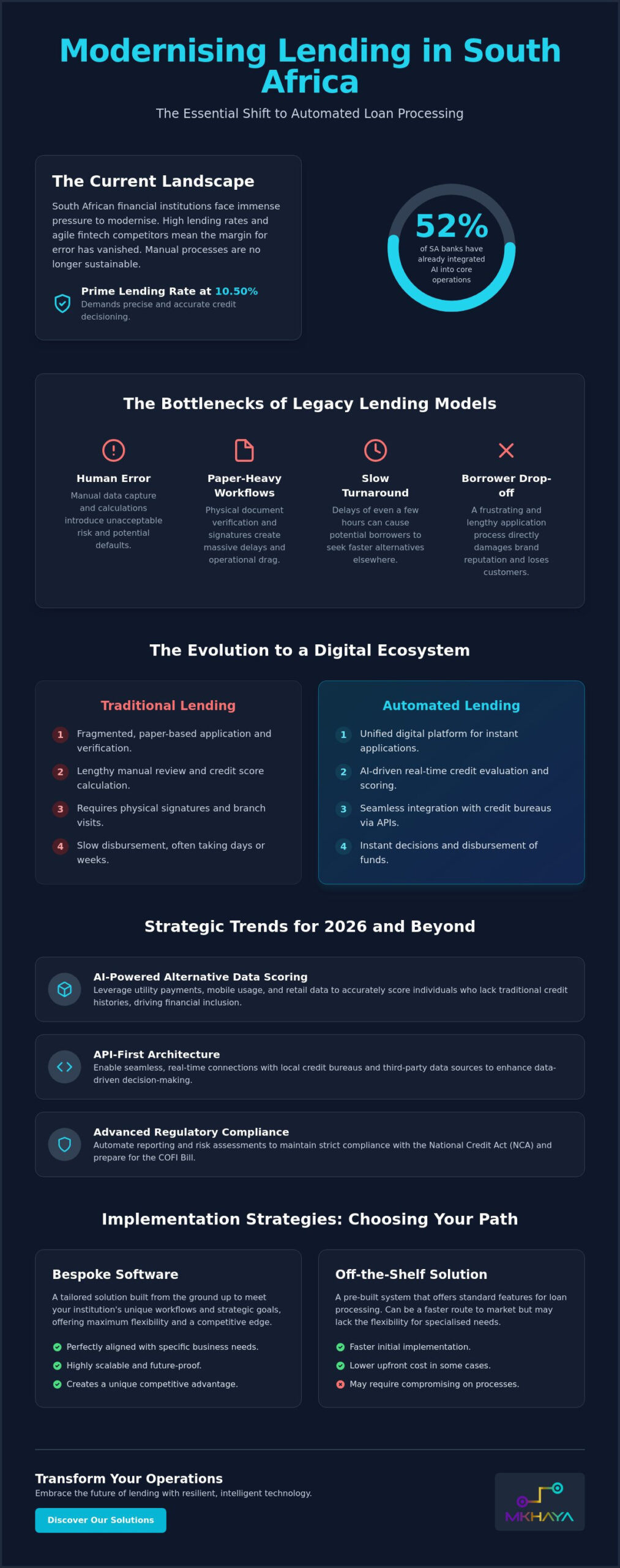
Did you know that over 52% of South African banks have already integrated AI into their core operations to stay ahead of shifting market demands? In a financial environment where the prime lending rate remains at 10.50%, the margin for error in credit decisioning has never been slimmer. Adopting a robust automated loan processing system south africa is no longer just a luxury for tech-first startups; it’s a vital step for established institutions looking to reduce manual data entry costs and eliminate the bottleneck of slow turnaround times. You probably recognise that whilst your team is dedicated, manual processes often lead to borrower drop-off and the constant worry of non-compliance with the National Credit Act.
We believe that technology should empower your team to build stronger relationships, not replace the human element of lending. This article promises to guide you through the essential steps to modernise your credit operations, ensuring your institution remains a stable anchor for your clients. You’ll discover how to leverage AI for improved risk accuracy and achieve seamless integration with local credit bureaus. We will also preview the strategic trends for 2026, including the impact of the COFI Bill and the latest FSCA positions on AI accountability, so you can lead your organisation with quiet confidence and precision.
Key Takeaways
Explore the transition from manual, paper-heavy workflows to a digital ecosystem that enables real-time credit evaluation and faster approvals.
Learn how a modern automated loan processing system south africa uses AI-driven alternative data to accurately score and serve the unbanked market.
Gain clarity on maintaining strict compliance with the National Credit Act (NCA) whilst automating complex regulatory reporting and risk assessments.
Evaluate the strategic advantages of bespoke software development versus off-the-shelf solutions for building a resilient, future-proof lending platform.
Identify how API-first architecture facilitates seamless connections with local credit bureaus to enhance data-driven decision-making.
The Evolution of Lending in South Africa: Why Automation is Non-Negotiable
An automated loan processing system south africa is far more than just a digital tool; it’s a comprehensive ecosystem designed to manage the entire lifecycle of a loan, from the first click of an application to the final disbursement of funds. It replaces fragmented, manual steps with a unified workflow that leverages data to make instant, accurate credit decisions. This evolution marks a significant departure from the traditional methods that have historically dominated Banking in South Africa, where physical paperwork and face-to-face meetings were the standard for decades.
The shift toward real-time digital lending is largely driven by the intense pressure from agile fintech startups that have entered the local market. These newcomers have raised borrower expectations, making speed and convenience the primary benchmarks for success. For traditional micro-lenders, automation isn’t just about matching that speed; it’s a strategic necessity to lower the cost-per-loan. By removing manual intervention from repetitive tasks, your institution can handle a much higher application volume whilst maintaining precision and reducing overheads.
To see how these workflows function in a real-world scenario, watch this helpful video:
The Problem with Legacy Lending Models
Manual document verification and the requirement for physical signatures create significant bottlenecks that stall growth and frustrate potential borrowers. In our mobile-first market, a delay of even a few hours can cause a borrower to seek alternatives, damaging your brand’s reputation for reliability. Beyond speed, the human error factor in data capture and credit score calculations introduces unnecessary risk. A single mistyped digit can lead to an incorrect risk profile, which might lead to non-compliance with the National Credit Act or avoidable defaults.
The Strategic Shift Toward Digital Transformation
Successful modernisation begins with a commitment to digital transformation. This foundation allows your institution to move away from rigid, branch-based operations and embrace cloud-native scalability. With a robust automated loan processing system south africa, you can extend your reach across the country without the expense of physical infrastructure. This approach prioritises a customer-centric digital experience, ensuring that your clients feel supported through every step of their financial journey whilst you maintain a stable, high-performing loan book.
Top Trends in Automated Loan Processing Systems for 2026
The lending environment in 2026 is defined by precision and inclusivity. As financial institutions move beyond basic digitisation, the focus shifts toward intelligent ecosystems that can anticipate borrower needs. A modern automated loan processing system south africa must now integrate sophisticated layers of data to remain competitive and secure whilst navigating a complex economic landscape. We see a move towards systems that don’t just process applications but actively enhance the quality of the loan book through smarter insights.
One of the most transformative trends is the use of AI-powered alternative data scoring. This technology allows lenders to evaluate individuals who lack traditional credit histories by analysing utility payments, mobile airtime usage, and even retail loyalty data. This shift is supported by insights from the South African National Treasury report, which highlights how fintech innovation can drive financial inclusion whilst managing systemic risk. By adopting these models, your institution can safely expand its reach into the unbanked sector with confidence.
Hyper-personalisation has also become a standard expectation. Instead of generic loan products, systems now offer tailored interest rates and repayment terms based on real-time spending behaviour. This level of customisation is often delivered through Lending-as-a-Service (LaaS) models, allowing non-financial retail brands to offer credit at the point of sale. To protect these digital transactions, biometric verification, such as facial recognition and liveness detection, has become the primary defence against identity fraud in the local market.
AI and Machine Learning in Credit Risk
Advanced AI & data automation helps your team identify subtle risk patterns that traditional human analysis might overlook. For first-time borrowers, psychometric testing is increasingly used to assess character and willingness to repay through interactive digital surveys. Machine learning models adapt to South African economic shifts by continuously retraining on new data sets to ensure risk profiles remain accurate during periods of volatility.
Mobile-First Borrower Journeys
With high mobile penetration, WhatsApp-integrated loan applications are no longer optional; they’re a necessity for reaching the mass market effectively. Professional UI/UX design services play a critical role here by reducing friction in mobile apps and ensuring the interface feels intuitive for all users. Self-service portals empower borrowers to manage their accounts, request settlements, or update personal details without ever needing to call a support centre. If you’re looking to refine these digital touchpoints, exploring our custom software development options can help you build a more resilient and user-friendly platform.
Navigating the South African Regulatory Landscape
Many lenders worry that moving to an automated loan processing system south africa might clash with the strict requirements of the National Credit Act (NCA). In reality, automation provides a level of consistency that manual processing simply cannot match. By removing human bias and ensuring every application follows the exact same logic, you create a more transparent and defensible lending process. This methodical approach builds trust with regulators and protects your institution from the risks of inconsistent decision-making.
The National Credit Regulator (NCR) oversees the industry to ensure fair outcomes for all consumers. To navigate these expectations, many forward-thinking institutions are aligning with South Africa’s coordinated approach to regulating FinTech. This regulatory framework ensures that digital lenders maintain high standards of accountability, especially as the Conduct of Financial Institutions (COFI) Bill consolidates multiple laws into a single, outcomes-based structure. Automation isn’t a way to bypass these rules; it’s a powerful tool to ensure you meet them every single time.
Automated Affordability Assessments
A core requirement of the NCA is the mandatory affordability assessment. A modern automated loan processing system south africa simplifies these checks by pulling real-time data directly from credit bureaus like TransUnion or Experian. This allows for the instant, accurate calculation of debt-to-income ratios, ensuring you don’t extend credit beyond a borrower’s financial capacity. Implementing a dedicated loan management system south africa ensures these complex calculations are consistent and fully documented for future regulatory reviews.
Data Privacy and Security Compliance
Handling sensitive financial data requires strict adherence to the Protection of Personal Information Act (POPIA). Automation helps you stay compliant through integrated encryption and secure data protocols that prevent unauthorised access. By utilising professional cloud solutions, your institution benefits from enterprise-grade security that protects borrower information whilst maintaining a detailed audit trail. Every decision the system generates is recorded, providing the transparency needed to explain outcomes to both the regulator and the consumer with total clarity.
Implementation Strategies: Custom vs. Off-the-Shelf Systems
Choosing how to build your automated loan processing system south africa is a pivotal decision that impacts your operational agility for years to come. You need a platform that aligns perfectly with your strategic vision rather than one that forces your team to adapt to rigid, pre-set workflows. Off-the-shelf products might offer a faster initial setup, but they frequently lack the flexibility required to navigate the unique nuances of the local credit market. An API-first architecture is essential for future-proofing your investment, as it allows your system to connect effortlessly with new data providers and digital banking services as they emerge.
The Case for Custom Software Development
Every lender possesses a unique “secret sauce” for risk assessment and customer engagement. A tailored approach through professional software engineering allows you to encode this specific business logic without any compromise. As we’ve detailed in our strategic pillar on custom software development south africa, the long-term ROI of owning your intellectual property is substantial. You aren’t simply paying for a subscription; you’re constructing a proprietary asset that provides a distinct competitive advantage and long-term stability.
Integrating with Existing ERP and Financial Systems
Integrating an automated loan processing system south africa with your existing ERP and financial systems is critical for eliminating data silos. Older organisations often struggle with information trapped in legacy databases that don’t communicate with modern tools. Our research into ERP solutions south africa demonstrates how sophisticated middleware can connect legacy infrastructure to modern automation engines. This ensures your data remains unified, providing your credit officers with a comprehensive view of borrower behaviour for higher risk accuracy.
Managing the operational risk of a digital shift requires a methodical, phased implementation. We believe in a structured rollout that allows your staff to gain confidence in the new tools whilst ensuring that borrower services remain completely uninterrupted. If your internal team is currently at capacity, staff augmentation can provide the specialised expertise needed to bridge the skills gap during the critical migration phase. This partnership model ensures your project stays on track without overwhelming your core staff or sacrificing the quality of your execution.
If you’re ready to build a platform that fits your unique lending model, get in touch with our team to discuss your requirements.
Transforming Your Operations with Mkhaya MK’s Lending Technology
Digital transformation in the credit sector requires more than just code; it requires a deep understanding of the local landscape. Mkhaya MK positions itself as a visionary partner, guiding your institution through every phase of modernisation with quiet confidence. Our engineering team provides an end-to-end service, moving from initial strategic consulting to full-scale deployment and ongoing support. This local presence ensures that your automated loan processing system south africa is built with an intimate knowledge of South African market dynamics and consumer behaviour. We don’t just provide tools; we build the foundations for your long-term success.
Our commitment to reliability means you can trust the precision of our execution. We avoid the high-pressure urgency often found in tech sales, opting instead for a supportive partnership that values transparency. By choosing a local partner, you benefit from experts who understand the nuances of the National Credit Act and the specific challenges faced by South African lenders. This allows us to construct solutions that are not only technologically advanced but also culturally and regulatory-appropriate for your specific audience.
Our Approach to Loan Management Systems
Our Loan Management System is designed to be the central nervous system of your lending operations. It streamlines the entire journey from application to recovery, ensuring that your team can focus on high-value tasks whilst the technology handles the heavy lifting of data processing. We incorporate sophisticated AI & data automation to facilitate smarter credit decisions, allowing you to identify opportunities and risks with unprecedented accuracy. If you’re ready to refine your workflows, we invite you to contact us for a strategic consultation to explore how we can tailor these tools to your specific needs.
Beyond Software: A Partnership for Success
We believe that successful digital transformation is rooted in traditional values of integrity and commitment. Our relationship with clients extends far beyond the initial software delivery; we view ourselves as a stable anchor in a rapidly changing technological landscape. This commitment to mutual success is why we offer staff augmentation services, allowing you to extend your internal capabilities with our specialised experts whenever needed. This methodical execution ensures that your transition to a modern automated loan processing system south africa is smooth, secure, and sustainable for the long term. Modernise your lending operations today and build a more resilient future for your institution.
Securing Your Competitive Edge in the 2026 Credit Market
The transition toward a digital-first lending ecosystem is a journey of precision and long-term stability. By embracing an automated loan processing system south africa, your institution can move beyond the limitations of manual data entry to achieve faster approval cycles and enhanced credit risk accuracy. We have explored how AI-driven insights and robust compliance frameworks act as foundations for growth rather than obstacles. Adopting a custom, API-first approach ensures that your operations remain agile whilst you maintain full control over your intellectual property and unique business logic.
At Mkhaya MK, we bring a national South African footprint and deep expertise in AI & Data Automation to every partnership. Our specialised Loan and Facility Management products are built to handle the complexities of the local market with quiet confidence and reliability. We are committed to your success, providing the technical depth and methodical execution needed to transform your vision into a high-performing reality. Before finalising your platform selection, reviewing our comprehensive loan management system south africa buying guide for 2026 will ensure you evaluate every critical factor with confidence. Optimise your lending operations with Mkhaya MK’s Loan Management System today. We look forward to building a smarter, more inclusive future for your organisation together.
Frequently Asked Questions
What is an automated loan processing system?
An automated loan processing system is a digital ecosystem that manages the entire loan lifecycle from the initial application through to credit evaluation and final disbursement. By replacing manual paperwork with rule-based logic and data integration, it ensures that every step of the lending journey is consistent and efficient. This technology allows your institution to scale operations without increasing overheads, providing a seamless experience for both your staff and your borrowers.
Is automated lending legal under the South African National Credit Act?
Yes, automated lending is fully legal provided the system is configured to comply with the National Credit Act (NCA) and its mandatory affordability assessments. Automation actually enhances compliance by ensuring that every applicant is evaluated against the same objective criteria. This reduces the risk of human error or bias, creating a transparent and defensible decision-making process that aligns with the expectations of the National Credit Regulator.
How much time can automation save in the loan approval process?
Automation can reduce loan approval cycles from several days to just a few minutes by eliminating manual document verification and physical signatures. By integrating an automated loan processing system south africa, your institution can provide instant feedback to applicants, which significantly reduces borrower drop-off. This speed allows your team to handle much higher application volumes whilst maintaining the precision required for accurate credit risk management.
Can automated systems handle complex business loans or just personal credit?
Modern systems are highly versatile and can handle complex business loans as effectively as personal credit products. Whilst personal loans often rely on individual credit scores, business lending modules can be configured to analyse financial statements, cash flow patterns, and company registration data. This customisation ensures that your unique business logic is applied accurately across various loan types, supporting a diverse and stable lending portfolio.
How does an automated system integrate with South African credit bureaus?
These systems integrate with South African credit bureaus through secure Application Programming Interfaces (APIs) to pull real-time data from providers like TransUnion, Experian, or XDS. This connection allows for the instant retrieval of credit reports and history, which the system then uses to calculate debt-to-income ratios and risk profiles. Such seamless integration ensures that your affordability assessments are based on the most current information available in the market.
What are the security risks of moving loan processing to the cloud?
Moving to the cloud introduces risks such as data breaches or unauthorised access, but these are effectively mitigated through enterprise-grade encryption and strict POPIA compliance protocols. Professional cloud solutions provide layers of security that often exceed what is possible with on-premise infrastructure. By maintaining detailed audit trails and secure data storage, your institution ensures that sensitive financial information remains protected whilst benefitting from the scalability of a modern digital environment.
Do I need to hire a full tech team to maintain an automated lending system?
You don’t necessarily need to hire a full internal tech team to maintain these systems. Many institutions choose to partner with experts for managed services or utilise staff augmentation to access specialised skills as needed. This approach allows you to focus on your core lending operations whilst your technology partner ensures the system remains secure, updated, and fully aligned with the latest regulatory shifts in the South African market.
How does AI improve credit scoring for borrowers with no formal credit history?
AI improves credit scoring by analysing alternative data points that traditional models often ignore, such as mobile airtime usage, utility bill payments, and retail loyalty data. This is particularly valuable for the unbanked sector where formal credit histories are absent. By using an automated loan processing system south africa equipped with machine learning, your institution can build accurate risk profiles for new borrowers, safely expanding your market reach without compromising your credit standards.