Did you know that robotic process automation costs approximately 10% of an onsite employee whilst potentially reducing process times by up to 90%? For many local institutions, the pressure to evolve is no longer theoretical. With the JIBAR cessation deadline fixed for 31 December 2026, the need to modernise has become a matter of survival. Implementing RPA for financial services south africa is a powerful way to reclaim your competitive edge against digital-first fintechs that aren’t weighed down by traditional overheads.
It’s understandable if you feel hesitant about the complexities of legacy software or the sensitivities surrounding labour unions and job security. We recognise that your journey involves more than just technical deployment; it requires a partnership built on trust and stability. This guide provides a clear roadmap to help you optimise financial operations and reduce error rates without disrupting your workforce. You’ll discover how to integrate automation into your existing systems and navigate the shifting regulatory environment with confidence. We’ll show you how to turn these technological shifts into a foundation for long-term growth and operational excellence.
Key Takeaways
You’ll learn how software bots revolutionise KYC and AML compliance to ensure your institution remains agile and secure.
Address local sensitivities regarding job security by positioning automation as a supportive tool that empowers your team rather than replaces them.
Explore methods for successfully integrating RPA for financial services south africa with complex legacy mainframes to bridge the gap between traditional banking and modern efficiency.
Gain a structured roadmap for your automation journey, beginning with a robust Readiness Assessment and a high-impact pilot project.
See how custom software engineering and staff augmentation can bridge internal skills gaps to sustain your long-term digital growth.
Understanding RPA in the South African Financial Sector
South Africa’s financial landscape is undergoing a profound shift as the Fourth Industrial Revolution (4IR) moves from a strategic concept to a practical necessity. At the heart of this transition is Robotic Process Automation (RPA), a technology that uses software “bots” to handle repetitive, rule-based tasks. These bots aren’t physical machines; they’re specialised software programmes designed to emulate human interactions with digital systems. This isn’t about replacing your valued team members; it’s about liberating them from the weight of mundane data entry and administrative drudgery.
To better understand how these bots compare to advanced AI agents in a business context, watch this helpful video:
By 2026, the pressure to maintain pace with agile, digital-first fintechs has intensified for traditional South African institutions. High operational costs and rigid structures often hinder growth. Implementing RPA for financial services south africa provides a non-intrusive way to bridge this gap. These bots operate on the presentation layer of your existing software, meaning they work on top of your legacy banking systems without requiring a risky or expensive overhaul of your core infrastructure. It’s a pragmatic approach that respects your current investments whilst driving immediate efficiency gains.
The Core Components of Financial Automation
Financial leaders should distinguish between basic task automation and more advanced cognitive automation. Standard RPA follows strict, predefined rules to move data or process transactions. However, when we integrate AI and machine learning, these bots gain “cognitive” abilities. They can interpret unstructured data, such as handwritten forms or complex emails, and make informed decisions based on patterns. Financial services are the ideal candidate for this technology because of the massive volumes of data processed daily. Whether it’s validating account details or reconciling statements, automation ensures precision at a scale that manual processing simply cannot match.
RPA vs. Traditional System Integration
A full system replacement is often a multi-year journey fraught with risk. RPA offers a faster, more cost-effective alternative for institutions that need results now. It’s particularly effective at solving “swivel-chair” processes, where staff are forced to manually copy and paste information between disparate applications that don’t talk to each other. By automating these touchpoints, you reduce the risk of human error and significantly accelerate service delivery. For organisations looking to build a sustainable, long-term strategy, our digital transformation consulting services help align these rapid RPA wins with your broader business objectives, ensuring a steady and reliable path toward a fully modernised operation.
Key Applications: Where RPA Transforms Banking and Insurance
Precision is the new currency in the South African financial sector. As institutions grapple with high operational costs, the deployment of RPA for financial services south africa has shifted from a luxury to a core strategic requirement. One of the most immediate impacts is seen in Know Your Customer (KYC) and Anti-Money Laundering (AML) workflows. Bots can instantly cross-reference applicant data against international sanction lists and local databases, flagging discrepancies for human review in seconds. This ensures that compliance isn’t just a box-ticking exercise but a robust, real-time defence against financial crime.
In the insurance sector, claims processing often suffers from bottlenecks caused by manual document verification. RPA changes this dynamic by automatically extracting data from accident reports, medical certificates, and repair quotes. Whilst the benefits are clear, understanding the challenges that affect the adoption of RPA in a local context is vital for building a resilient strategy. By automating the validation of policy coverage and initial damage assessments, insurers can settle claims faster, directly improving customer satisfaction scores in a highly competitive market.
Modernising Credit and Loan Operations
Loan processing is traditionally a paper-heavy journey that tests customer patience. By integrating these bots with a modern Loan Management System, you can significantly reduce the time it takes to move a customer from application to payout. Bots handle the heavy lifting of data extraction from payslips and bank statements, feeding accurate information into credit scoring models. This eliminates the human error often associated with complex interest rate calculations or repayment scheduling. If you’re looking to refine your back-office operations, our AI and data automation solutions provide the technical foundation you need to scale these efficiencies.
Compliance and Regulatory Reporting
The regulatory environment in South Africa is becoming increasingly stringent. Financial institutions must provide regular, detailed reports to the Financial Sector Conduct Authority (FSCA) and the South African Reserve Bank (SARB). Manual reporting is not only slow but carries a high risk of inaccuracies that can lead to heavy fines. RPA bots excel here by generating automated digital audit trails for every transaction they process. They can be scheduled to compile and submit monthly financial reports with 100% accuracy, ensuring your institution remains in good standing without draining your internal resources on administrative overhead. This level of precision creates a stable anchor for your business amidst a rapidly changing technological and legal landscape.
Account Reconciliation: Bots match thousands of transactions across disparate ledgers in minutes.
Data Migration: Move client information between old and new systems without losing data integrity.
Customer Onboarding: Automate the creation of new accounts across multiple banking platforms simultaneously.
Navigating Local Implementation Challenges: Labour and Legacy
Successful automation in the South African context requires more than technical proficiency; it demands a deep understanding of our unique social and structural landscape. Unlike global markets where the focus may be purely on cost reduction, implementing RPA for financial services south africa necessitates a balanced approach that respects the “sensitivity to employment.” Trade unions and labour groups play a pivotal role in our economy, and any automation strategy must prioritise transparency and ethical execution to ensure long-term stability.
Data privacy remains another critical hurdle. Every automation script must be designed with the Protection of Personal Information Act (POPIA) at its core. Bots handle vast amounts of sensitive client data, and ensuring that these processes remain secure and compliant is a non-negotiable requirement for any local institution. Aligning your strategy with the South African Reserve Bank’s fintech framework provides a reliable foundation for navigating these regulatory expectations whilst fostering innovation.
Ethical Automation and Workforce Reskilling
We view automation as a tool for empowerment rather than replacement. By automating repetitive data entry, you can move your staff into high-value, customer-facing roles where human empathy and intuition are irreplaceable. This transition is most effective when you collaborate with trade unions early in the process, demonstrating how bots improve employee wellbeing by removing the drudgery of manual processing. The augmented workforce represents a powerful synergy where digital bots handle high-volume processing whilst human expertise focuses on complex problem-solving and relationship management. This collaborative model helps build a resilient and motivated team ready for the future of finance.
Solving the Technical Skills Shortage
One of the primary barriers to scaling automation is the significant local skills gap in RPA engineering. Many organisations struggle to find and retain developers who understand the intricacies of South African financial regulations. Building internal centres of excellence (CoE) is a long-term goal, but the need for modernisation is immediate. Our staff augmentation services bridge this gap by providing instant access to specialists who can manage your automation pipeline. This approach allows you to scale your efforts quickly without the overhead of a lengthy recruitment process. Using local developers who are familiar with the challenges of integrating modern bots with decades-old legacy banking mainframes ensures that your digital transformation remains grounded in practical, real-world solutions.
A Roadmap for Successful RPA Adoption in 2026
Moving from a visionary concept to a functional automated environment requires a structured, methodical approach. Implementing RPA for financial services south africa isn’t merely a technical installation; it’s the construction of a reliable digital workforce that supports your human team. By following a clear progression, you ensure that your investment delivers measurable results whilst maintaining the stability your clients expect.
Step 1: Conduct a comprehensive Readiness Assessment. This phase focuses on process suitability and projected ROI, ensuring you don’t waste resources on tasks that aren’t ready for automation. We evaluate your current workflows to identify where bots can provide the most significant uplift.
Step 2: Select a pilot project. We recommend starting with a high-volume, low-complexity process such as account opening. This allows you to demonstrate immediate value and build internal confidence without the risks associated with more complex, interconnected systems.
Step 3: Define your governance model. It’s vital to establish clear rules that ensure every bot operation remains compliant with FSCA standards and POPIA requirements. This framework provides the transparency needed to satisfy both internal auditors and external regulators.
Step 4: Execute the pilot and measure against KPIs. Focus on concrete data points such as error rates and processing time. Research shows that well-executed RPA can reduce process time by up to 90%, giving you a clear benchmark for success.
Step 5: Scale across departments. Once your pilot has proven its worth, use an agile deployment framework to roll out automation to other areas of the business. This incremental growth ensures that your infrastructure stays robust as your digital capabilities expand.
Selecting the Right Processes for Automation
Identifying the best candidates for automation often involves the “Rule of Five.” We look for processes with fewer than five decisions, five systems involved, or five minutes of manual effort. These are typically the most stable and provide the fastest return on investment. It’s also crucial to avoid the trap of automating broken or inefficient processes; automation should refine a working system, not hide a flawed one. For more complex scenarios that require cognitive decision-making, our AI and data automation solutions can handle advanced use cases that go beyond standard rule-based tasks.
Measuring Success Beyond Cost Savings
Whilst reducing operational costs is a primary driver, true success is measured through a broader lens. You should track improvements in customer experience by monitoring your Net Promoter Score (NPS), as faster service delivery directly impacts client loyalty. Additionally, evaluate the reduction in compliance-related fines and the costs associated with rework. Perhaps most importantly, monitor employee engagement levels. When your team is freed from repetitive drudgery, they can focus on more fulfilling, high-value work. If you’re ready to see these benefits in your own institution, contact us today to begin your tailored readiness assessment.
Scaling Your Automation Journey with Mkhaya MK
Building a future-ready financial institution in South Africa requires more than just adopting the latest tools; it requires a partner who understands the intricate balance between technological innovation and local operational realities. At Mkhaya MK, we specialise in delivering end-to-end digital transformation that respects your legacy whilst driving you toward a more efficient future. Our approach to RPA for financial services south africa is built on the foundation of quiet confidence and methodical execution, ensuring that every bot we deploy serves a clear, strategic purpose.
We don’t believe in one-size-fits-all automation. Instead, we combine our deep expertise in AI-driven automation with a practical understanding of the South African business context. This dual focus allows us to help you navigate the complexities of national compliance and labour dynamics with transparency and integrity. By choosing a local partner, you gain access to a team that stays invested in your personal journey, providing the steady support needed to turn ambitious visions into concrete operational successes.
Custom Solutions for Complex Challenges
Standard RPA bots often encounter hurdles when interacting with highly customised or ageing financial systems. This is where our background in bespoke software engineering becomes a critical advantage. We develop the necessary middleware and custom interfaces that allow your automation scripts to communicate seamlessly with your core banking software. By integrating these bots with our proprietary ERP solutions, we provide you with holistic visibility across your entire business. To ensure these systems remain reliable and secure, we offer managed cloud and DevOps support, creating a stable environment where your digital workforce can thrive without constant manual intervention.
Partnering for National Success
Our commitment goes beyond mere technical delivery. We’re dedicated to building a resilient South African financial ecosystem where technology empowers people rather than replacing them. Our local roots and vision, which you can learn more about on our about us page, drive us to create solutions that foster long-term stability and growth for our clients. We understand that your success is our success, and we’re ready to help you identify the quick-wins that will kickstart your automation journey. Whether you’re looking to refine your loan processing or automate complex regulatory reporting, we provide the visionary guidance and practical expertise to make it happen. Contact Mkhaya MK today to book your strategic consultation and discover how we can optimise your financial operations together.
Building a Resilient Future for South African Finance
The path toward a modernised financial sector is paved with both challenge and opportunity. By 2026, the successful integration of RPA for financial services south africa will define the leaders who can balance technical agility with the unique social responsibilities of our local market. We’ve seen how bridging legacy gaps and fostering an augmented workforce creates a foundation for long-term stability. This journey requires a partner who values transparency and methodical execution over flashy claims.
Mkhaya MK offers the expertise in AI & Data Automation and the proven track record in South African financial software necessary to guide your transition. Our staff augmentation services provide a practical solution to the local skills gap, ensuring your team has the support it needs to thrive. We’re ready to help you turn these strategic concepts into concrete results. You can begin your digital transformation journey with Mkhaya MK to secure your institution’s place in the future economy. Let’s build something lasting together.
Frequently Asked Questions
What is the difference between RPA and AI in financial services?
RPA is a rules-based technology that uses software bots to emulate repetitive human actions, such as data entry or account reconciliation. AI is data-driven and focuses on learning and decision-making, allowing it to handle unstructured information. In the financial sector, these technologies are often combined to create intelligent automation that can both execute tasks and interpret complex documents.
How much does RPA implementation cost for a South African bank?
Implementation costs depend on the scale of your institution and the complexity of the processes involved. Global estimates for 2026 suggest mid-size companies typically invest between $210,000 and $595,000, whilst large enterprises may see costs ranging from $1.3 million to $3.55 million. These figures cover software licences, development, infrastructure, and staff training to ensure long-term stability.
Will RPA lead to job losses in the South African financial sector?
We view RPA for financial services south africa as a tool for workforce empowerment rather than replacement. Whilst bots handle the drudgery of manual processing, your team members are liberated for high-value, customer-facing roles. By prioritising reskilling and maintaining transparent communication with labour unions, you can create a synergy where digital bots and human expertise thrive together.
Is RPA compliant with POPIA and FSCA regulations?
RPA is highly compliant because every action a bot takes creates a permanent, digital audit trail. This level of transparency is vital for satisfying FSCA requirements and preparing for the outcomes-based approach of the COFI Bill. When configured correctly, bots enhance POPIA compliance by ensuring sensitive client data is handled securely and consistently without the risk of human error.
How long does it take to see ROI from an RPA project?
Most institutions begin to see a return on investment within 6 to 18 months of deployment. Because RPA can reduce process times by up to 90%, the efficiency gains often translate into rapid cost savings and improved service delivery. Starting with a high-volume, low-complexity pilot project is the most reliable way to secure early wins and build confidence.
Can RPA work with our old legacy banking systems?
Yes, RPA is non-intrusive and operates on the presentation layer of your existing software. It can interact with decades-old legacy banking mainframes just as easily as modern cloud applications. This allows you to modernise your operations and bridge technical gaps without the massive expense or operational risk of a total core system overhaul.
Do we need to hire a whole new team to manage RPA?
You don’t need to recruit a full internal department at the start of your journey. Many organisations use staff augmentation to access specialised RPA engineers whilst they gradually build their own internal centres of excellence. This flexible approach allows you to scale your automation efforts at a pace that matches your institutional growth and budget.
What are the biggest risks of RPA in financial services?
The primary risks include poor process selection and a lack of robust governance. Automating a broken or inefficient workflow only results in faster errors; it doesn’t solve the underlying issue. Success requires a methodical roadmap, clear risk management protocols, and a focus on long-term stability rather than chasing flashy, short-term claims of success.
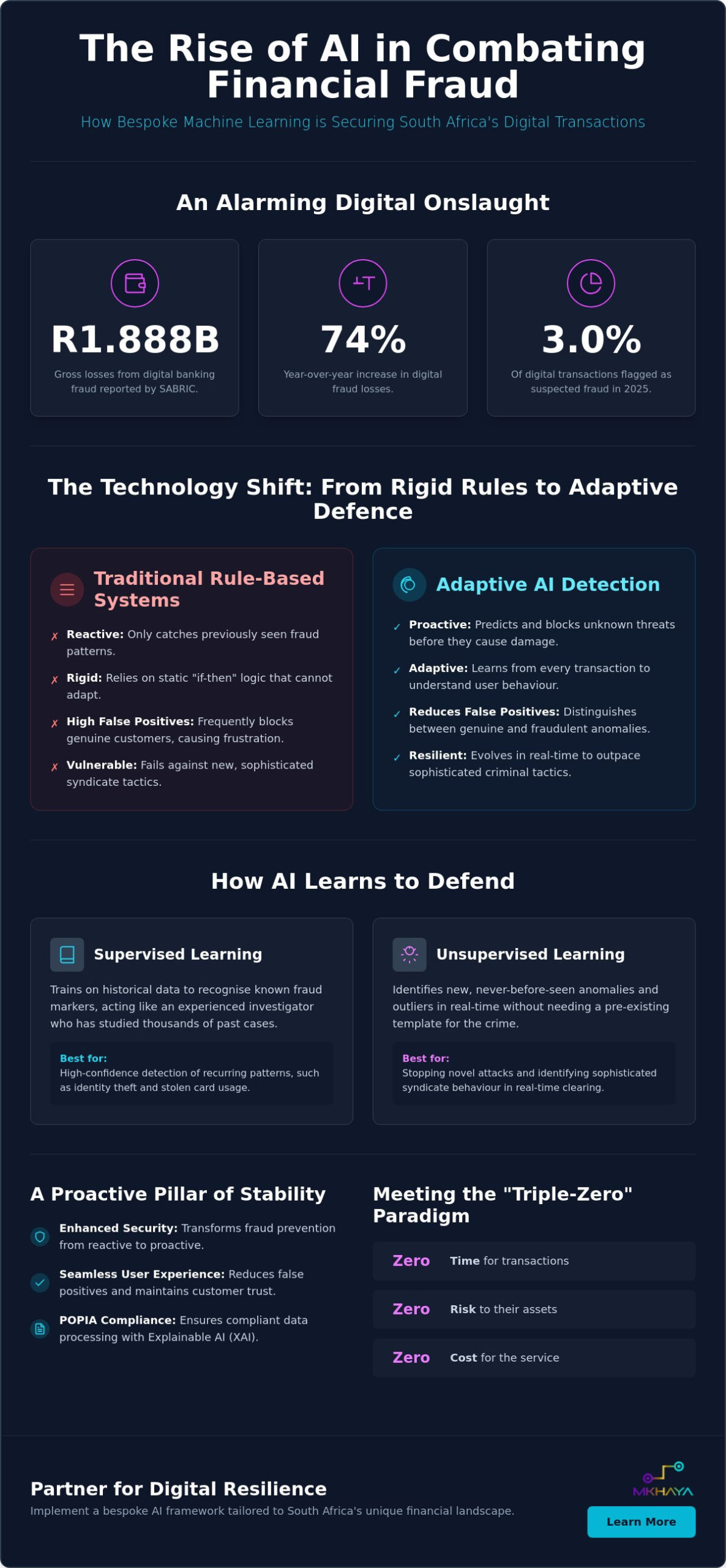
With 3.0% of all digital transactions in South Africa flagged as suspected fraud in 2025, our local financial sector faces a digital onslaught unlike any other on the continent. You’ve likely seen the reports from SABRIC showing gross losses from digital banking fraud reaching R1.888 billion, a staggering 74% year-over-year increase. It’s clear that relying on legacy systems for real-time clearing is no longer enough to protect your customers or your bottom line. Integrating bespoke AI for fraud detection in financial services South Africa has become a necessity for institutions that want to outpace sophisticated syndicates whilst maintaining a seamless user experience.
We understand the frustration of balancing rigorous security with the need to reduce false positives that alienate genuine clients. This case study discovers how South African institutions are leveraging custom AI and data automation to secure digital transactions and ensure compliant data processing under POPIA. You’ll learn how a strategic shift toward scalable, locally-tuned infrastructure can transform fraud prevention from a reactive cost centre into a proactive pillar of stability. We’ll examine the move from generic global models to precision-engineered solutions that handle the unique behavioural nuances of our domestic market.
Key Takeaways
Understand how adaptive machine learning models outpace rigid, rule-based systems to identify sophisticated local fraud patterns in real-time.
Evaluate the strategic advantages of building bespoke AI for fraud detection in financial services South Africa to ensure solutions are tailored to your specific transaction behaviours.
Master the architectural essentials of a fraud prevention engine, focusing on data aggregation and the engineering of unique local features.
Explore how specialised staff augmentation provides the expertise needed to bridge the technical skills gap and maintain digital resilience.
Discover a clear path toward reducing fraud losses and ensuring POPIA compliance without compromising the customer experience during high-volume clearing.
AI for fraud detection in financial services South Africa involves deploying machine learning algorithms that scrutinise millions of data points to identify and block fraudulent activities in real-time. In the broader context of Financial technology (FinTech), these systems act as the primary line of defence against a rising tide of sophisticated local threats. South African institutions currently navigate a complex environment where card-not-present fraud, identity theft, and the creation of synthetic identities are becoming increasingly common. With suspected digital fraud rates hitting 3.0% in 2025, the highest in Africa, the pressure to automate has never been greater.
The urgency for these systems is driven by what industry leaders call the “triple-zero” paradigm. Modern banking customers expect zero time for transactions, zero risk to their assets, and zero cost for the service. To meet these expectations whilst managing the high-volume requirements of real-time clearing, automated intervention is the only viable path. The South African Reserve Bank (SARB) and the Financial Sector Conduct Authority (FSCA) have set high security expectations. Specifically, the 2025 Joint Standard on Cybersecurity and Cyber Resilience makes robust AI integration a regulatory priority for any institution handling public funds.
The Shift from Reactive to Proactive Security
Traditional “if-then” rules are rigid; they only catch what has happened before. When fraud syndicates evolve their tactics, these legacy systems fail because they cannot adapt to new patterns without manual updates. The cost of remaining reactive is high. Beyond the R1.888 billion in gross losses reported by SABRIC, institutions face severe brand reputation damage that can take years to repair. Proactive AI detection marks the shift from merely stopping known threats to predicting unknown anomalies before they impact the customer.
Local Regulatory Compliance: POPIA and Beyond
Implementing AI requires a delicate balance between data-heavy training and strict adherence to the Protection of Personal Information Act (POPIA). Financial institutions must ensure that the data used to train models is handled with absolute integrity. This has led to the rise of “Explainable AI” (XAI). This approach allows banks to provide clear reasoning for why a transaction was flagged, which is essential for regulatory reporting and customer transparency. Leveraging expert digital transformation services helps organisations align their technical infrastructure with these complex compliance mandates whilst maintaining operational agility.
How AI-Driven Detection Surpasses Traditional Systems
Traditional fraud prevention relies on rigid, rule-based logic that operates on “if-then” scenarios. For example, a system might be programmed to flag any transaction over R10,000 or any purchase made outside of a user’s home province. Whilst these rules provided a basic safety net in the past, they’re often too blunt for modern requirements. They result in high rates of false positives, where genuine customers find their accounts frozen during legitimate activities. In contrast, AI for fraud detection in financial services South Africa utilises fluid, adaptive models that learn from every interaction, allowing for a far more nuanced understanding of what constitutes a threat.
These advanced systems typically employ a hybrid approach, combining supervised and unsupervised learning to create a multi-layered defence. Supervised learning acts like an experienced investigator who has studied thousands of past fraud cases. By training on historical data, these models recognise specific markers associated with known crimes, such as stolen card patterns or phishing signatures. However, because fraud syndicates constantly pivot, relying solely on history isn’t enough. This is where unsupervised learning becomes vital. These algorithms identify outliers in transaction behaviour that have never been seen before, flagging suspicious account-to-account transfers in real-time clearing environments without needing a prior “template” of the crime.
Supervised vs Unsupervised Machine Learning
The choice between these methods depends on the specific threat. Supervised ML is excellent for high-confidence detection of recurring patterns, such as identity theft attempts during loan applications. Unsupervised ML excels at spotting “zero-day” fraud, particularly amongst the high-velocity transactions seen in digital banking. Modern engines also incorporate deep learning to analyse unstructured data, such as customer support transcripts or login metadata, to detect subtle signs of account takeover. Navigating the challenges of AI in fraud detection requires this balanced, sophisticated architecture to ensure no stone is left unturned.
Reducing False Positives: The Customer Experience Factor
Precision is the ultimate goal for any financial institution. AI distinguishes between a traveller using their card in a new city and a fraudster attempting a remote transaction by analysing hundreds of variables, from device biometrics to the time of day. This precision reduces “friction,” ensuring that genuine transactions succeed on the first attempt. When you lower the number of blocked legitimate payments, you directly improve customer loyalty and retention. If you’re ready to move beyond rigid rules, exploring bespoke AI and data automation solutions can help you build a system that protects your revenue whilst respecting your customers’ time.
Implementing Bespoke AI Frameworks: A Practical Comparison
When choosing a framework for AI for fraud detection in financial services South Africa, the “buy versus build” debate is often the first hurdle for stakeholders. Off-the-shelf SaaS tools offer a quick start, but they frequently lack the granular control needed for our local market. Bespoke solutions, built on a foundation of custom software engineering, provide the flexibility to adapt to unique South African transaction patterns whilst ensuring total data sovereignty. This is particularly relevant given the strict requirements of POPIA; keeping sensitive financial data within local borders isn’t just a preference, it’s a regulatory necessity for many organisations today.
Off-the-Shelf vs Bespoke AI Solutions
Generic fraud models are often trained on European or North American datasets. These models frequently struggle with the nuances of the South African “informal economy” where transaction behaviours may appear irregular to a global algorithm but are perfectly normal locally. When you choose a bespoke framework for AI for fraud detection in financial services South Africa, you gain the ability to customise detection logic to these specific domestic realities. Beyond customisation, the long-term ROI of owning your intellectual property (IP) is substantial. You aren’t just renting a service; you’re building a proprietary asset that grows in value as it learns from your specific data pool. Local support also means your partner understands the immediate context of a new fraud wave hitting Cape Town or Johannesburg, allowing for faster model retraining. For a broader strategic perspective on reducing operational overheads through intelligent automation, the AI automation solutions South Africa executive guide for 2026 provides a comprehensive roadmap for enterprises navigating these decisions.
Real-Time Data Processing and Cloud Infrastructure
The shift toward Real-Time Clearing (RTC) in South Africa has changed the technical requirements for fraud prevention. It’s no longer acceptable to flag a transaction after the money has left the account. Your AI must process data with sub-second latency to block fraudulent transfers before they are finalised. Achieving this level of performance requires more than just a smart algorithm; it demands a robust backend. Leveraging managed cloud services allows your infrastructure to scale instantly during massive data spikes, such as month-end salary runs or Black Friday sales. By integrating these AI models into your existing ERP and banking cores through microservices, you create a seamless flow of information that supports both security and speed. This architectural precision ensures that your digital resilience remains stable even as transaction volumes grow, preventing legacy system bottlenecks from frustrating your genuine customers.
Case Study: Architecting an AI-Powered Fraud Prevention Engine
Building a resilient system for AI for fraud detection in financial services South Africa requires a structured, methodical approach that moves beyond simple software installation. It’s about creating a living architecture that evolves alongside the tactics of local syndicates. A successful implementation follows five critical steps to ensure the engine is both accurate and scalable within the South African banking context.
Step 1: Data Aggregation — We begin by centralising siloed data from across the institution, breaking down the walls between credit card history, personal loan applications, and savings account metadata.
Step 2: Feature Engineering — Our team identifies local variables that predict fraud, such as unusual high-value EFT patterns during public holidays or branch-specific anomalies that global models often overlook.
Step 3: Model Training and Testing — We refine the engine’s accuracy by using historical South African fraud data, ensuring the system recognises the specific signatures of regional threats.
Step 4: Deployment and Monitoring — The model is transitioned into the live transaction stream where it begins continuous learning in a real-world environment.
Step 5: Feedback Loops — Human analyst insights are integrated back into the model; this ensures that “grey area” cases are correctly categorised to improve future performance.
Phase 1: Discovery and Data Strategy
Auditing existing data quality is the first hurdle in any strategic build. We look for “dark data,” such as failed login attempts or specific device metadata, which often contains hidden patterns of account takeover behaviour. During this phase, we set clear KPIs that balance aggressive fraud detection rates with acceptable false positive thresholds to protect the customer experience. Following the structured Mkhaya MK process ensures that this discovery phase is thorough and sets a stable foundation for the technical work that follows.
Phase 2: Building the Neural Network
A successful build requires a balanced team of data scientists and specialised software engineers working in tandem. We place a heavy emphasis on “Adversarial AI,” where we train the system by simulating sophisticated fraud attacks based on known local syndicate behaviours. This stress-testing ensures the neural network is prepared for the unexpected. Predictive analytics can identify the precursor signs of an account takeover and stop the fraud before the final transaction is even initiated. This proactive stance is what separates modern digital banking from legacy reactive security measures.
If you’re ready to secure your infrastructure against evolving threats, our team provides the AI and data automation expertise needed to build a precision-engineered fraud engine.
Partnering for Digital Resilience: The Mkhaya MK Approach
Effective implementation of AI for fraud detection in financial services South Africa requires a partner who balances visionary strategy with practical, boots-on-the-ground execution. At Mkhaya MK, we position ourselves as more than just a service provider; we act as a steady anchor for institutions navigating the rapid shifts in the technological landscape. Our approach focuses on mutual success, ensuring that every custom algorithm or neural network we build serves a clear business outcome. We move from high-level conceptualisation to methodical deployment, creating a sense of momentum that leads your institution toward a more secure digital future.
One of the most significant hurdles in our local market is the scarcity of specialised talent. We address this directly through staff augmentation, providing the high-end expertise your projects require without the delays of traditional recruitment. This model allows you to scale your technical capabilities instantly, bringing in data scientists and engineers who understand the unique nuances of the South African financial sector. Security shouldn’t exist in a vacuum. By integrating these advanced AI models with your broader ERP solutions, we create a holistic security environment where fraud detection data informs every facet of your business operations.
Extending Your Internal Tech Team
We believe in the power of collaborative growth. When we provide specialised talent for your machine learning projects, our focus remains on long-term stability and reliability. Whether through on-site or remote engagement, our experts work alongside your staff to ensure a seamless knowledge transfer. This ensures that your internal team possesses the skills and confidence to manage and refine the AI for fraud detection in financial services South Africa once the initial deployment is complete. It’s a supportive partnership designed to build your internal resilience rather than creating a cycle of dependency.
The Future of AI in South African Finance
As we look toward 2027, the horizon of fraud prevention continues to expand. We anticipate a significant shift toward biometric integration and blockchain-based verification systems that offer even greater layers of protection. Digital transformation isn’t a destination with a fixed end point; it’s a continuous journey of refinement and construction. Staying ahead of sophisticated syndicates requires an agile mindset and a commitment to constant evolution. If you’re ready to define your path forward, we invite you to consult with Mkhaya MK on your AI roadmap and secure your position as a leader in digital banking.
Securing Your Financial Future Through Precise Innovation
Building a resilient defence against modern fraud syndicates is no longer just a technical requirement; it’s a strategic pillar for long-term stability. You’ve seen how shifting from rigid rules to adaptive machine learning allows for real-time protection whilst respecting the customer experience. By choosing bespoke AI for fraud detection in financial services South Africa, your institution gains a system that understands the nuances of our local informal economy and the high-velocity demands of real-time clearing. This transition ensures that your security infrastructure remains as agile and forward-thinking as the clients you serve.
The journey toward digital resilience is one we’re ready to walk with you. Whether you need end-to-end custom software engineering, specialised expertise through our national staff augmentation service, or advanced AI and data automation, we provide the methodical execution your vision requires. It’s time to transform your security from a reactive cost centre into a proactive engine of growth and trust. Partner with Mkhaya MK for your AI and Digital Transformation journey and let’s build a secure, stable future for your institution together.
Frequently Asked Questions
How does AI detect fraud in real-time for South African banks?
AI systems analyse millions of data points instantly by comparing current transaction behaviour against both historical patterns and emerging anomalies. In the South African banking sector, this capability is essential for Real-Time Clearing (RTC), as it allows the engine to flag and block suspicious EFTs or card-not-present transactions before the funds leave the account. This immediate intervention prevents losses that legacy systems would only identify hours after the event.
Can AI fraud detection help with POPIA compliance?
Yes, modern AI frameworks are designed with privacy-by-design principles that align with the Protection of Personal Information Act (POPIA). By utilising “Explainable AI” (XAI), financial institutions can generate clear audit trails that justify why a transaction was flagged whilst ensuring that personal data is processed securely and for a specific purpose. This transparency is vital for meeting the security expectations set by the FSCA and SARB.
What is the difference between rules-based and AI fraud detection?
Rules-based systems rely on static “if-then” logic that only catches known threats, often leading to high rates of false positives. AI for fraud detection in financial services South Africa is adaptive; it uses machine learning to learn from every interaction and identify unknown anomalies. This fluid approach allows the system to evolve alongside local syndicates, catching sophisticated tactics that fixed rules would simply overlook.
Is bespoke AI fraud software better than off-the-shelf solutions for SA businesses?
Bespoke solutions offer a significant advantage because they are trained on domestic datasets that reflect South African transaction behaviours and the nuances of our informal economy. Generic off-the-shelf tools often struggle with these local patterns, leading to unnecessary friction for genuine customers. A custom-built engine also ensures total data sovereignty, keeping sensitive financial information within local borders as required by many regulatory frameworks.
How long does it take to implement an AI fraud detection system?
A typical implementation follows a phased journey that usually spans several months. This timeline includes an initial discovery and data strategy phase, followed by data aggregation, feature engineering, and rigorous model testing. We focus on a methodical execution to ensure the system is stable and reliable before it begins monitoring live transaction streams, ensuring a smooth transition for your internal teams.
What data is required to train an AI fraud detection model?
Training requires a robust pool of historical transaction records, customer metadata, and documented fraud signatures from previous incidents. We also look for “dark data,” such as failed login attempts and device biometrics, to provide the context needed for detecting account takeovers. The more diverse and locally relevant the data, the more precise the AI for fraud detection in financial services South Africa becomes at predicting future threats.
How do you reduce false positives in AI-driven fraud prevention?
False positives are reduced by refining the model to distinguish between legitimate behavioural shifts, such as a customer travelling, and actual fraudulent intent. By scrutinising hundreds of variables simultaneously, the AI gains a precise understanding of the user’s typical behaviour. This cause-and-effect relationship ensures that you lower the “friction” for genuine clients whilst maintaining a high-security threshold for suspicious activities.
Do I need a dedicated data science team to run AI fraud detection?
You don’t need to hire a permanent, full-scale team before you begin your journey. Many institutions use bespoke AI automation solutions in South Africa to bring in specialised experts who build the initial architecture and deploy the models. This collaborative approach ensures a thorough knowledge transfer, allowing your existing IT staff to gain the skills needed to manage and maintain the AI engine post-deployment with confidence.