By 2026, the traditional approach of purchasing a boxed software package has become a primary driver of operational stagnation rather than growth. Many leaders across the country find themselves trapped in a cycle of high failure rates and fragmented data that fails to reflect the reality of their business. You likely recognise the frustration of managing departments in silos whilst trying to navigate strict POPIA compliance or the updated R2.3 million VAT registration threshold. It’s a difficult position to be in when your goal is simply to build a stable, scalable organisation.
This guide empowers you to master these complexities by identifying erp solutions south africa can utilise to bridge the gap between legacy stability and AI-driven agility. We’ll show you how to transform your operations into a unified ecosystem that automates manual tasks and eliminates human error. By the end of this article, you’ll have a clear roadmap for the construction of a future-proof digital foundation that supports cloud scaling and real-time analytics; this ensures your business remains a resilient anchor in a rapidly changing technological landscape.
Key Takeaways
Understand why modern ERP systems function as the central nervous system of your business, evolving from basic accounting tools into comprehensive platforms for digital transformation.
Explore how modular, cloud-native architectures for ERP solutions south africa provide the flexibility to connect core operations with custom mobile and web applications via robust APIs.
Evaluate the strategic advantage of custom-engineered modules over generic software by analysing total cost of ownership and the impact of precision-built workflows on your bottom line.
Learn the essential phases of a successful rollout, with a specific focus on using a dedicated Discovery Phase to uncover and resolve hidden operational bottlenecks.
Discover how integrating AI and data automation into your enterprise foundation creates a stable, scalable environment for long-term growth and consistent POPIA compliance.
Understanding ERP Solutions in the South African Context
Successful enterprise management requires more than just efficient departments; it needs a central nervous system. Modern Enterprise Resource Planning (ERP) systems provide this vital connectivity, allowing data to flow seamlessly between finance, operations, and human resources. Historically, these tools were viewed as simple accounting packages used to balance the books. Today, they’ve evolved into the foundation for full-scale digital transformation. This evolution allows you to view your entire organisation through a single, clear lens, turning raw data into strategic insight.
Implementing effective ERP solutions south africa relies on creating a unified data source that spans national operations, from Cape Town to Johannesburg. By 2026, the focus has shifted from mere record-keeping to AI-embedded resource planning. This shift allows businesses to predict market fluctuations and automate complex decision-making processes before they become bottlenecks. It’s about moving from reactive management to proactive strategy. Reliability is the new currency, and a well-constructed ERP provides the steady ground needed for that ambition.
To better understand this concept, watch this helpful video:
The Core Pillars of a Modern ERP Ecosystem
A robust suite of ERP solutions south africa rests on several critical pillars that support long-term stability. Financial management remains at the heart, offering real-time reporting that informs strategic direction and ensures VAT compliance. Beyond the ledger, supply chain and procurement optimisation have become essential for maintaining a competitive edge. Our Optimate procurement platform demonstrates how integration reduces waste and secures vendor relationships. Additionally, human capital management now incorporates integrated learner management systems. This ensures your workforce grows alongside your technology, closing the gap between human potential and digital capability.
Why South African Businesses are Modernising Now
The drive toward modernisation isn’t just about efficiency; it’s about resilience and legal necessity. Navigating POPIA requirements and data sovereignty is no longer optional for South African firms. Modern systems ensure that personal information is handled with the precision required by law, protecting both your clients and your reputation. We’re also seeing a massive move from on-premise legacy systems to managed cloud solutions. This transition helps address the local skills gap by automating repetitive tasks. By embedding automated business logic into the software, companies reduce the burden on manual entry and lower the risk of human error. This construction of a digital foundation allows your team to focus on high-value tasks that drive growth.
The Architecture of an Intelligent ERP System
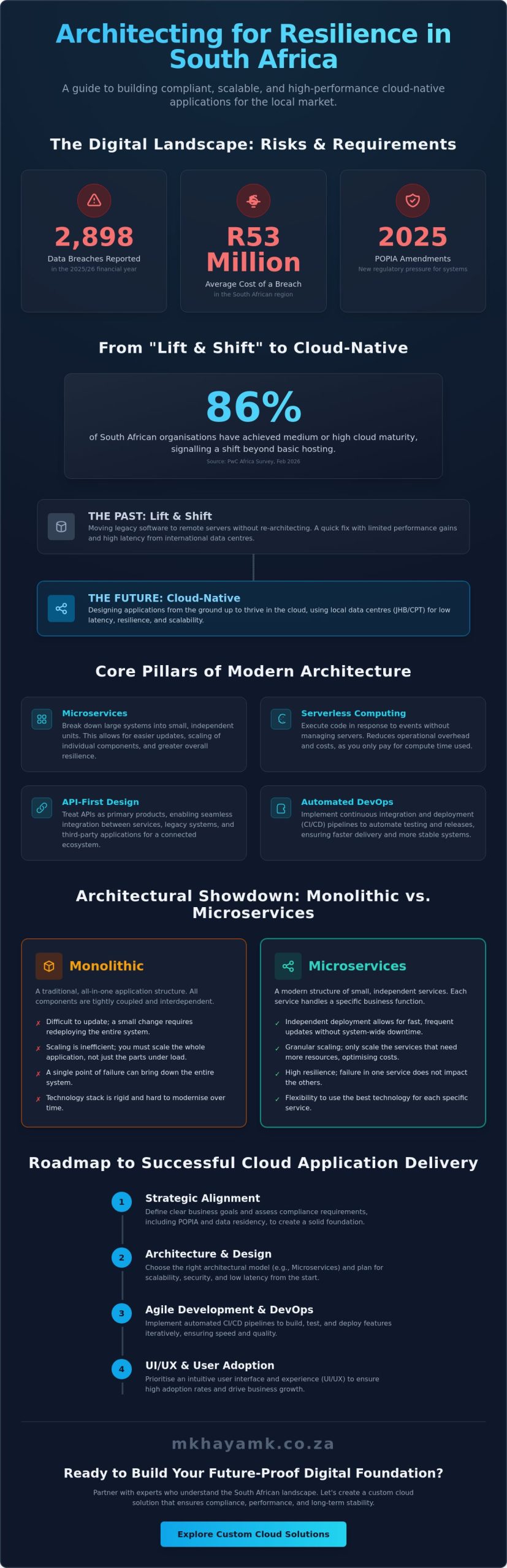
Architecture determines how well your business adapts to change. In the past, monolithic systems were the norm; they were rigid, difficult to update, and isolated from other tools. Modern ERP solutions south africa now embrace a modular, cloud-native approach. This structure allows you to select specific components that fit your unique requirements without carrying the weight of unnecessary features. By utilising APIs, these systems act as a bridge, connecting core enterprise data to custom web and mobile applications that your team actually enjoys using. This connectivity ensures that a sales representative in the field has the same real-time inventory data as the warehouse manager in Durban.
Cloud-First vs. Hybrid ERP Deployments
Choosing the right deployment model is a strategic decision that affects national scalability. Cloud-first models offer the agility needed to expand across provinces rapidly, whilst hybrid models remain a viable choice for organisations processing highly sensitive local data that requires on-premise security. This balance is often seen in large-scale initiatives like the South African Government ERP projects, where data sovereignty is paramount. To maintain these complex environments, our cloud application services leverage DevOps methodologies. This ensures constant uptime and high performance, preventing the costly disruptions that often plague legacy transitions.
Integrating AI and Robotic Process Automation (RPA)
Intelligence is built through the integration of AI and data automation. By embedding RPA into your enterprise workflows, you can automate repetitive data entry and reconciliation tasks that previously consumed hours of manual labour. Mkhaya MK specialises in weaving AI & data automation into existing structures, turning static records into predictive forecasting tools. This isn’t just about speed. It’s about providing executives with real-time analytics that inform high-stakes decisions with precision. When your system can predict a stock shortage or a cash flow dip before it happens, your business gains a massive competitive advantage. This is particularly vital for South African logistics and manufacturing sectors where supply chain volatility requires instant, data-backed responses.
Adoption is the ultimate measure of success. Even the most sophisticated architecture fails if the team finds it difficult to navigate. We prioritise user-centric UI/UX design to ensure that every staff member, from the warehouse to the boardroom, can access the information they need effortlessly. If your current interface feels like a hurdle, you might consider how a refined UI/UX design service could transform your internal engagement. A stable, intuitive system doesn’t just store data; it inspires the confidence your team needs to drive the business forward.
Bespoke Customisation vs. Off-the-Shelf ERP Modules
Deciding between a pre-packaged system and a custom-built environment is a pivotal moment in your digital transformation journey. Many organisations initially gravitate towards off-the-shelf ERP solutions south africa provides because they offer a sense of immediate readiness. However, a “one size fits all” approach often leads to expensive workarounds when the software fails to align with unique local workflows. Industry reports on South Africa’s ERP market growth suggest that whilst standardisation has its place, the most resilient firms are those that prioritise flexibility to meet specific SARS and B-BBEE requirements.
The total cost of ownership (TCO) is another critical factor. Whilst off-the-shelf products might have lower initial entry points, the recurring licensing fees and per-user costs can escalate quickly as you scale. In contrast, investing in custom software engineering allows you to own the intellectual property. This shift from an expense-based model to an asset-based one provides long-term financial stability. At Mkhaya MK, we bridge this gap by tailoring existing platforms with bespoke code, ensuring your system handles niche requirements like a specialised loan management system without the bloat of unnecessary features.
When to Choose Off-the-Shelf Solutions
Pre-built modules are ideal when your requirements are strictly standardised. If your primary goal is to manage a general ledger or standard retail inventory, these systems offer rapid deployment and lower initial costs. They provide a reliable starting point for smaller enterprises that don’t yet require proprietary logic to maintain their market position. It’s a practical choice for businesses that need to get up and running quickly with proven, albeit generic, operational structures.
The Strategic Advantage of Custom ERP Engineering
True competitive edge comes from features that your rivals cannot simply buy off a shelf. Custom engineering allows you to build proprietary workflows that integrate perfectly with existing facility management systems or complex logistics chains. This approach eliminates “vendor lock-in,” giving you the freedom to evolve your ERP solutions as the South African market changes. By focusing on precision and movement, we help you construct a digital environment that isn’t just a tool, but a unique business asset that supports your specific vision for growth.
A Roadmap for Successful ERP Implementation in South Africa
Implementation is a structural evolution, not just a technical switch. Many ERP solutions south africa provides fail because they overlook the unique human and infrastructural realities of the local market. A successful journey starts with a meticulous Discovery Phase. This is where we identify the specific operational bottlenecks that hinder your progress. By understanding these friction points early, you avoid the expensive re-works that often plague generic rollouts. It’s about building a stable anchor for your future growth.
Phase 1: Strategic Alignment and Process Audit
Success requires clarity. Before writing a single line of code, we map your existing workflows to identify areas ripe for digital transformation. This involves deep consultation with stakeholders across your national departments to ensure every voice is heard. We define clear key performance indicators (KPIs) that reflect your specific business goals. This ensures the transition is purposeful and aligned with your long-term vision. It’s a methodical approach that creates a steady sense of momentum from day one.
Phase 2: Development, Integration, and Data Migration
This phase involves the technical heavy lifting of software engineering and cloud migration. Maintaining data integrity whilst moving away from legacy databases is paramount to prevent operational downtime. We prioritise UI/UX design services to ensure the platform remains intuitive for your staff. If your internal team is stretched thin, staff augmentation can provide the specialised engineering talent needed to execute this transition. This allows you to scale your technical capacity without the long-term overhead of permanent hires.
Phase 3: Training, Support, and Continuous Optimisation
Adoption is the final hurdle. We utilise a structured learner management system to ensure your staff are fully equipped to use the new tools. Post-launch, our focus shifts to continuous health checks and the iterative refinement of your automated workflows. By leveraging managed cloud services, we ensure your system remains agile and responsive to market changes. This commitment to mutual success ensures your digital foundation stays strong as your business expands.
Ready to begin your enterprise transformation with a partner you can trust? Contact our team today to schedule your initial discovery session.
Optimising Your Enterprise with Mkhaya MK
Mkhaya MK stands as a visionary partner for organisations ready to lead the next wave of digital evolution. We don’t just sell software; we construct ecosystems that bridge the gap between your current operations and your future ambitions. By integrating custom software development with advanced AI & data automation, we ensure your ERP solutions south africa are as unique as your business model. This synergy allows us to deploy proprietary tools like Optimate for procurement and MkhayaMove for logistics. These aren’t generic modules; they’re refined instruments designed to provide you with a high-end toolkit that drives both movement and long-term stability.
Our approach is rooted in the belief that technology should be an invisible enabler of your success. We invite you to explore the resources and case studies available on our website to see how these integrated systems function in real-world South African environments. Witnessing the transition from fragmented data to a unified, intelligent enterprise often provides the clarity needed to take the first step toward your own transformation.
The Mkhaya MK Difference: Engineering for South Africa
Local expertise is the cornerstone of a reliable partnership. It isn’t just about being in the same time zone; it’s about understanding the nuances of the South African regulatory environment and the specific challenges of our infrastructure. This proximity ensures faster response times and solutions that feel inherently relevant to your daily operations. Whether you require on-site support or specialised remote engineers via staff augmentation, we provide the technical depth required to maintain your competitive edge. Our commitment to integrity and methodical execution means you can trust the stability of your digital foundation as it scales across provinces.
Getting Started on Your Transformation Journey
Your path to a scalable platform begins with a simple, transparent conversation. Engaging for an initial digital transformation consultation allows us to align our expertise with your specific vision. We follow a structured process that moves from identifying your core needs to deploying a platform that supports your long-term growth. This journey is collaborative and purposeful, ensuring that every refinement we make adds tangible value to your bottom line. We’re here to act as a stable anchor whilst you navigate the complexities of modern enterprise management.
The construction of a future-proof enterprise is a significant undertaking that requires a partner invested in your personal journey. If you’re ready to move beyond generic software and build a system that truly reflects your brand’s precision, contact our team today for a bespoke assessment of your requirements.
Secure Your Future with Strategic Enterprise Transformation
Transforming your business in 2026 requires more than a standard software installation. It demands a digital foundation that acts as a central nervous system; one that integrates your financial, operational, and human capital data into a single, intelligent source of truth. We’ve explored how ERP solutions south africa can be tailored to meet local regulatory nuances whilst providing the scalability needed for national growth. By choosing custom-engineered modules over rigid, off-the-shelf packages, you ensure your technology evolves alongside your unique business logic.
Mkhaya MK is here to guide you. We specialise in custom software engineering for South African enterprises and offer a proven track record in digital transformation and AI-driven automation. Whether you need to bridge technical gaps through our flexible staff augmentation models or build a bespoke platform from the ground up, our focus remains on your long-term stability and mutual success. Let’s build a resilient digital legacy together.
What are the most common ERP solutions used in South Africa today?
The South African market features a robust mix of international giants and specialised local players. Common choices include SAP, Oracle NetSuite, and Microsoft Dynamics 365, alongside regional favourites like Sage and SYSPRO. Most national enterprises in 2026 prioritise cloud-first platforms that can handle specific local requirements, such as B-BBEE scorecarding and SARS tax compliance, whilst maintaining the agility to scale across different provinces.
How long does a typical ERP implementation take for a national enterprise?
A successful implementation generally spans between 6 to 18 months, depending on the complexity of your organisation. This timeline accounts for the vital Discovery Phase, data migration from legacy systems, and the customisation of modules to fit your specific workflows. Rushing this process often leads to operational friction, so we focus on a methodical progression that ensures each department is fully aligned before the final deployment.
Is it better to buy an international ERP brand or build a custom solution?
The choice depends on whether your competitive advantage lies in standardised processes or proprietary logic. International brands offer proven frameworks for general accounting, but custom-engineered solutions allow you to own your intellectual property and avoid restrictive licensing fees. Many South African firms now opt for a hybrid approach, where a core platform is enhanced with bespoke modules to handle niche operational requirements.
How does POPIA impact the choice of an ERP system in South Africa?
POPIA makes data sovereignty and lawful processing a non-negotiable legal requirement for any enterprise. Your chosen system must provide robust encryption, clear access controls, and the ability to manage personal information according to strict privacy standards. When evaluating erp solutions south africa, it’s essential to ensure the architecture supports these compliance needs natively, protecting both your customers’ data and your brand’s reputation.
Can an ERP system integrate with my existing custom-built business apps?
Integration is a core strength of modern, API-driven architectures. A well-constructed ERP functions as a central hub that connects seamlessly with your existing facility management or loan systems. This connectivity ensures that data flows freely between specialised applications and your central ledger, eliminating the silos that cause manual entry errors. It allows you to preserve the value of your current tools whilst building a more unified digital foundation.
What is the average cost of ERP software licensing vs. custom development?
Licensing models typically involve recurring per-user fees that can escalate as your workforce grows. Custom development requires an initial investment in the construction of the system, but it eliminates those ongoing subscription costs and provides you with full ownership of the software. Over a five-year period, the total cost of ownership for a custom solution is often more favourable for large-scale enterprises that require high levels of precision.
How can AI and automation be integrated into a legacy ERP system?
You don’t always need a full “rip and replace” strategy to benefit from modern technology. AI-driven automation can be integrated into legacy environments through custom API layers or robotic process automation (RPA). This allows you to introduce predictive forecasting and automated reconciliation into your existing workflows. It’s a practical way to modernise your operations whilst maintaining the stability of the core systems your team already knows.
Why do so many ERP projects fail, and how can we avoid those pitfalls?
Most failures stem from a lack of strategic alignment and poor user adoption. You can avoid these common pitfalls by conducting a thorough process audit and involving stakeholders from every department early in the journey. Success is built on transparency and a structured training programme that empowers your staff. By focusing on the human element alongside the technical build, you create a stable environment where the new system can actually thrive.
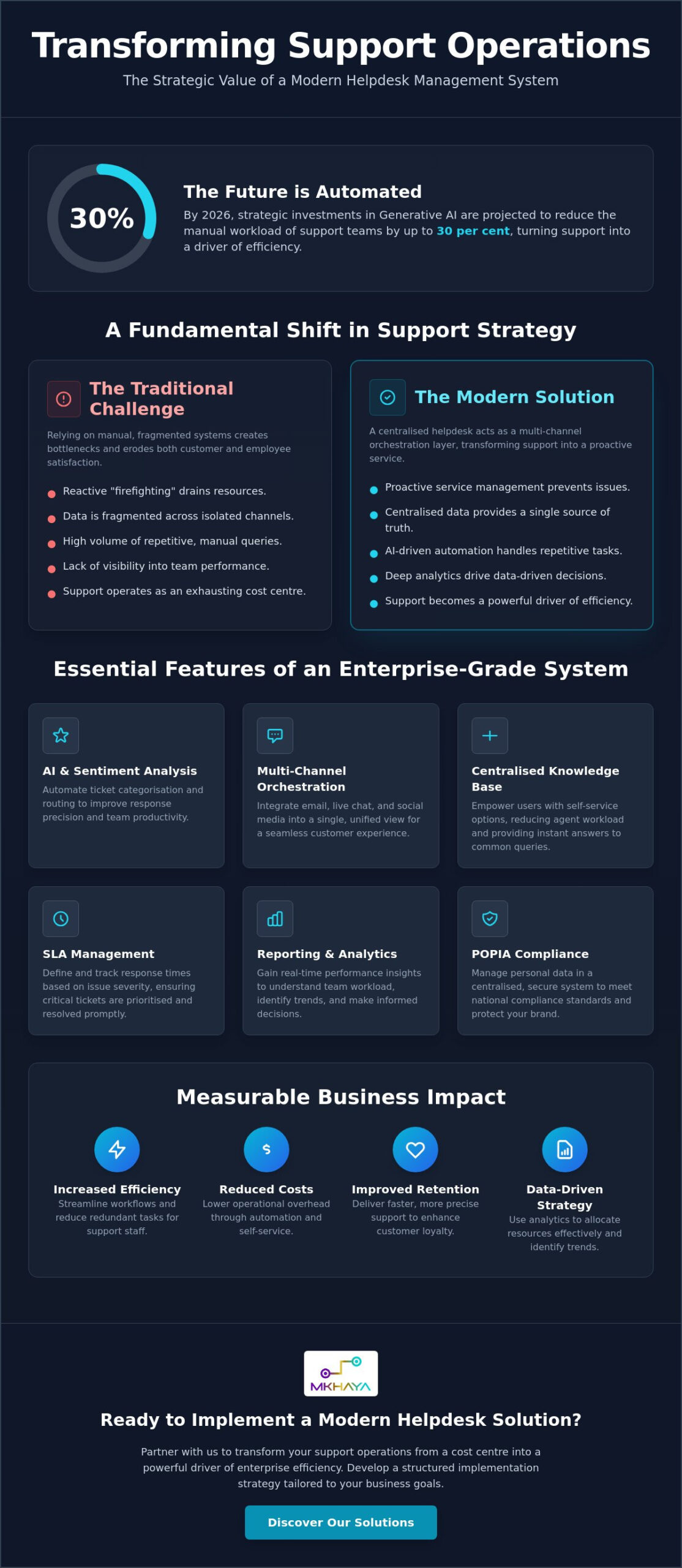
By 2026, strategic investments in Generative AI are projected to reduce the manual workload of support teams by up to 30 per cent. For many South African enterprises, the daily reality still involves managing a high volume of repetitive queries and fragmented data that feels impossible to organise. You likely recognise the frustration of losing visibility into team performance whilst customer information remains scattered across isolated channels. It’s a common challenge that often turns a vital service into an exhausting cost centre.
This guide demonstrates how a modern helpdesk management system can transform those hurdles into a streamlined driver of digital efficiency. By aligning technology with your specific business goals, you can build a support structure that offers both precision and scalability. We will examine the essential features of a helpdesk management system, the impact of recent POPIA enforcement on data handling, and the practical steps to integrate these tools into your existing workflows for measurable success.
Key Takeaways
Learn how to transition from reactive firefighting to a proactive service model by treating your support platform as a multi-channel orchestration layer.
Discover how AI-driven automation and sentiment analysis can refine ticket categorisation to improve response precision and team productivity.
Evaluate the long-term value of a helpdesk management system by comparing the total cost of ownership between custom-built and off-the-shelf solutions.
Develop a structured implementation strategy by auditing current bottlenecks and organising cross-functional teams to define precise system requirements.
Understand how strategic digital transformation converts support operations from a traditional cost centre into a powerful driver of enterprise efficiency.
What is a Helpdesk Management System and Why Does it Matter?
A modern helpdesk management system acts as more than a simple repository for customer complaints. It serves as a sophisticated orchestration layer that synchronises communications across every touchpoint your enterprise maintains. In the past, support teams often operated in a state of reactive firefighting, scrambling to address issues as they flared up. Today, the transition toward proactive service management allows businesses to identify patterns and resolve underlying problems before they escalate into systemic failures.
Relying on manual, email-based support poses a significant risk to South African business continuity. When critical data is trapped in individual inboxes, transparency vanishes and response times suffer. This fragmentation doesn’t just frustrate customers; it erodes employee morale as staff members struggle with redundant tasks and lack the tools to succeed. By centralising these interactions, you create a stable foundation for both customer retention and internal operational excellence.
To better understand how these systems function in a professional environment, watch this helpful video:
The Core Components of Modern Ticketing
Precision in support requires an intelligent structure. A robust helpdesk management system automates ticket routing and prioritisation based on urgency and agent expertise. This ensures that high-priority issues reach the right specialist instantly, reducing the “ping-pong” effect often seen in manual systems. This approach bridges the gap between external customer care and internal employee support, ensuring that your IT Service Management (ITSM) remains as agile as your client-facing departments.
Centralised knowledge bases also empower users through self-service options. This allows them to find answers to common queries without needing direct intervention, which lightens the load on your staff and builds trust through instant resolution. Multi-channel integration brings email, live chat, and social media into a single view. Your team never misses a conversation regardless of where it starts, creating a seamless experience that reflects a modern, professional brand.
Business Impact: Beyond the IT Department
The benefits of a structured support platform extend far beyond technical troubleshooting. These systems provide deep analytics that drive data-driven decision making, helping leadership understand where resources are best allocated. By increasing agent efficiency through AI and data automation, enterprises can significantly reduce operational costs whilst maintaining high service standards. This efficiency isn’t about cutting corners; it’s about refining the customer journey to ensure long-term stability.
These tools are also essential for supporting national compliance. With the Information Regulator intensifying monitoring of the Protection of Personal Information Act (POPIA) as of March 2026, having a centralised, secure way to manage personal data is no longer optional. It’s a fundamental pillar of digital transformation that protects your brand’s reputation. Implementing a reliable system provides a stable anchor in a rapidly changing technological landscape, allowing your business to move forward with quiet confidence.
Essential Features of an Enterprise-Grade System
Choosing a helpdesk management system involves more than comparing tick-box features. It requires a focus on the specific tools that allow your team to operate with precision at scale. For South African enterprises, the challenge isn’t just volume; it’s the complexity of maintaining high standards whilst resources are stretched. A truly enterprise-grade system provides the structural support needed to ensure every customer interaction is handled with professional care.
Customisable Service Level Agreement (SLA) management acts as the engine of accountability within these platforms. By defining and tracking response times based on issue severity, you ensure that critical tickets never languish in a queue. This transparency is bolstered by robust reporting dashboards that offer real-time performance monitoring. Integration with your existing ERP and CRM systems ensures that agents have a 360-degree view of the customer, linking support history directly to business outcomes.
AI and Automation: The New Standard
Robotic Process Automation (RPA) eliminates the burden of repetitive data entry, allowing your specialists to focus on high-value problem solving. AI chatbots complement this by providing immediate first-level support resolution for common queries, ensuring customers receive answers without delay. AI-driven ticketing functions as a predictive service tool that anticipates user needs based on historical data patterns. Integrating these capabilities through AI and data automation ensures your support remains agile and cost-effective.
Security and Collaboration Tools
Role-based access control (RBAC) restricts data visibility to authorised personnel only, which is essential for maintaining POPIA compliance. Beyond security, internal collaboration tools like ‘parent-child’ ticket linking enable teams to break down complex issues without losing the broader context. Internal notes allow agents to share insights privately, ensuring a seamless handover between departments. Audit trails provide a chronological record of every action taken, ensuring total regulatory transparency and long-term stability for your helpdesk management system.
The Strategic Choice: Custom-Built vs. Off-the-Shelf
When to Choose a SaaS Solution
Software-as-a-Service (SaaS) platforms are often ideal for smaller teams with standard support requirements. They allow for faster initial deployment, which is helpful if you need a basic ticketing structure in place immediately. However, users frequently encounter “feature bloat,” where they pay for complex modules that remain untouched. This creates a trade-off between immediate convenience and the long-term customisation needed to maintain a competitive edge. If your requirements are standard and your team is small, the convenience of a subscription might outweigh the need for a bespoke build.
The Power of Custom Software Engineering
When your business requirements exceed the capabilities of generic platforms, custom software engineering provides a path to long-term stability. Building a system that mirrors your exact internal processes ensures that the technology adapts to your team, not the other way around. This approach allows for seamless integration with bespoke legacy applications, creating a unified digital environment that supports sustainable growth. By investing in a tailored helpdesk management system, you eliminate recurring per-user fees and gain a proprietary asset that evolves alongside your enterprise. This level of precision ensures that your support infrastructure remains a stable anchor in a rapidly changing technological landscape.
Planning Your Helpdesk Implementation Strategy
Successful deployment of a helpdesk management system begins long before the first ticket is logged. You must first audit your current support behaviour to identify the primary bottlenecks that slow down resolution times. Are your agents manually re-entering data, or is information frequently lost between departments? By organising a cross-functional team to define system requirements, you ensure that the final solution serves the entire enterprise rather than just the IT desk. This collaborative approach builds internal buy-in and ensures the technology aligns with your broader business goals.
Developing a phased rollout plan is essential to minimise operational disruption whilst your team adapts to new workflows. Instead of a “big bang” launch, introduce the system to specific departments or regions first. This allows you to refine the configuration based on real-world usage and feedback. Establish clear key performance indicators (KPIs) such as First Response Time (FRT) and Customer Satisfaction Score (CSAT) to measure success. These metrics provide the data-driven evidence needed to justify the investment and demonstrate the system’s impact on enterprise efficiency.
Data Migration and Integration
Moving to a new platform offers a rare opportunity to purge outdated or redundant information. Cleaning legacy data before importing it prevents “garbage in, garbage out” scenarios that can undermine your new helpdesk management system. Ensuring secure API connections with existing business tools is equally vital for maintaining a unified workflow across your organisation. This technical alignment is a core component of digital transformation consulting, providing the connectivity needed for long-term scalability and precision.
User Training and Change Management
System adoption hinges entirely on the user experience. Designing an intuitive UI/UX encourages agents to embrace the new tool rather than resisting the change. Comprehensive documentation for both agents and end-users provides a stable reference point that reduces initial anxiety during the transition. Feedback loops play a critical role in continuous system refinement; your agents are on the front lines, and their insights will help you polish the platform over time. This iterative process ensures the system remains a supportive partner in your team’s daily success.
If you are ready to move beyond fragmented support and build a unified service engine, contact our team today to discuss a tailored implementation strategy for your enterprise.
Partnering with Mkhaya MK for National Tech Excellence
Mkhaya MK positions itself as a visionary yet practical guide for enterprises seeking national tech excellence. We understand that a helpdesk management system is more than a tool; it’s a fundamental pillar of your digital journey. Our team provides end-to-end digital transformation that moves from high-level strategic concepts to methodical execution. By focusing on the unique challenges faced by South African businesses, we ensure that your support infrastructure is both resilient and forward-looking. We project a persona of quiet confidence, valuing transparency and precision over flashy claims.
Our expertise in AI and data automation allows us to build smarter support structures that turn raw data into actionable business insights. This national reach ensures that your enterprise receives support tailored to the local landscape, including strict adherence to POPIA requirements and other regional standards. We act as a stable anchor in a rapidly changing technological environment, providing the reliability you need to grow without friction.
Bespoke Solutions for Complex Operations
We design custom applications that scale alongside your growth, ensuring that your infrastructure never becomes a bottleneck. By integrating helpdesk logic into broader ERP solutions, we create a unified ecosystem where support data informs procurement, finance, and operations. This connectivity allows for a 360-degree view of your business health. Our custom AI implementations go beyond simple chatbots; we build intelligent systems that reduce support overhead by predicting user needs and automating complex ticket routing. This level of precision ensures that your helpdesk management system remains a high-performing asset rather than a recurring expense.
Extending Your Team with Expert Talent
Finding the right technical skills shouldn’t be a hurdle to your progress. Through staff augmentation, we provide access to skilled developers who integrate seamlessly with your internal teams. This flexible model allows you to scale your technical capacity as needed without the long-term overhead of permanent hiring. We also provide ongoing maintenance and cloud optimisation to ensure peak performance and stability. Our goal is to act as a supportive partner, offering the guidance you need to navigate complex digital shifts. If you are ready to refine your support operations, contact Mkhaya MK to discuss your custom helpdesk strategy and discover how we can drive your digital efficiency forward.
Empowering Your Enterprise Through Strategic Support
Implementing a modern helpdesk management system is a significant step toward organisational maturity. It moves your team beyond the limitations of manual ticketing and into a space of data-driven precision. By focusing on essential features like AI-driven automation and robust SLA tracking, you ensure your support infrastructure grows as a stable anchor for your business. The choice between custom engineering and off-the-shelf tools depends on your specific business logic and long-term scalability needs.
Mkhaya MK provides the end-to-end digital transformation expertise required to build these sophisticated environments. With our national South African service coverage and specialised focus on AI and custom software engineering, we act as a reliable partner in your technical journey. We value transparency and methodical execution, ensuring that your transition into a high-efficiency support model is both seamless and sustainable.
What is the difference between a helpdesk and a service desk?
A helpdesk primarily handles tactical, end-user technical issues, whereas a service desk manages the entire lifecycle of IT services within an enterprise. While the helpdesk provides quick fixes for immediate problems, the service desk focuses on broader business goals and strategic service delivery. This distinction ensures your team isn’t just reacting to problems but is also supporting long-term operational stability.
Can a helpdesk management system integrate with our existing CRM?
Integration with your existing CRM is entirely possible through secure API connections that synchronise customer data across platforms. This connectivity allows support agents to view purchase history and previous interactions directly within the helpdesk management system. By linking these tools, you eliminate data silos and provide a more personalised, efficient service experience for every client.
How does AI improve the efficiency of a helpdesk?
AI improves efficiency by automating the categorisation and prioritisation of incoming tickets based on urgency and historical patterns. It also powers intelligent chatbots that provide immediate answers to repetitive questions without human intervention. This reduces the manual workload on your staff, allowing them to focus on high-value tasks that require human precision and complex problem-solving.
Is it better to build a custom helpdesk or buy a SaaS subscription?
Choosing between custom-built and SaaS depends on your unique business requirements and long-term growth strategy. SaaS solutions offer rapid deployment for standard workflows, but a custom helpdesk management system provides total control over your business logic. Custom builds also eliminate recurring per-user subscription fees, which often makes them a more stable financial choice as your enterprise scales.
How long does it typically take to implement a new helpdesk system?
Implementation timelines vary based on the complexity of your requirements and the volume of legacy data you need to migrate. A standard cloud-based setup might take several weeks, while a bespoke enterprise solution typically requires three to six months for full deployment. A phased rollout strategy helps manage this transition by minimising disruption to your daily operations.
How do helpdesk systems ensure data security and POPIA compliance?
These systems ensure POPIA compliance by implementing role-based access control and detailed audit trails that track every data interaction. Encryption and secure local data residency further protect sensitive personal information from unauthorised access. These measures provide the transparency and accountability required by the Information Regulator to maintain national standards of data privacy.
What are the most important KPIs to track in a helpdesk system?
The most critical metrics include First Response Time (FRT), Customer Satisfaction Score (CSAT), and the average time to resolution. Tracking these KPIs allows leadership to identify bottlenecks and measure the impact of service improvements over time. Consistent monitoring ensures your support team remains aligned with your enterprise’s broader performance targets and quality standards.
Can we use a helpdesk system for internal IT support only?
Yes, many South African enterprises use these platforms specifically for internal IT Service Management (ITSM) to support their own employees. A dedicated internal system streamlines hardware requests, software troubleshooting, and access management within the organisation. This focus on internal efficiency ensures that your staff has the technical support they need to remain productive without unnecessary delays.
In 2026, the difference between a successful digital transformation and a costly project failure isn’t just your budget; it’s the depth of your partner’s local operational knowledge. As the compulsory VAT registration threshold sits at R2.3 million and new POPIA regulations for health information take effect, the stakes for enterprise software development south africa have never been higher. You’ve likely felt the strain of searching for high-level talent while worrying about data security and the potential for budget overruns.
We understand that you need more than just a vendor. You need a reliable partner that feels like an automated extension of your own business. This guide will show you how to navigate the current outsourcing landscape to find a team that delivers technical excellence and long-term stability. We will explore how to modernise your legacy systems, leverage the 150% R&D tax incentive, and establish predictable delivery cycles that drive your business forward with quiet confidence. By the end of this article, you’ll have a clear, step-by-step framework for choosing a partner that aligns with your strategic vision.
Key Takeaways
Learn how to transition from tactical hiring to building long-term strategic technology partnerships that align with your broader business objectives.
Identify the essential technical and architectural criteria for selecting a partner for enterprise software development south africa to ensure high-quality, scalable results.
Evaluate the benefits of project-based models versus staff augmentation to determine the most flexible engagement structure for your specific requirements.
Understand how to navigate local regulatory requirements like POPIA while building resilient cloud applications tailored to the South African infrastructure.
Discover how custom ERP solutions and proprietary systems can accelerate your journey from basic software engineering to complete digital transformation.
The Strategic Shift: Why Outsource Software Development in South Africa?
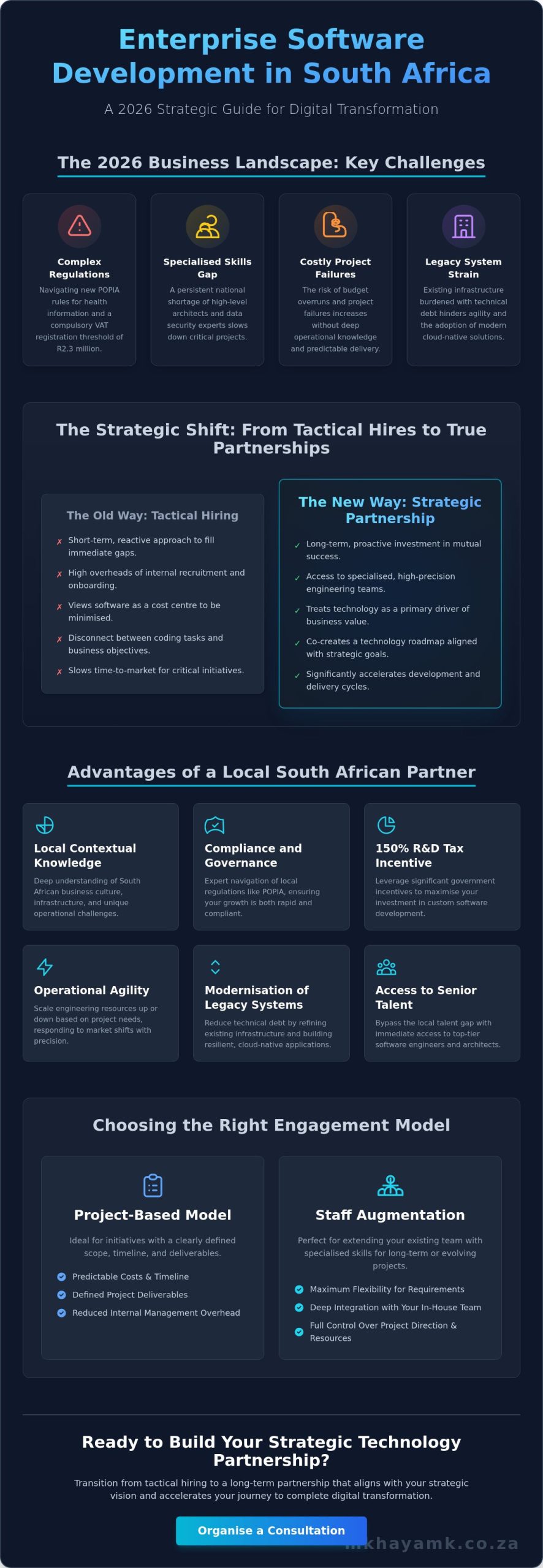
In 2026, enterprise software development south africa represents the construction of the structural backbone for our nation’s leading industries. This year, the focus has shifted from mere experimentation to full-scale digital transformation. Organisations are moving away from tactical, short-term hiring toward strategic technology partnerships that provide long-term stability and refined engineering standards. By choosing to outsource, your business avoids the immense overhead of maintaining massive internal departments whilst gaining the precision of specialised engineering teams. This approach doesn’t just save resources; it significantly accelerates your time-to-market for critical initiatives. The history of Science and technology in South Africa shows a resilient spirit of innovation that local partners carry into every project.
To better understand the current landscape of the tech workforce and the value of local expertise, watch this helpful video:
This shift marks a transition from viewing software as a cost centre to seeing it as a primary driver of value. When you move from tactical hiring to a strategic partnership, you’re investing in a relationship that prioritises mutual success. It’s about more than just clearing a backlog of tickets; it’s about co-creating a roadmap that integrates AI and cloud solutions into your core operations. This collaborative model ensures that every line of code serves a specific business objective, turning your technology stack into a competitive advantage.
Addressing the 2026 Talent Gap in South Africa
The reality of the national market in 2026 is a persistent shortage of specialised skills, particularly in high-level architecture and data security. Outsourcing provides instant access to senior software engineering expertise that might otherwise take months to recruit and onboard. Whilst offshore alternatives exist, a local partner understands the unique nuances of South African business culture and operational challenges. This proximity ensures that your tech team isn’t just a group of coders, but a collaborative extension of your business that shares your commitment to excellence. A local partner also navigates the specific complexities of the South African regulatory environment with greater ease, ensuring that your growth is both rapid and compliant.
The Business Case for Operational Agility
Selection Criteria: What Defines an Enterprise-Grade Development Partner?
Selecting a partner for enterprise software development south africa requires a gaze that penetrates deeper than surface-level testimonials or hourly rates. True enterprise-grade status is defined by a holistic approach to engineering. Architectural design, UI/UX design services, and rigorous quality assurance must intersect seamlessly. You need a partner whose portfolio reflects success in high-stakes environments like financial services or logistics. These sectors demand a level of precision and reliability that smaller firms often struggle to replicate. It’s about finding a team that understands the weight of your operational stability.
Transparency throughout the development lifecycle is non-negotiable for modern businesses. Enterprises require real-time visibility through Agile methodologies and automated DevOps pipelines. This ensures every sprint delivers tangible value whilst minimising the risk of project drift. As South Africa’s Digital Economy Master Plan outlines, the nation is rapidly positioning itself as a hub for high-tech services. This makes it vital to evaluate a partner’s ability to integrate AI and data automation into your existing workflows. If you’re looking for a team that prioritises this level of technical rigour, you can reach out to our specialists for a strategic consultation.
Security and Compliance Frameworks
Security isn’t a secondary consideration; it must be baked into the development culture. An enterprise-grade partner should adhere to international standards such as ISO 27001 or SOC2. The integration of SecOps into the engineering pipeline ensures that vulnerability assessments and encryption protocols are continuous rather than an afterthought. This methodical approach protects your data integrity whilst ensuring compliance with evolving local and international regulations. Verifying a partner’s internal data handling is essential for long-term trust.
Architecture for Scalability
Future-proofing your business requires a partner who builds for the cloud from day one. This involves a commitment to microservices and API-first development. Such structures allow for modular growth and easier integration with third-party systems. Choosing a partner with this level of foresight ensures your software remains agile and resilient as your business scales. For a deeper dive into these technical requirements, consult our enterprise software engineering services south africa reference guide.
Choosing the Right Engagement Model: Project-Based vs. Staff Augmentation
Selecting the right engagement model is a pivotal step in your journey toward technical excellence. It defines the boundaries of responsibility and the rhythm of delivery for enterprise software development south africa. A fixed-scope project model offers a defined destination with predictable costs, making it suitable for initiatives with static requirements. Conversely, monthly staff augmentation provides the fluid capacity needed for evolving roadmaps and rapid pivots. Your organisational state, whether you possess a robust internal tech team or require a full-service partner, will ultimately dictate which model offers the most significant return on investment.
We’ve found that the most successful enterprises often adopt a hybrid approach. This involves using a project-based team to handle the heavy lifting of architectural builds whilst integrating augmented staff to manage internal maintenance or niche feature sets. This blend ensures that your primary goals remain on track without neglecting the day-to-day refinements your systems require. Regardless of the model, clear Service Level Agreements (SLAs) are non-negotiable. They act as the stable anchor for your partnership, ensuring that quality, uptime, and delivery velocity meet your exact standards.
When to Choose Project-Based Development
This model is ideal for greenfield applications where the outcomes are clearly defined from the outset. By outsourcing the entire lifecycle from initial design to final deployment, you manage risk through a single point of accountability. It allows your business to focus on core operations whilst a specialised team handles the technical execution. If you’re planning a comprehensive new build, our guide on custom software development south africa provides a strategic framework for success.
The Power of IT Staff Augmentation
If your internal team is talented but overstretched, staff augmentation allows you to extend your engineering capacity almost instantly. You maintain full control over the product roadmap and internal processes whilst benefiting from the fresh perspectives of remote or on-site professionals. Mkhaya MK’s staff augmentation services are designed for this exact purpose, providing the agility to scale up for critical sprints and scale down once the objective is met. This flexibility ensures that your business remains responsive to market changes without the long-term burden of permanent headcount increases.
The South African Context: Compliance, Connectivity, and Local Expertise
Navigating the specific regulatory and infrastructural nuances of our region is where a local partner truly proves their value. For enterprise software development south africa, this means designing systems that are inherently compliant with the Protection of Personal Information Act (POPIA). It isn’t enough to simply host data locally; the very architecture of your database must reflect these legal requirements. A partner with a national presence facilitates the collaborative workshops necessary to align technical builds with your operational reality. This proximity ensures that your vision isn’t lost in translation across time zones or cultural gaps.
The ‘South African Advantage’ lies in the intersection of world-class engineering talent and a competitive national cost structure. This is a primary reason why enterprise software development south africa continues to grow as a strategic choice for firms seeking high-end engineering. Whilst internet penetration reached 79.6% by late 2025, the reality of varied connectivity speeds remains a factor for many users. Choosing a local expert ensures your platforms are built to handle these specific conditions as well as leveraging national initiatives like the R&D tax incentive. If you’re ready to align your tech stack with local excellence, contact our team today to discuss your roadmap.
Regulatory Compliance as a Feature
Compliance shouldn’t be a hurdle; it should be a built-in feature of your digital ecosystem. Local partners integrate POPIA requirements directly into the database architecture by ensuring:
Automated data handling and disposal procedures.
Strict adherence to the 2026 regulations for health-related personal information.
Optimised data residency through local cloud hosting options.
This methodical approach turns digital transformation into a path for compliant, sustainable operations. It provides an additional layer of security for sensitive information whilst maintaining the transparency your stakeholders expect.
Resilience in Software Engineering
Building for resilience means accounting for local infrastructure challenges from the first line of code. This involves developing for offline-first or low-bandwidth scenarios to ensure your enterprise platforms remain functional regardless of external conditions. Implementing robust DevOps practices further ensures high availability and rapid recovery, aligning with the government’s SA Connect goals for stable broadband access. Local expertise is the best defence against regional operational risks because it anticipates the specific environmental factors that an offshore vendor might overlook. It’s about creating a stable anchor through specialised engineering in a rapidly changing technological landscape.
Partnering for Longevity: The Mkhaya MK Approach to Digital Excellence
At Mkhaya MK, we believe that true excellence in enterprise software development south africa is found in the transition from technical execution to total digital transformation. We don’t view ourselves as a mere vendor; we act as a visionary guide for your unique business journey. Our approach is rooted in the understanding that software should be a stable anchor for your growth. By focusing on methodical execution and transparency, we ensure that every solution we construct is designed for long-term stability and precision. This philosophy allows us to move beyond simple coding to create systems that truly empower your workforce.
Our expertise is reflected in our suite of proprietary systems. We provide robust loan management systems and comprehensive ERP solutions that are customised to meet the specific needs of South African enterprises. These platforms aren’t just tools; they’re refined frameworks that organise complex operations into streamlined, efficient workflows. We also place a high priority on UI/UX design services. This focus ensures that your team finds the new tools intuitive and engaging, which is the only way to achieve the high user adoption rates necessary for a successful digital rollout.
Post-deployment, our commitment remains just as strong. We provide managed cloud solutions and continuous support to ensure your systems remain resilient and agile. This forward-looking ambition seeks to inspire trust, knowing that your technology partner is as invested in your future as you are. We value integrity and methodical execution over flashy claims, providing you with a reliable foundation in a rapidly changing technological landscape.
Beyond the Code: Strategic Consulting
Our strategic consulting services ensure that your technology roadmap aligns perfectly with your actual business revenue drivers. We help you identify opportunities where AI & data automation can optimise existing workflows and eliminate manual friction. By linking specific technical capabilities to practical business benefits, we help non-technical stakeholders see the clear value in every investment. This results-focused approach ensures that your journey toward enterprise software development south africa is both profitable and sustainable.
Your Path Forward with Mkhaya MK
Partnering with a privately held, national technology firm like Mkhaya MK offers a level of stability and commitment that is rare in a fragmented market. Our collaborative process moves you from initial concept to full-scale deployment through a rhythmic, logical progression. Each step is fully articulated and executed with the quiet confidence that comes from years of industry expertise. If you’re ready to begin your transformation, contact Mkhaya MK to discuss your specific enterprise requirements and discover how we can build your future together.
Building Your Digital Future with Confidence
The landscape of 2026 demands more than just code. It requires a strategic alliance that prioritises long-term stability and local operational expertise. By selecting an engagement model that fits your specific needs and ensuring your partner understands the nuances of POPIA compliance, you’re doing more than just launching a project. You’re constructing a resilient foundation for your organisation’s growth. High-quality enterprise software development south africa is about bridging the gap between global engineering standards and the unique challenges of our national infrastructure.
Mkhaya MK stands ready as your end-to-end digital transformation expert. With a national South African footprint and proven proprietary systems for loan and facility management, we help you move from legacy constraints to modernised excellence. We don’t just build software. We architect your digital future through methodical execution and quiet confidence. This approach ensures your technology remains a stable anchor in a rapidly changing world.
What are the main benefits to outsource software development in South Africa?
Outsourcing provides immediate access to high-level engineering talent at a competitive national cost whilst maintaining strong cultural alignment. It allows your business to scale engineering capacity rapidly without the long-term overhead of permanent headcount increases. Local partners also possess a deep understanding of the specific infrastructural challenges and tax incentives like the Section 11D R&D deduction. This ensures your project is both technically sound and financially optimised for the national environment.
How does POPIA affect enterprise software development for local companies?
POPIA requires that data protection is integrated into the software’s architecture through privacy by design principles. This involves implementing strict encryption, automated data disposal, and secure access protocols from the first line of code. For enterprise software development south africa, compliance also means ensuring that cloud hosting or third-party integrations adhere to South African data residency requirements, particularly following the 2026 regulations regarding health-related personal information.
What is the difference between staff augmentation and a dedicated development team?
Staff augmentation involves adding specific professionals to your existing internal team to boost capacity, whereas a dedicated development team operates as a self-contained unit managing the entire project lifecycle. Augmentation is ideal for maintaining direct internal control over the product roadmap. A dedicated team is better suited for complex, end-to-end builds where you want to outsource technical accountability and architectural leadership to a specialised, reliable partner.
How do you ensure code quality when working with an external software engineering partner?
Code quality is ensured through transparent DevOps pipelines, automated testing, and regular peer reviews. An enterprise-grade partner will provide real-time visibility into the development process using Agile methodologies. This ensures that every sprint meets predefined architectural standards and performance benchmarks. By establishing clear Service Level Agreements (SLAs) from the outset, you maintain a high standard of precision and long-term stability for your digital platforms.
Can an external partner help with the migration of legacy enterprise systems to the cloud?
Yes, an external partner provides the specialised expertise needed to refactor or rebuild legacy systems for cloud-native environments. This process involves moving away from monolithic architectures toward microservices, which improves scalability and resilience. A partner can help you navigate this transition methodically. They ensure your data remains secure whilst modernising your infrastructure to support advanced AI integration and real-time data automation for better business results.
What industries in South Africa benefit most from custom enterprise software?
Financial services, logistics, and healthcare sectors benefit most due to their high demand for precision, security, and complex data handling. Custom enterprise software development south africa allows these industries to automate intricate workflows that off-the-shelf solutions cannot support. Whether it’s managing loan applications or coordinating large-scale supply chains, bespoke systems provide the agility needed to compete in a rapidly changing national market whilst ensuring compliance.
How do I manage communication and project timelines with an outsourced team?
Effective management is achieved through a structured rhythm of communication, typically involving daily stand-ups and bi-weekly sprint reviews. Using collaborative project management tools ensures that all stakeholders have a clear view of progress and potential blockers. By choosing a partner with a national presence, you can also facilitate in-person workshops. This helps to build a stronger sense of partnership and ensures that project timelines remain predictable and aligned.
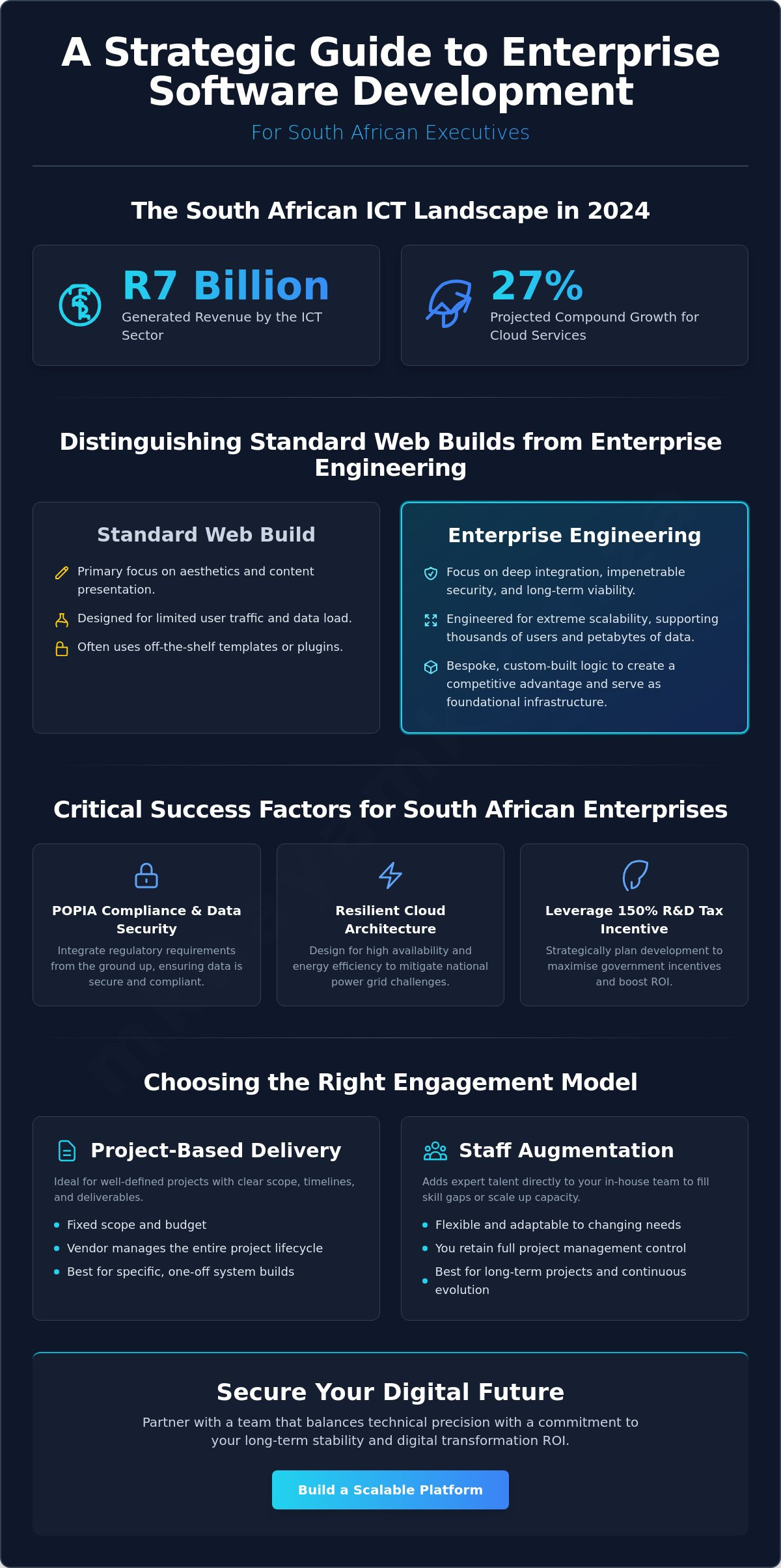
With South Africa’s ICT sector generating R7 billion in revenue in 2024 and cloud services projected to grow at a compound rate of 27%, the pressure to modernise has never been more intense. You likely recognise that your legacy systems are struggling to integrate with modern AI solutions, whilst finding high-level local talent often feels like an uphill battle. Navigating enterprise software development south africa requires more than just technical skill; it demands a partner who understands the delicate balance between global engineering standards and local operational realities.
We understand that your priorities revolve around POPIA compliance, data security, and the looming 30 June 2026 PAIA report deadline. This guide serves as a comprehensive reference for South African executives to evaluate and implement enterprise-grade solutions with quiet confidence. We will examine how to secure a scalable platform, leverage the 150% R&D tax incentive, and choose a partnership model that provides both project delivery and expert staff augmentation to ensure your digital transformation delivers a measurable return on investment. For a deeper look at navigating the outsourcing landscape, our strategic outsourcing guide for enterprise software development in South Africa provides essential context for executives making high-stakes technology decisions in 2026.
Key Takeaways
Understand the fundamental differences between standard web builds and high-load engineering to ensure your systems scale alongside your business ambitions.
Discover how a strategic approach to enterprise software development south africa can resolve legacy integration issues whilst maintaining strict POPIA compliance.
Evaluate the merits of project-based delivery versus staff augmentation to determine which engagement model best suits your specific resource requirements and timelines.
Learn why prioritising UI/UX design and cloud resilience is essential for maintaining operational continuity amongst South Africa’s unique infrastructure challenges.
Gain a clear roadmap for selecting a partner that balances technical precision with a commitment to your long-term stability and digital transformation ROI.
Defining Enterprise Software Engineering Services in South Africa
Enterprise software engineering represents the systematic application of disciplined engineering principles to the creation and maintenance of complex, high-scale business systems. It moves beyond basic coding to focus on structural integrity and long-term viability. When we explore what is software development in a corporate context, we see it involves a rigorous lifecycle designed to support thousands of concurrent users and petabytes of data. This approach ensures that every line of code serves a specific business objective whilst maintaining the flexibility to grow.
Distinguishing standard web development from enterprise-grade engineering is vital for South African executives. While a standard website might prioritise aesthetics, enterprise software development south africa focuses on deep integration, impenetrable security, and extreme scalability. These systems must communicate across disparate departments and legacy architectures without failing under load. They aren’t just tools; they’re the foundational infrastructure of your organisation.
To better understand this concept, watch this helpful video:
Approaching enterprise software development south africa requires an understanding of both global standards and local variables. This includes managing POPIA compliance and designing energy-efficient digital solutions that account for national power grid challenges. Success in this field rests on three core pillars: custom engineering, resilient cloud architecture, and AI-driven automation. By combining these elements, businesses create a stable foundation that remains agile in a changing market.
The Strategic Value of Bespoke Engineering
Off-the-shelf software often presents a “one size fits all” facade that cracks when applied to the specific regulatory and operational demands of South African enterprises. Choosing custom application development for business allows you to build proprietary logic that competitors cannot simply buy. This bespoke approach ensures your software adapts to your unique workflows, rather than forcing your staff to work around the limitations of a rigid third-party tool. It’s about building a digital asset that provides a genuine competitive advantage.
Digital Transformation as a Continuous Process
A common mistake is treating technology as a series of isolated, one-off projects. Successful leaders view digital evolution as a continuous journey that requires reliable software engineering services south africa to maintain system longevity. This long-term commitment ensures that your technology roadmap remains aligned with national business growth objectives. As your needs shift, your software must evolve. This methodical execution prevents technical debt from accumulating and ensures your platform remains a stable anchor for your business operations for years to come.
Core Capabilities of Modern Software Engineering Partners
Selecting a partner for enterprise software development south africa is a strategic decision that directly impacts your long-term stability. It involves finding a team that combines technical depth with a supportive, collaborative mindset. A robust partner doesn’t simply write code; they construct a resilient ecosystem. This includes full-stack development using frameworks like Java, .NET, or Python, which are specifically tailored for high-load environments where performance is non-negotiable. These frameworks provide the structural integrity needed to handle complex business logic and massive data volumes without compromise.
Reliability is born from methodical execution and rigorous Quality Assurance (QA). Automated testing ensures that every update is verified before it reaches your users, facilitating zero-downtime deployments. This level of precision is what distinguishes enterprise engineering from basic web development. Organisations like the State Information Technology Agency (SITA) set high benchmarks for national ICT strategy, and your private infrastructure should mirror that same commitment to excellence. By implementing Continuous Integration and Continuous Deployment (CI/CD) pipelines, your partner ensures that your software remains agile and secure throughout its lifecycle.
UI/UX Design and Digital Engagement
Digital engagement is the heartbeat of modern business operations. If a system is difficult to navigate, it won’t be adopted by your team, regardless of its underlying power. By weaving UI UX design services south africa into the engineering process, you prioritise the people behind the screens. With mobile connections in South Africa reaching 127 million by late 2025, your software must be accessible and performant across diverse network conditions. A well-designed interface reduces training time and improves operational efficiency by making complex tasks feel intuitive. If you’re looking to refine your current user journey, exploring advanced engineering services can provide the clarity your organisation needs.
AI and Data Automation Integration
Turning data into a strategic asset is a requirement for staying competitive. Implementing AI automation solutions south africa allows you to eliminate repetitive tasks that often lead to human error. This shift moves your staff away from manual data entry and toward high-value analysis. By 2026, AI-driven automation optimises legacy enterprise workflows by identifying patterns and automating decisions that previously required manual intervention. This evolution transforms your software from a passive record-keeping tool into an active participant in your business success, ensuring that your data provides clear, actionable intelligence for future growth.
Evaluating Engagement Models: Project-Based vs Staff Augmentation
Choosing the right engagement model is as critical as the technology stack itself. In the context of enterprise software development south africa, your choice reflects your internal capacity and the urgency of your business goals. As South Africa’s digital economy continues to expand, executives must decide whether they need end-to-end accountability or flexible resource scaling. Each model offers distinct advantages that can be tailored to your specific technical debt and future growth plans.
The project-based model provides a structured path for defined deliverables. It’s built on a foundation of fixed timelines and end-to-end responsibility. This approach is particularly effective when you have a clear vision but lack the internal bandwidth to manage the day-to-day engineering lifecycle. It offers a sense of stability, as the partner takes on the risk of delivery and ensures the final system meets every pre-defined requirement. It’s a partnership rooted in transparency and methodical execution.
Conversely, staff augmentation allows you to scale your internal teams quickly with specific technical expertise. This model is ideal for organisations that already have established DevOps cultures but need to plug specific skills gaps. It’s a supportive relationship where external engineers become a natural extension of your own team. This ensures you maintain full control over the creative process whilst benefiting from specialised knowledge that might be difficult to find in the local permanent market.
Many forward-thinking enterprises are now adopting a hybrid approach. This combines outsourced project leadership for high-stakes components with augmented internal teams for ongoing maintenance. This flexibility allows you to manage legacy systems whilst simultaneously pursuing aggressive innovation. It’s a visionary way to balance internal control with the precision of expert external execution, ensuring your digital assets remain stable and modern. Understanding how to structure these outsourcing decisions is explored in detail in our 2026 guide to outsourcing enterprise software development in South Africa, which covers how to avoid budget overruns and establish predictable delivery cycles.
When to Choose Fixed-Scope Projects
Launching a new product requires a rigorous custom web application development south africa process to ensure success. Fixed-scope projects provide the architectural oversight and external QA necessary to maintain global standards. They help you manage budgets and timelines during large-scale digital transformations, ensuring that the final output aligns perfectly with your strategic vision. This model is best when you need a stable anchor for a specific business unit or a new market entry.
Scaling with IT Staff Augmentation
Accessing professional IT staff augmentation services is a practical way to bypass the current local talent shortage. These “plug-and-play” engineers integrate into your existing workflows without the administrative burden of traditional recruitment. You maintain full control over the development process whilst benefiting from the specialised knowledge that modern enterprise software development south africa demands. This agile approach allows you to respond to market changes with quiet confidence and speed.
Critical Success Factors for South African Enterprises
Bridging the gap between legacy systems and modern cloud-native applications is a delicate operation. You shouldn’t have to discard years of valuable data to move forward. Instead, a methodical approach ensures that your new architecture integrates seamlessly with old records, allowing for a smooth transition that protects your historical insights. This prepares your organisation for national-level user growth from day one. By planning for scalability early, you ensure that your platform can handle the 127 million mobile connections active across the country without degrading performance.
Compliance and Data Sovereignty
The Information Regulator’s 30 June 2026 deadline for PAIA reports highlights the increasing urgency of robust data governance. Navigating POPIA requirements is no longer optional; it must be “baked in” to your software architecture. Leveraging local cloud migration services south africa allows you to maintain data residency whilst ensuring high-performance access for your local users. Security audits must be an integral part of the 2026 development lifecycle to ensure that every architectural update remains resilient against evolving cyber threats. This proactive stance protects both your reputation and your clients’ trust.
Modernising Operations with ERP and Specialised Systems
Many organisations struggle with fragmented data silos that prevent a clear view of business health. Implementing ERP solutions south africa helps unify these departments into a single source of truth, which is a key component of modern enterprise software development south africa strategies. Specialised tools like a loan management system south africa or facility management platforms provide the precision needed for niche sectors. These systems must support a mobile workforce, as smartphone usage reached 73% of the population by 2026. Ensuring cross-platform compatibility allows your team to remain productive whether they are in the office or in the field.
If you are ready to secure your digital infrastructure and ensure full compliance, consult with our engineering experts to begin your transformation journey.
Partnering with Mkhaya MK for Scalable Engineering
Choosing a partner for enterprise software development south africa is a decision that impacts your organisation for years. At Mkhaya MK, we approach this responsibility with a persona of “quiet confidence.” This means we value methodical execution and transparency over flashy, unverified claims. We position ourselves as a visionary yet practical guide, ensuring that your digital transformation isn’t just a project, but a stable anchor for your future growth. Our national reach allows us to support you wherever you operate, providing a local perspective that respects the complexities of our domestic infrastructure.
Our commitment to construction and refinement is evident in our proprietary platforms like MkhayaMove and the Optimate procurement platform. These aren’t just software products; they’re examples of how we apply rigorous engineering principles to create long-term stability. When you partner with us, you gain access to this same level of precision. We focus on building systems that are both agile and modern, yet rooted in traditional values of integrity. This ensures that your investment in custom engineering results in a secure, scalable platform that improves your bottom line whilst addressing the specific needs of the South African market.
Our Proven Engineering Process
We follow a structured rhythm to organise our development process, moving from high-level strategic consulting to precise deployment. This ensures every project is fully articulated before we move to the next phase, reducing risk and ensuring alignment with your business goals. For organisations that already have a core team, our staff augmentation offering provides a way to extend your internal capabilities with specialised engineering talent. This collaborative relationship focuses on mutual success and maintains the technical depth required for high-stakes enterprise software development south africa.
Next Steps: Initiating Your Transformation
Your journey toward a scalable and secure platform begins with a technical and business discovery phase. During this time, we seek to understand your unique pain points, from legacy system integration to specific POPIA compliance requirements. This phase isn’t about high-pressure sales; it’s about creating a rhythmic sense of momentum toward a concrete path forward. We provide a detailed explanation of engagement, ensuring you feel confident in the roadmap we build together. If you’re ready to evolve your technology stack with a reliable partner, Contact Mkhaya MK today to discuss your software engineering requirements.
Securing Your Digital Legacy with Methodical Precision
Navigating the complexities of modern business requires a shift from reactive maintenance to visionary, long-term construction. We have explored how the right engagement model, whether project-based or through national staff augmentation, can resolve talent shortages whilst ensuring your systems remain resilient amongst local infrastructure challenges. By prioritising bespoke engineering over rigid, off-the-shelf tools, your organisation gains a proprietary asset that adapts to your unique workflows. It’s about more than just code; it’s about building a stable foundation for sustained growth.
At Mkhaya MK, we provide the end-to-end digital transformation expertise needed to bridge the gap between legacy constraints and future possibilities. Our experience in developing specialised systems for loan and facility management ensures that your specific operational needs are met with absolute precision. Choosing a partner for enterprise software development south africa is about finding a stable anchor that values transparency and mutual success. We invite you to partner with Mkhaya MK for your next enterprise software project and experience a relationship built on quiet confidence and methodical execution. Together, we can build a secure, scalable foundation that inspires trust and drives meaningful ROI for years to come.
Frequently Asked Questions
What are the primary benefits of custom software engineering for South African businesses?
Custom software allows you to build proprietary logic that off-the-shelf tools simply cannot replicate. It ensures your platform adapts to your unique workflows whilst providing a genuine competitive advantage. By focusing on enterprise software development south africa, businesses can better manage local challenges such as power grid instability and specific regulatory requirements. This bespoke approach creates a stable foundation that grows alongside your long-term ambitions.
How does POPIA compliance affect the software development process?
Compliance requires data privacy to be “baked in” to the software architecture from the very first line of code. It involves implementing mandatory consent mechanisms and ensuring high-level security for all personal information. With the Information Regulator’s 30 June 2026 PAIA reporting deadline, these audits have become a critical part of the development lifecycle. This methodical approach protects your reputation and ensures your system remains legally resilient.
Can custom software be integrated with our existing legacy ERP systems?
Yes, custom solutions can be designed to bridge the gap between legacy ERPs and modern cloud-native applications. We use robust API layers and methodical architectural planning to ensure your historical data remains accessible and secure. This prevents the need for a “rip and replace” strategy, allowing you to modernise your operations without losing years of valuable business intelligence. It’s a practical way to evolve your technology stack.
What is the difference between software development and software engineering?
Software development refers to the creative act of building functional applications; software engineering is the systematic application of disciplined engineering principles. Engineering focuses on structural integrity, security, and extreme scalability for high-load environments. While development gets a project running, engineering ensures it remains stable and viable for thousands of concurrent users. It is the difference between building a house and constructing a resilient skyscraper.
How long does a typical enterprise software project take to deploy?
The timeline for a typical enterprise project varies based on complexity and your specific business objectives. Most engagements move through a structured discovery phase followed by methodical construction and refinement. This rhythmic progression ensures that each requirement is fully articulated before deployment. While smaller modules might be ready sooner, comprehensive transformations are designed for long-term stability rather than a sense of high-pressure urgency.
What are the advantages of using staff augmentation over traditional hiring?
Staff augmentation provides immediate access to high-level technical expertise without the administrative burden of traditional recruitment. It allows you to scale your internal teams quickly with “plug-and-play” engineers who integrate into your existing DevOps culture. This model is particularly effective for enterprise software development south africa, where finding local senior talent can be challenging. You maintain full control over the development process whilst benefiting from specialised skills.
How does Mkhaya MK ensure the security of our enterprise data?
We ensure data security by making rigorous audits and privacy-by-design core pillars of our engineering process. Our approach includes leveraging local cloud solutions to maintain data residency and meet POPIA standards. By treating security as a continuous refinement process rather than a one-off task, we provide a stable anchor for your digital assets. This methodical execution builds a relationship of trust and mutual success.
Is cloud migration necessary for all custom software projects in 2026?
While not strictly mandatory, cloud migration is essential for achieving high availability and resilience in South Africa’s current infrastructure. Cloud-native applications are better equipped to handle fluctuating loads and provide the scalability required for national-level growth. By 2026, most organisations view the cloud as a foundational requirement for digital transformation. It ensures your software remains accessible and performant, regardless of the challenges facing the national power grid.
With 2,898 data breaches reported to the Information Regulator during the 2025/26 financial year, the stakes for your digital infrastructure have never been higher. You’re likely aware that successful cloud application development south africa is no longer just about choosing a provider; it’s about architecting for local resilience. You’ve probably felt the frustration of high latency from international servers or the mounting pressure to align your systems with the April 2025 POPIA amendments, especially when the average cost of a single breach in our region has reached R53 million.
We understand these challenges. It’s often difficult to find local developers who truly grasp enterprise-grade DevOps whilst ensuring your data remains secure and accessible. This roadmap provides a clear path forward. You’ll discover how to build cloud-native applications that are compliant, scalable, and tailored to our unique business landscape. We’ll explore how to reduce operational overhead through automation and integrate legacy systems seamlessly, ensuring your technology serves as a stable anchor for your business’s journey into 2026 and beyond.
Key Insights
Understand the transition from basic cloud hosting to sophisticated cloud-native architectures that ensure long-term stability and performance for your enterprise.
Discover how leveraging microservices and serverless computing can reduce operational overhead whilst allowing your systems to scale effortlessly.
Master the complexities of POPIA compliance and data residency to ensure your cloud application development south africa aligns with the latest 2026 regulatory standards.
Evaluate the total cost of ownership between custom builds and SaaS solutions to determine which path provides a unique and sustainable competitive advantage.
Follow a structured delivery roadmap that prioritises strategic alignment and intuitive UI/UX design to drive high user adoption and business growth.
The Evolution of Cloud Application Development in South Africa
The journey of digital adoption in our region has reached a pivotal maturity point. According to a PwC Africa survey in February 2026, 86% of South African organisations have achieved medium or high cloud maturity. This isn’t just a statistic; it represents a fundamental shift in how local leaders perceive technology. We’ve moved past the era where being “cloud-first” was enough. Today, the focus has shifted toward being cloud-native, where applications are designed from the ground up to thrive in a distributed environment. This evolution is driven by the need for greater stability and the reality of local data residency requirements.
For many years, the standard approach was “lift and shift,” which involved moving existing legacy software to remote servers without changing its core structure. Whilst this offered a quick win for infrastructure reduction, it often failed to deliver the performance gains businesses expected. In 2026, the arrival of more robust local cloud regions in Johannesburg and Cape Town has changed the calculation. Low latency is no longer a luxury; it’s a baseline requirement for modern user experiences. Purposeful software engineering now ensures that applications are responsive and resilient, specifically tuned for the South African context.
To understand the professional landscape supporting these shifts, watch this overview of the sector’s growth:
Beyond Hosting: What Cloud-Native Development Really Means
There’s a significant difference between an application that sits “in the cloud” and one that is “built for the cloud.” True cloud application development south africa involves using microservices, containers, and serverless logic to create modular systems. This architecture allows individual components to be updated or scaled without affecting the entire platform. By leveraging the core principles of cloud computing, businesses can ensure their digital tools are not just hosted elsewhere, but are inherently flexible. This level of custom engineering is essential for supporting long-term digital transformation goals, as it prevents the technical debt often associated with rigid, monolithic systems.
The Local Landscape: Why South African Businesses are Scaling
The economic drivers for this shift are clear. Local enterprises are seeking ways to optimise costs whilst improving service delivery in an increasingly competitive market. Modern cloud applications bridge the gap between reliable legacy data and the high-end UX that today’s users demand. Whether it’s through sophisticated cloud solutions or automated workflows, the goal is always to create a more agile organisation. Cloud-native development serves as a catalyst for business agility in South Africa. By focusing on precision and long-term stability, companies can build a digital foundation that grows alongside their ambitions, rather than holding them back.
Core Pillars of Modern Cloud Application Architecture
Successful cloud application development south africa depends on moving beyond simple hosting to embrace a modular, resilient architecture. As the South Africa Cloud Computing Market continues its rapid expansion toward 2034, businesses are discovering that how an application is structured determines its long-term survival. We see four core pillars defining this new era: microservices, serverless computing, API-first design, and automated DevOps pipelines. These elements work in harmony to create systems that are not only powerful but also remarkably easy to maintain.
Microservices vs. Monolithic Builds
Microservices have become the favourite choice for high-growth South African firms because they break down large, monolithic systems into smaller, manageable units. This approach allows your development teams to organise around specific business capabilities rather than technical layers. Whilst this adds some architectural complexity, the reward is the ability to scale individual components of your application independently. This ensures you only expand the parts of the system that are under heavy load, preventing unnecessary expenditure on idle resources. It’s a precise way to build that values long-term stability over quick, rigid fixes.
Hybrid Cloud: The Strategic Middle Ground
Many enterprises aren’t ready for a total migration to the public cloud, often due to legacy requirements or specific data sensitivities. This is where hybrid cloud serves as a strategic middle ground. It allows you to keep sensitive data on-premise whilst leveraging the public cloud for intensive processing or customer-facing interfaces. Managing this balance requires purposeful engineering to ensure low-latency communication between environments. At Mkhaya MK, we often guide partners through these complexities via our digital transformation consulting, ensuring the transition is methodical and secure.
Modern builds also prioritise serverless computing, which reduces operational overhead by charging only for execution time. This efficiency is paired with an API-first design, ensuring your application integrates seamlessly with the broader digital ecosystem. We then implement DevOps and CI/CD practices to automate the journey from code to production. This creates a rhythmic momentum where updates are deployed with confidence and precision. If you’re looking to refine your current setup, exploring our cloud solutions can help you identify the most stable path forward for your business’s unique journey.
Strategic Evaluation: Custom Cloud Development vs. SaaS
The “Competitive Advantage” test is a vital tool for your roadmap: if the application handles a core process that differentiates you from competitors, you should own it. Off-the-shelf software is designed for the average user, meaning it rarely supports the nuanced workflows that make your business successful. By investing in custom builds, you ensure that your intellectual property remains yours, providing a stable foundation for growth. This approach also offers superior control over data sovereignty. Because you control the architecture, you can ensure that sensitive information is managed strictly according to POPIA requirements within our local borders, avoiding the compliance risks often associated with international SaaS providers.
When to Invest in Custom Cloud Engineering
You should consider custom builds for processes that are central to your value proposition. For instance, a generic ERP module might manage your accounting adequately, but a bespoke loan management system can be fine-tuned to your specific risk models and customer journey. Owning the code means you aren’t waiting for a third-party vendor to release a feature that your market demanded months ago. It gives you the agility to pivot and refine your services with precision. This level of customisation ensures that your software acts as a stable anchor, supporting your business as it scales through 2026.
Financial Implications of Cloud-Native Builds
The financial conversation often revolves around the shift from OPEX to CAPEX. Whilst SaaS represents a predictable monthly expense, those costs can spiral as your user base grows. Custom cloud apps eliminate per-user licensing fees over time. This makes the initial development investment a long-term asset rather than a perpetual liability. To manage the upfront costs of building these internal capabilities, many organisations utilise staff augmentation to access high-end expertise without the overhead of permanent hiring. This collaborative model allows you to build resilient systems whilst maintaining financial flexibility, ensuring your technology budget is spent on building value rather than just renting it.
Navigating Local Compliance and Performance Requirements
Building a successful digital platform in our current environment requires more than just functional code. It demands a deep commitment to regulatory integrity and technical excellence. With the Information Regulator reporting 2,898 data breaches during the 2025/26 financial year, the necessity for robust security has never been more apparent. Effective cloud application development south africa now involves integrating privacy and performance into the very fabric of your architecture. This ensures your systems remain resilient against evolving threats whilst delivering the responsive speed your users expect.
POPIA Compliance in Cloud Architectures
Compliance is no longer a checklist to be completed after development; it must be a core design principle. The April 2025 POPIA amendments simplified data subject rights but also heightened the responsibilities of information officers. To meet these standards, your application must employ rigorous encryption both at rest and in transit. We also prioritise sophisticated user consent management and automated data deletion protocols to ensure you stay aligned with the latest health information regulations of March 2026. Understanding how Mkhaya MK’s process integrates these safeguards from the first line of code can help you avoid the R53 million average cost associated with a data breach.
Performance Optimisation for the National Market
Connectivity across South Africa remains varied, which makes latency optimisation a critical focus for any local build. Whilst major providers have established data centres in Johannesburg and Cape Town, reaching users in more remote areas requires strategic engineering. We utilise several key techniques to ensure a snappy experience:
Content Delivery Networks (CDNs): Distributing content closer to the user to reduce load times significantly.
Intelligent Caching: Storing frequently accessed data locally to minimise repetitive server requests.
Adaptive Features: Balancing high-end functionality with the practical realities of local bandwidth.
By managing where your data lives within South African borders, you satisfy both residency requirements and performance needs. This methodical approach creates a stable anchor for your digital presence, ensuring your application remains accessible regardless of the user’s location. If you’re ready to build a system that is both secure and high-performing, we invite you to explore our custom software development services to see how we can partner for your long-term success.
The Roadmap to Successful Cloud Application Delivery
Moving from a strategic concept to a live digital environment requires a structured, rhythmic approach. Successful cloud application development south africa is rarely the result of chance; it’s the outcome of meticulous planning and collaborative execution. This final stage of the roadmap focuses on turning your vision into a high-performing reality whilst ensuring the system remains agile enough to adapt to future market shifts. By following a methodical path, you can minimise risk and maximise the return on your technological investment.
The Discovery Phase: Setting the Foundation
Before writing a single line of code, we focus on the discovery phase to align your cloud capabilities with business objectives. This involves identifying key stakeholders and user personas to ensure the final product solves specific, real-world problems. We work together to define a Minimum Viable Product (MVP), which allows you to deploy core functions quickly and gather essential user feedback. Mapping out integration requirements for your existing ERP or CRM systems at this stage prevents technical friction later, ensuring your new application isn’t an isolated silo but a functional part of a unified ecosystem. For organisations simultaneously planning a platform move, understanding the full scope of cloud migration services in South Africa can help you align your application development timeline with your broader infrastructure transition.
Partnering for Success: How Mkhaya MK Delivers
We believe in a persona of quiet confidence that values transparency and methodical execution over flashy claims. By leveraging our cloud solutions, you can drive significant operational efficiency and reduce the complexity of your digital estate. Our approach to software engineering is rooted in building future-proof platforms that are both resilient and scalable. We remain deeply invested in your journey, providing the technical expertise and supportive partnership needed to navigate the evolving technological landscape of 2026 with certainty and precision.
Architecting Your Digital Future with Precision
The transition toward cloud-native architecture represents a definitive shift in how local enterprises maintain their competitive edge. By prioritising resilience and purposeful design, you ensure that your systems aren’t just hosted in the cloud but are built to thrive within it. We’ve explored how navigating POPIA compliance and optimising for local latency are no longer optional hurdles but essential pillars of long-term stability. Embracing cloud application development south africa allows your business to move with agility whilst maintaining a secure, stable anchor for your data and operations.
Success in this rapidly evolving landscape requires a partner who values integrity and methodical execution. Mkhaya MK brings end-to-end digital transformation expertise and specialised proprietary products, such as Optimate and MkhayaMove, to every engagement. Our national reach and commitment to quiet confidence ensure that your project is handled with the precision it deserves. Whether you’re breaking down a monolith or building a new platform from the ground up, we’re here to guide your journey. Partner with Mkhaya MK for your next cloud project and let’s build a resilient, scalable future together.
Frequently Asked Questions
How does cloud application development differ from traditional software development?
Cloud-native development focuses on creating modular applications using microservices and containers, whilst traditional development typically results in rigid, monolithic structures. This modern approach allows individual components to be updated or scaled independently. It ensures your system remains agile and far easier to maintain as your business requirements evolve over time.
Is my data safe in the cloud under South African law (POPIA)?
Your data is secure if your architecture incorporates POPIA-by-design principles, such as encryption at rest and local data residency. Following the April 2025 POPIA amendments, it’s essential to utilise local data centres in Johannesburg or Cape Town. This ensures your cloud application development south africa remains fully compliant with national privacy standards and avoids the risks of international data transfers.
What is the average timeline for developing a custom cloud application?
A typical timeline for a Minimum Viable Product (MVP) usually ranges from three to six months, depending on the complexity of your requirements. This iterative process allows you to launch core functionality quickly. It provides a stable foundation that can be refined through subsequent development cycles based on actual user feedback and business performance.
Can I integrate my existing legacy software with a new cloud application?
Yes, you can bridge the gap between old and new systems using secure APIs or hybrid cloud architectures. This method allows your business to retain the value of legacy data whilst enjoying the enhanced performance of a modern cloud platform. It creates a rhythmic transition that protects your previous investments whilst moving your operations forward.
What are the main costs involved in cloud application development?
The primary costs include the initial software engineering, cloud infrastructure hosting fees, and ongoing maintenance. Investing in custom cloud application development south africa often proves more cost-effective over the long term. It eliminates the expensive per-user licensing fees associated with many off-the-shelf SaaS products, turning your technology into a permanent business asset.
Do I need an in-house team to manage a cloud application after launch?
Modern builds also prioritise serverless computing, which reduces operational overhead by charging only for execution time. Many organisations complement their internal teams by engaging specialist cloud migration services in South Africa to handle complex infrastructure transitions and ongoing platform management without the cost of permanent specialist hires.
What happens to my cloud application if my internet connection is unstable?
Modern applications often use “offline-first” designs or intelligent local caching to ensure users can continue their work during temporary connectivity issues. Once the connection is restored, the application synchronises any changes with the central cloud server. This ensures data integrity and a seamless experience, even in areas where local connectivity might fluctuate.
How do I choose between AWS, Azure, and Google Cloud for my South African business?
The best choice depends on your current technical ecosystem and specific business goals. Azure is often the favourite for organisations heavily invested in Microsoft tools, whilst AWS offers a vast array of services for bespoke custom engineering. Both providers have established local regions in Johannesburg and Cape Town to ensure the lowest possible latency for your South African users.