Did you know that inefficient contract management can cost your business up to 9% of its annual turnover? In the complex South African market of 2026, relying on manual spreadsheets and fragmented emails isn’t just a nuisance; it’s a significant financial risk. Implementing a dedicated contract management system south africa has become essential for navigating the 2026 clarifications on POPIA and the evolving Public Procurement Act regulations. You’re likely familiar with the stress of a missed renewal date or the frustration of finding inconsistent contract versions across different departments.
We believe that your legal and operational workflows should support your growth, not hinder it. This guide will show you how to transform these operational hurdles into a competitive advantage through tailored digital transformation. We’ll explore how a centralised digital repository and automated alerts can safeguard your compliance whilst ensuring your workflows integrate seamlessly with your existing ERP and finance tools. It’s time to move toward a future of precision and long-term stability as we walk through the steps to modernise your contract lifecycle.
Key Takeaways
Understand how a modern contract management system south africa acts as a strategic engine to prevent the costly errors and value leakage associated with manual procurement.
Discover how AI-driven analytics and automated templates can streamline your approval processes whilst maintaining strict legal consistency across all departments.
Learn to evaluate the total cost of ownership to determine when a bespoke software engineering approach offers better long-term stability than off-the-shelf tools.
Navigate the latest complexities of POPIA and data sovereignty to ensure your digital repository remains fully compliant with the 2026 South African regulatory landscape.
Explore how to bridge internal technical gaps and accelerate your digital transformation by leveraging specialised staff augmentation during system implementation.
Why Your South African Business Needs a Contract Management System in 2026
A modern contract management system south africa is far more than a digital filing cabinet. It’s a strategic business engine designed to drive efficiency and precision across your entire operation. In a market where agility is a competitive necessity, your contracts should be viewed as active assets that dictate the health of your commercial relationships. When these documents are buried in physical folders or scattered across local hard drives, they become liabilities rather than tools for growth.
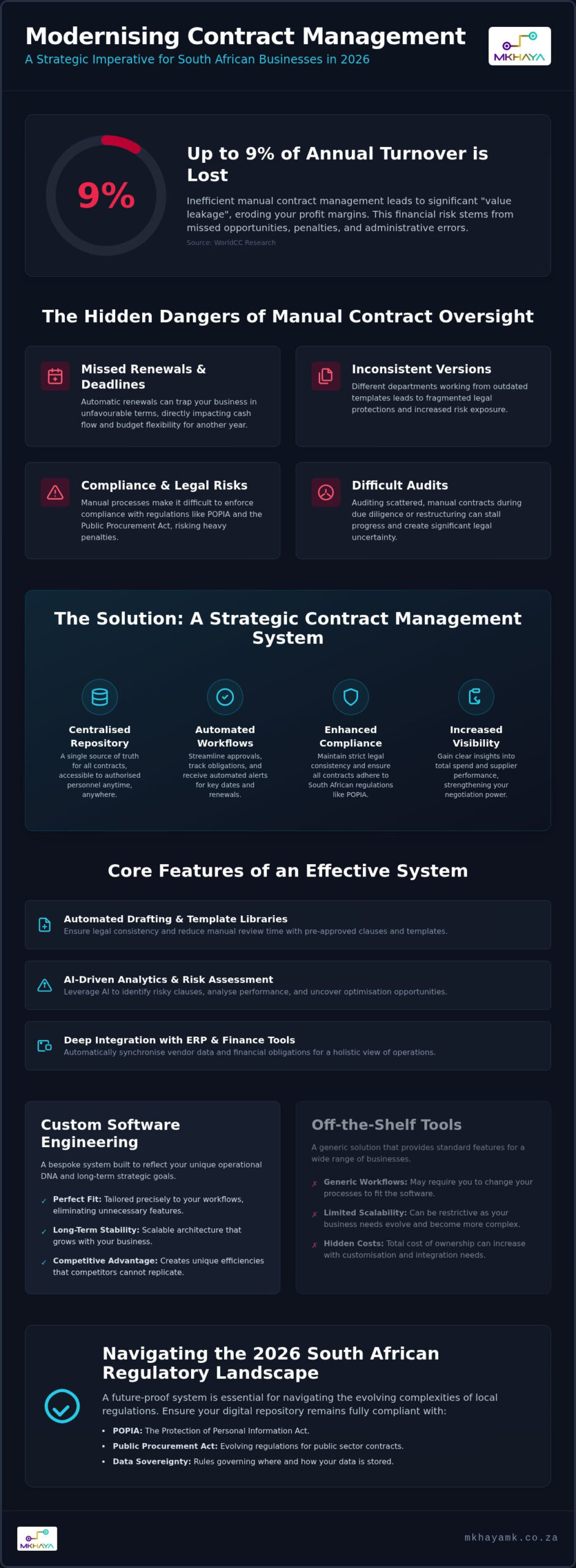
Relying on spreadsheets often leads to what industry experts call value leakage. Research from WorldCC indicates that inefficient processes can result in a loss of up to 9% of a business’s annual turnover. For South African procurement teams, these manual errors translate into missed rebates, unoptimised supplier terms, and heightened risk. By transitioning from a reactive stance to proactive contract lifecycle management, you empower your organisation to anticipate shifts rather than merely responding to them. This shift frees up your legal and finance resources to focus on high-value strategy whilst automation handles the repetitive administrative tasks.
To better understand how these systems function within a professional environment, watch this helpful overview:
The Hidden Risks of Manual Contract Oversight
Manual oversight often hides significant dangers that can quietly erode your profit margins. Missing an auto-renewal deadline can trap your business in unfavourable terms for another year, directly impacting your cash flow and budget flexibility. In multi-departmental organisations, version control becomes a nightmare when different teams work from outdated templates, leading to inconsistent legal protections. If your business undergoes corporate restructuring, the difficulty of auditing manual contracts can stall progress and create significant legal uncertainty during due diligence.
The Strategic Advantage of Digital Transformation
The true value lies in a broader digital transformation that centralises your data into a single source of truth. When your information is organised and accessible, your negotiation power with suppliers increases because you have clear visibility into total spend and performance metrics. This level of internal transparency fosters a culture of accountability across the business. By adhering to core contract management principles through a digital lens, you ensure that every agreement aligns with your long-term stability and growth objectives. Choosing a partner for bespoke software engineering allows you to build a system that reflects your unique operational DNA rather than settling for a generic, off-the-shelf solution.
Core Features of an Effective Contract Management System
An effective contract management system south africa must do more than simply store documents. It should act as a dynamic hub that facilitates every stage of the agreement process, from the first draft to the final signature and beyond. Consistency is the foundation of legal safety. By utilising automated drafting and template libraries, your legal team can ensure that every agreement adheres to pre-approved language, which significantly reduces the time spent on manual reviews. This level of standardisation prevents departments from inadvertently introducing risk through non-standard clauses.
A robust system must also bridge the gap between different departments. Rather than existing in a vacuum, it should offer deep integration with your existing ERP solutions. This connectivity allows for the automatic synchronisation of vendor data and financial obligations, highlighting the strategic benefits of a CMS that communicates with the rest of your enterprise software stack. For South African firms operating with hybrid or remote teams, cloud-based accessibility ensures that authorised personnel can review and approve documents from any location without compromising security.
AI and Automation in Contract Lifecycle Management
Modern systems leverage AI and data automation to transform how teams interact with their archives. Instead of manual data entry, these tools can instantly extract key terms, indemnity clauses, and renewal dates from legacy documents. Automated workflows then route these contracts to the correct signatories whilst maintaining a transparent audit trail. Smart notifications keep your team informed of upcoming milestones and obligations, ensuring that no deadline ever goes unnoticed. If you’re ready to move away from fragmented processes, our team can help you design a bespoke software solution tailored to these exact requirements.
The Role of User Experience in System Adoption
Technical capability means little if your team finds the software difficult to use. This is why high-quality UI/UX design is a non-negotiable feature for successful adoption. A mobile-first interface allows executives to provide approvals on the move, preventing bottlenecks in the procurement cycle. Customisable dashboards provide a real-time view of contract health, displaying pending actions and risk profiles in an accessible format. When the interface feels intuitive, employee buy-in increases, leading to more consistent data entry and more reliable reporting across the entire organisation.
Custom vs. Off-the-Shelf: Choosing the Right Fit for South Africa
Building on the core features discussed earlier, choosing the right architecture for your contract management system south africa requires a careful balance between immediate needs and long-term stability. Many enterprises face a fork in the road: do they invest in a pre-built global platform or commission a bespoke solution? Whilst off-the-shelf software promises rapid deployment, it often brings hidden complexities that can inflate the total cost of ownership (TCO) over time.
When evaluating TCO, you should consider:
Initial implementation and customisation fees.
Ongoing per-user subscription costs that scale with your headcount.
Internal training and change management resources required for adoption.
The potential cost of downtime during complex integrations.
The Case for Bespoke Software Engineering
A software engineering approach allows you to build a system that mirrors your exact internal approval hierarchies. In South Africa, where procurement often involves complex multi-level sign-offs, a tailored workflow is invaluable. Commissioning a custom build also means you own the intellectual property; this eliminates the burden of per-user monthly licensing fees as your organisation grows. Additionally, custom systems can be designed to interface directly with niche local legacy systems that global SaaS providers might not support.
Evaluating Off-the-Shelf Solutions
Pre-packaged solutions are often the primary choice when speed of deployment is the main driver. If your business needs a basic digital repository within weeks, a global platform might suffice. However, these tools frequently suffer from feature bloat, where you pay for complex modules that your team will never use. There is also the risk of vendor lock-in with international providers. If their pricing structures change or their local support diminishes, migrating your data can become a costly and technically exhausting ordeal.
Scalability should be at the heart of your decision. Your system must be capable of growing alongside your national ambitions without requiring a complete overhaul every few years. A custom-built contract management system south africa provides the flexibility to add new modules, such as automated compliance tracking for the Public Procurement Act, as regulations evolve. By prioritising a solution that adapts to your unique journey, you ensure that your technology remains a stable anchor in a rapidly changing market.
Navigating Compliance: POPIA and Legal Standards in South Africa
Integrating a contract management system south africa isn’t just an exercise in operational efficiency; it’s a critical component of your legal survival strategy. As of April 2026, the Information Regulator has clarified that the Protection of Personal Information Act (POPIA) remains a mandatory standalone requirement, even alongside new anti-spam rules in the Consumer Protection Act. This means every contract containing personal data, from employee agreements to vendor terms, must be managed with absolute precision. Where your data lives matters more than ever. Whilst global SaaS providers often host data in the US or Europe, local data sovereignty ensures your records remain within South African jurisdiction, significantly simplifying your compliance reporting.
Beyond data residency, the legal validity of your agreements hinges on your adherence to the Electronic Communications and Transactions (ECT) Act. Digital signatures are the standard for 2026, but a system must do more than just facilitate a “click to sign.” It must maintain a tamper-proof audit trail that logs every view, edit, and signature. This level of transparency provides undeniable proof during regulatory inspections or internal audits, protecting your business from the “he-said-she-said” nature of manual disputes. By building these protections into your digital foundation, you transform compliance from a burden into a mark of professional integrity.
Securing Sensitive Contract Data
Internal threats often pose as much risk as external ones. Implementing role-based access controls ensures that sensitive financial terms or personal data are only visible to authorised personnel. Encryption is non-negotiable; your contracts must be protected whilst in transit and at rest. Regular security audits, supported by robust cloud solutions, provide the necessary layers of defence to prevent data breaches. These systems allow you to detect anomalies early, ensuring that your most valuable intellectual property remains secure within a fortified digital environment.
POPIA Compliance Checklist for Contract Systems
Your system should be designed with the following South African legal requirements in mind:
Data minimisation: Ensure your contract records only capture and store the personal information strictly necessary for the agreement’s purpose.
Right to erasure: Your digital archive must support the “right to be forgotten,” allowing for the secure deletion of records once legal retention periods expire.
Breach reporting: In the event of a security compromise, your system must facilitate the rapid identification of affected parties to meet mandatory reporting deadlines.
Transitioning from manual chaos to automated precision is a significant journey for any organisation. It requires more than just software; it demands a partner who understands the local nuances of doing business in our specific regulatory environment. At Mkhaya MK, we view the implementation of a contract management system south africa as a collaborative endeavour rooted in mutual success. Our goal is to build a foundation of long-term stability that allows your team to focus on strategic growth rather than administrative firefighting. By choosing a local partner, you ensure that your system is built with an intimate knowledge of South African labour laws and procurement standards.
We pride ourselves on being a visionary yet practical guide. We don’t just hand over a tool and walk away; we invest in your personal journey. This means ensuring that every stakeholder, from the legal department to the finance team, feels supported throughout the transition. Our quiet confidence comes from a track record of methodical execution and a commitment to transparency that builds lasting trust.
Our End-to-End Digital Transformation Approach
Our approach to digital transformation is comprehensive and methodical. It begins with a discovery phase where we map your existing contract workflows in detail. We look for the friction points that cause delays, such as unclear sign-off paths or fragmented storage. During development and testing, we build a solution that mirrors your internal logic. We prioritise user experience to ensure that the system feels like a natural extension of your team’s daily tasks. This isn’t a “set and forget” service. We provide continuous support and system evolution, ensuring your technology scales alongside your national ambitions.
Extending Your Team with Expert Talent
A common gap in digital transformation is the lack of internal technical capacity to manage new systems. You might have the vision, but your current team may be stretched thin. This is why staff augmentation is a core part of our offering. It allows you to bridge the technical gap by accessing senior developers and data analysts who understand the complexities of modern CMS architecture. You get the expertise you need without the long-term overhead or recruitment delays.
These experts work alongside your staff to optimise the platform, ensuring your contract management system south africa remains a high-performing asset. They provide the precision needed to maintain data integrity and security in an increasingly complex digital landscape. If you’re ready to take the next step in your digital journey, organise a consultation with Mkhaya MK today. We’re here to help you move from manual uncertainty to digital precision with absolute confidence.
Securing Your Competitive Edge through Digital Precision
Transforming your legal and operational workflows is no longer a luxury; it’s a fundamental requirement for navigating the 2026 South African business landscape. We’ve seen how a dedicated contract management system south africa can protect your turnover from value leakage whilst ensuring strict compliance with POPIA and the ECT Act. By moving away from fragmented manual processes, you create a centralised repository that serves as a stable anchor for your national growth. This shift doesn’t just reduce risk; it empowers your team to make data-driven decisions with absolute clarity.
Our team brings deep expertise in South African compliance and a proven track record in digital transformation to every partnership. We specialise in custom software designed for national scalability, ensuring your technology evolves as your ambitions expand. Whether you need to bridge a technical gap through staff augmentation or build a bespoke platform from the ground up, we’re here to guide you with quiet confidence and methodical execution. We believe in building solutions that reflect your unique operational DNA.
Don’t let manual chaos hold your business back from its full potential. Partner with Mkhaya MK for Bespoke Contract Automation and start your journey toward automated precision today. We look forward to building a successful and stable future together.
Frequently Asked Questions
What is the best contract management system for South African businesses?
The best system is one that aligns perfectly with your specific internal workflows and the local regulatory environment. Whilst global SaaS platforms are available, many South African enterprises find that a bespoke solution offers superior flexibility for multi-level procurement sign-offs. A tailored system ensures that your data residency and compliance requirements are met without the burden of unnecessary global features.
How does POPIA affect digital contract management in 2026?
POPIA mandates that any contract containing personal information must be handled with strict data minimisation and purpose specification. In 2026, the Information Regulator clarified that these requirements are standalone and mandatory. Your system must support the right to erasure and provide secure, encrypted storage to prevent unauthorised access to sensitive party details during the contract lifecycle.
Can I integrate my contract system with my existing ERP software?
Yes, a robust contract management system south africa should integrate seamlessly with your existing ERP and finance tools. This connectivity allows for the automatic synchronisation of vendor data and payment milestones. By breaking down data silos, you ensure that your contractual obligations are always reflected in your real-time financial reporting and procurement cycles.
Are digital signatures legally binding for contracts in South Africa?
Digital signatures are fully recognised and legally binding under the Electronic Communications and Transactions (ECT) Act. To ensure validity, your system must maintain a tamper-proof audit trail that logs every signature and document edit. This provides the necessary evidence of integrity and authenticity required to protect your business during regulatory inspections or legal disputes.
How long does it take to implement a custom contract management system?
The implementation timeline typically depends on the complexity of your existing archives and approval hierarchies. A phased roll-out generally takes between three to six months to complete. This period covers everything from the initial discovery and workflow mapping to custom development, rigorous testing, and final staff training to ensure a smooth transition.
What is the difference between a contract repository and a CLM system?
A contract repository is essentially a static digital filing cabinet used for storing completed documents. In contrast, a Contract Lifecycle Management (CLM) system is an active tool that manages the entire process from initial drafting to final renewal. CLM systems provide automated alerts, version control, and AI-driven analytics to help you extract maximum strategic value from every agreement.
Is cloud storage or on-site storage better for contract data in South Africa?
Cloud storage is often the preferred choice for modern firms because it supports remote accessibility and scales effortlessly as you grow. When using a contract management system south africa, it’s essential to prioritise cloud providers with local data centres. This ensures your sensitive information stays within national borders, which simplifies your path to POPIA compliance and data sovereignty.
How much can a business save by automating contract management?
Automating your processes can prevent “value leakage,” which research from WorldCC suggests can cost a business up to 9% of its annual turnover. By eliminating manual errors and preventing missed renewal dates, you protect your profit margins. Automation also frees up your legal and finance teams to focus on high-value strategic tasks rather than repetitive administrative oversight.
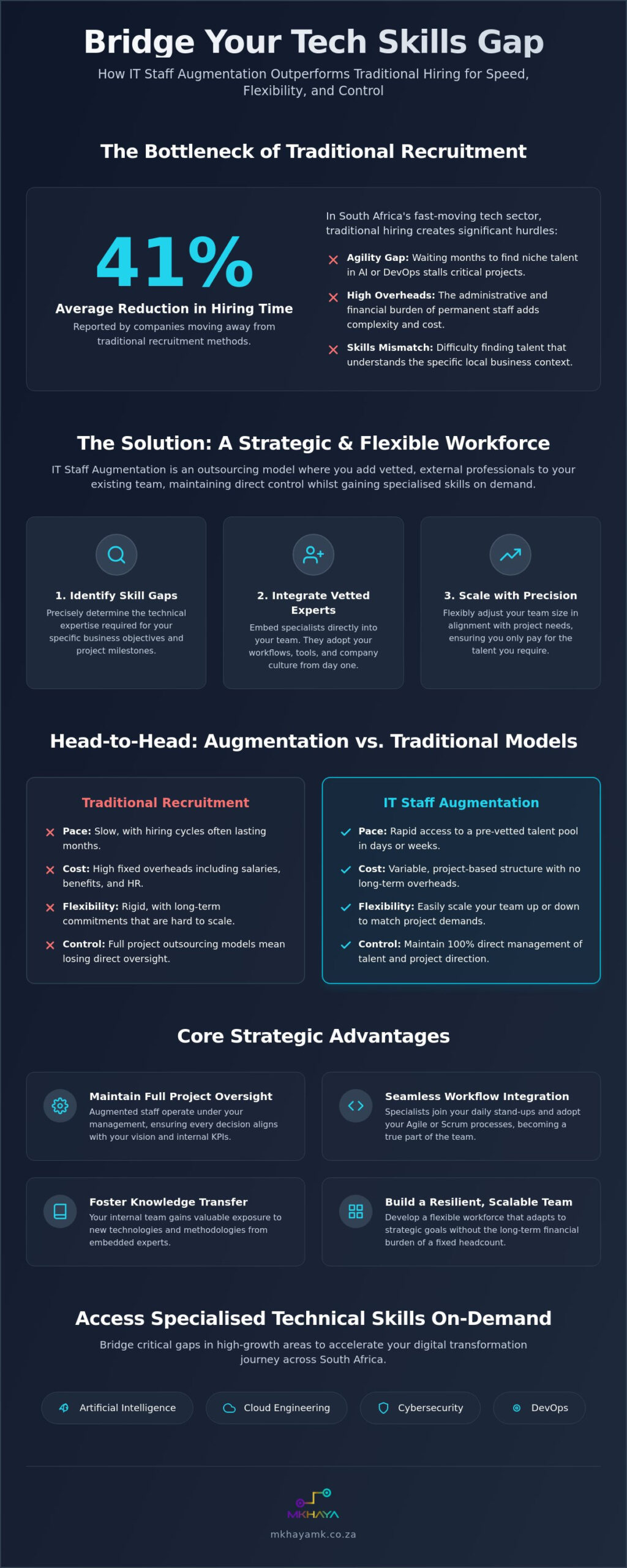
Did you know that companies report an average 41% reduction in hiring cycle times when they move away from traditional recruitment? In the fast-moving South African tech sector, waiting months to find a senior developer with niche AI or DevOps expertise isn’t just a frustration; it’s a bottleneck that stalls your digital transformation. You’ve likely felt the weight of high permanent overheads and the struggle to find talent that truly understands your local business context. By integrating high-calibre IT staff augmentation services, you can bypass these hurdles and secure the precision skills your project demands.
We understand that building a tech team requires more than just filling seats. It’s about finding a reliable partner who values your long-term stability as much as you do. This guide offers a strategic look at how to bridge technical skill gaps and accelerate growth through tailored staffing models. We’ll explore how to access specialised skills, manage flexible cost structures that align with your budget, and build a resilient tech team that scales alongside your ambitions throughout 2026.
Key Takeaways
Understand how IT staff augmentation services differ from traditional hiring to provide the agility needed for rapid, sustainable scaling.
Discover how to maintain full project oversight whilst integrating external talent directly into your existing Agile and Scrum workflows.
Learn to map your strategic business objectives to specialised technical roles in AI, Cloud, and Cybersecurity for more precise project outcomes.
Master the management techniques needed to foster a unified culture, ensuring augmented staff align perfectly with your internal KPIs and vision.
Explore the benefits of partnering with a provider that offers national reach and vetted expertise to support your digital transformation journey across South Africa.
Defining IT Staff Augmentation Services in the Modern Enterprise
In the 2026 South African tech landscape, agility is a survival mechanism. As digital transformation accelerates, the traditional recruitment model often feels like an anchor. This is where IT staff augmentation services come into play. This strategic outsourcing model allows you to add external talent to your existing team on a temporary basis. It differs from full-project outsourcing because you maintain direct control over the work and the individuals. Unlike permanent recruitment, it provides a flexible bridge that scales as project demands shift.
The model represents a fundamental shift toward a “flexible workforce” where stability is built through access to talent rather than just headcount. For many leaders, this approach fosters a sense of “quiet confidence”. You aren’t scrambling to fill seats; you are methodically constructing a team capable of executing a long-term vision. According to Wikipedia’s definition of staff augmentation, the primary goal is to evaluate existing staff and then determine which additional skills are required to meet specific business objectives.
The Core Mechanism of Talent Augmentation
The process begins by identifying specific skill gaps within your internal team. Instead of looking for generalists, you seek out vetted professionals with specialised expertise in areas like AI, DevOps, or custom software engineering. This model offers remarkable flexibility. You might engage a senior developer for a high-intensity three-month sprint or secure a specialist for a long-term strategic initiative. This targeted approach ensures that your team remains lean whilst possessing the exact technical depth needed to deliver results. It creates a cause-and-effect relationship where the right skill, added at the right time, leads to immediate project momentum.
Why Businesses are Moving Away from Traditional Hiring
The global war for talent has intensified, making traditional recruitment cycles increasingly unsustainable for fast-moving projects. Finding a niche developer in South Africa often takes months, creating a significant “agility gap”. The agility gap is the time lost between identifying a need and filling a seat. Beyond the time factor, the administrative burden of permanent employees, including HR, payroll, and benefits, adds layers of complexity that many modern enterprises prefer to avoid.
By choosing IT staff augmentation services, you offload these overheads to a reliable partner. This allows your leadership to focus on construction and refinement rather than administrative maintenance. It’s a practical path forward for businesses that value transparency and methodical execution. When you remove the friction of talent acquisition, you directly increase the speed and quality of your digital output.
Strategic Benefits: Why Augmentation Outperforms Traditional Outsourcing
Choosing between different outsourcing models often comes down to the level of control you wish to maintain. Full-project outsourcing requires you to hand over the entire lifecycle to an external vendor, which can sometimes lead to a disconnect in vision. In contrast, IT staff augmentation services place the external talent directly under your management. This ensures that every line of code and every architectural decision aligns with your long-term roadmap. Business leaders frequently cite the strategic advantages of IT staff augmentation when they need to scale without sacrificing the nuances of their internal culture.
This model thrives on integration. Because augmented professionals work alongside your permanent staff, they participate in your daily stand-ups and follow your specific Agile or Scrum processes. This proximity facilitates a natural knowledge transfer. Your internal team gains exposure to new methodologies and niche technologies, whilst the external specialists gain a deep understanding of your business context. It’s a symbiotic relationship that builds internal capacity over time rather than creating a dependency on an outside agency.
Maintaining Control and Cultural Alignment
One of the most significant hurdles in software engineering is maintaining consistency across a growing codebase. Augmented staff adopt your internal coding standards and documentation protocols from day one. They use your favourite project management tools and communication channels, ensuring there is no “us versus them” divide. For a deeper look at how these standards drive success, you might review our guide on custom software development in South Africa, which outlines the engineering excellence required in the local market.
Cost-Efficiency and Scalability in a Volatile Market
The financial logic of augmentation is grounded in precision. Traditional hiring involves substantial hidden costs, including recruitment fees, equipment, office space, and ongoing training. In a volatile market, these fixed overheads can become a liability. Augmentation allows you to pay for active expertise rather than idle capacity. You can “burst” your team’s capacity to meet a specific milestone, such as a major product launch, and then scale back once the objective is achieved.
This flexibility provides a predictable monthly service fee that aligns perfectly with your project budgets. It removes the stress of long-term financial commitments whilst ensuring you have the high-end talent needed to remain competitive. If you’re looking to refine your team structure, partnering with a specialist provider can help you identify the exact roles needed to move the needle without unnecessary expenditure.
Identifying the Right Technical Skills for Your Project Needs
Success in digital transformation isn’t just about adding more hands; it’s about adding the right hands. You need to map your high-level business goals to specific technical requirements. If your goal is to reduce operational friction, you might need an automation specialist. If it’s to enter a new market, a mobile developer might be the priority. High-calibre IT staff augmentation services allow you to pinpoint these exact needs without the risk of a misaligned permanent hire.
When evaluating a potential partner, look for a breadth of offering that spans various tech stacks. A partner who understands the intricacies of both legacy systems and emerging technologies can provide a more stable anchor for your growth. For long-term initiatives where you need consistent, deep-level engagement, you should consider the strategic benefits of how to hire dedicated developers in South Africa. This approach ensures that the institutional knowledge remains within your project for its entire duration.
From Software Engineering to AI and Data Automation
By 2026, the demand for engineers who can implement AI automation solutions has surpassed almost every other technical category. Data scientists and automation experts are no longer luxury additions; they’re essential for businesses looking to refine their data into actionable insights. Similarly, integrating specialists to manage cloud migration services ensures that your infrastructure remains resilient and scalable. These roles require a level of hyper-specialisation that is often difficult to source through traditional recruitment channels.
The Role of UI/UX Design and DevOps in Augmented Teams
Technical depth is only half the battle. Without a focus on the user, even the most sophisticated software can fail to gain traction. This makes UI/UX design services a critical component of any augmented team. Designers ensure that your digital products are not only functional but intuitive, which directly impacts user adoption and ROI.
To ensure these designs reach production quickly, DevOps engineers play a vital role. They automate the development pipeline, accelerating delivery cycles and preventing the bottlenecks that often plague large-scale projects. By including these supporting roles in your IT staff augmentation services strategy, you create a balanced, high-performance ecosystem capable of sustained innovation.
Overcoming the Integration Hurdle: Managing Augmented Teams Successfully
Successful integration of IT staff augmentation services hinges on clear expectations. From day one, establishing Key Performance Indicators (KPIs) ensures that every contributor understands their role in the broader mission. This clarity prevents the common pitfall of the “us versus them” mentality. Instead, it fosters a “one team” psychology where external specialists are viewed as vital partners in your construction process. This shared sense of purpose is what transforms a group of individuals into a high-performance unit.
A reliable partner acts as a visionary guide throughout this journey. They don’t just provide talent; they help you navigate the complexities of team dynamics and technical alignment. This supportive relationship ensures that the transition feels natural rather than forced. By focusing on mutual success, you create an atmosphere of steady, forward-looking ambition that inspires trust across the entire organisation.
Establishing Seamless Communication and Workflow Synchronisation
Daily stand-ups and sprint planning are the heart of a unified team. By including augmented staff in these rituals, you ensure that everyone stays aligned with the project’s pulse. Use collaborative platforms to centre all documentation and communication in a single, transparent location. In a national South African context, this approach bridges the gap between remote and on-site professionals. It ensures that local business contexts are respected and utilised to drive better project outcomes, regardless of where the developer is physically located.
Security, Compliance, and Intellectual Property Protection
Security is a non-negotiable pillar of modern team management. All augmented staff must strictly adhere to POPIA and international data standards to protect your sensitive information. This is especially critical when managing remote access for developers across the country. Clear contractual clauses regarding Intellectual Property (IP) ownership are essential to ensure that every line of code remains your exclusive asset. This transparency is a hallmark of a professional partnership and provides the stability you need to scale with confidence.
At Mkhaya MK, we prioritise a methodical onboarding process that handles these security and compliance layers with precision. This ensures that your new team members are ready to contribute safely and effectively from their first hour on the project. If you’re ready to scale your capacity with a partner that values integrity and methodical execution, contact our team to discuss how we can support your next milestone.
Partnering with Mkhaya MK for National IT Staff Augmentation
Mkhaya MK positions itself as a stable anchor in a rapidly shifting technological landscape. Our approach to IT staff augmentation services is built on a foundation of integrity and methodical execution. We don’t just provide resources; we offer a supportive partnership designed for mutual success. By accessing our national pool of vetted technical professionals, you gain the agility of a modern workforce backed by the reliability of a seasoned engineering firm.
Our depth of expertise is evidenced by the proprietary systems we build and maintain. We develop complex ERP solutions and loan management systems, which gives us a unique perspective on the challenges you face. This engineering heritage ensures that our augmented staff aren’t just contractors; they’re high-calibre professionals who understand the construction of robust, scalable software.
Our Rigorous Vetting and Placement Process
We believe that a perfect match requires a deep assessment of both technical capability and cultural alignment. Every developer in our network undergoes a thorough evaluation to ensure they meet our high standards for precision and reliability. This methodical process ensures that the professional we place within your team is ready to contribute to your specific project requirements from day one. We also provide ongoing management and support to our augmented professionals, ensuring they remain productive and motivated throughout their engagement.
Beyond Staffing: A Holistic Digital Transformation Approach
Staffing is rarely an isolated need. It’s usually a component of a much broader vision for growth. We integrate our IT staff augmentation services with our digital transformation consulting to ensure that every hire moves you closer to your long-term objectives. By leveraging our expertise in AI and data automation, we help you identify opportunities for refinement and construction that go beyond simple headcount.
We invite you to contact us for a comprehensive talent gap assessment. Let’s discuss how a visionary yet practical staffing strategy can accelerate your digital journey and provide the stability your business deserves in 2026.
Securing Your Path to Scalable Innovation
Navigating the complexities of the 2026 tech landscape requires more than just additional headcount; it demands a strategic alignment of talent and vision. We’ve explored how bridging the agility gap through precise skill mapping allows your organisation to remain lean whilst maintaining the technical depth needed for complex projects. By integrating specialised expertise directly into your internal workflows, you ensure that institutional knowledge stays within your business, creating a foundation for long-term stability and growth.
Choosing the right IT staff augmentation services is about finding a partner that values your journey as much as you do. With our national pool of vetted professionals and proven expertise in custom software and AI, we provide the methodical execution required to turn ambitious goals into concrete results. Our focus remains on your success, ensuring that every new team member integrates seamlessly with your internal Agile processes to drive immediate momentum.
Your next milestone is within reach. Scale your tech team with Mkhaya MK’s elite IT staff augmentation services and discover the confidence that comes from having a reliable, visionary guide by your side. We’re ready to help you build a resilient, future-ready team that scales alongside your ambitions.
Frequently Asked Questions
What is the difference between IT staff augmentation and project outsourcing?
Staff augmentation allows you to maintain direct control over the professional, whilst project outsourcing involves handing the entire lifecycle to a third party. When you use augmentation, the specialist becomes an extension of your internal team, following your specific coding standards and management style. This ensures that you retain oversight of the architectural decisions and daily progress, which is often lost in traditional project-based models.
How long does it typically take to onboard an augmented developer?
Onboarding an augmented developer typically takes significantly less time than traditional recruitment, often allowing you to fill a seat in days rather than months. Global data shows that companies report an average 41% reduction in hiring cycle times when using augmented teams. This speed helps you close the agility gap quickly, ensuring that project timelines remain on track even when unexpected skill requirements arise.
Can I choose the specific developers who will work on my project?
You have the final decision on every professional added to your team. We present a curated selection of candidates who have already passed our rigorous technical assessments, but the ultimate match is determined by your internal interviews. This consultative approach ensures that the developers you choose possess both the technical depth and the personal attributes required for your specific environment.
How do you ensure the augmented staff align with our company culture?
Alignment is achieved through a dual focus on cultural vetting during the selection process and direct integration into your daily rituals. Because augmented staff participate in your stand-ups and use your favourite project management tools, they naturally adopt your company’s work ethic and values. We prioritise professionals who demonstrate the soft skills needed to function as a unified part of your “one team” ecosystem.
Is staff augmentation suitable for short-term projects or just long-term ones?
IT staff augmentation services are designed for both short-term sprints and long-term strategic initiatives. You might need a specialist for a high-intensity three-month burst to reach a launch milestone, or a dedicated developer for a year-long digital transformation project. The model’s inherent flexibility allows you to scale capacity up or down as your project roadmap evolves, providing stability in a volatile market.
How are intellectual property and data security handled in staff augmentation?
Intellectual property (IP) and data security are managed through strict contractual clauses and adherence to local regulations like POPIA. Standard contracts include “work for hire” stipulations, ensuring that all code and documentation created by the augmented professional remain your exclusive property. We also implement robust security protocols for remote access to ensure that your sensitive data is handled with the highest level of precision.
What happens if an augmented staff member is not a good fit for our team?
If a professional isn’t a good fit, we initiate a methodical replacement process to ensure minimal disruption to your project momentum. Our commitment to your success means we take full responsibility for finding a more suitable candidate who aligns better with your technical or cultural needs. This safety net reduces the risk associated with traditional hiring and reinforces our role as a reliable, supportive partner.
Can staff augmentation help reduce our overall IT operational costs?
Yes, IT staff augmentation services help reduce operational costs by converting high fixed overheads into flexible project expenses. You avoid the hidden costs of permanent recruitment, such as training, equipment, and administrative HR burdens. This cause-and-effect relationship allows you to allocate your budget more efficiently, paying for active expertise only when it’s required to move your project forward.
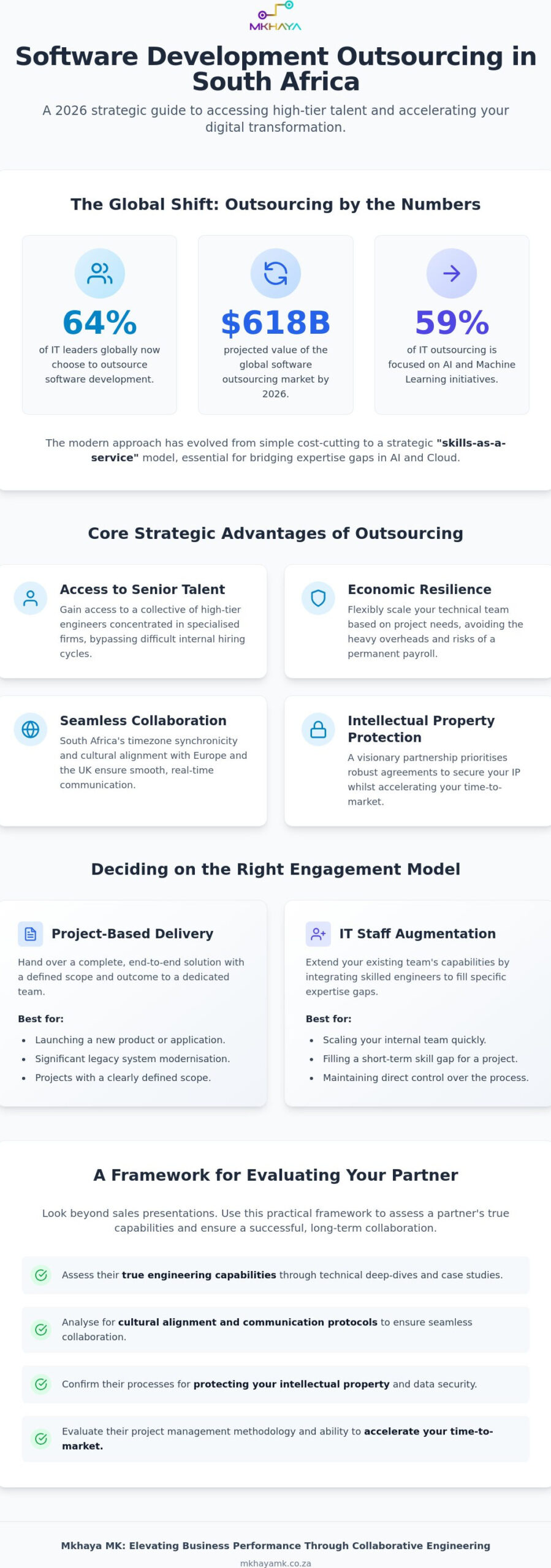
64% of IT leaders globally now choose to outsource software development, yet many still find themselves stalled by a lack of senior engineering talent for AI and Cloud initiatives. You’ve likely felt the weight of rising in-house costs and the pressure of project delays that threaten your competitive edge. When you choose to outsource software development South Africa offers, you’re making a strategic move to bridge this gap with world-class expertise and precision engineering.
We believe that a successful partnership is built on reliability and mutual success rather than just technical delivery. This 2026 guide provides the roadmap you need to navigate the South African landscape, ensuring you secure high-tier talent whilst maintaining predictable development costs. We’ll examine the latest regulatory standards, current hourly rates, and the specific steps required to accelerate your time-to-market through a collaborative, result-focused partnership that transforms your digital vision into a stable reality.
Key Takeaways
Understand the shift from tactical cost-cutting to a strategic “skills-as-a-service” model to bridge your AI and Cloud expertise gaps.
Identify the most effective engagement model for your goals, whether you need to outsource software development South Africa for a defined project or scale your team via staff augmentation.
Discover how timezone synchronicity and cultural alignment facilitate seamless real-time collaboration and ensure technical precision is maintained.
Master a practical evaluation framework to look beyond sales presentations and accurately assess a partner’s true engineering capabilities.
Learn how a visionary partnership can protect your intellectual property whilst accelerating your journey toward digital transformation.
Why South African Enterprises are Prioritising Software Development Outsourcing in 2026
The 2026 business environment has moved past the era where outsourcing was merely a tactic to trim budgets. Today, South African enterprises view it as a strategic “skills-as-a-service” model. This evolution aligns with the broader growth of Business Process Outsourcing, where the focus has shifted toward high-value ICT support and multi-disciplinary expertise. It’s about building a visionary partnership that prioritises long-term stability over short-term savings. By choosing this path, you transform technical debt into a refined asset that supports your broader commercial objectives.
Finding senior engineers has become increasingly difficult within internal hiring cycles. Many of the most skilled developers are now choosing to work within specialised firms where they can apply their expertise across diverse, high-impact projects. This concentration of talent means that when you choose to outsource software development South Africa offers, you aren’t just hiring a vendor; you’re gaining access to a collective of engineers who understand the nuances of the local market. Currently, 64% of IT leaders globally rely on this model to maintain momentum. By 2026, the global software development outsourcing market is estimated to reach $618 billion, reflecting a widespread reliance on external partners to drive innovation.
To better understand the talent landscape and the investment required for these skills, watch this helpful video:
The 2026 Tech Landscape: AI and Cloud Integration
Modern applications are no longer just collections of code. They require sophisticated AI & data automation and robust DevOps frameworks to remain functional. With 59% of IT outsourcing now focused on AI and machine learning, the cost of falling behind is immense. Outsourcing allows your business to transition from clunky legacy systems to modern, scalable cloud architectures without the friction of a complete internal restructure. This acceleration is vital for maintaining a competitive edge whilst user expectations for speed and precision are at an all-time high.
Economic Resilience Through Flexible Scaling
Building a permanent technical department involves significant long-term payroll overheads and substantial hiring risks. If a senior developer leaves, the resulting vacuum can stall progress for months. Outsourcing provides the agility to scale your team up or down based on specific project phases or market fluctuations. This flexibility ensures your internal resources remain focused on core business strategy and high-level decision-making. Whether you are implementing bespoke ERP solutions or refining a customer-facing app, a partner-led approach provides the stability and precision needed to grow without the burden of fixed technical debt.
Deciding Between Project-Based Delivery and IT Staff Augmentation
Choosing the right engagement model is a pivotal step in your digital journey. It’s a decision that balances your internal capacity with your long-term strategic goals. When you decide to outsource software development South Africa provides two primary paths: handing over a specific outcome or extending your existing team’s capabilities. Each model serves a distinct purpose in 2026, particularly as enterprises seek to integrate complex AI and Cloud architectures into their core operations. Your choice should reflect your organisational maturity and the level of direct control you wish to maintain over the daily engineering process.
When to Choose Project-Based Software Engineering
This model is designed for businesses that require a complete, end-to-end solution with a defined scope. It’s the most effective route for launching a new product or undergoing a significant legacy modernisation. By opting for project-based custom software development, you leverage a partner’s entire ecosystem, including UI/UX designers, QA testers, and DevOps specialists. This approach removes the burden of managing individual tasks, allowing you to focus on the business impact whilst your partner ensures the technical precision of the final delivery. It’s especially valuable when building cloud-native applications that require a cohesive, multidisciplinary team to succeed.
The Benefits of IT Staff Augmentation
If you already have an established internal technical department but lack specific expertise, staff augmentation is the superior choice. This model allows you to rapidly scale your capacity with remote or on-site professionals who integrate directly into your workflows. You maintain full control over the development lifecycle and daily priorities. In the current market, where 59% of outsourcing is focused on AI and machine learning, augmentation provides immediate access to niche roles like Cloud Architects or Data Engineers. You avoid the friction and cost of a traditional recruitment cycle, gaining the specific skills needed to accelerate your existing roadmap without long-term payroll commitments.
Determining which path fits your current needs is often the first step toward a successful transformation. Whether you require a visionary guide to build a system from scratch or a reliable partner to bolster your internal ranks, the right model ensures your engineering efforts remain stable and scalable. If you’re unsure which direction aligns with your 2026 objectives, discussing your roadmap with a strategic partner can provide the clarity needed to move forward with confidence.
The Strategic Advantages of Partnering with a Local South African Engineering Firm
Whilst much of the global conversation regarding technical partnerships focuses on international trade, the most profound advantages often emerge from local-to-local collaborations. Engaging a partner within your own borders removes the friction of vast time differences and misaligned business cultures. This proximity facilitates real-time collaboration and daily stand-ups where technical nuance is preserved rather than lost in translation. When you choose to outsource software development South Africa based engineering firms provide a level of synchronicity that offshore hubs simply cannot replicate. It’s a relationship built on shared market understanding and a mutual commitment to the national digital economy.
The logic is clear; a local partner is an invested stakeholder in your success. South Africa’s tech ecosystems in Johannesburg and Cape Town are mature and globally competitive, producing engineers who are trained to solve complex problems with limited resources. By keeping your engineering efforts within the country, you contribute to a sector that has already created 174,000 jobs and generated billions in revenue. This collaborative approach ensures that your digital transformation remains grounded in local realities whilst meeting world-class standards of execution.
POPIA Compliance and Data Sovereignty
Data sovereignty is a pillar of modern business stability. Local partners are inherently aligned with the Protection of Personal Information Act (POPIA), ensuring that your sensitive data never leaves the national legal jurisdiction without proper oversight. This is particularly critical for financial institutions; under Joint Standard 1 of 2024, insurers must ensure all outsourcing agreements are fully compliant by 30 November 2026. Furthermore, insurers are required to notify the Prudential Authority at least 30 days before entering into any material arrangement. A local partner understands these regulatory hurdles and provides the legal certainty needed to protect your intellectual property and code ownership.
Quality Standards and Technical Excellence
South Africa has earned a reputation for high-end engineering that rivals traditional Western hubs. Our engineering graduates from institutions like UCT and Stellenbosch are sought after globally for their precision and ability to build scalable, cloud-native applications. Choosing a local firm allows you to access this “Nearshore” quality without the communication risks associated with low-cost offshore providers. For a deeper look at how these standards are applied in practice, read our detailed analysis on Custom Software Development in South Africa: A Strategic Guide for 2026. This focus on excellence ensures that your software is not just functional, but built for long-term stability and growth.
A Framework for Evaluating Your Next Software Outsourcing Partner
Selecting a partner is a high-stakes decision that requires a methodical approach. It moves beyond surface-level sales pitches and focuses on long-term stability. When you decide to outsource software development South Africa offers, you must first define your primary objective with absolute clarity. Are you looking to build a ground-breaking new product from scratch, or do you simply need to scale an existing engineering team? This distinction is vital because the maturity required for end-to-end delivery differs significantly from the support needed for staff augmentation.
Technical depth is the next pillar of your evaluation. In 2026, buzzwords like “AI-ready” are common, but actual engineering capability is rarer. You should evaluate a partner’s ability to handle complex cloud architectures and data-driven automation. Security and IP policies must be non-negotiable. Ensure your partner provides full code ownership and adheres to the POPIA standards mentioned in previous sections. Starting with a small, phased engagement or a “pilot” project is often the wisest way to build a foundation of trust before committing to a multi-year roadmap. This approach allows you to test their communication rhythm and technical precision without immediate, large-scale risk.
Technical Vetting and Discovery
Before any code is written, a visionary partner will conduct a thorough digital transformation audit. This discovery phase identifies technical debt and aligns the proposed tech stack with your long-term goals. It’s also the stage where UI/UX design takes centre stage. A well-designed user journey is essential for project-based development success. It ensures that the final engineering effort translates into actual business value for your end-users whilst maintaining technical excellence.
Operational Alignment and Transparency
Successful partnerships thrive on clear communication protocols. You need to know exactly how the partner will integrate with your internal workflows. This involves establishing clear KPIs and structured reporting cycles that provide real-time visibility. Transparency in pricing is equally vital. Avoid partners who obscure their cost structures with hidden fees throughout the development lifecycle. A collaborative mindset ensures that both parties are working toward mutual success, treating the outsourcing arrangement as a stable extension of your own business.
Mkhaya MK: Elevating Business Performance through Collaborative Engineering
Mkhaya MK positions itself as a visionary guide rather than a mere vendor. We understand that your digital journey is unique. Our philosophy is rooted in the belief that technical precision must be paired with a supportive partnership to achieve long-term stability. When you choose to outsource software development South Africa based enterprises often seek, you require a partner who values transparency and methodical execution as much as you do. We provide high-end engineering nationally, ensuring that your business logic is preserved and refined through every stage of the development lifecycle.
Our commitment to mutual success drives our delivery of comprehensive services. We build everything from bespoke ERP solutions to complex cloud-native applications that serve as a stable anchor in a rapidly changing technological landscape. By focusing on the collaborative relationship, we ensure that our engineering efforts translate directly into measurable business outcomes. This approach allows us to project a persona of quiet confidence, where our results speak louder than flashy claims.
Our End-to-End Digital Transformation Offering
Modernising your operations requires more than just updated code; it necessitates a complete shift toward integrated cloud solutions and AI automation. We specialise in constructing platforms that fit your specific requirements, including robust loan management and learner management systems. Our approach prioritises customisation and precision, ensuring that the software we build respects your unique business rules whilst providing the scalability needed for 2026 and beyond. This end-to-end focus allows us to handle the technical complexities so you can focus on high-level strategy.
Getting Started with Mkhaya MK
We follow a highly structured process that begins with a deep discovery phase. This ensures that every engagement, whether it is a full project handover or a staff augmentation model, is rooted in a clear understanding of your goals. We facilitate a seamless transition by integrating our senior engineers into your existing workflows, maintaining the communication rhythm established in our framework. This methodical implementation ensures reliability and mitigates the risks typically associated with scaling technical teams. It’s a deliberate pace that reinforces our image as a detail-oriented and reliable partner.
The journey toward digital excellence is a personal one. We invite you to contact Mkhaya MK today to discuss your 2026 software strategy and discover how a collaborative engineering partnership can elevate your business performance.
Securing Your Digital Future through Strategic Engineering
The decision to outsource software development South Africa offers is a commitment to long-term stability and precision engineering. By shifting from tactical cost-cutting to a strategic “skills-as-a-service” model, your enterprise can bridge the AI and Cloud expertise gap with confidence. We’ve explored how a local partnership ensures POPIA compliance whilst maintaining the cultural synchronicity required for complex digital transformation. Your ambition deserves a stable, visionary partner.
Mkhaya MK stands ready to support your journey. With a national South African footprint and specialised AI and Cloud expertise, we ensure your engineering processes are both compliant and high-performing. Our methodical approach to custom software development and staff augmentation is designed to inspire trust and deliver business-focused results. We value transparency and commitment above all else.
Partner with Mkhaya MK for your next software project to accelerate your roadmap with a reliable, detail-oriented team. Let’s build a digital landscape that reflects your ambition and secures your competitive edge for years to come.
Frequently Asked Questions
Is it cheaper to outsource software development in South Africa than to hire in-house?
Outsourcing is generally more cost-effective because it eliminates the long-term overheads associated with permanent payroll, such as office space, equipment, and benefits. Whilst the hourly rates for senior talent are competitive, the true saving comes from reduced recruitment friction and the ability to scale your team down when a project phase concludes. It allows you to convert fixed costs into variable expenses that align with your actual development needs.
What is the difference between IT staff augmentation and project-based outsourcing?
Staff augmentation involves adding specific technical professionals to your existing internal team to fill skill gaps whilst you retain direct management. Project-based outsourcing is a model where you hand over a defined scope of work to a partner who manages the end-to-end delivery of the final product. Your choice depends on whether you need to bolster your current capacity or require a partner to take full responsibility for a specific technical outcome.
How do I ensure my intellectual property is protected when outsourcing?
Intellectual property is protected through robust, locally governed contracts that explicitly state your full ownership of the source code and design assets upon payment. When you choose to outsource software development South Africa based firms provide the advantage of operating within a familiar legal framework. Ensure your agreement includes comprehensive non-disclosure clauses and clear terms regarding data sovereignty to safeguard your competitive advantages from day one.
Can South African software companies handle complex AI and data automation projects?
South African engineering firms are highly capable of delivering sophisticated AI and data automation solutions due to a mature tech ecosystem and world-class university graduates. Local teams are already building complex, cloud-native applications that integrate machine learning to drive business efficiency. With 59% of global outsourcing now focused on AI, South African partners have refined their precision engineering to meet these modern technical demands whilst maintaining high standards of execution.
How long does it typically take to scale a team through staff augmentation?
Scaling a team through staff augmentation typically takes a few weeks, which is significantly faster than the months required for traditional permanent hiring. This agility allows you to respond to market fluctuations or technical challenges without delaying your roadmap. A visionary partner maintains a pipeline of vetted senior developers, ensuring that you gain access to the specific expertise you need with minimal lead time.
What are the common risks of outsourcing and how can they be mitigated?
The most common risks include communication silos, misaligned expectations, and scope creep. You can mitigate these by establishing clear KPIs, insisting on transparent reporting structures, and maintaining a regular cadence of daily stand-ups. Choosing a partner who prioritises a collaborative relationship ensures that technical nuance is never lost. Methodical discovery phases at the start of an engagement also help to align the technical roadmap with your commercial objectives.
Do I need to have a technical background to manage an outsourced development partner?
You do not need a technical background if you partner with a firm that prioritises business-focused results and clear communication. A reliable partner acts as a bridge between complex engineering and your strategic goals, providing transparent updates in a language that non-technical stakeholders understand. Your role is to define the vision and business logic, whilst the engineering team handles the precision execution and technical stability of the system.
How does POPIA compliance affect software development outsourcing in South Africa?
POPIA compliance requires that all personal data is handled with strict security and stored within compliant jurisdictions. When you outsource software development South Africa based partners are already aligned with these national privacy laws, which simplifies your regulatory burden. This is particularly vital as we approach the November 2026 deadline for financial institutions to ensure all their outsourcing arrangements meet the latest Joint Standards for data protection and sovereignty.
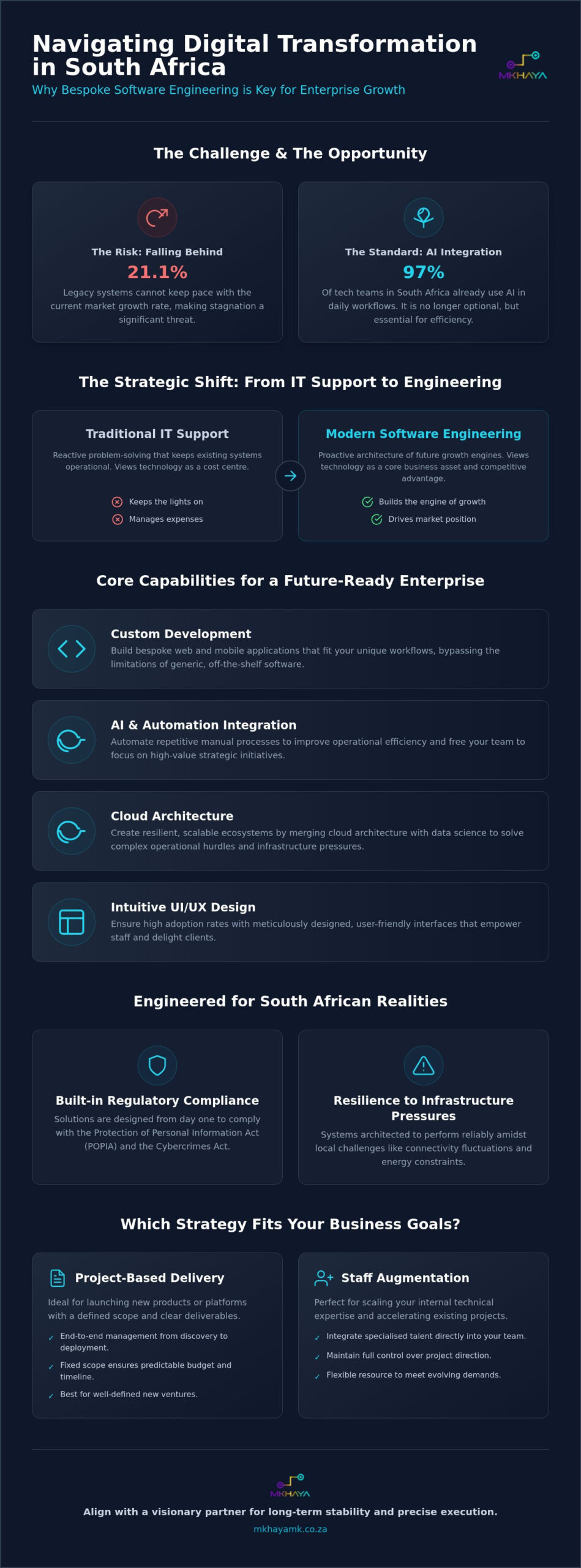
What if the greatest risk to your enterprise isn’t a competitor’s product, but the invisible weight of a legacy system that can no longer keep pace with a 21.1% market growth rate? In a territory where 97% of tech teams already use AI in their daily workflows, standing still is the fastest way to fall behind. Finding reliable software engineering services south africa enterprises can trust involves more than just hiring developers; it’s about securing a partner who understands how to bridge the gap between ageing infrastructure and future-ready automation.
You’ve likely experienced the high cost of failed software projects or the struggle to find specialised local talent amidst rising international competition. It’s a common challenge, and we agree that your digital transformation shouldn’t feel like a high-stakes gamble. This guide will show you how bespoke software engineering, cloud integration, and AI-driven automation empower South African enterprises to scale with precision. We’ll explore the strategic steps to modernise your operations, ensure compliance with the Cybercrimes Act, and build a secure platform that supports long-term stability.
Key Takeaways
Understand how modern software engineering in the local market balances high-level programming with the practicalities of South African infrastructure.
Learn to leverage software engineering services south africa enterprises use to integrate cloud-native architecture and AI automation for improved operational efficiency.
Identify whether your business goals are best served by project-based delivery for new launches or staff augmentation to scale your internal technical expertise.
Discover the importance of a structured lifecycle, from strategic discovery to intuitive UI/UX design, in building platforms that users actually want to adopt.
Align with a visionary partner to ensure long-term stability and precise execution whilst navigating the rapidly shifting technological landscape.
Defining the Landscape of Software Engineering Services in South Africa
Software engineering isn’t a simple technical task; it’s the deliberate architecture of a business’s future. In our region, high-quality software engineering services south africa providers focus on merging cloud architecture with data science to solve complex operational hurdles. It’s about building a digital foundation that doesn’t just work; it excels under pressure. This discipline moves beyond basic coding to create resilient ecosystems that support your specific commercial goals and long-term vision.
The technology landscape in South Africa is unique. We face specific infrastructure pressures, such as connectivity fluctuations and energy constraints, yet our enterprises must compete on a global stage. This requires a fundamental shift in perspective. Digital transformation isn’t a one-off purchase you can tick off a list. It’s a continuous journey of refinement and growth that requires a stable partner to guide the way whilst you navigate changing market demands.
To better understand how this profession is evolving locally, watch this insightful interview:
The Strategic Shift from IT Support to Engineering
Modern leaders don’t view software as a line-item expense. They see it as a core asset that dictates market position. Traditional IT support keeps the lights on, but engineering builds the engine of growth. By automating repetitive manual processes, bespoke systems free your team to focus on high-value strategy. Custom solutions provide a competitive edge that generic, off-the-shelf software simply can’t match. Off-the-shelf tools often force you to change your workflows to fit the software. True engineering does the opposite; it builds the software to empower your unique way of doing business.
Why National Enterprises Require Bespoke Solutions
South African businesses operate within a strict regulatory environment. Compliance with the Protection of Personal Information Act (POPIA) and the Cybercrimes Act is non-negotiable for any enterprise handling sensitive data. The software engineering services south africa requires must ensure these legal requirements are baked into the code from day one. This proactive approach supports long-term stability and protects your brand identity as you scale. National enterprises need systems that grow with them. You need the ability to adapt to a shifting economy without the risk of outgrowing your digital tools or facing the high cost of a failed migration. Custom software engineering provides that anchor.
Core Capabilities: Custom Development, Cloud, and AI Integration
Digital excellence isn’t something you can buy off a shelf. It’s a bespoke creation. When you invest in software engineering services south africa, you’re looking for a partner to build tools that fit your unique business workflows. Custom web and mobile application development allows you to bypass the limitations of generic software. It ensures that your technology supports your processes rather than forcing your team to work around rigid, third-party limitations. This precision is what allows an enterprise to move from being a participant in the market to a leader.
Success also depends on how your users interact with these tools. High adoption rates aren’t accidental; they’re the result of meticulous UI/UX design. By creating intuitive interfaces, we ensure that your staff and clients feel supported by the technology. This focus on the human element, combined with robust backend engineering, creates a stable platform for growth. If you’re curious about how these elements come together, exploring our approach to digital transformation can provide a clearer picture of the journey ahead.
Architecting for the Cloud and DevOps
High-growth enterprises can’t afford downtime or sluggish performance. Cloud-native architecture provides the high availability needed to serve users across the country reliably. By leveraging Managed Cloud and Digital Transformation, you gain an environment that scales automatically as your demand increases. We integrate DevOps practices to accelerate these delivery cycles. This methodology ensures that quality is baked into every update, allowing your business to pivot quickly without compromising system integrity. It’s a rhythmic approach to development that maintains momentum whilst protecting your core assets.
Leveraging AI-Driven Automation for Operational Efficiency
Data is the lifeblood of modern business, but raw information is often overwhelming. Integrating AI and data automation turns this complexity into a strategic advantage. For instance, in finance or logistics, Robotic Process Automation (RPA) can eliminate mundane, repetitive tasks, allowing your team to focus on higher-level strategy. This isn’t just about speed; it’s about accuracy and refinement. According to the State of the Software Developer Nation, the local demand for these intelligent systems is rising as businesses seek more sophisticated ways to manage ERP and procurement systems. We focus on linking AI directly to these core business systems, ensuring that automation delivers measurable results rather than just technical novelty.
Project-Based Delivery vs. Staff Augmentation: Which Strategy Fits?
Choosing the right engagement model is as critical as the architecture of the code itself. It’s the difference between a one-off success and a sustainable digital future. When you’re looking for software engineering services south africa, you need to decide if you want a partner to own the entire outcome or if you simply need more hands on deck. Both models offer distinct advantages. The right choice depends on your internal capacity and the complexity of your roadmap. As South Africa’s digital economy expands, the ability to pivot between these models has become a hallmark of agile, successful enterprises.
When to Opt for End-to-End Project Delivery
Project-based delivery is the preferred route when you have a clearly defined objective and need a partner to take full ownership of the result. It’s the ideal choice for building a new system from the ground up, such as a custom ERP or a proprietary loan management system. This model allows you to focus on your core business whilst we manage the entire lifecycle, from the initial UI/UX design to final deployment. By choosing Custom Software Development, you benefit from a fixed-price structure and a guaranteed outcome, ensuring that your vision is realised without the distraction of day-to-day management.
Scaling Internal Teams with Staff Augmentation
If you already have an established technical team but find yourself facing specific skill gaps or a sudden increase in workload, staff augmentation is the more strategic fit. This approach provides access to high-level professionals without the long-term overhead and complexity of permanent hiring. It’s about extending your team’s reach with remote or on-site experts who integrate into your existing culture and workflows. Our Staff Augmentation Services ensure you maintain momentum on long-term platforms whilst filling niche roles in DevOps, QA, or data science. It’s a flexible way to scale that prioritises speed and technical precision.
Evaluating cost-effectiveness requires looking beyond the initial quote. Fixed-price projects offer budget certainty for new launches. Conversely, monthly recurring professional fees for augmented staff provide the agility needed for ongoing maintenance. Regardless of the model, quality assurance and talent management remain the non-negotiables. We act as a stable anchor, ensuring that every engineer assigned to your project meets the highest standards of integrity and technical excellence. Securing the right software engineering services south africa has to offer ensures your digital platform remains secure, scalable, and ready for whatever the market demands next.
Navigating the Engineering Lifecycle: From Concept to Deployment
A successful digital platform isn’t the result of a single brilliant idea; it’s the product of a methodical, transparent journey. For many stakeholders, the world of software development feels like a “black box” where requirements go in and a product eventually comes out. We believe in a different approach. The most effective software engineering services south africa provides are those that invite the client into the process, turning technical execution into a collaborative partnership. This lifecycle ensures that every line of code serves a specific business purpose whilst maintaining the flexibility to adapt to new insights.
The Importance of Discovery and User Experience
Skipping the discovery phase is a primary cause of project bloat and eventual failure. This initial stage is where we align technology with your commercial goals, identifying potential roadblocks before they become expensive mistakes. We treat discovery as a strategic consulting session, ensuring the architecture supports your vision for the next five to ten years. Once the strategy is set, we move into UI/UX Design Services. User experience isn’t just about aesthetics; it’s about productivity. An interface that feels natural to your staff reduces training time and minimises user error, ensuring your investment pays for itself through improved operational efficiency.
Agile Methodology and Continuous Integration
We use an agile framework to maintain momentum and ensure you’re never left in the dark. By building in iterative cycles, or sprints, we provide regular progress reports and feedback loops. This prevents the “black box” effect and allows for course corrections as your market evolves. Our Engineering Process incorporates continuous integration and rigorous QA testing. We don’t just test for bugs; we test for performance, security, and reliability. This ensures that when your system goes live, it’s ready to handle the real-world demands of your users without hesitation. This phase also includes verifying compliance with local regulations like POPIA, ensuring your data remains secure from day one.
Deployment is the beginning of a new chapter, not the end of the work. Managed support ensures your platform remains a stable anchor in a changing landscape, with regular updates that keep your technology modern and secure. This long-term commitment to your success is what separates a vendor from a partner. If you’re ready to move from a vague concept to a concrete digital asset that drives revenue, contact our team to begin your discovery session and define your path to digital excellence.
Empowering South African Business with Mkhaya MK’s Engineering Expertise
Choosing Mkhaya MK means selecting a stable anchor in a rapidly shifting technological environment. We don’t just provide the software engineering services south africa businesses need to survive; we provide the strategic vision they need to lead. Our approach is rooted in transparency and methodical execution, ensuring that every project is a step toward mutual success. We see ourselves as your visionary yet practical guide, committed to your personal journey of digital transformation. This partnership ensures that your technology remains an asset rather than a burden.
Bespoke Enterprise Solutions: ERP and Loan Management
Our deep engineering capability is best evidenced by our proprietary systems. We’ve developed specialised tools to streamline complex operations, such as our Loan Management and Facility Management platforms. These aren’t generic templates. They’re high-end, custom-built solutions designed to handle the specific pressures of the local market. For those in the financial sector, our Loan Management System South Africa: The Strategic 2026 Buying Guide offers a deeper look into selecting the right technology for your portfolio. By integrating ERP Solutions into your core workflow, you optimise resources and gain a unified view of your entire enterprise.
Partnering for Long-term Digital Stability
We move beyond the traditional vendor relationship. A true partnership is built on integrity and a shared commitment to long-term stability. Whilst other providers might focus on global headcounts, we focus on the precision of our execution and the strength of our national service coverage. Whether you’re extending your team through staff augmentation or launching a new product, our goal is to ensure your digital platform remains a secure and scalable asset. We’re here to help you build something that lasts. We believe in building trust through consistent, high-quality delivery that respects your budget and your timeline. It’s about creating a foundation that can support your growth for years to come.
Securing high-level software engineering services south africa enterprises can rely on is the first step toward digital excellence. We’re ready to help you navigate this journey with confidence and clarity. Contact Mkhaya MK today to discuss your engineering requirements and let’s begin architecting your digital future.
Architecting Your Digital Legacy with Precision
The journey toward digital excellence requires more than just code; it demands a partner who understands the intricate balance between innovation and stability. We’ve explored how the high-level software engineering services south africa enterprises need are built on a foundation of strategic discovery, agile execution, and robust cloud architecture. Whether you’re modernising legacy systems or scaling your internal team through staff augmentation, the goal remains the same: creating a secure, reliable platform that drives measurable business value.
Mkhaya MK stands as a stable anchor in this evolving landscape. Our proprietary Loan and Facility Management Systems, combined with specialised AI and data automation expertise, serve as proof of our commitment to technical precision. With a proven track record in national digital transformation, we’re ready to help you navigate the complexities of modern engineering whilst ensuring your long-term success. We believe in building relationships that go beyond the typical vendor model, focusing instead on mutual growth and methodical execution.
Don’t leave your digital future to chance. Partner with Mkhaya MK for your next software engineering project and let’s build a resilient ecosystem together. We’re invested in your journey and look forward to architecting a solution that empowers your enterprise to scale with confidence.
Frequently Asked Questions
What is the difference between software development and software engineering?
Software development primarily focuses on the act of writing code to create functional tools. Software engineering is a broader, more disciplined application of engineering principles to the entire software lifecycle. It ensures that software engineering services south africa providers deliver systems that are not only functional but also scalable, maintainable, and resilient under heavy operational loads. This structured approach treats software as a core asset rather than just a technical script.
How much does custom software development cost in South Africa?
The cost of custom software varies significantly based on the project’s scope, complexity, and required integrations. Factors such as the number of user roles, the depth of data automation, and the need for cloud-native architecture all influence the final investment. Most professional firms provide a detailed discovery phase to establish a precise budget that aligns with your strategic goals. This ensures the solution remains cost-effective whilst meeting all your operational requirements.
How long does it take to build a bespoke business application?
Building a bespoke business application typically takes between three to nine months depending on the system’s intricacy. A basic Minimum Viable Product (MVP) might be ready for deployment sooner; however, enterprise-grade systems like ERP or Loan Management platforms require more time for rigorous testing and QA. We follow a methodical execution process to ensure that your timeline is realistic and your launch is stable from day one.
Can I hire a dedicated development team for a short-term project?
Yes, you can hire a dedicated team for short-term projects through flexible engagement models like staff augmentation. This allows you to scale your technical capacity quickly to meet a specific deadline or fill a niche skill gap without the long-term overhead of permanent employment. It’s an agile way to access high-level expertise whilst maintaining full control over your project’s momentum and quality without the burden of permanent hiring costs.
What technologies do software engineering firms in South Africa typically use?
Local engineering firms typically utilise a mix of modern, reliable technologies including Java, C#, Python, and JavaScript frameworks like React or Angular. Cloud-native development often centres on platforms like AWS, Microsoft Azure, or Google Cloud. These choices ensure that the software engineering services south africa enterprises receive are compatible with global standards whilst remaining robust enough to handle local infrastructure challenges and connectivity requirements.
How do you ensure the security of custom-developed software?
Security is ensured by integrating DevSecOps practices from the very first line of code. This includes end-to-end encryption, regular penetration testing, and strict adherence to local regulations like the Protection of Personal Information Act (POPIA) and the Cybercrimes Act. By baking security into the engineering lifecycle, we protect your data and ensure your platform remains a stable anchor for your business operations even as the threat landscape changes.
Is staff augmentation better than hiring permanent developers?
Staff augmentation is often better for businesses that need to scale rapidly or require specific expertise for a defined period. It avoids the lengthy recruitment cycles and administrative costs associated with permanent hiring. Permanent developers may be preferable for building long-term internal IP; however, augmentation provides the agility and precision needed to respond to a changing technological landscape without the commitment of fixed, long-term overheads.
With the South African data analytics market projected to grow at a staggering 31.4% annually from 2026, the gap between businesses that guess and those that know has never been wider. You’ve likely felt the frustration of fragmented data silos trapped within legacy systems or the pressure of the 30 June PAIA annual report deadline. Finding reliable data analytics services south africa shouldn’t feel like a gamble on unproven ROI. It’s understandable to feel cautious when internal specialised engineering talent is scarce and the regulatory landscape, especially with the new health information regulations that took effect in March, is shifting beneath your feet.
We’re here to help you turn that uncertainty into a decisive competitive advantage. This guide provides a clear, executive framework to move your organisation from basic reporting to automated decision-making and predictive modelling. We’ll explore how to establish a single source of truth that satisfies the Information Regulator’s intensified POPIA oversight whilst positioning your business for long-term stability. You’ll learn how to bridge the local skills gap and select a partner that aligns your technical architecture with your most ambitious digital transformation goals.
Shift your perspective from reactive reporting to prescriptive analytics to turn raw data into a proactive engine for business growth and digital transformation.
Learn to evaluate data analytics services south africa based on their commitment to transparency and their ability to translate complex technical stacks into clear business outcomes.
Establish a single source of truth by investing in robust data engineering and intuitive visualisations that empower your executive team with real-time, actionable insights.
Overcome the local specialised talent shortage and ensure POPIA compliance by adopting a flexible, methodical approach to scaling your technical capabilities.
Discover the Mkhaya MK “Consulting to Execution” methodology, designed to bridge the gap between initial strategy and long-term technological stability.
The landscape of data in South Africa has shifted dramatically. It’s no longer just about looking at last month’s sales figures. Modern Data analysis has transitioned from a passive reporting function into a core engine that drives every strategic move. In 2026, the most successful national enterprises treat their data as a living asset rather than a dusty archive. This evolution is central to why data analytics services south africa are now considered the bedrock of any serious digital transformation journey.
We’ve moved past the era of descriptive analytics, which merely told us what happened. Today, the focus is on prescriptive analytics; the science of determining what we should do next to achieve a specific outcome. This shift allows businesses to anticipate market fluctuations and supply chain disruptions before they impact the bottom line. It’s a move from reactive firefighting to proactive, methodical growth that builds a stable foundation for future innovation.
To better understand the practical side of this evolution, watch this helpful video:
Why National Enterprises are Prioritising Data in 2026
Operational efficiency is the primary driver. With the South African data analytics market having generated USD 1,115.2 million in revenue in 2025 and projected to grow at a CAGR of 31.4% through 2033, national enterprises recognise that data maturity is no longer optional. Real-time data allows for immediate cost reduction by identifying waste in logistics or production. It isn’t just about saving money, though. Data-driven insights provide the necessary roadmap for scaling technology platforms securely. By understanding local consumer behaviour through granular data, businesses can personalise experiences in a way that feels authentic rather than automated. This precision is what allows local firms to hold their own against global competitors.
The Intersection of Data Analytics and Custom Software
Many organisations find that off-the-shelf tools simply can’t handle the unique logic of their operations. This is where the integration of analytics into custom software development becomes vital. When your data architecture is built into the very fabric of your applications, you create a seamless flow of information. This bespoke approach ensures long-term organisational stability. It prevents the common pitfall of having powerful software that remains “blind” to the insights hidden within its own databases. By choosing data analytics services south africa that understand this intersection, you ensure your technology and your strategy move in perfect lockstep. We believe in a methodical execution that values transparency over flashy claims, ensuring your data informs every line of code we write.
A robust framework acts as the nervous system of your organisation. It doesn’t just store information; it organises it into a coherent narrative that supports long-term stability. To get the most from data analytics services south africa, your framework must excel in four critical areas that bridge the gap between raw information and strategic action.
Data Engineering: This is your foundation. It involves building resilient pipelines that ingest, clean, and move raw data from disparate sources into a central repository. Without clean data, even the most advanced AI will produce flawed results.
Data Visualisation: Raw numbers rarely inspire action. By transforming complex datasets into intuitive executive dashboards, you give your leadership team the clarity needed to make high-stakes decisions with quiet confidence.
Advanced Analytics: This moves beyond what happened to why it happened. Machine learning models identify hidden patterns and predict future trends, allowing you to stay ahead of market shifts.
Data Governance: This ensures your data remains high-quality, secure, and compliant. It’s the set of rules that keeps your organisation aligned with national standards whilst maintaining the integrity of your insights.
Leveraging AI and Data Automation
Static reporting is a relic of the past. Modern AI automation solutions turn your data into a proactive force. By implementing Robotic Process Automation (RPA), you can automate the tedious tasks of data cleaning and organisation, freeing your team for higher-level strategy. Whilst many businesses rely on standard tools, the real competitive edge in 2026 comes from custom-built predictive engines that reflect your unique business logic and operational goals.
Cloud-Native Data Solutions
Scalability is non-negotiable for data-intensive applications. Utilising managed cloud services ensures that your storage capacity grows alongside your business without the need for massive upfront hardware investments. This approach provides the high availability and performance required for real-time analytics. Integrating DevOps practices into your data workflow allows for the rapid deployment of new features, ensuring your analytics capabilities are always evolving. If you’re looking to refine your technical architecture, exploring our approach to digital transformation can help you identify the most effective path forward for your specific needs.
Selecting data analytics services south africa requires moving beyond a simple checklist of technical certifications. Whilst platform designations provide a baseline, they rarely account for the nuance of your specific operational logic. A true partner acts as a visionary guide, bridging the gap between raw data and your most ambitious business goals. You should look for a partner that projects “quiet confidence”; a persona that values transparency and methodical execution over flashy, unverified claims. This reliability is what transforms a service provider into a stable anchor for your technological evolution.
It’s essential to find a balance between strategic consulting and technical execution. A partner that only offers high-level advice leaves you with a roadmap but no vehicle. Conversely, a purely technical firm might build a powerful engine that doesn’t align with your commercial objectives. We believe the most successful engagements follow a structured process that moves from a broad vision to a concrete, step-by-step path forward, ensuring every technical milestone delivers a practical business benefit.
Technical Expertise vs. Business Alignment
Your partner must speak the language of ROI. If a team focuses solely on Python or SQL without discussing how those tools drive digital transformation, the alignment is missing. Designing effective data models is a collaborative relationship; it requires deep dives into your unique workflows to ensure the architecture supports your long-term journey. As your organisation grows, you may need to scale your capabilities through staff augmentation, ensuring you have the right talent at the right time without the overhead of permanent hiring or the delays of a traditional recruitment cycle.
The Custom Advantage: Bespoke vs. Template Solutions
Template-based dashboards often carry hidden costs. Whilst they appear cheaper initially, they frequently fail to capture the complexity of South African industries, leading to “blind spots” in your reporting. Custom-built solutions offer the precision needed for high-stakes decision-making. By investing in a bespoke architecture, you ensure your data remains a valuable asset rather than becoming a legacy burden that hinders future agility. Our commitment to integrity and transparency ensures that every custom build is designed for stability and precision, providing a single source of truth that you can rely on for years to come.
South African executives face a unique set of hurdles that global counterparts might overlook. Whilst the strategic value of data analytics services south africa is clear, the practical implementation often hits a wall when confronted with the national shortage of specialised engineering talent. It’s one thing to envision a data-driven future; it’s another to find the senior analysts, who now command average salaries of R656,497, to build it. Beyond the talent war, the regulatory environment has become significantly more rigorous, requiring a partner that understands the local legal fabric as well as the code.
Scaling Teams with Staff Augmentation
When internal recruitment stalls, IT staff augmentation provides a flexible bridge to success. This model grants you immediate access to scarce data specialist skills without the long-term overhead of permanent hiring or the delays of traditional recruitment. Whether you need on-site professionals in Cape Town or remote engineers to scale a national project, extending your team allows for the methodical execution of project-specific transformations. It’s a visionary way to bypass the local skills shortage, ensuring your digital transformation doesn’t lose momentum due to empty seats in your tech department.
Data Security and Compliance as a Competitive Edge
Compliance isn’t just a legal box to tick; it’s a way to build trust with a sophisticated consumer base. In March 2026, the Information Regulator shifted to a proactive oversight model, moving beyond reactive complaints to targeted assessments in high-risk sectors. This makes navigating POPIA complexities during data migration more critical than ever. Additionally, the new health information regulations that came into force on 6 March 2026 require immediate attention from insurers and medical schemes. Implementing robust encryption and access controls within your data lake ensures integrity, especially when integrating legacy ERP solutions with modern analytics.
Resilient infrastructure is the final piece of the puzzle. Your data architecture must withstand local connectivity challenges and power fluctuations to ensure high availability for decision-makers. By building a stable, hybrid-cloud environment, you protect your “single source of truth” from external disruptions. If you’re ready to secure your data future and bridge the talent gap, contact us today for a transparent discussion on how our professionals can support your journey.
We act as the stable anchor in your technological evolution. Unlike standalone BI tools that often offer surface-level charts without context; our approach treats data as a critical component of end-to-end digital transformation. By choosing our data analytics services south africa, you’re opting for a partner that values methodical refinement over flashy, short-term claims. We bridge the gap between initial strategy and long-term stability by integrating your data architecture directly with your ERP solutions and bespoke software environments.
Our “Consulting to Execution” methodology ensures that every insight we uncover is backed by the technical capability to implement it. This synergy prevents the common frustration of having a roadmap without a vehicle. We don’t just tell you what the data says; we build the automated systems that act on those findings. It’s a collaborative relationship built on transparency and mutual success, ensuring your data assets become more valuable with each passing year. This commitment to your personal journey is what defines our “quiet confidence” in a noisy market.
A Step-by-Step Path to Data Maturity
Achieving true business intelligence requires a structured progression. We guide you through three distinct phases to ensure your investment delivers measurable results and satisfies the Information Regulator’s evolving requirements:
Phase 1: Discovery and Audit – We begin by identifying your most valuable data sources and uncovering the fragmented silos that hinder your progress. This phase ensures your strategy is rooted in the reality of your current operations.
Phase 2: Foundation Building – We establish secure, cloud-based data warehouses that serve as your single source of truth. This architecture is designed to be scalable and resilient, providing a stable base for all future custom development.
Phase 3: Insights and Automation – Once the foundation is stable, we deploy intuitive executive dashboards and AI-driven workflows. This turns your static information into a proactive engine for automated decision-making.
Ready to Transform Your Data into a Strategic Asset?
The journey from raw numbers to visionary business intelligence is one of the most significant steps an organisation can take. It requires a forward-looking mindset that embraces agile, modern technology whilst remaining rooted in traditional values of integrity and commitment. By choosing data analytics services south africa that prioritise your specific business logic, you ensure that your digital transformation is both ambitious and practical. We’re ready to act as your stable guide in this rapidly changing landscape. Start your journey with us today and discover the power of a partnership that’s deeply invested in your long-term success.
The shift towards prescriptive analytics and automated decision-making is no longer a luxury for South African enterprises. It’s the foundational architecture for long-term stability. By integrating these insights into your custom software and ERP systems, you create a single source of truth that empowers your leadership team. Navigating the complexities of POPIA whilst managing the national skills shortage requires a partner who understands the local landscape as deeply as the technical code.
Choosing the right data analytics services south africa is about more than just technology; it’s about finding a visionary guide for your end-to-end digital transformation. With our national reach and proven track record in AI and custom software engineering, we act as a stable anchor for your technological evolution. We’re committed to your personal journey, ensuring that every data point leads to a practical business outcome and measurable growth.
What are the main benefits of using data analytics services in South Africa?
The primary benefit is turning fragmented data into a proactive business engine that drives digital transformation. By leveraging data analytics services south africa, organisations can automate decision-making processes and gain a competitive edge through predictive modelling. This shift allows you to anticipate market changes rather than simply reacting to them, ensuring your business remains a stable anchor in a changing landscape.
How does POPIA affect data analytics implementation for local businesses?
POPIA requires strict data governance and security protocols throughout the entire analytics lifecycle. Since the Information Regulator shifted to proactive oversight in March 2026, businesses must ensure that data migration and storage are fully compliant. This involves implementing robust encryption and access controls to protect personal information whilst maintaining the integrity of your insights and satisfying the latest regulatory assessments.
Should we build an internal data team or outsource to a South African partner?
Outsourcing to a local partner is often more efficient due to the national shortage of specialised data engineering talent. Whilst internal teams offer deep company knowledge, a partner provides a broader perspective and access to senior expertise that is difficult to recruit. This approach reduces the overhead of permanent hiring and allows for more agile scaling of your technical capabilities through a collaborative relationship.
What is the difference between Business Intelligence (BI) and Data Analytics?
Business Intelligence focuses on descriptive reporting of past events, whereas data analytics involves prescriptive and predictive modelling for the future. BI tells you what happened in your last quarter. Analytics uses machine learning to identify patterns that suggest what you should do next to optimise your results. It’s the difference between looking in the rear-view mirror and having a visionary guide for the road ahead.
How much does it cost to implement a custom data analytics solution?
The investment for a custom solution depends entirely on the complexity of your data silos and the specific business logic required. We focus on a methodical execution that ensures long-term stability and a clear path to ROI. Rather than providing a generic price, we believe in a thorough discovery phase to define a precise scope that aligns perfectly with your strategic goals and digital journey.
Can data analytics be integrated with our existing ERP or Loan Management systems?
Yes, modern analytics frameworks are designed to integrate seamlessly with existing ERP or Loan Management systems. Custom engineering allows us to build the necessary pipelines to move and clean data from these legacy platforms. This integration ensures that your analytics engine has access to all relevant information, creating a single source of truth for your entire organisation.
What is the average timeline for a digital transformation project involving data?
Timelines vary based on the maturity of your existing data infrastructure and the scale of the transformation. A typical project moves through structured phases of discovery, foundation building, and final deployment of insights. This deliberate pace ensures that each milestone is fully articulated and reliable before moving to the next stage, reinforcing our image as a detail-oriented and reliable partner.
How does staff augmentation help with data analytics backlogs?
Staff augmentation provides immediate access to scarce specialists to help you clear technical debt and accelerate your data analytics services south africa projects. It allows you to scale your team nationally with remote or on-site professionals without the delays of traditional recruitment. This flexibility is essential for overcoming project-specific backlogs and maintaining momentum in a competitive, high-end technological landscape.