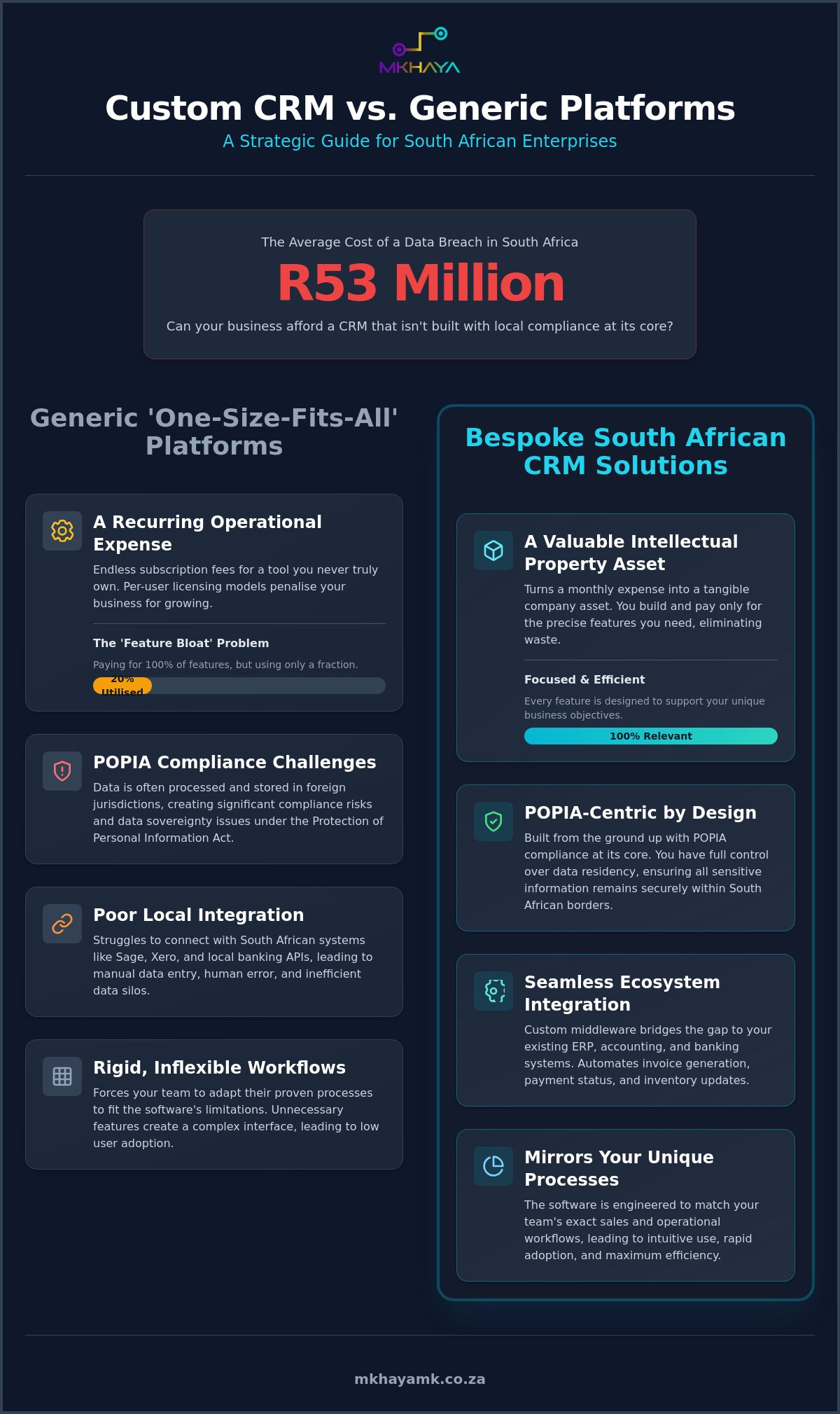
With the average cost of a data breach in South Africa reaching R53 million, can your business really afford a CRM that wasn’t built with local compliance at its core? You’ve likely felt the frustration of paying premium subscription fees for global platforms, only to find half the features are irrelevant to your local operations. We understand that the struggle with rigid systems and the constant worry over POPIA enforcement is a heavy burden for any enterprise. This is why custom crm development south africa has shifted from a luxury to a strategic necessity for those who value precision and long-term stability.
We agree that your technology should adapt to your business, not the other way around. In this guide, you’ll discover how a bespoke solution provides full ownership of your data whilst mirroring your exact sales and operational processes. We’ll explore how custom-built tools ensure seamless integration with South African banking systems, AI automation, and your existing ERP. This article provides a clear roadmap for leveraging these refined tools to gain a genuine competitive edge in the 2026 market. We’re here to help you move from fighting your software to mastering your growth through a partnership built on transparency and results.
Key Takeaways
Learn why generic global platforms often fail to match the unique operational behaviours of local businesses and how bespoke engineering solves these challenges.
Discover how custom crm development south africa serves as a foundational layer for AI automation whilst ensuring strict POPIA compliance.
Understand the “ownership advantage” of building your own software, turning a monthly operational expense into a valuable intellectual property asset.
Explore a strategic roadmap for development that focuses on business objectives and rapid deployment through a high-impact Minimum Viable Product.
Identify the key qualities of a reliable technology partner who prioritises transparent collaboration and long-term mutual success over simple vendor transactions.
The Limitations of Generic CRM Solutions for South African Enterprises
Many South African enterprises find themselves trapped in a cycle of adapting their unique business logic to fit the rigid templates of global software. Whilst Customer Relationship Management (CRM) is a universal concept, the application of it varies wildly across different markets. In South Africa, the nuances of our local trade, credit behaviours, and regulatory environment mean that a “one-size-fits-all” approach often leaves gaps in operational efficiency. This is why custom crm development south africa provides a distinct advantage, as it involves a bespoke engineering process built specifically around your internal workflows.
The “feature bloat” problem is a significant pain point for local firms. Many organisations pay for the full 100% of a global SaaS tool’s capabilities but only ever utilise about 20% of the features. This creates unnecessary complexity and high subscription costs that don’t translate into value. A custom solution ensures you only build and pay for what you actually use, removing the friction of per-user licensing that often stifles growth during expansion phases. When your team grows from ten to fifty, your software costs shouldn’t necessarily quintuple.
To better understand the value of this bespoke approach, watch this helpful video:
Navigating POPIA and Data Sovereignty
Compliance is no longer a peripheral concern; it’s a central pillar of digital strategy. Custom builds allow for precise control over data residency, ensuring that sensitive information remains within South African borders. This alignment with the Protection of Personal Information Act (POPIA) is much easier to maintain when you own the architecture. By avoiding third-party data processing in foreign jurisdictions, you eliminate the risks associated with international legal shifts and ensure your data sovereignty remains intact. This approach builds trust with your clients, who are increasingly aware of their privacy rights.
Integration with Local Accounting and ERP Systems
A CRM shouldn’t exist in a vacuum. Global platforms often struggle to integrate with South African favourites like Sage, Xero, or local banking APIs. These hurdles lead to manual data entry. Errors follow. Through custom middleware, we bridge the gap between legacy systems and modern interfaces. This creates a unified ecosystem where data flows effortlessly between your sales tools and your broader ERP solutions. We focus on:
Automating invoice generation directly from lead closure.
Synchronising customer payment status with sales dashboards.
Bridging the gap between warehouse inventory and client orders.
This ensures that your financial and operational data is always in sync, providing a single source of truth for your leadership team. By refining these connections, we help you build a stable anchor for your business in a rapidly changing technological landscape.
Building for Precision: Core Components of Custom CRM Development
Modern enterprises are moving away from static contact lists. They require intelligent hubs that act as the central nervous system of their operations. When evaluating bespoke vs. off-the-shelf solutions, the primary advantage is the ability to build a system that mirrors your team’s favourite workflows. custom crm development south africa isn’t just about storing data; it’s about refining the way your staff interacts with information. By creating a tool that feels intuitive, you drive user adoption and turn the CRM into a foundational asset for your broader digital strategy.
A high-end interface is not a luxury. It’s a requirement for success. When software feels clunky, teams find workarounds, and data integrity suffers. We focus on building precise, refined tools that provide a stable anchor in a rapidly changing technological environment. This precision ensures that your CRM isn’t just a database, but a visionary guide for your sales and support teams.
AI-Driven Automation and Predictive Analytics
Intelligence is the engine of the 2026 business landscape. It’s predicted that over 60% of South African Salesforce users will be leveraging AI tools by 2026, yet custom builds allow you to integrate these capabilities natively without the high “add-on” costs of global platforms. By baking AI and data automation directly into your architecture, you can implement predictive lead scoring that identifies high-value opportunities before your competitors do. Automated follow-up sequences can be designed to feel personal and supportive, ensuring no client is left behind whilst your team focuses on high-level strategy. Real-time reporting dashboards then translate this data into clear, actionable insights for executive decision-making.
User-Centric Design and Custom Workflows
Every organisation has a unique rhythm. Before writing a single line of code, we believe in mapping your specific sales pipeline to ensure the software matches your reality. Our UI/UX design services focus on creating intuitive client portals and internal dashboards that simplify complex tasks. For large South African organisations, role-based access control is essential for maintaining security and clarity across different departments. This methodical execution ensures that each user sees exactly what they need to succeed, nothing more and nothing less. If you’re ready to see how these components fit together, exploring our digital transformation services is a great next step toward long-term stability.
Bespoke vs. Off-the-Shelf: Evaluating the Long-Term ROI
Choosing a CRM is a financial decision as much as a technical one. Most businesses default to global SaaS platforms, viewing the monthly fee as a manageable operational expenditure (OpEx). However, as your organisation scales, this “subscription tax” often becomes a heavy burden that penalises your success. By investing in custom crm development south africa, you shift your technology spend from a perpetual rental model to a capital expenditure (CapEx) that builds a tangible intellectual property asset. This move ensures that your software grows alongside you without the friction of escalating per-user fees.
Ownership is power. When you own the source code, your software becomes a business asset that adds value to your company’s balance sheet. You are no longer at the mercy of a vendor’s price hikes or sudden changes in their terms of service. This stability allows you to plan for the long term with quiet confidence, knowing your foundational tools are secure. It’s a strategic shift from being a tenant to being a landlord of your own digital infrastructure.
Total Cost of Ownership (TCO) Over 5 Years
A realistic financial analysis must look beyond the first year. Whilst the upfront cost of bespoke development is higher than a single month of SaaS, the five-year trajectory often tells a different story. In a custom model, your primary costs are development, hosting, and annual maintenance; which typically ranges from 15% to 25% of the initial build cost according to industry data. Compare this to a SaaS model where seat prices escalate as you add staff. Our approach to software engineering focuses on creating sustainable, scalable architectures that eliminate these hidden costs. Growth should be a victory, not a financial penalty.
Eliminating Feature Bloat and Complexity
Productivity is the ultimate ROI. Generic systems are often cluttered with hundreds of features your team will never touch. This bloat leads to confusion and high training costs. A bespoke tool, designed specifically for your internal workflows, is easier to master. Your staff spend less time fighting the interface and more time engaging with clients. This refinement is a critical step in a successful digital transformation journey. By automating specialised processes, you reduce manual labour and free your team for high-value strategic work. A simpler, customised interface doesn’t just save time; it builds a culture of efficiency and precision.
The Custom CRM Development Lifecycle: A Strategic Roadmap
Building a bespoke system requires more than technical expertise; it demands a deep understanding of your business’s unique pulse. Successful custom crm development south africa depends on a lifecycle that prioritises business objectives over raw code. Our approach is designed to be a supportive partnership, guiding you from a broad vision toward a concrete, high-performance reality. By following a structured roadmap, we ensure that the final product isn’t just a tool, but a stable anchor for your daily operations.
The transition from fragmented spreadsheets or outdated legacy systems is often the most daunting phase for local enterprises. We treat data migration as a surgical process, ensuring that your historical records are cleaned, mapped, and securely transferred without loss of integrity. To maintain momentum, we advocate for an agile methodology. This involves building a Minimum Viable Product (MVP) that allows your team to begin using core features quickly. Early adoption provides invaluable feedback, allowing us to refine the software in real-time as your organisation grows.
Discovery, Mapping, and UI/UX Prototyping
Precision begins long before the first line of code is written. During the discovery phase, we engage in a collaborative process to identify specific pain points amongst your various departments. Whether it’s the sales team struggling with lead tracking or accounts needing better visibility, we map every requirement. We then create detailed wireframes and prototypes, allowing stakeholders to visualise the interface and workflow. This methodical preparation is a hallmark of our refined development process, ensuring there are no surprises during the build phase. It turns a complex technical project into a transparent, manageable journey.
Integration, Testing, and Deployment
Resilience is built through rigorous testing. Enterprise-grade software requires exhaustive Quality Assurance (QA) to ensure every module performs perfectly under pressure. We implement a phased rollout strategy, which minimises disruption to your daily activities and allows for a smooth transition. Our use of cloud solutions and modern DevOps practices ensures high availability and zero downtime during updates. This commitment to technical depth means your system remains agile and modern, even as the technological landscape shifts. If you’re ready to begin this evolution, get in touch with our team to discuss your specific requirements.
Choosing the Right Partner for Custom CRM Development in South Africa
Selecting a technology partner is a decision that defines the trajectory of your digital evolution. It’s about finding a visionary guide who understands that your software is a stable anchor for your business. A reliable partner for custom crm development south africa must offer more than just technical depth; they need to provide transparency and local market expertise. We believe in a partnership model that prioritises mutual success over simple transactions. This collaborative approach ensures that the final product isn’t just a piece of code, but a tool that truly mirrors your operational behaviour.
Trust is built through transparency. For large-scale implementations, having a partner with a national footprint across South Africa is essential. This local presence ensures that support is always within reach and that the team understands the specific regulatory and economic pressures your business faces. By choosing a partner who values methodical execution and integrity, you secure a foundation for long-term stability in a rapidly changing market.
Project-Based vs. Staff Augmentation Models
Flexibility in delivery is a key trait of a modern technology partner. Sometimes, a fixed-price project is the right choice for a clearly defined initial build. However, as your system evolves, you might find that extending your internal team via staff augmentation provides better long-term value. This model allows you to hire dedicated developers who work as a seamless extension of your own staff, maintaining and evolving the CRM post-launch. If you’re considering this path, our guide on hiring dedicated developers in South Africa offers a deeper look at how to scale your technical capacity with precision.
The Mkhaya MK Advantage
We provide a unique blend of custom engineering, AI expertise, and digital strategy. Our goal is to move you from a broad vision toward a concrete, high-performance reality. We encourage you to view your CRM not as an isolated tool, but as the first step in a broader custom software development roadmap. This strategic perspective ensures that every technical decision you make today supports your ambitions for 2026 and beyond. Our commitment to your journey is rooted in traditional values of integrity and a forward-looking ambition for your mutual success.
Securing Your Digital Future with Bespoke CRM Solutions
The journey toward operational excellence requires tools that mirror your unique business logic rather than forcing you into rigid, generic templates. We’ve explored how moving away from global SaaS platforms eliminates the “subscription tax” whilst turning your software into a valuable intellectual property asset. By prioritising custom crm development south africa, you ensure that your organisation remains resilient against regulatory shifts and evolving market demands. This strategic shift provides the precision needed to master your data and refine your customer relationships with absolute clarity.
At Mkhaya MK, we act as your authoritative partner through comprehensive digital transformation consulting and specialised expertise in POPIA-compliant software architecture. We offer the flexibility of staff augmentation to help you scale your development team with ease, ensuring each phase of construction is handled with methodical execution. Partner with Mkhaya MK for your custom CRM development to secure a stable anchor for your enterprise in a rapidly changing world. We’re committed to your personal journey and the long-term stability of your business operations. Let’s build a future defined by precision and mutual success.
Frequently Asked Questions
How long does custom CRM development typically take in South Africa?
The timeline for custom development depends on the complexity of your business logic and the depth of integration required. A Minimum Viable Product (MVP) typically takes three to four months to launch, whilst a comprehensive enterprise suite may require six to twelve months. We follow a methodical roadmap that prioritises high-impact features first, allowing your team to begin using the tool whilst we refine secondary modules in the background.
Is a custom CRM more expensive than a monthly subscription to a platform like Salesforce?
Upfront costs for custom builds are higher than initial monthly fees; however, the long-term Return on Investment (ROI) is often superior for growing firms. You avoid the “subscription tax” that penalises you as your team expands. By shifting from an operational expense to a capital asset, you gain full ownership of your software. This eliminates escalating seat prices and provides a more stable financial anchor for your digital strategy.
Can a custom CRM integrate with my existing South African accounting software?
Yes, seamless integration with local favourites like Sage, Xero, and South African banking APIs is a core benefit of bespoke engineering. We build custom middleware to bridge the gap between your legacy accounting systems and your new CRM interface. This ensures that invoice generation and payment tracking are automated, providing your leadership team with a single source of truth without the need for manual data entry.
How does a custom CRM help with POPIA compliance?
custom crm development south africa allows you to bake POPIA compliance into the very architecture of your software. You gain precise control over data residency by hosting information on local servers, avoiding the risks of foreign jurisdictions. Built-in audit logs and role-based access controls ensure that personal information is handled with the highest level of integrity, protecting your business from the significant fines associated with non-compliance.
Can we migrate our existing lead data from spreadsheets into a new custom CRM?
Data migration is a critical phase of our development lifecycle. We specialise in cleaning and mapping historical data from fragmented spreadsheets or legacy systems into your new, structured database. This surgical approach ensures that no lead is lost and that your data integrity remains intact. By moving your records into a unified hub, you empower your sales team with a refined view of every customer interaction.
What happens if we need to add new features to our CRM after it has been launched?
Bespoke software is designed to grow alongside your organisation. Because you own the platform, you can add new features or integrate fresh AI tools whenever your business strategy shifts. We offer flexible models, including staff augmentation, to help you maintain and evolve your system post-launch. This ensures your technology remains agile and modern, serving as a stable foundation for your long-term digital transformation journey.
Do we own the source code for the CRM developed by Mkhaya MK?
Yes, you retain full ownership of the source code and the intellectual property of the software we build for you. This “ownership advantage” is a central pillar of our partnership model. It ensures that your CRM is a tangible business asset rather than a rented service. Having complete control over your code provides the quiet confidence that your foundational tools are secure and independent of third-party vendor changes.
Can a custom CRM be used for mobile sales teams in the field?
custom crm development south africa frequently includes mobile-optimised interfaces or dedicated applications for field-based teams. We build cloud-based solutions that allow your sales staff to access real-time data and update lead status whilst on the move. These tools can even include offline synchronisation, ensuring that your team stays productive in areas with limited connectivity, which is a practical necessity for national operations across the country.
What if the success of your next digital venture has almost nothing to do with the programming language your team chooses? For many local businesses, custom web application development south africa often feels like a gamble against scope creep and unpredictable costs. It’s a valid concern; the transition from a visionary concept to a functional, bespoke tool is rarely a straight line. You want a solution that fits your unique workflows without the bloat of off-the-shelf software, yet the technical jargon and shifting regulatory landscape can make the path forward feel obscured.
We understand that you’re looking for more than just code; you’re seeking a stable anchor for your business’s future. This guide provides a comprehensive checklist for 2026 to help you navigate everything from the latest POPIA enforcement measures to ensuring measurable ROI. You’ll gain a clear, step-by-step roadmap that transforms uncertainty into a structured plan for deployment. We’ll explore how to choose a reliable local partner and precisely define your requirements to ensure your final product delivers the long-term stability your organisation deserves.
Key Takeaways
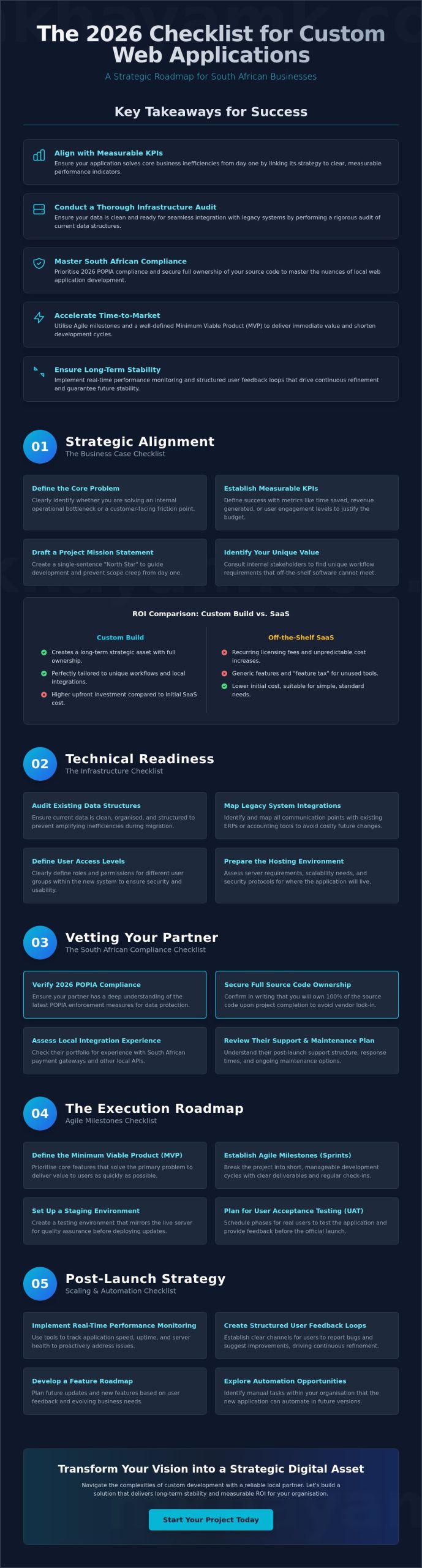
Align your digital strategy with measurable KPIs to ensure your application solves core business inefficiencies from day one.
Conduct a thorough infrastructure audit to ensure your data is clean and ready for seamless integration with legacy systems.
Master the nuances of custom web application development south africa by prioritising 2026 POPIA compliance and securing full ownership of your source code.
Accelerate your time-to-market using Agile milestones and a well-defined Minimum Viable Product to deliver immediate value.
Ensure long-term stability through real-time performance monitoring and structured user feedback loops that drive continuous refinement.
Success begins long before the first line of code is written. In the context of custom web application development south africa, the most common pitfall isn’t technical; it’s a lack of strategic alignment. You must first determine whether you’re solving an internal operational bottleneck or addressing a specific friction point for your customers. A clear understanding of this primary objective ensures that every feature developed serves a practical purpose rather than becoming a costly distraction. By identifying the core problem early, you transform the project from a technical expense into a strategic asset.
Citing the foundational definition of a web application helps clarify that these tools are dynamic systems designed to perform specific tasks via a browser. Because these systems are deeply integrated into your daily business life, they must be built with a specific outcome in mind. If a generic tool cannot handle your specific workflow or lacks the necessary local integrations, the case for a bespoke build becomes clear. This initial homework is what separates high-performing digital tools from abandoned software projects.
To better understand this concept and the foundational phases of development, watch this helpful video:
Once the problem is identified, define what “better” looks like through measurable KPIs. Will you measure success by time saved on manual data entry, revenue generated through a new digital channel, or user engagement levels? Establishing these metrics early allows you to justify a realistic budget range. It’s vital to distinguish between the initial build cost and the long-term value the system generates; a bespoke build might require a higher upfront investment, but it eliminates the recurring “feature tax” of paying for SaaS tools that don’t quite fit your needs.
Defining Your Unique Value Proposition (UVP)
Your application should offer something your competitors’ tools don’t. This starts by consulting with the people who will actually use the software every day. Internal stakeholders provide the most valuable insights into daily workflows that a generic tool simply cannot accommodate. By drafting a single-sentence mission statement for the project, you create a North Star that prevents scope creep. If a proposed feature doesn’t directly support that mission, it doesn’t belong in the initial build.
Evaluating the Strategic Guide to Software
Before committing to a path, it’s wise to review the Custom Software Development in South Africa: A Strategic Guide for 2026. This resource helps you compare the long-term ROI of a custom build against the recurring costs of SaaS licensing fees. Often, the decision to go bespoke is driven by “deal-breakers” such as the need for specific local payment gateway integrations or high-security data handling that international off-the-shelf tools might lack. Identifying these requirements now ensures your custom web application development south africa remains on track and within budget.
Technical & Operational Readiness: The Infrastructure Checklist
Before a single pixel is rendered, you must prepare the environment where your application will live. Technical readiness is the engine room of successful custom web application development south africa. It begins with a rigorous audit of your current data structures. If your existing data is unorganised or fragmented, migrating it to a new platform will only amplify those inefficiencies. A thorough audit ensures your information is clean and structured, allowing you to compete and grow in the digital economy with a solid foundation.
Your new system won’t exist in a vacuum. It must communicate fluently with your legacy systems, whether that’s an existing ERP or a specialised accounting tool. Mapping these integration points early prevents costly architectural changes later in the project. You should also consider the following operational requirements:
User Access Levels: Define who will use the system and what specific permissions they require to protect sensitive data.
Mobile Responsiveness: Whilst every site should be responsive, your business case might require a more robust, dedicated mobile app development strategy for offline access.
Data Flow Mapping: Create a visual guide of how information moves from a user’s input through to your internal databases.
Cloud and Data Strategy
When planning custom web application development south africa, your choice of hosting is just as important as the code itself. You might choose local South African data centres to reduce latency and satisfy specific local governance requirements, or opt for global providers like AWS or Azure for their vast feature sets. We recommend exploring cloud solutions that offer the elasticity needed to scale as your user base expands. This ensures your infrastructure remains a stable anchor even during periods of rapid growth. If you are unsure which path fits your trajectory, you can review our methodical execution process to see how we align technology with your goals.
UI/UX Design Expectations
Vetting Your Partner: The South African Compliance Checklist
Choosing a partner for custom web application development south africa requires looking beyond technical proficiency. You need a collaborator who understands the regulatory and economic pulse of the region. As South Africa’s Digital Economy Growth continues to accelerate, the complexity of compliance and data sovereignty increases. A partner who treats your project as a shared journey toward mutual success will always outperform a simple service provider. This relationship should feel like a supportive partnership, rooted in reliability and forward-looking ambition.
Compliance with the Protection of Personal Information Act (POPIA) is a cornerstone of any 2026 project. Your developer must demonstrate a “privacy by design” approach, ensuring data protection is baked into the architecture rather than added as an afterthought. Equally critical is the matter of Intellectual Property (IP). You must confirm in writing that your organisation will own the source code upon completion. This prevents vendor lock-in and ensures your software remains a long-term asset under your total control, providing the stability your business requires to scale.
Local sector experience provides a significant advantage. A partner who has navigated the specific challenges of South African finance or logistics will anticipate hurdles before they arise. Ask about their post-launch support and maintenance structures. You need to know the exact turnaround time for critical bug fixes. A reliable partner offers clear Service Level Agreements (SLAs) that protect your operations from unexpected downtime, ensuring your digital tools remain operational whilst your business grows. For organisations operating at a larger scale, understanding the full scope of enterprise software development south africa requirements can help you set the right expectations for compliance, data security, and partnership models from the outset.
Assessing Technical Depth and Staffing
Verify the seniority of the engineers assigned to your build. Sales teams often present a polished front, but the actual construction relies on seasoned developers who understand complex system logic. Enquire about staff augmentation options if you anticipate needing to scale your team rapidly during peak development phases. Request case studies that illustrate successful digital transformation for national clients to ensure they can handle high-stakes deployments with precision.
Communication and Culture Fit
Transparency is the bedrock of trust. Ensure your partner uses modern project management tools like Jira or ClickUp, giving you real-time visibility into progress. Establish a weekly “stand-up” rhythm to maintain momentum and address blockers immediately. This cultural alignment ensures that the team understands the unique nuances of our local business environment, from B-BBEE requirements to specific market behaviours. This structured approach moves your project from a broad vision toward a concrete, successful path forward.
The Execution Roadmap: Agile Milestones Checklist
The construction phase moves forward in two-week “sprints.” Each sprint focuses on a specific set of deliverables, allowing you to see the application grow in real-time. This iterative rhythm ensures that you remain a central part of the development journey. Before any feature is considered complete, it must pass through User Acceptance Testing (UAT). This is where your internal team interacts with the software to ensure it meets the practical needs of your daily operations. A successful UAT phase provides the confidence needed to move toward deployment.
When it’s time to launch, your deployment strategy should reflect the scale of your organisation. A “Big Bang” launch might suit smaller tools, but a phased rollout is often the more stable choice for enterprise systems. This allows you to introduce the application to specific user groups first, ensuring that your infrastructure handles the load gracefully. If you’re ready to see how a structured roadmap can bring your vision to life, you can explore our bespoke engineering services to start your journey.
Managing the Development Process
Understanding the process of iterative feedback is essential for long-term success. It prevents the team from drifting away from the original business case and helps catch potential errors before they require expensive fixes. We establish clear “Definition of Done” criteria for every feature, ensuring that nothing moves to the live environment without meeting our rigorous quality standards. A dedicated Quality Assurance (QA) phase acts as a final safety net, verifying that the code is secure, performant, and reliable.
Risk Mitigation and Flexibility
Even the most methodical projects encounter variables. We maintain a live risk register to track potential delays, such as changes in third-party APIs or external hardware shortages. By building a sensible buffer into the timeline, we protect the project from the pressure of unrealistic deadlines. Every change to the original scope is documented with precision, allowing you to track budget impacts accurately and maintain total transparency throughout the build. This structured flexibility is what makes a custom web application development south africa project truly resilient.
The successful deployment of your application marks the transition from construction to refinement. In the context of custom web application development south africa, the post-launch phase is where your strategic preparation truly begins to yield measurable ROI. You’ve built a stable anchor for your business; now you must ensure it remains resilient and responsive to the real-world needs of your team and customers. This period is about transformation, moving from a completed project to a living tool that grows with your organisation.
Effective performance monitoring is your first priority. By using real-time tools to track load times and user drop-off rates, you can identify technical bottlenecks before they impact productivity. This data-driven approach allows you to make informed decisions about where to refine the user experience. Simultaneously, establishing a structured user feedback loop ensures that those using the system daily have a voice in its evolution. Prioritising feature requests based on actual user behaviour prevents the development of “vanity features” that don’t add practical value to your bottom line.
To maintain a competitive edge, consider how AI & data automation can enhance your existing workflows. Integrating intelligent automation can reduce manual data entry and provide predictive insights that were previously inaccessible. Alongside these enhancements, regular security audits are essential. Scheduling frequent penetration testing protects your organisation from evolving cyber threats and reinforces your commitment to POPIA compliance, ensuring that your user data remains secure and your business reputation stays intact whilst you scale.
Long-term Growth and Evolution
Your MVP launch provides the data necessary to plan a robust Version 2.0. As your organisation expands, you may find that your application needs to be integrated into a more comprehensive ERP solution to synchronise your operations across different departments. This level of integration ensures that your digital tools scale alongside your business ambitions. We recommend staying updated with the latest resources on South African web technology trends to ensure your custom web application development south africa project remains a modern, high-performing asset for years to come.
Finalising the Project Transition
A smooth transition requires that your internal team feels a sense of ownership over the new system. Ensure that every administrator is fully trained on the application’s backend and that all technical documentation has been meticulously handed over by your development partner. This transparency ensures you aren’t reliant on external support for basic maintenance or minor configuration changes. Finally, take the time to celebrate the launch. Recognising this achievement builds the internal buy-in and enthusiasm necessary for high user adoption, turning your new software into a celebrated success amongst your staff.
Securing Your Digital Legacy Through Methodical Execution
Transforming a complex business challenge into a high-performing digital asset requires more than just technical skill; it demands a supportive partnership rooted in reliability. Successful custom web application development south africa relies on the synergy between strategic alignment and a disciplined execution roadmap. By prioritising POPIA compliance and establishing clear Agile milestones, you move from a broad vision toward a concrete path for growth. You now have the checklist to ensure your final product delivers measurable ROI whilst maintaining the long-term stability your organisation deserves.
Mkhaya MK serves as your visionary yet practical guide through every stage of this journey. As privately held South African expertise and end-to-end digital transformation specialists, we offer a proven track record in AI, Cloud, and Custom Engineering. We are deeply invested in the personal journey of our clients and value transparency over flashy claims. We invite you to take the next step toward a stable, scalable future. Ready to build your bespoke solution? Contact Mkhaya MK today. Let’s build something exceptional together.
Frequently Asked Questions
Is custom web application development better than using a website builder?
Custom development is superior when your business requires unique workflows, complex data handling, or high scalability that template-based builders cannot support. Whilst builders are excellent for simple brochures, a bespoke build ensures your software adapts to your specific operational needs. This prevents the limitations of “feature tax” and allows for long-term stability as your organisation grows and your processes become more sophisticated.
How much does custom web application development cost in South Africa?
General industry costs for custom web application development south africa vary significantly based on the complexity and the specific technical stack required. Small custom systems typically start from a lower baseline, whilst large enterprise-level platforms can require a substantial investment. These figures depend on the number of integrations, user roles, and security requirements. We focus on delivering measurable ROI by aligning the build with your strategic business goals.
Can a web application be converted into a mobile app later?
Yes, a web application can be extended into a mobile experience through technologies like Progressive Web Apps (PWAs) or hybrid frameworks. By building a robust web-based core first, you create a stable foundation that can be wrapped for app stores later. This phased approach allows you to validate your MVP with users before investing in dedicated mobile development, ensuring your capital is used efficiently and effectively.
How long does it typically take to build a custom web application?
Most projects involving custom web application development south africa move from the initial discovery phase to a functional MVP within three to nine months. The exact duration depends on the clarity of your requirements and the complexity of the integrations involved. Using an Agile approach with two-week sprints allows you to see tangible progress throughout the journey, ensuring the final product remains on track and aligned with your vision.
What is the difference between a website and a web application?
A website primarily focuses on displaying information, whereas a web application is designed to perform specific tasks and process user data. Websites are generally static and informational; in contrast, web applications are dynamic systems that allow users to interact with databases and perform complex functions. This distinction is crucial when deciding if your business requires a simple digital presence or a bespoke, task-oriented operational tool.
What happens if our development partner goes out of business?
You protect your business by ensuring you have full ownership of the source code and all technical documentation from the start. A reliable partner will confirm these Intellectual Property (IP) rights in writing, as discussed in our compliance checklist. By maintaining access to your code repository, you ensure that your digital asset remains a stable anchor, even if you need to transition to a new support team.
How does POPIA affect the development of our web application?
The Protection of Personal Information Act (POPIA) requires that your application incorporates “privacy by design” to protect all user data processed within South Africa. This means security measures, such as encryption and access controls, must be built into the architecture from day one. Compliance isn’t just a legal hurdle; it’s a commitment to your users’ trust and the long-term integrity of your digital infrastructure and business reputation.
Can we integrate our existing Excel data into a new web application?
Yes, your existing Excel data can be cleaned, structured, and migrated into a new web application through a methodical ETL (Extract, Transform, Load) process. Moving away from fragmented spreadsheets into a centralised database reduces manual errors and improves data visibility across your team. This transition is a vital step in digital transformation, allowing your data to work harder for your business in a secure, multi-user environment. For larger organisations navigating this shift, reviewing a dedicated enterprise software development south africa outsourcing guide can provide valuable context on managing data migration, POPIA compliance, and partner selection at scale.
What if the primary barrier to your enterprise’s growth isn’t a lack of ambition, but the weight of technical debt holding your team back? This complete guide to Mkhaya MK explores how forward-thinking organisations are shedding inefficient legacy systems to reclaim their momentum in a shifting market. It’s frustrating to watch digital transformation cycles stall whilst your competitors adopt more agile, automated frameworks. You’ve likely felt the pressure of searching for elite engineering talent in a South African market that often feels stretched thin.
We’re here to change that narrative. You’ll discover how Mkhaya MK integrates custom software, AI automation, and cloud solutions to help you scale with precision and confidence. By the end of this guide, you’ll have a clear understanding of how our ERP solutions, staff augmentation, and UI/UX design services can reduce your operational costs. We provide a structured roadmap that moves your business from high-level strategic concepts to a concrete path of technological refinement and long-term stability.
Key Takeaways
Understand how modernising business workflows strengthens South African enterprises and provides a stable foundation for national growth.
Learn how to leverage this complete guide to Mkhaya MK to integrate bespoke software and AI automation that eliminates repetitive manual tasks.
Explore how cloud infrastructure and comprehensive ERP solutions synchronise front-end and back-end operations for maximum efficiency.
Discover how to bridge the skills gap by accessing elite engineering talent through flexible staff augmentation models tailored to your team’s needs.
Identify high-impact proprietary systems, such as loan management and procurement platforms, designed to address specific industry challenges in the local market.
Defining the Mkhaya MK Approach to Digital Transformation
Mkhaya MK stands as a premier South African technology firm, specialising in the intricate world of custom software engineering and artificial intelligence. This complete guide to Mkhaya MK reveals a philosophy that goes beyond mere coding. We focus on modernising business workflows to ensure national stability and sustainable growth for the local economy. It’s not just about selling a product; it’s about building a digital transformation strategy that acts as a stable anchor in a volatile market.
Our approach integrates cloud infrastructure, data automation, and user-centric design to create high-impact digital experiences. We prioritise long-term partnerships over transactional sales, ensuring that every solution we build is a collaborative effort. By refining internal processes, we help enterprises move from fragmented operations to a unified, scalable ecosystem. To better understand this concept, watch this helpful video:
A Vision for South African Enterprise Growth
Aligning technology goals with national economic objectives is at the heart of our mission. We believe that when South African enterprises scale, the entire country benefits from increased stability and innovation. Mkhaya MK supports digital maturity by guiding organisations through complex transitions with a sense of quiet confidence. We value methodical execution over flashy claims, ensuring that large-scale projects are delivered with precision. This approach allows businesses across various sectors to evolve without the high-pressure urgency that often leads to technical errors. It’s about creating a roadmap that feels both visionary and practical.
The Core Pillars of Modern Software Engineering
Stability and customisation form the foundation of every build we undertake. Many organisations struggle with cloud-native architectures because they’re tethered to inefficient legacy systems. We specialise in bridging this gap, moving your operations toward agile frameworks that can handle future demands. Our commitment to integrity and transparency means you’re never in the dark about the development lifecycle. We focus on several key areas to ensure your success:
Precision-engineered code that matches your specific business logic.
Refined UI/UX design to ensure user adoption and satisfaction.
Robust AI and data automation to drive operational efficiency.
By maintaining a high-end register and a focus on business results, we ensure that the value of our engineering remains clear to both technical and non-technical stakeholders. We don’t just build software; we construct the digital infrastructure required for your long-term stability.
Custom Software Development: Beyond Just Coding
Building a digital ecosystem requires more than just technical proficiency; it demands a deep understanding of how your business breathes. Mkhaya MK delivers bespoke web and mobile applications that don’t just function but are meticulously designed around your specific business logic. This complete guide to Mkhaya MK highlights our commitment to full-stack engineering, where front-end aesthetics and back-end stability are perfectly synchronised. We treat software engineering as a tool to dismantle unique operational bottlenecks that generic, off-the-shelf products often ignore.
Reliability is the cornerstone of our development process. Every line of code undergoes rigorous testing and quality assurance to ensure enterprise-grade performance. We understand that for a South African enterprise, downtime isn’t just an inconvenience; it’s a loss of momentum. By focusing on precision and construction, we create software that serves as a stable anchor for your daily operations. This methodical execution reflects our persona of quiet confidence, where we value transparency and stability over flashy, untested features.
UI/UX Design as a Driver for User Adoption
The success of any internal tool depends entirely on whether your team actually uses it. This is why UI/UX design services are a core component of our development lifecycle. We balance aesthetic appeal with functional efficiency, ensuring that corporate users can navigate complex workflows without friction. Our approach to user-centric design focuses on digital engagement, making technology feel like a supportive partner rather than a hurdle. If you’re looking to refine your current interface, you might want to speak with our design team about your specific needs.
Developing Scalable Web and Mobile Applications
Growth should never be hindered by your technology stack. We build applications that grow alongside your organisation, avoiding the need for constant, costly re-engineering. Our cross-platform mobile development strategies are particularly effective for national workforces that require access across various devices and locations. We ensure that these custom apps integrate seamlessly with your existing ERP systems and legacy databases, creating a unified flow of information. This approach prevents data silos and ensures that your digital infrastructure remains robust and responsive as you expand your market presence.
Harnessing AI, Data Automation, and Cloud Infrastructure
Custom software provides the framework for your business, but the real competitive edge in 2026 stems from how you manage and utilise your data. This complete guide to Mkhaya MK highlights the critical synergy between intelligence and infrastructure. By leveraging AI and data automation, we help your organisation eliminate repetitive manual tasks that drain your team’s creative energy. It’s about refinement. It’s about precision. We build systems that learn from your operations, allowing your business to evolve without constant human intervention.
Strategic data analytics acts as a vital compass for executive decision-making. Modern enterprises often find themselves drowning in information but starving for actionable intelligence. We bridge this gap by transforming raw data into clear, visualised insights that help you steer the organisation with confidence. Managed DevOps services ensure that these high-growth digital platforms remain online and responsive, even during peak traffic periods. We focus on construction and stability, ensuring that your software delivery cycles are both fast and reliable. This methodical execution creates a stable anchor for your digital ambitions.
AI-Driven Automation for Operational Efficiency
Implementing robotic process automation (RPA) allows your staff to focus on high-value strategic work rather than mundane data entry. We design custom AI models tailored specifically to South African business data environments. These models account for local market nuances and regional economic shifts. These data-driven insights help you predict internal performance trends before they impact your bottom line. By automating the heavy lifting of data processing, you reduce operational costs and minimise the risk of human error in critical workflows. Efficiency isn’t just a goal; it’s a result of deliberate engineering.
Cloud Migration and Managed DevOps Services
Transitioning to the cloud is a critical step for any enterprise seeking long-term stability and global reach. Our strategic cloud solutions provide secure, scalable hosting that adapts to your growth in real time. We manage the full DevOps lifecycle to ensure continuous integration and deployment. This approach significantly improves your platform’s uptime and allows for seamless updates without disrupting the user experience. Security remains at the forefront of every migration. We ensure your cloud-native applications comply with local data regulations, providing a safe harbour for your most sensitive corporate information. Your infrastructure should be a foundation, not a bottleneck.
Industry-Specific Proprietary Systems and ERP Solutions
Whilst bespoke software solves unique problems, many South African enterprises find that their core challenges align with specific industry standards. This complete guide to Mkhaya MK highlights our suite of proprietary systems designed to address these common hurdles with precision. Our ERP solutions serve as the central nervous system for your organisation. They integrate disparate departments into a unified workflow, ensuring that your data remains accurate and accessible across all levels of management. This integration eliminates the silos that often lead to miscommunication and financial discrepancies, providing a stable foundation for corporate scaling.
We believe that technology should adapt to your business, not the other way around. By offering pre-built yet highly customisable systems, we help you achieve a faster time-to-market without sacrificing the refinement of a custom build. Each platform is constructed with the local market in mind, accounting for South African regulations and business behaviours. This methodical approach reinforces our commitment to your long-term success, providing you with tools that are both visionary and practical.
Streamlining Credit with Loan Management Systems
Credit operations demand a sophisticated balance of speed and risk mitigation. We provide loan management systems that automate the end-to-end credit lifecycle. This journey begins at the application stage and continues through to recovery, ensuring that no detail is overlooked. By managing risk and compliance within a centralised digital platform, you protect your organisation’s stability whilst offering borrowers a transparent, modern experience. These digital portals simplify the process for the end-user, creating a sense of reliability and trust that is essential in the financial sector.
Facility and Learner Management: Optimising Resources
Partnering for Success: Staff Augmentation and the Mkhaya Process
Technology is only as effective as the people who build and maintain it. This complete guide to Mkhaya MK highlights how we bridge the talent gap through staff augmentation. Many South African enterprises find that their growth is limited by a lack of specialised skills in the local market. We provide access to elite technical talent, allowing you to hire remote or on-site developers who act as a seamless extension of your own team. This isn’t just about filling seats; it’s about finding the right partners to ensure long-term stability and project success.
Our engagement model focuses on reliability and mutual success. We manage the technical professionals so you can focus on the strategic outcomes that matter most to your stakeholders. This structured approach provides a stable anchor in a rapidly changing technological landscape. It ensures that your internal teams aren’t overwhelmed by the complexities of modern software engineering. By leveraging our expertise, you can scale your operations with the quiet confidence that your infrastructure is built on a foundation of integrity and commitment.
Scaling Tech Teams with Managed Staff Augmentation
Accessing pre-vetted software engineers reduces recruitment overheads significantly. You keep control over project direction whilst benefiting from the specialised knowledge of external experts. This model is particularly effective for national projects that require rapid scaling or specific technical niches that are hard to find in the local market. We handle the management of these professionals, ensuring they align with your corporate culture and technical standards. It’s a practical way to maintain momentum without the risk of hiring the wrong fit or suffering from long, expensive recruitment cycles.
The Mkhaya MK Process: From Discovery to Deployment
We follow a logical, four-step progression to ensure every build meets your specific business requirements. This structured process ensures that your digital journey is predictable and successful:
Step 1: Deep Discovery. We begin with a thorough investigation into your business objectives and technical requirements to ensure perfect alignment.
Step 2: Strategic Design. Our team creates an architectural plan that prioritises precision, security, and future scalability.
Step 3: Agile Development. We build in cycles, providing regular feedback loops and transparent reporting to keep you informed of every milestone.
Step 4: Deployment and Support. Once the solution is live, we provide managed support for continuous optimisation and stability.
The journey toward digital maturity is a personal one for every client. We position ourselves as a visionary guide, deeply invested in your success. Whether you’re integrating AI and data automation or deploying a new ERP solution, our process remains consistent. We value transparency and methodical execution over flashy claims. This commitment to quality ensures that your technology roadmap in this complete guide to Mkhaya MK is not just a plan, but a concrete path toward reduced costs and increased efficiency.
Building Your Digital Future with Mkhaya MK
Digital transformation is a continuous journey of refinement and construction. We’ve explored how integrating custom software, cloud infrastructure, and AI automation creates a stable anchor for your enterprise. This complete guide to Mkhaya MK demonstrates our commitment to providing end-to-end expertise that bridges the gap between complex technology and practical business outcomes. Whether you require specialised proprietary systems for finance and logistics or access to elite South African tech talent through staff augmentation, our focus remains on your long-term stability.
Our national reach and methodical execution ensure that your scaling efforts are supported by a partner deeply invested in your success. It’s time to move from high-level vision to concrete execution. Contact Mkhaya MK to start your digital transformation journey today and secure your place in South Africa’s evolving digital landscape. We’re ready to build something remarkable together, ensuring your business remains agile and resilient for years to come.
Frequently Asked Questions
What services does Mkhaya MK provide for South African businesses?
Mkhaya MK offers a comprehensive suite of technology services including custom software development, AI and data automation, and cloud application services. We also provide specialised proprietary products such as loan management, learner management, and facility management systems. Our focus remains on refining business workflows through precise engineering and construction-focused digital experiences that support national growth.
How does staff augmentation differ from project-based software development?
Staff augmentation involves extending your internal team with our pre-vetted software engineers, whilst project-based development is an end-to-end service where we manage the entire lifecycle of a specific build. Augmentation provides you with direct control over the developers’ daily tasks. Project-based delivery follows our internal Mkhaya process to achieve a specific business outcome within a defined roadmap.
Can Mkhaya MK help with cloud migration and DevOps management?
Yes, we provide strategic cloud application services and managed DevOps to ensure your platforms are secure and scalable. We focus on transitioning legacy systems to cloud-native architectures that improve uptime and streamline deployment cycles. This service is designed to act as a stable anchor for high-growth enterprises that require robust infrastructure to handle increasing user demands.
Does Mkhaya MK offer specialised systems for the financial sector?
We deliver proprietary loan management systems specifically designed to automate the end-to-end credit lifecycle for South African financial institutions. These systems manage everything from the initial application to final recovery within a centralised digital framework. This complete guide to Mkhaya MK highlights how these tools help credit providers balance risk mitigation with a refined borrower experience.
What is the Mkhaya MK process for starting a new software project?
Our engagement begins with a deep discovery phase to identify your specific business objectives and technical requirements. Once we’ve established a clear vision, we move into strategic architectural planning and agile development. This structured progression ensures that each milestone is met with transparency and precision before the final deployment and managed support phase begins.
How does Mkhaya MK ensure the security of custom applications?
Security is integrated into every stage of our development lifecycle through rigorous quality assurance and testing protocols. We build applications that comply with South African data regulations, ensuring that your corporate information is protected within cloud-native environments. Our methodical execution prioritises long-term stability and reliability, preventing vulnerabilities that often arise from rushed or low-quality builds.
Is Mkhaya MK able to provide remote developers for my internal team?
We offer flexible staff augmentation services that allow you to hire remote or on-site developers based on your organisation’s needs. This service provides immediate access to elite engineering talent without the long-term overheads of traditional recruitment. It’s a practical solution for scaling your technical capabilities whilst maintaining project momentum and internal control.
What industries can benefit from Mkhaya MK’s facility management systems?
Any organisation managing physical assets, such as logistics companies, large-scale retailers, or corporate office centres, can benefit from our facility management systems. These platforms improve asset tracking and maintenance schedules, reducing the risk of neglected infrastructure. This complete guide to Mkhaya MK illustrates how these tools help industries optimise their resources and reduce operational friction through better data visibility.
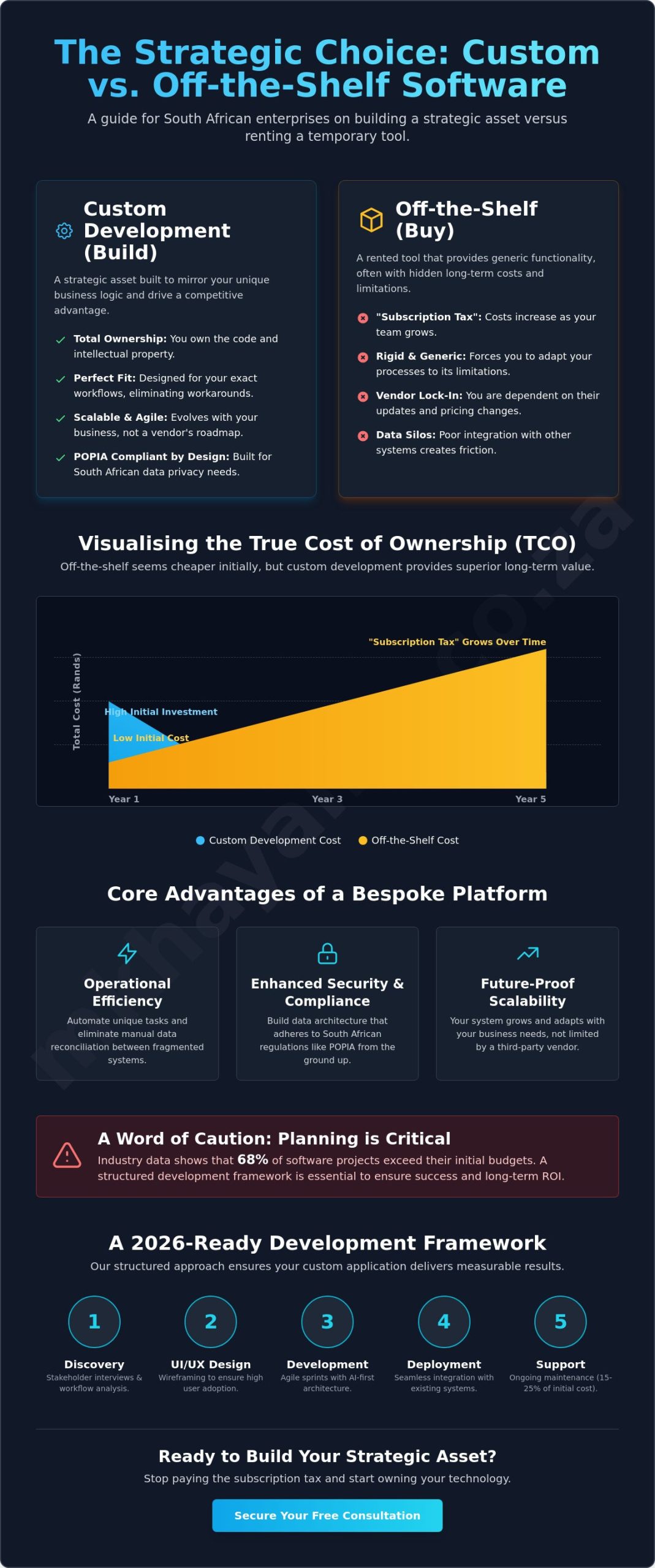
What if the software meant to streamline your South African enterprise is actually the very thing holding your growth back? Many local leaders find themselves trapped by rigid, off-the-shelf platforms that force internal processes to bend to the code, rather than the other way around. When you invest in custom application development for business, you aren’t just buying a tool; you’re securing a strategic asset that you own entirely. With 68% of software projects exceeding their initial budgets, choosing the right path between bespoke builds and ready-made subscriptions is the difference between operational agility and a permanent subscription tax on your bottom line.
It’s frustrating to feel like a guest in your own digital infrastructure, especially when legacy systems won’t talk to new cloud tools. We believe your technology should be a stable anchor, not a source of friction. This article helps you evaluate, compare, and implement custom strategies that drive long-term ROI and operational efficiency. We’ll explore the 2026 shift toward AI-first architecture, compare the true costs of ownership in Rands, and map out a clear journey toward a scalable system that evolves alongside your business.
Key Takeaways
Identify the specific operational triggers that signal when off-the-shelf software is no longer sufficient and learn how to transition to a solution that fits your unique workflows.
Understand how custom application development for business serves as a strategic asset by removing the “subscription tax” and enabling deep, bespoke AI-driven automation.
Compare the advantages of staff augmentation versus full project outsourcing to determine the most efficient way to bridge your internal technical talent gaps whilst maintaining momentum.
Follow a structured 2026 development framework that prioritises stakeholder discovery and UI/UX design to ensure your new system delivers measurable operational efficiency and high user adoption.
Explore how bespoke platforms for loan and facility management provide the stability and precision needed to scale an enterprise within the South African regulatory landscape.
Custom Application Development vs. Off-the-Shelf: The Strategic Choice
Choosing the right digital foundation is a defining moment for any modern enterprise. Most organisations start with off-the-shelf Software as a Service (SaaS) because it’s convenient; however, this convenience often comes with a hidden ceiling. Whilst a generic tool might handle basic tasks, it lacks the surgical precision required for high-stakes operations. Investing in custom application development for business allows you to build a system that mirrors your exact logic. For South African firms, owning custom software isn’t just about technical control; it’s about protecting your intellectual property in a competitive market.
The hidden costs of trying to force a generic platform to fit complex workflows often exceed the price of building from scratch. You might spend hundreds of hours on configuration, only to find that a software update breaks your customisations. High-quality custom application development for business avoids this cycle. Whilst research shows that ongoing maintenance usually costs between 15% and 25% of the initial investment annually, this is a predictable cost for an asset you own, rather than a perpetual rent for a tool you don’t.
To better understand how tailored solutions can transform your operations, watch this brief overview:
The Build vs. Buy Framework
Deciding between building or buying requires a clear look at your long-term Total Cost of Ownership (TCO). A SaaS subscription might look cheaper on day one, but the subscription tax grows as you scale. You also need to consider how well a tool integrates with your existing ERP solutions. If a generic platform requires expensive, brittle middleware to talk to your core systems, the initial savings vanish. We recommend bespoke builds when your workflow is a primary source of competitive advantage. If your process is unique, your software must be too.
The Flexibility Factor in a Shifting Market
The South African business environment requires agility. External vendors often change their product roadmaps without warning, which can leave your team scrambling to adapt. Bespoke applications remove this risk by giving you total control over every feature. This independence is especially vital for POPIA compliance. Generic international tools don’t always align with South African data privacy nuances, potentially exposing you to regulatory risks. By choosing a custom path, you ensure that your data architecture is built with local compliance and your specific growth trajectory in mind.
Evaluating the Long-Term ROI of Bespoke Business Solutions
Calculating the return on investment for high-end technology requires a shift in perspective. Whilst the initial price tag of a bespoke build might seem higher than a monthly subscription, the long-term financial health of your enterprise depends on capital value rather than operational expenses. By 2026, the real value of custom application development for business lies in its ability to eliminate the “subscription tax” that grows alongside your headcount. Instead of paying more as you succeed, you own a fixed-cost asset that appreciates in utility as it becomes more deeply embedded in your unique operations.
One of the most significant ROI drivers is the elimination of fragmented data silos. When information is trapped in separate, generic tools, your team wastes hours on manual reconciliation. A bespoke system creates a single source of truth, allowing for seamless AI and data automation that standard software simply cannot replicate. By 2026, AI is no longer a secondary feature; it’s a foundational layer that identifies inefficiencies before they impact your bottom line. If you’re ready to explore how a tailored architecture could streamline your specific workflows, our team can help you map out a strategic path forward.
Efficiency Gains and Labour Cost Reduction
Bespoke solutions allow you to quantify success through recovered time. By automating repetitive data entry and reducing the “human-in-the-loop” for administrative approvals, businesses can redirect their most expensive resource; human talent; toward high-value strategy. AI-driven custom apps can predict operational bottlenecks by analysing historical workflow patterns in real-time to suggest proactive adjustments. This level of precision ensures that your labour costs remain stable even as your output increases.
Scalability: Preparing for National Expansion
Growth shouldn’t be penalised by software vendors. A major advantage of bespoke builds is the ability to scale from 100 to 10,000 users without the burden of exponential licensing fees. Leveraging robust cloud application services ensures your infrastructure remains performant across multiple provinces. This future-proof approach allows you to invest in your own feature roadmap, ensuring your technology stack remains a stable, high-performance engine for the next five years of innovation and beyond.
Bridging the Talent Gap: Staff Augmentation vs. Full Project Outsourcing
Success in custom application development for business depends as much on the people as it does on the code. Many South African enterprises face a significant hurdle: the local scarcity of senior-level technical talent. To overcome this, leaders often choose between handing over an entire project to an external partner or augmenting their existing team with specialised contractors. Both paths offer unique advantages; the right choice depends on your internal capacity and the complexity of your roadmap. We believe that technology should empower your team, not create a recruitment bottleneck that slows your momentum.
Managing the long-term health of your application requires a deliberate strategy for knowledge transfer. Whether you outsource the whole project or hire temporary experts, ensure that your partner documents every architectural decision. This transparency ensures that your internal team can maintain and scale the system long after the initial build is complete. Reliability is built on this mutual commitment to clarity and shared success. By choosing a partner who values transparency, you secure the future of your digital assets whilst keeping your internal stakeholders informed and confident.
The Project-Based Delivery Model
This model is ideal when you have well-defined requirements and need a rapid time-to-market. By opting for end-to-end software engineering services, you leverage a partner’s entire infrastructure, including their QA testers and UI/UX designers. This approach minimises the management burden on your internal staff, allowing them to focus on core business operations whilst the external team handles the heavy lifting of construction. For a deeper look at planning these initiatives, our Strategic Guide for 2026 provides a comprehensive roadmap for project success.
Staff Augmentation: Speed and Flexibility
If you already have an internal dev team but lack specific expertise or extra hands for a temporary surge, staff augmentation is the most agile solution. It allows you to scale your workforce with senior engineers who integrate directly into your existing culture and workflows. This method keeps you in the driver’s seat; you maintain full control over the daily development process and the feature roadmap. It also significantly reduces recruitment lead times and overheads, which is critical when you need to respond to market shifts before your competitors do.
Navigating the Development Lifecycle: A 2026 Framework for Success
Building a high-performance digital asset requires more than just technical skill; it demands a structured, rhythmic progression from vision to execution. Successful custom application development for business in 2026 involves a five-phase lifecycle designed to minimise risk whilst maximising operational impact. This journey begins with deep discovery and stakeholder alignment to define core KPIs, ensuring every line of code serves a commercial purpose. Following this, we move into prototyping and user-centric UI/UX design to validate the solution before full-scale construction begins.
The middle stages focus on agile development, utilising continuous integration and deployment (CI/CD) to maintain momentum. Security is never an afterthought; phase four involves rigorous testing and specific South African data compliance checks to meet POPIA standards. Finally, the lifecycle concludes with managed deployment and ongoing digital transformation consulting. This ensures your software doesn’t just launch, but evolves as a stable anchor in your technological landscape. If you’re ready to build a solution that truly fits your organisation, you can start your discovery journey with us today.
The Discovery Phase: Beyond Technical Specs
We believe in identifying the underlying business problem before selecting a technology stack. By mapping intricate user journeys, we ensure the application solves real-world pains rather than just adding another layer of complexity. This phase is about transparency and methodical execution, where we align the software’s capabilities with your long-term stability. Securing active stakeholder buy-in from the outset remains the single most accurate predictor of a project’s long-term success. This collaborative foundation prevents the “feature creep” that often leads to budget overruns in less structured projects.
DevOps and Continuous Modernisation
Modern software requires a “shift-left” approach to quality, where automated testing is integrated into the earliest stages of development. Cloud-native architecture is essential for South African enterprises, providing resilience against local infrastructure challenges and ensuring high availability. We also look at how mobile app development integrates into your broader ecosystem, allowing your workforce to remain productive whilst on the move. By adopting these DevOps principles, you ensure your application remains agile and ready for the next wave of innovation without requiring a total rebuild.
Scaling with Confidence: Why Mkhaya MK is Your Development Partner
Our expertise extends into highly specialised sectors where generic tools often fail to meet the mark. Whether we are developing a sophisticated loan management system or a robust facility management system, our focus remains on methodical execution. We organise our teams to ensure continuity and deep knowledge retention, which is vital for the ongoing health of your software. This structured rhythm of engagement creates a sense of momentum, leading your business from a broad vision toward a clear, successful path forward.
Proven Expertise in Digital Transformation
Start Your Custom Journey Today
Engaging with Mkhaya MK begins with a strategic consultation where we listen to your unique challenges and aspirations. We value transparency and integrity above all else, providing a clear roadmap for your project without the high-pressure urgency common in the tech sector. Our promise is one of technical excellence and supportive partnership, ensuring you remain in control of your digital future. Ready to build your competitive advantage? Contact our expert team to discuss how we can bring your vision to life with a bespoke solution built for the South African context.
Building Your Strategic Advantage in a Digital First Era
Owning your operational intellectual property is no longer a luxury; it’s a strategic necessity for any enterprise looking to thrive in 2026. We’ve explored how custom application development for business provides the flexibility to pivot quickly whilst avoiding the long-term trap of rigid licensing fees. By choosing a tailored approach, you ensure that your technology integrates seamlessly with your existing infrastructure and evolves alongside your team’s ambitions. This path leads to full control over your feature roadmap and a system that grows with you rather than holding you back.
Mkhaya MK stands as your dedicated partner in this journey. As end-to-end digital transformation experts with national South African service coverage, we bring technical precision and business pragmatism to every project. Our experience with specialised proprietary systems for loans and facilities ensures that your build is rooted in practical, results-driven enterprise software development in South Africa. We’re committed to your long-term stability and mutual success. Partner with Mkhaya MK for your next custom development project and take the first step toward a scalable, high-performance future. We look forward to building something exceptional together.
Frequently Asked Questions
How much does custom application development for business typically cost in 2026?
The investment required for a bespoke build depends on the complexity of your workflows and the depth of integration with existing systems. Whilst industry averages suggest allocating 15% to 25% of the initial development cost for annual maintenance, the total price is influenced by your specific feature roadmap. We focus on providing a transparent breakdown of costs that aligns with your long-term ROI rather than offering a generic, one-size-fits-all estimate.
How long does it take to build a bespoke business application?
A typical development timeline ranges from three to nine months for a production-ready enterprise system. Smaller projects or Minimum Viable Products (MVPs) can often be launched in approximately twelve weeks to gather user feedback quickly. This duration allows for a thorough discovery phase and rigorous testing, ensuring the final application is a stable anchor for your operations.
What is the difference between custom web apps and mobile applications?
Web applications are accessed through a browser and offer broad compatibility across various devices without requiring a download. Mobile applications are built specifically for iOS or Android platforms to leverage hardware features like GPS or offline storage. For most custom application development for business, a web-based approach provides the best balance of accessibility and scalability for internal teams. To ensure your web-based project stays on track from the outset, review our detailed custom web application development South Africa project success checklist covering everything from POPIA compliance to measurable ROI.
Can custom software integrate with our existing legacy ERP systems?
Yes, bespoke solutions are specifically engineered to bridge the gap between modern cloud infrastructure and legacy South African ERP systems. We utilise secure APIs and custom middleware to ensure that data flows seamlessly between your old and new platforms. This integration eliminates manual data entry and prevents the creation of fragmented information silos within your organisation.
How do we ensure our custom application is POPIA compliant?
Compliance is achieved by integrating “privacy by design” principles into the earliest stages of the development lifecycle. This involves implementing robust encryption, granular access controls, and automated data retention policies that align with South African regulations. We also prioritise hosting on local servers when necessary to meet specific data residency requirements for sensitive information.
What happens to the software once the development project is finished?
You maintain full ownership of the source code and the intellectual property once the initial build is complete. Most enterprises then transition into a managed support phase to handle routine security updates and performance optimisations. This ensures that your application remains a reliable asset that can be refined as your business strategy evolves over time.
Is staff augmentation better than hiring a full-time in-house developer?
Staff augmentation is often more efficient for projects with a defined scope as it provides immediate access to senior expertise without long-term recruitment overheads. It allows you to scale your team’s capacity during peak development periods whilst maintaining internal control. In-house hires are generally better suited for businesses that require permanent, daily maintenance of a static product over many years.
What is the most common reason custom software projects fail?
The primary predictor of failure is a lack of stakeholder alignment and poorly defined requirements at the start of the project. When the technical roadmap doesn’t match the commercial goals, scope creep often leads to budget overruns and delays. We mitigate this risk by using a structured discovery framework that ensures all parties are committed to the same core KPIs before a single line of code is written. For a practical tool to help you avoid these pitfalls, our 2026 checklist for custom web application development in South Africa provides a step-by-step guide to structuring your project for success from day one.