

How Inefficient Workflows Impact Profitability: The 2026 Executive Guide
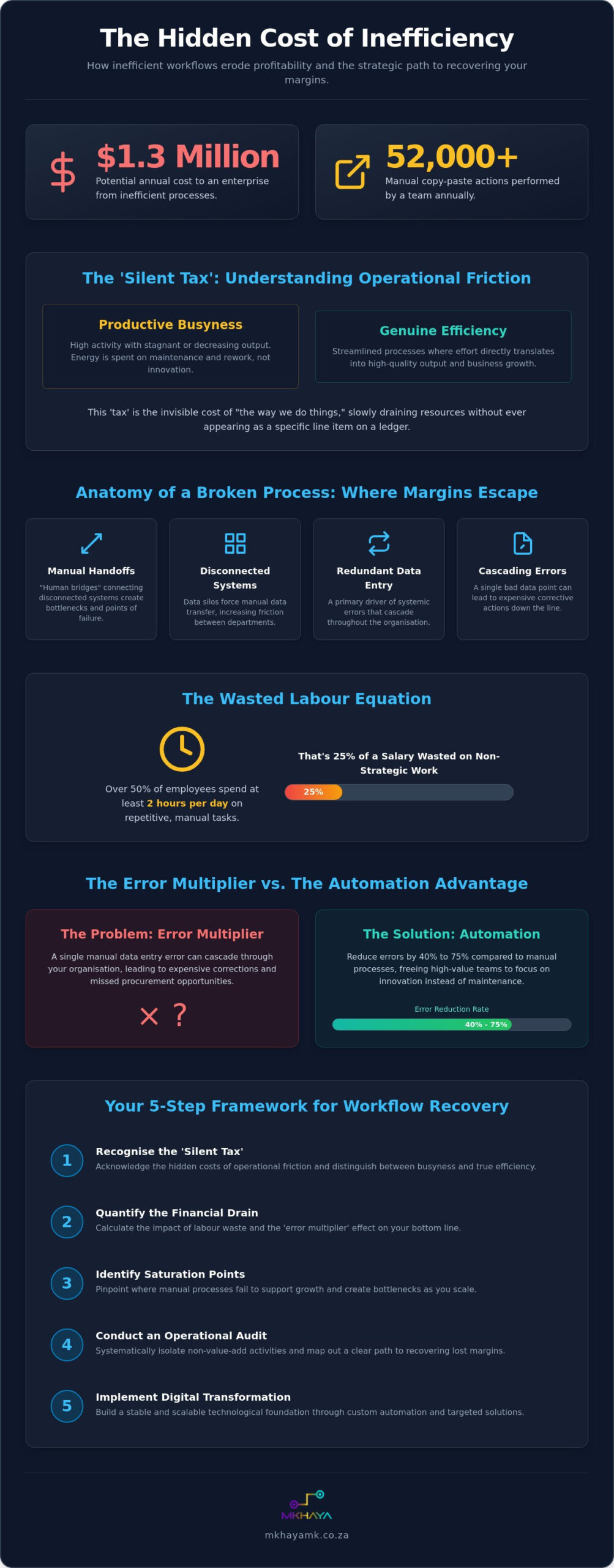
Did you know that inefficient processes can cost an enterprise up to $1.3 million every single year? When your team performs over 52,000 manual copy-paste actions annually, you aren’t just losing time; you’re actively eroding your competitive edge. Understanding exactly how inefficient workflows impact profitability is no longer a back-office concern. It’s a critical executive priority for 2026.
You’ve likely felt the strain of rising labour costs that don’t seem to translate into higher output. It’s a common frustration to see talented staff burning out whilst data silos create friction across every department. We’re here to help you identify these hidden financial leaks and recover your lost margins through precise digital optimisation. This guide explores the path toward clear operational visibility, reduced overheads through automation, and a stable technological foundation built for long-term growth. By refining your internal architecture, you can transform these systemic bottlenecks into a scalable engine for future success.
Key Takeaways
- Recognise the “silent tax” of operational friction and the vital difference between productive busyness and genuine efficiency.
- Quantify the financial drain on your business by learning how inefficient workflows impact profitability through labour waste and the “error multiplier” effect.
- Identify the saturation points where manual processes fail to support growth, helping you avoid the common pitfalls of scaling without digital refinement.
- Master a step-by-step framework for conducting operational audits that isolate non-value-add activities and recover lost margins.
- Discover how custom digital transformation and targeted staff augmentation can provide the stable foundation needed for sustainable future expansion.
The “Silent Tax”: How Inefficiency Erodes Business Margins
The “silent tax” is a phenomenon where operational friction slowly drains resources without ever appearing as a specific line item on a ledger. It’s the point where the “way we do things” actually costs more than the value those actions produce. For many leaders, the distinction between productive busyness and genuine operational efficiency remains blurred. Your team might be working late and moving quickly, yet the actual output remains stagnant or, worse, decreases in quality. This discrepancy is a clear indicator of structural waste.
In the South African context, enterprises frequently ignore these subtle leaks until they manifest as a disappointing annual report. By then, the damage to the bottom line is already done. Understanding how inefficient workflows impact profitability requires a shift in perspective. You must view every process through the lens of “Workflow ROI,” a key performance metric for 2026 that measures the net value generated by a specific sequence of tasks against the cost of its execution. This guide highlights how inefficient workflows impact profitability by diverting energy away from innovation and toward maintenance.
To better understand the tangible consequences of these hidden leaks, watch this helpful video:
The Anatomy of a Broken Process
A broken process is rarely a single catastrophic failure. Instead, it’s composed of manual handoffs and “human bridges” that try to connect disconnected software systems. When your staff must manually copy data from one platform to another, they aren’t just performing a task; they’re creating a point of failure. Redundant data entry is a primary driver of systemic errors that cascade throughout the organisation. This lack of clear visibility forces leaders into a cycle of “management by firefighting,” where they react to immediate crises rather than executing long-term strategy. Adopting a structured approach to Business process management (BPM) allows you to map these touchpoints and identify exactly where your margins are escaping.
Why Growth Often Masks Inefficiency
Rapid expansion can be a double-edged sword. Whilst rising revenue looks excellent on a dashboard, it often hides a declining net profit margin caused by “scaling the mess.” If your underlying workflows are flawed, adding more volume simply amplifies the waste. This is a primary reason why many executives wonder why they’re working harder but seeing less profit at the end of the month. Beyond the financial impact, the psychological cost is immense. High-performing talent will not tolerate broken systems for long. When professionals spend their days fixing avoidable errors rather than contributing to high-level goals, they eventually seek opportunities elsewhere. True digital transformation isn’t just about software; it’s about building a stable environment where your team can thrive without being hampered by structural decay.
Quantifying the Impact: The Financial Cost of Inefficiency
Moving from the abstract concept of the “silent tax” to concrete figures requires a cold look at your payroll and output. When we analyse how inefficient workflows impact profitability, we must look beyond obvious line items like rent or raw materials. The most significant drain often comes from labour waste. Research indicates that more than half of employees spend at least two hours every day on repetitive, manual tasks. For a skilled professional, this means 25% of their salary is effectively being spent on administrative work that adds zero strategic value to the business.
The “error multiplier” further compounds this loss. A single bad data point entered manually into a spreadsheet can cascade through your organisation, leading to expensive corrective actions or missed procurement opportunities. Automated processes can see error reduction rates between 40% and 75% compared to manual ones. When your team is bogged down in these corrective cycles, the opportunity cost is immense. Revenue is lost whilst high-value teams are stuck in “maintenance mode” instead of focusing on innovation or business development. This internal friction eventually spills over to the customer, where slow internal workflows lead to delayed responses and a poor user experience, directly driving customer churn.
Direct vs Indirect Financial Leaks
Financial leaks manifest in two distinct ways. Direct costs are easily visible: unnecessary overtime pay, software licences for tools that no longer serve a purpose, and physical material waste. Indirect costs are more insidious. They include damage to your brand reputation and a significantly slowed time-to-market for new products. We define “operational drag” as the systemic friction that traps capital in unproductive cycles, effectively reducing the impact of every Rand invested in the business. This is particularly evident in heavy industries. Research has shown the efficacy of digital tools in addressing longstanding challenges in the construction industry, proving that process refinement is the primary driver of schedule adherence and margin recovery.
The Long-term Cost of Technical Debt
Legacy systems often become more expensive to maintain than to replace. Many South African enterprises rely on “workarounds” that were intended to be temporary but have become permanent, inefficient fixtures in their daily operations. These stop-gap measures create technical debt that interest-loads your operational costs. Investing in custom software engineering isn’t just about getting new technology; it’s a strategic investment in margin recovery. By building systems tailored to your specific logic, you eliminate the need for these expensive manual interventions. If you’re noticing your team is bogged down by repetitive work, exploring AI and data automation can help bridge those gaps and restore your competitive edge.
The Complexity Trap: Why Scaling Without Optimisation Fails
Scaling a business is often viewed as a linear progression where more sales lead to more revenue, which should lead to more profit. However, many South African organisations fall into the “complexity trap.” This occurs when growth outpaces the capacity of existing manual processes. A common reaction is to “throw more people at the problem,” but this often triggers Brooks’s Law. Originally applied to software development, this principle suggests that adding manpower to a late project actually makes it later due to the increased communication overhead. In an operational context, hiring more staff to manage a broken workflow simply adds another layer of coordination, often decreasing overall efficiency.
This is the point where how inefficient workflows impact profitability becomes undeniably clear. Your organisation reaches a saturation point where manual oversight can no longer keep pace with transaction volume. Instead of a streamlined engine, you’re left with a fragmented tech stack where data is trapped in departmental silos. Without a unified view, executive decision-making is paralysed. Implementing integrated ERP solutions provides a central source of operational truth, ensuring that growth is supported by a stable, scalable foundation rather than a patchwork of temporary fixes.
Communication Breakdowns and Siloed Data
Data silos are more than just a technical inconvenience; they’re a significant drain on executive time. When departments operate in isolation, your team spends a disproportionate amount of time “information hunting” amongst disconnected spreadsheets and legacy platforms. This lack of real-time visibility leads to reactive business moves. You’re forced to make strategic decisions based on data that might be weeks old, which is a dangerous position in a fast-moving market. Optimising cross-functional collaboration requires integrated platforms that allow information to flow seamlessly between finance, procurement, and operations.
Regulatory and Compliance Risks
In the South African market, the risks of manual workflows extend beyond mere inefficiency. Data mishandling or reporting errors can lead to substantial financial penalties and legal complications. Manual processes are inherently prone to human error, which increases the risk of non-compliance with local regulations. Leveraging AI & Data Automation allows you to build automated audit trails that are both precise and transparent. By removing the “human bridge” from compliance reporting, you protect your organisation from the high costs of data inaccuracies whilst ensuring that your reporting remains robust and reliable.
A Strategic Framework for Workflow Recovery and Profit Maximisation
Recovering lost margins requires a methodical approach to operational refinement. It isn’t simply a matter of upgrading software; it’s about re-engineering the logic of your business to ensure every action contributes to the bottom line. This is where we see the most significant shift in how inefficient workflows impact profitability. By following a structured framework, you can transform a reactive environment into a proactive, profit-focused engine. This journey begins with a commitment to transparency and a willingness to challenge long-standing habits that may no longer serve your commercial interests.
- Step 1: The Operational Audit. You must map every touchpoint in your core business processes. This involves identifying exactly where data is generated, where it is transferred, and where it frequently gets stuck in manual queues.
- Step 2: Value Analysis. Distinguish between “Value-Add” activities that drive revenue and “Non-Value-Add” tasks. If a task doesn’t directly contribute to client satisfaction or strategic growth, it’s a candidate for elimination or automation.
- Step 3: Implementing Intelligent Automation. Deploy digital tools to handle repetitive, low-logic tasks. This frees your high-performing staff to focus on complex problem-solving and innovation.
- Step 4: Continuous Monitoring. Establish a feedback loop using real-time data analytics. This allows you to spot new bottlenecks early, ensuring your recovered margins stay protected over the long term.
Understanding how inefficient workflows impact profitability is the first step toward reclaiming your operational health. Once the leaks are identified, the focus shifts to building a technological foundation that supports your specific vision for growth.
The Role of AI and RPA in 2026
Automation has evolved far beyond simple scripts. In 2026, we focus on AI-driven predictive workflows that anticipate needs before they become delays. Robotic Process Automation (RPA) is a primary tool here, capable of recovering hundreds of man-hours monthly by handling the “human bridge” tasks that typically lead to data errors. These systems work silently in the background, ensuring that information flows accurately between departments without constant manual intervention. For a deeper look at these technologies, consult our AI Automation Solutions in South Africa: A Strategic 2026 Executive Guide.
Custom Software vs Off-the-Shelf: Choosing the Right Path
Generic, off-the-shelf tools often create “workflow friction” because they force your business to adapt to their rigid, pre-defined structures. This misalignment is a subtle yet persistent drain on resources. Bespoke systems, such as a tailored Loan Management System or a specialised Facility Management System, are built around your unique operational logic. This precision ensures that your technology supports your goals rather than hindering them. You can learn more about this approach in our guide to Custom Software Development in South Africa: A Strategic Guide for 2026.
If you’re ready to identify the hidden leaks in your operations, our team is here to guide your process of digital refinement.
Future-Proofing Profitability with Mkhaya MK’s Digital Solutions
Reclaiming your margins isn’t just about cutting costs; it’s about building long-term resilience through structural refinement. Mkhaya MK’s Digital Transformation services are specifically designed to diagnose and heal the operational wounds that slow your progress. We’ve seen firsthand how inefficient workflows impact profitability, and we address this by creating bespoke roadmaps that align your technical infrastructure with your commercial goals. By choosing a partner that values precision over flashy claims, you position your organisation as a modern, agile leader capable of navigating the unique challenges of the South African market.
Sometimes, the barrier to efficiency isn’t just the software; it’s a lack of specialised capacity. Our Staff Augmentation services allow you to inject expert efficiency directly into your team. This provides the technical momentum needed to clear backlogs and implement new systems without the long-term overhead of permanent hiring. Whether you need a temporary surge in development power or a dedicated specialist to oversee a transition, we provide the reliable talent required to keep your growth on track. This collaborative approach ensures that your internal team feels supported rather than overwhelmed during periods of change.
Our Methodical Process for Operational Excellence
We follow a highly structured rhythm that moves from high-level strategic consulting to the deployment of high-performance cloud solutions. Our process is rooted in transparency and methodical execution. We understand that new systems only work if people use them, which is why our UI/UX design services focus on enhancing internal adoption. By making workflows intuitive and accessible, we ensure that your staff can transition to new digital tools with minimal friction. This commitment to user-centric design reduces training time and accelerates the return on your investment, creating a stable anchor for your future operations.
Start Your Profit Recovery Journey Today
Waiting for a “better time” to optimise your internal processes is often a costly decision. Every day that passes with fragmented data and manual workarounds is a day where your margins are actively eroding. We invite you to engage with our team for a comprehensive workflow assessment to uncover how inefficient workflows impact profitability within your specific context. This diagnostic phase is the first step toward reclaiming your competitive advantage and establishing a scalable foundation for 2026 and beyond.
Reaching out to us is a straightforward process focused on your goals. You can contact our professionals today to begin a conversation about your operational refinement. Together, we can build a more stable, profitable, and ambitious future for your organisation.
Securing Your Operational Future
The transition from reactive firefighting to proactive efficiency is a strategic necessity for the modern executive. We’ve explored the tangible ways manual processes act as a silent tax on your growth, from the “error multiplier” to the hidden costs of technical debt. By addressing how inefficient workflows impact profitability today, you protect your organisation’s long-term health and ensure that every Rand invested contributes to a measurable result.
True operational refinement isn’t a one-time event; it’s a commitment to building a stable, scalable architecture. As end-to-end digital transformation experts and bespoke ERP specialists, we’re ready to guide you through this journey of recovery. Whether you require AI automation or expert staff augmentation, we provide the methodical execution needed to turn your operational gaps into competitive advantages.
Take the first step toward reclaiming your lost margins. Partner with Mkhaya MK to audit and optimise your business workflows for maximum profitability. We look forward to building a more resilient and ambitious future alongside you as your trusted South African partner.
Frequently Asked Questions
How do I know if my current workflows are actually inefficient?
You can identify inefficiency by looking for “human bridges” where staff manually move data between disconnected systems. Frequent project delays and a constant reliance on “firefighting” are also major red flags. If your talented professionals spend hours on repetitive tasks rather than strategic work, it’s a sign that your processes are broken. Understanding how inefficient workflows impact profitability starts with mapping these manual touchpoints to see where time is being leaked daily.
What is the fastest way to improve profitability through automation?
The quickest route to improved margins is automating high-volume, repetitive tasks that require low logical intervention. Focusing on finance and procurement workflows often provides immediate relief. By removing manual data entry from these core areas, you reduce error rates and free up capital. This targeted approach allows your organisation to see tangible results whilst you plan for broader, more complex digital transformation initiatives across other departments.
Does digital transformation always require replacing all our current software?
Not at all. Digital transformation often involves creating bridges between your existing legacy systems rather than a total replacement. We focus on integrating your current tools to eliminate data silos and improve visibility. This approach protects your previous investments whilst modernising your operational flow. It’s about refining your digital architecture to ensure that your technology supports your unique business logic rather than hindering it.
How long does it typically take to see a return on investment from workflow optimisation?
Most organisations begin to see a measurable return on investment within 12 months of implementing workflow optimisation. Some automated processes can deliver productivity increases of 25-30% almost immediately. The exact timeline depends on the complexity of your current systems and the scale of the automation. However, the reduction in error rates and labour waste typically provides a steady, positive impact on how inefficient workflows impact profitability very quickly.
Can custom software really be more cost-effective than off-the-shelf subscriptions?
Custom software is often more cost-effective because it eliminates the hidden costs of “workflow friction” found in generic tools. Off-the-shelf subscriptions often require expensive workarounds to fit your specific business needs. With a bespoke solution, you own the intellectual property and avoid per-user fees that grow as you scale. This precision ensures that your technology remains a stable anchor for long-term growth rather than a recurring financial drain.
What role does staff augmentation play in improving internal business processes?
Staff augmentation allows you to inject specialised technical expertise into your team exactly when it’s needed. These professionals can audit your current processes and implement sophisticated automation without the delays of traditional hiring. It’s an agile way to clear operational backlogs and modernise your workflows. This partnership ensures that your internal team stays focused on core goals whilst experts handle the heavy lifting of digital refinement.
How do inefficient workflows impact employee retention and morale?
Broken processes are a primary driver of burnout and staff turnover. When high-performing employees spend their days fixing avoidable errors, their morale drops significantly. Research shows that employee satisfaction can improve by 15-35% when repetitive, soul-crushing tasks are automated. By refining your workflows, you create a more aspirational work environment where your team can focus on meaningful work, which is essential for retaining top-tier talent in a competitive market.