

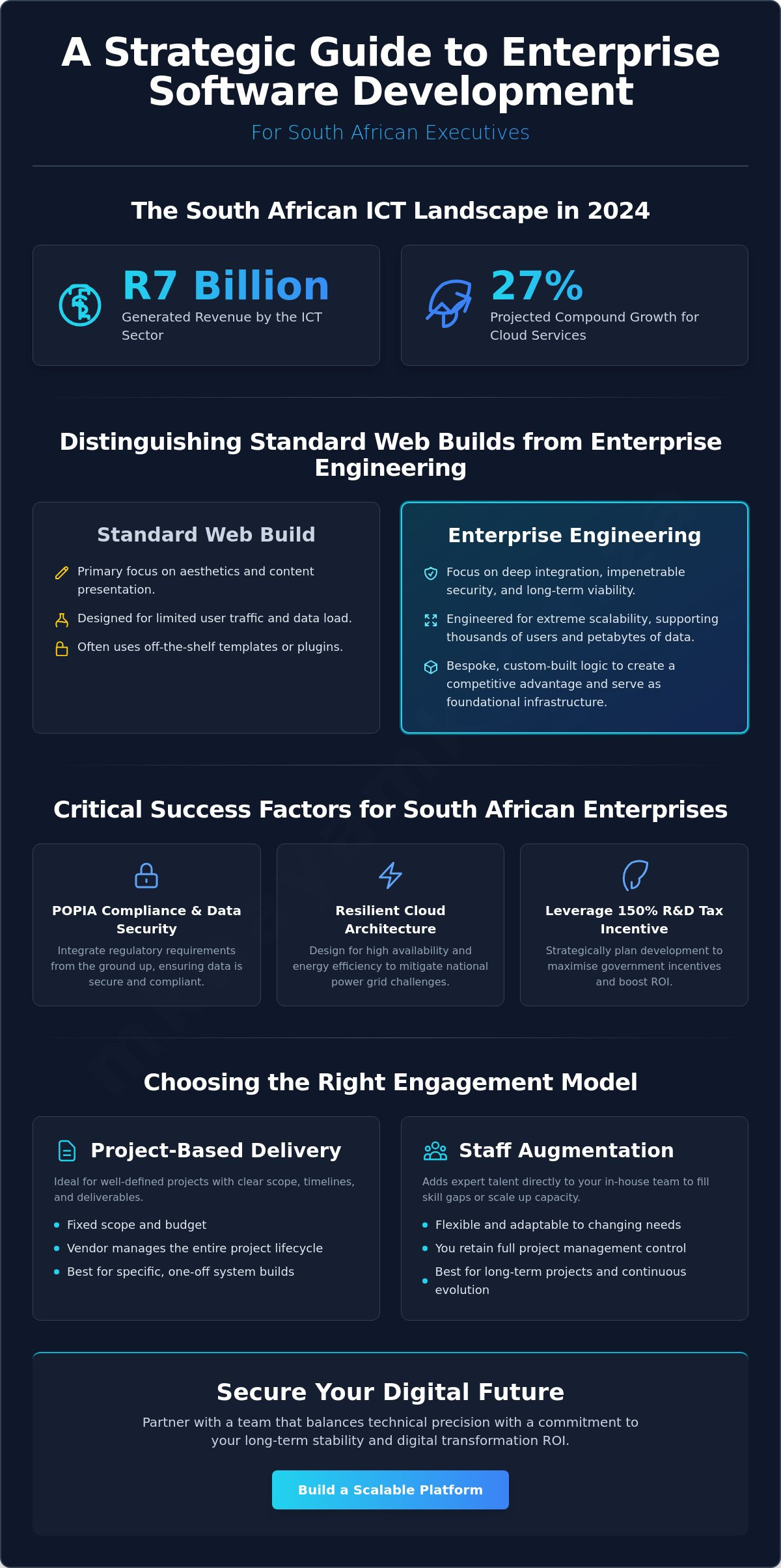
With South Africa’s ICT sector generating R7 billion in revenue in 2024 and cloud services projected to grow at a compound rate of 27%, the pressure to modernise has never been more intense. You likely recognise that your legacy systems are struggling to integrate with modern AI solutions, whilst finding high-level local talent often feels like an uphill battle. Navigating enterprise software development south africa requires more than just technical skill; it demands a partner who understands the delicate balance between global engineering standards and local operational realities.
We understand that your priorities revolve around POPIA compliance, data security, and the looming 30 June 2026 PAIA report deadline. This guide serves as a comprehensive reference for South African executives to evaluate and implement enterprise-grade solutions with quiet confidence. We will examine how to secure a scalable platform, leverage the 150% R&D tax incentive, and choose a partnership model that provides both project delivery and expert staff augmentation to ensure your digital transformation delivers a measurable return on investment. For a deeper look at navigating the outsourcing landscape, our strategic outsourcing guide for enterprise software development in South Africa provides essential context for executives making high-stakes technology decisions in 2026.
Key Takeaways
- Understand the fundamental differences between standard web builds and high-load engineering to ensure your systems scale alongside your business ambitions.
- Discover how a strategic approach to enterprise software development south africa can resolve legacy integration issues whilst maintaining strict POPIA compliance.
- Evaluate the merits of project-based delivery versus staff augmentation to determine which engagement model best suits your specific resource requirements and timelines.
- Learn why prioritising UI/UX design and cloud resilience is essential for maintaining operational continuity amongst South Africa’s unique infrastructure challenges.
- Gain a clear roadmap for selecting a partner that balances technical precision with a commitment to your long-term stability and digital transformation ROI.
Defining Enterprise Software Engineering Services in South Africa
Enterprise software engineering represents the systematic application of disciplined engineering principles to the creation and maintenance of complex, high-scale business systems. It moves beyond basic coding to focus on structural integrity and long-term viability. When we explore what is software development in a corporate context, we see it involves a rigorous lifecycle designed to support thousands of concurrent users and petabytes of data. This approach ensures that every line of code serves a specific business objective whilst maintaining the flexibility to grow.
Distinguishing standard web development from enterprise-grade engineering is vital for South African executives. While a standard website might prioritise aesthetics, enterprise software development south africa focuses on deep integration, impenetrable security, and extreme scalability. These systems must communicate across disparate departments and legacy architectures without failing under load. They aren’t just tools; they’re the foundational infrastructure of your organisation.
To better understand this concept, watch this helpful video:
Approaching enterprise software development south africa requires an understanding of both global standards and local variables. This includes managing POPIA compliance and designing energy-efficient digital solutions that account for national power grid challenges. Success in this field rests on three core pillars: custom engineering, resilient cloud architecture, and AI-driven automation. By combining these elements, businesses create a stable foundation that remains agile in a changing market.
The Strategic Value of Bespoke Engineering
Off-the-shelf software often presents a “one size fits all” facade that cracks when applied to the specific regulatory and operational demands of South African enterprises. Choosing custom application development for business allows you to build proprietary logic that competitors cannot simply buy. This bespoke approach ensures your software adapts to your unique workflows, rather than forcing your staff to work around the limitations of a rigid third-party tool. It’s about building a digital asset that provides a genuine competitive advantage.
Digital Transformation as a Continuous Process
A common mistake is treating technology as a series of isolated, one-off projects. Successful leaders view digital evolution as a continuous journey that requires reliable software engineering services south africa to maintain system longevity. This long-term commitment ensures that your technology roadmap remains aligned with national business growth objectives. As your needs shift, your software must evolve. This methodical execution prevents technical debt from accumulating and ensures your platform remains a stable anchor for your business operations for years to come.
Core Capabilities of Modern Software Engineering Partners
Selecting a partner for enterprise software development south africa is a strategic decision that directly impacts your long-term stability. It involves finding a team that combines technical depth with a supportive, collaborative mindset. A robust partner doesn’t simply write code; they construct a resilient ecosystem. This includes full-stack development using frameworks like Java, .NET, or Python, which are specifically tailored for high-load environments where performance is non-negotiable. These frameworks provide the structural integrity needed to handle complex business logic and massive data volumes without compromise.
Reliability is born from methodical execution and rigorous Quality Assurance (QA). Automated testing ensures that every update is verified before it reaches your users, facilitating zero-downtime deployments. This level of precision is what distinguishes enterprise engineering from basic web development. Organisations like the State Information Technology Agency (SITA) set high benchmarks for national ICT strategy, and your private infrastructure should mirror that same commitment to excellence. By implementing Continuous Integration and Continuous Deployment (CI/CD) pipelines, your partner ensures that your software remains agile and secure throughout its lifecycle.
UI/UX Design and Digital Engagement
Digital engagement is the heartbeat of modern business operations. If a system is difficult to navigate, it won’t be adopted by your team, regardless of its underlying power. By weaving UI UX design services south africa into the engineering process, you prioritise the people behind the screens. With mobile connections in South Africa reaching 127 million by late 2025, your software must be accessible and performant across diverse network conditions. A well-designed interface reduces training time and improves operational efficiency by making complex tasks feel intuitive. If you’re looking to refine your current user journey, exploring advanced engineering services can provide the clarity your organisation needs.
AI and Data Automation Integration
Turning data into a strategic asset is a requirement for staying competitive. Implementing AI automation solutions south africa allows you to eliminate repetitive tasks that often lead to human error. This shift moves your staff away from manual data entry and toward high-value analysis. By 2026, AI-driven automation optimises legacy enterprise workflows by identifying patterns and automating decisions that previously required manual intervention. This evolution transforms your software from a passive record-keeping tool into an active participant in your business success, ensuring that your data provides clear, actionable intelligence for future growth.
Evaluating Engagement Models: Project-Based vs Staff Augmentation
Choosing the right engagement model is as critical as the technology stack itself. In the context of enterprise software development south africa, your choice reflects your internal capacity and the urgency of your business goals. As South Africa’s digital economy continues to expand, executives must decide whether they need end-to-end accountability or flexible resource scaling. Each model offers distinct advantages that can be tailored to your specific technical debt and future growth plans.
The project-based model provides a structured path for defined deliverables. It’s built on a foundation of fixed timelines and end-to-end responsibility. This approach is particularly effective when you have a clear vision but lack the internal bandwidth to manage the day-to-day engineering lifecycle. It offers a sense of stability, as the partner takes on the risk of delivery and ensures the final system meets every pre-defined requirement. It’s a partnership rooted in transparency and methodical execution.
Conversely, staff augmentation allows you to scale your internal teams quickly with specific technical expertise. This model is ideal for organisations that already have established DevOps cultures but need to plug specific skills gaps. It’s a supportive relationship where external engineers become a natural extension of your own team. This ensures you maintain full control over the creative process whilst benefiting from specialised knowledge that might be difficult to find in the local permanent market.
Many forward-thinking enterprises are now adopting a hybrid approach. This combines outsourced project leadership for high-stakes components with augmented internal teams for ongoing maintenance. This flexibility allows you to manage legacy systems whilst simultaneously pursuing aggressive innovation. It’s a visionary way to balance internal control with the precision of expert external execution, ensuring your digital assets remain stable and modern. Understanding how to structure these outsourcing decisions is explored in detail in our 2026 guide to outsourcing enterprise software development in South Africa, which covers how to avoid budget overruns and establish predictable delivery cycles.
When to Choose Fixed-Scope Projects
Launching a new product requires a rigorous custom web application development south africa process to ensure success. Fixed-scope projects provide the architectural oversight and external QA necessary to maintain global standards. They help you manage budgets and timelines during large-scale digital transformations, ensuring that the final output aligns perfectly with your strategic vision. This model is best when you need a stable anchor for a specific business unit or a new market entry.
Scaling with IT Staff Augmentation
Accessing professional IT staff augmentation services is a practical way to bypass the current local talent shortage. These “plug-and-play” engineers integrate into your existing workflows without the administrative burden of traditional recruitment. You maintain full control over the development process whilst benefiting from the specialised knowledge that modern enterprise software development south africa demands. This agile approach allows you to respond to market changes with quiet confidence and speed.
Critical Success Factors for South African Enterprises
Bridging the gap between legacy systems and modern cloud-native applications is a delicate operation. You shouldn’t have to discard years of valuable data to move forward. Instead, a methodical approach ensures that your new architecture integrates seamlessly with old records, allowing for a smooth transition that protects your historical insights. This prepares your organisation for national-level user growth from day one. By planning for scalability early, you ensure that your platform can handle the 127 million mobile connections active across the country without degrading performance.
Compliance and Data Sovereignty
The Information Regulator’s 30 June 2026 deadline for PAIA reports highlights the increasing urgency of robust data governance. Navigating POPIA requirements is no longer optional; it must be “baked in” to your software architecture. Leveraging local cloud migration services south africa allows you to maintain data residency whilst ensuring high-performance access for your local users. Security audits must be an integral part of the 2026 development lifecycle to ensure that every architectural update remains resilient against evolving cyber threats. This proactive stance protects both your reputation and your clients’ trust.
Modernising Operations with ERP and Specialised Systems
Many organisations struggle with fragmented data silos that prevent a clear view of business health. Implementing ERP solutions south africa helps unify these departments into a single source of truth, which is a key component of modern enterprise software development south africa strategies. Specialised tools like a loan management system south africa or facility management platforms provide the precision needed for niche sectors. These systems must support a mobile workforce, as smartphone usage reached 73% of the population by 2026. Ensuring cross-platform compatibility allows your team to remain productive whether they are in the office or in the field.
If you are ready to secure your digital infrastructure and ensure full compliance, consult with our engineering experts to begin your transformation journey.
Partnering with Mkhaya MK for Scalable Engineering
Choosing a partner for enterprise software development south africa is a decision that impacts your organisation for years. At Mkhaya MK, we approach this responsibility with a persona of “quiet confidence.” This means we value methodical execution and transparency over flashy, unverified claims. We position ourselves as a visionary yet practical guide, ensuring that your digital transformation isn’t just a project, but a stable anchor for your future growth. Our national reach allows us to support you wherever you operate, providing a local perspective that respects the complexities of our domestic infrastructure.
Our commitment to construction and refinement is evident in our proprietary platforms like MkhayaMove and the Optimate procurement platform. These aren’t just software products; they’re examples of how we apply rigorous engineering principles to create long-term stability. When you partner with us, you gain access to this same level of precision. We focus on building systems that are both agile and modern, yet rooted in traditional values of integrity. This ensures that your investment in custom engineering results in a secure, scalable platform that improves your bottom line whilst addressing the specific needs of the South African market.
Our Proven Engineering Process
We follow a structured rhythm to organise our development process, moving from high-level strategic consulting to precise deployment. This ensures every project is fully articulated before we move to the next phase, reducing risk and ensuring alignment with your business goals. For organisations that already have a core team, our staff augmentation offering provides a way to extend your internal capabilities with specialised engineering talent. This collaborative relationship focuses on mutual success and maintains the technical depth required for high-stakes enterprise software development south africa.
Next Steps: Initiating Your Transformation
Your journey toward a scalable and secure platform begins with a technical and business discovery phase. During this time, we seek to understand your unique pain points, from legacy system integration to specific POPIA compliance requirements. This phase isn’t about high-pressure sales; it’s about creating a rhythmic sense of momentum toward a concrete path forward. We provide a detailed explanation of engagement, ensuring you feel confident in the roadmap we build together. If you’re ready to evolve your technology stack with a reliable partner, Contact Mkhaya MK today to discuss your software engineering requirements.
Securing Your Digital Legacy with Methodical Precision
Navigating the complexities of modern business requires a shift from reactive maintenance to visionary, long-term construction. We have explored how the right engagement model, whether project-based or through national staff augmentation, can resolve talent shortages whilst ensuring your systems remain resilient amongst local infrastructure challenges. By prioritising bespoke engineering over rigid, off-the-shelf tools, your organisation gains a proprietary asset that adapts to your unique workflows. It’s about more than just code; it’s about building a stable foundation for sustained growth.
At Mkhaya MK, we provide the end-to-end digital transformation expertise needed to bridge the gap between legacy constraints and future possibilities. Our experience in developing specialised systems for loan and facility management ensures that your specific operational needs are met with absolute precision. Choosing a partner for enterprise software development south africa is about finding a stable anchor that values transparency and mutual success. We invite you to partner with Mkhaya MK for your next enterprise software project and experience a relationship built on quiet confidence and methodical execution. Together, we can build a secure, scalable foundation that inspires trust and drives meaningful ROI for years to come.
Frequently Asked Questions
What are the primary benefits of custom software engineering for South African businesses?
Custom software allows you to build proprietary logic that off-the-shelf tools simply cannot replicate. It ensures your platform adapts to your unique workflows whilst providing a genuine competitive advantage. By focusing on enterprise software development south africa, businesses can better manage local challenges such as power grid instability and specific regulatory requirements. This bespoke approach creates a stable foundation that grows alongside your long-term ambitions.
How does POPIA compliance affect the software development process?
Compliance requires data privacy to be “baked in” to the software architecture from the very first line of code. It involves implementing mandatory consent mechanisms and ensuring high-level security for all personal information. With the Information Regulator’s 30 June 2026 PAIA reporting deadline, these audits have become a critical part of the development lifecycle. This methodical approach protects your reputation and ensures your system remains legally resilient.
Can custom software be integrated with our existing legacy ERP systems?
Yes, custom solutions can be designed to bridge the gap between legacy ERPs and modern cloud-native applications. We use robust API layers and methodical architectural planning to ensure your historical data remains accessible and secure. This prevents the need for a “rip and replace” strategy, allowing you to modernise your operations without losing years of valuable business intelligence. It’s a practical way to evolve your technology stack.
What is the difference between software development and software engineering?
Software development refers to the creative act of building functional applications; software engineering is the systematic application of disciplined engineering principles. Engineering focuses on structural integrity, security, and extreme scalability for high-load environments. While development gets a project running, engineering ensures it remains stable and viable for thousands of concurrent users. It is the difference between building a house and constructing a resilient skyscraper.
How long does a typical enterprise software project take to deploy?
The timeline for a typical enterprise project varies based on complexity and your specific business objectives. Most engagements move through a structured discovery phase followed by methodical construction and refinement. This rhythmic progression ensures that each requirement is fully articulated before deployment. While smaller modules might be ready sooner, comprehensive transformations are designed for long-term stability rather than a sense of high-pressure urgency.
What are the advantages of using staff augmentation over traditional hiring?
Staff augmentation provides immediate access to high-level technical expertise without the administrative burden of traditional recruitment. It allows you to scale your internal teams quickly with “plug-and-play” engineers who integrate into your existing DevOps culture. This model is particularly effective for enterprise software development south africa, where finding local senior talent can be challenging. You maintain full control over the development process whilst benefiting from specialised skills.
How does Mkhaya MK ensure the security of our enterprise data?
We ensure data security by making rigorous audits and privacy-by-design core pillars of our engineering process. Our approach includes leveraging local cloud solutions to maintain data residency and meet POPIA standards. By treating security as a continuous refinement process rather than a one-off task, we provide a stable anchor for your digital assets. This methodical execution builds a relationship of trust and mutual success.
Is cloud migration necessary for all custom software projects in 2026?
While not strictly mandatory, cloud migration is essential for achieving high availability and resilience in South Africa’s current infrastructure. Cloud-native applications are better equipped to handle fluctuating loads and provide the scalability required for national-level growth. By 2026, most organisations view the cloud as a foundational requirement for digital transformation. It ensures your software remains accessible and performant, regardless of the challenges facing the national power grid.