

Business Growth with Digital Transformation in South Africa: A 2026 Strategic Guide
What if the very infrastructure challenges currently slowing your operations down could become the catalyst for your most significant competitive advantage? It’s a sentiment many South African leaders share. You’re likely dealing with high operational costs and a frustrating shortage of local technical talent, all whilst trying to scale using legacy systems that weren’t built for a cloud-first economy. Achieving sustainable business growth with digital transformation south africa requires more than just adopting new tools. It demands a resilient orchestration of technology that works around local hurdles and builds long-term stability.
We understand that navigating a prime lending rate of 10.50% and persistent infrastructure instability requires a partner who values methodical execution over flashy claims. This guide shows you exactly how to leverage bespoke software, integrated AI, and robust cloud solutions to drive measurable growth within our unique economic landscape. We’ll preview the strategic shifts needed to turn your technical debt into a scalable, high-performance engine. By the end of this article, you’ll have a clear roadmap for modernising your operations and securing a dominant position in the national market through 2026 and beyond.
Key Takeaways
- Understand why strategic rewiring, rather than simple digitisation, is the primary driver of modern business evolution in South Africa.
- Identify how to integrate custom software, cloud services, and AI to build a resilient ecosystem that thrives despite local infrastructure challenges.
- Compare the long-term value of bespoke engineering against rigid off-the-shelf platforms to minimise hidden integration costs while scaling.
- Resolve internal capacity constraints by leveraging staff augmentation to access senior technical talent in a competitive national market.
- Discover how to achieve measurable business growth with digital transformation south africa through a collaborative, end-to-end partnership.
Navigating the Digital Frontier: Why Transformation is the Engine of South African Business Growth
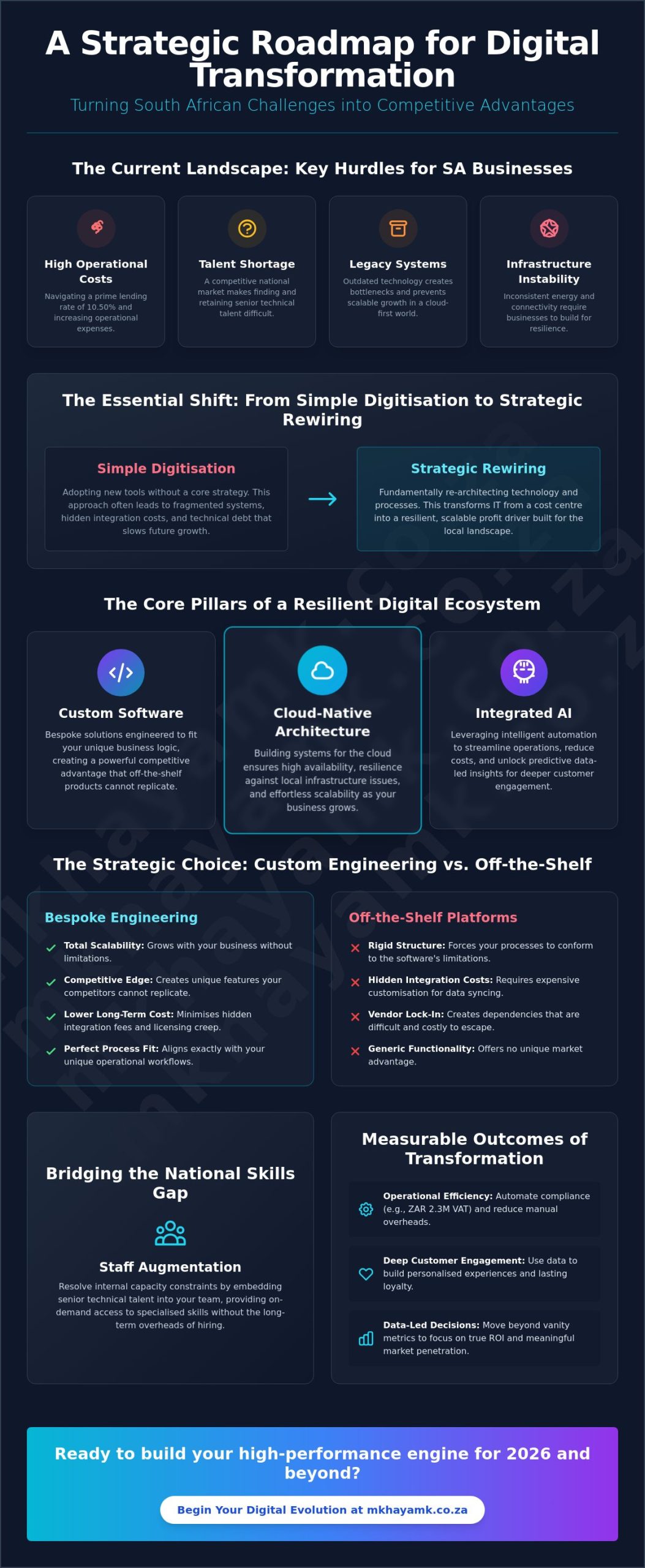
In 2026, digital transformation isn’t merely about adopting new software; it’s a fundamental strategic rewiring of your entire organisation. For local firms, the shift from simply “going digital” to “optimising for growth” marks a significant turning point in how we approach the market. This evolution is the primary engine behind business growth with digital transformation south africa, allowing agile enterprises to bypass traditional development hurdles that once slowed down expansion. By integrating technology into the core of your business model, you create a foundation that’s both resilient and ready for rapid scaling.
To better understand how these shifts impact small and medium enterprises in our local context, watch this insightful discussion:
The South African Business Landscape in 2026
The national ecosystem has reached a level of maturity where fintech integration is seamless and expected. Local firms now use technology to mitigate infrastructure challenges, such as energy instability or inconsistent connectivity, by building more resilient, cloud-optimised systems. This is supported by the R50 billion commitment to data centres announced in the 2026 State of the Nation Address, which provides the backbone for modern services. However, success also depends on addressing the digital divide in South Africa. Inclusive strategies ensure your services reach a broader national audience, turning social responsibility into meaningful market penetration.
Defining Measurable Growth in a Digital Economy
Growth must be measurable to be meaningful. We’ve moved beyond vanity metrics like website hits to focus on actual ROI and substantial cost reduction. Digital agility allows your business to pivot whilst your competitors remain stagnant, tied down by rigid, outdated structures. This level of digital transformation creates a direct correlation between technical maturity and corporate accountability. With the VAT registration threshold now at ZAR 2.3 million as of April 2026, businesses need precise data automation to manage compliance and operational scaling effectively. Every technical investment should build long-term value and support your journey toward becoming a market leader.
The Core Pillars of a Resilient Digital Ecosystem: Custom Software, Cloud, and AI
Building a resilient digital ecosystem requires more than just purchasing tools; it involves orchestrating three core technologies: custom software, cloud-native architecture, and intelligent automation. These pillars shouldn’t exist in isolation. Instead, they must be integrated to form a cohesive foundation that supports business growth with digital transformation south africa. Recent analysis of the state of digital transformation in South Africa suggests that whilst many firms have begun their journey, those who achieve the highest ROI are the ones moving away from fragmented legacy systems toward unified, agile environments.
Bespoke Software Engineering for Competitive Advantage
Off-the-shelf platforms often fail to account for the specific regulatory and operational nuances of our local market. Our software engineering services focus on building tools that mirror your unique workflows rather than forcing you to adapt to rigid templates. This precision ensures that every feature serves a commercial purpose. Additionally, investing in high-end UI/UX design isn’t just about aesthetics; it’s a practical strategy to drive user adoption amongst your staff and customers, directly impacting internal efficiency and market penetration.
AI and Data Automation: Optimising the Human Element
AI integration has shifted from experimentation to execution. By implementing AI & data automation, businesses can free their teams from repetitive tasks, allowing them to focus on high-value strategy. In sectors like logistics and finance, AI is already being used to optimise routing and detect fraud in real-time. Predictive analytics takes this a step further, identifying emerging growth opportunities by analysing national market trends before they become obvious to competitors. This data-led approach is a critical component of business growth with digital transformation south africa, turning raw information into a roadmap for expansion.
Cloud Migration: Building for Stability and Scale
With cloud services projected to have a compound annual growth rate of 27%, the move toward hybrid and multi-cloud environments is essential for stability. Cloud-native architectures provide the resilience needed for 24/7 operations, especially whilst dealing with local infrastructure challenges. This transition allows for national scalability that on-premise systems simply can’t match. By adopting DevOps practices, you accelerate your software delivery cycles, ensuring your business remains agile. If you’re ready to modernise your infrastructure, exploring our cloud solutions is a logical first step toward long-term stability.
Strategic Choice: Custom Engineering vs Off-the-Shelf Solutions for Scaling
Deciding between bespoke engineering and off-the-shelf software is one of the most critical choices for achieving business growth with digital transformation south africa. Whilst a ready-made platform might seem like a faster route to market, the five-year total cost of ownership (TCO) often tells a different story. Rigid platforms frequently carry a hidden “integration tax,” where your team spends more time forcing the software to work with local processes than actually using it to scale. This friction eventually slows down your momentum and increases operational costs.
Custom software allows you to build proprietary business processes directly into your technical architecture. This creates a unique competitive advantage that rivals cannot simply buy or replicate. By focusing on long-term stability and methodical execution, you ensure that your technical debt remains low whilst your ability to innovate remains high. It’s about building a stable anchor for your business in a rapidly changing technological landscape.
When Off-the-Shelf Falls Short
Generic ERPs often struggle with the specific regulatory and economic nuances of South African sectors. For example, a standard financial platform might not handle the specificities of local credit risk or interest rate fluctuations with the precision required. This is why many firms opt for custom loan management systems that are built to handle our specific market dynamics from the ground up. Relying on generic tools also risks “vendor lock-in,” where escalating licensing fees eat into your margins as your user base grows, making it harder to maintain a lean operation.
The ROI of Custom Development
Owning the intellectual property (IP) of your core systems provides a level of corporate stability that subscription models cannot offer. Custom applications allow you to tailor your infrastructure to specific local compliance standards, such as the VAT registration threshold increase to ZAR 2.3 million that took effect in April 2026. Bespoke engineering ROI is defined by the ability to adapt your technical infrastructure at the same pace as your commercial ambitions without being restricted by a third-party roadmap. This level of control ensures that your technology remains an asset that supports your journey, rather than a rigid framework that limits your potential for expansion.
Bridging the Skills Gap: Staff Augmentation and Agile Implementation
South Africa’s technical talent pool is currently under immense pressure. As firms strive for business growth with digital transformation south africa, they often encounter a stark reality: a national shortage of senior developers and data scientists. This gap can stall even the most ambitious scaling plans, leaving businesses with technical debt and missed opportunities. Rather than waiting months to fill a permanent role whilst competitors move ahead, visionary leaders are turning to flexible models that prioritise momentum and precision. It’s about finding a stable anchor in a talent market that is rapidly changing.
Execution requires a structured rhythm to ensure long-term stability. Bringing in specialised talent on a project basis allows you to maintain a lean operation whilst still accessing high-end expertise. This is where agile methodologies become indispensable. By breaking complex transformation projects into manageable sprints, you ensure that every technical investment remains on track and aligned with your commercial goals. This methodical approach reinforces your image as a detail-oriented and reliable partner in your own company’s evolution.
How Staff Augmentation Accelerates Growth
Staff augmentation allows you to extend your internal capabilities without the heavy overhead of traditional recruitment. By integrating specialised professionals into your existing teams, you drastically reduce recruitment overhead and time-to-hire for critical roles. This is particularly effective in our hybrid work era, where access to both remote and on-site experts ensures your project remains adequately resourced. Our staff augmentation services provide the technical depth needed to execute complex builds without the long-term liability of expanding your permanent payroll. This approach is a practical way to maintain agility whilst managing the current 10.50% prime lending rate, ensuring every technical spend delivers immediate value.
A Roadmap for Successful Digital Implementation
Navigating a successful transformation requires a clear, step-by-step path forward. We suggest following this logical progression to manage risk and ensure measurable results:
- Step 1: Audit legacy systems. Conduct a thorough review to identify growth bottlenecks and technical debt.
- Step 2: Define a phased roadmap. Break the transformation into stages to ensure early wins and manageable scaling.
- Step 3: Select the right partner. Choose a visionary guide capable of executing your technical vision with quiet confidence.
- Step 4: Continuous iteration. Use real-time data and user feedback to refine your systems and support long-term growth.
If you’re ready to bridge your internal skills gap and accelerate your project timelines, connect with our team today to explore how our specialised talent can support your strategic vision.
Partnering for Success: How Mkhaya MK Drives Sustainable Digital Evolution
Achieving sustainable business growth with digital transformation south africa is not a solo endeavour. It requires a visionary guide who understands the intricate balance between technical precision and the unique commercial realities of our national market. At Mkhaya MK, we position ourselves as that stable anchor, offering a partnership rooted in transparency and methodical execution. Our end-to-end digital transformation services are designed to move your organisation from a state of reactive maintenance to one of proactive, scalable innovation. We value quiet confidence over flashy claims, ensuring that every project we undertake is grounded in practical results that you can measure and rely upon for years to come.
A Proven Portfolio of Enterprise Solutions
Our commitment to your success is reflected in a diverse portfolio of enterprise solutions that solve real-world problems. We’ve developed specialised tools such as our Facility Management System and Learner Management System to address the specific operational hurdles local organisations face daily. For enterprises looking to refine their supply chain and maximise their margins, our Optimate procurement platform provides the visibility and control needed to reduce waste and improve efficiency. This stability is further reinforced by our long-term commitment to managed cloud and DevOps support, ensuring your infrastructure remains resilient whilst you focus on high-level strategy. Every tool we build is a step toward a more refined and constructed business model.
Taking the Next Step Toward Scalable Growth
We believe that a collaborative partnership model leads to far better outcomes than a traditional, detached vendor-client relationship. By working as an extension of your own team, we ensure that the entire development process is marked by integrity and a deep investment in your long-term success. This approach allows us to build systems that aren’t just technically sound but are also deeply aligned with your personal journey as a business leader. It’s time to turn the strategic concepts and technologies discussed in this guide into a concrete path forward. Business growth with digital transformation south africa is within your reach when you have the right technical ally at your side to navigate the complexities of the 2026 landscape. Contact our team today to begin a strategic consultation and discover how we can help you build a more resilient future.
Securing Your Competitive Edge in the 2026 Landscape
The journey toward 2027 requires more than just technical adoption; it demands a fundamental shift in how you view your infrastructure. By prioritising bespoke engineering and resilient cloud architectures, you move beyond the limitations of rigid legacy systems. This strategic rewiring is the most reliable path to achieving sustainable business growth with digital transformation south africa. We’ve explored how bridging the skills gap through staff augmentation ensures your projects remain on track, even whilst navigating a complex national talent market.
Mkhaya MK brings end-to-end software engineering expertise and deep local market insight to every partnership. Whether you require specialised products for loan, facility, or learner management, our focus remains on precision and long-term stability. We act as a stable anchor for your ambitions, providing the technical depth needed to turn visionary concepts into measurable results. It’s time to build a foundation that supports your scaling goals for years to come.
Scale your business with expert digital transformation from Mkhaya MK today. We’re ready to partner with you on this journey toward mutual success and national market leadership.
Frequently Asked Questions
What is the first step in digital transformation for a South African business?
The first step is a comprehensive audit of your current legacy systems to identify specific growth bottlenecks. This process allows you to understand exactly where technical debt is hindering your expansion. Once you’ve mapped these inefficiencies, you can define a phased roadmap that prioritises high-impact changes. This methodical beginning ensures that your technical investments align with your commercial objectives from day one.
How long does it typically take to see ROI from custom software development?
ROI from custom software is typically realised over a three-to-five-year period as you avoid the integration tax of off-the-shelf platforms. Whilst initial development costs require investment, you own the intellectual property and avoid escalating licensing fees as you scale. Measurable business growth with digital transformation south africa often starts with immediate operational efficiencies that compound over time. Owning your core architecture provides a level of stability that subscription models simply can’t match.
Can staff augmentation help if we already have an internal IT team?
Staff augmentation is an excellent way to extend the capabilities of an existing internal team without permanent overhead. It allows you to bring in specialised senior developers or data scientists for specific projects or phases. This model is particularly effective for bridging the national skills gap during intensive development cycles. Your internal team retains control whilst benefiting from the refined expertise of external professionals who integrate seamlessly into your workflow.
Is digital transformation only for large enterprises in South Africa?
No, digital transformation is a critical driver for businesses of all sizes, including SMMEs. Smaller firms often have the agility to leapfrog traditional development stages more quickly than large corporations. By adopting cloud-native architectures early, SMMEs can compete on a national level with minimal physical infrastructure. It’s about using technology to level the playing field and secure a dominant position in your specific niche.
How does Mkhaya MK ensure the security of cloud-based applications?
We secure cloud-based applications through a combination of cloud-native architectures and rigorous DevOps practices. This includes continuous monitoring and automated security protocols that protect your data against the rising average of 2,204 cyberattacks per week seen in early 2026. Our focus is on building a stable anchor for your operations. We ensure that your digital assets remain protected whilst you focus on scaling your core business.
What is the difference between a facility management system and a generic ERP?
How can AI-driven automation reduce operational costs for my business?
AI-driven automation reduces costs by handling repetitive operational tasks that currently consume your team’s time. By implementing AI & data automation, you free up human talent for high-value strategic work. In sectors like logistics, AI optimises routing to reduce fuel consumption, whilst in finance, it provides real-time fraud detection. These efficiencies lead to a leaner operation and more predictable business growth with digital transformation south africa.
Why is UI/UX design critical for the success of a digital transformation project?
UI/UX design is critical because the success of any digital tool depends entirely on user adoption. If your staff or customers find a system difficult to navigate, the investment fails to deliver its intended value. High-quality design ensures that your software is intuitive and efficient, which directly impacts internal productivity. Precision in the user interface turns complex technical capabilities into a seamless experience for all stakeholders.