Talent Management System South Africa: A Strategic Guide for 2026
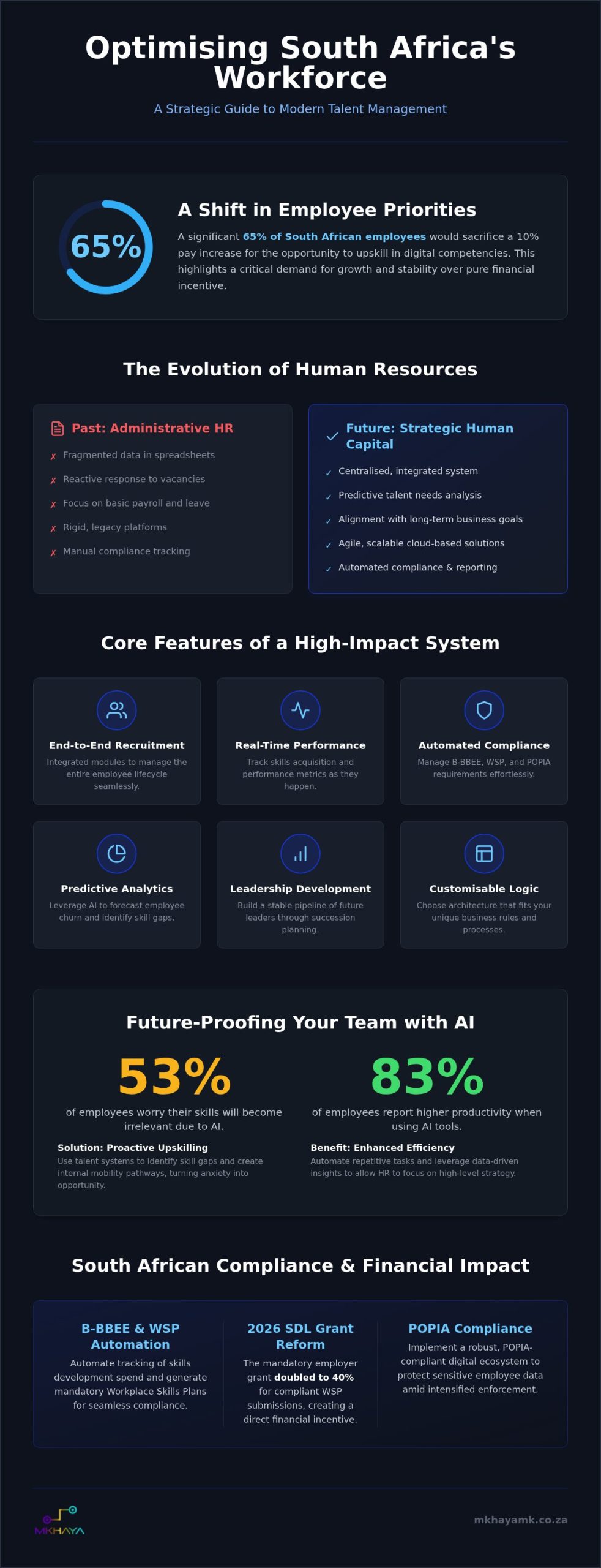
Did you know that 65% of South African employees would sacrifice a 10% pay increase just for the chance to upskill in digital competencies? This striking statistic highlights a fundamental shift in our local workforce. Your team values growth and stability above all else. You likely understand the frustration of losing skilled staff in technical sectors, especially when fragmented data makes it nearly impossible to track B-BBEE compliance whilst maintaining operational flow. Implementing a robust talent management system south africa is no longer just an HR requirement; it’s a vital step toward securing your business’s future.
Discover how to optimise your workforce and ensure compliance with a system tailored for our unique market. By centralising the employee lifecycle, you can turn complex reporting into a seamless part of your daily operations. Precision in execution. Stability in growth. This guide provides a clear path toward implementing scalable technology that grows alongside your business. We will examine the 2026 SDL grant reforms, the impact of AI on productivity, and the specific steps needed to create a robust, POPIA-compliant digital ecosystem that supports your long-term vision.
Key Takeaways
- Understand the transition from administrative HR to strategic human capital management to better strengthen your response to technical sector challenges.
- Identify the core modules of a high-impact talent management system South Africa that integrates end-to-end recruitment with real-time performance tracking.
- Evaluate why custom software development often provides a more stable foundation for unique business logic than generic off-the-shelf SaaS platforms.
- Automate the tracking of B-BBEE skills development spend and generate mandatory Workplace Skills Plans (WSP) for seamless compliance.
- Leverage AI and data automation to predict employee churn whilst using robotic process automation to eliminate repetitive HR tasks.
The Evolution of Talent Management Systems in South Africa
The local business environment has undergone a massive shift. In 2026, the focus has moved from simple payroll and leave management to high-level strategic human capital management. This evolution is driven by the need for precision. A modern Talent Management System is no longer an optional luxury for South African firms; it’s a foundational requirement for staying competitive. It’s about survival. The spreadsheets of yesterday can’t handle the complexities of tomorrow. Relying on fragmented data leads to missed opportunities and costly turnover.
South African businesses face a unique set of pressures. We deal with high staff turnover in technical sectors and rigorous compliance requirements that don’t exist elsewhere. A centralised talent management system south africa allows leaders to see the full picture. It moves beyond basic administration. It enables you to predict needs rather than just reacting to vacancies. This strategic shift ensures that your most valuable asset, your people, are aligned with your long-term goals.
To better understand the strategic importance of this transition, watch this helpful video:
Addressing the South African Skills Gap
The divide between available talent and industry requirements remains a significant hurdle. Research from July 2026 shows that 53% of South African employees worry their skills will become irrelevant due to AI. Technology doesn’t just create this gap; it bridges it. By using a specialised talent management system south africa, you can identify specific skill shortages within your teams before they become critical. While some academic reports suggest that South Africa ranks low in labour market efficiency, we believe that modern digital tools are the specific solution to these efficiency gaps. Software provides the visibility needed to turn potential into performance. Continuous learning is the new standard. Many local enterprises now prioritise internal mobility. It’s often more effective to upskill a loyal employee than to find a perfect external match. This approach builds a culture of growth and stability.
Digital Maturity in Local Human Resources
Assessing your current HR tech stack is the first step toward long-term success. Many legacy platforms are too rigid to handle the pace of change we see in 2026. A truly scalable solution must integrate with your existing workflows whilst providing room for future growth. Cloud-based systems have changed national business operations by allowing real-time data access across different provinces. This connectivity is essential for national compliance, especially with the Information Regulator’s intensified enforcement of POPIA as of March 2026. We view digital transformation as the bedrock of modern HR. It’s the stable anchor that allows your business to remain agile. The 2026 SDL reform, which doubled the mandatory employer grant to 40% for those submitting Workplace Skills Plans, makes having an integrated system a financial necessity as well as a strategic one.
Core Features of a High-Impact Talent Management Solution
A high-impact solution doesn’t just manage people; it empowers them. To thrive in 2026, your talent management system south africa must integrate several core modules into a single, cohesive ecosystem. This integration eliminates the data silos that often lead to poor decision-making. We’ve seen how 83% of South African employees report higher productivity when using AI tools. Your system should leverage this by providing automated workflows that handle the heavy lifting of administration, allowing your HR team to focus on high-level strategy.
Succession planning and leadership development are equally critical. You need to identify your future leaders today, not when a vacancy suddenly appears. By tracking skills acquisition and performance in real-time, you create a stable pipeline of talent ready to step up. This foresight is essential when navigating South Africa’s evolving talent landscape, where the competition for specialised skills is fiercer than ever. Data-driven analytics provide the clarity needed to understand which initiatives are working and which need refinement.
Automated Onboarding and Recruitment
Reducing time-to-hire is a primary goal for any growing business. AI-driven candidate screening allows you to filter through hundreds of applications with precision, ensuring that only the best-fit talent reaches the interview stage. Once hired, the onboarding process must be flawless. A seamless first-day experience significantly improves long-term retention. We prioritise UI/UX design services to ensure that your employees find the platform intuitive and engaging from the very first login. This reduces friction and helps new hires feel like part of the team immediately.
Learning and Development (L&D) Integration
The synergy between your talent platform and a Learner Management System is where true growth happens. With 65% of local workers willing to trade a pay rise for upskilling opportunities, providing clear career paths is a powerful retention tool. Your system should track certifications and skills acquisition automatically. This isn’t just for employee morale; it’s vital for national compliance. With the 2026 SDL reforms increasing mandatory grants to 40% for compliant employers, your ability to document and report on training is a direct financial benefit. Creating personalised learning paths ensures that your workforce remains agile and ready for the technological shifts ahead. If you’re looking to build a more resilient team, exploring our custom software development options can help you create a system that fits your exact operational needs.
Bespoke vs Off-the-Shelf: Choosing the Right Architecture
Selecting the right architecture for your talent management system south africa is a critical junction in your digital journey. Whilst generic SaaS platforms offer quick deployment, they often lack the flexibility required to handle the unique nuances of the South African regulatory environment. You’ve likely seen lists of hundreds of software options, but choice without a strategic framework usually leads to frustration. These off-the-shelf products are built for a global average, not the specific compliance and reporting needs of a local enterprise.
Opting for custom software development allows you to build a system that mirrors your exact business logic. Beyond the technical fit, there’s the question of long-term stability. Subscription models can feel like a “death by a thousand cuts” as per-user licensing fees climb alongside your headcount. Investing in a bespoke solution means you own your data and your intellectual property. This ownership provides a stable anchor, ensuring your technology remains a permanent asset rather than a monthly liability.
When to Choose a Custom-Built System
A custom-built talent management system south africa becomes essential when your organisational structure doesn’t fit into a standard box. Many South African firms operate with complex hierarchies or need to integrate with niche legacy ERP systems that global SaaS providers simply don’t support. If your employer brand is a key differentiator, a tailored user interface ensures that every interaction reflects your company’s values. It’s about precision. You shouldn’t have to change your successful business processes to fit the limitations of a software vendor’s template.
The Hybrid Approach: Customising ERP Modules
For businesses that already have a strong foundation, a hybrid approach often provides the best of both worlds. By leveraging existing ERP solutions to house your talent data, you ensure a single source of truth across the entire enterprise. We focus on building custom connectors that bridge the gap between your core financial tools and modern HR capabilities. This ensures a seamless data flow, allowing for more accurate reporting and a clearer view of your workforce’s impact on the bottom line. This methodical execution turns fragmented tools into a unified, high-performance engine.
Compliance and Reporting in the South African Context
Compliance is the backbone of operational integrity for local enterprises. In 2026, the regulatory landscape has become significantly more rigorous, requiring a level of precision that manual systems simply cannot provide. A dedicated talent management system south africa turns what used to be a month-long administrative headache into a streamlined, push-button reporting process. It’s about moving from a state of constant audit-anxiety to one of quiet confidence. By centralising your data, you ensure that every decision is backed by verifiable records, protecting your business from both financial penalties and reputational risk.
Tracking Employment Equity (EE) targets is a prime example of where digital automation excels. Real-time dashboards allow you to monitor your progress against national benchmarks throughout the year, rather than scrambling for data at the last minute. This visibility ensures you can make proactive adjustments to your hiring and development strategies. When your reporting is integrated directly into your employee lifecycle, compliance becomes a natural byproduct of your daily operations rather than a separate, burdensome task.
B-BBEE and Skills Development Levies
The 2026 reform to the Skills Development Levy (SDL) has changed the financial stakes for South African employers. With the mandatory grant increasing from 20% to 40% for those who successfully submit their Workplace Skills Plans (WSP) and Annual Training Reports (ATR), the ROI of an integrated system is undeniable. Your talent management system south africa should map every training intervention directly to B-BBEE scorecard requirements, ensuring that no spend goes uncounted. Automated tracking ensures that every Rand spent on training is verifiable and correctly categorised, providing an airtight audit trail for B-BBEE verification agencies. This level of detail simplifies the submission process for SETA grants, ensuring you recover the maximum possible levy amount to reinvest in your team’s growth.
Data Privacy and POPIA Compliance
Data security is no longer just a technical concern; it’s a legal imperative. As of March 2026, the Information Regulator has adopted a much more assertive enforcement-driven approach to POPIA. Securing sensitive employee records within a robust cloud solution is the most effective way to manage this risk. A tailored system allows you to define granular access rights, ensuring that HR personnel only see the data they need to perform their roles. We prioritise local data hosting where possible to provide regulatory peace of mind and ensure compliance with cross-border data transfer rules. Managing consent and data access rights shouldn’t be a manual chore. A well-designed platform handles these permissions automatically, creating a stable and secure environment for your workforce data. If you’re ready to secure your business’s compliance future, speak to our team today about building a tailored reporting engine.
Future-Proofing Talent Management with AI and Automation
While compliance provides the necessary foundation for your operations, the true value of a modern talent management system south africa lies in its ability to look forward. We’ve moved into an era where data doesn’t just record the past; it shapes the future. By integrating AI and data automation into your HR ecosystem, you gain the ability to predict employee churn before it happens. This foresight allows you to intervene with targeted retention strategies, protecting your investment in high-value talent. It’s a shift from reactive firefighting to proactive leadership.
Robotic Process Automation (RPA) acts as a silent partner for your HR team. It handles the repetitive, high-volume administration tasks that often lead to burnout and human error. From synchronising data across legacy systems to managing complex leave calculations, RPA ensures that your team focuses on what truly matters: human connection and strategic growth. Research shows that 61% of employees believe AI will improve the quality of people-related decisions. This confidence from the workforce suggests that your team is ready for a more intelligent approach to management. We facilitate this journey by ensuring your transition from legacy platforms is methodical, stable, and aligned with your long-term vision.
Predictive Talent Analytics
Predictive analytics allow you to identify high-potential employees by recognising patterns in performance and engagement data that might otherwise go unnoticed. This isn’t about surveillance; it’s about support. By forecasting future hiring needs based on your business growth projections, you can begin building talent pipelines months before a vacancy arises. AI also plays a crucial role in eliminating unconscious bias during recruitment and promotion cycles. By focusing on objective data points and skills-based assessments, you create a fairer, more inclusive workplace that naturally attracts the best talent in the country. It’s about building a team based on precision and potential.
Getting Started: Your Implementation Roadmap
A successful national rollout begins with clarity. You must first define your strategic objectives and the specific key performance indicators you wish to move. Whether your priority is reducing technical staff turnover or improving B-BBEE reporting accuracy, your roadmap should be tailored to those goals. Selecting the right technology partner is the final, most critical step. You need a guide that understands the South African context whilst possessing the technical expertise to build scalable, AI-driven solutions. At Mkhaya MK, we pride ourselves on being that stable anchor in a rapidly changing technological landscape. We invite you to contact our experts to begin your digital transformation and build a workforce that is ready for 2026 and beyond.
Securing Your Competitive Edge for 2026
The transition toward a high-performing workforce requires a fundamental shift from administrative oversight to visionary strategy. You’ve seen how a tailored talent management system south africa transforms complex B-BBEE reporting and POPIA requirements into seamless, automated workflows. This digital maturity doesn’t just ensure compliance; it fosters a culture of long-term stability. By leveraging AI and predictive analytics, your leadership can anticipate talent needs and nurture employee potential long before gaps emerge. It’s about building a resilient organisation that thrives on precision rather than reaction.
We pride ourselves on being specialists in South African digital transformation. With proven expertise in Learner and ERP systems, we provide the technical depth needed for comprehensive AI and cloud integration. We’re here to act as your stable anchor in a rapidly changing technological landscape, ensuring your technology grows as you do. Contact Mkhaya MK to build your bespoke talent management system and begin your journey toward operational excellence. Your team’s future is a shared mission, and we’re ready to help you lead the way with confidence.
Frequently Asked Questions
What is a talent management system and why does my South African business need one?
A talent management system is a centralised suite of digital tools designed to manage the entire employee lifecycle, from recruitment to succession planning. Local businesses need these systems to navigate unique challenges such as high staff turnover in technical sectors and complex national compliance requirements. It moves your HR operations from reactive administration to proactive human capital strategy, ensuring your workforce remains stable and productive.
How much does a talent management system cost in South Africa?
The cost of a system depends on your chosen architecture and the scale of your workforce. Subscription-based SaaS platforms typically charge a monthly fee per user, which can increase as your team grows. Alternatively, investing in a custom-built solution involves an initial development cost but offers long-term financial stability by eliminating recurring licensing fees and providing total ownership of your intellectual property.
Can a talent management system help with B-BBEE compliance?
Yes, a robust talent management system south africa is essential for automating the tracking of skills development spend. It allows you to map training interventions directly to B-BBEE scorecard requirements. This precision ensures that you can generate accurate Workplace Skills Plans (WSP) and Annual Training Reports (ATR), which are vital for securing SETA grants and maximising your mandatory grant returns under the 2026 SDL reforms.
Is bespoke software better than off-the-shelf talent management tools?
Bespoke software is often the superior choice for enterprises with unique business logic or complex organisational structures. Whilst off-the-shelf tools offer quick deployment, they frequently lack the flexibility to handle niche South African regulatory needs. Custom development ensures the platform mirrors your specific workflows, provides better integration with legacy systems, and gives you full control over your data security and user experience.
How does POPIA affect the storage of employee data in a TMS?
POPIA mandates that all personal employee information is processed lawfully and stored securely. Your system must include features like granular access permissions, automated consent management, and secure data hosting to meet the Information Regulator’s 2026 enforcement standards. Using a compliant platform ensures that sensitive records remain protected, reducing the risk of legal penalties and maintaining the trust of your workforce.
Can I integrate my existing payroll software with a new talent management system?
Integration is not only possible but highly recommended to ensure data consistency across your business. Most modern systems use custom connectors or APIs to bridge the gap between payroll, ERP, and talent modules. This connectivity allows for a seamless flow of information, reducing manual data entry and providing a more accurate view of your total human capital investment.
What is the difference between an HRIS and a talent management system?
An HRIS primarily handles core administrative tasks like payroll, leave management, and basic employee records. A talent management system south africa focuses on the strategic side of HR, including recruitment, performance tracking, and leadership development. Whilst an HRIS manages the day-to-day “mechanics” of employment, a talent system focuses on the long-term growth and optimisation of your people.
How long does it take to implement a custom talent management solution?
Implementation timelines vary based on the specific complexity of your requirements and the state of your current data. A methodical rollout usually begins with a thorough discovery phase to define your strategic goals, followed by development and rigorous testing. This structured approach ensures that the final system is stable, reliable, and ready to support your national operations from day one.