

Security Vulnerabilities in Old Software: A Strategic Guide to Managing Legacy Risk
Did you know that organisations anchored to legacy systems often spend between 60 and 80 percent of their entire IT budget just to keep the lights on? It’s a heavy burden to carry, especially when that investment doesn’t even guarantee safety. You’re likely all too aware of the fragile nature of your existing code and the persistent anxiety that security vulnerabilities in old software could expose your business to a breach or a compliance nightmare under POPIA. It’s understandable to feel caught between the need for stability and the urgent requirement for modern protection.
We believe that your technology should be a foundation for growth, not a source of constant risk. In this guide, you’ll learn how to identify, mitigate, and resolve critical security gaps without triggering operational downtime. We’ll outline a strategic roadmap for phased modernisation that transforms your legacy systems from liabilities into secure, high-performing assets. By the end, you’ll have a clear path to a more resilient future where your security posture is as ambitious as your business goals.
Key Takeaways
- Distinguish between simply outdated and truly legacy systems to better prioritise your risk management and security efforts.
- Understand how the end-of-support lifecycle creates permanent security vulnerabilities in old software by removing essential vendor patches and technical support.
- Evaluate the strategic impact of legacy risk, including the direct correlation between fragile code and the high cost of operational downtime.
- Implement immediate mitigation tactics such as network segregation to isolate risks whilst planning a phased, stable modernisation.
- Discover how bespoke software development provides a secure, future-proof alternative to maintaining obsolete and increasingly vulnerable technology.
The Growing Threat of Security Vulnerabilities in Old Software
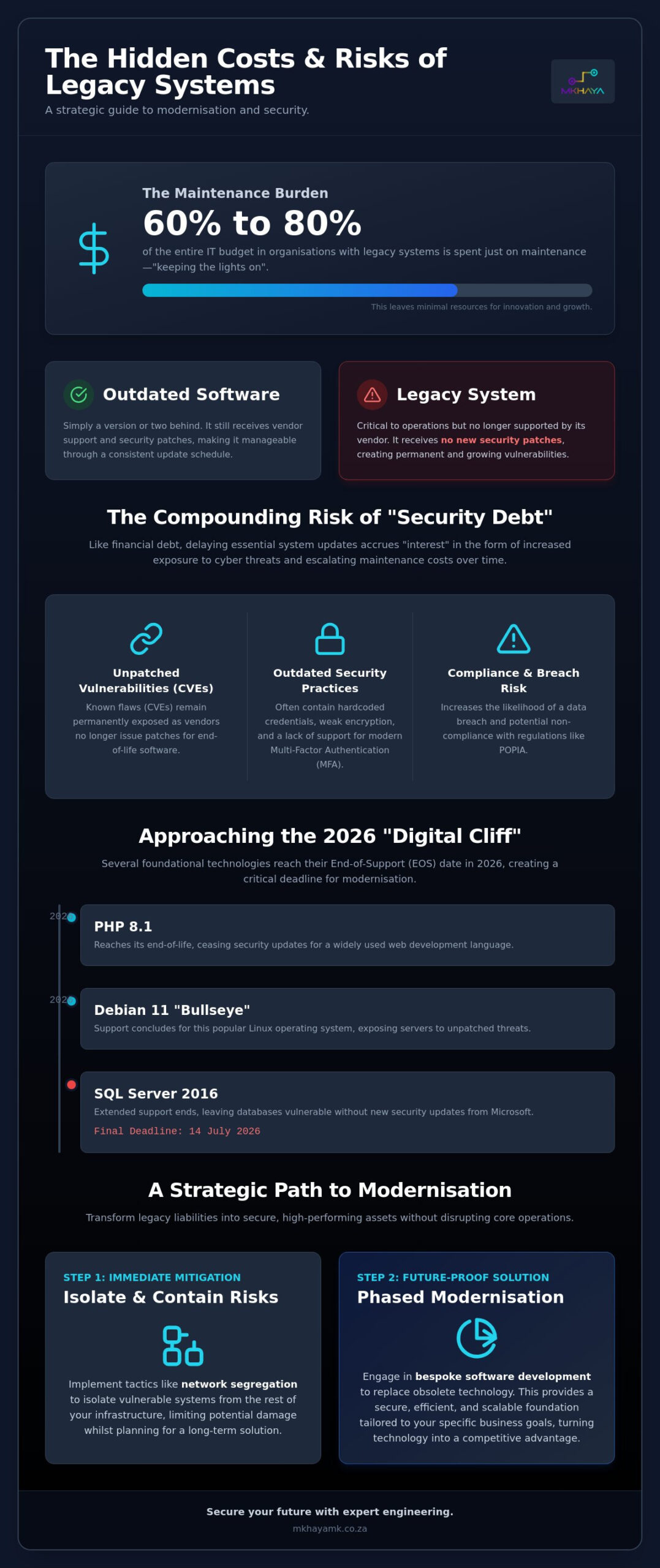
Many organisations struggle to distinguish between software that is simply outdated and systems that have become true legacy assets. Outdated software is typically a version or two behind, often manageable through a rigorous patching schedule. In contrast, What is a legacy system? It’s technology that remains critical to your daily operations but has been surpassed by modern standards and no longer receives updates. Security vulnerabilities in old software are particularly treacherous because they aren’t static; they compound over time, creating a non-linear risk profile that grows more dangerous every day it remains unaddressed.
This accumulation of risk is often described as “Security Debt.” Just like financial debt, the cost of delaying essential updates or migrations accrues interest in the form of increased exposure and higher maintenance costs. Recent data indicates that legacy-heavy organisations often spend between 60 and 80 percent of their IT budgets just on maintenance, leaving little room for innovation. When you consider that the global average cost of a data breach has reached $4.44 million, the financial argument for maintaining the status quo quickly collapses. A legacy vulnerability is a flaw in a system that no longer receives vendor support.
To better understand how hardware and software age into significant risk, watch this helpful video:
Why “If It Isn’t Broken, Don’t Fix It” Is a Dangerous Philosophy
The “if it isn’t broken” mindset is a common trap for busy leaders. Whilst a system might appear operationally stable, it often lacks the security resilience required to withstand modern cyber threats. Modern attackers specialise in silent entry; they exploit security vulnerabilities in old software to dwell within a network for months without detection. These environments usually lack the advanced telemetry and logging found in modern software engineering, making it nearly impossible to spot long-term data exfiltration until the damage is done.
Common Types of Vulnerabilities in Obsolete Systems
Obsolete systems are frequently riddled with documented CVEs (Common Vulnerabilities and Exposures) that will never be resolved because the vendor has moved on. You’ll often find hardcoded credentials, which were a common but poor practice in older development cycles, or encryption protocols that are easily cracked by modern computing power. Additionally, these systems rarely support modern Multi-Factor Authentication (MFA), leaving your most sensitive data protected by nothing more than a legacy password that’s vulnerable to simple brute-force attacks.
Why Legacy Systems Become High-Risk Assets in 2026
As we move through 2026, the timeline for several foundational technologies is reaching a critical junction. The transition from active maintenance to End-of-Life (EOL) or End-of-Support (EOS) isn’t just a change in status; it’s a fundamental shift in your risk profile. For instance, SQL Server 2016 reaches its final end-of-support milestone on 14 July 2026, whilst PHP 8.1 and Debian 11 also face their sunsets in the same year. These dates represent a “digital cliff” where vendor responsibility ends and your vulnerability begins. Microsoft highlights the significant risks posed by outdated systems, particularly as these platforms stop receiving the critical security updates necessary to thwart modern intrusion methods.
Beyond the software itself, the human element presents a growing challenge. Finding developers who are both willing and skilled enough to maintain ancient codebases is becoming increasingly difficult. Most modern talent focuses on contemporary frameworks, leaving a shrinking pool of experts who understand the nuances of legacy languages. This talent gap often forces organisations into a corner where they can’t even apply basic fixes to security vulnerabilities in old software because the original architecture is too fragile for anyone but a specialist to touch. If you’re struggling to find these niche skills, exploring staff augmentation can provide the bridge you need to maintain stability whilst planning your next move.
The Loss of Vendor Security Patches
When a vendor stops issuing patches, “Zero-Day” exploits become permanent fixtures of your environment. In a supported system, a new vulnerability is identified and patched within days. In an unsupported one, that hole remains open forever. Third-party extended support might feel like a safety net, but it’s often just a temporary sticking plaster that doesn’t address underlying architectural flaws. The financial impact is stark; emergency patching for a single incident often costs significantly more than a year of planned, proactive maintenance.
Modern Cyber Threats vs. Ancient Defences
Today’s ransomware isn’t just opportunistic; it’s sophisticated. Attackers now use AI-driven tools to scan entire networks, identifying and exploiting legacy code in mere seconds. These ancient defences simply aren’t built to communicate with modern cloud application services or advanced threat detection systems. This incompatibility creates a “security silo” where your most vulnerable assets are also the hardest to monitor. By modernising these components, you don’t just close a gap; you gain the visibility required for true operational resilience.
Evaluating the Business Impact: Risk vs Compliance
For many business leaders, the decision to maintain legacy systems is often framed as a cost-saving measure. However, the reality of managing security vulnerabilities in old software suggests a much more expensive outcome. There’s a direct, measurable correlation between the age of your technology stack and the probability of a successful data breach. With the global average cost of a breach sitting at $4.44 million in 2026, the perceived savings of delaying an upgrade are quickly eclipsed by the financial fallout of a single security incident. These systems aren’t just old; they’re inherently fragile, often lacking the modern architecture required to facilitate a rapid recovery after a compromise.
The operational impact extends far beyond the initial breach. Over 90 percent of mid-size and large enterprises now report that a single hour of downtime costs more than $300,000. When a legacy system fails, the recovery phase is frequently hampered by a lack of documentation and the “brittleness” of ancient code, leading to extended outages that can paralyse a business for days. This fragility also impacts your bottom line through skyrocketing insurance costs. Providers are increasingly conducting deep technical audits, and those with significant cybersecurity vulnerabilities in their legacy infrastructure often face higher premiums or outright denial of coverage.
POPIA and Regulatory Compliance in South Africa
In the South African context, the Protection of Personal Information Act (POPIA) places a clear legal obligation on organisations to secure the data they process. Relying on unpatched or obsolete systems is increasingly viewed by regulators as a failure to implement “reasonable technical and organisational measures.” If a breach occurs due to known security vulnerabilities in old software that can no longer be patched, your organisation could face significant administrative fines, legal liabilities, and mandatory public disclosures that permanently damage customer trust.
The Ripple Effect on Digital Transformation
Legacy systems act as a heavy anchor, slowing down even the most ambitious digital transformation initiatives. Every new AI tool or cloud-native application you wish to deploy requires expensive, custom-built “bridges” to talk to your old databases. This technical debt drains resources that should be spent on innovation. To understand how to navigate this transition effectively, our guide on Custom Software Development in South Africa: A Strategic Guide for 2026 provides a detailed framework for building modern, secure alternatives that support your long-term growth.
Strategic Mitigation: Modernising Without Disrupting Operations
Managing security vulnerabilities in old software requires a transition from reactive firefighting to proactive engineering. The first step is always a comprehensive inventory and audit. You simply cannot protect what you do not know exists. Many organisations discover “shadow IT” or forgotten databases only after a security incident occurs. Once your landscape is clear, you can implement immediate tactical shields such as network segregation. By isolating legacy systems within their own secure zones, you prevent attackers from using them as a beachhead to move laterally through your more modern infrastructure.
Virtual patching offers another layer of protection. By using modern web application firewalls and intrusion prevention systems, you can intercept threats before they reach the vulnerable legacy code. This buys you the most precious commodity in digital transformation: time. During this transition, maintaining operational stability is paramount. This is where staff augmentation becomes a strategic asset. By bringing in specialists to manage the day-to-day stability of your older systems, your internal team is freed to focus on building the future. If you are ready to secure your infrastructure, reach out to us for a consultation on your modernisation journey.
Creating a Phased Modernisation Roadmap
A “rip and replace” strategy is often too risky for mission-critical systems. Instead, we advocate for a phased approach, starting with encapsulation. This involves wrapping your old code in modern APIs, allowing it to communicate securely with new tools without exposing its underlying flaws. When deciding what to tackle first, prioritise systems based on data sensitivity and business criticality. In many cases, custom software engineering proves safer than buying off-the-shelf products. Bespoke solutions are designed specifically for your unique security requirements, ensuring that no unnecessary features introduce new risks.
Managed Cloud Migration as a Security Cure
Moving legacy workloads to the cloud often serves as a powerful security cure. Modern cloud environments provide superior monitoring and logging capabilities that legacy on-premise servers simply cannot match. You must choose between refactoring, which involves rewriting parts of the code for better performance, or replatforming, which involves moving the application with minimal changes to a cloud-native foundation. To ensure your transition remains financially viable, consult our guide on Cloud Cost Optimisation in South Africa: A Strategic Guide for 2026. This methodical approach ensures that your move to the cloud improves your security posture without creating unexpected overheads.
Securing Your Future with Mkhaya MK’s Engineering Expertise
Resolving the complex security vulnerabilities in old software requires more than a temporary fix; it demands a partner who understands the intricate balance between legacy stability and modern security. At Mkhaya MK, we begin by conducting deep-dive audits to uncover hidden risks within your current stack. We don’t just look for missing patches. We identify architectural weaknesses that could lead to future compromise. By combining this technical precision with a supportive partnership, we help you navigate the transition from fragile, high-maintenance code to a resilient, future-ready infrastructure.
Our approach to custom software development focuses on creating secure, scalable alternatives that don’t just replace your old systems but enhance them. We bridge the critical talent gap through our specialised staff augmentation services, providing you with experts who understand both your legacy languages and the modern frameworks required for a safe migration. This dual expertise ensures that your daily operations remain stable whilst we construct your new digital foundation.
Beyond mere replacement, we help you turn legacy liabilities into competitive advantages. By integrating AI & data automation, we unlock the value trapped in your old databases, transforming static records into actionable business intelligence. This evolution moves your organisation from a state of compliance anxiety to one of visionary growth, ensuring that your technology supports your long-term ambitions rather than hindering them.
Custom Software Engineering for Legacy Replacement
We believe that every organisation has a unique rhythm. That’s why our solutions are never off-the-shelf; they’re tailored to match your specific business workflows and security requirements. By following a rigorous software engineering process, we ensure that security-by-design is baked into every new line of code. This methodology eliminates the recurring costs of “fragile” legacy systems and replaces them with a stable anchor for your future digital initiatives.
A Partner in Your Digital Evolution
South African enterprises choose Mkhaya MK because we value integrity and methodical execution over flashy, short-term claims. We act as a visionary yet practical guide, helping you move away from the “digital cliff” of 2026 toward long-term stability. Our goal is your mutual success, providing the steady hand you need in a rapidly changing technological landscape. Contact us to audit your legacy systems today and take the first step toward a secure, modern future.
Building a Resilient Digital Foundation for Tomorrow
Addressing the risks of legacy technology is no longer a matter of simple maintenance; it’s a strategic necessity that protects your organisation’s reputation and financial health. We’ve explored how security vulnerabilities in old software create a digital cliff where vendor support vanishes and risks compound daily. By shifting toward a phased modernisation roadmap, you can isolate these fragile systems whilst constructing secure, scalable alternatives that support your long-term ambitions. This methodical approach ensures your business remains agile and protected against increasingly sophisticated threats.
Mkhaya MK brings deep expertise in South African enterprise environments, offering POPIA-compliant digital transformation and specialised technical staff augmentation to bridge your talent gaps. We’re committed to your mutual success, ensuring that your transition is methodical, transparent, and free from operational disruption. You don’t have to navigate this complex landscape alone. Our team is ready to serve as your visionary yet practical guide, turning yesterday’s liabilities into tomorrow’s competitive advantages. Secure your business today with Mkhaya MK’s custom software engineering and start your journey toward a more stable, secure future.
Frequently Asked Questions
What is the biggest security risk of using old software?
The most significant danger is the total absence of security patches for newly discovered threats. When a vendor stops supporting a product, any fresh vulnerability identified by cybercriminals remains open forever. This creates a permanent, unfixable entry point that attackers can exploit using automated scanning tools to gain access to your entire network.
How does POPIA affect businesses using legacy software in South Africa?
POPIA mandates that organisations must implement “reasonable technical and organisational measures” to secure personal information. Operating with known security vulnerabilities in old software that can no longer be patched is often viewed as a failure to meet this legal duty. If a breach occurs on an obsolete system, your business could face heavy fines and significant reputational damage from the Information Regulator.
Can I make my old software secure without replacing it entirely?
You can reduce the risk through mitigation, but you cannot make obsolete code truly secure. Strategies such as network segregation or “air-gapping” help by isolating the vulnerable system from the rest of your infrastructure. Whilst these tactical shields provide a temporary safety net, they don’t resolve the underlying flaws, making a phased modernisation the only way to achieve long-term resilience.
What is the difference between end-of-life and end-of-support?
End-of-Life (EOL) usually indicates that a product has reached the end of its intended useful life and is no longer being sold or improved. End-of-Support (EOS) is the more critical milestone for your security team; it’s the specific date when the vendor ceases all technical assistance and security updates. Once a system hits its EOS date, it becomes a high-risk asset that is permanently exposed to new exploits.
Why are legacy systems more expensive to maintain than modern ones?
Maintenance costs spiral because of “technical debt” and the increasing scarcity of specialised talent. Older systems often require complex, custom-built “bridges” to communicate with modern cloud tools or AI platforms. Additionally, as the pool of developers familiar with ancient codebases shrinks, the cost of hiring specialists to keep these fragile systems running continues to rise.
How can custom software development help with legacy vulnerabilities?
Custom development enables you to build a secure-by-design replacement that is tailored to your unique business workflows. Unlike generic off-the-shelf software, bespoke engineering allows you to eliminate unnecessary features that might otherwise expand your attack surface. This approach removes the baggage of security vulnerabilities in old software whilst providing a stable, scalable foundation for your future growth.
What is virtual patching and how does it protect old software?
Virtual patching involves using external security layers, like a Web Application Firewall, to intercept and block threats before they reach the vulnerable system. It acts as a digital shield that neutralises exploits at the network level. It’s an effective short-term measure to protect your business during a transition, but it doesn’t fix the core issues within the obsolete software itself.
How do I know if my software is considered “legacy”?
Your software is likely a legacy system if it no longer receives updates, is incompatible with modern operating systems, or relies on obsolete hardware. A key indicator is the “integration hurdle”; if your team finds it nearly impossible to connect the system with new cloud applications or automation tools, the technology has transitioned from a helpful asset to a strategic liability.