Contract Management System South Africa: The 2026 Strategic Guide
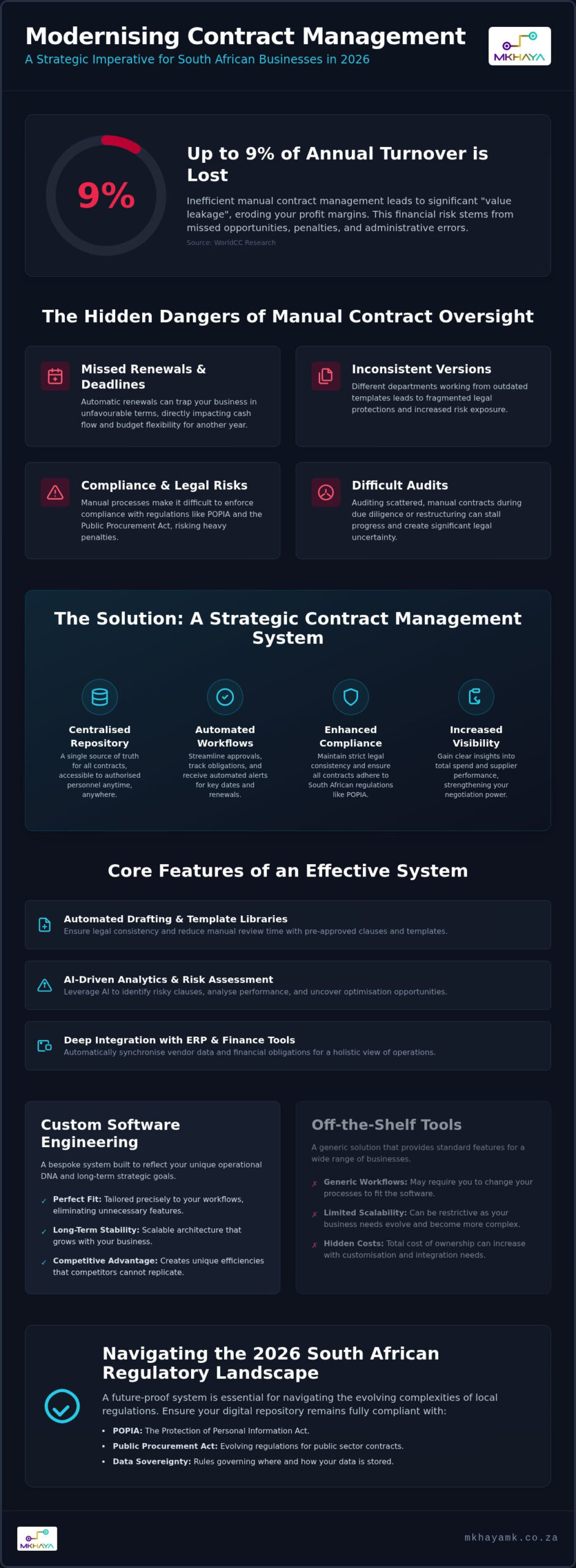
Did you know that inefficient contract management can cost your business up to 9% of its annual turnover? In the complex South African market of 2026, relying on manual spreadsheets and fragmented emails isn’t just a nuisance; it’s a significant financial risk. Implementing a dedicated contract management system south africa has become essential for navigating the 2026 clarifications on POPIA and the evolving Public Procurement Act regulations. You’re likely familiar with the stress of a missed renewal date or the frustration of finding inconsistent contract versions across different departments.
We believe that your legal and operational workflows should support your growth, not hinder it. This guide will show you how to transform these operational hurdles into a competitive advantage through tailored digital transformation. We’ll explore how a centralised digital repository and automated alerts can safeguard your compliance whilst ensuring your workflows integrate seamlessly with your existing ERP and finance tools. It’s time to move toward a future of precision and long-term stability as we walk through the steps to modernise your contract lifecycle.
Key Takeaways
- Understand how a modern contract management system south africa acts as a strategic engine to prevent the costly errors and value leakage associated with manual procurement.
- Discover how AI-driven analytics and automated templates can streamline your approval processes whilst maintaining strict legal consistency across all departments.
- Learn to evaluate the total cost of ownership to determine when a bespoke software engineering approach offers better long-term stability than off-the-shelf tools.
- Navigate the latest complexities of POPIA and data sovereignty to ensure your digital repository remains fully compliant with the 2026 South African regulatory landscape.
- Explore how to bridge internal technical gaps and accelerate your digital transformation by leveraging specialised staff augmentation during system implementation.
Why Your South African Business Needs a Contract Management System in 2026
A modern contract management system south africa is far more than a digital filing cabinet. It’s a strategic business engine designed to drive efficiency and precision across your entire operation. In a market where agility is a competitive necessity, your contracts should be viewed as active assets that dictate the health of your commercial relationships. When these documents are buried in physical folders or scattered across local hard drives, they become liabilities rather than tools for growth.
Relying on spreadsheets often leads to what industry experts call value leakage. Research from WorldCC indicates that inefficient processes can result in a loss of up to 9% of a business’s annual turnover. For South African procurement teams, these manual errors translate into missed rebates, unoptimised supplier terms, and heightened risk. By transitioning from a reactive stance to proactive contract lifecycle management, you empower your organisation to anticipate shifts rather than merely responding to them. This shift frees up your legal and finance resources to focus on high-value strategy whilst automation handles the repetitive administrative tasks.
To better understand how these systems function within a professional environment, watch this helpful overview:
The Hidden Risks of Manual Contract Oversight
Manual oversight often hides significant dangers that can quietly erode your profit margins. Missing an auto-renewal deadline can trap your business in unfavourable terms for another year, directly impacting your cash flow and budget flexibility. In multi-departmental organisations, version control becomes a nightmare when different teams work from outdated templates, leading to inconsistent legal protections. If your business undergoes corporate restructuring, the difficulty of auditing manual contracts can stall progress and create significant legal uncertainty during due diligence.
The Strategic Advantage of Digital Transformation
The true value lies in a broader digital transformation that centralises your data into a single source of truth. When your information is organised and accessible, your negotiation power with suppliers increases because you have clear visibility into total spend and performance metrics. This level of internal transparency fosters a culture of accountability across the business. By adhering to core contract management principles through a digital lens, you ensure that every agreement aligns with your long-term stability and growth objectives. Choosing a partner for bespoke software engineering allows you to build a system that reflects your unique operational DNA rather than settling for a generic, off-the-shelf solution.
Core Features of an Effective Contract Management System
An effective contract management system south africa must do more than simply store documents. It should act as a dynamic hub that facilitates every stage of the agreement process, from the first draft to the final signature and beyond. Consistency is the foundation of legal safety. By utilising automated drafting and template libraries, your legal team can ensure that every agreement adheres to pre-approved language, which significantly reduces the time spent on manual reviews. This level of standardisation prevents departments from inadvertently introducing risk through non-standard clauses.
A robust system must also bridge the gap between different departments. Rather than existing in a vacuum, it should offer deep integration with your existing ERP solutions. This connectivity allows for the automatic synchronisation of vendor data and financial obligations, highlighting the strategic benefits of a CMS that communicates with the rest of your enterprise software stack. For South African firms operating with hybrid or remote teams, cloud-based accessibility ensures that authorised personnel can review and approve documents from any location without compromising security.
AI and Automation in Contract Lifecycle Management
Modern systems leverage AI and data automation to transform how teams interact with their archives. Instead of manual data entry, these tools can instantly extract key terms, indemnity clauses, and renewal dates from legacy documents. Automated workflows then route these contracts to the correct signatories whilst maintaining a transparent audit trail. Smart notifications keep your team informed of upcoming milestones and obligations, ensuring that no deadline ever goes unnoticed. If you’re ready to move away from fragmented processes, our team can help you design a bespoke software solution tailored to these exact requirements.
The Role of User Experience in System Adoption
Technical capability means little if your team finds the software difficult to use. This is why high-quality UI/UX design is a non-negotiable feature for successful adoption. A mobile-first interface allows executives to provide approvals on the move, preventing bottlenecks in the procurement cycle. Customisable dashboards provide a real-time view of contract health, displaying pending actions and risk profiles in an accessible format. When the interface feels intuitive, employee buy-in increases, leading to more consistent data entry and more reliable reporting across the entire organisation.
Custom vs. Off-the-Shelf: Choosing the Right Fit for South Africa
Building on the core features discussed earlier, choosing the right architecture for your contract management system south africa requires a careful balance between immediate needs and long-term stability. Many enterprises face a fork in the road: do they invest in a pre-built global platform or commission a bespoke solution? Whilst off-the-shelf software promises rapid deployment, it often brings hidden complexities that can inflate the total cost of ownership (TCO) over time.
When evaluating TCO, you should consider:
- Initial implementation and customisation fees.
- Ongoing per-user subscription costs that scale with your headcount.
- Internal training and change management resources required for adoption.
- The potential cost of downtime during complex integrations.
The Case for Bespoke Software Engineering
A software engineering approach allows you to build a system that mirrors your exact internal approval hierarchies. In South Africa, where procurement often involves complex multi-level sign-offs, a tailored workflow is invaluable. Commissioning a custom build also means you own the intellectual property; this eliminates the burden of per-user monthly licensing fees as your organisation grows. Additionally, custom systems can be designed to interface directly with niche local legacy systems that global SaaS providers might not support.
Evaluating Off-the-Shelf Solutions
Pre-packaged solutions are often the primary choice when speed of deployment is the main driver. If your business needs a basic digital repository within weeks, a global platform might suffice. However, these tools frequently suffer from feature bloat, where you pay for complex modules that your team will never use. There is also the risk of vendor lock-in with international providers. If their pricing structures change or their local support diminishes, migrating your data can become a costly and technically exhausting ordeal.
Scalability should be at the heart of your decision. Your system must be capable of growing alongside your national ambitions without requiring a complete overhaul every few years. A custom-built contract management system south africa provides the flexibility to add new modules, such as automated compliance tracking for the Public Procurement Act, as regulations evolve. By prioritising a solution that adapts to your unique journey, you ensure that your technology remains a stable anchor in a rapidly changing market.
Navigating Compliance: POPIA and Legal Standards in South Africa
Integrating a contract management system south africa isn’t just an exercise in operational efficiency; it’s a critical component of your legal survival strategy. As of April 2026, the Information Regulator has clarified that the Protection of Personal Information Act (POPIA) remains a mandatory standalone requirement, even alongside new anti-spam rules in the Consumer Protection Act. This means every contract containing personal data, from employee agreements to vendor terms, must be managed with absolute precision. Where your data lives matters more than ever. Whilst global SaaS providers often host data in the US or Europe, local data sovereignty ensures your records remain within South African jurisdiction, significantly simplifying your compliance reporting.
Beyond data residency, the legal validity of your agreements hinges on your adherence to the Electronic Communications and Transactions (ECT) Act. Digital signatures are the standard for 2026, but a system must do more than just facilitate a “click to sign.” It must maintain a tamper-proof audit trail that logs every view, edit, and signature. This level of transparency provides undeniable proof during regulatory inspections or internal audits, protecting your business from the “he-said-she-said” nature of manual disputes. By building these protections into your digital foundation, you transform compliance from a burden into a mark of professional integrity.
Securing Sensitive Contract Data
Internal threats often pose as much risk as external ones. Implementing role-based access controls ensures that sensitive financial terms or personal data are only visible to authorised personnel. Encryption is non-negotiable; your contracts must be protected whilst in transit and at rest. Regular security audits, supported by robust cloud solutions, provide the necessary layers of defence to prevent data breaches. These systems allow you to detect anomalies early, ensuring that your most valuable intellectual property remains secure within a fortified digital environment.
POPIA Compliance Checklist for Contract Systems
Your system should be designed with the following South African legal requirements in mind:
- Data minimisation: Ensure your contract records only capture and store the personal information strictly necessary for the agreement’s purpose.
- Right to erasure: Your digital archive must support the “right to be forgotten,” allowing for the secure deletion of records once legal retention periods expire.
- Breach reporting: In the event of a security compromise, your system must facilitate the rapid identification of affected parties to meet mandatory reporting deadlines.
If you’re concerned about how your current storage methods align with these 2026 standards, contact our team for a compliance-focused consultation to safeguard your operations.
Building Your Future-Proof System with Mkhaya MK
Transitioning from manual chaos to automated precision is a significant journey for any organisation. It requires more than just software; it demands a partner who understands the local nuances of doing business in our specific regulatory environment. At Mkhaya MK, we view the implementation of a contract management system south africa as a collaborative endeavour rooted in mutual success. Our goal is to build a foundation of long-term stability that allows your team to focus on strategic growth rather than administrative firefighting. By choosing a local partner, you ensure that your system is built with an intimate knowledge of South African labour laws and procurement standards.
We pride ourselves on being a visionary yet practical guide. We don’t just hand over a tool and walk away; we invest in your personal journey. This means ensuring that every stakeholder, from the legal department to the finance team, feels supported throughout the transition. Our quiet confidence comes from a track record of methodical execution and a commitment to transparency that builds lasting trust.
Our End-to-End Digital Transformation Approach
Our approach to digital transformation is comprehensive and methodical. It begins with a discovery phase where we map your existing contract workflows in detail. We look for the friction points that cause delays, such as unclear sign-off paths or fragmented storage. During development and testing, we build a solution that mirrors your internal logic. We prioritise user experience to ensure that the system feels like a natural extension of your team’s daily tasks. This isn’t a “set and forget” service. We provide continuous support and system evolution, ensuring your technology scales alongside your national ambitions.
Extending Your Team with Expert Talent
A common gap in digital transformation is the lack of internal technical capacity to manage new systems. You might have the vision, but your current team may be stretched thin. This is why staff augmentation is a core part of our offering. It allows you to bridge the technical gap by accessing senior developers and data analysts who understand the complexities of modern CMS architecture. You get the expertise you need without the long-term overhead or recruitment delays.
These experts work alongside your staff to optimise the platform, ensuring your contract management system south africa remains a high-performing asset. They provide the precision needed to maintain data integrity and security in an increasingly complex digital landscape. If you’re ready to take the next step in your digital journey, organise a consultation with Mkhaya MK today. We’re here to help you move from manual uncertainty to digital precision with absolute confidence.
Securing Your Competitive Edge through Digital Precision
Transforming your legal and operational workflows is no longer a luxury; it’s a fundamental requirement for navigating the 2026 South African business landscape. We’ve seen how a dedicated contract management system south africa can protect your turnover from value leakage whilst ensuring strict compliance with POPIA and the ECT Act. By moving away from fragmented manual processes, you create a centralised repository that serves as a stable anchor for your national growth. This shift doesn’t just reduce risk; it empowers your team to make data-driven decisions with absolute clarity.
Our team brings deep expertise in South African compliance and a proven track record in digital transformation to every partnership. We specialise in custom software designed for national scalability, ensuring your technology evolves as your ambitions expand. Whether you need to bridge a technical gap through staff augmentation or build a bespoke platform from the ground up, we’re here to guide you with quiet confidence and methodical execution. We believe in building solutions that reflect your unique operational DNA.
Don’t let manual chaos hold your business back from its full potential. Partner with Mkhaya MK for Bespoke Contract Automation and start your journey toward automated precision today. We look forward to building a successful and stable future together.
Frequently Asked Questions
What is the best contract management system for South African businesses?
The best system is one that aligns perfectly with your specific internal workflows and the local regulatory environment. Whilst global SaaS platforms are available, many South African enterprises find that a bespoke solution offers superior flexibility for multi-level procurement sign-offs. A tailored system ensures that your data residency and compliance requirements are met without the burden of unnecessary global features.
How does POPIA affect digital contract management in 2026?
POPIA mandates that any contract containing personal information must be handled with strict data minimisation and purpose specification. In 2026, the Information Regulator clarified that these requirements are standalone and mandatory. Your system must support the right to erasure and provide secure, encrypted storage to prevent unauthorised access to sensitive party details during the contract lifecycle.
Can I integrate my contract system with my existing ERP software?
Yes, a robust contract management system south africa should integrate seamlessly with your existing ERP and finance tools. This connectivity allows for the automatic synchronisation of vendor data and payment milestones. By breaking down data silos, you ensure that your contractual obligations are always reflected in your real-time financial reporting and procurement cycles.
Are digital signatures legally binding for contracts in South Africa?
Digital signatures are fully recognised and legally binding under the Electronic Communications and Transactions (ECT) Act. To ensure validity, your system must maintain a tamper-proof audit trail that logs every signature and document edit. This provides the necessary evidence of integrity and authenticity required to protect your business during regulatory inspections or legal disputes.
How long does it take to implement a custom contract management system?
The implementation timeline typically depends on the complexity of your existing archives and approval hierarchies. A phased roll-out generally takes between three to six months to complete. This period covers everything from the initial discovery and workflow mapping to custom development, rigorous testing, and final staff training to ensure a smooth transition.
What is the difference between a contract repository and a CLM system?
A contract repository is essentially a static digital filing cabinet used for storing completed documents. In contrast, a Contract Lifecycle Management (CLM) system is an active tool that manages the entire process from initial drafting to final renewal. CLM systems provide automated alerts, version control, and AI-driven analytics to help you extract maximum strategic value from every agreement.
Is cloud storage or on-site storage better for contract data in South Africa?
Cloud storage is often the preferred choice for modern firms because it supports remote accessibility and scales effortlessly as you grow. When using a contract management system south africa, it’s essential to prioritise cloud providers with local data centres. This ensures your sensitive information stays within national borders, which simplifies your path to POPIA compliance and data sovereignty.
How much can a business save by automating contract management?
Automating your processes can prevent “value leakage,” which research from WorldCC suggests can cost a business up to 9% of its annual turnover. By eliminating manual errors and preventing missed renewal dates, you protect your profit margins. Automation also frees up your legal and finance teams to focus on high-value strategic tasks rather than repetitive administrative oversight.