

Facility Management System South Africa: A Strategic Guide to Digital Transformation in 2026
What if your physical assets weren’t just line items on a balance sheet, but data-driven engines of operational growth? You likely feel the weight of fragmented data across multiple sites and the rising pressure of reactive maintenance costs that eat into your margins. It’s a common struggle amongst property managers, especially when inconsistent reporting for B-BBEE audits or the 2026 Occupational Health and Safety Act requirements slows down your strategic momentum. We believe your technology should be a partner in your success, not a hurdle to clear.
This guide shows you how a modern facility management system south africa can transform these challenges into a centralised dashboard for total control, reducing costs whilst extending the lifecycle of every asset you manage. You’ll discover how to move beyond manual logs to embrace automated scheduling and seamless ERP integration. We’ll preview the essential digital tools you need to stay compliant in the 2026 regulatory landscape, ensuring your operations remain as agile and resilient as the South African market demands.
Key Takeaways
- Understand the transition from manual spreadsheets to cloud-based automation to unify fragmented data across your South African operations.
- Learn how to master asset lifecycle management and automated maintenance scheduling to drive long-term ROI and reduce reactive costs.
- Evaluate the strategic benefits of a bespoke facility management system south africa compared to generic off-the-shelf software with high recurring fees.
- Identify the essential phases of digital implementation, starting with a thorough operational audit to pinpoint bottlenecks and data gaps.
- Explore the role of AI and data automation in future-proofing your facilities through predictive maintenance and precise compliance reporting.
Defining the Modern Facility Management System in South Africa
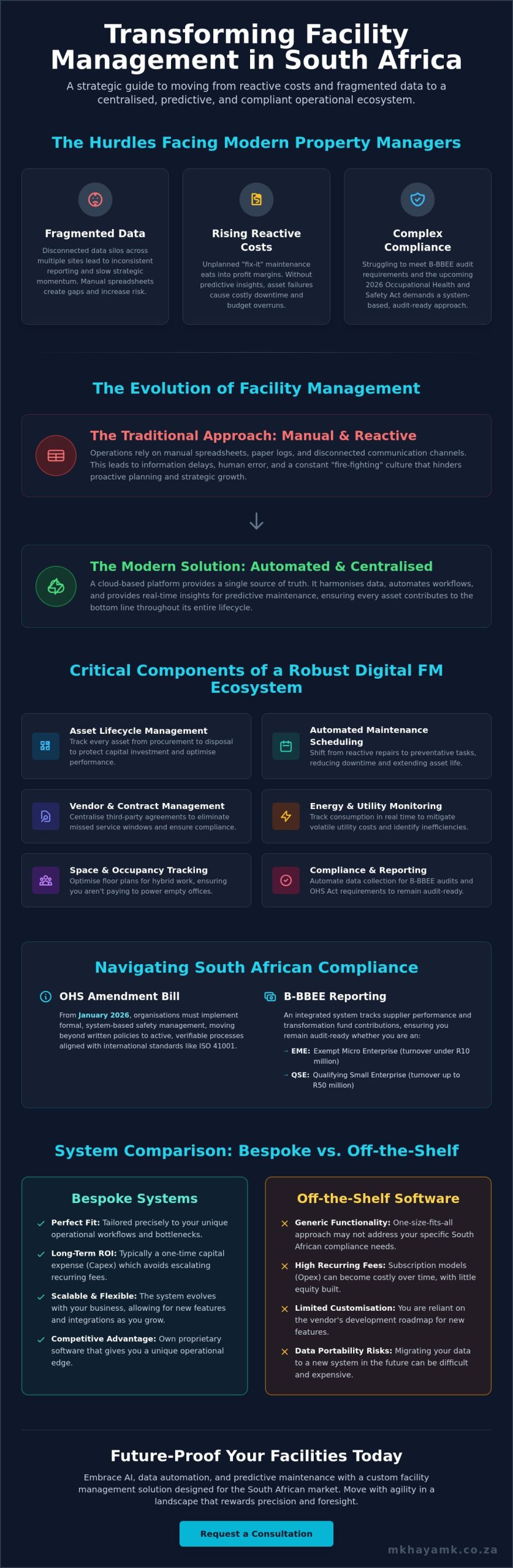
A modern facility management system south africa acts as an integrated digital platform that harmonises workplace and asset optimisation. It represents a fundamental shift from the traditional reliance on manual spreadsheets and disconnected silos of information. By adopting cloud-based automation, businesses can finally manage the “whole life” of a productive workplace, ensuring that every asset contributes to the bottom line from the moment of procurement until its eventual disposal. This digital-first approach provides a single source of truth, allowing teams to collaborate with a sense of shared purpose and professional confidence.
To better understand this concept, watch this helpful video:
Integrating local compliance into these digital workflows is no longer optional. As of January 2026, the OHS Amendment Bill has pushed organisations to implement formal, system-based safety management rather than just keeping a written policy on a shelf. This aligns local operations with international standards like ISO 41001. Additionally, an effective system must handle the complexities of B-BBEE reporting. Whether your turnover classifies you as an Exempt Micro Enterprise (EME) under R10 million or a Qualifying Small Enterprise (QSE) up to R50 million, tracking your transformation fund contributions and supplier performance within your facility management framework ensures you remain audit-ready at all times.
The Evolution of Facilities Management in 2026
Why South African Enterprises are Prioritising Digital Systems
Unique local challenges, such as volatile utility costs and infrastructure strain, make real-time data indispensable. Decision-makers need clear insights to balance Capex and Opex budgets effectively. A digital facility management system south africa provides the transparency required to manage vendor performance rigorously, ensuring that procurement processes are both efficient and ethical. When you have a clear view of your operational data, you can make strategic choices that foster long-term stability and mutual success with your service partners.
Critical Components of a Robust Digital FM Ecosystem
A robust facility management system south africa functions as the central nervous system of your physical operations. It provides a comprehensive view of asset lifecycle management, tracking every generator, HVAC unit, and fleet vehicle from initial procurement through to final disposal. This level of oversight is vital for protecting your capital investment. By centralising vendor and contract management, you ensure that third-party service agreements are visible and manageable from a single point of truth, eliminating the risk of expired contracts or missed service windows.
Maintenance management within this ecosystem moves beyond simple repair logs. Automated scheduling ensures that preventative tasks occur on time, which is essential for managing South African energy challenges and utility monitoring. When your system tracks energy consumption in real time, you can identify inefficiencies and adjust usage patterns to mitigate the impact of rising costs. Space and occupancy tracking further supports this by helping you optimise floor plans for hybrid work environments, ensuring you aren’t cooling or lighting empty offices unnecessarily.
Smart Asset Tracking and Maintenance
IoT sensors and QR codes now feed data directly into your digital environment. This connectivity enables “automated work orders,” which reduce downtime in critical facilities by alerting technicians before a failure occurs. This proactive stance is a cornerstone of digital transformation in facility management. If standard tools lack the precision your specific industry requires, bespoke software engineering can build the custom modules you need to bridge those gaps. This ensures your technology fits your workflow, rather than forcing your team to adapt to rigid software.
Reporting and Business Intelligence
Data-driven dashboards offer the C-suite immediate visibility into operational costs. You can generate audit-ready reports for health, safety, and environmental compliance, which is essential for meeting the 2026 OHS Act requirements. Using this business intelligence allows you to justify facility upgrades with concrete data rather than gut feel. If you’re looking to enhance your operational transparency, exploring how digital transformation can refine your reporting is a logical next step. These insights don’t just track the past; they provide the predictive power to secure your facility’s future.
Comparing Bespoke Systems with Off-the-Shelf Software
Selecting the ideal facility management system south africa requires a careful balance between immediate needs and future ambitions. Whilst off-the-shelf software offers a quick start, it often relies on a one-size-fits-all model that fails to account for the intricate workflows of local enterprises. A recent South African facility management market analysis indicates the industry is projected to reach USD 2.72 billion in 2026. This rapid growth demands tools that aren’t just functional; they must be capable of evolving with your specific operational requirements.
A bespoke system allows you to build a digital environment that mirrors your actual physical processes. Standardised software often forces teams to adopt rigid, pre-defined workflows that can disrupt efficiency. By choosing a custom-built solution, you ensure that your technology integrates perfectly with existing legacy ERP or financial tools, creating a seamless flow of information. This connectivity allows for more accurate reporting and better visibility across all your sites, regardless of their location or complexity.
Bespoke solutions offer several distinct advantages that standardised tools lack:
- Full ownership of the software source code and intellectual property, providing long-term asset value.
- Zero recurring per-user licensing fees, which improves budget predictability as your team grows.
- Direct integration with local financial systems and specific South African regulatory frameworks.
- Customisable security levels that align with your internal risk management protocols.
Owning the intellectual property of your software is a visionary move for any growing enterprise. It provides a level of stability and independence that subscription models simply cannot match. When you control the roadmap, you can prioritise the features that matter most to your on-site teams and stakeholders. This control extends to data sovereignty; you decide exactly how your operational data is stored and protected, which is a critical consideration for long-term risk management and POPIA compliance.
When to Choose a Custom Facility Management System
The Limitations of Standardised FM Tools
Standardised tools often force you to change your proven operations to fit their rigid workflows. This can lead to internal friction and reduced productivity amongst your staff. You’ll likely encounter hidden costs, such as expensive “add-on” modules for essential local features like specific safety audit reporting or B-BBEE supplier tracking. Additionally, relying on global software often means struggling with time-zone differences and a lack of high-touch local support. Investing in custom software development ensures that your technology is a supportive partner in your growth, rather than a restrictive hurdle.
Navigating the Implementation of an Integrated FM System
Successfully deploying a facility management system south africa requires a methodical roadmap that balances technical precision with human engagement. The process begins with a comprehensive operational audit to identify current bottlenecks and data gaps. This phase allows you to see exactly where manual processes are failing and where digital intervention will provide the highest return on investment. You must treat this audit as the foundation of your future digital ecosystem, ensuring that every subsequent step is rooted in practical operational needs.
Stakeholder alignment follows closely, as securing buy-in from both executive management and on-site teams is vital for long-term adoption. During the customisation and integration phase, the system is mapped to specific South African workflows. In 2026, this means ensuring your digital tools are configured to handle the system-based safety management required by the OHS Amendment Bill. Integrating B-BBEE supplier tracking from the outset ensures your procurement data remains audit-ready, whether you are managing Exempt Micro Enterprises or larger Qualifying Small Enterprises. The typical implementation timeline for such a transformation, particularly when aiming for ISO 41001 standards, can range from 6 to 18 months, depending on your organisational complexity.
Data migration and training represent the final push toward going live. It’s essential to move legacy data with integrity whilst upskilling your workforce to use the new tools effectively. Once the system is active, continuous optimisation begins. By using feedback loops and AI-driven insights, you can refine your maintenance schedules and energy usage patterns, ensuring the system remains a stable anchor in a shifting technological landscape. If you’re ready to move beyond manual logs, you can start your digital transformation journey with a partner committed to your long-term stability.
Overcoming Common Implementation Hurdles
Staff resistance is often the biggest barrier to digital adoption. You can mitigate this by prioritising intuitive UI/UX design, making the software a helpful tool rather than a complex burden. Data integrity must be guarded fiercely during the migration from manual logs to digital databases to prevent “garbage in, garbage out” scenarios. Furthermore, your system must include robust offline functionality. This ensures that technicians at remote sites with inconsistent connectivity can still record critical data, which then syncs automatically once a connection is restored.
Scaling the System Nationally
Rolling out a facility management system across multiple provinces requires a strategy that respects regional operational nuances whilst maintaining central control. Using cloud solutions ensures high system uptime and accessibility for teams in Johannesburg, Durban, and beyond. This centralised approach allows you to benchmark performance across your entire national footprint, identifying top-performing sites and applying those lessons to improve efficiency across the board. It’s about creating a unified standard of excellence that grows alongside your business.
Future-Proofing with Mkhaya MK: Custom Facility Management Solutions
Mkhaya MK approaches technology as a catalyst for long-term stability. We don’t just build a facility management system south africa; we construct a digital framework tailored to your unique operational DNA. This methodical execution ensures that your transition to digital is seamless, transparent, and rooted in a deep understanding of local business conditions. We act as a visionary guide, helping you refine your physical assets into strategic digital engines that support your broader corporate goals. Our commitment is to provide a stable anchor in a rapidly changing technological landscape.
By integrating AI and data automation, we move your operations from reactive repairs to a sophisticated predictive maintenance model. This capability allows you to anticipate failures before they disrupt your productivity, which is a critical advantage in the fast-moving South African market. Our focus remains on mutual success, ensuring that your investment in technology translates directly into improved asset lifecycle and higher ROI. We value transparency and methodical execution over flashy claims, providing you with a reliable partner for your digital journey.
Our Digital Transformation Philosophy
Our philosophy transcends the delivery of code. We provide end-to-end digital transformation for your facilities, ensuring that every stakeholder feels supported throughout the journey. The “quiet confidence” we bring to each project means we prioritise precision and clarity. Our facility management systems are designed to drive measurable business results, giving you the data needed to lead with authority. We believe that technology should adapt to your proven workflows, enhancing your strengths whilst eliminating operational friction.
The Mkhaya MK Advantage
Choosing Mkhaya MK means gaining a partner that stays invested in your operational success. If you need to scale your technical capacity quickly, our staff augmentation services provide the expert talent required to support your internal teams. We offer customisable modules that cover everything from procurement to learner management, ensuring your software grows as your national footprint expands. To maximise the return on your workforce investment, pairing your facilities platform with a dedicated learner management system for corporates ensures your staff development and B-BBEE skills development spend are tracked with the same precision as your physical assets. This is a supportive partnership built on integrity and a shared vision for a more efficient, future-proofed enterprise. We remain dedicated to your journey, ensuring your physical assets are managed with the precision they deserve.
Securing Your Operational Legacy Through Digital Precision
Transitioning to a bespoke facility management system south africa is a strategic commitment to operational excellence. You now understand how integrating AI-driven automation and custom asset tracking can significantly reduce maintenance costs whilst ensuring compliance with 2026 safety and B-BBEE regulations. By moving away from rigid off-the-shelf software, you gain the agility needed to lead in a competitive landscape. This shift allows you to own your data and your software IP, creating long-term value for your enterprise.
We provide national South African service coverage and end-to-end digital transformation services to ensure your facilities remain resilient. Our team stays invested in your success, offering the expertise required to turn fragmented data into a clear path forward. Complementing your facilities platform with a robust inventory management system south africa further reduces stock shrinkage and ties up less capital in slow-moving assets, giving you complete visibility across your entire operational footprint. If you’re ready to future-proof your physical assets with a partner who values transparency and methodical execution, it’s time to take the next step. Speak to a consultant about your custom facility management system today. We look forward to building a more efficient and stable future alongside you.
Frequently Asked Questions
What is a facility management system and why does my South African business need one?
A facility management system is an integrated digital platform that unifies your asset tracking, maintenance scheduling, and workplace optimisation. Your business needs one to move away from fragmented spreadsheets, allowing you to manage the entire lifecycle of your assets whilst ensuring compliance with local regulations. It provides the quiet confidence of a single source of truth for all your operations, ensuring data is accessible across multiple sites.
How can an automated system help reduce my facility’s maintenance costs?
Automation shifts your strategy from reactive repairs to predictive maintenance. By using data to anticipate failures, you avoid the high costs of emergency call-outs and extend the useful life of your equipment. This cause-and-effect logic ensures that a small investment in a facility management system south africa leads to significant long-term savings and improved ROI on your physical assets by preventing expensive downtime.
Is it better to buy off-the-shelf FM software or develop a custom system?
Custom systems are often superior for enterprises with unique workflows or legacy ERP tools. Whilst off-the-shelf software is quick to deploy, it usually involves rigid workflows and recurring per-user licensing fees. A bespoke system ensures you own the intellectual property and can tailor every module to your specific South African business requirements, providing greater long-term stability and precision for your specific operational journey.
Can a facility management system help with B-BBEE and OHS compliance in South Africa?
Yes, it is a vital tool for meeting the 2026 OHS Amendment Bill requirements for system-based safety management. The system can also automate the tracking of supplier data and transformation fund contributions. This makes generating reports for B-BBEE audits much simpler, whether your company is classified as an EME or a QSE based on its annual turnover, ensuring you remain audit-ready at all times.
What kind of hardware is required to implement a modern digital FM system?
Modern systems typically rely on IoT sensors, QR codes, and mobile devices for on-site technicians. Mkhaya MK specialises in the software and cloud architecture rather than hardware sales; you should consult with a specialist vendor for your physical equipment needs. We focus on ensuring the software integrates seamlessly with these devices to provide real-time data from every corner of your facility, ensuring total connectivity.
How long does it typically take to implement an integrated FM system nationally?
The implementation timeline generally ranges from 6 to 18 months for a mid-size organisation. This period allows for a thorough operational audit, custom development, and full staff training across your provinces. If you are pursuing ISO 41001 certification, this timeframe aligns with the typical preparation and audit cycle required for international recognition, ensuring each step is fully articulated before moving to the next.
Will a digital system replace my existing facility management staff?
No, the system is designed to empower your team, not replace it. By automating repetitive administrative tasks and work order generation, your staff can focus on high-value strategic maintenance and asset health. It transforms their role from being reactive fire-fighters to proactive managers who use data to drive operational success across all your sites, fostering a culture of mutual success and professional growth.
Does Mkhaya MK provide ongoing support after the system is deployed?
We view every engagement as a long-term partnership rather than a one-off transaction. Our supportive approach includes ongoing maintenance and refinement to ensure your facility management system south africa evolves as your business grows. We remain deeply invested in your journey, providing the steady, forward-looking guidance needed to maintain a stable and modern technological landscape that adapts to your changing business needs.