

How to Navigate Digital Transformation Consulting in South Africa: A Practical Guide
What if the very systems meant to support your business are actually the ones holding your growth hostage? With the South African digital transformation market projected to grow by over 22% annually through 2033, the pressure to evolve has never been more intense. Many local leaders find themselves trapped between legacy software that slows down operations and the high cost of failed IT implementations. If you’ve struggled to find reliable local talent or feel overwhelmed by the complexity of modernising, you aren’t alone. Partnering with the right digital transformation consulting south africa firm can turn these technical hurdles into a clear path for sustainable growth.
We understand that true modernisation isn’t about buying the newest gadget; it’s about building a stable foundation that supports your unique goals. This guide offers a practical, structured roadmap to help you navigate the transition with precision and confidence. You’ll learn how to audit your current processes, manage rising cloud costs, and implement scalable technology that actually improves efficiency. From understanding how the new R2.3 million VAT threshold affects your digital strategy to choosing the right bespoke software, we’ll walk through the essential steps to ensure your digital journey is a success.
Key Takeaways
- Learn why successful digital transformation consulting south africa requires a unique balance between infrastructure resilience and mobile-first user experiences.
- Discover how to conduct a thorough operational audit to identify legacy tech debt and define measurable KPIs for your modernisation journey.
- Evaluate the “Build vs Buy” dilemma to decide between off-the-shelf SaaS or bespoke custom software development tailored to your specific business needs.
- Explore how cloud migration and IT staff augmentation can bridge the local skills gap and provide a scalable foundation for sustainable growth.
- Understand the value of a visionary partnership that integrates high-level strategic consulting with practical engineering excellence to ensure long-term stability.
What is Digital Transformation Consulting in South Africa?
At its heart, Digital transformation consulting is the strategic process of aligning modern technology with your core business objectives. It isn’t just about installing new software or moving files to a server. Instead, it involves a fundamental shift in how your organisation delivers value. In the South African context, this requires a specialised approach. Local businesses must contend with specific infrastructure challenges, such as power stability and varying connectivity speeds, whilst catering to a consumer base that is overwhelmingly mobile-first.
To better understand this concept, watch this helpful video:
The Core Pillars of a Successful Digital Evolution
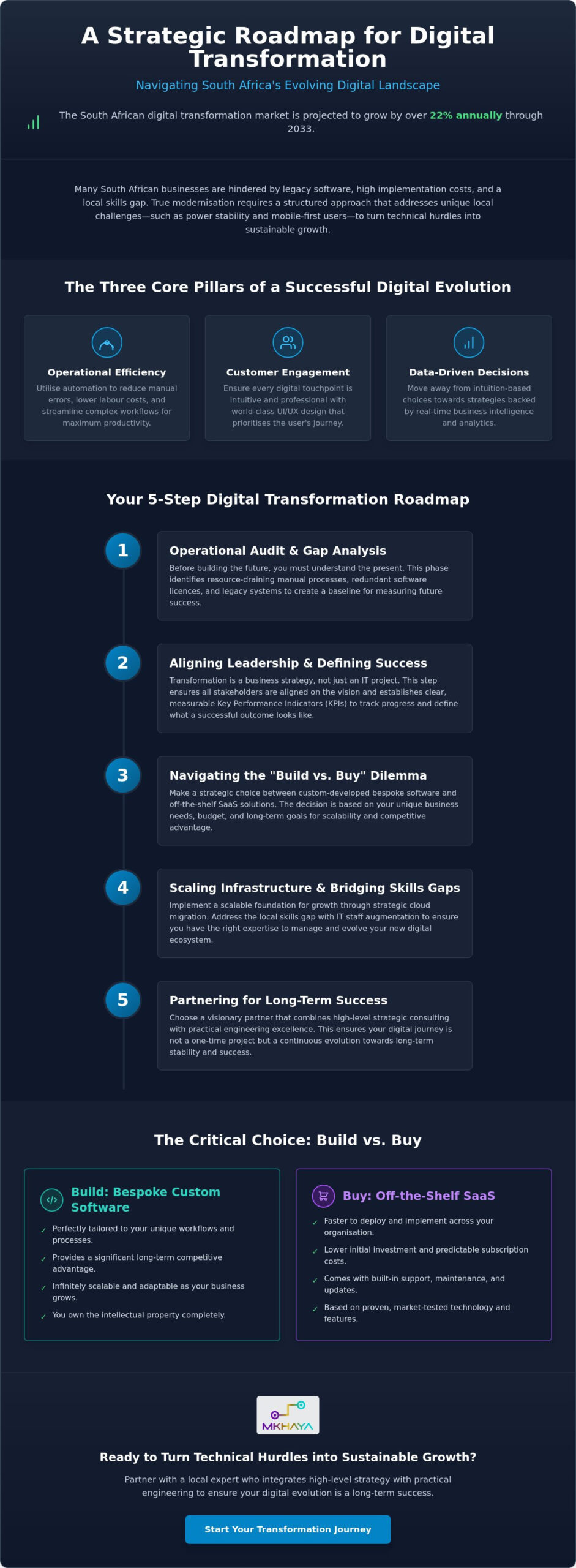
Building a resilient digital foundation rests on three essential pillars. First, operational efficiency focuses on using automation to reduce manual errors and lower labour costs. Second, customer engagement ensures that every digital touchpoint feels intuitive and professional. This is achieved through world-class UI/UX design services that prioritise the user’s journey. Finally, data-driven decision making moves your leadership team away from gut-feel choices toward strategies backed by real-time business intelligence.
Why Local Expertise Matters for National Enterprises
Navigating the South African business environment requires more than just technical skill; it demands local insight. A local partner understands the intricacies of the regulatory landscape, ensuring your systems remain POPIA compliant from day one. They also help you navigate unique economic challenges, such as fluctuating exchange rates that impact software licensing costs. By choosing a partner who understands the domestic market, you ensure that your technology scales smoothly across diverse national operations without encountering regional friction or cultural misalignment.
How to Organise Your Digital Transformation Strategy: A 5-Step Roadmap
Embarking on a journey of digital transformation consulting south africa requires moving beyond vague ambitions toward a granular, actionable plan. Transformation without structure is simply expensive experimentation. By following a methodical, five-phase roadmap, you can ensure that every Rand invested produces a measurable return and supports your long-term vision. This structured approach provides the stability needed to navigate the complexities of modernising a national enterprise.
Step 1: The Operational Audit and Gap Analysis
Before you can build the future, you must understand the limitations of the present. This initial phase involves evaluating existing workflows to see exactly where manual processes are draining your resources. We often identify “shadow IT”—unauthorised software used by different departments—and redundant software licences that inflate costs without adding value. Determining which legacy systems can be modernised and which must be replaced is a critical decision. This audit creates a baseline, allowing you to measure the actual impact of your future technology investments against current inefficiencies.
Step 2: Aligning Leadership and Defining Success
Digital evolution isn’t just a technical task; it’s a cultural shift that requires total buy-in. It’s essential that the C-suite and middle management are aligned on the digital vision to prevent internal friction during implementation. We recommend creating a roadmap that delivers “quick wins” early on. These small, visible victories build organisational momentum and prove the project’s value to stakeholders. To keep your efforts focused, write a single sentence defining success for your specific business case. For instance: “Our goal is to reduce customer onboarding time by 50% through automated identity verification.”
Once the strategic foundation is set, the process moves into technical construction and continuous improvement. Phase 3 involves architecting a scalable technology stack, prioritising cloud-native solutions that offer the flexibility South African businesses need to grow. Phase 4 is the execution stage, where we use agile software engineering and iterative testing to bring the vision to life safely. Finally, Phase 5 ensures long-term stability by monitoring, measuring, and refining the digital ecosystem. This continuous feedback loop allows you to adapt to market changes whilst maintaining peak operational performance. If you’re ready to begin this journey, exploring our proven engagement methodology can help clarify the road ahead.
Navigating the Build vs Buy Dilemma in the South African Market
One of the most frequent questions we encounter in digital transformation consulting south africa is whether to invest in a ready-made platform or build a unique solution from scratch. This decision is rarely a simple “either-or” choice. Instead, it’s about finding the right balance for your specific operational needs. Many leaders worry that custom work is too expensive for a local business. However, when you consider the long-term cost of rigid licensing and the inability to adapt to local market shifts, bespoke development often proves more cost-effective over time. Hybrid models often provide the best return on investment; you might use a global accounting tool whilst building a custom layer that connects directly to your unique logistics chain.
When to Choose Off-the-Shelf ERP or Management Systems
Standard business processes that don’t provide a competitive advantage are often best served by established ERP solutions. If your requirements for payroll or basic inventory management align with industry standards, an off-the-shelf product allows for faster deployment. It’s vital to evaluate the long-term licensing costs of global platforms, which are often pegged to fluctuating foreign currencies. Always check for integration capabilities with existing South African financial tools. With the 2026 VAT registration threshold increasing to R2.3 million, ensuring your software can handle local tax compliance and SARS eFiling requirements is a non-negotiable priority for any growing enterprise.
The Strategic Advantage of Bespoke Software Engineering
Custom builds should focus on your “secret sauce”—the specific processes that make your business unique and competitive. When you invest in custom software development, you own the intellectual property rather than merely renting it. This ownership provides long-term stability and removes the risk of a third-party provider suddenly changing their terms or pricing. Bespoke applications are also designed specifically for local user behaviour. In South Africa, this means creating interfaces that function reliably despite connectivity constraints or high data costs. Whether you need a specialised loan management system or a unique procurement platform, a custom build ensures the technology fits your workflow perfectly, rather than forcing your team to adapt to a generic template.
Choosing the right path requires a partner who understands both the technical possibilities and the local economic reality. By aligning your technology choices with your long-term business goals, you create a scalable ecosystem that supports growth without unnecessary technical debt. This balanced approach ensures that your digital evolution remains agile, precise, and firmly rooted in your company’s specific needs.
Scaling Your Infrastructure: Cloud Migration and Staff Augmentation
Once you’ve defined your strategic roadmap and chosen your software path, the focus must shift to the engine room of your organisation. Scaling your infrastructure is a critical phase where theoretical plans become operational reality. In any successful digital transformation consulting south africa engagement, this step ensures that your technology can handle increased loads whilst remaining secure and cost-effective. Without a flexible, modern foundation, even the most sophisticated custom applications will struggle to deliver their full value. By modernising your back-end systems, you create a resilient environment that supports both current operations and future innovations like AI and data automation.
Foundational Cloud Migration and DevOps
Transitioning from on-premise servers to secure, scalable cloud environments is the cornerstone of modern business evolution. Utilising expert cloud migration services allows you to move away from the limitations of physical hardware toward a more agile setup. To maintain this environment, we implement DevOps services that ensure continuous integration and deployment. This approach reduces the time between a business requirement and a live technical solution. Ultimately, cloud infrastructure reduces long-term capital expenditure by shifting costs to a predictable operational model whilst increasing the agility needed to respond to sudden market changes. Once this stable foundation is in place, you can begin to layer in AI and data automation to further refine your efficiency.
Overcoming the Skills Gap with Staff Augmentation
South Africa’s technology landscape currently faces a significant shortage of specialised technical talent. This gap can often stall transformation projects just as they gain momentum. To solve this, we introduce staff augmentation as a strategic outcome of our consulting process. This model allows you to access highly skilled developers, analysts, and engineers without the heavy overhead and long lead times of permanent hiring. You can scale your internal tech team quickly to meet the intense demands of a migration or a new software launch. Crucially, this partnership ensures a steady knowledge transfer between augmented staff and your permanent employees, leaving your internal team stronger and more capable than they were before the project began.
Building a scalable infrastructure requires a blend of high-level cloud strategy and practical, hands-on engineering. If you’re ready to bridge the skills gap and modernise your technical foundation, we invite you to connect with our expert team to discuss a tailored scaling strategy for your business.
Partnering for Success: How Mkhaya MK Executes Digital Evolution
Our Comprehensive Transformation Ecosystem
Our approach encompasses every stage of the modernisation process. We move organised and seamlessly from initial digital transformation consulting to the final deployment of bespoke tools. This ecosystem includes specialised products such as our loan management platform and ERP solutions, each meticulously tailored for the national market. We don’t simply deliver a product and depart. Instead, we provide continuous support and AI-driven optimisation. This commitment ensures your technology remains agile and never falls behind in an increasingly competitive landscape.
Start Your Journey: Discovery and Engagement
Taking the first step toward modernisation shouldn’t feel overwhelming. We begin every partnership with a comprehensive discovery session designed to audit your current tech stack and identify immediate opportunities for improvement. This phase is the bedrock of our digital transformation consulting south africa service, where we listen to your pains and define what success looks like for your specific organisation. This transparent, methodical execution creates a stable anchor for the work ahead.
What can you expect during the first 90 days? Our focus remains on building organisational momentum through “quick wins” whilst architecting the foundation for larger shifts. We prioritise clear communication and knowledge transfer, ensuring your internal team feels supported throughout the transition. This structured rhythm leads you from a broad vision toward a concrete, high-performing digital reality. If you’re ready to move beyond legacy limitations, contact Mkhaya MK today to begin your digital transformation.
Building Your Resilient Digital Future
Modernising your business operations is a continuous journey that requires a blend of strategic vision and technical precision. By moving beyond simple digitisation and embracing a structured roadmap, you ensure that your technology serves your business goals rather than complicating them. Whether you’re navigating the decision between bespoke builds and off-the-shelf platforms or scaling your internal team to meet new demands, the focus must always remain on creating a stable, scalable foundation.
Expert digital transformation consulting south africa provides the clarity needed to overcome local infrastructure hurdles and the technical skills gap. Mkhaya MK offers a comprehensive ecosystem to support this evolution. Our end-to-end software engineering and cloud expertise, combined with specialised proprietary products like our Loan Management System and Facility Management System, provide a reliable path to success. We also offer agile staff augmentation to ensure your projects never lose momentum due to talent shortages. Partner with Mkhaya MK for your Digital Transformation and turn your technological vision into a concrete reality. We’re ready to walk this path with you.
Frequently Asked Questions
What is the typical timeline for a digital transformation project in South Africa?
A typical project timeline ranges from six to eighteen months depending on the complexity of your requirements. Smaller automation tasks might take a few weeks; however, a full scale digital transformation consulting south africa engagement requires a phased rollout to ensure long term stability. This allows your team to adapt to new workflows whilst technical teams refine the infrastructure in a controlled manner.
How much does digital transformation consulting cost for a mid-sized business?
The investment required is determined by the scope of your legacy debt and the complexity of the required solutions. Rather than a fixed fee, costs are usually structured around specific phases such as the initial audit or custom software development. This ensures that your budget is allocated toward high impact areas that provide the fastest return on investment for your specific business model.
Can digital transformation be done in stages, or must it be all at once?
Executing in stages is the most reliable method for local enterprises. This modular approach allows you to address high priority bottlenecks first, such as automating manual data entry, before moving to more complex cloud integrations. It minimises operational disruption and allows you to fund future phases using the savings generated by early efficiencies, creating a self sustaining cycle of growth.
Is my business too small to benefit from digital transformation consulting?
No business is too small to benefit from a strategic digital shift. Even smaller operations see significant growth by adopting AI and data automation or migrating to the cloud. Modernising early prevents the accumulation of technical debt. It makes it much easier to scale your operations and maintain a competitive edge as your customer base expands within the national market.
How do we ensure our data remains secure during a cloud migration?
Security is maintained through a combination of end to end encryption, multi factor authentication, and strict access controls. During a cloud migration, we prioritise compliance with the Protection of Personal Information Act (POPIA). This ensures that your sensitive business data and customer information remain protected against external threats throughout the entire transition, providing peace of mind for your stakeholders.
What is the difference between IT consulting and digital transformation consulting?
How do we measure the ROI of our digital transformation efforts?
ROI is measured by tracking specific Key Performance Indicators (KPIs) defined during the initial audit phase. These often include metrics such as a percentage reduction in manual processing time, lower customer acquisition costs, or increased system uptime. By comparing these figures against your pre transformation baseline, you can see the tangible impact on your bottom line and overall operational efficiency.
What happens to our legacy systems during the transformation process?
Your legacy systems are evaluated during the initial audit to determine their future viability. Some systems are retired and replaced with more efficient cloud native tools, whilst others are modernised by adding a custom software layer. This ensures that you don’t lose valuable historical data whilst moving toward a more agile, modern technical environment that supports your future ambitions.