

Helpdesk Management Systems: A Guide for ZA Enterprises
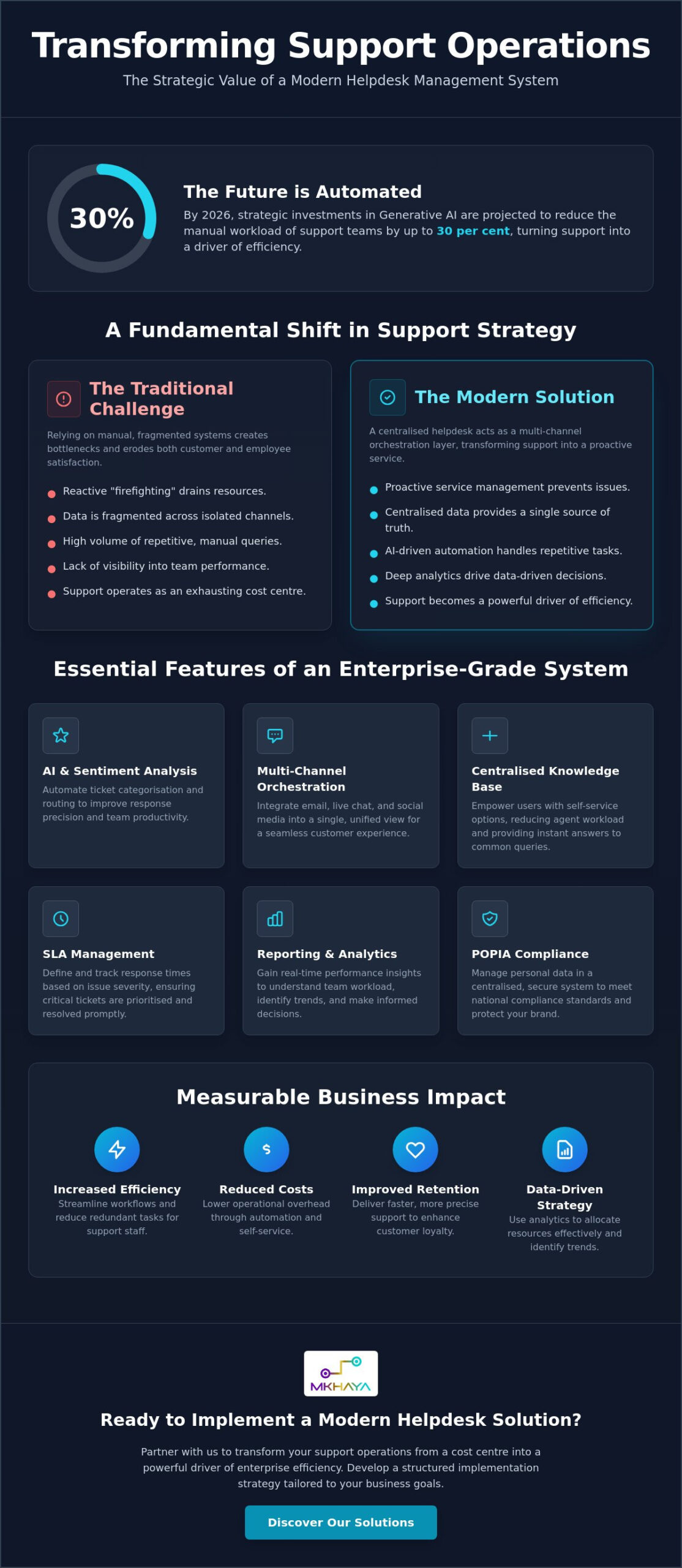
By 2026, strategic investments in Generative AI are projected to reduce the manual workload of support teams by up to 30 per cent. For many South African enterprises, the daily reality still involves managing a high volume of repetitive queries and fragmented data that feels impossible to organise. You likely recognise the frustration of losing visibility into team performance whilst customer information remains scattered across isolated channels. It’s a common challenge that often turns a vital service into an exhausting cost centre.
This guide demonstrates how a modern helpdesk management system can transform those hurdles into a streamlined driver of digital efficiency. By aligning technology with your specific business goals, you can build a support structure that offers both precision and scalability. We will examine the essential features of a helpdesk management system, the impact of recent POPIA enforcement on data handling, and the practical steps to integrate these tools into your existing workflows for measurable success.
Key Takeaways
- Learn how to transition from reactive firefighting to a proactive service model by treating your support platform as a multi-channel orchestration layer.
- Discover how AI-driven automation and sentiment analysis can refine ticket categorisation to improve response precision and team productivity.
- Evaluate the long-term value of a helpdesk management system by comparing the total cost of ownership between custom-built and off-the-shelf solutions.
- Develop a structured implementation strategy by auditing current bottlenecks and organising cross-functional teams to define precise system requirements.
- Understand how strategic digital transformation converts support operations from a traditional cost centre into a powerful driver of enterprise efficiency.
What is a Helpdesk Management System and Why Does it Matter?
A modern helpdesk management system acts as more than a simple repository for customer complaints. It serves as a sophisticated orchestration layer that synchronises communications across every touchpoint your enterprise maintains. In the past, support teams often operated in a state of reactive firefighting, scrambling to address issues as they flared up. Today, the transition toward proactive service management allows businesses to identify patterns and resolve underlying problems before they escalate into systemic failures.
Relying on manual, email-based support poses a significant risk to South African business continuity. When critical data is trapped in individual inboxes, transparency vanishes and response times suffer. This fragmentation doesn’t just frustrate customers; it erodes employee morale as staff members struggle with redundant tasks and lack the tools to succeed. By centralising these interactions, you create a stable foundation for both customer retention and internal operational excellence.
To better understand how these systems function in a professional environment, watch this helpful video:
The Core Components of Modern Ticketing
Precision in support requires an intelligent structure. A robust helpdesk management system automates ticket routing and prioritisation based on urgency and agent expertise. This ensures that high-priority issues reach the right specialist instantly, reducing the “ping-pong” effect often seen in manual systems. This approach bridges the gap between external customer care and internal employee support, ensuring that your IT Service Management (ITSM) remains as agile as your client-facing departments.
Centralised knowledge bases also empower users through self-service options. This allows them to find answers to common queries without needing direct intervention, which lightens the load on your staff and builds trust through instant resolution. Multi-channel integration brings email, live chat, and social media into a single view. Your team never misses a conversation regardless of where it starts, creating a seamless experience that reflects a modern, professional brand.
Business Impact: Beyond the IT Department
The benefits of a structured support platform extend far beyond technical troubleshooting. These systems provide deep analytics that drive data-driven decision making, helping leadership understand where resources are best allocated. By increasing agent efficiency through AI and data automation, enterprises can significantly reduce operational costs whilst maintaining high service standards. This efficiency isn’t about cutting corners; it’s about refining the customer journey to ensure long-term stability.
These tools are also essential for supporting national compliance. With the Information Regulator intensifying monitoring of the Protection of Personal Information Act (POPIA) as of March 2026, having a centralised, secure way to manage personal data is no longer optional. It’s a fundamental pillar of digital transformation that protects your brand’s reputation. Implementing a reliable system provides a stable anchor in a rapidly changing technological landscape, allowing your business to move forward with quiet confidence.
Essential Features of an Enterprise-Grade System
Choosing a helpdesk management system involves more than comparing tick-box features. It requires a focus on the specific tools that allow your team to operate with precision at scale. For South African enterprises, the challenge isn’t just volume; it’s the complexity of maintaining high standards whilst resources are stretched. A truly enterprise-grade system provides the structural support needed to ensure every customer interaction is handled with professional care.
Customisable Service Level Agreement (SLA) management acts as the engine of accountability within these platforms. By defining and tracking response times based on issue severity, you ensure that critical tickets never languish in a queue. This transparency is bolstered by robust reporting dashboards that offer real-time performance monitoring. Integration with your existing ERP and CRM systems ensures that agents have a 360-degree view of the customer, linking support history directly to business outcomes.
AI and Automation: The New Standard
Robotic Process Automation (RPA) eliminates the burden of repetitive data entry, allowing your specialists to focus on high-value problem solving. AI chatbots complement this by providing immediate first-level support resolution for common queries, ensuring customers receive answers without delay. AI-driven ticketing functions as a predictive service tool that anticipates user needs based on historical data patterns. Integrating these capabilities through AI and data automation ensures your support remains agile and cost-effective.
Security and Collaboration Tools
Role-based access control (RBAC) restricts data visibility to authorised personnel only, which is essential for maintaining POPIA compliance. Beyond security, internal collaboration tools like ‘parent-child’ ticket linking enable teams to break down complex issues without losing the broader context. Internal notes allow agents to share insights privately, ensuring a seamless handover between departments. Audit trails provide a chronological record of every action taken, ensuring total regulatory transparency and long-term stability for your helpdesk management system.
The Strategic Choice: Custom-Built vs. Off-the-Shelf
When to Choose a SaaS Solution
Software-as-a-Service (SaaS) platforms are often ideal for smaller teams with standard support requirements. They allow for faster initial deployment, which is helpful if you need a basic ticketing structure in place immediately. However, users frequently encounter “feature bloat,” where they pay for complex modules that remain untouched. This creates a trade-off between immediate convenience and the long-term customisation needed to maintain a competitive edge. If your requirements are standard and your team is small, the convenience of a subscription might outweigh the need for a bespoke build.
The Power of Custom Software Engineering
When your business requirements exceed the capabilities of generic platforms, custom software engineering provides a path to long-term stability. Building a system that mirrors your exact internal processes ensures that the technology adapts to your team, not the other way around. This approach allows for seamless integration with bespoke legacy applications, creating a unified digital environment that supports sustainable growth. By investing in a tailored helpdesk management system, you eliminate recurring per-user fees and gain a proprietary asset that evolves alongside your enterprise. This level of precision ensures that your support infrastructure remains a stable anchor in a rapidly changing technological landscape.
Planning Your Helpdesk Implementation Strategy
Successful deployment of a helpdesk management system begins long before the first ticket is logged. You must first audit your current support behaviour to identify the primary bottlenecks that slow down resolution times. Are your agents manually re-entering data, or is information frequently lost between departments? By organising a cross-functional team to define system requirements, you ensure that the final solution serves the entire enterprise rather than just the IT desk. This collaborative approach builds internal buy-in and ensures the technology aligns with your broader business goals.
Developing a phased rollout plan is essential to minimise operational disruption whilst your team adapts to new workflows. Instead of a “big bang” launch, introduce the system to specific departments or regions first. This allows you to refine the configuration based on real-world usage and feedback. Establish clear key performance indicators (KPIs) such as First Response Time (FRT) and Customer Satisfaction Score (CSAT) to measure success. These metrics provide the data-driven evidence needed to justify the investment and demonstrate the system’s impact on enterprise efficiency.
Data Migration and Integration
Moving to a new platform offers a rare opportunity to purge outdated or redundant information. Cleaning legacy data before importing it prevents “garbage in, garbage out” scenarios that can undermine your new helpdesk management system. Ensuring secure API connections with existing business tools is equally vital for maintaining a unified workflow across your organisation. This technical alignment is a core component of digital transformation consulting, providing the connectivity needed for long-term scalability and precision.
User Training and Change Management
System adoption hinges entirely on the user experience. Designing an intuitive UI/UX encourages agents to embrace the new tool rather than resisting the change. Comprehensive documentation for both agents and end-users provides a stable reference point that reduces initial anxiety during the transition. Feedback loops play a critical role in continuous system refinement; your agents are on the front lines, and their insights will help you polish the platform over time. This iterative process ensures the system remains a supportive partner in your team’s daily success.
If you are ready to move beyond fragmented support and build a unified service engine, contact our team today to discuss a tailored implementation strategy for your enterprise.
Partnering with Mkhaya MK for National Tech Excellence
Mkhaya MK positions itself as a visionary yet practical guide for enterprises seeking national tech excellence. We understand that a helpdesk management system is more than a tool; it’s a fundamental pillar of your digital journey. Our team provides end-to-end digital transformation that moves from high-level strategic concepts to methodical execution. By focusing on the unique challenges faced by South African businesses, we ensure that your support infrastructure is both resilient and forward-looking. We project a persona of quiet confidence, valuing transparency and precision over flashy claims.
Our expertise in AI and data automation allows us to build smarter support structures that turn raw data into actionable business insights. This national reach ensures that your enterprise receives support tailored to the local landscape, including strict adherence to POPIA requirements and other regional standards. We act as a stable anchor in a rapidly changing technological environment, providing the reliability you need to grow without friction.
Bespoke Solutions for Complex Operations
We design custom applications that scale alongside your growth, ensuring that your infrastructure never becomes a bottleneck. By integrating helpdesk logic into broader ERP solutions, we create a unified ecosystem where support data informs procurement, finance, and operations. This connectivity allows for a 360-degree view of your business health. Our custom AI implementations go beyond simple chatbots; we build intelligent systems that reduce support overhead by predicting user needs and automating complex ticket routing. This level of precision ensures that your helpdesk management system remains a high-performing asset rather than a recurring expense.
Extending Your Team with Expert Talent
Finding the right technical skills shouldn’t be a hurdle to your progress. Through staff augmentation, we provide access to skilled developers who integrate seamlessly with your internal teams. This flexible model allows you to scale your technical capacity as needed without the long-term overhead of permanent hiring. We also provide ongoing maintenance and cloud optimisation to ensure peak performance and stability. Our goal is to act as a supportive partner, offering the guidance you need to navigate complex digital shifts. If you are ready to refine your support operations, contact Mkhaya MK to discuss your custom helpdesk strategy and discover how we can drive your digital efficiency forward.
Empowering Your Enterprise Through Strategic Support
Implementing a modern helpdesk management system is a significant step toward organisational maturity. It moves your team beyond the limitations of manual ticketing and into a space of data-driven precision. By focusing on essential features like AI-driven automation and robust SLA tracking, you ensure your support infrastructure grows as a stable anchor for your business. The choice between custom engineering and off-the-shelf tools depends on your specific business logic and long-term scalability needs.
Mkhaya MK provides the end-to-end digital transformation expertise required to build these sophisticated environments. With our national South African service coverage and specialised focus on AI and custom software engineering, we act as a reliable partner in your technical journey. We value transparency and methodical execution, ensuring that your transition into a high-efficiency support model is both seamless and sustainable.
Partner with Mkhaya MK for your Digital Transformation and take the first step toward a more resilient digital future. We look forward to building this path alongside you.
Frequently Asked Questions
What is the difference between a helpdesk and a service desk?
A helpdesk primarily handles tactical, end-user technical issues, whereas a service desk manages the entire lifecycle of IT services within an enterprise. While the helpdesk provides quick fixes for immediate problems, the service desk focuses on broader business goals and strategic service delivery. This distinction ensures your team isn’t just reacting to problems but is also supporting long-term operational stability.
Can a helpdesk management system integrate with our existing CRM?
Integration with your existing CRM is entirely possible through secure API connections that synchronise customer data across platforms. This connectivity allows support agents to view purchase history and previous interactions directly within the helpdesk management system. By linking these tools, you eliminate data silos and provide a more personalised, efficient service experience for every client.
How does AI improve the efficiency of a helpdesk?
AI improves efficiency by automating the categorisation and prioritisation of incoming tickets based on urgency and historical patterns. It also powers intelligent chatbots that provide immediate answers to repetitive questions without human intervention. This reduces the manual workload on your staff, allowing them to focus on high-value tasks that require human precision and complex problem-solving.
Is it better to build a custom helpdesk or buy a SaaS subscription?
Choosing between custom-built and SaaS depends on your unique business requirements and long-term growth strategy. SaaS solutions offer rapid deployment for standard workflows, but a custom helpdesk management system provides total control over your business logic. Custom builds also eliminate recurring per-user subscription fees, which often makes them a more stable financial choice as your enterprise scales.
How long does it typically take to implement a new helpdesk system?
Implementation timelines vary based on the complexity of your requirements and the volume of legacy data you need to migrate. A standard cloud-based setup might take several weeks, while a bespoke enterprise solution typically requires three to six months for full deployment. A phased rollout strategy helps manage this transition by minimising disruption to your daily operations.
How do helpdesk systems ensure data security and POPIA compliance?
These systems ensure POPIA compliance by implementing role-based access control and detailed audit trails that track every data interaction. Encryption and secure local data residency further protect sensitive personal information from unauthorised access. These measures provide the transparency and accountability required by the Information Regulator to maintain national standards of data privacy.
What are the most important KPIs to track in a helpdesk system?
The most critical metrics include First Response Time (FRT), Customer Satisfaction Score (CSAT), and the average time to resolution. Tracking these KPIs allows leadership to identify bottlenecks and measure the impact of service improvements over time. Consistent monitoring ensures your support team remains aligned with your enterprise’s broader performance targets and quality standards.
Can we use a helpdesk system for internal IT support only?
Yes, many South African enterprises use these platforms specifically for internal IT Service Management (ITSM) to support their own employees. A dedicated internal system streamlines hardware requests, software troubleshooting, and access management within the organisation. This focus on internal efficiency ensures that your staff has the technical support they need to remain productive without unnecessary delays.