

Staff Augmentation vs Project Outsourcing in South Africa: A Strategic Guide for 2026
The search for high-level engineering expertise in South Africa has reached a critical turning point in 2026, where the way you scale is now as vital as the talent you find. With the national ICT market projected to reach USD 45.69 billion this year, the competition for senior developers is fiercer than ever. Deciding between staff augmentation vs project outsourcing south africa isn’t just a choice about headcount; it’s a strategic decision between operational control and delivery accountability.
You’ve likely felt the frustration of niche talent shortages or the management overhead that often shadows remote teams. It’s a common challenge to balance the need for rapid scaling against the reality of internal capacity constraints. This guide helps you discover the ideal scaling model for your South African enterprise by comparing control, cost, and delivery outcomes. We’ll examine how to secure a faster time-to-market and access elite engineering skills without the long-term commitment of a permanent headcount, ensuring your business remains agile whilst navigating the 2026 labour law amendments.
Key Takeaways
- Understand how the 2026 South African talent landscape and the “brain drain” affect your ability to secure niche engineering expertise locally.
- Discover how staff augmentation allows you to maintain absolute control over daily workflows whilst scaling your internal team with surgical precision.
- Explore the advantages of project-based outsourcing for results-driven, turnkey solutions where the vendor assumes full accountability for delivery and quality.
- Evaluate management overhead and cost structures to determine whether staff augmentation vs project outsourcing south africa best suits your operational goals.
- Learn how Mkhaya MK organises its engagement models to provide a seamless extension of your team that remains aligned with local B-BBEE objectives.
The South African Tech Landscape in 2026: Why Model Choice Matters
A foundational grasp of these structures is essential for long-term stability. Before committing to a vendor, many leaders ask What is Staff Augmentation? to ensure they understand the level of control they retain. This model allows for surgical precision in team building, which is vital when navigating the 2026 Labour Law Amendment Bill and its new regulations regarding gig worker classifications. Choosing the right path ensures your infrastructure remains resilient whilst you leverage local expertise that understands the nuances of the South African market.
To better understand how these models function in a real-world setting, watch this helpful comparison:
Addressing the Local Skills Gap
The demand for specialised skills in AI integration and cloud-native architectures has never been higher. In tech hubs like Cape Town and Johannesburg, the shift toward flexible talent models is a direct response to the slow pace of traditional hiring. Businesses need access to senior engineering talent that can hit the ground running. With the South African government implementing a draft AI policy in 2026, the need for compliant, high-level expertise is paramount. These flexible models provide a way to bypass lengthy recruitment cycles and immediately address capacity constraints with precision.
Economic Pressures and IT Budgeting
Fluctuations in the Rand make offshore talent a risky financial gamble for many local enterprises. Strategic tech spend now focuses on local partnerships that ensure B-BBEE alignment and support the domestic economy. Achieving high-end digital transformation doesn’t have to mean sacrificing cost-efficiency. By choosing local expertise, businesses gain partners who understand the unique challenges of the South African market, including infrastructure stability and the latest regulatory requirements like the 2025 Joint Standard on Cybersecurity. This local focus ensures that every Rand spent contributes to both project success and national economic growth.
Understanding Staff Augmentation: Scaling with Precision
Choosing staff augmentation is akin to performing a surgical upgrade on your existing technical team. This model allows you to hand-pick specific experts who join your internal ranks to bridge a precise skill gap. Unlike other models, you retain the leadership role. You direct their daily tasks, set their priorities, and ensure they adhere to your internal culture. When evaluating staff augmentation vs project outsourcing south africa, the decision often hinges on how much day-to-day involvement your internal managers can sustain.
Integrating augmented talent into your current software engineering processes feels natural because they function as a seamless extension of your workforce. This approach is particularly effective for long-term product maintenance or the development of core intellectual property where deep, ongoing knowledge of your systems is required. It ensures that the institutional knowledge stays within your walls, even if the individual isn’t a permanent hire. It’s a model built for businesses that already have a strong internal technical vision but simply lack the hands to execute it at pace.
Key Advantages of the Augmentation Model
The primary appeal lies in direct oversight. You eliminate the “black box” effect where progress happens out of sight. Instead, you see the developer’s output in real-time. This level of transparency builds trust and allows for immediate course correction. It also offers a pathway to scale without the long-term liabilities associated with permanent employment, such as the increased severance pay requirements introduced in the 2026 Labour Law Amendment Bill. You gain the skills you need without the administrative weight of a permanent headcount.
Potential Challenges for SA Managers
The management burden is the most overlooked factor when comparing staff augmentation vs project outsourcing south africa. Many businesses underestimate the hours spent in daily stand-ups, code reviews, and performance check-ins. If your internal leads are already at maximum capacity, adding more individuals to supervise might lead to bottlenecks rather than solving them. You also carry the full weight of project outcomes. If the roadmap is flawed, the responsibility rests entirely with your team. Friction can also arise if the new talent isn’t carefully aligned with your existing team’s social dynamics, requiring a proactive approach to cultural integration.
If your team has the leadership capacity to guide high-level talent toward your vision, exploring our staff augmentation services could be the steady foundation your next phase of growth requires.
Project-Based Outsourcing: Delivering End-to-End Excellence
Project outsourcing represents a fundamental shift from managing people to managing results. In this model, you entrust a partner with the entire lifecycle of a project, from the initial concept to the final deployment. It’s a turnkey solution where the vendor assumes full accountability for meeting deadlines and maintaining quality standards. This shift is particularly beneficial when you’re looking to accelerate custom software development without diverting your internal team from their core responsibilities.
When comparing staff augmentation vs project outsourcing south africa, the primary differentiator is the ownership of the process. Whilst augmentation requires you to lead the daily stand-ups, outsourcing allows you to focus on the strategic “why” whilst your partner handles the technical “how”. Success in this model relies heavily on a well-defined scope and robust Service Level Agreements (SLAs) that align with South Africa’s 2025 Joint Standard on Cybersecurity. These documents ensure that both parties have a shared vision of success and a clear roadmap for delivery, providing a stable anchor in a fast-moving market.
When to Choose Project-Based Delivery
This model is the ideal choice for ambitious product launches or non-core initiatives that require a rapid turnaround. It’s especially effective when your project demands highly specialised tech stacks, such as AI and data automation, which might otherwise require months of internal training. By outsourcing the entire project, you bypass the learning curve. You gain immediate access to a team that already possesses the necessary expertise. This significantly reduces the burden on your internal IT leadership, allowing them to focus on high-level strategy rather than the minutiae of daily development tasks.
Managing the Outsourcing Relationship
A successful partnership begins long before the first line of code is written. It starts with a comprehensive Discovery Phase where your vision is translated into functional requirements and intuitive UI/UX design. This phase is crucial for eliminating the “black box” feel that sometimes plagues traditional outsourcing. By leveraging modern cloud solutions, we ensure that remote project delivery is seamless and secure, regardless of where your stakeholders are located. We maintain transparency through Agile methodologies, providing regular updates that keep you informed and in control of the project’s direction without the need for constant micromanagement.
Staff Augmentation vs Project Outsourcing: A Strategic Comparison
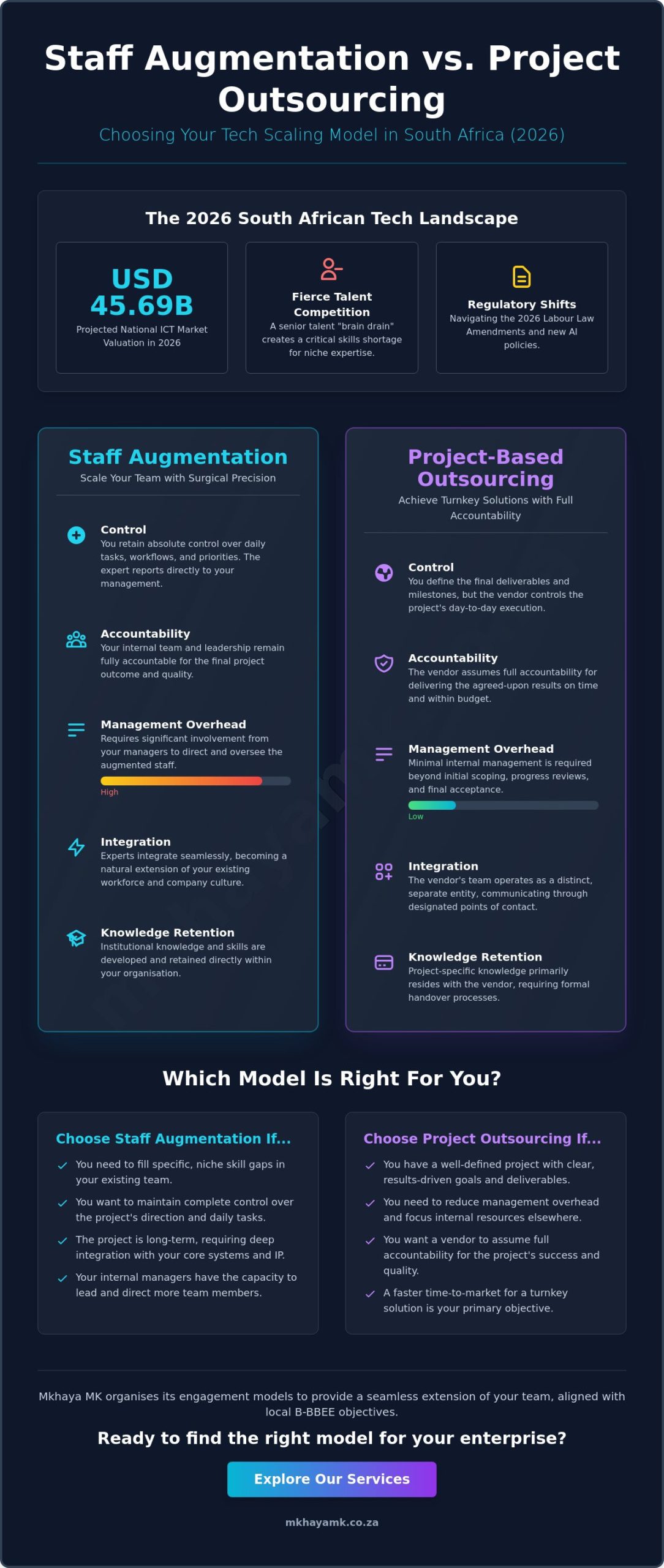
The fundamental difference in management overhead often dictates the success of your scaling strategy. In a staff augmentation model, your internal leads direct every daily stand-up and code review, maintaining a tight grip on the development culture. Conversely, project outsourcing shifts this burden to your partner. They manage the technical execution whilst you oversee the high-level roadmap. When weighing staff augmentation vs project outsourcing south africa, you must evaluate if your internal leadership has the capacity to mentor additional hands or if they need the freedom to focus on core business growth.
Cost structures also diverge significantly to suit different financial goals. Augmentation typically relies on monthly retainers, providing predictable operational expenses for ongoing support and long-term stability. Project-based models often utilise fixed-price fees or milestone payments. These offer budget certainty for specific deliverables, which is particularly relevant in 2026 as South African firms navigate exchange rate volatility and the need for local, B-BBEE-compliant tech spend. This financial clarity allows you to allocate resources with confidence, knowing that the price of delivery is locked in from the start.
Risk mitigation involves more than just delivery guarantees; it requires a deep understanding of local regulations. Both models must adhere to POPIA and the 2025 Joint Standard on Cybersecurity to ensure data integrity. Scalability speed is another vital factor. Augmentation allows for rapid, surgical additions to your team to meet immediate needs. Project outsourcing can ramp up an entire project squad in weeks rather than months, providing a stable anchor for large-scale initiatives that your internal team might not be equipped to handle alone.
The Decision Matrix for 2026
Choosing the right path requires an honest assessment of your project’s maturity and your budget certainty. For most South African CTOs, control remains the deciding factor. If the project involves core intellectual property or requires daily pivots based on user feedback, augmentation is usually the safer bet. However, if a project is too complex for your internal team to oversee without significant distraction, a results-driven outsourcing model provides the necessary buffer. This ensures that your primary operations don’t suffer whilst you pursue new innovations.
Hybrid Models: The Best of Both Worlds?
Many forward-thinking enterprises find that a single model isn’t enough to meet all their needs. You might use augmented talent to maintain your core learner management system whilst tasking an outsourced specialist team with building a new AI-driven automation feature. We facilitate this transition at Mkhaya MK, allowing you to move between models as your project evolves. A hybrid model is the ultimate flexibility tool for South African enterprises seeking to balance operational control with rapid innovation.
If you’re ready to define your scaling strategy, contact our team to discuss which model aligns with your 2026 objectives.
Navigating the Choice: Implementing the Right Model with Mkhaya MK
Finding the right balance in the staff augmentation vs project outsourcing south africa debate is only the first step toward operational excellence. The real value lies in how that model is integrated into your daily business life. At Mkhaya MK, we organise our staff augmentation to feel like a natural extension of your team. This ensures that the transition is smooth and that the technical expertise we provide aligns perfectly with your internal culture and objectives. We don’t just provide hands; we provide a collaborative partnership built on mutual success.
Our commitment to local talent development goes beyond simple recruitment. We prioritise B-BBEE alignment and domestic economic contribution, ensuring that your tech spend strengthens the South African ecosystem. Choosing a local partner also provides a level of infrastructure resilience that offshore alternatives cannot match. We understand the local challenges, from connectivity nuances to the importance of data sovereignty under POPIA. We build our delivery models to remain stable and reliable, providing a steady anchor in a rapidly changing technological landscape.
The Mkhaya MK process moves purposefully from an initial consultation to a steady state of delivery. This methodical execution ensures that every detail is articulated before we move forward. By linking our specific engineering capabilities to your practical business outcomes, we create a rhythmic sense of momentum. This approach leads your business from a broad vision toward a concrete path of growth and stability.
Your Roadmap to Successful Engagement
Success requires a structured approach. We recommend starting with an internal audit to identify your most pressing technical gaps and long-term project goals. Once these are clear, you can choose the model that best aligns with your management capacity. Finally, we work with you to establish clear KPIs and communication channels. This transparency ensures that every stakeholder remains informed and that the project moves forward with absolute clarity.
Why Mkhaya MK is the Preferred Partner in South Africa
We bring deep expertise across ERP solutions and custom engineering to every engagement. Our focus is never on transactional vendor relationships; we strive for long-term partnerships that grow alongside your business. We have a proven track record of delivering digital transformation for national brands, providing the visionary yet practical guidance needed to navigate 2026. By choosing Mkhaya MK, you gain a reliable partner dedicated to your personal journey and your business’s forward-looking ambition.
Building Your Technical Future with Confidence
The choice between staff augmentation vs project outsourcing south africa ultimately rests on your unique operational vision and internal capacity. Throughout this guide, we’ve explored how augmentation offers surgical control whilst project outsourcing provides results-driven accountability. Both models serve as powerful catalysts for growth when aligned with the right strategic goals and management structures. As end-to-end digital transformation experts with a national South African reach, Mkhaya MK is here to ensure your scaling journey is both precise and sustainable.
Our specialised expertise in AI, Cloud, and Custom Engineering allows us to guide you through the complexities of the 2026 tech landscape. Whether you need to bolster your internal team or deliver a turnkey solution, we provide the steady foundation your business requires to thrive. We invite you to book a consultation with Mkhaya MK to find your ideal scaling model. We look forward to partnering with you to turn your ambitious vision into a concrete, high-performing reality.
Frequently Asked Questions
What is the primary difference between staff augmentation and project outsourcing?
The primary difference lies in who manages the daily workflow and team leadership. Staff augmentation provides you with individual experts who report directly to your internal leads, whilst project outsourcing involves a partner taking full responsibility for the end-to-end delivery of a specific outcome. One offers operational control, while the other provides delivery accountability.
Which model is more cost-effective for a South African startup?
For a South African startup, the most cost-effective model depends on your internal leadership capacity. Staff augmentation often provides lower upfront costs if you already have technical leads to manage the work. However, project outsourcing offers predictable, fixed-price structures that help startups avoid the financial risks of project creep and management overhead during critical growth phases.
How does staff augmentation affect my internal company culture?
Staff augmentation introduces new talent directly into your existing team rituals and social dynamics. This can strengthen your culture by bringing in fresh perspectives and high-level expertise, provided you have a structured onboarding process. It’s essential to treat augmented staff as a true extension of your workforce to maintain a cohesive and aspirational environment.
Can I switch from staff augmentation to project outsourcing mid-way through a project?
Switching between models is entirely possible and often strategically sound as a project evolves. You might start with project outsourcing to build a core product and then transition to staff augmentation for long-term maintenance. When comparing staff augmentation vs project outsourcing south africa, many firms find that a hybrid approach offers the most long-term stability.
Who owns the Intellectual Property (IP) in a project outsourcing agreement?
In a standard project outsourcing agreement, the client typically retains full ownership of the Intellectual Property. It’s vital to ensure your contract explicitly states that all custom code, designs, and documentation belong to your enterprise upon payment. This protection is a standard part of our commitment to transparency and the mutual success of our partnerships.
How do I ensure data security when using augmented staff in South Africa?
Ensuring data security requires strict adherence to POPIA regulations and the 2025 Joint Standard on Cybersecurity. You should implement secure cloud environments and ensure all augmented staff follow your internal security protocols. Regular audits and clear data-handling policies are non-negotiable for maintaining resilience in the South African technological landscape.
What management tools are best for overseeing an outsourced development project?
Does Mkhaya MK offer support for both remote and on-site staff augmentation?
Mkhaya MK provides flexible staff augmentation services designed to fit your specific infrastructure and operational requirements. We focus on delivering a seamless experience that feels like a natural extension of your team, ensuring that our experts align with your internal workflows. Our goal is to provide the steady support and engineering expertise your business needs to thrive.