

Custom Software Development South Africa: A Strategic Guide for 2026
What if the software holding your business back is actually costing you more in hidden licence fees than it would to build a proprietary asset from the ground up? Many South African leaders find themselves trapped between high international costs and platforms that simply don’t scale with national expansion. It’s a common frustration to feel that your digital tools are a constraint rather than a catalyst for growth.
We understand that you’re looking for more than just a vendor; you’re looking for a partner to help you navigate the complexities of custom software development south africa in 2026. In this guide, you’ll discover how bespoke engineering, AI-driven automation, and cloud-native solutions are transforming the local landscape. We’ll explore the shift toward delivery maturity and how owning your digital IP provides the stability needed for long-term success. By the end of this article, you’ll have a clear path toward achieving operational efficiency whilst securing a scalable platform that supports your unique business journey.
Key Takeaways
- Learn why South African enterprises are moving away from restrictive international licences in favour of custom software development south africa to secure long-term digital IP.
- Understand how integrating AI-driven automation and cloud-native architecture ensures your platform remains scalable and efficient in a competitive market.
- Discover how a rigorous Discovery phase and Agile methodology mitigate project risks whilst ensuring your software aligns perfectly with complex business logic.
- Evaluate the cost-benefit ratio of bespoke tools compared to off-the-shelf packages, focusing on long-term operational savings and enhanced productivity.
- Explore how a flexible partnership model, including staff augmentation, allows you to extend your internal team’s capabilities whilst maintaining project momentum.
The Landscape of Custom Software Development in South Africa (2026)
In 2026, custom software development south africa is no longer just about building apps; it’s about engineering strategic assets that align with unique business logic. Whilst off-the-shelf solutions offer a quick start, they often fail to capture the specific nuances of the local market. Local enterprises are increasingly viewing digital transformation as a necessary evolution rather than a luxury. Within the 2026 South African digital economy, custom software development is defined as the creation of high-precision, cloud-native tools that transform operational friction into a competitive advantage.
Choosing local engineering over international SaaS allows businesses to bypass the volatility of exchange rates and rigid global frameworks. By focusing on bespoke builds, organisations ensure their technology scales alongside their national footprint. This shift represents a move toward stability and long-term resilience in a landscape where agility is the primary currency for success.
To better understand the practical side of engineering in our local context, watch this helpful video:
Addressing Local Operational Challenges
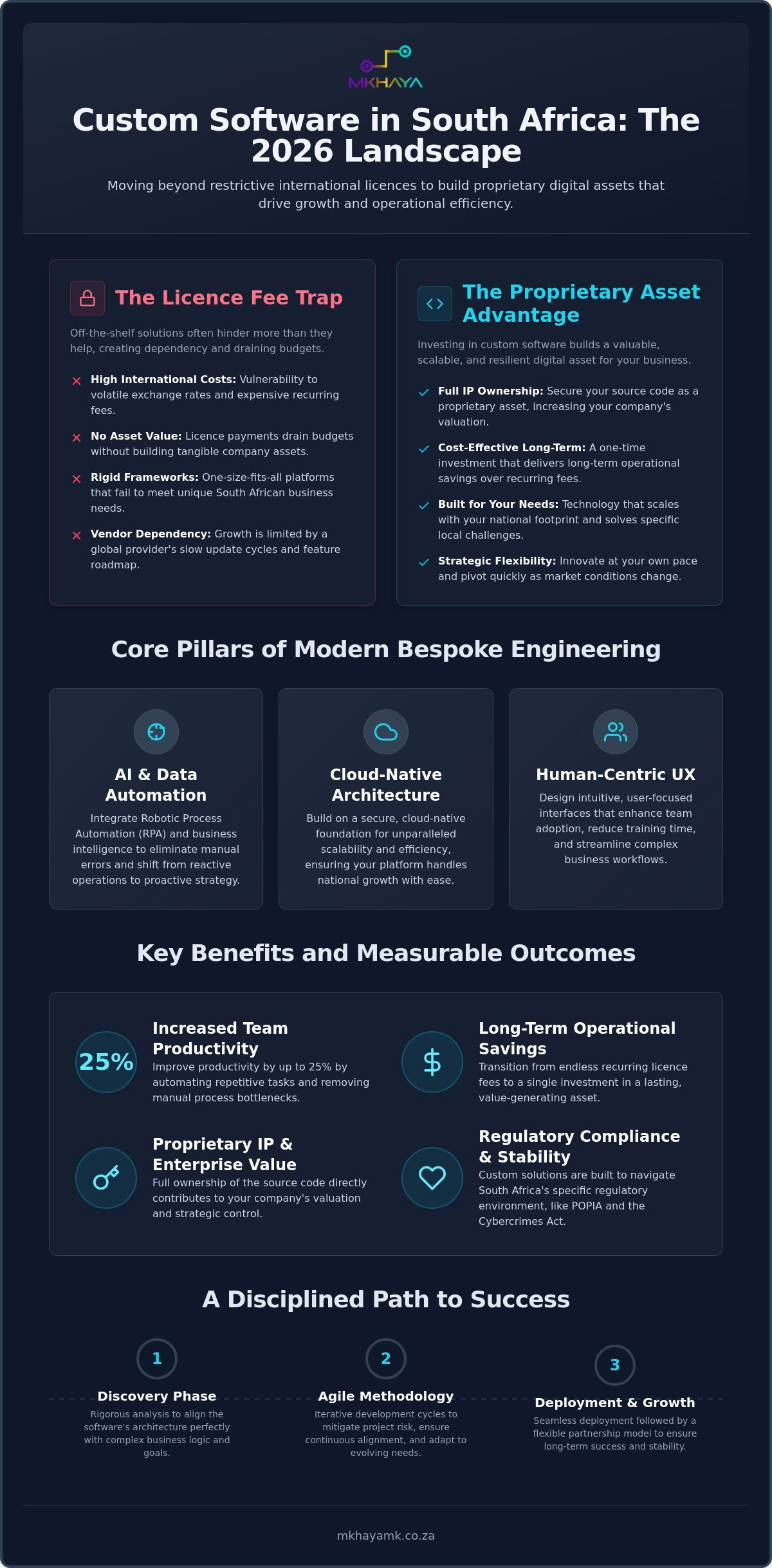
Fragmented legacy systems continue to hinder productivity for many established firms. Modern software engineering provides a bridge, integrating disparate processes into a unified, high-performing workflow. This approach is vital for navigating South Africa’s strict regulatory environment, including POPIA and the Cybercrimes Act. Industry benchmarks suggest that bespoke tools can improve team productivity by up to 25% by removing manual bottlenecks and automating repetitive tasks. Following a structured approach to The Software Development Lifecycle ensures that these solutions remain robust, compliant, and ready for future expansion from the very first day of deployment.
The Move Towards Proprietary Intellectual Property
Many businesses are waking up to the “licence fee trap” associated with international software packages. These recurring costs often drain budgets without adding to the company’s tangible asset value. By investing in software engineering, a business secures full ownership of its source code. This proprietary IP increases the overall valuation of the enterprise and provides the strategic flexibility to pivot quickly when market conditions change. Owning the platform means you aren’t waiting for a global provider to update a feature; you have the power to innovate and refine your tools at your own pace, ensuring your technology remains a stable anchor for your growth.
Core Pillars of Modern Bespoke Engineering: AI, Cloud, and UX
The technical foundation of any digital asset determines its lifespan and its ability to return value. In 2026, custom software development south africa has evolved beyond simple coding to encompass a sophisticated blend of intelligence, scalability, and human-centric design. These pillars ensure that a platform doesn’t just function; it thrives within the unique economic context of The South African Software Industry. By building on these core strengths, organisations create tools that are resilient enough to handle national growth whilst remaining agile enough to adapt to local market shifts.
AI and Data Automation Integration
Artificial intelligence is no longer a futuristic add-on; it’s a standard requirement for modern builds. Implementing AI automation solutions south africa allows businesses to move from reactive operations to proactive strategy. Robotic Process Automation (RPA) is frequently integrated within custom workflows to eliminate manual errors in data entry and processing. This precision is backed by business intelligence tools that provide real-time oversight. When your software can predict bottlenecks before they occur, your leadership team can focus on growth rather than fire-fighting.
Cloud Solutions and DevOps Excellence
Scalability across provinces requires a robust infrastructure that only cloud-native architecture can provide. Utilising cloud migration services south africa is essential for businesses looking to shed the weight of physical servers and local hardware limitations. DevOps practices further accelerate this by creating a continuous loop of refinement and deployment. This methodology ensures that security updates and new features reach users without downtime. It also keeps your organisation compliant with national data protection laws, such as POPIA, by embedding security protocols directly into the development pipeline.
Specialised Business Systems
Generic software often fails to meet the specific demands of regulated sectors. For instance, a bespoke loan management system south africa provides the exact compliance and reporting features required by local financial authorities. Similarly, custom tools for learner management and facility oversight allow organisations to organise their internal logic without compromise. Custom ERP solutions are designed to adapt to your existing business behaviour rather than forcing your staff to learn a foreign, rigid system. If you’re ready to build a system that truly fits your operations, you might consider how tailored engineering services can refine your current processes.
User experience remains the final, critical pillar. Even the most advanced AI or cloud system will fail if employees find it difficult to use. Prioritising UI/UX design ensures high adoption rates, making the transition to new technology a smooth and supportive experience for your entire team.
Strategic Benefits: Why South African Enterprises Favour Bespoke Tools
Strategic value in 2026 is measured by how well your technology serves your specific business behaviour. Whilst many leaders initially consider off-the-shelf packages for their perceived speed, they often encounter the “80/20” rule. This is where a generic platform meets 80% of your requirements but leaves the most critical 20% of your unique logic unsupported. Choosing custom software development south africa ensures that your digital tools are a 100% fit, eliminating the workarounds that typically stifle productivity.
The shift toward bespoke engineering is driven by a desire for stability and control. Instead of being a tenant on a global SaaS platform, you become the owner of a proprietary asset. This transition from recurring monthly subscription costs to capital investment in your own source code significantly enhances the long-term valuation of your enterprise. It also provides a level of agility that international software simply cannot match. When your market changes, you have the power to refine your platform instantly without waiting for a global update cycle.
Custom vs. Off-the-Shelf: A 2026 Comparison
The difference between these two paths often comes down to the quality of the partnership. Generic software users frequently find themselves stuck in international ticket systems, waiting days for a response from a remote support centre. In contrast, bespoke engineering offers direct access to local engineers who understand the South African business context. This proximity ensures that support is not just technical, but strategic. Additionally, custom builds allow for seamless integration with your existing legacy hardware and APIs, ensuring that your new system works in harmony with your current infrastructure rather than requiring a total overhaul.
Security and Data Sovereignty
Compliance with POPIA is a non-negotiable priority for any organisation handling personal data. Bespoke systems allow you to keep data strictly within South African borders, ensuring full data sovereignty. You can build custom security protocols that address the specific risks inherent to your industry, rather than relying on a one-size-fits-all security patch. There is also a distinct advantage in “security through obscurity”. Whilst generic tools are high-profile targets for global cyberattacks, a custom-built system is far less likely to be targeted by automated hacking scripts designed for mass-market software.
A key differentiator in managing project risk is the ability to extend your team’s capabilities through staff augmentation. This model allows you to maintain momentum by bringing in specialised expertise exactly when it’s needed. It bridges the gap between hiring a full-time team and outsourcing entirely, providing a flexible way to scale your software engineering efforts. By combining this flexible talent model with a custom architecture, you create a platform that is ready to support national growth and future innovation.
The Software Development Lifecycle: From Discovery to Deployment
Building a high-performing digital asset requires a methodical and transparent approach. Success in custom software development south africa depends on more than just technical skill; it relies on a structured lifecycle that prioritises clarity and partnership at every stage. By following a rhythmic momentum from strategy to execution, we ensure that the final product isn’t just a piece of software, but a stable anchor for your business operations. This process transforms abstract goals into concrete, scalable platforms that deliver a measurable return on investment.
Discovery and Business Analysis
The Discovery phase is arguably the most critical part of the entire journey. We begin with collaborative workshops designed to map out intricate user journeys and define the technical architecture. This isn’t just about planning; it’s about deep alignment between your business logic and our engineering strategy. Integrating professional UI UX design services south africa during this stage ensures that the software remains intuitive and supportive for the people who will use it daily. We establish clear KPIs before development begins, providing a shared definition of success that guides every subsequent decision.
Agile Development and Deployment
Agile methodologies keep you at the heart of the build process. By breaking the project into manageable sprints, we create frequent feedback loops that allow for refinements in real-time. This iterative approach significantly reduces project risk, as any deviations from the original vision are caught and corrected early. We utilise Continuous Integration and Deployment (CI/CD) pipelines to manage updates seamlessly, ensuring that new features are integrated without disrupting your existing workflows. Transitioning from development to a live production environment is handled with precision to avoid downtime, maintaining your operational momentum throughout the launch.
Stability is never an accident; it’s the result of rigorous Quality Assurance (QA). Every line of code undergoes thorough testing to ensure it meets enterprise-grade standards for security and performance. Even after deployment, our commitment continues through dedicated maintenance and support. Software is a living asset that must evolve alongside your business. If you’re ready to see how a structured approach can secure your digital future, you can explore our development process in more detail. This long-term perspective ensures your platform remains a reliable tool for national expansion and sustained efficiency.
Partnering for Growth: Mkhaya MK’s Integrated Development Model
Choosing a partner for custom software development south africa is a decision that shapes your organisation’s long-term stability. At Mkhaya MK, we don’t just deliver code; we build collaborative relationships designed to bridge the gap between high-level business strategy and precise technical execution. Our integrated model offers the flexibility you need to navigate a rapidly changing technological landscape whilst ensuring your digital assets remain secure and scalable. By acting as a stable anchor for your growth, we help you transform ambitious visions into practical, operational realities.
Working with a national partner means you’re collaborating with a team that truly understands the South African business context. We’re deeply invested in your personal journey and the success of your national expansion. This local expertise ensures that your technology isn’t just modern; it’s relevant to the specific challenges and opportunities within our borders. It’s about moving forward with a sense of quiet confidence, knowing that your software is built on a foundation of integrity and commitment.
Staff Augmentation: Scaling Your Team on Demand
One of the greatest challenges in 2026 is accessing niche technical expertise without the heavy overhead of permanent hiring. Our IT staff augmentation services allow you to extend your internal team seamlessly. Whether you need to hire dedicated developers south africa for a specific sprint or bring in long-term specialists, this model ensures you maintain project momentum. It’s an agile way to scale that keeps you in control of your workflows. You get the benefit of senior-level skills whilst avoiding the complexities of traditional recruitment, allowing your core team to focus on their primary objectives.
End-to-End Digital Transformation
Our approach goes beyond simple engineering to provide comprehensive digital transformation consulting south africa. We look at your entire business ecosystem to identify where automation and cloud-native tools can create the most value. For businesses in the financial sector, leveraging our proprietary Loan Management System offers a faster return on investment by providing a pre-validated framework that can be customised to your specific logic. This blend of bespoke engineering and specialised platforms ensures that your technology is always fit for purpose.
The Mkhaya MK promise is to provide a visionary yet practical guide that empowers your business to lead with confidence. We value transparency and methodical execution over flashy claims, ensuring that every step of our engagement is clearly articulated. As you look toward 2026 and beyond, we’re ready to help you build the stable, high-performing platforms your future demands. Together, we can create a technological landscape that supports your ambition and secures your legacy.
Securing Your Digital Legacy in 2026
The transition from restrictive international licences to proprietary digital assets marks a turning point for any ambitious organisation. By embracing custom software development south africa, you secure the ownership of your source code whilst ensuring your technology aligns perfectly with your business logic. We’ve explored how integrating AI-driven automation and cloud-native architecture provides the scalability required for national expansion. From the initial Discovery phase to the final deployment, a structured approach ensures that every line of code serves a strategic purpose.
Mkhaya MK brings a polished, professional team with national coverage to every project. Whether you require specialised systems for Loan, Facility, or Learner Management, our end-to-end service covers everything from UI/UX design to complex Cloud DevOps. We’re here to act as your stable anchor in a rapidly changing landscape, providing the technical precision and visionary guidance needed to succeed. Start your digital transformation journey with Mkhaya MK today and build a platform that grows with your ambition. Your path toward operational excellence is a partnership we value deeply, and we look forward to building a resilient, high-performing future together.
Frequently Asked Questions
How much does custom software development cost in South Africa?
Market benchmarks for custom software development south africa in 2026 typically start from R27,000 for specialised applications, whilst complex mobile platforms can range from R50,000 to over R1,500,000. These figures depend heavily on the specific feature set and integration requirements of your project. Ongoing application maintenance usually adds an annual expense of 15% to 20% of the initial development cost to ensure the platform remains stable and secure.
How long does it typically take to build a bespoke business application?
Building a bespoke business application generally takes between three and nine months, depending on the complexity of the requirements. A focused tool with limited integrations might reach deployment in twelve weeks, whereas an enterprise-grade system requires a longer timeline for rigorous testing. Following an Agile methodology allows for iterative releases, meaning your staff can often begin using core features whilst the rest of the platform is being constructed.
What is the difference between project-based development and staff augmentation?
Project-based development involves a defined scope where the service provider manages the entire delivery from discovery to launch. Staff augmentation allows you to extend your internal team by bringing in specialised developers to work directly under your management. This flexible model is ideal for maintaining project momentum during rapid growth phases without the long-term overhead of permanent hiring, providing access to niche technical skills on demand.
Can custom software be integrated with my existing legacy systems?
Yes, custom software is designed to integrate seamlessly with your existing legacy systems through secure APIs and custom middleware. This approach allows you to modernise your workflows without needing to replace your entire hardware infrastructure. By building bridges between old and new technology, you can protect your previous investments whilst gaining the efficiency benefits of modern, cloud-native engineering and automated data flows.
Who owns the intellectual property (IP) of the developed software?
Standard practice ensures that the client owns the full intellectual property and source code upon completion of the project. It’s vital to have a written IP assignment clause in your development agreement to confirm this ownership from the outset. Owning your digital assets increases the overall valuation of your enterprise and provides the freedom to refine your platform without being beholden to a third-party vendor’s restrictive roadmap.
Is bespoke software more secure than off-the-shelf alternatives?
Bespoke software is often more secure because it isn’t a high-profile target for automated global hacking scripts designed for mass-market tools. Custom systems allow for the construction of specific security protocols tailored to your industry’s unique risks and regulatory requirements. This “security through obscurity” is reinforced by embedding compliance with POPIA and the Cybercrimes Act directly into the software architecture during the development process.
What industries in South Africa benefit most from custom software?
Industries such as FinTech, logistics, and education benefit significantly from custom software development south africa due to their complex operational needs. For example, financial institutions require specialised loan management tools, whilst educational organisations rely on bespoke learner management systems to organise student data. Any sector where generic software fails to capture unique business logic will find a competitive advantage in building a proprietary, scalable platform.
How do I choose the right software development company in South Africa?
Choosing the right partner requires looking beyond technical skills to find “delivery maturity” and a deep understanding of the local business context. You should prioritise a company that values transparency and offers a clear, step-by-step explanation of their engagement process. Look for a visionary guide that remains invested in your personal journey and is capable of providing end-to-end support from UI/UX design to cloud-native deployment.