

Custom CRM Development South Africa: A Strategic Guide for 2026
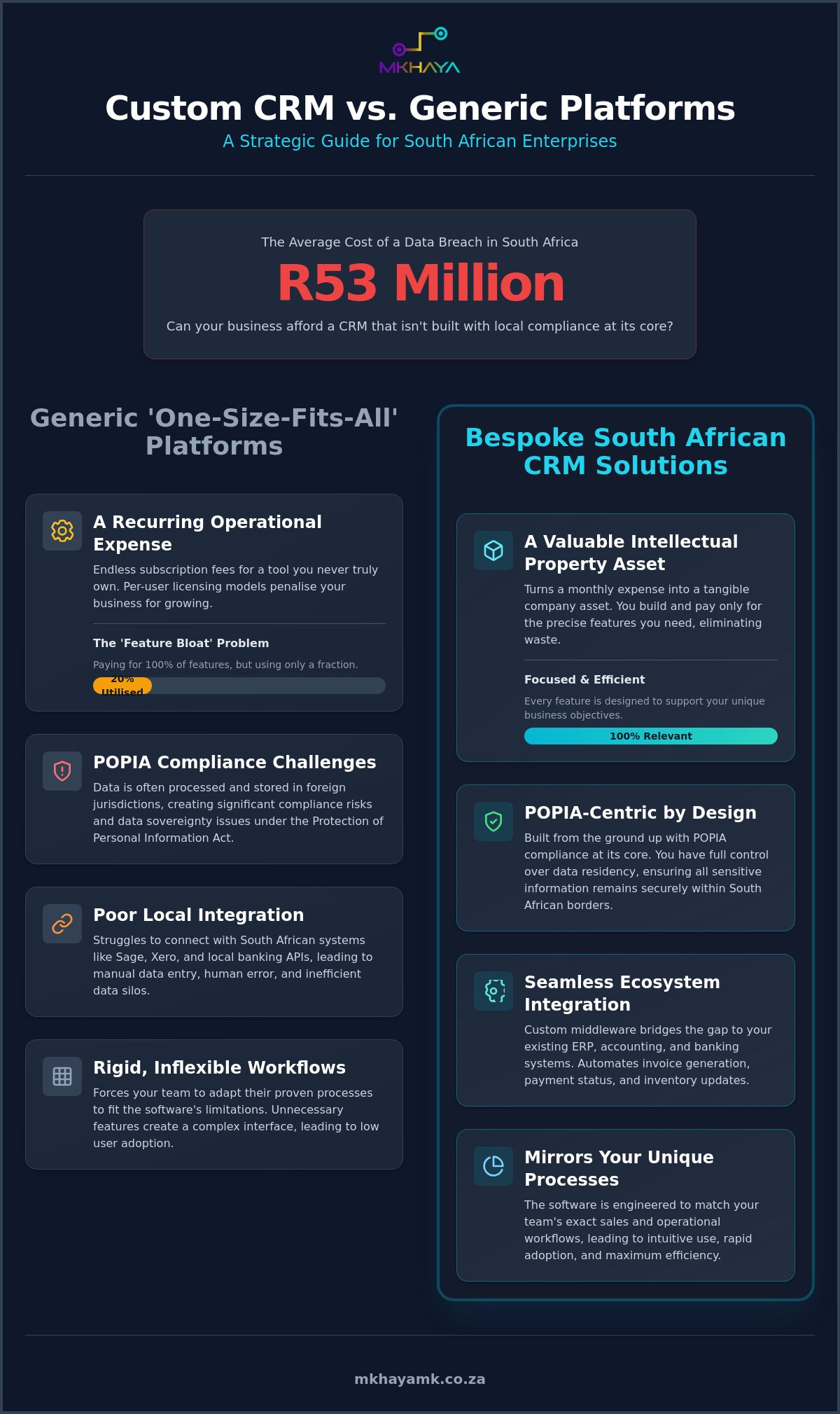
With the average cost of a data breach in South Africa reaching R53 million, can your business really afford a CRM that wasn’t built with local compliance at its core? You’ve likely felt the frustration of paying premium subscription fees for global platforms, only to find half the features are irrelevant to your local operations. We understand that the struggle with rigid systems and the constant worry over POPIA enforcement is a heavy burden for any enterprise. This is why custom crm development south africa has shifted from a luxury to a strategic necessity for those who value precision and long-term stability.
We agree that your technology should adapt to your business, not the other way around. In this guide, you’ll discover how a bespoke solution provides full ownership of your data whilst mirroring your exact sales and operational processes. We’ll explore how custom-built tools ensure seamless integration with South African banking systems, AI automation, and your existing ERP. This article provides a clear roadmap for leveraging these refined tools to gain a genuine competitive edge in the 2026 market. We’re here to help you move from fighting your software to mastering your growth through a partnership built on transparency and results.
Key Takeaways
- Learn why generic global platforms often fail to match the unique operational behaviours of local businesses and how bespoke engineering solves these challenges.
- Discover how custom crm development south africa serves as a foundational layer for AI automation whilst ensuring strict POPIA compliance.
- Understand the “ownership advantage” of building your own software, turning a monthly operational expense into a valuable intellectual property asset.
- Explore a strategic roadmap for development that focuses on business objectives and rapid deployment through a high-impact Minimum Viable Product.
- Identify the key qualities of a reliable technology partner who prioritises transparent collaboration and long-term mutual success over simple vendor transactions.
The Limitations of Generic CRM Solutions for South African Enterprises
Many South African enterprises find themselves trapped in a cycle of adapting their unique business logic to fit the rigid templates of global software. Whilst Customer Relationship Management (CRM) is a universal concept, the application of it varies wildly across different markets. In South Africa, the nuances of our local trade, credit behaviours, and regulatory environment mean that a “one-size-fits-all” approach often leaves gaps in operational efficiency. This is why custom crm development south africa provides a distinct advantage, as it involves a bespoke engineering process built specifically around your internal workflows.
The “feature bloat” problem is a significant pain point for local firms. Many organisations pay for the full 100% of a global SaaS tool’s capabilities but only ever utilise about 20% of the features. This creates unnecessary complexity and high subscription costs that don’t translate into value. A custom solution ensures you only build and pay for what you actually use, removing the friction of per-user licensing that often stifles growth during expansion phases. When your team grows from ten to fifty, your software costs shouldn’t necessarily quintuple.
To better understand the value of this bespoke approach, watch this helpful video:
Navigating POPIA and Data Sovereignty
Compliance is no longer a peripheral concern; it’s a central pillar of digital strategy. Custom builds allow for precise control over data residency, ensuring that sensitive information remains within South African borders. This alignment with the Protection of Personal Information Act (POPIA) is much easier to maintain when you own the architecture. By avoiding third-party data processing in foreign jurisdictions, you eliminate the risks associated with international legal shifts and ensure your data sovereignty remains intact. This approach builds trust with your clients, who are increasingly aware of their privacy rights.
Integration with Local Accounting and ERP Systems
A CRM shouldn’t exist in a vacuum. Global platforms often struggle to integrate with South African favourites like Sage, Xero, or local banking APIs. These hurdles lead to manual data entry. Errors follow. Through custom middleware, we bridge the gap between legacy systems and modern interfaces. This creates a unified ecosystem where data flows effortlessly between your sales tools and your broader ERP solutions. We focus on:
- Automating invoice generation directly from lead closure.
- Synchronising customer payment status with sales dashboards.
- Bridging the gap between warehouse inventory and client orders.
This ensures that your financial and operational data is always in sync, providing a single source of truth for your leadership team. By refining these connections, we help you build a stable anchor for your business in a rapidly changing technological landscape.
Building for Precision: Core Components of Custom CRM Development
Modern enterprises are moving away from static contact lists. They require intelligent hubs that act as the central nervous system of their operations. When evaluating bespoke vs. off-the-shelf solutions, the primary advantage is the ability to build a system that mirrors your team’s favourite workflows. custom crm development south africa isn’t just about storing data; it’s about refining the way your staff interacts with information. By creating a tool that feels intuitive, you drive user adoption and turn the CRM into a foundational asset for your broader digital strategy.
A high-end interface is not a luxury. It’s a requirement for success. When software feels clunky, teams find workarounds, and data integrity suffers. We focus on building precise, refined tools that provide a stable anchor in a rapidly changing technological environment. This precision ensures that your CRM isn’t just a database, but a visionary guide for your sales and support teams.
AI-Driven Automation and Predictive Analytics
Intelligence is the engine of the 2026 business landscape. It’s predicted that over 60% of South African Salesforce users will be leveraging AI tools by 2026, yet custom builds allow you to integrate these capabilities natively without the high “add-on” costs of global platforms. By baking AI and data automation directly into your architecture, you can implement predictive lead scoring that identifies high-value opportunities before your competitors do. Automated follow-up sequences can be designed to feel personal and supportive, ensuring no client is left behind whilst your team focuses on high-level strategy. Real-time reporting dashboards then translate this data into clear, actionable insights for executive decision-making.
User-Centric Design and Custom Workflows
Every organisation has a unique rhythm. Before writing a single line of code, we believe in mapping your specific sales pipeline to ensure the software matches your reality. Our UI/UX design services focus on creating intuitive client portals and internal dashboards that simplify complex tasks. For large South African organisations, role-based access control is essential for maintaining security and clarity across different departments. This methodical execution ensures that each user sees exactly what they need to succeed, nothing more and nothing less. If you’re ready to see how these components fit together, exploring our digital transformation services is a great next step toward long-term stability.
Bespoke vs. Off-the-Shelf: Evaluating the Long-Term ROI
Choosing a CRM is a financial decision as much as a technical one. Most businesses default to global SaaS platforms, viewing the monthly fee as a manageable operational expenditure (OpEx). However, as your organisation scales, this “subscription tax” often becomes a heavy burden that penalises your success. By investing in custom crm development south africa, you shift your technology spend from a perpetual rental model to a capital expenditure (CapEx) that builds a tangible intellectual property asset. This move ensures that your software grows alongside you without the friction of escalating per-user fees.
Ownership is power. When you own the source code, your software becomes a business asset that adds value to your company’s balance sheet. You are no longer at the mercy of a vendor’s price hikes or sudden changes in their terms of service. This stability allows you to plan for the long term with quiet confidence, knowing your foundational tools are secure. It’s a strategic shift from being a tenant to being a landlord of your own digital infrastructure.
Total Cost of Ownership (TCO) Over 5 Years
A realistic financial analysis must look beyond the first year. Whilst the upfront cost of bespoke development is higher than a single month of SaaS, the five-year trajectory often tells a different story. In a custom model, your primary costs are development, hosting, and annual maintenance; which typically ranges from 15% to 25% of the initial build cost according to industry data. Compare this to a SaaS model where seat prices escalate as you add staff. Our approach to software engineering focuses on creating sustainable, scalable architectures that eliminate these hidden costs. Growth should be a victory, not a financial penalty.
Eliminating Feature Bloat and Complexity
Productivity is the ultimate ROI. Generic systems are often cluttered with hundreds of features your team will never touch. This bloat leads to confusion and high training costs. A bespoke tool, designed specifically for your internal workflows, is easier to master. Your staff spend less time fighting the interface and more time engaging with clients. This refinement is a critical step in a successful digital transformation journey. By automating specialised processes, you reduce manual labour and free your team for high-value strategic work. A simpler, customised interface doesn’t just save time; it builds a culture of efficiency and precision.
The Custom CRM Development Lifecycle: A Strategic Roadmap
Building a bespoke system requires more than technical expertise; it demands a deep understanding of your business’s unique pulse. Successful custom crm development south africa depends on a lifecycle that prioritises business objectives over raw code. Our approach is designed to be a supportive partnership, guiding you from a broad vision toward a concrete, high-performance reality. By following a structured roadmap, we ensure that the final product isn’t just a tool, but a stable anchor for your daily operations.
The transition from fragmented spreadsheets or outdated legacy systems is often the most daunting phase for local enterprises. We treat data migration as a surgical process, ensuring that your historical records are cleaned, mapped, and securely transferred without loss of integrity. To maintain momentum, we advocate for an agile methodology. This involves building a Minimum Viable Product (MVP) that allows your team to begin using core features quickly. Early adoption provides invaluable feedback, allowing us to refine the software in real-time as your organisation grows.
Discovery, Mapping, and UI/UX Prototyping
Precision begins long before the first line of code is written. During the discovery phase, we engage in a collaborative process to identify specific pain points amongst your various departments. Whether it’s the sales team struggling with lead tracking or accounts needing better visibility, we map every requirement. We then create detailed wireframes and prototypes, allowing stakeholders to visualise the interface and workflow. This methodical preparation is a hallmark of our refined development process, ensuring there are no surprises during the build phase. It turns a complex technical project into a transparent, manageable journey.
Integration, Testing, and Deployment
Resilience is built through rigorous testing. Enterprise-grade software requires exhaustive Quality Assurance (QA) to ensure every module performs perfectly under pressure. We implement a phased rollout strategy, which minimises disruption to your daily activities and allows for a smooth transition. Our use of cloud solutions and modern DevOps practices ensures high availability and zero downtime during updates. This commitment to technical depth means your system remains agile and modern, even as the technological landscape shifts. If you’re ready to begin this evolution, get in touch with our team to discuss your specific requirements.
Choosing the Right Partner for Custom CRM Development in South Africa
Selecting a technology partner is a decision that defines the trajectory of your digital evolution. It’s about finding a visionary guide who understands that your software is a stable anchor for your business. A reliable partner for custom crm development south africa must offer more than just technical depth; they need to provide transparency and local market expertise. We believe in a partnership model that prioritises mutual success over simple transactions. This collaborative approach ensures that the final product isn’t just a piece of code, but a tool that truly mirrors your operational behaviour.
Trust is built through transparency. For large-scale implementations, having a partner with a national footprint across South Africa is essential. This local presence ensures that support is always within reach and that the team understands the specific regulatory and economic pressures your business faces. By choosing a partner who values methodical execution and integrity, you secure a foundation for long-term stability in a rapidly changing market.
Project-Based vs. Staff Augmentation Models
Flexibility in delivery is a key trait of a modern technology partner. Sometimes, a fixed-price project is the right choice for a clearly defined initial build. However, as your system evolves, you might find that extending your internal team via staff augmentation provides better long-term value. This model allows you to hire dedicated developers who work as a seamless extension of your own staff, maintaining and evolving the CRM post-launch. If you’re considering this path, our guide on hiring dedicated developers in South Africa offers a deeper look at how to scale your technical capacity with precision.
The Mkhaya MK Advantage
We provide a unique blend of custom engineering, AI expertise, and digital strategy. Our goal is to move you from a broad vision toward a concrete, high-performance reality. We encourage you to view your CRM not as an isolated tool, but as the first step in a broader custom software development roadmap. This strategic perspective ensures that every technical decision you make today supports your ambitions for 2026 and beyond. Our commitment to your journey is rooted in traditional values of integrity and a forward-looking ambition for your mutual success.
Securing Your Digital Future with Bespoke CRM Solutions
The journey toward operational excellence requires tools that mirror your unique business logic rather than forcing you into rigid, generic templates. We’ve explored how moving away from global SaaS platforms eliminates the “subscription tax” whilst turning your software into a valuable intellectual property asset. By prioritising custom crm development south africa, you ensure that your organisation remains resilient against regulatory shifts and evolving market demands. This strategic shift provides the precision needed to master your data and refine your customer relationships with absolute clarity.
At Mkhaya MK, we act as your authoritative partner through comprehensive digital transformation consulting and specialised expertise in POPIA-compliant software architecture. We offer the flexibility of staff augmentation to help you scale your development team with ease, ensuring each phase of construction is handled with methodical execution. Partner with Mkhaya MK for your custom CRM development to secure a stable anchor for your enterprise in a rapidly changing world. We’re committed to your personal journey and the long-term stability of your business operations. Let’s build a future defined by precision and mutual success.
Frequently Asked Questions
How long does custom CRM development typically take in South Africa?
The timeline for custom development depends on the complexity of your business logic and the depth of integration required. A Minimum Viable Product (MVP) typically takes three to four months to launch, whilst a comprehensive enterprise suite may require six to twelve months. We follow a methodical roadmap that prioritises high-impact features first, allowing your team to begin using the tool whilst we refine secondary modules in the background.
Is a custom CRM more expensive than a monthly subscription to a platform like Salesforce?
Upfront costs for custom builds are higher than initial monthly fees; however, the long-term Return on Investment (ROI) is often superior for growing firms. You avoid the “subscription tax” that penalises you as your team expands. By shifting from an operational expense to a capital asset, you gain full ownership of your software. This eliminates escalating seat prices and provides a more stable financial anchor for your digital strategy.
Can a custom CRM integrate with my existing South African accounting software?
Yes, seamless integration with local favourites like Sage, Xero, and South African banking APIs is a core benefit of bespoke engineering. We build custom middleware to bridge the gap between your legacy accounting systems and your new CRM interface. This ensures that invoice generation and payment tracking are automated, providing your leadership team with a single source of truth without the need for manual data entry.
How does a custom CRM help with POPIA compliance?
custom crm development south africa allows you to bake POPIA compliance into the very architecture of your software. You gain precise control over data residency by hosting information on local servers, avoiding the risks of foreign jurisdictions. Built-in audit logs and role-based access controls ensure that personal information is handled with the highest level of integrity, protecting your business from the significant fines associated with non-compliance.
Can we migrate our existing lead data from spreadsheets into a new custom CRM?
Data migration is a critical phase of our development lifecycle. We specialise in cleaning and mapping historical data from fragmented spreadsheets or legacy systems into your new, structured database. This surgical approach ensures that no lead is lost and that your data integrity remains intact. By moving your records into a unified hub, you empower your sales team with a refined view of every customer interaction.
What happens if we need to add new features to our CRM after it has been launched?
Bespoke software is designed to grow alongside your organisation. Because you own the platform, you can add new features or integrate fresh AI tools whenever your business strategy shifts. We offer flexible models, including staff augmentation, to help you maintain and evolve your system post-launch. This ensures your technology remains agile and modern, serving as a stable foundation for your long-term digital transformation journey.
Do we own the source code for the CRM developed by Mkhaya MK?
Yes, you retain full ownership of the source code and the intellectual property of the software we build for you. This “ownership advantage” is a central pillar of our partnership model. It ensures that your CRM is a tangible business asset rather than a rented service. Having complete control over your code provides the quiet confidence that your foundational tools are secure and independent of third-party vendor changes.
Can a custom CRM be used for mobile sales teams in the field?
custom crm development south africa frequently includes mobile-optimised interfaces or dedicated applications for field-based teams. We build cloud-based solutions that allow your sales staff to access real-time data and update lead status whilst on the move. These tools can even include offline synchronisation, ensuring that your team stays productive in areas with limited connectivity, which is a practical necessity for national operations across the country.