

How to Implement a Learner Management System for Corporates: A Strategic 2026 Guide
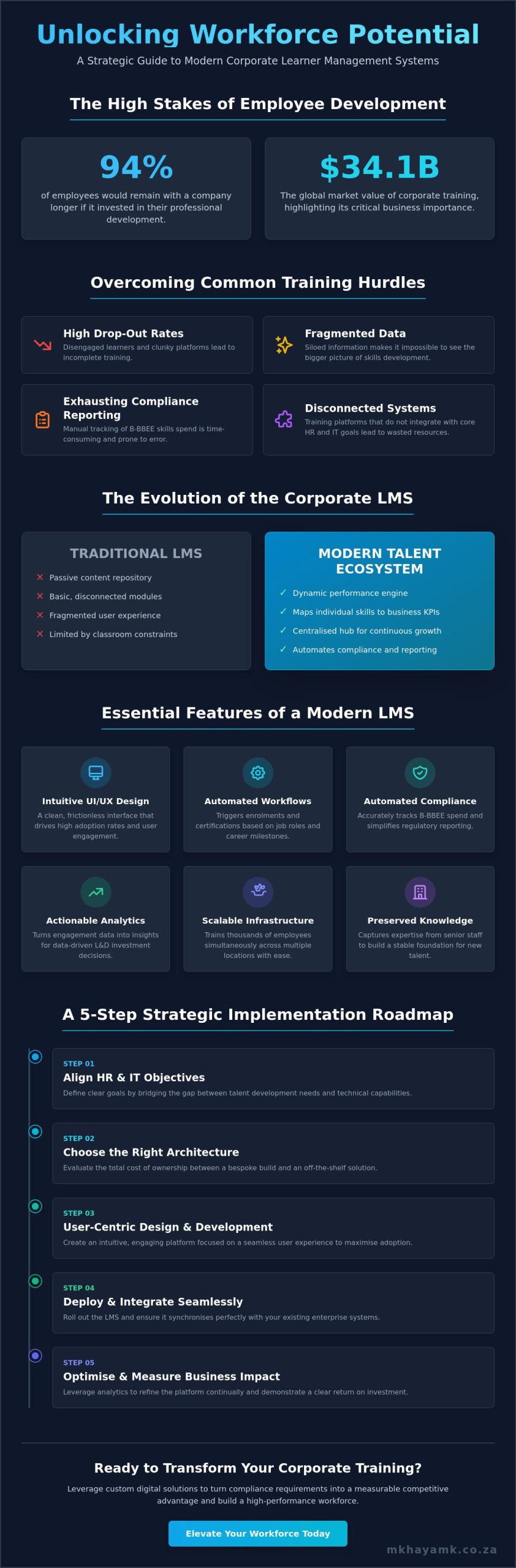
Did you know that 94% of employees would remain with their employer longer if the business invested in their professional development? In a global market valued at $34.1 billion, the stakes for effective training have never been higher. Yet, many South African organisations still battle high drop-out rates and fragmented data that makes tracking B-BBEE skills development spend a manual, exhausting process. Implementing a robust learner management system for corporates is no longer just an HR checkbox; it’s a strategic necessity to transform your internal knowledge into a high-performance engine.
We understand that you want more than just a digital library. You need a centralised hub that automates compliance reporting and delivers clear, measurable improvements in staff performance. You likely agree that current systems often feel disconnected from your broader IT and HR goals, leading to wasted resources. This guide will show you how to design and deploy a tailored LMS that synchronises employee growth with your enterprise operations. We’ll explore the path from initial technical integration to optimising your platform for long-term stability and business impact.
Key Takeaways
- Understand how a modern learner management system for corporates evolves from a simple content repository into a high-impact talent development ecosystem.
- Identify the essential technical features and user-centric design choices that drive engagement and reduce training drop-out rates.
- Evaluate the total cost of ownership by comparing bespoke architecture with off-the-shelf solutions to find the most sustainable fit for your budget.
- Master a structured five-step implementation roadmap designed to align HR objectives with IT infrastructure for a seamless deployment.
- Learn how to leverage custom digital solutions to transform compliance requirements into a measurable competitive advantage for your workforce.
Understanding the Modern Learner Management System for Corporates
A modern learner management system for corporates is far more than a repository for training videos; it’s a sophisticated digital engine designed to synchronise enterprise knowledge with operational goals. In the past, organisations viewed an LMS as a passive tool for hosting basic e-learning modules. Today, this technology has evolved into a dynamic talent development ecosystem that maps individual skills to business KPIs. By implementing a centralised learning management system, your business can move beyond fragmented training sessions and build a scalable infrastructure for continuous growth.
To better understand how these systems function within a professional environment, watch this helpful video:
Why Digital Learning is Essential in 2026
The Role of LMS in Corporate Digital Transformation
An effective LMS serves as a core pillar of your broader digital transformation strategy. It bridges the gap between your HR objectives and your IT capabilities, turning learning data into actionable insights for leadership. By tracking engagement levels and completion rates, L&D departments can make data-driven decisions about where to invest future resources. These systems also support modern work behaviours, providing remote and hybrid employees with the same high-quality development opportunities as those in the office. This consistency is essential for maintaining a unified corporate culture in a decentralised world.
Essential Features to Modernise Your Corporate Training Environment
A high-performing learner management system for corporates is more than just a container for educational content. It’s a precise suite of tools designed to remove friction from the learning process and ensure that training translates into tangible business results. To achieve high adoption rates, the technical architecture must prioritise the user experience above all else. If a platform feels clunky or difficult to navigate, employees will naturally resist using it, regardless of how valuable the training material might be.
This is where professional UI/UX design becomes a non-negotiable feature. A clean, intuitive interface ensures that your staff spend their time mastering new skills rather than struggling to find the “play” button. Beyond the interface, automation is the engine that drives efficiency. Manual enrolment processes are a significant bottleneck for large organisations. Modern systems use automated workflows to trigger enrolments based on specific job roles, performance reviews, or career milestones. This automation extends to the certification phase; once a learner completes a module, the system should instantly generate a certificate and update their central HR profile without any manual intervention.
Building these sophisticated features requires a partner who understands the intersection of technology and enterprise growth. If you’re looking to refine your internal training, exploring a bespoke learner management system tailored to your specific operational needs is a logical next step.
Advanced Analytics and Automated Reporting
Mobile-First Design and Micro-learning
Learning should happen where the employee is, not just at a desk. A mobile-first approach is essential for field staff or those who prefer to engage with content during transit. By adopting micro-learning, you deliver content in bite-sized, manageable pieces that are easier to digest and retain. This is especially effective when combined with offline access capabilities. Employees in areas with variable connectivity can download their modules when they have a stable connection and sync their progress once they’re back online, ensuring that learning never stops due to technical limitations.
Custom vs Off-the-Shelf: Choosing the Right Architecture for Your Business
Selecting the architectural foundation for a learner management system for corporates is a decision that resonates far beyond the initial launch. Whilst many organisations are tempted by the rapid deployment of SaaS solutions, these often lead to a cycle of per-user licensing fees and rigid feature sets that don’t scale gracefully. For a South African enterprise with specific operational goals, this technical debt can become a significant hurdle. A custom-built system allows you to align every technical capability with your specific requirements, ensuring the software serves the business rather than the other way around.
Security is a non-negotiable factor when hosting sensitive corporate IP. Entrusting your proprietary training methodologies and internal knowledge to a third-party platform carries inherent risks that many legal and IT departments find difficult to justify. By opting for a private, custom architecture, you maintain absolute control over your data sovereignty. This approach also enables the system to mirror your exact corporate hierarchy. Whether you manage multiple subsidiaries or complex departmental reporting lines, a bespoke platform adapts to your internal structure with precision.
The Power of Bespoke Software Engineering
Strategic custom software development provides the freedom to build unique feature sets that off-the-shelf tools simply cannot match. Owning the source code ensures your platform remains a stable asset that grows alongside your company. This ownership allows you to build specific integrations that support your unique workflows, ensuring your learner management system for corporates is never a siloed tool but an integrated part of your operational engine.
Integrating with ERP and Cloud Solutions
A high-performing LMS must synchronise perfectly with your existing ERP solutions to ensure a seamless flow of employee data and performance metrics. Leveraging cloud solutions further enhances this by providing global accessibility whilst maintaining high standards of data security. An API-first architecture future-proofs your learning ecosystem, allowing you to plug in new technologies as they emerge without needing to rebuild your entire foundation from scratch.
This scalability is essential for global enterprises that need to manage various automated systems simultaneously. For instance, while an LMS manages internal knowledge, you can learn more about Computer Market Research to understand how cloud-based SaaS solutions can automate complex sales channel incentives alongside your core operations.
How to Implement a Corporate LMS: A Step-by-Step Strategic Roadmap
Deploying a learner management system for corporates is a transformative journey that requires a balance of technical precision and human-centric change management. It’s not a “set and forget” installation; rather, it’s a strategic shift in how your organisation cultivates talent. To ensure long-term success, you must secure buy-in from both HR and IT departments early in the process. While IT focuses on security and system architecture, HR ensures the platform meets essential South African regulatory requirements, such as SETA reporting and B-BBEE skills development targets. When these two pillars are aligned, the implementation moves from a simple software rollout to a robust business solution.
A pilot programme is a critical component of this roadmap. By testing the platform with a small, diverse group of employees, you can observe user behaviour and identify technical friction points before a full-scale launch. This phase allows you to establish continuous feedback loops, ensuring that the final environment is intuitive and genuinely helpful for your staff. This methodical approach builds trust and ensures that the system is viewed as a supportive partner in employee growth rather than a mandatory hurdle.
Step 1 & 2: Audit and Architectural Design
Success begins with a thorough audit of your existing training materials and technical infrastructure. You need to understand what assets you already possess and where the gaps lie. Your learner management system for corporates should not function in isolation. Often, it must align with other operational tools, such as a facility management system, to ensure that site-specific safety certifications or operational training are tracked automatically. Defining clear KPIs at this stage, such as reducing time-to-competency or simplifying audit preparation, provides a concrete benchmark for your return on investment.
Step 3, 4 & 5: Development, Integration, and Launch
During the development phase, many organisations utilise staff augmentation to bring in specialised technical expertise. This allows you to accelerate the build and ensure high-end customisation without the long-term overhead of expanding your permanent IT team. Once the system is built, execute a phased rollout. This managed approach allows you to gather early user data and make minor adjustments to the interface or workflows. Finally, establish a long-term maintenance plan to keep the platform secure and aligned with evolving industry standards. If you are ready to transform your training infrastructure, explore our learner management solutions to see how we can build a compliant, high-performance hub for your business.
Elevating Your Workforce with Mkhaya MK’s Digital Solutions
At Mkhaya MK, we view the development of a learner management system for corporates as a journey of shared ambition. We aren’t just software vendors; we are strategic partners invested in your long-term success. Our focus remains on building high-end, custom systems that reflect the unique identity and operational needs of South African enterprises. By moving away from generic, one-size-fits-all platforms, we ensure your training infrastructure is a precise reflection of your corporate values. We value transparency and methodical execution over flashy claims, providing you with a stable anchor in a rapidly changing technological landscape.
To truly future-proof your organisation, we integrate AI and data automation into our builds to personalise the learner journey. This technology allows the system to adapt to individual performance levels, suggesting specific modules that address unique skill gaps in real time. This precision ensures that your employees remain engaged and productive, driving the measurable business growth we discussed throughout this guide. Our commitment to refinement means your platform won’t just meet today’s requirements; it will evolve alongside your enterprise. We build for stability, ensuring your intellectual property remains secure within a system you own and control.
Our Collaborative Approach to Software
Our methodical process ensures that every project is executed with professional confidence. As a national partner, we understand the local business landscape and the specific regulatory pressures you face, from SETA audits to B-BBEE reporting. We offer access to expert professionals for project-based development, ensuring you have the right talent at the right time to refine your digital tools. This collaborative relationship allows us to build features that off-the-shelf tools simply cannot support. We don’t just deliver code. We deliver a refined engine for staff development.
Next Steps for Your Digital Learning Journey
Transitioning to a bespoke, integrated learning environment is a visionary step toward empowering your workforce. We invite you to explore more resources on digital transformation to see how other organisations are evolving their technical stacks. When you are ready to move from vision to execution, our team is here to guide you through a strategic consultation. Summarising the value of this journey is simple: a custom learner management system turns training from an expense into a strategic asset. Let’s build a stable foundation for your corporate knowledge together. Contact us today to begin your consultation.
Future-Proof Your Workforce with a Custom Learning Engine
Building a high-performance learner management system for corporates is a commitment to the long-term growth of your most valuable resource: your people. We’ve explored how moving beyond rigid, off-the-shelf software allows you to create a tailored digital environment that synchronises perfectly with your enterprise goals. By following a structured roadmap and prioritising user-centric design, you ensure that training becomes a measurable driver of business success rather than a manual administrative burden. This strategic shift transforms your internal knowledge into a stable, scalable asset.
At Mkhaya MK, we specialise in designing South African corporate systems that meet complex national compliance standards whilst maintaining technical excellence. Our end-to-end digital transformation expertise and proven track record in custom software engineering make us the ideal partner for your journey. We don’t just build platforms; we create stable foundations for talent development that feel modern and precise. It’s time to move toward a more refined and automated learning ecosystem that truly reflects your brand’s ambition.
Book a consultation with our experts to design your custom Learner Management System and take the first step toward a more agile workforce. We look forward to building this vision with you.
Frequently Asked Questions
What is the primary difference between a standard LMS and a corporate LMS?
The primary difference lies in the end goal: a standard LMS focuses on pedagogy and academic grading, whilst a learner management system for corporates is designed to align training with business KPIs and operational performance. It includes specific features for compliance tracking, talent management, and reporting on the return on investment for training spend. This ensures that every module completed contributes directly to the organisation’s strategic growth and long-term stability.
How long does it typically take to implement a custom learner management system for corporates?
A custom implementation typically requires between three and six months from the initial audit to the final launch. This timeline allows for thorough architectural design, bespoke feature development, and rigorous testing within a pilot programme. By following a structured roadmap, we ensure that the platform is stable and fully integrated with your existing tech stack before it reaches your entire workforce, avoiding the pitfalls of a rushed deployment.
Can a corporate LMS integrate with our existing HR and payroll software?
What are the security implications of moving corporate training to the cloud?
How does an LMS help with B-BBEE skills development reporting in South Africa?
An LMS simplifies B-BBEE reporting by automatically categorising and tracking every Rand spent on skills development across your organisation. Instead of manually compiling records for SETA audits, the system generates real-time reports on training hours and demographic spend. This automation ensures your data is accurate and audit-ready, helping you maintain or improve your compliance level with significantly less administrative effort and reduced risk of human error.
Beyond skills development, maintaining general fiscal compliance is a cornerstone of robust corporate governance; for organisations with international interests, you can explore Corporate tax return filing with Bin Hamad Mathew Joseph and Associates Chartered Accountants to ensure professional standards are met.
Is it better to build a custom LMS or buy a subscription-based SaaS product?
How do we ensure high employee engagement with a new digital learning platform?
High engagement is achieved by prioritising intuitive UI/UX design and delivering content through bite-sized micro-learning modules. When a platform is easy to navigate and accessible on mobile devices, employees are more likely to incorporate learning into their daily routines. Providing clear career progression paths and immediate certification also motivates staff to complete their training, as they can see the direct benefit to their professional growth and performance reviews.