

Maximise ROI with a Performance Appraisal Management System
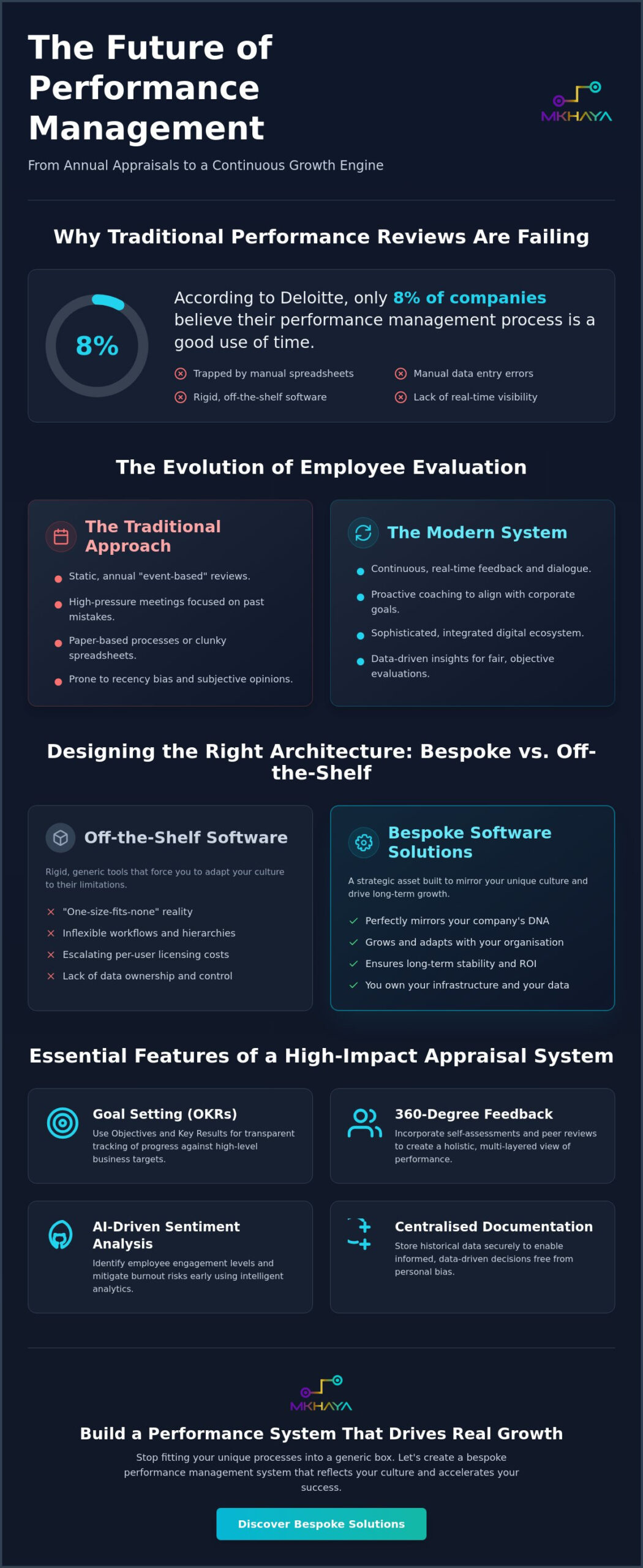
According to Deloitte, only 8% of companies believe their performance management process is a good use of time. It’s a staggering figure that highlights why so many organisations feel trapped by manual spreadsheets and rigid, off-the-shelf software. When your performance appraisal management system feels like a hurdle rather than a help, it’s difficult to see the path toward genuine growth. You likely recognise the frustration of manual data entry errors and the persistent lack of real-time visibility into how your teams are actually faring.
We understand that your company culture is unique, and your tools should reflect that precision. This article explores how to transform these administrative burdens into a data-driven engine for organisational success. You’ll discover how bespoke systems can automate review cycles and provide the actionable analytics needed to secure long-term stability. We’ll look at building transparent growth paths that improve employee retention and ensure your talent feels truly seen. It’s time to move toward a more agile, modern approach that turns every evaluation into a strategic advantage.
Key Takeaways
- Understand the shift from traditional annual reviews to a continuous performance appraisal management system that tracks output in real-time.
- Learn why bespoke software engineering provides the flexibility needed to integrate seamlessly with your existing ERP solutions and unique company culture.
- Discover how integrating AI-driven sentiment analysis can help identify employee engagement levels and mitigate burnout risks early.
- Explore a strategic roadmap for implementation that focuses on defining clear KPIs and prioritising user experience for high adoption rates.
What is a Performance Appraisal Management System in 2026?
In 2026, a Performance appraisal is no longer a static document tucked away in a filing cabinet or a forgotten folder. It has evolved into a sophisticated performance appraisal management system. This digital ecosystem tracks, evaluates, and improves employee output with surgical precision. By moving away from paper-based processes and spreadsheet-heavy workflows, organisations can finally eliminate the manual data entry errors and version control issues that often plague HR departments. It’s about creating a reliable foundation for mutual success rather than just ticking a box once a year.
To better understand the pitfalls of traditional reviews and why a modern approach is necessary, watch this helpful video:
The shift from annual “event-based” reviews to continuous performance management marks a significant change in corporate strategy. Instead of a high-pressure meeting every twelve months, managers and employees engage in a steady stream of feedback. This constant dialogue ensures that individual effort aligns perfectly with national corporate objectives. When you use bespoke software engineering to build these tools, the system becomes a pillar of your digital transformation journey, adapting to your specific organisational DNA.
The Evolution of Employee Evaluation
Employee evaluation has moved far beyond simple checklists. Modern systems often use behaviourally anchored rating scales (BARS) to provide objective, qualitative data that standard metrics might miss. This is particularly vital for the remote and hybrid workforce structures that have become standard across South Africa. Digital systems bridge the gap between physical locations, ensuring every team member stays visible and supported regardless of where they log in. Real-time feedback mechanisms allow for immediate course correction, which is far more effective than discussing a mistake six months after it happened.
Core Components of a Digital Appraisal Framework
A robust digital framework relies on several key pillars to drive growth. First, goal setting through OKRs (Objectives and Key Results) allows for transparent tracking of progress against high-level business targets. Self-assessment modules and peer review capabilities then add multiple layers of perspective, creating a 360-degree view of performance. Finally, centralised documentation stores historical data securely. This allows leaders to make informed decisions based on long-term trends and data-driven insights rather than recent impressions or personal bias.
Custom vs. Off-the-Shelf: Designing the Right Architecture
Many organisations start their digital journey with off-the-shelf SaaS platforms, attracted by the promise of quick deployment. However, these solutions often lead to a “one-size-fits-none” reality. Generic tools limit growth. When your business model relies on unique hierarchies or specialised workflows, rigid software becomes a barrier to progress. You shouldn’t have to change your successful company culture to fit the limitations of a software vendor’s template.
Owning your performance data infrastructure is a strategic move toward long-term stability. Whilst subscription models seem affordable initially, the per-user licensing bloat can become a significant financial burden as your national operations expand. By investing in a custom performance appraisal management system, you ensure that your tools grow with you, not against you. This shift is a key part of The Performance Management Revolution, where businesses prioritise agility and precision over generic functionality.
The Case for Bespoke Software Engineering
Building a system from the ground up allows you to mirror your specific internal hierarchy and culture. Every organisation has its own way of rewarding excellence and identifying growth areas. Through bespoke software engineering, you can create custom modules that reflect these nuances. This approach avoids the “feature bloat” of standard tools, giving your team exactly what they need without the clutter. It’s about building a reliable partner for your HR team that feels like a natural extension of your brand.
Integration with Existing Enterprise Systems
A performance system shouldn’t exist in a vacuum. To drive real ROI, your performance data must talk to your payroll, recruitment, and learner management systems. Integrating these platforms creates a unified data source, which is essential for executive decision-making. When your ERP solutions work in harmony with a custom performance appraisal management system, you gain a holistic view of your talent landscape. If you’re finding that your current tools can’t communicate with your other business systems, it’s a clear sign you’ve outgrown the standard market offerings.
You might find it helpful to explore a custom approach if you want to see how tailored architecture can solve your specific integration challenges.
Essential Features of a High-Impact Appraisal System
Modern systems must do more than just record scores; they need to provide actionable intelligence. A high-impact performance appraisal management system acts as an early warning system for your leadership team. By incorporating AI-driven sentiment analysis, you can identify patterns in feedback that suggest employee burnout or high levels of engagement long before they manifest in turnover rates. It’s about being proactive rather than reactive, ensuring that your talent remains motivated and supported throughout their journey with your organisation.
Efficiency is built into the architecture through automated reminders and workflow triggers. These features ensure that review cycles stay on track without constant manual intervention from HR. When the system handles the scheduling and follow-ups, your team can focus on the quality of the conversations. Advanced data visualisation further enhances this by providing clear dashboards that highlight high-potential talent across different departments. This birds-eye view is crucial for succession planning and ensuring that your most promising individuals have clear, transparent growth paths.
AI and Data Automation in Performance Tracking
The integration of AI and data automation transforms how managers interact with performance data. Instead of sifting through months of notes, AI provides objective performance summaries that highlight key achievements and areas for refinement. Predictive analytics can even forecast future leadership candidates by analysing performance trajectories over time. This data-driven approach removes the guesswork from talent development, allowing you to build a stable and visionary leadership pipeline based on evidence rather than intuition.
360-Degree Feedback and Peer Recognition
Removing managerial bias is a priority for any fair evaluation process. Multi-source feedback loops allow peers and subordinates to contribute to an employee’s profile, creating a more balanced reflection of an individual’s contribution. Encouraging a culture of continuous improvement becomes easier when you include social recognition features, where colleagues can celebrate each other’s successes in real-time. To maintain trust, the system must allow for granular privacy levels for different feedback categories. Robust security protocols are non-negotiable here, as protecting sensitive employee personal information is the foundation of a reliable partnership between employer and staff.
Implementing a Performance Management Framework: A Strategic Roadmap
Launching a performance appraisal management system requires more than just a technical installation; it demands a phased, strategic approach to ensure lasting success. Phase 1 begins with defining your key performance indicators (KPIs) and broader organisational goals. This foundational step ensures that every metric tracked within the system serves a specific business purpose. Without this initial clarity, even the most advanced software fails to deliver a meaningful return on investment. It’s about building a framework that reflects your unique ambitions from the very first day.
Once your goals are established, the focus moves toward technical execution and refinement. Phase 3 involves the careful migration of data from legacy systems and rigorous pilot testing. This ensures technical reliability and data integrity before you commit to a full-scale rollout. Finally, Phase 4 centres on continuous system optimisation. By analysing feedback from the pilot phase, you can refine workflows and adjust features to better serve your teams. This methodical progression creates a sense of steady momentum, leading your organisation toward a concrete and successful digital future.
User Experience (UX) and Adoption Strategies
High adoption rates are the true measure of a system’s success. If the interface is clunky or confusing, employees will inevitably view it as an administrative burden. This is why Phase 2 of our roadmap prioritises website and UI/UX design to create an intuitive, frictionless experience. Staff should feel that the platform is a growth tool designed for their benefit, rather than a surveillance mechanism. Clear training programmes help shift this perception, fostering a culture where performance data is welcomed as a transparent path to professional development and reward.
Change Management and Organisational Buy-in
Transitioning to a digital framework requires strong executive sponsorship to secure genuine organisational buy-in. Leaders must proactively communicate the “why” behind the shift, explaining how a modern performance appraisal management system benefits the entire team through fairness and clarity. It’s vital to address common employee anxieties regarding automated evaluations early in the process. By being transparent about how data is used and how it supports individual growth, you build the trust necessary for a stable transition. This collaborative relationship between the business and its people is what turns a software tool into a pillar of corporate culture.
If you’re ready to transform your evaluation process, contact our team to discuss your implementation roadmap and see how we can support your journey.
Bespoke Performance Solutions with Mkhaya MK
At Mkhaya MK, we believe that your digital tools should be as unique as your organisation’s DNA. We position ourselves as a visionary yet practical guide in your digital transformation journey, moving away from the cold, detached language often found in technical sectors. A custom-engineered performance appraisal management system isn’t just a recording tool; it’s a strategic asset built to solve the “rigid software” problem that so often stifles innovation. By choosing a bespoke approach, you’re investing in a system that adapts to your culture, rather than forcing your team to bend to the limitations of a pre-built template.
Our deep expertise in AI and cloud solutions allows us to construct future-proof platforms that grow alongside your ambitions. We focus on creating an atmosphere of steady, forward-looking ambition, ensuring that your technology remains a stable anchor even as the market shifts. As a national partner, we bring a profound understanding of the local business landscape, ensuring that your performance framework is grounded in practical, business-focused results. This local insight, combined with our polished, high-end technical execution, creates a reliable partnership rooted in integrity and commitment.
Our Collaborative Development Process
The path to a high-impact system is highly structured and follows a logical progression. We start with strategic digital transformation consulting to align your software with your high-level corporate objectives. From there, we move through methodical deployment to managed support, ensuring that your performance appraisal management system integrates seamlessly with your existing tech stack. This cause-and-effect logic ensures that every capability we build is immediately linked to a practical benefit for your HR team and executive leadership. We don’t just deliver software; we deliver a clear, step-by-step path to engagement and success.
Scaling Your Vision with Mkhaya MK
We understand that achieving operational excellence often requires more than just new software. To truly scale your vision, you might need to extend your internal capacity through our staff augmentation services. This flexible approach allows you to access specialised expertise exactly when you need it, ensuring that your roadmap for AI-driven excellence stays on track. Whether you’re refining your current review cycles or building a completely new data-driven engine for growth, we’re here to provide the precision and long-term stability your organisation deserves. It’s a supportive partnership designed to inspire trust and drive mutual success across your entire enterprise.
Building Your Engine for Organisational Growth
Transitioning to a modern performance appraisal management system is about more than just software; it’s about refining your organisational culture. By moving away from manual spreadsheets and adopting bespoke architecture, you create a foundation for long-term stability and mutual success. You’ve seen how continuous feedback and AI-driven insights can identify talent and mitigate burnout before it affects your bottom line. This strategic roadmap ensures that your digital tools mirror your unique business DNA, rather than forcing you to adapt to a generic template.
Mkhaya MK stands as your visionary partner in this journey. As end-to-end digital transformation experts and specialists in AI-driven automation, we bring a proven track record in custom enterprise software to every engagement. We value transparency and methodical execution, ensuring that your vision is built on a reliable and stable anchor. It’s time to turn your evaluation process into a sophisticated engine for growth. Partner with Mkhaya MK to build your bespoke performance system today and start your journey toward a more agile, modern future. We look forward to building this success together.
Frequently Asked Questions
What is the primary difference between performance appraisal and performance management?
Performance appraisal is a specific, formal evaluation event, whilst performance management is the ongoing, holistic process of aligning employee goals with business objectives. A performance appraisal management system integrates these two concepts by providing the tools for both formal reviews and continuous feedback loops. This ensures that development is a constant conversation rather than a stressful annual occurrence, fostering a more supportive and reliable partnership between managers and their teams.
How does a digital performance system improve employee retention?
Digital systems improve retention by providing employees with transparent growth paths and consistent recognition. Sourced data indicates that 24% of employees who receive inadequate feedback will consider looking for a new job. By using a digital platform to provide real-time visibility into achievements and skill development, you show a commitment to their personal journey. This clarity reduces frustration and builds the long-term stability needed to keep high-potential talent within your organisation.
Can a performance appraisal management system integrate with our existing payroll software?
Yes, a bespoke system can be engineered to integrate seamlessly with your existing payroll and ERP software. This connectivity allows for the automated trigger of performance-based bonuses or salary adjustments based on verified data. By creating a unified data source, you eliminate manual entry errors and ensure that rewards are distributed with precision. It’s a practical way to link individual output directly to your financial operations and reward structures.
Is it better to build a custom performance system or buy a subscription-based tool?
Building a custom system is generally better for organisations with unique cultures or complex hierarchies that rigid SaaS tools cannot accommodate. Whilst subscription tools offer quick deployment, they often lead to per-user licensing bloat and data silos. Bespoke engineering allows you to own your infrastructure and scale without restrictions. It ensures your technology remains a stable anchor that evolves as your business grows, providing a better long-term return on investment.
How do we ensure data privacy and security within a digital appraisal platform?
Data security is maintained through robust encryption protocols, multi-factor authentication, and granular access controls. Within a digital appraisal platform, you can configure exactly who sees specific feedback categories to protect sensitive personal information. This methodical approach to security ensures compliance with local regulations. By prioritising transparency in how data is handled, you build the trust necessary for employees to engage fully with the evaluation process and share honest feedback.
How often should performance reviews be conducted within a digital system?
While the traditional annual review is becoming less common, digital systems allow for a rhythm of continuous check-ins supplemented by formal quarterly sessions. This steady flow of feedback prevents surprises and allows for immediate course correction. Modern frameworks often use automated triggers to remind managers of these cycles, ensuring that development remains a priority. The goal is to move toward a more agile pace that matches the rapidly changing technological landscape of 2026.
What role does AI play in modern employee evaluations?
AI plays a transformative role by providing objective performance summaries and identifying patterns through sentiment analysis. It helps managers detect early signs of burnout or disengagement by analysing feedback trends across departments. Predictive analytics can also identify future leadership candidates based on historical growth data. This data-driven approach removes personal bias from evaluations, ensuring that talent development is based on precise, actionable insights rather than subjective impressions or recent events.