Business Process Automation in South Africa: A Strategic 2026 Guide
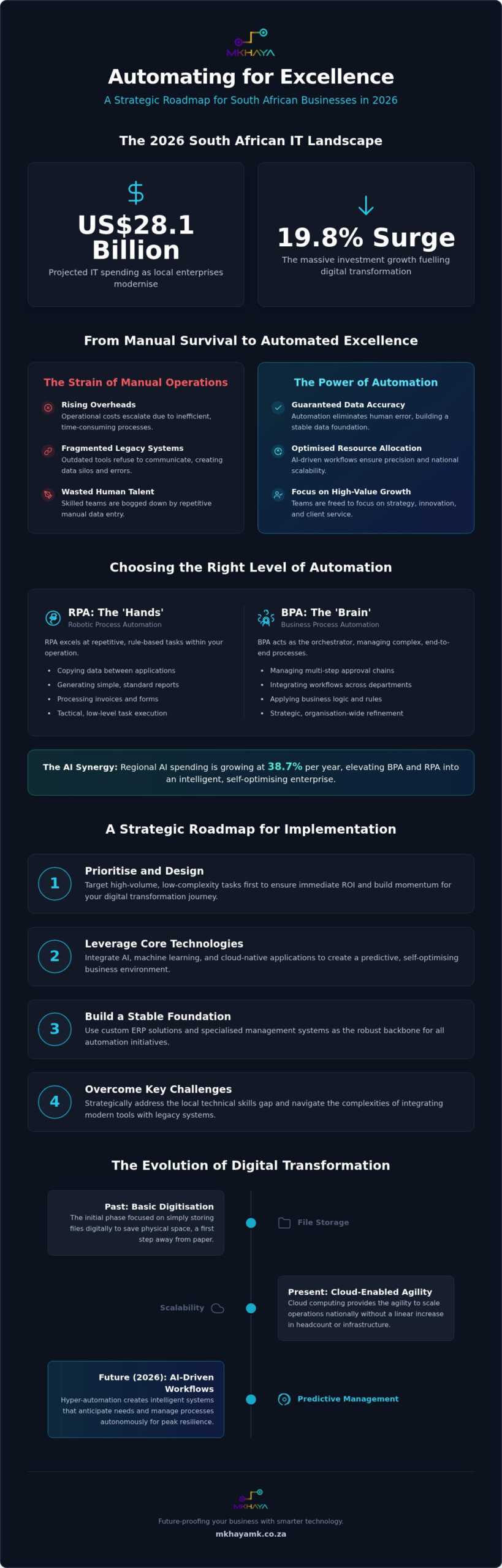
South African IT spending is projected to surge by 19.8% in 2026, reaching an impressive US$28.1 billion as local enterprises race to modernise. This massive investment highlights the critical role of business process automation south africa in maintaining a competitive edge. You’ve likely felt the strain of rising operational overheads and the frustration of legacy systems that simply refuse to talk to one another. It’s exhausting to watch your team’s talent being swallowed by manual data entry when they should be focused on high-value growth.
This guide provides a clear roadmap to help you reclaim that lost time, improve data accuracy, and scale your operations with precision. We’ll explore how custom software, AI-driven workflows, and robust cloud solutions can transform your business into a high-performance engine ready for the 2026 landscape. By aligning your digital transformation with proven strategies, you can move from manual survival to automated excellence. Let’s look at how to build a more resilient, scalable future for your organisation through methodical execution and smarter technology.
Key Takeaways
- Learn how to distinguish between simple task automation and strategic business process automation south africa to drive long-term organisational resilience.
- Discover how AI and cloud-native applications enable predictive workflows and provide the flexibility needed for national scalability in 2026.
- Master a strategic roadmap that prioritises process design to ensure immediate ROI by automating high-volume, low-complexity tasks first.
- Explore effective ways to bridge the local technical skills gap and navigate the complexities of integrating modern automation with legacy systems.
- Understand how custom ERP solutions and specialised management systems provide a stable foundation for your digital transformation journey.
Understanding Business Process Automation in the South African Context
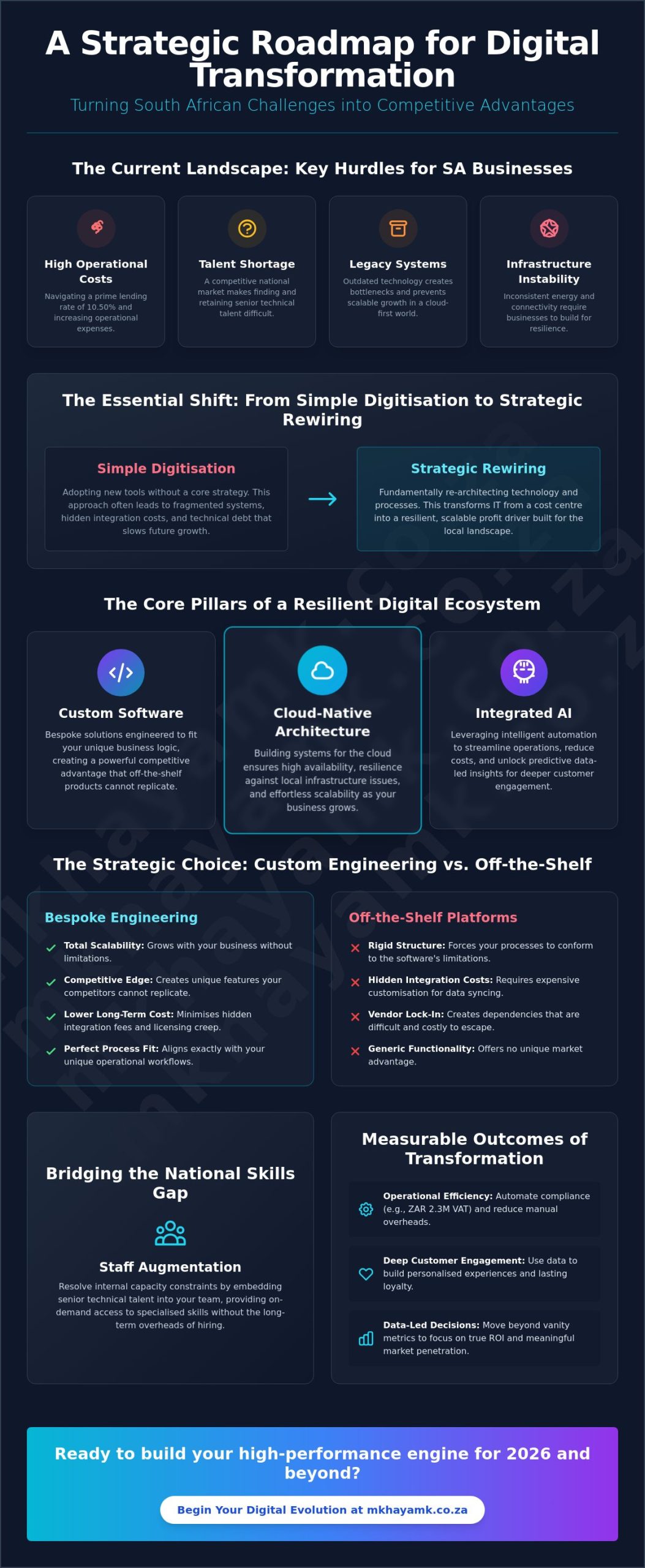
Many local leaders often confuse Business Process Automation with industrial robotics found on factory floors. Whilst industrial automation focuses on physical hardware like sensors or conveyor systems, business process automation resides within the digital architecture of your company. It’s the use of sophisticated software to execute recurring tasks and complex workflows that traditionally required manual intervention. By 2026, this distinction has become vital as enterprises move away from isolated spreadsheets toward unified digital ecosystems. This shift represents a move from mere digitisation to a more profound, strategic refinement of how work is actually performed.
Adopting business process automation south africa is now a strategic necessity for staying competitive in a volatile market. With local IT spending projected to grow by 19.8% in 2026, businesses that continue to rely on manual data entry risk falling behind more agile, technology-led competitors. This transition isn’t just about speed; it’s about building a stable foundation where data accuracy is guaranteed and resource allocation is optimised. Moving from fragmented legacy systems to a cohesive digital environment allows your team to focus on high-value growth rather than repetitive administrative maintenance. It’s about creating a reliable partnership between your human talent and your digital tools.
To better understand how this technology transforms modern operations, watch this helpful video:
The Evolution of Digital Transformation in South Africa
The journey of digital transformation in the local market has moved rapidly from basic digitisation to AI-driven autonomous workflows. Initially, companies were content with simply storing files digitally to save space. Today, cloud computing has fundamentally changed the game by providing the agility needed to scale across the country without a linear increase in headcount. This evolution enables a more supportive partnership between technology and staff. Systems can now anticipate needs rather than just reacting to inputs, ensuring that your organisation remains resilient in the face of rapid technological changes.
BPA vs. RPA: Choosing the Right Level of Automation
When evaluating business process automation south africa, it’s helpful to think of Robotic Process Automation (RPA) as the ‘hands’ of your operation. RPA excels at repetitive, low-level tasks like copying data between applications or generating simple reports. In contrast, BPA acts as the ‘brain’, managing end-to-end processes that require logic, multi-step approvals, and integration across multiple departments. For those seeking more advanced capabilities, exploring AI automation solutions in South Africa reveals how these technologies work together. With regional AI spending growing at 38.7% per year, these tools are becoming essential for creating an intelligent enterprise. Choosing the right level of automation ensures that your investment delivers long-term stability and measurable results for your specific business needs.
The Core Technologies Driving Operational Efficiency in 2026
The technological landscape of 2026 has moved beyond isolated software tools toward a concept known as hyper-automation. This approach doesn’t just automate a single task; it orchestrates a combination of Artificial Intelligence (AI), machine learning, and cloud-native applications to create a self-optimising business environment. For local enterprises, business process automation south africa has become the primary engine for maintaining agility in a fast-paced market. By integrating these advanced technologies, companies can move from reactive troubleshooting to predictive management, where the system identifies potential hurdles before they impact the bottom line.
Cloud-native applications serve as the backbone of this transformation, providing the necessary infrastructure for national scalability and seamless remote work. These systems ensure that your team remains connected and productive, regardless of their physical location. Simultaneously, sophisticated data analytics tools act as a diagnostic lens, pinpointing workflow bottlenecks that were previously invisible. This data-driven approach is supported by initiatives like South Africa’s Digital Economy Master Plan, which encourages the adoption of digital tools to drive economic resilience. When these technologies work in harmony, they create a robust framework that supports long-term stability and growth.
AI and Data Automation: Beyond Simple Macros
Modern machine learning algorithms have evolved to handle complex decision-making processes that once required constant human oversight. Instead of following rigid, pre-defined rules, these systems learn from historical data to make intelligent recommendations. This capability is particularly valuable for executive decision-making, where real-time data processing provides a clear view of operational health. AI & Data Automation represents the core of modern competitive advantage by turning raw information into actionable insights. It allows your leadership team to move with confidence, backed by precise analytics rather than intuition alone.
Custom Software Engineering for Unique Business Workflows
Whilst off-the-shelf software might seem like a quick fix, it often fails to address the specific nuances of the local business environment. Many generic tools struggle to integrate with the legacy systems that still form the foundation of many South African organisations. This is where bespoke Software Engineering becomes a critical asset. Custom-built solutions are designed to wrap around your existing processes, ensuring a seamless flow of data across different departments. This precision prevents the “disconnected silo” effect that often plagues standard implementations. If you’re looking to build a system that truly reflects your unique operational DNA, exploring Custom Software Development in South Africa is a logical next step. Tailored engineering ensures that your technology serves your business goals, rather than forcing your business to adapt to the limitations of a pre-packaged product.
Building a future-proof enterprise requires a partner who understands these technical intricacies. You might find it helpful to speak with a specialist about how custom engineering can bridge the gap between your current legacy systems and your 2026 automation goals.
A Strategic Roadmap for Implementing Automation in Your Organisation
Success in business process automation south africa is rarely about the software alone. In fact, most experts agree that a successful rollout is 20% technology and 80% process design. If you automate a flawed or redundant workflow, you don’t solve the problem; you simply accelerate the rate of failure. To ensure your investment yields tangible results, it’s best to begin with high-volume, low-complexity tasks. These “quick wins” provide the immediate ROI needed to build momentum and prove the value of digital transformation to your broader team.
Securing stakeholder buy-in across every level of the organisation is a vital part of this journey. Leadership must champion the vision, whilst operational staff need to see how automation serves as a supportive partner in their daily tasks. Once a system is live, the work isn’t finished. Continuous monitoring and refinement are necessary to ensure that your automated workflows adapt to changing market conditions and internal requirements. This methodical execution ensures long-term stability rather than a temporary fix.
Step 1: Process Auditing and Workflow Mapping
The first step is a rigorous audit of your current operations. You must identify redundant steps or “broken” links before they are hard-coded into a new system. The danger of ‘automating chaos’ is real; it leads to technical debt and frustrated employees. By mapping your current state with absolute precision, you can eliminate waste and ensure the new digital environment is built on a lean foundation. Many enterprises find that using a professional process consultant is the most reliable way to uncover these hidden inefficiencies and design a future-proof workflow.
Step 2-5: From Pilot to Enterprise Scaling
After refining your processes, you can select a tech stack that aligns with your specific needs. This choice should be driven by the audit results, ensuring compatibility with existing systems and compliance with local regulations like POPIA. Starting with a pilot phase allows you to test the solution and measure success against key performance indicators. It’s a chance to catch minor issues before they impact the entire company. During this phase, focus heavily on staff training and change management to ensure a smooth transition.
As the pilot proves its worth, you can begin scaling the solution across different departments and even nationally. This phased approach reduces risk and allows for a more controlled resource allocation. By the time you reach enterprise-wide deployment, your team will be well-versed in the new tools, and your business process automation south africa strategy will be firmly rooted in practical, measurable success. This progression moves your organisation from a broad vision toward a concrete, high-performance reality.
Overcoming Challenges: Skills, Compliance, and Legacy Systems
Implementing business process automation south africa often reveals a “talent paradox” where the desire for innovation outpaces the available technical expertise. This skills gap remains one of the most significant hurdles for local enterprises attempting to scale. Beyond the human element, many organisations struggle with the friction between modern, agile automation tools and the rigid legacy ERP systems that have anchored their operations for decades. Successfully bridging this gap requires a methodical approach that respects existing infrastructure whilst preparing for a more fluid, digital future.
Employee anxiety regarding AI is another critical factor that leadership must address with transparency. It’s natural for teams to feel uneasy when terms like “autonomous agents” are introduced. However, the goal of automation isn’t to replace human talent but to liberate it from the drudgery of manual data entry. By reframing automation as a supportive partner, you can shift the internal culture from one of fear to one of forward-looking ambition. This transition allows your staff to focus on the high-value, creative tasks that technology simply cannot replicate, ensuring your human capital is utilised where it matters most.
Addressing the Skills Gap with Staff Augmentation
When internal resources are stretched thin, Staff Augmentation offers a flexible way to inject expert engineering talent into your project without a permanent increase in headcount. These external professionals don’t just build systems; they act as mentors who upskill your internal teams during the implementation process. This collaborative approach ensures that your staff are prepared to manage the new digital environment long after the initial rollout. For a deeper look at how to structure this partnership, you can consult our guide on how to Hire Dedicated Developers. It’s about building a stable bridge to technical excellence.
Compliance and Security in the Age of Automation
In the current regulatory climate, POPIA compliance is no longer optional. With the April 2025 Amendment Regulations expanding direct marketing rules and the March 2026 regulations regarding health information, the stakes for data processing have never been higher. A “security by design” approach ensures that automated workflows are built with these protections at their core. Paradoxically, automation often improves compliance by creating rigorous, tamper-proof audit trails that manual processes often lack. Leveraging Cloud Solutions provides the secure, scalable infrastructure needed to handle sensitive data whilst maintaining the agility your business requires for national expansion.
If you’re ready to bridge the gap between your legacy systems and modern automation, explore our staff augmentation services to find the right expertise for your journey.
Future-Proofing Your Business with Mkhaya MK
Navigating the complexities of digital transformation requires more than just a software vendor; it demands a visionary partner who understands the unique pulse of the local market. Mkhaya MK bridges the gap between high-level strategic consulting and technical execution. We don’t just build tools. We construct foundations for long-term stability. By choosing to implement business process automation south africa with a dedicated partner, you ensure that every line of code aligns with your specific growth objectives for 2026 and beyond.
Our approach is rooted in a commitment to reliability and mutual success. Whether you’re looking to refine your financial operations through a precision-engineered Loan Management System or seeking to unify your entire enterprise with robust ERP Solutions, we provide the technical depth needed for complex organisational processes. These systems are designed to be scalable, ensuring that as your headcount or national footprint grows, your digital infrastructure remains a stable anchor rather than a bottleneck.
Bespoke Solutions for Specific Industry Needs
We recognise that different sectors face distinct operational hurdles. To accelerate your automation timeline, we offer specialised platforms that are pre-built yet fully customiseable to your workflow. For enterprises looking to refine their supply chain, Optimate provides an intelligent procurement platform that enhances transparency. If your focus is on bridging the skills gap we discussed earlier, our Learner Management system organises corporate training into a seamless, automated experience. Each of these solutions is designed to deliver immediate value whilst maintaining the flexibility to evolve with your business.
For organisations managing complex logistics and asset tracking, MkhayaMove offers a specialised framework to ensure your physical assets are as well-managed as your digital ones.
Your Next Step Toward Operational Excellence
The journey toward a fully automated enterprise is a personal one. It requires a methodical assessment of your current readiness and a clear-eyed view of your future goals. Mkhaya MK brings a persona of “quiet confidence” to every engagement, valuing transparency and precise execution over flashy, unsubstantiated claims. We’re here to guide you through the transition, providing the expertise needed to turn your vision of an agile, AI-driven business into a concrete reality. This partnership is built on integrity and a shared commitment to seeing South African enterprises thrive on the global stage.
Your path to streamlined operations and reduced overheads begins with a single, strategic conversation. We invite you to contact Mkhaya MK today to begin your automation journey and discover how our tailored approach to business process automation south africa can transform your organisation’s future.
Building Your Resilient Digital Future
The transition toward an automated enterprise is a journey of refinement and precision. By moving beyond fragmented legacy systems and manual spreadsheets, your organisation can finally reclaim the resources needed for high-value innovation. We’ve explored how a strategic roadmap, rooted in sound process design and the latest AI-driven technologies, provides the stability required to scale. Successfully implementing business process automation south africa means turning these technological capabilities into measurable business outcomes that protect your bottom line whilst driving growth.
Mkhaya MK stands ready to serve as your long-term partner in this transformation. With our deep expertise in AI-driven automation and custom software engineering, we provide the technical depth your growth demands. Our proven track record in ERP and management system implementation, combined with national coverage, ensures that your operations remain supported as you expand. It’s time to move from a broad vision of efficiency toward a concrete path of operational excellence. Book a Digital Transformation Consultation with Mkhaya MK to assess your readiness and begin your journey. Together, we can build a more agile and prosperous future for your enterprise.
Frequently Asked Questions
What are the primary benefits of business process automation for South African companies?
The primary benefits include significantly reduced operational overheads, enhanced data accuracy, and the ability to scale operations without a linear increase in headcount. By automating repetitive tasks, your team can pivot from manual data entry to high-value strategic initiatives. This shift creates a more resilient business model that is better equipped to handle the economic fluctuations expected in the 2026 market.
How does automation help with POPIA compliance in South Africa?
Automation strengthens compliance by implementing “security by design” and creating immutable audit trails for every data interaction. It ensures that personal information is processed strictly according to predefined regulatory rules, eliminating the risk of human error. Automated systems also help you meet the mandated 30-day window for customer data correction or deletion requests, providing a reliable shield against potential regulatory fines.
Can business process automation integrate with my existing legacy software?
Yes, modern business process automation south africa is specifically designed to bridge the gap between contemporary tools and legacy systems. Through custom-engineered APIs and middleware, we create digital layers that allow disconnected systems to communicate seamlessly. This approach preserves your previous technology investments whilst introducing the speed and precision of modern, AI-driven workflows into your daily operations.
How long does it typically take to see a return on investment (ROI) from BPA?
Most organisations realise a measurable return on investment within six to eighteen months, depending on the scope of the implementation. By following a strategic roadmap that prioritises high-volume, low-complexity tasks, you can achieve “quick wins” that provide immediate cost relief. This phased methodology ensures that the initial savings can help fund the broader digital transformation across your entire enterprise.
Is automation only for large corporations, or can SMEs benefit too?
Automation is highly beneficial for SMEs, as cloud-based solutions have made advanced technology more accessible than ever before. For smaller businesses, automation acts as a force equaliser, allowing a lean team to manage complex processes that would otherwise require a much larger staff. It provides the operational maturity needed for SMEs to compete effectively with larger counterparts on a national scale.
What is the difference between business process automation and simple digitisation?
Digitisation is the act of converting physical information into a digital format, such as turning a paper form into a PDF. Business process automation is the orchestration of those digital assets into a functional, self-sustaining workflow. It’s the difference between merely having a digital record and having an intelligent system that executes multi-step tasks and approvals without requiring constant manual intervention.
How do I choose between an off-the-shelf automation tool and custom software?
Off-the-shelf tools offer faster initial deployment but often require you to change your unique processes to fit the software’s rigid structure. Custom software is engineered to mirror your specific operational DNA, providing greater long-term stability and deeper integration with your existing environment. For many South African enterprises with complex requirements, the precision of a bespoke solution offers a more reliable foundation for growth.
What role does AI play in modern business process automation?
AI serves as the intelligent engine within business process automation south africa, moving beyond simple rules-based logic to handle complex decision-making. It enables predictive process management by identifying patterns in your data and suggesting optimisations before bottlenecks occur. This allows your leadership team to transition from reactive troubleshooting to a proactive, data-driven strategy that anticipates market changes and internal needs.