

DevOps Services in South Africa: A Strategic Guide for 2026
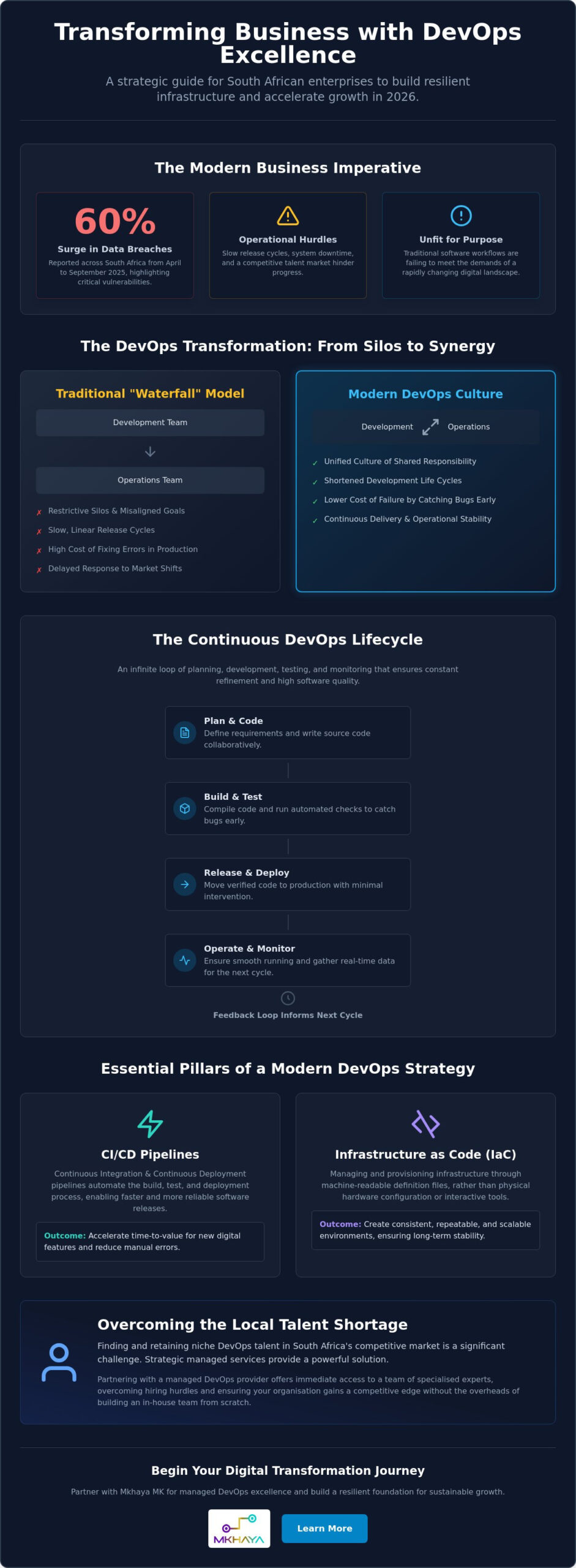
With a 60% surge in reported data breaches across the country between April and September 2025, many local enterprises are realising that their traditional software workflows are no longer fit for purpose. You likely feel the daily pressure of slow release cycles and the persistent worry of system downtime, all whilst struggling to find and retain niche talent in a competitive market. It’s a common challenge in our current environment, but choosing the right DevOps services south africa can transform these operational hurdles into a distinct competitive advantage for your organisation.
We believe that your business deserves a stable anchor in this rapidly changing technological landscape. This guide explores how modern DevOps strategies, including AI-powered automation and robust DevSecOps, help you build a more resilient cloud infrastructure for 2026. We will examine the latest regulatory shifts under POPIA and provide a clear, strategic path for your digital transformation journey. By the end of this article, you will have a practical framework to lead your business toward sustainable growth, faster time-to-market, and reduced operational costs.
Key Takeaways
- Learn how shifting from siloed IT to a collaborative culture significantly shortens your systems development life cycles.
- Discover practical methods to lower the cost of failure by catching bugs earlier and accelerating your time-to-value for new digital features.
- Identify the essential technical pillars, such as CI/CD pipelines and Infrastructure as Code, that define high-performing DevOps services south africa.
- Gain insights into overcoming the local talent shortage through strategic managed services that provide immediate access to niche expertise.
- Understand how integrating DevOps from the start of your digital transformation journey ensures long-term stability and operational resilience.
What are DevOps Services and Why are They Essential for South African Businesses?
In the fast-paced South African business environment, the traditional wall between software developers and IT operations teams is finally crumbling. This barrier often led to delayed releases, misaligned goals, and frequent system errors. By choosing professional DevOps services south africa, your organisation can replace these restrictive silos with a unified culture of shared responsibility. At its heart, What is DevOps represents the intentional integration of development and operations teams to significantly shorten the systems development life cycle whilst maintaining high software quality.
To gain a clearer perspective on how these principles function in practice, watch this helpful video:
DevOps is a methodology that prioritises continuous delivery and operational stability. It isn’t just about the technical tools your team uses; it’s about how your people work together to deliver consistent value to your customers. In South Africa’s rapidly evolving digital economy, this collaborative approach has become essential for staying relevant and resilient.
The Evolution of Software Delivery in the Local Market
For years, many SA firms relied on the “Waterfall” model, where each phase of a project had to finish completely before the next began. This linear method often meant that by the time software was ready for the public, market demands had already shifted. The transition toward Agile helped teams move faster, but DevOps completes the journey by ensuring that deployment is as reliable as the development itself. Local businesses are now using these strategies to compete with international digital-first brands that have set high global expectations for speed. This modern approach is particularly vital in supporting custom software development south africa, where precision and rapid iteration are non-negotiable for long-term success.
Breaking Down the DevOps Lifecycle
The DevOps process is best understood as a continuous loop rather than a linear track with a fixed end point. It moves through several distinct stages that feed into one another:
- Plan and Code: Defining business requirements and writing the source code in a collaborative environment.
- Build and Test: Compiling the code and running automated quality checks to catch bugs early.
- Release and Deploy: Moving the verified code into the production environment with minimal manual intervention.
- Operate and Monitor: Ensuring the software runs smoothly and gathering real-time data to inform the next cycle.
The ultimate goal of modern DevOps services south africa is to achieve “continuous everything”—continuous integration, continuous testing, and continuous deployment. This loop ensures that feedback from the “operate” stage immediately informs the next “plan” stage. It creates a rhythm of constant refinement that keeps your infrastructure stable and your software modern without the stress of traditional “big bang” launches.
The Business Value of Implementing DevOps Excellence
Every minute your software is down, you lose more than just revenue; you lose customer trust. Investing in professional DevOps services south africa isn’t just a technical upgrade; it’s a strategic move that protects your bottom line. When your development and operations teams work in harmony, you create a stable foundation for growth. This alignment ensures that every digital feature you release adds genuine value to your users without the risk of system instability.
One of the most immediate benefits of this approach is the drastic reduction in the cost of failure. When you catch a bug during the initial coding phase, it costs a fraction of what it would to fix that same error once it reaches production. Industry leaders at Red Hat emphasise The Business Value of Implementing DevOps as a primary driver for aligning IT goals with broader business outcomes. By integrating automated testing into your daily workflow, you catch errors early and often, ensuring a smoother journey from concept to customer.
Beyond the financial savings, automation acts as a powerful engine for innovation. It removes the burden of manual labour from repetitive tasks like server provisioning or code deployment. This shift frees up your high-value engineers to focus on what they do best: building creative solutions that set your brand apart. If you’re looking to refine your current systems, exploring digital transformation options can help identify where automation will have the most immediate impact on your efficiency.
Accelerating Market Agility
In a competitive local market, speed is a currency. Faster release cycles allow your business to respond to market shifts in real-time, ensuring you aren’t left behind by more agile competitors. We often see South African corporate projects stall due to “deployment pain”—the fear and friction associated with manual updates. Modern DevOps services south africa eliminate this hurdle, creating a predictable and stress-free path to production. This agility is a core component of a successful cloud application development south africa strategy, where the goal is to deliver value to the user as quickly as possible.
Enhancing Security through DevSecOps
Security can no longer be an afterthought or a final “gate” at the end of a project. With increasing local cyber threats and strict regulatory requirements like POPIA, security must be “shifted left” directly into the development phase. DevSecOps integrates automated security audits and compliance checks into your delivery pipeline. This means your software is born secure, rather than being patched later. It allows your team to maintain a rapid pace of delivery whilst ensuring that every release remains compliant and resilient against modern vulnerabilities.
Key Components of a Modern DevOps Strategy
The heartbeat of this modern approach is the Continuous Integration and Continuous Deployment (CI/CD) pipeline. This automated workflow ensures that every code change is built, tested, and prepared for release without manual intervention. Alongside this, a microservices architecture allows you to break down large, monolithic applications into smaller, independent components. This means you can scale specific parts of your system, such as a payment gateway or a search function, without needing to redeploy your entire platform. It’s about precision and the ability to move fast without breaking things.
To maintain this momentum, automated testing suites must be integrated at every stage. These tests act as a constant safety net, catching regressions and performance issues before they ever reach your users. When combined with centralised logging and real-time monitoring, your team gains total visibility into the health of your systems. Instead of waiting for a customer to report a bug, your monitoring tools alert you to potential issues, allowing for proactive resolution that keeps your services running smoothly.
Automation: The Core of the DevOps Engine
Manual hand-offs are the primary cause of delays and errors in traditional IT projects. Every time a developer has to wait for an operations engineer to provision a server or run a script, your time-to-market slows down. Automation removes these bottlenecks by handling everything from unit testing to server configuration. This level of efficiency is particularly vital when you’re planning a move to the cloud. By automating your deployment processes, you simplify the complexities of cloud migration, ensuring your transition is as seamless and cost-effective as possible.
Infrastructure as Code and Containerisation
Infrastructure as Code (IaC) is a transformative practice where you manage and provision your servers through code rather than manual configuration. This approach prevents “environment drift”, where your development, staging, and production environments slowly become different over time, leading to unexpected failures. We use containers, like Docker, and orchestration tools, like Kubernetes, to package your applications with everything they need to run. This ensures that your software behaves exactly the same way regardless of where it’s deployed. These technologies are the foundation of scalable cloud solutions, providing the flexibility to grow your infrastructure alongside your business needs.
Navigating the Challenges of DevOps Adoption in 2026
It’s not just about the technical tools you choose; it’s about the people using them. Silos between developers and operations teams create friction that no software platform can fix on its own. Without a strategic vision, businesses often fall into the trap of “tool sprawl”, where they pay for dozens of disconnected platforms that fail to deliver a cohesive result. The greatest hurdle to DevOps is often human behaviour rather than technical complexity. Success requires a commitment to transparency and a shared sense of ownership across every level of your organisation. Understanding how to structure this transition is precisely why many local leaders turn to a specialist in digital transformation consulting south africa to build a clear, structured roadmap before committing to new tooling.
Addressing the Skills Gap with Staff Augmentation
Recruiting the right talent in a competitive market is both slow and expensive. Choosing managed DevOps services south africa through staff augmentation provides you with immediate access to expert engineers who integrate directly into your existing workflow. This approach allows you to extend your team with specialists who understand the nuances of local infrastructure and regulatory requirements. At Mkhaya MK, we manage the placement of these skilled professionals to bridge your technical gaps, ensuring your projects stay on track whilst your internal team grows their capabilities naturally.
Achieving Cloud Cost Optimisation
A common fear amongst South African firms is “cloud bill shock”, where unmanaged resources lead to spiralling monthly costs. DevOps practices mitigate this risk through automated scaling and better resource management. By ensuring your infrastructure only uses the resources it needs at any given moment, you can significantly reduce unnecessary spend. Implementing these efficiencies is a core part of our approach to cloud cost optimisation south africa, helping you maintain a high-performance environment without exceeding your budget. If you’re ready to bridge your talent gap and streamline your operations, explore our Staff Augmentation services to find the expertise your business needs today.
Partnering with Mkhaya MK for Managed DevOps Excellence
Choosing a partner for your digital evolution is a significant decision that impacts your organisation’s long-term stability. At Mkhaya MK, we don’t just provide technical tools; we build a supportive partnership focused on your mutual success. Our approach to DevOps services south africa is fundamentally client-centric, ensuring that every automation we build and every pipeline we refine serves your unique business goals. We believe that true success comes from a collaborative relationship where we act as a stable anchor for your team whilst navigating the complexities of modern IT.
Our digital transformation consulting isn’t a separate phase of your project. We integrate DevOps principles from day one, ensuring that your infrastructure is built for scale and resilience from the very start. This proactive alignment prevents the technical debt that often plagues rapid growth. By combining these strategies with our deep software engineering capabilities, we ensure that your applications are not only well-coded but also perfectly optimised for the environments they inhabit. We value transparency and methodical execution, offering long-term service agreements that guarantee ongoing optimisation as your business evolves.
Tailored DevOps Consulting and Execution
Every business is at a different stage of its journey. We begin by assessing your current maturity level to design a bespoke roadmap that addresses your specific bottlenecks. Our focus remains on delivering measurable business outcomes, such as reduced downtime and faster release cycles, rather than just chasing technical metrics. As a local partner, we understand the specific nuances of the South African business landscape, from regulatory compliance to the unique challenges of our national infrastructure. This local context allows us to provide solutions that are both visionary and practical, ensuring your digital transformation is grounded in reality.
Ready to Accelerate Your Digital Journey?
The transition from fragmented, siloed IT to a streamlined DevOps engine is a journey of refinement and construction. By moving away from manual processes and embracing continuous delivery, you position your organisation for sustainable growth in 2026 and beyond. We invite you to discuss your specific infrastructure challenges with us and discover how a customised approach to DevOps services south africa can drive your operational efficiency. Our team is ready to guide you through each step of the process with quiet confidence and a commitment to your long-term success. Contact Mkhaya MK today to organise a DevOps assessment and take the first step toward a more resilient digital future.
Secure Your Digital Advantage for 2026
The transition from siloed IT workflows to a unified DevOps engine isn’t just a technical upgrade; it’s a strategic commitment to your organisation’s resilience. By prioritising continuous delivery and automated security, you ensure your business remains agile enough to respond to the evolving local market. Professional DevOps services south africa allow your team to focus on high-value innovation whilst we maintain the stability and precision of your underlying systems.
We’re here to act as a stable anchor for your digital journey. Our team provides end-to-end digital transformation expertise and flexible staff augmentation for rapid scaling, grounded in specialised South African market knowledge. It’s time to replace operational friction with a streamlined, engineered path to success. Partner with Mkhaya MK for Expert DevOps Services. We look forward to building a more resilient future alongside you.
Frequently Asked Questions
What are the main benefits of DevOps services for my South African business?
Professional DevOps services south africa accelerate your time-to-market whilst significantly improving the reliability of your digital products. By integrating development and operations, your organisation can reduce the friction of manual hand-offs and catch software bugs much earlier in the cycle. This leads to a more resilient infrastructure and a better experience for your customers, who benefit from faster feature updates and less system downtime.
How much do DevOps services cost in South Africa?
The investment required for DevOps depends on the complexity of your current infrastructure and the specific maturity level you aim to reach. Most organisations choose between managed service agreements or staff augmentation models to gain access to niche expertise without the high costs of permanent hiring. We recommend a thorough strategic assessment to define a project scope that aligns with your specific budget and operational goals.
Can DevOps be implemented in a small or medium-sized enterprise?
Yes, SMEs can successfully adopt DevOps by focusing on modular, high-impact automations rather than attempting a total overhaul at once. Starting with a single CI/CD pipeline or automated testing suite allows smaller teams to see immediate efficiency gains without requiring a massive initial investment. This approach provides a stable foundation that allows your technology to grow alongside your business.
What is the difference between DevOps and traditional IT operations?
Traditional IT operations often rely on isolated silos where developers and operations teams work independently, which can lead to misaligned goals and delayed releases. DevOps replaces this with a culture of shared responsibility and continuous feedback. It moves away from manual, high-risk “big bang” updates toward a steady rhythm of automated, frequent, and low-risk deployments that ensure long-term stability.
How long does it take to see results from a DevOps transformation?
Initial technical improvements, such as faster build times and more frequent deployments, are often visible within the first three to six months. Whilst a complete cultural shift amongst your staff takes longer, the immediate reduction in “deployment pain” provides a quick boost to team morale and productivity. The speed of your results depends on your organisation’s commitment to adopting new collaborative behaviours.
Is DevOps only for companies using cloud infrastructure?
DevOps principles are effective across on-premise, hybrid, and cloud environments. Whilst cloud platforms offer the most flexibility for automated scaling, the core practices of version control and continuous integration are vital for managing any modern IT environment. Many DevOps services south africa are specifically designed to help businesses bridge the gap between their legacy on-site hardware and modern cloud solutions.
What role does automation play in a successful DevOps strategy?
Automation acts as the core engine of DevOps by removing the repetitive manual tasks that frequently cause human error and project delays. It ensures that your environments are consistent and that every piece of code is rigorously tested before it reaches your users. By automating your infrastructure provisioning, you create a predictable and repeatable process that protects your system’s uptime and integrity.
How can I find a reliable DevOps partner in South Africa?
A reliable partner should demonstrate deep expertise in digital transformation consulting south africa and a clear understanding of the local regulatory landscape, including POPIA compliance. Look for an organisation that values transparency and offers flexible engagement models, such as staff augmentation, to meet your specific needs. The right partner acts as a visionary guide, focusing on measurable business outcomes rather than just technical metrics.